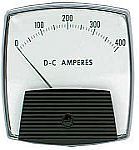
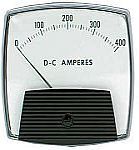
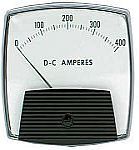
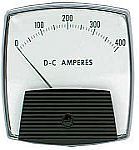
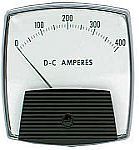
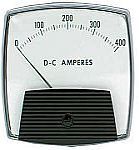
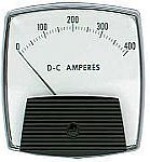
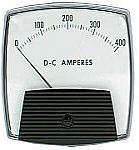
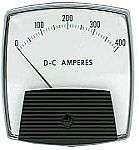
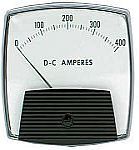
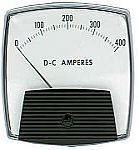
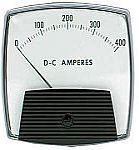
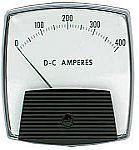
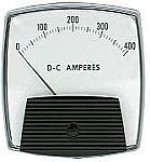
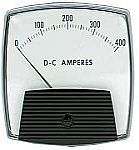
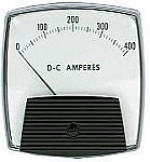
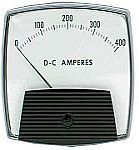
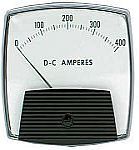
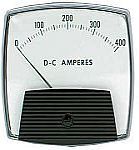
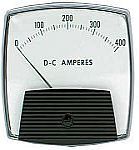
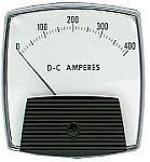
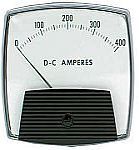
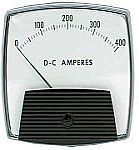
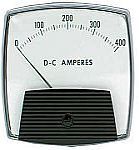
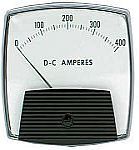
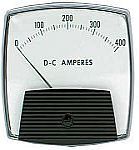
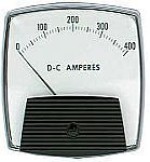
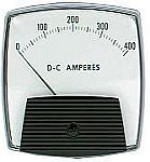
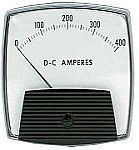
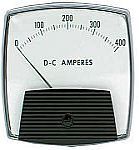
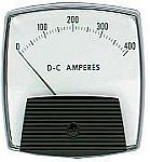
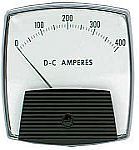
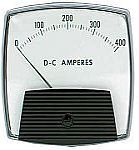
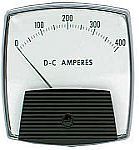
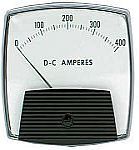
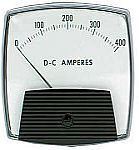
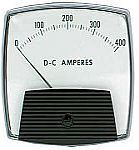
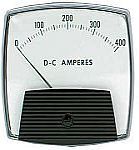
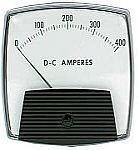
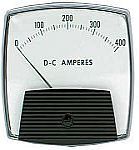
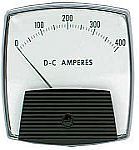
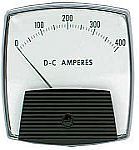
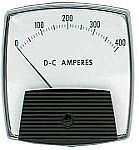
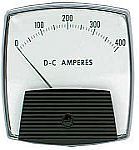
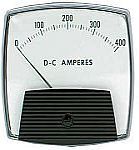
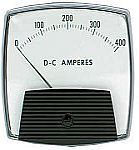
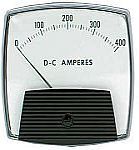
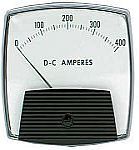
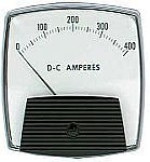
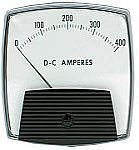
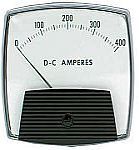
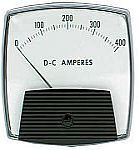
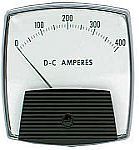
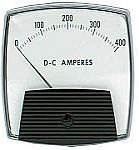
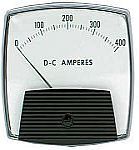
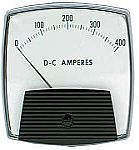
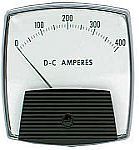
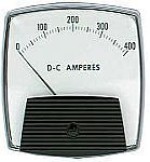
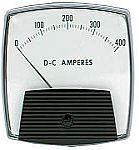
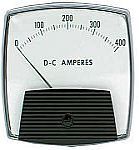
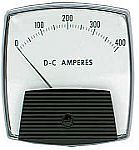
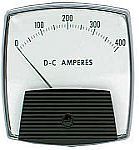
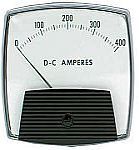
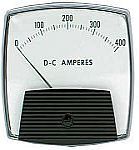
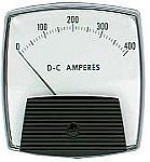
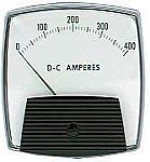
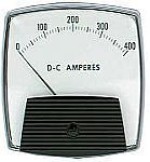
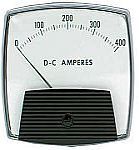
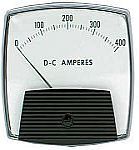
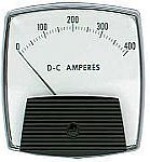
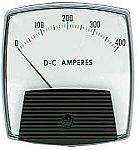
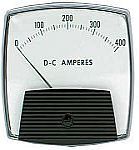
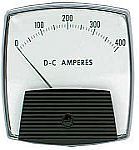
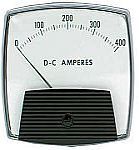
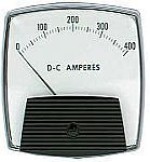
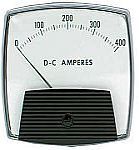
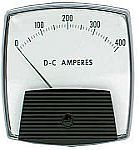
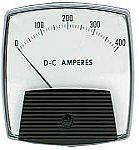
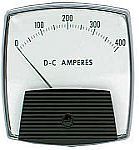
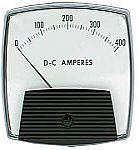
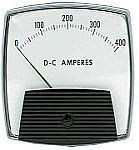
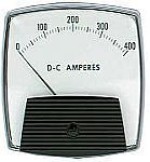
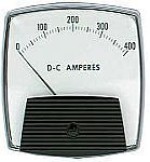
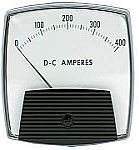
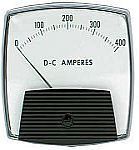
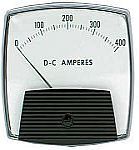
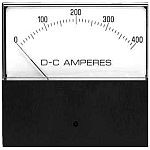
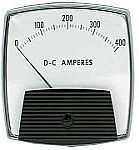
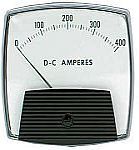
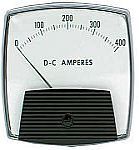
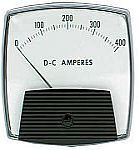
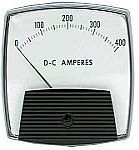
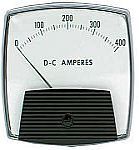
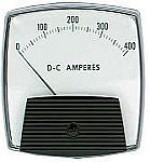
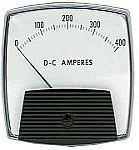
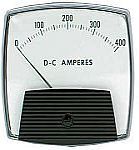
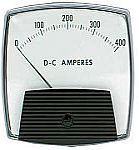
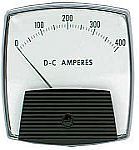
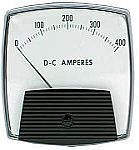
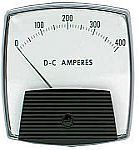
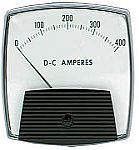
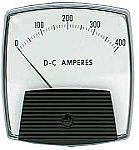
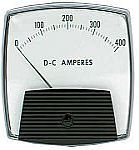
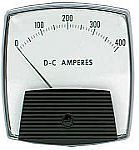
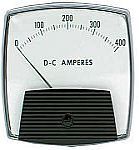
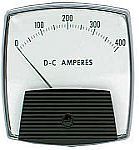
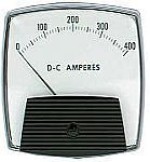
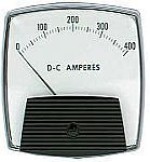
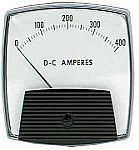
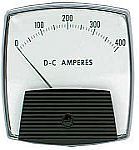
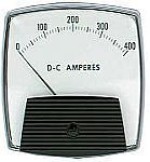
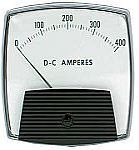
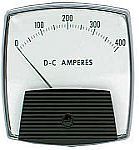
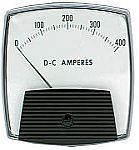
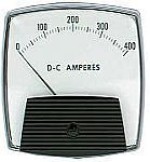
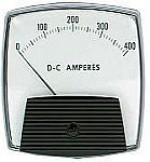
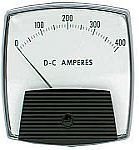
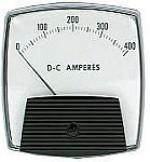
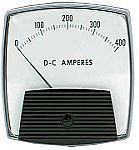
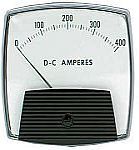
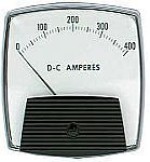
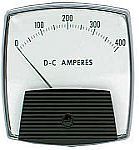
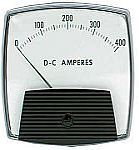
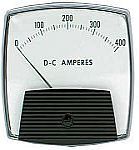
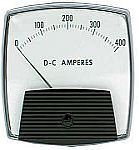
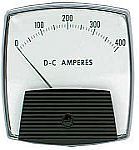
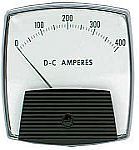
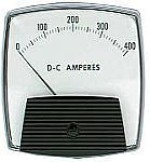
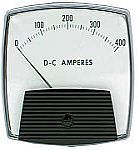
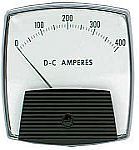
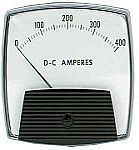
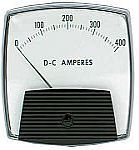
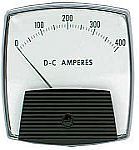
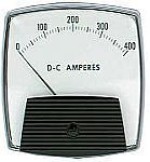
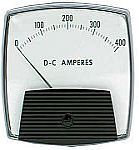
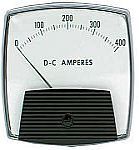
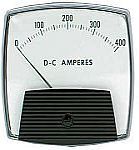
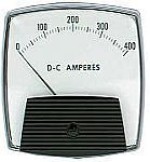
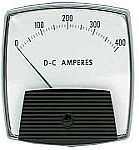
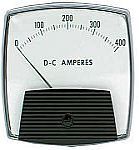
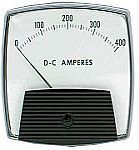
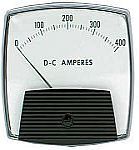
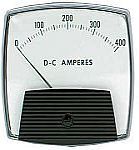
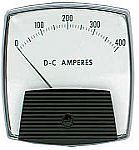
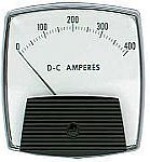
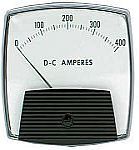
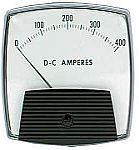
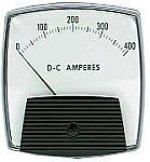
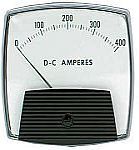
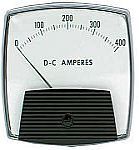
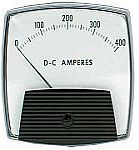
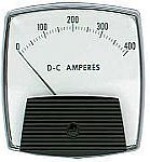
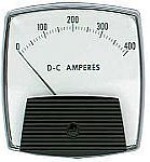
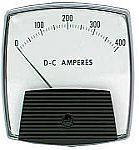
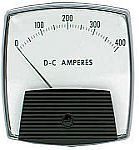
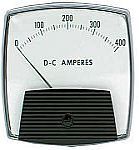
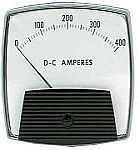
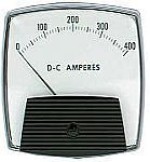
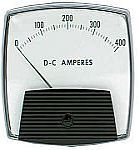
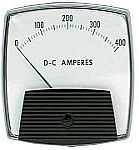
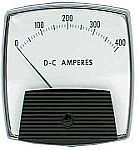
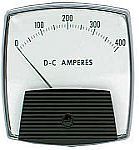
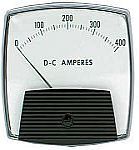
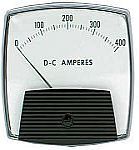
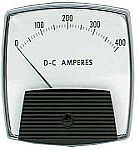
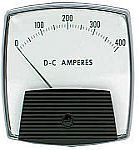
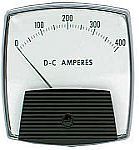
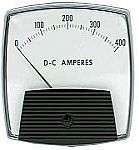
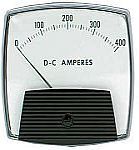
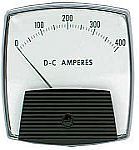
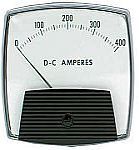
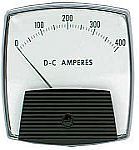
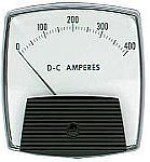
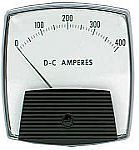
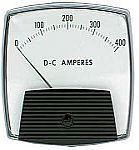
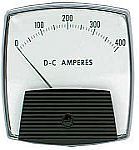
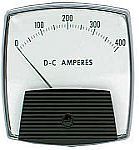
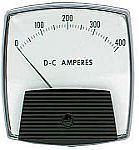
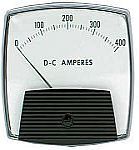
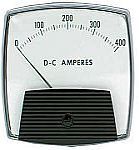
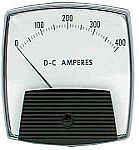
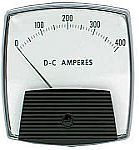
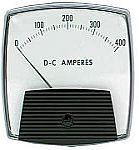
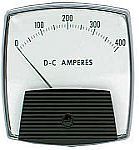
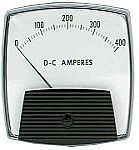
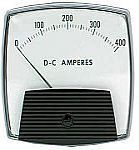
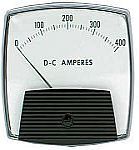
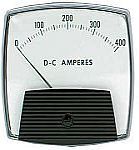
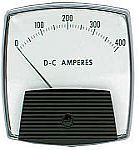
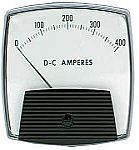
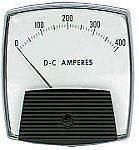
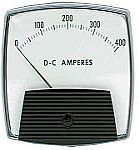
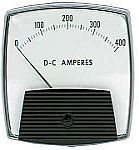
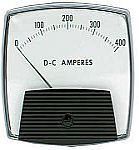
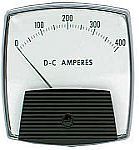
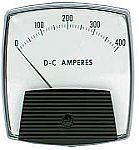
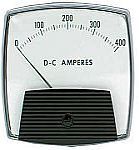
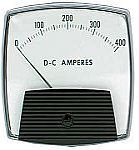
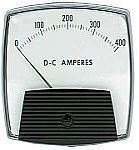
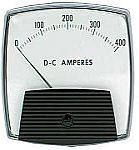
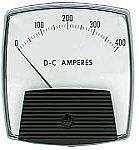
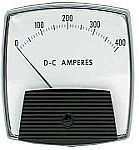
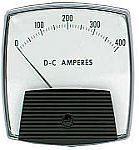
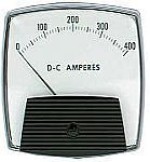
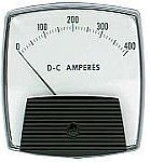
SPECIFICATIONS: Accuracy: All DC and AC iron-vane; +-2% of full-scale AC rectifier type; +-3% of full scale (with 60 Hz sine wave at 25 degrees C). When standard 60 Hz iron vane ammeters are used at the extreme limits of 25 or 400 Hz, additional error (approx. .75%) may be experienced. Expanded-scale voltmeters: +-.5% of full scale value. ANSI Specification: All meters meet ANSI Specifications C-39.1
Overload: Voltmeters (AC and DC) - 50% momentary, 20% sustained. Ammeters (AC and DC) momentary; 10 times the rated current for 10 consecutive intervals of .5 second with a 1 minute interval between successive applications; sustained: 20% for six hours. Scale Data: 90 degree rotation. Scale Length: 1.40in on the 1-1/2in model 2.06in on the 2-1/2in model 2.88in on the 3-1/2in model 3.93in on the 4-1/2in model
Burden Data: AC ammeter-5 amps, 0.5 va, Max. 0.5 power-factor lagging at 60 Hz. AC voltmeter - unity power factor.
Response Time: 3 seconds (max.) for 2-1/2in, 3-1/2in, 4-1/2in size for microammeters; 2 seconds (max.) for all other DC ratings, and 2.5 seconds (max) for AC ratings.
Overshoot: Maximum of 40% overshoot.
Notes: Pivot & jewel instruments are not available in 1-1/2in size. Severe-duty meters are available to meet CSA, UL 1437 and IEC 144 requirements. UL/CUL version, with flame retardant window and base, is not offered in 1-1/2in. IEC version is not offered in 1-1/2in and 4-1/2in. To order, add /CUL, /UL or IEC after catalog number, or contact factory. For ratings and scales not listed contact factory.
Dust Resistant Construction. YOKOGAWA Big Look panel meters, except 1-1/2in, feature gasketed construction to seal out dust and other air-suspended damaging particles. Application is ideal for adverse environments. Special dust resistant features are included on all YOKOGAWA New Big Look meters (except 1-1/2in). For more severe applications, to meet UL-1437 or IEC 144 requirements, other models are also available upon request.
Clean, Readable Case Design Provides Extra Safety: YOKOGAWAs brand New Big Look and Horizon Line panel meters are designed to provide attractive styling, quick, sure readability for any application... and a built in safety feature to help you meet national safety requirements. If you must remove the acrylic cover, you have to remove the instrument itself from the panel in order to reach the special safety screws holding on the cover. Removing the meter prevents shock hazard. This safety feature is standard on all New Big Look and Horizon Line meters.
Gasket Sealing Design Establishes A New Industry Standard: Dust resistant construction is now a standard feature of all New Big Look panel meters 2-1/2in - 4-1/2in only. YOKOGAWAs unique gasket sealing design eliminates the need for a crimped bezel, providing for quick modification and scale changes while maintaining the integrity of the meters.
Taut Band: Taut band is a means of suspending the moving mechanism between two ribbons of metal, obviating the need for pivots, jewels and control springs found in conventional mechanisms. The absence of friction resulting from this permits greater sensitivities and provides more rugged meters. Common failures of conventional meters subjected to shock testing are cracked jewels and/or blunted pivots. Taut band, without pivot and jewels, consequently, will withstand shock in excess of that specified for pivot and jewel meters. For example, ANSI Specifications for panel meters require 50G shock. Taut-band meters will withstand 100G shock.
Pivot and Jewel: In this design the coil and pointer are supported by polished steel pivots at each end which fit into jewel bearings. Pivot and jewel meters are recommended for highvibration environments because of the mechanisms inherent stability and strength. Accuracy and repeatability are almost equal to the taut-bands, and good performance from the pivot and jewel construction is the reason for its long popularity. Dont specify pivot and jewel meters for applications that involve high shock, but do take advantage of this meters ability to withstand vibration.
High-Sensitivity DC Voltmeters: Standard DC voltmeter sensitivity is 1000 ohms/volt. Expressed differently, 1000 ohms/volt sensitivity means that the meter draws approximately one milliamp full-scale current. Occasionally lower current drains are necessary, hence higher sensitivities may be required. The table below compares available sensitivities, maximum self-contained voltages, and approximate full-scale currents. The voltage range could be extended by using external resistors.
Expanded-Scale Voltmeters: For very close monitoring of voltages, Zener diode expanded scale voltmeters are available in 3-1/2- and 4-1/2-inch sizes for AC and DC ratings. Accuracy is +-0.5% of fullscale value. Standard voltage spans are listed in Ratings. Expanded scale voltmeters can be furnished for any mid-span values from 12 to 300 volts. Minimum span is 16% of mid-span value.
Frequency Effect - AC Meters: Iron vane voltmeters are sensitive to frequency and should not be used on frequencies other than design frequency. (Standard voltmeters are calibrated at 60 Hertz. Used at 50 Hertz, accuracy becomes +-2-1/4%. There are also 150- and 300-volt ratings listed which are calibrated at 400 Hertz). For calibrations at frequencies other than 60 and 400 Hertz, refer to factory.
All Iron-vane ammeters (which produce a conventional scale distribution with divisions crowded in lower third of scale) from 10 milliamperes to 50 amperes are virtually unaffected by a change in frequency; e.g., a stock ammeter (calibrated at 60 Hertz) when used at 400 Hertz incurs an additional error of only .5 percent full-scale. If used on 1000 Hertz, the additional error is 4 percent. We recommend use of stock (60 Hertz) ammeters on any frequency in the range of 25 Hertz to 400 Hertz. For calibration at frequencies outside the 25-Hertz to 400-Hertz range, refer to factory or use a rectifier-type AC ammeter.
Rectifier-Type Meters: Rectifier-type meters differ from iron-vane mechanisms in that: They provide a nominally linear (DC) scale rather than conventional iron-vane distribution which has a slight crowding at low end of scale. AC current measurements of microamperes and milliamperes at minimum power consumption are permitted. AC voltmeters of higher sensitivity (ohms/volt) than iron-vane types can be made. Frequency response of rectifier type meters is essentially flat from 20 to 1,000 Hertz (1% effect from reference to 60 Hertz). Rectifier-type meters employ a full-wave rectifier and are available in ratings of 500microA to 30A.
Suppressed-Zero DC Meters: DC meters can be mechanically suppressed up to 20% of end-scale value. However, additional errors are introduced by suppressions (e.g. errors at 20% suppression = +-3% of end-scale). Many process transmitters in use today provide a 4-20mA signal (occasionally 10-50mA or 1-5mA) and require a suppressed-zero meter with operating zero set. These are known as live-zero and are standard.
Higher Accuracy: Standard calibration accuracy is +-2% of full scale. DC meters can be calibrated to +-1% of full scale as a special model in 3-1/2in and 4-1/2in with mirrored scale.
Conduit Mounting Case - 2-1/2-inch New Big Look Meter: Available only for 2-1/2-inch Type 250 panel meters, for indoor or outdoor use, the conduitmounted case provides protection to the meter under severe environmental conditions. The conduit case is both sealed and weatherproof and is pre-drilled, ready for mounting of separately ordered panel meters.
SPECIFICATIONS: Accuracy: All DC and AC iron-vane; +-2% of full-scale AC rectifier type; +-3% of full scale (with 60 Hz sine wave at 25 degrees C). When standard 60 Hz iron vane ammeters are used at the extreme limits of 25 or 400 Hz, additional error (approx. .75%) may be experienced. Expanded-scale voltmeters: +-.5% of full scale value. ANSI Specification: All meters meet ANSI Specifications C-39.1
Overload: Voltmeters (AC and DC) - 50% momentary, 20% sustained. Ammeters (AC and DC) momentary; 10 times the rated current for 10 consecutive intervals of .5 second with a 1 minute interval between successive applications; sustained: 20% for six hours. Scale Data: 90 degree rotation. Scale Length: 1.40in on the 1-1/2in model 2.06in on the 2-1/2in model 2.88in on the 3-1/2in model 3.93in on the 4-1/2in model
Burden Data: AC ammeter-5 amps, 0.5 va, Max. 0.5 power-factor lagging at 60 Hz. AC voltmeter - unity power factor.
Response Time: 3 seconds (max.) for 2-1/2in, 3-1/2in, 4-1/2in size for microammeters; 2 seconds (max.) for all other DC ratings, and 2.5 seconds (max) for AC ratings.
Overshoot: Maximum of 40% overshoot.
Notes: Pivot & jewel instruments are not available in 1-1/2in size. Severe-duty meters are available to meet CSA, UL 1437 and IEC 144 requirements. UL/CUL version, with flame retardant window and base, is not offered in 1-1/2in. IEC version is not offered in 1-1/2in and 4-1/2in. To order, add /CUL, /UL or IEC after catalog number, or contact factory. For ratings and scales not listed contact factory.
Dust Resistant Construction. YOKOGAWA Big Look panel meters, except 1-1/2in, feature gasketed construction to seal out dust and other air-suspended damaging particles. Application is ideal for adverse environments. Special dust resistant features are included on all YOKOGAWA New Big Look meters (except 1-1/2in). For more severe applications, to meet UL-1437 or IEC 144 requirements, other models are also available upon request.
Clean, Readable Case Design Provides Extra Safety: YOKOGAWAs brand New Big Look and Horizon Line panel meters are designed to provide attractive styling, quick, sure readability for any application... and a built in safety feature to help you meet national safety requirements. If you must remove the acrylic cover, you have to remove the instrument itself from the panel in order to reach the special safety screws holding on the cover. Removing the meter prevents shock hazard. This safety feature is standard on all New Big Look and Horizon Line meters.
Gasket Sealing Design Establishes A New Industry Standard: Dust resistant construction is now a standard feature of all New Big Look panel meters 2-1/2in - 4-1/2in only. YOKOGAWAs unique gasket sealing design eliminates the need for a crimped bezel, providing for quick modification and scale changes while maintaining the integrity of the meters.
Taut Band: Taut band is a means of suspending the moving mechanism between two ribbons of metal, obviating the need for pivots, jewels and control springs found in conventional mechanisms. The absence of friction resulting from this permits greater sensitivities and provides more rugged meters. Common failures of conventional meters subjected to shock testing are cracked jewels and/or blunted pivots. Taut band, without pivot and jewels, consequently, will withstand shock in excess of that specified for pivot and jewel meters. For example, ANSI Specifications for panel meters require 50G shock. Taut-band meters will withstand 100G shock.
Pivot and Jewel: In this design the coil and pointer are supported by polished steel pivots at each end which fit into jewel bearings. Pivot and jewel meters are recommended for highvibration environments because of the mechanisms inherent stability and strength. Accuracy and repeatability are almost equal to the taut-bands, and good performance from the pivot and jewel construction is the reason for its long popularity. Dont specify pivot and jewel meters for applications that involve high shock, but do take advantage of this meters ability to withstand vibration.
High-Sensitivity DC Voltmeters: Standard DC voltmeter sensitivity is 1000 ohms/volt. Expressed differently, 1000 ohms/volt sensitivity means that the meter draws approximately one milliamp full-scale current. Occasionally lower current drains are necessary, hence higher sensitivities may be required. The table below compares available sensitivities, maximum self-contained voltages, and approximate full-scale currents. The voltage range could be extended by using external resistors.
Expanded-Scale Voltmeters: For very close monitoring of voltages, Zener diode expanded scale voltmeters are available in 3-1/2- and 4-1/2-inch sizes for AC and DC ratings. Accuracy is +-0.5% of fullscale value. Standard voltage spans are listed in Ratings. Expanded scale voltmeters can be furnished for any mid-span values from 12 to 300 volts. Minimum span is 16% of mid-span value.
Frequency Effect - AC Meters: Iron vane voltmeters are sensitive to frequency and should not be used on frequencies other than design frequency. (Standard voltmeters are calibrated at 60 Hertz. Used at 50 Hertz, accuracy becomes +-2-1/4%. There are also 150- and 300-volt ratings listed which are calibrated at 400 Hertz). For calibrations at frequencies other than 60 and 400 Hertz, refer to factory.
All Iron-vane ammeters (which produce a conventional scale distribution with divisions crowded in lower third of scale) from 10 milliamperes to 50 amperes are virtually unaffected by a change in frequency; e.g., a stock ammeter (calibrated at 60 Hertz) when used at 400 Hertz incurs an additional error of only .5 percent full-scale. If used on 1000 Hertz, the additional error is 4 percent. We recommend use of stock (60 Hertz) ammeters on any frequency in the range of 25 Hertz to 400 Hertz. For calibration at frequencies outside the 25-Hertz to 400-Hertz range, refer to factory or use a rectifier-type AC ammeter.
Rectifier-Type Meters: Rectifier-type meters differ from iron-vane mechanisms in that: They provide a nominally linear (DC) scale rather than conventional iron-vane distribution which has a slight crowding at low end of scale. AC current measurements of microamperes and milliamperes at minimum power consumption are permitted. AC voltmeters of higher sensitivity (ohms/volt) than iron-vane types can be made. Frequency response of rectifier type meters is essentially flat from 20 to 1,000 Hertz (1% effect from reference to 60 Hertz). Rectifier-type meters employ a full-wave rectifier and are available in ratings of 500microA to 30A.
Suppressed-Zero DC Meters: DC meters can be mechanically suppressed up to 20% of end-scale value. However, additional errors are introduced by suppressions (e.g. errors at 20% suppression = +-3% of end-scale). Many process transmitters in use today provide a 4-20mA signal (occasionally 10-50mA or 1-5mA) and require a suppressed-zero meter with operating zero set. These are known as live-zero and are standard.
Higher Accuracy: Standard calibration accuracy is +-2% of full scale. DC meters can be calibrated to +-1% of full scale as a special model in 3-1/2in and 4-1/2in with mirrored scale.
Conduit Mounting Case - 2-1/2-inch New Big Look Meter: Available only for 2-1/2-inch Type 250 panel meters, for indoor or outdoor use, the conduitmounted case provides protection to the meter under severe environmental conditions. The conduit case is both sealed and weatherproof and is pre-drilled, ready for mounting of separately ordered panel meters.
SPECIFICATIONS: Accuracy: All DC and AC iron-vane; +-2% of full-scale AC rectifier type; +-3% of full scale (with 60 Hz sine wave at 25 degrees C). When standard 60 Hz iron vane ammeters are used at the extreme limits of 25 or 400 Hz, additional error (approx. .75%) may be experienced. Expanded-scale voltmeters: +-.5% of full scale value. ANSI Specification: All meters meet ANSI Specifications C-39.1
Overload: Voltmeters (AC and DC) - 50% momentary, 20% sustained. Ammeters (AC and DC) momentary; 10 times the rated current for 10 consecutive intervals of .5 second with a 1 minute interval between successive applications; sustained: 20% for six hours. Scale Data: 90 degree rotation. Scale Length: 1.40in on the 1-1/2in model 2.06in on the 2-1/2in model 2.88in on the 3-1/2in model 3.93in on the 4-1/2in model
Burden Data: AC ammeter-5 amps, 0.5 va, Max. 0.5 power-factor lagging at 60 Hz. AC voltmeter - unity power factor.
Response Time: 3 seconds (max.) for 2-1/2in, 3-1/2in, 4-1/2in size for microammeters; 2 seconds (max.) for all other DC ratings, and 2.5 seconds (max) for AC ratings.
Overshoot: Maximum of 40% overshoot.
Notes: Pivot & jewel instruments are not available in 1-1/2in size. Severe-duty meters are available to meet CSA, UL 1437 and IEC 144 requirements. UL/CUL version, with flame retardant window and base, is not offered in 1-1/2in. IEC version is not offered in 1-1/2in and 4-1/2in. To order, add /CUL, /UL or IEC after catalog number, or contact factory. For ratings and scales not listed contact factory.
Dust Resistant Construction. YOKOGAWA Big Look panel meters, except 1-1/2in, feature gasketed construction to seal out dust and other air-suspended damaging particles. Application is ideal for adverse environments. Special dust resistant features are included on all YOKOGAWA New Big Look meters (except 1-1/2in). For more severe applications, to meet UL-1437 or IEC 144 requirements, other models are also available upon request.
Clean, Readable Case Design Provides Extra Safety: YOKOGAWAs brand New Big Look and Horizon Line panel meters are designed to provide attractive styling, quick, sure readability for any application... and a built in safety feature to help you meet national safety requirements. If you must remove the acrylic cover, you have to remove the instrument itself from the panel in order to reach the special safety screws holding on the cover. Removing the meter prevents shock hazard. This safety feature is standard on all New Big Look and Horizon Line meters.
Gasket Sealing Design Establishes A New Industry Standard: Dust resistant construction is now a standard feature of all New Big Look panel meters 2-1/2in - 4-1/2in only. YOKOGAWAs unique gasket sealing design eliminates the need for a crimped bezel, providing for quick modification and scale changes while maintaining the integrity of the meters.
Taut Band: Taut band is a means of suspending the moving mechanism between two ribbons of metal, obviating the need for pivots, jewels and control springs found in conventional mechanisms. The absence of friction resulting from this permits greater sensitivities and provides more rugged meters. Common failures of conventional meters subjected to shock testing are cracked jewels and/or blunted pivots. Taut band, without pivot and jewels, consequently, will withstand shock in excess of that specified for pivot and jewel meters. For example, ANSI Specifications for panel meters require 50G shock. Taut-band meters will withstand 100G shock.
Pivot and Jewel: In this design the coil and pointer are supported by polished steel pivots at each end which fit into jewel bearings. Pivot and jewel meters are recommended for highvibration environments because of the mechanisms inherent stability and strength. Accuracy and repeatability are almost equal to the taut-bands, and good performance from the pivot and jewel construction is the reason for its long popularity. Dont specify pivot and jewel meters for applications that involve high shock, but do take advantage of this meters ability to withstand vibration.
High-Sensitivity DC Voltmeters: Standard DC voltmeter sensitivity is 1000 ohms/volt. Expressed differently, 1000 ohms/volt sensitivity means that the meter draws approximately one milliamp full-scale current. Occasionally lower current drains are necessary, hence higher sensitivities may be required. The table below compares available sensitivities, maximum self-contained voltages, and approximate full-scale currents. The voltage range could be extended by using external resistors.
Expanded-Scale Voltmeters: For very close monitoring of voltages, Zener diode expanded scale voltmeters are available in 3-1/2- and 4-1/2-inch sizes for AC and DC ratings. Accuracy is +-0.5% of fullscale value. Standard voltage spans are listed in Ratings. Expanded scale voltmeters can be furnished for any mid-span values from 12 to 300 volts. Minimum span is 16% of mid-span value.
Frequency Effect - AC Meters: Iron vane voltmeters are sensitive to frequency and should not be used on frequencies other than design frequency. (Standard voltmeters are calibrated at 60 Hertz. Used at 50 Hertz, accuracy becomes +-2-1/4%. There are also 150- and 300-volt ratings listed which are calibrated at 400 Hertz). For calibrations at frequencies other than 60 and 400 Hertz, refer to factory.
All Iron-vane ammeters (which produce a conventional scale distribution with divisions crowded in lower third of scale) from 10 milliamperes to 50 amperes are virtually unaffected by a change in frequency; e.g., a stock ammeter (calibrated at 60 Hertz) when used at 400 Hertz incurs an additional error of only .5 percent full-scale. If used on 1000 Hertz, the additional error is 4 percent. We recommend use of stock (60 Hertz) ammeters on any frequency in the range of 25 Hertz to 400 Hertz. For calibration at frequencies outside the 25-Hertz to 400-Hertz range, refer to factory or use a rectifier-type AC ammeter.
Rectifier-Type Meters: Rectifier-type meters differ from iron-vane mechanisms in that: They provide a nominally linear (DC) scale rather than conventional iron-vane distribution which has a slight crowding at low end of scale. AC current measurements of microamperes and milliamperes at minimum power consumption are permitted. AC voltmeters of higher sensitivity (ohms/volt) than iron-vane types can be made. Frequency response of rectifier type meters is essentially flat from 20 to 1,000 Hertz (1% effect from reference to 60 Hertz). Rectifier-type meters employ a full-wave rectifier and are available in ratings of 500microA to 30A.
Suppressed-Zero DC Meters: DC meters can be mechanically suppressed up to 20% of end-scale value. However, additional errors are introduced by suppressions (e.g. errors at 20% suppression = +-3% of end-scale). Many process transmitters in use today provide a 4-20mA signal (occasionally 10-50mA or 1-5mA) and require a suppressed-zero meter with operating zero set. These are known as live-zero and are standard.
Higher Accuracy: Standard calibration accuracy is +-2% of full scale. DC meters can be calibrated to +-1% of full scale as a special model in 3-1/2in and 4-1/2in with mirrored scale.
Conduit Mounting Case - 2-1/2-inch New Big Look Meter: Available only for 2-1/2-inch Type 250 panel meters, for indoor or outdoor use, the conduitmounted case provides protection to the meter under severe environmental conditions. The conduit case is both sealed and weatherproof and is pre-drilled, ready for mounting of separately ordered panel meters.
SPECIFICATIONS: Accuracy: All DC and AC iron-vane; +-2% of full-scale AC rectifier type; +-3% of full scale (with 60 Hz sine wave at 25 degrees C). When standard 60 Hz iron vane ammeters are used at the extreme limits of 25 or 400 Hz, additional error (approx. .75%) may be experienced. Expanded-scale voltmeters: +-.5% of full scale value. ANSI Specification: All meters meet ANSI Specifications C-39.1
Overload: Voltmeters (AC and DC) - 50% momentary, 20% sustained. Ammeters (AC and DC) momentary; 10 times the rated current for 10 consecutive intervals of .5 second with a 1 minute interval between successive applications; sustained: 20% for six hours. Scale Data: 90 degree rotation. Scale Length: 1.40in on the 1-1/2in model 2.06in on the 2-1/2in model 2.88in on the 3-1/2in model 3.93in on the 4-1/2in model
Burden Data: AC ammeter-5 amps, 0.5 va, Max. 0.5 power-factor lagging at 60 Hz. AC voltmeter - unity power factor.
Response Time: 3 seconds (max.) for 2-1/2in, 3-1/2in, 4-1/2in size for microammeters; 2 seconds (max.) for all other DC ratings, and 2.5 seconds (max) for AC ratings.
Overshoot: Maximum of 40% overshoot.
Notes: Pivot & jewel instruments are not available in 1-1/2in size. Severe-duty meters are available to meet CSA, UL 1437 and IEC 144 requirements. UL/CUL version, with flame retardant window and base, is not offered in 1-1/2in. IEC version is not offered in 1-1/2in and 4-1/2in. To order, add /CUL, /UL or IEC after catalog number, or contact factory. For ratings and scales not listed contact factory.
Dust Resistant Construction. YOKOGAWA Big Look panel meters, except 1-1/2in, feature gasketed construction to seal out dust and other air-suspended damaging particles. Application is ideal for adverse environments. Special dust resistant features are included on all YOKOGAWA New Big Look meters (except 1-1/2in). For more severe applications, to meet UL-1437 or IEC 144 requirements, other models are also available upon request.
Clean, Readable Case Design Provides Extra Safety: YOKOGAWAs brand New Big Look and Horizon Line panel meters are designed to provide attractive styling, quick, sure readability for any application... and a built in safety feature to help you meet national safety requirements. If you must remove the acrylic cover, you have to remove the instrument itself from the panel in order to reach the special safety screws holding on the cover. Removing the meter prevents shock hazard. This safety feature is standard on all New Big Look and Horizon Line meters.
Gasket Sealing Design Establishes A New Industry Standard: Dust resistant construction is now a standard feature of all New Big Look panel meters 2-1/2in - 4-1/2in only. YOKOGAWAs unique gasket sealing design eliminates the need for a crimped bezel, providing for quick modification and scale changes while maintaining the integrity of the meters.
Taut Band: Taut band is a means of suspending the moving mechanism between two ribbons of metal, obviating the need for pivots, jewels and control springs found in conventional mechanisms. The absence of friction resulting from this permits greater sensitivities and provides more rugged meters. Common failures of conventional meters subjected to shock testing are cracked jewels and/or blunted pivots. Taut band, without pivot and jewels, consequently, will withstand shock in excess of that specified for pivot and jewel meters. For example, ANSI Specifications for panel meters require 50G shock. Taut-band meters will withstand 100G shock.
Pivot and Jewel: In this design the coil and pointer are supported by polished steel pivots at each end which fit into jewel bearings. Pivot and jewel meters are recommended for highvibration environments because of the mechanisms inherent stability and strength. Accuracy and repeatability are almost equal to the taut-bands, and good performance from the pivot and jewel construction is the reason for its long popularity. Dont specify pivot and jewel meters for applications that involve high shock, but do take advantage of this meters ability to withstand vibration.
High-Sensitivity DC Voltmeters: Standard DC voltmeter sensitivity is 1000 ohms/volt. Expressed differently, 1000 ohms/volt sensitivity means that the meter draws approximately one milliamp full-scale current. Occasionally lower current drains are necessary, hence higher sensitivities may be required. The table below compares available sensitivities, maximum self-contained voltages, and approximate full-scale currents. The voltage range could be extended by using external resistors.
Expanded-Scale Voltmeters: For very close monitoring of voltages, Zener diode expanded scale voltmeters are available in 3-1/2- and 4-1/2-inch sizes for AC and DC ratings. Accuracy is +-0.5% of fullscale value. Standard voltage spans are listed in Ratings. Expanded scale voltmeters can be furnished for any mid-span values from 12 to 300 volts. Minimum span is 16% of mid-span value.
Frequency Effect - AC Meters: Iron vane voltmeters are sensitive to frequency and should not be used on frequencies other than design frequency. (Standard voltmeters are calibrated at 60 Hertz. Used at 50 Hertz, accuracy becomes +-2-1/4%. There are also 150- and 300-volt ratings listed which are calibrated at 400 Hertz). For calibrations at frequencies other than 60 and 400 Hertz, refer to factory.
All Iron-vane ammeters (which produce a conventional scale distribution with divisions crowded in lower third of scale) from 10 milliamperes to 50 amperes are virtually unaffected by a change in frequency; e.g., a stock ammeter (calibrated at 60 Hertz) when used at 400 Hertz incurs an additional error of only .5 percent full-scale. If used on 1000 Hertz, the additional error is 4 percent. We recommend use of stock (60 Hertz) ammeters on any frequency in the range of 25 Hertz to 400 Hertz. For calibration at frequencies outside the 25-Hertz to 400-Hertz range, refer to factory or use a rectifier-type AC ammeter.
Rectifier-Type Meters: Rectifier-type meters differ from iron-vane mechanisms in that: They provide a nominally linear (DC) scale rather than conventional iron-vane distribution which has a slight crowding at low end of scale. AC current measurements of microamperes and milliamperes at minimum power consumption are permitted. AC voltmeters of higher sensitivity (ohms/volt) than iron-vane types can be made. Frequency response of rectifier type meters is essentially flat from 20 to 1,000 Hertz (1% effect from reference to 60 Hertz). Rectifier-type meters employ a full-wave rectifier and are available in ratings of 500microA to 30A.
Suppressed-Zero DC Meters: DC meters can be mechanically suppressed up to 20% of end-scale value. However, additional errors are introduced by suppressions (e.g. errors at 20% suppression = +-3% of end-scale). Many process transmitters in use today provide a 4-20mA signal (occasionally 10-50mA or 1-5mA) and require a suppressed-zero meter with operating zero set. These are known as live-zero and are standard.
Higher Accuracy: Standard calibration accuracy is +-2% of full scale. DC meters can be calibrated to +-1% of full scale as a special model in 3-1/2in and 4-1/2in with mirrored scale.
Conduit Mounting Case - 2-1/2-inch New Big Look Meter: Available only for 2-1/2-inch Type 250 panel meters, for indoor or outdoor use, the conduitmounted case provides protection to the meter under severe environmental conditions. The conduit case is both sealed and weatherproof and is pre-drilled, ready for mounting of separately ordered panel meters.
SPECIFICATIONS: Accuracy: All DC and AC iron-vane; +-2% of full-scale AC rectifier type; +-3% of full scale (with 60 Hz sine wave at 25 degrees C). When standard 60 Hz iron vane ammeters are used at the extreme limits of 25 or 400 Hz, additional error (approx. .75%) may be experienced. Expanded-scale voltmeters: +-.5% of full scale value. ANSI Specification: All meters meet ANSI Specifications C-39.1
Overload: Voltmeters (AC and DC) - 50% momentary, 20% sustained. Ammeters (AC and DC) momentary; 10 times the rated current for 10 consecutive intervals of .5 second with a 1 minute interval between successive applications; sustained: 20% for six hours. Scale Data: 90 degree rotation. Scale Length: 1.40in on the 1-1/2in model 2.06in on the 2-1/2in model 2.88in on the 3-1/2in model 3.93in on the 4-1/2in model
Burden Data: AC ammeter-5 amps, 0.5 va, Max. 0.5 power-factor lagging at 60 Hz. AC voltmeter - unity power factor.
Response Time: 3 seconds (max.) for 2-1/2in, 3-1/2in, 4-1/2in size for microammeters; 2 seconds (max.) for all other DC ratings, and 2.5 seconds (max) for AC ratings.
Overshoot: Maximum of 40% overshoot.
Notes: Pivot & jewel instruments are not available in 1-1/2in size. Severe-duty meters are available to meet CSA, UL 1437 and IEC 144 requirements. UL/CUL version, with flame retardant window and base, is not offered in 1-1/2in. IEC version is not offered in 1-1/2in and 4-1/2in. To order, add /CUL, /UL or IEC after catalog number, or contact factory. For ratings and scales not listed contact factory.
Dust Resistant Construction. YOKOGAWA Big Look panel meters, except 1-1/2in, feature gasketed construction to seal out dust and other air-suspended damaging particles. Application is ideal for adverse environments. Special dust resistant features are included on all YOKOGAWA New Big Look meters (except 1-1/2in). For more severe applications, to meet UL-1437 or IEC 144 requirements, other models are also available upon request.
Clean, Readable Case Design Provides Extra Safety: YOKOGAWAs brand New Big Look and Horizon Line panel meters are designed to provide attractive styling, quick, sure readability for any application... and a built in safety feature to help you meet national safety requirements. If you must remove the acrylic cover, you have to remove the instrument itself from the panel in order to reach the special safety screws holding on the cover. Removing the meter prevents shock hazard. This safety feature is standard on all New Big Look and Horizon Line meters.
Gasket Sealing Design Establishes A New Industry Standard: Dust resistant construction is now a standard feature of all New Big Look panel meters 2-1/2in - 4-1/2in only. YOKOGAWAs unique gasket sealing design eliminates the need for a crimped bezel, providing for quick modification and scale changes while maintaining the integrity of the meters.
Taut Band: Taut band is a means of suspending the moving mechanism between two ribbons of metal, obviating the need for pivots, jewels and control springs found in conventional mechanisms. The absence of friction resulting from this permits greater sensitivities and provides more rugged meters. Common failures of conventional meters subjected to shock testing are cracked jewels and/or blunted pivots. Taut band, without pivot and jewels, consequently, will withstand shock in excess of that specified for pivot and jewel meters. For example, ANSI Specifications for panel meters require 50G shock. Taut-band meters will withstand 100G shock.
Pivot and Jewel: In this design the coil and pointer are supported by polished steel pivots at each end which fit into jewel bearings. Pivot and jewel meters are recommended for highvibration environments because of the mechanisms inherent stability and strength. Accuracy and repeatability are almost equal to the taut-bands, and good performance from the pivot and jewel construction is the reason for its long popularity. Dont specify pivot and jewel meters for applications that involve high shock, but do take advantage of this meters ability to withstand vibration.
High-Sensitivity DC Voltmeters: Standard DC voltmeter sensitivity is 1000 ohms/volt. Expressed differently, 1000 ohms/volt sensitivity means that the meter draws approximately one milliamp full-scale current. Occasionally lower current drains are necessary, hence higher sensitivities may be required. The table below compares available sensitivities, maximum self-contained voltages, and approximate full-scale currents. The voltage range could be extended by using external resistors.
Expanded-Scale Voltmeters: For very close monitoring of voltages, Zener diode expanded scale voltmeters are available in 3-1/2- and 4-1/2-inch sizes for AC and DC ratings. Accuracy is +-0.5% of fullscale value. Standard voltage spans are listed in Ratings. Expanded scale voltmeters can be furnished for any mid-span values from 12 to 300 volts. Minimum span is 16% of mid-span value.
Frequency Effect - AC Meters: Iron vane voltmeters are sensitive to frequency and should not be used on frequencies other than design frequency. (Standard voltmeters are calibrated at 60 Hertz. Used at 50 Hertz, accuracy becomes +-2-1/4%. There are also 150- and 300-volt ratings listed which are calibrated at 400 Hertz). For calibrations at frequencies other than 60 and 400 Hertz, refer to factory.
All Iron-vane ammeters (which produce a conventional scale distribution with divisions crowded in lower third of scale) from 10 milliamperes to 50 amperes are virtually unaffected by a change in frequency; e.g., a stock ammeter (calibrated at 60 Hertz) when used at 400 Hertz incurs an additional error of only .5 percent full-scale. If used on 1000 Hertz, the additional error is 4 percent. We recommend use of stock (60 Hertz) ammeters on any frequency in the range of 25 Hertz to 400 Hertz. For calibration at frequencies outside the 25-Hertz to 400-Hertz range, refer to factory or use a rectifier-type AC ammeter.
Rectifier-Type Meters: Rectifier-type meters differ from iron-vane mechanisms in that: They provide a nominally linear (DC) scale rather than conventional iron-vane distribution which has a slight crowding at low end of scale. AC current measurements of microamperes and milliamperes at minimum power consumption are permitted. AC voltmeters of higher sensitivity (ohms/volt) than iron-vane types can be made. Frequency response of rectifier type meters is essentially flat from 20 to 1,000 Hertz (1% effect from reference to 60 Hertz). Rectifier-type meters employ a full-wave rectifier and are available in ratings of 500microA to 30A.
Suppressed-Zero DC Meters: DC meters can be mechanically suppressed up to 20% of end-scale value. However, additional errors are introduced by suppressions (e.g. errors at 20% suppression = +-3% of end-scale). Many process transmitters in use today provide a 4-20mA signal (occasionally 10-50mA or 1-5mA) and require a suppressed-zero meter with operating zero set. These are known as live-zero and are standard.
Higher Accuracy: Standard calibration accuracy is +-2% of full scale. DC meters can be calibrated to +-1% of full scale as a special model in 3-1/2in and 4-1/2in with mirrored scale.
Conduit Mounting Case - 2-1/2-inch New Big Look Meter: Available only for 2-1/2-inch Type 250 panel meters, for indoor or outdoor use, the conduitmounted case provides protection to the meter under severe environmental conditions. The conduit case is both sealed and weatherproof and is pre-drilled, ready for mounting of separately ordered panel meters.
SPECIFICATIONS: Accuracy: All DC and AC iron-vane; +-2% of full-scale AC rectifier type; +-3% of full scale (with 60 Hz sine wave at 25 degrees C). When standard 60 Hz iron vane ammeters are used at the extreme limits of 25 or 400 Hz, additional error (approx. .75%) may be experienced. Expanded-scale voltmeters: +-.5% of full scale value. ANSI Specification: All meters meet ANSI Specifications C-39.1
Overload: Voltmeters (AC and DC) - 50% momentary, 20% sustained. Ammeters (AC and DC) momentary; 10 times the rated current for 10 consecutive intervals of .5 second with a 1 minute interval between successive applications; sustained: 20% for six hours. Scale Data: 90 degree rotation. Scale Length: 1.40in on the 1-1/2in model 2.06in on the 2-1/2in model 2.88in on the 3-1/2in model 3.93in on the 4-1/2in model
Burden Data: AC ammeter-5 amps, 0.5 va, Max. 0.5 power-factor lagging at 60 Hz. AC voltmeter - unity power factor.
Response Time: 3 seconds (max.) for 2-1/2in, 3-1/2in, 4-1/2in size for microammeters; 2 seconds (max.) for all other DC ratings, and 2.5 seconds (max) for AC ratings.
Overshoot: Maximum of 40% overshoot.
Notes: Pivot & jewel instruments are not available in 1-1/2in size. Severe-duty meters are available to meet CSA, UL 1437 and IEC 144 requirements. UL/CUL version, with flame retardant window and base, is not offered in 1-1/2in. IEC version is not offered in 1-1/2in and 4-1/2in. To order, add /CUL, /UL or IEC after catalog number, or contact factory. For ratings and scales not listed contact factory.
Dust Resistant Construction. YOKOGAWA Big Look panel meters, except 1-1/2in, feature gasketed construction to seal out dust and other air-suspended damaging particles. Application is ideal for adverse environments. Special dust resistant features are included on all YOKOGAWA New Big Look meters (except 1-1/2in). For more severe applications, to meet UL-1437 or IEC 144 requirements, other models are also available upon request.
Clean, Readable Case Design Provides Extra Safety: YOKOGAWAs brand New Big Look and Horizon Line panel meters are designed to provide attractive styling, quick, sure readability for any application... and a built in safety feature to help you meet national safety requirements. If you must remove the acrylic cover, you have to remove the instrument itself from the panel in order to reach the special safety screws holding on the cover. Removing the meter prevents shock hazard. This safety feature is standard on all New Big Look and Horizon Line meters.
Gasket Sealing Design Establishes A New Industry Standard: Dust resistant construction is now a standard feature of all New Big Look panel meters 2-1/2in - 4-1/2in only. YOKOGAWAs unique gasket sealing design eliminates the need for a crimped bezel, providing for quick modification and scale changes while maintaining the integrity of the meters.
Taut Band: Taut band is a means of suspending the moving mechanism between two ribbons of metal, obviating the need for pivots, jewels and control springs found in conventional mechanisms. The absence of friction resulting from this permits greater sensitivities and provides more rugged meters. Common failures of conventional meters subjected to shock testing are cracked jewels and/or blunted pivots. Taut band, without pivot and jewels, consequently, will withstand shock in excess of that specified for pivot and jewel meters. For example, ANSI Specifications for panel meters require 50G shock. Taut-band meters will withstand 100G shock.
Pivot and Jewel: In this design the coil and pointer are supported by polished steel pivots at each end which fit into jewel bearings. Pivot and jewel meters are recommended for highvibration environments because of the mechanisms inherent stability and strength. Accuracy and repeatability are almost equal to the taut-bands, and good performance from the pivot and jewel construction is the reason for its long popularity. Dont specify pivot and jewel meters for applications that involve high shock, but do take advantage of this meters ability to withstand vibration.
High-Sensitivity DC Voltmeters: Standard DC voltmeter sensitivity is 1000 ohms/volt. Expressed differently, 1000 ohms/volt sensitivity means that the meter draws approximately one milliamp full-scale current. Occasionally lower current drains are necessary, hence higher sensitivities may be required. The table below compares available sensitivities, maximum self-contained voltages, and approximate full-scale currents. The voltage range could be extended by using external resistors.
Expanded-Scale Voltmeters: For very close monitoring of voltages, Zener diode expanded scale voltmeters are available in 3-1/2- and 4-1/2-inch sizes for AC and DC ratings. Accuracy is +-0.5% of fullscale value. Standard voltage spans are listed in Ratings. Expanded scale voltmeters can be furnished for any mid-span values from 12 to 300 volts. Minimum span is 16% of mid-span value.
Frequency Effect - AC Meters: Iron vane voltmeters are sensitive to frequency and should not be used on frequencies other than design frequency. (Standard voltmeters are calibrated at 60 Hertz. Used at 50 Hertz, accuracy becomes +-2-1/4%. There are also 150- and 300-volt ratings listed which are calibrated at 400 Hertz). For calibrations at frequencies other than 60 and 400 Hertz, refer to factory.
All Iron-vane ammeters (which produce a conventional scale distribution with divisions crowded in lower third of scale) from 10 milliamperes to 50 amperes are virtually unaffected by a change in frequency; e.g., a stock ammeter (calibrated at 60 Hertz) when used at 400 Hertz incurs an additional error of only .5 percent full-scale. If used on 1000 Hertz, the additional error is 4 percent. We recommend use of stock (60 Hertz) ammeters on any frequency in the range of 25 Hertz to 400 Hertz. For calibration at frequencies outside the 25-Hertz to 400-Hertz range, refer to factory or use a rectifier-type AC ammeter.
Rectifier-Type Meters: Rectifier-type meters differ from iron-vane mechanisms in that: They provide a nominally linear (DC) scale rather than conventional iron-vane distribution which has a slight crowding at low end of scale. AC current measurements of microamperes and milliamperes at minimum power consumption are permitted. AC voltmeters of higher sensitivity (ohms/volt) than iron-vane types can be made. Frequency response of rectifier type meters is essentially flat from 20 to 1,000 Hertz (1% effect from reference to 60 Hertz). Rectifier-type meters employ a full-wave rectifier and are available in ratings of 500microA to 30A.
Suppressed-Zero DC Meters: DC meters can be mechanically suppressed up to 20% of end-scale value. However, additional errors are introduced by suppressions (e.g. errors at 20% suppression = +-3% of end-scale). Many process transmitters in use today provide a 4-20mA signal (occasionally 10-50mA or 1-5mA) and require a suppressed-zero meter with operating zero set. These are known as live-zero and are standard.
Higher Accuracy: Standard calibration accuracy is +-2% of full scale. DC meters can be calibrated to +-1% of full scale as a special model in 3-1/2in and 4-1/2in with mirrored scale.
Conduit Mounting Case - 2-1/2-inch New Big Look Meter: Available only for 2-1/2-inch Type 250 panel meters, for indoor or outdoor use, the conduitmounted case provides protection to the meter under severe environmental conditions. The conduit case is both sealed and weatherproof and is pre-drilled, ready for mounting of separately ordered panel meters.
SPECIFICATIONS: Accuracy: All DC and AC iron-vane; +-2% of full-scale AC rectifier type; +-3% of full scale (with 60 Hz sine wave at 25 degrees C). When standard 60 Hz iron vane ammeters are used at the extreme limits of 25 or 400 Hz, additional error (approx. .75%) may be experienced. Expanded-scale voltmeters: +-.5% of full scale value. ANSI Specification: All meters meet ANSI Specifications C-39.1
Overload: Voltmeters (AC and DC) - 50% momentary, 20% sustained. Ammeters (AC and DC) momentary; 10 times the rated current for 10 consecutive intervals of .5 second with a 1 minute interval between successive applications; sustained: 20% for six hours. Scale Data: 90 degree rotation. Scale Length: 1.40in on the 1-1/2in model 2.06in on the 2-1/2in model 2.88in on the 3-1/2in model 3.93in on the 4-1/2in model
Burden Data: AC ammeter-5 amps, 0.5 va, Max. 0.5 power-factor lagging at 60 Hz. AC voltmeter - unity power factor.
Response Time: 3 seconds (max.) for 2-1/2in, 3-1/2in, 4-1/2in size for microammeters; 2 seconds (max.) for all other DC ratings, and 2.5 seconds (max) for AC ratings.
Overshoot: Maximum of 40% overshoot.
Notes: Pivot & jewel instruments are not available in 1-1/2in size. Severe-duty meters are available to meet CSA, UL 1437 and IEC 144 requirements. UL/CUL version, with flame retardant window and base, is not offered in 1-1/2in. IEC version is not offered in 1-1/2in and 4-1/2in. To order, add /CUL, /UL or IEC after catalog number, or contact factory. For ratings and scales not listed contact factory.
Dust Resistant Construction. YOKOGAWA Big Look panel meters, except 1-1/2in, feature gasketed construction to seal out dust and other air-suspended damaging particles. Application is ideal for adverse environments. Special dust resistant features are included on all YOKOGAWA New Big Look meters (except 1-1/2in). For more severe applications, to meet UL-1437 or IEC 144 requirements, other models are also available upon request.
Clean, Readable Case Design Provides Extra Safety: YOKOGAWAs brand New Big Look and Horizon Line panel meters are designed to provide attractive styling, quick, sure readability for any application... and a built in safety feature to help you meet national safety requirements. If you must remove the acrylic cover, you have to remove the instrument itself from the panel in order to reach the special safety screws holding on the cover. Removing the meter prevents shock hazard. This safety feature is standard on all New Big Look and Horizon Line meters.
Gasket Sealing Design Establishes A New Industry Standard: Dust resistant construction is now a standard feature of all New Big Look panel meters 2-1/2in - 4-1/2in only. YOKOGAWAs unique gasket sealing design eliminates the need for a crimped bezel, providing for quick modification and scale changes while maintaining the integrity of the meters.
Taut Band: Taut band is a means of suspending the moving mechanism between two ribbons of metal, obviating the need for pivots, jewels and control springs found in conventional mechanisms. The absence of friction resulting from this permits greater sensitivities and provides more rugged meters. Common failures of conventional meters subjected to shock testing are cracked jewels and/or blunted pivots. Taut band, without pivot and jewels, consequently, will withstand shock in excess of that specified for pivot and jewel meters. For example, ANSI Specifications for panel meters require 50G shock. Taut-band meters will withstand 100G shock.
Pivot and Jewel: In this design the coil and pointer are supported by polished steel pivots at each end which fit into jewel bearings. Pivot and jewel meters are recommended for highvibration environments because of the mechanisms inherent stability and strength. Accuracy and repeatability are almost equal to the taut-bands, and good performance from the pivot and jewel construction is the reason for its long popularity. Dont specify pivot and jewel meters for applications that involve high shock, but do take advantage of this meters ability to withstand vibration.
High-Sensitivity DC Voltmeters: Standard DC voltmeter sensitivity is 1000 ohms/volt. Expressed differently, 1000 ohms/volt sensitivity means that the meter draws approximately one milliamp full-scale current. Occasionally lower current drains are necessary, hence higher sensitivities may be required. The table below compares available sensitivities, maximum self-contained voltages, and approximate full-scale currents. The voltage range could be extended by using external resistors.
Expanded-Scale Voltmeters: For very close monitoring of voltages, Zener diode expanded scale voltmeters are available in 3-1/2- and 4-1/2-inch sizes for AC and DC ratings. Accuracy is +-0.5% of fullscale value. Standard voltage spans are listed in Ratings. Expanded scale voltmeters can be furnished for any mid-span values from 12 to 300 volts. Minimum span is 16% of mid-span value.
Frequency Effect - AC Meters: Iron vane voltmeters are sensitive to frequency and should not be used on frequencies other than design frequency. (Standard voltmeters are calibrated at 60 Hertz. Used at 50 Hertz, accuracy becomes +-2-1/4%. There are also 150- and 300-volt ratings listed which are calibrated at 400 Hertz). For calibrations at frequencies other than 60 and 400 Hertz, refer to factory.
All Iron-vane ammeters (which produce a conventional scale distribution with divisions crowded in lower third of scale) from 10 milliamperes to 50 amperes are virtually unaffected by a change in frequency; e.g., a stock ammeter (calibrated at 60 Hertz) when used at 400 Hertz incurs an additional error of only .5 percent full-scale. If used on 1000 Hertz, the additional error is 4 percent. We recommend use of stock (60 Hertz) ammeters on any frequency in the range of 25 Hertz to 400 Hertz. For calibration at frequencies outside the 25-Hertz to 400-Hertz range, refer to factory or use a rectifier-type AC ammeter.
Rectifier-Type Meters: Rectifier-type meters differ from iron-vane mechanisms in that: They provide a nominally linear (DC) scale rather than conventional iron-vane distribution which has a slight crowding at low end of scale. AC current measurements of microamperes and milliamperes at minimum power consumption are permitted. AC voltmeters of higher sensitivity (ohms/volt) than iron-vane types can be made. Frequency response of rectifier type meters is essentially flat from 20 to 1,000 Hertz (1% effect from reference to 60 Hertz). Rectifier-type meters employ a full-wave rectifier and are available in ratings of 500microA to 30A.
Suppressed-Zero DC Meters: DC meters can be mechanically suppressed up to 20% of end-scale value. However, additional errors are introduced by suppressions (e.g. errors at 20% suppression = +-3% of end-scale). Many process transmitters in use today provide a 4-20mA signal (occasionally 10-50mA or 1-5mA) and require a suppressed-zero meter with operating zero set. These are known as live-zero and are standard.
Higher Accuracy: Standard calibration accuracy is +-2% of full scale. DC meters can be calibrated to +-1% of full scale as a special model in 3-1/2in and 4-1/2in with mirrored scale.
Conduit Mounting Case - 2-1/2-inch New Big Look Meter: Available only for 2-1/2-inch Type 250 panel meters, for indoor or outdoor use, the conduitmounted case provides protection to the meter under severe environmental conditions. The conduit case is both sealed and weatherproof and is pre-drilled, ready for mounting of separately ordered panel meters.
SPECIFICATIONS: Accuracy: All DC and AC iron-vane; +-2% of full-scale AC rectifier type; +-3% of full scale (with 60 Hz sine wave at 25 degrees C). When standard 60 Hz iron vane ammeters are used at the extreme limits of 25 or 400 Hz, additional error (approx. .75%) may be experienced. Expanded-scale voltmeters: +-.5% of full scale value. ANSI Specification: All meters meet ANSI Specifications C-39.1
Overload: Voltmeters (AC and DC) - 50% momentary, 20% sustained. Ammeters (AC and DC) momentary; 10 times the rated current for 10 consecutive intervals of .5 second with a 1 minute interval between successive applications; sustained: 20% for six hours. Scale Data: 90 degree rotation. Scale Length: 1.40in on the 1-1/2in model 2.06in on the 2-1/2in model 2.88in on the 3-1/2in model 3.93in on the 4-1/2in model
Burden Data: AC ammeter-5 amps, 0.5 va, Max. 0.5 power-factor lagging at 60 Hz. AC voltmeter - unity power factor.
Response Time: 3 seconds (max.) for 2-1/2in, 3-1/2in, 4-1/2in size for microammeters; 2 seconds (max.) for all other DC ratings, and 2.5 seconds (max) for AC ratings.
Overshoot: Maximum of 40% overshoot.
Notes: Pivot & jewel instruments are not available in 1-1/2in size. Severe-duty meters are available to meet CSA, UL 1437 and IEC 144 requirements. UL/CUL version, with flame retardant window and base, is not offered in 1-1/2in. IEC version is not offered in 1-1/2in and 4-1/2in. To order, add /CUL, /UL or IEC after catalog number, or contact factory. For ratings and scales not listed contact factory.
Dust Resistant Construction. YOKOGAWA Big Look panel meters, except 1-1/2in, feature gasketed construction to seal out dust and other air-suspended damaging particles. Application is ideal for adverse environments. Special dust resistant features are included on all YOKOGAWA New Big Look meters (except 1-1/2in). For more severe applications, to meet UL-1437 or IEC 144 requirements, other models are also available upon request.
Clean, Readable Case Design Provides Extra Safety: YOKOGAWAs brand New Big Look and Horizon Line panel meters are designed to provide attractive styling, quick, sure readability for any application... and a built in safety feature to help you meet national safety requirements. If you must remove the acrylic cover, you have to remove the instrument itself from the panel in order to reach the special safety screws holding on the cover. Removing the meter prevents shock hazard. This safety feature is standard on all New Big Look and Horizon Line meters.
Gasket Sealing Design Establishes A New Industry Standard: Dust resistant construction is now a standard feature of all New Big Look panel meters 2-1/2in - 4-1/2in only. YOKOGAWAs unique gasket sealing design eliminates the need for a crimped bezel, providing for quick modification and scale changes while maintaining the integrity of the meters.
Taut Band: Taut band is a means of suspending the moving mechanism between two ribbons of metal, obviating the need for pivots, jewels and control springs found in conventional mechanisms. The absence of friction resulting from this permits greater sensitivities and provides more rugged meters. Common failures of conventional meters subjected to shock testing are cracked jewels and/or blunted pivots. Taut band, without pivot and jewels, consequently, will withstand shock in excess of that specified for pivot and jewel meters. For example, ANSI Specifications for panel meters require 50G shock. Taut-band meters will withstand 100G shock.
Pivot and Jewel: In this design the coil and pointer are supported by polished steel pivots at each end which fit into jewel bearings. Pivot and jewel meters are recommended for highvibration environments because of the mechanisms inherent stability and strength. Accuracy and repeatability are almost equal to the taut-bands, and good performance from the pivot and jewel construction is the reason for its long popularity. Dont specify pivot and jewel meters for applications that involve high shock, but do take advantage of this meters ability to withstand vibration.
High-Sensitivity DC Voltmeters: Standard DC voltmeter sensitivity is 1000 ohms/volt. Expressed differently, 1000 ohms/volt sensitivity means that the meter draws approximately one milliamp full-scale current. Occasionally lower current drains are necessary, hence higher sensitivities may be required. The table below compares available sensitivities, maximum self-contained voltages, and approximate full-scale currents. The voltage range could be extended by using external resistors.
Expanded-Scale Voltmeters: For very close monitoring of voltages, Zener diode expanded scale voltmeters are available in 3-1/2- and 4-1/2-inch sizes for AC and DC ratings. Accuracy is +-0.5% of fullscale value. Standard voltage spans are listed in Ratings. Expanded scale voltmeters can be furnished for any mid-span values from 12 to 300 volts. Minimum span is 16% of mid-span value.
Frequency Effect - AC Meters: Iron vane voltmeters are sensitive to frequency and should not be used on frequencies other than design frequency. (Standard voltmeters are calibrated at 60 Hertz. Used at 50 Hertz, accuracy becomes +-2-1/4%. There are also 150- and 300-volt ratings listed which are calibrated at 400 Hertz). For calibrations at frequencies other than 60 and 400 Hertz, refer to factory.
All Iron-vane ammeters (which produce a conventional scale distribution with divisions crowded in lower third of scale) from 10 milliamperes to 50 amperes are virtually unaffected by a change in frequency; e.g., a stock ammeter (calibrated at 60 Hertz) when used at 400 Hertz incurs an additional error of only .5 percent full-scale. If used on 1000 Hertz, the additional error is 4 percent. We recommend use of stock (60 Hertz) ammeters on any frequency in the range of 25 Hertz to 400 Hertz. For calibration at frequencies outside the 25-Hertz to 400-Hertz range, refer to factory or use a rectifier-type AC ammeter.
Rectifier-Type Meters: Rectifier-type meters differ from iron-vane mechanisms in that: They provide a nominally linear (DC) scale rather than conventional iron-vane distribution which has a slight crowding at low end of scale. AC current measurements of microamperes and milliamperes at minimum power consumption are permitted. AC voltmeters of higher sensitivity (ohms/volt) than iron-vane types can be made. Frequency response of rectifier type meters is essentially flat from 20 to 1,000 Hertz (1% effect from reference to 60 Hertz). Rectifier-type meters employ a full-wave rectifier and are available in ratings of 500microA to 30A.
Suppressed-Zero DC Meters: DC meters can be mechanically suppressed up to 20% of end-scale value. However, additional errors are introduced by suppressions (e.g. errors at 20% suppression = +-3% of end-scale). Many process transmitters in use today provide a 4-20mA signal (occasionally 10-50mA or 1-5mA) and require a suppressed-zero meter with operating zero set. These are known as live-zero and are standard.
Higher Accuracy: Standard calibration accuracy is +-2% of full scale. DC meters can be calibrated to +-1% of full scale as a special model in 3-1/2in and 4-1/2in with mirrored scale.
Conduit Mounting Case - 2-1/2-inch New Big Look Meter: Available only for 2-1/2-inch Type 250 panel meters, for indoor or outdoor use, the conduitmounted case provides protection to the meter under severe environmental conditions. The conduit case is both sealed and weatherproof and is pre-drilled, ready for mounting of separately ordered panel meters.
SPECIFICATIONS: Accuracy: All DC and AC iron-vane; +-2% of full-scale AC rectifier type; +-3% of full scale (with 60 Hz sine wave at 25 degrees C). When standard 60 Hz iron vane ammeters are used at the extreme limits of 25 or 400 Hz, additional error (approx. .75%) may be experienced. Expanded-scale voltmeters: +-.5% of full scale value. ANSI Specification: All meters meet ANSI Specifications C-39.1
Overload: Voltmeters (AC and DC) - 50% momentary, 20% sustained. Ammeters (AC and DC) momentary; 10 times the rated current for 10 consecutive intervals of .5 second with a 1 minute interval between successive applications; sustained: 20% for six hours. Scale Data: 90 degree rotation. Scale Length: 1.40in on the 1-1/2in model 2.06in on the 2-1/2in model 2.88in on the 3-1/2in model 3.93in on the 4-1/2in model
Burden Data: AC ammeter-5 amps, 0.5 va, Max. 0.5 power-factor lagging at 60 Hz. AC voltmeter - unity power factor.
Response Time: 3 seconds (max.) for 2-1/2in, 3-1/2in, 4-1/2in size for microammeters; 2 seconds (max.) for all other DC ratings, and 2.5 seconds (max) for AC ratings.
Overshoot: Maximum of 40% overshoot.
Notes: Pivot & jewel instruments are not available in 1-1/2in size. Severe-duty meters are available to meet CSA, UL 1437 and IEC 144 requirements. UL/CUL version, with flame retardant window and base, is not offered in 1-1/2in. IEC version is not offered in 1-1/2in and 4-1/2in. To order, add /CUL, /UL or IEC after catalog number, or contact factory. For ratings and scales not listed contact factory.
Dust Resistant Construction. YOKOGAWA Big Look panel meters, except 1-1/2in, feature gasketed construction to seal out dust and other air-suspended damaging particles. Application is ideal for adverse environments. Special dust resistant features are included on all YOKOGAWA New Big Look meters (except 1-1/2in). For more severe applications, to meet UL-1437 or IEC 144 requirements, other models are also available upon request.
Clean, Readable Case Design Provides Extra Safety: YOKOGAWAs brand New Big Look and Horizon Line panel meters are designed to provide attractive styling, quick, sure readability for any application... and a built in safety feature to help you meet national safety requirements. If you must remove the acrylic cover, you have to remove the instrument itself from the panel in order to reach the special safety screws holding on the cover. Removing the meter prevents shock hazard. This safety feature is standard on all New Big Look and Horizon Line meters.
Gasket Sealing Design Establishes A New Industry Standard: Dust resistant construction is now a standard feature of all New Big Look panel meters 2-1/2in - 4-1/2in only. YOKOGAWAs unique gasket sealing design eliminates the need for a crimped bezel, providing for quick modification and scale changes while maintaining the integrity of the meters.
Taut Band: Taut band is a means of suspending the moving mechanism between two ribbons of metal, obviating the need for pivots, jewels and control springs found in conventional mechanisms. The absence of friction resulting from this permits greater sensitivities and provides more rugged meters. Common failures of conventional meters subjected to shock testing are cracked jewels and/or blunted pivots. Taut band, without pivot and jewels, consequently, will withstand shock in excess of that specified for pivot and jewel meters. For example, ANSI Specifications for panel meters require 50G shock. Taut-band meters will withstand 100G shock.
Pivot and Jewel: In this design the coil and pointer are supported by polished steel pivots at each end which fit into jewel bearings. Pivot and jewel meters are recommended for highvibration environments because of the mechanisms inherent stability and strength. Accuracy and repeatability are almost equal to the taut-bands, and good performance from the pivot and jewel construction is the reason for its long popularity. Dont specify pivot and jewel meters for applications that involve high shock, but do take advantage of this meters ability to withstand vibration.
High-Sensitivity DC Voltmeters: Standard DC voltmeter sensitivity is 1000 ohms/volt. Expressed differently, 1000 ohms/volt sensitivity means that the meter draws approximately one milliamp full-scale current. Occasionally lower current drains are necessary, hence higher sensitivities may be required. The table below compares available sensitivities, maximum self-contained voltages, and approximate full-scale currents. The voltage range could be extended by using external resistors.
Expanded-Scale Voltmeters: For very close monitoring of voltages, Zener diode expanded scale voltmeters are available in 3-1/2- and 4-1/2-inch sizes for AC and DC ratings. Accuracy is +-0.5% of fullscale value. Standard voltage spans are listed in Ratings. Expanded scale voltmeters can be furnished for any mid-span values from 12 to 300 volts. Minimum span is 16% of mid-span value.
Frequency Effect - AC Meters: Iron vane voltmeters are sensitive to frequency and should not be used on frequencies other than design frequency. (Standard voltmeters are calibrated at 60 Hertz. Used at 50 Hertz, accuracy becomes +-2-1/4%. There are also 150- and 300-volt ratings listed which are calibrated at 400 Hertz). For calibrations at frequencies other than 60 and 400 Hertz, refer to factory.
All Iron-vane ammeters (which produce a conventional scale distribution with divisions crowded in lower third of scale) from 10 milliamperes to 50 amperes are virtually unaffected by a change in frequency; e.g., a stock ammeter (calibrated at 60 Hertz) when used at 400 Hertz incurs an additional error of only .5 percent full-scale. If used on 1000 Hertz, the additional error is 4 percent. We recommend use of stock (60 Hertz) ammeters on any frequency in the range of 25 Hertz to 400 Hertz. For calibration at frequencies outside the 25-Hertz to 400-Hertz range, refer to factory or use a rectifier-type AC ammeter.
Rectifier-Type Meters: Rectifier-type meters differ from iron-vane mechanisms in that: They provide a nominally linear (DC) scale rather than conventional iron-vane distribution which has a slight crowding at low end of scale. AC current measurements of microamperes and milliamperes at minimum power consumption are permitted. AC voltmeters of higher sensitivity (ohms/volt) than iron-vane types can be made. Frequency response of rectifier type meters is essentially flat from 20 to 1,000 Hertz (1% effect from reference to 60 Hertz). Rectifier-type meters employ a full-wave rectifier and are available in ratings of 500microA to 30A.
Suppressed-Zero DC Meters: DC meters can be mechanically suppressed up to 20% of end-scale value. However, additional errors are introduced by suppressions (e.g. errors at 20% suppression = +-3% of end-scale). Many process transmitters in use today provide a 4-20mA signal (occasionally 10-50mA or 1-5mA) and require a suppressed-zero meter with operating zero set. These are known as live-zero and are standard.
Higher Accuracy: Standard calibration accuracy is +-2% of full scale. DC meters can be calibrated to +-1% of full scale as a special model in 3-1/2in and 4-1/2in with mirrored scale.
Conduit Mounting Case - 2-1/2-inch New Big Look Meter: Available only for 2-1/2-inch Type 250 panel meters, for indoor or outdoor use, the conduitmounted case provides protection to the meter under severe environmental conditions. The conduit case is both sealed and weatherproof and is pre-drilled, ready for mounting of separately ordered panel meters.
SPECIFICATIONS: Accuracy: All DC and AC iron-vane; +-2% of full-scale AC rectifier type; +-3% of full scale (with 60 Hz sine wave at 25 degrees C). When standard 60 Hz iron vane ammeters are used at the extreme limits of 25 or 400 Hz, additional error (approx. .75%) may be experienced. Expanded-scale voltmeters: +-.5% of full scale value. ANSI Specification: All meters meet ANSI Specifications C-39.1
Overload: Voltmeters (AC and DC) - 50% momentary, 20% sustained. Ammeters (AC and DC) momentary; 10 times the rated current for 10 consecutive intervals of .5 second with a 1 minute interval between successive applications; sustained: 20% for six hours. Scale Data: 90 degree rotation. Scale Length: 1.40in on the 1-1/2in model 2.06in on the 2-1/2in model 2.88in on the 3-1/2in model 3.93in on the 4-1/2in model
Burden Data: AC ammeter-5 amps, 0.5 va, Max. 0.5 power-factor lagging at 60 Hz. AC voltmeter - unity power factor.
Response Time: 3 seconds (max.) for 2-1/2in, 3-1/2in, 4-1/2in size for microammeters; 2 seconds (max.) for all other DC ratings, and 2.5 seconds (max) for AC ratings.
Overshoot: Maximum of 40% overshoot.
Notes: Pivot & jewel instruments are not available in 1-1/2in size. Severe-duty meters are available to meet CSA, UL 1437 and IEC 144 requirements. UL/CUL version, with flame retardant window and base, is not offered in 1-1/2in. IEC version is not offered in 1-1/2in and 4-1/2in. To order, add /CUL, /UL or IEC after catalog number, or contact factory. For ratings and scales not listed contact factory.
Dust Resistant Construction. YOKOGAWA Big Look panel meters, except 1-1/2in, feature gasketed construction to seal out dust and other air-suspended damaging particles. Application is ideal for adverse environments. Special dust resistant features are included on all YOKOGAWA New Big Look meters (except 1-1/2in). For more severe applications, to meet UL-1437 or IEC 144 requirements, other models are also available upon request.
Clean, Readable Case Design Provides Extra Safety: YOKOGAWAs brand New Big Look and Horizon Line panel meters are designed to provide attractive styling, quick, sure readability for any application... and a built in safety feature to help you meet national safety requirements. If you must remove the acrylic cover, you have to remove the instrument itself from the panel in order to reach the special safety screws holding on the cover. Removing the meter prevents shock hazard. This safety feature is standard on all New Big Look and Horizon Line meters.
Gasket Sealing Design Establishes A New Industry Standard: Dust resistant construction is now a standard feature of all New Big Look panel meters 2-1/2in - 4-1/2in only. YOKOGAWAs unique gasket sealing design eliminates the need for a crimped bezel, providing for quick modification and scale changes while maintaining the integrity of the meters.
Taut Band: Taut band is a means of suspending the moving mechanism between two ribbons of metal, obviating the need for pivots, jewels and control springs found in conventional mechanisms. The absence of friction resulting from this permits greater sensitivities and provides more rugged meters. Common failures of conventional meters subjected to shock testing are cracked jewels and/or blunted pivots. Taut band, without pivot and jewels, consequently, will withstand shock in excess of that specified for pivot and jewel meters. For example, ANSI Specifications for panel meters require 50G shock. Taut-band meters will withstand 100G shock.
Pivot and Jewel: In this design the coil and pointer are supported by polished steel pivots at each end which fit into jewel bearings. Pivot and jewel meters are recommended for highvibration environments because of the mechanisms inherent stability and strength. Accuracy and repeatability are almost equal to the taut-bands, and good performance from the pivot and jewel construction is the reason for its long popularity. Dont specify pivot and jewel meters for applications that involve high shock, but do take advantage of this meters ability to withstand vibration.
High-Sensitivity DC Voltmeters: Standard DC voltmeter sensitivity is 1000 ohms/volt. Expressed differently, 1000 ohms/volt sensitivity means that the meter draws approximately one milliamp full-scale current. Occasionally lower current drains are necessary, hence higher sensitivities may be required. The table below compares available sensitivities, maximum self-contained voltages, and approximate full-scale currents. The voltage range could be extended by using external resistors.
Expanded-Scale Voltmeters: For very close monitoring of voltages, Zener diode expanded scale voltmeters are available in 3-1/2- and 4-1/2-inch sizes for AC and DC ratings. Accuracy is +-0.5% of fullscale value. Standard voltage spans are listed in Ratings. Expanded scale voltmeters can be furnished for any mid-span values from 12 to 300 volts. Minimum span is 16% of mid-span value.
Frequency Effect - AC Meters: Iron vane voltmeters are sensitive to frequency and should not be used on frequencies other than design frequency. (Standard voltmeters are calibrated at 60 Hertz. Used at 50 Hertz, accuracy becomes +-2-1/4%. There are also 150- and 300-volt ratings listed which are calibrated at 400 Hertz). For calibrations at frequencies other than 60 and 400 Hertz, refer to factory.
All Iron-vane ammeters (which produce a conventional scale distribution with divisions crowded in lower third of scale) from 10 milliamperes to 50 amperes are virtually unaffected by a change in frequency; e.g., a stock ammeter (calibrated at 60 Hertz) when used at 400 Hertz incurs an additional error of only .5 percent full-scale. If used on 1000 Hertz, the additional error is 4 percent. We recommend use of stock (60 Hertz) ammeters on any frequency in the range of 25 Hertz to 400 Hertz. For calibration at frequencies outside the 25-Hertz to 400-Hertz range, refer to factory or use a rectifier-type AC ammeter.
Rectifier-Type Meters: Rectifier-type meters differ from iron-vane mechanisms in that: They provide a nominally linear (DC) scale rather than conventional iron-vane distribution which has a slight crowding at low end of scale. AC current measurements of microamperes and milliamperes at minimum power consumption are permitted. AC voltmeters of higher sensitivity (ohms/volt) than iron-vane types can be made. Frequency response of rectifier type meters is essentially flat from 20 to 1,000 Hertz (1% effect from reference to 60 Hertz). Rectifier-type meters employ a full-wave rectifier and are available in ratings of 500microA to 30A.
Suppressed-Zero DC Meters: DC meters can be mechanically suppressed up to 20% of end-scale value. However, additional errors are introduced by suppressions (e.g. errors at 20% suppression = +-3% of end-scale). Many process transmitters in use today provide a 4-20mA signal (occasionally 10-50mA or 1-5mA) and require a suppressed-zero meter with operating zero set. These are known as live-zero and are standard.
Higher Accuracy: Standard calibration accuracy is +-2% of full scale. DC meters can be calibrated to +-1% of full scale as a special model in 3-1/2in and 4-1/2in with mirrored scale.
Conduit Mounting Case - 2-1/2-inch New Big Look Meter: Available only for 2-1/2-inch Type 250 panel meters, for indoor or outdoor use, the conduitmounted case provides protection to the meter under severe environmental conditions. The conduit case is both sealed and weatherproof and is pre-drilled, ready for mounting of separately ordered panel meters.
SPECIFICATIONS: Accuracy: All DC and AC iron-vane; +-2% of full-scale AC rectifier type; +-3% of full scale (with 60 Hz sine wave at 25 degrees C). When standard 60 Hz iron vane ammeters are used at the extreme limits of 25 or 400 Hz, additional error (approx. .75%) may be experienced. Expanded-scale voltmeters: +-.5% of full scale value. ANSI Specification: All meters meet ANSI Specifications C-39.1
Overload: Voltmeters (AC and DC) - 50% momentary, 20% sustained. Ammeters (AC and DC) momentary; 10 times the rated current for 10 consecutive intervals of .5 second with a 1 minute interval between successive applications; sustained: 20% for six hours. Scale Data: 90 degree rotation. Scale Length: 1.40in on the 1-1/2in model 2.06in on the 2-1/2in model 2.88in on the 3-1/2in model 3.93in on the 4-1/2in model
Burden Data: AC ammeter-5 amps, 0.5 va, Max. 0.5 power-factor lagging at 60 Hz. AC voltmeter - unity power factor.
Response Time: 3 seconds (max.) for 2-1/2in, 3-1/2in, 4-1/2in size for microammeters; 2 seconds (max.) for all other DC ratings, and 2.5 seconds (max) for AC ratings.
Overshoot: Maximum of 40% overshoot.
Notes: Pivot & jewel instruments are not available in 1-1/2in size. Severe-duty meters are available to meet CSA, UL 1437 and IEC 144 requirements. UL/CUL version, with flame retardant window and base, is not offered in 1-1/2in. IEC version is not offered in 1-1/2in and 4-1/2in. To order, add /CUL, /UL or IEC after catalog number, or contact factory. For ratings and scales not listed contact factory.
Dust Resistant Construction. YOKOGAWA Big Look panel meters, except 1-1/2in, feature gasketed construction to seal out dust and other air-suspended damaging particles. Application is ideal for adverse environments. Special dust resistant features are included on all YOKOGAWA New Big Look meters (except 1-1/2in). For more severe applications, to meet UL-1437 or IEC 144 requirements, other models are also available upon request.
Clean, Readable Case Design Provides Extra Safety: YOKOGAWAs brand New Big Look and Horizon Line panel meters are designed to provide attractive styling, quick, sure readability for any application... and a built in safety feature to help you meet national safety requirements. If you must remove the acrylic cover, you have to remove the instrument itself from the panel in order to reach the special safety screws holding on the cover. Removing the meter prevents shock hazard. This safety feature is standard on all New Big Look and Horizon Line meters.
Gasket Sealing Design Establishes A New Industry Standard: Dust resistant construction is now a standard feature of all New Big Look panel meters 2-1/2in - 4-1/2in only. YOKOGAWAs unique gasket sealing design eliminates the need for a crimped bezel, providing for quick modification and scale changes while maintaining the integrity of the meters.
Taut Band: Taut band is a means of suspending the moving mechanism between two ribbons of metal, obviating the need for pivots, jewels and control springs found in conventional mechanisms. The absence of friction resulting from this permits greater sensitivities and provides more rugged meters. Common failures of conventional meters subjected to shock testing are cracked jewels and/or blunted pivots. Taut band, without pivot and jewels, consequently, will withstand shock in excess of that specified for pivot and jewel meters. For example, ANSI Specifications for panel meters require 50G shock. Taut-band meters will withstand 100G shock.
Pivot and Jewel: In this design the coil and pointer are supported by polished steel pivots at each end which fit into jewel bearings. Pivot and jewel meters are recommended for highvibration environments because of the mechanisms inherent stability and strength. Accuracy and repeatability are almost equal to the taut-bands, and good performance from the pivot and jewel construction is the reason for its long popularity. Dont specify pivot and jewel meters for applications that involve high shock, but do take advantage of this meters ability to withstand vibration.
High-Sensitivity DC Voltmeters: Standard DC voltmeter sensitivity is 1000 ohms/volt. Expressed differently, 1000 ohms/volt sensitivity means that the meter draws approximately one milliamp full-scale current. Occasionally lower current drains are necessary, hence higher sensitivities may be required. The table below compares available sensitivities, maximum self-contained voltages, and approximate full-scale currents. The voltage range could be extended by using external resistors.
Expanded-Scale Voltmeters: For very close monitoring of voltages, Zener diode expanded scale voltmeters are available in 3-1/2- and 4-1/2-inch sizes for AC and DC ratings. Accuracy is +-0.5% of fullscale value. Standard voltage spans are listed in Ratings. Expanded scale voltmeters can be furnished for any mid-span values from 12 to 300 volts. Minimum span is 16% of mid-span value.
Frequency Effect - AC Meters: Iron vane voltmeters are sensitive to frequency and should not be used on frequencies other than design frequency. (Standard voltmeters are calibrated at 60 Hertz. Used at 50 Hertz, accuracy becomes +-2-1/4%. There are also 150- and 300-volt ratings listed which are calibrated at 400 Hertz). For calibrations at frequencies other than 60 and 400 Hertz, refer to factory.
All Iron-vane ammeters (which produce a conventional scale distribution with divisions crowded in lower third of scale) from 10 milliamperes to 50 amperes are virtually unaffected by a change in frequency; e.g., a stock ammeter (calibrated at 60 Hertz) when used at 400 Hertz incurs an additional error of only .5 percent full-scale. If used on 1000 Hertz, the additional error is 4 percent. We recommend use of stock (60 Hertz) ammeters on any frequency in the range of 25 Hertz to 400 Hertz. For calibration at frequencies outside the 25-Hertz to 400-Hertz range, refer to factory or use a rectifier-type AC ammeter.
Rectifier-Type Meters: Rectifier-type meters differ from iron-vane mechanisms in that: They provide a nominally linear (DC) scale rather than conventional iron-vane distribution which has a slight crowding at low end of scale. AC current measurements of microamperes and milliamperes at minimum power consumption are permitted. AC voltmeters of higher sensitivity (ohms/volt) than iron-vane types can be made. Frequency response of rectifier type meters is essentially flat from 20 to 1,000 Hertz (1% effect from reference to 60 Hertz). Rectifier-type meters employ a full-wave rectifier and are available in ratings of 500microA to 30A.
Suppressed-Zero DC Meters: DC meters can be mechanically suppressed up to 20% of end-scale value. However, additional errors are introduced by suppressions (e.g. errors at 20% suppression = +-3% of end-scale). Many process transmitters in use today provide a 4-20mA signal (occasionally 10-50mA or 1-5mA) and require a suppressed-zero meter with operating zero set. These are known as live-zero and are standard.
Higher Accuracy: Standard calibration accuracy is +-2% of full scale. DC meters can be calibrated to +-1% of full scale as a special model in 3-1/2in and 4-1/2in with mirrored scale.
Conduit Mounting Case - 2-1/2-inch New Big Look Meter: Available only for 2-1/2-inch Type 250 panel meters, for indoor or outdoor use, the conduitmounted case provides protection to the meter under severe environmental conditions. The conduit case is both sealed and weatherproof and is pre-drilled, ready for mounting of separately ordered panel meters.
SPECIFICATIONS: Accuracy: All DC and AC iron-vane; +-2% of full-scale AC rectifier type; +-3% of full scale (with 60 Hz sine wave at 25 degrees C). When standard 60 Hz iron vane ammeters are used at the extreme limits of 25 or 400 Hz, additional error (approx. .75%) may be experienced. Expanded-scale voltmeters: +-.5% of full scale value. ANSI Specification: All meters meet ANSI Specifications C-39.1
Overload: Voltmeters (AC and DC) - 50% momentary, 20% sustained. Ammeters (AC and DC) momentary; 10 times the rated current for 10 consecutive intervals of .5 second with a 1 minute interval between successive applications; sustained: 20% for six hours. Scale Data: 90 degree rotation. Scale Length: 1.40in on the 1-1/2in model 2.06in on the 2-1/2in model 2.88in on the 3-1/2in model 3.93in on the 4-1/2in model
Burden Data: AC ammeter-5 amps, 0.5 va, Max. 0.5 power-factor lagging at 60 Hz. AC voltmeter - unity power factor.
Response Time: 3 seconds (max.) for 2-1/2in, 3-1/2in, 4-1/2in size for microammeters; 2 seconds (max.) for all other DC ratings, and 2.5 seconds (max) for AC ratings.
Overshoot: Maximum of 40% overshoot.
Notes: Pivot & jewel instruments are not available in 1-1/2in size. Severe-duty meters are available to meet CSA, UL 1437 and IEC 144 requirements. UL/CUL version, with flame retardant window and base, is not offered in 1-1/2in. IEC version is not offered in 1-1/2in and 4-1/2in. To order, add /CUL, /UL or IEC after catalog number, or contact factory. For ratings and scales not listed contact factory.
Dust Resistant Construction. YOKOGAWA Big Look panel meters, except 1-1/2in, feature gasketed construction to seal out dust and other air-suspended damaging particles. Application is ideal for adverse environments. Special dust resistant features are included on all YOKOGAWA New Big Look meters (except 1-1/2in). For more severe applications, to meet UL-1437 or IEC 144 requirements, other models are also available upon request.
Clean, Readable Case Design Provides Extra Safety: YOKOGAWAs brand New Big Look and Horizon Line panel meters are designed to provide attractive styling, quick, sure readability for any application... and a built in safety feature to help you meet national safety requirements. If you must remove the acrylic cover, you have to remove the instrument itself from the panel in order to reach the special safety screws holding on the cover. Removing the meter prevents shock hazard. This safety feature is standard on all New Big Look and Horizon Line meters.
Gasket Sealing Design Establishes A New Industry Standard: Dust resistant construction is now a standard feature of all New Big Look panel meters 2-1/2in - 4-1/2in only. YOKOGAWAs unique gasket sealing design eliminates the need for a crimped bezel, providing for quick modification and scale changes while maintaining the integrity of the meters.
Taut Band: Taut band is a means of suspending the moving mechanism between two ribbons of metal, obviating the need for pivots, jewels and control springs found in conventional mechanisms. The absence of friction resulting from this permits greater sensitivities and provides more rugged meters. Common failures of conventional meters subjected to shock testing are cracked jewels and/or blunted pivots. Taut band, without pivot and jewels, consequently, will withstand shock in excess of that specified for pivot and jewel meters. For example, ANSI Specifications for panel meters require 50G shock. Taut-band meters will withstand 100G shock.
Pivot and Jewel: In this design the coil and pointer are supported by polished steel pivots at each end which fit into jewel bearings. Pivot and jewel meters are recommended for highvibration environments because of the mechanisms inherent stability and strength. Accuracy and repeatability are almost equal to the taut-bands, and good performance from the pivot and jewel construction is the reason for its long popularity. Dont specify pivot and jewel meters for applications that involve high shock, but do take advantage of this meters ability to withstand vibration.
High-Sensitivity DC Voltmeters: Standard DC voltmeter sensitivity is 1000 ohms/volt. Expressed differently, 1000 ohms/volt sensitivity means that the meter draws approximately one milliamp full-scale current. Occasionally lower current drains are necessary, hence higher sensitivities may be required. The table below compares available sensitivities, maximum self-contained voltages, and approximate full-scale currents. The voltage range could be extended by using external resistors.
Expanded-Scale Voltmeters: For very close monitoring of voltages, Zener diode expanded scale voltmeters are available in 3-1/2- and 4-1/2-inch sizes for AC and DC ratings. Accuracy is +-0.5% of fullscale value. Standard voltage spans are listed in Ratings. Expanded scale voltmeters can be furnished for any mid-span values from 12 to 300 volts. Minimum span is 16% of mid-span value.
Frequency Effect - AC Meters: Iron vane voltmeters are sensitive to frequency and should not be used on frequencies other than design frequency. (Standard voltmeters are calibrated at 60 Hertz. Used at 50 Hertz, accuracy becomes +-2-1/4%. There are also 150- and 300-volt ratings listed which are calibrated at 400 Hertz). For calibrations at frequencies other than 60 and 400 Hertz, refer to factory.
All Iron-vane ammeters (which produce a conventional scale distribution with divisions crowded in lower third of scale) from 10 milliamperes to 50 amperes are virtually unaffected by a change in frequency; e.g., a stock ammeter (calibrated at 60 Hertz) when used at 400 Hertz incurs an additional error of only .5 percent full-scale. If used on 1000 Hertz, the additional error is 4 percent. We recommend use of stock (60 Hertz) ammeters on any frequency in the range of 25 Hertz to 400 Hertz. For calibration at frequencies outside the 25-Hertz to 400-Hertz range, refer to factory or use a rectifier-type AC ammeter.
Rectifier-Type Meters: Rectifier-type meters differ from iron-vane mechanisms in that: They provide a nominally linear (DC) scale rather than conventional iron-vane distribution which has a slight crowding at low end of scale. AC current measurements of microamperes and milliamperes at minimum power consumption are permitted. AC voltmeters of higher sensitivity (ohms/volt) than iron-vane types can be made. Frequency response of rectifier type meters is essentially flat from 20 to 1,000 Hertz (1% effect from reference to 60 Hertz). Rectifier-type meters employ a full-wave rectifier and are available in ratings of 500microA to 30A.
Suppressed-Zero DC Meters: DC meters can be mechanically suppressed up to 20% of end-scale value. However, additional errors are introduced by suppressions (e.g. errors at 20% suppression = +-3% of end-scale). Many process transmitters in use today provide a 4-20mA signal (occasionally 10-50mA or 1-5mA) and require a suppressed-zero meter with operating zero set. These are known as live-zero and are standard.
Higher Accuracy: Standard calibration accuracy is +-2% of full scale. DC meters can be calibrated to +-1% of full scale as a special model in 3-1/2in and 4-1/2in with mirrored scale.
Conduit Mounting Case - 2-1/2-inch New Big Look Meter: Available only for 2-1/2-inch Type 250 panel meters, for indoor or outdoor use, the conduitmounted case provides protection to the meter under severe environmental conditions. The conduit case is both sealed and weatherproof and is pre-drilled, ready for mounting of separately ordered panel meters.
SPECIFICATIONS: Accuracy: All DC and AC iron-vane; +-2% of full-scale AC rectifier type; +-3% of full scale (with 60 Hz sine wave at 25 degrees C). When standard 60 Hz iron vane ammeters are used at the extreme limits of 25 or 400 Hz, additional error (approx. .75%) may be experienced. Expanded-scale voltmeters: +-.5% of full scale value. ANSI Specification: All meters meet ANSI Specifications C-39.1
Overload: Voltmeters (AC and DC) - 50% momentary, 20% sustained. Ammeters (AC and DC) momentary; 10 times the rated current for 10 consecutive intervals of .5 second with a 1 minute interval between successive applications; sustained: 20% for six hours. Scale Data: 90 degree rotation. Scale Length: 1.40in on the 1-1/2in model 2.06in on the 2-1/2in model 2.88in on the 3-1/2in model 3.93in on the 4-1/2in model
Burden Data: AC ammeter-5 amps, 0.5 va, Max. 0.5 power-factor lagging at 60 Hz. AC voltmeter - unity power factor.
Response Time: 3 seconds (max.) for 2-1/2in, 3-1/2in, 4-1/2in size for microammeters; 2 seconds (max.) for all other DC ratings, and 2.5 seconds (max) for AC ratings.
Overshoot: Maximum of 40% overshoot.
Notes: Pivot & jewel instruments are not available in 1-1/2in size. Severe-duty meters are available to meet CSA, UL 1437 and IEC 144 requirements. UL/CUL version, with flame retardant window and base, is not offered in 1-1/2in. IEC version is not offered in 1-1/2in and 4-1/2in. To order, add /CUL, /UL or IEC after catalog number, or contact factory. For ratings and scales not listed contact factory.
Dust Resistant Construction. YOKOGAWA Big Look panel meters, except 1-1/2in, feature gasketed construction to seal out dust and other air-suspended damaging particles. Application is ideal for adverse environments. Special dust resistant features are included on all YOKOGAWA New Big Look meters (except 1-1/2in). For more severe applications, to meet UL-1437 or IEC 144 requirements, other models are also available upon request.
Clean, Readable Case Design Provides Extra Safety: YOKOGAWAs brand New Big Look and Horizon Line panel meters are designed to provide attractive styling, quick, sure readability for any application... and a built in safety feature to help you meet national safety requirements. If you must remove the acrylic cover, you have to remove the instrument itself from the panel in order to reach the special safety screws holding on the cover. Removing the meter prevents shock hazard. This safety feature is standard on all New Big Look and Horizon Line meters.
Gasket Sealing Design Establishes A New Industry Standard: Dust resistant construction is now a standard feature of all New Big Look panel meters 2-1/2in - 4-1/2in only. YOKOGAWAs unique gasket sealing design eliminates the need for a crimped bezel, providing for quick modification and scale changes while maintaining the integrity of the meters.
Taut Band: Taut band is a means of suspending the moving mechanism between two ribbons of metal, obviating the need for pivots, jewels and control springs found in conventional mechanisms. The absence of friction resulting from this permits greater sensitivities and provides more rugged meters. Common failures of conventional meters subjected to shock testing are cracked jewels and/or blunted pivots. Taut band, without pivot and jewels, consequently, will withstand shock in excess of that specified for pivot and jewel meters. For example, ANSI Specifications for panel meters require 50G shock. Taut-band meters will withstand 100G shock.
Pivot and Jewel: In this design the coil and pointer are supported by polished steel pivots at each end which fit into jewel bearings. Pivot and jewel meters are recommended for highvibration environments because of the mechanisms inherent stability and strength. Accuracy and repeatability are almost equal to the taut-bands, and good performance from the pivot and jewel construction is the reason for its long popularity. Dont specify pivot and jewel meters for applications that involve high shock, but do take advantage of this meters ability to withstand vibration.
High-Sensitivity DC Voltmeters: Standard DC voltmeter sensitivity is 1000 ohms/volt. Expressed differently, 1000 ohms/volt sensitivity means that the meter draws approximately one milliamp full-scale current. Occasionally lower current drains are necessary, hence higher sensitivities may be required. The table below compares available sensitivities, maximum self-contained voltages, and approximate full-scale currents. The voltage range could be extended by using external resistors.
Expanded-Scale Voltmeters: For very close monitoring of voltages, Zener diode expanded scale voltmeters are available in 3-1/2- and 4-1/2-inch sizes for AC and DC ratings. Accuracy is +-0.5% of fullscale value. Standard voltage spans are listed in Ratings. Expanded scale voltmeters can be furnished for any mid-span values from 12 to 300 volts. Minimum span is 16% of mid-span value.
Frequency Effect - AC Meters: Iron vane voltmeters are sensitive to frequency and should not be used on frequencies other than design frequency. (Standard voltmeters are calibrated at 60 Hertz. Used at 50 Hertz, accuracy becomes +-2-1/4%. There are also 150- and 300-volt ratings listed which are calibrated at 400 Hertz). For calibrations at frequencies other than 60 and 400 Hertz, refer to factory.
All Iron-vane ammeters (which produce a conventional scale distribution with divisions crowded in lower third of scale) from 10 milliamperes to 50 amperes are virtually unaffected by a change in frequency; e.g., a stock ammeter (calibrated at 60 Hertz) when used at 400 Hertz incurs an additional error of only .5 percent full-scale. If used on 1000 Hertz, the additional error is 4 percent. We recommend use of stock (60 Hertz) ammeters on any frequency in the range of 25 Hertz to 400 Hertz. For calibration at frequencies outside the 25-Hertz to 400-Hertz range, refer to factory or use a rectifier-type AC ammeter.
Rectifier-Type Meters: Rectifier-type meters differ from iron-vane mechanisms in that: They provide a nominally linear (DC) scale rather than conventional iron-vane distribution which has a slight crowding at low end of scale. AC current measurements of microamperes and milliamperes at minimum power consumption are permitted. AC voltmeters of higher sensitivity (ohms/volt) than iron-vane types can be made. Frequency response of rectifier type meters is essentially flat from 20 to 1,000 Hertz (1% effect from reference to 60 Hertz). Rectifier-type meters employ a full-wave rectifier and are available in ratings of 500microA to 30A.
Suppressed-Zero DC Meters: DC meters can be mechanically suppressed up to 20% of end-scale value. However, additional errors are introduced by suppressions (e.g. errors at 20% suppression = +-3% of end-scale). Many process transmitters in use today provide a 4-20mA signal (occasionally 10-50mA or 1-5mA) and require a suppressed-zero meter with operating zero set. These are known as live-zero and are standard.
Higher Accuracy: Standard calibration accuracy is +-2% of full scale. DC meters can be calibrated to +-1% of full scale as a special model in 3-1/2in and 4-1/2in with mirrored scale.
Conduit Mounting Case - 2-1/2-inch New Big Look Meter: Available only for 2-1/2-inch Type 250 panel meters, for indoor or outdoor use, the conduitmounted case provides protection to the meter under severe environmental conditions. The conduit case is both sealed and weatherproof and is pre-drilled, ready for mounting of separately ordered panel meters.
SPECIFICATIONS: Accuracy: All DC and AC iron-vane; +-2% of full-scale AC rectifier type; +-3% of full scale (with 60 Hz sine wave at 25 degrees C). When standard 60 Hz iron vane ammeters are used at the extreme limits of 25 or 400 Hz, additional error (approx. .75%) may be experienced. Expanded-scale voltmeters: +-.5% of full scale value. ANSI Specification: All meters meet ANSI Specifications C-39.1
Overload: Voltmeters (AC and DC) - 50% momentary, 20% sustained. Ammeters (AC and DC) momentary; 10 times the rated current for 10 consecutive intervals of .5 second with a 1 minute interval between successive applications; sustained: 20% for six hours. Scale Data: 90 degree rotation. Scale Length: 1.40in on the 1-1/2in model 2.06in on the 2-1/2in model 2.88in on the 3-1/2in model 3.93in on the 4-1/2in model
Burden Data: AC ammeter-5 amps, 0.5 va, Max. 0.5 power-factor lagging at 60 Hz. AC voltmeter - unity power factor.
Response Time: 3 seconds (max.) for 2-1/2in, 3-1/2in, 4-1/2in size for microammeters; 2 seconds (max.) for all other DC ratings, and 2.5 seconds (max) for AC ratings.
Overshoot: Maximum of 40% overshoot.
Notes: Pivot & jewel instruments are not available in 1-1/2in size. Severe-duty meters are available to meet CSA, UL 1437 and IEC 144 requirements. UL/CUL version, with flame retardant window and base, is not offered in 1-1/2in. IEC version is not offered in 1-1/2in and 4-1/2in. To order, add /CUL, /UL or IEC after catalog number, or contact factory. For ratings and scales not listed contact factory.
Dust Resistant Construction. YOKOGAWA Big Look panel meters, except 1-1/2in, feature gasketed construction to seal out dust and other air-suspended damaging particles. Application is ideal for adverse environments. Special dust resistant features are included on all YOKOGAWA New Big Look meters (except 1-1/2in). For more severe applications, to meet UL-1437 or IEC 144 requirements, other models are also available upon request.
Clean, Readable Case Design Provides Extra Safety: YOKOGAWAs brand New Big Look and Horizon Line panel meters are designed to provide attractive styling, quick, sure readability for any application... and a built in safety feature to help you meet national safety requirements. If you must remove the acrylic cover, you have to remove the instrument itself from the panel in order to reach the special safety screws holding on the cover. Removing the meter prevents shock hazard. This safety feature is standard on all New Big Look and Horizon Line meters.
Gasket Sealing Design Establishes A New Industry Standard: Dust resistant construction is now a standard feature of all New Big Look panel meters 2-1/2in - 4-1/2in only. YOKOGAWAs unique gasket sealing design eliminates the need for a crimped bezel, providing for quick modification and scale changes while maintaining the integrity of the meters.
Taut Band: Taut band is a means of suspending the moving mechanism between two ribbons of metal, obviating the need for pivots, jewels and control springs found in conventional mechanisms. The absence of friction resulting from this permits greater sensitivities and provides more rugged meters. Common failures of conventional meters subjected to shock testing are cracked jewels and/or blunted pivots. Taut band, without pivot and jewels, consequently, will withstand shock in excess of that specified for pivot and jewel meters. For example, ANSI Specifications for panel meters require 50G shock. Taut-band meters will withstand 100G shock.
Pivot and Jewel: In this design the coil and pointer are supported by polished steel pivots at each end which fit into jewel bearings. Pivot and jewel meters are recommended for highvibration environments because of the mechanisms inherent stability and strength. Accuracy and repeatability are almost equal to the taut-bands, and good performance from the pivot and jewel construction is the reason for its long popularity. Dont specify pivot and jewel meters for applications that involve high shock, but do take advantage of this meters ability to withstand vibration.
High-Sensitivity DC Voltmeters: Standard DC voltmeter sensitivity is 1000 ohms/volt. Expressed differently, 1000 ohms/volt sensitivity means that the meter draws approximately one milliamp full-scale current. Occasionally lower current drains are necessary, hence higher sensitivities may be required. The table below compares available sensitivities, maximum self-contained voltages, and approximate full-scale currents. The voltage range could be extended by using external resistors.
Expanded-Scale Voltmeters: For very close monitoring of voltages, Zener diode expanded scale voltmeters are available in 3-1/2- and 4-1/2-inch sizes for AC and DC ratings. Accuracy is +-0.5% of fullscale value. Standard voltage spans are listed in Ratings. Expanded scale voltmeters can be furnished for any mid-span values from 12 to 300 volts. Minimum span is 16% of mid-span value.
Frequency Effect - AC Meters: Iron vane voltmeters are sensitive to frequency and should not be used on frequencies other than design frequency. (Standard voltmeters are calibrated at 60 Hertz. Used at 50 Hertz, accuracy becomes +-2-1/4%. There are also 150- and 300-volt ratings listed which are calibrated at 400 Hertz). For calibrations at frequencies other than 60 and 400 Hertz, refer to factory.
All Iron-vane ammeters (which produce a conventional scale distribution with divisions crowded in lower third of scale) from 10 milliamperes to 50 amperes are virtually unaffected by a change in frequency; e.g., a stock ammeter (calibrated at 60 Hertz) when used at 400 Hertz incurs an additional error of only .5 percent full-scale. If used on 1000 Hertz, the additional error is 4 percent. We recommend use of stock (60 Hertz) ammeters on any frequency in the range of 25 Hertz to 400 Hertz. For calibration at frequencies outside the 25-Hertz to 400-Hertz range, refer to factory or use a rectifier-type AC ammeter.
Rectifier-Type Meters: Rectifier-type meters differ from iron-vane mechanisms in that: They provide a nominally linear (DC) scale rather than conventional iron-vane distribution which has a slight crowding at low end of scale. AC current measurements of microamperes and milliamperes at minimum power consumption are permitted. AC voltmeters of higher sensitivity (ohms/volt) than iron-vane types can be made. Frequency response of rectifier type meters is essentially flat from 20 to 1,000 Hertz (1% effect from reference to 60 Hertz). Rectifier-type meters employ a full-wave rectifier and are available in ratings of 500microA to 30A.
Suppressed-Zero DC Meters: DC meters can be mechanically suppressed up to 20% of end-scale value. However, additional errors are introduced by suppressions (e.g. errors at 20% suppression = +-3% of end-scale). Many process transmitters in use today provide a 4-20mA signal (occasionally 10-50mA or 1-5mA) and require a suppressed-zero meter with operating zero set. These are known as live-zero and are standard.
Higher Accuracy: Standard calibration accuracy is +-2% of full scale. DC meters can be calibrated to +-1% of full scale as a special model in 3-1/2in and 4-1/2in with mirrored scale.
Conduit Mounting Case - 2-1/2-inch New Big Look Meter: Available only for 2-1/2-inch Type 250 panel meters, for indoor or outdoor use, the conduitmounted case provides protection to the meter under severe environmental conditions. The conduit case is both sealed and weatherproof and is pre-drilled, ready for mounting of separately ordered panel meters.
SPECIFICATIONS: Accuracy: All DC and AC iron-vane; +-2% of full-scale AC rectifier type; +-3% of full scale (with 60 Hz sine wave at 25 degrees C). When standard 60 Hz iron vane ammeters are used at the extreme limits of 25 or 400 Hz, additional error (approx. .75%) may be experienced. Expanded-scale voltmeters: +-.5% of full scale value. ANSI Specification: All meters meet ANSI Specifications C-39.1
Overload: Voltmeters (AC and DC) - 50% momentary, 20% sustained. Ammeters (AC and DC) momentary; 10 times the rated current for 10 consecutive intervals of .5 second with a 1 minute interval between successive applications; sustained: 20% for six hours. Scale Data: 90 degree rotation. Scale Length: 1.40in on the 1-1/2in model 2.06in on the 2-1/2in model 2.88in on the 3-1/2in model 3.93in on the 4-1/2in model
Burden Data: AC ammeter-5 amps, 0.5 va, Max. 0.5 power-factor lagging at 60 Hz. AC voltmeter - unity power factor.
Response Time: 3 seconds (max.) for 2-1/2in, 3-1/2in, 4-1/2in size for microammeters; 2 seconds (max.) for all other DC ratings, and 2.5 seconds (max) for AC ratings.
Overshoot: Maximum of 40% overshoot.
Notes: Pivot & jewel instruments are not available in 1-1/2in size. Severe-duty meters are available to meet CSA, UL 1437 and IEC 144 requirements. UL/CUL version, with flame retardant window and base, is not offered in 1-1/2in. IEC version is not offered in 1-1/2in and 4-1/2in. To order, add /CUL, /UL or IEC after catalog number, or contact factory. For ratings and scales not listed contact factory.
Dust Resistant Construction. YOKOGAWA Big Look panel meters, except 1-1/2in, feature gasketed construction to seal out dust and other air-suspended damaging particles. Application is ideal for adverse environments. Special dust resistant features are included on all YOKOGAWA New Big Look meters (except 1-1/2in). For more severe applications, to meet UL-1437 or IEC 144 requirements, other models are also available upon request.
Clean, Readable Case Design Provides Extra Safety: YOKOGAWAs brand New Big Look and Horizon Line panel meters are designed to provide attractive styling, quick, sure readability for any application... and a built in safety feature to help you meet national safety requirements. If you must remove the acrylic cover, you have to remove the instrument itself from the panel in order to reach the special safety screws holding on the cover. Removing the meter prevents shock hazard. This safety feature is standard on all New Big Look and Horizon Line meters.
Gasket Sealing Design Establishes A New Industry Standard: Dust resistant construction is now a standard feature of all New Big Look panel meters 2-1/2in - 4-1/2in only. YOKOGAWAs unique gasket sealing design eliminates the need for a crimped bezel, providing for quick modification and scale changes while maintaining the integrity of the meters.
Taut Band: Taut band is a means of suspending the moving mechanism between two ribbons of metal, obviating the need for pivots, jewels and control springs found in conventional mechanisms. The absence of friction resulting from this permits greater sensitivities and provides more rugged meters. Common failures of conventional meters subjected to shock testing are cracked jewels and/or blunted pivots. Taut band, without pivot and jewels, consequently, will withstand shock in excess of that specified for pivot and jewel meters. For example, ANSI Specifications for panel meters require 50G shock. Taut-band meters will withstand 100G shock.
Pivot and Jewel: In this design the coil and pointer are supported by polished steel pivots at each end which fit into jewel bearings. Pivot and jewel meters are recommended for highvibration environments because of the mechanisms inherent stability and strength. Accuracy and repeatability are almost equal to the taut-bands, and good performance from the pivot and jewel construction is the reason for its long popularity. Dont specify pivot and jewel meters for applications that involve high shock, but do take advantage of this meters ability to withstand vibration.
High-Sensitivity DC Voltmeters: Standard DC voltmeter sensitivity is 1000 ohms/volt. Expressed differently, 1000 ohms/volt sensitivity means that the meter draws approximately one milliamp full-scale current. Occasionally lower current drains are necessary, hence higher sensitivities may be required. The table below compares available sensitivities, maximum self-contained voltages, and approximate full-scale currents. The voltage range could be extended by using external resistors.
Expanded-Scale Voltmeters: For very close monitoring of voltages, Zener diode expanded scale voltmeters are available in 3-1/2- and 4-1/2-inch sizes for AC and DC ratings. Accuracy is +-0.5% of fullscale value. Standard voltage spans are listed in Ratings. Expanded scale voltmeters can be furnished for any mid-span values from 12 to 300 volts. Minimum span is 16% of mid-span value.
Frequency Effect - AC Meters: Iron vane voltmeters are sensitive to frequency and should not be used on frequencies other than design frequency. (Standard voltmeters are calibrated at 60 Hertz. Used at 50 Hertz, accuracy becomes +-2-1/4%. There are also 150- and 300-volt ratings listed which are calibrated at 400 Hertz). For calibrations at frequencies other than 60 and 400 Hertz, refer to factory.
All Iron-vane ammeters (which produce a conventional scale distribution with divisions crowded in lower third of scale) from 10 milliamperes to 50 amperes are virtually unaffected by a change in frequency; e.g., a stock ammeter (calibrated at 60 Hertz) when used at 400 Hertz incurs an additional error of only .5 percent full-scale. If used on 1000 Hertz, the additional error is 4 percent. We recommend use of stock (60 Hertz) ammeters on any frequency in the range of 25 Hertz to 400 Hertz. For calibration at frequencies outside the 25-Hertz to 400-Hertz range, refer to factory or use a rectifier-type AC ammeter.
Rectifier-Type Meters: Rectifier-type meters differ from iron-vane mechanisms in that: They provide a nominally linear (DC) scale rather than conventional iron-vane distribution which has a slight crowding at low end of scale. AC current measurements of microamperes and milliamperes at minimum power consumption are permitted. AC voltmeters of higher sensitivity (ohms/volt) than iron-vane types can be made. Frequency response of rectifier type meters is essentially flat from 20 to 1,000 Hertz (1% effect from reference to 60 Hertz). Rectifier-type meters employ a full-wave rectifier and are available in ratings of 500microA to 30A.
Suppressed-Zero DC Meters: DC meters can be mechanically suppressed up to 20% of end-scale value. However, additional errors are introduced by suppressions (e.g. errors at 20% suppression = +-3% of end-scale). Many process transmitters in use today provide a 4-20mA signal (occasionally 10-50mA or 1-5mA) and require a suppressed-zero meter with operating zero set. These are known as live-zero and are standard.
Higher Accuracy: Standard calibration accuracy is +-2% of full scale. DC meters can be calibrated to +-1% of full scale as a special model in 3-1/2in and 4-1/2in with mirrored scale.
Conduit Mounting Case - 2-1/2-inch New Big Look Meter: Available only for 2-1/2-inch Type 250 panel meters, for indoor or outdoor use, the conduitmounted case provides protection to the meter under severe environmental conditions. The conduit case is both sealed and weatherproof and is pre-drilled, ready for mounting of separately ordered panel meters.
SPECIFICATIONS: Accuracy: All DC and AC iron-vane; +-2% of full-scale AC rectifier type; +-3% of full scale (with 60 Hz sine wave at 25 degrees C). When standard 60 Hz iron vane ammeters are used at the extreme limits of 25 or 400 Hz, additional error (approx. .75%) may be experienced. Expanded-scale voltmeters: +-.5% of full scale value. ANSI Specification: All meters meet ANSI Specifications C-39.1
Overload: Voltmeters (AC and DC) - 50% momentary, 20% sustained. Ammeters (AC and DC) momentary; 10 times the rated current for 10 consecutive intervals of .5 second with a 1 minute interval between successive applications; sustained: 20% for six hours. Scale Data: 90 degree rotation. Scale Length: 1.40in on the 1-1/2in model 2.06in on the 2-1/2in model 2.88in on the 3-1/2in model 3.93in on the 4-1/2in model
Burden Data: AC ammeter-5 amps, 0.5 va, Max. 0.5 power-factor lagging at 60 Hz. AC voltmeter - unity power factor.
Response Time: 3 seconds (max.) for 2-1/2in, 3-1/2in, 4-1/2in size for microammeters; 2 seconds (max.) for all other DC ratings, and 2.5 seconds (max) for AC ratings.
Overshoot: Maximum of 40% overshoot.
Notes: Pivot & jewel instruments are not available in 1-1/2in size. Severe-duty meters are available to meet CSA, UL 1437 and IEC 144 requirements. UL/CUL version, with flame retardant window and base, is not offered in 1-1/2in. IEC version is not offered in 1-1/2in and 4-1/2in. To order, add /CUL, /UL or IEC after catalog number, or contact factory. For ratings and scales not listed contact factory.
Dust Resistant Construction. YOKOGAWA Big Look panel meters, except 1-1/2in, feature gasketed construction to seal out dust and other air-suspended damaging particles. Application is ideal for adverse environments. Special dust resistant features are included on all YOKOGAWA New Big Look meters (except 1-1/2in). For more severe applications, to meet UL-1437 or IEC 144 requirements, other models are also available upon request.
Clean, Readable Case Design Provides Extra Safety: YOKOGAWAs brand New Big Look and Horizon Line panel meters are designed to provide attractive styling, quick, sure readability for any application... and a built in safety feature to help you meet national safety requirements. If you must remove the acrylic cover, you have to remove the instrument itself from the panel in order to reach the special safety screws holding on the cover. Removing the meter prevents shock hazard. This safety feature is standard on all New Big Look and Horizon Line meters.
Gasket Sealing Design Establishes A New Industry Standard: Dust resistant construction is now a standard feature of all New Big Look panel meters 2-1/2in - 4-1/2in only. YOKOGAWAs unique gasket sealing design eliminates the need for a crimped bezel, providing for quick modification and scale changes while maintaining the integrity of the meters.
Taut Band: Taut band is a means of suspending the moving mechanism between two ribbons of metal, obviating the need for pivots, jewels and control springs found in conventional mechanisms. The absence of friction resulting from this permits greater sensitivities and provides more rugged meters. Common failures of conventional meters subjected to shock testing are cracked jewels and/or blunted pivots. Taut band, without pivot and jewels, consequently, will withstand shock in excess of that specified for pivot and jewel meters. For example, ANSI Specifications for panel meters require 50G shock. Taut-band meters will withstand 100G shock.
Pivot and Jewel: In this design the coil and pointer are supported by polished steel pivots at each end which fit into jewel bearings. Pivot and jewel meters are recommended for highvibration environments because of the mechanisms inherent stability and strength. Accuracy and repeatability are almost equal to the taut-bands, and good performance from the pivot and jewel construction is the reason for its long popularity. Dont specify pivot and jewel meters for applications that involve high shock, but do take advantage of this meters ability to withstand vibration.
High-Sensitivity DC Voltmeters: Standard DC voltmeter sensitivity is 1000 ohms/volt. Expressed differently, 1000 ohms/volt sensitivity means that the meter draws approximately one milliamp full-scale current. Occasionally lower current drains are necessary, hence higher sensitivities may be required. The table below compares available sensitivities, maximum self-contained voltages, and approximate full-scale currents. The voltage range could be extended by using external resistors.
Expanded-Scale Voltmeters: For very close monitoring of voltages, Zener diode expanded scale voltmeters are available in 3-1/2- and 4-1/2-inch sizes for AC and DC ratings. Accuracy is +-0.5% of fullscale value. Standard voltage spans are listed in Ratings. Expanded scale voltmeters can be furnished for any mid-span values from 12 to 300 volts. Minimum span is 16% of mid-span value.
Frequency Effect - AC Meters: Iron vane voltmeters are sensitive to frequency and should not be used on frequencies other than design frequency. (Standard voltmeters are calibrated at 60 Hertz. Used at 50 Hertz, accuracy becomes +-2-1/4%. There are also 150- and 300-volt ratings listed which are calibrated at 400 Hertz). For calibrations at frequencies other than 60 and 400 Hertz, refer to factory.
All Iron-vane ammeters (which produce a conventional scale distribution with divisions crowded in lower third of scale) from 10 milliamperes to 50 amperes are virtually unaffected by a change in frequency; e.g., a stock ammeter (calibrated at 60 Hertz) when used at 400 Hertz incurs an additional error of only .5 percent full-scale. If used on 1000 Hertz, the additional error is 4 percent. We recommend use of stock (60 Hertz) ammeters on any frequency in the range of 25 Hertz to 400 Hertz. For calibration at frequencies outside the 25-Hertz to 400-Hertz range, refer to factory or use a rectifier-type AC ammeter.
Rectifier-Type Meters: Rectifier-type meters differ from iron-vane mechanisms in that: They provide a nominally linear (DC) scale rather than conventional iron-vane distribution which has a slight crowding at low end of scale. AC current measurements of microamperes and milliamperes at minimum power consumption are permitted. AC voltmeters of higher sensitivity (ohms/volt) than iron-vane types can be made. Frequency response of rectifier type meters is essentially flat from 20 to 1,000 Hertz (1% effect from reference to 60 Hertz). Rectifier-type meters employ a full-wave rectifier and are available in ratings of 500microA to 30A.
Suppressed-Zero DC Meters: DC meters can be mechanically suppressed up to 20% of end-scale value. However, additional errors are introduced by suppressions (e.g. errors at 20% suppression = +-3% of end-scale). Many process transmitters in use today provide a 4-20mA signal (occasionally 10-50mA or 1-5mA) and require a suppressed-zero meter with operating zero set. These are known as live-zero and are standard.
Higher Accuracy: Standard calibration accuracy is +-2% of full scale. DC meters can be calibrated to +-1% of full scale as a special model in 3-1/2in and 4-1/2in with mirrored scale.
Conduit Mounting Case - 2-1/2-inch New Big Look Meter: Available only for 2-1/2-inch Type 250 panel meters, for indoor or outdoor use, the conduitmounted case provides protection to the meter under severe environmental conditions. The conduit case is both sealed and weatherproof and is pre-drilled, ready for mounting of separately ordered panel meters.
SPECIFICATIONS: Accuracy: All DC and AC iron-vane; +-2% of full-scale AC rectifier type; +-3% of full scale (with 60 Hz sine wave at 25 degrees C). When standard 60 Hz iron vane ammeters are used at the extreme limits of 25 or 400 Hz, additional error (approx. .75%) may be experienced. Expanded-scale voltmeters: +-.5% of full scale value. ANSI Specification: All meters meet ANSI Specifications C-39.1
Overload: Voltmeters (AC and DC) - 50% momentary, 20% sustained. Ammeters (AC and DC) momentary; 10 times the rated current for 10 consecutive intervals of .5 second with a 1 minute interval between successive applications; sustained: 20% for six hours. Scale Data: 90 degree rotation. Scale Length: 1.40in on the 1-1/2in model 2.06in on the 2-1/2in model 2.88in on the 3-1/2in model 3.93in on the 4-1/2in model
Burden Data: AC ammeter-5 amps, 0.5 va, Max. 0.5 power-factor lagging at 60 Hz. AC voltmeter - unity power factor.
Response Time: 3 seconds (max.) for 2-1/2in, 3-1/2in, 4-1/2in size for microammeters; 2 seconds (max.) for all other DC ratings, and 2.5 seconds (max) for AC ratings.
Overshoot: Maximum of 40% overshoot.
Notes: Pivot & jewel instruments are not available in 1-1/2in size. Severe-duty meters are available to meet CSA, UL 1437 and IEC 144 requirements. UL/CUL version, with flame retardant window and base, is not offered in 1-1/2in. IEC version is not offered in 1-1/2in and 4-1/2in. To order, add /CUL, /UL or IEC after catalog number, or contact factory. For ratings and scales not listed contact factory.
Dust Resistant Construction. YOKOGAWA Big Look panel meters, except 1-1/2in, feature gasketed construction to seal out dust and other air-suspended damaging particles. Application is ideal for adverse environments. Special dust resistant features are included on all YOKOGAWA New Big Look meters (except 1-1/2in). For more severe applications, to meet UL-1437 or IEC 144 requirements, other models are also available upon request.
Clean, Readable Case Design Provides Extra Safety: YOKOGAWAs brand New Big Look and Horizon Line panel meters are designed to provide attractive styling, quick, sure readability for any application... and a built in safety feature to help you meet national safety requirements. If you must remove the acrylic cover, you have to remove the instrument itself from the panel in order to reach the special safety screws holding on the cover. Removing the meter prevents shock hazard. This safety feature is standard on all New Big Look and Horizon Line meters.
Gasket Sealing Design Establishes A New Industry Standard: Dust resistant construction is now a standard feature of all New Big Look panel meters 2-1/2in - 4-1/2in only. YOKOGAWAs unique gasket sealing design eliminates the need for a crimped bezel, providing for quick modification and scale changes while maintaining the integrity of the meters.
Taut Band: Taut band is a means of suspending the moving mechanism between two ribbons of metal, obviating the need for pivots, jewels and control springs found in conventional mechanisms. The absence of friction resulting from this permits greater sensitivities and provides more rugged meters. Common failures of conventional meters subjected to shock testing are cracked jewels and/or blunted pivots. Taut band, without pivot and jewels, consequently, will withstand shock in excess of that specified for pivot and jewel meters. For example, ANSI Specifications for panel meters require 50G shock. Taut-band meters will withstand 100G shock.
Pivot and Jewel: In this design the coil and pointer are supported by polished steel pivots at each end which fit into jewel bearings. Pivot and jewel meters are recommended for highvibration environments because of the mechanisms inherent stability and strength. Accuracy and repeatability are almost equal to the taut-bands, and good performance from the pivot and jewel construction is the reason for its long popularity. Dont specify pivot and jewel meters for applications that involve high shock, but do take advantage of this meters ability to withstand vibration.
High-Sensitivity DC Voltmeters: Standard DC voltmeter sensitivity is 1000 ohms/volt. Expressed differently, 1000 ohms/volt sensitivity means that the meter draws approximately one milliamp full-scale current. Occasionally lower current drains are necessary, hence higher sensitivities may be required. The table below compares available sensitivities, maximum self-contained voltages, and approximate full-scale currents. The voltage range could be extended by using external resistors.
Expanded-Scale Voltmeters: For very close monitoring of voltages, Zener diode expanded scale voltmeters are available in 3-1/2- and 4-1/2-inch sizes for AC and DC ratings. Accuracy is +-0.5% of fullscale value. Standard voltage spans are listed in Ratings. Expanded scale voltmeters can be furnished for any mid-span values from 12 to 300 volts. Minimum span is 16% of mid-span value.
Frequency Effect - AC Meters: Iron vane voltmeters are sensitive to frequency and should not be used on frequencies other than design frequency. (Standard voltmeters are calibrated at 60 Hertz. Used at 50 Hertz, accuracy becomes +-2-1/4%. There are also 150- and 300-volt ratings listed which are calibrated at 400 Hertz). For calibrations at frequencies other than 60 and 400 Hertz, refer to factory.
All Iron-vane ammeters (which produce a conventional scale distribution with divisions crowded in lower third of scale) from 10 milliamperes to 50 amperes are virtually unaffected by a change in frequency; e.g., a stock ammeter (calibrated at 60 Hertz) when used at 400 Hertz incurs an additional error of only .5 percent full-scale. If used on 1000 Hertz, the additional error is 4 percent. We recommend use of stock (60 Hertz) ammeters on any frequency in the range of 25 Hertz to 400 Hertz. For calibration at frequencies outside the 25-Hertz to 400-Hertz range, refer to factory or use a rectifier-type AC ammeter.
Rectifier-Type Meters: Rectifier-type meters differ from iron-vane mechanisms in that: They provide a nominally linear (DC) scale rather than conventional iron-vane distribution which has a slight crowding at low end of scale. AC current measurements of microamperes and milliamperes at minimum power consumption are permitted. AC voltmeters of higher sensitivity (ohms/volt) than iron-vane types can be made. Frequency response of rectifier type meters is essentially flat from 20 to 1,000 Hertz (1% effect from reference to 60 Hertz). Rectifier-type meters employ a full-wave rectifier and are available in ratings of 500microA to 30A.
Suppressed-Zero DC Meters: DC meters can be mechanically suppressed up to 20% of end-scale value. However, additional errors are introduced by suppressions (e.g. errors at 20% suppression = +-3% of end-scale). Many process transmitters in use today provide a 4-20mA signal (occasionally 10-50mA or 1-5mA) and require a suppressed-zero meter with operating zero set. These are known as live-zero and are standard.
Higher Accuracy: Standard calibration accuracy is +-2% of full scale. DC meters can be calibrated to +-1% of full scale as a special model in 3-1/2in and 4-1/2in with mirrored scale.
Conduit Mounting Case - 2-1/2-inch New Big Look Meter: Available only for 2-1/2-inch Type 250 panel meters, for indoor or outdoor use, the conduitmounted case provides protection to the meter under severe environmental conditions. The conduit case is both sealed and weatherproof and is pre-drilled, ready for mounting of separately ordered panel meters.
SPECIFICATIONS: Accuracy: All DC and AC iron-vane; +-2% of full-scale AC rectifier type; +-3% of full scale (with 60 Hz sine wave at 25 degrees C). When standard 60 Hz iron vane ammeters are used at the extreme limits of 25 or 400 Hz, additional error (approx. .75%) may be experienced. Expanded-scale voltmeters: +-.5% of full scale value. ANSI Specification: All meters meet ANSI Specifications C-39.1
Overload: Voltmeters (AC and DC) - 50% momentary, 20% sustained. Ammeters (AC and DC) momentary; 10 times the rated current for 10 consecutive intervals of .5 second with a 1 minute interval between successive applications; sustained: 20% for six hours. Scale Data: 90 degree rotation. Scale Length: 1.40in on the 1-1/2in model 2.06in on the 2-1/2in model 2.88in on the 3-1/2in model 3.93in on the 4-1/2in model
Burden Data: AC ammeter-5 amps, 0.5 va, Max. 0.5 power-factor lagging at 60 Hz. AC voltmeter - unity power factor.
Response Time: 3 seconds (max.) for 2-1/2in, 3-1/2in, 4-1/2in size for microammeters; 2 seconds (max.) for all other DC ratings, and 2.5 seconds (max) for AC ratings.
Overshoot: Maximum of 40% overshoot.
Notes: Pivot & jewel instruments are not available in 1-1/2in size. Severe-duty meters are available to meet CSA, UL 1437 and IEC 144 requirements. UL/CUL version, with flame retardant window and base, is not offered in 1-1/2in. IEC version is not offered in 1-1/2in and 4-1/2in. To order, add /CUL, /UL or IEC after catalog number, or contact factory. For ratings and scales not listed contact factory.
Dust Resistant Construction. YOKOGAWA Big Look panel meters, except 1-1/2in, feature gasketed construction to seal out dust and other air-suspended damaging particles. Application is ideal for adverse environments. Special dust resistant features are included on all YOKOGAWA New Big Look meters (except 1-1/2in). For more severe applications, to meet UL-1437 or IEC 144 requirements, other models are also available upon request.
Clean, Readable Case Design Provides Extra Safety: YOKOGAWAs brand New Big Look and Horizon Line panel meters are designed to provide attractive styling, quick, sure readability for any application... and a built in safety feature to help you meet national safety requirements. If you must remove the acrylic cover, you have to remove the instrument itself from the panel in order to reach the special safety screws holding on the cover. Removing the meter prevents shock hazard. This safety feature is standard on all New Big Look and Horizon Line meters.
Gasket Sealing Design Establishes A New Industry Standard: Dust resistant construction is now a standard feature of all New Big Look panel meters 2-1/2in - 4-1/2in only. YOKOGAWAs unique gasket sealing design eliminates the need for a crimped bezel, providing for quick modification and scale changes while maintaining the integrity of the meters.
Taut Band: Taut band is a means of suspending the moving mechanism between two ribbons of metal, obviating the need for pivots, jewels and control springs found in conventional mechanisms. The absence of friction resulting from this permits greater sensitivities and provides more rugged meters. Common failures of conventional meters subjected to shock testing are cracked jewels and/or blunted pivots. Taut band, without pivot and jewels, consequently, will withstand shock in excess of that specified for pivot and jewel meters. For example, ANSI Specifications for panel meters require 50G shock. Taut-band meters will withstand 100G shock.
Pivot and Jewel: In this design the coil and pointer are supported by polished steel pivots at each end which fit into jewel bearings. Pivot and jewel meters are recommended for highvibration environments because of the mechanisms inherent stability and strength. Accuracy and repeatability are almost equal to the taut-bands, and good performance from the pivot and jewel construction is the reason for its long popularity. Dont specify pivot and jewel meters for applications that involve high shock, but do take advantage of this meters ability to withstand vibration.
High-Sensitivity DC Voltmeters: Standard DC voltmeter sensitivity is 1000 ohms/volt. Expressed differently, 1000 ohms/volt sensitivity means that the meter draws approximately one milliamp full-scale current. Occasionally lower current drains are necessary, hence higher sensitivities may be required. The table below compares available sensitivities, maximum self-contained voltages, and approximate full-scale currents. The voltage range could be extended by using external resistors.
Expanded-Scale Voltmeters: For very close monitoring of voltages, Zener diode expanded scale voltmeters are available in 3-1/2- and 4-1/2-inch sizes for AC and DC ratings. Accuracy is +-0.5% of fullscale value. Standard voltage spans are listed in Ratings. Expanded scale voltmeters can be furnished for any mid-span values from 12 to 300 volts. Minimum span is 16% of mid-span value.
Frequency Effect - AC Meters: Iron vane voltmeters are sensitive to frequency and should not be used on frequencies other than design frequency. (Standard voltmeters are calibrated at 60 Hertz. Used at 50 Hertz, accuracy becomes +-2-1/4%. There are also 150- and 300-volt ratings listed which are calibrated at 400 Hertz). For calibrations at frequencies other than 60 and 400 Hertz, refer to factory.
All Iron-vane ammeters (which produce a conventional scale distribution with divisions crowded in lower third of scale) from 10 milliamperes to 50 amperes are virtually unaffected by a change in frequency; e.g., a stock ammeter (calibrated at 60 Hertz) when used at 400 Hertz incurs an additional error of only .5 percent full-scale. If used on 1000 Hertz, the additional error is 4 percent. We recommend use of stock (60 Hertz) ammeters on any frequency in the range of 25 Hertz to 400 Hertz. For calibration at frequencies outside the 25-Hertz to 400-Hertz range, refer to factory or use a rectifier-type AC ammeter.
Rectifier-Type Meters: Rectifier-type meters differ from iron-vane mechanisms in that: They provide a nominally linear (DC) scale rather than conventional iron-vane distribution which has a slight crowding at low end of scale. AC current measurements of microamperes and milliamperes at minimum power consumption are permitted. AC voltmeters of higher sensitivity (ohms/volt) than iron-vane types can be made. Frequency response of rectifier type meters is essentially flat from 20 to 1,000 Hertz (1% effect from reference to 60 Hertz). Rectifier-type meters employ a full-wave rectifier and are available in ratings of 500microA to 30A.
Suppressed-Zero DC Meters: DC meters can be mechanically suppressed up to 20% of end-scale value. However, additional errors are introduced by suppressions (e.g. errors at 20% suppression = +-3% of end-scale). Many process transmitters in use today provide a 4-20mA signal (occasionally 10-50mA or 1-5mA) and require a suppressed-zero meter with operating zero set. These are known as live-zero and are standard.
Higher Accuracy: Standard calibration accuracy is +-2% of full scale. DC meters can be calibrated to +-1% of full scale as a special model in 3-1/2in and 4-1/2in with mirrored scale.
Conduit Mounting Case - 2-1/2-inch New Big Look Meter: Available only for 2-1/2-inch Type 250 panel meters, for indoor or outdoor use, the conduitmounted case provides protection to the meter under severe environmental conditions. The conduit case is both sealed and weatherproof and is pre-drilled, ready for mounting of separately ordered panel meters.
SPECIFICATIONS: Accuracy: All DC and AC iron-vane; +-2% of full-scale AC rectifier type; +-3% of full scale (with 60 Hz sine wave at 25 degrees C). When standard 60 Hz iron vane ammeters are used at the extreme limits of 25 or 400 Hz, additional error (approx. .75%) may be experienced. Expanded-scale voltmeters: +-.5% of full scale value. ANSI Specification: All meters meet ANSI Specifications C-39.1
Overload: Voltmeters (AC and DC) - 50% momentary, 20% sustained. Ammeters (AC and DC) momentary; 10 times the rated current for 10 consecutive intervals of .5 second with a 1 minute interval between successive applications; sustained: 20% for six hours. Scale Data: 90 degree rotation. Scale Length: 1.40in on the 1-1/2in model 2.06in on the 2-1/2in model 2.88in on the 3-1/2in model 3.93in on the 4-1/2in model
Burden Data: AC ammeter-5 amps, 0.5 va, Max. 0.5 power-factor lagging at 60 Hz. AC voltmeter - unity power factor.
Response Time: 3 seconds (max.) for 2-1/2in, 3-1/2in, 4-1/2in size for microammeters; 2 seconds (max.) for all other DC ratings, and 2.5 seconds (max) for AC ratings.
Overshoot: Maximum of 40% overshoot.
Notes: Pivot & jewel instruments are not available in 1-1/2in size. Severe-duty meters are available to meet CSA, UL 1437 and IEC 144 requirements. UL/CUL version, with flame retardant window and base, is not offered in 1-1/2in. IEC version is not offered in 1-1/2in and 4-1/2in. To order, add /CUL, /UL or IEC after catalog number, or contact factory. For ratings and scales not listed contact factory.
Dust Resistant Construction. YOKOGAWA Big Look panel meters, except 1-1/2in, feature gasketed construction to seal out dust and other air-suspended damaging particles. Application is ideal for adverse environments. Special dust resistant features are included on all YOKOGAWA New Big Look meters (except 1-1/2in). For more severe applications, to meet UL-1437 or IEC 144 requirements, other models are also available upon request.
Clean, Readable Case Design Provides Extra Safety: YOKOGAWAs brand New Big Look and Horizon Line panel meters are designed to provide attractive styling, quick, sure readability for any application... and a built in safety feature to help you meet national safety requirements. If you must remove the acrylic cover, you have to remove the instrument itself from the panel in order to reach the special safety screws holding on the cover. Removing the meter prevents shock hazard. This safety feature is standard on all New Big Look and Horizon Line meters.
Gasket Sealing Design Establishes A New Industry Standard: Dust resistant construction is now a standard feature of all New Big Look panel meters 2-1/2in - 4-1/2in only. YOKOGAWAs unique gasket sealing design eliminates the need for a crimped bezel, providing for quick modification and scale changes while maintaining the integrity of the meters.
Taut Band: Taut band is a means of suspending the moving mechanism between two ribbons of metal, obviating the need for pivots, jewels and control springs found in conventional mechanisms. The absence of friction resulting from this permits greater sensitivities and provides more rugged meters. Common failures of conventional meters subjected to shock testing are cracked jewels and/or blunted pivots. Taut band, without pivot and jewels, consequently, will withstand shock in excess of that specified for pivot and jewel meters. For example, ANSI Specifications for panel meters require 50G shock. Taut-band meters will withstand 100G shock.
Pivot and Jewel: In this design the coil and pointer are supported by polished steel pivots at each end which fit into jewel bearings. Pivot and jewel meters are recommended for highvibration environments because of the mechanisms inherent stability and strength. Accuracy and repeatability are almost equal to the taut-bands, and good performance from the pivot and jewel construction is the reason for its long popularity. Dont specify pivot and jewel meters for applications that involve high shock, but do take advantage of this meters ability to withstand vibration.
High-Sensitivity DC Voltmeters: Standard DC voltmeter sensitivity is 1000 ohms/volt. Expressed differently, 1000 ohms/volt sensitivity means that the meter draws approximately one milliamp full-scale current. Occasionally lower current drains are necessary, hence higher sensitivities may be required. The table below compares available sensitivities, maximum self-contained voltages, and approximate full-scale currents. The voltage range could be extended by using external resistors.
Expanded-Scale Voltmeters: For very close monitoring of voltages, Zener diode expanded scale voltmeters are available in 3-1/2- and 4-1/2-inch sizes for AC and DC ratings. Accuracy is +-0.5% of fullscale value. Standard voltage spans are listed in Ratings. Expanded scale voltmeters can be furnished for any mid-span values from 12 to 300 volts. Minimum span is 16% of mid-span value.
Frequency Effect - AC Meters: Iron vane voltmeters are sensitive to frequency and should not be used on frequencies other than design frequency. (Standard voltmeters are calibrated at 60 Hertz. Used at 50 Hertz, accuracy becomes +-2-1/4%. There are also 150- and 300-volt ratings listed which are calibrated at 400 Hertz). For calibrations at frequencies other than 60 and 400 Hertz, refer to factory.
All Iron-vane ammeters (which produce a conventional scale distribution with divisions crowded in lower third of scale) from 10 milliamperes to 50 amperes are virtually unaffected by a change in frequency; e.g., a stock ammeter (calibrated at 60 Hertz) when used at 400 Hertz incurs an additional error of only .5 percent full-scale. If used on 1000 Hertz, the additional error is 4 percent. We recommend use of stock (60 Hertz) ammeters on any frequency in the range of 25 Hertz to 400 Hertz. For calibration at frequencies outside the 25-Hertz to 400-Hertz range, refer to factory or use a rectifier-type AC ammeter.
Rectifier-Type Meters: Rectifier-type meters differ from iron-vane mechanisms in that: They provide a nominally linear (DC) scale rather than conventional iron-vane distribution which has a slight crowding at low end of scale. AC current measurements of microamperes and milliamperes at minimum power consumption are permitted. AC voltmeters of higher sensitivity (ohms/volt) than iron-vane types can be made. Frequency response of rectifier type meters is essentially flat from 20 to 1,000 Hertz (1% effect from reference to 60 Hertz). Rectifier-type meters employ a full-wave rectifier and are available in ratings of 500microA to 30A.
Suppressed-Zero DC Meters: DC meters can be mechanically suppressed up to 20% of end-scale value. However, additional errors are introduced by suppressions (e.g. errors at 20% suppression = +-3% of end-scale). Many process transmitters in use today provide a 4-20mA signal (occasionally 10-50mA or 1-5mA) and require a suppressed-zero meter with operating zero set. These are known as live-zero and are standard.
Higher Accuracy: Standard calibration accuracy is +-2% of full scale. DC meters can be calibrated to +-1% of full scale as a special model in 3-1/2in and 4-1/2in with mirrored scale.
Conduit Mounting Case - 2-1/2-inch New Big Look Meter: Available only for 2-1/2-inch Type 250 panel meters, for indoor or outdoor use, the conduitmounted case provides protection to the meter under severe environmental conditions. The conduit case is both sealed and weatherproof and is pre-drilled, ready for mounting of separately ordered panel meters.
SPECIFICATIONS: Accuracy: All DC and AC iron-vane; +-2% of full-scale AC rectifier type; +-3% of full scale (with 60 Hz sine wave at 25 degrees C). When standard 60 Hz iron vane ammeters are used at the extreme limits of 25 or 400 Hz, additional error (approx. .75%) may be experienced. Expanded-scale voltmeters: +-.5% of full scale value. ANSI Specification: All meters meet ANSI Specifications C-39.1
Overload: Voltmeters (AC and DC) - 50% momentary, 20% sustained. Ammeters (AC and DC) momentary; 10 times the rated current for 10 consecutive intervals of .5 second with a 1 minute interval between successive applications; sustained: 20% for six hours. Scale Data: 90 degree rotation. Scale Length: 1.40in on the 1-1/2in model 2.06in on the 2-1/2in model 2.88in on the 3-1/2in model 3.93in on the 4-1/2in model
Burden Data: AC ammeter-5 amps, 0.5 va, Max. 0.5 power-factor lagging at 60 Hz. AC voltmeter - unity power factor.
Response Time: 3 seconds (max.) for 2-1/2in, 3-1/2in, 4-1/2in size for microammeters; 2 seconds (max.) for all other DC ratings, and 2.5 seconds (max) for AC ratings.
Overshoot: Maximum of 40% overshoot.
Notes: Pivot & jewel instruments are not available in 1-1/2in size. Severe-duty meters are available to meet CSA, UL 1437 and IEC 144 requirements. UL/CUL version, with flame retardant window and base, is not offered in 1-1/2in. IEC version is not offered in 1-1/2in and 4-1/2in. To order, add /CUL, /UL or IEC after catalog number, or contact factory. For ratings and scales not listed contact factory.
Dust Resistant Construction. YOKOGAWA Big Look panel meters, except 1-1/2in, feature gasketed construction to seal out dust and other air-suspended damaging particles. Application is ideal for adverse environments. Special dust resistant features are included on all YOKOGAWA New Big Look meters (except 1-1/2in). For more severe applications, to meet UL-1437 or IEC 144 requirements, other models are also available upon request.
Clean, Readable Case Design Provides Extra Safety: YOKOGAWAs brand New Big Look and Horizon Line panel meters are designed to provide attractive styling, quick, sure readability for any application... and a built in safety feature to help you meet national safety requirements. If you must remove the acrylic cover, you have to remove the instrument itself from the panel in order to reach the special safety screws holding on the cover. Removing the meter prevents shock hazard. This safety feature is standard on all New Big Look and Horizon Line meters.
Gasket Sealing Design Establishes A New Industry Standard: Dust resistant construction is now a standard feature of all New Big Look panel meters 2-1/2in - 4-1/2in only. YOKOGAWAs unique gasket sealing design eliminates the need for a crimped bezel, providing for quick modification and scale changes while maintaining the integrity of the meters.
Taut Band: Taut band is a means of suspending the moving mechanism between two ribbons of metal, obviating the need for pivots, jewels and control springs found in conventional mechanisms. The absence of friction resulting from this permits greater sensitivities and provides more rugged meters. Common failures of conventional meters subjected to shock testing are cracked jewels and/or blunted pivots. Taut band, without pivot and jewels, consequently, will withstand shock in excess of that specified for pivot and jewel meters. For example, ANSI Specifications for panel meters require 50G shock. Taut-band meters will withstand 100G shock.
Pivot and Jewel: In this design the coil and pointer are supported by polished steel pivots at each end which fit into jewel bearings. Pivot and jewel meters are recommended for highvibration environments because of the mechanisms inherent stability and strength. Accuracy and repeatability are almost equal to the taut-bands, and good performance from the pivot and jewel construction is the reason for its long popularity. Dont specify pivot and jewel meters for applications that involve high shock, but do take advantage of this meters ability to withstand vibration.
High-Sensitivity DC Voltmeters: Standard DC voltmeter sensitivity is 1000 ohms/volt. Expressed differently, 1000 ohms/volt sensitivity means that the meter draws approximately one milliamp full-scale current. Occasionally lower current drains are necessary, hence higher sensitivities may be required. The table below compares available sensitivities, maximum self-contained voltages, and approximate full-scale currents. The voltage range could be extended by using external resistors.
Expanded-Scale Voltmeters: For very close monitoring of voltages, Zener diode expanded scale voltmeters are available in 3-1/2- and 4-1/2-inch sizes for AC and DC ratings. Accuracy is +-0.5% of fullscale value. Standard voltage spans are listed in Ratings. Expanded scale voltmeters can be furnished for any mid-span values from 12 to 300 volts. Minimum span is 16% of mid-span value.
Frequency Effect - AC Meters: Iron vane voltmeters are sensitive to frequency and should not be used on frequencies other than design frequency. (Standard voltmeters are calibrated at 60 Hertz. Used at 50 Hertz, accuracy becomes +-2-1/4%. There are also 150- and 300-volt ratings listed which are calibrated at 400 Hertz). For calibrations at frequencies other than 60 and 400 Hertz, refer to factory.
All Iron-vane ammeters (which produce a conventional scale distribution with divisions crowded in lower third of scale) from 10 milliamperes to 50 amperes are virtually unaffected by a change in frequency; e.g., a stock ammeter (calibrated at 60 Hertz) when used at 400 Hertz incurs an additional error of only .5 percent full-scale. If used on 1000 Hertz, the additional error is 4 percent. We recommend use of stock (60 Hertz) ammeters on any frequency in the range of 25 Hertz to 400 Hertz. For calibration at frequencies outside the 25-Hertz to 400-Hertz range, refer to factory or use a rectifier-type AC ammeter.
Rectifier-Type Meters: Rectifier-type meters differ from iron-vane mechanisms in that: They provide a nominally linear (DC) scale rather than conventional iron-vane distribution which has a slight crowding at low end of scale. AC current measurements of microamperes and milliamperes at minimum power consumption are permitted. AC voltmeters of higher sensitivity (ohms/volt) than iron-vane types can be made. Frequency response of rectifier type meters is essentially flat from 20 to 1,000 Hertz (1% effect from reference to 60 Hertz). Rectifier-type meters employ a full-wave rectifier and are available in ratings of 500microA to 30A.
Suppressed-Zero DC Meters: DC meters can be mechanically suppressed up to 20% of end-scale value. However, additional errors are introduced by suppressions (e.g. errors at 20% suppression = +-3% of end-scale). Many process transmitters in use today provide a 4-20mA signal (occasionally 10-50mA or 1-5mA) and require a suppressed-zero meter with operating zero set. These are known as live-zero and are standard.
Higher Accuracy: Standard calibration accuracy is +-2% of full scale. DC meters can be calibrated to +-1% of full scale as a special model in 3-1/2in and 4-1/2in with mirrored scale.
Conduit Mounting Case - 2-1/2-inch New Big Look Meter: Available only for 2-1/2-inch Type 250 panel meters, for indoor or outdoor use, the conduitmounted case provides protection to the meter under severe environmental conditions. The conduit case is both sealed and weatherproof and is pre-drilled, ready for mounting of separately ordered panel meters.
SPECIFICATIONS: Accuracy: All DC and AC iron-vane; +-2% of full-scale AC rectifier type; +-3% of full scale (with 60 Hz sine wave at 25 degrees C). When standard 60 Hz iron vane ammeters are used at the extreme limits of 25 or 400 Hz, additional error (approx. .75%) may be experienced. Expanded-scale voltmeters: +-.5% of full scale value. ANSI Specification: All meters meet ANSI Specifications C-39.1
Overload: Voltmeters (AC and DC) - 50% momentary, 20% sustained. Ammeters (AC and DC) momentary; 10 times the rated current for 10 consecutive intervals of .5 second with a 1 minute interval between successive applications; sustained: 20% for six hours. Scale Data: 90 degree rotation. Scale Length: 1.40in on the 1-1/2in model 2.06in on the 2-1/2in model 2.88in on the 3-1/2in model 3.93in on the 4-1/2in model
Burden Data: AC ammeter-5 amps, 0.5 va, Max. 0.5 power-factor lagging at 60 Hz. AC voltmeter - unity power factor.
Response Time: 3 seconds (max.) for 2-1/2in, 3-1/2in, 4-1/2in size for microammeters; 2 seconds (max.) for all other DC ratings, and 2.5 seconds (max) for AC ratings.
Overshoot: Maximum of 40% overshoot.
Notes: Pivot & jewel instruments are not available in 1-1/2in size. Severe-duty meters are available to meet CSA, UL 1437 and IEC 144 requirements. UL/CUL version, with flame retardant window and base, is not offered in 1-1/2in. IEC version is not offered in 1-1/2in and 4-1/2in. To order, add /CUL, /UL or IEC after catalog number, or contact factory. For ratings and scales not listed contact factory.
Dust Resistant Construction. YOKOGAWA Big Look panel meters, except 1-1/2in, feature gasketed construction to seal out dust and other air-suspended damaging particles. Application is ideal for adverse environments. Special dust resistant features are included on all YOKOGAWA New Big Look meters (except 1-1/2in). For more severe applications, to meet UL-1437 or IEC 144 requirements, other models are also available upon request.
Clean, Readable Case Design Provides Extra Safety: YOKOGAWAs brand New Big Look and Horizon Line panel meters are designed to provide attractive styling, quick, sure readability for any application... and a built in safety feature to help you meet national safety requirements. If you must remove the acrylic cover, you have to remove the instrument itself from the panel in order to reach the special safety screws holding on the cover. Removing the meter prevents shock hazard. This safety feature is standard on all New Big Look and Horizon Line meters.
Gasket Sealing Design Establishes A New Industry Standard: Dust resistant construction is now a standard feature of all New Big Look panel meters 2-1/2in - 4-1/2in only. YOKOGAWAs unique gasket sealing design eliminates the need for a crimped bezel, providing for quick modification and scale changes while maintaining the integrity of the meters.
Taut Band: Taut band is a means of suspending the moving mechanism between two ribbons of metal, obviating the need for pivots, jewels and control springs found in conventional mechanisms. The absence of friction resulting from this permits greater sensitivities and provides more rugged meters. Common failures of conventional meters subjected to shock testing are cracked jewels and/or blunted pivots. Taut band, without pivot and jewels, consequently, will withstand shock in excess of that specified for pivot and jewel meters. For example, ANSI Specifications for panel meters require 50G shock. Taut-band meters will withstand 100G shock.
Pivot and Jewel: In this design the coil and pointer are supported by polished steel pivots at each end which fit into jewel bearings. Pivot and jewel meters are recommended for highvibration environments because of the mechanisms inherent stability and strength. Accuracy and repeatability are almost equal to the taut-bands, and good performance from the pivot and jewel construction is the reason for its long popularity. Dont specify pivot and jewel meters for applications that involve high shock, but do take advantage of this meters ability to withstand vibration.
High-Sensitivity DC Voltmeters: Standard DC voltmeter sensitivity is 1000 ohms/volt. Expressed differently, 1000 ohms/volt sensitivity means that the meter draws approximately one milliamp full-scale current. Occasionally lower current drains are necessary, hence higher sensitivities may be required. The table below compares available sensitivities, maximum self-contained voltages, and approximate full-scale currents. The voltage range could be extended by using external resistors.
Expanded-Scale Voltmeters: For very close monitoring of voltages, Zener diode expanded scale voltmeters are available in 3-1/2- and 4-1/2-inch sizes for AC and DC ratings. Accuracy is +-0.5% of fullscale value. Standard voltage spans are listed in Ratings. Expanded scale voltmeters can be furnished for any mid-span values from 12 to 300 volts. Minimum span is 16% of mid-span value.
Frequency Effect - AC Meters: Iron vane voltmeters are sensitive to frequency and should not be used on frequencies other than design frequency. (Standard voltmeters are calibrated at 60 Hertz. Used at 50 Hertz, accuracy becomes +-2-1/4%. There are also 150- and 300-volt ratings listed which are calibrated at 400 Hertz). For calibrations at frequencies other than 60 and 400 Hertz, refer to factory.
All Iron-vane ammeters (which produce a conventional scale distribution with divisions crowded in lower third of scale) from 10 milliamperes to 50 amperes are virtually unaffected by a change in frequency; e.g., a stock ammeter (calibrated at 60 Hertz) when used at 400 Hertz incurs an additional error of only .5 percent full-scale. If used on 1000 Hertz, the additional error is 4 percent. We recommend use of stock (60 Hertz) ammeters on any frequency in the range of 25 Hertz to 400 Hertz. For calibration at frequencies outside the 25-Hertz to 400-Hertz range, refer to factory or use a rectifier-type AC ammeter.
Rectifier-Type Meters: Rectifier-type meters differ from iron-vane mechanisms in that: They provide a nominally linear (DC) scale rather than conventional iron-vane distribution which has a slight crowding at low end of scale. AC current measurements of microamperes and milliamperes at minimum power consumption are permitted. AC voltmeters of higher sensitivity (ohms/volt) than iron-vane types can be made. Frequency response of rectifier type meters is essentially flat from 20 to 1,000 Hertz (1% effect from reference to 60 Hertz). Rectifier-type meters employ a full-wave rectifier and are available in ratings of 500microA to 30A.
Suppressed-Zero DC Meters: DC meters can be mechanically suppressed up to 20% of end-scale value. However, additional errors are introduced by suppressions (e.g. errors at 20% suppression = +-3% of end-scale). Many process transmitters in use today provide a 4-20mA signal (occasionally 10-50mA or 1-5mA) and require a suppressed-zero meter with operating zero set. These are known as live-zero and are standard.
Higher Accuracy: Standard calibration accuracy is +-2% of full scale. DC meters can be calibrated to +-1% of full scale as a special model in 3-1/2in and 4-1/2in with mirrored scale.
Conduit Mounting Case - 2-1/2-inch New Big Look Meter: Available only for 2-1/2-inch Type 250 panel meters, for indoor or outdoor use, the conduitmounted case provides protection to the meter under severe environmental conditions. The conduit case is both sealed and weatherproof and is pre-drilled, ready for mounting of separately ordered panel meters.
SPECIFICATIONS: Accuracy: All DC and AC iron-vane; +-2% of full-scale AC rectifier type; +-3% of full scale (with 60 Hz sine wave at 25 degrees C). When standard 60 Hz iron vane ammeters are used at the extreme limits of 25 or 400 Hz, additional error (approx. .75%) may be experienced. Expanded-scale voltmeters: +-.5% of full scale value. ANSI Specification: All meters meet ANSI Specifications C-39.1
Overload: Voltmeters (AC and DC) - 50% momentary, 20% sustained. Ammeters (AC and DC) momentary; 10 times the rated current for 10 consecutive intervals of .5 second with a 1 minute interval between successive applications; sustained: 20% for six hours. Scale Data: 90 degree rotation. Scale Length: 1.40in on the 1-1/2in model 2.06in on the 2-1/2in model 2.88in on the 3-1/2in model 3.93in on the 4-1/2in model
Burden Data: AC ammeter-5 amps, 0.5 va, Max. 0.5 power-factor lagging at 60 Hz. AC voltmeter - unity power factor.
Response Time: 3 seconds (max.) for 2-1/2in, 3-1/2in, 4-1/2in size for microammeters; 2 seconds (max.) for all other DC ratings, and 2.5 seconds (max) for AC ratings.
Overshoot: Maximum of 40% overshoot.
Notes: Pivot & jewel instruments are not available in 1-1/2in size. Severe-duty meters are available to meet CSA, UL 1437 and IEC 144 requirements. UL/CUL version, with flame retardant window and base, is not offered in 1-1/2in. IEC version is not offered in 1-1/2in and 4-1/2in. To order, add /CUL, /UL or IEC after catalog number, or contact factory. For ratings and scales not listed contact factory.
Dust Resistant Construction. YOKOGAWA Big Look panel meters, except 1-1/2in, feature gasketed construction to seal out dust and other air-suspended damaging particles. Application is ideal for adverse environments. Special dust resistant features are included on all YOKOGAWA New Big Look meters (except 1-1/2in). For more severe applications, to meet UL-1437 or IEC 144 requirements, other models are also available upon request.
Clean, Readable Case Design Provides Extra Safety: YOKOGAWAs brand New Big Look and Horizon Line panel meters are designed to provide attractive styling, quick, sure readability for any application... and a built in safety feature to help you meet national safety requirements. If you must remove the acrylic cover, you have to remove the instrument itself from the panel in order to reach the special safety screws holding on the cover. Removing the meter prevents shock hazard. This safety feature is standard on all New Big Look and Horizon Line meters.
Gasket Sealing Design Establishes A New Industry Standard: Dust resistant construction is now a standard feature of all New Big Look panel meters 2-1/2in - 4-1/2in only. YOKOGAWAs unique gasket sealing design eliminates the need for a crimped bezel, providing for quick modification and scale changes while maintaining the integrity of the meters.
Taut Band: Taut band is a means of suspending the moving mechanism between two ribbons of metal, obviating the need for pivots, jewels and control springs found in conventional mechanisms. The absence of friction resulting from this permits greater sensitivities and provides more rugged meters. Common failures of conventional meters subjected to shock testing are cracked jewels and/or blunted pivots. Taut band, without pivot and jewels, consequently, will withstand shock in excess of that specified for pivot and jewel meters. For example, ANSI Specifications for panel meters require 50G shock. Taut-band meters will withstand 100G shock.
Pivot and Jewel: In this design the coil and pointer are supported by polished steel pivots at each end which fit into jewel bearings. Pivot and jewel meters are recommended for highvibration environments because of the mechanisms inherent stability and strength. Accuracy and repeatability are almost equal to the taut-bands, and good performance from the pivot and jewel construction is the reason for its long popularity. Dont specify pivot and jewel meters for applications that involve high shock, but do take advantage of this meters ability to withstand vibration.
High-Sensitivity DC Voltmeters: Standard DC voltmeter sensitivity is 1000 ohms/volt. Expressed differently, 1000 ohms/volt sensitivity means that the meter draws approximately one milliamp full-scale current. Occasionally lower current drains are necessary, hence higher sensitivities may be required. The table below compares available sensitivities, maximum self-contained voltages, and approximate full-scale currents. The voltage range could be extended by using external resistors.
Expanded-Scale Voltmeters: For very close monitoring of voltages, Zener diode expanded scale voltmeters are available in 3-1/2- and 4-1/2-inch sizes for AC and DC ratings. Accuracy is +-0.5% of fullscale value. Standard voltage spans are listed in Ratings. Expanded scale voltmeters can be furnished for any mid-span values from 12 to 300 volts. Minimum span is 16% of mid-span value.
Frequency Effect - AC Meters: Iron vane voltmeters are sensitive to frequency and should not be used on frequencies other than design frequency. (Standard voltmeters are calibrated at 60 Hertz. Used at 50 Hertz, accuracy becomes +-2-1/4%. There are also 150- and 300-volt ratings listed which are calibrated at 400 Hertz). For calibrations at frequencies other than 60 and 400 Hertz, refer to factory.
All Iron-vane ammeters (which produce a conventional scale distribution with divisions crowded in lower third of scale) from 10 milliamperes to 50 amperes are virtually unaffected by a change in frequency; e.g., a stock ammeter (calibrated at 60 Hertz) when used at 400 Hertz incurs an additional error of only .5 percent full-scale. If used on 1000 Hertz, the additional error is 4 percent. We recommend use of stock (60 Hertz) ammeters on any frequency in the range of 25 Hertz to 400 Hertz. For calibration at frequencies outside the 25-Hertz to 400-Hertz range, refer to factory or use a rectifier-type AC ammeter.
Rectifier-Type Meters: Rectifier-type meters differ from iron-vane mechanisms in that: They provide a nominally linear (DC) scale rather than conventional iron-vane distribution which has a slight crowding at low end of scale. AC current measurements of microamperes and milliamperes at minimum power consumption are permitted. AC voltmeters of higher sensitivity (ohms/volt) than iron-vane types can be made. Frequency response of rectifier type meters is essentially flat from 20 to 1,000 Hertz (1% effect from reference to 60 Hertz). Rectifier-type meters employ a full-wave rectifier and are available in ratings of 500microA to 30A.
Suppressed-Zero DC Meters: DC meters can be mechanically suppressed up to 20% of end-scale value. However, additional errors are introduced by suppressions (e.g. errors at 20% suppression = +-3% of end-scale). Many process transmitters in use today provide a 4-20mA signal (occasionally 10-50mA or 1-5mA) and require a suppressed-zero meter with operating zero set. These are known as live-zero and are standard.
Higher Accuracy: Standard calibration accuracy is +-2% of full scale. DC meters can be calibrated to +-1% of full scale as a special model in 3-1/2in and 4-1/2in with mirrored scale.
Conduit Mounting Case - 2-1/2-inch New Big Look Meter: Available only for 2-1/2-inch Type 250 panel meters, for indoor or outdoor use, the conduitmounted case provides protection to the meter under severe environmental conditions. The conduit case is both sealed and weatherproof and is pre-drilled, ready for mounting of separately ordered panel meters.
SPECIFICATIONS: Accuracy: All DC and AC iron-vane; +-2% of full-scale AC rectifier type; +-3% of full scale (with 60 Hz sine wave at 25 degrees C). When standard 60 Hz iron vane ammeters are used at the extreme limits of 25 or 400 Hz, additional error (approx. .75%) may be experienced. Expanded-scale voltmeters: +-.5% of full scale value. ANSI Specification: All meters meet ANSI Specifications C-39.1
Overload: Voltmeters (AC and DC) - 50% momentary, 20% sustained. Ammeters (AC and DC) momentary; 10 times the rated current for 10 consecutive intervals of .5 second with a 1 minute interval between successive applications; sustained: 20% for six hours. Scale Data: 90 degree rotation. Scale Length: 1.40in on the 1-1/2in model 2.06in on the 2-1/2in model 2.88in on the 3-1/2in model 3.93in on the 4-1/2in model
Burden Data: AC ammeter-5 amps, 0.5 va, Max. 0.5 power-factor lagging at 60 Hz. AC voltmeter - unity power factor.
Response Time: 3 seconds (max.) for 2-1/2in, 3-1/2in, 4-1/2in size for microammeters; 2 seconds (max.) for all other DC ratings, and 2.5 seconds (max) for AC ratings.
Overshoot: Maximum of 40% overshoot.
Notes: Pivot & jewel instruments are not available in 1-1/2in size. Severe-duty meters are available to meet CSA, UL 1437 and IEC 144 requirements. UL/CUL version, with flame retardant window and base, is not offered in 1-1/2in. IEC version is not offered in 1-1/2in and 4-1/2in. To order, add /CUL, /UL or IEC after catalog number, or contact factory. For ratings and scales not listed contact factory.
Dust Resistant Construction. YOKOGAWA Big Look panel meters, except 1-1/2in, feature gasketed construction to seal out dust and other air-suspended damaging particles. Application is ideal for adverse environments. Special dust resistant features are included on all YOKOGAWA New Big Look meters (except 1-1/2in). For more severe applications, to meet UL-1437 or IEC 144 requirements, other models are also available upon request.
Clean, Readable Case Design Provides Extra Safety: YOKOGAWAs brand New Big Look and Horizon Line panel meters are designed to provide attractive styling, quick, sure readability for any application... and a built in safety feature to help you meet national safety requirements. If you must remove the acrylic cover, you have to remove the instrument itself from the panel in order to reach the special safety screws holding on the cover. Removing the meter prevents shock hazard. This safety feature is standard on all New Big Look and Horizon Line meters.
Gasket Sealing Design Establishes A New Industry Standard: Dust resistant construction is now a standard feature of all New Big Look panel meters 2-1/2in - 4-1/2in only. YOKOGAWAs unique gasket sealing design eliminates the need for a crimped bezel, providing for quick modification and scale changes while maintaining the integrity of the meters.
Taut Band: Taut band is a means of suspending the moving mechanism between two ribbons of metal, obviating the need for pivots, jewels and control springs found in conventional mechanisms. The absence of friction resulting from this permits greater sensitivities and provides more rugged meters. Common failures of conventional meters subjected to shock testing are cracked jewels and/or blunted pivots. Taut band, without pivot and jewels, consequently, will withstand shock in excess of that specified for pivot and jewel meters. For example, ANSI Specifications for panel meters require 50G shock. Taut-band meters will withstand 100G shock.
Pivot and Jewel: In this design the coil and pointer are supported by polished steel pivots at each end which fit into jewel bearings. Pivot and jewel meters are recommended for highvibration environments because of the mechanisms inherent stability and strength. Accuracy and repeatability are almost equal to the taut-bands, and good performance from the pivot and jewel construction is the reason for its long popularity. Dont specify pivot and jewel meters for applications that involve high shock, but do take advantage of this meters ability to withstand vibration.
High-Sensitivity DC Voltmeters: Standard DC voltmeter sensitivity is 1000 ohms/volt. Expressed differently, 1000 ohms/volt sensitivity means that the meter draws approximately one milliamp full-scale current. Occasionally lower current drains are necessary, hence higher sensitivities may be required. The table below compares available sensitivities, maximum self-contained voltages, and approximate full-scale currents. The voltage range could be extended by using external resistors.
Expanded-Scale Voltmeters: For very close monitoring of voltages, Zener diode expanded scale voltmeters are available in 3-1/2- and 4-1/2-inch sizes for AC and DC ratings. Accuracy is +-0.5% of fullscale value. Standard voltage spans are listed in Ratings. Expanded scale voltmeters can be furnished for any mid-span values from 12 to 300 volts. Minimum span is 16% of mid-span value.
Frequency Effect - AC Meters: Iron vane voltmeters are sensitive to frequency and should not be used on frequencies other than design frequency. (Standard voltmeters are calibrated at 60 Hertz. Used at 50 Hertz, accuracy becomes +-2-1/4%. There are also 150- and 300-volt ratings listed which are calibrated at 400 Hertz). For calibrations at frequencies other than 60 and 400 Hertz, refer to factory.
All Iron-vane ammeters (which produce a conventional scale distribution with divisions crowded in lower third of scale) from 10 milliamperes to 50 amperes are virtually unaffected by a change in frequency; e.g., a stock ammeter (calibrated at 60 Hertz) when used at 400 Hertz incurs an additional error of only .5 percent full-scale. If used on 1000 Hertz, the additional error is 4 percent. We recommend use of stock (60 Hertz) ammeters on any frequency in the range of 25 Hertz to 400 Hertz. For calibration at frequencies outside the 25-Hertz to 400-Hertz range, refer to factory or use a rectifier-type AC ammeter.
Rectifier-Type Meters: Rectifier-type meters differ from iron-vane mechanisms in that: They provide a nominally linear (DC) scale rather than conventional iron-vane distribution which has a slight crowding at low end of scale. AC current measurements of microamperes and milliamperes at minimum power consumption are permitted. AC voltmeters of higher sensitivity (ohms/volt) than iron-vane types can be made. Frequency response of rectifier type meters is essentially flat from 20 to 1,000 Hertz (1% effect from reference to 60 Hertz). Rectifier-type meters employ a full-wave rectifier and are available in ratings of 500microA to 30A.
Suppressed-Zero DC Meters: DC meters can be mechanically suppressed up to 20% of end-scale value. However, additional errors are introduced by suppressions (e.g. errors at 20% suppression = +-3% of end-scale). Many process transmitters in use today provide a 4-20mA signal (occasionally 10-50mA or 1-5mA) and require a suppressed-zero meter with operating zero set. These are known as live-zero and are standard.
Higher Accuracy: Standard calibration accuracy is +-2% of full scale. DC meters can be calibrated to +-1% of full scale as a special model in 3-1/2in and 4-1/2in with mirrored scale.
Conduit Mounting Case - 2-1/2-inch New Big Look Meter: Available only for 2-1/2-inch Type 250 panel meters, for indoor or outdoor use, the conduitmounted case provides protection to the meter under severe environmental conditions. The conduit case is both sealed and weatherproof and is pre-drilled, ready for mounting of separately ordered panel meters.
SPECIFICATIONS: Accuracy: All DC and AC iron-vane; +-2% of full-scale AC rectifier type; +-3% of full scale (with 60 Hz sine wave at 25 degrees C). When standard 60 Hz iron vane ammeters are used at the extreme limits of 25 or 400 Hz, additional error (approx. .75%) may be experienced. Expanded-scale voltmeters: +-.5% of full scale value. ANSI Specification: All meters meet ANSI Specifications C-39.1
Overload: Voltmeters (AC and DC) - 50% momentary, 20% sustained. Ammeters (AC and DC) momentary; 10 times the rated current for 10 consecutive intervals of .5 second with a 1 minute interval between successive applications; sustained: 20% for six hours. Scale Data: 90 degree rotation. Scale Length: 1.40in on the 1-1/2in model 2.06in on the 2-1/2in model 2.88in on the 3-1/2in model 3.93in on the 4-1/2in model
Burden Data: AC ammeter-5 amps, 0.5 va, Max. 0.5 power-factor lagging at 60 Hz. AC voltmeter - unity power factor.
Response Time: 3 seconds (max.) for 2-1/2in, 3-1/2in, 4-1/2in size for microammeters; 2 seconds (max.) for all other DC ratings, and 2.5 seconds (max) for AC ratings.
Overshoot: Maximum of 40% overshoot.
Notes: Pivot & jewel instruments are not available in 1-1/2in size. Severe-duty meters are available to meet CSA, UL 1437 and IEC 144 requirements. UL/CUL version, with flame retardant window and base, is not offered in 1-1/2in. IEC version is not offered in 1-1/2in and 4-1/2in. To order, add /CUL, /UL or IEC after catalog number, or contact factory. For ratings and scales not listed contact factory.
Dust Resistant Construction. YOKOGAWA Big Look panel meters, except 1-1/2in, feature gasketed construction to seal out dust and other air-suspended damaging particles. Application is ideal for adverse environments. Special dust resistant features are included on all YOKOGAWA New Big Look meters (except 1-1/2in). For more severe applications, to meet UL-1437 or IEC 144 requirements, other models are also available upon request.
Clean, Readable Case Design Provides Extra Safety: YOKOGAWAs brand New Big Look and Horizon Line panel meters are designed to provide attractive styling, quick, sure readability for any application... and a built in safety feature to help you meet national safety requirements. If you must remove the acrylic cover, you have to remove the instrument itself from the panel in order to reach the special safety screws holding on the cover. Removing the meter prevents shock hazard. This safety feature is standard on all New Big Look and Horizon Line meters.
Gasket Sealing Design Establishes A New Industry Standard: Dust resistant construction is now a standard feature of all New Big Look panel meters 2-1/2in - 4-1/2in only. YOKOGAWAs unique gasket sealing design eliminates the need for a crimped bezel, providing for quick modification and scale changes while maintaining the integrity of the meters.
Taut Band: Taut band is a means of suspending the moving mechanism between two ribbons of metal, obviating the need for pivots, jewels and control springs found in conventional mechanisms. The absence of friction resulting from this permits greater sensitivities and provides more rugged meters. Common failures of conventional meters subjected to shock testing are cracked jewels and/or blunted pivots. Taut band, without pivot and jewels, consequently, will withstand shock in excess of that specified for pivot and jewel meters. For example, ANSI Specifications for panel meters require 50G shock. Taut-band meters will withstand 100G shock.
Pivot and Jewel: In this design the coil and pointer are supported by polished steel pivots at each end which fit into jewel bearings. Pivot and jewel meters are recommended for highvibration environments because of the mechanisms inherent stability and strength. Accuracy and repeatability are almost equal to the taut-bands, and good performance from the pivot and jewel construction is the reason for its long popularity. Dont specify pivot and jewel meters for applications that involve high shock, but do take advantage of this meters ability to withstand vibration.
High-Sensitivity DC Voltmeters: Standard DC voltmeter sensitivity is 1000 ohms/volt. Expressed differently, 1000 ohms/volt sensitivity means that the meter draws approximately one milliamp full-scale current. Occasionally lower current drains are necessary, hence higher sensitivities may be required. The table below compares available sensitivities, maximum self-contained voltages, and approximate full-scale currents. The voltage range could be extended by using external resistors.
Expanded-Scale Voltmeters: For very close monitoring of voltages, Zener diode expanded scale voltmeters are available in 3-1/2- and 4-1/2-inch sizes for AC and DC ratings. Accuracy is +-0.5% of fullscale value. Standard voltage spans are listed in Ratings. Expanded scale voltmeters can be furnished for any mid-span values from 12 to 300 volts. Minimum span is 16% of mid-span value.
Frequency Effect - AC Meters: Iron vane voltmeters are sensitive to frequency and should not be used on frequencies other than design frequency. (Standard voltmeters are calibrated at 60 Hertz. Used at 50 Hertz, accuracy becomes +-2-1/4%. There are also 150- and 300-volt ratings listed which are calibrated at 400 Hertz). For calibrations at frequencies other than 60 and 400 Hertz, refer to factory.
All Iron-vane ammeters (which produce a conventional scale distribution with divisions crowded in lower third of scale) from 10 milliamperes to 50 amperes are virtually unaffected by a change in frequency; e.g., a stock ammeter (calibrated at 60 Hertz) when used at 400 Hertz incurs an additional error of only .5 percent full-scale. If used on 1000 Hertz, the additional error is 4 percent. We recommend use of stock (60 Hertz) ammeters on any frequency in the range of 25 Hertz to 400 Hertz. For calibration at frequencies outside the 25-Hertz to 400-Hertz range, refer to factory or use a rectifier-type AC ammeter.
Rectifier-Type Meters: Rectifier-type meters differ from iron-vane mechanisms in that: They provide a nominally linear (DC) scale rather than conventional iron-vane distribution which has a slight crowding at low end of scale. AC current measurements of microamperes and milliamperes at minimum power consumption are permitted. AC voltmeters of higher sensitivity (ohms/volt) than iron-vane types can be made. Frequency response of rectifier type meters is essentially flat from 20 to 1,000 Hertz (1% effect from reference to 60 Hertz). Rectifier-type meters employ a full-wave rectifier and are available in ratings of 500microA to 30A.
Suppressed-Zero DC Meters: DC meters can be mechanically suppressed up to 20% of end-scale value. However, additional errors are introduced by suppressions (e.g. errors at 20% suppression = +-3% of end-scale). Many process transmitters in use today provide a 4-20mA signal (occasionally 10-50mA or 1-5mA) and require a suppressed-zero meter with operating zero set. These are known as live-zero and are standard.
Higher Accuracy: Standard calibration accuracy is +-2% of full scale. DC meters can be calibrated to +-1% of full scale as a special model in 3-1/2in and 4-1/2in with mirrored scale.
Conduit Mounting Case - 2-1/2-inch New Big Look Meter: Available only for 2-1/2-inch Type 250 panel meters, for indoor or outdoor use, the conduitmounted case provides protection to the meter under severe environmental conditions. The conduit case is both sealed and weatherproof and is pre-drilled, ready for mounting of separately ordered panel meters.
SPECIFICATIONS: Accuracy: All DC and AC iron-vane; +-2% of full-scale AC rectifier type; +-3% of full scale (with 60 Hz sine wave at 25 degrees C). When standard 60 Hz iron vane ammeters are used at the extreme limits of 25 or 400 Hz, additional error (approx. .75%) may be experienced. Expanded-scale voltmeters: +-.5% of full scale value. ANSI Specification: All meters meet ANSI Specifications C-39.1
Overload: Voltmeters (AC and DC) - 50% momentary, 20% sustained. Ammeters (AC and DC) momentary; 10 times the rated current for 10 consecutive intervals of .5 second with a 1 minute interval between successive applications; sustained: 20% for six hours. Scale Data: 90 degree rotation. Scale Length: 1.40in on the 1-1/2in model 2.06in on the 2-1/2in model 2.88in on the 3-1/2in model 3.93in on the 4-1/2in model
Burden Data: AC ammeter-5 amps, 0.5 va, Max. 0.5 power-factor lagging at 60 Hz. AC voltmeter - unity power factor.
Response Time: 3 seconds (max.) for 2-1/2in, 3-1/2in, 4-1/2in size for microammeters; 2 seconds (max.) for all other DC ratings, and 2.5 seconds (max) for AC ratings.
Overshoot: Maximum of 40% overshoot.
Notes: Pivot & jewel instruments are not available in 1-1/2in size. Severe-duty meters are available to meet CSA, UL 1437 and IEC 144 requirements. UL/CUL version, with flame retardant window and base, is not offered in 1-1/2in. IEC version is not offered in 1-1/2in and 4-1/2in. To order, add /CUL, /UL or IEC after catalog number, or contact factory. For ratings and scales not listed contact factory.
Dust Resistant Construction. YOKOGAWA Big Look panel meters, except 1-1/2in, feature gasketed construction to seal out dust and other air-suspended damaging particles. Application is ideal for adverse environments. Special dust resistant features are included on all YOKOGAWA New Big Look meters (except 1-1/2in). For more severe applications, to meet UL-1437 or IEC 144 requirements, other models are also available upon request.
Clean, Readable Case Design Provides Extra Safety: YOKOGAWAs brand New Big Look and Horizon Line panel meters are designed to provide attractive styling, quick, sure readability for any application... and a built in safety feature to help you meet national safety requirements. If you must remove the acrylic cover, you have to remove the instrument itself from the panel in order to reach the special safety screws holding on the cover. Removing the meter prevents shock hazard. This safety feature is standard on all New Big Look and Horizon Line meters.
Gasket Sealing Design Establishes A New Industry Standard: Dust resistant construction is now a standard feature of all New Big Look panel meters 2-1/2in - 4-1/2in only. YOKOGAWAs unique gasket sealing design eliminates the need for a crimped bezel, providing for quick modification and scale changes while maintaining the integrity of the meters.
Taut Band: Taut band is a means of suspending the moving mechanism between two ribbons of metal, obviating the need for pivots, jewels and control springs found in conventional mechanisms. The absence of friction resulting from this permits greater sensitivities and provides more rugged meters. Common failures of conventional meters subjected to shock testing are cracked jewels and/or blunted pivots. Taut band, without pivot and jewels, consequently, will withstand shock in excess of that specified for pivot and jewel meters. For example, ANSI Specifications for panel meters require 50G shock. Taut-band meters will withstand 100G shock.
Pivot and Jewel: In this design the coil and pointer are supported by polished steel pivots at each end which fit into jewel bearings. Pivot and jewel meters are recommended for highvibration environments because of the mechanisms inherent stability and strength. Accuracy and repeatability are almost equal to the taut-bands, and good performance from the pivot and jewel construction is the reason for its long popularity. Dont specify pivot and jewel meters for applications that involve high shock, but do take advantage of this meters ability to withstand vibration.
High-Sensitivity DC Voltmeters: Standard DC voltmeter sensitivity is 1000 ohms/volt. Expressed differently, 1000 ohms/volt sensitivity means that the meter draws approximately one milliamp full-scale current. Occasionally lower current drains are necessary, hence higher sensitivities may be required. The table below compares available sensitivities, maximum self-contained voltages, and approximate full-scale currents. The voltage range could be extended by using external resistors.
Expanded-Scale Voltmeters: For very close monitoring of voltages, Zener diode expanded scale voltmeters are available in 3-1/2- and 4-1/2-inch sizes for AC and DC ratings. Accuracy is +-0.5% of fullscale value. Standard voltage spans are listed in Ratings. Expanded scale voltmeters can be furnished for any mid-span values from 12 to 300 volts. Minimum span is 16% of mid-span value.
Frequency Effect - AC Meters: Iron vane voltmeters are sensitive to frequency and should not be used on frequencies other than design frequency. (Standard voltmeters are calibrated at 60 Hertz. Used at 50 Hertz, accuracy becomes +-2-1/4%. There are also 150- and 300-volt ratings listed which are calibrated at 400 Hertz). For calibrations at frequencies other than 60 and 400 Hertz, refer to factory.
All Iron-vane ammeters (which produce a conventional scale distribution with divisions crowded in lower third of scale) from 10 milliamperes to 50 amperes are virtually unaffected by a change in frequency; e.g., a stock ammeter (calibrated at 60 Hertz) when used at 400 Hertz incurs an additional error of only .5 percent full-scale. If used on 1000 Hertz, the additional error is 4 percent. We recommend use of stock (60 Hertz) ammeters on any frequency in the range of 25 Hertz to 400 Hertz. For calibration at frequencies outside the 25-Hertz to 400-Hertz range, refer to factory or use a rectifier-type AC ammeter.
Rectifier-Type Meters: Rectifier-type meters differ from iron-vane mechanisms in that: They provide a nominally linear (DC) scale rather than conventional iron-vane distribution which has a slight crowding at low end of scale. AC current measurements of microamperes and milliamperes at minimum power consumption are permitted. AC voltmeters of higher sensitivity (ohms/volt) than iron-vane types can be made. Frequency response of rectifier type meters is essentially flat from 20 to 1,000 Hertz (1% effect from reference to 60 Hertz). Rectifier-type meters employ a full-wave rectifier and are available in ratings of 500microA to 30A.
Suppressed-Zero DC Meters: DC meters can be mechanically suppressed up to 20% of end-scale value. However, additional errors are introduced by suppressions (e.g. errors at 20% suppression = +-3% of end-scale). Many process transmitters in use today provide a 4-20mA signal (occasionally 10-50mA or 1-5mA) and require a suppressed-zero meter with operating zero set. These are known as live-zero and are standard.
Higher Accuracy: Standard calibration accuracy is +-2% of full scale. DC meters can be calibrated to +-1% of full scale as a special model in 3-1/2in and 4-1/2in with mirrored scale.
Conduit Mounting Case - 2-1/2-inch New Big Look Meter: Available only for 2-1/2-inch Type 250 panel meters, for indoor or outdoor use, the conduitmounted case provides protection to the meter under severe environmental conditions. The conduit case is both sealed and weatherproof and is pre-drilled, ready for mounting of separately ordered panel meters.
SPECIFICATIONS: Accuracy: All DC and AC iron-vane; +-2% of full-scale AC rectifier type; +-3% of full scale (with 60 Hz sine wave at 25 degrees C). When standard 60 Hz iron vane ammeters are used at the extreme limits of 25 or 400 Hz, additional error (approx. .75%) may be experienced. Expanded-scale voltmeters: +-.5% of full scale value. ANSI Specification: All meters meet ANSI Specifications C-39.1
Overload: Voltmeters (AC and DC) - 50% momentary, 20% sustained. Ammeters (AC and DC) momentary; 10 times the rated current for 10 consecutive intervals of .5 second with a 1 minute interval between successive applications; sustained: 20% for six hours. Scale Data: 90 degree rotation. Scale Length: 1.40in on the 1-1/2in model 2.06in on the 2-1/2in model 2.88in on the 3-1/2in model 3.93in on the 4-1/2in model
Burden Data: AC ammeter-5 amps, 0.5 va, Max. 0.5 power-factor lagging at 60 Hz. AC voltmeter - unity power factor.
Response Time: 3 seconds (max.) for 2-1/2in, 3-1/2in, 4-1/2in size for microammeters; 2 seconds (max.) for all other DC ratings, and 2.5 seconds (max) for AC ratings.
Overshoot: Maximum of 40% overshoot.
Notes: Pivot & jewel instruments are not available in 1-1/2in size. Severe-duty meters are available to meet CSA, UL 1437 and IEC 144 requirements. UL/CUL version, with flame retardant window and base, is not offered in 1-1/2in. IEC version is not offered in 1-1/2in and 4-1/2in. To order, add /CUL, /UL or IEC after catalog number, or contact factory. For ratings and scales not listed contact factory.
Dust Resistant Construction. YOKOGAWA Big Look panel meters, except 1-1/2in, feature gasketed construction to seal out dust and other air-suspended damaging particles. Application is ideal for adverse environments. Special dust resistant features are included on all YOKOGAWA New Big Look meters (except 1-1/2in). For more severe applications, to meet UL-1437 or IEC 144 requirements, other models are also available upon request.
Clean, Readable Case Design Provides Extra Safety: YOKOGAWAs brand New Big Look and Horizon Line panel meters are designed to provide attractive styling, quick, sure readability for any application... and a built in safety feature to help you meet national safety requirements. If you must remove the acrylic cover, you have to remove the instrument itself from the panel in order to reach the special safety screws holding on the cover. Removing the meter prevents shock hazard. This safety feature is standard on all New Big Look and Horizon Line meters.
Gasket Sealing Design Establishes A New Industry Standard: Dust resistant construction is now a standard feature of all New Big Look panel meters 2-1/2in - 4-1/2in only. YOKOGAWAs unique gasket sealing design eliminates the need for a crimped bezel, providing for quick modification and scale changes while maintaining the integrity of the meters.
Taut Band: Taut band is a means of suspending the moving mechanism between two ribbons of metal, obviating the need for pivots, jewels and control springs found in conventional mechanisms. The absence of friction resulting from this permits greater sensitivities and provides more rugged meters. Common failures of conventional meters subjected to shock testing are cracked jewels and/or blunted pivots. Taut band, without pivot and jewels, consequently, will withstand shock in excess of that specified for pivot and jewel meters. For example, ANSI Specifications for panel meters require 50G shock. Taut-band meters will withstand 100G shock.
Pivot and Jewel: In this design the coil and pointer are supported by polished steel pivots at each end which fit into jewel bearings. Pivot and jewel meters are recommended for highvibration environments because of the mechanisms inherent stability and strength. Accuracy and repeatability are almost equal to the taut-bands, and good performance from the pivot and jewel construction is the reason for its long popularity. Dont specify pivot and jewel meters for applications that involve high shock, but do take advantage of this meters ability to withstand vibration.
High-Sensitivity DC Voltmeters: Standard DC voltmeter sensitivity is 1000 ohms/volt. Expressed differently, 1000 ohms/volt sensitivity means that the meter draws approximately one milliamp full-scale current. Occasionally lower current drains are necessary, hence higher sensitivities may be required. The table below compares available sensitivities, maximum self-contained voltages, and approximate full-scale currents. The voltage range could be extended by using external resistors.
Expanded-Scale Voltmeters: For very close monitoring of voltages, Zener diode expanded scale voltmeters are available in 3-1/2- and 4-1/2-inch sizes for AC and DC ratings. Accuracy is +-0.5% of fullscale value. Standard voltage spans are listed in Ratings. Expanded scale voltmeters can be furnished for any mid-span values from 12 to 300 volts. Minimum span is 16% of mid-span value.
Frequency Effect - AC Meters: Iron vane voltmeters are sensitive to frequency and should not be used on frequencies other than design frequency. (Standard voltmeters are calibrated at 60 Hertz. Used at 50 Hertz, accuracy becomes +-2-1/4%. There are also 150- and 300-volt ratings listed which are calibrated at 400 Hertz). For calibrations at frequencies other than 60 and 400 Hertz, refer to factory.
All Iron-vane ammeters (which produce a conventional scale distribution with divisions crowded in lower third of scale) from 10 milliamperes to 50 amperes are virtually unaffected by a change in frequency; e.g., a stock ammeter (calibrated at 60 Hertz) when used at 400 Hertz incurs an additional error of only .5 percent full-scale. If used on 1000 Hertz, the additional error is 4 percent. We recommend use of stock (60 Hertz) ammeters on any frequency in the range of 25 Hertz to 400 Hertz. For calibration at frequencies outside the 25-Hertz to 400-Hertz range, refer to factory or use a rectifier-type AC ammeter.
Rectifier-Type Meters: Rectifier-type meters differ from iron-vane mechanisms in that: They provide a nominally linear (DC) scale rather than conventional iron-vane distribution which has a slight crowding at low end of scale. AC current measurements of microamperes and milliamperes at minimum power consumption are permitted. AC voltmeters of higher sensitivity (ohms/volt) than iron-vane types can be made. Frequency response of rectifier type meters is essentially flat from 20 to 1,000 Hertz (1% effect from reference to 60 Hertz). Rectifier-type meters employ a full-wave rectifier and are available in ratings of 500microA to 30A.
Suppressed-Zero DC Meters: DC meters can be mechanically suppressed up to 20% of end-scale value. However, additional errors are introduced by suppressions (e.g. errors at 20% suppression = +-3% of end-scale). Many process transmitters in use today provide a 4-20mA signal (occasionally 10-50mA or 1-5mA) and require a suppressed-zero meter with operating zero set. These are known as live-zero and are standard.
Higher Accuracy: Standard calibration accuracy is +-2% of full scale. DC meters can be calibrated to +-1% of full scale as a special model in 3-1/2in and 4-1/2in with mirrored scale.
Conduit Mounting Case - 2-1/2-inch New Big Look Meter: Available only for 2-1/2-inch Type 250 panel meters, for indoor or outdoor use, the conduitmounted case provides protection to the meter under severe environmental conditions. The conduit case is both sealed and weatherproof and is pre-drilled, ready for mounting of separately ordered panel meters.
SPECIFICATIONS: Accuracy: All DC and AC iron-vane; +-2% of full-scale AC rectifier type; +-3% of full scale (with 60 Hz sine wave at 25 degrees C). When standard 60 Hz iron vane ammeters are used at the extreme limits of 25 or 400 Hz, additional error (approx. .75%) may be experienced. Expanded-scale voltmeters: +-.5% of full scale value. ANSI Specification: All meters meet ANSI Specifications C-39.1
Overload: Voltmeters (AC and DC) - 50% momentary, 20% sustained. Ammeters (AC and DC) momentary; 10 times the rated current for 10 consecutive intervals of .5 second with a 1 minute interval between successive applications; sustained: 20% for six hours. Scale Data: 90 degree rotation. Scale Length: 1.40in on the 1-1/2in model 2.06in on the 2-1/2in model 2.88in on the 3-1/2in model 3.93in on the 4-1/2in model
Burden Data: AC ammeter-5 amps, 0.5 va, Max. 0.5 power-factor lagging at 60 Hz. AC voltmeter - unity power factor.
Response Time: 3 seconds (max.) for 2-1/2in, 3-1/2in, 4-1/2in size for microammeters; 2 seconds (max.) for all other DC ratings, and 2.5 seconds (max) for AC ratings.
Overshoot: Maximum of 40% overshoot.
Notes: Pivot & jewel instruments are not available in 1-1/2in size. Severe-duty meters are available to meet CSA, UL 1437 and IEC 144 requirements. UL/CUL version, with flame retardant window and base, is not offered in 1-1/2in. IEC version is not offered in 1-1/2in and 4-1/2in. To order, add /CUL, /UL or IEC after catalog number, or contact factory. For ratings and scales not listed contact factory.
Dust Resistant Construction. YOKOGAWA Big Look panel meters, except 1-1/2in, feature gasketed construction to seal out dust and other air-suspended damaging particles. Application is ideal for adverse environments. Special dust resistant features are included on all YOKOGAWA New Big Look meters (except 1-1/2in). For more severe applications, to meet UL-1437 or IEC 144 requirements, other models are also available upon request.
Clean, Readable Case Design Provides Extra Safety: YOKOGAWAs brand New Big Look and Horizon Line panel meters are designed to provide attractive styling, quick, sure readability for any application... and a built in safety feature to help you meet national safety requirements. If you must remove the acrylic cover, you have to remove the instrument itself from the panel in order to reach the special safety screws holding on the cover. Removing the meter prevents shock hazard. This safety feature is standard on all New Big Look and Horizon Line meters.
Gasket Sealing Design Establishes A New Industry Standard: Dust resistant construction is now a standard feature of all New Big Look panel meters 2-1/2in - 4-1/2in only. YOKOGAWAs unique gasket sealing design eliminates the need for a crimped bezel, providing for quick modification and scale changes while maintaining the integrity of the meters.
Taut Band: Taut band is a means of suspending the moving mechanism between two ribbons of metal, obviating the need for pivots, jewels and control springs found in conventional mechanisms. The absence of friction resulting from this permits greater sensitivities and provides more rugged meters. Common failures of conventional meters subjected to shock testing are cracked jewels and/or blunted pivots. Taut band, without pivot and jewels, consequently, will withstand shock in excess of that specified for pivot and jewel meters. For example, ANSI Specifications for panel meters require 50G shock. Taut-band meters will withstand 100G shock.
Pivot and Jewel: In this design the coil and pointer are supported by polished steel pivots at each end which fit into jewel bearings. Pivot and jewel meters are recommended for highvibration environments because of the mechanisms inherent stability and strength. Accuracy and repeatability are almost equal to the taut-bands, and good performance from the pivot and jewel construction is the reason for its long popularity. Dont specify pivot and jewel meters for applications that involve high shock, but do take advantage of this meters ability to withstand vibration.
High-Sensitivity DC Voltmeters: Standard DC voltmeter sensitivity is 1000 ohms/volt. Expressed differently, 1000 ohms/volt sensitivity means that the meter draws approximately one milliamp full-scale current. Occasionally lower current drains are necessary, hence higher sensitivities may be required. The table below compares available sensitivities, maximum self-contained voltages, and approximate full-scale currents. The voltage range could be extended by using external resistors.
Expanded-Scale Voltmeters: For very close monitoring of voltages, Zener diode expanded scale voltmeters are available in 3-1/2- and 4-1/2-inch sizes for AC and DC ratings. Accuracy is +-0.5% of fullscale value. Standard voltage spans are listed in Ratings. Expanded scale voltmeters can be furnished for any mid-span values from 12 to 300 volts. Minimum span is 16% of mid-span value.
Frequency Effect - AC Meters: Iron vane voltmeters are sensitive to frequency and should not be used on frequencies other than design frequency. (Standard voltmeters are calibrated at 60 Hertz. Used at 50 Hertz, accuracy becomes +-2-1/4%. There are also 150- and 300-volt ratings listed which are calibrated at 400 Hertz). For calibrations at frequencies other than 60 and 400 Hertz, refer to factory.
All Iron-vane ammeters (which produce a conventional scale distribution with divisions crowded in lower third of scale) from 10 milliamperes to 50 amperes are virtually unaffected by a change in frequency; e.g., a stock ammeter (calibrated at 60 Hertz) when used at 400 Hertz incurs an additional error of only .5 percent full-scale. If used on 1000 Hertz, the additional error is 4 percent. We recommend use of stock (60 Hertz) ammeters on any frequency in the range of 25 Hertz to 400 Hertz. For calibration at frequencies outside the 25-Hertz to 400-Hertz range, refer to factory or use a rectifier-type AC ammeter.
Rectifier-Type Meters: Rectifier-type meters differ from iron-vane mechanisms in that: They provide a nominally linear (DC) scale rather than conventional iron-vane distribution which has a slight crowding at low end of scale. AC current measurements of microamperes and milliamperes at minimum power consumption are permitted. AC voltmeters of higher sensitivity (ohms/volt) than iron-vane types can be made. Frequency response of rectifier type meters is essentially flat from 20 to 1,000 Hertz (1% effect from reference to 60 Hertz). Rectifier-type meters employ a full-wave rectifier and are available in ratings of 500microA to 30A.
Suppressed-Zero DC Meters: DC meters can be mechanically suppressed up to 20% of end-scale value. However, additional errors are introduced by suppressions (e.g. errors at 20% suppression = +-3% of end-scale). Many process transmitters in use today provide a 4-20mA signal (occasionally 10-50mA or 1-5mA) and require a suppressed-zero meter with operating zero set. These are known as live-zero and are standard.
Higher Accuracy: Standard calibration accuracy is +-2% of full scale. DC meters can be calibrated to +-1% of full scale as a special model in 3-1/2in and 4-1/2in with mirrored scale.
Conduit Mounting Case - 2-1/2-inch New Big Look Meter: Available only for 2-1/2-inch Type 250 panel meters, for indoor or outdoor use, the conduitmounted case provides protection to the meter under severe environmental conditions. The conduit case is both sealed and weatherproof and is pre-drilled, ready for mounting of separately ordered panel meters.
SPECIFICATIONS: Accuracy: All DC and AC iron-vane; +-2% of full-scale AC rectifier type; +-3% of full scale (with 60 Hz sine wave at 25 degrees C). When standard 60 Hz iron vane ammeters are used at the extreme limits of 25 or 400 Hz, additional error (approx. .75%) may be experienced. Expanded-scale voltmeters: +-.5% of full scale value. ANSI Specification: All meters meet ANSI Specifications C-39.1
Overload: Voltmeters (AC and DC) - 50% momentary, 20% sustained. Ammeters (AC and DC) momentary; 10 times the rated current for 10 consecutive intervals of .5 second with a 1 minute interval between successive applications; sustained: 20% for six hours. Scale Data: 90 degree rotation. Scale Length: 1.40in on the 1-1/2in model 2.06in on the 2-1/2in model 2.88in on the 3-1/2in model 3.93in on the 4-1/2in model
Burden Data: AC ammeter-5 amps, 0.5 va, Max. 0.5 power-factor lagging at 60 Hz. AC voltmeter - unity power factor.
Response Time: 3 seconds (max.) for 2-1/2in, 3-1/2in, 4-1/2in size for microammeters; 2 seconds (max.) for all other DC ratings, and 2.5 seconds (max) for AC ratings.
Overshoot: Maximum of 40% overshoot.
Notes: Pivot & jewel instruments are not available in 1-1/2in size. Severe-duty meters are available to meet CSA, UL 1437 and IEC 144 requirements. UL/CUL version, with flame retardant window and base, is not offered in 1-1/2in. IEC version is not offered in 1-1/2in and 4-1/2in. To order, add /CUL, /UL or IEC after catalog number, or contact factory. For ratings and scales not listed contact factory.
Dust Resistant Construction. YOKOGAWA Big Look panel meters, except 1-1/2in, feature gasketed construction to seal out dust and other air-suspended damaging particles. Application is ideal for adverse environments. Special dust resistant features are included on all YOKOGAWA New Big Look meters (except 1-1/2in). For more severe applications, to meet UL-1437 or IEC 144 requirements, other models are also available upon request.
Clean, Readable Case Design Provides Extra Safety: YOKOGAWAs brand New Big Look and Horizon Line panel meters are designed to provide attractive styling, quick, sure readability for any application... and a built in safety feature to help you meet national safety requirements. If you must remove the acrylic cover, you have to remove the instrument itself from the panel in order to reach the special safety screws holding on the cover. Removing the meter prevents shock hazard. This safety feature is standard on all New Big Look and Horizon Line meters.
Gasket Sealing Design Establishes A New Industry Standard: Dust resistant construction is now a standard feature of all New Big Look panel meters 2-1/2in - 4-1/2in only. YOKOGAWAs unique gasket sealing design eliminates the need for a crimped bezel, providing for quick modification and scale changes while maintaining the integrity of the meters.
Taut Band: Taut band is a means of suspending the moving mechanism between two ribbons of metal, obviating the need for pivots, jewels and control springs found in conventional mechanisms. The absence of friction resulting from this permits greater sensitivities and provides more rugged meters. Common failures of conventional meters subjected to shock testing are cracked jewels and/or blunted pivots. Taut band, without pivot and jewels, consequently, will withstand shock in excess of that specified for pivot and jewel meters. For example, ANSI Specifications for panel meters require 50G shock. Taut-band meters will withstand 100G shock.
Pivot and Jewel: In this design the coil and pointer are supported by polished steel pivots at each end which fit into jewel bearings. Pivot and jewel meters are recommended for highvibration environments because of the mechanisms inherent stability and strength. Accuracy and repeatability are almost equal to the taut-bands, and good performance from the pivot and jewel construction is the reason for its long popularity. Dont specify pivot and jewel meters for applications that involve high shock, but do take advantage of this meters ability to withstand vibration.
High-Sensitivity DC Voltmeters: Standard DC voltmeter sensitivity is 1000 ohms/volt. Expressed differently, 1000 ohms/volt sensitivity means that the meter draws approximately one milliamp full-scale current. Occasionally lower current drains are necessary, hence higher sensitivities may be required. The table below compares available sensitivities, maximum self-contained voltages, and approximate full-scale currents. The voltage range could be extended by using external resistors.
Expanded-Scale Voltmeters: For very close monitoring of voltages, Zener diode expanded scale voltmeters are available in 3-1/2- and 4-1/2-inch sizes for AC and DC ratings. Accuracy is +-0.5% of fullscale value. Standard voltage spans are listed in Ratings. Expanded scale voltmeters can be furnished for any mid-span values from 12 to 300 volts. Minimum span is 16% of mid-span value.
Frequency Effect - AC Meters: Iron vane voltmeters are sensitive to frequency and should not be used on frequencies other than design frequency. (Standard voltmeters are calibrated at 60 Hertz. Used at 50 Hertz, accuracy becomes +-2-1/4%. There are also 150- and 300-volt ratings listed which are calibrated at 400 Hertz). For calibrations at frequencies other than 60 and 400 Hertz, refer to factory.
All Iron-vane ammeters (which produce a conventional scale distribution with divisions crowded in lower third of scale) from 10 milliamperes to 50 amperes are virtually unaffected by a change in frequency; e.g., a stock ammeter (calibrated at 60 Hertz) when used at 400 Hertz incurs an additional error of only .5 percent full-scale. If used on 1000 Hertz, the additional error is 4 percent. We recommend use of stock (60 Hertz) ammeters on any frequency in the range of 25 Hertz to 400 Hertz. For calibration at frequencies outside the 25-Hertz to 400-Hertz range, refer to factory or use a rectifier-type AC ammeter.
Rectifier-Type Meters: Rectifier-type meters differ from iron-vane mechanisms in that: They provide a nominally linear (DC) scale rather than conventional iron-vane distribution which has a slight crowding at low end of scale. AC current measurements of microamperes and milliamperes at minimum power consumption are permitted. AC voltmeters of higher sensitivity (ohms/volt) than iron-vane types can be made. Frequency response of rectifier type meters is essentially flat from 20 to 1,000 Hertz (1% effect from reference to 60 Hertz). Rectifier-type meters employ a full-wave rectifier and are available in ratings of 500microA to 30A.
Suppressed-Zero DC Meters: DC meters can be mechanically suppressed up to 20% of end-scale value. However, additional errors are introduced by suppressions (e.g. errors at 20% suppression = +-3% of end-scale). Many process transmitters in use today provide a 4-20mA signal (occasionally 10-50mA or 1-5mA) and require a suppressed-zero meter with operating zero set. These are known as live-zero and are standard.
Higher Accuracy: Standard calibration accuracy is +-2% of full scale. DC meters can be calibrated to +-1% of full scale as a special model in 3-1/2in and 4-1/2in with mirrored scale.
Conduit Mounting Case - 2-1/2-inch New Big Look Meter: Available only for 2-1/2-inch Type 250 panel meters, for indoor or outdoor use, the conduitmounted case provides protection to the meter under severe environmental conditions. The conduit case is both sealed and weatherproof and is pre-drilled, ready for mounting of separately ordered panel meters.
SPECIFICATIONS: Accuracy: All DC and AC iron-vane; +-2% of full-scale AC rectifier type; +-3% of full scale (with 60 Hz sine wave at 25 degrees C). When standard 60 Hz iron vane ammeters are used at the extreme limits of 25 or 400 Hz, additional error (approx. .75%) may be experienced. Expanded-scale voltmeters: +-.5% of full scale value. ANSI Specification: All meters meet ANSI Specifications C-39.1
Overload: Voltmeters (AC and DC) - 50% momentary, 20% sustained. Ammeters (AC and DC) momentary; 10 times the rated current for 10 consecutive intervals of .5 second with a 1 minute interval between successive applications; sustained: 20% for six hours. Scale Data: 90 degree rotation. Scale Length: 1.40in on the 1-1/2in model 2.06in on the 2-1/2in model 2.88in on the 3-1/2in model 3.93in on the 4-1/2in model
Burden Data: AC ammeter-5 amps, 0.5 va, Max. 0.5 power-factor lagging at 60 Hz. AC voltmeter - unity power factor.
Response Time: 3 seconds (max.) for 2-1/2in, 3-1/2in, 4-1/2in size for microammeters; 2 seconds (max.) for all other DC ratings, and 2.5 seconds (max) for AC ratings.
Overshoot: Maximum of 40% overshoot.
Notes: Pivot & jewel instruments are not available in 1-1/2in size. Severe-duty meters are available to meet CSA, UL 1437 and IEC 144 requirements. UL/CUL version, with flame retardant window and base, is not offered in 1-1/2in. IEC version is not offered in 1-1/2in and 4-1/2in. To order, add /CUL, /UL or IEC after catalog number, or contact factory. For ratings and scales not listed contact factory.
Dust Resistant Construction. YOKOGAWA Big Look panel meters, except 1-1/2in, feature gasketed construction to seal out dust and other air-suspended damaging particles. Application is ideal for adverse environments. Special dust resistant features are included on all YOKOGAWA New Big Look meters (except 1-1/2in). For more severe applications, to meet UL-1437 or IEC 144 requirements, other models are also available upon request.
Clean, Readable Case Design Provides Extra Safety: YOKOGAWAs brand New Big Look and Horizon Line panel meters are designed to provide attractive styling, quick, sure readability for any application... and a built in safety feature to help you meet national safety requirements. If you must remove the acrylic cover, you have to remove the instrument itself from the panel in order to reach the special safety screws holding on the cover. Removing the meter prevents shock hazard. This safety feature is standard on all New Big Look and Horizon Line meters.
Gasket Sealing Design Establishes A New Industry Standard: Dust resistant construction is now a standard feature of all New Big Look panel meters 2-1/2in - 4-1/2in only. YOKOGAWAs unique gasket sealing design eliminates the need for a crimped bezel, providing for quick modification and scale changes while maintaining the integrity of the meters.
Taut Band: Taut band is a means of suspending the moving mechanism between two ribbons of metal, obviating the need for pivots, jewels and control springs found in conventional mechanisms. The absence of friction resulting from this permits greater sensitivities and provides more rugged meters. Common failures of conventional meters subjected to shock testing are cracked jewels and/or blunted pivots. Taut band, without pivot and jewels, consequently, will withstand shock in excess of that specified for pivot and jewel meters. For example, ANSI Specifications for panel meters require 50G shock. Taut-band meters will withstand 100G shock.
Pivot and Jewel: In this design the coil and pointer are supported by polished steel pivots at each end which fit into jewel bearings. Pivot and jewel meters are recommended for highvibration environments because of the mechanisms inherent stability and strength. Accuracy and repeatability are almost equal to the taut-bands, and good performance from the pivot and jewel construction is the reason for its long popularity. Dont specify pivot and jewel meters for applications that involve high shock, but do take advantage of this meters ability to withstand vibration.
High-Sensitivity DC Voltmeters: Standard DC voltmeter sensitivity is 1000 ohms/volt. Expressed differently, 1000 ohms/volt sensitivity means that the meter draws approximately one milliamp full-scale current. Occasionally lower current drains are necessary, hence higher sensitivities may be required. The table below compares available sensitivities, maximum self-contained voltages, and approximate full-scale currents. The voltage range could be extended by using external resistors.
Expanded-Scale Voltmeters: For very close monitoring of voltages, Zener diode expanded scale voltmeters are available in 3-1/2- and 4-1/2-inch sizes for AC and DC ratings. Accuracy is +-0.5% of fullscale value. Standard voltage spans are listed in Ratings. Expanded scale voltmeters can be furnished for any mid-span values from 12 to 300 volts. Minimum span is 16% of mid-span value.
Frequency Effect - AC Meters: Iron vane voltmeters are sensitive to frequency and should not be used on frequencies other than design frequency. (Standard voltmeters are calibrated at 60 Hertz. Used at 50 Hertz, accuracy becomes +-2-1/4%. There are also 150- and 300-volt ratings listed which are calibrated at 400 Hertz). For calibrations at frequencies other than 60 and 400 Hertz, refer to factory.
All Iron-vane ammeters (which produce a conventional scale distribution with divisions crowded in lower third of scale) from 10 milliamperes to 50 amperes are virtually unaffected by a change in frequency; e.g., a stock ammeter (calibrated at 60 Hertz) when used at 400 Hertz incurs an additional error of only .5 percent full-scale. If used on 1000 Hertz, the additional error is 4 percent. We recommend use of stock (60 Hertz) ammeters on any frequency in the range of 25 Hertz to 400 Hertz. For calibration at frequencies outside the 25-Hertz to 400-Hertz range, refer to factory or use a rectifier-type AC ammeter.
Rectifier-Type Meters: Rectifier-type meters differ from iron-vane mechanisms in that: They provide a nominally linear (DC) scale rather than conventional iron-vane distribution which has a slight crowding at low end of scale. AC current measurements of microamperes and milliamperes at minimum power consumption are permitted. AC voltmeters of higher sensitivity (ohms/volt) than iron-vane types can be made. Frequency response of rectifier type meters is essentially flat from 20 to 1,000 Hertz (1% effect from reference to 60 Hertz). Rectifier-type meters employ a full-wave rectifier and are available in ratings of 500microA to 30A.
Suppressed-Zero DC Meters: DC meters can be mechanically suppressed up to 20% of end-scale value. However, additional errors are introduced by suppressions (e.g. errors at 20% suppression = +-3% of end-scale). Many process transmitters in use today provide a 4-20mA signal (occasionally 10-50mA or 1-5mA) and require a suppressed-zero meter with operating zero set. These are known as live-zero and are standard.
Higher Accuracy: Standard calibration accuracy is +-2% of full scale. DC meters can be calibrated to +-1% of full scale as a special model in 3-1/2in and 4-1/2in with mirrored scale.
Conduit Mounting Case - 2-1/2-inch New Big Look Meter: Available only for 2-1/2-inch Type 250 panel meters, for indoor or outdoor use, the conduitmounted case provides protection to the meter under severe environmental conditions. The conduit case is both sealed and weatherproof and is pre-drilled, ready for mounting of separately ordered panel meters.
SPECIFICATIONS: Accuracy: All DC and AC iron-vane; +-2% of full-scale AC rectifier type; +-3% of full scale (with 60 Hz sine wave at 25 degrees C). When standard 60 Hz iron vane ammeters are used at the extreme limits of 25 or 400 Hz, additional error (approx. .75%) may be experienced. Expanded-scale voltmeters: +-.5% of full scale value. ANSI Specification: All meters meet ANSI Specifications C-39.1
Overload: Voltmeters (AC and DC) - 50% momentary, 20% sustained. Ammeters (AC and DC) momentary; 10 times the rated current for 10 consecutive intervals of .5 second with a 1 minute interval between successive applications; sustained: 20% for six hours. Scale Data: 90 degree rotation. Scale Length: 1.40in on the 1-1/2in model 2.06in on the 2-1/2in model 2.88in on the 3-1/2in model 3.93in on the 4-1/2in model
Burden Data: AC ammeter-5 amps, 0.5 va, Max. 0.5 power-factor lagging at 60 Hz. AC voltmeter - unity power factor.
Response Time: 3 seconds (max.) for 2-1/2in, 3-1/2in, 4-1/2in size for microammeters; 2 seconds (max.) for all other DC ratings, and 2.5 seconds (max) for AC ratings.
Overshoot: Maximum of 40% overshoot.
Notes: Pivot & jewel instruments are not available in 1-1/2in size. Severe-duty meters are available to meet CSA, UL 1437 and IEC 144 requirements. UL/CUL version, with flame retardant window and base, is not offered in 1-1/2in. IEC version is not offered in 1-1/2in and 4-1/2in. To order, add /CUL, /UL or IEC after catalog number, or contact factory. For ratings and scales not listed contact factory.
Dust Resistant Construction. YOKOGAWA Big Look panel meters, except 1-1/2in, feature gasketed construction to seal out dust and other air-suspended damaging particles. Application is ideal for adverse environments. Special dust resistant features are included on all YOKOGAWA New Big Look meters (except 1-1/2in). For more severe applications, to meet UL-1437 or IEC 144 requirements, other models are also available upon request.
Clean, Readable Case Design Provides Extra Safety: YOKOGAWAs brand New Big Look and Horizon Line panel meters are designed to provide attractive styling, quick, sure readability for any application... and a built in safety feature to help you meet national safety requirements. If you must remove the acrylic cover, you have to remove the instrument itself from the panel in order to reach the special safety screws holding on the cover. Removing the meter prevents shock hazard. This safety feature is standard on all New Big Look and Horizon Line meters.
Gasket Sealing Design Establishes A New Industry Standard: Dust resistant construction is now a standard feature of all New Big Look panel meters 2-1/2in - 4-1/2in only. YOKOGAWAs unique gasket sealing design eliminates the need for a crimped bezel, providing for quick modification and scale changes while maintaining the integrity of the meters.
Taut Band: Taut band is a means of suspending the moving mechanism between two ribbons of metal, obviating the need for pivots, jewels and control springs found in conventional mechanisms. The absence of friction resulting from this permits greater sensitivities and provides more rugged meters. Common failures of conventional meters subjected to shock testing are cracked jewels and/or blunted pivots. Taut band, without pivot and jewels, consequently, will withstand shock in excess of that specified for pivot and jewel meters. For example, ANSI Specifications for panel meters require 50G shock. Taut-band meters will withstand 100G shock.
Pivot and Jewel: In this design the coil and pointer are supported by polished steel pivots at each end which fit into jewel bearings. Pivot and jewel meters are recommended for highvibration environments because of the mechanisms inherent stability and strength. Accuracy and repeatability are almost equal to the taut-bands, and good performance from the pivot and jewel construction is the reason for its long popularity. Dont specify pivot and jewel meters for applications that involve high shock, but do take advantage of this meters ability to withstand vibration.
High-Sensitivity DC Voltmeters: Standard DC voltmeter sensitivity is 1000 ohms/volt. Expressed differently, 1000 ohms/volt sensitivity means that the meter draws approximately one milliamp full-scale current. Occasionally lower current drains are necessary, hence higher sensitivities may be required. The table below compares available sensitivities, maximum self-contained voltages, and approximate full-scale currents. The voltage range could be extended by using external resistors.
Expanded-Scale Voltmeters: For very close monitoring of voltages, Zener diode expanded scale voltmeters are available in 3-1/2- and 4-1/2-inch sizes for AC and DC ratings. Accuracy is +-0.5% of fullscale value. Standard voltage spans are listed in Ratings. Expanded scale voltmeters can be furnished for any mid-span values from 12 to 300 volts. Minimum span is 16% of mid-span value.
Frequency Effect - AC Meters: Iron vane voltmeters are sensitive to frequency and should not be used on frequencies other than design frequency. (Standard voltmeters are calibrated at 60 Hertz. Used at 50 Hertz, accuracy becomes +-2-1/4%. There are also 150- and 300-volt ratings listed which are calibrated at 400 Hertz). For calibrations at frequencies other than 60 and 400 Hertz, refer to factory.
All Iron-vane ammeters (which produce a conventional scale distribution with divisions crowded in lower third of scale) from 10 milliamperes to 50 amperes are virtually unaffected by a change in frequency; e.g., a stock ammeter (calibrated at 60 Hertz) when used at 400 Hertz incurs an additional error of only .5 percent full-scale. If used on 1000 Hertz, the additional error is 4 percent. We recommend use of stock (60 Hertz) ammeters on any frequency in the range of 25 Hertz to 400 Hertz. For calibration at frequencies outside the 25-Hertz to 400-Hertz range, refer to factory or use a rectifier-type AC ammeter.
Rectifier-Type Meters: Rectifier-type meters differ from iron-vane mechanisms in that: They provide a nominally linear (DC) scale rather than conventional iron-vane distribution which has a slight crowding at low end of scale. AC current measurements of microamperes and milliamperes at minimum power consumption are permitted. AC voltmeters of higher sensitivity (ohms/volt) than iron-vane types can be made. Frequency response of rectifier type meters is essentially flat from 20 to 1,000 Hertz (1% effect from reference to 60 Hertz). Rectifier-type meters employ a full-wave rectifier and are available in ratings of 500microA to 30A.
Suppressed-Zero DC Meters: DC meters can be mechanically suppressed up to 20% of end-scale value. However, additional errors are introduced by suppressions (e.g. errors at 20% suppression = +-3% of end-scale). Many process transmitters in use today provide a 4-20mA signal (occasionally 10-50mA or 1-5mA) and require a suppressed-zero meter with operating zero set. These are known as live-zero and are standard.
Higher Accuracy: Standard calibration accuracy is +-2% of full scale. DC meters can be calibrated to +-1% of full scale as a special model in 3-1/2in and 4-1/2in with mirrored scale.
Conduit Mounting Case - 2-1/2-inch New Big Look Meter: Available only for 2-1/2-inch Type 250 panel meters, for indoor or outdoor use, the conduitmounted case provides protection to the meter under severe environmental conditions. The conduit case is both sealed and weatherproof and is pre-drilled, ready for mounting of separately ordered panel meters.
SPECIFICATIONS: Accuracy: All DC and AC iron-vane; +-2% of full-scale AC rectifier type; +-3% of full scale (with 60 Hz sine wave at 25 degrees C). When standard 60 Hz iron vane ammeters are used at the extreme limits of 25 or 400 Hz, additional error (approx. .75%) may be experienced. Expanded-scale voltmeters: +-.5% of full scale value. ANSI Specification: All meters meet ANSI Specifications C-39.1
Overload: Voltmeters (AC and DC) - 50% momentary, 20% sustained. Ammeters (AC and DC) momentary; 10 times the rated current for 10 consecutive intervals of .5 second with a 1 minute interval between successive applications; sustained: 20% for six hours. Scale Data: 90 degree rotation. Scale Length: 1.40in on the 1-1/2in model 2.06in on the 2-1/2in model 2.88in on the 3-1/2in model 3.93in on the 4-1/2in model
Burden Data: AC ammeter-5 amps, 0.5 va, Max. 0.5 power-factor lagging at 60 Hz. AC voltmeter - unity power factor.
Response Time: 3 seconds (max.) for 2-1/2in, 3-1/2in, 4-1/2in size for microammeters; 2 seconds (max.) for all other DC ratings, and 2.5 seconds (max) for AC ratings.
Overshoot: Maximum of 40% overshoot.
Notes: Pivot & jewel instruments are not available in 1-1/2in size. Severe-duty meters are available to meet CSA, UL 1437 and IEC 144 requirements. UL/CUL version, with flame retardant window and base, is not offered in 1-1/2in. IEC version is not offered in 1-1/2in and 4-1/2in. To order, add /CUL, /UL or IEC after catalog number, or contact factory. For ratings and scales not listed contact factory.
Dust Resistant Construction. YOKOGAWA Big Look panel meters, except 1-1/2in, feature gasketed construction to seal out dust and other air-suspended damaging particles. Application is ideal for adverse environments. Special dust resistant features are included on all YOKOGAWA New Big Look meters (except 1-1/2in). For more severe applications, to meet UL-1437 or IEC 144 requirements, other models are also available upon request.
Clean, Readable Case Design Provides Extra Safety: YOKOGAWAs brand New Big Look and Horizon Line panel meters are designed to provide attractive styling, quick, sure readability for any application... and a built in safety feature to help you meet national safety requirements. If you must remove the acrylic cover, you have to remove the instrument itself from the panel in order to reach the special safety screws holding on the cover. Removing the meter prevents shock hazard. This safety feature is standard on all New Big Look and Horizon Line meters.
Gasket Sealing Design Establishes A New Industry Standard: Dust resistant construction is now a standard feature of all New Big Look panel meters 2-1/2in - 4-1/2in only. YOKOGAWAs unique gasket sealing design eliminates the need for a crimped bezel, providing for quick modification and scale changes while maintaining the integrity of the meters.
Taut Band: Taut band is a means of suspending the moving mechanism between two ribbons of metal, obviating the need for pivots, jewels and control springs found in conventional mechanisms. The absence of friction resulting from this permits greater sensitivities and provides more rugged meters. Common failures of conventional meters subjected to shock testing are cracked jewels and/or blunted pivots. Taut band, without pivot and jewels, consequently, will withstand shock in excess of that specified for pivot and jewel meters. For example, ANSI Specifications for panel meters require 50G shock. Taut-band meters will withstand 100G shock.
Pivot and Jewel: In this design the coil and pointer are supported by polished steel pivots at each end which fit into jewel bearings. Pivot and jewel meters are recommended for highvibration environments because of the mechanisms inherent stability and strength. Accuracy and repeatability are almost equal to the taut-bands, and good performance from the pivot and jewel construction is the reason for its long popularity. Dont specify pivot and jewel meters for applications that involve high shock, but do take advantage of this meters ability to withstand vibration.
High-Sensitivity DC Voltmeters: Standard DC voltmeter sensitivity is 1000 ohms/volt. Expressed differently, 1000 ohms/volt sensitivity means that the meter draws approximately one milliamp full-scale current. Occasionally lower current drains are necessary, hence higher sensitivities may be required. The table below compares available sensitivities, maximum self-contained voltages, and approximate full-scale currents. The voltage range could be extended by using external resistors.
Expanded-Scale Voltmeters: For very close monitoring of voltages, Zener diode expanded scale voltmeters are available in 3-1/2- and 4-1/2-inch sizes for AC and DC ratings. Accuracy is +-0.5% of fullscale value. Standard voltage spans are listed in Ratings. Expanded scale voltmeters can be furnished for any mid-span values from 12 to 300 volts. Minimum span is 16% of mid-span value.
Frequency Effect - AC Meters: Iron vane voltmeters are sensitive to frequency and should not be used on frequencies other than design frequency. (Standard voltmeters are calibrated at 60 Hertz. Used at 50 Hertz, accuracy becomes +-2-1/4%. There are also 150- and 300-volt ratings listed which are calibrated at 400 Hertz). For calibrations at frequencies other than 60 and 400 Hertz, refer to factory.
All Iron-vane ammeters (which produce a conventional scale distribution with divisions crowded in lower third of scale) from 10 milliamperes to 50 amperes are virtually unaffected by a change in frequency; e.g., a stock ammeter (calibrated at 60 Hertz) when used at 400 Hertz incurs an additional error of only .5 percent full-scale. If used on 1000 Hertz, the additional error is 4 percent. We recommend use of stock (60 Hertz) ammeters on any frequency in the range of 25 Hertz to 400 Hertz. For calibration at frequencies outside the 25-Hertz to 400-Hertz range, refer to factory or use a rectifier-type AC ammeter.
Rectifier-Type Meters: Rectifier-type meters differ from iron-vane mechanisms in that: They provide a nominally linear (DC) scale rather than conventional iron-vane distribution which has a slight crowding at low end of scale. AC current measurements of microamperes and milliamperes at minimum power consumption are permitted. AC voltmeters of higher sensitivity (ohms/volt) than iron-vane types can be made. Frequency response of rectifier type meters is essentially flat from 20 to 1,000 Hertz (1% effect from reference to 60 Hertz). Rectifier-type meters employ a full-wave rectifier and are available in ratings of 500microA to 30A.
Suppressed-Zero DC Meters: DC meters can be mechanically suppressed up to 20% of end-scale value. However, additional errors are introduced by suppressions (e.g. errors at 20% suppression = +-3% of end-scale). Many process transmitters in use today provide a 4-20mA signal (occasionally 10-50mA or 1-5mA) and require a suppressed-zero meter with operating zero set. These are known as live-zero and are standard.
Higher Accuracy: Standard calibration accuracy is +-2% of full scale. DC meters can be calibrated to +-1% of full scale as a special model in 3-1/2in and 4-1/2in with mirrored scale.
Conduit Mounting Case - 2-1/2-inch New Big Look Meter: Available only for 2-1/2-inch Type 250 panel meters, for indoor or outdoor use, the conduitmounted case provides protection to the meter under severe environmental conditions. The conduit case is both sealed and weatherproof and is pre-drilled, ready for mounting of separately ordered panel meters.
SPECIFICATIONS: Accuracy: All DC and AC iron-vane; +-2% of full-scale AC rectifier type; +-3% of full scale (with 60 Hz sine wave at 25 degrees C). When standard 60 Hz iron vane ammeters are used at the extreme limits of 25 or 400 Hz, additional error (approx. .75%) may be experienced. Expanded-scale voltmeters: +-.5% of full scale value. ANSI Specification: All meters meet ANSI Specifications C-39.1
Overload: Voltmeters (AC and DC) - 50% momentary, 20% sustained. Ammeters (AC and DC) momentary; 10 times the rated current for 10 consecutive intervals of .5 second with a 1 minute interval between successive applications; sustained: 20% for six hours. Scale Data: 90 degree rotation. Scale Length: 1.40in on the 1-1/2in model 2.06in on the 2-1/2in model 2.88in on the 3-1/2in model 3.93in on the 4-1/2in model
Burden Data: AC ammeter-5 amps, 0.5 va, Max. 0.5 power-factor lagging at 60 Hz. AC voltmeter - unity power factor.
Response Time: 3 seconds (max.) for 2-1/2in, 3-1/2in, 4-1/2in size for microammeters; 2 seconds (max.) for all other DC ratings, and 2.5 seconds (max) for AC ratings.
Overshoot: Maximum of 40% overshoot.
Notes: Pivot & jewel instruments are not available in 1-1/2in size. Severe-duty meters are available to meet CSA, UL 1437 and IEC 144 requirements. UL/CUL version, with flame retardant window and base, is not offered in 1-1/2in. IEC version is not offered in 1-1/2in and 4-1/2in. To order, add /CUL, /UL or IEC after catalog number, or contact factory. For ratings and scales not listed contact factory.
Dust Resistant Construction. YOKOGAWA Big Look panel meters, except 1-1/2in, feature gasketed construction to seal out dust and other air-suspended damaging particles. Application is ideal for adverse environments. Special dust resistant features are included on all YOKOGAWA New Big Look meters (except 1-1/2in). For more severe applications, to meet UL-1437 or IEC 144 requirements, other models are also available upon request.
Clean, Readable Case Design Provides Extra Safety: YOKOGAWAs brand New Big Look and Horizon Line panel meters are designed to provide attractive styling, quick, sure readability for any application... and a built in safety feature to help you meet national safety requirements. If you must remove the acrylic cover, you have to remove the instrument itself from the panel in order to reach the special safety screws holding on the cover. Removing the meter prevents shock hazard. This safety feature is standard on all New Big Look and Horizon Line meters.
Gasket Sealing Design Establishes A New Industry Standard: Dust resistant construction is now a standard feature of all New Big Look panel meters 2-1/2in - 4-1/2in only. YOKOGAWAs unique gasket sealing design eliminates the need for a crimped bezel, providing for quick modification and scale changes while maintaining the integrity of the meters.
Taut Band: Taut band is a means of suspending the moving mechanism between two ribbons of metal, obviating the need for pivots, jewels and control springs found in conventional mechanisms. The absence of friction resulting from this permits greater sensitivities and provides more rugged meters. Common failures of conventional meters subjected to shock testing are cracked jewels and/or blunted pivots. Taut band, without pivot and jewels, consequently, will withstand shock in excess of that specified for pivot and jewel meters. For example, ANSI Specifications for panel meters require 50G shock. Taut-band meters will withstand 100G shock.
Pivot and Jewel: In this design the coil and pointer are supported by polished steel pivots at each end which fit into jewel bearings. Pivot and jewel meters are recommended for highvibration environments because of the mechanisms inherent stability and strength. Accuracy and repeatability are almost equal to the taut-bands, and good performance from the pivot and jewel construction is the reason for its long popularity. Dont specify pivot and jewel meters for applications that involve high shock, but do take advantage of this meters ability to withstand vibration.
High-Sensitivity DC Voltmeters: Standard DC voltmeter sensitivity is 1000 ohms/volt. Expressed differently, 1000 ohms/volt sensitivity means that the meter draws approximately one milliamp full-scale current. Occasionally lower current drains are necessary, hence higher sensitivities may be required. The table below compares available sensitivities, maximum self-contained voltages, and approximate full-scale currents. The voltage range could be extended by using external resistors.
Expanded-Scale Voltmeters: For very close monitoring of voltages, Zener diode expanded scale voltmeters are available in 3-1/2- and 4-1/2-inch sizes for AC and DC ratings. Accuracy is +-0.5% of fullscale value. Standard voltage spans are listed in Ratings. Expanded scale voltmeters can be furnished for any mid-span values from 12 to 300 volts. Minimum span is 16% of mid-span value.
Frequency Effect - AC Meters: Iron vane voltmeters are sensitive to frequency and should not be used on frequencies other than design frequency. (Standard voltmeters are calibrated at 60 Hertz. Used at 50 Hertz, accuracy becomes +-2-1/4%. There are also 150- and 300-volt ratings listed which are calibrated at 400 Hertz). For calibrations at frequencies other than 60 and 400 Hertz, refer to factory.
All Iron-vane ammeters (which produce a conventional scale distribution with divisions crowded in lower third of scale) from 10 milliamperes to 50 amperes are virtually unaffected by a change in frequency; e.g., a stock ammeter (calibrated at 60 Hertz) when used at 400 Hertz incurs an additional error of only .5 percent full-scale. If used on 1000 Hertz, the additional error is 4 percent. We recommend use of stock (60 Hertz) ammeters on any frequency in the range of 25 Hertz to 400 Hertz. For calibration at frequencies outside the 25-Hertz to 400-Hertz range, refer to factory or use a rectifier-type AC ammeter.
Rectifier-Type Meters: Rectifier-type meters differ from iron-vane mechanisms in that: They provide a nominally linear (DC) scale rather than conventional iron-vane distribution which has a slight crowding at low end of scale. AC current measurements of microamperes and milliamperes at minimum power consumption are permitted. AC voltmeters of higher sensitivity (ohms/volt) than iron-vane types can be made. Frequency response of rectifier type meters is essentially flat from 20 to 1,000 Hertz (1% effect from reference to 60 Hertz). Rectifier-type meters employ a full-wave rectifier and are available in ratings of 500microA to 30A.
Suppressed-Zero DC Meters: DC meters can be mechanically suppressed up to 20% of end-scale value. However, additional errors are introduced by suppressions (e.g. errors at 20% suppression = +-3% of end-scale). Many process transmitters in use today provide a 4-20mA signal (occasionally 10-50mA or 1-5mA) and require a suppressed-zero meter with operating zero set. These are known as live-zero and are standard.
Higher Accuracy: Standard calibration accuracy is +-2% of full scale. DC meters can be calibrated to +-1% of full scale as a special model in 3-1/2in and 4-1/2in with mirrored scale.
Conduit Mounting Case - 2-1/2-inch New Big Look Meter: Available only for 2-1/2-inch Type 250 panel meters, for indoor or outdoor use, the conduitmounted case provides protection to the meter under severe environmental conditions. The conduit case is both sealed and weatherproof and is pre-drilled, ready for mounting of separately ordered panel meters.
SPECIFICATIONS: Accuracy: All DC and AC iron-vane; +-2% of full-scale AC rectifier type; +-3% of full scale (with 60 Hz sine wave at 25 degrees C). When standard 60 Hz iron vane ammeters are used at the extreme limits of 25 or 400 Hz, additional error (approx. .75%) may be experienced. Expanded-scale voltmeters: +-.5% of full scale value. ANSI Specification: All meters meet ANSI Specifications C-39.1
Overload: Voltmeters (AC and DC) - 50% momentary, 20% sustained. Ammeters (AC and DC) momentary; 10 times the rated current for 10 consecutive intervals of .5 second with a 1 minute interval between successive applications; sustained: 20% for six hours. Scale Data: 90 degree rotation. Scale Length: 1.40in on the 1-1/2in model 2.06in on the 2-1/2in model 2.88in on the 3-1/2in model 3.93in on the 4-1/2in model
Burden Data: AC ammeter-5 amps, 0.5 va, Max. 0.5 power-factor lagging at 60 Hz. AC voltmeter - unity power factor.
Response Time: 3 seconds (max.) for 2-1/2in, 3-1/2in, 4-1/2in size for microammeters; 2 seconds (max.) for all other DC ratings, and 2.5 seconds (max) for AC ratings.
Overshoot: Maximum of 40% overshoot.
Notes: Pivot & jewel instruments are not available in 1-1/2in size. Severe-duty meters are available to meet CSA, UL 1437 and IEC 144 requirements. UL/CUL version, with flame retardant window and base, is not offered in 1-1/2in. IEC version is not offered in 1-1/2in and 4-1/2in. To order, add /CUL, /UL or IEC after catalog number, or contact factory. For ratings and scales not listed contact factory.
Dust Resistant Construction. YOKOGAWA Big Look panel meters, except 1-1/2in, feature gasketed construction to seal out dust and other air-suspended damaging particles. Application is ideal for adverse environments. Special dust resistant features are included on all YOKOGAWA New Big Look meters (except 1-1/2in). For more severe applications, to meet UL-1437 or IEC 144 requirements, other models are also available upon request.
Clean, Readable Case Design Provides Extra Safety: YOKOGAWAs brand New Big Look and Horizon Line panel meters are designed to provide attractive styling, quick, sure readability for any application... and a built in safety feature to help you meet national safety requirements. If you must remove the acrylic cover, you have to remove the instrument itself from the panel in order to reach the special safety screws holding on the cover. Removing the meter prevents shock hazard. This safety feature is standard on all New Big Look and Horizon Line meters.
Gasket Sealing Design Establishes A New Industry Standard: Dust resistant construction is now a standard feature of all New Big Look panel meters 2-1/2in - 4-1/2in only. YOKOGAWAs unique gasket sealing design eliminates the need for a crimped bezel, providing for quick modification and scale changes while maintaining the integrity of the meters.
Taut Band: Taut band is a means of suspending the moving mechanism between two ribbons of metal, obviating the need for pivots, jewels and control springs found in conventional mechanisms. The absence of friction resulting from this permits greater sensitivities and provides more rugged meters. Common failures of conventional meters subjected to shock testing are cracked jewels and/or blunted pivots. Taut band, without pivot and jewels, consequently, will withstand shock in excess of that specified for pivot and jewel meters. For example, ANSI Specifications for panel meters require 50G shock. Taut-band meters will withstand 100G shock.
Pivot and Jewel: In this design the coil and pointer are supported by polished steel pivots at each end which fit into jewel bearings. Pivot and jewel meters are recommended for highvibration environments because of the mechanisms inherent stability and strength. Accuracy and repeatability are almost equal to the taut-bands, and good performance from the pivot and jewel construction is the reason for its long popularity. Dont specify pivot and jewel meters for applications that involve high shock, but do take advantage of this meters ability to withstand vibration.
High-Sensitivity DC Voltmeters: Standard DC voltmeter sensitivity is 1000 ohms/volt. Expressed differently, 1000 ohms/volt sensitivity means that the meter draws approximately one milliamp full-scale current. Occasionally lower current drains are necessary, hence higher sensitivities may be required. The table below compares available sensitivities, maximum self-contained voltages, and approximate full-scale currents. The voltage range could be extended by using external resistors.
Expanded-Scale Voltmeters: For very close monitoring of voltages, Zener diode expanded scale voltmeters are available in 3-1/2- and 4-1/2-inch sizes for AC and DC ratings. Accuracy is +-0.5% of fullscale value. Standard voltage spans are listed in Ratings. Expanded scale voltmeters can be furnished for any mid-span values from 12 to 300 volts. Minimum span is 16% of mid-span value.
Frequency Effect - AC Meters: Iron vane voltmeters are sensitive to frequency and should not be used on frequencies other than design frequency. (Standard voltmeters are calibrated at 60 Hertz. Used at 50 Hertz, accuracy becomes +-2-1/4%. There are also 150- and 300-volt ratings listed which are calibrated at 400 Hertz). For calibrations at frequencies other than 60 and 400 Hertz, refer to factory.
All Iron-vane ammeters (which produce a conventional scale distribution with divisions crowded in lower third of scale) from 10 milliamperes to 50 amperes are virtually unaffected by a change in frequency; e.g., a stock ammeter (calibrated at 60 Hertz) when used at 400 Hertz incurs an additional error of only .5 percent full-scale. If used on 1000 Hertz, the additional error is 4 percent. We recommend use of stock (60 Hertz) ammeters on any frequency in the range of 25 Hertz to 400 Hertz. For calibration at frequencies outside the 25-Hertz to 400-Hertz range, refer to factory or use a rectifier-type AC ammeter.
Rectifier-Type Meters: Rectifier-type meters differ from iron-vane mechanisms in that: They provide a nominally linear (DC) scale rather than conventional iron-vane distribution which has a slight crowding at low end of scale. AC current measurements of microamperes and milliamperes at minimum power consumption are permitted. AC voltmeters of higher sensitivity (ohms/volt) than iron-vane types can be made. Frequency response of rectifier type meters is essentially flat from 20 to 1,000 Hertz (1% effect from reference to 60 Hertz). Rectifier-type meters employ a full-wave rectifier and are available in ratings of 500microA to 30A.
Suppressed-Zero DC Meters: DC meters can be mechanically suppressed up to 20% of end-scale value. However, additional errors are introduced by suppressions (e.g. errors at 20% suppression = +-3% of end-scale). Many process transmitters in use today provide a 4-20mA signal (occasionally 10-50mA or 1-5mA) and require a suppressed-zero meter with operating zero set. These are known as live-zero and are standard.
Higher Accuracy: Standard calibration accuracy is +-2% of full scale. DC meters can be calibrated to +-1% of full scale as a special model in 3-1/2in and 4-1/2in with mirrored scale.
Conduit Mounting Case - 2-1/2-inch New Big Look Meter: Available only for 2-1/2-inch Type 250 panel meters, for indoor or outdoor use, the conduitmounted case provides protection to the meter under severe environmental conditions. The conduit case is both sealed and weatherproof and is pre-drilled, ready for mounting of separately ordered panel meters.
SPECIFICATIONS: Accuracy: All DC and AC iron-vane; +-2% of full-scale AC rectifier type; +-3% of full scale (with 60 Hz sine wave at 25 degrees C). When standard 60 Hz iron vane ammeters are used at the extreme limits of 25 or 400 Hz, additional error (approx. .75%) may be experienced. Expanded-scale voltmeters: +-.5% of full scale value. ANSI Specification: All meters meet ANSI Specifications C-39.1
Overload: Voltmeters (AC and DC) - 50% momentary, 20% sustained. Ammeters (AC and DC) momentary; 10 times the rated current for 10 consecutive intervals of .5 second with a 1 minute interval between successive applications; sustained: 20% for six hours. Scale Data: 90 degree rotation. Scale Length: 1.40in on the 1-1/2in model 2.06in on the 2-1/2in model 2.88in on the 3-1/2in model 3.93in on the 4-1/2in model
Burden Data: AC ammeter-5 amps, 0.5 va, Max. 0.5 power-factor lagging at 60 Hz. AC voltmeter - unity power factor.
Response Time: 3 seconds (max.) for 2-1/2in, 3-1/2in, 4-1/2in size for microammeters; 2 seconds (max.) for all other DC ratings, and 2.5 seconds (max) for AC ratings.
Overshoot: Maximum of 40% overshoot.
Notes: Pivot & jewel instruments are not available in 1-1/2in size. Severe-duty meters are available to meet CSA, UL 1437 and IEC 144 requirements. UL/CUL version, with flame retardant window and base, is not offered in 1-1/2in. IEC version is not offered in 1-1/2in and 4-1/2in. To order, add /CUL, /UL or IEC after catalog number, or contact factory. For ratings and scales not listed contact factory.
Dust Resistant Construction. YOKOGAWA Big Look panel meters, except 1-1/2in, feature gasketed construction to seal out dust and other air-suspended damaging particles. Application is ideal for adverse environments. Special dust resistant features are included on all YOKOGAWA New Big Look meters (except 1-1/2in). For more severe applications, to meet UL-1437 or IEC 144 requirements, other models are also available upon request.
Clean, Readable Case Design Provides Extra Safety: YOKOGAWAs brand New Big Look and Horizon Line panel meters are designed to provide attractive styling, quick, sure readability for any application... and a built in safety feature to help you meet national safety requirements. If you must remove the acrylic cover, you have to remove the instrument itself from the panel in order to reach the special safety screws holding on the cover. Removing the meter prevents shock hazard. This safety feature is standard on all New Big Look and Horizon Line meters.
Gasket Sealing Design Establishes A New Industry Standard: Dust resistant construction is now a standard feature of all New Big Look panel meters 2-1/2in - 4-1/2in only. YOKOGAWAs unique gasket sealing design eliminates the need for a crimped bezel, providing for quick modification and scale changes while maintaining the integrity of the meters.
Taut Band: Taut band is a means of suspending the moving mechanism between two ribbons of metal, obviating the need for pivots, jewels and control springs found in conventional mechanisms. The absence of friction resulting from this permits greater sensitivities and provides more rugged meters. Common failures of conventional meters subjected to shock testing are cracked jewels and/or blunted pivots. Taut band, without pivot and jewels, consequently, will withstand shock in excess of that specified for pivot and jewel meters. For example, ANSI Specifications for panel meters require 50G shock. Taut-band meters will withstand 100G shock.
Pivot and Jewel: In this design the coil and pointer are supported by polished steel pivots at each end which fit into jewel bearings. Pivot and jewel meters are recommended for highvibration environments because of the mechanisms inherent stability and strength. Accuracy and repeatability are almost equal to the taut-bands, and good performance from the pivot and jewel construction is the reason for its long popularity. Dont specify pivot and jewel meters for applications that involve high shock, but do take advantage of this meters ability to withstand vibration.
High-Sensitivity DC Voltmeters: Standard DC voltmeter sensitivity is 1000 ohms/volt. Expressed differently, 1000 ohms/volt sensitivity means that the meter draws approximately one milliamp full-scale current. Occasionally lower current drains are necessary, hence higher sensitivities may be required. The table below compares available sensitivities, maximum self-contained voltages, and approximate full-scale currents. The voltage range could be extended by using external resistors.
Expanded-Scale Voltmeters: For very close monitoring of voltages, Zener diode expanded scale voltmeters are available in 3-1/2- and 4-1/2-inch sizes for AC and DC ratings. Accuracy is +-0.5% of fullscale value. Standard voltage spans are listed in Ratings. Expanded scale voltmeters can be furnished for any mid-span values from 12 to 300 volts. Minimum span is 16% of mid-span value.
Frequency Effect - AC Meters: Iron vane voltmeters are sensitive to frequency and should not be used on frequencies other than design frequency. (Standard voltmeters are calibrated at 60 Hertz. Used at 50 Hertz, accuracy becomes +-2-1/4%. There are also 150- and 300-volt ratings listed which are calibrated at 400 Hertz). For calibrations at frequencies other than 60 and 400 Hertz, refer to factory.
All Iron-vane ammeters (which produce a conventional scale distribution with divisions crowded in lower third of scale) from 10 milliamperes to 50 amperes are virtually unaffected by a change in frequency; e.g., a stock ammeter (calibrated at 60 Hertz) when used at 400 Hertz incurs an additional error of only .5 percent full-scale. If used on 1000 Hertz, the additional error is 4 percent. We recommend use of stock (60 Hertz) ammeters on any frequency in the range of 25 Hertz to 400 Hertz. For calibration at frequencies outside the 25-Hertz to 400-Hertz range, refer to factory or use a rectifier-type AC ammeter.
Rectifier-Type Meters: Rectifier-type meters differ from iron-vane mechanisms in that: They provide a nominally linear (DC) scale rather than conventional iron-vane distribution which has a slight crowding at low end of scale. AC current measurements of microamperes and milliamperes at minimum power consumption are permitted. AC voltmeters of higher sensitivity (ohms/volt) than iron-vane types can be made. Frequency response of rectifier type meters is essentially flat from 20 to 1,000 Hertz (1% effect from reference to 60 Hertz). Rectifier-type meters employ a full-wave rectifier and are available in ratings of 500microA to 30A.
Suppressed-Zero DC Meters: DC meters can be mechanically suppressed up to 20% of end-scale value. However, additional errors are introduced by suppressions (e.g. errors at 20% suppression = +-3% of end-scale). Many process transmitters in use today provide a 4-20mA signal (occasionally 10-50mA or 1-5mA) and require a suppressed-zero meter with operating zero set. These are known as live-zero and are standard.
Higher Accuracy: Standard calibration accuracy is +-2% of full scale. DC meters can be calibrated to +-1% of full scale as a special model in 3-1/2in and 4-1/2in with mirrored scale.
Conduit Mounting Case - 2-1/2-inch New Big Look Meter: Available only for 2-1/2-inch Type 250 panel meters, for indoor or outdoor use, the conduitmounted case provides protection to the meter under severe environmental conditions. The conduit case is both sealed and weatherproof and is pre-drilled, ready for mounting of separately ordered panel meters.
SPECIFICATIONS: Accuracy: All DC and AC iron-vane; +-2% of full-scale AC rectifier type; +-3% of full scale (with 60 Hz sine wave at 25 degrees C). When standard 60 Hz iron vane ammeters are used at the extreme limits of 25 or 400 Hz, additional error (approx. .75%) may be experienced. Expanded-scale voltmeters: +-.5% of full scale value. ANSI Specification: All meters meet ANSI Specifications C-39.1
Overload: Voltmeters (AC and DC) - 50% momentary, 20% sustained. Ammeters (AC and DC) momentary; 10 times the rated current for 10 consecutive intervals of .5 second with a 1 minute interval between successive applications; sustained: 20% for six hours. Scale Data: 90 degree rotation. Scale Length: 1.40in on the 1-1/2in model 2.06in on the 2-1/2in model 2.88in on the 3-1/2in model 3.93in on the 4-1/2in model
Burden Data: AC ammeter-5 amps, 0.5 va, Max. 0.5 power-factor lagging at 60 Hz. AC voltmeter - unity power factor.
Response Time: 3 seconds (max.) for 2-1/2in, 3-1/2in, 4-1/2in size for microammeters; 2 seconds (max.) for all other DC ratings, and 2.5 seconds (max) for AC ratings.
Overshoot: Maximum of 40% overshoot.
Notes: Pivot & jewel instruments are not available in 1-1/2in size. Severe-duty meters are available to meet CSA, UL 1437 and IEC 144 requirements. UL/CUL version, with flame retardant window and base, is not offered in 1-1/2in. IEC version is not offered in 1-1/2in and 4-1/2in. To order, add /CUL, /UL or IEC after catalog number, or contact factory. For ratings and scales not listed contact factory.
Dust Resistant Construction. YOKOGAWA Big Look panel meters, except 1-1/2in, feature gasketed construction to seal out dust and other air-suspended damaging particles. Application is ideal for adverse environments. Special dust resistant features are included on all YOKOGAWA New Big Look meters (except 1-1/2in). For more severe applications, to meet UL-1437 or IEC 144 requirements, other models are also available upon request.
Clean, Readable Case Design Provides Extra Safety: YOKOGAWAs brand New Big Look and Horizon Line panel meters are designed to provide attractive styling, quick, sure readability for any application... and a built in safety feature to help you meet national safety requirements. If you must remove the acrylic cover, you have to remove the instrument itself from the panel in order to reach the special safety screws holding on the cover. Removing the meter prevents shock hazard. This safety feature is standard on all New Big Look and Horizon Line meters.
Gasket Sealing Design Establishes A New Industry Standard: Dust resistant construction is now a standard feature of all New Big Look panel meters 2-1/2in - 4-1/2in only. YOKOGAWAs unique gasket sealing design eliminates the need for a crimped bezel, providing for quick modification and scale changes while maintaining the integrity of the meters.
Taut Band: Taut band is a means of suspending the moving mechanism between two ribbons of metal, obviating the need for pivots, jewels and control springs found in conventional mechanisms. The absence of friction resulting from this permits greater sensitivities and provides more rugged meters. Common failures of conventional meters subjected to shock testing are cracked jewels and/or blunted pivots. Taut band, without pivot and jewels, consequently, will withstand shock in excess of that specified for pivot and jewel meters. For example, ANSI Specifications for panel meters require 50G shock. Taut-band meters will withstand 100G shock.
Pivot and Jewel: In this design the coil and pointer are supported by polished steel pivots at each end which fit into jewel bearings. Pivot and jewel meters are recommended for highvibration environments because of the mechanisms inherent stability and strength. Accuracy and repeatability are almost equal to the taut-bands, and good performance from the pivot and jewel construction is the reason for its long popularity. Dont specify pivot and jewel meters for applications that involve high shock, but do take advantage of this meters ability to withstand vibration.
High-Sensitivity DC Voltmeters: Standard DC voltmeter sensitivity is 1000 ohms/volt. Expressed differently, 1000 ohms/volt sensitivity means that the meter draws approximately one milliamp full-scale current. Occasionally lower current drains are necessary, hence higher sensitivities may be required. The table below compares available sensitivities, maximum self-contained voltages, and approximate full-scale currents. The voltage range could be extended by using external resistors.
Expanded-Scale Voltmeters: For very close monitoring of voltages, Zener diode expanded scale voltmeters are available in 3-1/2- and 4-1/2-inch sizes for AC and DC ratings. Accuracy is +-0.5% of fullscale value. Standard voltage spans are listed in Ratings. Expanded scale voltmeters can be furnished for any mid-span values from 12 to 300 volts. Minimum span is 16% of mid-span value.
Frequency Effect - AC Meters: Iron vane voltmeters are sensitive to frequency and should not be used on frequencies other than design frequency. (Standard voltmeters are calibrated at 60 Hertz. Used at 50 Hertz, accuracy becomes +-2-1/4%. There are also 150- and 300-volt ratings listed which are calibrated at 400 Hertz). For calibrations at frequencies other than 60 and 400 Hertz, refer to factory.
All Iron-vane ammeters (which produce a conventional scale distribution with divisions crowded in lower third of scale) from 10 milliamperes to 50 amperes are virtually unaffected by a change in frequency; e.g., a stock ammeter (calibrated at 60 Hertz) when used at 400 Hertz incurs an additional error of only .5 percent full-scale. If used on 1000 Hertz, the additional error is 4 percent. We recommend use of stock (60 Hertz) ammeters on any frequency in the range of 25 Hertz to 400 Hertz. For calibration at frequencies outside the 25-Hertz to 400-Hertz range, refer to factory or use a rectifier-type AC ammeter.
Rectifier-Type Meters: Rectifier-type meters differ from iron-vane mechanisms in that: They provide a nominally linear (DC) scale rather than conventional iron-vane distribution which has a slight crowding at low end of scale. AC current measurements of microamperes and milliamperes at minimum power consumption are permitted. AC voltmeters of higher sensitivity (ohms/volt) than iron-vane types can be made. Frequency response of rectifier type meters is essentially flat from 20 to 1,000 Hertz (1% effect from reference to 60 Hertz). Rectifier-type meters employ a full-wave rectifier and are available in ratings of 500microA to 30A.
Suppressed-Zero DC Meters: DC meters can be mechanically suppressed up to 20% of end-scale value. However, additional errors are introduced by suppressions (e.g. errors at 20% suppression = +-3% of end-scale). Many process transmitters in use today provide a 4-20mA signal (occasionally 10-50mA or 1-5mA) and require a suppressed-zero meter with operating zero set. These are known as live-zero and are standard.
Higher Accuracy: Standard calibration accuracy is +-2% of full scale. DC meters can be calibrated to +-1% of full scale as a special model in 3-1/2in and 4-1/2in with mirrored scale.
Conduit Mounting Case - 2-1/2-inch New Big Look Meter: Available only for 2-1/2-inch Type 250 panel meters, for indoor or outdoor use, the conduitmounted case provides protection to the meter under severe environmental conditions. The conduit case is both sealed and weatherproof and is pre-drilled, ready for mounting of separately ordered panel meters.
SPECIFICATIONS: Accuracy: All DC and AC iron-vane; +-2% of full-scale AC rectifier type; +-3% of full scale (with 60 Hz sine wave at 25 degrees C). When standard 60 Hz iron vane ammeters are used at the extreme limits of 25 or 400 Hz, additional error (approx. .75%) may be experienced. Expanded-scale voltmeters: +-.5% of full scale value. ANSI Specification: All meters meet ANSI Specifications C-39.1
Overload: Voltmeters (AC and DC) - 50% momentary, 20% sustained. Ammeters (AC and DC) momentary; 10 times the rated current for 10 consecutive intervals of .5 second with a 1 minute interval between successive applications; sustained: 20% for six hours. Scale Data: 90 degree rotation. Scale Length: 1.40in on the 1-1/2in model 2.06in on the 2-1/2in model 2.88in on the 3-1/2in model 3.93in on the 4-1/2in model
Burden Data: AC ammeter-5 amps, 0.5 va, Max. 0.5 power-factor lagging at 60 Hz. AC voltmeter - unity power factor.
Response Time: 3 seconds (max.) for 2-1/2in, 3-1/2in, 4-1/2in size for microammeters; 2 seconds (max.) for all other DC ratings, and 2.5 seconds (max) for AC ratings.
Overshoot: Maximum of 40% overshoot.
Notes: Pivot & jewel instruments are not available in 1-1/2in size. Severe-duty meters are available to meet CSA, UL 1437 and IEC 144 requirements. UL/CUL version, with flame retardant window and base, is not offered in 1-1/2in. IEC version is not offered in 1-1/2in and 4-1/2in. To order, add /CUL, /UL or IEC after catalog number, or contact factory. For ratings and scales not listed contact factory.
Dust Resistant Construction. YOKOGAWA Big Look panel meters, except 1-1/2in, feature gasketed construction to seal out dust and other air-suspended damaging particles. Application is ideal for adverse environments. Special dust resistant features are included on all YOKOGAWA New Big Look meters (except 1-1/2in). For more severe applications, to meet UL-1437 or IEC 144 requirements, other models are also available upon request.
Clean, Readable Case Design Provides Extra Safety: YOKOGAWAs brand New Big Look and Horizon Line panel meters are designed to provide attractive styling, quick, sure readability for any application... and a built in safety feature to help you meet national safety requirements. If you must remove the acrylic cover, you have to remove the instrument itself from the panel in order to reach the special safety screws holding on the cover. Removing the meter prevents shock hazard. This safety feature is standard on all New Big Look and Horizon Line meters.
Gasket Sealing Design Establishes A New Industry Standard: Dust resistant construction is now a standard feature of all New Big Look panel meters 2-1/2in - 4-1/2in only. YOKOGAWAs unique gasket sealing design eliminates the need for a crimped bezel, providing for quick modification and scale changes while maintaining the integrity of the meters.
Taut Band: Taut band is a means of suspending the moving mechanism between two ribbons of metal, obviating the need for pivots, jewels and control springs found in conventional mechanisms. The absence of friction resulting from this permits greater sensitivities and provides more rugged meters. Common failures of conventional meters subjected to shock testing are cracked jewels and/or blunted pivots. Taut band, without pivot and jewels, consequently, will withstand shock in excess of that specified for pivot and jewel meters. For example, ANSI Specifications for panel meters require 50G shock. Taut-band meters will withstand 100G shock.
Pivot and Jewel: In this design the coil and pointer are supported by polished steel pivots at each end which fit into jewel bearings. Pivot and jewel meters are recommended for highvibration environments because of the mechanisms inherent stability and strength. Accuracy and repeatability are almost equal to the taut-bands, and good performance from the pivot and jewel construction is the reason for its long popularity. Dont specify pivot and jewel meters for applications that involve high shock, but do take advantage of this meters ability to withstand vibration.
High-Sensitivity DC Voltmeters: Standard DC voltmeter sensitivity is 1000 ohms/volt. Expressed differently, 1000 ohms/volt sensitivity means that the meter draws approximately one milliamp full-scale current. Occasionally lower current drains are necessary, hence higher sensitivities may be required. The table below compares available sensitivities, maximum self-contained voltages, and approximate full-scale currents. The voltage range could be extended by using external resistors.
Expanded-Scale Voltmeters: For very close monitoring of voltages, Zener diode expanded scale voltmeters are available in 3-1/2- and 4-1/2-inch sizes for AC and DC ratings. Accuracy is +-0.5% of fullscale value. Standard voltage spans are listed in Ratings. Expanded scale voltmeters can be furnished for any mid-span values from 12 to 300 volts. Minimum span is 16% of mid-span value.
Frequency Effect - AC Meters: Iron vane voltmeters are sensitive to frequency and should not be used on frequencies other than design frequency. (Standard voltmeters are calibrated at 60 Hertz. Used at 50 Hertz, accuracy becomes +-2-1/4%. There are also 150- and 300-volt ratings listed which are calibrated at 400 Hertz). For calibrations at frequencies other than 60 and 400 Hertz, refer to factory.
All Iron-vane ammeters (which produce a conventional scale distribution with divisions crowded in lower third of scale) from 10 milliamperes to 50 amperes are virtually unaffected by a change in frequency; e.g., a stock ammeter (calibrated at 60 Hertz) when used at 400 Hertz incurs an additional error of only .5 percent full-scale. If used on 1000 Hertz, the additional error is 4 percent. We recommend use of stock (60 Hertz) ammeters on any frequency in the range of 25 Hertz to 400 Hertz. For calibration at frequencies outside the 25-Hertz to 400-Hertz range, refer to factory or use a rectifier-type AC ammeter.
Rectifier-Type Meters: Rectifier-type meters differ from iron-vane mechanisms in that: They provide a nominally linear (DC) scale rather than conventional iron-vane distribution which has a slight crowding at low end of scale. AC current measurements of microamperes and milliamperes at minimum power consumption are permitted. AC voltmeters of higher sensitivity (ohms/volt) than iron-vane types can be made. Frequency response of rectifier type meters is essentially flat from 20 to 1,000 Hertz (1% effect from reference to 60 Hertz). Rectifier-type meters employ a full-wave rectifier and are available in ratings of 500microA to 30A.
Suppressed-Zero DC Meters: DC meters can be mechanically suppressed up to 20% of end-scale value. However, additional errors are introduced by suppressions (e.g. errors at 20% suppression = +-3% of end-scale). Many process transmitters in use today provide a 4-20mA signal (occasionally 10-50mA or 1-5mA) and require a suppressed-zero meter with operating zero set. These are known as live-zero and are standard.
Higher Accuracy: Standard calibration accuracy is +-2% of full scale. DC meters can be calibrated to +-1% of full scale as a special model in 3-1/2in and 4-1/2in with mirrored scale.
Conduit Mounting Case - 2-1/2-inch New Big Look Meter: Available only for 2-1/2-inch Type 250 panel meters, for indoor or outdoor use, the conduitmounted case provides protection to the meter under severe environmental conditions. The conduit case is both sealed and weatherproof and is pre-drilled, ready for mounting of separately ordered panel meters.
SPECIFICATIONS: Accuracy: All DC and AC iron-vane; +-2% of full-scale AC rectifier type; +-3% of full scale (with 60 Hz sine wave at 25 degrees C). When standard 60 Hz iron vane ammeters are used at the extreme limits of 25 or 400 Hz, additional error (approx. .75%) may be experienced. Expanded-scale voltmeters: +-.5% of full scale value. ANSI Specification: All meters meet ANSI Specifications C-39.1
Overload: Voltmeters (AC and DC) - 50% momentary, 20% sustained. Ammeters (AC and DC) momentary; 10 times the rated current for 10 consecutive intervals of .5 second with a 1 minute interval between successive applications; sustained: 20% for six hours. Scale Data: 90 degree rotation. Scale Length: 1.40in on the 1-1/2in model 2.06in on the 2-1/2in model 2.88in on the 3-1/2in model 3.93in on the 4-1/2in model
Burden Data: AC ammeter-5 amps, 0.5 va, Max. 0.5 power-factor lagging at 60 Hz. AC voltmeter - unity power factor.
Response Time: 3 seconds (max.) for 2-1/2in, 3-1/2in, 4-1/2in size for microammeters; 2 seconds (max.) for all other DC ratings, and 2.5 seconds (max) for AC ratings.
Overshoot: Maximum of 40% overshoot.
Notes: Pivot & jewel instruments are not available in 1-1/2in size. Severe-duty meters are available to meet CSA, UL 1437 and IEC 144 requirements. UL/CUL version, with flame retardant window and base, is not offered in 1-1/2in. IEC version is not offered in 1-1/2in and 4-1/2in. To order, add /CUL, /UL or IEC after catalog number, or contact factory. For ratings and scales not listed contact factory.
Dust Resistant Construction. YOKOGAWA Big Look panel meters, except 1-1/2in, feature gasketed construction to seal out dust and other air-suspended damaging particles. Application is ideal for adverse environments. Special dust resistant features are included on all YOKOGAWA New Big Look meters (except 1-1/2in). For more severe applications, to meet UL-1437 or IEC 144 requirements, other models are also available upon request.
Clean, Readable Case Design Provides Extra Safety: YOKOGAWAs brand New Big Look and Horizon Line panel meters are designed to provide attractive styling, quick, sure readability for any application... and a built in safety feature to help you meet national safety requirements. If you must remove the acrylic cover, you have to remove the instrument itself from the panel in order to reach the special safety screws holding on the cover. Removing the meter prevents shock hazard. This safety feature is standard on all New Big Look and Horizon Line meters.
Gasket Sealing Design Establishes A New Industry Standard: Dust resistant construction is now a standard feature of all New Big Look panel meters 2-1/2in - 4-1/2in only. YOKOGAWAs unique gasket sealing design eliminates the need for a crimped bezel, providing for quick modification and scale changes while maintaining the integrity of the meters.
Taut Band: Taut band is a means of suspending the moving mechanism between two ribbons of metal, obviating the need for pivots, jewels and control springs found in conventional mechanisms. The absence of friction resulting from this permits greater sensitivities and provides more rugged meters. Common failures of conventional meters subjected to shock testing are cracked jewels and/or blunted pivots. Taut band, without pivot and jewels, consequently, will withstand shock in excess of that specified for pivot and jewel meters. For example, ANSI Specifications for panel meters require 50G shock. Taut-band meters will withstand 100G shock.
Pivot and Jewel: In this design the coil and pointer are supported by polished steel pivots at each end which fit into jewel bearings. Pivot and jewel meters are recommended for highvibration environments because of the mechanisms inherent stability and strength. Accuracy and repeatability are almost equal to the taut-bands, and good performance from the pivot and jewel construction is the reason for its long popularity. Dont specify pivot and jewel meters for applications that involve high shock, but do take advantage of this meters ability to withstand vibration.
High-Sensitivity DC Voltmeters: Standard DC voltmeter sensitivity is 1000 ohms/volt. Expressed differently, 1000 ohms/volt sensitivity means that the meter draws approximately one milliamp full-scale current. Occasionally lower current drains are necessary, hence higher sensitivities may be required. The table below compares available sensitivities, maximum self-contained voltages, and approximate full-scale currents. The voltage range could be extended by using external resistors.
Expanded-Scale Voltmeters: For very close monitoring of voltages, Zener diode expanded scale voltmeters are available in 3-1/2- and 4-1/2-inch sizes for AC and DC ratings. Accuracy is +-0.5% of fullscale value. Standard voltage spans are listed in Ratings. Expanded scale voltmeters can be furnished for any mid-span values from 12 to 300 volts. Minimum span is 16% of mid-span value.
Frequency Effect - AC Meters: Iron vane voltmeters are sensitive to frequency and should not be used on frequencies other than design frequency. (Standard voltmeters are calibrated at 60 Hertz. Used at 50 Hertz, accuracy becomes +-2-1/4%. There are also 150- and 300-volt ratings listed which are calibrated at 400 Hertz). For calibrations at frequencies other than 60 and 400 Hertz, refer to factory.
All Iron-vane ammeters (which produce a conventional scale distribution with divisions crowded in lower third of scale) from 10 milliamperes to 50 amperes are virtually unaffected by a change in frequency; e.g., a stock ammeter (calibrated at 60 Hertz) when used at 400 Hertz incurs an additional error of only .5 percent full-scale. If used on 1000 Hertz, the additional error is 4 percent. We recommend use of stock (60 Hertz) ammeters on any frequency in the range of 25 Hertz to 400 Hertz. For calibration at frequencies outside the 25-Hertz to 400-Hertz range, refer to factory or use a rectifier-type AC ammeter.
Rectifier-Type Meters: Rectifier-type meters differ from iron-vane mechanisms in that: They provide a nominally linear (DC) scale rather than conventional iron-vane distribution which has a slight crowding at low end of scale. AC current measurements of microamperes and milliamperes at minimum power consumption are permitted. AC voltmeters of higher sensitivity (ohms/volt) than iron-vane types can be made. Frequency response of rectifier type meters is essentially flat from 20 to 1,000 Hertz (1% effect from reference to 60 Hertz). Rectifier-type meters employ a full-wave rectifier and are available in ratings of 500microA to 30A.
Suppressed-Zero DC Meters: DC meters can be mechanically suppressed up to 20% of end-scale value. However, additional errors are introduced by suppressions (e.g. errors at 20% suppression = +-3% of end-scale). Many process transmitters in use today provide a 4-20mA signal (occasionally 10-50mA or 1-5mA) and require a suppressed-zero meter with operating zero set. These are known as live-zero and are standard.
Higher Accuracy: Standard calibration accuracy is +-2% of full scale. DC meters can be calibrated to +-1% of full scale as a special model in 3-1/2in and 4-1/2in with mirrored scale.
Conduit Mounting Case - 2-1/2-inch New Big Look Meter: Available only for 2-1/2-inch Type 250 panel meters, for indoor or outdoor use, the conduitmounted case provides protection to the meter under severe environmental conditions. The conduit case is both sealed and weatherproof and is pre-drilled, ready for mounting of separately ordered panel meters.
SPECIFICATIONS: Accuracy: All DC and AC iron-vane; +-2% of full-scale AC rectifier type; +-3% of full scale (with 60 Hz sine wave at 25 degrees C). When standard 60 Hz iron vane ammeters are used at the extreme limits of 25 or 400 Hz, additional error (approx. .75%) may be experienced. Expanded-scale voltmeters: +-.5% of full scale value. ANSI Specification: All meters meet ANSI Specifications C-39.1
Overload: Voltmeters (AC and DC) - 50% momentary, 20% sustained. Ammeters (AC and DC) momentary; 10 times the rated current for 10 consecutive intervals of .5 second with a 1 minute interval between successive applications; sustained: 20% for six hours. Scale Data: 90 degree rotation. Scale Length: 1.40in on the 1-1/2in model 2.06in on the 2-1/2in model 2.88in on the 3-1/2in model 3.93in on the 4-1/2in model
Burden Data: AC ammeter-5 amps, 0.5 va, Max. 0.5 power-factor lagging at 60 Hz. AC voltmeter - unity power factor.
Response Time: 3 seconds (max.) for 2-1/2in, 3-1/2in, 4-1/2in size for microammeters; 2 seconds (max.) for all other DC ratings, and 2.5 seconds (max) for AC ratings.
Overshoot: Maximum of 40% overshoot.
Notes: Pivot & jewel instruments are not available in 1-1/2in size. Severe-duty meters are available to meet CSA, UL 1437 and IEC 144 requirements. UL/CUL version, with flame retardant window and base, is not offered in 1-1/2in. IEC version is not offered in 1-1/2in and 4-1/2in. To order, add /CUL, /UL or IEC after catalog number, or contact factory. For ratings and scales not listed contact factory.
Dust Resistant Construction. YOKOGAWA Big Look panel meters, except 1-1/2in, feature gasketed construction to seal out dust and other air-suspended damaging particles. Application is ideal for adverse environments. Special dust resistant features are included on all YOKOGAWA New Big Look meters (except 1-1/2in). For more severe applications, to meet UL-1437 or IEC 144 requirements, other models are also available upon request.
Clean, Readable Case Design Provides Extra Safety: YOKOGAWAs brand New Big Look and Horizon Line panel meters are designed to provide attractive styling, quick, sure readability for any application... and a built in safety feature to help you meet national safety requirements. If you must remove the acrylic cover, you have to remove the instrument itself from the panel in order to reach the special safety screws holding on the cover. Removing the meter prevents shock hazard. This safety feature is standard on all New Big Look and Horizon Line meters.
Gasket Sealing Design Establishes A New Industry Standard: Dust resistant construction is now a standard feature of all New Big Look panel meters 2-1/2in - 4-1/2in only. YOKOGAWAs unique gasket sealing design eliminates the need for a crimped bezel, providing for quick modification and scale changes while maintaining the integrity of the meters.
Taut Band: Taut band is a means of suspending the moving mechanism between two ribbons of metal, obviating the need for pivots, jewels and control springs found in conventional mechanisms. The absence of friction resulting from this permits greater sensitivities and provides more rugged meters. Common failures of conventional meters subjected to shock testing are cracked jewels and/or blunted pivots. Taut band, without pivot and jewels, consequently, will withstand shock in excess of that specified for pivot and jewel meters. For example, ANSI Specifications for panel meters require 50G shock. Taut-band meters will withstand 100G shock.
Pivot and Jewel: In this design the coil and pointer are supported by polished steel pivots at each end which fit into jewel bearings. Pivot and jewel meters are recommended for highvibration environments because of the mechanisms inherent stability and strength. Accuracy and repeatability are almost equal to the taut-bands, and good performance from the pivot and jewel construction is the reason for its long popularity. Dont specify pivot and jewel meters for applications that involve high shock, but do take advantage of this meters ability to withstand vibration.
High-Sensitivity DC Voltmeters: Standard DC voltmeter sensitivity is 1000 ohms/volt. Expressed differently, 1000 ohms/volt sensitivity means that the meter draws approximately one milliamp full-scale current. Occasionally lower current drains are necessary, hence higher sensitivities may be required. The table below compares available sensitivities, maximum self-contained voltages, and approximate full-scale currents. The voltage range could be extended by using external resistors.
Expanded-Scale Voltmeters: For very close monitoring of voltages, Zener diode expanded scale voltmeters are available in 3-1/2- and 4-1/2-inch sizes for AC and DC ratings. Accuracy is +-0.5% of fullscale value. Standard voltage spans are listed in Ratings. Expanded scale voltmeters can be furnished for any mid-span values from 12 to 300 volts. Minimum span is 16% of mid-span value.
Frequency Effect - AC Meters: Iron vane voltmeters are sensitive to frequency and should not be used on frequencies other than design frequency. (Standard voltmeters are calibrated at 60 Hertz. Used at 50 Hertz, accuracy becomes +-2-1/4%. There are also 150- and 300-volt ratings listed which are calibrated at 400 Hertz). For calibrations at frequencies other than 60 and 400 Hertz, refer to factory.
All Iron-vane ammeters (which produce a conventional scale distribution with divisions crowded in lower third of scale) from 10 milliamperes to 50 amperes are virtually unaffected by a change in frequency; e.g., a stock ammeter (calibrated at 60 Hertz) when used at 400 Hertz incurs an additional error of only .5 percent full-scale. If used on 1000 Hertz, the additional error is 4 percent. We recommend use of stock (60 Hertz) ammeters on any frequency in the range of 25 Hertz to 400 Hertz. For calibration at frequencies outside the 25-Hertz to 400-Hertz range, refer to factory or use a rectifier-type AC ammeter.
Rectifier-Type Meters: Rectifier-type meters differ from iron-vane mechanisms in that: They provide a nominally linear (DC) scale rather than conventional iron-vane distribution which has a slight crowding at low end of scale. AC current measurements of microamperes and milliamperes at minimum power consumption are permitted. AC voltmeters of higher sensitivity (ohms/volt) than iron-vane types can be made. Frequency response of rectifier type meters is essentially flat from 20 to 1,000 Hertz (1% effect from reference to 60 Hertz). Rectifier-type meters employ a full-wave rectifier and are available in ratings of 500microA to 30A.
Suppressed-Zero DC Meters: DC meters can be mechanically suppressed up to 20% of end-scale value. However, additional errors are introduced by suppressions (e.g. errors at 20% suppression = +-3% of end-scale). Many process transmitters in use today provide a 4-20mA signal (occasionally 10-50mA or 1-5mA) and require a suppressed-zero meter with operating zero set. These are known as live-zero and are standard.
Higher Accuracy: Standard calibration accuracy is +-2% of full scale. DC meters can be calibrated to +-1% of full scale as a special model in 3-1/2in and 4-1/2in with mirrored scale.
Conduit Mounting Case - 2-1/2-inch New Big Look Meter: Available only for 2-1/2-inch Type 250 panel meters, for indoor or outdoor use, the conduitmounted case provides protection to the meter under severe environmental conditions. The conduit case is both sealed and weatherproof and is pre-drilled, ready for mounting of separately ordered panel meters.
SPECIFICATIONS: Accuracy: All DC and AC iron-vane; +-2% of full-scale AC rectifier type; +-3% of full scale (with 60 Hz sine wave at 25 degrees C). When standard 60 Hz iron vane ammeters are used at the extreme limits of 25 or 400 Hz, additional error (approx. .75%) may be experienced. Expanded-scale voltmeters: +-.5% of full scale value. ANSI Specification: All meters meet ANSI Specifications C-39.1
Overload: Voltmeters (AC and DC) - 50% momentary, 20% sustained. Ammeters (AC and DC) momentary; 10 times the rated current for 10 consecutive intervals of .5 second with a 1 minute interval between successive applications; sustained: 20% for six hours. Scale Data: 90 degree rotation. Scale Length: 1.40in on the 1-1/2in model 2.06in on the 2-1/2in model 2.88in on the 3-1/2in model 3.93in on the 4-1/2in model
Burden Data: AC ammeter-5 amps, 0.5 va, Max. 0.5 power-factor lagging at 60 Hz. AC voltmeter - unity power factor.
Response Time: 3 seconds (max.) for 2-1/2in, 3-1/2in, 4-1/2in size for microammeters; 2 seconds (max.) for all other DC ratings, and 2.5 seconds (max) for AC ratings.
Overshoot: Maximum of 40% overshoot.
Notes: Pivot & jewel instruments are not available in 1-1/2in size. Severe-duty meters are available to meet CSA, UL 1437 and IEC 144 requirements. UL/CUL version, with flame retardant window and base, is not offered in 1-1/2in. IEC version is not offered in 1-1/2in and 4-1/2in. To order, add /CUL, /UL or IEC after catalog number, or contact factory. For ratings and scales not listed contact factory.
Dust Resistant Construction. YOKOGAWA Big Look panel meters, except 1-1/2in, feature gasketed construction to seal out dust and other air-suspended damaging particles. Application is ideal for adverse environments. Special dust resistant features are included on all YOKOGAWA New Big Look meters (except 1-1/2in). For more severe applications, to meet UL-1437 or IEC 144 requirements, other models are also available upon request.
Clean, Readable Case Design Provides Extra Safety: YOKOGAWAs brand New Big Look and Horizon Line panel meters are designed to provide attractive styling, quick, sure readability for any application... and a built in safety feature to help you meet national safety requirements. If you must remove the acrylic cover, you have to remove the instrument itself from the panel in order to reach the special safety screws holding on the cover. Removing the meter prevents shock hazard. This safety feature is standard on all New Big Look and Horizon Line meters.
Gasket Sealing Design Establishes A New Industry Standard: Dust resistant construction is now a standard feature of all New Big Look panel meters 2-1/2in - 4-1/2in only. YOKOGAWAs unique gasket sealing design eliminates the need for a crimped bezel, providing for quick modification and scale changes while maintaining the integrity of the meters.
Taut Band: Taut band is a means of suspending the moving mechanism between two ribbons of metal, obviating the need for pivots, jewels and control springs found in conventional mechanisms. The absence of friction resulting from this permits greater sensitivities and provides more rugged meters. Common failures of conventional meters subjected to shock testing are cracked jewels and/or blunted pivots. Taut band, without pivot and jewels, consequently, will withstand shock in excess of that specified for pivot and jewel meters. For example, ANSI Specifications for panel meters require 50G shock. Taut-band meters will withstand 100G shock.
Pivot and Jewel: In this design the coil and pointer are supported by polished steel pivots at each end which fit into jewel bearings. Pivot and jewel meters are recommended for highvibration environments because of the mechanisms inherent stability and strength. Accuracy and repeatability are almost equal to the taut-bands, and good performance from the pivot and jewel construction is the reason for its long popularity. Dont specify pivot and jewel meters for applications that involve high shock, but do take advantage of this meters ability to withstand vibration.
High-Sensitivity DC Voltmeters: Standard DC voltmeter sensitivity is 1000 ohms/volt. Expressed differently, 1000 ohms/volt sensitivity means that the meter draws approximately one milliamp full-scale current. Occasionally lower current drains are necessary, hence higher sensitivities may be required. The table below compares available sensitivities, maximum self-contained voltages, and approximate full-scale currents. The voltage range could be extended by using external resistors.
Expanded-Scale Voltmeters: For very close monitoring of voltages, Zener diode expanded scale voltmeters are available in 3-1/2- and 4-1/2-inch sizes for AC and DC ratings. Accuracy is +-0.5% of fullscale value. Standard voltage spans are listed in Ratings. Expanded scale voltmeters can be furnished for any mid-span values from 12 to 300 volts. Minimum span is 16% of mid-span value.
Frequency Effect - AC Meters: Iron vane voltmeters are sensitive to frequency and should not be used on frequencies other than design frequency. (Standard voltmeters are calibrated at 60 Hertz. Used at 50 Hertz, accuracy becomes +-2-1/4%. There are also 150- and 300-volt ratings listed which are calibrated at 400 Hertz). For calibrations at frequencies other than 60 and 400 Hertz, refer to factory.
All Iron-vane ammeters (which produce a conventional scale distribution with divisions crowded in lower third of scale) from 10 milliamperes to 50 amperes are virtually unaffected by a change in frequency; e.g., a stock ammeter (calibrated at 60 Hertz) when used at 400 Hertz incurs an additional error of only .5 percent full-scale. If used on 1000 Hertz, the additional error is 4 percent. We recommend use of stock (60 Hertz) ammeters on any frequency in the range of 25 Hertz to 400 Hertz. For calibration at frequencies outside the 25-Hertz to 400-Hertz range, refer to factory or use a rectifier-type AC ammeter.
Rectifier-Type Meters: Rectifier-type meters differ from iron-vane mechanisms in that: They provide a nominally linear (DC) scale rather than conventional iron-vane distribution which has a slight crowding at low end of scale. AC current measurements of microamperes and milliamperes at minimum power consumption are permitted. AC voltmeters of higher sensitivity (ohms/volt) than iron-vane types can be made. Frequency response of rectifier type meters is essentially flat from 20 to 1,000 Hertz (1% effect from reference to 60 Hertz). Rectifier-type meters employ a full-wave rectifier and are available in ratings of 500microA to 30A.
Suppressed-Zero DC Meters: DC meters can be mechanically suppressed up to 20% of end-scale value. However, additional errors are introduced by suppressions (e.g. errors at 20% suppression = +-3% of end-scale). Many process transmitters in use today provide a 4-20mA signal (occasionally 10-50mA or 1-5mA) and require a suppressed-zero meter with operating zero set. These are known as live-zero and are standard.
Higher Accuracy: Standard calibration accuracy is +-2% of full scale. DC meters can be calibrated to +-1% of full scale as a special model in 3-1/2in and 4-1/2in with mirrored scale.
Conduit Mounting Case - 2-1/2-inch New Big Look Meter: Available only for 2-1/2-inch Type 250 panel meters, for indoor or outdoor use, the conduitmounted case provides protection to the meter under severe environmental conditions. The conduit case is both sealed and weatherproof and is pre-drilled, ready for mounting of separately ordered panel meters.
SPECIFICATIONS: Accuracy: All DC and AC iron-vane; +-2% of full-scale AC rectifier type; +-3% of full scale (with 60 Hz sine wave at 25 degrees C). When standard 60 Hz iron vane ammeters are used at the extreme limits of 25 or 400 Hz, additional error (approx. .75%) may be experienced. Expanded-scale voltmeters: +-.5% of full scale value. ANSI Specification: All meters meet ANSI Specifications C-39.1
Overload: Voltmeters (AC and DC) - 50% momentary, 20% sustained. Ammeters (AC and DC) momentary; 10 times the rated current for 10 consecutive intervals of .5 second with a 1 minute interval between successive applications; sustained: 20% for six hours. Scale Data: 90 degree rotation. Scale Length: 1.40in on the 1-1/2in model 2.06in on the 2-1/2in model 2.88in on the 3-1/2in model 3.93in on the 4-1/2in model
Burden Data: AC ammeter-5 amps, 0.5 va, Max. 0.5 power-factor lagging at 60 Hz. AC voltmeter - unity power factor.
Response Time: 3 seconds (max.) for 2-1/2in, 3-1/2in, 4-1/2in size for microammeters; 2 seconds (max.) for all other DC ratings, and 2.5 seconds (max) for AC ratings.
Overshoot: Maximum of 40% overshoot.
Notes: Pivot & jewel instruments are not available in 1-1/2in size. Severe-duty meters are available to meet CSA, UL 1437 and IEC 144 requirements. UL/CUL version, with flame retardant window and base, is not offered in 1-1/2in. IEC version is not offered in 1-1/2in and 4-1/2in. To order, add /CUL, /UL or IEC after catalog number, or contact factory. For ratings and scales not listed contact factory.
Dust Resistant Construction. YOKOGAWA Big Look panel meters, except 1-1/2in, feature gasketed construction to seal out dust and other air-suspended damaging particles. Application is ideal for adverse environments. Special dust resistant features are included on all YOKOGAWA New Big Look meters (except 1-1/2in). For more severe applications, to meet UL-1437 or IEC 144 requirements, other models are also available upon request.
Clean, Readable Case Design Provides Extra Safety: YOKOGAWAs brand New Big Look and Horizon Line panel meters are designed to provide attractive styling, quick, sure readability for any application... and a built in safety feature to help you meet national safety requirements. If you must remove the acrylic cover, you have to remove the instrument itself from the panel in order to reach the special safety screws holding on the cover. Removing the meter prevents shock hazard. This safety feature is standard on all New Big Look and Horizon Line meters.
Gasket Sealing Design Establishes A New Industry Standard: Dust resistant construction is now a standard feature of all New Big Look panel meters 2-1/2in - 4-1/2in only. YOKOGAWAs unique gasket sealing design eliminates the need for a crimped bezel, providing for quick modification and scale changes while maintaining the integrity of the meters.
Taut Band: Taut band is a means of suspending the moving mechanism between two ribbons of metal, obviating the need for pivots, jewels and control springs found in conventional mechanisms. The absence of friction resulting from this permits greater sensitivities and provides more rugged meters. Common failures of conventional meters subjected to shock testing are cracked jewels and/or blunted pivots. Taut band, without pivot and jewels, consequently, will withstand shock in excess of that specified for pivot and jewel meters. For example, ANSI Specifications for panel meters require 50G shock. Taut-band meters will withstand 100G shock.
Pivot and Jewel: In this design the coil and pointer are supported by polished steel pivots at each end which fit into jewel bearings. Pivot and jewel meters are recommended for highvibration environments because of the mechanisms inherent stability and strength. Accuracy and repeatability are almost equal to the taut-bands, and good performance from the pivot and jewel construction is the reason for its long popularity. Dont specify pivot and jewel meters for applications that involve high shock, but do take advantage of this meters ability to withstand vibration.
High-Sensitivity DC Voltmeters: Standard DC voltmeter sensitivity is 1000 ohms/volt. Expressed differently, 1000 ohms/volt sensitivity means that the meter draws approximately one milliamp full-scale current. Occasionally lower current drains are necessary, hence higher sensitivities may be required. The table below compares available sensitivities, maximum self-contained voltages, and approximate full-scale currents. The voltage range could be extended by using external resistors.
Expanded-Scale Voltmeters: For very close monitoring of voltages, Zener diode expanded scale voltmeters are available in 3-1/2- and 4-1/2-inch sizes for AC and DC ratings. Accuracy is +-0.5% of fullscale value. Standard voltage spans are listed in Ratings. Expanded scale voltmeters can be furnished for any mid-span values from 12 to 300 volts. Minimum span is 16% of mid-span value.
Frequency Effect - AC Meters: Iron vane voltmeters are sensitive to frequency and should not be used on frequencies other than design frequency. (Standard voltmeters are calibrated at 60 Hertz. Used at 50 Hertz, accuracy becomes +-2-1/4%. There are also 150- and 300-volt ratings listed which are calibrated at 400 Hertz). For calibrations at frequencies other than 60 and 400 Hertz, refer to factory.
All Iron-vane ammeters (which produce a conventional scale distribution with divisions crowded in lower third of scale) from 10 milliamperes to 50 amperes are virtually unaffected by a change in frequency; e.g., a stock ammeter (calibrated at 60 Hertz) when used at 400 Hertz incurs an additional error of only .5 percent full-scale. If used on 1000 Hertz, the additional error is 4 percent. We recommend use of stock (60 Hertz) ammeters on any frequency in the range of 25 Hertz to 400 Hertz. For calibration at frequencies outside the 25-Hertz to 400-Hertz range, refer to factory or use a rectifier-type AC ammeter.
Rectifier-Type Meters: Rectifier-type meters differ from iron-vane mechanisms in that: They provide a nominally linear (DC) scale rather than conventional iron-vane distribution which has a slight crowding at low end of scale. AC current measurements of microamperes and milliamperes at minimum power consumption are permitted. AC voltmeters of higher sensitivity (ohms/volt) than iron-vane types can be made. Frequency response of rectifier type meters is essentially flat from 20 to 1,000 Hertz (1% effect from reference to 60 Hertz). Rectifier-type meters employ a full-wave rectifier and are available in ratings of 500microA to 30A.
Suppressed-Zero DC Meters: DC meters can be mechanically suppressed up to 20% of end-scale value. However, additional errors are introduced by suppressions (e.g. errors at 20% suppression = +-3% of end-scale). Many process transmitters in use today provide a 4-20mA signal (occasionally 10-50mA or 1-5mA) and require a suppressed-zero meter with operating zero set. These are known as live-zero and are standard.
Higher Accuracy: Standard calibration accuracy is +-2% of full scale. DC meters can be calibrated to +-1% of full scale as a special model in 3-1/2in and 4-1/2in with mirrored scale.
Conduit Mounting Case - 2-1/2-inch New Big Look Meter: Available only for 2-1/2-inch Type 250 panel meters, for indoor or outdoor use, the conduitmounted case provides protection to the meter under severe environmental conditions. The conduit case is both sealed and weatherproof and is pre-drilled, ready for mounting of separately ordered panel meters.
SPECIFICATIONS: Accuracy: All DC and AC iron-vane; +-2% of full-scale AC rectifier type; +-3% of full scale (with 60 Hz sine wave at 25 degrees C). When standard 60 Hz iron vane ammeters are used at the extreme limits of 25 or 400 Hz, additional error (approx. .75%) may be experienced. Expanded-scale voltmeters: +-.5% of full scale value. ANSI Specification: All meters meet ANSI Specifications C-39.1
Overload: Voltmeters (AC and DC) - 50% momentary, 20% sustained. Ammeters (AC and DC) momentary; 10 times the rated current for 10 consecutive intervals of .5 second with a 1 minute interval between successive applications; sustained: 20% for six hours. Scale Data: 90 degree rotation. Scale Length: 1.40in on the 1-1/2in model 2.06in on the 2-1/2in model 2.88in on the 3-1/2in model 3.93in on the 4-1/2in model
Burden Data: AC ammeter-5 amps, 0.5 va, Max. 0.5 power-factor lagging at 60 Hz. AC voltmeter - unity power factor.
Response Time: 3 seconds (max.) for 2-1/2in, 3-1/2in, 4-1/2in size for microammeters; 2 seconds (max.) for all other DC ratings, and 2.5 seconds (max) for AC ratings.
Overshoot: Maximum of 40% overshoot.
Notes: Pivot & jewel instruments are not available in 1-1/2in size. Severe-duty meters are available to meet CSA, UL 1437 and IEC 144 requirements. UL/CUL version, with flame retardant window and base, is not offered in 1-1/2in. IEC version is not offered in 1-1/2in and 4-1/2in. To order, add /CUL, /UL or IEC after catalog number, or contact factory. For ratings and scales not listed contact factory.
Dust Resistant Construction. YOKOGAWA Big Look panel meters, except 1-1/2in, feature gasketed construction to seal out dust and other air-suspended damaging particles. Application is ideal for adverse environments. Special dust resistant features are included on all YOKOGAWA New Big Look meters (except 1-1/2in). For more severe applications, to meet UL-1437 or IEC 144 requirements, other models are also available upon request.
Clean, Readable Case Design Provides Extra Safety: YOKOGAWAs brand New Big Look and Horizon Line panel meters are designed to provide attractive styling, quick, sure readability for any application... and a built in safety feature to help you meet national safety requirements. If you must remove the acrylic cover, you have to remove the instrument itself from the panel in order to reach the special safety screws holding on the cover. Removing the meter prevents shock hazard. This safety feature is standard on all New Big Look and Horizon Line meters.
Gasket Sealing Design Establishes A New Industry Standard: Dust resistant construction is now a standard feature of all New Big Look panel meters 2-1/2in - 4-1/2in only. YOKOGAWAs unique gasket sealing design eliminates the need for a crimped bezel, providing for quick modification and scale changes while maintaining the integrity of the meters.
Taut Band: Taut band is a means of suspending the moving mechanism between two ribbons of metal, obviating the need for pivots, jewels and control springs found in conventional mechanisms. The absence of friction resulting from this permits greater sensitivities and provides more rugged meters. Common failures of conventional meters subjected to shock testing are cracked jewels and/or blunted pivots. Taut band, without pivot and jewels, consequently, will withstand shock in excess of that specified for pivot and jewel meters. For example, ANSI Specifications for panel meters require 50G shock. Taut-band meters will withstand 100G shock.
Pivot and Jewel: In this design the coil and pointer are supported by polished steel pivots at each end which fit into jewel bearings. Pivot and jewel meters are recommended for highvibration environments because of the mechanisms inherent stability and strength. Accuracy and repeatability are almost equal to the taut-bands, and good performance from the pivot and jewel construction is the reason for its long popularity. Dont specify pivot and jewel meters for applications that involve high shock, but do take advantage of this meters ability to withstand vibration.
High-Sensitivity DC Voltmeters: Standard DC voltmeter sensitivity is 1000 ohms/volt. Expressed differently, 1000 ohms/volt sensitivity means that the meter draws approximately one milliamp full-scale current. Occasionally lower current drains are necessary, hence higher sensitivities may be required. The table below compares available sensitivities, maximum self-contained voltages, and approximate full-scale currents. The voltage range could be extended by using external resistors.
Expanded-Scale Voltmeters: For very close monitoring of voltages, Zener diode expanded scale voltmeters are available in 3-1/2- and 4-1/2-inch sizes for AC and DC ratings. Accuracy is +-0.5% of fullscale value. Standard voltage spans are listed in Ratings. Expanded scale voltmeters can be furnished for any mid-span values from 12 to 300 volts. Minimum span is 16% of mid-span value.
Frequency Effect - AC Meters: Iron vane voltmeters are sensitive to frequency and should not be used on frequencies other than design frequency. (Standard voltmeters are calibrated at 60 Hertz. Used at 50 Hertz, accuracy becomes +-2-1/4%. There are also 150- and 300-volt ratings listed which are calibrated at 400 Hertz). For calibrations at frequencies other than 60 and 400 Hertz, refer to factory.
All Iron-vane ammeters (which produce a conventional scale distribution with divisions crowded in lower third of scale) from 10 milliamperes to 50 amperes are virtually unaffected by a change in frequency; e.g., a stock ammeter (calibrated at 60 Hertz) when used at 400 Hertz incurs an additional error of only .5 percent full-scale. If used on 1000 Hertz, the additional error is 4 percent. We recommend use of stock (60 Hertz) ammeters on any frequency in the range of 25 Hertz to 400 Hertz. For calibration at frequencies outside the 25-Hertz to 400-Hertz range, refer to factory or use a rectifier-type AC ammeter.
Rectifier-Type Meters: Rectifier-type meters differ from iron-vane mechanisms in that: They provide a nominally linear (DC) scale rather than conventional iron-vane distribution which has a slight crowding at low end of scale. AC current measurements of microamperes and milliamperes at minimum power consumption are permitted. AC voltmeters of higher sensitivity (ohms/volt) than iron-vane types can be made. Frequency response of rectifier type meters is essentially flat from 20 to 1,000 Hertz (1% effect from reference to 60 Hertz). Rectifier-type meters employ a full-wave rectifier and are available in ratings of 500microA to 30A.
Suppressed-Zero DC Meters: DC meters can be mechanically suppressed up to 20% of end-scale value. However, additional errors are introduced by suppressions (e.g. errors at 20% suppression = +-3% of end-scale). Many process transmitters in use today provide a 4-20mA signal (occasionally 10-50mA or 1-5mA) and require a suppressed-zero meter with operating zero set. These are known as live-zero and are standard.
Higher Accuracy: Standard calibration accuracy is +-2% of full scale. DC meters can be calibrated to +-1% of full scale as a special model in 3-1/2in and 4-1/2in with mirrored scale.
Conduit Mounting Case - 2-1/2-inch New Big Look Meter: Available only for 2-1/2-inch Type 250 panel meters, for indoor or outdoor use, the conduitmounted case provides protection to the meter under severe environmental conditions. The conduit case is both sealed and weatherproof and is pre-drilled, ready for mounting of separately ordered panel meters.
SPECIFICATIONS: Accuracy: All DC and AC iron-vane; +-2% of full-scale AC rectifier type; +-3% of full scale (with 60 Hz sine wave at 25 degrees C). When standard 60 Hz iron vane ammeters are used at the extreme limits of 25 or 400 Hz, additional error (approx. .75%) may be experienced. Expanded-scale voltmeters: +-.5% of full scale value. ANSI Specification: All meters meet ANSI Specifications C-39.1
Overload: Voltmeters (AC and DC) - 50% momentary, 20% sustained. Ammeters (AC and DC) momentary; 10 times the rated current for 10 consecutive intervals of .5 second with a 1 minute interval between successive applications; sustained: 20% for six hours. Scale Data: 90 degree rotation. Scale Length: 1.40in on the 1-1/2in model 2.06in on the 2-1/2in model 2.88in on the 3-1/2in model 3.93in on the 4-1/2in model
Burden Data: AC ammeter-5 amps, 0.5 va, Max. 0.5 power-factor lagging at 60 Hz. AC voltmeter - unity power factor.
Response Time: 3 seconds (max.) for 2-1/2in, 3-1/2in, 4-1/2in size for microammeters; 2 seconds (max.) for all other DC ratings, and 2.5 seconds (max) for AC ratings.
Overshoot: Maximum of 40% overshoot.
Notes: Pivot & jewel instruments are not available in 1-1/2in size. Severe-duty meters are available to meet CSA, UL 1437 and IEC 144 requirements. UL/CUL version, with flame retardant window and base, is not offered in 1-1/2in. IEC version is not offered in 1-1/2in and 4-1/2in. To order, add /CUL, /UL or IEC after catalog number, or contact factory. For ratings and scales not listed contact factory.
Dust Resistant Construction. YOKOGAWA Big Look panel meters, except 1-1/2in, feature gasketed construction to seal out dust and other air-suspended damaging particles. Application is ideal for adverse environments. Special dust resistant features are included on all YOKOGAWA New Big Look meters (except 1-1/2in). For more severe applications, to meet UL-1437 or IEC 144 requirements, other models are also available upon request.
Clean, Readable Case Design Provides Extra Safety: YOKOGAWAs brand New Big Look and Horizon Line panel meters are designed to provide attractive styling, quick, sure readability for any application... and a built in safety feature to help you meet national safety requirements. If you must remove the acrylic cover, you have to remove the instrument itself from the panel in order to reach the special safety screws holding on the cover. Removing the meter prevents shock hazard. This safety feature is standard on all New Big Look and Horizon Line meters.
Gasket Sealing Design Establishes A New Industry Standard: Dust resistant construction is now a standard feature of all New Big Look panel meters 2-1/2in - 4-1/2in only. YOKOGAWAs unique gasket sealing design eliminates the need for a crimped bezel, providing for quick modification and scale changes while maintaining the integrity of the meters.
Taut Band: Taut band is a means of suspending the moving mechanism between two ribbons of metal, obviating the need for pivots, jewels and control springs found in conventional mechanisms. The absence of friction resulting from this permits greater sensitivities and provides more rugged meters. Common failures of conventional meters subjected to shock testing are cracked jewels and/or blunted pivots. Taut band, without pivot and jewels, consequently, will withstand shock in excess of that specified for pivot and jewel meters. For example, ANSI Specifications for panel meters require 50G shock. Taut-band meters will withstand 100G shock.
Pivot and Jewel: In this design the coil and pointer are supported by polished steel pivots at each end which fit into jewel bearings. Pivot and jewel meters are recommended for highvibration environments because of the mechanisms inherent stability and strength. Accuracy and repeatability are almost equal to the taut-bands, and good performance from the pivot and jewel construction is the reason for its long popularity. Dont specify pivot and jewel meters for applications that involve high shock, but do take advantage of this meters ability to withstand vibration.
High-Sensitivity DC Voltmeters: Standard DC voltmeter sensitivity is 1000 ohms/volt. Expressed differently, 1000 ohms/volt sensitivity means that the meter draws approximately one milliamp full-scale current. Occasionally lower current drains are necessary, hence higher sensitivities may be required. The table below compares available sensitivities, maximum self-contained voltages, and approximate full-scale currents. The voltage range could be extended by using external resistors.
Expanded-Scale Voltmeters: For very close monitoring of voltages, Zener diode expanded scale voltmeters are available in 3-1/2- and 4-1/2-inch sizes for AC and DC ratings. Accuracy is +-0.5% of fullscale value. Standard voltage spans are listed in Ratings. Expanded scale voltmeters can be furnished for any mid-span values from 12 to 300 volts. Minimum span is 16% of mid-span value.
Frequency Effect - AC Meters: Iron vane voltmeters are sensitive to frequency and should not be used on frequencies other than design frequency. (Standard voltmeters are calibrated at 60 Hertz. Used at 50 Hertz, accuracy becomes +-2-1/4%. There are also 150- and 300-volt ratings listed which are calibrated at 400 Hertz). For calibrations at frequencies other than 60 and 400 Hertz, refer to factory.
All Iron-vane ammeters (which produce a conventional scale distribution with divisions crowded in lower third of scale) from 10 milliamperes to 50 amperes are virtually unaffected by a change in frequency; e.g., a stock ammeter (calibrated at 60 Hertz) when used at 400 Hertz incurs an additional error of only .5 percent full-scale. If used on 1000 Hertz, the additional error is 4 percent. We recommend use of stock (60 Hertz) ammeters on any frequency in the range of 25 Hertz to 400 Hertz. For calibration at frequencies outside the 25-Hertz to 400-Hertz range, refer to factory or use a rectifier-type AC ammeter.
Rectifier-Type Meters: Rectifier-type meters differ from iron-vane mechanisms in that: They provide a nominally linear (DC) scale rather than conventional iron-vane distribution which has a slight crowding at low end of scale. AC current measurements of microamperes and milliamperes at minimum power consumption are permitted. AC voltmeters of higher sensitivity (ohms/volt) than iron-vane types can be made. Frequency response of rectifier type meters is essentially flat from 20 to 1,000 Hertz (1% effect from reference to 60 Hertz). Rectifier-type meters employ a full-wave rectifier and are available in ratings of 500microA to 30A.
Suppressed-Zero DC Meters: DC meters can be mechanically suppressed up to 20% of end-scale value. However, additional errors are introduced by suppressions (e.g. errors at 20% suppression = +-3% of end-scale). Many process transmitters in use today provide a 4-20mA signal (occasionally 10-50mA or 1-5mA) and require a suppressed-zero meter with operating zero set. These are known as live-zero and are standard.
Higher Accuracy: Standard calibration accuracy is +-2% of full scale. DC meters can be calibrated to +-1% of full scale as a special model in 3-1/2in and 4-1/2in with mirrored scale.
Conduit Mounting Case - 2-1/2-inch New Big Look Meter: Available only for 2-1/2-inch Type 250 panel meters, for indoor or outdoor use, the conduitmounted case provides protection to the meter under severe environmental conditions. The conduit case is both sealed and weatherproof and is pre-drilled, ready for mounting of separately ordered panel meters.
SPECIFICATIONS: Accuracy: All DC and AC iron-vane; +-2% of full-scale AC rectifier type; +-3% of full scale (with 60 Hz sine wave at 25 degrees C). When standard 60 Hz iron vane ammeters are used at the extreme limits of 25 or 400 Hz, additional error (approx. .75%) may be experienced. Expanded-scale voltmeters: +-.5% of full scale value. ANSI Specification: All meters meet ANSI Specifications C-39.1
Overload: Voltmeters (AC and DC) - 50% momentary, 20% sustained. Ammeters (AC and DC) momentary; 10 times the rated current for 10 consecutive intervals of .5 second with a 1 minute interval between successive applications; sustained: 20% for six hours. Scale Data: 90 degree rotation. Scale Length: 1.40in on the 1-1/2in model 2.06in on the 2-1/2in model 2.88in on the 3-1/2in model 3.93in on the 4-1/2in model
Burden Data: AC ammeter-5 amps, 0.5 va, Max. 0.5 power-factor lagging at 60 Hz. AC voltmeter - unity power factor.
Response Time: 3 seconds (max.) for 2-1/2in, 3-1/2in, 4-1/2in size for microammeters; 2 seconds (max.) for all other DC ratings, and 2.5 seconds (max) for AC ratings.
Overshoot: Maximum of 40% overshoot.
Notes: Pivot & jewel instruments are not available in 1-1/2in size. Severe-duty meters are available to meet CSA, UL 1437 and IEC 144 requirements. UL/CUL version, with flame retardant window and base, is not offered in 1-1/2in. IEC version is not offered in 1-1/2in and 4-1/2in. To order, add /CUL, /UL or IEC after catalog number, or contact factory. For ratings and scales not listed contact factory.
Dust Resistant Construction. YOKOGAWA Big Look panel meters, except 1-1/2in, feature gasketed construction to seal out dust and other air-suspended damaging particles. Application is ideal for adverse environments. Special dust resistant features are included on all YOKOGAWA New Big Look meters (except 1-1/2in). For more severe applications, to meet UL-1437 or IEC 144 requirements, other models are also available upon request.
Clean, Readable Case Design Provides Extra Safety: YOKOGAWAs brand New Big Look and Horizon Line panel meters are designed to provide attractive styling, quick, sure readability for any application... and a built in safety feature to help you meet national safety requirements. If you must remove the acrylic cover, you have to remove the instrument itself from the panel in order to reach the special safety screws holding on the cover. Removing the meter prevents shock hazard. This safety feature is standard on all New Big Look and Horizon Line meters.
Gasket Sealing Design Establishes A New Industry Standard: Dust resistant construction is now a standard feature of all New Big Look panel meters 2-1/2in - 4-1/2in only. YOKOGAWAs unique gasket sealing design eliminates the need for a crimped bezel, providing for quick modification and scale changes while maintaining the integrity of the meters.
Taut Band: Taut band is a means of suspending the moving mechanism between two ribbons of metal, obviating the need for pivots, jewels and control springs found in conventional mechanisms. The absence of friction resulting from this permits greater sensitivities and provides more rugged meters. Common failures of conventional meters subjected to shock testing are cracked jewels and/or blunted pivots. Taut band, without pivot and jewels, consequently, will withstand shock in excess of that specified for pivot and jewel meters. For example, ANSI Specifications for panel meters require 50G shock. Taut-band meters will withstand 100G shock.
Pivot and Jewel: In this design the coil and pointer are supported by polished steel pivots at each end which fit into jewel bearings. Pivot and jewel meters are recommended for highvibration environments because of the mechanisms inherent stability and strength. Accuracy and repeatability are almost equal to the taut-bands, and good performance from the pivot and jewel construction is the reason for its long popularity. Dont specify pivot and jewel meters for applications that involve high shock, but do take advantage of this meters ability to withstand vibration.
High-Sensitivity DC Voltmeters: Standard DC voltmeter sensitivity is 1000 ohms/volt. Expressed differently, 1000 ohms/volt sensitivity means that the meter draws approximately one milliamp full-scale current. Occasionally lower current drains are necessary, hence higher sensitivities may be required. The table below compares available sensitivities, maximum self-contained voltages, and approximate full-scale currents. The voltage range could be extended by using external resistors.
Expanded-Scale Voltmeters: For very close monitoring of voltages, Zener diode expanded scale voltmeters are available in 3-1/2- and 4-1/2-inch sizes for AC and DC ratings. Accuracy is +-0.5% of fullscale value. Standard voltage spans are listed in Ratings. Expanded scale voltmeters can be furnished for any mid-span values from 12 to 300 volts. Minimum span is 16% of mid-span value.
Frequency Effect - AC Meters: Iron vane voltmeters are sensitive to frequency and should not be used on frequencies other than design frequency. (Standard voltmeters are calibrated at 60 Hertz. Used at 50 Hertz, accuracy becomes +-2-1/4%. There are also 150- and 300-volt ratings listed which are calibrated at 400 Hertz). For calibrations at frequencies other than 60 and 400 Hertz, refer to factory.
All Iron-vane ammeters (which produce a conventional scale distribution with divisions crowded in lower third of scale) from 10 milliamperes to 50 amperes are virtually unaffected by a change in frequency; e.g., a stock ammeter (calibrated at 60 Hertz) when used at 400 Hertz incurs an additional error of only .5 percent full-scale. If used on 1000 Hertz, the additional error is 4 percent. We recommend use of stock (60 Hertz) ammeters on any frequency in the range of 25 Hertz to 400 Hertz. For calibration at frequencies outside the 25-Hertz to 400-Hertz range, refer to factory or use a rectifier-type AC ammeter.
Rectifier-Type Meters: Rectifier-type meters differ from iron-vane mechanisms in that: They provide a nominally linear (DC) scale rather than conventional iron-vane distribution which has a slight crowding at low end of scale. AC current measurements of microamperes and milliamperes at minimum power consumption are permitted. AC voltmeters of higher sensitivity (ohms/volt) than iron-vane types can be made. Frequency response of rectifier type meters is essentially flat from 20 to 1,000 Hertz (1% effect from reference to 60 Hertz). Rectifier-type meters employ a full-wave rectifier and are available in ratings of 500microA to 30A.
Suppressed-Zero DC Meters: DC meters can be mechanically suppressed up to 20% of end-scale value. However, additional errors are introduced by suppressions (e.g. errors at 20% suppression = +-3% of end-scale). Many process transmitters in use today provide a 4-20mA signal (occasionally 10-50mA or 1-5mA) and require a suppressed-zero meter with operating zero set. These are known as live-zero and are standard.
Higher Accuracy: Standard calibration accuracy is +-2% of full scale. DC meters can be calibrated to +-1% of full scale as a special model in 3-1/2in and 4-1/2in with mirrored scale.
Conduit Mounting Case - 2-1/2-inch New Big Look Meter: Available only for 2-1/2-inch Type 250 panel meters, for indoor or outdoor use, the conduitmounted case provides protection to the meter under severe environmental conditions. The conduit case is both sealed and weatherproof and is pre-drilled, ready for mounting of separately ordered panel meters.
SPECIFICATIONS: Accuracy: All DC and AC iron-vane; +-2% of full-scale AC rectifier type; +-3% of full scale (with 60 Hz sine wave at 25 degrees C). When standard 60 Hz iron vane ammeters are used at the extreme limits of 25 or 400 Hz, additional error (approx. .75%) may be experienced. Expanded-scale voltmeters: +-.5% of full scale value. ANSI Specification: All meters meet ANSI Specifications C-39.1
Overload: Voltmeters (AC and DC) - 50% momentary, 20% sustained. Ammeters (AC and DC) momentary; 10 times the rated current for 10 consecutive intervals of .5 second with a 1 minute interval between successive applications; sustained: 20% for six hours. Scale Data: 90 degree rotation. Scale Length: 1.40in on the 1-1/2in model 2.06in on the 2-1/2in model 2.88in on the 3-1/2in model 3.93in on the 4-1/2in model
Burden Data: AC ammeter-5 amps, 0.5 va, Max. 0.5 power-factor lagging at 60 Hz. AC voltmeter - unity power factor.
Response Time: 3 seconds (max.) for 2-1/2in, 3-1/2in, 4-1/2in size for microammeters; 2 seconds (max.) for all other DC ratings, and 2.5 seconds (max) for AC ratings.
Overshoot: Maximum of 40% overshoot.
Notes: Pivot & jewel instruments are not available in 1-1/2in size. Severe-duty meters are available to meet CSA, UL 1437 and IEC 144 requirements. UL/CUL version, with flame retardant window and base, is not offered in 1-1/2in. IEC version is not offered in 1-1/2in and 4-1/2in. To order, add /CUL, /UL or IEC after catalog number, or contact factory. For ratings and scales not listed contact factory.
Dust Resistant Construction. YOKOGAWA Big Look panel meters, except 1-1/2in, feature gasketed construction to seal out dust and other air-suspended damaging particles. Application is ideal for adverse environments. Special dust resistant features are included on all YOKOGAWA New Big Look meters (except 1-1/2in). For more severe applications, to meet UL-1437 or IEC 144 requirements, other models are also available upon request.
Clean, Readable Case Design Provides Extra Safety: YOKOGAWAs brand New Big Look and Horizon Line panel meters are designed to provide attractive styling, quick, sure readability for any application... and a built in safety feature to help you meet national safety requirements. If you must remove the acrylic cover, you have to remove the instrument itself from the panel in order to reach the special safety screws holding on the cover. Removing the meter prevents shock hazard. This safety feature is standard on all New Big Look and Horizon Line meters.
Gasket Sealing Design Establishes A New Industry Standard: Dust resistant construction is now a standard feature of all New Big Look panel meters 2-1/2in - 4-1/2in only. YOKOGAWAs unique gasket sealing design eliminates the need for a crimped bezel, providing for quick modification and scale changes while maintaining the integrity of the meters.
Taut Band: Taut band is a means of suspending the moving mechanism between two ribbons of metal, obviating the need for pivots, jewels and control springs found in conventional mechanisms. The absence of friction resulting from this permits greater sensitivities and provides more rugged meters. Common failures of conventional meters subjected to shock testing are cracked jewels and/or blunted pivots. Taut band, without pivot and jewels, consequently, will withstand shock in excess of that specified for pivot and jewel meters. For example, ANSI Specifications for panel meters require 50G shock. Taut-band meters will withstand 100G shock.
Pivot and Jewel: In this design the coil and pointer are supported by polished steel pivots at each end which fit into jewel bearings. Pivot and jewel meters are recommended for highvibration environments because of the mechanisms inherent stability and strength. Accuracy and repeatability are almost equal to the taut-bands, and good performance from the pivot and jewel construction is the reason for its long popularity. Dont specify pivot and jewel meters for applications that involve high shock, but do take advantage of this meters ability to withstand vibration.
High-Sensitivity DC Voltmeters: Standard DC voltmeter sensitivity is 1000 ohms/volt. Expressed differently, 1000 ohms/volt sensitivity means that the meter draws approximately one milliamp full-scale current. Occasionally lower current drains are necessary, hence higher sensitivities may be required. The table below compares available sensitivities, maximum self-contained voltages, and approximate full-scale currents. The voltage range could be extended by using external resistors.
Expanded-Scale Voltmeters: For very close monitoring of voltages, Zener diode expanded scale voltmeters are available in 3-1/2- and 4-1/2-inch sizes for AC and DC ratings. Accuracy is +-0.5% of fullscale value. Standard voltage spans are listed in Ratings. Expanded scale voltmeters can be furnished for any mid-span values from 12 to 300 volts. Minimum span is 16% of mid-span value.
Frequency Effect - AC Meters: Iron vane voltmeters are sensitive to frequency and should not be used on frequencies other than design frequency. (Standard voltmeters are calibrated at 60 Hertz. Used at 50 Hertz, accuracy becomes +-2-1/4%. There are also 150- and 300-volt ratings listed which are calibrated at 400 Hertz). For calibrations at frequencies other than 60 and 400 Hertz, refer to factory.
All Iron-vane ammeters (which produce a conventional scale distribution with divisions crowded in lower third of scale) from 10 milliamperes to 50 amperes are virtually unaffected by a change in frequency; e.g., a stock ammeter (calibrated at 60 Hertz) when used at 400 Hertz incurs an additional error of only .5 percent full-scale. If used on 1000 Hertz, the additional error is 4 percent. We recommend use of stock (60 Hertz) ammeters on any frequency in the range of 25 Hertz to 400 Hertz. For calibration at frequencies outside the 25-Hertz to 400-Hertz range, refer to factory or use a rectifier-type AC ammeter.
Rectifier-Type Meters: Rectifier-type meters differ from iron-vane mechanisms in that: They provide a nominally linear (DC) scale rather than conventional iron-vane distribution which has a slight crowding at low end of scale. AC current measurements of microamperes and milliamperes at minimum power consumption are permitted. AC voltmeters of higher sensitivity (ohms/volt) than iron-vane types can be made. Frequency response of rectifier type meters is essentially flat from 20 to 1,000 Hertz (1% effect from reference to 60 Hertz). Rectifier-type meters employ a full-wave rectifier and are available in ratings of 500microA to 30A.
Suppressed-Zero DC Meters: DC meters can be mechanically suppressed up to 20% of end-scale value. However, additional errors are introduced by suppressions (e.g. errors at 20% suppression = +-3% of end-scale). Many process transmitters in use today provide a 4-20mA signal (occasionally 10-50mA or 1-5mA) and require a suppressed-zero meter with operating zero set. These are known as live-zero and are standard.
Higher Accuracy: Standard calibration accuracy is +-2% of full scale. DC meters can be calibrated to +-1% of full scale as a special model in 3-1/2in and 4-1/2in with mirrored scale.
Conduit Mounting Case - 2-1/2-inch New Big Look Meter: Available only for 2-1/2-inch Type 250 panel meters, for indoor or outdoor use, the conduitmounted case provides protection to the meter under severe environmental conditions. The conduit case is both sealed and weatherproof and is pre-drilled, ready for mounting of separately ordered panel meters.
SPECIFICATIONS: Accuracy: All DC and AC iron-vane; +-2% of full-scale AC rectifier type; +-3% of full scale (with 60 Hz sine wave at 25 degrees C). When standard 60 Hz iron vane ammeters are used at the extreme limits of 25 or 400 Hz, additional error (approx. .75%) may be experienced. Expanded-scale voltmeters: +-.5% of full scale value. ANSI Specification: All meters meet ANSI Specifications C-39.1
Overload: Voltmeters (AC and DC) - 50% momentary, 20% sustained. Ammeters (AC and DC) momentary; 10 times the rated current for 10 consecutive intervals of .5 second with a 1 minute interval between successive applications; sustained: 20% for six hours. Scale Data: 90 degree rotation. Scale Length: 1.40in on the 1-1/2in model 2.06in on the 2-1/2in model 2.88in on the 3-1/2in model 3.93in on the 4-1/2in model
Burden Data: AC ammeter-5 amps, 0.5 va, Max. 0.5 power-factor lagging at 60 Hz. AC voltmeter - unity power factor.
Response Time: 3 seconds (max.) for 2-1/2in, 3-1/2in, 4-1/2in size for microammeters; 2 seconds (max.) for all other DC ratings, and 2.5 seconds (max) for AC ratings.
Overshoot: Maximum of 40% overshoot.
Notes: Pivot & jewel instruments are not available in 1-1/2in size. Severe-duty meters are available to meet CSA, UL 1437 and IEC 144 requirements. UL/CUL version, with flame retardant window and base, is not offered in 1-1/2in. IEC version is not offered in 1-1/2in and 4-1/2in. To order, add /CUL, /UL or IEC after catalog number, or contact factory. For ratings and scales not listed contact factory.
Dust Resistant Construction. YOKOGAWA Big Look panel meters, except 1-1/2in, feature gasketed construction to seal out dust and other air-suspended damaging particles. Application is ideal for adverse environments. Special dust resistant features are included on all YOKOGAWA New Big Look meters (except 1-1/2in). For more severe applications, to meet UL-1437 or IEC 144 requirements, other models are also available upon request.
Clean, Readable Case Design Provides Extra Safety: YOKOGAWAs brand New Big Look and Horizon Line panel meters are designed to provide attractive styling, quick, sure readability for any application... and a built in safety feature to help you meet national safety requirements. If you must remove the acrylic cover, you have to remove the instrument itself from the panel in order to reach the special safety screws holding on the cover. Removing the meter prevents shock hazard. This safety feature is standard on all New Big Look and Horizon Line meters.
Gasket Sealing Design Establishes A New Industry Standard: Dust resistant construction is now a standard feature of all New Big Look panel meters 2-1/2in - 4-1/2in only. YOKOGAWAs unique gasket sealing design eliminates the need for a crimped bezel, providing for quick modification and scale changes while maintaining the integrity of the meters.
Taut Band: Taut band is a means of suspending the moving mechanism between two ribbons of metal, obviating the need for pivots, jewels and control springs found in conventional mechanisms. The absence of friction resulting from this permits greater sensitivities and provides more rugged meters. Common failures of conventional meters subjected to shock testing are cracked jewels and/or blunted pivots. Taut band, without pivot and jewels, consequently, will withstand shock in excess of that specified for pivot and jewel meters. For example, ANSI Specifications for panel meters require 50G shock. Taut-band meters will withstand 100G shock.
Pivot and Jewel: In this design the coil and pointer are supported by polished steel pivots at each end which fit into jewel bearings. Pivot and jewel meters are recommended for highvibration environments because of the mechanisms inherent stability and strength. Accuracy and repeatability are almost equal to the taut-bands, and good performance from the pivot and jewel construction is the reason for its long popularity. Dont specify pivot and jewel meters for applications that involve high shock, but do take advantage of this meters ability to withstand vibration.
High-Sensitivity DC Voltmeters: Standard DC voltmeter sensitivity is 1000 ohms/volt. Expressed differently, 1000 ohms/volt sensitivity means that the meter draws approximately one milliamp full-scale current. Occasionally lower current drains are necessary, hence higher sensitivities may be required. The table below compares available sensitivities, maximum self-contained voltages, and approximate full-scale currents. The voltage range could be extended by using external resistors.
Expanded-Scale Voltmeters: For very close monitoring of voltages, Zener diode expanded scale voltmeters are available in 3-1/2- and 4-1/2-inch sizes for AC and DC ratings. Accuracy is +-0.5% of fullscale value. Standard voltage spans are listed in Ratings. Expanded scale voltmeters can be furnished for any mid-span values from 12 to 300 volts. Minimum span is 16% of mid-span value.
Frequency Effect - AC Meters: Iron vane voltmeters are sensitive to frequency and should not be used on frequencies other than design frequency. (Standard voltmeters are calibrated at 60 Hertz. Used at 50 Hertz, accuracy becomes +-2-1/4%. There are also 150- and 300-volt ratings listed which are calibrated at 400 Hertz). For calibrations at frequencies other than 60 and 400 Hertz, refer to factory.
All Iron-vane ammeters (which produce a conventional scale distribution with divisions crowded in lower third of scale) from 10 milliamperes to 50 amperes are virtually unaffected by a change in frequency; e.g., a stock ammeter (calibrated at 60 Hertz) when used at 400 Hertz incurs an additional error of only .5 percent full-scale. If used on 1000 Hertz, the additional error is 4 percent. We recommend use of stock (60 Hertz) ammeters on any frequency in the range of 25 Hertz to 400 Hertz. For calibration at frequencies outside the 25-Hertz to 400-Hertz range, refer to factory or use a rectifier-type AC ammeter.
Rectifier-Type Meters: Rectifier-type meters differ from iron-vane mechanisms in that: They provide a nominally linear (DC) scale rather than conventional iron-vane distribution which has a slight crowding at low end of scale. AC current measurements of microamperes and milliamperes at minimum power consumption are permitted. AC voltmeters of higher sensitivity (ohms/volt) than iron-vane types can be made. Frequency response of rectifier type meters is essentially flat from 20 to 1,000 Hertz (1% effect from reference to 60 Hertz). Rectifier-type meters employ a full-wave rectifier and are available in ratings of 500microA to 30A.
Suppressed-Zero DC Meters: DC meters can be mechanically suppressed up to 20% of end-scale value. However, additional errors are introduced by suppressions (e.g. errors at 20% suppression = +-3% of end-scale). Many process transmitters in use today provide a 4-20mA signal (occasionally 10-50mA or 1-5mA) and require a suppressed-zero meter with operating zero set. These are known as live-zero and are standard.
Higher Accuracy: Standard calibration accuracy is +-2% of full scale. DC meters can be calibrated to +-1% of full scale as a special model in 3-1/2in and 4-1/2in with mirrored scale.
Conduit Mounting Case - 2-1/2-inch New Big Look Meter: Available only for 2-1/2-inch Type 250 panel meters, for indoor or outdoor use, the conduitmounted case provides protection to the meter under severe environmental conditions. The conduit case is both sealed and weatherproof and is pre-drilled, ready for mounting of separately ordered panel meters.
SPECIFICATIONS: Accuracy: All DC and AC iron-vane; +-2% of full-scale AC rectifier type; +-3% of full scale (with 60 Hz sine wave at 25 degrees C). When standard 60 Hz iron vane ammeters are used at the extreme limits of 25 or 400 Hz, additional error (approx. .75%) may be experienced. Expanded-scale voltmeters: +-.5% of full scale value. ANSI Specification: All meters meet ANSI Specifications C-39.1
Overload: Voltmeters (AC and DC) - 50% momentary, 20% sustained. Ammeters (AC and DC) momentary; 10 times the rated current for 10 consecutive intervals of .5 second with a 1 minute interval between successive applications; sustained: 20% for six hours. Scale Data: 90 degree rotation. Scale Length: 1.40in on the 1-1/2in model 2.06in on the 2-1/2in model 2.88in on the 3-1/2in model 3.93in on the 4-1/2in model
Burden Data: AC ammeter-5 amps, 0.5 va, Max. 0.5 power-factor lagging at 60 Hz. AC voltmeter - unity power factor.
Response Time: 3 seconds (max.) for 2-1/2in, 3-1/2in, 4-1/2in size for microammeters; 2 seconds (max.) for all other DC ratings, and 2.5 seconds (max) for AC ratings.
Overshoot: Maximum of 40% overshoot.
Notes: Pivot & jewel instruments are not available in 1-1/2in size. Severe-duty meters are available to meet CSA, UL 1437 and IEC 144 requirements. UL/CUL version, with flame retardant window and base, is not offered in 1-1/2in. IEC version is not offered in 1-1/2in and 4-1/2in. To order, add /CUL, /UL or IEC after catalog number, or contact factory. For ratings and scales not listed contact factory.
Dust Resistant Construction. YOKOGAWA Big Look panel meters, except 1-1/2in, feature gasketed construction to seal out dust and other air-suspended damaging particles. Application is ideal for adverse environments. Special dust resistant features are included on all YOKOGAWA New Big Look meters (except 1-1/2in). For more severe applications, to meet UL-1437 or IEC 144 requirements, other models are also available upon request.
Clean, Readable Case Design Provides Extra Safety: YOKOGAWAs brand New Big Look and Horizon Line panel meters are designed to provide attractive styling, quick, sure readability for any application... and a built in safety feature to help you meet national safety requirements. If you must remove the acrylic cover, you have to remove the instrument itself from the panel in order to reach the special safety screws holding on the cover. Removing the meter prevents shock hazard. This safety feature is standard on all New Big Look and Horizon Line meters.
Gasket Sealing Design Establishes A New Industry Standard: Dust resistant construction is now a standard feature of all New Big Look panel meters 2-1/2in - 4-1/2in only. YOKOGAWAs unique gasket sealing design eliminates the need for a crimped bezel, providing for quick modification and scale changes while maintaining the integrity of the meters.
Taut Band: Taut band is a means of suspending the moving mechanism between two ribbons of metal, obviating the need for pivots, jewels and control springs found in conventional mechanisms. The absence of friction resulting from this permits greater sensitivities and provides more rugged meters. Common failures of conventional meters subjected to shock testing are cracked jewels and/or blunted pivots. Taut band, without pivot and jewels, consequently, will withstand shock in excess of that specified for pivot and jewel meters. For example, ANSI Specifications for panel meters require 50G shock. Taut-band meters will withstand 100G shock.
Pivot and Jewel: In this design the coil and pointer are supported by polished steel pivots at each end which fit into jewel bearings. Pivot and jewel meters are recommended for highvibration environments because of the mechanisms inherent stability and strength. Accuracy and repeatability are almost equal to the taut-bands, and good performance from the pivot and jewel construction is the reason for its long popularity. Dont specify pivot and jewel meters for applications that involve high shock, but do take advantage of this meters ability to withstand vibration.
High-Sensitivity DC Voltmeters: Standard DC voltmeter sensitivity is 1000 ohms/volt. Expressed differently, 1000 ohms/volt sensitivity means that the meter draws approximately one milliamp full-scale current. Occasionally lower current drains are necessary, hence higher sensitivities may be required. The table below compares available sensitivities, maximum self-contained voltages, and approximate full-scale currents. The voltage range could be extended by using external resistors.
Expanded-Scale Voltmeters: For very close monitoring of voltages, Zener diode expanded scale voltmeters are available in 3-1/2- and 4-1/2-inch sizes for AC and DC ratings. Accuracy is +-0.5% of fullscale value. Standard voltage spans are listed in Ratings. Expanded scale voltmeters can be furnished for any mid-span values from 12 to 300 volts. Minimum span is 16% of mid-span value.
Frequency Effect - AC Meters: Iron vane voltmeters are sensitive to frequency and should not be used on frequencies other than design frequency. (Standard voltmeters are calibrated at 60 Hertz. Used at 50 Hertz, accuracy becomes +-2-1/4%. There are also 150- and 300-volt ratings listed which are calibrated at 400 Hertz). For calibrations at frequencies other than 60 and 400 Hertz, refer to factory.
All Iron-vane ammeters (which produce a conventional scale distribution with divisions crowded in lower third of scale) from 10 milliamperes to 50 amperes are virtually unaffected by a change in frequency; e.g., a stock ammeter (calibrated at 60 Hertz) when used at 400 Hertz incurs an additional error of only .5 percent full-scale. If used on 1000 Hertz, the additional error is 4 percent. We recommend use of stock (60 Hertz) ammeters on any frequency in the range of 25 Hertz to 400 Hertz. For calibration at frequencies outside the 25-Hertz to 400-Hertz range, refer to factory or use a rectifier-type AC ammeter.
Rectifier-Type Meters: Rectifier-type meters differ from iron-vane mechanisms in that: They provide a nominally linear (DC) scale rather than conventional iron-vane distribution which has a slight crowding at low end of scale. AC current measurements of microamperes and milliamperes at minimum power consumption are permitted. AC voltmeters of higher sensitivity (ohms/volt) than iron-vane types can be made. Frequency response of rectifier type meters is essentially flat from 20 to 1,000 Hertz (1% effect from reference to 60 Hertz). Rectifier-type meters employ a full-wave rectifier and are available in ratings of 500microA to 30A.
Suppressed-Zero DC Meters: DC meters can be mechanically suppressed up to 20% of end-scale value. However, additional errors are introduced by suppressions (e.g. errors at 20% suppression = +-3% of end-scale). Many process transmitters in use today provide a 4-20mA signal (occasionally 10-50mA or 1-5mA) and require a suppressed-zero meter with operating zero set. These are known as live-zero and are standard.
Higher Accuracy: Standard calibration accuracy is +-2% of full scale. DC meters can be calibrated to +-1% of full scale as a special model in 3-1/2in and 4-1/2in with mirrored scale.
Conduit Mounting Case - 2-1/2-inch New Big Look Meter: Available only for 2-1/2-inch Type 250 panel meters, for indoor or outdoor use, the conduitmounted case provides protection to the meter under severe environmental conditions. The conduit case is both sealed and weatherproof and is pre-drilled, ready for mounting of separately ordered panel meters.
SPECIFICATIONS: Accuracy: All DC and AC iron-vane; +-2% of full-scale AC rectifier type; +-3% of full scale (with 60 Hz sine wave at 25 degrees C). When standard 60 Hz iron vane ammeters are used at the extreme limits of 25 or 400 Hz, additional error (approx. .75%) may be experienced. Expanded-scale voltmeters: +-.5% of full scale value. ANSI Specification: All meters meet ANSI Specifications C-39.1
Overload: Voltmeters (AC and DC) - 50% momentary, 20% sustained. Ammeters (AC and DC) momentary; 10 times the rated current for 10 consecutive intervals of .5 second with a 1 minute interval between successive applications; sustained: 20% for six hours. Scale Data: 90 degree rotation. Scale Length: 1.40in on the 1-1/2in model 2.06in on the 2-1/2in model 2.88in on the 3-1/2in model 3.93in on the 4-1/2in model
Burden Data: AC ammeter-5 amps, 0.5 va, Max. 0.5 power-factor lagging at 60 Hz. AC voltmeter - unity power factor.
Response Time: 3 seconds (max.) for 2-1/2in, 3-1/2in, 4-1/2in size for microammeters; 2 seconds (max.) for all other DC ratings, and 2.5 seconds (max) for AC ratings.
Overshoot: Maximum of 40% overshoot.
Notes: Pivot & jewel instruments are not available in 1-1/2in size. Severe-duty meters are available to meet CSA, UL 1437 and IEC 144 requirements. UL/CUL version, with flame retardant window and base, is not offered in 1-1/2in. IEC version is not offered in 1-1/2in and 4-1/2in. To order, add /CUL, /UL or IEC after catalog number, or contact factory. For ratings and scales not listed contact factory.
Dust Resistant Construction. YOKOGAWA Big Look panel meters, except 1-1/2in, feature gasketed construction to seal out dust and other air-suspended damaging particles. Application is ideal for adverse environments. Special dust resistant features are included on all YOKOGAWA New Big Look meters (except 1-1/2in). For more severe applications, to meet UL-1437 or IEC 144 requirements, other models are also available upon request.
Clean, Readable Case Design Provides Extra Safety: YOKOGAWAs brand New Big Look and Horizon Line panel meters are designed to provide attractive styling, quick, sure readability for any application... and a built in safety feature to help you meet national safety requirements. If you must remove the acrylic cover, you have to remove the instrument itself from the panel in order to reach the special safety screws holding on the cover. Removing the meter prevents shock hazard. This safety feature is standard on all New Big Look and Horizon Line meters.
Gasket Sealing Design Establishes A New Industry Standard: Dust resistant construction is now a standard feature of all New Big Look panel meters 2-1/2in - 4-1/2in only. YOKOGAWAs unique gasket sealing design eliminates the need for a crimped bezel, providing for quick modification and scale changes while maintaining the integrity of the meters.
Taut Band: Taut band is a means of suspending the moving mechanism between two ribbons of metal, obviating the need for pivots, jewels and control springs found in conventional mechanisms. The absence of friction resulting from this permits greater sensitivities and provides more rugged meters. Common failures of conventional meters subjected to shock testing are cracked jewels and/or blunted pivots. Taut band, without pivot and jewels, consequently, will withstand shock in excess of that specified for pivot and jewel meters. For example, ANSI Specifications for panel meters require 50G shock. Taut-band meters will withstand 100G shock.
Pivot and Jewel: In this design the coil and pointer are supported by polished steel pivots at each end which fit into jewel bearings. Pivot and jewel meters are recommended for highvibration environments because of the mechanisms inherent stability and strength. Accuracy and repeatability are almost equal to the taut-bands, and good performance from the pivot and jewel construction is the reason for its long popularity. Dont specify pivot and jewel meters for applications that involve high shock, but do take advantage of this meters ability to withstand vibration.
High-Sensitivity DC Voltmeters: Standard DC voltmeter sensitivity is 1000 ohms/volt. Expressed differently, 1000 ohms/volt sensitivity means that the meter draws approximately one milliamp full-scale current. Occasionally lower current drains are necessary, hence higher sensitivities may be required. The table below compares available sensitivities, maximum self-contained voltages, and approximate full-scale currents. The voltage range could be extended by using external resistors.
Expanded-Scale Voltmeters: For very close monitoring of voltages, Zener diode expanded scale voltmeters are available in 3-1/2- and 4-1/2-inch sizes for AC and DC ratings. Accuracy is +-0.5% of fullscale value. Standard voltage spans are listed in Ratings. Expanded scale voltmeters can be furnished for any mid-span values from 12 to 300 volts. Minimum span is 16% of mid-span value.
Frequency Effect - AC Meters: Iron vane voltmeters are sensitive to frequency and should not be used on frequencies other than design frequency. (Standard voltmeters are calibrated at 60 Hertz. Used at 50 Hertz, accuracy becomes +-2-1/4%. There are also 150- and 300-volt ratings listed which are calibrated at 400 Hertz). For calibrations at frequencies other than 60 and 400 Hertz, refer to factory.
All Iron-vane ammeters (which produce a conventional scale distribution with divisions crowded in lower third of scale) from 10 milliamperes to 50 amperes are virtually unaffected by a change in frequency; e.g., a stock ammeter (calibrated at 60 Hertz) when used at 400 Hertz incurs an additional error of only .5 percent full-scale. If used on 1000 Hertz, the additional error is 4 percent. We recommend use of stock (60 Hertz) ammeters on any frequency in the range of 25 Hertz to 400 Hertz. For calibration at frequencies outside the 25-Hertz to 400-Hertz range, refer to factory or use a rectifier-type AC ammeter.
Rectifier-Type Meters: Rectifier-type meters differ from iron-vane mechanisms in that: They provide a nominally linear (DC) scale rather than conventional iron-vane distribution which has a slight crowding at low end of scale. AC current measurements of microamperes and milliamperes at minimum power consumption are permitted. AC voltmeters of higher sensitivity (ohms/volt) than iron-vane types can be made. Frequency response of rectifier type meters is essentially flat from 20 to 1,000 Hertz (1% effect from reference to 60 Hertz). Rectifier-type meters employ a full-wave rectifier and are available in ratings of 500microA to 30A.
Suppressed-Zero DC Meters: DC meters can be mechanically suppressed up to 20% of end-scale value. However, additional errors are introduced by suppressions (e.g. errors at 20% suppression = +-3% of end-scale). Many process transmitters in use today provide a 4-20mA signal (occasionally 10-50mA or 1-5mA) and require a suppressed-zero meter with operating zero set. These are known as live-zero and are standard.
Higher Accuracy: Standard calibration accuracy is +-2% of full scale. DC meters can be calibrated to +-1% of full scale as a special model in 3-1/2in and 4-1/2in with mirrored scale.
Conduit Mounting Case - 2-1/2-inch New Big Look Meter: Available only for 2-1/2-inch Type 250 panel meters, for indoor or outdoor use, the conduitmounted case provides protection to the meter under severe environmental conditions. The conduit case is both sealed and weatherproof and is pre-drilled, ready for mounting of separately ordered panel meters.
SPECIFICATIONS: Accuracy: All DC and AC iron-vane; +-2% of full-scale AC rectifier type; +-3% of full scale (with 60 Hz sine wave at 25 degrees C). When standard 60 Hz iron vane ammeters are used at the extreme limits of 25 or 400 Hz, additional error (approx. .75%) may be experienced. Expanded-scale voltmeters: +-.5% of full scale value. ANSI Specification: All meters meet ANSI Specifications C-39.1
Overload: Voltmeters (AC and DC) - 50% momentary, 20% sustained. Ammeters (AC and DC) momentary; 10 times the rated current for 10 consecutive intervals of .5 second with a 1 minute interval between successive applications; sustained: 20% for six hours. Scale Data: 90 degree rotation. Scale Length: 1.40in on the 1-1/2in model 2.06in on the 2-1/2in model 2.88in on the 3-1/2in model 3.93in on the 4-1/2in model
Burden Data: AC ammeter-5 amps, 0.5 va, Max. 0.5 power-factor lagging at 60 Hz. AC voltmeter - unity power factor.
Response Time: 3 seconds (max.) for 2-1/2in, 3-1/2in, 4-1/2in size for microammeters; 2 seconds (max.) for all other DC ratings, and 2.5 seconds (max) for AC ratings.
Overshoot: Maximum of 40% overshoot.
Notes: Pivot & jewel instruments are not available in 1-1/2in size. Severe-duty meters are available to meet CSA, UL 1437 and IEC 144 requirements. UL/CUL version, with flame retardant window and base, is not offered in 1-1/2in. IEC version is not offered in 1-1/2in and 4-1/2in. To order, add /CUL, /UL or IEC after catalog number, or contact factory. For ratings and scales not listed contact factory.
Dust Resistant Construction. YOKOGAWA Big Look panel meters, except 1-1/2in, feature gasketed construction to seal out dust and other air-suspended damaging particles. Application is ideal for adverse environments. Special dust resistant features are included on all YOKOGAWA New Big Look meters (except 1-1/2in). For more severe applications, to meet UL-1437 or IEC 144 requirements, other models are also available upon request.
Clean, Readable Case Design Provides Extra Safety: YOKOGAWAs brand New Big Look and Horizon Line panel meters are designed to provide attractive styling, quick, sure readability for any application... and a built in safety feature to help you meet national safety requirements. If you must remove the acrylic cover, you have to remove the instrument itself from the panel in order to reach the special safety screws holding on the cover. Removing the meter prevents shock hazard. This safety feature is standard on all New Big Look and Horizon Line meters.
Gasket Sealing Design Establishes A New Industry Standard: Dust resistant construction is now a standard feature of all New Big Look panel meters 2-1/2in - 4-1/2in only. YOKOGAWAs unique gasket sealing design eliminates the need for a crimped bezel, providing for quick modification and scale changes while maintaining the integrity of the meters.
Taut Band: Taut band is a means of suspending the moving mechanism between two ribbons of metal, obviating the need for pivots, jewels and control springs found in conventional mechanisms. The absence of friction resulting from this permits greater sensitivities and provides more rugged meters. Common failures of conventional meters subjected to shock testing are cracked jewels and/or blunted pivots. Taut band, without pivot and jewels, consequently, will withstand shock in excess of that specified for pivot and jewel meters. For example, ANSI Specifications for panel meters require 50G shock. Taut-band meters will withstand 100G shock.
Pivot and Jewel: In this design the coil and pointer are supported by polished steel pivots at each end which fit into jewel bearings. Pivot and jewel meters are recommended for highvibration environments because of the mechanisms inherent stability and strength. Accuracy and repeatability are almost equal to the taut-bands, and good performance from the pivot and jewel construction is the reason for its long popularity. Dont specify pivot and jewel meters for applications that involve high shock, but do take advantage of this meters ability to withstand vibration.
High-Sensitivity DC Voltmeters: Standard DC voltmeter sensitivity is 1000 ohms/volt. Expressed differently, 1000 ohms/volt sensitivity means that the meter draws approximately one milliamp full-scale current. Occasionally lower current drains are necessary, hence higher sensitivities may be required. The table below compares available sensitivities, maximum self-contained voltages, and approximate full-scale currents. The voltage range could be extended by using external resistors.
Expanded-Scale Voltmeters: For very close monitoring of voltages, Zener diode expanded scale voltmeters are available in 3-1/2- and 4-1/2-inch sizes for AC and DC ratings. Accuracy is +-0.5% of fullscale value. Standard voltage spans are listed in Ratings. Expanded scale voltmeters can be furnished for any mid-span values from 12 to 300 volts. Minimum span is 16% of mid-span value.
Frequency Effect - AC Meters: Iron vane voltmeters are sensitive to frequency and should not be used on frequencies other than design frequency. (Standard voltmeters are calibrated at 60 Hertz. Used at 50 Hertz, accuracy becomes +-2-1/4%. There are also 150- and 300-volt ratings listed which are calibrated at 400 Hertz). For calibrations at frequencies other than 60 and 400 Hertz, refer to factory.
All Iron-vane ammeters (which produce a conventional scale distribution with divisions crowded in lower third of scale) from 10 milliamperes to 50 amperes are virtually unaffected by a change in frequency; e.g., a stock ammeter (calibrated at 60 Hertz) when used at 400 Hertz incurs an additional error of only .5 percent full-scale. If used on 1000 Hertz, the additional error is 4 percent. We recommend use of stock (60 Hertz) ammeters on any frequency in the range of 25 Hertz to 400 Hertz. For calibration at frequencies outside the 25-Hertz to 400-Hertz range, refer to factory or use a rectifier-type AC ammeter.
Rectifier-Type Meters: Rectifier-type meters differ from iron-vane mechanisms in that: They provide a nominally linear (DC) scale rather than conventional iron-vane distribution which has a slight crowding at low end of scale. AC current measurements of microamperes and milliamperes at minimum power consumption are permitted. AC voltmeters of higher sensitivity (ohms/volt) than iron-vane types can be made. Frequency response of rectifier type meters is essentially flat from 20 to 1,000 Hertz (1% effect from reference to 60 Hertz). Rectifier-type meters employ a full-wave rectifier and are available in ratings of 500microA to 30A.
Suppressed-Zero DC Meters: DC meters can be mechanically suppressed up to 20% of end-scale value. However, additional errors are introduced by suppressions (e.g. errors at 20% suppression = +-3% of end-scale). Many process transmitters in use today provide a 4-20mA signal (occasionally 10-50mA or 1-5mA) and require a suppressed-zero meter with operating zero set. These are known as live-zero and are standard.
Higher Accuracy: Standard calibration accuracy is +-2% of full scale. DC meters can be calibrated to +-1% of full scale as a special model in 3-1/2in and 4-1/2in with mirrored scale.
Conduit Mounting Case - 2-1/2-inch New Big Look Meter: Available only for 2-1/2-inch Type 250 panel meters, for indoor or outdoor use, the conduitmounted case provides protection to the meter under severe environmental conditions. The conduit case is both sealed and weatherproof and is pre-drilled, ready for mounting of separately ordered panel meters.
SPECIFICATIONS: Accuracy: All DC and AC iron-vane; +-2% of full-scale AC rectifier type; +-3% of full scale (with 60 Hz sine wave at 25 degrees C). When standard 60 Hz iron vane ammeters are used at the extreme limits of 25 or 400 Hz, additional error (approx. .75%) may be experienced. Expanded-scale voltmeters: +-.5% of full scale value. ANSI Specification: All meters meet ANSI Specifications C-39.1
Overload: Voltmeters (AC and DC) - 50% momentary, 20% sustained. Ammeters (AC and DC) momentary; 10 times the rated current for 10 consecutive intervals of .5 second with a 1 minute interval between successive applications; sustained: 20% for six hours. Scale Data: 90 degree rotation. Scale Length: 1.40in on the 1-1/2in model 2.06in on the 2-1/2in model 2.88in on the 3-1/2in model 3.93in on the 4-1/2in model
Burden Data: AC ammeter-5 amps, 0.5 va, Max. 0.5 power-factor lagging at 60 Hz. AC voltmeter - unity power factor.
Response Time: 3 seconds (max.) for 2-1/2in, 3-1/2in, 4-1/2in size for microammeters; 2 seconds (max.) for all other DC ratings, and 2.5 seconds (max) for AC ratings.
Overshoot: Maximum of 40% overshoot.
Notes: Pivot & jewel instruments are not available in 1-1/2in size. Severe-duty meters are available to meet CSA, UL 1437 and IEC 144 requirements. UL/CUL version, with flame retardant window and base, is not offered in 1-1/2in. IEC version is not offered in 1-1/2in and 4-1/2in. To order, add /CUL, /UL or IEC after catalog number, or contact factory. For ratings and scales not listed contact factory.
Dust Resistant Construction. YOKOGAWA Big Look panel meters, except 1-1/2in, feature gasketed construction to seal out dust and other air-suspended damaging particles. Application is ideal for adverse environments. Special dust resistant features are included on all YOKOGAWA New Big Look meters (except 1-1/2in). For more severe applications, to meet UL-1437 or IEC 144 requirements, other models are also available upon request.
Clean, Readable Case Design Provides Extra Safety: YOKOGAWAs brand New Big Look and Horizon Line panel meters are designed to provide attractive styling, quick, sure readability for any application... and a built in safety feature to help you meet national safety requirements. If you must remove the acrylic cover, you have to remove the instrument itself from the panel in order to reach the special safety screws holding on the cover. Removing the meter prevents shock hazard. This safety feature is standard on all New Big Look and Horizon Line meters.
Gasket Sealing Design Establishes A New Industry Standard: Dust resistant construction is now a standard feature of all New Big Look panel meters 2-1/2in - 4-1/2in only. YOKOGAWAs unique gasket sealing design eliminates the need for a crimped bezel, providing for quick modification and scale changes while maintaining the integrity of the meters.
Taut Band: Taut band is a means of suspending the moving mechanism between two ribbons of metal, obviating the need for pivots, jewels and control springs found in conventional mechanisms. The absence of friction resulting from this permits greater sensitivities and provides more rugged meters. Common failures of conventional meters subjected to shock testing are cracked jewels and/or blunted pivots. Taut band, without pivot and jewels, consequently, will withstand shock in excess of that specified for pivot and jewel meters. For example, ANSI Specifications for panel meters require 50G shock. Taut-band meters will withstand 100G shock.
Pivot and Jewel: In this design the coil and pointer are supported by polished steel pivots at each end which fit into jewel bearings. Pivot and jewel meters are recommended for highvibration environments because of the mechanisms inherent stability and strength. Accuracy and repeatability are almost equal to the taut-bands, and good performance from the pivot and jewel construction is the reason for its long popularity. Dont specify pivot and jewel meters for applications that involve high shock, but do take advantage of this meters ability to withstand vibration.
High-Sensitivity DC Voltmeters: Standard DC voltmeter sensitivity is 1000 ohms/volt. Expressed differently, 1000 ohms/volt sensitivity means that the meter draws approximately one milliamp full-scale current. Occasionally lower current drains are necessary, hence higher sensitivities may be required. The table below compares available sensitivities, maximum self-contained voltages, and approximate full-scale currents. The voltage range could be extended by using external resistors.
Expanded-Scale Voltmeters: For very close monitoring of voltages, Zener diode expanded scale voltmeters are available in 3-1/2- and 4-1/2-inch sizes for AC and DC ratings. Accuracy is +-0.5% of fullscale value. Standard voltage spans are listed in Ratings. Expanded scale voltmeters can be furnished for any mid-span values from 12 to 300 volts. Minimum span is 16% of mid-span value.
Frequency Effect - AC Meters: Iron vane voltmeters are sensitive to frequency and should not be used on frequencies other than design frequency. (Standard voltmeters are calibrated at 60 Hertz. Used at 50 Hertz, accuracy becomes +-2-1/4%. There are also 150- and 300-volt ratings listed which are calibrated at 400 Hertz). For calibrations at frequencies other than 60 and 400 Hertz, refer to factory.
All Iron-vane ammeters (which produce a conventional scale distribution with divisions crowded in lower third of scale) from 10 milliamperes to 50 amperes are virtually unaffected by a change in frequency; e.g., a stock ammeter (calibrated at 60 Hertz) when used at 400 Hertz incurs an additional error of only .5 percent full-scale. If used on 1000 Hertz, the additional error is 4 percent. We recommend use of stock (60 Hertz) ammeters on any frequency in the range of 25 Hertz to 400 Hertz. For calibration at frequencies outside the 25-Hertz to 400-Hertz range, refer to factory or use a rectifier-type AC ammeter.
Rectifier-Type Meters: Rectifier-type meters differ from iron-vane mechanisms in that: They provide a nominally linear (DC) scale rather than conventional iron-vane distribution which has a slight crowding at low end of scale. AC current measurements of microamperes and milliamperes at minimum power consumption are permitted. AC voltmeters of higher sensitivity (ohms/volt) than iron-vane types can be made. Frequency response of rectifier type meters is essentially flat from 20 to 1,000 Hertz (1% effect from reference to 60 Hertz). Rectifier-type meters employ a full-wave rectifier and are available in ratings of 500microA to 30A.
Suppressed-Zero DC Meters: DC meters can be mechanically suppressed up to 20% of end-scale value. However, additional errors are introduced by suppressions (e.g. errors at 20% suppression = +-3% of end-scale). Many process transmitters in use today provide a 4-20mA signal (occasionally 10-50mA or 1-5mA) and require a suppressed-zero meter with operating zero set. These are known as live-zero and are standard.
Higher Accuracy: Standard calibration accuracy is +-2% of full scale. DC meters can be calibrated to +-1% of full scale as a special model in 3-1/2in and 4-1/2in with mirrored scale.
Conduit Mounting Case - 2-1/2-inch New Big Look Meter: Available only for 2-1/2-inch Type 250 panel meters, for indoor or outdoor use, the conduitmounted case provides protection to the meter under severe environmental conditions. The conduit case is both sealed and weatherproof and is pre-drilled, ready for mounting of separately ordered panel meters.
SPECIFICATIONS: Accuracy: All DC and AC iron-vane; +-2% of full-scale AC rectifier type; +-3% of full scale (with 60 Hz sine wave at 25 degrees C). When standard 60 Hz iron vane ammeters are used at the extreme limits of 25 or 400 Hz, additional error (approx. .75%) may be experienced. Expanded-scale voltmeters: +-.5% of full scale value. ANSI Specification: All meters meet ANSI Specifications C-39.1
Overload: Voltmeters (AC and DC) - 50% momentary, 20% sustained. Ammeters (AC and DC) momentary; 10 times the rated current for 10 consecutive intervals of .5 second with a 1 minute interval between successive applications; sustained: 20% for six hours. Scale Data: 90 degree rotation. Scale Length: 1.40in on the 1-1/2in model 2.06in on the 2-1/2in model 2.88in on the 3-1/2in model 3.93in on the 4-1/2in model
Burden Data: AC ammeter-5 amps, 0.5 va, Max. 0.5 power-factor lagging at 60 Hz. AC voltmeter - unity power factor.
Response Time: 3 seconds (max.) for 2-1/2in, 3-1/2in, 4-1/2in size for microammeters; 2 seconds (max.) for all other DC ratings, and 2.5 seconds (max) for AC ratings.
Overshoot: Maximum of 40% overshoot.
Notes: Pivot & jewel instruments are not available in 1-1/2in size. Severe-duty meters are available to meet CSA, UL 1437 and IEC 144 requirements. UL/CUL version, with flame retardant window and base, is not offered in 1-1/2in. IEC version is not offered in 1-1/2in and 4-1/2in. To order, add /CUL, /UL or IEC after catalog number, or contact factory. For ratings and scales not listed contact factory.
Dust Resistant Construction. YOKOGAWA Big Look panel meters, except 1-1/2in, feature gasketed construction to seal out dust and other air-suspended damaging particles. Application is ideal for adverse environments. Special dust resistant features are included on all YOKOGAWA New Big Look meters (except 1-1/2in). For more severe applications, to meet UL-1437 or IEC 144 requirements, other models are also available upon request.
Clean, Readable Case Design Provides Extra Safety: YOKOGAWAs brand New Big Look and Horizon Line panel meters are designed to provide attractive styling, quick, sure readability for any application... and a built in safety feature to help you meet national safety requirements. If you must remove the acrylic cover, you have to remove the instrument itself from the panel in order to reach the special safety screws holding on the cover. Removing the meter prevents shock hazard. This safety feature is standard on all New Big Look and Horizon Line meters.
Gasket Sealing Design Establishes A New Industry Standard: Dust resistant construction is now a standard feature of all New Big Look panel meters 2-1/2in - 4-1/2in only. YOKOGAWAs unique gasket sealing design eliminates the need for a crimped bezel, providing for quick modification and scale changes while maintaining the integrity of the meters.
Taut Band: Taut band is a means of suspending the moving mechanism between two ribbons of metal, obviating the need for pivots, jewels and control springs found in conventional mechanisms. The absence of friction resulting from this permits greater sensitivities and provides more rugged meters. Common failures of conventional meters subjected to shock testing are cracked jewels and/or blunted pivots. Taut band, without pivot and jewels, consequently, will withstand shock in excess of that specified for pivot and jewel meters. For example, ANSI Specifications for panel meters require 50G shock. Taut-band meters will withstand 100G shock.
Pivot and Jewel: In this design the coil and pointer are supported by polished steel pivots at each end which fit into jewel bearings. Pivot and jewel meters are recommended for highvibration environments because of the mechanisms inherent stability and strength. Accuracy and repeatability are almost equal to the taut-bands, and good performance from the pivot and jewel construction is the reason for its long popularity. Dont specify pivot and jewel meters for applications that involve high shock, but do take advantage of this meters ability to withstand vibration.
High-Sensitivity DC Voltmeters: Standard DC voltmeter sensitivity is 1000 ohms/volt. Expressed differently, 1000 ohms/volt sensitivity means that the meter draws approximately one milliamp full-scale current. Occasionally lower current drains are necessary, hence higher sensitivities may be required. The table below compares available sensitivities, maximum self-contained voltages, and approximate full-scale currents. The voltage range could be extended by using external resistors.
Expanded-Scale Voltmeters: For very close monitoring of voltages, Zener diode expanded scale voltmeters are available in 3-1/2- and 4-1/2-inch sizes for AC and DC ratings. Accuracy is +-0.5% of fullscale value. Standard voltage spans are listed in Ratings. Expanded scale voltmeters can be furnished for any mid-span values from 12 to 300 volts. Minimum span is 16% of mid-span value.
Frequency Effect - AC Meters: Iron vane voltmeters are sensitive to frequency and should not be used on frequencies other than design frequency. (Standard voltmeters are calibrated at 60 Hertz. Used at 50 Hertz, accuracy becomes +-2-1/4%. There are also 150- and 300-volt ratings listed which are calibrated at 400 Hertz). For calibrations at frequencies other than 60 and 400 Hertz, refer to factory.
All Iron-vane ammeters (which produce a conventional scale distribution with divisions crowded in lower third of scale) from 10 milliamperes to 50 amperes are virtually unaffected by a change in frequency; e.g., a stock ammeter (calibrated at 60 Hertz) when used at 400 Hertz incurs an additional error of only .5 percent full-scale. If used on 1000 Hertz, the additional error is 4 percent. We recommend use of stock (60 Hertz) ammeters on any frequency in the range of 25 Hertz to 400 Hertz. For calibration at frequencies outside the 25-Hertz to 400-Hertz range, refer to factory or use a rectifier-type AC ammeter.
Rectifier-Type Meters: Rectifier-type meters differ from iron-vane mechanisms in that: They provide a nominally linear (DC) scale rather than conventional iron-vane distribution which has a slight crowding at low end of scale. AC current measurements of microamperes and milliamperes at minimum power consumption are permitted. AC voltmeters of higher sensitivity (ohms/volt) than iron-vane types can be made. Frequency response of rectifier type meters is essentially flat from 20 to 1,000 Hertz (1% effect from reference to 60 Hertz). Rectifier-type meters employ a full-wave rectifier and are available in ratings of 500microA to 30A.
Suppressed-Zero DC Meters: DC meters can be mechanically suppressed up to 20% of end-scale value. However, additional errors are introduced by suppressions (e.g. errors at 20% suppression = +-3% of end-scale). Many process transmitters in use today provide a 4-20mA signal (occasionally 10-50mA or 1-5mA) and require a suppressed-zero meter with operating zero set. These are known as live-zero and are standard.
Higher Accuracy: Standard calibration accuracy is +-2% of full scale. DC meters can be calibrated to +-1% of full scale as a special model in 3-1/2in and 4-1/2in with mirrored scale.
Conduit Mounting Case - 2-1/2-inch New Big Look Meter: Available only for 2-1/2-inch Type 250 panel meters, for indoor or outdoor use, the conduitmounted case provides protection to the meter under severe environmental conditions. The conduit case is both sealed and weatherproof and is pre-drilled, ready for mounting of separately ordered panel meters.
SPECIFICATIONS: Accuracy: All DC and AC iron-vane; +-2% of full-scale AC rectifier type; +-3% of full scale (with 60 Hz sine wave at 25 degrees C). When standard 60 Hz iron vane ammeters are used at the extreme limits of 25 or 400 Hz, additional error (approx. .75%) may be experienced. Expanded-scale voltmeters: +-.5% of full scale value. ANSI Specification: All meters meet ANSI Specifications C-39.1
Overload: Voltmeters (AC and DC) - 50% momentary, 20% sustained. Ammeters (AC and DC) momentary; 10 times the rated current for 10 consecutive intervals of .5 second with a 1 minute interval between successive applications; sustained: 20% for six hours. Scale Data: 90 degree rotation. Scale Length: 1.40in on the 1-1/2in model 2.06in on the 2-1/2in model 2.88in on the 3-1/2in model 3.93in on the 4-1/2in model
Burden Data: AC ammeter-5 amps, 0.5 va, Max. 0.5 power-factor lagging at 60 Hz. AC voltmeter - unity power factor.
Response Time: 3 seconds (max.) for 2-1/2in, 3-1/2in, 4-1/2in size for microammeters; 2 seconds (max.) for all other DC ratings, and 2.5 seconds (max) for AC ratings.
Overshoot: Maximum of 40% overshoot.
Notes: Pivot & jewel instruments are not available in 1-1/2in size. Severe-duty meters are available to meet CSA, UL 1437 and IEC 144 requirements. UL/CUL version, with flame retardant window and base, is not offered in 1-1/2in. IEC version is not offered in 1-1/2in and 4-1/2in. To order, add /CUL, /UL or IEC after catalog number, or contact factory. For ratings and scales not listed contact factory.
Dust Resistant Construction. YOKOGAWA Big Look panel meters, except 1-1/2in, feature gasketed construction to seal out dust and other air-suspended damaging particles. Application is ideal for adverse environments. Special dust resistant features are included on all YOKOGAWA New Big Look meters (except 1-1/2in). For more severe applications, to meet UL-1437 or IEC 144 requirements, other models are also available upon request.
Clean, Readable Case Design Provides Extra Safety: YOKOGAWAs brand New Big Look and Horizon Line panel meters are designed to provide attractive styling, quick, sure readability for any application... and a built in safety feature to help you meet national safety requirements. If you must remove the acrylic cover, you have to remove the instrument itself from the panel in order to reach the special safety screws holding on the cover. Removing the meter prevents shock hazard. This safety feature is standard on all New Big Look and Horizon Line meters.
Gasket Sealing Design Establishes A New Industry Standard: Dust resistant construction is now a standard feature of all New Big Look panel meters 2-1/2in - 4-1/2in only. YOKOGAWAs unique gasket sealing design eliminates the need for a crimped bezel, providing for quick modification and scale changes while maintaining the integrity of the meters.
Taut Band: Taut band is a means of suspending the moving mechanism between two ribbons of metal, obviating the need for pivots, jewels and control springs found in conventional mechanisms. The absence of friction resulting from this permits greater sensitivities and provides more rugged meters. Common failures of conventional meters subjected to shock testing are cracked jewels and/or blunted pivots. Taut band, without pivot and jewels, consequently, will withstand shock in excess of that specified for pivot and jewel meters. For example, ANSI Specifications for panel meters require 50G shock. Taut-band meters will withstand 100G shock.
Pivot and Jewel: In this design the coil and pointer are supported by polished steel pivots at each end which fit into jewel bearings. Pivot and jewel meters are recommended for highvibration environments because of the mechanisms inherent stability and strength. Accuracy and repeatability are almost equal to the taut-bands, and good performance from the pivot and jewel construction is the reason for its long popularity. Dont specify pivot and jewel meters for applications that involve high shock, but do take advantage of this meters ability to withstand vibration.
High-Sensitivity DC Voltmeters: Standard DC voltmeter sensitivity is 1000 ohms/volt. Expressed differently, 1000 ohms/volt sensitivity means that the meter draws approximately one milliamp full-scale current. Occasionally lower current drains are necessary, hence higher sensitivities may be required. The table below compares available sensitivities, maximum self-contained voltages, and approximate full-scale currents. The voltage range could be extended by using external resistors.
Expanded-Scale Voltmeters: For very close monitoring of voltages, Zener diode expanded scale voltmeters are available in 3-1/2- and 4-1/2-inch sizes for AC and DC ratings. Accuracy is +-0.5% of fullscale value. Standard voltage spans are listed in Ratings. Expanded scale voltmeters can be furnished for any mid-span values from 12 to 300 volts. Minimum span is 16% of mid-span value.
Frequency Effect - AC Meters: Iron vane voltmeters are sensitive to frequency and should not be used on frequencies other than design frequency. (Standard voltmeters are calibrated at 60 Hertz. Used at 50 Hertz, accuracy becomes +-2-1/4%. There are also 150- and 300-volt ratings listed which are calibrated at 400 Hertz). For calibrations at frequencies other than 60 and 400 Hertz, refer to factory.
All Iron-vane ammeters (which produce a conventional scale distribution with divisions crowded in lower third of scale) from 10 milliamperes to 50 amperes are virtually unaffected by a change in frequency; e.g., a stock ammeter (calibrated at 60 Hertz) when used at 400 Hertz incurs an additional error of only .5 percent full-scale. If used on 1000 Hertz, the additional error is 4 percent. We recommend use of stock (60 Hertz) ammeters on any frequency in the range of 25 Hertz to 400 Hertz. For calibration at frequencies outside the 25-Hertz to 400-Hertz range, refer to factory or use a rectifier-type AC ammeter.
Rectifier-Type Meters: Rectifier-type meters differ from iron-vane mechanisms in that: They provide a nominally linear (DC) scale rather than conventional iron-vane distribution which has a slight crowding at low end of scale. AC current measurements of microamperes and milliamperes at minimum power consumption are permitted. AC voltmeters of higher sensitivity (ohms/volt) than iron-vane types can be made. Frequency response of rectifier type meters is essentially flat from 20 to 1,000 Hertz (1% effect from reference to 60 Hertz). Rectifier-type meters employ a full-wave rectifier and are available in ratings of 500microA to 30A.
Suppressed-Zero DC Meters: DC meters can be mechanically suppressed up to 20% of end-scale value. However, additional errors are introduced by suppressions (e.g. errors at 20% suppression = +-3% of end-scale). Many process transmitters in use today provide a 4-20mA signal (occasionally 10-50mA or 1-5mA) and require a suppressed-zero meter with operating zero set. These are known as live-zero and are standard.
Higher Accuracy: Standard calibration accuracy is +-2% of full scale. DC meters can be calibrated to +-1% of full scale as a special model in 3-1/2in and 4-1/2in with mirrored scale.
Conduit Mounting Case - 2-1/2-inch New Big Look Meter: Available only for 2-1/2-inch Type 250 panel meters, for indoor or outdoor use, the conduitmounted case provides protection to the meter under severe environmental conditions. The conduit case is both sealed and weatherproof and is pre-drilled, ready for mounting of separately ordered panel meters.
SPECIFICATIONS: Accuracy: All DC and AC iron-vane; +-2% of full-scale AC rectifier type; +-3% of full scale (with 60 Hz sine wave at 25 degrees C). When standard 60 Hz iron vane ammeters are used at the extreme limits of 25 or 400 Hz, additional error (approx. .75%) may be experienced. Expanded-scale voltmeters: +-.5% of full scale value. ANSI Specification: All meters meet ANSI Specifications C-39.1
Overload: Voltmeters (AC and DC) - 50% momentary, 20% sustained. Ammeters (AC and DC) momentary; 10 times the rated current for 10 consecutive intervals of .5 second with a 1 minute interval between successive applications; sustained: 20% for six hours. Scale Data: 90 degree rotation. Scale Length: 1.40in on the 1-1/2in model 2.06in on the 2-1/2in model 2.88in on the 3-1/2in model 3.93in on the 4-1/2in model
Burden Data: AC ammeter-5 amps, 0.5 va, Max. 0.5 power-factor lagging at 60 Hz. AC voltmeter - unity power factor.
Response Time: 3 seconds (max.) for 2-1/2in, 3-1/2in, 4-1/2in size for microammeters; 2 seconds (max.) for all other DC ratings, and 2.5 seconds (max) for AC ratings.
Overshoot: Maximum of 40% overshoot.
Notes: Pivot & jewel instruments are not available in 1-1/2in size. Severe-duty meters are available to meet CSA, UL 1437 and IEC 144 requirements. UL/CUL version, with flame retardant window and base, is not offered in 1-1/2in. IEC version is not offered in 1-1/2in and 4-1/2in. To order, add /CUL, /UL or IEC after catalog number, or contact factory. For ratings and scales not listed contact factory.
Dust Resistant Construction. YOKOGAWA Big Look panel meters, except 1-1/2in, feature gasketed construction to seal out dust and other air-suspended damaging particles. Application is ideal for adverse environments. Special dust resistant features are included on all YOKOGAWA New Big Look meters (except 1-1/2in). For more severe applications, to meet UL-1437 or IEC 144 requirements, other models are also available upon request.
Clean, Readable Case Design Provides Extra Safety: YOKOGAWAs brand New Big Look and Horizon Line panel meters are designed to provide attractive styling, quick, sure readability for any application... and a built in safety feature to help you meet national safety requirements. If you must remove the acrylic cover, you have to remove the instrument itself from the panel in order to reach the special safety screws holding on the cover. Removing the meter prevents shock hazard. This safety feature is standard on all New Big Look and Horizon Line meters.
Gasket Sealing Design Establishes A New Industry Standard: Dust resistant construction is now a standard feature of all New Big Look panel meters 2-1/2in - 4-1/2in only. YOKOGAWAs unique gasket sealing design eliminates the need for a crimped bezel, providing for quick modification and scale changes while maintaining the integrity of the meters.
Taut Band: Taut band is a means of suspending the moving mechanism between two ribbons of metal, obviating the need for pivots, jewels and control springs found in conventional mechanisms. The absence of friction resulting from this permits greater sensitivities and provides more rugged meters. Common failures of conventional meters subjected to shock testing are cracked jewels and/or blunted pivots. Taut band, without pivot and jewels, consequently, will withstand shock in excess of that specified for pivot and jewel meters. For example, ANSI Specifications for panel meters require 50G shock. Taut-band meters will withstand 100G shock.
Pivot and Jewel: In this design the coil and pointer are supported by polished steel pivots at each end which fit into jewel bearings. Pivot and jewel meters are recommended for highvibration environments because of the mechanisms inherent stability and strength. Accuracy and repeatability are almost equal to the taut-bands, and good performance from the pivot and jewel construction is the reason for its long popularity. Dont specify pivot and jewel meters for applications that involve high shock, but do take advantage of this meters ability to withstand vibration.
High-Sensitivity DC Voltmeters: Standard DC voltmeter sensitivity is 1000 ohms/volt. Expressed differently, 1000 ohms/volt sensitivity means that the meter draws approximately one milliamp full-scale current. Occasionally lower current drains are necessary, hence higher sensitivities may be required. The table below compares available sensitivities, maximum self-contained voltages, and approximate full-scale currents. The voltage range could be extended by using external resistors.
Expanded-Scale Voltmeters: For very close monitoring of voltages, Zener diode expanded scale voltmeters are available in 3-1/2- and 4-1/2-inch sizes for AC and DC ratings. Accuracy is +-0.5% of fullscale value. Standard voltage spans are listed in Ratings. Expanded scale voltmeters can be furnished for any mid-span values from 12 to 300 volts. Minimum span is 16% of mid-span value.
Frequency Effect - AC Meters: Iron vane voltmeters are sensitive to frequency and should not be used on frequencies other than design frequency. (Standard voltmeters are calibrated at 60 Hertz. Used at 50 Hertz, accuracy becomes +-2-1/4%. There are also 150- and 300-volt ratings listed which are calibrated at 400 Hertz). For calibrations at frequencies other than 60 and 400 Hertz, refer to factory.
All Iron-vane ammeters (which produce a conventional scale distribution with divisions crowded in lower third of scale) from 10 milliamperes to 50 amperes are virtually unaffected by a change in frequency; e.g., a stock ammeter (calibrated at 60 Hertz) when used at 400 Hertz incurs an additional error of only .5 percent full-scale. If used on 1000 Hertz, the additional error is 4 percent. We recommend use of stock (60 Hertz) ammeters on any frequency in the range of 25 Hertz to 400 Hertz. For calibration at frequencies outside the 25-Hertz to 400-Hertz range, refer to factory or use a rectifier-type AC ammeter.
Rectifier-Type Meters: Rectifier-type meters differ from iron-vane mechanisms in that: They provide a nominally linear (DC) scale rather than conventional iron-vane distribution which has a slight crowding at low end of scale. AC current measurements of microamperes and milliamperes at minimum power consumption are permitted. AC voltmeters of higher sensitivity (ohms/volt) than iron-vane types can be made. Frequency response of rectifier type meters is essentially flat from 20 to 1,000 Hertz (1% effect from reference to 60 Hertz). Rectifier-type meters employ a full-wave rectifier and are available in ratings of 500microA to 30A.
Suppressed-Zero DC Meters: DC meters can be mechanically suppressed up to 20% of end-scale value. However, additional errors are introduced by suppressions (e.g. errors at 20% suppression = +-3% of end-scale). Many process transmitters in use today provide a 4-20mA signal (occasionally 10-50mA or 1-5mA) and require a suppressed-zero meter with operating zero set. These are known as live-zero and are standard.
Higher Accuracy: Standard calibration accuracy is +-2% of full scale. DC meters can be calibrated to +-1% of full scale as a special model in 3-1/2in and 4-1/2in with mirrored scale.
Conduit Mounting Case - 2-1/2-inch New Big Look Meter: Available only for 2-1/2-inch Type 250 panel meters, for indoor or outdoor use, the conduitmounted case provides protection to the meter under severe environmental conditions. The conduit case is both sealed and weatherproof and is pre-drilled, ready for mounting of separately ordered panel meters.
SPECIFICATIONS: Accuracy: All DC and AC iron-vane; +-2% of full-scale AC rectifier type; +-3% of full scale (with 60 Hz sine wave at 25 degrees C). When standard 60 Hz iron vane ammeters are used at the extreme limits of 25 or 400 Hz, additional error (approx. .75%) may be experienced. Expanded-scale voltmeters: +-.5% of full scale value. ANSI Specification: All meters meet ANSI Specifications C-39.1
Overload: Voltmeters (AC and DC) - 50% momentary, 20% sustained. Ammeters (AC and DC) momentary; 10 times the rated current for 10 consecutive intervals of .5 second with a 1 minute interval between successive applications; sustained: 20% for six hours. Scale Data: 90 degree rotation. Scale Length: 1.40in on the 1-1/2in model 2.06in on the 2-1/2in model 2.88in on the 3-1/2in model 3.93in on the 4-1/2in model
Burden Data: AC ammeter-5 amps, 0.5 va, Max. 0.5 power-factor lagging at 60 Hz. AC voltmeter - unity power factor.
Response Time: 3 seconds (max.) for 2-1/2in, 3-1/2in, 4-1/2in size for microammeters; 2 seconds (max.) for all other DC ratings, and 2.5 seconds (max) for AC ratings.
Overshoot: Maximum of 40% overshoot.
Notes: Pivot & jewel instruments are not available in 1-1/2in size. Severe-duty meters are available to meet CSA, UL 1437 and IEC 144 requirements. UL/CUL version, with flame retardant window and base, is not offered in 1-1/2in. IEC version is not offered in 1-1/2in and 4-1/2in. To order, add /CUL, /UL or IEC after catalog number, or contact factory. For ratings and scales not listed contact factory.
Dust Resistant Construction. YOKOGAWA Big Look panel meters, except 1-1/2in, feature gasketed construction to seal out dust and other air-suspended damaging particles. Application is ideal for adverse environments. Special dust resistant features are included on all YOKOGAWA New Big Look meters (except 1-1/2in). For more severe applications, to meet UL-1437 or IEC 144 requirements, other models are also available upon request.
Clean, Readable Case Design Provides Extra Safety: YOKOGAWAs brand New Big Look and Horizon Line panel meters are designed to provide attractive styling, quick, sure readability for any application... and a built in safety feature to help you meet national safety requirements. If you must remove the acrylic cover, you have to remove the instrument itself from the panel in order to reach the special safety screws holding on the cover. Removing the meter prevents shock hazard. This safety feature is standard on all New Big Look and Horizon Line meters.
Gasket Sealing Design Establishes A New Industry Standard: Dust resistant construction is now a standard feature of all New Big Look panel meters 2-1/2in - 4-1/2in only. YOKOGAWAs unique gasket sealing design eliminates the need for a crimped bezel, providing for quick modification and scale changes while maintaining the integrity of the meters.
Taut Band: Taut band is a means of suspending the moving mechanism between two ribbons of metal, obviating the need for pivots, jewels and control springs found in conventional mechanisms. The absence of friction resulting from this permits greater sensitivities and provides more rugged meters. Common failures of conventional meters subjected to shock testing are cracked jewels and/or blunted pivots. Taut band, without pivot and jewels, consequently, will withstand shock in excess of that specified for pivot and jewel meters. For example, ANSI Specifications for panel meters require 50G shock. Taut-band meters will withstand 100G shock.
Pivot and Jewel: In this design the coil and pointer are supported by polished steel pivots at each end which fit into jewel bearings. Pivot and jewel meters are recommended for highvibration environments because of the mechanisms inherent stability and strength. Accuracy and repeatability are almost equal to the taut-bands, and good performance from the pivot and jewel construction is the reason for its long popularity. Dont specify pivot and jewel meters for applications that involve high shock, but do take advantage of this meters ability to withstand vibration.
High-Sensitivity DC Voltmeters: Standard DC voltmeter sensitivity is 1000 ohms/volt. Expressed differently, 1000 ohms/volt sensitivity means that the meter draws approximately one milliamp full-scale current. Occasionally lower current drains are necessary, hence higher sensitivities may be required. The table below compares available sensitivities, maximum self-contained voltages, and approximate full-scale currents. The voltage range could be extended by using external resistors.
Expanded-Scale Voltmeters: For very close monitoring of voltages, Zener diode expanded scale voltmeters are available in 3-1/2- and 4-1/2-inch sizes for AC and DC ratings. Accuracy is +-0.5% of fullscale value. Standard voltage spans are listed in Ratings. Expanded scale voltmeters can be furnished for any mid-span values from 12 to 300 volts. Minimum span is 16% of mid-span value.
Frequency Effect - AC Meters: Iron vane voltmeters are sensitive to frequency and should not be used on frequencies other than design frequency. (Standard voltmeters are calibrated at 60 Hertz. Used at 50 Hertz, accuracy becomes +-2-1/4%. There are also 150- and 300-volt ratings listed which are calibrated at 400 Hertz). For calibrations at frequencies other than 60 and 400 Hertz, refer to factory.
All Iron-vane ammeters (which produce a conventional scale distribution with divisions crowded in lower third of scale) from 10 milliamperes to 50 amperes are virtually unaffected by a change in frequency; e.g., a stock ammeter (calibrated at 60 Hertz) when used at 400 Hertz incurs an additional error of only .5 percent full-scale. If used on 1000 Hertz, the additional error is 4 percent. We recommend use of stock (60 Hertz) ammeters on any frequency in the range of 25 Hertz to 400 Hertz. For calibration at frequencies outside the 25-Hertz to 400-Hertz range, refer to factory or use a rectifier-type AC ammeter.
Rectifier-Type Meters: Rectifier-type meters differ from iron-vane mechanisms in that: They provide a nominally linear (DC) scale rather than conventional iron-vane distribution which has a slight crowding at low end of scale. AC current measurements of microamperes and milliamperes at minimum power consumption are permitted. AC voltmeters of higher sensitivity (ohms/volt) than iron-vane types can be made. Frequency response of rectifier type meters is essentially flat from 20 to 1,000 Hertz (1% effect from reference to 60 Hertz). Rectifier-type meters employ a full-wave rectifier and are available in ratings of 500microA to 30A.
Suppressed-Zero DC Meters: DC meters can be mechanically suppressed up to 20% of end-scale value. However, additional errors are introduced by suppressions (e.g. errors at 20% suppression = +-3% of end-scale). Many process transmitters in use today provide a 4-20mA signal (occasionally 10-50mA or 1-5mA) and require a suppressed-zero meter with operating zero set. These are known as live-zero and are standard.
Higher Accuracy: Standard calibration accuracy is +-2% of full scale. DC meters can be calibrated to +-1% of full scale as a special model in 3-1/2in and 4-1/2in with mirrored scale.
Conduit Mounting Case - 2-1/2-inch New Big Look Meter: Available only for 2-1/2-inch Type 250 panel meters, for indoor or outdoor use, the conduitmounted case provides protection to the meter under severe environmental conditions. The conduit case is both sealed and weatherproof and is pre-drilled, ready for mounting of separately ordered panel meters.
SPECIFICATIONS: Accuracy: All DC and AC iron-vane; +-2% of full-scale AC rectifier type; +-3% of full scale (with 60 Hz sine wave at 25 degrees C). When standard 60 Hz iron vane ammeters are used at the extreme limits of 25 or 400 Hz, additional error (approx. .75%) may be experienced. Expanded-scale voltmeters: +-.5% of full scale value. ANSI Specification: All meters meet ANSI Specifications C-39.1
Overload: Voltmeters (AC and DC) - 50% momentary, 20% sustained. Ammeters (AC and DC) momentary; 10 times the rated current for 10 consecutive intervals of .5 second with a 1 minute interval between successive applications; sustained: 20% for six hours. Scale Data: 90 degree rotation. Scale Length: 1.40in on the 1-1/2in model 2.06in on the 2-1/2in model 2.88in on the 3-1/2in model 3.93in on the 4-1/2in model
Burden Data: AC ammeter-5 amps, 0.5 va, Max. 0.5 power-factor lagging at 60 Hz. AC voltmeter - unity power factor.
Response Time: 3 seconds (max.) for 2-1/2in, 3-1/2in, 4-1/2in size for microammeters; 2 seconds (max.) for all other DC ratings, and 2.5 seconds (max) for AC ratings.
Overshoot: Maximum of 40% overshoot.
Notes: Pivot & jewel instruments are not available in 1-1/2in size. Severe-duty meters are available to meet CSA, UL 1437 and IEC 144 requirements. UL/CUL version, with flame retardant window and base, is not offered in 1-1/2in. IEC version is not offered in 1-1/2in and 4-1/2in. To order, add /CUL, /UL or IEC after catalog number, or contact factory. For ratings and scales not listed contact factory.
Dust Resistant Construction. YOKOGAWA Big Look panel meters, except 1-1/2in, feature gasketed construction to seal out dust and other air-suspended damaging particles. Application is ideal for adverse environments. Special dust resistant features are included on all YOKOGAWA New Big Look meters (except 1-1/2in). For more severe applications, to meet UL-1437 or IEC 144 requirements, other models are also available upon request.
Clean, Readable Case Design Provides Extra Safety: YOKOGAWAs brand New Big Look and Horizon Line panel meters are designed to provide attractive styling, quick, sure readability for any application... and a built in safety feature to help you meet national safety requirements. If you must remove the acrylic cover, you have to remove the instrument itself from the panel in order to reach the special safety screws holding on the cover. Removing the meter prevents shock hazard. This safety feature is standard on all New Big Look and Horizon Line meters.
Gasket Sealing Design Establishes A New Industry Standard: Dust resistant construction is now a standard feature of all New Big Look panel meters 2-1/2in - 4-1/2in only. YOKOGAWAs unique gasket sealing design eliminates the need for a crimped bezel, providing for quick modification and scale changes while maintaining the integrity of the meters.
Taut Band: Taut band is a means of suspending the moving mechanism between two ribbons of metal, obviating the need for pivots, jewels and control springs found in conventional mechanisms. The absence of friction resulting from this permits greater sensitivities and provides more rugged meters. Common failures of conventional meters subjected to shock testing are cracked jewels and/or blunted pivots. Taut band, without pivot and jewels, consequently, will withstand shock in excess of that specified for pivot and jewel meters. For example, ANSI Specifications for panel meters require 50G shock. Taut-band meters will withstand 100G shock.
Pivot and Jewel: In this design the coil and pointer are supported by polished steel pivots at each end which fit into jewel bearings. Pivot and jewel meters are recommended for highvibration environments because of the mechanisms inherent stability and strength. Accuracy and repeatability are almost equal to the taut-bands, and good performance from the pivot and jewel construction is the reason for its long popularity. Dont specify pivot and jewel meters for applications that involve high shock, but do take advantage of this meters ability to withstand vibration.
High-Sensitivity DC Voltmeters: Standard DC voltmeter sensitivity is 1000 ohms/volt. Expressed differently, 1000 ohms/volt sensitivity means that the meter draws approximately one milliamp full-scale current. Occasionally lower current drains are necessary, hence higher sensitivities may be required. The table below compares available sensitivities, maximum self-contained voltages, and approximate full-scale currents. The voltage range could be extended by using external resistors.
Expanded-Scale Voltmeters: For very close monitoring of voltages, Zener diode expanded scale voltmeters are available in 3-1/2- and 4-1/2-inch sizes for AC and DC ratings. Accuracy is +-0.5% of fullscale value. Standard voltage spans are listed in Ratings. Expanded scale voltmeters can be furnished for any mid-span values from 12 to 300 volts. Minimum span is 16% of mid-span value.
Frequency Effect - AC Meters: Iron vane voltmeters are sensitive to frequency and should not be used on frequencies other than design frequency. (Standard voltmeters are calibrated at 60 Hertz. Used at 50 Hertz, accuracy becomes +-2-1/4%. There are also 150- and 300-volt ratings listed which are calibrated at 400 Hertz). For calibrations at frequencies other than 60 and 400 Hertz, refer to factory.
All Iron-vane ammeters (which produce a conventional scale distribution with divisions crowded in lower third of scale) from 10 milliamperes to 50 amperes are virtually unaffected by a change in frequency; e.g., a stock ammeter (calibrated at 60 Hertz) when used at 400 Hertz incurs an additional error of only .5 percent full-scale. If used on 1000 Hertz, the additional error is 4 percent. We recommend use of stock (60 Hertz) ammeters on any frequency in the range of 25 Hertz to 400 Hertz. For calibration at frequencies outside the 25-Hertz to 400-Hertz range, refer to factory or use a rectifier-type AC ammeter.
Rectifier-Type Meters: Rectifier-type meters differ from iron-vane mechanisms in that: They provide a nominally linear (DC) scale rather than conventional iron-vane distribution which has a slight crowding at low end of scale. AC current measurements of microamperes and milliamperes at minimum power consumption are permitted. AC voltmeters of higher sensitivity (ohms/volt) than iron-vane types can be made. Frequency response of rectifier type meters is essentially flat from 20 to 1,000 Hertz (1% effect from reference to 60 Hertz). Rectifier-type meters employ a full-wave rectifier and are available in ratings of 500microA to 30A.
Suppressed-Zero DC Meters: DC meters can be mechanically suppressed up to 20% of end-scale value. However, additional errors are introduced by suppressions (e.g. errors at 20% suppression = +-3% of end-scale). Many process transmitters in use today provide a 4-20mA signal (occasionally 10-50mA or 1-5mA) and require a suppressed-zero meter with operating zero set. These are known as live-zero and are standard.
Higher Accuracy: Standard calibration accuracy is +-2% of full scale. DC meters can be calibrated to +-1% of full scale as a special model in 3-1/2in and 4-1/2in with mirrored scale.
Conduit Mounting Case - 2-1/2-inch New Big Look Meter: Available only for 2-1/2-inch Type 250 panel meters, for indoor or outdoor use, the conduitmounted case provides protection to the meter under severe environmental conditions. The conduit case is both sealed and weatherproof and is pre-drilled, ready for mounting of separately ordered panel meters.
SPECIFICATIONS: Accuracy: All DC and AC iron-vane; +-2% of full-scale AC rectifier type; +-3% of full scale (with 60 Hz sine wave at 25 degrees C). When standard 60 Hz iron vane ammeters are used at the extreme limits of 25 or 400 Hz, additional error (approx. .75%) may be experienced. Expanded-scale voltmeters: +-.5% of full scale value. ANSI Specification: All meters meet ANSI Specifications C-39.1
Overload: Voltmeters (AC and DC) - 50% momentary, 20% sustained. Ammeters (AC and DC) momentary; 10 times the rated current for 10 consecutive intervals of .5 second with a 1 minute interval between successive applications; sustained: 20% for six hours. Scale Data: 90 degree rotation. Scale Length: 1.40in on the 1-1/2in model 2.06in on the 2-1/2in model 2.88in on the 3-1/2in model 3.93in on the 4-1/2in model
Burden Data: AC ammeter-5 amps, 0.5 va, Max. 0.5 power-factor lagging at 60 Hz. AC voltmeter - unity power factor.
Response Time: 3 seconds (max.) for 2-1/2in, 3-1/2in, 4-1/2in size for microammeters; 2 seconds (max.) for all other DC ratings, and 2.5 seconds (max) for AC ratings.
Overshoot: Maximum of 40% overshoot.
Notes: Pivot & jewel instruments are not available in 1-1/2in size. Severe-duty meters are available to meet CSA, UL 1437 and IEC 144 requirements. UL/CUL version, with flame retardant window and base, is not offered in 1-1/2in. IEC version is not offered in 1-1/2in and 4-1/2in. To order, add /CUL, /UL or IEC after catalog number, or contact factory. For ratings and scales not listed contact factory.
Dust Resistant Construction. YOKOGAWA Big Look panel meters, except 1-1/2in, feature gasketed construction to seal out dust and other air-suspended damaging particles. Application is ideal for adverse environments. Special dust resistant features are included on all YOKOGAWA New Big Look meters (except 1-1/2in). For more severe applications, to meet UL-1437 or IEC 144 requirements, other models are also available upon request.
Clean, Readable Case Design Provides Extra Safety: YOKOGAWAs brand New Big Look and Horizon Line panel meters are designed to provide attractive styling, quick, sure readability for any application... and a built in safety feature to help you meet national safety requirements. If you must remove the acrylic cover, you have to remove the instrument itself from the panel in order to reach the special safety screws holding on the cover. Removing the meter prevents shock hazard. This safety feature is standard on all New Big Look and Horizon Line meters.
Gasket Sealing Design Establishes A New Industry Standard: Dust resistant construction is now a standard feature of all New Big Look panel meters 2-1/2in - 4-1/2in only. YOKOGAWAs unique gasket sealing design eliminates the need for a crimped bezel, providing for quick modification and scale changes while maintaining the integrity of the meters.
Taut Band: Taut band is a means of suspending the moving mechanism between two ribbons of metal, obviating the need for pivots, jewels and control springs found in conventional mechanisms. The absence of friction resulting from this permits greater sensitivities and provides more rugged meters. Common failures of conventional meters subjected to shock testing are cracked jewels and/or blunted pivots. Taut band, without pivot and jewels, consequently, will withstand shock in excess of that specified for pivot and jewel meters. For example, ANSI Specifications for panel meters require 50G shock. Taut-band meters will withstand 100G shock.
Pivot and Jewel: In this design the coil and pointer are supported by polished steel pivots at each end which fit into jewel bearings. Pivot and jewel meters are recommended for highvibration environments because of the mechanisms inherent stability and strength. Accuracy and repeatability are almost equal to the taut-bands, and good performance from the pivot and jewel construction is the reason for its long popularity. Dont specify pivot and jewel meters for applications that involve high shock, but do take advantage of this meters ability to withstand vibration.
High-Sensitivity DC Voltmeters: Standard DC voltmeter sensitivity is 1000 ohms/volt. Expressed differently, 1000 ohms/volt sensitivity means that the meter draws approximately one milliamp full-scale current. Occasionally lower current drains are necessary, hence higher sensitivities may be required. The table below compares available sensitivities, maximum self-contained voltages, and approximate full-scale currents. The voltage range could be extended by using external resistors.
Expanded-Scale Voltmeters: For very close monitoring of voltages, Zener diode expanded scale voltmeters are available in 3-1/2- and 4-1/2-inch sizes for AC and DC ratings. Accuracy is +-0.5% of fullscale value. Standard voltage spans are listed in Ratings. Expanded scale voltmeters can be furnished for any mid-span values from 12 to 300 volts. Minimum span is 16% of mid-span value.
Frequency Effect - AC Meters: Iron vane voltmeters are sensitive to frequency and should not be used on frequencies other than design frequency. (Standard voltmeters are calibrated at 60 Hertz. Used at 50 Hertz, accuracy becomes +-2-1/4%. There are also 150- and 300-volt ratings listed which are calibrated at 400 Hertz). For calibrations at frequencies other than 60 and 400 Hertz, refer to factory.
All Iron-vane ammeters (which produce a conventional scale distribution with divisions crowded in lower third of scale) from 10 milliamperes to 50 amperes are virtually unaffected by a change in frequency; e.g., a stock ammeter (calibrated at 60 Hertz) when used at 400 Hertz incurs an additional error of only .5 percent full-scale. If used on 1000 Hertz, the additional error is 4 percent. We recommend use of stock (60 Hertz) ammeters on any frequency in the range of 25 Hertz to 400 Hertz. For calibration at frequencies outside the 25-Hertz to 400-Hertz range, refer to factory or use a rectifier-type AC ammeter.
Rectifier-Type Meters: Rectifier-type meters differ from iron-vane mechanisms in that: They provide a nominally linear (DC) scale rather than conventional iron-vane distribution which has a slight crowding at low end of scale. AC current measurements of microamperes and milliamperes at minimum power consumption are permitted. AC voltmeters of higher sensitivity (ohms/volt) than iron-vane types can be made. Frequency response of rectifier type meters is essentially flat from 20 to 1,000 Hertz (1% effect from reference to 60 Hertz). Rectifier-type meters employ a full-wave rectifier and are available in ratings of 500microA to 30A.
Suppressed-Zero DC Meters: DC meters can be mechanically suppressed up to 20% of end-scale value. However, additional errors are introduced by suppressions (e.g. errors at 20% suppression = +-3% of end-scale). Many process transmitters in use today provide a 4-20mA signal (occasionally 10-50mA or 1-5mA) and require a suppressed-zero meter with operating zero set. These are known as live-zero and are standard.
Higher Accuracy: Standard calibration accuracy is +-2% of full scale. DC meters can be calibrated to +-1% of full scale as a special model in 3-1/2in and 4-1/2in with mirrored scale.
Conduit Mounting Case - 2-1/2-inch New Big Look Meter: Available only for 2-1/2-inch Type 250 panel meters, for indoor or outdoor use, the conduitmounted case provides protection to the meter under severe environmental conditions. The conduit case is both sealed and weatherproof and is pre-drilled, ready for mounting of separately ordered panel meters.
SPECIFICATIONS: Accuracy: All DC and AC iron-vane; +-2% of full-scale AC rectifier type; +-3% of full scale (with 60 Hz sine wave at 25 degrees C). When standard 60 Hz iron vane ammeters are used at the extreme limits of 25 or 400 Hz, additional error (approx. .75%) may be experienced. Expanded-scale voltmeters: +-.5% of full scale value. ANSI Specification: All meters meet ANSI Specifications C-39.1
Overload: Voltmeters (AC and DC) - 50% momentary, 20% sustained. Ammeters (AC and DC) momentary; 10 times the rated current for 10 consecutive intervals of .5 second with a 1 minute interval between successive applications; sustained: 20% for six hours. Scale Data: 90 degree rotation. Scale Length: 1.40in on the 1-1/2in model 2.06in on the 2-1/2in model 2.88in on the 3-1/2in model 3.93in on the 4-1/2in model
Burden Data: AC ammeter-5 amps, 0.5 va, Max. 0.5 power-factor lagging at 60 Hz. AC voltmeter - unity power factor.
Response Time: 3 seconds (max.) for 2-1/2in, 3-1/2in, 4-1/2in size for microammeters; 2 seconds (max.) for all other DC ratings, and 2.5 seconds (max) for AC ratings.
Overshoot: Maximum of 40% overshoot.
Notes: Pivot & jewel instruments are not available in 1-1/2in size. Severe-duty meters are available to meet CSA, UL 1437 and IEC 144 requirements. UL/CUL version, with flame retardant window and base, is not offered in 1-1/2in. IEC version is not offered in 1-1/2in and 4-1/2in. To order, add /CUL, /UL or IEC after catalog number, or contact factory. For ratings and scales not listed contact factory.
Dust Resistant Construction. YOKOGAWA Big Look panel meters, except 1-1/2in, feature gasketed construction to seal out dust and other air-suspended damaging particles. Application is ideal for adverse environments. Special dust resistant features are included on all YOKOGAWA New Big Look meters (except 1-1/2in). For more severe applications, to meet UL-1437 or IEC 144 requirements, other models are also available upon request.
Clean, Readable Case Design Provides Extra Safety: YOKOGAWAs brand New Big Look and Horizon Line panel meters are designed to provide attractive styling, quick, sure readability for any application... and a built in safety feature to help you meet national safety requirements. If you must remove the acrylic cover, you have to remove the instrument itself from the panel in order to reach the special safety screws holding on the cover. Removing the meter prevents shock hazard. This safety feature is standard on all New Big Look and Horizon Line meters.
Gasket Sealing Design Establishes A New Industry Standard: Dust resistant construction is now a standard feature of all New Big Look panel meters 2-1/2in - 4-1/2in only. YOKOGAWAs unique gasket sealing design eliminates the need for a crimped bezel, providing for quick modification and scale changes while maintaining the integrity of the meters.
Taut Band: Taut band is a means of suspending the moving mechanism between two ribbons of metal, obviating the need for pivots, jewels and control springs found in conventional mechanisms. The absence of friction resulting from this permits greater sensitivities and provides more rugged meters. Common failures of conventional meters subjected to shock testing are cracked jewels and/or blunted pivots. Taut band, without pivot and jewels, consequently, will withstand shock in excess of that specified for pivot and jewel meters. For example, ANSI Specifications for panel meters require 50G shock. Taut-band meters will withstand 100G shock.
Pivot and Jewel: In this design the coil and pointer are supported by polished steel pivots at each end which fit into jewel bearings. Pivot and jewel meters are recommended for highvibration environments because of the mechanisms inherent stability and strength. Accuracy and repeatability are almost equal to the taut-bands, and good performance from the pivot and jewel construction is the reason for its long popularity. Dont specify pivot and jewel meters for applications that involve high shock, but do take advantage of this meters ability to withstand vibration.
High-Sensitivity DC Voltmeters: Standard DC voltmeter sensitivity is 1000 ohms/volt. Expressed differently, 1000 ohms/volt sensitivity means that the meter draws approximately one milliamp full-scale current. Occasionally lower current drains are necessary, hence higher sensitivities may be required. The table below compares available sensitivities, maximum self-contained voltages, and approximate full-scale currents. The voltage range could be extended by using external resistors.
Expanded-Scale Voltmeters: For very close monitoring of voltages, Zener diode expanded scale voltmeters are available in 3-1/2- and 4-1/2-inch sizes for AC and DC ratings. Accuracy is +-0.5% of fullscale value. Standard voltage spans are listed in Ratings. Expanded scale voltmeters can be furnished for any mid-span values from 12 to 300 volts. Minimum span is 16% of mid-span value.
Frequency Effect - AC Meters: Iron vane voltmeters are sensitive to frequency and should not be used on frequencies other than design frequency. (Standard voltmeters are calibrated at 60 Hertz. Used at 50 Hertz, accuracy becomes +-2-1/4%. There are also 150- and 300-volt ratings listed which are calibrated at 400 Hertz). For calibrations at frequencies other than 60 and 400 Hertz, refer to factory.
All Iron-vane ammeters (which produce a conventional scale distribution with divisions crowded in lower third of scale) from 10 milliamperes to 50 amperes are virtually unaffected by a change in frequency; e.g., a stock ammeter (calibrated at 60 Hertz) when used at 400 Hertz incurs an additional error of only .5 percent full-scale. If used on 1000 Hertz, the additional error is 4 percent. We recommend use of stock (60 Hertz) ammeters on any frequency in the range of 25 Hertz to 400 Hertz. For calibration at frequencies outside the 25-Hertz to 400-Hertz range, refer to factory or use a rectifier-type AC ammeter.
Rectifier-Type Meters: Rectifier-type meters differ from iron-vane mechanisms in that: They provide a nominally linear (DC) scale rather than conventional iron-vane distribution which has a slight crowding at low end of scale. AC current measurements of microamperes and milliamperes at minimum power consumption are permitted. AC voltmeters of higher sensitivity (ohms/volt) than iron-vane types can be made. Frequency response of rectifier type meters is essentially flat from 20 to 1,000 Hertz (1% effect from reference to 60 Hertz). Rectifier-type meters employ a full-wave rectifier and are available in ratings of 500microA to 30A.
Suppressed-Zero DC Meters: DC meters can be mechanically suppressed up to 20% of end-scale value. However, additional errors are introduced by suppressions (e.g. errors at 20% suppression = +-3% of end-scale). Many process transmitters in use today provide a 4-20mA signal (occasionally 10-50mA or 1-5mA) and require a suppressed-zero meter with operating zero set. These are known as live-zero and are standard.
Higher Accuracy: Standard calibration accuracy is +-2% of full scale. DC meters can be calibrated to +-1% of full scale as a special model in 3-1/2in and 4-1/2in with mirrored scale.
Conduit Mounting Case - 2-1/2-inch New Big Look Meter: Available only for 2-1/2-inch Type 250 panel meters, for indoor or outdoor use, the conduitmounted case provides protection to the meter under severe environmental conditions. The conduit case is both sealed and weatherproof and is pre-drilled, ready for mounting of separately ordered panel meters.
SPECIFICATIONS: Accuracy: All DC and AC iron-vane; +-2% of full-scale AC rectifier type; +-3% of full scale (with 60 Hz sine wave at 25 degrees C). When standard 60 Hz iron vane ammeters are used at the extreme limits of 25 or 400 Hz, additional error (approx. .75%) may be experienced. Expanded-scale voltmeters: +-.5% of full scale value. ANSI Specification: All meters meet ANSI Specifications C-39.1
Overload: Voltmeters (AC and DC) - 50% momentary, 20% sustained. Ammeters (AC and DC) momentary; 10 times the rated current for 10 consecutive intervals of .5 second with a 1 minute interval between successive applications; sustained: 20% for six hours. Scale Data: 90 degree rotation. Scale Length: 1.40in on the 1-1/2in model 2.06in on the 2-1/2in model 2.88in on the 3-1/2in model 3.93in on the 4-1/2in model
Burden Data: AC ammeter-5 amps, 0.5 va, Max. 0.5 power-factor lagging at 60 Hz. AC voltmeter - unity power factor.
Response Time: 3 seconds (max.) for 2-1/2in, 3-1/2in, 4-1/2in size for microammeters; 2 seconds (max.) for all other DC ratings, and 2.5 seconds (max) for AC ratings.
Overshoot: Maximum of 40% overshoot.
Notes: Pivot & jewel instruments are not available in 1-1/2in size. Severe-duty meters are available to meet CSA, UL 1437 and IEC 144 requirements. UL/CUL version, with flame retardant window and base, is not offered in 1-1/2in. IEC version is not offered in 1-1/2in and 4-1/2in. To order, add /CUL, /UL or IEC after catalog number, or contact factory. For ratings and scales not listed contact factory.
Dust Resistant Construction. YOKOGAWA Big Look panel meters, except 1-1/2in, feature gasketed construction to seal out dust and other air-suspended damaging particles. Application is ideal for adverse environments. Special dust resistant features are included on all YOKOGAWA New Big Look meters (except 1-1/2in). For more severe applications, to meet UL-1437 or IEC 144 requirements, other models are also available upon request.
Clean, Readable Case Design Provides Extra Safety: YOKOGAWAs brand New Big Look and Horizon Line panel meters are designed to provide attractive styling, quick, sure readability for any application... and a built in safety feature to help you meet national safety requirements. If you must remove the acrylic cover, you have to remove the instrument itself from the panel in order to reach the special safety screws holding on the cover. Removing the meter prevents shock hazard. This safety feature is standard on all New Big Look and Horizon Line meters.
Gasket Sealing Design Establishes A New Industry Standard: Dust resistant construction is now a standard feature of all New Big Look panel meters 2-1/2in - 4-1/2in only. YOKOGAWAs unique gasket sealing design eliminates the need for a crimped bezel, providing for quick modification and scale changes while maintaining the integrity of the meters.
Taut Band: Taut band is a means of suspending the moving mechanism between two ribbons of metal, obviating the need for pivots, jewels and control springs found in conventional mechanisms. The absence of friction resulting from this permits greater sensitivities and provides more rugged meters. Common failures of conventional meters subjected to shock testing are cracked jewels and/or blunted pivots. Taut band, without pivot and jewels, consequently, will withstand shock in excess of that specified for pivot and jewel meters. For example, ANSI Specifications for panel meters require 50G shock. Taut-band meters will withstand 100G shock.
Pivot and Jewel: In this design the coil and pointer are supported by polished steel pivots at each end which fit into jewel bearings. Pivot and jewel meters are recommended for highvibration environments because of the mechanisms inherent stability and strength. Accuracy and repeatability are almost equal to the taut-bands, and good performance from the pivot and jewel construction is the reason for its long popularity. Dont specify pivot and jewel meters for applications that involve high shock, but do take advantage of this meters ability to withstand vibration.
High-Sensitivity DC Voltmeters: Standard DC voltmeter sensitivity is 1000 ohms/volt. Expressed differently, 1000 ohms/volt sensitivity means that the meter draws approximately one milliamp full-scale current. Occasionally lower current drains are necessary, hence higher sensitivities may be required. The table below compares available sensitivities, maximum self-contained voltages, and approximate full-scale currents. The voltage range could be extended by using external resistors.
Expanded-Scale Voltmeters: For very close monitoring of voltages, Zener diode expanded scale voltmeters are available in 3-1/2- and 4-1/2-inch sizes for AC and DC ratings. Accuracy is +-0.5% of fullscale value. Standard voltage spans are listed in Ratings. Expanded scale voltmeters can be furnished for any mid-span values from 12 to 300 volts. Minimum span is 16% of mid-span value.
Frequency Effect - AC Meters: Iron vane voltmeters are sensitive to frequency and should not be used on frequencies other than design frequency. (Standard voltmeters are calibrated at 60 Hertz. Used at 50 Hertz, accuracy becomes +-2-1/4%. There are also 150- and 300-volt ratings listed which are calibrated at 400 Hertz). For calibrations at frequencies other than 60 and 400 Hertz, refer to factory.
All Iron-vane ammeters (which produce a conventional scale distribution with divisions crowded in lower third of scale) from 10 milliamperes to 50 amperes are virtually unaffected by a change in frequency; e.g., a stock ammeter (calibrated at 60 Hertz) when used at 400 Hertz incurs an additional error of only .5 percent full-scale. If used on 1000 Hertz, the additional error is 4 percent. We recommend use of stock (60 Hertz) ammeters on any frequency in the range of 25 Hertz to 400 Hertz. For calibration at frequencies outside the 25-Hertz to 400-Hertz range, refer to factory or use a rectifier-type AC ammeter.
Rectifier-Type Meters: Rectifier-type meters differ from iron-vane mechanisms in that: They provide a nominally linear (DC) scale rather than conventional iron-vane distribution which has a slight crowding at low end of scale. AC current measurements of microamperes and milliamperes at minimum power consumption are permitted. AC voltmeters of higher sensitivity (ohms/volt) than iron-vane types can be made. Frequency response of rectifier type meters is essentially flat from 20 to 1,000 Hertz (1% effect from reference to 60 Hertz). Rectifier-type meters employ a full-wave rectifier and are available in ratings of 500microA to 30A.
Suppressed-Zero DC Meters: DC meters can be mechanically suppressed up to 20% of end-scale value. However, additional errors are introduced by suppressions (e.g. errors at 20% suppression = +-3% of end-scale). Many process transmitters in use today provide a 4-20mA signal (occasionally 10-50mA or 1-5mA) and require a suppressed-zero meter with operating zero set. These are known as live-zero and are standard.
Higher Accuracy: Standard calibration accuracy is +-2% of full scale. DC meters can be calibrated to +-1% of full scale as a special model in 3-1/2in and 4-1/2in with mirrored scale.
Conduit Mounting Case - 2-1/2-inch New Big Look Meter: Available only for 2-1/2-inch Type 250 panel meters, for indoor or outdoor use, the conduitmounted case provides protection to the meter under severe environmental conditions. The conduit case is both sealed and weatherproof and is pre-drilled, ready for mounting of separately ordered panel meters.
SPECIFICATIONS: Accuracy: All DC and AC iron-vane; +-2% of full-scale AC rectifier type; +-3% of full scale (with 60 Hz sine wave at 25 degrees C). When standard 60 Hz iron vane ammeters are used at the extreme limits of 25 or 400 Hz, additional error (approx. .75%) may be experienced. Expanded-scale voltmeters: +-.5% of full scale value. ANSI Specification: All meters meet ANSI Specifications C-39.1
Overload: Voltmeters (AC and DC) - 50% momentary, 20% sustained. Ammeters (AC and DC) momentary; 10 times the rated current for 10 consecutive intervals of .5 second with a 1 minute interval between successive applications; sustained: 20% for six hours. Scale Data: 90 degree rotation. Scale Length: 1.40in on the 1-1/2in model 2.06in on the 2-1/2in model 2.88in on the 3-1/2in model 3.93in on the 4-1/2in model
Burden Data: AC ammeter-5 amps, 0.5 va, Max. 0.5 power-factor lagging at 60 Hz. AC voltmeter - unity power factor.
Response Time: 3 seconds (max.) for 2-1/2in, 3-1/2in, 4-1/2in size for microammeters; 2 seconds (max.) for all other DC ratings, and 2.5 seconds (max) for AC ratings.
Overshoot: Maximum of 40% overshoot.
Notes: Pivot & jewel instruments are not available in 1-1/2in size. Severe-duty meters are available to meet CSA, UL 1437 and IEC 144 requirements. UL/CUL version, with flame retardant window and base, is not offered in 1-1/2in. IEC version is not offered in 1-1/2in and 4-1/2in. To order, add /CUL, /UL or IEC after catalog number, or contact factory. For ratings and scales not listed contact factory.
Dust Resistant Construction. YOKOGAWA Big Look panel meters, except 1-1/2in, feature gasketed construction to seal out dust and other air-suspended damaging particles. Application is ideal for adverse environments. Special dust resistant features are included on all YOKOGAWA New Big Look meters (except 1-1/2in). For more severe applications, to meet UL-1437 or IEC 144 requirements, other models are also available upon request.
Clean, Readable Case Design Provides Extra Safety: YOKOGAWAs brand New Big Look and Horizon Line panel meters are designed to provide attractive styling, quick, sure readability for any application... and a built in safety feature to help you meet national safety requirements. If you must remove the acrylic cover, you have to remove the instrument itself from the panel in order to reach the special safety screws holding on the cover. Removing the meter prevents shock hazard. This safety feature is standard on all New Big Look and Horizon Line meters.
Gasket Sealing Design Establishes A New Industry Standard: Dust resistant construction is now a standard feature of all New Big Look panel meters 2-1/2in - 4-1/2in only. YOKOGAWAs unique gasket sealing design eliminates the need for a crimped bezel, providing for quick modification and scale changes while maintaining the integrity of the meters.
Taut Band: Taut band is a means of suspending the moving mechanism between two ribbons of metal, obviating the need for pivots, jewels and control springs found in conventional mechanisms. The absence of friction resulting from this permits greater sensitivities and provides more rugged meters. Common failures of conventional meters subjected to shock testing are cracked jewels and/or blunted pivots. Taut band, without pivot and jewels, consequently, will withstand shock in excess of that specified for pivot and jewel meters. For example, ANSI Specifications for panel meters require 50G shock. Taut-band meters will withstand 100G shock.
Pivot and Jewel: In this design the coil and pointer are supported by polished steel pivots at each end which fit into jewel bearings. Pivot and jewel meters are recommended for highvibration environments because of the mechanisms inherent stability and strength. Accuracy and repeatability are almost equal to the taut-bands, and good performance from the pivot and jewel construction is the reason for its long popularity. Dont specify pivot and jewel meters for applications that involve high shock, but do take advantage of this meters ability to withstand vibration.
High-Sensitivity DC Voltmeters: Standard DC voltmeter sensitivity is 1000 ohms/volt. Expressed differently, 1000 ohms/volt sensitivity means that the meter draws approximately one milliamp full-scale current. Occasionally lower current drains are necessary, hence higher sensitivities may be required. The table below compares available sensitivities, maximum self-contained voltages, and approximate full-scale currents. The voltage range could be extended by using external resistors.
Expanded-Scale Voltmeters: For very close monitoring of voltages, Zener diode expanded scale voltmeters are available in 3-1/2- and 4-1/2-inch sizes for AC and DC ratings. Accuracy is +-0.5% of fullscale value. Standard voltage spans are listed in Ratings. Expanded scale voltmeters can be furnished for any mid-span values from 12 to 300 volts. Minimum span is 16% of mid-span value.
Frequency Effect - AC Meters: Iron vane voltmeters are sensitive to frequency and should not be used on frequencies other than design frequency. (Standard voltmeters are calibrated at 60 Hertz. Used at 50 Hertz, accuracy becomes +-2-1/4%. There are also 150- and 300-volt ratings listed which are calibrated at 400 Hertz). For calibrations at frequencies other than 60 and 400 Hertz, refer to factory.
All Iron-vane ammeters (which produce a conventional scale distribution with divisions crowded in lower third of scale) from 10 milliamperes to 50 amperes are virtually unaffected by a change in frequency; e.g., a stock ammeter (calibrated at 60 Hertz) when used at 400 Hertz incurs an additional error of only .5 percent full-scale. If used on 1000 Hertz, the additional error is 4 percent. We recommend use of stock (60 Hertz) ammeters on any frequency in the range of 25 Hertz to 400 Hertz. For calibration at frequencies outside the 25-Hertz to 400-Hertz range, refer to factory or use a rectifier-type AC ammeter.
Rectifier-Type Meters: Rectifier-type meters differ from iron-vane mechanisms in that: They provide a nominally linear (DC) scale rather than conventional iron-vane distribution which has a slight crowding at low end of scale. AC current measurements of microamperes and milliamperes at minimum power consumption are permitted. AC voltmeters of higher sensitivity (ohms/volt) than iron-vane types can be made. Frequency response of rectifier type meters is essentially flat from 20 to 1,000 Hertz (1% effect from reference to 60 Hertz). Rectifier-type meters employ a full-wave rectifier and are available in ratings of 500microA to 30A.
Suppressed-Zero DC Meters: DC meters can be mechanically suppressed up to 20% of end-scale value. However, additional errors are introduced by suppressions (e.g. errors at 20% suppression = +-3% of end-scale). Many process transmitters in use today provide a 4-20mA signal (occasionally 10-50mA or 1-5mA) and require a suppressed-zero meter with operating zero set. These are known as live-zero and are standard.
Higher Accuracy: Standard calibration accuracy is +-2% of full scale. DC meters can be calibrated to +-1% of full scale as a special model in 3-1/2in and 4-1/2in with mirrored scale.
Conduit Mounting Case - 2-1/2-inch New Big Look Meter: Available only for 2-1/2-inch Type 250 panel meters, for indoor or outdoor use, the conduitmounted case provides protection to the meter under severe environmental conditions. The conduit case is both sealed and weatherproof and is pre-drilled, ready for mounting of separately ordered panel meters.
SPECIFICATIONS: Accuracy: All DC and AC iron-vane; +-2% of full-scale AC rectifier type; +-3% of full scale (with 60 Hz sine wave at 25 degrees C). When standard 60 Hz iron vane ammeters are used at the extreme limits of 25 or 400 Hz, additional error (approx. .75%) may be experienced. Expanded-scale voltmeters: +-.5% of full scale value. ANSI Specification: All meters meet ANSI Specifications C-39.1
Overload: Voltmeters (AC and DC) - 50% momentary, 20% sustained. Ammeters (AC and DC) momentary; 10 times the rated current for 10 consecutive intervals of .5 second with a 1 minute interval between successive applications; sustained: 20% for six hours. Scale Data: 90 degree rotation. Scale Length: 1.40in on the 1-1/2in model 2.06in on the 2-1/2in model 2.88in on the 3-1/2in model 3.93in on the 4-1/2in model
Burden Data: AC ammeter-5 amps, 0.5 va, Max. 0.5 power-factor lagging at 60 Hz. AC voltmeter - unity power factor.
Response Time: 3 seconds (max.) for 2-1/2in, 3-1/2in, 4-1/2in size for microammeters; 2 seconds (max.) for all other DC ratings, and 2.5 seconds (max) for AC ratings.
Overshoot: Maximum of 40% overshoot.
Notes: Pivot & jewel instruments are not available in 1-1/2in size. Severe-duty meters are available to meet CSA, UL 1437 and IEC 144 requirements. UL/CUL version, with flame retardant window and base, is not offered in 1-1/2in. IEC version is not offered in 1-1/2in and 4-1/2in. To order, add /CUL, /UL or IEC after catalog number, or contact factory. For ratings and scales not listed contact factory.
Dust Resistant Construction. YOKOGAWA Big Look panel meters, except 1-1/2in, feature gasketed construction to seal out dust and other air-suspended damaging particles. Application is ideal for adverse environments. Special dust resistant features are included on all YOKOGAWA New Big Look meters (except 1-1/2in). For more severe applications, to meet UL-1437 or IEC 144 requirements, other models are also available upon request.
Clean, Readable Case Design Provides Extra Safety: YOKOGAWAs brand New Big Look and Horizon Line panel meters are designed to provide attractive styling, quick, sure readability for any application... and a built in safety feature to help you meet national safety requirements. If you must remove the acrylic cover, you have to remove the instrument itself from the panel in order to reach the special safety screws holding on the cover. Removing the meter prevents shock hazard. This safety feature is standard on all New Big Look and Horizon Line meters.
Gasket Sealing Design Establishes A New Industry Standard: Dust resistant construction is now a standard feature of all New Big Look panel meters 2-1/2in - 4-1/2in only. YOKOGAWAs unique gasket sealing design eliminates the need for a crimped bezel, providing for quick modification and scale changes while maintaining the integrity of the meters.
Taut Band: Taut band is a means of suspending the moving mechanism between two ribbons of metal, obviating the need for pivots, jewels and control springs found in conventional mechanisms. The absence of friction resulting from this permits greater sensitivities and provides more rugged meters. Common failures of conventional meters subjected to shock testing are cracked jewels and/or blunted pivots. Taut band, without pivot and jewels, consequently, will withstand shock in excess of that specified for pivot and jewel meters. For example, ANSI Specifications for panel meters require 50G shock. Taut-band meters will withstand 100G shock.
Pivot and Jewel: In this design the coil and pointer are supported by polished steel pivots at each end which fit into jewel bearings. Pivot and jewel meters are recommended for highvibration environments because of the mechanisms inherent stability and strength. Accuracy and repeatability are almost equal to the taut-bands, and good performance from the pivot and jewel construction is the reason for its long popularity. Dont specify pivot and jewel meters for applications that involve high shock, but do take advantage of this meters ability to withstand vibration.
High-Sensitivity DC Voltmeters: Standard DC voltmeter sensitivity is 1000 ohms/volt. Expressed differently, 1000 ohms/volt sensitivity means that the meter draws approximately one milliamp full-scale current. Occasionally lower current drains are necessary, hence higher sensitivities may be required. The table below compares available sensitivities, maximum self-contained voltages, and approximate full-scale currents. The voltage range could be extended by using external resistors.
Expanded-Scale Voltmeters: For very close monitoring of voltages, Zener diode expanded scale voltmeters are available in 3-1/2- and 4-1/2-inch sizes for AC and DC ratings. Accuracy is +-0.5% of fullscale value. Standard voltage spans are listed in Ratings. Expanded scale voltmeters can be furnished for any mid-span values from 12 to 300 volts. Minimum span is 16% of mid-span value.
Frequency Effect - AC Meters: Iron vane voltmeters are sensitive to frequency and should not be used on frequencies other than design frequency. (Standard voltmeters are calibrated at 60 Hertz. Used at 50 Hertz, accuracy becomes +-2-1/4%. There are also 150- and 300-volt ratings listed which are calibrated at 400 Hertz). For calibrations at frequencies other than 60 and 400 Hertz, refer to factory.
All Iron-vane ammeters (which produce a conventional scale distribution with divisions crowded in lower third of scale) from 10 milliamperes to 50 amperes are virtually unaffected by a change in frequency; e.g., a stock ammeter (calibrated at 60 Hertz) when used at 400 Hertz incurs an additional error of only .5 percent full-scale. If used on 1000 Hertz, the additional error is 4 percent. We recommend use of stock (60 Hertz) ammeters on any frequency in the range of 25 Hertz to 400 Hertz. For calibration at frequencies outside the 25-Hertz to 400-Hertz range, refer to factory or use a rectifier-type AC ammeter.
Rectifier-Type Meters: Rectifier-type meters differ from iron-vane mechanisms in that: They provide a nominally linear (DC) scale rather than conventional iron-vane distribution which has a slight crowding at low end of scale. AC current measurements of microamperes and milliamperes at minimum power consumption are permitted. AC voltmeters of higher sensitivity (ohms/volt) than iron-vane types can be made. Frequency response of rectifier type meters is essentially flat from 20 to 1,000 Hertz (1% effect from reference to 60 Hertz). Rectifier-type meters employ a full-wave rectifier and are available in ratings of 500microA to 30A.
Suppressed-Zero DC Meters: DC meters can be mechanically suppressed up to 20% of end-scale value. However, additional errors are introduced by suppressions (e.g. errors at 20% suppression = +-3% of end-scale). Many process transmitters in use today provide a 4-20mA signal (occasionally 10-50mA or 1-5mA) and require a suppressed-zero meter with operating zero set. These are known as live-zero and are standard.
Higher Accuracy: Standard calibration accuracy is +-2% of full scale. DC meters can be calibrated to +-1% of full scale as a special model in 3-1/2in and 4-1/2in with mirrored scale.
Conduit Mounting Case - 2-1/2-inch New Big Look Meter: Available only for 2-1/2-inch Type 250 panel meters, for indoor or outdoor use, the conduitmounted case provides protection to the meter under severe environmental conditions. The conduit case is both sealed and weatherproof and is pre-drilled, ready for mounting of separately ordered panel meters.
SPECIFICATIONS: Accuracy: All DC and AC iron-vane; +-2% of full-scale AC rectifier type; +-3% of full scale (with 60 Hz sine wave at 25 degrees C). When standard 60 Hz iron vane ammeters are used at the extreme limits of 25 or 400 Hz, additional error (approx. .75%) may be experienced. Expanded-scale voltmeters: +-.5% of full scale value. ANSI Specification: All meters meet ANSI Specifications C-39.1
Overload: Voltmeters (AC and DC) - 50% momentary, 20% sustained. Ammeters (AC and DC) momentary; 10 times the rated current for 10 consecutive intervals of .5 second with a 1 minute interval between successive applications; sustained: 20% for six hours. Scale Data: 90 degree rotation. Scale Length: 1.40in on the 1-1/2in model 2.06in on the 2-1/2in model 2.88in on the 3-1/2in model 3.93in on the 4-1/2in model
Burden Data: AC ammeter-5 amps, 0.5 va, Max. 0.5 power-factor lagging at 60 Hz. AC voltmeter - unity power factor.
Response Time: 3 seconds (max.) for 2-1/2in, 3-1/2in, 4-1/2in size for microammeters; 2 seconds (max.) for all other DC ratings, and 2.5 seconds (max) for AC ratings.
Overshoot: Maximum of 40% overshoot.
Notes: Pivot & jewel instruments are not available in 1-1/2in size. Severe-duty meters are available to meet CSA, UL 1437 and IEC 144 requirements. UL/CUL version, with flame retardant window and base, is not offered in 1-1/2in. IEC version is not offered in 1-1/2in and 4-1/2in. To order, add /CUL, /UL or IEC after catalog number, or contact factory. For ratings and scales not listed contact factory.
Dust Resistant Construction. YOKOGAWA Big Look panel meters, except 1-1/2in, feature gasketed construction to seal out dust and other air-suspended damaging particles. Application is ideal for adverse environments. Special dust resistant features are included on all YOKOGAWA New Big Look meters (except 1-1/2in). For more severe applications, to meet UL-1437 or IEC 144 requirements, other models are also available upon request.
Clean, Readable Case Design Provides Extra Safety: YOKOGAWAs brand New Big Look and Horizon Line panel meters are designed to provide attractive styling, quick, sure readability for any application... and a built in safety feature to help you meet national safety requirements. If you must remove the acrylic cover, you have to remove the instrument itself from the panel in order to reach the special safety screws holding on the cover. Removing the meter prevents shock hazard. This safety feature is standard on all New Big Look and Horizon Line meters.
Gasket Sealing Design Establishes A New Industry Standard: Dust resistant construction is now a standard feature of all New Big Look panel meters 2-1/2in - 4-1/2in only. YOKOGAWAs unique gasket sealing design eliminates the need for a crimped bezel, providing for quick modification and scale changes while maintaining the integrity of the meters.
Taut Band: Taut band is a means of suspending the moving mechanism between two ribbons of metal, obviating the need for pivots, jewels and control springs found in conventional mechanisms. The absence of friction resulting from this permits greater sensitivities and provides more rugged meters. Common failures of conventional meters subjected to shock testing are cracked jewels and/or blunted pivots. Taut band, without pivot and jewels, consequently, will withstand shock in excess of that specified for pivot and jewel meters. For example, ANSI Specifications for panel meters require 50G shock. Taut-band meters will withstand 100G shock.
Pivot and Jewel: In this design the coil and pointer are supported by polished steel pivots at each end which fit into jewel bearings. Pivot and jewel meters are recommended for highvibration environments because of the mechanisms inherent stability and strength. Accuracy and repeatability are almost equal to the taut-bands, and good performance from the pivot and jewel construction is the reason for its long popularity. Dont specify pivot and jewel meters for applications that involve high shock, but do take advantage of this meters ability to withstand vibration.
High-Sensitivity DC Voltmeters: Standard DC voltmeter sensitivity is 1000 ohms/volt. Expressed differently, 1000 ohms/volt sensitivity means that the meter draws approximately one milliamp full-scale current. Occasionally lower current drains are necessary, hence higher sensitivities may be required. The table below compares available sensitivities, maximum self-contained voltages, and approximate full-scale currents. The voltage range could be extended by using external resistors.
Expanded-Scale Voltmeters: For very close monitoring of voltages, Zener diode expanded scale voltmeters are available in 3-1/2- and 4-1/2-inch sizes for AC and DC ratings. Accuracy is +-0.5% of fullscale value. Standard voltage spans are listed in Ratings. Expanded scale voltmeters can be furnished for any mid-span values from 12 to 300 volts. Minimum span is 16% of mid-span value.
Frequency Effect - AC Meters: Iron vane voltmeters are sensitive to frequency and should not be used on frequencies other than design frequency. (Standard voltmeters are calibrated at 60 Hertz. Used at 50 Hertz, accuracy becomes +-2-1/4%. There are also 150- and 300-volt ratings listed which are calibrated at 400 Hertz). For calibrations at frequencies other than 60 and 400 Hertz, refer to factory.
All Iron-vane ammeters (which produce a conventional scale distribution with divisions crowded in lower third of scale) from 10 milliamperes to 50 amperes are virtually unaffected by a change in frequency; e.g., a stock ammeter (calibrated at 60 Hertz) when used at 400 Hertz incurs an additional error of only .5 percent full-scale. If used on 1000 Hertz, the additional error is 4 percent. We recommend use of stock (60 Hertz) ammeters on any frequency in the range of 25 Hertz to 400 Hertz. For calibration at frequencies outside the 25-Hertz to 400-Hertz range, refer to factory or use a rectifier-type AC ammeter.
Rectifier-Type Meters: Rectifier-type meters differ from iron-vane mechanisms in that: They provide a nominally linear (DC) scale rather than conventional iron-vane distribution which has a slight crowding at low end of scale. AC current measurements of microamperes and milliamperes at minimum power consumption are permitted. AC voltmeters of higher sensitivity (ohms/volt) than iron-vane types can be made. Frequency response of rectifier type meters is essentially flat from 20 to 1,000 Hertz (1% effect from reference to 60 Hertz). Rectifier-type meters employ a full-wave rectifier and are available in ratings of 500microA to 30A.
Suppressed-Zero DC Meters: DC meters can be mechanically suppressed up to 20% of end-scale value. However, additional errors are introduced by suppressions (e.g. errors at 20% suppression = +-3% of end-scale). Many process transmitters in use today provide a 4-20mA signal (occasionally 10-50mA or 1-5mA) and require a suppressed-zero meter with operating zero set. These are known as live-zero and are standard.
Higher Accuracy: Standard calibration accuracy is +-2% of full scale. DC meters can be calibrated to +-1% of full scale as a special model in 3-1/2in and 4-1/2in with mirrored scale.
Conduit Mounting Case - 2-1/2-inch New Big Look Meter: Available only for 2-1/2-inch Type 250 panel meters, for indoor or outdoor use, the conduitmounted case provides protection to the meter under severe environmental conditions. The conduit case is both sealed and weatherproof and is pre-drilled, ready for mounting of separately ordered panel meters.
SPECIFICATIONS: Accuracy: All DC and AC iron-vane; +-2% of full-scale AC rectifier type; +-3% of full scale (with 60 Hz sine wave at 25 degrees C). When standard 60 Hz iron vane ammeters are used at the extreme limits of 25 or 400 Hz, additional error (approx. .75%) may be experienced. Expanded-scale voltmeters: +-.5% of full scale value. ANSI Specification: All meters meet ANSI Specifications C-39.1
Overload: Voltmeters (AC and DC) - 50% momentary, 20% sustained. Ammeters (AC and DC) momentary; 10 times the rated current for 10 consecutive intervals of .5 second with a 1 minute interval between successive applications; sustained: 20% for six hours. Scale Data: 90 degree rotation. Scale Length: 1.40in on the 1-1/2in model 2.06in on the 2-1/2in model 2.88in on the 3-1/2in model 3.93in on the 4-1/2in model
Burden Data: AC ammeter-5 amps, 0.5 va, Max. 0.5 power-factor lagging at 60 Hz. AC voltmeter - unity power factor.
Response Time: 3 seconds (max.) for 2-1/2in, 3-1/2in, 4-1/2in size for microammeters; 2 seconds (max.) for all other DC ratings, and 2.5 seconds (max) for AC ratings.
Overshoot: Maximum of 40% overshoot.
Notes: Pivot & jewel instruments are not available in 1-1/2in size. Severe-duty meters are available to meet CSA, UL 1437 and IEC 144 requirements. UL/CUL version, with flame retardant window and base, is not offered in 1-1/2in. IEC version is not offered in 1-1/2in and 4-1/2in. To order, add /CUL, /UL or IEC after catalog number, or contact factory. For ratings and scales not listed contact factory.
Dust Resistant Construction. YOKOGAWA Big Look panel meters, except 1-1/2in, feature gasketed construction to seal out dust and other air-suspended damaging particles. Application is ideal for adverse environments. Special dust resistant features are included on all YOKOGAWA New Big Look meters (except 1-1/2in). For more severe applications, to meet UL-1437 or IEC 144 requirements, other models are also available upon request.
Clean, Readable Case Design Provides Extra Safety: YOKOGAWAs brand New Big Look and Horizon Line panel meters are designed to provide attractive styling, quick, sure readability for any application... and a built in safety feature to help you meet national safety requirements. If you must remove the acrylic cover, you have to remove the instrument itself from the panel in order to reach the special safety screws holding on the cover. Removing the meter prevents shock hazard. This safety feature is standard on all New Big Look and Horizon Line meters.
Gasket Sealing Design Establishes A New Industry Standard: Dust resistant construction is now a standard feature of all New Big Look panel meters 2-1/2in - 4-1/2in only. YOKOGAWAs unique gasket sealing design eliminates the need for a crimped bezel, providing for quick modification and scale changes while maintaining the integrity of the meters.
Taut Band: Taut band is a means of suspending the moving mechanism between two ribbons of metal, obviating the need for pivots, jewels and control springs found in conventional mechanisms. The absence of friction resulting from this permits greater sensitivities and provides more rugged meters. Common failures of conventional meters subjected to shock testing are cracked jewels and/or blunted pivots. Taut band, without pivot and jewels, consequently, will withstand shock in excess of that specified for pivot and jewel meters. For example, ANSI Specifications for panel meters require 50G shock. Taut-band meters will withstand 100G shock.
Pivot and Jewel: In this design the coil and pointer are supported by polished steel pivots at each end which fit into jewel bearings. Pivot and jewel meters are recommended for highvibration environments because of the mechanisms inherent stability and strength. Accuracy and repeatability are almost equal to the taut-bands, and good performance from the pivot and jewel construction is the reason for its long popularity. Dont specify pivot and jewel meters for applications that involve high shock, but do take advantage of this meters ability to withstand vibration.
High-Sensitivity DC Voltmeters: Standard DC voltmeter sensitivity is 1000 ohms/volt. Expressed differently, 1000 ohms/volt sensitivity means that the meter draws approximately one milliamp full-scale current. Occasionally lower current drains are necessary, hence higher sensitivities may be required. The table below compares available sensitivities, maximum self-contained voltages, and approximate full-scale currents. The voltage range could be extended by using external resistors.
Expanded-Scale Voltmeters: For very close monitoring of voltages, Zener diode expanded scale voltmeters are available in 3-1/2- and 4-1/2-inch sizes for AC and DC ratings. Accuracy is +-0.5% of fullscale value. Standard voltage spans are listed in Ratings. Expanded scale voltmeters can be furnished for any mid-span values from 12 to 300 volts. Minimum span is 16% of mid-span value.
Frequency Effect - AC Meters: Iron vane voltmeters are sensitive to frequency and should not be used on frequencies other than design frequency. (Standard voltmeters are calibrated at 60 Hertz. Used at 50 Hertz, accuracy becomes +-2-1/4%. There are also 150- and 300-volt ratings listed which are calibrated at 400 Hertz). For calibrations at frequencies other than 60 and 400 Hertz, refer to factory.
All Iron-vane ammeters (which produce a conventional scale distribution with divisions crowded in lower third of scale) from 10 milliamperes to 50 amperes are virtually unaffected by a change in frequency; e.g., a stock ammeter (calibrated at 60 Hertz) when used at 400 Hertz incurs an additional error of only .5 percent full-scale. If used on 1000 Hertz, the additional error is 4 percent. We recommend use of stock (60 Hertz) ammeters on any frequency in the range of 25 Hertz to 400 Hertz. For calibration at frequencies outside the 25-Hertz to 400-Hertz range, refer to factory or use a rectifier-type AC ammeter.
Rectifier-Type Meters: Rectifier-type meters differ from iron-vane mechanisms in that: They provide a nominally linear (DC) scale rather than conventional iron-vane distribution which has a slight crowding at low end of scale. AC current measurements of microamperes and milliamperes at minimum power consumption are permitted. AC voltmeters of higher sensitivity (ohms/volt) than iron-vane types can be made. Frequency response of rectifier type meters is essentially flat from 20 to 1,000 Hertz (1% effect from reference to 60 Hertz). Rectifier-type meters employ a full-wave rectifier and are available in ratings of 500microA to 30A.
Suppressed-Zero DC Meters: DC meters can be mechanically suppressed up to 20% of end-scale value. However, additional errors are introduced by suppressions (e.g. errors at 20% suppression = +-3% of end-scale). Many process transmitters in use today provide a 4-20mA signal (occasionally 10-50mA or 1-5mA) and require a suppressed-zero meter with operating zero set. These are known as live-zero and are standard.
Higher Accuracy: Standard calibration accuracy is +-2% of full scale. DC meters can be calibrated to +-1% of full scale as a special model in 3-1/2in and 4-1/2in with mirrored scale.
Conduit Mounting Case - 2-1/2-inch New Big Look Meter: Available only for 2-1/2-inch Type 250 panel meters, for indoor or outdoor use, the conduitmounted case provides protection to the meter under severe environmental conditions. The conduit case is both sealed and weatherproof and is pre-drilled, ready for mounting of separately ordered panel meters.
SPECIFICATIONS: Accuracy: All DC and AC iron-vane; +-2% of full-scale AC rectifier type; +-3% of full scale (with 60 Hz sine wave at 25 degrees C). When standard 60 Hz iron vane ammeters are used at the extreme limits of 25 or 400 Hz, additional error (approx. .75%) may be experienced. Expanded-scale voltmeters: +-.5% of full scale value. ANSI Specification: All meters meet ANSI Specifications C-39.1
Overload: Voltmeters (AC and DC) - 50% momentary, 20% sustained. Ammeters (AC and DC) momentary; 10 times the rated current for 10 consecutive intervals of .5 second with a 1 minute interval between successive applications; sustained: 20% for six hours. Scale Data: 90 degree rotation. Scale Length: 1.40in on the 1-1/2in model 2.06in on the 2-1/2in model 2.88in on the 3-1/2in model 3.93in on the 4-1/2in model
Burden Data: AC ammeter-5 amps, 0.5 va, Max. 0.5 power-factor lagging at 60 Hz. AC voltmeter - unity power factor.
Response Time: 3 seconds (max.) for 2-1/2in, 3-1/2in, 4-1/2in size for microammeters; 2 seconds (max.) for all other DC ratings, and 2.5 seconds (max) for AC ratings.
Overshoot: Maximum of 40% overshoot.
Notes: Pivot & jewel instruments are not available in 1-1/2in size. Severe-duty meters are available to meet CSA, UL 1437 and IEC 144 requirements. UL/CUL version, with flame retardant window and base, is not offered in 1-1/2in. IEC version is not offered in 1-1/2in and 4-1/2in. To order, add /CUL, /UL or IEC after catalog number, or contact factory. For ratings and scales not listed contact factory.
Dust Resistant Construction. YOKOGAWA Big Look panel meters, except 1-1/2in, feature gasketed construction to seal out dust and other air-suspended damaging particles. Application is ideal for adverse environments. Special dust resistant features are included on all YOKOGAWA New Big Look meters (except 1-1/2in). For more severe applications, to meet UL-1437 or IEC 144 requirements, other models are also available upon request.
Clean, Readable Case Design Provides Extra Safety: YOKOGAWAs brand New Big Look and Horizon Line panel meters are designed to provide attractive styling, quick, sure readability for any application... and a built in safety feature to help you meet national safety requirements. If you must remove the acrylic cover, you have to remove the instrument itself from the panel in order to reach the special safety screws holding on the cover. Removing the meter prevents shock hazard. This safety feature is standard on all New Big Look and Horizon Line meters.
Gasket Sealing Design Establishes A New Industry Standard: Dust resistant construction is now a standard feature of all New Big Look panel meters 2-1/2in - 4-1/2in only. YOKOGAWAs unique gasket sealing design eliminates the need for a crimped bezel, providing for quick modification and scale changes while maintaining the integrity of the meters.
Taut Band: Taut band is a means of suspending the moving mechanism between two ribbons of metal, obviating the need for pivots, jewels and control springs found in conventional mechanisms. The absence of friction resulting from this permits greater sensitivities and provides more rugged meters. Common failures of conventional meters subjected to shock testing are cracked jewels and/or blunted pivots. Taut band, without pivot and jewels, consequently, will withstand shock in excess of that specified for pivot and jewel meters. For example, ANSI Specifications for panel meters require 50G shock. Taut-band meters will withstand 100G shock.
Pivot and Jewel: In this design the coil and pointer are supported by polished steel pivots at each end which fit into jewel bearings. Pivot and jewel meters are recommended for highvibration environments because of the mechanisms inherent stability and strength. Accuracy and repeatability are almost equal to the taut-bands, and good performance from the pivot and jewel construction is the reason for its long popularity. Dont specify pivot and jewel meters for applications that involve high shock, but do take advantage of this meters ability to withstand vibration.
High-Sensitivity DC Voltmeters: Standard DC voltmeter sensitivity is 1000 ohms/volt. Expressed differently, 1000 ohms/volt sensitivity means that the meter draws approximately one milliamp full-scale current. Occasionally lower current drains are necessary, hence higher sensitivities may be required. The table below compares available sensitivities, maximum self-contained voltages, and approximate full-scale currents. The voltage range could be extended by using external resistors.
Expanded-Scale Voltmeters: For very close monitoring of voltages, Zener diode expanded scale voltmeters are available in 3-1/2- and 4-1/2-inch sizes for AC and DC ratings. Accuracy is +-0.5% of fullscale value. Standard voltage spans are listed in Ratings. Expanded scale voltmeters can be furnished for any mid-span values from 12 to 300 volts. Minimum span is 16% of mid-span value.
Frequency Effect - AC Meters: Iron vane voltmeters are sensitive to frequency and should not be used on frequencies other than design frequency. (Standard voltmeters are calibrated at 60 Hertz. Used at 50 Hertz, accuracy becomes +-2-1/4%. There are also 150- and 300-volt ratings listed which are calibrated at 400 Hertz). For calibrations at frequencies other than 60 and 400 Hertz, refer to factory.
All Iron-vane ammeters (which produce a conventional scale distribution with divisions crowded in lower third of scale) from 10 milliamperes to 50 amperes are virtually unaffected by a change in frequency; e.g., a stock ammeter (calibrated at 60 Hertz) when used at 400 Hertz incurs an additional error of only .5 percent full-scale. If used on 1000 Hertz, the additional error is 4 percent. We recommend use of stock (60 Hertz) ammeters on any frequency in the range of 25 Hertz to 400 Hertz. For calibration at frequencies outside the 25-Hertz to 400-Hertz range, refer to factory or use a rectifier-type AC ammeter.
Rectifier-Type Meters: Rectifier-type meters differ from iron-vane mechanisms in that: They provide a nominally linear (DC) scale rather than conventional iron-vane distribution which has a slight crowding at low end of scale. AC current measurements of microamperes and milliamperes at minimum power consumption are permitted. AC voltmeters of higher sensitivity (ohms/volt) than iron-vane types can be made. Frequency response of rectifier type meters is essentially flat from 20 to 1,000 Hertz (1% effect from reference to 60 Hertz). Rectifier-type meters employ a full-wave rectifier and are available in ratings of 500microA to 30A.
Suppressed-Zero DC Meters: DC meters can be mechanically suppressed up to 20% of end-scale value. However, additional errors are introduced by suppressions (e.g. errors at 20% suppression = +-3% of end-scale). Many process transmitters in use today provide a 4-20mA signal (occasionally 10-50mA or 1-5mA) and require a suppressed-zero meter with operating zero set. These are known as live-zero and are standard.
Higher Accuracy: Standard calibration accuracy is +-2% of full scale. DC meters can be calibrated to +-1% of full scale as a special model in 3-1/2in and 4-1/2in with mirrored scale.
Conduit Mounting Case - 2-1/2-inch New Big Look Meter: Available only for 2-1/2-inch Type 250 panel meters, for indoor or outdoor use, the conduitmounted case provides protection to the meter under severe environmental conditions. The conduit case is both sealed and weatherproof and is pre-drilled, ready for mounting of separately ordered panel meters.
SPECIFICATIONS: Accuracy: All DC and AC iron-vane; +-2% of full-scale AC rectifier type; +-3% of full scale (with 60 Hz sine wave at 25 degrees C). When standard 60 Hz iron vane ammeters are used at the extreme limits of 25 or 400 Hz, additional error (approx. .75%) may be experienced. Expanded-scale voltmeters: +-.5% of full scale value. ANSI Specification: All meters meet ANSI Specifications C-39.1
Overload: Voltmeters (AC and DC) - 50% momentary, 20% sustained. Ammeters (AC and DC) momentary; 10 times the rated current for 10 consecutive intervals of .5 second with a 1 minute interval between successive applications; sustained: 20% for six hours. Scale Data: 90 degree rotation. Scale Length: 1.40in on the 1-1/2in model 2.06in on the 2-1/2in model 2.88in on the 3-1/2in model 3.93in on the 4-1/2in model
Burden Data: AC ammeter-5 amps, 0.5 va, Max. 0.5 power-factor lagging at 60 Hz. AC voltmeter - unity power factor.
Response Time: 3 seconds (max.) for 2-1/2in, 3-1/2in, 4-1/2in size for microammeters; 2 seconds (max.) for all other DC ratings, and 2.5 seconds (max) for AC ratings.
Overshoot: Maximum of 40% overshoot.
Notes: Pivot & jewel instruments are not available in 1-1/2in size. Severe-duty meters are available to meet CSA, UL 1437 and IEC 144 requirements. UL/CUL version, with flame retardant window and base, is not offered in 1-1/2in. IEC version is not offered in 1-1/2in and 4-1/2in. To order, add /CUL, /UL or IEC after catalog number, or contact factory. For ratings and scales not listed contact factory.
Dust Resistant Construction. YOKOGAWA Big Look panel meters, except 1-1/2in, feature gasketed construction to seal out dust and other air-suspended damaging particles. Application is ideal for adverse environments. Special dust resistant features are included on all YOKOGAWA New Big Look meters (except 1-1/2in). For more severe applications, to meet UL-1437 or IEC 144 requirements, other models are also available upon request.
Clean, Readable Case Design Provides Extra Safety: YOKOGAWAs brand New Big Look and Horizon Line panel meters are designed to provide attractive styling, quick, sure readability for any application... and a built in safety feature to help you meet national safety requirements. If you must remove the acrylic cover, you have to remove the instrument itself from the panel in order to reach the special safety screws holding on the cover. Removing the meter prevents shock hazard. This safety feature is standard on all New Big Look and Horizon Line meters.
Gasket Sealing Design Establishes A New Industry Standard: Dust resistant construction is now a standard feature of all New Big Look panel meters 2-1/2in - 4-1/2in only. YOKOGAWAs unique gasket sealing design eliminates the need for a crimped bezel, providing for quick modification and scale changes while maintaining the integrity of the meters.
Taut Band: Taut band is a means of suspending the moving mechanism between two ribbons of metal, obviating the need for pivots, jewels and control springs found in conventional mechanisms. The absence of friction resulting from this permits greater sensitivities and provides more rugged meters. Common failures of conventional meters subjected to shock testing are cracked jewels and/or blunted pivots. Taut band, without pivot and jewels, consequently, will withstand shock in excess of that specified for pivot and jewel meters. For example, ANSI Specifications for panel meters require 50G shock. Taut-band meters will withstand 100G shock.
Pivot and Jewel: In this design the coil and pointer are supported by polished steel pivots at each end which fit into jewel bearings. Pivot and jewel meters are recommended for highvibration environments because of the mechanisms inherent stability and strength. Accuracy and repeatability are almost equal to the taut-bands, and good performance from the pivot and jewel construction is the reason for its long popularity. Dont specify pivot and jewel meters for applications that involve high shock, but do take advantage of this meters ability to withstand vibration.
High-Sensitivity DC Voltmeters: Standard DC voltmeter sensitivity is 1000 ohms/volt. Expressed differently, 1000 ohms/volt sensitivity means that the meter draws approximately one milliamp full-scale current. Occasionally lower current drains are necessary, hence higher sensitivities may be required. The table below compares available sensitivities, maximum self-contained voltages, and approximate full-scale currents. The voltage range could be extended by using external resistors.
Expanded-Scale Voltmeters: For very close monitoring of voltages, Zener diode expanded scale voltmeters are available in 3-1/2- and 4-1/2-inch sizes for AC and DC ratings. Accuracy is +-0.5% of fullscale value. Standard voltage spans are listed in Ratings. Expanded scale voltmeters can be furnished for any mid-span values from 12 to 300 volts. Minimum span is 16% of mid-span value.
Frequency Effect - AC Meters: Iron vane voltmeters are sensitive to frequency and should not be used on frequencies other than design frequency. (Standard voltmeters are calibrated at 60 Hertz. Used at 50 Hertz, accuracy becomes +-2-1/4%. There are also 150- and 300-volt ratings listed which are calibrated at 400 Hertz). For calibrations at frequencies other than 60 and 400 Hertz, refer to factory.
All Iron-vane ammeters (which produce a conventional scale distribution with divisions crowded in lower third of scale) from 10 milliamperes to 50 amperes are virtually unaffected by a change in frequency; e.g., a stock ammeter (calibrated at 60 Hertz) when used at 400 Hertz incurs an additional error of only .5 percent full-scale. If used on 1000 Hertz, the additional error is 4 percent. We recommend use of stock (60 Hertz) ammeters on any frequency in the range of 25 Hertz to 400 Hertz. For calibration at frequencies outside the 25-Hertz to 400-Hertz range, refer to factory or use a rectifier-type AC ammeter.
Rectifier-Type Meters: Rectifier-type meters differ from iron-vane mechanisms in that: They provide a nominally linear (DC) scale rather than conventional iron-vane distribution which has a slight crowding at low end of scale. AC current measurements of microamperes and milliamperes at minimum power consumption are permitted. AC voltmeters of higher sensitivity (ohms/volt) than iron-vane types can be made. Frequency response of rectifier type meters is essentially flat from 20 to 1,000 Hertz (1% effect from reference to 60 Hertz). Rectifier-type meters employ a full-wave rectifier and are available in ratings of 500microA to 30A.
Suppressed-Zero DC Meters: DC meters can be mechanically suppressed up to 20% of end-scale value. However, additional errors are introduced by suppressions (e.g. errors at 20% suppression = +-3% of end-scale). Many process transmitters in use today provide a 4-20mA signal (occasionally 10-50mA or 1-5mA) and require a suppressed-zero meter with operating zero set. These are known as live-zero and are standard.
Higher Accuracy: Standard calibration accuracy is +-2% of full scale. DC meters can be calibrated to +-1% of full scale as a special model in 3-1/2in and 4-1/2in with mirrored scale.
Conduit Mounting Case - 2-1/2-inch New Big Look Meter: Available only for 2-1/2-inch Type 250 panel meters, for indoor or outdoor use, the conduitmounted case provides protection to the meter under severe environmental conditions. The conduit case is both sealed and weatherproof and is pre-drilled, ready for mounting of separately ordered panel meters.
SPECIFICATIONS: Accuracy: All DC and AC iron-vane; +-2% of full-scale AC rectifier type; +-3% of full scale (with 60 Hz sine wave at 25 degrees C). When standard 60 Hz iron vane ammeters are used at the extreme limits of 25 or 400 Hz, additional error (approx. .75%) may be experienced. Expanded-scale voltmeters: +-.5% of full scale value. ANSI Specification: All meters meet ANSI Specifications C-39.1
Overload: Voltmeters (AC and DC) - 50% momentary, 20% sustained. Ammeters (AC and DC) momentary; 10 times the rated current for 10 consecutive intervals of .5 second with a 1 minute interval between successive applications; sustained: 20% for six hours. Scale Data: 90 degree rotation. Scale Length: 1.40in on the 1-1/2in model 2.06in on the 2-1/2in model 2.88in on the 3-1/2in model 3.93in on the 4-1/2in model
Burden Data: AC ammeter-5 amps, 0.5 va, Max. 0.5 power-factor lagging at 60 Hz. AC voltmeter - unity power factor.
Response Time: 3 seconds (max.) for 2-1/2in, 3-1/2in, 4-1/2in size for microammeters; 2 seconds (max.) for all other DC ratings, and 2.5 seconds (max) for AC ratings.
Overshoot: Maximum of 40% overshoot.
Notes: Pivot & jewel instruments are not available in 1-1/2in size. Severe-duty meters are available to meet CSA, UL 1437 and IEC 144 requirements. UL/CUL version, with flame retardant window and base, is not offered in 1-1/2in. IEC version is not offered in 1-1/2in and 4-1/2in. To order, add /CUL, /UL or IEC after catalog number, or contact factory. For ratings and scales not listed contact factory.
Dust Resistant Construction. YOKOGAWA Big Look panel meters, except 1-1/2in, feature gasketed construction to seal out dust and other air-suspended damaging particles. Application is ideal for adverse environments. Special dust resistant features are included on all YOKOGAWA New Big Look meters (except 1-1/2in). For more severe applications, to meet UL-1437 or IEC 144 requirements, other models are also available upon request.
Clean, Readable Case Design Provides Extra Safety: YOKOGAWAs brand New Big Look and Horizon Line panel meters are designed to provide attractive styling, quick, sure readability for any application... and a built in safety feature to help you meet national safety requirements. If you must remove the acrylic cover, you have to remove the instrument itself from the panel in order to reach the special safety screws holding on the cover. Removing the meter prevents shock hazard. This safety feature is standard on all New Big Look and Horizon Line meters.
Gasket Sealing Design Establishes A New Industry Standard: Dust resistant construction is now a standard feature of all New Big Look panel meters 2-1/2in - 4-1/2in only. YOKOGAWAs unique gasket sealing design eliminates the need for a crimped bezel, providing for quick modification and scale changes while maintaining the integrity of the meters.
Taut Band: Taut band is a means of suspending the moving mechanism between two ribbons of metal, obviating the need for pivots, jewels and control springs found in conventional mechanisms. The absence of friction resulting from this permits greater sensitivities and provides more rugged meters. Common failures of conventional meters subjected to shock testing are cracked jewels and/or blunted pivots. Taut band, without pivot and jewels, consequently, will withstand shock in excess of that specified for pivot and jewel meters. For example, ANSI Specifications for panel meters require 50G shock. Taut-band meters will withstand 100G shock.
Pivot and Jewel: In this design the coil and pointer are supported by polished steel pivots at each end which fit into jewel bearings. Pivot and jewel meters are recommended for highvibration environments because of the mechanisms inherent stability and strength. Accuracy and repeatability are almost equal to the taut-bands, and good performance from the pivot and jewel construction is the reason for its long popularity. Dont specify pivot and jewel meters for applications that involve high shock, but do take advantage of this meters ability to withstand vibration.
High-Sensitivity DC Voltmeters: Standard DC voltmeter sensitivity is 1000 ohms/volt. Expressed differently, 1000 ohms/volt sensitivity means that the meter draws approximately one milliamp full-scale current. Occasionally lower current drains are necessary, hence higher sensitivities may be required. The table below compares available sensitivities, maximum self-contained voltages, and approximate full-scale currents. The voltage range could be extended by using external resistors.
Expanded-Scale Voltmeters: For very close monitoring of voltages, Zener diode expanded scale voltmeters are available in 3-1/2- and 4-1/2-inch sizes for AC and DC ratings. Accuracy is +-0.5% of fullscale value. Standard voltage spans are listed in Ratings. Expanded scale voltmeters can be furnished for any mid-span values from 12 to 300 volts. Minimum span is 16% of mid-span value.
Frequency Effect - AC Meters: Iron vane voltmeters are sensitive to frequency and should not be used on frequencies other than design frequency. (Standard voltmeters are calibrated at 60 Hertz. Used at 50 Hertz, accuracy becomes +-2-1/4%. There are also 150- and 300-volt ratings listed which are calibrated at 400 Hertz). For calibrations at frequencies other than 60 and 400 Hertz, refer to factory.
All Iron-vane ammeters (which produce a conventional scale distribution with divisions crowded in lower third of scale) from 10 milliamperes to 50 amperes are virtually unaffected by a change in frequency; e.g., a stock ammeter (calibrated at 60 Hertz) when used at 400 Hertz incurs an additional error of only .5 percent full-scale. If used on 1000 Hertz, the additional error is 4 percent. We recommend use of stock (60 Hertz) ammeters on any frequency in the range of 25 Hertz to 400 Hertz. For calibration at frequencies outside the 25-Hertz to 400-Hertz range, refer to factory or use a rectifier-type AC ammeter.
Rectifier-Type Meters: Rectifier-type meters differ from iron-vane mechanisms in that: They provide a nominally linear (DC) scale rather than conventional iron-vane distribution which has a slight crowding at low end of scale. AC current measurements of microamperes and milliamperes at minimum power consumption are permitted. AC voltmeters of higher sensitivity (ohms/volt) than iron-vane types can be made. Frequency response of rectifier type meters is essentially flat from 20 to 1,000 Hertz (1% effect from reference to 60 Hertz). Rectifier-type meters employ a full-wave rectifier and are available in ratings of 500microA to 30A.
Suppressed-Zero DC Meters: DC meters can be mechanically suppressed up to 20% of end-scale value. However, additional errors are introduced by suppressions (e.g. errors at 20% suppression = +-3% of end-scale). Many process transmitters in use today provide a 4-20mA signal (occasionally 10-50mA or 1-5mA) and require a suppressed-zero meter with operating zero set. These are known as live-zero and are standard.
Higher Accuracy: Standard calibration accuracy is +-2% of full scale. DC meters can be calibrated to +-1% of full scale as a special model in 3-1/2in and 4-1/2in with mirrored scale.
Conduit Mounting Case - 2-1/2-inch New Big Look Meter: Available only for 2-1/2-inch Type 250 panel meters, for indoor or outdoor use, the conduitmounted case provides protection to the meter under severe environmental conditions. The conduit case is both sealed and weatherproof and is pre-drilled, ready for mounting of separately ordered panel meters.
SPECIFICATIONS: Accuracy: All DC and AC iron-vane; +-2% of full-scale AC rectifier type; +-3% of full scale (with 60 Hz sine wave at 25 degrees C). When standard 60 Hz iron vane ammeters are used at the extreme limits of 25 or 400 Hz, additional error (approx. .75%) may be experienced. Expanded-scale voltmeters: +-.5% of full scale value. ANSI Specification: All meters meet ANSI Specifications C-39.1
Overload: Voltmeters (AC and DC) - 50% momentary, 20% sustained. Ammeters (AC and DC) momentary; 10 times the rated current for 10 consecutive intervals of .5 second with a 1 minute interval between successive applications; sustained: 20% for six hours. Scale Data: 90 degree rotation. Scale Length: 1.40in on the 1-1/2in model 2.06in on the 2-1/2in model 2.88in on the 3-1/2in model 3.93in on the 4-1/2in model
Burden Data: AC ammeter-5 amps, 0.5 va, Max. 0.5 power-factor lagging at 60 Hz. AC voltmeter - unity power factor.
Response Time: 3 seconds (max.) for 2-1/2in, 3-1/2in, 4-1/2in size for microammeters; 2 seconds (max.) for all other DC ratings, and 2.5 seconds (max) for AC ratings.
Overshoot: Maximum of 40% overshoot.
Notes: Pivot & jewel instruments are not available in 1-1/2in size. Severe-duty meters are available to meet CSA, UL 1437 and IEC 144 requirements. UL/CUL version, with flame retardant window and base, is not offered in 1-1/2in. IEC version is not offered in 1-1/2in and 4-1/2in. To order, add /CUL, /UL or IEC after catalog number, or contact factory. For ratings and scales not listed contact factory.
Dust Resistant Construction. YOKOGAWA Big Look panel meters, except 1-1/2in, feature gasketed construction to seal out dust and other air-suspended damaging particles. Application is ideal for adverse environments. Special dust resistant features are included on all YOKOGAWA New Big Look meters (except 1-1/2in). For more severe applications, to meet UL-1437 or IEC 144 requirements, other models are also available upon request.
Clean, Readable Case Design Provides Extra Safety: YOKOGAWAs brand New Big Look and Horizon Line panel meters are designed to provide attractive styling, quick, sure readability for any application... and a built in safety feature to help you meet national safety requirements. If you must remove the acrylic cover, you have to remove the instrument itself from the panel in order to reach the special safety screws holding on the cover. Removing the meter prevents shock hazard. This safety feature is standard on all New Big Look and Horizon Line meters.
Gasket Sealing Design Establishes A New Industry Standard: Dust resistant construction is now a standard feature of all New Big Look panel meters 2-1/2in - 4-1/2in only. YOKOGAWAs unique gasket sealing design eliminates the need for a crimped bezel, providing for quick modification and scale changes while maintaining the integrity of the meters.
Taut Band: Taut band is a means of suspending the moving mechanism between two ribbons of metal, obviating the need for pivots, jewels and control springs found in conventional mechanisms. The absence of friction resulting from this permits greater sensitivities and provides more rugged meters. Common failures of conventional meters subjected to shock testing are cracked jewels and/or blunted pivots. Taut band, without pivot and jewels, consequently, will withstand shock in excess of that specified for pivot and jewel meters. For example, ANSI Specifications for panel meters require 50G shock. Taut-band meters will withstand 100G shock.
Pivot and Jewel: In this design the coil and pointer are supported by polished steel pivots at each end which fit into jewel bearings. Pivot and jewel meters are recommended for highvibration environments because of the mechanisms inherent stability and strength. Accuracy and repeatability are almost equal to the taut-bands, and good performance from the pivot and jewel construction is the reason for its long popularity. Dont specify pivot and jewel meters for applications that involve high shock, but do take advantage of this meters ability to withstand vibration.
High-Sensitivity DC Voltmeters: Standard DC voltmeter sensitivity is 1000 ohms/volt. Expressed differently, 1000 ohms/volt sensitivity means that the meter draws approximately one milliamp full-scale current. Occasionally lower current drains are necessary, hence higher sensitivities may be required. The table below compares available sensitivities, maximum self-contained voltages, and approximate full-scale currents. The voltage range could be extended by using external resistors.
Expanded-Scale Voltmeters: For very close monitoring of voltages, Zener diode expanded scale voltmeters are available in 3-1/2- and 4-1/2-inch sizes for AC and DC ratings. Accuracy is +-0.5% of fullscale value. Standard voltage spans are listed in Ratings. Expanded scale voltmeters can be furnished for any mid-span values from 12 to 300 volts. Minimum span is 16% of mid-span value.
Frequency Effect - AC Meters: Iron vane voltmeters are sensitive to frequency and should not be used on frequencies other than design frequency. (Standard voltmeters are calibrated at 60 Hertz. Used at 50 Hertz, accuracy becomes +-2-1/4%. There are also 150- and 300-volt ratings listed which are calibrated at 400 Hertz). For calibrations at frequencies other than 60 and 400 Hertz, refer to factory.
All Iron-vane ammeters (which produce a conventional scale distribution with divisions crowded in lower third of scale) from 10 milliamperes to 50 amperes are virtually unaffected by a change in frequency; e.g., a stock ammeter (calibrated at 60 Hertz) when used at 400 Hertz incurs an additional error of only .5 percent full-scale. If used on 1000 Hertz, the additional error is 4 percent. We recommend use of stock (60 Hertz) ammeters on any frequency in the range of 25 Hertz to 400 Hertz. For calibration at frequencies outside the 25-Hertz to 400-Hertz range, refer to factory or use a rectifier-type AC ammeter.
Rectifier-Type Meters: Rectifier-type meters differ from iron-vane mechanisms in that: They provide a nominally linear (DC) scale rather than conventional iron-vane distribution which has a slight crowding at low end of scale. AC current measurements of microamperes and milliamperes at minimum power consumption are permitted. AC voltmeters of higher sensitivity (ohms/volt) than iron-vane types can be made. Frequency response of rectifier type meters is essentially flat from 20 to 1,000 Hertz (1% effect from reference to 60 Hertz). Rectifier-type meters employ a full-wave rectifier and are available in ratings of 500microA to 30A.
Suppressed-Zero DC Meters: DC meters can be mechanically suppressed up to 20% of end-scale value. However, additional errors are introduced by suppressions (e.g. errors at 20% suppression = +-3% of end-scale). Many process transmitters in use today provide a 4-20mA signal (occasionally 10-50mA or 1-5mA) and require a suppressed-zero meter with operating zero set. These are known as live-zero and are standard.
Higher Accuracy: Standard calibration accuracy is +-2% of full scale. DC meters can be calibrated to +-1% of full scale as a special model in 3-1/2in and 4-1/2in with mirrored scale.
Conduit Mounting Case - 2-1/2-inch New Big Look Meter: Available only for 2-1/2-inch Type 250 panel meters, for indoor or outdoor use, the conduitmounted case provides protection to the meter under severe environmental conditions. The conduit case is both sealed and weatherproof and is pre-drilled, ready for mounting of separately ordered panel meters.
SPECIFICATIONS: Accuracy: All DC and AC iron-vane; +-2% of full-scale AC rectifier type; +-3% of full scale (with 60 Hz sine wave at 25 degrees C). When standard 60 Hz iron vane ammeters are used at the extreme limits of 25 or 400 Hz, additional error (approx. .75%) may be experienced. Expanded-scale voltmeters: +-.5% of full scale value. ANSI Specification: All meters meet ANSI Specifications C-39.1
Overload: Voltmeters (AC and DC) - 50% momentary, 20% sustained. Ammeters (AC and DC) momentary; 10 times the rated current for 10 consecutive intervals of .5 second with a 1 minute interval between successive applications; sustained: 20% for six hours. Scale Data: 90 degree rotation. Scale Length: 1.40in on the 1-1/2in model 2.06in on the 2-1/2in model 2.88in on the 3-1/2in model 3.93in on the 4-1/2in model
Burden Data: AC ammeter-5 amps, 0.5 va, Max. 0.5 power-factor lagging at 60 Hz. AC voltmeter - unity power factor.
Response Time: 3 seconds (max.) for 2-1/2in, 3-1/2in, 4-1/2in size for microammeters; 2 seconds (max.) for all other DC ratings, and 2.5 seconds (max) for AC ratings.
Overshoot: Maximum of 40% overshoot.
Notes: Pivot & jewel instruments are not available in 1-1/2in size. Severe-duty meters are available to meet CSA, UL 1437 and IEC 144 requirements. UL/CUL version, with flame retardant window and base, is not offered in 1-1/2in. IEC version is not offered in 1-1/2in and 4-1/2in. To order, add /CUL, /UL or IEC after catalog number, or contact factory. For ratings and scales not listed contact factory.
Dust Resistant Construction. YOKOGAWA Big Look panel meters, except 1-1/2in, feature gasketed construction to seal out dust and other air-suspended damaging particles. Application is ideal for adverse environments. Special dust resistant features are included on all YOKOGAWA New Big Look meters (except 1-1/2in). For more severe applications, to meet UL-1437 or IEC 144 requirements, other models are also available upon request.
Clean, Readable Case Design Provides Extra Safety: YOKOGAWAs brand New Big Look and Horizon Line panel meters are designed to provide attractive styling, quick, sure readability for any application... and a built in safety feature to help you meet national safety requirements. If you must remove the acrylic cover, you have to remove the instrument itself from the panel in order to reach the special safety screws holding on the cover. Removing the meter prevents shock hazard. This safety feature is standard on all New Big Look and Horizon Line meters.
Gasket Sealing Design Establishes A New Industry Standard: Dust resistant construction is now a standard feature of all New Big Look panel meters 2-1/2in - 4-1/2in only. YOKOGAWAs unique gasket sealing design eliminates the need for a crimped bezel, providing for quick modification and scale changes while maintaining the integrity of the meters.
Taut Band: Taut band is a means of suspending the moving mechanism between two ribbons of metal, obviating the need for pivots, jewels and control springs found in conventional mechanisms. The absence of friction resulting from this permits greater sensitivities and provides more rugged meters. Common failures of conventional meters subjected to shock testing are cracked jewels and/or blunted pivots. Taut band, without pivot and jewels, consequently, will withstand shock in excess of that specified for pivot and jewel meters. For example, ANSI Specifications for panel meters require 50G shock. Taut-band meters will withstand 100G shock.
Pivot and Jewel: In this design the coil and pointer are supported by polished steel pivots at each end which fit into jewel bearings. Pivot and jewel meters are recommended for highvibration environments because of the mechanisms inherent stability and strength. Accuracy and repeatability are almost equal to the taut-bands, and good performance from the pivot and jewel construction is the reason for its long popularity. Dont specify pivot and jewel meters for applications that involve high shock, but do take advantage of this meters ability to withstand vibration.
High-Sensitivity DC Voltmeters: Standard DC voltmeter sensitivity is 1000 ohms/volt. Expressed differently, 1000 ohms/volt sensitivity means that the meter draws approximately one milliamp full-scale current. Occasionally lower current drains are necessary, hence higher sensitivities may be required. The table below compares available sensitivities, maximum self-contained voltages, and approximate full-scale currents. The voltage range could be extended by using external resistors.
Expanded-Scale Voltmeters: For very close monitoring of voltages, Zener diode expanded scale voltmeters are available in 3-1/2- and 4-1/2-inch sizes for AC and DC ratings. Accuracy is +-0.5% of fullscale value. Standard voltage spans are listed in Ratings. Expanded scale voltmeters can be furnished for any mid-span values from 12 to 300 volts. Minimum span is 16% of mid-span value.
Frequency Effect - AC Meters: Iron vane voltmeters are sensitive to frequency and should not be used on frequencies other than design frequency. (Standard voltmeters are calibrated at 60 Hertz. Used at 50 Hertz, accuracy becomes +-2-1/4%. There are also 150- and 300-volt ratings listed which are calibrated at 400 Hertz). For calibrations at frequencies other than 60 and 400 Hertz, refer to factory.
All Iron-vane ammeters (which produce a conventional scale distribution with divisions crowded in lower third of scale) from 10 milliamperes to 50 amperes are virtually unaffected by a change in frequency; e.g., a stock ammeter (calibrated at 60 Hertz) when used at 400 Hertz incurs an additional error of only .5 percent full-scale. If used on 1000 Hertz, the additional error is 4 percent. We recommend use of stock (60 Hertz) ammeters on any frequency in the range of 25 Hertz to 400 Hertz. For calibration at frequencies outside the 25-Hertz to 400-Hertz range, refer to factory or use a rectifier-type AC ammeter.
Rectifier-Type Meters: Rectifier-type meters differ from iron-vane mechanisms in that: They provide a nominally linear (DC) scale rather than conventional iron-vane distribution which has a slight crowding at low end of scale. AC current measurements of microamperes and milliamperes at minimum power consumption are permitted. AC voltmeters of higher sensitivity (ohms/volt) than iron-vane types can be made. Frequency response of rectifier type meters is essentially flat from 20 to 1,000 Hertz (1% effect from reference to 60 Hertz). Rectifier-type meters employ a full-wave rectifier and are available in ratings of 500microA to 30A.
Suppressed-Zero DC Meters: DC meters can be mechanically suppressed up to 20% of end-scale value. However, additional errors are introduced by suppressions (e.g. errors at 20% suppression = +-3% of end-scale). Many process transmitters in use today provide a 4-20mA signal (occasionally 10-50mA or 1-5mA) and require a suppressed-zero meter with operating zero set. These are known as live-zero and are standard.
Higher Accuracy: Standard calibration accuracy is +-2% of full scale. DC meters can be calibrated to +-1% of full scale as a special model in 3-1/2in and 4-1/2in with mirrored scale.
Conduit Mounting Case - 2-1/2-inch New Big Look Meter: Available only for 2-1/2-inch Type 250 panel meters, for indoor or outdoor use, the conduitmounted case provides protection to the meter under severe environmental conditions. The conduit case is both sealed and weatherproof and is pre-drilled, ready for mounting of separately ordered panel meters.
SPECIFICATIONS: Accuracy: All DC and AC iron-vane; +-2% of full-scale AC rectifier type; +-3% of full scale (with 60 Hz sine wave at 25 degrees C). When standard 60 Hz iron vane ammeters are used at the extreme limits of 25 or 400 Hz, additional error (approx. .75%) may be experienced. Expanded-scale voltmeters: +-.5% of full scale value. ANSI Specification: All meters meet ANSI Specifications C-39.1
Overload: Voltmeters (AC and DC) - 50% momentary, 20% sustained. Ammeters (AC and DC) momentary; 10 times the rated current for 10 consecutive intervals of .5 second with a 1 minute interval between successive applications; sustained: 20% for six hours. Scale Data: 90 degree rotation. Scale Length: 1.40in on the 1-1/2in model 2.06in on the 2-1/2in model 2.88in on the 3-1/2in model 3.93in on the 4-1/2in model
Burden Data: AC ammeter-5 amps, 0.5 va, Max. 0.5 power-factor lagging at 60 Hz. AC voltmeter - unity power factor.
Response Time: 3 seconds (max.) for 2-1/2in, 3-1/2in, 4-1/2in size for microammeters; 2 seconds (max.) for all other DC ratings, and 2.5 seconds (max) for AC ratings.
Overshoot: Maximum of 40% overshoot.
Notes: Pivot & jewel instruments are not available in 1-1/2in size. Severe-duty meters are available to meet CSA, UL 1437 and IEC 144 requirements. UL/CUL version, with flame retardant window and base, is not offered in 1-1/2in. IEC version is not offered in 1-1/2in and 4-1/2in. To order, add /CUL, /UL or IEC after catalog number, or contact factory. For ratings and scales not listed contact factory.
Dust Resistant Construction. YOKOGAWA Big Look panel meters, except 1-1/2in, feature gasketed construction to seal out dust and other air-suspended damaging particles. Application is ideal for adverse environments. Special dust resistant features are included on all YOKOGAWA New Big Look meters (except 1-1/2in). For more severe applications, to meet UL-1437 or IEC 144 requirements, other models are also available upon request.
Clean, Readable Case Design Provides Extra Safety: YOKOGAWAs brand New Big Look and Horizon Line panel meters are designed to provide attractive styling, quick, sure readability for any application... and a built in safety feature to help you meet national safety requirements. If you must remove the acrylic cover, you have to remove the instrument itself from the panel in order to reach the special safety screws holding on the cover. Removing the meter prevents shock hazard. This safety feature is standard on all New Big Look and Horizon Line meters.
Gasket Sealing Design Establishes A New Industry Standard: Dust resistant construction is now a standard feature of all New Big Look panel meters 2-1/2in - 4-1/2in only. YOKOGAWAs unique gasket sealing design eliminates the need for a crimped bezel, providing for quick modification and scale changes while maintaining the integrity of the meters.
Taut Band: Taut band is a means of suspending the moving mechanism between two ribbons of metal, obviating the need for pivots, jewels and control springs found in conventional mechanisms. The absence of friction resulting from this permits greater sensitivities and provides more rugged meters. Common failures of conventional meters subjected to shock testing are cracked jewels and/or blunted pivots. Taut band, without pivot and jewels, consequently, will withstand shock in excess of that specified for pivot and jewel meters. For example, ANSI Specifications for panel meters require 50G shock. Taut-band meters will withstand 100G shock.
Pivot and Jewel: In this design the coil and pointer are supported by polished steel pivots at each end which fit into jewel bearings. Pivot and jewel meters are recommended for highvibration environments because of the mechanisms inherent stability and strength. Accuracy and repeatability are almost equal to the taut-bands, and good performance from the pivot and jewel construction is the reason for its long popularity. Dont specify pivot and jewel meters for applications that involve high shock, but do take advantage of this meters ability to withstand vibration.
High-Sensitivity DC Voltmeters: Standard DC voltmeter sensitivity is 1000 ohms/volt. Expressed differently, 1000 ohms/volt sensitivity means that the meter draws approximately one milliamp full-scale current. Occasionally lower current drains are necessary, hence higher sensitivities may be required. The table below compares available sensitivities, maximum self-contained voltages, and approximate full-scale currents. The voltage range could be extended by using external resistors.
Expanded-Scale Voltmeters: For very close monitoring of voltages, Zener diode expanded scale voltmeters are available in 3-1/2- and 4-1/2-inch sizes for AC and DC ratings. Accuracy is +-0.5% of fullscale value. Standard voltage spans are listed in Ratings. Expanded scale voltmeters can be furnished for any mid-span values from 12 to 300 volts. Minimum span is 16% of mid-span value.
Frequency Effect - AC Meters: Iron vane voltmeters are sensitive to frequency and should not be used on frequencies other than design frequency. (Standard voltmeters are calibrated at 60 Hertz. Used at 50 Hertz, accuracy becomes +-2-1/4%. There are also 150- and 300-volt ratings listed which are calibrated at 400 Hertz). For calibrations at frequencies other than 60 and 400 Hertz, refer to factory.
All Iron-vane ammeters (which produce a conventional scale distribution with divisions crowded in lower third of scale) from 10 milliamperes to 50 amperes are virtually unaffected by a change in frequency; e.g., a stock ammeter (calibrated at 60 Hertz) when used at 400 Hertz incurs an additional error of only .5 percent full-scale. If used on 1000 Hertz, the additional error is 4 percent. We recommend use of stock (60 Hertz) ammeters on any frequency in the range of 25 Hertz to 400 Hertz. For calibration at frequencies outside the 25-Hertz to 400-Hertz range, refer to factory or use a rectifier-type AC ammeter.
Rectifier-Type Meters: Rectifier-type meters differ from iron-vane mechanisms in that: They provide a nominally linear (DC) scale rather than conventional iron-vane distribution which has a slight crowding at low end of scale. AC current measurements of microamperes and milliamperes at minimum power consumption are permitted. AC voltmeters of higher sensitivity (ohms/volt) than iron-vane types can be made. Frequency response of rectifier type meters is essentially flat from 20 to 1,000 Hertz (1% effect from reference to 60 Hertz). Rectifier-type meters employ a full-wave rectifier and are available in ratings of 500microA to 30A.
Suppressed-Zero DC Meters: DC meters can be mechanically suppressed up to 20% of end-scale value. However, additional errors are introduced by suppressions (e.g. errors at 20% suppression = +-3% of end-scale). Many process transmitters in use today provide a 4-20mA signal (occasionally 10-50mA or 1-5mA) and require a suppressed-zero meter with operating zero set. These are known as live-zero and are standard.
Higher Accuracy: Standard calibration accuracy is +-2% of full scale. DC meters can be calibrated to +-1% of full scale as a special model in 3-1/2in and 4-1/2in with mirrored scale.
Conduit Mounting Case - 2-1/2-inch New Big Look Meter: Available only for 2-1/2-inch Type 250 panel meters, for indoor or outdoor use, the conduitmounted case provides protection to the meter under severe environmental conditions. The conduit case is both sealed and weatherproof and is pre-drilled, ready for mounting of separately ordered panel meters.
SPECIFICATIONS: Accuracy: All DC and AC iron-vane; +-2% of full-scale AC rectifier type; +-3% of full scale (with 60 Hz sine wave at 25 degrees C). When standard 60 Hz iron vane ammeters are used at the extreme limits of 25 or 400 Hz, additional error (approx. .75%) may be experienced. Expanded-scale voltmeters: +-.5% of full scale value. ANSI Specification: All meters meet ANSI Specifications C-39.1
Overload: Voltmeters (AC and DC) - 50% momentary, 20% sustained. Ammeters (AC and DC) momentary; 10 times the rated current for 10 consecutive intervals of .5 second with a 1 minute interval between successive applications; sustained: 20% for six hours. Scale Data: 90 degree rotation. Scale Length: 1.40in on the 1-1/2in model 2.06in on the 2-1/2in model 2.88in on the 3-1/2in model 3.93in on the 4-1/2in model
Burden Data: AC ammeter-5 amps, 0.5 va, Max. 0.5 power-factor lagging at 60 Hz. AC voltmeter - unity power factor.
Response Time: 3 seconds (max.) for 2-1/2in, 3-1/2in, 4-1/2in size for microammeters; 2 seconds (max.) for all other DC ratings, and 2.5 seconds (max) for AC ratings.
Overshoot: Maximum of 40% overshoot.
Notes: Pivot & jewel instruments are not available in 1-1/2in size. Severe-duty meters are available to meet CSA, UL 1437 and IEC 144 requirements. UL/CUL version, with flame retardant window and base, is not offered in 1-1/2in. IEC version is not offered in 1-1/2in and 4-1/2in. To order, add /CUL, /UL or IEC after catalog number, or contact factory. For ratings and scales not listed contact factory.
Dust Resistant Construction. YOKOGAWA Big Look panel meters, except 1-1/2in, feature gasketed construction to seal out dust and other air-suspended damaging particles. Application is ideal for adverse environments. Special dust resistant features are included on all YOKOGAWA New Big Look meters (except 1-1/2in). For more severe applications, to meet UL-1437 or IEC 144 requirements, other models are also available upon request.
Clean, Readable Case Design Provides Extra Safety: YOKOGAWAs brand New Big Look and Horizon Line panel meters are designed to provide attractive styling, quick, sure readability for any application... and a built in safety feature to help you meet national safety requirements. If you must remove the acrylic cover, you have to remove the instrument itself from the panel in order to reach the special safety screws holding on the cover. Removing the meter prevents shock hazard. This safety feature is standard on all New Big Look and Horizon Line meters.
Gasket Sealing Design Establishes A New Industry Standard: Dust resistant construction is now a standard feature of all New Big Look panel meters 2-1/2in - 4-1/2in only. YOKOGAWAs unique gasket sealing design eliminates the need for a crimped bezel, providing for quick modification and scale changes while maintaining the integrity of the meters.
Taut Band: Taut band is a means of suspending the moving mechanism between two ribbons of metal, obviating the need for pivots, jewels and control springs found in conventional mechanisms. The absence of friction resulting from this permits greater sensitivities and provides more rugged meters. Common failures of conventional meters subjected to shock testing are cracked jewels and/or blunted pivots. Taut band, without pivot and jewels, consequently, will withstand shock in excess of that specified for pivot and jewel meters. For example, ANSI Specifications for panel meters require 50G shock. Taut-band meters will withstand 100G shock.
Pivot and Jewel: In this design the coil and pointer are supported by polished steel pivots at each end which fit into jewel bearings. Pivot and jewel meters are recommended for highvibration environments because of the mechanisms inherent stability and strength. Accuracy and repeatability are almost equal to the taut-bands, and good performance from the pivot and jewel construction is the reason for its long popularity. Dont specify pivot and jewel meters for applications that involve high shock, but do take advantage of this meters ability to withstand vibration.
High-Sensitivity DC Voltmeters: Standard DC voltmeter sensitivity is 1000 ohms/volt. Expressed differently, 1000 ohms/volt sensitivity means that the meter draws approximately one milliamp full-scale current. Occasionally lower current drains are necessary, hence higher sensitivities may be required. The table below compares available sensitivities, maximum self-contained voltages, and approximate full-scale currents. The voltage range could be extended by using external resistors.
Expanded-Scale Voltmeters: For very close monitoring of voltages, Zener diode expanded scale voltmeters are available in 3-1/2- and 4-1/2-inch sizes for AC and DC ratings. Accuracy is +-0.5% of fullscale value. Standard voltage spans are listed in Ratings. Expanded scale voltmeters can be furnished for any mid-span values from 12 to 300 volts. Minimum span is 16% of mid-span value.
Frequency Effect - AC Meters: Iron vane voltmeters are sensitive to frequency and should not be used on frequencies other than design frequency. (Standard voltmeters are calibrated at 60 Hertz. Used at 50 Hertz, accuracy becomes +-2-1/4%. There are also 150- and 300-volt ratings listed which are calibrated at 400 Hertz). For calibrations at frequencies other than 60 and 400 Hertz, refer to factory.
All Iron-vane ammeters (which produce a conventional scale distribution with divisions crowded in lower third of scale) from 10 milliamperes to 50 amperes are virtually unaffected by a change in frequency; e.g., a stock ammeter (calibrated at 60 Hertz) when used at 400 Hertz incurs an additional error of only .5 percent full-scale. If used on 1000 Hertz, the additional error is 4 percent. We recommend use of stock (60 Hertz) ammeters on any frequency in the range of 25 Hertz to 400 Hertz. For calibration at frequencies outside the 25-Hertz to 400-Hertz range, refer to factory or use a rectifier-type AC ammeter.
Rectifier-Type Meters: Rectifier-type meters differ from iron-vane mechanisms in that: They provide a nominally linear (DC) scale rather than conventional iron-vane distribution which has a slight crowding at low end of scale. AC current measurements of microamperes and milliamperes at minimum power consumption are permitted. AC voltmeters of higher sensitivity (ohms/volt) than iron-vane types can be made. Frequency response of rectifier type meters is essentially flat from 20 to 1,000 Hertz (1% effect from reference to 60 Hertz). Rectifier-type meters employ a full-wave rectifier and are available in ratings of 500microA to 30A.
Suppressed-Zero DC Meters: DC meters can be mechanically suppressed up to 20% of end-scale value. However, additional errors are introduced by suppressions (e.g. errors at 20% suppression = +-3% of end-scale). Many process transmitters in use today provide a 4-20mA signal (occasionally 10-50mA or 1-5mA) and require a suppressed-zero meter with operating zero set. These are known as live-zero and are standard.
Higher Accuracy: Standard calibration accuracy is +-2% of full scale. DC meters can be calibrated to +-1% of full scale as a special model in 3-1/2in and 4-1/2in with mirrored scale.
Conduit Mounting Case - 2-1/2-inch New Big Look Meter: Available only for 2-1/2-inch Type 250 panel meters, for indoor or outdoor use, the conduitmounted case provides protection to the meter under severe environmental conditions. The conduit case is both sealed and weatherproof and is pre-drilled, ready for mounting of separately ordered panel meters.
SPECIFICATIONS: Accuracy: All DC and AC iron-vane; +-2% of full-scale AC rectifier type; +-3% of full scale (with 60 Hz sine wave at 25 degrees C). When standard 60 Hz iron vane ammeters are used at the extreme limits of 25 or 400 Hz, additional error (approx. .75%) may be experienced. Expanded-scale voltmeters: +-.5% of full scale value. ANSI Specification: All meters meet ANSI Specifications C-39.1
Overload: Voltmeters (AC and DC) - 50% momentary, 20% sustained. Ammeters (AC and DC) momentary; 10 times the rated current for 10 consecutive intervals of .5 second with a 1 minute interval between successive applications; sustained: 20% for six hours. Scale Data: 90 degree rotation. Scale Length: 1.40in on the 1-1/2in model 2.06in on the 2-1/2in model 2.88in on the 3-1/2in model 3.93in on the 4-1/2in model
Burden Data: AC ammeter-5 amps, 0.5 va, Max. 0.5 power-factor lagging at 60 Hz. AC voltmeter - unity power factor.
Response Time: 3 seconds (max.) for 2-1/2in, 3-1/2in, 4-1/2in size for microammeters; 2 seconds (max.) for all other DC ratings, and 2.5 seconds (max) for AC ratings.
Overshoot: Maximum of 40% overshoot.
Notes: Pivot & jewel instruments are not available in 1-1/2in size. Severe-duty meters are available to meet CSA, UL 1437 and IEC 144 requirements. UL/CUL version, with flame retardant window and base, is not offered in 1-1/2in. IEC version is not offered in 1-1/2in and 4-1/2in. To order, add /CUL, /UL or IEC after catalog number, or contact factory. For ratings and scales not listed contact factory.
Dust Resistant Construction. YOKOGAWA Big Look panel meters, except 1-1/2in, feature gasketed construction to seal out dust and other air-suspended damaging particles. Application is ideal for adverse environments. Special dust resistant features are included on all YOKOGAWA New Big Look meters (except 1-1/2in). For more severe applications, to meet UL-1437 or IEC 144 requirements, other models are also available upon request.
Clean, Readable Case Design Provides Extra Safety: YOKOGAWAs brand New Big Look and Horizon Line panel meters are designed to provide attractive styling, quick, sure readability for any application... and a built in safety feature to help you meet national safety requirements. If you must remove the acrylic cover, you have to remove the instrument itself from the panel in order to reach the special safety screws holding on the cover. Removing the meter prevents shock hazard. This safety feature is standard on all New Big Look and Horizon Line meters.
Gasket Sealing Design Establishes A New Industry Standard: Dust resistant construction is now a standard feature of all New Big Look panel meters 2-1/2in - 4-1/2in only. YOKOGAWAs unique gasket sealing design eliminates the need for a crimped bezel, providing for quick modification and scale changes while maintaining the integrity of the meters.
Taut Band: Taut band is a means of suspending the moving mechanism between two ribbons of metal, obviating the need for pivots, jewels and control springs found in conventional mechanisms. The absence of friction resulting from this permits greater sensitivities and provides more rugged meters. Common failures of conventional meters subjected to shock testing are cracked jewels and/or blunted pivots. Taut band, without pivot and jewels, consequently, will withstand shock in excess of that specified for pivot and jewel meters. For example, ANSI Specifications for panel meters require 50G shock. Taut-band meters will withstand 100G shock.
Pivot and Jewel: In this design the coil and pointer are supported by polished steel pivots at each end which fit into jewel bearings. Pivot and jewel meters are recommended for highvibration environments because of the mechanisms inherent stability and strength. Accuracy and repeatability are almost equal to the taut-bands, and good performance from the pivot and jewel construction is the reason for its long popularity. Dont specify pivot and jewel meters for applications that involve high shock, but do take advantage of this meters ability to withstand vibration.
High-Sensitivity DC Voltmeters: Standard DC voltmeter sensitivity is 1000 ohms/volt. Expressed differently, 1000 ohms/volt sensitivity means that the meter draws approximately one milliamp full-scale current. Occasionally lower current drains are necessary, hence higher sensitivities may be required. The table below compares available sensitivities, maximum self-contained voltages, and approximate full-scale currents. The voltage range could be extended by using external resistors.
Expanded-Scale Voltmeters: For very close monitoring of voltages, Zener diode expanded scale voltmeters are available in 3-1/2- and 4-1/2-inch sizes for AC and DC ratings. Accuracy is +-0.5% of fullscale value. Standard voltage spans are listed in Ratings. Expanded scale voltmeters can be furnished for any mid-span values from 12 to 300 volts. Minimum span is 16% of mid-span value.
Frequency Effect - AC Meters: Iron vane voltmeters are sensitive to frequency and should not be used on frequencies other than design frequency. (Standard voltmeters are calibrated at 60 Hertz. Used at 50 Hertz, accuracy becomes +-2-1/4%. There are also 150- and 300-volt ratings listed which are calibrated at 400 Hertz). For calibrations at frequencies other than 60 and 400 Hertz, refer to factory.
All Iron-vane ammeters (which produce a conventional scale distribution with divisions crowded in lower third of scale) from 10 milliamperes to 50 amperes are virtually unaffected by a change in frequency; e.g., a stock ammeter (calibrated at 60 Hertz) when used at 400 Hertz incurs an additional error of only .5 percent full-scale. If used on 1000 Hertz, the additional error is 4 percent. We recommend use of stock (60 Hertz) ammeters on any frequency in the range of 25 Hertz to 400 Hertz. For calibration at frequencies outside the 25-Hertz to 400-Hertz range, refer to factory or use a rectifier-type AC ammeter.
Rectifier-Type Meters: Rectifier-type meters differ from iron-vane mechanisms in that: They provide a nominally linear (DC) scale rather than conventional iron-vane distribution which has a slight crowding at low end of scale. AC current measurements of microamperes and milliamperes at minimum power consumption are permitted. AC voltmeters of higher sensitivity (ohms/volt) than iron-vane types can be made. Frequency response of rectifier type meters is essentially flat from 20 to 1,000 Hertz (1% effect from reference to 60 Hertz). Rectifier-type meters employ a full-wave rectifier and are available in ratings of 500microA to 30A.
Suppressed-Zero DC Meters: DC meters can be mechanically suppressed up to 20% of end-scale value. However, additional errors are introduced by suppressions (e.g. errors at 20% suppression = +-3% of end-scale). Many process transmitters in use today provide a 4-20mA signal (occasionally 10-50mA or 1-5mA) and require a suppressed-zero meter with operating zero set. These are known as live-zero and are standard.
Higher Accuracy: Standard calibration accuracy is +-2% of full scale. DC meters can be calibrated to +-1% of full scale as a special model in 3-1/2in and 4-1/2in with mirrored scale.
Conduit Mounting Case - 2-1/2-inch New Big Look Meter: Available only for 2-1/2-inch Type 250 panel meters, for indoor or outdoor use, the conduitmounted case provides protection to the meter under severe environmental conditions. The conduit case is both sealed and weatherproof and is pre-drilled, ready for mounting of separately ordered panel meters.
SPECIFICATIONS: Accuracy: All DC and AC iron-vane; +-2% of full-scale AC rectifier type; +-3% of full scale (with 60 Hz sine wave at 25 degrees C). When standard 60 Hz iron vane ammeters are used at the extreme limits of 25 or 400 Hz, additional error (approx. .75%) may be experienced. Expanded-scale voltmeters: +-.5% of full scale value. ANSI Specification: All meters meet ANSI Specifications C-39.1
Overload: Voltmeters (AC and DC) - 50% momentary, 20% sustained. Ammeters (AC and DC) momentary; 10 times the rated current for 10 consecutive intervals of .5 second with a 1 minute interval between successive applications; sustained: 20% for six hours. Scale Data: 90 degree rotation. Scale Length: 1.40in on the 1-1/2in model 2.06in on the 2-1/2in model 2.88in on the 3-1/2in model 3.93in on the 4-1/2in model
Burden Data: AC ammeter-5 amps, 0.5 va, Max. 0.5 power-factor lagging at 60 Hz. AC voltmeter - unity power factor.
Response Time: 3 seconds (max.) for 2-1/2in, 3-1/2in, 4-1/2in size for microammeters; 2 seconds (max.) for all other DC ratings, and 2.5 seconds (max) for AC ratings.
Overshoot: Maximum of 40% overshoot.
Notes: Pivot & jewel instruments are not available in 1-1/2in size. Severe-duty meters are available to meet CSA, UL 1437 and IEC 144 requirements. UL/CUL version, with flame retardant window and base, is not offered in 1-1/2in. IEC version is not offered in 1-1/2in and 4-1/2in. To order, add /CUL, /UL or IEC after catalog number, or contact factory. For ratings and scales not listed contact factory.
Dust Resistant Construction. YOKOGAWA Big Look panel meters, except 1-1/2in, feature gasketed construction to seal out dust and other air-suspended damaging particles. Application is ideal for adverse environments. Special dust resistant features are included on all YOKOGAWA New Big Look meters (except 1-1/2in). For more severe applications, to meet UL-1437 or IEC 144 requirements, other models are also available upon request.
Clean, Readable Case Design Provides Extra Safety: YOKOGAWAs brand New Big Look and Horizon Line panel meters are designed to provide attractive styling, quick, sure readability for any application... and a built in safety feature to help you meet national safety requirements. If you must remove the acrylic cover, you have to remove the instrument itself from the panel in order to reach the special safety screws holding on the cover. Removing the meter prevents shock hazard. This safety feature is standard on all New Big Look and Horizon Line meters.
Gasket Sealing Design Establishes A New Industry Standard: Dust resistant construction is now a standard feature of all New Big Look panel meters 2-1/2in - 4-1/2in only. YOKOGAWAs unique gasket sealing design eliminates the need for a crimped bezel, providing for quick modification and scale changes while maintaining the integrity of the meters.
Taut Band: Taut band is a means of suspending the moving mechanism between two ribbons of metal, obviating the need for pivots, jewels and control springs found in conventional mechanisms. The absence of friction resulting from this permits greater sensitivities and provides more rugged meters. Common failures of conventional meters subjected to shock testing are cracked jewels and/or blunted pivots. Taut band, without pivot and jewels, consequently, will withstand shock in excess of that specified for pivot and jewel meters. For example, ANSI Specifications for panel meters require 50G shock. Taut-band meters will withstand 100G shock.
Pivot and Jewel: In this design the coil and pointer are supported by polished steel pivots at each end which fit into jewel bearings. Pivot and jewel meters are recommended for highvibration environments because of the mechanisms inherent stability and strength. Accuracy and repeatability are almost equal to the taut-bands, and good performance from the pivot and jewel construction is the reason for its long popularity. Dont specify pivot and jewel meters for applications that involve high shock, but do take advantage of this meters ability to withstand vibration.
High-Sensitivity DC Voltmeters: Standard DC voltmeter sensitivity is 1000 ohms/volt. Expressed differently, 1000 ohms/volt sensitivity means that the meter draws approximately one milliamp full-scale current. Occasionally lower current drains are necessary, hence higher sensitivities may be required. The table below compares available sensitivities, maximum self-contained voltages, and approximate full-scale currents. The voltage range could be extended by using external resistors.
Expanded-Scale Voltmeters: For very close monitoring of voltages, Zener diode expanded scale voltmeters are available in 3-1/2- and 4-1/2-inch sizes for AC and DC ratings. Accuracy is +-0.5% of fullscale value. Standard voltage spans are listed in Ratings. Expanded scale voltmeters can be furnished for any mid-span values from 12 to 300 volts. Minimum span is 16% of mid-span value.
Frequency Effect - AC Meters: Iron vane voltmeters are sensitive to frequency and should not be used on frequencies other than design frequency. (Standard voltmeters are calibrated at 60 Hertz. Used at 50 Hertz, accuracy becomes +-2-1/4%. There are also 150- and 300-volt ratings listed which are calibrated at 400 Hertz). For calibrations at frequencies other than 60 and 400 Hertz, refer to factory.
All Iron-vane ammeters (which produce a conventional scale distribution with divisions crowded in lower third of scale) from 10 milliamperes to 50 amperes are virtually unaffected by a change in frequency; e.g., a stock ammeter (calibrated at 60 Hertz) when used at 400 Hertz incurs an additional error of only .5 percent full-scale. If used on 1000 Hertz, the additional error is 4 percent. We recommend use of stock (60 Hertz) ammeters on any frequency in the range of 25 Hertz to 400 Hertz. For calibration at frequencies outside the 25-Hertz to 400-Hertz range, refer to factory or use a rectifier-type AC ammeter.
Rectifier-Type Meters: Rectifier-type meters differ from iron-vane mechanisms in that: They provide a nominally linear (DC) scale rather than conventional iron-vane distribution which has a slight crowding at low end of scale. AC current measurements of microamperes and milliamperes at minimum power consumption are permitted. AC voltmeters of higher sensitivity (ohms/volt) than iron-vane types can be made. Frequency response of rectifier type meters is essentially flat from 20 to 1,000 Hertz (1% effect from reference to 60 Hertz). Rectifier-type meters employ a full-wave rectifier and are available in ratings of 500microA to 30A.
Suppressed-Zero DC Meters: DC meters can be mechanically suppressed up to 20% of end-scale value. However, additional errors are introduced by suppressions (e.g. errors at 20% suppression = +-3% of end-scale). Many process transmitters in use today provide a 4-20mA signal (occasionally 10-50mA or 1-5mA) and require a suppressed-zero meter with operating zero set. These are known as live-zero and are standard.
Higher Accuracy: Standard calibration accuracy is +-2% of full scale. DC meters can be calibrated to +-1% of full scale as a special model in 3-1/2in and 4-1/2in with mirrored scale.
Conduit Mounting Case - 2-1/2-inch New Big Look Meter: Available only for 2-1/2-inch Type 250 panel meters, for indoor or outdoor use, the conduitmounted case provides protection to the meter under severe environmental conditions. The conduit case is both sealed and weatherproof and is pre-drilled, ready for mounting of separately ordered panel meters.
SPECIFICATIONS: Accuracy: All DC and AC iron-vane; +-2% of full-scale AC rectifier type; +-3% of full scale (with 60 Hz sine wave at 25 degrees C). When standard 60 Hz iron vane ammeters are used at the extreme limits of 25 or 400 Hz, additional error (approx. .75%) may be experienced. Expanded-scale voltmeters: +-.5% of full scale value. ANSI Specification: All meters meet ANSI Specifications C-39.1
Overload: Voltmeters (AC and DC) - 50% momentary, 20% sustained. Ammeters (AC and DC) momentary; 10 times the rated current for 10 consecutive intervals of .5 second with a 1 minute interval between successive applications; sustained: 20% for six hours. Scale Data: 90 degree rotation. Scale Length: 1.40in on the 1-1/2in model 2.06in on the 2-1/2in model 2.88in on the 3-1/2in model 3.93in on the 4-1/2in model
Burden Data: AC ammeter-5 amps, 0.5 va, Max. 0.5 power-factor lagging at 60 Hz. AC voltmeter - unity power factor.
Response Time: 3 seconds (max.) for 2-1/2in, 3-1/2in, 4-1/2in size for microammeters; 2 seconds (max.) for all other DC ratings, and 2.5 seconds (max) for AC ratings.
Overshoot: Maximum of 40% overshoot.
Notes: Pivot & jewel instruments are not available in 1-1/2in size. Severe-duty meters are available to meet CSA, UL 1437 and IEC 144 requirements. UL/CUL version, with flame retardant window and base, is not offered in 1-1/2in. IEC version is not offered in 1-1/2in and 4-1/2in. To order, add /CUL, /UL or IEC after catalog number, or contact factory. For ratings and scales not listed contact factory.
Dust Resistant Construction. YOKOGAWA Big Look panel meters, except 1-1/2in, feature gasketed construction to seal out dust and other air-suspended damaging particles. Application is ideal for adverse environments. Special dust resistant features are included on all YOKOGAWA New Big Look meters (except 1-1/2in). For more severe applications, to meet UL-1437 or IEC 144 requirements, other models are also available upon request.
Clean, Readable Case Design Provides Extra Safety: YOKOGAWAs brand New Big Look and Horizon Line panel meters are designed to provide attractive styling, quick, sure readability for any application... and a built in safety feature to help you meet national safety requirements. If you must remove the acrylic cover, you have to remove the instrument itself from the panel in order to reach the special safety screws holding on the cover. Removing the meter prevents shock hazard. This safety feature is standard on all New Big Look and Horizon Line meters.
Gasket Sealing Design Establishes A New Industry Standard: Dust resistant construction is now a standard feature of all New Big Look panel meters 2-1/2in - 4-1/2in only. YOKOGAWAs unique gasket sealing design eliminates the need for a crimped bezel, providing for quick modification and scale changes while maintaining the integrity of the meters.
Taut Band: Taut band is a means of suspending the moving mechanism between two ribbons of metal, obviating the need for pivots, jewels and control springs found in conventional mechanisms. The absence of friction resulting from this permits greater sensitivities and provides more rugged meters. Common failures of conventional meters subjected to shock testing are cracked jewels and/or blunted pivots. Taut band, without pivot and jewels, consequently, will withstand shock in excess of that specified for pivot and jewel meters. For example, ANSI Specifications for panel meters require 50G shock. Taut-band meters will withstand 100G shock.
Pivot and Jewel: In this design the coil and pointer are supported by polished steel pivots at each end which fit into jewel bearings. Pivot and jewel meters are recommended for highvibration environments because of the mechanisms inherent stability and strength. Accuracy and repeatability are almost equal to the taut-bands, and good performance from the pivot and jewel construction is the reason for its long popularity. Dont specify pivot and jewel meters for applications that involve high shock, but do take advantage of this meters ability to withstand vibration.
High-Sensitivity DC Voltmeters: Standard DC voltmeter sensitivity is 1000 ohms/volt. Expressed differently, 1000 ohms/volt sensitivity means that the meter draws approximately one milliamp full-scale current. Occasionally lower current drains are necessary, hence higher sensitivities may be required. The table below compares available sensitivities, maximum self-contained voltages, and approximate full-scale currents. The voltage range could be extended by using external resistors.
Expanded-Scale Voltmeters: For very close monitoring of voltages, Zener diode expanded scale voltmeters are available in 3-1/2- and 4-1/2-inch sizes for AC and DC ratings. Accuracy is +-0.5% of fullscale value. Standard voltage spans are listed in Ratings. Expanded scale voltmeters can be furnished for any mid-span values from 12 to 300 volts. Minimum span is 16% of mid-span value.
Frequency Effect - AC Meters: Iron vane voltmeters are sensitive to frequency and should not be used on frequencies other than design frequency. (Standard voltmeters are calibrated at 60 Hertz. Used at 50 Hertz, accuracy becomes +-2-1/4%. There are also 150- and 300-volt ratings listed which are calibrated at 400 Hertz). For calibrations at frequencies other than 60 and 400 Hertz, refer to factory.
All Iron-vane ammeters (which produce a conventional scale distribution with divisions crowded in lower third of scale) from 10 milliamperes to 50 amperes are virtually unaffected by a change in frequency; e.g., a stock ammeter (calibrated at 60 Hertz) when used at 400 Hertz incurs an additional error of only .5 percent full-scale. If used on 1000 Hertz, the additional error is 4 percent. We recommend use of stock (60 Hertz) ammeters on any frequency in the range of 25 Hertz to 400 Hertz. For calibration at frequencies outside the 25-Hertz to 400-Hertz range, refer to factory or use a rectifier-type AC ammeter.
Rectifier-Type Meters: Rectifier-type meters differ from iron-vane mechanisms in that: They provide a nominally linear (DC) scale rather than conventional iron-vane distribution which has a slight crowding at low end of scale. AC current measurements of microamperes and milliamperes at minimum power consumption are permitted. AC voltmeters of higher sensitivity (ohms/volt) than iron-vane types can be made. Frequency response of rectifier type meters is essentially flat from 20 to 1,000 Hertz (1% effect from reference to 60 Hertz). Rectifier-type meters employ a full-wave rectifier and are available in ratings of 500microA to 30A.
Suppressed-Zero DC Meters: DC meters can be mechanically suppressed up to 20% of end-scale value. However, additional errors are introduced by suppressions (e.g. errors at 20% suppression = +-3% of end-scale). Many process transmitters in use today provide a 4-20mA signal (occasionally 10-50mA or 1-5mA) and require a suppressed-zero meter with operating zero set. These are known as live-zero and are standard.
Higher Accuracy: Standard calibration accuracy is +-2% of full scale. DC meters can be calibrated to +-1% of full scale as a special model in 3-1/2in and 4-1/2in with mirrored scale.
Conduit Mounting Case - 2-1/2-inch New Big Look Meter: Available only for 2-1/2-inch Type 250 panel meters, for indoor or outdoor use, the conduitmounted case provides protection to the meter under severe environmental conditions. The conduit case is both sealed and weatherproof and is pre-drilled, ready for mounting of separately ordered panel meters.
SPECIFICATIONS: Accuracy: All DC and AC iron-vane; +-2% of full-scale AC rectifier type; +-3% of full scale (with 60 Hz sine wave at 25 degrees C). When standard 60 Hz iron vane ammeters are used at the extreme limits of 25 or 400 Hz, additional error (approx. .75%) may be experienced. Expanded-scale voltmeters: +-.5% of full scale value. ANSI Specification: All meters meet ANSI Specifications C-39.1
Overload: Voltmeters (AC and DC) - 50% momentary, 20% sustained. Ammeters (AC and DC) momentary; 10 times the rated current for 10 consecutive intervals of .5 second with a 1 minute interval between successive applications; sustained: 20% for six hours. Scale Data: 90 degree rotation. Scale Length: 1.40in on the 1-1/2in model 2.06in on the 2-1/2in model 2.88in on the 3-1/2in model 3.93in on the 4-1/2in model
Burden Data: AC ammeter-5 amps, 0.5 va, Max. 0.5 power-factor lagging at 60 Hz. AC voltmeter - unity power factor.
Response Time: 3 seconds (max.) for 2-1/2in, 3-1/2in, 4-1/2in size for microammeters; 2 seconds (max.) for all other DC ratings, and 2.5 seconds (max) for AC ratings.
Overshoot: Maximum of 40% overshoot.
Notes: Pivot & jewel instruments are not available in 1-1/2in size. Severe-duty meters are available to meet CSA, UL 1437 and IEC 144 requirements. UL/CUL version, with flame retardant window and base, is not offered in 1-1/2in. IEC version is not offered in 1-1/2in and 4-1/2in. To order, add /CUL, /UL or IEC after catalog number, or contact factory. For ratings and scales not listed contact factory.
Dust Resistant Construction. YOKOGAWA Big Look panel meters, except 1-1/2in, feature gasketed construction to seal out dust and other air-suspended damaging particles. Application is ideal for adverse environments. Special dust resistant features are included on all YOKOGAWA New Big Look meters (except 1-1/2in). For more severe applications, to meet UL-1437 or IEC 144 requirements, other models are also available upon request.
Clean, Readable Case Design Provides Extra Safety: YOKOGAWAs brand New Big Look and Horizon Line panel meters are designed to provide attractive styling, quick, sure readability for any application... and a built in safety feature to help you meet national safety requirements. If you must remove the acrylic cover, you have to remove the instrument itself from the panel in order to reach the special safety screws holding on the cover. Removing the meter prevents shock hazard. This safety feature is standard on all New Big Look and Horizon Line meters.
Gasket Sealing Design Establishes A New Industry Standard: Dust resistant construction is now a standard feature of all New Big Look panel meters 2-1/2in - 4-1/2in only. YOKOGAWAs unique gasket sealing design eliminates the need for a crimped bezel, providing for quick modification and scale changes while maintaining the integrity of the meters.
Taut Band: Taut band is a means of suspending the moving mechanism between two ribbons of metal, obviating the need for pivots, jewels and control springs found in conventional mechanisms. The absence of friction resulting from this permits greater sensitivities and provides more rugged meters. Common failures of conventional meters subjected to shock testing are cracked jewels and/or blunted pivots. Taut band, without pivot and jewels, consequently, will withstand shock in excess of that specified for pivot and jewel meters. For example, ANSI Specifications for panel meters require 50G shock. Taut-band meters will withstand 100G shock.
Pivot and Jewel: In this design the coil and pointer are supported by polished steel pivots at each end which fit into jewel bearings. Pivot and jewel meters are recommended for highvibration environments because of the mechanisms inherent stability and strength. Accuracy and repeatability are almost equal to the taut-bands, and good performance from the pivot and jewel construction is the reason for its long popularity. Dont specify pivot and jewel meters for applications that involve high shock, but do take advantage of this meters ability to withstand vibration.
High-Sensitivity DC Voltmeters: Standard DC voltmeter sensitivity is 1000 ohms/volt. Expressed differently, 1000 ohms/volt sensitivity means that the meter draws approximately one milliamp full-scale current. Occasionally lower current drains are necessary, hence higher sensitivities may be required. The table below compares available sensitivities, maximum self-contained voltages, and approximate full-scale currents. The voltage range could be extended by using external resistors.
Expanded-Scale Voltmeters: For very close monitoring of voltages, Zener diode expanded scale voltmeters are available in 3-1/2- and 4-1/2-inch sizes for AC and DC ratings. Accuracy is +-0.5% of fullscale value. Standard voltage spans are listed in Ratings. Expanded scale voltmeters can be furnished for any mid-span values from 12 to 300 volts. Minimum span is 16% of mid-span value.
Frequency Effect - AC Meters: Iron vane voltmeters are sensitive to frequency and should not be used on frequencies other than design frequency. (Standard voltmeters are calibrated at 60 Hertz. Used at 50 Hertz, accuracy becomes +-2-1/4%. There are also 150- and 300-volt ratings listed which are calibrated at 400 Hertz). For calibrations at frequencies other than 60 and 400 Hertz, refer to factory.
All Iron-vane ammeters (which produce a conventional scale distribution with divisions crowded in lower third of scale) from 10 milliamperes to 50 amperes are virtually unaffected by a change in frequency; e.g., a stock ammeter (calibrated at 60 Hertz) when used at 400 Hertz incurs an additional error of only .5 percent full-scale. If used on 1000 Hertz, the additional error is 4 percent. We recommend use of stock (60 Hertz) ammeters on any frequency in the range of 25 Hertz to 400 Hertz. For calibration at frequencies outside the 25-Hertz to 400-Hertz range, refer to factory or use a rectifier-type AC ammeter.
Rectifier-Type Meters: Rectifier-type meters differ from iron-vane mechanisms in that: They provide a nominally linear (DC) scale rather than conventional iron-vane distribution which has a slight crowding at low end of scale. AC current measurements of microamperes and milliamperes at minimum power consumption are permitted. AC voltmeters of higher sensitivity (ohms/volt) than iron-vane types can be made. Frequency response of rectifier type meters is essentially flat from 20 to 1,000 Hertz (1% effect from reference to 60 Hertz). Rectifier-type meters employ a full-wave rectifier and are available in ratings of 500microA to 30A.
Suppressed-Zero DC Meters: DC meters can be mechanically suppressed up to 20% of end-scale value. However, additional errors are introduced by suppressions (e.g. errors at 20% suppression = +-3% of end-scale). Many process transmitters in use today provide a 4-20mA signal (occasionally 10-50mA or 1-5mA) and require a suppressed-zero meter with operating zero set. These are known as live-zero and are standard.
Higher Accuracy: Standard calibration accuracy is +-2% of full scale. DC meters can be calibrated to +-1% of full scale as a special model in 3-1/2in and 4-1/2in with mirrored scale.
Conduit Mounting Case - 2-1/2-inch New Big Look Meter: Available only for 2-1/2-inch Type 250 panel meters, for indoor or outdoor use, the conduitmounted case provides protection to the meter under severe environmental conditions. The conduit case is both sealed and weatherproof and is pre-drilled, ready for mounting of separately ordered panel meters.
SPECIFICATIONS: Accuracy: All DC and AC iron-vane; +-2% of full-scale AC rectifier type; +-3% of full scale (with 60 Hz sine wave at 25 degrees C). When standard 60 Hz iron vane ammeters are used at the extreme limits of 25 or 400 Hz, additional error (approx. .75%) may be experienced. Expanded-scale voltmeters: +-.5% of full scale value. ANSI Specification: All meters meet ANSI Specifications C-39.1
Overload: Voltmeters (AC and DC) - 50% momentary, 20% sustained. Ammeters (AC and DC) momentary; 10 times the rated current for 10 consecutive intervals of .5 second with a 1 minute interval between successive applications; sustained: 20% for six hours. Scale Data: 90 degree rotation. Scale Length: 1.40in on the 1-1/2in model 2.06in on the 2-1/2in model 2.88in on the 3-1/2in model 3.93in on the 4-1/2in model
Burden Data: AC ammeter-5 amps, 0.5 va, Max. 0.5 power-factor lagging at 60 Hz. AC voltmeter - unity power factor.
Response Time: 3 seconds (max.) for 2-1/2in, 3-1/2in, 4-1/2in size for microammeters; 2 seconds (max.) for all other DC ratings, and 2.5 seconds (max) for AC ratings.
Overshoot: Maximum of 40% overshoot.
Notes: Pivot & jewel instruments are not available in 1-1/2in size. Severe-duty meters are available to meet CSA, UL 1437 and IEC 144 requirements. UL/CUL version, with flame retardant window and base, is not offered in 1-1/2in. IEC version is not offered in 1-1/2in and 4-1/2in. To order, add /CUL, /UL or IEC after catalog number, or contact factory. For ratings and scales not listed contact factory.
Dust Resistant Construction. YOKOGAWA Big Look panel meters, except 1-1/2in, feature gasketed construction to seal out dust and other air-suspended damaging particles. Application is ideal for adverse environments. Special dust resistant features are included on all YOKOGAWA New Big Look meters (except 1-1/2in). For more severe applications, to meet UL-1437 or IEC 144 requirements, other models are also available upon request.
Clean, Readable Case Design Provides Extra Safety: YOKOGAWAs brand New Big Look and Horizon Line panel meters are designed to provide attractive styling, quick, sure readability for any application... and a built in safety feature to help you meet national safety requirements. If you must remove the acrylic cover, you have to remove the instrument itself from the panel in order to reach the special safety screws holding on the cover. Removing the meter prevents shock hazard. This safety feature is standard on all New Big Look and Horizon Line meters.
Gasket Sealing Design Establishes A New Industry Standard: Dust resistant construction is now a standard feature of all New Big Look panel meters 2-1/2in - 4-1/2in only. YOKOGAWAs unique gasket sealing design eliminates the need for a crimped bezel, providing for quick modification and scale changes while maintaining the integrity of the meters.
Taut Band: Taut band is a means of suspending the moving mechanism between two ribbons of metal, obviating the need for pivots, jewels and control springs found in conventional mechanisms. The absence of friction resulting from this permits greater sensitivities and provides more rugged meters. Common failures of conventional meters subjected to shock testing are cracked jewels and/or blunted pivots. Taut band, without pivot and jewels, consequently, will withstand shock in excess of that specified for pivot and jewel meters. For example, ANSI Specifications for panel meters require 50G shock. Taut-band meters will withstand 100G shock.
Pivot and Jewel: In this design the coil and pointer are supported by polished steel pivots at each end which fit into jewel bearings. Pivot and jewel meters are recommended for highvibration environments because of the mechanisms inherent stability and strength. Accuracy and repeatability are almost equal to the taut-bands, and good performance from the pivot and jewel construction is the reason for its long popularity. Dont specify pivot and jewel meters for applications that involve high shock, but do take advantage of this meters ability to withstand vibration.
High-Sensitivity DC Voltmeters: Standard DC voltmeter sensitivity is 1000 ohms/volt. Expressed differently, 1000 ohms/volt sensitivity means that the meter draws approximately one milliamp full-scale current. Occasionally lower current drains are necessary, hence higher sensitivities may be required. The table below compares available sensitivities, maximum self-contained voltages, and approximate full-scale currents. The voltage range could be extended by using external resistors.
Expanded-Scale Voltmeters: For very close monitoring of voltages, Zener diode expanded scale voltmeters are available in 3-1/2- and 4-1/2-inch sizes for AC and DC ratings. Accuracy is +-0.5% of fullscale value. Standard voltage spans are listed in Ratings. Expanded scale voltmeters can be furnished for any mid-span values from 12 to 300 volts. Minimum span is 16% of mid-span value.
Frequency Effect - AC Meters: Iron vane voltmeters are sensitive to frequency and should not be used on frequencies other than design frequency. (Standard voltmeters are calibrated at 60 Hertz. Used at 50 Hertz, accuracy becomes +-2-1/4%. There are also 150- and 300-volt ratings listed which are calibrated at 400 Hertz). For calibrations at frequencies other than 60 and 400 Hertz, refer to factory.
All Iron-vane ammeters (which produce a conventional scale distribution with divisions crowded in lower third of scale) from 10 milliamperes to 50 amperes are virtually unaffected by a change in frequency; e.g., a stock ammeter (calibrated at 60 Hertz) when used at 400 Hertz incurs an additional error of only .5 percent full-scale. If used on 1000 Hertz, the additional error is 4 percent. We recommend use of stock (60 Hertz) ammeters on any frequency in the range of 25 Hertz to 400 Hertz. For calibration at frequencies outside the 25-Hertz to 400-Hertz range, refer to factory or use a rectifier-type AC ammeter.
Rectifier-Type Meters: Rectifier-type meters differ from iron-vane mechanisms in that: They provide a nominally linear (DC) scale rather than conventional iron-vane distribution which has a slight crowding at low end of scale. AC current measurements of microamperes and milliamperes at minimum power consumption are permitted. AC voltmeters of higher sensitivity (ohms/volt) than iron-vane types can be made. Frequency response of rectifier type meters is essentially flat from 20 to 1,000 Hertz (1% effect from reference to 60 Hertz). Rectifier-type meters employ a full-wave rectifier and are available in ratings of 500microA to 30A.
Suppressed-Zero DC Meters: DC meters can be mechanically suppressed up to 20% of end-scale value. However, additional errors are introduced by suppressions (e.g. errors at 20% suppression = +-3% of end-scale). Many process transmitters in use today provide a 4-20mA signal (occasionally 10-50mA or 1-5mA) and require a suppressed-zero meter with operating zero set. These are known as live-zero and are standard.
Higher Accuracy: Standard calibration accuracy is +-2% of full scale. DC meters can be calibrated to +-1% of full scale as a special model in 3-1/2in and 4-1/2in with mirrored scale.
Conduit Mounting Case - 2-1/2-inch New Big Look Meter: Available only for 2-1/2-inch Type 250 panel meters, for indoor or outdoor use, the conduitmounted case provides protection to the meter under severe environmental conditions. The conduit case is both sealed and weatherproof and is pre-drilled, ready for mounting of separately ordered panel meters.
SPECIFICATIONS: Accuracy: All DC and AC iron-vane; +-2% of full-scale AC rectifier type; +-3% of full scale (with 60 Hz sine wave at 25 degrees C). When standard 60 Hz iron vane ammeters are used at the extreme limits of 25 or 400 Hz, additional error (approx. .75%) may be experienced. Expanded-scale voltmeters: +-.5% of full scale value. ANSI Specification: All meters meet ANSI Specifications C-39.1
Overload: Voltmeters (AC and DC) - 50% momentary, 20% sustained. Ammeters (AC and DC) momentary; 10 times the rated current for 10 consecutive intervals of .5 second with a 1 minute interval between successive applications; sustained: 20% for six hours. Scale Data: 90 degree rotation. Scale Length: 1.40in on the 1-1/2in model 2.06in on the 2-1/2in model 2.88in on the 3-1/2in model 3.93in on the 4-1/2in model
Burden Data: AC ammeter-5 amps, 0.5 va, Max. 0.5 power-factor lagging at 60 Hz. AC voltmeter - unity power factor.
Response Time: 3 seconds (max.) for 2-1/2in, 3-1/2in, 4-1/2in size for microammeters; 2 seconds (max.) for all other DC ratings, and 2.5 seconds (max) for AC ratings.
Overshoot: Maximum of 40% overshoot.
Notes: Pivot & jewel instruments are not available in 1-1/2in size. Severe-duty meters are available to meet CSA, UL 1437 and IEC 144 requirements. UL/CUL version, with flame retardant window and base, is not offered in 1-1/2in. IEC version is not offered in 1-1/2in and 4-1/2in. To order, add /CUL, /UL or IEC after catalog number, or contact factory. For ratings and scales not listed contact factory.
Dust Resistant Construction. YOKOGAWA Big Look panel meters, except 1-1/2in, feature gasketed construction to seal out dust and other air-suspended damaging particles. Application is ideal for adverse environments. Special dust resistant features are included on all YOKOGAWA New Big Look meters (except 1-1/2in). For more severe applications, to meet UL-1437 or IEC 144 requirements, other models are also available upon request.
Clean, Readable Case Design Provides Extra Safety: YOKOGAWAs brand New Big Look and Horizon Line panel meters are designed to provide attractive styling, quick, sure readability for any application... and a built in safety feature to help you meet national safety requirements. If you must remove the acrylic cover, you have to remove the instrument itself from the panel in order to reach the special safety screws holding on the cover. Removing the meter prevents shock hazard. This safety feature is standard on all New Big Look and Horizon Line meters.
Gasket Sealing Design Establishes A New Industry Standard: Dust resistant construction is now a standard feature of all New Big Look panel meters 2-1/2in - 4-1/2in only. YOKOGAWAs unique gasket sealing design eliminates the need for a crimped bezel, providing for quick modification and scale changes while maintaining the integrity of the meters.
Taut Band: Taut band is a means of suspending the moving mechanism between two ribbons of metal, obviating the need for pivots, jewels and control springs found in conventional mechanisms. The absence of friction resulting from this permits greater sensitivities and provides more rugged meters. Common failures of conventional meters subjected to shock testing are cracked jewels and/or blunted pivots. Taut band, without pivot and jewels, consequently, will withstand shock in excess of that specified for pivot and jewel meters. For example, ANSI Specifications for panel meters require 50G shock. Taut-band meters will withstand 100G shock.
Pivot and Jewel: In this design the coil and pointer are supported by polished steel pivots at each end which fit into jewel bearings. Pivot and jewel meters are recommended for highvibration environments because of the mechanisms inherent stability and strength. Accuracy and repeatability are almost equal to the taut-bands, and good performance from the pivot and jewel construction is the reason for its long popularity. Dont specify pivot and jewel meters for applications that involve high shock, but do take advantage of this meters ability to withstand vibration.
High-Sensitivity DC Voltmeters: Standard DC voltmeter sensitivity is 1000 ohms/volt. Expressed differently, 1000 ohms/volt sensitivity means that the meter draws approximately one milliamp full-scale current. Occasionally lower current drains are necessary, hence higher sensitivities may be required. The table below compares available sensitivities, maximum self-contained voltages, and approximate full-scale currents. The voltage range could be extended by using external resistors.
Expanded-Scale Voltmeters: For very close monitoring of voltages, Zener diode expanded scale voltmeters are available in 3-1/2- and 4-1/2-inch sizes for AC and DC ratings. Accuracy is +-0.5% of fullscale value. Standard voltage spans are listed in Ratings. Expanded scale voltmeters can be furnished for any mid-span values from 12 to 300 volts. Minimum span is 16% of mid-span value.
Frequency Effect - AC Meters: Iron vane voltmeters are sensitive to frequency and should not be used on frequencies other than design frequency. (Standard voltmeters are calibrated at 60 Hertz. Used at 50 Hertz, accuracy becomes +-2-1/4%. There are also 150- and 300-volt ratings listed which are calibrated at 400 Hertz). For calibrations at frequencies other than 60 and 400 Hertz, refer to factory.
All Iron-vane ammeters (which produce a conventional scale distribution with divisions crowded in lower third of scale) from 10 milliamperes to 50 amperes are virtually unaffected by a change in frequency; e.g., a stock ammeter (calibrated at 60 Hertz) when used at 400 Hertz incurs an additional error of only .5 percent full-scale. If used on 1000 Hertz, the additional error is 4 percent. We recommend use of stock (60 Hertz) ammeters on any frequency in the range of 25 Hertz to 400 Hertz. For calibration at frequencies outside the 25-Hertz to 400-Hertz range, refer to factory or use a rectifier-type AC ammeter.
Rectifier-Type Meters: Rectifier-type meters differ from iron-vane mechanisms in that: They provide a nominally linear (DC) scale rather than conventional iron-vane distribution which has a slight crowding at low end of scale. AC current measurements of microamperes and milliamperes at minimum power consumption are permitted. AC voltmeters of higher sensitivity (ohms/volt) than iron-vane types can be made. Frequency response of rectifier type meters is essentially flat from 20 to 1,000 Hertz (1% effect from reference to 60 Hertz). Rectifier-type meters employ a full-wave rectifier and are available in ratings of 500microA to 30A.
Suppressed-Zero DC Meters: DC meters can be mechanically suppressed up to 20% of end-scale value. However, additional errors are introduced by suppressions (e.g. errors at 20% suppression = +-3% of end-scale). Many process transmitters in use today provide a 4-20mA signal (occasionally 10-50mA or 1-5mA) and require a suppressed-zero meter with operating zero set. These are known as live-zero and are standard.
Higher Accuracy: Standard calibration accuracy is +-2% of full scale. DC meters can be calibrated to +-1% of full scale as a special model in 3-1/2in and 4-1/2in with mirrored scale.
Conduit Mounting Case - 2-1/2-inch New Big Look Meter: Available only for 2-1/2-inch Type 250 panel meters, for indoor or outdoor use, the conduitmounted case provides protection to the meter under severe environmental conditions. The conduit case is both sealed and weatherproof and is pre-drilled, ready for mounting of separately ordered panel meters.
SPECIFICATIONS: Accuracy: All DC and AC iron-vane; +-2% of full-scale AC rectifier type; +-3% of full scale (with 60 Hz sine wave at 25 degrees C). When standard 60 Hz iron vane ammeters are used at the extreme limits of 25 or 400 Hz, additional error (approx. .75%) may be experienced. Expanded-scale voltmeters: +-.5% of full scale value. ANSI Specification: All meters meet ANSI Specifications C-39.1
Overload: Voltmeters (AC and DC) - 50% momentary, 20% sustained. Ammeters (AC and DC) momentary; 10 times the rated current for 10 consecutive intervals of .5 second with a 1 minute interval between successive applications; sustained: 20% for six hours. Scale Data: 90 degree rotation. Scale Length: 1.40in on the 1-1/2in model 2.06in on the 2-1/2in model 2.88in on the 3-1/2in model 3.93in on the 4-1/2in model
Burden Data: AC ammeter-5 amps, 0.5 va, Max. 0.5 power-factor lagging at 60 Hz. AC voltmeter - unity power factor.
Response Time: 3 seconds (max.) for 2-1/2in, 3-1/2in, 4-1/2in size for microammeters; 2 seconds (max.) for all other DC ratings, and 2.5 seconds (max) for AC ratings.
Overshoot: Maximum of 40% overshoot.
Notes: Pivot & jewel instruments are not available in 1-1/2in size. Severe-duty meters are available to meet CSA, UL 1437 and IEC 144 requirements. UL/CUL version, with flame retardant window and base, is not offered in 1-1/2in. IEC version is not offered in 1-1/2in and 4-1/2in. To order, add /CUL, /UL or IEC after catalog number, or contact factory. For ratings and scales not listed contact factory.
Dust Resistant Construction. YOKOGAWA Big Look panel meters, except 1-1/2in, feature gasketed construction to seal out dust and other air-suspended damaging particles. Application is ideal for adverse environments. Special dust resistant features are included on all YOKOGAWA New Big Look meters (except 1-1/2in). For more severe applications, to meet UL-1437 or IEC 144 requirements, other models are also available upon request.
Clean, Readable Case Design Provides Extra Safety: YOKOGAWAs brand New Big Look and Horizon Line panel meters are designed to provide attractive styling, quick, sure readability for any application... and a built in safety feature to help you meet national safety requirements. If you must remove the acrylic cover, you have to remove the instrument itself from the panel in order to reach the special safety screws holding on the cover. Removing the meter prevents shock hazard. This safety feature is standard on all New Big Look and Horizon Line meters.
Gasket Sealing Design Establishes A New Industry Standard: Dust resistant construction is now a standard feature of all New Big Look panel meters 2-1/2in - 4-1/2in only. YOKOGAWAs unique gasket sealing design eliminates the need for a crimped bezel, providing for quick modification and scale changes while maintaining the integrity of the meters.
Taut Band: Taut band is a means of suspending the moving mechanism between two ribbons of metal, obviating the need for pivots, jewels and control springs found in conventional mechanisms. The absence of friction resulting from this permits greater sensitivities and provides more rugged meters. Common failures of conventional meters subjected to shock testing are cracked jewels and/or blunted pivots. Taut band, without pivot and jewels, consequently, will withstand shock in excess of that specified for pivot and jewel meters. For example, ANSI Specifications for panel meters require 50G shock. Taut-band meters will withstand 100G shock.
Pivot and Jewel: In this design the coil and pointer are supported by polished steel pivots at each end which fit into jewel bearings. Pivot and jewel meters are recommended for highvibration environments because of the mechanisms inherent stability and strength. Accuracy and repeatability are almost equal to the taut-bands, and good performance from the pivot and jewel construction is the reason for its long popularity. Dont specify pivot and jewel meters for applications that involve high shock, but do take advantage of this meters ability to withstand vibration.
High-Sensitivity DC Voltmeters: Standard DC voltmeter sensitivity is 1000 ohms/volt. Expressed differently, 1000 ohms/volt sensitivity means that the meter draws approximately one milliamp full-scale current. Occasionally lower current drains are necessary, hence higher sensitivities may be required. The table below compares available sensitivities, maximum self-contained voltages, and approximate full-scale currents. The voltage range could be extended by using external resistors.
Expanded-Scale Voltmeters: For very close monitoring of voltages, Zener diode expanded scale voltmeters are available in 3-1/2- and 4-1/2-inch sizes for AC and DC ratings. Accuracy is +-0.5% of fullscale value. Standard voltage spans are listed in Ratings. Expanded scale voltmeters can be furnished for any mid-span values from 12 to 300 volts. Minimum span is 16% of mid-span value.
Frequency Effect - AC Meters: Iron vane voltmeters are sensitive to frequency and should not be used on frequencies other than design frequency. (Standard voltmeters are calibrated at 60 Hertz. Used at 50 Hertz, accuracy becomes +-2-1/4%. There are also 150- and 300-volt ratings listed which are calibrated at 400 Hertz). For calibrations at frequencies other than 60 and 400 Hertz, refer to factory.
All Iron-vane ammeters (which produce a conventional scale distribution with divisions crowded in lower third of scale) from 10 milliamperes to 50 amperes are virtually unaffected by a change in frequency; e.g., a stock ammeter (calibrated at 60 Hertz) when used at 400 Hertz incurs an additional error of only .5 percent full-scale. If used on 1000 Hertz, the additional error is 4 percent. We recommend use of stock (60 Hertz) ammeters on any frequency in the range of 25 Hertz to 400 Hertz. For calibration at frequencies outside the 25-Hertz to 400-Hertz range, refer to factory or use a rectifier-type AC ammeter.
Rectifier-Type Meters: Rectifier-type meters differ from iron-vane mechanisms in that: They provide a nominally linear (DC) scale rather than conventional iron-vane distribution which has a slight crowding at low end of scale. AC current measurements of microamperes and milliamperes at minimum power consumption are permitted. AC voltmeters of higher sensitivity (ohms/volt) than iron-vane types can be made. Frequency response of rectifier type meters is essentially flat from 20 to 1,000 Hertz (1% effect from reference to 60 Hertz). Rectifier-type meters employ a full-wave rectifier and are available in ratings of 500microA to 30A.
Suppressed-Zero DC Meters: DC meters can be mechanically suppressed up to 20% of end-scale value. However, additional errors are introduced by suppressions (e.g. errors at 20% suppression = +-3% of end-scale). Many process transmitters in use today provide a 4-20mA signal (occasionally 10-50mA or 1-5mA) and require a suppressed-zero meter with operating zero set. These are known as live-zero and are standard.
Higher Accuracy: Standard calibration accuracy is +-2% of full scale. DC meters can be calibrated to +-1% of full scale as a special model in 3-1/2in and 4-1/2in with mirrored scale.
Conduit Mounting Case - 2-1/2-inch New Big Look Meter: Available only for 2-1/2-inch Type 250 panel meters, for indoor or outdoor use, the conduitmounted case provides protection to the meter under severe environmental conditions. The conduit case is both sealed and weatherproof and is pre-drilled, ready for mounting of separately ordered panel meters.
SPECIFICATIONS: Accuracy: All DC and AC iron-vane; +-2% of full-scale AC rectifier type; +-3% of full scale (with 60 Hz sine wave at 25 degrees C). When standard 60 Hz iron vane ammeters are used at the extreme limits of 25 or 400 Hz, additional error (approx. .75%) may be experienced. Expanded-scale voltmeters: +-.5% of full scale value. ANSI Specification: All meters meet ANSI Specifications C-39.1
Overload: Voltmeters (AC and DC) - 50% momentary, 20% sustained. Ammeters (AC and DC) momentary; 10 times the rated current for 10 consecutive intervals of .5 second with a 1 minute interval between successive applications; sustained: 20% for six hours. Scale Data: 90 degree rotation. Scale Length: 1.40in on the 1-1/2in model 2.06in on the 2-1/2in model 2.88in on the 3-1/2in model 3.93in on the 4-1/2in model
Burden Data: AC ammeter-5 amps, 0.5 va, Max. 0.5 power-factor lagging at 60 Hz. AC voltmeter - unity power factor.
Response Time: 3 seconds (max.) for 2-1/2in, 3-1/2in, 4-1/2in size for microammeters; 2 seconds (max.) for all other DC ratings, and 2.5 seconds (max) for AC ratings.
Overshoot: Maximum of 40% overshoot.
Notes: Pivot & jewel instruments are not available in 1-1/2in size. Severe-duty meters are available to meet CSA, UL 1437 and IEC 144 requirements. UL/CUL version, with flame retardant window and base, is not offered in 1-1/2in. IEC version is not offered in 1-1/2in and 4-1/2in. To order, add /CUL, /UL or IEC after catalog number, or contact factory. For ratings and scales not listed contact factory.
Dust Resistant Construction. YOKOGAWA Big Look panel meters, except 1-1/2in, feature gasketed construction to seal out dust and other air-suspended damaging particles. Application is ideal for adverse environments. Special dust resistant features are included on all YOKOGAWA New Big Look meters (except 1-1/2in). For more severe applications, to meet UL-1437 or IEC 144 requirements, other models are also available upon request.
Clean, Readable Case Design Provides Extra Safety: YOKOGAWAs brand New Big Look and Horizon Line panel meters are designed to provide attractive styling, quick, sure readability for any application... and a built in safety feature to help you meet national safety requirements. If you must remove the acrylic cover, you have to remove the instrument itself from the panel in order to reach the special safety screws holding on the cover. Removing the meter prevents shock hazard. This safety feature is standard on all New Big Look and Horizon Line meters.
Gasket Sealing Design Establishes A New Industry Standard: Dust resistant construction is now a standard feature of all New Big Look panel meters 2-1/2in - 4-1/2in only. YOKOGAWAs unique gasket sealing design eliminates the need for a crimped bezel, providing for quick modification and scale changes while maintaining the integrity of the meters.
Taut Band: Taut band is a means of suspending the moving mechanism between two ribbons of metal, obviating the need for pivots, jewels and control springs found in conventional mechanisms. The absence of friction resulting from this permits greater sensitivities and provides more rugged meters. Common failures of conventional meters subjected to shock testing are cracked jewels and/or blunted pivots. Taut band, without pivot and jewels, consequently, will withstand shock in excess of that specified for pivot and jewel meters. For example, ANSI Specifications for panel meters require 50G shock. Taut-band meters will withstand 100G shock.
Pivot and Jewel: In this design the coil and pointer are supported by polished steel pivots at each end which fit into jewel bearings. Pivot and jewel meters are recommended for highvibration environments because of the mechanisms inherent stability and strength. Accuracy and repeatability are almost equal to the taut-bands, and good performance from the pivot and jewel construction is the reason for its long popularity. Dont specify pivot and jewel meters for applications that involve high shock, but do take advantage of this meters ability to withstand vibration.
High-Sensitivity DC Voltmeters: Standard DC voltmeter sensitivity is 1000 ohms/volt. Expressed differently, 1000 ohms/volt sensitivity means that the meter draws approximately one milliamp full-scale current. Occasionally lower current drains are necessary, hence higher sensitivities may be required. The table below compares available sensitivities, maximum self-contained voltages, and approximate full-scale currents. The voltage range could be extended by using external resistors.
Expanded-Scale Voltmeters: For very close monitoring of voltages, Zener diode expanded scale voltmeters are available in 3-1/2- and 4-1/2-inch sizes for AC and DC ratings. Accuracy is +-0.5% of fullscale value. Standard voltage spans are listed in Ratings. Expanded scale voltmeters can be furnished for any mid-span values from 12 to 300 volts. Minimum span is 16% of mid-span value.
Frequency Effect - AC Meters: Iron vane voltmeters are sensitive to frequency and should not be used on frequencies other than design frequency. (Standard voltmeters are calibrated at 60 Hertz. Used at 50 Hertz, accuracy becomes +-2-1/4%. There are also 150- and 300-volt ratings listed which are calibrated at 400 Hertz). For calibrations at frequencies other than 60 and 400 Hertz, refer to factory.
All Iron-vane ammeters (which produce a conventional scale distribution with divisions crowded in lower third of scale) from 10 milliamperes to 50 amperes are virtually unaffected by a change in frequency; e.g., a stock ammeter (calibrated at 60 Hertz) when used at 400 Hertz incurs an additional error of only .5 percent full-scale. If used on 1000 Hertz, the additional error is 4 percent. We recommend use of stock (60 Hertz) ammeters on any frequency in the range of 25 Hertz to 400 Hertz. For calibration at frequencies outside the 25-Hertz to 400-Hertz range, refer to factory or use a rectifier-type AC ammeter.
Rectifier-Type Meters: Rectifier-type meters differ from iron-vane mechanisms in that: They provide a nominally linear (DC) scale rather than conventional iron-vane distribution which has a slight crowding at low end of scale. AC current measurements of microamperes and milliamperes at minimum power consumption are permitted. AC voltmeters of higher sensitivity (ohms/volt) than iron-vane types can be made. Frequency response of rectifier type meters is essentially flat from 20 to 1,000 Hertz (1% effect from reference to 60 Hertz). Rectifier-type meters employ a full-wave rectifier and are available in ratings of 500microA to 30A.
Suppressed-Zero DC Meters: DC meters can be mechanically suppressed up to 20% of end-scale value. However, additional errors are introduced by suppressions (e.g. errors at 20% suppression = +-3% of end-scale). Many process transmitters in use today provide a 4-20mA signal (occasionally 10-50mA or 1-5mA) and require a suppressed-zero meter with operating zero set. These are known as live-zero and are standard.
Higher Accuracy: Standard calibration accuracy is +-2% of full scale. DC meters can be calibrated to +-1% of full scale as a special model in 3-1/2in and 4-1/2in with mirrored scale.
Conduit Mounting Case - 2-1/2-inch New Big Look Meter: Available only for 2-1/2-inch Type 250 panel meters, for indoor or outdoor use, the conduitmounted case provides protection to the meter under severe environmental conditions. The conduit case is both sealed and weatherproof and is pre-drilled, ready for mounting of separately ordered panel meters.
SPECIFICATIONS: Accuracy: All DC and AC iron-vane; +-2% of full-scale AC rectifier type; +-3% of full scale (with 60 Hz sine wave at 25 degrees C). When standard 60 Hz iron vane ammeters are used at the extreme limits of 25 or 400 Hz, additional error (approx. .75%) may be experienced. Expanded-scale voltmeters: +-.5% of full scale value. ANSI Specification: All meters meet ANSI Specifications C-39.1
Overload: Voltmeters (AC and DC) - 50% momentary, 20% sustained. Ammeters (AC and DC) momentary; 10 times the rated current for 10 consecutive intervals of .5 second with a 1 minute interval between successive applications; sustained: 20% for six hours. Scale Data: 90 degree rotation. Scale Length: 1.40in on the 1-1/2in model 2.06in on the 2-1/2in model 2.88in on the 3-1/2in model 3.93in on the 4-1/2in model
Burden Data: AC ammeter-5 amps, 0.5 va, Max. 0.5 power-factor lagging at 60 Hz. AC voltmeter - unity power factor.
Response Time: 3 seconds (max.) for 2-1/2in, 3-1/2in, 4-1/2in size for microammeters; 2 seconds (max.) for all other DC ratings, and 2.5 seconds (max) for AC ratings.
Overshoot: Maximum of 40% overshoot.
Notes: Pivot & jewel instruments are not available in 1-1/2in size. Severe-duty meters are available to meet CSA, UL 1437 and IEC 144 requirements. UL/CUL version, with flame retardant window and base, is not offered in 1-1/2in. IEC version is not offered in 1-1/2in and 4-1/2in. To order, add /CUL, /UL or IEC after catalog number, or contact factory. For ratings and scales not listed contact factory.
Dust Resistant Construction. YOKOGAWA Big Look panel meters, except 1-1/2in, feature gasketed construction to seal out dust and other air-suspended damaging particles. Application is ideal for adverse environments. Special dust resistant features are included on all YOKOGAWA New Big Look meters (except 1-1/2in). For more severe applications, to meet UL-1437 or IEC 144 requirements, other models are also available upon request.
Clean, Readable Case Design Provides Extra Safety: YOKOGAWAs brand New Big Look and Horizon Line panel meters are designed to provide attractive styling, quick, sure readability for any application... and a built in safety feature to help you meet national safety requirements. If you must remove the acrylic cover, you have to remove the instrument itself from the panel in order to reach the special safety screws holding on the cover. Removing the meter prevents shock hazard. This safety feature is standard on all New Big Look and Horizon Line meters.
Gasket Sealing Design Establishes A New Industry Standard: Dust resistant construction is now a standard feature of all New Big Look panel meters 2-1/2in - 4-1/2in only. YOKOGAWAs unique gasket sealing design eliminates the need for a crimped bezel, providing for quick modification and scale changes while maintaining the integrity of the meters.
Taut Band: Taut band is a means of suspending the moving mechanism between two ribbons of metal, obviating the need for pivots, jewels and control springs found in conventional mechanisms. The absence of friction resulting from this permits greater sensitivities and provides more rugged meters. Common failures of conventional meters subjected to shock testing are cracked jewels and/or blunted pivots. Taut band, without pivot and jewels, consequently, will withstand shock in excess of that specified for pivot and jewel meters. For example, ANSI Specifications for panel meters require 50G shock. Taut-band meters will withstand 100G shock.
Pivot and Jewel: In this design the coil and pointer are supported by polished steel pivots at each end which fit into jewel bearings. Pivot and jewel meters are recommended for highvibration environments because of the mechanisms inherent stability and strength. Accuracy and repeatability are almost equal to the taut-bands, and good performance from the pivot and jewel construction is the reason for its long popularity. Dont specify pivot and jewel meters for applications that involve high shock, but do take advantage of this meters ability to withstand vibration.
High-Sensitivity DC Voltmeters: Standard DC voltmeter sensitivity is 1000 ohms/volt. Expressed differently, 1000 ohms/volt sensitivity means that the meter draws approximately one milliamp full-scale current. Occasionally lower current drains are necessary, hence higher sensitivities may be required. The table below compares available sensitivities, maximum self-contained voltages, and approximate full-scale currents. The voltage range could be extended by using external resistors.
Expanded-Scale Voltmeters: For very close monitoring of voltages, Zener diode expanded scale voltmeters are available in 3-1/2- and 4-1/2-inch sizes for AC and DC ratings. Accuracy is +-0.5% of fullscale value. Standard voltage spans are listed in Ratings. Expanded scale voltmeters can be furnished for any mid-span values from 12 to 300 volts. Minimum span is 16% of mid-span value.
Frequency Effect - AC Meters: Iron vane voltmeters are sensitive to frequency and should not be used on frequencies other than design frequency. (Standard voltmeters are calibrated at 60 Hertz. Used at 50 Hertz, accuracy becomes +-2-1/4%. There are also 150- and 300-volt ratings listed which are calibrated at 400 Hertz). For calibrations at frequencies other than 60 and 400 Hertz, refer to factory.
All Iron-vane ammeters (which produce a conventional scale distribution with divisions crowded in lower third of scale) from 10 milliamperes to 50 amperes are virtually unaffected by a change in frequency; e.g., a stock ammeter (calibrated at 60 Hertz) when used at 400 Hertz incurs an additional error of only .5 percent full-scale. If used on 1000 Hertz, the additional error is 4 percent. We recommend use of stock (60 Hertz) ammeters on any frequency in the range of 25 Hertz to 400 Hertz. For calibration at frequencies outside the 25-Hertz to 400-Hertz range, refer to factory or use a rectifier-type AC ammeter.
Rectifier-Type Meters: Rectifier-type meters differ from iron-vane mechanisms in that: They provide a nominally linear (DC) scale rather than conventional iron-vane distribution which has a slight crowding at low end of scale. AC current measurements of microamperes and milliamperes at minimum power consumption are permitted. AC voltmeters of higher sensitivity (ohms/volt) than iron-vane types can be made. Frequency response of rectifier type meters is essentially flat from 20 to 1,000 Hertz (1% effect from reference to 60 Hertz). Rectifier-type meters employ a full-wave rectifier and are available in ratings of 500microA to 30A.
Suppressed-Zero DC Meters: DC meters can be mechanically suppressed up to 20% of end-scale value. However, additional errors are introduced by suppressions (e.g. errors at 20% suppression = +-3% of end-scale). Many process transmitters in use today provide a 4-20mA signal (occasionally 10-50mA or 1-5mA) and require a suppressed-zero meter with operating zero set. These are known as live-zero and are standard.
Higher Accuracy: Standard calibration accuracy is +-2% of full scale. DC meters can be calibrated to +-1% of full scale as a special model in 3-1/2in and 4-1/2in with mirrored scale.
Conduit Mounting Case - 2-1/2-inch New Big Look Meter: Available only for 2-1/2-inch Type 250 panel meters, for indoor or outdoor use, the conduitmounted case provides protection to the meter under severe environmental conditions. The conduit case is both sealed and weatherproof and is pre-drilled, ready for mounting of separately ordered panel meters.
SPECIFICATIONS: Accuracy: All DC and AC iron-vane; +-2% of full-scale AC rectifier type; +-3% of full scale (with 60 Hz sine wave at 25 degrees C). When standard 60 Hz iron vane ammeters are used at the extreme limits of 25 or 400 Hz, additional error (approx. .75%) may be experienced. Expanded-scale voltmeters: +-.5% of full scale value. ANSI Specification: All meters meet ANSI Specifications C-39.1
Overload: Voltmeters (AC and DC) - 50% momentary, 20% sustained. Ammeters (AC and DC) momentary; 10 times the rated current for 10 consecutive intervals of .5 second with a 1 minute interval between successive applications; sustained: 20% for six hours. Scale Data: 90 degree rotation. Scale Length: 1.40in on the 1-1/2in model 2.06in on the 2-1/2in model 2.88in on the 3-1/2in model 3.93in on the 4-1/2in model
Burden Data: AC ammeter-5 amps, 0.5 va, Max. 0.5 power-factor lagging at 60 Hz. AC voltmeter - unity power factor.
Response Time: 3 seconds (max.) for 2-1/2in, 3-1/2in, 4-1/2in size for microammeters; 2 seconds (max.) for all other DC ratings, and 2.5 seconds (max) for AC ratings.
Overshoot: Maximum of 40% overshoot.
Notes: Pivot & jewel instruments are not available in 1-1/2in size. Severe-duty meters are available to meet CSA, UL 1437 and IEC 144 requirements. UL/CUL version, with flame retardant window and base, is not offered in 1-1/2in. IEC version is not offered in 1-1/2in and 4-1/2in. To order, add /CUL, /UL or IEC after catalog number, or contact factory. For ratings and scales not listed contact factory.
Dust Resistant Construction. YOKOGAWA Big Look panel meters, except 1-1/2in, feature gasketed construction to seal out dust and other air-suspended damaging particles. Application is ideal for adverse environments. Special dust resistant features are included on all YOKOGAWA New Big Look meters (except 1-1/2in). For more severe applications, to meet UL-1437 or IEC 144 requirements, other models are also available upon request.
Clean, Readable Case Design Provides Extra Safety: YOKOGAWAs brand New Big Look and Horizon Line panel meters are designed to provide attractive styling, quick, sure readability for any application... and a built in safety feature to help you meet national safety requirements. If you must remove the acrylic cover, you have to remove the instrument itself from the panel in order to reach the special safety screws holding on the cover. Removing the meter prevents shock hazard. This safety feature is standard on all New Big Look and Horizon Line meters.
Gasket Sealing Design Establishes A New Industry Standard: Dust resistant construction is now a standard feature of all New Big Look panel meters 2-1/2in - 4-1/2in only. YOKOGAWAs unique gasket sealing design eliminates the need for a crimped bezel, providing for quick modification and scale changes while maintaining the integrity of the meters.
Taut Band: Taut band is a means of suspending the moving mechanism between two ribbons of metal, obviating the need for pivots, jewels and control springs found in conventional mechanisms. The absence of friction resulting from this permits greater sensitivities and provides more rugged meters. Common failures of conventional meters subjected to shock testing are cracked jewels and/or blunted pivots. Taut band, without pivot and jewels, consequently, will withstand shock in excess of that specified for pivot and jewel meters. For example, ANSI Specifications for panel meters require 50G shock. Taut-band meters will withstand 100G shock.
Pivot and Jewel: In this design the coil and pointer are supported by polished steel pivots at each end which fit into jewel bearings. Pivot and jewel meters are recommended for highvibration environments because of the mechanisms inherent stability and strength. Accuracy and repeatability are almost equal to the taut-bands, and good performance from the pivot and jewel construction is the reason for its long popularity. Dont specify pivot and jewel meters for applications that involve high shock, but do take advantage of this meters ability to withstand vibration.
High-Sensitivity DC Voltmeters: Standard DC voltmeter sensitivity is 1000 ohms/volt. Expressed differently, 1000 ohms/volt sensitivity means that the meter draws approximately one milliamp full-scale current. Occasionally lower current drains are necessary, hence higher sensitivities may be required. The table below compares available sensitivities, maximum self-contained voltages, and approximate full-scale currents. The voltage range could be extended by using external resistors.
Expanded-Scale Voltmeters: For very close monitoring of voltages, Zener diode expanded scale voltmeters are available in 3-1/2- and 4-1/2-inch sizes for AC and DC ratings. Accuracy is +-0.5% of fullscale value. Standard voltage spans are listed in Ratings. Expanded scale voltmeters can be furnished for any mid-span values from 12 to 300 volts. Minimum span is 16% of mid-span value.
Frequency Effect - AC Meters: Iron vane voltmeters are sensitive to frequency and should not be used on frequencies other than design frequency. (Standard voltmeters are calibrated at 60 Hertz. Used at 50 Hertz, accuracy becomes +-2-1/4%. There are also 150- and 300-volt ratings listed which are calibrated at 400 Hertz). For calibrations at frequencies other than 60 and 400 Hertz, refer to factory.
All Iron-vane ammeters (which produce a conventional scale distribution with divisions crowded in lower third of scale) from 10 milliamperes to 50 amperes are virtually unaffected by a change in frequency; e.g., a stock ammeter (calibrated at 60 Hertz) when used at 400 Hertz incurs an additional error of only .5 percent full-scale. If used on 1000 Hertz, the additional error is 4 percent. We recommend use of stock (60 Hertz) ammeters on any frequency in the range of 25 Hertz to 400 Hertz. For calibration at frequencies outside the 25-Hertz to 400-Hertz range, refer to factory or use a rectifier-type AC ammeter.
Rectifier-Type Meters: Rectifier-type meters differ from iron-vane mechanisms in that: They provide a nominally linear (DC) scale rather than conventional iron-vane distribution which has a slight crowding at low end of scale. AC current measurements of microamperes and milliamperes at minimum power consumption are permitted. AC voltmeters of higher sensitivity (ohms/volt) than iron-vane types can be made. Frequency response of rectifier type meters is essentially flat from 20 to 1,000 Hertz (1% effect from reference to 60 Hertz). Rectifier-type meters employ a full-wave rectifier and are available in ratings of 500microA to 30A.
Suppressed-Zero DC Meters: DC meters can be mechanically suppressed up to 20% of end-scale value. However, additional errors are introduced by suppressions (e.g. errors at 20% suppression = +-3% of end-scale). Many process transmitters in use today provide a 4-20mA signal (occasionally 10-50mA or 1-5mA) and require a suppressed-zero meter with operating zero set. These are known as live-zero and are standard.
Higher Accuracy: Standard calibration accuracy is +-2% of full scale. DC meters can be calibrated to +-1% of full scale as a special model in 3-1/2in and 4-1/2in with mirrored scale.
Conduit Mounting Case - 2-1/2-inch New Big Look Meter: Available only for 2-1/2-inch Type 250 panel meters, for indoor or outdoor use, the conduitmounted case provides protection to the meter under severe environmental conditions. The conduit case is both sealed and weatherproof and is pre-drilled, ready for mounting of separately ordered panel meters.
SPECIFICATIONS: Accuracy: All DC and AC iron-vane; +-2% of full-scale AC rectifier type; +-3% of full scale (with 60 Hz sine wave at 25 degrees C). When standard 60 Hz iron vane ammeters are used at the extreme limits of 25 or 400 Hz, additional error (approx. .75%) may be experienced. Expanded-scale voltmeters: +-.5% of full scale value. ANSI Specification: All meters meet ANSI Specifications C-39.1
Overload: Voltmeters (AC and DC) - 50% momentary, 20% sustained. Ammeters (AC and DC) momentary; 10 times the rated current for 10 consecutive intervals of .5 second with a 1 minute interval between successive applications; sustained: 20% for six hours. Scale Data: 90 degree rotation. Scale Length: 1.40in on the 1-1/2in model 2.06in on the 2-1/2in model 2.88in on the 3-1/2in model 3.93in on the 4-1/2in model
Burden Data: AC ammeter-5 amps, 0.5 va, Max. 0.5 power-factor lagging at 60 Hz. AC voltmeter - unity power factor.
Response Time: 3 seconds (max.) for 2-1/2in, 3-1/2in, 4-1/2in size for microammeters; 2 seconds (max.) for all other DC ratings, and 2.5 seconds (max) for AC ratings.
Overshoot: Maximum of 40% overshoot.
Notes: Pivot & jewel instruments are not available in 1-1/2in size. Severe-duty meters are available to meet CSA, UL 1437 and IEC 144 requirements. UL/CUL version, with flame retardant window and base, is not offered in 1-1/2in. IEC version is not offered in 1-1/2in and 4-1/2in. To order, add /CUL, /UL or IEC after catalog number, or contact factory. For ratings and scales not listed contact factory.
Dust Resistant Construction. YOKOGAWA Big Look panel meters, except 1-1/2in, feature gasketed construction to seal out dust and other air-suspended damaging particles. Application is ideal for adverse environments. Special dust resistant features are included on all YOKOGAWA New Big Look meters (except 1-1/2in). For more severe applications, to meet UL-1437 or IEC 144 requirements, other models are also available upon request.
Clean, Readable Case Design Provides Extra Safety: YOKOGAWAs brand New Big Look and Horizon Line panel meters are designed to provide attractive styling, quick, sure readability for any application... and a built in safety feature to help you meet national safety requirements. If you must remove the acrylic cover, you have to remove the instrument itself from the panel in order to reach the special safety screws holding on the cover. Removing the meter prevents shock hazard. This safety feature is standard on all New Big Look and Horizon Line meters.
Gasket Sealing Design Establishes A New Industry Standard: Dust resistant construction is now a standard feature of all New Big Look panel meters 2-1/2in - 4-1/2in only. YOKOGAWAs unique gasket sealing design eliminates the need for a crimped bezel, providing for quick modification and scale changes while maintaining the integrity of the meters.
Taut Band: Taut band is a means of suspending the moving mechanism between two ribbons of metal, obviating the need for pivots, jewels and control springs found in conventional mechanisms. The absence of friction resulting from this permits greater sensitivities and provides more rugged meters. Common failures of conventional meters subjected to shock testing are cracked jewels and/or blunted pivots. Taut band, without pivot and jewels, consequently, will withstand shock in excess of that specified for pivot and jewel meters. For example, ANSI Specifications for panel meters require 50G shock. Taut-band meters will withstand 100G shock.
Pivot and Jewel: In this design the coil and pointer are supported by polished steel pivots at each end which fit into jewel bearings. Pivot and jewel meters are recommended for highvibration environments because of the mechanisms inherent stability and strength. Accuracy and repeatability are almost equal to the taut-bands, and good performance from the pivot and jewel construction is the reason for its long popularity. Dont specify pivot and jewel meters for applications that involve high shock, but do take advantage of this meters ability to withstand vibration.
High-Sensitivity DC Voltmeters: Standard DC voltmeter sensitivity is 1000 ohms/volt. Expressed differently, 1000 ohms/volt sensitivity means that the meter draws approximately one milliamp full-scale current. Occasionally lower current drains are necessary, hence higher sensitivities may be required. The table below compares available sensitivities, maximum self-contained voltages, and approximate full-scale currents. The voltage range could be extended by using external resistors.
Expanded-Scale Voltmeters: For very close monitoring of voltages, Zener diode expanded scale voltmeters are available in 3-1/2- and 4-1/2-inch sizes for AC and DC ratings. Accuracy is +-0.5% of fullscale value. Standard voltage spans are listed in Ratings. Expanded scale voltmeters can be furnished for any mid-span values from 12 to 300 volts. Minimum span is 16% of mid-span value.
Frequency Effect - AC Meters: Iron vane voltmeters are sensitive to frequency and should not be used on frequencies other than design frequency. (Standard voltmeters are calibrated at 60 Hertz. Used at 50 Hertz, accuracy becomes +-2-1/4%. There are also 150- and 300-volt ratings listed which are calibrated at 400 Hertz). For calibrations at frequencies other than 60 and 400 Hertz, refer to factory.
All Iron-vane ammeters (which produce a conventional scale distribution with divisions crowded in lower third of scale) from 10 milliamperes to 50 amperes are virtually unaffected by a change in frequency; e.g., a stock ammeter (calibrated at 60 Hertz) when used at 400 Hertz incurs an additional error of only .5 percent full-scale. If used on 1000 Hertz, the additional error is 4 percent. We recommend use of stock (60 Hertz) ammeters on any frequency in the range of 25 Hertz to 400 Hertz. For calibration at frequencies outside the 25-Hertz to 400-Hertz range, refer to factory or use a rectifier-type AC ammeter.
Rectifier-Type Meters: Rectifier-type meters differ from iron-vane mechanisms in that: They provide a nominally linear (DC) scale rather than conventional iron-vane distribution which has a slight crowding at low end of scale. AC current measurements of microamperes and milliamperes at minimum power consumption are permitted. AC voltmeters of higher sensitivity (ohms/volt) than iron-vane types can be made. Frequency response of rectifier type meters is essentially flat from 20 to 1,000 Hertz (1% effect from reference to 60 Hertz). Rectifier-type meters employ a full-wave rectifier and are available in ratings of 500microA to 30A.
Suppressed-Zero DC Meters: DC meters can be mechanically suppressed up to 20% of end-scale value. However, additional errors are introduced by suppressions (e.g. errors at 20% suppression = +-3% of end-scale). Many process transmitters in use today provide a 4-20mA signal (occasionally 10-50mA or 1-5mA) and require a suppressed-zero meter with operating zero set. These are known as live-zero and are standard.
Higher Accuracy: Standard calibration accuracy is +-2% of full scale. DC meters can be calibrated to +-1% of full scale as a special model in 3-1/2in and 4-1/2in with mirrored scale.
Conduit Mounting Case - 2-1/2-inch New Big Look Meter: Available only for 2-1/2-inch Type 250 panel meters, for indoor or outdoor use, the conduitmounted case provides protection to the meter under severe environmental conditions. The conduit case is both sealed and weatherproof and is pre-drilled, ready for mounting of separately ordered panel meters.
SPECIFICATIONS: Accuracy: All DC and AC iron-vane; +-2% of full-scale AC rectifier type; +-3% of full scale (with 60 Hz sine wave at 25 degrees C). When standard 60 Hz iron vane ammeters are used at the extreme limits of 25 or 400 Hz, additional error (approx. .75%) may be experienced. Expanded-scale voltmeters: +-.5% of full scale value. ANSI Specification: All meters meet ANSI Specifications C-39.1
Overload: Voltmeters (AC and DC) - 50% momentary, 20% sustained. Ammeters (AC and DC) momentary; 10 times the rated current for 10 consecutive intervals of .5 second with a 1 minute interval between successive applications; sustained: 20% for six hours. Scale Data: 90 degree rotation. Scale Length: 1.40in on the 1-1/2in model 2.06in on the 2-1/2in model 2.88in on the 3-1/2in model 3.93in on the 4-1/2in model
Burden Data: AC ammeter-5 amps, 0.5 va, Max. 0.5 power-factor lagging at 60 Hz. AC voltmeter - unity power factor.
Response Time: 3 seconds (max.) for 2-1/2in, 3-1/2in, 4-1/2in size for microammeters; 2 seconds (max.) for all other DC ratings, and 2.5 seconds (max) for AC ratings.
Overshoot: Maximum of 40% overshoot.
Notes: Pivot & jewel instruments are not available in 1-1/2in size. Severe-duty meters are available to meet CSA, UL 1437 and IEC 144 requirements. UL/CUL version, with flame retardant window and base, is not offered in 1-1/2in. IEC version is not offered in 1-1/2in and 4-1/2in. To order, add /CUL, /UL or IEC after catalog number, or contact factory. For ratings and scales not listed contact factory.
Dust Resistant Construction. YOKOGAWA Big Look panel meters, except 1-1/2in, feature gasketed construction to seal out dust and other air-suspended damaging particles. Application is ideal for adverse environments. Special dust resistant features are included on all YOKOGAWA New Big Look meters (except 1-1/2in). For more severe applications, to meet UL-1437 or IEC 144 requirements, other models are also available upon request.
Clean, Readable Case Design Provides Extra Safety: YOKOGAWAs brand New Big Look and Horizon Line panel meters are designed to provide attractive styling, quick, sure readability for any application... and a built in safety feature to help you meet national safety requirements. If you must remove the acrylic cover, you have to remove the instrument itself from the panel in order to reach the special safety screws holding on the cover. Removing the meter prevents shock hazard. This safety feature is standard on all New Big Look and Horizon Line meters.
Gasket Sealing Design Establishes A New Industry Standard: Dust resistant construction is now a standard feature of all New Big Look panel meters 2-1/2in - 4-1/2in only. YOKOGAWAs unique gasket sealing design eliminates the need for a crimped bezel, providing for quick modification and scale changes while maintaining the integrity of the meters.
Taut Band: Taut band is a means of suspending the moving mechanism between two ribbons of metal, obviating the need for pivots, jewels and control springs found in conventional mechanisms. The absence of friction resulting from this permits greater sensitivities and provides more rugged meters. Common failures of conventional meters subjected to shock testing are cracked jewels and/or blunted pivots. Taut band, without pivot and jewels, consequently, will withstand shock in excess of that specified for pivot and jewel meters. For example, ANSI Specifications for panel meters require 50G shock. Taut-band meters will withstand 100G shock.
Pivot and Jewel: In this design the coil and pointer are supported by polished steel pivots at each end which fit into jewel bearings. Pivot and jewel meters are recommended for highvibration environments because of the mechanisms inherent stability and strength. Accuracy and repeatability are almost equal to the taut-bands, and good performance from the pivot and jewel construction is the reason for its long popularity. Dont specify pivot and jewel meters for applications that involve high shock, but do take advantage of this meters ability to withstand vibration.
High-Sensitivity DC Voltmeters: Standard DC voltmeter sensitivity is 1000 ohms/volt. Expressed differently, 1000 ohms/volt sensitivity means that the meter draws approximately one milliamp full-scale current. Occasionally lower current drains are necessary, hence higher sensitivities may be required. The table below compares available sensitivities, maximum self-contained voltages, and approximate full-scale currents. The voltage range could be extended by using external resistors.
Expanded-Scale Voltmeters: For very close monitoring of voltages, Zener diode expanded scale voltmeters are available in 3-1/2- and 4-1/2-inch sizes for AC and DC ratings. Accuracy is +-0.5% of fullscale value. Standard voltage spans are listed in Ratings. Expanded scale voltmeters can be furnished for any mid-span values from 12 to 300 volts. Minimum span is 16% of mid-span value.
Frequency Effect - AC Meters: Iron vane voltmeters are sensitive to frequency and should not be used on frequencies other than design frequency. (Standard voltmeters are calibrated at 60 Hertz. Used at 50 Hertz, accuracy becomes +-2-1/4%. There are also 150- and 300-volt ratings listed which are calibrated at 400 Hertz). For calibrations at frequencies other than 60 and 400 Hertz, refer to factory.
All Iron-vane ammeters (which produce a conventional scale distribution with divisions crowded in lower third of scale) from 10 milliamperes to 50 amperes are virtually unaffected by a change in frequency; e.g., a stock ammeter (calibrated at 60 Hertz) when used at 400 Hertz incurs an additional error of only .5 percent full-scale. If used on 1000 Hertz, the additional error is 4 percent. We recommend use of stock (60 Hertz) ammeters on any frequency in the range of 25 Hertz to 400 Hertz. For calibration at frequencies outside the 25-Hertz to 400-Hertz range, refer to factory or use a rectifier-type AC ammeter.
Rectifier-Type Meters: Rectifier-type meters differ from iron-vane mechanisms in that: They provide a nominally linear (DC) scale rather than conventional iron-vane distribution which has a slight crowding at low end of scale. AC current measurements of microamperes and milliamperes at minimum power consumption are permitted. AC voltmeters of higher sensitivity (ohms/volt) than iron-vane types can be made. Frequency response of rectifier type meters is essentially flat from 20 to 1,000 Hertz (1% effect from reference to 60 Hertz). Rectifier-type meters employ a full-wave rectifier and are available in ratings of 500microA to 30A.
Suppressed-Zero DC Meters: DC meters can be mechanically suppressed up to 20% of end-scale value. However, additional errors are introduced by suppressions (e.g. errors at 20% suppression = +-3% of end-scale). Many process transmitters in use today provide a 4-20mA signal (occasionally 10-50mA or 1-5mA) and require a suppressed-zero meter with operating zero set. These are known as live-zero and are standard.
Higher Accuracy: Standard calibration accuracy is +-2% of full scale. DC meters can be calibrated to +-1% of full scale as a special model in 3-1/2in and 4-1/2in with mirrored scale.
Conduit Mounting Case - 2-1/2-inch New Big Look Meter: Available only for 2-1/2-inch Type 250 panel meters, for indoor or outdoor use, the conduitmounted case provides protection to the meter under severe environmental conditions. The conduit case is both sealed and weatherproof and is pre-drilled, ready for mounting of separately ordered panel meters.
SPECIFICATIONS: Accuracy: All DC and AC iron-vane; +-2% of full-scale AC rectifier type; +-3% of full scale (with 60 Hz sine wave at 25 degrees C). When standard 60 Hz iron vane ammeters are used at the extreme limits of 25 or 400 Hz, additional error (approx. .75%) may be experienced. Expanded-scale voltmeters: +-.5% of full scale value. ANSI Specification: All meters meet ANSI Specifications C-39.1
Overload: Voltmeters (AC and DC) - 50% momentary, 20% sustained. Ammeters (AC and DC) momentary; 10 times the rated current for 10 consecutive intervals of .5 second with a 1 minute interval between successive applications; sustained: 20% for six hours. Scale Data: 90 degree rotation. Scale Length: 1.40in on the 1-1/2in model 2.06in on the 2-1/2in model 2.88in on the 3-1/2in model 3.93in on the 4-1/2in model
Burden Data: AC ammeter-5 amps, 0.5 va, Max. 0.5 power-factor lagging at 60 Hz. AC voltmeter - unity power factor.
Response Time: 3 seconds (max.) for 2-1/2in, 3-1/2in, 4-1/2in size for microammeters; 2 seconds (max.) for all other DC ratings, and 2.5 seconds (max) for AC ratings.
Overshoot: Maximum of 40% overshoot.
Notes: Pivot & jewel instruments are not available in 1-1/2in size. Severe-duty meters are available to meet CSA, UL 1437 and IEC 144 requirements. UL/CUL version, with flame retardant window and base, is not offered in 1-1/2in. IEC version is not offered in 1-1/2in and 4-1/2in. To order, add /CUL, /UL or IEC after catalog number, or contact factory. For ratings and scales not listed contact factory.
Dust Resistant Construction. YOKOGAWA Big Look panel meters, except 1-1/2in, feature gasketed construction to seal out dust and other air-suspended damaging particles. Application is ideal for adverse environments. Special dust resistant features are included on all YOKOGAWA New Big Look meters (except 1-1/2in). For more severe applications, to meet UL-1437 or IEC 144 requirements, other models are also available upon request.
Clean, Readable Case Design Provides Extra Safety: YOKOGAWAs brand New Big Look and Horizon Line panel meters are designed to provide attractive styling, quick, sure readability for any application... and a built in safety feature to help you meet national safety requirements. If you must remove the acrylic cover, you have to remove the instrument itself from the panel in order to reach the special safety screws holding on the cover. Removing the meter prevents shock hazard. This safety feature is standard on all New Big Look and Horizon Line meters.
Gasket Sealing Design Establishes A New Industry Standard: Dust resistant construction is now a standard feature of all New Big Look panel meters 2-1/2in - 4-1/2in only. YOKOGAWAs unique gasket sealing design eliminates the need for a crimped bezel, providing for quick modification and scale changes while maintaining the integrity of the meters.
Taut Band: Taut band is a means of suspending the moving mechanism between two ribbons of metal, obviating the need for pivots, jewels and control springs found in conventional mechanisms. The absence of friction resulting from this permits greater sensitivities and provides more rugged meters. Common failures of conventional meters subjected to shock testing are cracked jewels and/or blunted pivots. Taut band, without pivot and jewels, consequently, will withstand shock in excess of that specified for pivot and jewel meters. For example, ANSI Specifications for panel meters require 50G shock. Taut-band meters will withstand 100G shock.
Pivot and Jewel: In this design the coil and pointer are supported by polished steel pivots at each end which fit into jewel bearings. Pivot and jewel meters are recommended for highvibration environments because of the mechanisms inherent stability and strength. Accuracy and repeatability are almost equal to the taut-bands, and good performance from the pivot and jewel construction is the reason for its long popularity. Dont specify pivot and jewel meters for applications that involve high shock, but do take advantage of this meters ability to withstand vibration.
High-Sensitivity DC Voltmeters: Standard DC voltmeter sensitivity is 1000 ohms/volt. Expressed differently, 1000 ohms/volt sensitivity means that the meter draws approximately one milliamp full-scale current. Occasionally lower current drains are necessary, hence higher sensitivities may be required. The table below compares available sensitivities, maximum self-contained voltages, and approximate full-scale currents. The voltage range could be extended by using external resistors.
Expanded-Scale Voltmeters: For very close monitoring of voltages, Zener diode expanded scale voltmeters are available in 3-1/2- and 4-1/2-inch sizes for AC and DC ratings. Accuracy is +-0.5% of fullscale value. Standard voltage spans are listed in Ratings. Expanded scale voltmeters can be furnished for any mid-span values from 12 to 300 volts. Minimum span is 16% of mid-span value.
Frequency Effect - AC Meters: Iron vane voltmeters are sensitive to frequency and should not be used on frequencies other than design frequency. (Standard voltmeters are calibrated at 60 Hertz. Used at 50 Hertz, accuracy becomes +-2-1/4%. There are also 150- and 300-volt ratings listed which are calibrated at 400 Hertz). For calibrations at frequencies other than 60 and 400 Hertz, refer to factory.
All Iron-vane ammeters (which produce a conventional scale distribution with divisions crowded in lower third of scale) from 10 milliamperes to 50 amperes are virtually unaffected by a change in frequency; e.g., a stock ammeter (calibrated at 60 Hertz) when used at 400 Hertz incurs an additional error of only .5 percent full-scale. If used on 1000 Hertz, the additional error is 4 percent. We recommend use of stock (60 Hertz) ammeters on any frequency in the range of 25 Hertz to 400 Hertz. For calibration at frequencies outside the 25-Hertz to 400-Hertz range, refer to factory or use a rectifier-type AC ammeter.
Rectifier-Type Meters: Rectifier-type meters differ from iron-vane mechanisms in that: They provide a nominally linear (DC) scale rather than conventional iron-vane distribution which has a slight crowding at low end of scale. AC current measurements of microamperes and milliamperes at minimum power consumption are permitted. AC voltmeters of higher sensitivity (ohms/volt) than iron-vane types can be made. Frequency response of rectifier type meters is essentially flat from 20 to 1,000 Hertz (1% effect from reference to 60 Hertz). Rectifier-type meters employ a full-wave rectifier and are available in ratings of 500microA to 30A.
Suppressed-Zero DC Meters: DC meters can be mechanically suppressed up to 20% of end-scale value. However, additional errors are introduced by suppressions (e.g. errors at 20% suppression = +-3% of end-scale). Many process transmitters in use today provide a 4-20mA signal (occasionally 10-50mA or 1-5mA) and require a suppressed-zero meter with operating zero set. These are known as live-zero and are standard.
Higher Accuracy: Standard calibration accuracy is +-2% of full scale. DC meters can be calibrated to +-1% of full scale as a special model in 3-1/2in and 4-1/2in with mirrored scale.
Conduit Mounting Case - 2-1/2-inch New Big Look Meter: Available only for 2-1/2-inch Type 250 panel meters, for indoor or outdoor use, the conduitmounted case provides protection to the meter under severe environmental conditions. The conduit case is both sealed and weatherproof and is pre-drilled, ready for mounting of separately ordered panel meters.
SPECIFICATIONS: Accuracy: All DC and AC iron-vane; +-2% of full-scale AC rectifier type; +-3% of full scale (with 60 Hz sine wave at 25 degrees C). When standard 60 Hz iron vane ammeters are used at the extreme limits of 25 or 400 Hz, additional error (approx. .75%) may be experienced. Expanded-scale voltmeters: +-.5% of full scale value. ANSI Specification: All meters meet ANSI Specifications C-39.1
Overload: Voltmeters (AC and DC) - 50% momentary, 20% sustained. Ammeters (AC and DC) momentary; 10 times the rated current for 10 consecutive intervals of .5 second with a 1 minute interval between successive applications; sustained: 20% for six hours. Scale Data: 90 degree rotation. Scale Length: 1.40in on the 1-1/2in model 2.06in on the 2-1/2in model 2.88in on the 3-1/2in model 3.93in on the 4-1/2in model
Burden Data: AC ammeter-5 amps, 0.5 va, Max. 0.5 power-factor lagging at 60 Hz. AC voltmeter - unity power factor.
Response Time: 3 seconds (max.) for 2-1/2in, 3-1/2in, 4-1/2in size for microammeters; 2 seconds (max.) for all other DC ratings, and 2.5 seconds (max) for AC ratings.
Overshoot: Maximum of 40% overshoot.
Notes: Pivot & jewel instruments are not available in 1-1/2in size. Severe-duty meters are available to meet CSA, UL 1437 and IEC 144 requirements. UL/CUL version, with flame retardant window and base, is not offered in 1-1/2in. IEC version is not offered in 1-1/2in and 4-1/2in. To order, add /CUL, /UL or IEC after catalog number, or contact factory. For ratings and scales not listed contact factory.
Dust Resistant Construction. YOKOGAWA Big Look panel meters, except 1-1/2in, feature gasketed construction to seal out dust and other air-suspended damaging particles. Application is ideal for adverse environments. Special dust resistant features are included on all YOKOGAWA New Big Look meters (except 1-1/2in). For more severe applications, to meet UL-1437 or IEC 144 requirements, other models are also available upon request.
Clean, Readable Case Design Provides Extra Safety: YOKOGAWAs brand New Big Look and Horizon Line panel meters are designed to provide attractive styling, quick, sure readability for any application... and a built in safety feature to help you meet national safety requirements. If you must remove the acrylic cover, you have to remove the instrument itself from the panel in order to reach the special safety screws holding on the cover. Removing the meter prevents shock hazard. This safety feature is standard on all New Big Look and Horizon Line meters.
Gasket Sealing Design Establishes A New Industry Standard: Dust resistant construction is now a standard feature of all New Big Look panel meters 2-1/2in - 4-1/2in only. YOKOGAWAs unique gasket sealing design eliminates the need for a crimped bezel, providing for quick modification and scale changes while maintaining the integrity of the meters.
Taut Band: Taut band is a means of suspending the moving mechanism between two ribbons of metal, obviating the need for pivots, jewels and control springs found in conventional mechanisms. The absence of friction resulting from this permits greater sensitivities and provides more rugged meters. Common failures of conventional meters subjected to shock testing are cracked jewels and/or blunted pivots. Taut band, without pivot and jewels, consequently, will withstand shock in excess of that specified for pivot and jewel meters. For example, ANSI Specifications for panel meters require 50G shock. Taut-band meters will withstand 100G shock.
Pivot and Jewel: In this design the coil and pointer are supported by polished steel pivots at each end which fit into jewel bearings. Pivot and jewel meters are recommended for highvibration environments because of the mechanisms inherent stability and strength. Accuracy and repeatability are almost equal to the taut-bands, and good performance from the pivot and jewel construction is the reason for its long popularity. Dont specify pivot and jewel meters for applications that involve high shock, but do take advantage of this meters ability to withstand vibration.
High-Sensitivity DC Voltmeters: Standard DC voltmeter sensitivity is 1000 ohms/volt. Expressed differently, 1000 ohms/volt sensitivity means that the meter draws approximately one milliamp full-scale current. Occasionally lower current drains are necessary, hence higher sensitivities may be required. The table below compares available sensitivities, maximum self-contained voltages, and approximate full-scale currents. The voltage range could be extended by using external resistors.
Expanded-Scale Voltmeters: For very close monitoring of voltages, Zener diode expanded scale voltmeters are available in 3-1/2- and 4-1/2-inch sizes for AC and DC ratings. Accuracy is +-0.5% of fullscale value. Standard voltage spans are listed in Ratings. Expanded scale voltmeters can be furnished for any mid-span values from 12 to 300 volts. Minimum span is 16% of mid-span value.
Frequency Effect - AC Meters: Iron vane voltmeters are sensitive to frequency and should not be used on frequencies other than design frequency. (Standard voltmeters are calibrated at 60 Hertz. Used at 50 Hertz, accuracy becomes +-2-1/4%. There are also 150- and 300-volt ratings listed which are calibrated at 400 Hertz). For calibrations at frequencies other than 60 and 400 Hertz, refer to factory.
All Iron-vane ammeters (which produce a conventional scale distribution with divisions crowded in lower third of scale) from 10 milliamperes to 50 amperes are virtually unaffected by a change in frequency; e.g., a stock ammeter (calibrated at 60 Hertz) when used at 400 Hertz incurs an additional error of only .5 percent full-scale. If used on 1000 Hertz, the additional error is 4 percent. We recommend use of stock (60 Hertz) ammeters on any frequency in the range of 25 Hertz to 400 Hertz. For calibration at frequencies outside the 25-Hertz to 400-Hertz range, refer to factory or use a rectifier-type AC ammeter.
Rectifier-Type Meters: Rectifier-type meters differ from iron-vane mechanisms in that: They provide a nominally linear (DC) scale rather than conventional iron-vane distribution which has a slight crowding at low end of scale. AC current measurements of microamperes and milliamperes at minimum power consumption are permitted. AC voltmeters of higher sensitivity (ohms/volt) than iron-vane types can be made. Frequency response of rectifier type meters is essentially flat from 20 to 1,000 Hertz (1% effect from reference to 60 Hertz). Rectifier-type meters employ a full-wave rectifier and are available in ratings of 500microA to 30A.
Suppressed-Zero DC Meters: DC meters can be mechanically suppressed up to 20% of end-scale value. However, additional errors are introduced by suppressions (e.g. errors at 20% suppression = +-3% of end-scale). Many process transmitters in use today provide a 4-20mA signal (occasionally 10-50mA or 1-5mA) and require a suppressed-zero meter with operating zero set. These are known as live-zero and are standard.
Higher Accuracy: Standard calibration accuracy is +-2% of full scale. DC meters can be calibrated to +-1% of full scale as a special model in 3-1/2in and 4-1/2in with mirrored scale.
Conduit Mounting Case - 2-1/2-inch New Big Look Meter: Available only for 2-1/2-inch Type 250 panel meters, for indoor or outdoor use, the conduitmounted case provides protection to the meter under severe environmental conditions. The conduit case is both sealed and weatherproof and is pre-drilled, ready for mounting of separately ordered panel meters.
SPECIFICATIONS: Accuracy: All DC and AC iron-vane; +-2% of full-scale AC rectifier type; +-3% of full scale (with 60 Hz sine wave at 25 degrees C). When standard 60 Hz iron vane ammeters are used at the extreme limits of 25 or 400 Hz, additional error (approx. .75%) may be experienced. Expanded-scale voltmeters: +-.5% of full scale value. ANSI Specification: All meters meet ANSI Specifications C-39.1
Overload: Voltmeters (AC and DC) - 50% momentary, 20% sustained. Ammeters (AC and DC) momentary; 10 times the rated current for 10 consecutive intervals of .5 second with a 1 minute interval between successive applications; sustained: 20% for six hours. Scale Data: 90 degree rotation. Scale Length: 1.40in on the 1-1/2in model 2.06in on the 2-1/2in model 2.88in on the 3-1/2in model 3.93in on the 4-1/2in model
Burden Data: AC ammeter-5 amps, 0.5 va, Max. 0.5 power-factor lagging at 60 Hz. AC voltmeter - unity power factor.
Response Time: 3 seconds (max.) for 2-1/2in, 3-1/2in, 4-1/2in size for microammeters; 2 seconds (max.) for all other DC ratings, and 2.5 seconds (max) for AC ratings.
Overshoot: Maximum of 40% overshoot.
Notes: Pivot & jewel instruments are not available in 1-1/2in size. Severe-duty meters are available to meet CSA, UL 1437 and IEC 144 requirements. UL/CUL version, with flame retardant window and base, is not offered in 1-1/2in. IEC version is not offered in 1-1/2in and 4-1/2in. To order, add /CUL, /UL or IEC after catalog number, or contact factory. For ratings and scales not listed contact factory.
Dust Resistant Construction. YOKOGAWA Big Look panel meters, except 1-1/2in, feature gasketed construction to seal out dust and other air-suspended damaging particles. Application is ideal for adverse environments. Special dust resistant features are included on all YOKOGAWA New Big Look meters (except 1-1/2in). For more severe applications, to meet UL-1437 or IEC 144 requirements, other models are also available upon request.
Clean, Readable Case Design Provides Extra Safety: YOKOGAWAs brand New Big Look and Horizon Line panel meters are designed to provide attractive styling, quick, sure readability for any application... and a built in safety feature to help you meet national safety requirements. If you must remove the acrylic cover, you have to remove the instrument itself from the panel in order to reach the special safety screws holding on the cover. Removing the meter prevents shock hazard. This safety feature is standard on all New Big Look and Horizon Line meters.
Gasket Sealing Design Establishes A New Industry Standard: Dust resistant construction is now a standard feature of all New Big Look panel meters 2-1/2in - 4-1/2in only. YOKOGAWAs unique gasket sealing design eliminates the need for a crimped bezel, providing for quick modification and scale changes while maintaining the integrity of the meters.
Taut Band: Taut band is a means of suspending the moving mechanism between two ribbons of metal, obviating the need for pivots, jewels and control springs found in conventional mechanisms. The absence of friction resulting from this permits greater sensitivities and provides more rugged meters. Common failures of conventional meters subjected to shock testing are cracked jewels and/or blunted pivots. Taut band, without pivot and jewels, consequently, will withstand shock in excess of that specified for pivot and jewel meters. For example, ANSI Specifications for panel meters require 50G shock. Taut-band meters will withstand 100G shock.
Pivot and Jewel: In this design the coil and pointer are supported by polished steel pivots at each end which fit into jewel bearings. Pivot and jewel meters are recommended for highvibration environments because of the mechanisms inherent stability and strength. Accuracy and repeatability are almost equal to the taut-bands, and good performance from the pivot and jewel construction is the reason for its long popularity. Dont specify pivot and jewel meters for applications that involve high shock, but do take advantage of this meters ability to withstand vibration.
High-Sensitivity DC Voltmeters: Standard DC voltmeter sensitivity is 1000 ohms/volt. Expressed differently, 1000 ohms/volt sensitivity means that the meter draws approximately one milliamp full-scale current. Occasionally lower current drains are necessary, hence higher sensitivities may be required. The table below compares available sensitivities, maximum self-contained voltages, and approximate full-scale currents. The voltage range could be extended by using external resistors.
Expanded-Scale Voltmeters: For very close monitoring of voltages, Zener diode expanded scale voltmeters are available in 3-1/2- and 4-1/2-inch sizes for AC and DC ratings. Accuracy is +-0.5% of fullscale value. Standard voltage spans are listed in Ratings. Expanded scale voltmeters can be furnished for any mid-span values from 12 to 300 volts. Minimum span is 16% of mid-span value.
Frequency Effect - AC Meters: Iron vane voltmeters are sensitive to frequency and should not be used on frequencies other than design frequency. (Standard voltmeters are calibrated at 60 Hertz. Used at 50 Hertz, accuracy becomes +-2-1/4%. There are also 150- and 300-volt ratings listed which are calibrated at 400 Hertz). For calibrations at frequencies other than 60 and 400 Hertz, refer to factory.
All Iron-vane ammeters (which produce a conventional scale distribution with divisions crowded in lower third of scale) from 10 milliamperes to 50 amperes are virtually unaffected by a change in frequency; e.g., a stock ammeter (calibrated at 60 Hertz) when used at 400 Hertz incurs an additional error of only .5 percent full-scale. If used on 1000 Hertz, the additional error is 4 percent. We recommend use of stock (60 Hertz) ammeters on any frequency in the range of 25 Hertz to 400 Hertz. For calibration at frequencies outside the 25-Hertz to 400-Hertz range, refer to factory or use a rectifier-type AC ammeter.
Rectifier-Type Meters: Rectifier-type meters differ from iron-vane mechanisms in that: They provide a nominally linear (DC) scale rather than conventional iron-vane distribution which has a slight crowding at low end of scale. AC current measurements of microamperes and milliamperes at minimum power consumption are permitted. AC voltmeters of higher sensitivity (ohms/volt) than iron-vane types can be made. Frequency response of rectifier type meters is essentially flat from 20 to 1,000 Hertz (1% effect from reference to 60 Hertz). Rectifier-type meters employ a full-wave rectifier and are available in ratings of 500microA to 30A.
Suppressed-Zero DC Meters: DC meters can be mechanically suppressed up to 20% of end-scale value. However, additional errors are introduced by suppressions (e.g. errors at 20% suppression = +-3% of end-scale). Many process transmitters in use today provide a 4-20mA signal (occasionally 10-50mA or 1-5mA) and require a suppressed-zero meter with operating zero set. These are known as live-zero and are standard.
Higher Accuracy: Standard calibration accuracy is +-2% of full scale. DC meters can be calibrated to +-1% of full scale as a special model in 3-1/2in and 4-1/2in with mirrored scale.
Conduit Mounting Case - 2-1/2-inch New Big Look Meter: Available only for 2-1/2-inch Type 250 panel meters, for indoor or outdoor use, the conduitmounted case provides protection to the meter under severe environmental conditions. The conduit case is both sealed and weatherproof and is pre-drilled, ready for mounting of separately ordered panel meters.
SPECIFICATIONS: Accuracy: All DC and AC iron-vane; +-2% of full-scale AC rectifier type; +-3% of full scale (with 60 Hz sine wave at 25 degrees C). When standard 60 Hz iron vane ammeters are used at the extreme limits of 25 or 400 Hz, additional error (approx. .75%) may be experienced. Expanded-scale voltmeters: +-.5% of full scale value. ANSI Specification: All meters meet ANSI Specifications C-39.1
Overload: Voltmeters (AC and DC) - 50% momentary, 20% sustained. Ammeters (AC and DC) momentary; 10 times the rated current for 10 consecutive intervals of .5 second with a 1 minute interval between successive applications; sustained: 20% for six hours. Scale Data: 90 degree rotation. Scale Length: 1.40in on the 1-1/2in model 2.06in on the 2-1/2in model 2.88in on the 3-1/2in model 3.93in on the 4-1/2in model
Burden Data: AC ammeter-5 amps, 0.5 va, Max. 0.5 power-factor lagging at 60 Hz. AC voltmeter - unity power factor.
Response Time: 3 seconds (max.) for 2-1/2in, 3-1/2in, 4-1/2in size for microammeters; 2 seconds (max.) for all other DC ratings, and 2.5 seconds (max) for AC ratings.
Overshoot: Maximum of 40% overshoot.
Notes: Pivot & jewel instruments are not available in 1-1/2in size. Severe-duty meters are available to meet CSA, UL 1437 and IEC 144 requirements. UL/CUL version, with flame retardant window and base, is not offered in 1-1/2in. IEC version is not offered in 1-1/2in and 4-1/2in. To order, add /CUL, /UL or IEC after catalog number, or contact factory. For ratings and scales not listed contact factory.
Dust Resistant Construction. YOKOGAWA Big Look panel meters, except 1-1/2in, feature gasketed construction to seal out dust and other air-suspended damaging particles. Application is ideal for adverse environments. Special dust resistant features are included on all YOKOGAWA New Big Look meters (except 1-1/2in). For more severe applications, to meet UL-1437 or IEC 144 requirements, other models are also available upon request.
Clean, Readable Case Design Provides Extra Safety: YOKOGAWAs brand New Big Look and Horizon Line panel meters are designed to provide attractive styling, quick, sure readability for any application... and a built in safety feature to help you meet national safety requirements. If you must remove the acrylic cover, you have to remove the instrument itself from the panel in order to reach the special safety screws holding on the cover. Removing the meter prevents shock hazard. This safety feature is standard on all New Big Look and Horizon Line meters.
Gasket Sealing Design Establishes A New Industry Standard: Dust resistant construction is now a standard feature of all New Big Look panel meters 2-1/2in - 4-1/2in only. YOKOGAWAs unique gasket sealing design eliminates the need for a crimped bezel, providing for quick modification and scale changes while maintaining the integrity of the meters.
Taut Band: Taut band is a means of suspending the moving mechanism between two ribbons of metal, obviating the need for pivots, jewels and control springs found in conventional mechanisms. The absence of friction resulting from this permits greater sensitivities and provides more rugged meters. Common failures of conventional meters subjected to shock testing are cracked jewels and/or blunted pivots. Taut band, without pivot and jewels, consequently, will withstand shock in excess of that specified for pivot and jewel meters. For example, ANSI Specifications for panel meters require 50G shock. Taut-band meters will withstand 100G shock.
Pivot and Jewel: In this design the coil and pointer are supported by polished steel pivots at each end which fit into jewel bearings. Pivot and jewel meters are recommended for highvibration environments because of the mechanisms inherent stability and strength. Accuracy and repeatability are almost equal to the taut-bands, and good performance from the pivot and jewel construction is the reason for its long popularity. Dont specify pivot and jewel meters for applications that involve high shock, but do take advantage of this meters ability to withstand vibration.
High-Sensitivity DC Voltmeters: Standard DC voltmeter sensitivity is 1000 ohms/volt. Expressed differently, 1000 ohms/volt sensitivity means that the meter draws approximately one milliamp full-scale current. Occasionally lower current drains are necessary, hence higher sensitivities may be required. The table below compares available sensitivities, maximum self-contained voltages, and approximate full-scale currents. The voltage range could be extended by using external resistors.
Expanded-Scale Voltmeters: For very close monitoring of voltages, Zener diode expanded scale voltmeters are available in 3-1/2- and 4-1/2-inch sizes for AC and DC ratings. Accuracy is +-0.5% of fullscale value. Standard voltage spans are listed in Ratings. Expanded scale voltmeters can be furnished for any mid-span values from 12 to 300 volts. Minimum span is 16% of mid-span value.
Frequency Effect - AC Meters: Iron vane voltmeters are sensitive to frequency and should not be used on frequencies other than design frequency. (Standard voltmeters are calibrated at 60 Hertz. Used at 50 Hertz, accuracy becomes +-2-1/4%. There are also 150- and 300-volt ratings listed which are calibrated at 400 Hertz). For calibrations at frequencies other than 60 and 400 Hertz, refer to factory.
All Iron-vane ammeters (which produce a conventional scale distribution with divisions crowded in lower third of scale) from 10 milliamperes to 50 amperes are virtually unaffected by a change in frequency; e.g., a stock ammeter (calibrated at 60 Hertz) when used at 400 Hertz incurs an additional error of only .5 percent full-scale. If used on 1000 Hertz, the additional error is 4 percent. We recommend use of stock (60 Hertz) ammeters on any frequency in the range of 25 Hertz to 400 Hertz. For calibration at frequencies outside the 25-Hertz to 400-Hertz range, refer to factory or use a rectifier-type AC ammeter.
Rectifier-Type Meters: Rectifier-type meters differ from iron-vane mechanisms in that: They provide a nominally linear (DC) scale rather than conventional iron-vane distribution which has a slight crowding at low end of scale. AC current measurements of microamperes and milliamperes at minimum power consumption are permitted. AC voltmeters of higher sensitivity (ohms/volt) than iron-vane types can be made. Frequency response of rectifier type meters is essentially flat from 20 to 1,000 Hertz (1% effect from reference to 60 Hertz). Rectifier-type meters employ a full-wave rectifier and are available in ratings of 500microA to 30A.
Suppressed-Zero DC Meters: DC meters can be mechanically suppressed up to 20% of end-scale value. However, additional errors are introduced by suppressions (e.g. errors at 20% suppression = +-3% of end-scale). Many process transmitters in use today provide a 4-20mA signal (occasionally 10-50mA or 1-5mA) and require a suppressed-zero meter with operating zero set. These are known as live-zero and are standard.
Higher Accuracy: Standard calibration accuracy is +-2% of full scale. DC meters can be calibrated to +-1% of full scale as a special model in 3-1/2in and 4-1/2in with mirrored scale.
Conduit Mounting Case - 2-1/2-inch New Big Look Meter: Available only for 2-1/2-inch Type 250 panel meters, for indoor or outdoor use, the conduitmounted case provides protection to the meter under severe environmental conditions. The conduit case is both sealed and weatherproof and is pre-drilled, ready for mounting of separately ordered panel meters.
SPECIFICATIONS: Accuracy: All DC and AC iron-vane; +-2% of full-scale AC rectifier type; +-3% of full scale (with 60 Hz sine wave at 25 degrees C). When standard 60 Hz iron vane ammeters are used at the extreme limits of 25 or 400 Hz, additional error (approx. .75%) may be experienced. Expanded-scale voltmeters: +-.5% of full scale value. ANSI Specification: All meters meet ANSI Specifications C-39.1
Overload: Voltmeters (AC and DC) - 50% momentary, 20% sustained. Ammeters (AC and DC) momentary; 10 times the rated current for 10 consecutive intervals of .5 second with a 1 minute interval between successive applications; sustained: 20% for six hours. Scale Data: 90 degree rotation. Scale Length: 1.40in on the 1-1/2in model 2.06in on the 2-1/2in model 2.88in on the 3-1/2in model 3.93in on the 4-1/2in model
Burden Data: AC ammeter-5 amps, 0.5 va, Max. 0.5 power-factor lagging at 60 Hz. AC voltmeter - unity power factor.
Response Time: 3 seconds (max.) for 2-1/2in, 3-1/2in, 4-1/2in size for microammeters; 2 seconds (max.) for all other DC ratings, and 2.5 seconds (max) for AC ratings.
Overshoot: Maximum of 40% overshoot.
Notes: Pivot & jewel instruments are not available in 1-1/2in size. Severe-duty meters are available to meet CSA, UL 1437 and IEC 144 requirements. UL/CUL version, with flame retardant window and base, is not offered in 1-1/2in. IEC version is not offered in 1-1/2in and 4-1/2in. To order, add /CUL, /UL or IEC after catalog number, or contact factory. For ratings and scales not listed contact factory.
Dust Resistant Construction. YOKOGAWA Big Look panel meters, except 1-1/2in, feature gasketed construction to seal out dust and other air-suspended damaging particles. Application is ideal for adverse environments. Special dust resistant features are included on all YOKOGAWA New Big Look meters (except 1-1/2in). For more severe applications, to meet UL-1437 or IEC 144 requirements, other models are also available upon request.
Clean, Readable Case Design Provides Extra Safety: YOKOGAWAs brand New Big Look and Horizon Line panel meters are designed to provide attractive styling, quick, sure readability for any application... and a built in safety feature to help you meet national safety requirements. If you must remove the acrylic cover, you have to remove the instrument itself from the panel in order to reach the special safety screws holding on the cover. Removing the meter prevents shock hazard. This safety feature is standard on all New Big Look and Horizon Line meters.
Gasket Sealing Design Establishes A New Industry Standard: Dust resistant construction is now a standard feature of all New Big Look panel meters 2-1/2in - 4-1/2in only. YOKOGAWAs unique gasket sealing design eliminates the need for a crimped bezel, providing for quick modification and scale changes while maintaining the integrity of the meters.
Taut Band: Taut band is a means of suspending the moving mechanism between two ribbons of metal, obviating the need for pivots, jewels and control springs found in conventional mechanisms. The absence of friction resulting from this permits greater sensitivities and provides more rugged meters. Common failures of conventional meters subjected to shock testing are cracked jewels and/or blunted pivots. Taut band, without pivot and jewels, consequently, will withstand shock in excess of that specified for pivot and jewel meters. For example, ANSI Specifications for panel meters require 50G shock. Taut-band meters will withstand 100G shock.
Pivot and Jewel: In this design the coil and pointer are supported by polished steel pivots at each end which fit into jewel bearings. Pivot and jewel meters are recommended for highvibration environments because of the mechanisms inherent stability and strength. Accuracy and repeatability are almost equal to the taut-bands, and good performance from the pivot and jewel construction is the reason for its long popularity. Dont specify pivot and jewel meters for applications that involve high shock, but do take advantage of this meters ability to withstand vibration.
High-Sensitivity DC Voltmeters: Standard DC voltmeter sensitivity is 1000 ohms/volt. Expressed differently, 1000 ohms/volt sensitivity means that the meter draws approximately one milliamp full-scale current. Occasionally lower current drains are necessary, hence higher sensitivities may be required. The table below compares available sensitivities, maximum self-contained voltages, and approximate full-scale currents. The voltage range could be extended by using external resistors.
Expanded-Scale Voltmeters: For very close monitoring of voltages, Zener diode expanded scale voltmeters are available in 3-1/2- and 4-1/2-inch sizes for AC and DC ratings. Accuracy is +-0.5% of fullscale value. Standard voltage spans are listed in Ratings. Expanded scale voltmeters can be furnished for any mid-span values from 12 to 300 volts. Minimum span is 16% of mid-span value.
Frequency Effect - AC Meters: Iron vane voltmeters are sensitive to frequency and should not be used on frequencies other than design frequency. (Standard voltmeters are calibrated at 60 Hertz. Used at 50 Hertz, accuracy becomes +-2-1/4%. There are also 150- and 300-volt ratings listed which are calibrated at 400 Hertz). For calibrations at frequencies other than 60 and 400 Hertz, refer to factory.
All Iron-vane ammeters (which produce a conventional scale distribution with divisions crowded in lower third of scale) from 10 milliamperes to 50 amperes are virtually unaffected by a change in frequency; e.g., a stock ammeter (calibrated at 60 Hertz) when used at 400 Hertz incurs an additional error of only .5 percent full-scale. If used on 1000 Hertz, the additional error is 4 percent. We recommend use of stock (60 Hertz) ammeters on any frequency in the range of 25 Hertz to 400 Hertz. For calibration at frequencies outside the 25-Hertz to 400-Hertz range, refer to factory or use a rectifier-type AC ammeter.
Rectifier-Type Meters: Rectifier-type meters differ from iron-vane mechanisms in that: They provide a nominally linear (DC) scale rather than conventional iron-vane distribution which has a slight crowding at low end of scale. AC current measurements of microamperes and milliamperes at minimum power consumption are permitted. AC voltmeters of higher sensitivity (ohms/volt) than iron-vane types can be made. Frequency response of rectifier type meters is essentially flat from 20 to 1,000 Hertz (1% effect from reference to 60 Hertz). Rectifier-type meters employ a full-wave rectifier and are available in ratings of 500microA to 30A.
Suppressed-Zero DC Meters: DC meters can be mechanically suppressed up to 20% of end-scale value. However, additional errors are introduced by suppressions (e.g. errors at 20% suppression = +-3% of end-scale). Many process transmitters in use today provide a 4-20mA signal (occasionally 10-50mA or 1-5mA) and require a suppressed-zero meter with operating zero set. These are known as live-zero and are standard.
Higher Accuracy: Standard calibration accuracy is +-2% of full scale. DC meters can be calibrated to +-1% of full scale as a special model in 3-1/2in and 4-1/2in with mirrored scale.
Conduit Mounting Case - 2-1/2-inch New Big Look Meter: Available only for 2-1/2-inch Type 250 panel meters, for indoor or outdoor use, the conduitmounted case provides protection to the meter under severe environmental conditions. The conduit case is both sealed and weatherproof and is pre-drilled, ready for mounting of separately ordered panel meters.
SPECIFICATIONS: Accuracy: All DC and AC iron-vane; +-2% of full-scale AC rectifier type; +-3% of full scale (with 60 Hz sine wave at 25 degrees C). When standard 60 Hz iron vane ammeters are used at the extreme limits of 25 or 400 Hz, additional error (approx. .75%) may be experienced. Expanded-scale voltmeters: +-.5% of full scale value. ANSI Specification: All meters meet ANSI Specifications C-39.1
Overload: Voltmeters (AC and DC) - 50% momentary, 20% sustained. Ammeters (AC and DC) momentary; 10 times the rated current for 10 consecutive intervals of .5 second with a 1 minute interval between successive applications; sustained: 20% for six hours. Scale Data: 90 degree rotation. Scale Length: 1.40in on the 1-1/2in model 2.06in on the 2-1/2in model 2.88in on the 3-1/2in model 3.93in on the 4-1/2in model
Burden Data: AC ammeter-5 amps, 0.5 va, Max. 0.5 power-factor lagging at 60 Hz. AC voltmeter - unity power factor.
Response Time: 3 seconds (max.) for 2-1/2in, 3-1/2in, 4-1/2in size for microammeters; 2 seconds (max.) for all other DC ratings, and 2.5 seconds (max) for AC ratings.
Overshoot: Maximum of 40% overshoot.
Notes: Pivot & jewel instruments are not available in 1-1/2in size. Severe-duty meters are available to meet CSA, UL 1437 and IEC 144 requirements. UL/CUL version, with flame retardant window and base, is not offered in 1-1/2in. IEC version is not offered in 1-1/2in and 4-1/2in. To order, add /CUL, /UL or IEC after catalog number, or contact factory. For ratings and scales not listed contact factory.
Dust Resistant Construction. YOKOGAWA Big Look panel meters, except 1-1/2in, feature gasketed construction to seal out dust and other air-suspended damaging particles. Application is ideal for adverse environments. Special dust resistant features are included on all YOKOGAWA New Big Look meters (except 1-1/2in). For more severe applications, to meet UL-1437 or IEC 144 requirements, other models are also available upon request.
Clean, Readable Case Design Provides Extra Safety: YOKOGAWAs brand New Big Look and Horizon Line panel meters are designed to provide attractive styling, quick, sure readability for any application... and a built in safety feature to help you meet national safety requirements. If you must remove the acrylic cover, you have to remove the instrument itself from the panel in order to reach the special safety screws holding on the cover. Removing the meter prevents shock hazard. This safety feature is standard on all New Big Look and Horizon Line meters.
Gasket Sealing Design Establishes A New Industry Standard: Dust resistant construction is now a standard feature of all New Big Look panel meters 2-1/2in - 4-1/2in only. YOKOGAWAs unique gasket sealing design eliminates the need for a crimped bezel, providing for quick modification and scale changes while maintaining the integrity of the meters.
Taut Band: Taut band is a means of suspending the moving mechanism between two ribbons of metal, obviating the need for pivots, jewels and control springs found in conventional mechanisms. The absence of friction resulting from this permits greater sensitivities and provides more rugged meters. Common failures of conventional meters subjected to shock testing are cracked jewels and/or blunted pivots. Taut band, without pivot and jewels, consequently, will withstand shock in excess of that specified for pivot and jewel meters. For example, ANSI Specifications for panel meters require 50G shock. Taut-band meters will withstand 100G shock.
Pivot and Jewel: In this design the coil and pointer are supported by polished steel pivots at each end which fit into jewel bearings. Pivot and jewel meters are recommended for highvibration environments because of the mechanisms inherent stability and strength. Accuracy and repeatability are almost equal to the taut-bands, and good performance from the pivot and jewel construction is the reason for its long popularity. Dont specify pivot and jewel meters for applications that involve high shock, but do take advantage of this meters ability to withstand vibration.
High-Sensitivity DC Voltmeters: Standard DC voltmeter sensitivity is 1000 ohms/volt. Expressed differently, 1000 ohms/volt sensitivity means that the meter draws approximately one milliamp full-scale current. Occasionally lower current drains are necessary, hence higher sensitivities may be required. The table below compares available sensitivities, maximum self-contained voltages, and approximate full-scale currents. The voltage range could be extended by using external resistors.
Expanded-Scale Voltmeters: For very close monitoring of voltages, Zener diode expanded scale voltmeters are available in 3-1/2- and 4-1/2-inch sizes for AC and DC ratings. Accuracy is +-0.5% of fullscale value. Standard voltage spans are listed in Ratings. Expanded scale voltmeters can be furnished for any mid-span values from 12 to 300 volts. Minimum span is 16% of mid-span value.
Frequency Effect - AC Meters: Iron vane voltmeters are sensitive to frequency and should not be used on frequencies other than design frequency. (Standard voltmeters are calibrated at 60 Hertz. Used at 50 Hertz, accuracy becomes +-2-1/4%. There are also 150- and 300-volt ratings listed which are calibrated at 400 Hertz). For calibrations at frequencies other than 60 and 400 Hertz, refer to factory.
All Iron-vane ammeters (which produce a conventional scale distribution with divisions crowded in lower third of scale) from 10 milliamperes to 50 amperes are virtually unaffected by a change in frequency; e.g., a stock ammeter (calibrated at 60 Hertz) when used at 400 Hertz incurs an additional error of only .5 percent full-scale. If used on 1000 Hertz, the additional error is 4 percent. We recommend use of stock (60 Hertz) ammeters on any frequency in the range of 25 Hertz to 400 Hertz. For calibration at frequencies outside the 25-Hertz to 400-Hertz range, refer to factory or use a rectifier-type AC ammeter.
Rectifier-Type Meters: Rectifier-type meters differ from iron-vane mechanisms in that: They provide a nominally linear (DC) scale rather than conventional iron-vane distribution which has a slight crowding at low end of scale. AC current measurements of microamperes and milliamperes at minimum power consumption are permitted. AC voltmeters of higher sensitivity (ohms/volt) than iron-vane types can be made. Frequency response of rectifier type meters is essentially flat from 20 to 1,000 Hertz (1% effect from reference to 60 Hertz). Rectifier-type meters employ a full-wave rectifier and are available in ratings of 500microA to 30A.
Suppressed-Zero DC Meters: DC meters can be mechanically suppressed up to 20% of end-scale value. However, additional errors are introduced by suppressions (e.g. errors at 20% suppression = +-3% of end-scale). Many process transmitters in use today provide a 4-20mA signal (occasionally 10-50mA or 1-5mA) and require a suppressed-zero meter with operating zero set. These are known as live-zero and are standard.
Higher Accuracy: Standard calibration accuracy is +-2% of full scale. DC meters can be calibrated to +-1% of full scale as a special model in 3-1/2in and 4-1/2in with mirrored scale.
Conduit Mounting Case - 2-1/2-inch New Big Look Meter: Available only for 2-1/2-inch Type 250 panel meters, for indoor or outdoor use, the conduitmounted case provides protection to the meter under severe environmental conditions. The conduit case is both sealed and weatherproof and is pre-drilled, ready for mounting of separately ordered panel meters.
SPECIFICATIONS: Accuracy: All DC and AC iron-vane; +-2% of full-scale AC rectifier type; +-3% of full scale (with 60 Hz sine wave at 25 degrees C). When standard 60 Hz iron vane ammeters are used at the extreme limits of 25 or 400 Hz, additional error (approx. .75%) may be experienced. Expanded-scale voltmeters: +-.5% of full scale value. ANSI Specification: All meters meet ANSI Specifications C-39.1
Overload: Voltmeters (AC and DC) - 50% momentary, 20% sustained. Ammeters (AC and DC) momentary; 10 times the rated current for 10 consecutive intervals of .5 second with a 1 minute interval between successive applications; sustained: 20% for six hours. Scale Data: 90 degree rotation. Scale Length: 1.40in on the 1-1/2in model 2.06in on the 2-1/2in model 2.88in on the 3-1/2in model 3.93in on the 4-1/2in model
Burden Data: AC ammeter-5 amps, 0.5 va, Max. 0.5 power-factor lagging at 60 Hz. AC voltmeter - unity power factor.
Response Time: 3 seconds (max.) for 2-1/2in, 3-1/2in, 4-1/2in size for microammeters; 2 seconds (max.) for all other DC ratings, and 2.5 seconds (max) for AC ratings.
Overshoot: Maximum of 40% overshoot.
Notes: Pivot & jewel instruments are not available in 1-1/2in size. Severe-duty meters are available to meet CSA, UL 1437 and IEC 144 requirements. UL/CUL version, with flame retardant window and base, is not offered in 1-1/2in. IEC version is not offered in 1-1/2in and 4-1/2in. To order, add /CUL, /UL or IEC after catalog number, or contact factory. For ratings and scales not listed contact factory.
Dust Resistant Construction. YOKOGAWA Big Look panel meters, except 1-1/2in, feature gasketed construction to seal out dust and other air-suspended damaging particles. Application is ideal for adverse environments. Special dust resistant features are included on all YOKOGAWA New Big Look meters (except 1-1/2in). For more severe applications, to meet UL-1437 or IEC 144 requirements, other models are also available upon request.
Clean, Readable Case Design Provides Extra Safety: YOKOGAWAs brand New Big Look and Horizon Line panel meters are designed to provide attractive styling, quick, sure readability for any application... and a built in safety feature to help you meet national safety requirements. If you must remove the acrylic cover, you have to remove the instrument itself from the panel in order to reach the special safety screws holding on the cover. Removing the meter prevents shock hazard. This safety feature is standard on all New Big Look and Horizon Line meters.
Gasket Sealing Design Establishes A New Industry Standard: Dust resistant construction is now a standard feature of all New Big Look panel meters 2-1/2in - 4-1/2in only. YOKOGAWAs unique gasket sealing design eliminates the need for a crimped bezel, providing for quick modification and scale changes while maintaining the integrity of the meters.
Taut Band: Taut band is a means of suspending the moving mechanism between two ribbons of metal, obviating the need for pivots, jewels and control springs found in conventional mechanisms. The absence of friction resulting from this permits greater sensitivities and provides more rugged meters. Common failures of conventional meters subjected to shock testing are cracked jewels and/or blunted pivots. Taut band, without pivot and jewels, consequently, will withstand shock in excess of that specified for pivot and jewel meters. For example, ANSI Specifications for panel meters require 50G shock. Taut-band meters will withstand 100G shock.
Pivot and Jewel: In this design the coil and pointer are supported by polished steel pivots at each end which fit into jewel bearings. Pivot and jewel meters are recommended for highvibration environments because of the mechanisms inherent stability and strength. Accuracy and repeatability are almost equal to the taut-bands, and good performance from the pivot and jewel construction is the reason for its long popularity. Dont specify pivot and jewel meters for applications that involve high shock, but do take advantage of this meters ability to withstand vibration.
High-Sensitivity DC Voltmeters: Standard DC voltmeter sensitivity is 1000 ohms/volt. Expressed differently, 1000 ohms/volt sensitivity means that the meter draws approximately one milliamp full-scale current. Occasionally lower current drains are necessary, hence higher sensitivities may be required. The table below compares available sensitivities, maximum self-contained voltages, and approximate full-scale currents. The voltage range could be extended by using external resistors.
Expanded-Scale Voltmeters: For very close monitoring of voltages, Zener diode expanded scale voltmeters are available in 3-1/2- and 4-1/2-inch sizes for AC and DC ratings. Accuracy is +-0.5% of fullscale value. Standard voltage spans are listed in Ratings. Expanded scale voltmeters can be furnished for any mid-span values from 12 to 300 volts. Minimum span is 16% of mid-span value.
Frequency Effect - AC Meters: Iron vane voltmeters are sensitive to frequency and should not be used on frequencies other than design frequency. (Standard voltmeters are calibrated at 60 Hertz. Used at 50 Hertz, accuracy becomes +-2-1/4%. There are also 150- and 300-volt ratings listed which are calibrated at 400 Hertz). For calibrations at frequencies other than 60 and 400 Hertz, refer to factory.
All Iron-vane ammeters (which produce a conventional scale distribution with divisions crowded in lower third of scale) from 10 milliamperes to 50 amperes are virtually unaffected by a change in frequency; e.g., a stock ammeter (calibrated at 60 Hertz) when used at 400 Hertz incurs an additional error of only .5 percent full-scale. If used on 1000 Hertz, the additional error is 4 percent. We recommend use of stock (60 Hertz) ammeters on any frequency in the range of 25 Hertz to 400 Hertz. For calibration at frequencies outside the 25-Hertz to 400-Hertz range, refer to factory or use a rectifier-type AC ammeter.
Rectifier-Type Meters: Rectifier-type meters differ from iron-vane mechanisms in that: They provide a nominally linear (DC) scale rather than conventional iron-vane distribution which has a slight crowding at low end of scale. AC current measurements of microamperes and milliamperes at minimum power consumption are permitted. AC voltmeters of higher sensitivity (ohms/volt) than iron-vane types can be made. Frequency response of rectifier type meters is essentially flat from 20 to 1,000 Hertz (1% effect from reference to 60 Hertz). Rectifier-type meters employ a full-wave rectifier and are available in ratings of 500microA to 30A.
Suppressed-Zero DC Meters: DC meters can be mechanically suppressed up to 20% of end-scale value. However, additional errors are introduced by suppressions (e.g. errors at 20% suppression = +-3% of end-scale). Many process transmitters in use today provide a 4-20mA signal (occasionally 10-50mA or 1-5mA) and require a suppressed-zero meter with operating zero set. These are known as live-zero and are standard.
Higher Accuracy: Standard calibration accuracy is +-2% of full scale. DC meters can be calibrated to +-1% of full scale as a special model in 3-1/2in and 4-1/2in with mirrored scale.
Conduit Mounting Case - 2-1/2-inch New Big Look Meter: Available only for 2-1/2-inch Type 250 panel meters, for indoor or outdoor use, the conduitmounted case provides protection to the meter under severe environmental conditions. The conduit case is both sealed and weatherproof and is pre-drilled, ready for mounting of separately ordered panel meters.
SPECIFICATIONS: Accuracy: All DC and AC iron-vane; +-2% of full-scale AC rectifier type; +-3% of full scale (with 60 Hz sine wave at 25 degrees C). When standard 60 Hz iron vane ammeters are used at the extreme limits of 25 or 400 Hz, additional error (approx. .75%) may be experienced. Expanded-scale voltmeters: +-.5% of full scale value. ANSI Specification: All meters meet ANSI Specifications C-39.1
Overload: Voltmeters (AC and DC) - 50% momentary, 20% sustained. Ammeters (AC and DC) momentary; 10 times the rated current for 10 consecutive intervals of .5 second with a 1 minute interval between successive applications; sustained: 20% for six hours. Scale Data: 90 degree rotation. Scale Length: 1.40in on the 1-1/2in model 2.06in on the 2-1/2in model 2.88in on the 3-1/2in model 3.93in on the 4-1/2in model
Burden Data: AC ammeter-5 amps, 0.5 va, Max. 0.5 power-factor lagging at 60 Hz. AC voltmeter - unity power factor.
Response Time: 3 seconds (max.) for 2-1/2in, 3-1/2in, 4-1/2in size for microammeters; 2 seconds (max.) for all other DC ratings, and 2.5 seconds (max) for AC ratings.
Overshoot: Maximum of 40% overshoot.
Notes: Pivot & jewel instruments are not available in 1-1/2in size. Severe-duty meters are available to meet CSA, UL 1437 and IEC 144 requirements. UL/CUL version, with flame retardant window and base, is not offered in 1-1/2in. IEC version is not offered in 1-1/2in and 4-1/2in. To order, add /CUL, /UL or IEC after catalog number, or contact factory. For ratings and scales not listed contact factory.
Dust Resistant Construction. YOKOGAWA Big Look panel meters, except 1-1/2in, feature gasketed construction to seal out dust and other air-suspended damaging particles. Application is ideal for adverse environments. Special dust resistant features are included on all YOKOGAWA New Big Look meters (except 1-1/2in). For more severe applications, to meet UL-1437 or IEC 144 requirements, other models are also available upon request.
Clean, Readable Case Design Provides Extra Safety: YOKOGAWAs brand New Big Look and Horizon Line panel meters are designed to provide attractive styling, quick, sure readability for any application... and a built in safety feature to help you meet national safety requirements. If you must remove the acrylic cover, you have to remove the instrument itself from the panel in order to reach the special safety screws holding on the cover. Removing the meter prevents shock hazard. This safety feature is standard on all New Big Look and Horizon Line meters.
Gasket Sealing Design Establishes A New Industry Standard: Dust resistant construction is now a standard feature of all New Big Look panel meters 2-1/2in - 4-1/2in only. YOKOGAWAs unique gasket sealing design eliminates the need for a crimped bezel, providing for quick modification and scale changes while maintaining the integrity of the meters.
Taut Band: Taut band is a means of suspending the moving mechanism between two ribbons of metal, obviating the need for pivots, jewels and control springs found in conventional mechanisms. The absence of friction resulting from this permits greater sensitivities and provides more rugged meters. Common failures of conventional meters subjected to shock testing are cracked jewels and/or blunted pivots. Taut band, without pivot and jewels, consequently, will withstand shock in excess of that specified for pivot and jewel meters. For example, ANSI Specifications for panel meters require 50G shock. Taut-band meters will withstand 100G shock.
Pivot and Jewel: In this design the coil and pointer are supported by polished steel pivots at each end which fit into jewel bearings. Pivot and jewel meters are recommended for highvibration environments because of the mechanisms inherent stability and strength. Accuracy and repeatability are almost equal to the taut-bands, and good performance from the pivot and jewel construction is the reason for its long popularity. Dont specify pivot and jewel meters for applications that involve high shock, but do take advantage of this meters ability to withstand vibration.
High-Sensitivity DC Voltmeters: Standard DC voltmeter sensitivity is 1000 ohms/volt. Expressed differently, 1000 ohms/volt sensitivity means that the meter draws approximately one milliamp full-scale current. Occasionally lower current drains are necessary, hence higher sensitivities may be required. The table below compares available sensitivities, maximum self-contained voltages, and approximate full-scale currents. The voltage range could be extended by using external resistors.
Expanded-Scale Voltmeters: For very close monitoring of voltages, Zener diode expanded scale voltmeters are available in 3-1/2- and 4-1/2-inch sizes for AC and DC ratings. Accuracy is +-0.5% of fullscale value. Standard voltage spans are listed in Ratings. Expanded scale voltmeters can be furnished for any mid-span values from 12 to 300 volts. Minimum span is 16% of mid-span value.
Frequency Effect - AC Meters: Iron vane voltmeters are sensitive to frequency and should not be used on frequencies other than design frequency. (Standard voltmeters are calibrated at 60 Hertz. Used at 50 Hertz, accuracy becomes +-2-1/4%. There are also 150- and 300-volt ratings listed which are calibrated at 400 Hertz). For calibrations at frequencies other than 60 and 400 Hertz, refer to factory.
All Iron-vane ammeters (which produce a conventional scale distribution with divisions crowded in lower third of scale) from 10 milliamperes to 50 amperes are virtually unaffected by a change in frequency; e.g., a stock ammeter (calibrated at 60 Hertz) when used at 400 Hertz incurs an additional error of only .5 percent full-scale. If used on 1000 Hertz, the additional error is 4 percent. We recommend use of stock (60 Hertz) ammeters on any frequency in the range of 25 Hertz to 400 Hertz. For calibration at frequencies outside the 25-Hertz to 400-Hertz range, refer to factory or use a rectifier-type AC ammeter.
Rectifier-Type Meters: Rectifier-type meters differ from iron-vane mechanisms in that: They provide a nominally linear (DC) scale rather than conventional iron-vane distribution which has a slight crowding at low end of scale. AC current measurements of microamperes and milliamperes at minimum power consumption are permitted. AC voltmeters of higher sensitivity (ohms/volt) than iron-vane types can be made. Frequency response of rectifier type meters is essentially flat from 20 to 1,000 Hertz (1% effect from reference to 60 Hertz). Rectifier-type meters employ a full-wave rectifier and are available in ratings of 500microA to 30A.
Suppressed-Zero DC Meters: DC meters can be mechanically suppressed up to 20% of end-scale value. However, additional errors are introduced by suppressions (e.g. errors at 20% suppression = +-3% of end-scale). Many process transmitters in use today provide a 4-20mA signal (occasionally 10-50mA or 1-5mA) and require a suppressed-zero meter with operating zero set. These are known as live-zero and are standard.
Higher Accuracy: Standard calibration accuracy is +-2% of full scale. DC meters can be calibrated to +-1% of full scale as a special model in 3-1/2in and 4-1/2in with mirrored scale.
Conduit Mounting Case - 2-1/2-inch New Big Look Meter: Available only for 2-1/2-inch Type 250 panel meters, for indoor or outdoor use, the conduitmounted case provides protection to the meter under severe environmental conditions. The conduit case is both sealed and weatherproof and is pre-drilled, ready for mounting of separately ordered panel meters.
SPECIFICATIONS: Accuracy: All DC and AC iron-vane; +-2% of full-scale AC rectifier type; +-3% of full scale (with 60 Hz sine wave at 25 degrees C). When standard 60 Hz iron vane ammeters are used at the extreme limits of 25 or 400 Hz, additional error (approx. .75%) may be experienced. Expanded-scale voltmeters: +-.5% of full scale value. ANSI Specification: All meters meet ANSI Specifications C-39.1
Overload: Voltmeters (AC and DC) - 50% momentary, 20% sustained. Ammeters (AC and DC) momentary; 10 times the rated current for 10 consecutive intervals of .5 second with a 1 minute interval between successive applications; sustained: 20% for six hours. Scale Data: 90 degree rotation. Scale Length: 1.40in on the 1-1/2in model 2.06in on the 2-1/2in model 2.88in on the 3-1/2in model 3.93in on the 4-1/2in model
Burden Data: AC ammeter-5 amps, 0.5 va, Max. 0.5 power-factor lagging at 60 Hz. AC voltmeter - unity power factor.
Response Time: 3 seconds (max.) for 2-1/2in, 3-1/2in, 4-1/2in size for microammeters; 2 seconds (max.) for all other DC ratings, and 2.5 seconds (max) for AC ratings.
Overshoot: Maximum of 40% overshoot.
Notes: Pivot & jewel instruments are not available in 1-1/2in size. Severe-duty meters are available to meet CSA, UL 1437 and IEC 144 requirements. UL/CUL version, with flame retardant window and base, is not offered in 1-1/2in. IEC version is not offered in 1-1/2in and 4-1/2in. To order, add /CUL, /UL or IEC after catalog number, or contact factory. For ratings and scales not listed contact factory.
Dust Resistant Construction. YOKOGAWA Big Look panel meters, except 1-1/2in, feature gasketed construction to seal out dust and other air-suspended damaging particles. Application is ideal for adverse environments. Special dust resistant features are included on all YOKOGAWA New Big Look meters (except 1-1/2in). For more severe applications, to meet UL-1437 or IEC 144 requirements, other models are also available upon request.
Clean, Readable Case Design Provides Extra Safety: YOKOGAWAs brand New Big Look and Horizon Line panel meters are designed to provide attractive styling, quick, sure readability for any application... and a built in safety feature to help you meet national safety requirements. If you must remove the acrylic cover, you have to remove the instrument itself from the panel in order to reach the special safety screws holding on the cover. Removing the meter prevents shock hazard. This safety feature is standard on all New Big Look and Horizon Line meters.
Gasket Sealing Design Establishes A New Industry Standard: Dust resistant construction is now a standard feature of all New Big Look panel meters 2-1/2in - 4-1/2in only. YOKOGAWAs unique gasket sealing design eliminates the need for a crimped bezel, providing for quick modification and scale changes while maintaining the integrity of the meters.
Taut Band: Taut band is a means of suspending the moving mechanism between two ribbons of metal, obviating the need for pivots, jewels and control springs found in conventional mechanisms. The absence of friction resulting from this permits greater sensitivities and provides more rugged meters. Common failures of conventional meters subjected to shock testing are cracked jewels and/or blunted pivots. Taut band, without pivot and jewels, consequently, will withstand shock in excess of that specified for pivot and jewel meters. For example, ANSI Specifications for panel meters require 50G shock. Taut-band meters will withstand 100G shock.
Pivot and Jewel: In this design the coil and pointer are supported by polished steel pivots at each end which fit into jewel bearings. Pivot and jewel meters are recommended for highvibration environments because of the mechanisms inherent stability and strength. Accuracy and repeatability are almost equal to the taut-bands, and good performance from the pivot and jewel construction is the reason for its long popularity. Dont specify pivot and jewel meters for applications that involve high shock, but do take advantage of this meters ability to withstand vibration.
High-Sensitivity DC Voltmeters: Standard DC voltmeter sensitivity is 1000 ohms/volt. Expressed differently, 1000 ohms/volt sensitivity means that the meter draws approximately one milliamp full-scale current. Occasionally lower current drains are necessary, hence higher sensitivities may be required. The table below compares available sensitivities, maximum self-contained voltages, and approximate full-scale currents. The voltage range could be extended by using external resistors.
Expanded-Scale Voltmeters: For very close monitoring of voltages, Zener diode expanded scale voltmeters are available in 3-1/2- and 4-1/2-inch sizes for AC and DC ratings. Accuracy is +-0.5% of fullscale value. Standard voltage spans are listed in Ratings. Expanded scale voltmeters can be furnished for any mid-span values from 12 to 300 volts. Minimum span is 16% of mid-span value.
Frequency Effect - AC Meters: Iron vane voltmeters are sensitive to frequency and should not be used on frequencies other than design frequency. (Standard voltmeters are calibrated at 60 Hertz. Used at 50 Hertz, accuracy becomes +-2-1/4%. There are also 150- and 300-volt ratings listed which are calibrated at 400 Hertz). For calibrations at frequencies other than 60 and 400 Hertz, refer to factory.
All Iron-vane ammeters (which produce a conventional scale distribution with divisions crowded in lower third of scale) from 10 milliamperes to 50 amperes are virtually unaffected by a change in frequency; e.g., a stock ammeter (calibrated at 60 Hertz) when used at 400 Hertz incurs an additional error of only .5 percent full-scale. If used on 1000 Hertz, the additional error is 4 percent. We recommend use of stock (60 Hertz) ammeters on any frequency in the range of 25 Hertz to 400 Hertz. For calibration at frequencies outside the 25-Hertz to 400-Hertz range, refer to factory or use a rectifier-type AC ammeter.
Rectifier-Type Meters: Rectifier-type meters differ from iron-vane mechanisms in that: They provide a nominally linear (DC) scale rather than conventional iron-vane distribution which has a slight crowding at low end of scale. AC current measurements of microamperes and milliamperes at minimum power consumption are permitted. AC voltmeters of higher sensitivity (ohms/volt) than iron-vane types can be made. Frequency response of rectifier type meters is essentially flat from 20 to 1,000 Hertz (1% effect from reference to 60 Hertz). Rectifier-type meters employ a full-wave rectifier and are available in ratings of 500microA to 30A.
Suppressed-Zero DC Meters: DC meters can be mechanically suppressed up to 20% of end-scale value. However, additional errors are introduced by suppressions (e.g. errors at 20% suppression = +-3% of end-scale). Many process transmitters in use today provide a 4-20mA signal (occasionally 10-50mA or 1-5mA) and require a suppressed-zero meter with operating zero set. These are known as live-zero and are standard.
Higher Accuracy: Standard calibration accuracy is +-2% of full scale. DC meters can be calibrated to +-1% of full scale as a special model in 3-1/2in and 4-1/2in with mirrored scale.
Conduit Mounting Case - 2-1/2-inch New Big Look Meter: Available only for 2-1/2-inch Type 250 panel meters, for indoor or outdoor use, the conduitmounted case provides protection to the meter under severe environmental conditions. The conduit case is both sealed and weatherproof and is pre-drilled, ready for mounting of separately ordered panel meters.
SPECIFICATIONS: Accuracy: All DC and AC iron-vane; +-2% of full-scale AC rectifier type; +-3% of full scale (with 60 Hz sine wave at 25 degrees C). When standard 60 Hz iron vane ammeters are used at the extreme limits of 25 or 400 Hz, additional error (approx. .75%) may be experienced. Expanded-scale voltmeters: +-.5% of full scale value. ANSI Specification: All meters meet ANSI Specifications C-39.1
Overload: Voltmeters (AC and DC) - 50% momentary, 20% sustained. Ammeters (AC and DC) momentary; 10 times the rated current for 10 consecutive intervals of .5 second with a 1 minute interval between successive applications; sustained: 20% for six hours. Scale Data: 90 degree rotation. Scale Length: 1.40in on the 1-1/2in model 2.06in on the 2-1/2in model 2.88in on the 3-1/2in model 3.93in on the 4-1/2in model
Burden Data: AC ammeter-5 amps, 0.5 va, Max. 0.5 power-factor lagging at 60 Hz. AC voltmeter - unity power factor.
Response Time: 3 seconds (max.) for 2-1/2in, 3-1/2in, 4-1/2in size for microammeters; 2 seconds (max.) for all other DC ratings, and 2.5 seconds (max) for AC ratings.
Overshoot: Maximum of 40% overshoot.
Notes: Pivot & jewel instruments are not available in 1-1/2in size. Severe-duty meters are available to meet CSA, UL 1437 and IEC 144 requirements. UL/CUL version, with flame retardant window and base, is not offered in 1-1/2in. IEC version is not offered in 1-1/2in and 4-1/2in. To order, add /CUL, /UL or IEC after catalog number, or contact factory. For ratings and scales not listed contact factory.
Dust Resistant Construction. YOKOGAWA Big Look panel meters, except 1-1/2in, feature gasketed construction to seal out dust and other air-suspended damaging particles. Application is ideal for adverse environments. Special dust resistant features are included on all YOKOGAWA New Big Look meters (except 1-1/2in). For more severe applications, to meet UL-1437 or IEC 144 requirements, other models are also available upon request.
Clean, Readable Case Design Provides Extra Safety: YOKOGAWAs brand New Big Look and Horizon Line panel meters are designed to provide attractive styling, quick, sure readability for any application... and a built in safety feature to help you meet national safety requirements. If you must remove the acrylic cover, you have to remove the instrument itself from the panel in order to reach the special safety screws holding on the cover. Removing the meter prevents shock hazard. This safety feature is standard on all New Big Look and Horizon Line meters.
Gasket Sealing Design Establishes A New Industry Standard: Dust resistant construction is now a standard feature of all New Big Look panel meters 2-1/2in - 4-1/2in only. YOKOGAWAs unique gasket sealing design eliminates the need for a crimped bezel, providing for quick modification and scale changes while maintaining the integrity of the meters.
Taut Band: Taut band is a means of suspending the moving mechanism between two ribbons of metal, obviating the need for pivots, jewels and control springs found in conventional mechanisms. The absence of friction resulting from this permits greater sensitivities and provides more rugged meters. Common failures of conventional meters subjected to shock testing are cracked jewels and/or blunted pivots. Taut band, without pivot and jewels, consequently, will withstand shock in excess of that specified for pivot and jewel meters. For example, ANSI Specifications for panel meters require 50G shock. Taut-band meters will withstand 100G shock.
Pivot and Jewel: In this design the coil and pointer are supported by polished steel pivots at each end which fit into jewel bearings. Pivot and jewel meters are recommended for highvibration environments because of the mechanisms inherent stability and strength. Accuracy and repeatability are almost equal to the taut-bands, and good performance from the pivot and jewel construction is the reason for its long popularity. Dont specify pivot and jewel meters for applications that involve high shock, but do take advantage of this meters ability to withstand vibration.
High-Sensitivity DC Voltmeters: Standard DC voltmeter sensitivity is 1000 ohms/volt. Expressed differently, 1000 ohms/volt sensitivity means that the meter draws approximately one milliamp full-scale current. Occasionally lower current drains are necessary, hence higher sensitivities may be required. The table below compares available sensitivities, maximum self-contained voltages, and approximate full-scale currents. The voltage range could be extended by using external resistors.
Expanded-Scale Voltmeters: For very close monitoring of voltages, Zener diode expanded scale voltmeters are available in 3-1/2- and 4-1/2-inch sizes for AC and DC ratings. Accuracy is +-0.5% of fullscale value. Standard voltage spans are listed in Ratings. Expanded scale voltmeters can be furnished for any mid-span values from 12 to 300 volts. Minimum span is 16% of mid-span value.
Frequency Effect - AC Meters: Iron vane voltmeters are sensitive to frequency and should not be used on frequencies other than design frequency. (Standard voltmeters are calibrated at 60 Hertz. Used at 50 Hertz, accuracy becomes +-2-1/4%. There are also 150- and 300-volt ratings listed which are calibrated at 400 Hertz). For calibrations at frequencies other than 60 and 400 Hertz, refer to factory.
All Iron-vane ammeters (which produce a conventional scale distribution with divisions crowded in lower third of scale) from 10 milliamperes to 50 amperes are virtually unaffected by a change in frequency; e.g., a stock ammeter (calibrated at 60 Hertz) when used at 400 Hertz incurs an additional error of only .5 percent full-scale. If used on 1000 Hertz, the additional error is 4 percent. We recommend use of stock (60 Hertz) ammeters on any frequency in the range of 25 Hertz to 400 Hertz. For calibration at frequencies outside the 25-Hertz to 400-Hertz range, refer to factory or use a rectifier-type AC ammeter.
Rectifier-Type Meters: Rectifier-type meters differ from iron-vane mechanisms in that: They provide a nominally linear (DC) scale rather than conventional iron-vane distribution which has a slight crowding at low end of scale. AC current measurements of microamperes and milliamperes at minimum power consumption are permitted. AC voltmeters of higher sensitivity (ohms/volt) than iron-vane types can be made. Frequency response of rectifier type meters is essentially flat from 20 to 1,000 Hertz (1% effect from reference to 60 Hertz). Rectifier-type meters employ a full-wave rectifier and are available in ratings of 500microA to 30A.
Suppressed-Zero DC Meters: DC meters can be mechanically suppressed up to 20% of end-scale value. However, additional errors are introduced by suppressions (e.g. errors at 20% suppression = +-3% of end-scale). Many process transmitters in use today provide a 4-20mA signal (occasionally 10-50mA or 1-5mA) and require a suppressed-zero meter with operating zero set. These are known as live-zero and are standard.
Higher Accuracy: Standard calibration accuracy is +-2% of full scale. DC meters can be calibrated to +-1% of full scale as a special model in 3-1/2in and 4-1/2in with mirrored scale.
Conduit Mounting Case - 2-1/2-inch New Big Look Meter: Available only for 2-1/2-inch Type 250 panel meters, for indoor or outdoor use, the conduitmounted case provides protection to the meter under severe environmental conditions. The conduit case is both sealed and weatherproof and is pre-drilled, ready for mounting of separately ordered panel meters.
SPECIFICATIONS: Accuracy: All DC and AC iron-vane; +-2% of full-scale AC rectifier type; +-3% of full scale (with 60 Hz sine wave at 25 degrees C). When standard 60 Hz iron vane ammeters are used at the extreme limits of 25 or 400 Hz, additional error (approx. .75%) may be experienced. Expanded-scale voltmeters: +-.5% of full scale value. ANSI Specification: All meters meet ANSI Specifications C-39.1
Overload: Voltmeters (AC and DC) - 50% momentary, 20% sustained. Ammeters (AC and DC) momentary; 10 times the rated current for 10 consecutive intervals of .5 second with a 1 minute interval between successive applications; sustained: 20% for six hours. Scale Data: 90 degree rotation. Scale Length: 1.40in on the 1-1/2in model 2.06in on the 2-1/2in model 2.88in on the 3-1/2in model 3.93in on the 4-1/2in model
Burden Data: AC ammeter-5 amps, 0.5 va, Max. 0.5 power-factor lagging at 60 Hz. AC voltmeter - unity power factor.
Response Time: 3 seconds (max.) for 2-1/2in, 3-1/2in, 4-1/2in size for microammeters; 2 seconds (max.) for all other DC ratings, and 2.5 seconds (max) for AC ratings.
Overshoot: Maximum of 40% overshoot.
Notes: Pivot & jewel instruments are not available in 1-1/2in size. Severe-duty meters are available to meet CSA, UL 1437 and IEC 144 requirements. UL/CUL version, with flame retardant window and base, is not offered in 1-1/2in. IEC version is not offered in 1-1/2in and 4-1/2in. To order, add /CUL, /UL or IEC after catalog number, or contact factory. For ratings and scales not listed contact factory.
Dust Resistant Construction. YOKOGAWA Big Look panel meters, except 1-1/2in, feature gasketed construction to seal out dust and other air-suspended damaging particles. Application is ideal for adverse environments. Special dust resistant features are included on all YOKOGAWA New Big Look meters (except 1-1/2in). For more severe applications, to meet UL-1437 or IEC 144 requirements, other models are also available upon request.
Clean, Readable Case Design Provides Extra Safety: YOKOGAWAs brand New Big Look and Horizon Line panel meters are designed to provide attractive styling, quick, sure readability for any application... and a built in safety feature to help you meet national safety requirements. If you must remove the acrylic cover, you have to remove the instrument itself from the panel in order to reach the special safety screws holding on the cover. Removing the meter prevents shock hazard. This safety feature is standard on all New Big Look and Horizon Line meters.
Gasket Sealing Design Establishes A New Industry Standard: Dust resistant construction is now a standard feature of all New Big Look panel meters 2-1/2in - 4-1/2in only. YOKOGAWAs unique gasket sealing design eliminates the need for a crimped bezel, providing for quick modification and scale changes while maintaining the integrity of the meters.
Taut Band: Taut band is a means of suspending the moving mechanism between two ribbons of metal, obviating the need for pivots, jewels and control springs found in conventional mechanisms. The absence of friction resulting from this permits greater sensitivities and provides more rugged meters. Common failures of conventional meters subjected to shock testing are cracked jewels and/or blunted pivots. Taut band, without pivot and jewels, consequently, will withstand shock in excess of that specified for pivot and jewel meters. For example, ANSI Specifications for panel meters require 50G shock. Taut-band meters will withstand 100G shock.
Pivot and Jewel: In this design the coil and pointer are supported by polished steel pivots at each end which fit into jewel bearings. Pivot and jewel meters are recommended for highvibration environments because of the mechanisms inherent stability and strength. Accuracy and repeatability are almost equal to the taut-bands, and good performance from the pivot and jewel construction is the reason for its long popularity. Dont specify pivot and jewel meters for applications that involve high shock, but do take advantage of this meters ability to withstand vibration.
High-Sensitivity DC Voltmeters: Standard DC voltmeter sensitivity is 1000 ohms/volt. Expressed differently, 1000 ohms/volt sensitivity means that the meter draws approximately one milliamp full-scale current. Occasionally lower current drains are necessary, hence higher sensitivities may be required. The table below compares available sensitivities, maximum self-contained voltages, and approximate full-scale currents. The voltage range could be extended by using external resistors.
Expanded-Scale Voltmeters: For very close monitoring of voltages, Zener diode expanded scale voltmeters are available in 3-1/2- and 4-1/2-inch sizes for AC and DC ratings. Accuracy is +-0.5% of fullscale value. Standard voltage spans are listed in Ratings. Expanded scale voltmeters can be furnished for any mid-span values from 12 to 300 volts. Minimum span is 16% of mid-span value.
Frequency Effect - AC Meters: Iron vane voltmeters are sensitive to frequency and should not be used on frequencies other than design frequency. (Standard voltmeters are calibrated at 60 Hertz. Used at 50 Hertz, accuracy becomes +-2-1/4%. There are also 150- and 300-volt ratings listed which are calibrated at 400 Hertz). For calibrations at frequencies other than 60 and 400 Hertz, refer to factory.
All Iron-vane ammeters (which produce a conventional scale distribution with divisions crowded in lower third of scale) from 10 milliamperes to 50 amperes are virtually unaffected by a change in frequency; e.g., a stock ammeter (calibrated at 60 Hertz) when used at 400 Hertz incurs an additional error of only .5 percent full-scale. If used on 1000 Hertz, the additional error is 4 percent. We recommend use of stock (60 Hertz) ammeters on any frequency in the range of 25 Hertz to 400 Hertz. For calibration at frequencies outside the 25-Hertz to 400-Hertz range, refer to factory or use a rectifier-type AC ammeter.
Rectifier-Type Meters: Rectifier-type meters differ from iron-vane mechanisms in that: They provide a nominally linear (DC) scale rather than conventional iron-vane distribution which has a slight crowding at low end of scale. AC current measurements of microamperes and milliamperes at minimum power consumption are permitted. AC voltmeters of higher sensitivity (ohms/volt) than iron-vane types can be made. Frequency response of rectifier type meters is essentially flat from 20 to 1,000 Hertz (1% effect from reference to 60 Hertz). Rectifier-type meters employ a full-wave rectifier and are available in ratings of 500microA to 30A.
Suppressed-Zero DC Meters: DC meters can be mechanically suppressed up to 20% of end-scale value. However, additional errors are introduced by suppressions (e.g. errors at 20% suppression = +-3% of end-scale). Many process transmitters in use today provide a 4-20mA signal (occasionally 10-50mA or 1-5mA) and require a suppressed-zero meter with operating zero set. These are known as live-zero and are standard.
Higher Accuracy: Standard calibration accuracy is +-2% of full scale. DC meters can be calibrated to +-1% of full scale as a special model in 3-1/2in and 4-1/2in with mirrored scale.
Conduit Mounting Case - 2-1/2-inch New Big Look Meter: Available only for 2-1/2-inch Type 250 panel meters, for indoor or outdoor use, the conduitmounted case provides protection to the meter under severe environmental conditions. The conduit case is both sealed and weatherproof and is pre-drilled, ready for mounting of separately ordered panel meters.
SPECIFICATIONS: Accuracy: All DC and AC iron-vane; +-2% of full-scale AC rectifier type; +-3% of full scale (with 60 Hz sine wave at 25 degrees C). When standard 60 Hz iron vane ammeters are used at the extreme limits of 25 or 400 Hz, additional error (approx. .75%) may be experienced. Expanded-scale voltmeters: +-.5% of full scale value. ANSI Specification: All meters meet ANSI Specifications C-39.1
Overload: Voltmeters (AC and DC) - 50% momentary, 20% sustained. Ammeters (AC and DC) momentary; 10 times the rated current for 10 consecutive intervals of .5 second with a 1 minute interval between successive applications; sustained: 20% for six hours. Scale Data: 90 degree rotation. Scale Length: 1.40in on the 1-1/2in model 2.06in on the 2-1/2in model 2.88in on the 3-1/2in model 3.93in on the 4-1/2in model
Burden Data: AC ammeter-5 amps, 0.5 va, Max. 0.5 power-factor lagging at 60 Hz. AC voltmeter - unity power factor.
Response Time: 3 seconds (max.) for 2-1/2in, 3-1/2in, 4-1/2in size for microammeters; 2 seconds (max.) for all other DC ratings, and 2.5 seconds (max) for AC ratings.
Overshoot: Maximum of 40% overshoot.
Notes: Pivot & jewel instruments are not available in 1-1/2in size. Severe-duty meters are available to meet CSA, UL 1437 and IEC 144 requirements. UL/CUL version, with flame retardant window and base, is not offered in 1-1/2in. IEC version is not offered in 1-1/2in and 4-1/2in. To order, add /CUL, /UL or IEC after catalog number, or contact factory. For ratings and scales not listed contact factory.
Dust Resistant Construction. YOKOGAWA Big Look panel meters, except 1-1/2in, feature gasketed construction to seal out dust and other air-suspended damaging particles. Application is ideal for adverse environments. Special dust resistant features are included on all YOKOGAWA New Big Look meters (except 1-1/2in). For more severe applications, to meet UL-1437 or IEC 144 requirements, other models are also available upon request.
Clean, Readable Case Design Provides Extra Safety: YOKOGAWAs brand New Big Look and Horizon Line panel meters are designed to provide attractive styling, quick, sure readability for any application... and a built in safety feature to help you meet national safety requirements. If you must remove the acrylic cover, you have to remove the instrument itself from the panel in order to reach the special safety screws holding on the cover. Removing the meter prevents shock hazard. This safety feature is standard on all New Big Look and Horizon Line meters.
Gasket Sealing Design Establishes A New Industry Standard: Dust resistant construction is now a standard feature of all New Big Look panel meters 2-1/2in - 4-1/2in only. YOKOGAWAs unique gasket sealing design eliminates the need for a crimped bezel, providing for quick modification and scale changes while maintaining the integrity of the meters.
Taut Band: Taut band is a means of suspending the moving mechanism between two ribbons of metal, obviating the need for pivots, jewels and control springs found in conventional mechanisms. The absence of friction resulting from this permits greater sensitivities and provides more rugged meters. Common failures of conventional meters subjected to shock testing are cracked jewels and/or blunted pivots. Taut band, without pivot and jewels, consequently, will withstand shock in excess of that specified for pivot and jewel meters. For example, ANSI Specifications for panel meters require 50G shock. Taut-band meters will withstand 100G shock.
Pivot and Jewel: In this design the coil and pointer are supported by polished steel pivots at each end which fit into jewel bearings. Pivot and jewel meters are recommended for highvibration environments because of the mechanisms inherent stability and strength. Accuracy and repeatability are almost equal to the taut-bands, and good performance from the pivot and jewel construction is the reason for its long popularity. Dont specify pivot and jewel meters for applications that involve high shock, but do take advantage of this meters ability to withstand vibration.
High-Sensitivity DC Voltmeters: Standard DC voltmeter sensitivity is 1000 ohms/volt. Expressed differently, 1000 ohms/volt sensitivity means that the meter draws approximately one milliamp full-scale current. Occasionally lower current drains are necessary, hence higher sensitivities may be required. The table below compares available sensitivities, maximum self-contained voltages, and approximate full-scale currents. The voltage range could be extended by using external resistors.
Expanded-Scale Voltmeters: For very close monitoring of voltages, Zener diode expanded scale voltmeters are available in 3-1/2- and 4-1/2-inch sizes for AC and DC ratings. Accuracy is +-0.5% of fullscale value. Standard voltage spans are listed in Ratings. Expanded scale voltmeters can be furnished for any mid-span values from 12 to 300 volts. Minimum span is 16% of mid-span value.
Frequency Effect - AC Meters: Iron vane voltmeters are sensitive to frequency and should not be used on frequencies other than design frequency. (Standard voltmeters are calibrated at 60 Hertz. Used at 50 Hertz, accuracy becomes +-2-1/4%. There are also 150- and 300-volt ratings listed which are calibrated at 400 Hertz). For calibrations at frequencies other than 60 and 400 Hertz, refer to factory.
All Iron-vane ammeters (which produce a conventional scale distribution with divisions crowded in lower third of scale) from 10 milliamperes to 50 amperes are virtually unaffected by a change in frequency; e.g., a stock ammeter (calibrated at 60 Hertz) when used at 400 Hertz incurs an additional error of only .5 percent full-scale. If used on 1000 Hertz, the additional error is 4 percent. We recommend use of stock (60 Hertz) ammeters on any frequency in the range of 25 Hertz to 400 Hertz. For calibration at frequencies outside the 25-Hertz to 400-Hertz range, refer to factory or use a rectifier-type AC ammeter.
Rectifier-Type Meters: Rectifier-type meters differ from iron-vane mechanisms in that: They provide a nominally linear (DC) scale rather than conventional iron-vane distribution which has a slight crowding at low end of scale. AC current measurements of microamperes and milliamperes at minimum power consumption are permitted. AC voltmeters of higher sensitivity (ohms/volt) than iron-vane types can be made. Frequency response of rectifier type meters is essentially flat from 20 to 1,000 Hertz (1% effect from reference to 60 Hertz). Rectifier-type meters employ a full-wave rectifier and are available in ratings of 500microA to 30A.
Suppressed-Zero DC Meters: DC meters can be mechanically suppressed up to 20% of end-scale value. However, additional errors are introduced by suppressions (e.g. errors at 20% suppression = +-3% of end-scale). Many process transmitters in use today provide a 4-20mA signal (occasionally 10-50mA or 1-5mA) and require a suppressed-zero meter with operating zero set. These are known as live-zero and are standard.
Higher Accuracy: Standard calibration accuracy is +-2% of full scale. DC meters can be calibrated to +-1% of full scale as a special model in 3-1/2in and 4-1/2in with mirrored scale.
Conduit Mounting Case - 2-1/2-inch New Big Look Meter: Available only for 2-1/2-inch Type 250 panel meters, for indoor or outdoor use, the conduitmounted case provides protection to the meter under severe environmental conditions. The conduit case is both sealed and weatherproof and is pre-drilled, ready for mounting of separately ordered panel meters.
SPECIFICATIONS: Accuracy: All DC and AC iron-vane; +-2% of full-scale AC rectifier type; +-3% of full scale (with 60 Hz sine wave at 25 degrees C). When standard 60 Hz iron vane ammeters are used at the extreme limits of 25 or 400 Hz, additional error (approx. .75%) may be experienced. Expanded-scale voltmeters: +-.5% of full scale value. ANSI Specification: All meters meet ANSI Specifications C-39.1
Overload: Voltmeters (AC and DC) - 50% momentary, 20% sustained. Ammeters (AC and DC) momentary; 10 times the rated current for 10 consecutive intervals of .5 second with a 1 minute interval between successive applications; sustained: 20% for six hours. Scale Data: 90 degree rotation. Scale Length: 1.40in on the 1-1/2in model 2.06in on the 2-1/2in model 2.88in on the 3-1/2in model 3.93in on the 4-1/2in model
Burden Data: AC ammeter-5 amps, 0.5 va, Max. 0.5 power-factor lagging at 60 Hz. AC voltmeter - unity power factor.
Response Time: 3 seconds (max.) for 2-1/2in, 3-1/2in, 4-1/2in size for microammeters; 2 seconds (max.) for all other DC ratings, and 2.5 seconds (max) for AC ratings.
Overshoot: Maximum of 40% overshoot.
Notes: Pivot & jewel instruments are not available in 1-1/2in size. Severe-duty meters are available to meet CSA, UL 1437 and IEC 144 requirements. UL/CUL version, with flame retardant window and base, is not offered in 1-1/2in. IEC version is not offered in 1-1/2in and 4-1/2in. To order, add /CUL, /UL or IEC after catalog number, or contact factory. For ratings and scales not listed contact factory.
Dust Resistant Construction. YOKOGAWA Big Look panel meters, except 1-1/2in, feature gasketed construction to seal out dust and other air-suspended damaging particles. Application is ideal for adverse environments. Special dust resistant features are included on all YOKOGAWA New Big Look meters (except 1-1/2in). For more severe applications, to meet UL-1437 or IEC 144 requirements, other models are also available upon request.
Clean, Readable Case Design Provides Extra Safety: YOKOGAWAs brand New Big Look and Horizon Line panel meters are designed to provide attractive styling, quick, sure readability for any application... and a built in safety feature to help you meet national safety requirements. If you must remove the acrylic cover, you have to remove the instrument itself from the panel in order to reach the special safety screws holding on the cover. Removing the meter prevents shock hazard. This safety feature is standard on all New Big Look and Horizon Line meters.
Gasket Sealing Design Establishes A New Industry Standard: Dust resistant construction is now a standard feature of all New Big Look panel meters 2-1/2in - 4-1/2in only. YOKOGAWAs unique gasket sealing design eliminates the need for a crimped bezel, providing for quick modification and scale changes while maintaining the integrity of the meters.
Taut Band: Taut band is a means of suspending the moving mechanism between two ribbons of metal, obviating the need for pivots, jewels and control springs found in conventional mechanisms. The absence of friction resulting from this permits greater sensitivities and provides more rugged meters. Common failures of conventional meters subjected to shock testing are cracked jewels and/or blunted pivots. Taut band, without pivot and jewels, consequently, will withstand shock in excess of that specified for pivot and jewel meters. For example, ANSI Specifications for panel meters require 50G shock. Taut-band meters will withstand 100G shock.
Pivot and Jewel: In this design the coil and pointer are supported by polished steel pivots at each end which fit into jewel bearings. Pivot and jewel meters are recommended for highvibration environments because of the mechanisms inherent stability and strength. Accuracy and repeatability are almost equal to the taut-bands, and good performance from the pivot and jewel construction is the reason for its long popularity. Dont specify pivot and jewel meters for applications that involve high shock, but do take advantage of this meters ability to withstand vibration.
High-Sensitivity DC Voltmeters: Standard DC voltmeter sensitivity is 1000 ohms/volt. Expressed differently, 1000 ohms/volt sensitivity means that the meter draws approximately one milliamp full-scale current. Occasionally lower current drains are necessary, hence higher sensitivities may be required. The table below compares available sensitivities, maximum self-contained voltages, and approximate full-scale currents. The voltage range could be extended by using external resistors.
Expanded-Scale Voltmeters: For very close monitoring of voltages, Zener diode expanded scale voltmeters are available in 3-1/2- and 4-1/2-inch sizes for AC and DC ratings. Accuracy is +-0.5% of fullscale value. Standard voltage spans are listed in Ratings. Expanded scale voltmeters can be furnished for any mid-span values from 12 to 300 volts. Minimum span is 16% of mid-span value.
Frequency Effect - AC Meters: Iron vane voltmeters are sensitive to frequency and should not be used on frequencies other than design frequency. (Standard voltmeters are calibrated at 60 Hertz. Used at 50 Hertz, accuracy becomes +-2-1/4%. There are also 150- and 300-volt ratings listed which are calibrated at 400 Hertz). For calibrations at frequencies other than 60 and 400 Hertz, refer to factory.
All Iron-vane ammeters (which produce a conventional scale distribution with divisions crowded in lower third of scale) from 10 milliamperes to 50 amperes are virtually unaffected by a change in frequency; e.g., a stock ammeter (calibrated at 60 Hertz) when used at 400 Hertz incurs an additional error of only .5 percent full-scale. If used on 1000 Hertz, the additional error is 4 percent. We recommend use of stock (60 Hertz) ammeters on any frequency in the range of 25 Hertz to 400 Hertz. For calibration at frequencies outside the 25-Hertz to 400-Hertz range, refer to factory or use a rectifier-type AC ammeter.
Rectifier-Type Meters: Rectifier-type meters differ from iron-vane mechanisms in that: They provide a nominally linear (DC) scale rather than conventional iron-vane distribution which has a slight crowding at low end of scale. AC current measurements of microamperes and milliamperes at minimum power consumption are permitted. AC voltmeters of higher sensitivity (ohms/volt) than iron-vane types can be made. Frequency response of rectifier type meters is essentially flat from 20 to 1,000 Hertz (1% effect from reference to 60 Hertz). Rectifier-type meters employ a full-wave rectifier and are available in ratings of 500microA to 30A.
Suppressed-Zero DC Meters: DC meters can be mechanically suppressed up to 20% of end-scale value. However, additional errors are introduced by suppressions (e.g. errors at 20% suppression = +-3% of end-scale). Many process transmitters in use today provide a 4-20mA signal (occasionally 10-50mA or 1-5mA) and require a suppressed-zero meter with operating zero set. These are known as live-zero and are standard.
Higher Accuracy: Standard calibration accuracy is +-2% of full scale. DC meters can be calibrated to +-1% of full scale as a special model in 3-1/2in and 4-1/2in with mirrored scale.
Conduit Mounting Case - 2-1/2-inch New Big Look Meter: Available only for 2-1/2-inch Type 250 panel meters, for indoor or outdoor use, the conduitmounted case provides protection to the meter under severe environmental conditions. The conduit case is both sealed and weatherproof and is pre-drilled, ready for mounting of separately ordered panel meters.
SPECIFICATIONS: Accuracy: All DC and AC iron-vane; +-2% of full-scale AC rectifier type; +-3% of full scale (with 60 Hz sine wave at 25 degrees C). When standard 60 Hz iron vane ammeters are used at the extreme limits of 25 or 400 Hz, additional error (approx. .75%) may be experienced. Expanded-scale voltmeters: +-.5% of full scale value. ANSI Specification: All meters meet ANSI Specifications C-39.1
Overload: Voltmeters (AC and DC) - 50% momentary, 20% sustained. Ammeters (AC and DC) momentary; 10 times the rated current for 10 consecutive intervals of .5 second with a 1 minute interval between successive applications; sustained: 20% for six hours. Scale Data: 90 degree rotation. Scale Length: 1.40in on the 1-1/2in model 2.06in on the 2-1/2in model 2.88in on the 3-1/2in model 3.93in on the 4-1/2in model
Burden Data: AC ammeter-5 amps, 0.5 va, Max. 0.5 power-factor lagging at 60 Hz. AC voltmeter - unity power factor.
Response Time: 3 seconds (max.) for 2-1/2in, 3-1/2in, 4-1/2in size for microammeters; 2 seconds (max.) for all other DC ratings, and 2.5 seconds (max) for AC ratings.
Overshoot: Maximum of 40% overshoot.
Notes: Pivot & jewel instruments are not available in 1-1/2in size. Severe-duty meters are available to meet CSA, UL 1437 and IEC 144 requirements. UL/CUL version, with flame retardant window and base, is not offered in 1-1/2in. IEC version is not offered in 1-1/2in and 4-1/2in. To order, add /CUL, /UL or IEC after catalog number, or contact factory. For ratings and scales not listed contact factory.
Dust Resistant Construction. YOKOGAWA Big Look panel meters, except 1-1/2in, feature gasketed construction to seal out dust and other air-suspended damaging particles. Application is ideal for adverse environments. Special dust resistant features are included on all YOKOGAWA New Big Look meters (except 1-1/2in). For more severe applications, to meet UL-1437 or IEC 144 requirements, other models are also available upon request.
Clean, Readable Case Design Provides Extra Safety: YOKOGAWAs brand New Big Look and Horizon Line panel meters are designed to provide attractive styling, quick, sure readability for any application... and a built in safety feature to help you meet national safety requirements. If you must remove the acrylic cover, you have to remove the instrument itself from the panel in order to reach the special safety screws holding on the cover. Removing the meter prevents shock hazard. This safety feature is standard on all New Big Look and Horizon Line meters.
Gasket Sealing Design Establishes A New Industry Standard: Dust resistant construction is now a standard feature of all New Big Look panel meters 2-1/2in - 4-1/2in only. YOKOGAWAs unique gasket sealing design eliminates the need for a crimped bezel, providing for quick modification and scale changes while maintaining the integrity of the meters.
Taut Band: Taut band is a means of suspending the moving mechanism between two ribbons of metal, obviating the need for pivots, jewels and control springs found in conventional mechanisms. The absence of friction resulting from this permits greater sensitivities and provides more rugged meters. Common failures of conventional meters subjected to shock testing are cracked jewels and/or blunted pivots. Taut band, without pivot and jewels, consequently, will withstand shock in excess of that specified for pivot and jewel meters. For example, ANSI Specifications for panel meters require 50G shock. Taut-band meters will withstand 100G shock.
Pivot and Jewel: In this design the coil and pointer are supported by polished steel pivots at each end which fit into jewel bearings. Pivot and jewel meters are recommended for highvibration environments because of the mechanisms inherent stability and strength. Accuracy and repeatability are almost equal to the taut-bands, and good performance from the pivot and jewel construction is the reason for its long popularity. Dont specify pivot and jewel meters for applications that involve high shock, but do take advantage of this meters ability to withstand vibration.
High-Sensitivity DC Voltmeters: Standard DC voltmeter sensitivity is 1000 ohms/volt. Expressed differently, 1000 ohms/volt sensitivity means that the meter draws approximately one milliamp full-scale current. Occasionally lower current drains are necessary, hence higher sensitivities may be required. The table below compares available sensitivities, maximum self-contained voltages, and approximate full-scale currents. The voltage range could be extended by using external resistors.
Expanded-Scale Voltmeters: For very close monitoring of voltages, Zener diode expanded scale voltmeters are available in 3-1/2- and 4-1/2-inch sizes for AC and DC ratings. Accuracy is +-0.5% of fullscale value. Standard voltage spans are listed in Ratings. Expanded scale voltmeters can be furnished for any mid-span values from 12 to 300 volts. Minimum span is 16% of mid-span value.
Frequency Effect - AC Meters: Iron vane voltmeters are sensitive to frequency and should not be used on frequencies other than design frequency. (Standard voltmeters are calibrated at 60 Hertz. Used at 50 Hertz, accuracy becomes +-2-1/4%. There are also 150- and 300-volt ratings listed which are calibrated at 400 Hertz). For calibrations at frequencies other than 60 and 400 Hertz, refer to factory.
All Iron-vane ammeters (which produce a conventional scale distribution with divisions crowded in lower third of scale) from 10 milliamperes to 50 amperes are virtually unaffected by a change in frequency; e.g., a stock ammeter (calibrated at 60 Hertz) when used at 400 Hertz incurs an additional error of only .5 percent full-scale. If used on 1000 Hertz, the additional error is 4 percent. We recommend use of stock (60 Hertz) ammeters on any frequency in the range of 25 Hertz to 400 Hertz. For calibration at frequencies outside the 25-Hertz to 400-Hertz range, refer to factory or use a rectifier-type AC ammeter.
Rectifier-Type Meters: Rectifier-type meters differ from iron-vane mechanisms in that: They provide a nominally linear (DC) scale rather than conventional iron-vane distribution which has a slight crowding at low end of scale. AC current measurements of microamperes and milliamperes at minimum power consumption are permitted. AC voltmeters of higher sensitivity (ohms/volt) than iron-vane types can be made. Frequency response of rectifier type meters is essentially flat from 20 to 1,000 Hertz (1% effect from reference to 60 Hertz). Rectifier-type meters employ a full-wave rectifier and are available in ratings of 500microA to 30A.
Suppressed-Zero DC Meters: DC meters can be mechanically suppressed up to 20% of end-scale value. However, additional errors are introduced by suppressions (e.g. errors at 20% suppression = +-3% of end-scale). Many process transmitters in use today provide a 4-20mA signal (occasionally 10-50mA or 1-5mA) and require a suppressed-zero meter with operating zero set. These are known as live-zero and are standard.
Higher Accuracy: Standard calibration accuracy is +-2% of full scale. DC meters can be calibrated to +-1% of full scale as a special model in 3-1/2in and 4-1/2in with mirrored scale.
Conduit Mounting Case - 2-1/2-inch New Big Look Meter: Available only for 2-1/2-inch Type 250 panel meters, for indoor or outdoor use, the conduitmounted case provides protection to the meter under severe environmental conditions. The conduit case is both sealed and weatherproof and is pre-drilled, ready for mounting of separately ordered panel meters.
SPECIFICATIONS: Accuracy: All DC and AC iron-vane; +-2% of full-scale AC rectifier type; +-3% of full scale (with 60 Hz sine wave at 25 degrees C). When standard 60 Hz iron vane ammeters are used at the extreme limits of 25 or 400 Hz, additional error (approx. .75%) may be experienced. Expanded-scale voltmeters: +-.5% of full scale value. ANSI Specification: All meters meet ANSI Specifications C-39.1
Overload: Voltmeters (AC and DC) - 50% momentary, 20% sustained. Ammeters (AC and DC) momentary; 10 times the rated current for 10 consecutive intervals of .5 second with a 1 minute interval between successive applications; sustained: 20% for six hours. Scale Data: 90 degree rotation. Scale Length: 1.40in on the 1-1/2in model 2.06in on the 2-1/2in model 2.88in on the 3-1/2in model 3.93in on the 4-1/2in model
Burden Data: AC ammeter-5 amps, 0.5 va, Max. 0.5 power-factor lagging at 60 Hz. AC voltmeter - unity power factor.
Response Time: 3 seconds (max.) for 2-1/2in, 3-1/2in, 4-1/2in size for microammeters; 2 seconds (max.) for all other DC ratings, and 2.5 seconds (max) for AC ratings.
Overshoot: Maximum of 40% overshoot.
Notes: Pivot & jewel instruments are not available in 1-1/2in size. Severe-duty meters are available to meet CSA, UL 1437 and IEC 144 requirements. UL/CUL version, with flame retardant window and base, is not offered in 1-1/2in. IEC version is not offered in 1-1/2in and 4-1/2in. To order, add /CUL, /UL or IEC after catalog number, or contact factory. For ratings and scales not listed contact factory.
Dust Resistant Construction. YOKOGAWA Big Look panel meters, except 1-1/2in, feature gasketed construction to seal out dust and other air-suspended damaging particles. Application is ideal for adverse environments. Special dust resistant features are included on all YOKOGAWA New Big Look meters (except 1-1/2in). For more severe applications, to meet UL-1437 or IEC 144 requirements, other models are also available upon request.
Clean, Readable Case Design Provides Extra Safety: YOKOGAWAs brand New Big Look and Horizon Line panel meters are designed to provide attractive styling, quick, sure readability for any application... and a built in safety feature to help you meet national safety requirements. If you must remove the acrylic cover, you have to remove the instrument itself from the panel in order to reach the special safety screws holding on the cover. Removing the meter prevents shock hazard. This safety feature is standard on all New Big Look and Horizon Line meters.
Gasket Sealing Design Establishes A New Industry Standard: Dust resistant construction is now a standard feature of all New Big Look panel meters 2-1/2in - 4-1/2in only. YOKOGAWAs unique gasket sealing design eliminates the need for a crimped bezel, providing for quick modification and scale changes while maintaining the integrity of the meters.
Taut Band: Taut band is a means of suspending the moving mechanism between two ribbons of metal, obviating the need for pivots, jewels and control springs found in conventional mechanisms. The absence of friction resulting from this permits greater sensitivities and provides more rugged meters. Common failures of conventional meters subjected to shock testing are cracked jewels and/or blunted pivots. Taut band, without pivot and jewels, consequently, will withstand shock in excess of that specified for pivot and jewel meters. For example, ANSI Specifications for panel meters require 50G shock. Taut-band meters will withstand 100G shock.
Pivot and Jewel: In this design the coil and pointer are supported by polished steel pivots at each end which fit into jewel bearings. Pivot and jewel meters are recommended for highvibration environments because of the mechanisms inherent stability and strength. Accuracy and repeatability are almost equal to the taut-bands, and good performance from the pivot and jewel construction is the reason for its long popularity. Dont specify pivot and jewel meters for applications that involve high shock, but do take advantage of this meters ability to withstand vibration.
High-Sensitivity DC Voltmeters: Standard DC voltmeter sensitivity is 1000 ohms/volt. Expressed differently, 1000 ohms/volt sensitivity means that the meter draws approximately one milliamp full-scale current. Occasionally lower current drains are necessary, hence higher sensitivities may be required. The table below compares available sensitivities, maximum self-contained voltages, and approximate full-scale currents. The voltage range could be extended by using external resistors.
Expanded-Scale Voltmeters: For very close monitoring of voltages, Zener diode expanded scale voltmeters are available in 3-1/2- and 4-1/2-inch sizes for AC and DC ratings. Accuracy is +-0.5% of fullscale value. Standard voltage spans are listed in Ratings. Expanded scale voltmeters can be furnished for any mid-span values from 12 to 300 volts. Minimum span is 16% of mid-span value.
Frequency Effect - AC Meters: Iron vane voltmeters are sensitive to frequency and should not be used on frequencies other than design frequency. (Standard voltmeters are calibrated at 60 Hertz. Used at 50 Hertz, accuracy becomes +-2-1/4%. There are also 150- and 300-volt ratings listed which are calibrated at 400 Hertz). For calibrations at frequencies other than 60 and 400 Hertz, refer to factory.
All Iron-vane ammeters (which produce a conventional scale distribution with divisions crowded in lower third of scale) from 10 milliamperes to 50 amperes are virtually unaffected by a change in frequency; e.g., a stock ammeter (calibrated at 60 Hertz) when used at 400 Hertz incurs an additional error of only .5 percent full-scale. If used on 1000 Hertz, the additional error is 4 percent. We recommend use of stock (60 Hertz) ammeters on any frequency in the range of 25 Hertz to 400 Hertz. For calibration at frequencies outside the 25-Hertz to 400-Hertz range, refer to factory or use a rectifier-type AC ammeter.
Rectifier-Type Meters: Rectifier-type meters differ from iron-vane mechanisms in that: They provide a nominally linear (DC) scale rather than conventional iron-vane distribution which has a slight crowding at low end of scale. AC current measurements of microamperes and milliamperes at minimum power consumption are permitted. AC voltmeters of higher sensitivity (ohms/volt) than iron-vane types can be made. Frequency response of rectifier type meters is essentially flat from 20 to 1,000 Hertz (1% effect from reference to 60 Hertz). Rectifier-type meters employ a full-wave rectifier and are available in ratings of 500microA to 30A.
Suppressed-Zero DC Meters: DC meters can be mechanically suppressed up to 20% of end-scale value. However, additional errors are introduced by suppressions (e.g. errors at 20% suppression = +-3% of end-scale). Many process transmitters in use today provide a 4-20mA signal (occasionally 10-50mA or 1-5mA) and require a suppressed-zero meter with operating zero set. These are known as live-zero and are standard.
Higher Accuracy: Standard calibration accuracy is +-2% of full scale. DC meters can be calibrated to +-1% of full scale as a special model in 3-1/2in and 4-1/2in with mirrored scale.
Conduit Mounting Case - 2-1/2-inch New Big Look Meter: Available only for 2-1/2-inch Type 250 panel meters, for indoor or outdoor use, the conduitmounted case provides protection to the meter under severe environmental conditions. The conduit case is both sealed and weatherproof and is pre-drilled, ready for mounting of separately ordered panel meters.
SPECIFICATIONS: Accuracy: All DC and AC iron-vane; +-2% of full-scale AC rectifier type; +-3% of full scale (with 60 Hz sine wave at 25 degrees C). When standard 60 Hz iron vane ammeters are used at the extreme limits of 25 or 400 Hz, additional error (approx. .75%) may be experienced. Expanded-scale voltmeters: +-.5% of full scale value. ANSI Specification: All meters meet ANSI Specifications C-39.1
Overload: Voltmeters (AC and DC) - 50% momentary, 20% sustained. Ammeters (AC and DC) momentary; 10 times the rated current for 10 consecutive intervals of .5 second with a 1 minute interval between successive applications; sustained: 20% for six hours. Scale Data: 90 degree rotation. Scale Length: 1.40in on the 1-1/2in model 2.06in on the 2-1/2in model 2.88in on the 3-1/2in model 3.93in on the 4-1/2in model
Burden Data: AC ammeter-5 amps, 0.5 va, Max. 0.5 power-factor lagging at 60 Hz. AC voltmeter - unity power factor.
Response Time: 3 seconds (max.) for 2-1/2in, 3-1/2in, 4-1/2in size for microammeters; 2 seconds (max.) for all other DC ratings, and 2.5 seconds (max) for AC ratings.
Overshoot: Maximum of 40% overshoot.
Notes: Pivot & jewel instruments are not available in 1-1/2in size. Severe-duty meters are available to meet CSA, UL 1437 and IEC 144 requirements. UL/CUL version, with flame retardant window and base, is not offered in 1-1/2in. IEC version is not offered in 1-1/2in and 4-1/2in. To order, add /CUL, /UL or IEC after catalog number, or contact factory. For ratings and scales not listed contact factory.
Dust Resistant Construction. YOKOGAWA Big Look panel meters, except 1-1/2in, feature gasketed construction to seal out dust and other air-suspended damaging particles. Application is ideal for adverse environments. Special dust resistant features are included on all YOKOGAWA New Big Look meters (except 1-1/2in). For more severe applications, to meet UL-1437 or IEC 144 requirements, other models are also available upon request.
Clean, Readable Case Design Provides Extra Safety: YOKOGAWAs brand New Big Look and Horizon Line panel meters are designed to provide attractive styling, quick, sure readability for any application... and a built in safety feature to help you meet national safety requirements. If you must remove the acrylic cover, you have to remove the instrument itself from the panel in order to reach the special safety screws holding on the cover. Removing the meter prevents shock hazard. This safety feature is standard on all New Big Look and Horizon Line meters.
Gasket Sealing Design Establishes A New Industry Standard: Dust resistant construction is now a standard feature of all New Big Look panel meters 2-1/2in - 4-1/2in only. YOKOGAWAs unique gasket sealing design eliminates the need for a crimped bezel, providing for quick modification and scale changes while maintaining the integrity of the meters.
Taut Band: Taut band is a means of suspending the moving mechanism between two ribbons of metal, obviating the need for pivots, jewels and control springs found in conventional mechanisms. The absence of friction resulting from this permits greater sensitivities and provides more rugged meters. Common failures of conventional meters subjected to shock testing are cracked jewels and/or blunted pivots. Taut band, without pivot and jewels, consequently, will withstand shock in excess of that specified for pivot and jewel meters. For example, ANSI Specifications for panel meters require 50G shock. Taut-band meters will withstand 100G shock.
Pivot and Jewel: In this design the coil and pointer are supported by polished steel pivots at each end which fit into jewel bearings. Pivot and jewel meters are recommended for highvibration environments because of the mechanisms inherent stability and strength. Accuracy and repeatability are almost equal to the taut-bands, and good performance from the pivot and jewel construction is the reason for its long popularity. Dont specify pivot and jewel meters for applications that involve high shock, but do take advantage of this meters ability to withstand vibration.
High-Sensitivity DC Voltmeters: Standard DC voltmeter sensitivity is 1000 ohms/volt. Expressed differently, 1000 ohms/volt sensitivity means that the meter draws approximately one milliamp full-scale current. Occasionally lower current drains are necessary, hence higher sensitivities may be required. The table below compares available sensitivities, maximum self-contained voltages, and approximate full-scale currents. The voltage range could be extended by using external resistors.
Expanded-Scale Voltmeters: For very close monitoring of voltages, Zener diode expanded scale voltmeters are available in 3-1/2- and 4-1/2-inch sizes for AC and DC ratings. Accuracy is +-0.5% of fullscale value. Standard voltage spans are listed in Ratings. Expanded scale voltmeters can be furnished for any mid-span values from 12 to 300 volts. Minimum span is 16% of mid-span value.
Frequency Effect - AC Meters: Iron vane voltmeters are sensitive to frequency and should not be used on frequencies other than design frequency. (Standard voltmeters are calibrated at 60 Hertz. Used at 50 Hertz, accuracy becomes +-2-1/4%. There are also 150- and 300-volt ratings listed which are calibrated at 400 Hertz). For calibrations at frequencies other than 60 and 400 Hertz, refer to factory.
All Iron-vane ammeters (which produce a conventional scale distribution with divisions crowded in lower third of scale) from 10 milliamperes to 50 amperes are virtually unaffected by a change in frequency; e.g., a stock ammeter (calibrated at 60 Hertz) when used at 400 Hertz incurs an additional error of only .5 percent full-scale. If used on 1000 Hertz, the additional error is 4 percent. We recommend use of stock (60 Hertz) ammeters on any frequency in the range of 25 Hertz to 400 Hertz. For calibration at frequencies outside the 25-Hertz to 400-Hertz range, refer to factory or use a rectifier-type AC ammeter.
Rectifier-Type Meters: Rectifier-type meters differ from iron-vane mechanisms in that: They provide a nominally linear (DC) scale rather than conventional iron-vane distribution which has a slight crowding at low end of scale. AC current measurements of microamperes and milliamperes at minimum power consumption are permitted. AC voltmeters of higher sensitivity (ohms/volt) than iron-vane types can be made. Frequency response of rectifier type meters is essentially flat from 20 to 1,000 Hertz (1% effect from reference to 60 Hertz). Rectifier-type meters employ a full-wave rectifier and are available in ratings of 500microA to 30A.
Suppressed-Zero DC Meters: DC meters can be mechanically suppressed up to 20% of end-scale value. However, additional errors are introduced by suppressions (e.g. errors at 20% suppression = +-3% of end-scale). Many process transmitters in use today provide a 4-20mA signal (occasionally 10-50mA or 1-5mA) and require a suppressed-zero meter with operating zero set. These are known as live-zero and are standard.
Higher Accuracy: Standard calibration accuracy is +-2% of full scale. DC meters can be calibrated to +-1% of full scale as a special model in 3-1/2in and 4-1/2in with mirrored scale.
Conduit Mounting Case - 2-1/2-inch New Big Look Meter: Available only for 2-1/2-inch Type 250 panel meters, for indoor or outdoor use, the conduitmounted case provides protection to the meter under severe environmental conditions. The conduit case is both sealed and weatherproof and is pre-drilled, ready for mounting of separately ordered panel meters.
SPECIFICATIONS: Accuracy: All DC and AC iron-vane; +-2% of full-scale AC rectifier type; +-3% of full scale (with 60 Hz sine wave at 25 degrees C). When standard 60 Hz iron vane ammeters are used at the extreme limits of 25 or 400 Hz, additional error (approx. .75%) may be experienced. Expanded-scale voltmeters: +-.5% of full scale value. ANSI Specification: All meters meet ANSI Specifications C-39.1
Overload: Voltmeters (AC and DC) - 50% momentary, 20% sustained. Ammeters (AC and DC) momentary; 10 times the rated current for 10 consecutive intervals of .5 second with a 1 minute interval between successive applications; sustained: 20% for six hours. Scale Data: 90 degree rotation. Scale Length: 1.40in on the 1-1/2in model 2.06in on the 2-1/2in model 2.88in on the 3-1/2in model 3.93in on the 4-1/2in model
Burden Data: AC ammeter-5 amps, 0.5 va, Max. 0.5 power-factor lagging at 60 Hz. AC voltmeter - unity power factor.
Response Time: 3 seconds (max.) for 2-1/2in, 3-1/2in, 4-1/2in size for microammeters; 2 seconds (max.) for all other DC ratings, and 2.5 seconds (max) for AC ratings.
Overshoot: Maximum of 40% overshoot.
Notes: Pivot & jewel instruments are not available in 1-1/2in size. Severe-duty meters are available to meet CSA, UL 1437 and IEC 144 requirements. UL/CUL version, with flame retardant window and base, is not offered in 1-1/2in. IEC version is not offered in 1-1/2in and 4-1/2in. To order, add /CUL, /UL or IEC after catalog number, or contact factory. For ratings and scales not listed contact factory.
Dust Resistant Construction. YOKOGAWA Big Look panel meters, except 1-1/2in, feature gasketed construction to seal out dust and other air-suspended damaging particles. Application is ideal for adverse environments. Special dust resistant features are included on all YOKOGAWA New Big Look meters (except 1-1/2in). For more severe applications, to meet UL-1437 or IEC 144 requirements, other models are also available upon request.
Clean, Readable Case Design Provides Extra Safety: YOKOGAWAs brand New Big Look and Horizon Line panel meters are designed to provide attractive styling, quick, sure readability for any application... and a built in safety feature to help you meet national safety requirements. If you must remove the acrylic cover, you have to remove the instrument itself from the panel in order to reach the special safety screws holding on the cover. Removing the meter prevents shock hazard. This safety feature is standard on all New Big Look and Horizon Line meters.
Gasket Sealing Design Establishes A New Industry Standard: Dust resistant construction is now a standard feature of all New Big Look panel meters 2-1/2in - 4-1/2in only. YOKOGAWAs unique gasket sealing design eliminates the need for a crimped bezel, providing for quick modification and scale changes while maintaining the integrity of the meters.
Taut Band: Taut band is a means of suspending the moving mechanism between two ribbons of metal, obviating the need for pivots, jewels and control springs found in conventional mechanisms. The absence of friction resulting from this permits greater sensitivities and provides more rugged meters. Common failures of conventional meters subjected to shock testing are cracked jewels and/or blunted pivots. Taut band, without pivot and jewels, consequently, will withstand shock in excess of that specified for pivot and jewel meters. For example, ANSI Specifications for panel meters require 50G shock. Taut-band meters will withstand 100G shock.
Pivot and Jewel: In this design the coil and pointer are supported by polished steel pivots at each end which fit into jewel bearings. Pivot and jewel meters are recommended for highvibration environments because of the mechanisms inherent stability and strength. Accuracy and repeatability are almost equal to the taut-bands, and good performance from the pivot and jewel construction is the reason for its long popularity. Dont specify pivot and jewel meters for applications that involve high shock, but do take advantage of this meters ability to withstand vibration.
High-Sensitivity DC Voltmeters: Standard DC voltmeter sensitivity is 1000 ohms/volt. Expressed differently, 1000 ohms/volt sensitivity means that the meter draws approximately one milliamp full-scale current. Occasionally lower current drains are necessary, hence higher sensitivities may be required. The table below compares available sensitivities, maximum self-contained voltages, and approximate full-scale currents. The voltage range could be extended by using external resistors.
Expanded-Scale Voltmeters: For very close monitoring of voltages, Zener diode expanded scale voltmeters are available in 3-1/2- and 4-1/2-inch sizes for AC and DC ratings. Accuracy is +-0.5% of fullscale value. Standard voltage spans are listed in Ratings. Expanded scale voltmeters can be furnished for any mid-span values from 12 to 300 volts. Minimum span is 16% of mid-span value.
Frequency Effect - AC Meters: Iron vane voltmeters are sensitive to frequency and should not be used on frequencies other than design frequency. (Standard voltmeters are calibrated at 60 Hertz. Used at 50 Hertz, accuracy becomes +-2-1/4%. There are also 150- and 300-volt ratings listed which are calibrated at 400 Hertz). For calibrations at frequencies other than 60 and 400 Hertz, refer to factory.
All Iron-vane ammeters (which produce a conventional scale distribution with divisions crowded in lower third of scale) from 10 milliamperes to 50 amperes are virtually unaffected by a change in frequency; e.g., a stock ammeter (calibrated at 60 Hertz) when used at 400 Hertz incurs an additional error of only .5 percent full-scale. If used on 1000 Hertz, the additional error is 4 percent. We recommend use of stock (60 Hertz) ammeters on any frequency in the range of 25 Hertz to 400 Hertz. For calibration at frequencies outside the 25-Hertz to 400-Hertz range, refer to factory or use a rectifier-type AC ammeter.
Rectifier-Type Meters: Rectifier-type meters differ from iron-vane mechanisms in that: They provide a nominally linear (DC) scale rather than conventional iron-vane distribution which has a slight crowding at low end of scale. AC current measurements of microamperes and milliamperes at minimum power consumption are permitted. AC voltmeters of higher sensitivity (ohms/volt) than iron-vane types can be made. Frequency response of rectifier type meters is essentially flat from 20 to 1,000 Hertz (1% effect from reference to 60 Hertz). Rectifier-type meters employ a full-wave rectifier and are available in ratings of 500microA to 30A.
Suppressed-Zero DC Meters: DC meters can be mechanically suppressed up to 20% of end-scale value. However, additional errors are introduced by suppressions (e.g. errors at 20% suppression = +-3% of end-scale). Many process transmitters in use today provide a 4-20mA signal (occasionally 10-50mA or 1-5mA) and require a suppressed-zero meter with operating zero set. These are known as live-zero and are standard.
Higher Accuracy: Standard calibration accuracy is +-2% of full scale. DC meters can be calibrated to +-1% of full scale as a special model in 3-1/2in and 4-1/2in with mirrored scale.
Conduit Mounting Case - 2-1/2-inch New Big Look Meter: Available only for 2-1/2-inch Type 250 panel meters, for indoor or outdoor use, the conduitmounted case provides protection to the meter under severe environmental conditions. The conduit case is both sealed and weatherproof and is pre-drilled, ready for mounting of separately ordered panel meters.
SPECIFICATIONS: Accuracy: All DC and AC iron-vane; +-2% of full-scale AC rectifier type; +-3% of full scale (with 60 Hz sine wave at 25 degrees C). When standard 60 Hz iron vane ammeters are used at the extreme limits of 25 or 400 Hz, additional error (approx. .75%) may be experienced. Expanded-scale voltmeters: +-.5% of full scale value. ANSI Specification: All meters meet ANSI Specifications C-39.1
Overload: Voltmeters (AC and DC) - 50% momentary, 20% sustained. Ammeters (AC and DC) momentary; 10 times the rated current for 10 consecutive intervals of .5 second with a 1 minute interval between successive applications; sustained: 20% for six hours. Scale Data: 90 degree rotation. Scale Length: 1.40in on the 1-1/2in model 2.06in on the 2-1/2in model 2.88in on the 3-1/2in model 3.93in on the 4-1/2in model
Burden Data: AC ammeter-5 amps, 0.5 va, Max. 0.5 power-factor lagging at 60 Hz. AC voltmeter - unity power factor.
Response Time: 3 seconds (max.) for 2-1/2in, 3-1/2in, 4-1/2in size for microammeters; 2 seconds (max.) for all other DC ratings, and 2.5 seconds (max) for AC ratings.
Overshoot: Maximum of 40% overshoot.
Notes: Pivot & jewel instruments are not available in 1-1/2in size. Severe-duty meters are available to meet CSA, UL 1437 and IEC 144 requirements. UL/CUL version, with flame retardant window and base, is not offered in 1-1/2in. IEC version is not offered in 1-1/2in and 4-1/2in. To order, add /CUL, /UL or IEC after catalog number, or contact factory. For ratings and scales not listed contact factory.
Dust Resistant Construction. YOKOGAWA Big Look panel meters, except 1-1/2in, feature gasketed construction to seal out dust and other air-suspended damaging particles. Application is ideal for adverse environments. Special dust resistant features are included on all YOKOGAWA New Big Look meters (except 1-1/2in). For more severe applications, to meet UL-1437 or IEC 144 requirements, other models are also available upon request.
Clean, Readable Case Design Provides Extra Safety: YOKOGAWAs brand New Big Look and Horizon Line panel meters are designed to provide attractive styling, quick, sure readability for any application... and a built in safety feature to help you meet national safety requirements. If you must remove the acrylic cover, you have to remove the instrument itself from the panel in order to reach the special safety screws holding on the cover. Removing the meter prevents shock hazard. This safety feature is standard on all New Big Look and Horizon Line meters.
Gasket Sealing Design Establishes A New Industry Standard: Dust resistant construction is now a standard feature of all New Big Look panel meters 2-1/2in - 4-1/2in only. YOKOGAWAs unique gasket sealing design eliminates the need for a crimped bezel, providing for quick modification and scale changes while maintaining the integrity of the meters.
Taut Band: Taut band is a means of suspending the moving mechanism between two ribbons of metal, obviating the need for pivots, jewels and control springs found in conventional mechanisms. The absence of friction resulting from this permits greater sensitivities and provides more rugged meters. Common failures of conventional meters subjected to shock testing are cracked jewels and/or blunted pivots. Taut band, without pivot and jewels, consequently, will withstand shock in excess of that specified for pivot and jewel meters. For example, ANSI Specifications for panel meters require 50G shock. Taut-band meters will withstand 100G shock.
Pivot and Jewel: In this design the coil and pointer are supported by polished steel pivots at each end which fit into jewel bearings. Pivot and jewel meters are recommended for highvibration environments because of the mechanisms inherent stability and strength. Accuracy and repeatability are almost equal to the taut-bands, and good performance from the pivot and jewel construction is the reason for its long popularity. Dont specify pivot and jewel meters for applications that involve high shock, but do take advantage of this meters ability to withstand vibration.
High-Sensitivity DC Voltmeters: Standard DC voltmeter sensitivity is 1000 ohms/volt. Expressed differently, 1000 ohms/volt sensitivity means that the meter draws approximately one milliamp full-scale current. Occasionally lower current drains are necessary, hence higher sensitivities may be required. The table below compares available sensitivities, maximum self-contained voltages, and approximate full-scale currents. The voltage range could be extended by using external resistors.
Expanded-Scale Voltmeters: For very close monitoring of voltages, Zener diode expanded scale voltmeters are available in 3-1/2- and 4-1/2-inch sizes for AC and DC ratings. Accuracy is +-0.5% of fullscale value. Standard voltage spans are listed in Ratings. Expanded scale voltmeters can be furnished for any mid-span values from 12 to 300 volts. Minimum span is 16% of mid-span value.
Frequency Effect - AC Meters: Iron vane voltmeters are sensitive to frequency and should not be used on frequencies other than design frequency. (Standard voltmeters are calibrated at 60 Hertz. Used at 50 Hertz, accuracy becomes +-2-1/4%. There are also 150- and 300-volt ratings listed which are calibrated at 400 Hertz). For calibrations at frequencies other than 60 and 400 Hertz, refer to factory.
All Iron-vane ammeters (which produce a conventional scale distribution with divisions crowded in lower third of scale) from 10 milliamperes to 50 amperes are virtually unaffected by a change in frequency; e.g., a stock ammeter (calibrated at 60 Hertz) when used at 400 Hertz incurs an additional error of only .5 percent full-scale. If used on 1000 Hertz, the additional error is 4 percent. We recommend use of stock (60 Hertz) ammeters on any frequency in the range of 25 Hertz to 400 Hertz. For calibration at frequencies outside the 25-Hertz to 400-Hertz range, refer to factory or use a rectifier-type AC ammeter.
Rectifier-Type Meters: Rectifier-type meters differ from iron-vane mechanisms in that: They provide a nominally linear (DC) scale rather than conventional iron-vane distribution which has a slight crowding at low end of scale. AC current measurements of microamperes and milliamperes at minimum power consumption are permitted. AC voltmeters of higher sensitivity (ohms/volt) than iron-vane types can be made. Frequency response of rectifier type meters is essentially flat from 20 to 1,000 Hertz (1% effect from reference to 60 Hertz). Rectifier-type meters employ a full-wave rectifier and are available in ratings of 500microA to 30A.
Suppressed-Zero DC Meters: DC meters can be mechanically suppressed up to 20% of end-scale value. However, additional errors are introduced by suppressions (e.g. errors at 20% suppression = +-3% of end-scale). Many process transmitters in use today provide a 4-20mA signal (occasionally 10-50mA or 1-5mA) and require a suppressed-zero meter with operating zero set. These are known as live-zero and are standard.
Higher Accuracy: Standard calibration accuracy is +-2% of full scale. DC meters can be calibrated to +-1% of full scale as a special model in 3-1/2in and 4-1/2in with mirrored scale.
Conduit Mounting Case - 2-1/2-inch New Big Look Meter: Available only for 2-1/2-inch Type 250 panel meters, for indoor or outdoor use, the conduitmounted case provides protection to the meter under severe environmental conditions. The conduit case is both sealed and weatherproof and is pre-drilled, ready for mounting of separately ordered panel meters.
SPECIFICATIONS: Accuracy: All DC and AC iron-vane; +-2% of full-scale AC rectifier type; +-3% of full scale (with 60 Hz sine wave at 25 degrees C). When standard 60 Hz iron vane ammeters are used at the extreme limits of 25 or 400 Hz, additional error (approx. .75%) may be experienced. Expanded-scale voltmeters: +-.5% of full scale value. ANSI Specification: All meters meet ANSI Specifications C-39.1
Overload: Voltmeters (AC and DC) - 50% momentary, 20% sustained. Ammeters (AC and DC) momentary; 10 times the rated current for 10 consecutive intervals of .5 second with a 1 minute interval between successive applications; sustained: 20% for six hours. Scale Data: 90 degree rotation. Scale Length: 1.40in on the 1-1/2in model 2.06in on the 2-1/2in model 2.88in on the 3-1/2in model 3.93in on the 4-1/2in model
Burden Data: AC ammeter-5 amps, 0.5 va, Max. 0.5 power-factor lagging at 60 Hz. AC voltmeter - unity power factor.
Response Time: 3 seconds (max.) for 2-1/2in, 3-1/2in, 4-1/2in size for microammeters; 2 seconds (max.) for all other DC ratings, and 2.5 seconds (max) for AC ratings.
Overshoot: Maximum of 40% overshoot.
Notes: Pivot & jewel instruments are not available in 1-1/2in size. Severe-duty meters are available to meet CSA, UL 1437 and IEC 144 requirements. UL/CUL version, with flame retardant window and base, is not offered in 1-1/2in. IEC version is not offered in 1-1/2in and 4-1/2in. To order, add /CUL, /UL or IEC after catalog number, or contact factory. For ratings and scales not listed contact factory.
Dust Resistant Construction. YOKOGAWA Big Look panel meters, except 1-1/2in, feature gasketed construction to seal out dust and other air-suspended damaging particles. Application is ideal for adverse environments. Special dust resistant features are included on all YOKOGAWA New Big Look meters (except 1-1/2in). For more severe applications, to meet UL-1437 or IEC 144 requirements, other models are also available upon request.
Clean, Readable Case Design Provides Extra Safety: YOKOGAWAs brand New Big Look and Horizon Line panel meters are designed to provide attractive styling, quick, sure readability for any application... and a built in safety feature to help you meet national safety requirements. If you must remove the acrylic cover, you have to remove the instrument itself from the panel in order to reach the special safety screws holding on the cover. Removing the meter prevents shock hazard. This safety feature is standard on all New Big Look and Horizon Line meters.
Gasket Sealing Design Establishes A New Industry Standard: Dust resistant construction is now a standard feature of all New Big Look panel meters 2-1/2in - 4-1/2in only. YOKOGAWAs unique gasket sealing design eliminates the need for a crimped bezel, providing for quick modification and scale changes while maintaining the integrity of the meters.
Taut Band: Taut band is a means of suspending the moving mechanism between two ribbons of metal, obviating the need for pivots, jewels and control springs found in conventional mechanisms. The absence of friction resulting from this permits greater sensitivities and provides more rugged meters. Common failures of conventional meters subjected to shock testing are cracked jewels and/or blunted pivots. Taut band, without pivot and jewels, consequently, will withstand shock in excess of that specified for pivot and jewel meters. For example, ANSI Specifications for panel meters require 50G shock. Taut-band meters will withstand 100G shock.
Pivot and Jewel: In this design the coil and pointer are supported by polished steel pivots at each end which fit into jewel bearings. Pivot and jewel meters are recommended for highvibration environments because of the mechanisms inherent stability and strength. Accuracy and repeatability are almost equal to the taut-bands, and good performance from the pivot and jewel construction is the reason for its long popularity. Dont specify pivot and jewel meters for applications that involve high shock, but do take advantage of this meters ability to withstand vibration.
High-Sensitivity DC Voltmeters: Standard DC voltmeter sensitivity is 1000 ohms/volt. Expressed differently, 1000 ohms/volt sensitivity means that the meter draws approximately one milliamp full-scale current. Occasionally lower current drains are necessary, hence higher sensitivities may be required. The table below compares available sensitivities, maximum self-contained voltages, and approximate full-scale currents. The voltage range could be extended by using external resistors.
Expanded-Scale Voltmeters: For very close monitoring of voltages, Zener diode expanded scale voltmeters are available in 3-1/2- and 4-1/2-inch sizes for AC and DC ratings. Accuracy is +-0.5% of fullscale value. Standard voltage spans are listed in Ratings. Expanded scale voltmeters can be furnished for any mid-span values from 12 to 300 volts. Minimum span is 16% of mid-span value.
Frequency Effect - AC Meters: Iron vane voltmeters are sensitive to frequency and should not be used on frequencies other than design frequency. (Standard voltmeters are calibrated at 60 Hertz. Used at 50 Hertz, accuracy becomes +-2-1/4%. There are also 150- and 300-volt ratings listed which are calibrated at 400 Hertz). For calibrations at frequencies other than 60 and 400 Hertz, refer to factory.
All Iron-vane ammeters (which produce a conventional scale distribution with divisions crowded in lower third of scale) from 10 milliamperes to 50 amperes are virtually unaffected by a change in frequency; e.g., a stock ammeter (calibrated at 60 Hertz) when used at 400 Hertz incurs an additional error of only .5 percent full-scale. If used on 1000 Hertz, the additional error is 4 percent. We recommend use of stock (60 Hertz) ammeters on any frequency in the range of 25 Hertz to 400 Hertz. For calibration at frequencies outside the 25-Hertz to 400-Hertz range, refer to factory or use a rectifier-type AC ammeter.
Rectifier-Type Meters: Rectifier-type meters differ from iron-vane mechanisms in that: They provide a nominally linear (DC) scale rather than conventional iron-vane distribution which has a slight crowding at low end of scale. AC current measurements of microamperes and milliamperes at minimum power consumption are permitted. AC voltmeters of higher sensitivity (ohms/volt) than iron-vane types can be made. Frequency response of rectifier type meters is essentially flat from 20 to 1,000 Hertz (1% effect from reference to 60 Hertz). Rectifier-type meters employ a full-wave rectifier and are available in ratings of 500microA to 30A.
Suppressed-Zero DC Meters: DC meters can be mechanically suppressed up to 20% of end-scale value. However, additional errors are introduced by suppressions (e.g. errors at 20% suppression = +-3% of end-scale). Many process transmitters in use today provide a 4-20mA signal (occasionally 10-50mA or 1-5mA) and require a suppressed-zero meter with operating zero set. These are known as live-zero and are standard.
Higher Accuracy: Standard calibration accuracy is +-2% of full scale. DC meters can be calibrated to +-1% of full scale as a special model in 3-1/2in and 4-1/2in with mirrored scale.
Conduit Mounting Case - 2-1/2-inch New Big Look Meter: Available only for 2-1/2-inch Type 250 panel meters, for indoor or outdoor use, the conduitmounted case provides protection to the meter under severe environmental conditions. The conduit case is both sealed and weatherproof and is pre-drilled, ready for mounting of separately ordered panel meters.
SPECIFICATIONS: Accuracy: All DC and AC iron-vane; +-2% of full-scale AC rectifier type; +-3% of full scale (with 60 Hz sine wave at 25 degrees C). When standard 60 Hz iron vane ammeters are used at the extreme limits of 25 or 400 Hz, additional error (approx. .75%) may be experienced. Expanded-scale voltmeters: +-.5% of full scale value. ANSI Specification: All meters meet ANSI Specifications C-39.1
Overload: Voltmeters (AC and DC) - 50% momentary, 20% sustained. Ammeters (AC and DC) momentary; 10 times the rated current for 10 consecutive intervals of .5 second with a 1 minute interval between successive applications; sustained: 20% for six hours. Scale Data: 90 degree rotation. Scale Length: 1.40in on the 1-1/2in model 2.06in on the 2-1/2in model 2.88in on the 3-1/2in model 3.93in on the 4-1/2in model
Burden Data: AC ammeter-5 amps, 0.5 va, Max. 0.5 power-factor lagging at 60 Hz. AC voltmeter - unity power factor.
Response Time: 3 seconds (max.) for 2-1/2in, 3-1/2in, 4-1/2in size for microammeters; 2 seconds (max.) for all other DC ratings, and 2.5 seconds (max) for AC ratings.
Overshoot: Maximum of 40% overshoot.
Notes: Pivot & jewel instruments are not available in 1-1/2in size. Severe-duty meters are available to meet CSA, UL 1437 and IEC 144 requirements. UL/CUL version, with flame retardant window and base, is not offered in 1-1/2in. IEC version is not offered in 1-1/2in and 4-1/2in. To order, add /CUL, /UL or IEC after catalog number, or contact factory. For ratings and scales not listed contact factory.
Dust Resistant Construction. YOKOGAWA Big Look panel meters, except 1-1/2in, feature gasketed construction to seal out dust and other air-suspended damaging particles. Application is ideal for adverse environments. Special dust resistant features are included on all YOKOGAWA New Big Look meters (except 1-1/2in). For more severe applications, to meet UL-1437 or IEC 144 requirements, other models are also available upon request.
Clean, Readable Case Design Provides Extra Safety: YOKOGAWAs brand New Big Look and Horizon Line panel meters are designed to provide attractive styling, quick, sure readability for any application... and a built in safety feature to help you meet national safety requirements. If you must remove the acrylic cover, you have to remove the instrument itself from the panel in order to reach the special safety screws holding on the cover. Removing the meter prevents shock hazard. This safety feature is standard on all New Big Look and Horizon Line meters.
Gasket Sealing Design Establishes A New Industry Standard: Dust resistant construction is now a standard feature of all New Big Look panel meters 2-1/2in - 4-1/2in only. YOKOGAWAs unique gasket sealing design eliminates the need for a crimped bezel, providing for quick modification and scale changes while maintaining the integrity of the meters.
Taut Band: Taut band is a means of suspending the moving mechanism between two ribbons of metal, obviating the need for pivots, jewels and control springs found in conventional mechanisms. The absence of friction resulting from this permits greater sensitivities and provides more rugged meters. Common failures of conventional meters subjected to shock testing are cracked jewels and/or blunted pivots. Taut band, without pivot and jewels, consequently, will withstand shock in excess of that specified for pivot and jewel meters. For example, ANSI Specifications for panel meters require 50G shock. Taut-band meters will withstand 100G shock.
Pivot and Jewel: In this design the coil and pointer are supported by polished steel pivots at each end which fit into jewel bearings. Pivot and jewel meters are recommended for highvibration environments because of the mechanisms inherent stability and strength. Accuracy and repeatability are almost equal to the taut-bands, and good performance from the pivot and jewel construction is the reason for its long popularity. Dont specify pivot and jewel meters for applications that involve high shock, but do take advantage of this meters ability to withstand vibration.
High-Sensitivity DC Voltmeters: Standard DC voltmeter sensitivity is 1000 ohms/volt. Expressed differently, 1000 ohms/volt sensitivity means that the meter draws approximately one milliamp full-scale current. Occasionally lower current drains are necessary, hence higher sensitivities may be required. The table below compares available sensitivities, maximum self-contained voltages, and approximate full-scale currents. The voltage range could be extended by using external resistors.
Expanded-Scale Voltmeters: For very close monitoring of voltages, Zener diode expanded scale voltmeters are available in 3-1/2- and 4-1/2-inch sizes for AC and DC ratings. Accuracy is +-0.5% of fullscale value. Standard voltage spans are listed in Ratings. Expanded scale voltmeters can be furnished for any mid-span values from 12 to 300 volts. Minimum span is 16% of mid-span value.
Frequency Effect - AC Meters: Iron vane voltmeters are sensitive to frequency and should not be used on frequencies other than design frequency. (Standard voltmeters are calibrated at 60 Hertz. Used at 50 Hertz, accuracy becomes +-2-1/4%. There are also 150- and 300-volt ratings listed which are calibrated at 400 Hertz). For calibrations at frequencies other than 60 and 400 Hertz, refer to factory.
All Iron-vane ammeters (which produce a conventional scale distribution with divisions crowded in lower third of scale) from 10 milliamperes to 50 amperes are virtually unaffected by a change in frequency; e.g., a stock ammeter (calibrated at 60 Hertz) when used at 400 Hertz incurs an additional error of only .5 percent full-scale. If used on 1000 Hertz, the additional error is 4 percent. We recommend use of stock (60 Hertz) ammeters on any frequency in the range of 25 Hertz to 400 Hertz. For calibration at frequencies outside the 25-Hertz to 400-Hertz range, refer to factory or use a rectifier-type AC ammeter.
Rectifier-Type Meters: Rectifier-type meters differ from iron-vane mechanisms in that: They provide a nominally linear (DC) scale rather than conventional iron-vane distribution which has a slight crowding at low end of scale. AC current measurements of microamperes and milliamperes at minimum power consumption are permitted. AC voltmeters of higher sensitivity (ohms/volt) than iron-vane types can be made. Frequency response of rectifier type meters is essentially flat from 20 to 1,000 Hertz (1% effect from reference to 60 Hertz). Rectifier-type meters employ a full-wave rectifier and are available in ratings of 500microA to 30A.
Suppressed-Zero DC Meters: DC meters can be mechanically suppressed up to 20% of end-scale value. However, additional errors are introduced by suppressions (e.g. errors at 20% suppression = +-3% of end-scale). Many process transmitters in use today provide a 4-20mA signal (occasionally 10-50mA or 1-5mA) and require a suppressed-zero meter with operating zero set. These are known as live-zero and are standard.
Higher Accuracy: Standard calibration accuracy is +-2% of full scale. DC meters can be calibrated to +-1% of full scale as a special model in 3-1/2in and 4-1/2in with mirrored scale.
Conduit Mounting Case - 2-1/2-inch New Big Look Meter: Available only for 2-1/2-inch Type 250 panel meters, for indoor or outdoor use, the conduitmounted case provides protection to the meter under severe environmental conditions. The conduit case is both sealed and weatherproof and is pre-drilled, ready for mounting of separately ordered panel meters.
SPECIFICATIONS: Accuracy: All DC and AC iron-vane; +-2% of full-scale AC rectifier type; +-3% of full scale (with 60 Hz sine wave at 25 degrees C). When standard 60 Hz iron vane ammeters are used at the extreme limits of 25 or 400 Hz, additional error (approx. .75%) may be experienced. Expanded-scale voltmeters: +-.5% of full scale value. ANSI Specification: All meters meet ANSI Specifications C-39.1
Overload: Voltmeters (AC and DC) - 50% momentary, 20% sustained. Ammeters (AC and DC) momentary; 10 times the rated current for 10 consecutive intervals of .5 second with a 1 minute interval between successive applications; sustained: 20% for six hours. Scale Data: 90 degree rotation. Scale Length: 1.40in on the 1-1/2in model 2.06in on the 2-1/2in model 2.88in on the 3-1/2in model 3.93in on the 4-1/2in model
Burden Data: AC ammeter-5 amps, 0.5 va, Max. 0.5 power-factor lagging at 60 Hz. AC voltmeter - unity power factor.
Response Time: 3 seconds (max.) for 2-1/2in, 3-1/2in, 4-1/2in size for microammeters; 2 seconds (max.) for all other DC ratings, and 2.5 seconds (max) for AC ratings.
Overshoot: Maximum of 40% overshoot.
Notes: Pivot & jewel instruments are not available in 1-1/2in size. Severe-duty meters are available to meet CSA, UL 1437 and IEC 144 requirements. UL/CUL version, with flame retardant window and base, is not offered in 1-1/2in. IEC version is not offered in 1-1/2in and 4-1/2in. To order, add /CUL, /UL or IEC after catalog number, or contact factory. For ratings and scales not listed contact factory.
Dust Resistant Construction. YOKOGAWA Big Look panel meters, except 1-1/2in, feature gasketed construction to seal out dust and other air-suspended damaging particles. Application is ideal for adverse environments. Special dust resistant features are included on all YOKOGAWA New Big Look meters (except 1-1/2in). For more severe applications, to meet UL-1437 or IEC 144 requirements, other models are also available upon request.
Clean, Readable Case Design Provides Extra Safety: YOKOGAWAs brand New Big Look and Horizon Line panel meters are designed to provide attractive styling, quick, sure readability for any application... and a built in safety feature to help you meet national safety requirements. If you must remove the acrylic cover, you have to remove the instrument itself from the panel in order to reach the special safety screws holding on the cover. Removing the meter prevents shock hazard. This safety feature is standard on all New Big Look and Horizon Line meters.
Gasket Sealing Design Establishes A New Industry Standard: Dust resistant construction is now a standard feature of all New Big Look panel meters 2-1/2in - 4-1/2in only. YOKOGAWAs unique gasket sealing design eliminates the need for a crimped bezel, providing for quick modification and scale changes while maintaining the integrity of the meters.
Taut Band: Taut band is a means of suspending the moving mechanism between two ribbons of metal, obviating the need for pivots, jewels and control springs found in conventional mechanisms. The absence of friction resulting from this permits greater sensitivities and provides more rugged meters. Common failures of conventional meters subjected to shock testing are cracked jewels and/or blunted pivots. Taut band, without pivot and jewels, consequently, will withstand shock in excess of that specified for pivot and jewel meters. For example, ANSI Specifications for panel meters require 50G shock. Taut-band meters will withstand 100G shock.
Pivot and Jewel: In this design the coil and pointer are supported by polished steel pivots at each end which fit into jewel bearings. Pivot and jewel meters are recommended for highvibration environments because of the mechanisms inherent stability and strength. Accuracy and repeatability are almost equal to the taut-bands, and good performance from the pivot and jewel construction is the reason for its long popularity. Dont specify pivot and jewel meters for applications that involve high shock, but do take advantage of this meters ability to withstand vibration.
High-Sensitivity DC Voltmeters: Standard DC voltmeter sensitivity is 1000 ohms/volt. Expressed differently, 1000 ohms/volt sensitivity means that the meter draws approximately one milliamp full-scale current. Occasionally lower current drains are necessary, hence higher sensitivities may be required. The table below compares available sensitivities, maximum self-contained voltages, and approximate full-scale currents. The voltage range could be extended by using external resistors.
Expanded-Scale Voltmeters: For very close monitoring of voltages, Zener diode expanded scale voltmeters are available in 3-1/2- and 4-1/2-inch sizes for AC and DC ratings. Accuracy is +-0.5% of fullscale value. Standard voltage spans are listed in Ratings. Expanded scale voltmeters can be furnished for any mid-span values from 12 to 300 volts. Minimum span is 16% of mid-span value.
Frequency Effect - AC Meters: Iron vane voltmeters are sensitive to frequency and should not be used on frequencies other than design frequency. (Standard voltmeters are calibrated at 60 Hertz. Used at 50 Hertz, accuracy becomes +-2-1/4%. There are also 150- and 300-volt ratings listed which are calibrated at 400 Hertz). For calibrations at frequencies other than 60 and 400 Hertz, refer to factory.
All Iron-vane ammeters (which produce a conventional scale distribution with divisions crowded in lower third of scale) from 10 milliamperes to 50 amperes are virtually unaffected by a change in frequency; e.g., a stock ammeter (calibrated at 60 Hertz) when used at 400 Hertz incurs an additional error of only .5 percent full-scale. If used on 1000 Hertz, the additional error is 4 percent. We recommend use of stock (60 Hertz) ammeters on any frequency in the range of 25 Hertz to 400 Hertz. For calibration at frequencies outside the 25-Hertz to 400-Hertz range, refer to factory or use a rectifier-type AC ammeter.
Rectifier-Type Meters: Rectifier-type meters differ from iron-vane mechanisms in that: They provide a nominally linear (DC) scale rather than conventional iron-vane distribution which has a slight crowding at low end of scale. AC current measurements of microamperes and milliamperes at minimum power consumption are permitted. AC voltmeters of higher sensitivity (ohms/volt) than iron-vane types can be made. Frequency response of rectifier type meters is essentially flat from 20 to 1,000 Hertz (1% effect from reference to 60 Hertz). Rectifier-type meters employ a full-wave rectifier and are available in ratings of 500microA to 30A.
Suppressed-Zero DC Meters: DC meters can be mechanically suppressed up to 20% of end-scale value. However, additional errors are introduced by suppressions (e.g. errors at 20% suppression = +-3% of end-scale). Many process transmitters in use today provide a 4-20mA signal (occasionally 10-50mA or 1-5mA) and require a suppressed-zero meter with operating zero set. These are known as live-zero and are standard.
Higher Accuracy: Standard calibration accuracy is +-2% of full scale. DC meters can be calibrated to +-1% of full scale as a special model in 3-1/2in and 4-1/2in with mirrored scale.
Conduit Mounting Case - 2-1/2-inch New Big Look Meter: Available only for 2-1/2-inch Type 250 panel meters, for indoor or outdoor use, the conduitmounted case provides protection to the meter under severe environmental conditions. The conduit case is both sealed and weatherproof and is pre-drilled, ready for mounting of separately ordered panel meters.
SPECIFICATIONS: Accuracy: All DC and AC iron-vane; +-2% of full-scale AC rectifier type; +-3% of full scale (with 60 Hz sine wave at 25 degrees C). When standard 60 Hz iron vane ammeters are used at the extreme limits of 25 or 400 Hz, additional error (approx. .75%) may be experienced. Expanded-scale voltmeters: +-.5% of full scale value. ANSI Specification: All meters meet ANSI Specifications C-39.1
Overload: Voltmeters (AC and DC) - 50% momentary, 20% sustained. Ammeters (AC and DC) momentary; 10 times the rated current for 10 consecutive intervals of .5 second with a 1 minute interval between successive applications; sustained: 20% for six hours. Scale Data: 90 degree rotation. Scale Length: 1.40in on the 1-1/2in model 2.06in on the 2-1/2in model 2.88in on the 3-1/2in model 3.93in on the 4-1/2in model
Burden Data: AC ammeter-5 amps, 0.5 va, Max. 0.5 power-factor lagging at 60 Hz. AC voltmeter - unity power factor.
Response Time: 3 seconds (max.) for 2-1/2in, 3-1/2in, 4-1/2in size for microammeters; 2 seconds (max.) for all other DC ratings, and 2.5 seconds (max) for AC ratings.
Overshoot: Maximum of 40% overshoot.
Notes: Pivot & jewel instruments are not available in 1-1/2in size. Severe-duty meters are available to meet CSA, UL 1437 and IEC 144 requirements. UL/CUL version, with flame retardant window and base, is not offered in 1-1/2in. IEC version is not offered in 1-1/2in and 4-1/2in. To order, add /CUL, /UL or IEC after catalog number, or contact factory. For ratings and scales not listed contact factory.
Dust Resistant Construction. YOKOGAWA Big Look panel meters, except 1-1/2in, feature gasketed construction to seal out dust and other air-suspended damaging particles. Application is ideal for adverse environments. Special dust resistant features are included on all YOKOGAWA New Big Look meters (except 1-1/2in). For more severe applications, to meet UL-1437 or IEC 144 requirements, other models are also available upon request.
Clean, Readable Case Design Provides Extra Safety: YOKOGAWAs brand New Big Look and Horizon Line panel meters are designed to provide attractive styling, quick, sure readability for any application... and a built in safety feature to help you meet national safety requirements. If you must remove the acrylic cover, you have to remove the instrument itself from the panel in order to reach the special safety screws holding on the cover. Removing the meter prevents shock hazard. This safety feature is standard on all New Big Look and Horizon Line meters.
Gasket Sealing Design Establishes A New Industry Standard: Dust resistant construction is now a standard feature of all New Big Look panel meters 2-1/2in - 4-1/2in only. YOKOGAWAs unique gasket sealing design eliminates the need for a crimped bezel, providing for quick modification and scale changes while maintaining the integrity of the meters.
Taut Band: Taut band is a means of suspending the moving mechanism between two ribbons of metal, obviating the need for pivots, jewels and control springs found in conventional mechanisms. The absence of friction resulting from this permits greater sensitivities and provides more rugged meters. Common failures of conventional meters subjected to shock testing are cracked jewels and/or blunted pivots. Taut band, without pivot and jewels, consequently, will withstand shock in excess of that specified for pivot and jewel meters. For example, ANSI Specifications for panel meters require 50G shock. Taut-band meters will withstand 100G shock.
Pivot and Jewel: In this design the coil and pointer are supported by polished steel pivots at each end which fit into jewel bearings. Pivot and jewel meters are recommended for highvibration environments because of the mechanisms inherent stability and strength. Accuracy and repeatability are almost equal to the taut-bands, and good performance from the pivot and jewel construction is the reason for its long popularity. Dont specify pivot and jewel meters for applications that involve high shock, but do take advantage of this meters ability to withstand vibration.
High-Sensitivity DC Voltmeters: Standard DC voltmeter sensitivity is 1000 ohms/volt. Expressed differently, 1000 ohms/volt sensitivity means that the meter draws approximately one milliamp full-scale current. Occasionally lower current drains are necessary, hence higher sensitivities may be required. The table below compares available sensitivities, maximum self-contained voltages, and approximate full-scale currents. The voltage range could be extended by using external resistors.
Expanded-Scale Voltmeters: For very close monitoring of voltages, Zener diode expanded scale voltmeters are available in 3-1/2- and 4-1/2-inch sizes for AC and DC ratings. Accuracy is +-0.5% of fullscale value. Standard voltage spans are listed in Ratings. Expanded scale voltmeters can be furnished for any mid-span values from 12 to 300 volts. Minimum span is 16% of mid-span value.
Frequency Effect - AC Meters: Iron vane voltmeters are sensitive to frequency and should not be used on frequencies other than design frequency. (Standard voltmeters are calibrated at 60 Hertz. Used at 50 Hertz, accuracy becomes +-2-1/4%. There are also 150- and 300-volt ratings listed which are calibrated at 400 Hertz). For calibrations at frequencies other than 60 and 400 Hertz, refer to factory.
All Iron-vane ammeters (which produce a conventional scale distribution with divisions crowded in lower third of scale) from 10 milliamperes to 50 amperes are virtually unaffected by a change in frequency; e.g., a stock ammeter (calibrated at 60 Hertz) when used at 400 Hertz incurs an additional error of only .5 percent full-scale. If used on 1000 Hertz, the additional error is 4 percent. We recommend use of stock (60 Hertz) ammeters on any frequency in the range of 25 Hertz to 400 Hertz. For calibration at frequencies outside the 25-Hertz to 400-Hertz range, refer to factory or use a rectifier-type AC ammeter.
Rectifier-Type Meters: Rectifier-type meters differ from iron-vane mechanisms in that: They provide a nominally linear (DC) scale rather than conventional iron-vane distribution which has a slight crowding at low end of scale. AC current measurements of microamperes and milliamperes at minimum power consumption are permitted. AC voltmeters of higher sensitivity (ohms/volt) than iron-vane types can be made. Frequency response of rectifier type meters is essentially flat from 20 to 1,000 Hertz (1% effect from reference to 60 Hertz). Rectifier-type meters employ a full-wave rectifier and are available in ratings of 500microA to 30A.
Suppressed-Zero DC Meters: DC meters can be mechanically suppressed up to 20% of end-scale value. However, additional errors are introduced by suppressions (e.g. errors at 20% suppression = +-3% of end-scale). Many process transmitters in use today provide a 4-20mA signal (occasionally 10-50mA or 1-5mA) and require a suppressed-zero meter with operating zero set. These are known as live-zero and are standard.
Higher Accuracy: Standard calibration accuracy is +-2% of full scale. DC meters can be calibrated to +-1% of full scale as a special model in 3-1/2in and 4-1/2in with mirrored scale.
Conduit Mounting Case - 2-1/2-inch New Big Look Meter: Available only for 2-1/2-inch Type 250 panel meters, for indoor or outdoor use, the conduitmounted case provides protection to the meter under severe environmental conditions. The conduit case is both sealed and weatherproof and is pre-drilled, ready for mounting of separately ordered panel meters.
SPECIFICATIONS: Accuracy: All DC and AC iron-vane; +-2% of full-scale AC rectifier type; +-3% of full scale (with 60 Hz sine wave at 25 degrees C). When standard 60 Hz iron vane ammeters are used at the extreme limits of 25 or 400 Hz, additional error (approx. .75%) may be experienced. Expanded-scale voltmeters: +-.5% of full scale value. ANSI Specification: All meters meet ANSI Specifications C-39.1
Overload: Voltmeters (AC and DC) - 50% momentary, 20% sustained. Ammeters (AC and DC) momentary; 10 times the rated current for 10 consecutive intervals of .5 second with a 1 minute interval between successive applications; sustained: 20% for six hours. Scale Data: 90 degree rotation. Scale Length: 1.40in on the 1-1/2in model 2.06in on the 2-1/2in model 2.88in on the 3-1/2in model 3.93in on the 4-1/2in model
Burden Data: AC ammeter-5 amps, 0.5 va, Max. 0.5 power-factor lagging at 60 Hz. AC voltmeter - unity power factor.
Response Time: 3 seconds (max.) for 2-1/2in, 3-1/2in, 4-1/2in size for microammeters; 2 seconds (max.) for all other DC ratings, and 2.5 seconds (max) for AC ratings.
Overshoot: Maximum of 40% overshoot.
Notes: Pivot & jewel instruments are not available in 1-1/2in size. Severe-duty meters are available to meet CSA, UL 1437 and IEC 144 requirements. UL/CUL version, with flame retardant window and base, is not offered in 1-1/2in. IEC version is not offered in 1-1/2in and 4-1/2in. To order, add /CUL, /UL or IEC after catalog number, or contact factory. For ratings and scales not listed contact factory.
Dust Resistant Construction. YOKOGAWA Big Look panel meters, except 1-1/2in, feature gasketed construction to seal out dust and other air-suspended damaging particles. Application is ideal for adverse environments. Special dust resistant features are included on all YOKOGAWA New Big Look meters (except 1-1/2in). For more severe applications, to meet UL-1437 or IEC 144 requirements, other models are also available upon request.
Clean, Readable Case Design Provides Extra Safety: YOKOGAWAs brand New Big Look and Horizon Line panel meters are designed to provide attractive styling, quick, sure readability for any application... and a built in safety feature to help you meet national safety requirements. If you must remove the acrylic cover, you have to remove the instrument itself from the panel in order to reach the special safety screws holding on the cover. Removing the meter prevents shock hazard. This safety feature is standard on all New Big Look and Horizon Line meters.
Gasket Sealing Design Establishes A New Industry Standard: Dust resistant construction is now a standard feature of all New Big Look panel meters 2-1/2in - 4-1/2in only. YOKOGAWAs unique gasket sealing design eliminates the need for a crimped bezel, providing for quick modification and scale changes while maintaining the integrity of the meters.
Taut Band: Taut band is a means of suspending the moving mechanism between two ribbons of metal, obviating the need for pivots, jewels and control springs found in conventional mechanisms. The absence of friction resulting from this permits greater sensitivities and provides more rugged meters. Common failures of conventional meters subjected to shock testing are cracked jewels and/or blunted pivots. Taut band, without pivot and jewels, consequently, will withstand shock in excess of that specified for pivot and jewel meters. For example, ANSI Specifications for panel meters require 50G shock. Taut-band meters will withstand 100G shock.
Pivot and Jewel: In this design the coil and pointer are supported by polished steel pivots at each end which fit into jewel bearings. Pivot and jewel meters are recommended for highvibration environments because of the mechanisms inherent stability and strength. Accuracy and repeatability are almost equal to the taut-bands, and good performance from the pivot and jewel construction is the reason for its long popularity. Dont specify pivot and jewel meters for applications that involve high shock, but do take advantage of this meters ability to withstand vibration.
High-Sensitivity DC Voltmeters: Standard DC voltmeter sensitivity is 1000 ohms/volt. Expressed differently, 1000 ohms/volt sensitivity means that the meter draws approximately one milliamp full-scale current. Occasionally lower current drains are necessary, hence higher sensitivities may be required. The table below compares available sensitivities, maximum self-contained voltages, and approximate full-scale currents. The voltage range could be extended by using external resistors.
Expanded-Scale Voltmeters: For very close monitoring of voltages, Zener diode expanded scale voltmeters are available in 3-1/2- and 4-1/2-inch sizes for AC and DC ratings. Accuracy is +-0.5% of fullscale value. Standard voltage spans are listed in Ratings. Expanded scale voltmeters can be furnished for any mid-span values from 12 to 300 volts. Minimum span is 16% of mid-span value.
Frequency Effect - AC Meters: Iron vane voltmeters are sensitive to frequency and should not be used on frequencies other than design frequency. (Standard voltmeters are calibrated at 60 Hertz. Used at 50 Hertz, accuracy becomes +-2-1/4%. There are also 150- and 300-volt ratings listed which are calibrated at 400 Hertz). For calibrations at frequencies other than 60 and 400 Hertz, refer to factory.
All Iron-vane ammeters (which produce a conventional scale distribution with divisions crowded in lower third of scale) from 10 milliamperes to 50 amperes are virtually unaffected by a change in frequency; e.g., a stock ammeter (calibrated at 60 Hertz) when used at 400 Hertz incurs an additional error of only .5 percent full-scale. If used on 1000 Hertz, the additional error is 4 percent. We recommend use of stock (60 Hertz) ammeters on any frequency in the range of 25 Hertz to 400 Hertz. For calibration at frequencies outside the 25-Hertz to 400-Hertz range, refer to factory or use a rectifier-type AC ammeter.
Rectifier-Type Meters: Rectifier-type meters differ from iron-vane mechanisms in that: They provide a nominally linear (DC) scale rather than conventional iron-vane distribution which has a slight crowding at low end of scale. AC current measurements of microamperes and milliamperes at minimum power consumption are permitted. AC voltmeters of higher sensitivity (ohms/volt) than iron-vane types can be made. Frequency response of rectifier type meters is essentially flat from 20 to 1,000 Hertz (1% effect from reference to 60 Hertz). Rectifier-type meters employ a full-wave rectifier and are available in ratings of 500microA to 30A.
Suppressed-Zero DC Meters: DC meters can be mechanically suppressed up to 20% of end-scale value. However, additional errors are introduced by suppressions (e.g. errors at 20% suppression = +-3% of end-scale). Many process transmitters in use today provide a 4-20mA signal (occasionally 10-50mA or 1-5mA) and require a suppressed-zero meter with operating zero set. These are known as live-zero and are standard.
Higher Accuracy: Standard calibration accuracy is +-2% of full scale. DC meters can be calibrated to +-1% of full scale as a special model in 3-1/2in and 4-1/2in with mirrored scale.
Conduit Mounting Case - 2-1/2-inch New Big Look Meter: Available only for 2-1/2-inch Type 250 panel meters, for indoor or outdoor use, the conduitmounted case provides protection to the meter under severe environmental conditions. The conduit case is both sealed and weatherproof and is pre-drilled, ready for mounting of separately ordered panel meters.
SPECIFICATIONS: Accuracy: All DC and AC iron-vane; +-2% of full-scale AC rectifier type; +-3% of full scale (with 60 Hz sine wave at 25 degrees C). When standard 60 Hz iron vane ammeters are used at the extreme limits of 25 or 400 Hz, additional error (approx. .75%) may be experienced. Expanded-scale voltmeters: +-.5% of full scale value. ANSI Specification: All meters meet ANSI Specifications C-39.1
Overload: Voltmeters (AC and DC) - 50% momentary, 20% sustained. Ammeters (AC and DC) momentary; 10 times the rated current for 10 consecutive intervals of .5 second with a 1 minute interval between successive applications; sustained: 20% for six hours. Scale Data: 90 degree rotation. Scale Length: 1.40in on the 1-1/2in model 2.06in on the 2-1/2in model 2.88in on the 3-1/2in model 3.93in on the 4-1/2in model
Burden Data: AC ammeter-5 amps, 0.5 va, Max. 0.5 power-factor lagging at 60 Hz. AC voltmeter - unity power factor.
Response Time: 3 seconds (max.) for 2-1/2in, 3-1/2in, 4-1/2in size for microammeters; 2 seconds (max.) for all other DC ratings, and 2.5 seconds (max) for AC ratings.
Overshoot: Maximum of 40% overshoot.
Notes: Pivot & jewel instruments are not available in 1-1/2in size. Severe-duty meters are available to meet CSA, UL 1437 and IEC 144 requirements. UL/CUL version, with flame retardant window and base, is not offered in 1-1/2in. IEC version is not offered in 1-1/2in and 4-1/2in. To order, add /CUL, /UL or IEC after catalog number, or contact factory. For ratings and scales not listed contact factory.
Dust Resistant Construction. YOKOGAWA Big Look panel meters, except 1-1/2in, feature gasketed construction to seal out dust and other air-suspended damaging particles. Application is ideal for adverse environments. Special dust resistant features are included on all YOKOGAWA New Big Look meters (except 1-1/2in). For more severe applications, to meet UL-1437 or IEC 144 requirements, other models are also available upon request.
Clean, Readable Case Design Provides Extra Safety: YOKOGAWAs brand New Big Look and Horizon Line panel meters are designed to provide attractive styling, quick, sure readability for any application... and a built in safety feature to help you meet national safety requirements. If you must remove the acrylic cover, you have to remove the instrument itself from the panel in order to reach the special safety screws holding on the cover. Removing the meter prevents shock hazard. This safety feature is standard on all New Big Look and Horizon Line meters.
Gasket Sealing Design Establishes A New Industry Standard: Dust resistant construction is now a standard feature of all New Big Look panel meters 2-1/2in - 4-1/2in only. YOKOGAWAs unique gasket sealing design eliminates the need for a crimped bezel, providing for quick modification and scale changes while maintaining the integrity of the meters.
Taut Band: Taut band is a means of suspending the moving mechanism between two ribbons of metal, obviating the need for pivots, jewels and control springs found in conventional mechanisms. The absence of friction resulting from this permits greater sensitivities and provides more rugged meters. Common failures of conventional meters subjected to shock testing are cracked jewels and/or blunted pivots. Taut band, without pivot and jewels, consequently, will withstand shock in excess of that specified for pivot and jewel meters. For example, ANSI Specifications for panel meters require 50G shock. Taut-band meters will withstand 100G shock.
Pivot and Jewel: In this design the coil and pointer are supported by polished steel pivots at each end which fit into jewel bearings. Pivot and jewel meters are recommended for highvibration environments because of the mechanisms inherent stability and strength. Accuracy and repeatability are almost equal to the taut-bands, and good performance from the pivot and jewel construction is the reason for its long popularity. Dont specify pivot and jewel meters for applications that involve high shock, but do take advantage of this meters ability to withstand vibration.
High-Sensitivity DC Voltmeters: Standard DC voltmeter sensitivity is 1000 ohms/volt. Expressed differently, 1000 ohms/volt sensitivity means that the meter draws approximately one milliamp full-scale current. Occasionally lower current drains are necessary, hence higher sensitivities may be required. The table below compares available sensitivities, maximum self-contained voltages, and approximate full-scale currents. The voltage range could be extended by using external resistors.
Expanded-Scale Voltmeters: For very close monitoring of voltages, Zener diode expanded scale voltmeters are available in 3-1/2- and 4-1/2-inch sizes for AC and DC ratings. Accuracy is +-0.5% of fullscale value. Standard voltage spans are listed in Ratings. Expanded scale voltmeters can be furnished for any mid-span values from 12 to 300 volts. Minimum span is 16% of mid-span value.
Frequency Effect - AC Meters: Iron vane voltmeters are sensitive to frequency and should not be used on frequencies other than design frequency. (Standard voltmeters are calibrated at 60 Hertz. Used at 50 Hertz, accuracy becomes +-2-1/4%. There are also 150- and 300-volt ratings listed which are calibrated at 400 Hertz). For calibrations at frequencies other than 60 and 400 Hertz, refer to factory.
All Iron-vane ammeters (which produce a conventional scale distribution with divisions crowded in lower third of scale) from 10 milliamperes to 50 amperes are virtually unaffected by a change in frequency; e.g., a stock ammeter (calibrated at 60 Hertz) when used at 400 Hertz incurs an additional error of only .5 percent full-scale. If used on 1000 Hertz, the additional error is 4 percent. We recommend use of stock (60 Hertz) ammeters on any frequency in the range of 25 Hertz to 400 Hertz. For calibration at frequencies outside the 25-Hertz to 400-Hertz range, refer to factory or use a rectifier-type AC ammeter.
Rectifier-Type Meters: Rectifier-type meters differ from iron-vane mechanisms in that: They provide a nominally linear (DC) scale rather than conventional iron-vane distribution which has a slight crowding at low end of scale. AC current measurements of microamperes and milliamperes at minimum power consumption are permitted. AC voltmeters of higher sensitivity (ohms/volt) than iron-vane types can be made. Frequency response of rectifier type meters is essentially flat from 20 to 1,000 Hertz (1% effect from reference to 60 Hertz). Rectifier-type meters employ a full-wave rectifier and are available in ratings of 500microA to 30A.
Suppressed-Zero DC Meters: DC meters can be mechanically suppressed up to 20% of end-scale value. However, additional errors are introduced by suppressions (e.g. errors at 20% suppression = +-3% of end-scale). Many process transmitters in use today provide a 4-20mA signal (occasionally 10-50mA or 1-5mA) and require a suppressed-zero meter with operating zero set. These are known as live-zero and are standard.
Higher Accuracy: Standard calibration accuracy is +-2% of full scale. DC meters can be calibrated to +-1% of full scale as a special model in 3-1/2in and 4-1/2in with mirrored scale.
Conduit Mounting Case - 2-1/2-inch New Big Look Meter: Available only for 2-1/2-inch Type 250 panel meters, for indoor or outdoor use, the conduitmounted case provides protection to the meter under severe environmental conditions. The conduit case is both sealed and weatherproof and is pre-drilled, ready for mounting of separately ordered panel meters.
SPECIFICATIONS: Accuracy: All DC and AC iron-vane; +-2% of full-scale AC rectifier type; +-3% of full scale (with 60 Hz sine wave at 25 degrees C). When standard 60 Hz iron vane ammeters are used at the extreme limits of 25 or 400 Hz, additional error (approx. .75%) may be experienced. Expanded-scale voltmeters: +-.5% of full scale value. ANSI Specification: All meters meet ANSI Specifications C-39.1
Overload: Voltmeters (AC and DC) - 50% momentary, 20% sustained. Ammeters (AC and DC) momentary; 10 times the rated current for 10 consecutive intervals of .5 second with a 1 minute interval between successive applications; sustained: 20% for six hours. Scale Data: 90 degree rotation. Scale Length: 1.40in on the 1-1/2in model 2.06in on the 2-1/2in model 2.88in on the 3-1/2in model 3.93in on the 4-1/2in model
Burden Data: AC ammeter-5 amps, 0.5 va, Max. 0.5 power-factor lagging at 60 Hz. AC voltmeter - unity power factor.
Response Time: 3 seconds (max.) for 2-1/2in, 3-1/2in, 4-1/2in size for microammeters; 2 seconds (max.) for all other DC ratings, and 2.5 seconds (max) for AC ratings.
Overshoot: Maximum of 40% overshoot.
Notes: Pivot & jewel instruments are not available in 1-1/2in size. Severe-duty meters are available to meet CSA, UL 1437 and IEC 144 requirements. UL/CUL version, with flame retardant window and base, is not offered in 1-1/2in. IEC version is not offered in 1-1/2in and 4-1/2in. To order, add /CUL, /UL or IEC after catalog number, or contact factory. For ratings and scales not listed contact factory.
Dust Resistant Construction. YOKOGAWA Big Look panel meters, except 1-1/2in, feature gasketed construction to seal out dust and other air-suspended damaging particles. Application is ideal for adverse environments. Special dust resistant features are included on all YOKOGAWA New Big Look meters (except 1-1/2in). For more severe applications, to meet UL-1437 or IEC 144 requirements, other models are also available upon request.
Clean, Readable Case Design Provides Extra Safety: YOKOGAWAs brand New Big Look and Horizon Line panel meters are designed to provide attractive styling, quick, sure readability for any application... and a built in safety feature to help you meet national safety requirements. If you must remove the acrylic cover, you have to remove the instrument itself from the panel in order to reach the special safety screws holding on the cover. Removing the meter prevents shock hazard. This safety feature is standard on all New Big Look and Horizon Line meters.
Gasket Sealing Design Establishes A New Industry Standard: Dust resistant construction is now a standard feature of all New Big Look panel meters 2-1/2in - 4-1/2in only. YOKOGAWAs unique gasket sealing design eliminates the need for a crimped bezel, providing for quick modification and scale changes while maintaining the integrity of the meters.
Taut Band: Taut band is a means of suspending the moving mechanism between two ribbons of metal, obviating the need for pivots, jewels and control springs found in conventional mechanisms. The absence of friction resulting from this permits greater sensitivities and provides more rugged meters. Common failures of conventional meters subjected to shock testing are cracked jewels and/or blunted pivots. Taut band, without pivot and jewels, consequently, will withstand shock in excess of that specified for pivot and jewel meters. For example, ANSI Specifications for panel meters require 50G shock. Taut-band meters will withstand 100G shock.
Pivot and Jewel: In this design the coil and pointer are supported by polished steel pivots at each end which fit into jewel bearings. Pivot and jewel meters are recommended for highvibration environments because of the mechanisms inherent stability and strength. Accuracy and repeatability are almost equal to the taut-bands, and good performance from the pivot and jewel construction is the reason for its long popularity. Dont specify pivot and jewel meters for applications that involve high shock, but do take advantage of this meters ability to withstand vibration.
High-Sensitivity DC Voltmeters: Standard DC voltmeter sensitivity is 1000 ohms/volt. Expressed differently, 1000 ohms/volt sensitivity means that the meter draws approximately one milliamp full-scale current. Occasionally lower current drains are necessary, hence higher sensitivities may be required. The table below compares available sensitivities, maximum self-contained voltages, and approximate full-scale currents. The voltage range could be extended by using external resistors.
Expanded-Scale Voltmeters: For very close monitoring of voltages, Zener diode expanded scale voltmeters are available in 3-1/2- and 4-1/2-inch sizes for AC and DC ratings. Accuracy is +-0.5% of fullscale value. Standard voltage spans are listed in Ratings. Expanded scale voltmeters can be furnished for any mid-span values from 12 to 300 volts. Minimum span is 16% of mid-span value.
Frequency Effect - AC Meters: Iron vane voltmeters are sensitive to frequency and should not be used on frequencies other than design frequency. (Standard voltmeters are calibrated at 60 Hertz. Used at 50 Hertz, accuracy becomes +-2-1/4%. There are also 150- and 300-volt ratings listed which are calibrated at 400 Hertz). For calibrations at frequencies other than 60 and 400 Hertz, refer to factory.
All Iron-vane ammeters (which produce a conventional scale distribution with divisions crowded in lower third of scale) from 10 milliamperes to 50 amperes are virtually unaffected by a change in frequency; e.g., a stock ammeter (calibrated at 60 Hertz) when used at 400 Hertz incurs an additional error of only .5 percent full-scale. If used on 1000 Hertz, the additional error is 4 percent. We recommend use of stock (60 Hertz) ammeters on any frequency in the range of 25 Hertz to 400 Hertz. For calibration at frequencies outside the 25-Hertz to 400-Hertz range, refer to factory or use a rectifier-type AC ammeter.
Rectifier-Type Meters: Rectifier-type meters differ from iron-vane mechanisms in that: They provide a nominally linear (DC) scale rather than conventional iron-vane distribution which has a slight crowding at low end of scale. AC current measurements of microamperes and milliamperes at minimum power consumption are permitted. AC voltmeters of higher sensitivity (ohms/volt) than iron-vane types can be made. Frequency response of rectifier type meters is essentially flat from 20 to 1,000 Hertz (1% effect from reference to 60 Hertz). Rectifier-type meters employ a full-wave rectifier and are available in ratings of 500microA to 30A.
Suppressed-Zero DC Meters: DC meters can be mechanically suppressed up to 20% of end-scale value. However, additional errors are introduced by suppressions (e.g. errors at 20% suppression = +-3% of end-scale). Many process transmitters in use today provide a 4-20mA signal (occasionally 10-50mA or 1-5mA) and require a suppressed-zero meter with operating zero set. These are known as live-zero and are standard.
Higher Accuracy: Standard calibration accuracy is +-2% of full scale. DC meters can be calibrated to +-1% of full scale as a special model in 3-1/2in and 4-1/2in with mirrored scale.
Conduit Mounting Case - 2-1/2-inch New Big Look Meter: Available only for 2-1/2-inch Type 250 panel meters, for indoor or outdoor use, the conduitmounted case provides protection to the meter under severe environmental conditions. The conduit case is both sealed and weatherproof and is pre-drilled, ready for mounting of separately ordered panel meters.
SPECIFICATIONS: Accuracy: All DC and AC iron-vane; +-2% of full-scale AC rectifier type; +-3% of full scale (with 60 Hz sine wave at 25 degrees C). When standard 60 Hz iron vane ammeters are used at the extreme limits of 25 or 400 Hz, additional error (approx. .75%) may be experienced. Expanded-scale voltmeters: +-.5% of full scale value. ANSI Specification: All meters meet ANSI Specifications C-39.1
Overload: Voltmeters (AC and DC) - 50% momentary, 20% sustained. Ammeters (AC and DC) momentary; 10 times the rated current for 10 consecutive intervals of .5 second with a 1 minute interval between successive applications; sustained: 20% for six hours. Scale Data: 90 degree rotation. Scale Length: 1.40in on the 1-1/2in model 2.06in on the 2-1/2in model 2.88in on the 3-1/2in model 3.93in on the 4-1/2in model
Burden Data: AC ammeter-5 amps, 0.5 va, Max. 0.5 power-factor lagging at 60 Hz. AC voltmeter - unity power factor.
Response Time: 3 seconds (max.) for 2-1/2in, 3-1/2in, 4-1/2in size for microammeters; 2 seconds (max.) for all other DC ratings, and 2.5 seconds (max) for AC ratings.
Overshoot: Maximum of 40% overshoot.
Notes: Pivot & jewel instruments are not available in 1-1/2in size. Severe-duty meters are available to meet CSA, UL 1437 and IEC 144 requirements. UL/CUL version, with flame retardant window and base, is not offered in 1-1/2in. IEC version is not offered in 1-1/2in and 4-1/2in. To order, add /CUL, /UL or IEC after catalog number, or contact factory. For ratings and scales not listed contact factory.
Dust Resistant Construction. YOKOGAWA Big Look panel meters, except 1-1/2in, feature gasketed construction to seal out dust and other air-suspended damaging particles. Application is ideal for adverse environments. Special dust resistant features are included on all YOKOGAWA New Big Look meters (except 1-1/2in). For more severe applications, to meet UL-1437 or IEC 144 requirements, other models are also available upon request.
Clean, Readable Case Design Provides Extra Safety: YOKOGAWAs brand New Big Look and Horizon Line panel meters are designed to provide attractive styling, quick, sure readability for any application... and a built in safety feature to help you meet national safety requirements. If you must remove the acrylic cover, you have to remove the instrument itself from the panel in order to reach the special safety screws holding on the cover. Removing the meter prevents shock hazard. This safety feature is standard on all New Big Look and Horizon Line meters.
Gasket Sealing Design Establishes A New Industry Standard: Dust resistant construction is now a standard feature of all New Big Look panel meters 2-1/2in - 4-1/2in only. YOKOGAWAs unique gasket sealing design eliminates the need for a crimped bezel, providing for quick modification and scale changes while maintaining the integrity of the meters.
Taut Band: Taut band is a means of suspending the moving mechanism between two ribbons of metal, obviating the need for pivots, jewels and control springs found in conventional mechanisms. The absence of friction resulting from this permits greater sensitivities and provides more rugged meters. Common failures of conventional meters subjected to shock testing are cracked jewels and/or blunted pivots. Taut band, without pivot and jewels, consequently, will withstand shock in excess of that specified for pivot and jewel meters. For example, ANSI Specifications for panel meters require 50G shock. Taut-band meters will withstand 100G shock.
Pivot and Jewel: In this design the coil and pointer are supported by polished steel pivots at each end which fit into jewel bearings. Pivot and jewel meters are recommended for highvibration environments because of the mechanisms inherent stability and strength. Accuracy and repeatability are almost equal to the taut-bands, and good performance from the pivot and jewel construction is the reason for its long popularity. Dont specify pivot and jewel meters for applications that involve high shock, but do take advantage of this meters ability to withstand vibration.
High-Sensitivity DC Voltmeters: Standard DC voltmeter sensitivity is 1000 ohms/volt. Expressed differently, 1000 ohms/volt sensitivity means that the meter draws approximately one milliamp full-scale current. Occasionally lower current drains are necessary, hence higher sensitivities may be required. The table below compares available sensitivities, maximum self-contained voltages, and approximate full-scale currents. The voltage range could be extended by using external resistors.
Expanded-Scale Voltmeters: For very close monitoring of voltages, Zener diode expanded scale voltmeters are available in 3-1/2- and 4-1/2-inch sizes for AC and DC ratings. Accuracy is +-0.5% of fullscale value. Standard voltage spans are listed in Ratings. Expanded scale voltmeters can be furnished for any mid-span values from 12 to 300 volts. Minimum span is 16% of mid-span value.
Frequency Effect - AC Meters: Iron vane voltmeters are sensitive to frequency and should not be used on frequencies other than design frequency. (Standard voltmeters are calibrated at 60 Hertz. Used at 50 Hertz, accuracy becomes +-2-1/4%. There are also 150- and 300-volt ratings listed which are calibrated at 400 Hertz). For calibrations at frequencies other than 60 and 400 Hertz, refer to factory.
All Iron-vane ammeters (which produce a conventional scale distribution with divisions crowded in lower third of scale) from 10 milliamperes to 50 amperes are virtually unaffected by a change in frequency; e.g., a stock ammeter (calibrated at 60 Hertz) when used at 400 Hertz incurs an additional error of only .5 percent full-scale. If used on 1000 Hertz, the additional error is 4 percent. We recommend use of stock (60 Hertz) ammeters on any frequency in the range of 25 Hertz to 400 Hertz. For calibration at frequencies outside the 25-Hertz to 400-Hertz range, refer to factory or use a rectifier-type AC ammeter.
Rectifier-Type Meters: Rectifier-type meters differ from iron-vane mechanisms in that: They provide a nominally linear (DC) scale rather than conventional iron-vane distribution which has a slight crowding at low end of scale. AC current measurements of microamperes and milliamperes at minimum power consumption are permitted. AC voltmeters of higher sensitivity (ohms/volt) than iron-vane types can be made. Frequency response of rectifier type meters is essentially flat from 20 to 1,000 Hertz (1% effect from reference to 60 Hertz). Rectifier-type meters employ a full-wave rectifier and are available in ratings of 500microA to 30A.
Suppressed-Zero DC Meters: DC meters can be mechanically suppressed up to 20% of end-scale value. However, additional errors are introduced by suppressions (e.g. errors at 20% suppression = +-3% of end-scale). Many process transmitters in use today provide a 4-20mA signal (occasionally 10-50mA or 1-5mA) and require a suppressed-zero meter with operating zero set. These are known as live-zero and are standard.
Higher Accuracy: Standard calibration accuracy is +-2% of full scale. DC meters can be calibrated to +-1% of full scale as a special model in 3-1/2in and 4-1/2in with mirrored scale.
Conduit Mounting Case - 2-1/2-inch New Big Look Meter: Available only for 2-1/2-inch Type 250 panel meters, for indoor or outdoor use, the conduitmounted case provides protection to the meter under severe environmental conditions. The conduit case is both sealed and weatherproof and is pre-drilled, ready for mounting of separately ordered panel meters.
SPECIFICATIONS: Accuracy: All DC and AC iron-vane; +-2% of full-scale AC rectifier type; +-3% of full scale (with 60 Hz sine wave at 25 degrees C). When standard 60 Hz iron vane ammeters are used at the extreme limits of 25 or 400 Hz, additional error (approx. .75%) may be experienced. Expanded-scale voltmeters: +-.5% of full scale value. ANSI Specification: All meters meet ANSI Specifications C-39.1
Overload: Voltmeters (AC and DC) - 50% momentary, 20% sustained. Ammeters (AC and DC) momentary; 10 times the rated current for 10 consecutive intervals of .5 second with a 1 minute interval between successive applications; sustained: 20% for six hours. Scale Data: 90 degree rotation. Scale Length: 1.40in on the 1-1/2in model 2.06in on the 2-1/2in model 2.88in on the 3-1/2in model 3.93in on the 4-1/2in model
Burden Data: AC ammeter-5 amps, 0.5 va, Max. 0.5 power-factor lagging at 60 Hz. AC voltmeter - unity power factor.
Response Time: 3 seconds (max.) for 2-1/2in, 3-1/2in, 4-1/2in size for microammeters; 2 seconds (max.) for all other DC ratings, and 2.5 seconds (max) for AC ratings.
Overshoot: Maximum of 40% overshoot.
Notes: Pivot & jewel instruments are not available in 1-1/2in size. Severe-duty meters are available to meet CSA, UL 1437 and IEC 144 requirements. UL/CUL version, with flame retardant window and base, is not offered in 1-1/2in. IEC version is not offered in 1-1/2in and 4-1/2in. To order, add /CUL, /UL or IEC after catalog number, or contact factory. For ratings and scales not listed contact factory.
Dust Resistant Construction. YOKOGAWA Big Look panel meters, except 1-1/2in, feature gasketed construction to seal out dust and other air-suspended damaging particles. Application is ideal for adverse environments. Special dust resistant features are included on all YOKOGAWA New Big Look meters (except 1-1/2in). For more severe applications, to meet UL-1437 or IEC 144 requirements, other models are also available upon request.
Clean, Readable Case Design Provides Extra Safety: YOKOGAWAs brand New Big Look and Horizon Line panel meters are designed to provide attractive styling, quick, sure readability for any application... and a built in safety feature to help you meet national safety requirements. If you must remove the acrylic cover, you have to remove the instrument itself from the panel in order to reach the special safety screws holding on the cover. Removing the meter prevents shock hazard. This safety feature is standard on all New Big Look and Horizon Line meters.
Gasket Sealing Design Establishes A New Industry Standard: Dust resistant construction is now a standard feature of all New Big Look panel meters 2-1/2in - 4-1/2in only. YOKOGAWAs unique gasket sealing design eliminates the need for a crimped bezel, providing for quick modification and scale changes while maintaining the integrity of the meters.
Taut Band: Taut band is a means of suspending the moving mechanism between two ribbons of metal, obviating the need for pivots, jewels and control springs found in conventional mechanisms. The absence of friction resulting from this permits greater sensitivities and provides more rugged meters. Common failures of conventional meters subjected to shock testing are cracked jewels and/or blunted pivots. Taut band, without pivot and jewels, consequently, will withstand shock in excess of that specified for pivot and jewel meters. For example, ANSI Specifications for panel meters require 50G shock. Taut-band meters will withstand 100G shock.
Pivot and Jewel: In this design the coil and pointer are supported by polished steel pivots at each end which fit into jewel bearings. Pivot and jewel meters are recommended for highvibration environments because of the mechanisms inherent stability and strength. Accuracy and repeatability are almost equal to the taut-bands, and good performance from the pivot and jewel construction is the reason for its long popularity. Dont specify pivot and jewel meters for applications that involve high shock, but do take advantage of this meters ability to withstand vibration.
High-Sensitivity DC Voltmeters: Standard DC voltmeter sensitivity is 1000 ohms/volt. Expressed differently, 1000 ohms/volt sensitivity means that the meter draws approximately one milliamp full-scale current. Occasionally lower current drains are necessary, hence higher sensitivities may be required. The table below compares available sensitivities, maximum self-contained voltages, and approximate full-scale currents. The voltage range could be extended by using external resistors.
Expanded-Scale Voltmeters: For very close monitoring of voltages, Zener diode expanded scale voltmeters are available in 3-1/2- and 4-1/2-inch sizes for AC and DC ratings. Accuracy is +-0.5% of fullscale value. Standard voltage spans are listed in Ratings. Expanded scale voltmeters can be furnished for any mid-span values from 12 to 300 volts. Minimum span is 16% of mid-span value.
Frequency Effect - AC Meters: Iron vane voltmeters are sensitive to frequency and should not be used on frequencies other than design frequency. (Standard voltmeters are calibrated at 60 Hertz. Used at 50 Hertz, accuracy becomes +-2-1/4%. There are also 150- and 300-volt ratings listed which are calibrated at 400 Hertz). For calibrations at frequencies other than 60 and 400 Hertz, refer to factory.
All Iron-vane ammeters (which produce a conventional scale distribution with divisions crowded in lower third of scale) from 10 milliamperes to 50 amperes are virtually unaffected by a change in frequency; e.g., a stock ammeter (calibrated at 60 Hertz) when used at 400 Hertz incurs an additional error of only .5 percent full-scale. If used on 1000 Hertz, the additional error is 4 percent. We recommend use of stock (60 Hertz) ammeters on any frequency in the range of 25 Hertz to 400 Hertz. For calibration at frequencies outside the 25-Hertz to 400-Hertz range, refer to factory or use a rectifier-type AC ammeter.
Rectifier-Type Meters: Rectifier-type meters differ from iron-vane mechanisms in that: They provide a nominally linear (DC) scale rather than conventional iron-vane distribution which has a slight crowding at low end of scale. AC current measurements of microamperes and milliamperes at minimum power consumption are permitted. AC voltmeters of higher sensitivity (ohms/volt) than iron-vane types can be made. Frequency response of rectifier type meters is essentially flat from 20 to 1,000 Hertz (1% effect from reference to 60 Hertz). Rectifier-type meters employ a full-wave rectifier and are available in ratings of 500microA to 30A.
Suppressed-Zero DC Meters: DC meters can be mechanically suppressed up to 20% of end-scale value. However, additional errors are introduced by suppressions (e.g. errors at 20% suppression = +-3% of end-scale). Many process transmitters in use today provide a 4-20mA signal (occasionally 10-50mA or 1-5mA) and require a suppressed-zero meter with operating zero set. These are known as live-zero and are standard.
Higher Accuracy: Standard calibration accuracy is +-2% of full scale. DC meters can be calibrated to +-1% of full scale as a special model in 3-1/2in and 4-1/2in with mirrored scale.
Conduit Mounting Case - 2-1/2-inch New Big Look Meter: Available only for 2-1/2-inch Type 250 panel meters, for indoor or outdoor use, the conduitmounted case provides protection to the meter under severe environmental conditions. The conduit case is both sealed and weatherproof and is pre-drilled, ready for mounting of separately ordered panel meters.
SPECIFICATIONS: Accuracy: All DC and AC iron-vane; +-2% of full-scale AC rectifier type; +-3% of full scale (with 60 Hz sine wave at 25 degrees C). When standard 60 Hz iron vane ammeters are used at the extreme limits of 25 or 400 Hz, additional error (approx. .75%) may be experienced. Expanded-scale voltmeters: +-.5% of full scale value. ANSI Specification: All meters meet ANSI Specifications C-39.1
Overload: Voltmeters (AC and DC) - 50% momentary, 20% sustained. Ammeters (AC and DC) momentary; 10 times the rated current for 10 consecutive intervals of .5 second with a 1 minute interval between successive applications; sustained: 20% for six hours. Scale Data: 90 degree rotation. Scale Length: 1.40in on the 1-1/2in model 2.06in on the 2-1/2in model 2.88in on the 3-1/2in model 3.93in on the 4-1/2in model
Burden Data: AC ammeter-5 amps, 0.5 va, Max. 0.5 power-factor lagging at 60 Hz. AC voltmeter - unity power factor.
Response Time: 3 seconds (max.) for 2-1/2in, 3-1/2in, 4-1/2in size for microammeters; 2 seconds (max.) for all other DC ratings, and 2.5 seconds (max) for AC ratings.
Overshoot: Maximum of 40% overshoot.
Notes: Pivot & jewel instruments are not available in 1-1/2in size. Severe-duty meters are available to meet CSA, UL 1437 and IEC 144 requirements. UL/CUL version, with flame retardant window and base, is not offered in 1-1/2in. IEC version is not offered in 1-1/2in and 4-1/2in. To order, add /CUL, /UL or IEC after catalog number, or contact factory. For ratings and scales not listed contact factory.
Dust Resistant Construction. YOKOGAWA Big Look panel meters, except 1-1/2in, feature gasketed construction to seal out dust and other air-suspended damaging particles. Application is ideal for adverse environments. Special dust resistant features are included on all YOKOGAWA New Big Look meters (except 1-1/2in). For more severe applications, to meet UL-1437 or IEC 144 requirements, other models are also available upon request.
Clean, Readable Case Design Provides Extra Safety: YOKOGAWAs brand New Big Look and Horizon Line panel meters are designed to provide attractive styling, quick, sure readability for any application... and a built in safety feature to help you meet national safety requirements. If you must remove the acrylic cover, you have to remove the instrument itself from the panel in order to reach the special safety screws holding on the cover. Removing the meter prevents shock hazard. This safety feature is standard on all New Big Look and Horizon Line meters.
Gasket Sealing Design Establishes A New Industry Standard: Dust resistant construction is now a standard feature of all New Big Look panel meters 2-1/2in - 4-1/2in only. YOKOGAWAs unique gasket sealing design eliminates the need for a crimped bezel, providing for quick modification and scale changes while maintaining the integrity of the meters.
Taut Band: Taut band is a means of suspending the moving mechanism between two ribbons of metal, obviating the need for pivots, jewels and control springs found in conventional mechanisms. The absence of friction resulting from this permits greater sensitivities and provides more rugged meters. Common failures of conventional meters subjected to shock testing are cracked jewels and/or blunted pivots. Taut band, without pivot and jewels, consequently, will withstand shock in excess of that specified for pivot and jewel meters. For example, ANSI Specifications for panel meters require 50G shock. Taut-band meters will withstand 100G shock.
Pivot and Jewel: In this design the coil and pointer are supported by polished steel pivots at each end which fit into jewel bearings. Pivot and jewel meters are recommended for highvibration environments because of the mechanisms inherent stability and strength. Accuracy and repeatability are almost equal to the taut-bands, and good performance from the pivot and jewel construction is the reason for its long popularity. Dont specify pivot and jewel meters for applications that involve high shock, but do take advantage of this meters ability to withstand vibration.
High-Sensitivity DC Voltmeters: Standard DC voltmeter sensitivity is 1000 ohms/volt. Expressed differently, 1000 ohms/volt sensitivity means that the meter draws approximately one milliamp full-scale current. Occasionally lower current drains are necessary, hence higher sensitivities may be required. The table below compares available sensitivities, maximum self-contained voltages, and approximate full-scale currents. The voltage range could be extended by using external resistors.
Expanded-Scale Voltmeters: For very close monitoring of voltages, Zener diode expanded scale voltmeters are available in 3-1/2- and 4-1/2-inch sizes for AC and DC ratings. Accuracy is +-0.5% of fullscale value. Standard voltage spans are listed in Ratings. Expanded scale voltmeters can be furnished for any mid-span values from 12 to 300 volts. Minimum span is 16% of mid-span value.
Frequency Effect - AC Meters: Iron vane voltmeters are sensitive to frequency and should not be used on frequencies other than design frequency. (Standard voltmeters are calibrated at 60 Hertz. Used at 50 Hertz, accuracy becomes +-2-1/4%. There are also 150- and 300-volt ratings listed which are calibrated at 400 Hertz). For calibrations at frequencies other than 60 and 400 Hertz, refer to factory.
All Iron-vane ammeters (which produce a conventional scale distribution with divisions crowded in lower third of scale) from 10 milliamperes to 50 amperes are virtually unaffected by a change in frequency; e.g., a stock ammeter (calibrated at 60 Hertz) when used at 400 Hertz incurs an additional error of only .5 percent full-scale. If used on 1000 Hertz, the additional error is 4 percent. We recommend use of stock (60 Hertz) ammeters on any frequency in the range of 25 Hertz to 400 Hertz. For calibration at frequencies outside the 25-Hertz to 400-Hertz range, refer to factory or use a rectifier-type AC ammeter.
Rectifier-Type Meters: Rectifier-type meters differ from iron-vane mechanisms in that: They provide a nominally linear (DC) scale rather than conventional iron-vane distribution which has a slight crowding at low end of scale. AC current measurements of microamperes and milliamperes at minimum power consumption are permitted. AC voltmeters of higher sensitivity (ohms/volt) than iron-vane types can be made. Frequency response of rectifier type meters is essentially flat from 20 to 1,000 Hertz (1% effect from reference to 60 Hertz). Rectifier-type meters employ a full-wave rectifier and are available in ratings of 500microA to 30A.
Suppressed-Zero DC Meters: DC meters can be mechanically suppressed up to 20% of end-scale value. However, additional errors are introduced by suppressions (e.g. errors at 20% suppression = +-3% of end-scale). Many process transmitters in use today provide a 4-20mA signal (occasionally 10-50mA or 1-5mA) and require a suppressed-zero meter with operating zero set. These are known as live-zero and are standard.
Higher Accuracy: Standard calibration accuracy is +-2% of full scale. DC meters can be calibrated to +-1% of full scale as a special model in 3-1/2in and 4-1/2in with mirrored scale.
Conduit Mounting Case - 2-1/2-inch New Big Look Meter: Available only for 2-1/2-inch Type 250 panel meters, for indoor or outdoor use, the conduitmounted case provides protection to the meter under severe environmental conditions. The conduit case is both sealed and weatherproof and is pre-drilled, ready for mounting of separately ordered panel meters.
SPECIFICATIONS: Accuracy: All DC and AC iron-vane; +-2% of full-scale AC rectifier type; +-3% of full scale (with 60 Hz sine wave at 25 degrees C). When standard 60 Hz iron vane ammeters are used at the extreme limits of 25 or 400 Hz, additional error (approx. .75%) may be experienced. Expanded-scale voltmeters: +-.5% of full scale value. ANSI Specification: All meters meet ANSI Specifications C-39.1
Overload: Voltmeters (AC and DC) - 50% momentary, 20% sustained. Ammeters (AC and DC) momentary; 10 times the rated current for 10 consecutive intervals of .5 second with a 1 minute interval between successive applications; sustained: 20% for six hours. Scale Data: 90 degree rotation. Scale Length: 1.40in on the 1-1/2in model 2.06in on the 2-1/2in model 2.88in on the 3-1/2in model 3.93in on the 4-1/2in model
Burden Data: AC ammeter-5 amps, 0.5 va, Max. 0.5 power-factor lagging at 60 Hz. AC voltmeter - unity power factor.
Response Time: 3 seconds (max.) for 2-1/2in, 3-1/2in, 4-1/2in size for microammeters; 2 seconds (max.) for all other DC ratings, and 2.5 seconds (max) for AC ratings.
Overshoot: Maximum of 40% overshoot.
Notes: Pivot & jewel instruments are not available in 1-1/2in size. Severe-duty meters are available to meet CSA, UL 1437 and IEC 144 requirements. UL/CUL version, with flame retardant window and base, is not offered in 1-1/2in. IEC version is not offered in 1-1/2in and 4-1/2in. To order, add /CUL, /UL or IEC after catalog number, or contact factory. For ratings and scales not listed contact factory.
Dust Resistant Construction. YOKOGAWA Big Look panel meters, except 1-1/2in, feature gasketed construction to seal out dust and other air-suspended damaging particles. Application is ideal for adverse environments. Special dust resistant features are included on all YOKOGAWA New Big Look meters (except 1-1/2in). For more severe applications, to meet UL-1437 or IEC 144 requirements, other models are also available upon request.
Clean, Readable Case Design Provides Extra Safety: YOKOGAWAs brand New Big Look and Horizon Line panel meters are designed to provide attractive styling, quick, sure readability for any application... and a built in safety feature to help you meet national safety requirements. If you must remove the acrylic cover, you have to remove the instrument itself from the panel in order to reach the special safety screws holding on the cover. Removing the meter prevents shock hazard. This safety feature is standard on all New Big Look and Horizon Line meters.
Gasket Sealing Design Establishes A New Industry Standard: Dust resistant construction is now a standard feature of all New Big Look panel meters 2-1/2in - 4-1/2in only. YOKOGAWAs unique gasket sealing design eliminates the need for a crimped bezel, providing for quick modification and scale changes while maintaining the integrity of the meters.
Taut Band: Taut band is a means of suspending the moving mechanism between two ribbons of metal, obviating the need for pivots, jewels and control springs found in conventional mechanisms. The absence of friction resulting from this permits greater sensitivities and provides more rugged meters. Common failures of conventional meters subjected to shock testing are cracked jewels and/or blunted pivots. Taut band, without pivot and jewels, consequently, will withstand shock in excess of that specified for pivot and jewel meters. For example, ANSI Specifications for panel meters require 50G shock. Taut-band meters will withstand 100G shock.
Pivot and Jewel: In this design the coil and pointer are supported by polished steel pivots at each end which fit into jewel bearings. Pivot and jewel meters are recommended for highvibration environments because of the mechanisms inherent stability and strength. Accuracy and repeatability are almost equal to the taut-bands, and good performance from the pivot and jewel construction is the reason for its long popularity. Dont specify pivot and jewel meters for applications that involve high shock, but do take advantage of this meters ability to withstand vibration.
High-Sensitivity DC Voltmeters: Standard DC voltmeter sensitivity is 1000 ohms/volt. Expressed differently, 1000 ohms/volt sensitivity means that the meter draws approximately one milliamp full-scale current. Occasionally lower current drains are necessary, hence higher sensitivities may be required. The table below compares available sensitivities, maximum self-contained voltages, and approximate full-scale currents. The voltage range could be extended by using external resistors.
Expanded-Scale Voltmeters: For very close monitoring of voltages, Zener diode expanded scale voltmeters are available in 3-1/2- and 4-1/2-inch sizes for AC and DC ratings. Accuracy is +-0.5% of fullscale value. Standard voltage spans are listed in Ratings. Expanded scale voltmeters can be furnished for any mid-span values from 12 to 300 volts. Minimum span is 16% of mid-span value.
Frequency Effect - AC Meters: Iron vane voltmeters are sensitive to frequency and should not be used on frequencies other than design frequency. (Standard voltmeters are calibrated at 60 Hertz. Used at 50 Hertz, accuracy becomes +-2-1/4%. There are also 150- and 300-volt ratings listed which are calibrated at 400 Hertz). For calibrations at frequencies other than 60 and 400 Hertz, refer to factory.
All Iron-vane ammeters (which produce a conventional scale distribution with divisions crowded in lower third of scale) from 10 milliamperes to 50 amperes are virtually unaffected by a change in frequency; e.g., a stock ammeter (calibrated at 60 Hertz) when used at 400 Hertz incurs an additional error of only .5 percent full-scale. If used on 1000 Hertz, the additional error is 4 percent. We recommend use of stock (60 Hertz) ammeters on any frequency in the range of 25 Hertz to 400 Hertz. For calibration at frequencies outside the 25-Hertz to 400-Hertz range, refer to factory or use a rectifier-type AC ammeter.
Rectifier-Type Meters: Rectifier-type meters differ from iron-vane mechanisms in that: They provide a nominally linear (DC) scale rather than conventional iron-vane distribution which has a slight crowding at low end of scale. AC current measurements of microamperes and milliamperes at minimum power consumption are permitted. AC voltmeters of higher sensitivity (ohms/volt) than iron-vane types can be made. Frequency response of rectifier type meters is essentially flat from 20 to 1,000 Hertz (1% effect from reference to 60 Hertz). Rectifier-type meters employ a full-wave rectifier and are available in ratings of 500microA to 30A.
Suppressed-Zero DC Meters: DC meters can be mechanically suppressed up to 20% of end-scale value. However, additional errors are introduced by suppressions (e.g. errors at 20% suppression = +-3% of end-scale). Many process transmitters in use today provide a 4-20mA signal (occasionally 10-50mA or 1-5mA) and require a suppressed-zero meter with operating zero set. These are known as live-zero and are standard.
Higher Accuracy: Standard calibration accuracy is +-2% of full scale. DC meters can be calibrated to +-1% of full scale as a special model in 3-1/2in and 4-1/2in with mirrored scale.
Conduit Mounting Case - 2-1/2-inch New Big Look Meter: Available only for 2-1/2-inch Type 250 panel meters, for indoor or outdoor use, the conduitmounted case provides protection to the meter under severe environmental conditions. The conduit case is both sealed and weatherproof and is pre-drilled, ready for mounting of separately ordered panel meters.
SPECIFICATIONS: Accuracy: All DC and AC iron-vane; +-2% of full-scale AC rectifier type; +-3% of full scale (with 60 Hz sine wave at 25 degrees C). When standard 60 Hz iron vane ammeters are used at the extreme limits of 25 or 400 Hz, additional error (approx. .75%) may be experienced. Expanded-scale voltmeters: +-.5% of full scale value. ANSI Specification: All meters meet ANSI Specifications C-39.1
Overload: Voltmeters (AC and DC) - 50% momentary, 20% sustained. Ammeters (AC and DC) momentary; 10 times the rated current for 10 consecutive intervals of .5 second with a 1 minute interval between successive applications; sustained: 20% for six hours. Scale Data: 90 degree rotation. Scale Length: 1.40in on the 1-1/2in model 2.06in on the 2-1/2in model 2.88in on the 3-1/2in model 3.93in on the 4-1/2in model
Burden Data: AC ammeter-5 amps, 0.5 va, Max. 0.5 power-factor lagging at 60 Hz. AC voltmeter - unity power factor.
Response Time: 3 seconds (max.) for 2-1/2in, 3-1/2in, 4-1/2in size for microammeters; 2 seconds (max.) for all other DC ratings, and 2.5 seconds (max) for AC ratings.
Overshoot: Maximum of 40% overshoot.
Notes: Pivot & jewel instruments are not available in 1-1/2in size. Severe-duty meters are available to meet CSA, UL 1437 and IEC 144 requirements. UL/CUL version, with flame retardant window and base, is not offered in 1-1/2in. IEC version is not offered in 1-1/2in and 4-1/2in. To order, add /CUL, /UL or IEC after catalog number, or contact factory. For ratings and scales not listed contact factory.
Dust Resistant Construction. YOKOGAWA Big Look panel meters, except 1-1/2in, feature gasketed construction to seal out dust and other air-suspended damaging particles. Application is ideal for adverse environments. Special dust resistant features are included on all YOKOGAWA New Big Look meters (except 1-1/2in). For more severe applications, to meet UL-1437 or IEC 144 requirements, other models are also available upon request.
Clean, Readable Case Design Provides Extra Safety: YOKOGAWAs brand New Big Look and Horizon Line panel meters are designed to provide attractive styling, quick, sure readability for any application... and a built in safety feature to help you meet national safety requirements. If you must remove the acrylic cover, you have to remove the instrument itself from the panel in order to reach the special safety screws holding on the cover. Removing the meter prevents shock hazard. This safety feature is standard on all New Big Look and Horizon Line meters.
Gasket Sealing Design Establishes A New Industry Standard: Dust resistant construction is now a standard feature of all New Big Look panel meters 2-1/2in - 4-1/2in only. YOKOGAWAs unique gasket sealing design eliminates the need for a crimped bezel, providing for quick modification and scale changes while maintaining the integrity of the meters.
Taut Band: Taut band is a means of suspending the moving mechanism between two ribbons of metal, obviating the need for pivots, jewels and control springs found in conventional mechanisms. The absence of friction resulting from this permits greater sensitivities and provides more rugged meters. Common failures of conventional meters subjected to shock testing are cracked jewels and/or blunted pivots. Taut band, without pivot and jewels, consequently, will withstand shock in excess of that specified for pivot and jewel meters. For example, ANSI Specifications for panel meters require 50G shock. Taut-band meters will withstand 100G shock.
Pivot and Jewel: In this design the coil and pointer are supported by polished steel pivots at each end which fit into jewel bearings. Pivot and jewel meters are recommended for highvibration environments because of the mechanisms inherent stability and strength. Accuracy and repeatability are almost equal to the taut-bands, and good performance from the pivot and jewel construction is the reason for its long popularity. Dont specify pivot and jewel meters for applications that involve high shock, but do take advantage of this meters ability to withstand vibration.
High-Sensitivity DC Voltmeters: Standard DC voltmeter sensitivity is 1000 ohms/volt. Expressed differently, 1000 ohms/volt sensitivity means that the meter draws approximately one milliamp full-scale current. Occasionally lower current drains are necessary, hence higher sensitivities may be required. The table below compares available sensitivities, maximum self-contained voltages, and approximate full-scale currents. The voltage range could be extended by using external resistors.
Expanded-Scale Voltmeters: For very close monitoring of voltages, Zener diode expanded scale voltmeters are available in 3-1/2- and 4-1/2-inch sizes for AC and DC ratings. Accuracy is +-0.5% of fullscale value. Standard voltage spans are listed in Ratings. Expanded scale voltmeters can be furnished for any mid-span values from 12 to 300 volts. Minimum span is 16% of mid-span value.
Frequency Effect - AC Meters: Iron vane voltmeters are sensitive to frequency and should not be used on frequencies other than design frequency. (Standard voltmeters are calibrated at 60 Hertz. Used at 50 Hertz, accuracy becomes +-2-1/4%. There are also 150- and 300-volt ratings listed which are calibrated at 400 Hertz). For calibrations at frequencies other than 60 and 400 Hertz, refer to factory.
All Iron-vane ammeters (which produce a conventional scale distribution with divisions crowded in lower third of scale) from 10 milliamperes to 50 amperes are virtually unaffected by a change in frequency; e.g., a stock ammeter (calibrated at 60 Hertz) when used at 400 Hertz incurs an additional error of only .5 percent full-scale. If used on 1000 Hertz, the additional error is 4 percent. We recommend use of stock (60 Hertz) ammeters on any frequency in the range of 25 Hertz to 400 Hertz. For calibration at frequencies outside the 25-Hertz to 400-Hertz range, refer to factory or use a rectifier-type AC ammeter.
Rectifier-Type Meters: Rectifier-type meters differ from iron-vane mechanisms in that: They provide a nominally linear (DC) scale rather than conventional iron-vane distribution which has a slight crowding at low end of scale. AC current measurements of microamperes and milliamperes at minimum power consumption are permitted. AC voltmeters of higher sensitivity (ohms/volt) than iron-vane types can be made. Frequency response of rectifier type meters is essentially flat from 20 to 1,000 Hertz (1% effect from reference to 60 Hertz). Rectifier-type meters employ a full-wave rectifier and are available in ratings of 500microA to 30A.
Suppressed-Zero DC Meters: DC meters can be mechanically suppressed up to 20% of end-scale value. However, additional errors are introduced by suppressions (e.g. errors at 20% suppression = +-3% of end-scale). Many process transmitters in use today provide a 4-20mA signal (occasionally 10-50mA or 1-5mA) and require a suppressed-zero meter with operating zero set. These are known as live-zero and are standard.
Higher Accuracy: Standard calibration accuracy is +-2% of full scale. DC meters can be calibrated to +-1% of full scale as a special model in 3-1/2in and 4-1/2in with mirrored scale.
Conduit Mounting Case - 2-1/2-inch New Big Look Meter: Available only for 2-1/2-inch Type 250 panel meters, for indoor or outdoor use, the conduitmounted case provides protection to the meter under severe environmental conditions. The conduit case is both sealed and weatherproof and is pre-drilled, ready for mounting of separately ordered panel meters.
SPECIFICATIONS: Accuracy: All DC and AC iron-vane; +-2% of full-scale AC rectifier type; +-3% of full scale (with 60 Hz sine wave at 25 degrees C). When standard 60 Hz iron vane ammeters are used at the extreme limits of 25 or 400 Hz, additional error (approx. .75%) may be experienced. Expanded-scale voltmeters: +-.5% of full scale value. ANSI Specification: All meters meet ANSI Specifications C-39.1
Overload: Voltmeters (AC and DC) - 50% momentary, 20% sustained. Ammeters (AC and DC) momentary; 10 times the rated current for 10 consecutive intervals of .5 second with a 1 minute interval between successive applications; sustained: 20% for six hours. Scale Data: 90 degree rotation. Scale Length: 1.40in on the 1-1/2in model 2.06in on the 2-1/2in model 2.88in on the 3-1/2in model 3.93in on the 4-1/2in model
Burden Data: AC ammeter-5 amps, 0.5 va, Max. 0.5 power-factor lagging at 60 Hz. AC voltmeter - unity power factor.
Response Time: 3 seconds (max.) for 2-1/2in, 3-1/2in, 4-1/2in size for microammeters; 2 seconds (max.) for all other DC ratings, and 2.5 seconds (max) for AC ratings.
Overshoot: Maximum of 40% overshoot.
Notes: Pivot & jewel instruments are not available in 1-1/2in size. Severe-duty meters are available to meet CSA, UL 1437 and IEC 144 requirements. UL/CUL version, with flame retardant window and base, is not offered in 1-1/2in. IEC version is not offered in 1-1/2in and 4-1/2in. To order, add /CUL, /UL or IEC after catalog number, or contact factory. For ratings and scales not listed contact factory.
Dust Resistant Construction. YOKOGAWA Big Look panel meters, except 1-1/2in, feature gasketed construction to seal out dust and other air-suspended damaging particles. Application is ideal for adverse environments. Special dust resistant features are included on all YOKOGAWA New Big Look meters (except 1-1/2in). For more severe applications, to meet UL-1437 or IEC 144 requirements, other models are also available upon request.
Clean, Readable Case Design Provides Extra Safety: YOKOGAWAs brand New Big Look and Horizon Line panel meters are designed to provide attractive styling, quick, sure readability for any application... and a built in safety feature to help you meet national safety requirements. If you must remove the acrylic cover, you have to remove the instrument itself from the panel in order to reach the special safety screws holding on the cover. Removing the meter prevents shock hazard. This safety feature is standard on all New Big Look and Horizon Line meters.
Gasket Sealing Design Establishes A New Industry Standard: Dust resistant construction is now a standard feature of all New Big Look panel meters 2-1/2in - 4-1/2in only. YOKOGAWAs unique gasket sealing design eliminates the need for a crimped bezel, providing for quick modification and scale changes while maintaining the integrity of the meters.
Taut Band: Taut band is a means of suspending the moving mechanism between two ribbons of metal, obviating the need for pivots, jewels and control springs found in conventional mechanisms. The absence of friction resulting from this permits greater sensitivities and provides more rugged meters. Common failures of conventional meters subjected to shock testing are cracked jewels and/or blunted pivots. Taut band, without pivot and jewels, consequently, will withstand shock in excess of that specified for pivot and jewel meters. For example, ANSI Specifications for panel meters require 50G shock. Taut-band meters will withstand 100G shock.
Pivot and Jewel: In this design the coil and pointer are supported by polished steel pivots at each end which fit into jewel bearings. Pivot and jewel meters are recommended for highvibration environments because of the mechanisms inherent stability and strength. Accuracy and repeatability are almost equal to the taut-bands, and good performance from the pivot and jewel construction is the reason for its long popularity. Dont specify pivot and jewel meters for applications that involve high shock, but do take advantage of this meters ability to withstand vibration.
High-Sensitivity DC Voltmeters: Standard DC voltmeter sensitivity is 1000 ohms/volt. Expressed differently, 1000 ohms/volt sensitivity means that the meter draws approximately one milliamp full-scale current. Occasionally lower current drains are necessary, hence higher sensitivities may be required. The table below compares available sensitivities, maximum self-contained voltages, and approximate full-scale currents. The voltage range could be extended by using external resistors.
Expanded-Scale Voltmeters: For very close monitoring of voltages, Zener diode expanded scale voltmeters are available in 3-1/2- and 4-1/2-inch sizes for AC and DC ratings. Accuracy is +-0.5% of fullscale value. Standard voltage spans are listed in Ratings. Expanded scale voltmeters can be furnished for any mid-span values from 12 to 300 volts. Minimum span is 16% of mid-span value.
Frequency Effect - AC Meters: Iron vane voltmeters are sensitive to frequency and should not be used on frequencies other than design frequency. (Standard voltmeters are calibrated at 60 Hertz. Used at 50 Hertz, accuracy becomes +-2-1/4%. There are also 150- and 300-volt ratings listed which are calibrated at 400 Hertz). For calibrations at frequencies other than 60 and 400 Hertz, refer to factory.
All Iron-vane ammeters (which produce a conventional scale distribution with divisions crowded in lower third of scale) from 10 milliamperes to 50 amperes are virtually unaffected by a change in frequency; e.g., a stock ammeter (calibrated at 60 Hertz) when used at 400 Hertz incurs an additional error of only .5 percent full-scale. If used on 1000 Hertz, the additional error is 4 percent. We recommend use of stock (60 Hertz) ammeters on any frequency in the range of 25 Hertz to 400 Hertz. For calibration at frequencies outside the 25-Hertz to 400-Hertz range, refer to factory or use a rectifier-type AC ammeter.
Rectifier-Type Meters: Rectifier-type meters differ from iron-vane mechanisms in that: They provide a nominally linear (DC) scale rather than conventional iron-vane distribution which has a slight crowding at low end of scale. AC current measurements of microamperes and milliamperes at minimum power consumption are permitted. AC voltmeters of higher sensitivity (ohms/volt) than iron-vane types can be made. Frequency response of rectifier type meters is essentially flat from 20 to 1,000 Hertz (1% effect from reference to 60 Hertz). Rectifier-type meters employ a full-wave rectifier and are available in ratings of 500microA to 30A.
Suppressed-Zero DC Meters: DC meters can be mechanically suppressed up to 20% of end-scale value. However, additional errors are introduced by suppressions (e.g. errors at 20% suppression = +-3% of end-scale). Many process transmitters in use today provide a 4-20mA signal (occasionally 10-50mA or 1-5mA) and require a suppressed-zero meter with operating zero set. These are known as live-zero and are standard.
Higher Accuracy: Standard calibration accuracy is +-2% of full scale. DC meters can be calibrated to +-1% of full scale as a special model in 3-1/2in and 4-1/2in with mirrored scale.
Conduit Mounting Case - 2-1/2-inch New Big Look Meter: Available only for 2-1/2-inch Type 250 panel meters, for indoor or outdoor use, the conduitmounted case provides protection to the meter under severe environmental conditions. The conduit case is both sealed and weatherproof and is pre-drilled, ready for mounting of separately ordered panel meters.
SPECIFICATIONS: Accuracy: All DC and AC iron-vane; +-2% of full-scale AC rectifier type; +-3% of full scale (with 60 Hz sine wave at 25 degrees C). When standard 60 Hz iron vane ammeters are used at the extreme limits of 25 or 400 Hz, additional error (approx. .75%) may be experienced. Expanded-scale voltmeters: +-.5% of full scale value. ANSI Specification: All meters meet ANSI Specifications C-39.1
Overload: Voltmeters (AC and DC) - 50% momentary, 20% sustained. Ammeters (AC and DC) momentary; 10 times the rated current for 10 consecutive intervals of .5 second with a 1 minute interval between successive applications; sustained: 20% for six hours. Scale Data: 90 degree rotation. Scale Length: 1.40in on the 1-1/2in model 2.06in on the 2-1/2in model 2.88in on the 3-1/2in model 3.93in on the 4-1/2in model
Burden Data: AC ammeter-5 amps, 0.5 va, Max. 0.5 power-factor lagging at 60 Hz. AC voltmeter - unity power factor.
Response Time: 3 seconds (max.) for 2-1/2in, 3-1/2in, 4-1/2in size for microammeters; 2 seconds (max.) for all other DC ratings, and 2.5 seconds (max) for AC ratings.
Overshoot: Maximum of 40% overshoot.
Notes: Pivot & jewel instruments are not available in 1-1/2in size. Severe-duty meters are available to meet CSA, UL 1437 and IEC 144 requirements. UL/CUL version, with flame retardant window and base, is not offered in 1-1/2in. IEC version is not offered in 1-1/2in and 4-1/2in. To order, add /CUL, /UL or IEC after catalog number, or contact factory. For ratings and scales not listed contact factory.
Dust Resistant Construction. YOKOGAWA Big Look panel meters, except 1-1/2in, feature gasketed construction to seal out dust and other air-suspended damaging particles. Application is ideal for adverse environments. Special dust resistant features are included on all YOKOGAWA New Big Look meters (except 1-1/2in). For more severe applications, to meet UL-1437 or IEC 144 requirements, other models are also available upon request.
Clean, Readable Case Design Provides Extra Safety: YOKOGAWAs brand New Big Look and Horizon Line panel meters are designed to provide attractive styling, quick, sure readability for any application... and a built in safety feature to help you meet national safety requirements. If you must remove the acrylic cover, you have to remove the instrument itself from the panel in order to reach the special safety screws holding on the cover. Removing the meter prevents shock hazard. This safety feature is standard on all New Big Look and Horizon Line meters.
Gasket Sealing Design Establishes A New Industry Standard: Dust resistant construction is now a standard feature of all New Big Look panel meters 2-1/2in - 4-1/2in only. YOKOGAWAs unique gasket sealing design eliminates the need for a crimped bezel, providing for quick modification and scale changes while maintaining the integrity of the meters.
Taut Band: Taut band is a means of suspending the moving mechanism between two ribbons of metal, obviating the need for pivots, jewels and control springs found in conventional mechanisms. The absence of friction resulting from this permits greater sensitivities and provides more rugged meters. Common failures of conventional meters subjected to shock testing are cracked jewels and/or blunted pivots. Taut band, without pivot and jewels, consequently, will withstand shock in excess of that specified for pivot and jewel meters. For example, ANSI Specifications for panel meters require 50G shock. Taut-band meters will withstand 100G shock.
Pivot and Jewel: In this design the coil and pointer are supported by polished steel pivots at each end which fit into jewel bearings. Pivot and jewel meters are recommended for highvibration environments because of the mechanisms inherent stability and strength. Accuracy and repeatability are almost equal to the taut-bands, and good performance from the pivot and jewel construction is the reason for its long popularity. Dont specify pivot and jewel meters for applications that involve high shock, but do take advantage of this meters ability to withstand vibration.
High-Sensitivity DC Voltmeters: Standard DC voltmeter sensitivity is 1000 ohms/volt. Expressed differently, 1000 ohms/volt sensitivity means that the meter draws approximately one milliamp full-scale current. Occasionally lower current drains are necessary, hence higher sensitivities may be required. The table below compares available sensitivities, maximum self-contained voltages, and approximate full-scale currents. The voltage range could be extended by using external resistors.
Expanded-Scale Voltmeters: For very close monitoring of voltages, Zener diode expanded scale voltmeters are available in 3-1/2- and 4-1/2-inch sizes for AC and DC ratings. Accuracy is +-0.5% of fullscale value. Standard voltage spans are listed in Ratings. Expanded scale voltmeters can be furnished for any mid-span values from 12 to 300 volts. Minimum span is 16% of mid-span value.
Frequency Effect - AC Meters: Iron vane voltmeters are sensitive to frequency and should not be used on frequencies other than design frequency. (Standard voltmeters are calibrated at 60 Hertz. Used at 50 Hertz, accuracy becomes +-2-1/4%. There are also 150- and 300-volt ratings listed which are calibrated at 400 Hertz). For calibrations at frequencies other than 60 and 400 Hertz, refer to factory.
All Iron-vane ammeters (which produce a conventional scale distribution with divisions crowded in lower third of scale) from 10 milliamperes to 50 amperes are virtually unaffected by a change in frequency; e.g., a stock ammeter (calibrated at 60 Hertz) when used at 400 Hertz incurs an additional error of only .5 percent full-scale. If used on 1000 Hertz, the additional error is 4 percent. We recommend use of stock (60 Hertz) ammeters on any frequency in the range of 25 Hertz to 400 Hertz. For calibration at frequencies outside the 25-Hertz to 400-Hertz range, refer to factory or use a rectifier-type AC ammeter.
Rectifier-Type Meters: Rectifier-type meters differ from iron-vane mechanisms in that: They provide a nominally linear (DC) scale rather than conventional iron-vane distribution which has a slight crowding at low end of scale. AC current measurements of microamperes and milliamperes at minimum power consumption are permitted. AC voltmeters of higher sensitivity (ohms/volt) than iron-vane types can be made. Frequency response of rectifier type meters is essentially flat from 20 to 1,000 Hertz (1% effect from reference to 60 Hertz). Rectifier-type meters employ a full-wave rectifier and are available in ratings of 500microA to 30A.
Suppressed-Zero DC Meters: DC meters can be mechanically suppressed up to 20% of end-scale value. However, additional errors are introduced by suppressions (e.g. errors at 20% suppression = +-3% of end-scale). Many process transmitters in use today provide a 4-20mA signal (occasionally 10-50mA or 1-5mA) and require a suppressed-zero meter with operating zero set. These are known as live-zero and are standard.
Higher Accuracy: Standard calibration accuracy is +-2% of full scale. DC meters can be calibrated to +-1% of full scale as a special model in 3-1/2in and 4-1/2in with mirrored scale.
Conduit Mounting Case - 2-1/2-inch New Big Look Meter: Available only for 2-1/2-inch Type 250 panel meters, for indoor or outdoor use, the conduitmounted case provides protection to the meter under severe environmental conditions. The conduit case is both sealed and weatherproof and is pre-drilled, ready for mounting of separately ordered panel meters.
SPECIFICATIONS: Accuracy: All DC and AC iron-vane; +-2% of full-scale AC rectifier type; +-3% of full scale (with 60 Hz sine wave at 25 degrees C). When standard 60 Hz iron vane ammeters are used at the extreme limits of 25 or 400 Hz, additional error (approx. .75%) may be experienced. Expanded-scale voltmeters: +-.5% of full scale value. ANSI Specification: All meters meet ANSI Specifications C-39.1
Overload: Voltmeters (AC and DC) - 50% momentary, 20% sustained. Ammeters (AC and DC) momentary; 10 times the rated current for 10 consecutive intervals of .5 second with a 1 minute interval between successive applications; sustained: 20% for six hours. Scale Data: 90 degree rotation. Scale Length: 1.40in on the 1-1/2in model 2.06in on the 2-1/2in model 2.88in on the 3-1/2in model 3.93in on the 4-1/2in model
Burden Data: AC ammeter-5 amps, 0.5 va, Max. 0.5 power-factor lagging at 60 Hz. AC voltmeter - unity power factor.
Response Time: 3 seconds (max.) for 2-1/2in, 3-1/2in, 4-1/2in size for microammeters; 2 seconds (max.) for all other DC ratings, and 2.5 seconds (max) for AC ratings.
Overshoot: Maximum of 40% overshoot.
Notes: Pivot & jewel instruments are not available in 1-1/2in size. Severe-duty meters are available to meet CSA, UL 1437 and IEC 144 requirements. UL/CUL version, with flame retardant window and base, is not offered in 1-1/2in. IEC version is not offered in 1-1/2in and 4-1/2in. To order, add /CUL, /UL or IEC after catalog number, or contact factory. For ratings and scales not listed contact factory.
Dust Resistant Construction. YOKOGAWA Big Look panel meters, except 1-1/2in, feature gasketed construction to seal out dust and other air-suspended damaging particles. Application is ideal for adverse environments. Special dust resistant features are included on all YOKOGAWA New Big Look meters (except 1-1/2in). For more severe applications, to meet UL-1437 or IEC 144 requirements, other models are also available upon request.
Clean, Readable Case Design Provides Extra Safety: YOKOGAWAs brand New Big Look and Horizon Line panel meters are designed to provide attractive styling, quick, sure readability for any application... and a built in safety feature to help you meet national safety requirements. If you must remove the acrylic cover, you have to remove the instrument itself from the panel in order to reach the special safety screws holding on the cover. Removing the meter prevents shock hazard. This safety feature is standard on all New Big Look and Horizon Line meters.
Gasket Sealing Design Establishes A New Industry Standard: Dust resistant construction is now a standard feature of all New Big Look panel meters 2-1/2in - 4-1/2in only. YOKOGAWAs unique gasket sealing design eliminates the need for a crimped bezel, providing for quick modification and scale changes while maintaining the integrity of the meters.
Taut Band: Taut band is a means of suspending the moving mechanism between two ribbons of metal, obviating the need for pivots, jewels and control springs found in conventional mechanisms. The absence of friction resulting from this permits greater sensitivities and provides more rugged meters. Common failures of conventional meters subjected to shock testing are cracked jewels and/or blunted pivots. Taut band, without pivot and jewels, consequently, will withstand shock in excess of that specified for pivot and jewel meters. For example, ANSI Specifications for panel meters require 50G shock. Taut-band meters will withstand 100G shock.
Pivot and Jewel: In this design the coil and pointer are supported by polished steel pivots at each end which fit into jewel bearings. Pivot and jewel meters are recommended for highvibration environments because of the mechanisms inherent stability and strength. Accuracy and repeatability are almost equal to the taut-bands, and good performance from the pivot and jewel construction is the reason for its long popularity. Dont specify pivot and jewel meters for applications that involve high shock, but do take advantage of this meters ability to withstand vibration.
High-Sensitivity DC Voltmeters: Standard DC voltmeter sensitivity is 1000 ohms/volt. Expressed differently, 1000 ohms/volt sensitivity means that the meter draws approximately one milliamp full-scale current. Occasionally lower current drains are necessary, hence higher sensitivities may be required. The table below compares available sensitivities, maximum self-contained voltages, and approximate full-scale currents. The voltage range could be extended by using external resistors.
Expanded-Scale Voltmeters: For very close monitoring of voltages, Zener diode expanded scale voltmeters are available in 3-1/2- and 4-1/2-inch sizes for AC and DC ratings. Accuracy is +-0.5% of fullscale value. Standard voltage spans are listed in Ratings. Expanded scale voltmeters can be furnished for any mid-span values from 12 to 300 volts. Minimum span is 16% of mid-span value.
Frequency Effect - AC Meters: Iron vane voltmeters are sensitive to frequency and should not be used on frequencies other than design frequency. (Standard voltmeters are calibrated at 60 Hertz. Used at 50 Hertz, accuracy becomes +-2-1/4%. There are also 150- and 300-volt ratings listed which are calibrated at 400 Hertz). For calibrations at frequencies other than 60 and 400 Hertz, refer to factory.
All Iron-vane ammeters (which produce a conventional scale distribution with divisions crowded in lower third of scale) from 10 milliamperes to 50 amperes are virtually unaffected by a change in frequency; e.g., a stock ammeter (calibrated at 60 Hertz) when used at 400 Hertz incurs an additional error of only .5 percent full-scale. If used on 1000 Hertz, the additional error is 4 percent. We recommend use of stock (60 Hertz) ammeters on any frequency in the range of 25 Hertz to 400 Hertz. For calibration at frequencies outside the 25-Hertz to 400-Hertz range, refer to factory or use a rectifier-type AC ammeter.
Rectifier-Type Meters: Rectifier-type meters differ from iron-vane mechanisms in that: They provide a nominally linear (DC) scale rather than conventional iron-vane distribution which has a slight crowding at low end of scale. AC current measurements of microamperes and milliamperes at minimum power consumption are permitted. AC voltmeters of higher sensitivity (ohms/volt) than iron-vane types can be made. Frequency response of rectifier type meters is essentially flat from 20 to 1,000 Hertz (1% effect from reference to 60 Hertz). Rectifier-type meters employ a full-wave rectifier and are available in ratings of 500microA to 30A.
Suppressed-Zero DC Meters: DC meters can be mechanically suppressed up to 20% of end-scale value. However, additional errors are introduced by suppressions (e.g. errors at 20% suppression = +-3% of end-scale). Many process transmitters in use today provide a 4-20mA signal (occasionally 10-50mA or 1-5mA) and require a suppressed-zero meter with operating zero set. These are known as live-zero and are standard.
Higher Accuracy: Standard calibration accuracy is +-2% of full scale. DC meters can be calibrated to +-1% of full scale as a special model in 3-1/2in and 4-1/2in with mirrored scale.
Conduit Mounting Case - 2-1/2-inch New Big Look Meter: Available only for 2-1/2-inch Type 250 panel meters, for indoor or outdoor use, the conduitmounted case provides protection to the meter under severe environmental conditions. The conduit case is both sealed and weatherproof and is pre-drilled, ready for mounting of separately ordered panel meters.
SPECIFICATIONS: Accuracy: All DC and AC iron-vane; +-2% of full-scale AC rectifier type; +-3% of full scale (with 60 Hz sine wave at 25 degrees C). When standard 60 Hz iron vane ammeters are used at the extreme limits of 25 or 400 Hz, additional error (approx. .75%) may be experienced. Expanded-scale voltmeters: +-.5% of full scale value. ANSI Specification: All meters meet ANSI Specifications C-39.1
Overload: Voltmeters (AC and DC) - 50% momentary, 20% sustained. Ammeters (AC and DC) momentary; 10 times the rated current for 10 consecutive intervals of .5 second with a 1 minute interval between successive applications; sustained: 20% for six hours. Scale Data: 90 degree rotation. Scale Length: 1.40in on the 1-1/2in model 2.06in on the 2-1/2in model 2.88in on the 3-1/2in model 3.93in on the 4-1/2in model
Burden Data: AC ammeter-5 amps, 0.5 va, Max. 0.5 power-factor lagging at 60 Hz. AC voltmeter - unity power factor.
Response Time: 3 seconds (max.) for 2-1/2in, 3-1/2in, 4-1/2in size for microammeters; 2 seconds (max.) for all other DC ratings, and 2.5 seconds (max) for AC ratings.
Overshoot: Maximum of 40% overshoot.
Notes: Pivot & jewel instruments are not available in 1-1/2in size. Severe-duty meters are available to meet CSA, UL 1437 and IEC 144 requirements. UL/CUL version, with flame retardant window and base, is not offered in 1-1/2in. IEC version is not offered in 1-1/2in and 4-1/2in. To order, add /CUL, /UL or IEC after catalog number, or contact factory. For ratings and scales not listed contact factory.
Dust Resistant Construction. YOKOGAWA Big Look panel meters, except 1-1/2in, feature gasketed construction to seal out dust and other air-suspended damaging particles. Application is ideal for adverse environments. Special dust resistant features are included on all YOKOGAWA New Big Look meters (except 1-1/2in). For more severe applications, to meet UL-1437 or IEC 144 requirements, other models are also available upon request.
Clean, Readable Case Design Provides Extra Safety: YOKOGAWAs brand New Big Look and Horizon Line panel meters are designed to provide attractive styling, quick, sure readability for any application... and a built in safety feature to help you meet national safety requirements. If you must remove the acrylic cover, you have to remove the instrument itself from the panel in order to reach the special safety screws holding on the cover. Removing the meter prevents shock hazard. This safety feature is standard on all New Big Look and Horizon Line meters.
Gasket Sealing Design Establishes A New Industry Standard: Dust resistant construction is now a standard feature of all New Big Look panel meters 2-1/2in - 4-1/2in only. YOKOGAWAs unique gasket sealing design eliminates the need for a crimped bezel, providing for quick modification and scale changes while maintaining the integrity of the meters.
Taut Band: Taut band is a means of suspending the moving mechanism between two ribbons of metal, obviating the need for pivots, jewels and control springs found in conventional mechanisms. The absence of friction resulting from this permits greater sensitivities and provides more rugged meters. Common failures of conventional meters subjected to shock testing are cracked jewels and/or blunted pivots. Taut band, without pivot and jewels, consequently, will withstand shock in excess of that specified for pivot and jewel meters. For example, ANSI Specifications for panel meters require 50G shock. Taut-band meters will withstand 100G shock.
Pivot and Jewel: In this design the coil and pointer are supported by polished steel pivots at each end which fit into jewel bearings. Pivot and jewel meters are recommended for highvibration environments because of the mechanisms inherent stability and strength. Accuracy and repeatability are almost equal to the taut-bands, and good performance from the pivot and jewel construction is the reason for its long popularity. Dont specify pivot and jewel meters for applications that involve high shock, but do take advantage of this meters ability to withstand vibration.
High-Sensitivity DC Voltmeters: Standard DC voltmeter sensitivity is 1000 ohms/volt. Expressed differently, 1000 ohms/volt sensitivity means that the meter draws approximately one milliamp full-scale current. Occasionally lower current drains are necessary, hence higher sensitivities may be required. The table below compares available sensitivities, maximum self-contained voltages, and approximate full-scale currents. The voltage range could be extended by using external resistors.
Expanded-Scale Voltmeters: For very close monitoring of voltages, Zener diode expanded scale voltmeters are available in 3-1/2- and 4-1/2-inch sizes for AC and DC ratings. Accuracy is +-0.5% of fullscale value. Standard voltage spans are listed in Ratings. Expanded scale voltmeters can be furnished for any mid-span values from 12 to 300 volts. Minimum span is 16% of mid-span value.
Frequency Effect - AC Meters: Iron vane voltmeters are sensitive to frequency and should not be used on frequencies other than design frequency. (Standard voltmeters are calibrated at 60 Hertz. Used at 50 Hertz, accuracy becomes +-2-1/4%. There are also 150- and 300-volt ratings listed which are calibrated at 400 Hertz). For calibrations at frequencies other than 60 and 400 Hertz, refer to factory.
All Iron-vane ammeters (which produce a conventional scale distribution with divisions crowded in lower third of scale) from 10 milliamperes to 50 amperes are virtually unaffected by a change in frequency; e.g., a stock ammeter (calibrated at 60 Hertz) when used at 400 Hertz incurs an additional error of only .5 percent full-scale. If used on 1000 Hertz, the additional error is 4 percent. We recommend use of stock (60 Hertz) ammeters on any frequency in the range of 25 Hertz to 400 Hertz. For calibration at frequencies outside the 25-Hertz to 400-Hertz range, refer to factory or use a rectifier-type AC ammeter.
Rectifier-Type Meters: Rectifier-type meters differ from iron-vane mechanisms in that: They provide a nominally linear (DC) scale rather than conventional iron-vane distribution which has a slight crowding at low end of scale. AC current measurements of microamperes and milliamperes at minimum power consumption are permitted. AC voltmeters of higher sensitivity (ohms/volt) than iron-vane types can be made. Frequency response of rectifier type meters is essentially flat from 20 to 1,000 Hertz (1% effect from reference to 60 Hertz). Rectifier-type meters employ a full-wave rectifier and are available in ratings of 500microA to 30A.
Suppressed-Zero DC Meters: DC meters can be mechanically suppressed up to 20% of end-scale value. However, additional errors are introduced by suppressions (e.g. errors at 20% suppression = +-3% of end-scale). Many process transmitters in use today provide a 4-20mA signal (occasionally 10-50mA or 1-5mA) and require a suppressed-zero meter with operating zero set. These are known as live-zero and are standard.
Higher Accuracy: Standard calibration accuracy is +-2% of full scale. DC meters can be calibrated to +-1% of full scale as a special model in 3-1/2in and 4-1/2in with mirrored scale.
Conduit Mounting Case - 2-1/2-inch New Big Look Meter: Available only for 2-1/2-inch Type 250 panel meters, for indoor or outdoor use, the conduitmounted case provides protection to the meter under severe environmental conditions. The conduit case is both sealed and weatherproof and is pre-drilled, ready for mounting of separately ordered panel meters.
SPECIFICATIONS: Accuracy: All DC and AC iron-vane; +-2% of full-scale AC rectifier type; +-3% of full scale (with 60 Hz sine wave at 25 degrees C). When standard 60 Hz iron vane ammeters are used at the extreme limits of 25 or 400 Hz, additional error (approx. .75%) may be experienced. Expanded-scale voltmeters: +-.5% of full scale value. ANSI Specification: All meters meet ANSI Specifications C-39.1
Overload: Voltmeters (AC and DC) - 50% momentary, 20% sustained. Ammeters (AC and DC) momentary; 10 times the rated current for 10 consecutive intervals of .5 second with a 1 minute interval between successive applications; sustained: 20% for six hours. Scale Data: 90 degree rotation. Scale Length: 1.40in on the 1-1/2in model 2.06in on the 2-1/2in model 2.88in on the 3-1/2in model 3.93in on the 4-1/2in model
Burden Data: AC ammeter-5 amps, 0.5 va, Max. 0.5 power-factor lagging at 60 Hz. AC voltmeter - unity power factor.
Response Time: 3 seconds (max.) for 2-1/2in, 3-1/2in, 4-1/2in size for microammeters; 2 seconds (max.) for all other DC ratings, and 2.5 seconds (max) for AC ratings.
Overshoot: Maximum of 40% overshoot.
Notes: Pivot & jewel instruments are not available in 1-1/2in size. Severe-duty meters are available to meet CSA, UL 1437 and IEC 144 requirements. UL/CUL version, with flame retardant window and base, is not offered in 1-1/2in. IEC version is not offered in 1-1/2in and 4-1/2in. To order, add /CUL, /UL or IEC after catalog number, or contact factory. For ratings and scales not listed contact factory.
Dust Resistant Construction. YOKOGAWA Big Look panel meters, except 1-1/2in, feature gasketed construction to seal out dust and other air-suspended damaging particles. Application is ideal for adverse environments. Special dust resistant features are included on all YOKOGAWA New Big Look meters (except 1-1/2in). For more severe applications, to meet UL-1437 or IEC 144 requirements, other models are also available upon request.
Clean, Readable Case Design Provides Extra Safety: YOKOGAWAs brand New Big Look and Horizon Line panel meters are designed to provide attractive styling, quick, sure readability for any application... and a built in safety feature to help you meet national safety requirements. If you must remove the acrylic cover, you have to remove the instrument itself from the panel in order to reach the special safety screws holding on the cover. Removing the meter prevents shock hazard. This safety feature is standard on all New Big Look and Horizon Line meters.
Gasket Sealing Design Establishes A New Industry Standard: Dust resistant construction is now a standard feature of all New Big Look panel meters 2-1/2in - 4-1/2in only. YOKOGAWAs unique gasket sealing design eliminates the need for a crimped bezel, providing for quick modification and scale changes while maintaining the integrity of the meters.
Taut Band: Taut band is a means of suspending the moving mechanism between two ribbons of metal, obviating the need for pivots, jewels and control springs found in conventional mechanisms. The absence of friction resulting from this permits greater sensitivities and provides more rugged meters. Common failures of conventional meters subjected to shock testing are cracked jewels and/or blunted pivots. Taut band, without pivot and jewels, consequently, will withstand shock in excess of that specified for pivot and jewel meters. For example, ANSI Specifications for panel meters require 50G shock. Taut-band meters will withstand 100G shock.
Pivot and Jewel: In this design the coil and pointer are supported by polished steel pivots at each end which fit into jewel bearings. Pivot and jewel meters are recommended for highvibration environments because of the mechanisms inherent stability and strength. Accuracy and repeatability are almost equal to the taut-bands, and good performance from the pivot and jewel construction is the reason for its long popularity. Dont specify pivot and jewel meters for applications that involve high shock, but do take advantage of this meters ability to withstand vibration.
High-Sensitivity DC Voltmeters: Standard DC voltmeter sensitivity is 1000 ohms/volt. Expressed differently, 1000 ohms/volt sensitivity means that the meter draws approximately one milliamp full-scale current. Occasionally lower current drains are necessary, hence higher sensitivities may be required. The table below compares available sensitivities, maximum self-contained voltages, and approximate full-scale currents. The voltage range could be extended by using external resistors.
Expanded-Scale Voltmeters: For very close monitoring of voltages, Zener diode expanded scale voltmeters are available in 3-1/2- and 4-1/2-inch sizes for AC and DC ratings. Accuracy is +-0.5% of fullscale value. Standard voltage spans are listed in Ratings. Expanded scale voltmeters can be furnished for any mid-span values from 12 to 300 volts. Minimum span is 16% of mid-span value.
Frequency Effect - AC Meters: Iron vane voltmeters are sensitive to frequency and should not be used on frequencies other than design frequency. (Standard voltmeters are calibrated at 60 Hertz. Used at 50 Hertz, accuracy becomes +-2-1/4%. There are also 150- and 300-volt ratings listed which are calibrated at 400 Hertz). For calibrations at frequencies other than 60 and 400 Hertz, refer to factory.
All Iron-vane ammeters (which produce a conventional scale distribution with divisions crowded in lower third of scale) from 10 milliamperes to 50 amperes are virtually unaffected by a change in frequency; e.g., a stock ammeter (calibrated at 60 Hertz) when used at 400 Hertz incurs an additional error of only .5 percent full-scale. If used on 1000 Hertz, the additional error is 4 percent. We recommend use of stock (60 Hertz) ammeters on any frequency in the range of 25 Hertz to 400 Hertz. For calibration at frequencies outside the 25-Hertz to 400-Hertz range, refer to factory or use a rectifier-type AC ammeter.
Rectifier-Type Meters: Rectifier-type meters differ from iron-vane mechanisms in that: They provide a nominally linear (DC) scale rather than conventional iron-vane distribution which has a slight crowding at low end of scale. AC current measurements of microamperes and milliamperes at minimum power consumption are permitted. AC voltmeters of higher sensitivity (ohms/volt) than iron-vane types can be made. Frequency response of rectifier type meters is essentially flat from 20 to 1,000 Hertz (1% effect from reference to 60 Hertz). Rectifier-type meters employ a full-wave rectifier and are available in ratings of 500microA to 30A.
Suppressed-Zero DC Meters: DC meters can be mechanically suppressed up to 20% of end-scale value. However, additional errors are introduced by suppressions (e.g. errors at 20% suppression = +-3% of end-scale). Many process transmitters in use today provide a 4-20mA signal (occasionally 10-50mA or 1-5mA) and require a suppressed-zero meter with operating zero set. These are known as live-zero and are standard.
Higher Accuracy: Standard calibration accuracy is +-2% of full scale. DC meters can be calibrated to +-1% of full scale as a special model in 3-1/2in and 4-1/2in with mirrored scale.
Conduit Mounting Case - 2-1/2-inch New Big Look Meter: Available only for 2-1/2-inch Type 250 panel meters, for indoor or outdoor use, the conduitmounted case provides protection to the meter under severe environmental conditions. The conduit case is both sealed and weatherproof and is pre-drilled, ready for mounting of separately ordered panel meters.
SPECIFICATIONS: Accuracy: All DC and AC iron-vane; +-2% of full-scale AC rectifier type; +-3% of full scale (with 60 Hz sine wave at 25 degrees C). When standard 60 Hz iron vane ammeters are used at the extreme limits of 25 or 400 Hz, additional error (approx. .75%) may be experienced. Expanded-scale voltmeters: +-.5% of full scale value. ANSI Specification: All meters meet ANSI Specifications C-39.1
Overload: Voltmeters (AC and DC) - 50% momentary, 20% sustained. Ammeters (AC and DC) momentary; 10 times the rated current for 10 consecutive intervals of .5 second with a 1 minute interval between successive applications; sustained: 20% for six hours. Scale Data: 90 degree rotation. Scale Length: 1.40in on the 1-1/2in model 2.06in on the 2-1/2in model 2.88in on the 3-1/2in model 3.93in on the 4-1/2in model
Burden Data: AC ammeter-5 amps, 0.5 va, Max. 0.5 power-factor lagging at 60 Hz. AC voltmeter - unity power factor.
Response Time: 3 seconds (max.) for 2-1/2in, 3-1/2in, 4-1/2in size for microammeters; 2 seconds (max.) for all other DC ratings, and 2.5 seconds (max) for AC ratings.
Overshoot: Maximum of 40% overshoot.
Notes: Pivot & jewel instruments are not available in 1-1/2in size. Severe-duty meters are available to meet CSA, UL 1437 and IEC 144 requirements. UL/CUL version, with flame retardant window and base, is not offered in 1-1/2in. IEC version is not offered in 1-1/2in and 4-1/2in. To order, add /CUL, /UL or IEC after catalog number, or contact factory. For ratings and scales not listed contact factory.
Dust Resistant Construction. YOKOGAWA Big Look panel meters, except 1-1/2in, feature gasketed construction to seal out dust and other air-suspended damaging particles. Application is ideal for adverse environments. Special dust resistant features are included on all YOKOGAWA New Big Look meters (except 1-1/2in). For more severe applications, to meet UL-1437 or IEC 144 requirements, other models are also available upon request.
Clean, Readable Case Design Provides Extra Safety: YOKOGAWAs brand New Big Look and Horizon Line panel meters are designed to provide attractive styling, quick, sure readability for any application... and a built in safety feature to help you meet national safety requirements. If you must remove the acrylic cover, you have to remove the instrument itself from the panel in order to reach the special safety screws holding on the cover. Removing the meter prevents shock hazard. This safety feature is standard on all New Big Look and Horizon Line meters.
Gasket Sealing Design Establishes A New Industry Standard: Dust resistant construction is now a standard feature of all New Big Look panel meters 2-1/2in - 4-1/2in only. YOKOGAWAs unique gasket sealing design eliminates the need for a crimped bezel, providing for quick modification and scale changes while maintaining the integrity of the meters.
Taut Band: Taut band is a means of suspending the moving mechanism between two ribbons of metal, obviating the need for pivots, jewels and control springs found in conventional mechanisms. The absence of friction resulting from this permits greater sensitivities and provides more rugged meters. Common failures of conventional meters subjected to shock testing are cracked jewels and/or blunted pivots. Taut band, without pivot and jewels, consequently, will withstand shock in excess of that specified for pivot and jewel meters. For example, ANSI Specifications for panel meters require 50G shock. Taut-band meters will withstand 100G shock.
Pivot and Jewel: In this design the coil and pointer are supported by polished steel pivots at each end which fit into jewel bearings. Pivot and jewel meters are recommended for highvibration environments because of the mechanisms inherent stability and strength. Accuracy and repeatability are almost equal to the taut-bands, and good performance from the pivot and jewel construction is the reason for its long popularity. Dont specify pivot and jewel meters for applications that involve high shock, but do take advantage of this meters ability to withstand vibration.
High-Sensitivity DC Voltmeters: Standard DC voltmeter sensitivity is 1000 ohms/volt. Expressed differently, 1000 ohms/volt sensitivity means that the meter draws approximately one milliamp full-scale current. Occasionally lower current drains are necessary, hence higher sensitivities may be required. The table below compares available sensitivities, maximum self-contained voltages, and approximate full-scale currents. The voltage range could be extended by using external resistors.
Expanded-Scale Voltmeters: For very close monitoring of voltages, Zener diode expanded scale voltmeters are available in 3-1/2- and 4-1/2-inch sizes for AC and DC ratings. Accuracy is +-0.5% of fullscale value. Standard voltage spans are listed in Ratings. Expanded scale voltmeters can be furnished for any mid-span values from 12 to 300 volts. Minimum span is 16% of mid-span value.
Frequency Effect - AC Meters: Iron vane voltmeters are sensitive to frequency and should not be used on frequencies other than design frequency. (Standard voltmeters are calibrated at 60 Hertz. Used at 50 Hertz, accuracy becomes +-2-1/4%. There are also 150- and 300-volt ratings listed which are calibrated at 400 Hertz). For calibrations at frequencies other than 60 and 400 Hertz, refer to factory.
All Iron-vane ammeters (which produce a conventional scale distribution with divisions crowded in lower third of scale) from 10 milliamperes to 50 amperes are virtually unaffected by a change in frequency; e.g., a stock ammeter (calibrated at 60 Hertz) when used at 400 Hertz incurs an additional error of only .5 percent full-scale. If used on 1000 Hertz, the additional error is 4 percent. We recommend use of stock (60 Hertz) ammeters on any frequency in the range of 25 Hertz to 400 Hertz. For calibration at frequencies outside the 25-Hertz to 400-Hertz range, refer to factory or use a rectifier-type AC ammeter.
Rectifier-Type Meters: Rectifier-type meters differ from iron-vane mechanisms in that: They provide a nominally linear (DC) scale rather than conventional iron-vane distribution which has a slight crowding at low end of scale. AC current measurements of microamperes and milliamperes at minimum power consumption are permitted. AC voltmeters of higher sensitivity (ohms/volt) than iron-vane types can be made. Frequency response of rectifier type meters is essentially flat from 20 to 1,000 Hertz (1% effect from reference to 60 Hertz). Rectifier-type meters employ a full-wave rectifier and are available in ratings of 500microA to 30A.
Suppressed-Zero DC Meters: DC meters can be mechanically suppressed up to 20% of end-scale value. However, additional errors are introduced by suppressions (e.g. errors at 20% suppression = +-3% of end-scale). Many process transmitters in use today provide a 4-20mA signal (occasionally 10-50mA or 1-5mA) and require a suppressed-zero meter with operating zero set. These are known as live-zero and are standard.
Higher Accuracy: Standard calibration accuracy is +-2% of full scale. DC meters can be calibrated to +-1% of full scale as a special model in 3-1/2in and 4-1/2in with mirrored scale.
Conduit Mounting Case - 2-1/2-inch New Big Look Meter: Available only for 2-1/2-inch Type 250 panel meters, for indoor or outdoor use, the conduitmounted case provides protection to the meter under severe environmental conditions. The conduit case is both sealed and weatherproof and is pre-drilled, ready for mounting of separately ordered panel meters.
SPECIFICATIONS: Accuracy: All DC and AC iron-vane; +-2% of full-scale AC rectifier type; +-3% of full scale (with 60 Hz sine wave at 25 degrees C). When standard 60 Hz iron vane ammeters are used at the extreme limits of 25 or 400 Hz, additional error (approx. .75%) may be experienced. Expanded-scale voltmeters: +-.5% of full scale value. ANSI Specification: All meters meet ANSI Specifications C-39.1
Overload: Voltmeters (AC and DC) - 50% momentary, 20% sustained. Ammeters (AC and DC) momentary; 10 times the rated current for 10 consecutive intervals of .5 second with a 1 minute interval between successive applications; sustained: 20% for six hours. Scale Data: 90 degree rotation. Scale Length: 1.40in on the 1-1/2in model 2.06in on the 2-1/2in model 2.88in on the 3-1/2in model 3.93in on the 4-1/2in model
Burden Data: AC ammeter-5 amps, 0.5 va, Max. 0.5 power-factor lagging at 60 Hz. AC voltmeter - unity power factor.
Response Time: 3 seconds (max.) for 2-1/2in, 3-1/2in, 4-1/2in size for microammeters; 2 seconds (max.) for all other DC ratings, and 2.5 seconds (max) for AC ratings.
Overshoot: Maximum of 40% overshoot.
Notes: Pivot & jewel instruments are not available in 1-1/2in size. Severe-duty meters are available to meet CSA, UL 1437 and IEC 144 requirements. UL/CUL version, with flame retardant window and base, is not offered in 1-1/2in. IEC version is not offered in 1-1/2in and 4-1/2in. To order, add /CUL, /UL or IEC after catalog number, or contact factory. For ratings and scales not listed contact factory.
Dust Resistant Construction. YOKOGAWA Big Look panel meters, except 1-1/2in, feature gasketed construction to seal out dust and other air-suspended damaging particles. Application is ideal for adverse environments. Special dust resistant features are included on all YOKOGAWA New Big Look meters (except 1-1/2in). For more severe applications, to meet UL-1437 or IEC 144 requirements, other models are also available upon request.
Clean, Readable Case Design Provides Extra Safety: YOKOGAWAs brand New Big Look and Horizon Line panel meters are designed to provide attractive styling, quick, sure readability for any application... and a built in safety feature to help you meet national safety requirements. If you must remove the acrylic cover, you have to remove the instrument itself from the panel in order to reach the special safety screws holding on the cover. Removing the meter prevents shock hazard. This safety feature is standard on all New Big Look and Horizon Line meters.
Gasket Sealing Design Establishes A New Industry Standard: Dust resistant construction is now a standard feature of all New Big Look panel meters 2-1/2in - 4-1/2in only. YOKOGAWAs unique gasket sealing design eliminates the need for a crimped bezel, providing for quick modification and scale changes while maintaining the integrity of the meters.
Taut Band: Taut band is a means of suspending the moving mechanism between two ribbons of metal, obviating the need for pivots, jewels and control springs found in conventional mechanisms. The absence of friction resulting from this permits greater sensitivities and provides more rugged meters. Common failures of conventional meters subjected to shock testing are cracked jewels and/or blunted pivots. Taut band, without pivot and jewels, consequently, will withstand shock in excess of that specified for pivot and jewel meters. For example, ANSI Specifications for panel meters require 50G shock. Taut-band meters will withstand 100G shock.
Pivot and Jewel: In this design the coil and pointer are supported by polished steel pivots at each end which fit into jewel bearings. Pivot and jewel meters are recommended for highvibration environments because of the mechanisms inherent stability and strength. Accuracy and repeatability are almost equal to the taut-bands, and good performance from the pivot and jewel construction is the reason for its long popularity. Dont specify pivot and jewel meters for applications that involve high shock, but do take advantage of this meters ability to withstand vibration.
High-Sensitivity DC Voltmeters: Standard DC voltmeter sensitivity is 1000 ohms/volt. Expressed differently, 1000 ohms/volt sensitivity means that the meter draws approximately one milliamp full-scale current. Occasionally lower current drains are necessary, hence higher sensitivities may be required. The table below compares available sensitivities, maximum self-contained voltages, and approximate full-scale currents. The voltage range could be extended by using external resistors.
Expanded-Scale Voltmeters: For very close monitoring of voltages, Zener diode expanded scale voltmeters are available in 3-1/2- and 4-1/2-inch sizes for AC and DC ratings. Accuracy is +-0.5% of fullscale value. Standard voltage spans are listed in Ratings. Expanded scale voltmeters can be furnished for any mid-span values from 12 to 300 volts. Minimum span is 16% of mid-span value.
Frequency Effect - AC Meters: Iron vane voltmeters are sensitive to frequency and should not be used on frequencies other than design frequency. (Standard voltmeters are calibrated at 60 Hertz. Used at 50 Hertz, accuracy becomes +-2-1/4%. There are also 150- and 300-volt ratings listed which are calibrated at 400 Hertz). For calibrations at frequencies other than 60 and 400 Hertz, refer to factory.
All Iron-vane ammeters (which produce a conventional scale distribution with divisions crowded in lower third of scale) from 10 milliamperes to 50 amperes are virtually unaffected by a change in frequency; e.g., a stock ammeter (calibrated at 60 Hertz) when used at 400 Hertz incurs an additional error of only .5 percent full-scale. If used on 1000 Hertz, the additional error is 4 percent. We recommend use of stock (60 Hertz) ammeters on any frequency in the range of 25 Hertz to 400 Hertz. For calibration at frequencies outside the 25-Hertz to 400-Hertz range, refer to factory or use a rectifier-type AC ammeter.
Rectifier-Type Meters: Rectifier-type meters differ from iron-vane mechanisms in that: They provide a nominally linear (DC) scale rather than conventional iron-vane distribution which has a slight crowding at low end of scale. AC current measurements of microamperes and milliamperes at minimum power consumption are permitted. AC voltmeters of higher sensitivity (ohms/volt) than iron-vane types can be made. Frequency response of rectifier type meters is essentially flat from 20 to 1,000 Hertz (1% effect from reference to 60 Hertz). Rectifier-type meters employ a full-wave rectifier and are available in ratings of 500microA to 30A.
Suppressed-Zero DC Meters: DC meters can be mechanically suppressed up to 20% of end-scale value. However, additional errors are introduced by suppressions (e.g. errors at 20% suppression = +-3% of end-scale). Many process transmitters in use today provide a 4-20mA signal (occasionally 10-50mA or 1-5mA) and require a suppressed-zero meter with operating zero set. These are known as live-zero and are standard.
Higher Accuracy: Standard calibration accuracy is +-2% of full scale. DC meters can be calibrated to +-1% of full scale as a special model in 3-1/2in and 4-1/2in with mirrored scale.
Conduit Mounting Case - 2-1/2-inch New Big Look Meter: Available only for 2-1/2-inch Type 250 panel meters, for indoor or outdoor use, the conduitmounted case provides protection to the meter under severe environmental conditions. The conduit case is both sealed and weatherproof and is pre-drilled, ready for mounting of separately ordered panel meters.
SPECIFICATIONS: Accuracy: All DC and AC iron-vane; +-2% of full-scale AC rectifier type; +-3% of full scale (with 60 Hz sine wave at 25 degrees C). When standard 60 Hz iron vane ammeters are used at the extreme limits of 25 or 400 Hz, additional error (approx. .75%) may be experienced. Expanded-scale voltmeters: +-.5% of full scale value. ANSI Specification: All meters meet ANSI Specifications C-39.1
Overload: Voltmeters (AC and DC) - 50% momentary, 20% sustained. Ammeters (AC and DC) momentary; 10 times the rated current for 10 consecutive intervals of .5 second with a 1 minute interval between successive applications; sustained: 20% for six hours. Scale Data: 90 degree rotation. Scale Length: 1.40in on the 1-1/2in model 2.06in on the 2-1/2in model 2.88in on the 3-1/2in model 3.93in on the 4-1/2in model
Burden Data: AC ammeter-5 amps, 0.5 va, Max. 0.5 power-factor lagging at 60 Hz. AC voltmeter - unity power factor.
Response Time: 3 seconds (max.) for 2-1/2in, 3-1/2in, 4-1/2in size for microammeters; 2 seconds (max.) for all other DC ratings, and 2.5 seconds (max) for AC ratings.
Overshoot: Maximum of 40% overshoot.
Notes: Pivot & jewel instruments are not available in 1-1/2in size. Severe-duty meters are available to meet CSA, UL 1437 and IEC 144 requirements. UL/CUL version, with flame retardant window and base, is not offered in 1-1/2in. IEC version is not offered in 1-1/2in and 4-1/2in. To order, add /CUL, /UL or IEC after catalog number, or contact factory. For ratings and scales not listed contact factory.
Dust Resistant Construction. YOKOGAWA Big Look panel meters, except 1-1/2in, feature gasketed construction to seal out dust and other air-suspended damaging particles. Application is ideal for adverse environments. Special dust resistant features are included on all YOKOGAWA New Big Look meters (except 1-1/2in). For more severe applications, to meet UL-1437 or IEC 144 requirements, other models are also available upon request.
Clean, Readable Case Design Provides Extra Safety: YOKOGAWAs brand New Big Look and Horizon Line panel meters are designed to provide attractive styling, quick, sure readability for any application... and a built in safety feature to help you meet national safety requirements. If you must remove the acrylic cover, you have to remove the instrument itself from the panel in order to reach the special safety screws holding on the cover. Removing the meter prevents shock hazard. This safety feature is standard on all New Big Look and Horizon Line meters.
Gasket Sealing Design Establishes A New Industry Standard: Dust resistant construction is now a standard feature of all New Big Look panel meters 2-1/2in - 4-1/2in only. YOKOGAWAs unique gasket sealing design eliminates the need for a crimped bezel, providing for quick modification and scale changes while maintaining the integrity of the meters.
Taut Band: Taut band is a means of suspending the moving mechanism between two ribbons of metal, obviating the need for pivots, jewels and control springs found in conventional mechanisms. The absence of friction resulting from this permits greater sensitivities and provides more rugged meters. Common failures of conventional meters subjected to shock testing are cracked jewels and/or blunted pivots. Taut band, without pivot and jewels, consequently, will withstand shock in excess of that specified for pivot and jewel meters. For example, ANSI Specifications for panel meters require 50G shock. Taut-band meters will withstand 100G shock.
Pivot and Jewel: In this design the coil and pointer are supported by polished steel pivots at each end which fit into jewel bearings. Pivot and jewel meters are recommended for highvibration environments because of the mechanisms inherent stability and strength. Accuracy and repeatability are almost equal to the taut-bands, and good performance from the pivot and jewel construction is the reason for its long popularity. Dont specify pivot and jewel meters for applications that involve high shock, but do take advantage of this meters ability to withstand vibration.
High-Sensitivity DC Voltmeters: Standard DC voltmeter sensitivity is 1000 ohms/volt. Expressed differently, 1000 ohms/volt sensitivity means that the meter draws approximately one milliamp full-scale current. Occasionally lower current drains are necessary, hence higher sensitivities may be required. The table below compares available sensitivities, maximum self-contained voltages, and approximate full-scale currents. The voltage range could be extended by using external resistors.
Expanded-Scale Voltmeters: For very close monitoring of voltages, Zener diode expanded scale voltmeters are available in 3-1/2- and 4-1/2-inch sizes for AC and DC ratings. Accuracy is +-0.5% of fullscale value. Standard voltage spans are listed in Ratings. Expanded scale voltmeters can be furnished for any mid-span values from 12 to 300 volts. Minimum span is 16% of mid-span value.
Frequency Effect - AC Meters: Iron vane voltmeters are sensitive to frequency and should not be used on frequencies other than design frequency. (Standard voltmeters are calibrated at 60 Hertz. Used at 50 Hertz, accuracy becomes +-2-1/4%. There are also 150- and 300-volt ratings listed which are calibrated at 400 Hertz). For calibrations at frequencies other than 60 and 400 Hertz, refer to factory.
All Iron-vane ammeters (which produce a conventional scale distribution with divisions crowded in lower third of scale) from 10 milliamperes to 50 amperes are virtually unaffected by a change in frequency; e.g., a stock ammeter (calibrated at 60 Hertz) when used at 400 Hertz incurs an additional error of only .5 percent full-scale. If used on 1000 Hertz, the additional error is 4 percent. We recommend use of stock (60 Hertz) ammeters on any frequency in the range of 25 Hertz to 400 Hertz. For calibration at frequencies outside the 25-Hertz to 400-Hertz range, refer to factory or use a rectifier-type AC ammeter.
Rectifier-Type Meters: Rectifier-type meters differ from iron-vane mechanisms in that: They provide a nominally linear (DC) scale rather than conventional iron-vane distribution which has a slight crowding at low end of scale. AC current measurements of microamperes and milliamperes at minimum power consumption are permitted. AC voltmeters of higher sensitivity (ohms/volt) than iron-vane types can be made. Frequency response of rectifier type meters is essentially flat from 20 to 1,000 Hertz (1% effect from reference to 60 Hertz). Rectifier-type meters employ a full-wave rectifier and are available in ratings of 500microA to 30A.
Suppressed-Zero DC Meters: DC meters can be mechanically suppressed up to 20% of end-scale value. However, additional errors are introduced by suppressions (e.g. errors at 20% suppression = +-3% of end-scale). Many process transmitters in use today provide a 4-20mA signal (occasionally 10-50mA or 1-5mA) and require a suppressed-zero meter with operating zero set. These are known as live-zero and are standard.
Higher Accuracy: Standard calibration accuracy is +-2% of full scale. DC meters can be calibrated to +-1% of full scale as a special model in 3-1/2in and 4-1/2in with mirrored scale.
Conduit Mounting Case - 2-1/2-inch New Big Look Meter: Available only for 2-1/2-inch Type 250 panel meters, for indoor or outdoor use, the conduitmounted case provides protection to the meter under severe environmental conditions. The conduit case is both sealed and weatherproof and is pre-drilled, ready for mounting of separately ordered panel meters.
SPECIFICATIONS: Accuracy: All DC and AC iron-vane; +-2% of full-scale AC rectifier type; +-3% of full scale (with 60 Hz sine wave at 25 degrees C). When standard 60 Hz iron vane ammeters are used at the extreme limits of 25 or 400 Hz, additional error (approx. .75%) may be experienced. Expanded-scale voltmeters: +-.5% of full scale value. ANSI Specification: All meters meet ANSI Specifications C-39.1
Overload: Voltmeters (AC and DC) - 50% momentary, 20% sustained. Ammeters (AC and DC) momentary; 10 times the rated current for 10 consecutive intervals of .5 second with a 1 minute interval between successive applications; sustained: 20% for six hours. Scale Data: 90 degree rotation. Scale Length: 1.40in on the 1-1/2in model 2.06in on the 2-1/2in model 2.88in on the 3-1/2in model 3.93in on the 4-1/2in model
Burden Data: AC ammeter-5 amps, 0.5 va, Max. 0.5 power-factor lagging at 60 Hz. AC voltmeter - unity power factor.
Response Time: 3 seconds (max.) for 2-1/2in, 3-1/2in, 4-1/2in size for microammeters; 2 seconds (max.) for all other DC ratings, and 2.5 seconds (max) for AC ratings.
Overshoot: Maximum of 40% overshoot.
Notes: Pivot & jewel instruments are not available in 1-1/2in size. Severe-duty meters are available to meet CSA, UL 1437 and IEC 144 requirements. UL/CUL version, with flame retardant window and base, is not offered in 1-1/2in. IEC version is not offered in 1-1/2in and 4-1/2in. To order, add /CUL, /UL or IEC after catalog number, or contact factory. For ratings and scales not listed contact factory.
Dust Resistant Construction. YOKOGAWA Big Look panel meters, except 1-1/2in, feature gasketed construction to seal out dust and other air-suspended damaging particles. Application is ideal for adverse environments. Special dust resistant features are included on all YOKOGAWA New Big Look meters (except 1-1/2in). For more severe applications, to meet UL-1437 or IEC 144 requirements, other models are also available upon request.
Clean, Readable Case Design Provides Extra Safety: YOKOGAWAs brand New Big Look and Horizon Line panel meters are designed to provide attractive styling, quick, sure readability for any application... and a built in safety feature to help you meet national safety requirements. If you must remove the acrylic cover, you have to remove the instrument itself from the panel in order to reach the special safety screws holding on the cover. Removing the meter prevents shock hazard. This safety feature is standard on all New Big Look and Horizon Line meters.
Gasket Sealing Design Establishes A New Industry Standard: Dust resistant construction is now a standard feature of all New Big Look panel meters 2-1/2in - 4-1/2in only. YOKOGAWAs unique gasket sealing design eliminates the need for a crimped bezel, providing for quick modification and scale changes while maintaining the integrity of the meters.
Taut Band: Taut band is a means of suspending the moving mechanism between two ribbons of metal, obviating the need for pivots, jewels and control springs found in conventional mechanisms. The absence of friction resulting from this permits greater sensitivities and provides more rugged meters. Common failures of conventional meters subjected to shock testing are cracked jewels and/or blunted pivots. Taut band, without pivot and jewels, consequently, will withstand shock in excess of that specified for pivot and jewel meters. For example, ANSI Specifications for panel meters require 50G shock. Taut-band meters will withstand 100G shock.
Pivot and Jewel: In this design the coil and pointer are supported by polished steel pivots at each end which fit into jewel bearings. Pivot and jewel meters are recommended for highvibration environments because of the mechanisms inherent stability and strength. Accuracy and repeatability are almost equal to the taut-bands, and good performance from the pivot and jewel construction is the reason for its long popularity. Dont specify pivot and jewel meters for applications that involve high shock, but do take advantage of this meters ability to withstand vibration.
High-Sensitivity DC Voltmeters: Standard DC voltmeter sensitivity is 1000 ohms/volt. Expressed differently, 1000 ohms/volt sensitivity means that the meter draws approximately one milliamp full-scale current. Occasionally lower current drains are necessary, hence higher sensitivities may be required. The table below compares available sensitivities, maximum self-contained voltages, and approximate full-scale currents. The voltage range could be extended by using external resistors.
Expanded-Scale Voltmeters: For very close monitoring of voltages, Zener diode expanded scale voltmeters are available in 3-1/2- and 4-1/2-inch sizes for AC and DC ratings. Accuracy is +-0.5% of fullscale value. Standard voltage spans are listed in Ratings. Expanded scale voltmeters can be furnished for any mid-span values from 12 to 300 volts. Minimum span is 16% of mid-span value.
Frequency Effect - AC Meters: Iron vane voltmeters are sensitive to frequency and should not be used on frequencies other than design frequency. (Standard voltmeters are calibrated at 60 Hertz. Used at 50 Hertz, accuracy becomes +-2-1/4%. There are also 150- and 300-volt ratings listed which are calibrated at 400 Hertz). For calibrations at frequencies other than 60 and 400 Hertz, refer to factory.
All Iron-vane ammeters (which produce a conventional scale distribution with divisions crowded in lower third of scale) from 10 milliamperes to 50 amperes are virtually unaffected by a change in frequency; e.g., a stock ammeter (calibrated at 60 Hertz) when used at 400 Hertz incurs an additional error of only .5 percent full-scale. If used on 1000 Hertz, the additional error is 4 percent. We recommend use of stock (60 Hertz) ammeters on any frequency in the range of 25 Hertz to 400 Hertz. For calibration at frequencies outside the 25-Hertz to 400-Hertz range, refer to factory or use a rectifier-type AC ammeter.
Rectifier-Type Meters: Rectifier-type meters differ from iron-vane mechanisms in that: They provide a nominally linear (DC) scale rather than conventional iron-vane distribution which has a slight crowding at low end of scale. AC current measurements of microamperes and milliamperes at minimum power consumption are permitted. AC voltmeters of higher sensitivity (ohms/volt) than iron-vane types can be made. Frequency response of rectifier type meters is essentially flat from 20 to 1,000 Hertz (1% effect from reference to 60 Hertz). Rectifier-type meters employ a full-wave rectifier and are available in ratings of 500microA to 30A.
Suppressed-Zero DC Meters: DC meters can be mechanically suppressed up to 20% of end-scale value. However, additional errors are introduced by suppressions (e.g. errors at 20% suppression = +-3% of end-scale). Many process transmitters in use today provide a 4-20mA signal (occasionally 10-50mA or 1-5mA) and require a suppressed-zero meter with operating zero set. These are known as live-zero and are standard.
Higher Accuracy: Standard calibration accuracy is +-2% of full scale. DC meters can be calibrated to +-1% of full scale as a special model in 3-1/2in and 4-1/2in with mirrored scale.
Conduit Mounting Case - 2-1/2-inch New Big Look Meter: Available only for 2-1/2-inch Type 250 panel meters, for indoor or outdoor use, the conduitmounted case provides protection to the meter under severe environmental conditions. The conduit case is both sealed and weatherproof and is pre-drilled, ready for mounting of separately ordered panel meters.
SPECIFICATIONS: Accuracy: All DC and AC iron-vane; +-2% of full-scale AC rectifier type; +-3% of full scale (with 60 Hz sine wave at 25 degrees C). When standard 60 Hz iron vane ammeters are used at the extreme limits of 25 or 400 Hz, additional error (approx. .75%) may be experienced. Expanded-scale voltmeters: +-.5% of full scale value. ANSI Specification: All meters meet ANSI Specifications C-39.1
Overload: Voltmeters (AC and DC) - 50% momentary, 20% sustained. Ammeters (AC and DC) momentary; 10 times the rated current for 10 consecutive intervals of .5 second with a 1 minute interval between successive applications; sustained: 20% for six hours. Scale Data: 90 degree rotation. Scale Length: 1.40in on the 1-1/2in model 2.06in on the 2-1/2in model 2.88in on the 3-1/2in model 3.93in on the 4-1/2in model
Burden Data: AC ammeter-5 amps, 0.5 va, Max. 0.5 power-factor lagging at 60 Hz. AC voltmeter - unity power factor.
Response Time: 3 seconds (max.) for 2-1/2in, 3-1/2in, 4-1/2in size for microammeters; 2 seconds (max.) for all other DC ratings, and 2.5 seconds (max) for AC ratings.
Overshoot: Maximum of 40% overshoot.
Notes: Pivot & jewel instruments are not available in 1-1/2in size. Severe-duty meters are available to meet CSA, UL 1437 and IEC 144 requirements. UL/CUL version, with flame retardant window and base, is not offered in 1-1/2in. IEC version is not offered in 1-1/2in and 4-1/2in. To order, add /CUL, /UL or IEC after catalog number, or contact factory. For ratings and scales not listed contact factory.
Dust Resistant Construction. YOKOGAWA Big Look panel meters, except 1-1/2in, feature gasketed construction to seal out dust and other air-suspended damaging particles. Application is ideal for adverse environments. Special dust resistant features are included on all YOKOGAWA New Big Look meters (except 1-1/2in). For more severe applications, to meet UL-1437 or IEC 144 requirements, other models are also available upon request.
Clean, Readable Case Design Provides Extra Safety: YOKOGAWAs brand New Big Look and Horizon Line panel meters are designed to provide attractive styling, quick, sure readability for any application... and a built in safety feature to help you meet national safety requirements. If you must remove the acrylic cover, you have to remove the instrument itself from the panel in order to reach the special safety screws holding on the cover. Removing the meter prevents shock hazard. This safety feature is standard on all New Big Look and Horizon Line meters.
Gasket Sealing Design Establishes A New Industry Standard: Dust resistant construction is now a standard feature of all New Big Look panel meters 2-1/2in - 4-1/2in only. YOKOGAWAs unique gasket sealing design eliminates the need for a crimped bezel, providing for quick modification and scale changes while maintaining the integrity of the meters.
Taut Band: Taut band is a means of suspending the moving mechanism between two ribbons of metal, obviating the need for pivots, jewels and control springs found in conventional mechanisms. The absence of friction resulting from this permits greater sensitivities and provides more rugged meters. Common failures of conventional meters subjected to shock testing are cracked jewels and/or blunted pivots. Taut band, without pivot and jewels, consequently, will withstand shock in excess of that specified for pivot and jewel meters. For example, ANSI Specifications for panel meters require 50G shock. Taut-band meters will withstand 100G shock.
Pivot and Jewel: In this design the coil and pointer are supported by polished steel pivots at each end which fit into jewel bearings. Pivot and jewel meters are recommended for highvibration environments because of the mechanisms inherent stability and strength. Accuracy and repeatability are almost equal to the taut-bands, and good performance from the pivot and jewel construction is the reason for its long popularity. Dont specify pivot and jewel meters for applications that involve high shock, but do take advantage of this meters ability to withstand vibration.
High-Sensitivity DC Voltmeters: Standard DC voltmeter sensitivity is 1000 ohms/volt. Expressed differently, 1000 ohms/volt sensitivity means that the meter draws approximately one milliamp full-scale current. Occasionally lower current drains are necessary, hence higher sensitivities may be required. The table below compares available sensitivities, maximum self-contained voltages, and approximate full-scale currents. The voltage range could be extended by using external resistors.
Expanded-Scale Voltmeters: For very close monitoring of voltages, Zener diode expanded scale voltmeters are available in 3-1/2- and 4-1/2-inch sizes for AC and DC ratings. Accuracy is +-0.5% of fullscale value. Standard voltage spans are listed in Ratings. Expanded scale voltmeters can be furnished for any mid-span values from 12 to 300 volts. Minimum span is 16% of mid-span value.
Frequency Effect - AC Meters: Iron vane voltmeters are sensitive to frequency and should not be used on frequencies other than design frequency. (Standard voltmeters are calibrated at 60 Hertz. Used at 50 Hertz, accuracy becomes +-2-1/4%. There are also 150- and 300-volt ratings listed which are calibrated at 400 Hertz). For calibrations at frequencies other than 60 and 400 Hertz, refer to factory.
All Iron-vane ammeters (which produce a conventional scale distribution with divisions crowded in lower third of scale) from 10 milliamperes to 50 amperes are virtually unaffected by a change in frequency; e.g., a stock ammeter (calibrated at 60 Hertz) when used at 400 Hertz incurs an additional error of only .5 percent full-scale. If used on 1000 Hertz, the additional error is 4 percent. We recommend use of stock (60 Hertz) ammeters on any frequency in the range of 25 Hertz to 400 Hertz. For calibration at frequencies outside the 25-Hertz to 400-Hertz range, refer to factory or use a rectifier-type AC ammeter.
Rectifier-Type Meters: Rectifier-type meters differ from iron-vane mechanisms in that: They provide a nominally linear (DC) scale rather than conventional iron-vane distribution which has a slight crowding at low end of scale. AC current measurements of microamperes and milliamperes at minimum power consumption are permitted. AC voltmeters of higher sensitivity (ohms/volt) than iron-vane types can be made. Frequency response of rectifier type meters is essentially flat from 20 to 1,000 Hertz (1% effect from reference to 60 Hertz). Rectifier-type meters employ a full-wave rectifier and are available in ratings of 500microA to 30A.
Suppressed-Zero DC Meters: DC meters can be mechanically suppressed up to 20% of end-scale value. However, additional errors are introduced by suppressions (e.g. errors at 20% suppression = +-3% of end-scale). Many process transmitters in use today provide a 4-20mA signal (occasionally 10-50mA or 1-5mA) and require a suppressed-zero meter with operating zero set. These are known as live-zero and are standard.
Higher Accuracy: Standard calibration accuracy is +-2% of full scale. DC meters can be calibrated to +-1% of full scale as a special model in 3-1/2in and 4-1/2in with mirrored scale.
Conduit Mounting Case - 2-1/2-inch New Big Look Meter: Available only for 2-1/2-inch Type 250 panel meters, for indoor or outdoor use, the conduitmounted case provides protection to the meter under severe environmental conditions. The conduit case is both sealed and weatherproof and is pre-drilled, ready for mounting of separately ordered panel meters.
SPECIFICATIONS: Accuracy: All DC and AC iron-vane; +-2% of full-scale AC rectifier type; +-3% of full scale (with 60 Hz sine wave at 25 degrees C). When standard 60 Hz iron vane ammeters are used at the extreme limits of 25 or 400 Hz, additional error (approx. .75%) may be experienced. Expanded-scale voltmeters: +-.5% of full scale value. ANSI Specification: All meters meet ANSI Specifications C-39.1
Overload: Voltmeters (AC and DC) - 50% momentary, 20% sustained. Ammeters (AC and DC) momentary; 10 times the rated current for 10 consecutive intervals of .5 second with a 1 minute interval between successive applications; sustained: 20% for six hours. Scale Data: 90 degree rotation. Scale Length: 1.40in on the 1-1/2in model 2.06in on the 2-1/2in model 2.88in on the 3-1/2in model 3.93in on the 4-1/2in model
Burden Data: AC ammeter-5 amps, 0.5 va, Max. 0.5 power-factor lagging at 60 Hz. AC voltmeter - unity power factor.
Response Time: 3 seconds (max.) for 2-1/2in, 3-1/2in, 4-1/2in size for microammeters; 2 seconds (max.) for all other DC ratings, and 2.5 seconds (max) for AC ratings.
Overshoot: Maximum of 40% overshoot.
Notes: Pivot & jewel instruments are not available in 1-1/2in size. Severe-duty meters are available to meet CSA, UL 1437 and IEC 144 requirements. UL/CUL version, with flame retardant window and base, is not offered in 1-1/2in. IEC version is not offered in 1-1/2in and 4-1/2in. To order, add /CUL, /UL or IEC after catalog number, or contact factory. For ratings and scales not listed contact factory.
Dust Resistant Construction. YOKOGAWA Big Look panel meters, except 1-1/2in, feature gasketed construction to seal out dust and other air-suspended damaging particles. Application is ideal for adverse environments. Special dust resistant features are included on all YOKOGAWA New Big Look meters (except 1-1/2in). For more severe applications, to meet UL-1437 or IEC 144 requirements, other models are also available upon request.
Clean, Readable Case Design Provides Extra Safety: YOKOGAWAs brand New Big Look and Horizon Line panel meters are designed to provide attractive styling, quick, sure readability for any application... and a built in safety feature to help you meet national safety requirements. If you must remove the acrylic cover, you have to remove the instrument itself from the panel in order to reach the special safety screws holding on the cover. Removing the meter prevents shock hazard. This safety feature is standard on all New Big Look and Horizon Line meters.
Gasket Sealing Design Establishes A New Industry Standard: Dust resistant construction is now a standard feature of all New Big Look panel meters 2-1/2in - 4-1/2in only. YOKOGAWAs unique gasket sealing design eliminates the need for a crimped bezel, providing for quick modification and scale changes while maintaining the integrity of the meters.
Taut Band: Taut band is a means of suspending the moving mechanism between two ribbons of metal, obviating the need for pivots, jewels and control springs found in conventional mechanisms. The absence of friction resulting from this permits greater sensitivities and provides more rugged meters. Common failures of conventional meters subjected to shock testing are cracked jewels and/or blunted pivots. Taut band, without pivot and jewels, consequently, will withstand shock in excess of that specified for pivot and jewel meters. For example, ANSI Specifications for panel meters require 50G shock. Taut-band meters will withstand 100G shock.
Pivot and Jewel: In this design the coil and pointer are supported by polished steel pivots at each end which fit into jewel bearings. Pivot and jewel meters are recommended for highvibration environments because of the mechanisms inherent stability and strength. Accuracy and repeatability are almost equal to the taut-bands, and good performance from the pivot and jewel construction is the reason for its long popularity. Dont specify pivot and jewel meters for applications that involve high shock, but do take advantage of this meters ability to withstand vibration.
High-Sensitivity DC Voltmeters: Standard DC voltmeter sensitivity is 1000 ohms/volt. Expressed differently, 1000 ohms/volt sensitivity means that the meter draws approximately one milliamp full-scale current. Occasionally lower current drains are necessary, hence higher sensitivities may be required. The table below compares available sensitivities, maximum self-contained voltages, and approximate full-scale currents. The voltage range could be extended by using external resistors.
Expanded-Scale Voltmeters: For very close monitoring of voltages, Zener diode expanded scale voltmeters are available in 3-1/2- and 4-1/2-inch sizes for AC and DC ratings. Accuracy is +-0.5% of fullscale value. Standard voltage spans are listed in Ratings. Expanded scale voltmeters can be furnished for any mid-span values from 12 to 300 volts. Minimum span is 16% of mid-span value.
Frequency Effect - AC Meters: Iron vane voltmeters are sensitive to frequency and should not be used on frequencies other than design frequency. (Standard voltmeters are calibrated at 60 Hertz. Used at 50 Hertz, accuracy becomes +-2-1/4%. There are also 150- and 300-volt ratings listed which are calibrated at 400 Hertz). For calibrations at frequencies other than 60 and 400 Hertz, refer to factory.
All Iron-vane ammeters (which produce a conventional scale distribution with divisions crowded in lower third of scale) from 10 milliamperes to 50 amperes are virtually unaffected by a change in frequency; e.g., a stock ammeter (calibrated at 60 Hertz) when used at 400 Hertz incurs an additional error of only .5 percent full-scale. If used on 1000 Hertz, the additional error is 4 percent. We recommend use of stock (60 Hertz) ammeters on any frequency in the range of 25 Hertz to 400 Hertz. For calibration at frequencies outside the 25-Hertz to 400-Hertz range, refer to factory or use a rectifier-type AC ammeter.
Rectifier-Type Meters: Rectifier-type meters differ from iron-vane mechanisms in that: They provide a nominally linear (DC) scale rather than conventional iron-vane distribution which has a slight crowding at low end of scale. AC current measurements of microamperes and milliamperes at minimum power consumption are permitted. AC voltmeters of higher sensitivity (ohms/volt) than iron-vane types can be made. Frequency response of rectifier type meters is essentially flat from 20 to 1,000 Hertz (1% effect from reference to 60 Hertz). Rectifier-type meters employ a full-wave rectifier and are available in ratings of 500microA to 30A.
Suppressed-Zero DC Meters: DC meters can be mechanically suppressed up to 20% of end-scale value. However, additional errors are introduced by suppressions (e.g. errors at 20% suppression = +-3% of end-scale). Many process transmitters in use today provide a 4-20mA signal (occasionally 10-50mA or 1-5mA) and require a suppressed-zero meter with operating zero set. These are known as live-zero and are standard.
Higher Accuracy: Standard calibration accuracy is +-2% of full scale. DC meters can be calibrated to +-1% of full scale as a special model in 3-1/2in and 4-1/2in with mirrored scale.
Conduit Mounting Case - 2-1/2-inch New Big Look Meter: Available only for 2-1/2-inch Type 250 panel meters, for indoor or outdoor use, the conduitmounted case provides protection to the meter under severe environmental conditions. The conduit case is both sealed and weatherproof and is pre-drilled, ready for mounting of separately ordered panel meters.
SPECIFICATIONS: Accuracy: All DC and AC iron-vane; +-2% of full-scale AC rectifier type; +-3% of full scale (with 60 Hz sine wave at 25 degrees C). When standard 60 Hz iron vane ammeters are used at the extreme limits of 25 or 400 Hz, additional error (approx. .75%) may be experienced. Expanded-scale voltmeters: +-.5% of full scale value. ANSI Specification: All meters meet ANSI Specifications C-39.1
Overload: Voltmeters (AC and DC) - 50% momentary, 20% sustained. Ammeters (AC and DC) momentary; 10 times the rated current for 10 consecutive intervals of .5 second with a 1 minute interval between successive applications; sustained: 20% for six hours. Scale Data: 90 degree rotation. Scale Length: 1.40in on the 1-1/2in model 2.06in on the 2-1/2in model 2.88in on the 3-1/2in model 3.93in on the 4-1/2in model
Burden Data: AC ammeter-5 amps, 0.5 va, Max. 0.5 power-factor lagging at 60 Hz. AC voltmeter - unity power factor.
Response Time: 3 seconds (max.) for 2-1/2in, 3-1/2in, 4-1/2in size for microammeters; 2 seconds (max.) for all other DC ratings, and 2.5 seconds (max) for AC ratings.
Overshoot: Maximum of 40% overshoot.
Notes: Pivot & jewel instruments are not available in 1-1/2in size. Severe-duty meters are available to meet CSA, UL 1437 and IEC 144 requirements. UL/CUL version, with flame retardant window and base, is not offered in 1-1/2in. IEC version is not offered in 1-1/2in and 4-1/2in. To order, add /CUL, /UL or IEC after catalog number, or contact factory. For ratings and scales not listed contact factory.
Dust Resistant Construction. YOKOGAWA Big Look panel meters, except 1-1/2in, feature gasketed construction to seal out dust and other air-suspended damaging particles. Application is ideal for adverse environments. Special dust resistant features are included on all YOKOGAWA New Big Look meters (except 1-1/2in). For more severe applications, to meet UL-1437 or IEC 144 requirements, other models are also available upon request.
Clean, Readable Case Design Provides Extra Safety: YOKOGAWAs brand New Big Look and Horizon Line panel meters are designed to provide attractive styling, quick, sure readability for any application... and a built in safety feature to help you meet national safety requirements. If you must remove the acrylic cover, you have to remove the instrument itself from the panel in order to reach the special safety screws holding on the cover. Removing the meter prevents shock hazard. This safety feature is standard on all New Big Look and Horizon Line meters.
Gasket Sealing Design Establishes A New Industry Standard: Dust resistant construction is now a standard feature of all New Big Look panel meters 2-1/2in - 4-1/2in only. YOKOGAWAs unique gasket sealing design eliminates the need for a crimped bezel, providing for quick modification and scale changes while maintaining the integrity of the meters.
Taut Band: Taut band is a means of suspending the moving mechanism between two ribbons of metal, obviating the need for pivots, jewels and control springs found in conventional mechanisms. The absence of friction resulting from this permits greater sensitivities and provides more rugged meters. Common failures of conventional meters subjected to shock testing are cracked jewels and/or blunted pivots. Taut band, without pivot and jewels, consequently, will withstand shock in excess of that specified for pivot and jewel meters. For example, ANSI Specifications for panel meters require 50G shock. Taut-band meters will withstand 100G shock.
Pivot and Jewel: In this design the coil and pointer are supported by polished steel pivots at each end which fit into jewel bearings. Pivot and jewel meters are recommended for highvibration environments because of the mechanisms inherent stability and strength. Accuracy and repeatability are almost equal to the taut-bands, and good performance from the pivot and jewel construction is the reason for its long popularity. Dont specify pivot and jewel meters for applications that involve high shock, but do take advantage of this meters ability to withstand vibration.
High-Sensitivity DC Voltmeters: Standard DC voltmeter sensitivity is 1000 ohms/volt. Expressed differently, 1000 ohms/volt sensitivity means that the meter draws approximately one milliamp full-scale current. Occasionally lower current drains are necessary, hence higher sensitivities may be required. The table below compares available sensitivities, maximum self-contained voltages, and approximate full-scale currents. The voltage range could be extended by using external resistors.
Expanded-Scale Voltmeters: For very close monitoring of voltages, Zener diode expanded scale voltmeters are available in 3-1/2- and 4-1/2-inch sizes for AC and DC ratings. Accuracy is +-0.5% of fullscale value. Standard voltage spans are listed in Ratings. Expanded scale voltmeters can be furnished for any mid-span values from 12 to 300 volts. Minimum span is 16% of mid-span value.
Frequency Effect - AC Meters: Iron vane voltmeters are sensitive to frequency and should not be used on frequencies other than design frequency. (Standard voltmeters are calibrated at 60 Hertz. Used at 50 Hertz, accuracy becomes +-2-1/4%. There are also 150- and 300-volt ratings listed which are calibrated at 400 Hertz). For calibrations at frequencies other than 60 and 400 Hertz, refer to factory.
All Iron-vane ammeters (which produce a conventional scale distribution with divisions crowded in lower third of scale) from 10 milliamperes to 50 amperes are virtually unaffected by a change in frequency; e.g., a stock ammeter (calibrated at 60 Hertz) when used at 400 Hertz incurs an additional error of only .5 percent full-scale. If used on 1000 Hertz, the additional error is 4 percent. We recommend use of stock (60 Hertz) ammeters on any frequency in the range of 25 Hertz to 400 Hertz. For calibration at frequencies outside the 25-Hertz to 400-Hertz range, refer to factory or use a rectifier-type AC ammeter.
Rectifier-Type Meters: Rectifier-type meters differ from iron-vane mechanisms in that: They provide a nominally linear (DC) scale rather than conventional iron-vane distribution which has a slight crowding at low end of scale. AC current measurements of microamperes and milliamperes at minimum power consumption are permitted. AC voltmeters of higher sensitivity (ohms/volt) than iron-vane types can be made. Frequency response of rectifier type meters is essentially flat from 20 to 1,000 Hertz (1% effect from reference to 60 Hertz). Rectifier-type meters employ a full-wave rectifier and are available in ratings of 500microA to 30A.
Suppressed-Zero DC Meters: DC meters can be mechanically suppressed up to 20% of end-scale value. However, additional errors are introduced by suppressions (e.g. errors at 20% suppression = +-3% of end-scale). Many process transmitters in use today provide a 4-20mA signal (occasionally 10-50mA or 1-5mA) and require a suppressed-zero meter with operating zero set. These are known as live-zero and are standard.
Higher Accuracy: Standard calibration accuracy is +-2% of full scale. DC meters can be calibrated to +-1% of full scale as a special model in 3-1/2in and 4-1/2in with mirrored scale.
Conduit Mounting Case - 2-1/2-inch New Big Look Meter: Available only for 2-1/2-inch Type 250 panel meters, for indoor or outdoor use, the conduitmounted case provides protection to the meter under severe environmental conditions. The conduit case is both sealed and weatherproof and is pre-drilled, ready for mounting of separately ordered panel meters.
SPECIFICATIONS: Accuracy: All DC and AC iron-vane; +-2% of full-scale AC rectifier type; +-3% of full scale (with 60 Hz sine wave at 25 degrees C). When standard 60 Hz iron vane ammeters are used at the extreme limits of 25 or 400 Hz, additional error (approx. .75%) may be experienced. Expanded-scale voltmeters: +-.5% of full scale value. ANSI Specification: All meters meet ANSI Specifications C-39.1
Overload: Voltmeters (AC and DC) - 50% momentary, 20% sustained. Ammeters (AC and DC) momentary; 10 times the rated current for 10 consecutive intervals of .5 second with a 1 minute interval between successive applications; sustained: 20% for six hours. Scale Data: 90 degree rotation. Scale Length: 1.40in on the 1-1/2in model 2.06in on the 2-1/2in model 2.88in on the 3-1/2in model 3.93in on the 4-1/2in model
Burden Data: AC ammeter-5 amps, 0.5 va, Max. 0.5 power-factor lagging at 60 Hz. AC voltmeter - unity power factor.
Response Time: 3 seconds (max.) for 2-1/2in, 3-1/2in, 4-1/2in size for microammeters; 2 seconds (max.) for all other DC ratings, and 2.5 seconds (max) for AC ratings.
Overshoot: Maximum of 40% overshoot.
Notes: Pivot & jewel instruments are not available in 1-1/2in size. Severe-duty meters are available to meet CSA, UL 1437 and IEC 144 requirements. UL/CUL version, with flame retardant window and base, is not offered in 1-1/2in. IEC version is not offered in 1-1/2in and 4-1/2in. To order, add /CUL, /UL or IEC after catalog number, or contact factory. For ratings and scales not listed contact factory.
Dust Resistant Construction. YOKOGAWA Big Look panel meters, except 1-1/2in, feature gasketed construction to seal out dust and other air-suspended damaging particles. Application is ideal for adverse environments. Special dust resistant features are included on all YOKOGAWA New Big Look meters (except 1-1/2in). For more severe applications, to meet UL-1437 or IEC 144 requirements, other models are also available upon request.
Clean, Readable Case Design Provides Extra Safety: YOKOGAWAs brand New Big Look and Horizon Line panel meters are designed to provide attractive styling, quick, sure readability for any application... and a built in safety feature to help you meet national safety requirements. If you must remove the acrylic cover, you have to remove the instrument itself from the panel in order to reach the special safety screws holding on the cover. Removing the meter prevents shock hazard. This safety feature is standard on all New Big Look and Horizon Line meters.
Gasket Sealing Design Establishes A New Industry Standard: Dust resistant construction is now a standard feature of all New Big Look panel meters 2-1/2in - 4-1/2in only. YOKOGAWAs unique gasket sealing design eliminates the need for a crimped bezel, providing for quick modification and scale changes while maintaining the integrity of the meters.
Taut Band: Taut band is a means of suspending the moving mechanism between two ribbons of metal, obviating the need for pivots, jewels and control springs found in conventional mechanisms. The absence of friction resulting from this permits greater sensitivities and provides more rugged meters. Common failures of conventional meters subjected to shock testing are cracked jewels and/or blunted pivots. Taut band, without pivot and jewels, consequently, will withstand shock in excess of that specified for pivot and jewel meters. For example, ANSI Specifications for panel meters require 50G shock. Taut-band meters will withstand 100G shock.
Pivot and Jewel: In this design the coil and pointer are supported by polished steel pivots at each end which fit into jewel bearings. Pivot and jewel meters are recommended for highvibration environments because of the mechanisms inherent stability and strength. Accuracy and repeatability are almost equal to the taut-bands, and good performance from the pivot and jewel construction is the reason for its long popularity. Dont specify pivot and jewel meters for applications that involve high shock, but do take advantage of this meters ability to withstand vibration.
High-Sensitivity DC Voltmeters: Standard DC voltmeter sensitivity is 1000 ohms/volt. Expressed differently, 1000 ohms/volt sensitivity means that the meter draws approximately one milliamp full-scale current. Occasionally lower current drains are necessary, hence higher sensitivities may be required. The table below compares available sensitivities, maximum self-contained voltages, and approximate full-scale currents. The voltage range could be extended by using external resistors.
Expanded-Scale Voltmeters: For very close monitoring of voltages, Zener diode expanded scale voltmeters are available in 3-1/2- and 4-1/2-inch sizes for AC and DC ratings. Accuracy is +-0.5% of fullscale value. Standard voltage spans are listed in Ratings. Expanded scale voltmeters can be furnished for any mid-span values from 12 to 300 volts. Minimum span is 16% of mid-span value.
Frequency Effect - AC Meters: Iron vane voltmeters are sensitive to frequency and should not be used on frequencies other than design frequency. (Standard voltmeters are calibrated at 60 Hertz. Used at 50 Hertz, accuracy becomes +-2-1/4%. There are also 150- and 300-volt ratings listed which are calibrated at 400 Hertz). For calibrations at frequencies other than 60 and 400 Hertz, refer to factory.
All Iron-vane ammeters (which produce a conventional scale distribution with divisions crowded in lower third of scale) from 10 milliamperes to 50 amperes are virtually unaffected by a change in frequency; e.g., a stock ammeter (calibrated at 60 Hertz) when used at 400 Hertz incurs an additional error of only .5 percent full-scale. If used on 1000 Hertz, the additional error is 4 percent. We recommend use of stock (60 Hertz) ammeters on any frequency in the range of 25 Hertz to 400 Hertz. For calibration at frequencies outside the 25-Hertz to 400-Hertz range, refer to factory or use a rectifier-type AC ammeter.
Rectifier-Type Meters: Rectifier-type meters differ from iron-vane mechanisms in that: They provide a nominally linear (DC) scale rather than conventional iron-vane distribution which has a slight crowding at low end of scale. AC current measurements of microamperes and milliamperes at minimum power consumption are permitted. AC voltmeters of higher sensitivity (ohms/volt) than iron-vane types can be made. Frequency response of rectifier type meters is essentially flat from 20 to 1,000 Hertz (1% effect from reference to 60 Hertz). Rectifier-type meters employ a full-wave rectifier and are available in ratings of 500microA to 30A.
Suppressed-Zero DC Meters: DC meters can be mechanically suppressed up to 20% of end-scale value. However, additional errors are introduced by suppressions (e.g. errors at 20% suppression = +-3% of end-scale). Many process transmitters in use today provide a 4-20mA signal (occasionally 10-50mA or 1-5mA) and require a suppressed-zero meter with operating zero set. These are known as live-zero and are standard.
Higher Accuracy: Standard calibration accuracy is +-2% of full scale. DC meters can be calibrated to +-1% of full scale as a special model in 3-1/2in and 4-1/2in with mirrored scale.
Conduit Mounting Case - 2-1/2-inch New Big Look Meter: Available only for 2-1/2-inch Type 250 panel meters, for indoor or outdoor use, the conduitmounted case provides protection to the meter under severe environmental conditions. The conduit case is both sealed and weatherproof and is pre-drilled, ready for mounting of separately ordered panel meters.
SPECIFICATIONS: Accuracy: All DC and AC iron-vane; +-2% of full-scale AC rectifier type; +-3% of full scale (with 60 Hz sine wave at 25 degrees C). When standard 60 Hz iron vane ammeters are used at the extreme limits of 25 or 400 Hz, additional error (approx. .75%) may be experienced. Expanded-scale voltmeters: +-.5% of full scale value. ANSI Specification: All meters meet ANSI Specifications C-39.1
Overload: Voltmeters (AC and DC) - 50% momentary, 20% sustained. Ammeters (AC and DC) momentary; 10 times the rated current for 10 consecutive intervals of .5 second with a 1 minute interval between successive applications; sustained: 20% for six hours. Scale Data: 90 degree rotation. Scale Length: 1.40in on the 1-1/2in model 2.06in on the 2-1/2in model 2.88in on the 3-1/2in model 3.93in on the 4-1/2in model
Burden Data: AC ammeter-5 amps, 0.5 va, Max. 0.5 power-factor lagging at 60 Hz. AC voltmeter - unity power factor.
Response Time: 3 seconds (max.) for 2-1/2in, 3-1/2in, 4-1/2in size for microammeters; 2 seconds (max.) for all other DC ratings, and 2.5 seconds (max) for AC ratings.
Overshoot: Maximum of 40% overshoot.
Notes: Pivot & jewel instruments are not available in 1-1/2in size. Severe-duty meters are available to meet CSA, UL 1437 and IEC 144 requirements. UL/CUL version, with flame retardant window and base, is not offered in 1-1/2in. IEC version is not offered in 1-1/2in and 4-1/2in. To order, add /CUL, /UL or IEC after catalog number, or contact factory. For ratings and scales not listed contact factory.
Dust Resistant Construction. YOKOGAWA Big Look panel meters, except 1-1/2in, feature gasketed construction to seal out dust and other air-suspended damaging particles. Application is ideal for adverse environments. Special dust resistant features are included on all YOKOGAWA New Big Look meters (except 1-1/2in). For more severe applications, to meet UL-1437 or IEC 144 requirements, other models are also available upon request.
Clean, Readable Case Design Provides Extra Safety: YOKOGAWAs brand New Big Look and Horizon Line panel meters are designed to provide attractive styling, quick, sure readability for any application... and a built in safety feature to help you meet national safety requirements. If you must remove the acrylic cover, you have to remove the instrument itself from the panel in order to reach the special safety screws holding on the cover. Removing the meter prevents shock hazard. This safety feature is standard on all New Big Look and Horizon Line meters.
Gasket Sealing Design Establishes A New Industry Standard: Dust resistant construction is now a standard feature of all New Big Look panel meters 2-1/2in - 4-1/2in only. YOKOGAWAs unique gasket sealing design eliminates the need for a crimped bezel, providing for quick modification and scale changes while maintaining the integrity of the meters.
Taut Band: Taut band is a means of suspending the moving mechanism between two ribbons of metal, obviating the need for pivots, jewels and control springs found in conventional mechanisms. The absence of friction resulting from this permits greater sensitivities and provides more rugged meters. Common failures of conventional meters subjected to shock testing are cracked jewels and/or blunted pivots. Taut band, without pivot and jewels, consequently, will withstand shock in excess of that specified for pivot and jewel meters. For example, ANSI Specifications for panel meters require 50G shock. Taut-band meters will withstand 100G shock.
Pivot and Jewel: In this design the coil and pointer are supported by polished steel pivots at each end which fit into jewel bearings. Pivot and jewel meters are recommended for highvibration environments because of the mechanisms inherent stability and strength. Accuracy and repeatability are almost equal to the taut-bands, and good performance from the pivot and jewel construction is the reason for its long popularity. Dont specify pivot and jewel meters for applications that involve high shock, but do take advantage of this meters ability to withstand vibration.
High-Sensitivity DC Voltmeters: Standard DC voltmeter sensitivity is 1000 ohms/volt. Expressed differently, 1000 ohms/volt sensitivity means that the meter draws approximately one milliamp full-scale current. Occasionally lower current drains are necessary, hence higher sensitivities may be required. The table below compares available sensitivities, maximum self-contained voltages, and approximate full-scale currents. The voltage range could be extended by using external resistors.
Expanded-Scale Voltmeters: For very close monitoring of voltages, Zener diode expanded scale voltmeters are available in 3-1/2- and 4-1/2-inch sizes for AC and DC ratings. Accuracy is +-0.5% of fullscale value. Standard voltage spans are listed in Ratings. Expanded scale voltmeters can be furnished for any mid-span values from 12 to 300 volts. Minimum span is 16% of mid-span value.
Frequency Effect - AC Meters: Iron vane voltmeters are sensitive to frequency and should not be used on frequencies other than design frequency. (Standard voltmeters are calibrated at 60 Hertz. Used at 50 Hertz, accuracy becomes +-2-1/4%. There are also 150- and 300-volt ratings listed which are calibrated at 400 Hertz). For calibrations at frequencies other than 60 and 400 Hertz, refer to factory.
All Iron-vane ammeters (which produce a conventional scale distribution with divisions crowded in lower third of scale) from 10 milliamperes to 50 amperes are virtually unaffected by a change in frequency; e.g., a stock ammeter (calibrated at 60 Hertz) when used at 400 Hertz incurs an additional error of only .5 percent full-scale. If used on 1000 Hertz, the additional error is 4 percent. We recommend use of stock (60 Hertz) ammeters on any frequency in the range of 25 Hertz to 400 Hertz. For calibration at frequencies outside the 25-Hertz to 400-Hertz range, refer to factory or use a rectifier-type AC ammeter.
Rectifier-Type Meters: Rectifier-type meters differ from iron-vane mechanisms in that: They provide a nominally linear (DC) scale rather than conventional iron-vane distribution which has a slight crowding at low end of scale. AC current measurements of microamperes and milliamperes at minimum power consumption are permitted. AC voltmeters of higher sensitivity (ohms/volt) than iron-vane types can be made. Frequency response of rectifier type meters is essentially flat from 20 to 1,000 Hertz (1% effect from reference to 60 Hertz). Rectifier-type meters employ a full-wave rectifier and are available in ratings of 500microA to 30A.
Suppressed-Zero DC Meters: DC meters can be mechanically suppressed up to 20% of end-scale value. However, additional errors are introduced by suppressions (e.g. errors at 20% suppression = +-3% of end-scale). Many process transmitters in use today provide a 4-20mA signal (occasionally 10-50mA or 1-5mA) and require a suppressed-zero meter with operating zero set. These are known as live-zero and are standard.
Higher Accuracy: Standard calibration accuracy is +-2% of full scale. DC meters can be calibrated to +-1% of full scale as a special model in 3-1/2in and 4-1/2in with mirrored scale.
Conduit Mounting Case - 2-1/2-inch New Big Look Meter: Available only for 2-1/2-inch Type 250 panel meters, for indoor or outdoor use, the conduitmounted case provides protection to the meter under severe environmental conditions. The conduit case is both sealed and weatherproof and is pre-drilled, ready for mounting of separately ordered panel meters.
SPECIFICATIONS: Accuracy: All DC and AC iron-vane; +-2% of full-scale AC rectifier type; +-3% of full scale (with 60 Hz sine wave at 25 degrees C). When standard 60 Hz iron vane ammeters are used at the extreme limits of 25 or 400 Hz, additional error (approx. .75%) may be experienced. Expanded-scale voltmeters: +-.5% of full scale value. ANSI Specification: All meters meet ANSI Specifications C-39.1
Overload: Voltmeters (AC and DC) - 50% momentary, 20% sustained. Ammeters (AC and DC) momentary; 10 times the rated current for 10 consecutive intervals of .5 second with a 1 minute interval between successive applications; sustained: 20% for six hours. Scale Data: 90 degree rotation. Scale Length: 1.40in on the 1-1/2in model 2.06in on the 2-1/2in model 2.88in on the 3-1/2in model 3.93in on the 4-1/2in model
Burden Data: AC ammeter-5 amps, 0.5 va, Max. 0.5 power-factor lagging at 60 Hz. AC voltmeter - unity power factor.
Response Time: 3 seconds (max.) for 2-1/2in, 3-1/2in, 4-1/2in size for microammeters; 2 seconds (max.) for all other DC ratings, and 2.5 seconds (max) for AC ratings.
Overshoot: Maximum of 40% overshoot.
Notes: Pivot & jewel instruments are not available in 1-1/2in size. Severe-duty meters are available to meet CSA, UL 1437 and IEC 144 requirements. UL/CUL version, with flame retardant window and base, is not offered in 1-1/2in. IEC version is not offered in 1-1/2in and 4-1/2in. To order, add /CUL, /UL or IEC after catalog number, or contact factory. For ratings and scales not listed contact factory.
Dust Resistant Construction. YOKOGAWA Big Look panel meters, except 1-1/2in, feature gasketed construction to seal out dust and other air-suspended damaging particles. Application is ideal for adverse environments. Special dust resistant features are included on all YOKOGAWA New Big Look meters (except 1-1/2in). For more severe applications, to meet UL-1437 or IEC 144 requirements, other models are also available upon request.
Clean, Readable Case Design Provides Extra Safety: YOKOGAWAs brand New Big Look and Horizon Line panel meters are designed to provide attractive styling, quick, sure readability for any application... and a built in safety feature to help you meet national safety requirements. If you must remove the acrylic cover, you have to remove the instrument itself from the panel in order to reach the special safety screws holding on the cover. Removing the meter prevents shock hazard. This safety feature is standard on all New Big Look and Horizon Line meters.
Gasket Sealing Design Establishes A New Industry Standard: Dust resistant construction is now a standard feature of all New Big Look panel meters 2-1/2in - 4-1/2in only. YOKOGAWAs unique gasket sealing design eliminates the need for a crimped bezel, providing for quick modification and scale changes while maintaining the integrity of the meters.
Taut Band: Taut band is a means of suspending the moving mechanism between two ribbons of metal, obviating the need for pivots, jewels and control springs found in conventional mechanisms. The absence of friction resulting from this permits greater sensitivities and provides more rugged meters. Common failures of conventional meters subjected to shock testing are cracked jewels and/or blunted pivots. Taut band, without pivot and jewels, consequently, will withstand shock in excess of that specified for pivot and jewel meters. For example, ANSI Specifications for panel meters require 50G shock. Taut-band meters will withstand 100G shock.
Pivot and Jewel: In this design the coil and pointer are supported by polished steel pivots at each end which fit into jewel bearings. Pivot and jewel meters are recommended for highvibration environments because of the mechanisms inherent stability and strength. Accuracy and repeatability are almost equal to the taut-bands, and good performance from the pivot and jewel construction is the reason for its long popularity. Dont specify pivot and jewel meters for applications that involve high shock, but do take advantage of this meters ability to withstand vibration.
High-Sensitivity DC Voltmeters: Standard DC voltmeter sensitivity is 1000 ohms/volt. Expressed differently, 1000 ohms/volt sensitivity means that the meter draws approximately one milliamp full-scale current. Occasionally lower current drains are necessary, hence higher sensitivities may be required. The table below compares available sensitivities, maximum self-contained voltages, and approximate full-scale currents. The voltage range could be extended by using external resistors.
Expanded-Scale Voltmeters: For very close monitoring of voltages, Zener diode expanded scale voltmeters are available in 3-1/2- and 4-1/2-inch sizes for AC and DC ratings. Accuracy is +-0.5% of fullscale value. Standard voltage spans are listed in Ratings. Expanded scale voltmeters can be furnished for any mid-span values from 12 to 300 volts. Minimum span is 16% of mid-span value.
Frequency Effect - AC Meters: Iron vane voltmeters are sensitive to frequency and should not be used on frequencies other than design frequency. (Standard voltmeters are calibrated at 60 Hertz. Used at 50 Hertz, accuracy becomes +-2-1/4%. There are also 150- and 300-volt ratings listed which are calibrated at 400 Hertz). For calibrations at frequencies other than 60 and 400 Hertz, refer to factory.
All Iron-vane ammeters (which produce a conventional scale distribution with divisions crowded in lower third of scale) from 10 milliamperes to 50 amperes are virtually unaffected by a change in frequency; e.g., a stock ammeter (calibrated at 60 Hertz) when used at 400 Hertz incurs an additional error of only .5 percent full-scale. If used on 1000 Hertz, the additional error is 4 percent. We recommend use of stock (60 Hertz) ammeters on any frequency in the range of 25 Hertz to 400 Hertz. For calibration at frequencies outside the 25-Hertz to 400-Hertz range, refer to factory or use a rectifier-type AC ammeter.
Rectifier-Type Meters: Rectifier-type meters differ from iron-vane mechanisms in that: They provide a nominally linear (DC) scale rather than conventional iron-vane distribution which has a slight crowding at low end of scale. AC current measurements of microamperes and milliamperes at minimum power consumption are permitted. AC voltmeters of higher sensitivity (ohms/volt) than iron-vane types can be made. Frequency response of rectifier type meters is essentially flat from 20 to 1,000 Hertz (1% effect from reference to 60 Hertz). Rectifier-type meters employ a full-wave rectifier and are available in ratings of 500microA to 30A.
Suppressed-Zero DC Meters: DC meters can be mechanically suppressed up to 20% of end-scale value. However, additional errors are introduced by suppressions (e.g. errors at 20% suppression = +-3% of end-scale). Many process transmitters in use today provide a 4-20mA signal (occasionally 10-50mA or 1-5mA) and require a suppressed-zero meter with operating zero set. These are known as live-zero and are standard.
Higher Accuracy: Standard calibration accuracy is +-2% of full scale. DC meters can be calibrated to +-1% of full scale as a special model in 3-1/2in and 4-1/2in with mirrored scale.
Conduit Mounting Case - 2-1/2-inch New Big Look Meter: Available only for 2-1/2-inch Type 250 panel meters, for indoor or outdoor use, the conduitmounted case provides protection to the meter under severe environmental conditions. The conduit case is both sealed and weatherproof and is pre-drilled, ready for mounting of separately ordered panel meters.
SPECIFICATIONS: Accuracy: All DC and AC iron-vane; +-2% of full-scale, AC rectifier type; +-3% of full scale (with 60 Hz sine wave at 25 degrees C). When standard 60 Hz iron vane ammeters are used at the extreme limits of 20 or 400 Hz, additional error (approx. .75%) may be experienced. Expanded-scale voltmeters; +-.5% of full scale value. ANSI Specification: All meters meet ANSI Specifications C-39.1.
Overload: Voltmeters (AC and DC) - 50% momentary, 20% sustained. Ammeters (AC and DC) momentary: 10 times the rated current for 10 consecutive intervals of .5 second with a 1 minute interval between successive applications; sustained: 20% for six hours. Scale Data: 90 degree rotation. Scale Length: 1.50in on 1-1/2in model 2.06in on 2-1/2in model 2.88in on 3-1/2in model 3.93in on 4-1/2in model
Burden Data: AC ammeter-5 amps, 0.5 va max. 0.5 power-factor lagging, at 60 Hz. AC Voltmeter-unity power factor. Response Time: 3 seconds (max.) for 2-1/in, 3-1/2in, 4-1/2in size for microammeters: 2 seconds (max.) for all other DC ratings, and 2.5 seconds (max.) for AC ratings.
Overshoot: Maximum of 40% overshoot.
Notes: Severe-duty meters are available to meet UL 1437 requirements. UL/CUL version, with flame retardant window and base, is not offered in 1-1/2in. To order, add /UL or /CUL after catalog number, or contact factory. For ratings and scales not listed contact factory.
Back-Of-Panel Mounting For Horizon Line: Horizon Line panel meters can be mounted either behind or in front of the panel. Behind-panel mounting is easy. . . just remove snap-off mask and mount. No special mounting hardware or bezel is required. This design feature improves panel appearance . . . saves time and money. When illuminated scales are required, simply position light source as shown, or in any suitable position along the edge of the instrument.
Clean, Readable Case Design Provides Extra Safety: YOKOGAWAs brand New Big Look and Horizon Line panel meters are designed to provide attractive styling, quick, sure readability for any application . . . and a built in safety feature to help you meet national safety requirements. If you must remove the acrylic cover, you have to remove the instrument itself from the panel in order to reach the special safety screws holding on the cover. Removing the meter prevents shock hazard. This safety feature is standard on all New Big Look and Horizon Line meters.
Taut Band: Taut band is a means of suspending the moving mechanism between two ribbons of metal, obviating the need for pivots, jewels and control springs found in conventional mechanisms. The absence of friction resulting from this permits greater sensitivities and provides more rugged meters. Common failures of conventional meters subjected to shock testing are cracked jewels and/or blunted pivots. Taut band, without pivot and jewels, consequently, will withstand shock in excess of that specified for pivot and jewel meters. For example, ANSI Specifications for panel meters require 50G shock. Taut-band meters will withstand 100G shock.
Pivot and Jewel: In this design the coil and pointer are supported by polished steel pivots at each end which fit into jewel bearings. Pivot and jewel meters are recommended for highvibration environments because of the mechanisms inherent stability and strength. Accuracy and repeatability are almost equal to the taut-bands, and good performance from the pivot and jewel construction is the reason for its long popularity. Dont specify pivot and jewel meters for applications that involve high shock, but do take advantage of this meters ability to withstand vibration.
High-Sensitivity DC Voltmeters: Standard DC voltmeter sensitivity is 1000 ohms/volt. Expressed differently, 1000 ohms/volt sensitivity means that the meter draws approximately one milliamp full-scale current.
Occasionally lower current drains are necessary, hence higher sensitivities may be required. The table below compares available sensitivities, maximum self-contained voltages, and approximate full-scale currents. The voltage range could be extended by using external resistors.
Expanded-Scale Voltmeters: For very close monitoring of voltages, Zener diode expanded scale voltmeters are available in 3-1/2- and 4-1/2-inch sizes for AC and DC ratings. Accuracy is +-0.5% of fullscale value. Standard voltage spans are listed in Ratings.
Expanded scale voltmeters can be furnished for any mid-span values from 12 to 300 volts. Minimum span is 16% of mid-span value.
Frequency Effect - AC Meters: Iron vane voltmeters are sensitive to frequency and should not be used on frequencies other than design frequency. (Standard voltmeters are calibrated at 60 Hertz. Used at 50 Hertz, accuracy becomes +-2-1/4%. There are also 150- and 300-volt ratings listed which are calibrated at 400 Hertz). For calibrations at frequencies other than 60 and 400 Hertz, refer to factory.
All Iron-vane ammeters (which produce a conventional scale distribution with divisions crowded in lower third of scale) from 10 milliamperes to 50 amperes are virtually unaffected by a change in frequency; e.g., a stock ammeter (calibrated at 60 Hertz) when used at 400 Hertz incurs an additional error of only .5 percent full-scale. If used on 1000 Hertz, the additional error is 4 percent. We recommend use of stock (60 Hertz) ammeters on any frequency in the range of 25 Hertz to 400 Hertz. For calibration at frequencies outside the 25-Hertz to 400-Hertz range, refer to factory or use a rectifier-type AC ammeter.
Rectifier-Type Meters: Rectifier-type meters differ from iron-vane mechanisms in that: They provide a nominally linear (DC) scale rather than conventional iron-vane distribution which has a slight crowding at low end of scale. AC current measurements of microamperes and milliamperes at minimum power consumption are permitted. AC voltmeters of higher sensitivity (ohms/volt) than iron-vane types can be made. Frequency response of rectifier type meters is essentially flat from 20 to 1,000 Hertz (1% effect from reference to 60 Hertz). Rectifier-type meters employ a full-wave rectifier and are available in ratings of 500microA to 30A.
Suppressed-Zero DC Meters: DC meters can be mechanically suppressed up to 20% of end-scale value. However, additional errors are introduced by suppressions (e.g. errors at 20% suppression = +-3% of end-scale). Many process transmitters in use today provide a 4-20mA signal (occasionally 10-50mA or 1-5mA) and require a suppressed-zero meter with operating zero set. These are known as live-zero and are standard.
Higher Accuracy: Standard calibration accuracy is +-2% of full scale. DC meters can be calibrated to +-1% of full scale as a special model in 3-1/2in and 4-1/2in with mirrored scale.
SPECIFICATIONS: Accuracy: All DC and AC iron-vane; +-2% of full-scale AC rectifier type; +-3% of full scale (with 60 Hz sine wave at 25 degrees C). When standard 60 Hz iron vane ammeters are used at the extreme limits of 25 or 400 Hz, additional error (approx. .75%) may be experienced. Expanded-scale voltmeters: +-.5% of full scale value. ANSI Specification: All meters meet ANSI Specifications C-39.1
Overload: Voltmeters (AC and DC) - 50% momentary, 20% sustained. Ammeters (AC and DC) momentary; 10 times the rated current for 10 consecutive intervals of .5 second with a 1 minute interval between successive applications; sustained: 20% for six hours. Scale Data: 90 degree rotation. Scale Length: 1.40in on the 1-1/2in model 2.06in on the 2-1/2in model 2.88in on the 3-1/2in model 3.93in on the 4-1/2in model
Burden Data: AC ammeter-5 amps, 0.5 va, Max. 0.5 power-factor lagging at 60 Hz. AC voltmeter - unity power factor.
Response Time: 3 seconds (max.) for 2-1/2in, 3-1/2in, 4-1/2in size for microammeters; 2 seconds (max.) for all other DC ratings, and 2.5 seconds (max) for AC ratings.
Overshoot: Maximum of 40% overshoot.
Notes: Pivot & jewel instruments are not available in 1-1/2in size. Severe-duty meters are available to meet CSA, UL 1437 and IEC 144 requirements. UL/CUL version, with flame retardant window and base, is not offered in 1-1/2in. IEC version is not offered in 1-1/2in and 4-1/2in. To order, add /CUL, /UL or IEC after catalog number, or contact factory. For ratings and scales not listed contact factory.
Dust Resistant Construction. YOKOGAWA Big Look panel meters, except 1-1/2in, feature gasketed construction to seal out dust and other air-suspended damaging particles. Application is ideal for adverse environments. Special dust resistant features are included on all YOKOGAWA New Big Look meters (except 1-1/2in). For more severe applications, to meet UL-1437 or IEC 144 requirements, other models are also available upon request.
Clean, Readable Case Design Provides Extra Safety: YOKOGAWAs brand New Big Look and Horizon Line panel meters are designed to provide attractive styling, quick, sure readability for any application... and a built in safety feature to help you meet national safety requirements. If you must remove the acrylic cover, you have to remove the instrument itself from the panel in order to reach the special safety screws holding on the cover. Removing the meter prevents shock hazard. This safety feature is standard on all New Big Look and Horizon Line meters.
Gasket Sealing Design Establishes A New Industry Standard: Dust resistant construction is now a standard feature of all New Big Look panel meters 2-1/2in - 4-1/2in only. YOKOGAWAs unique gasket sealing design eliminates the need for a crimped bezel, providing for quick modification and scale changes while maintaining the integrity of the meters.
Taut Band: Taut band is a means of suspending the moving mechanism between two ribbons of metal, obviating the need for pivots, jewels and control springs found in conventional mechanisms. The absence of friction resulting from this permits greater sensitivities and provides more rugged meters. Common failures of conventional meters subjected to shock testing are cracked jewels and/or blunted pivots. Taut band, without pivot and jewels, consequently, will withstand shock in excess of that specified for pivot and jewel meters. For example, ANSI Specifications for panel meters require 50G shock. Taut-band meters will withstand 100G shock.
Pivot and Jewel: In this design the coil and pointer are supported by polished steel pivots at each end which fit into jewel bearings. Pivot and jewel meters are recommended for highvibration environments because of the mechanisms inherent stability and strength. Accuracy and repeatability are almost equal to the taut-bands, and good performance from the pivot and jewel construction is the reason for its long popularity. Dont specify pivot and jewel meters for applications that involve high shock, but do take advantage of this meters ability to withstand vibration.
High-Sensitivity DC Voltmeters: Standard DC voltmeter sensitivity is 1000 ohms/volt. Expressed differently, 1000 ohms/volt sensitivity means that the meter draws approximately one milliamp full-scale current. Occasionally lower current drains are necessary, hence higher sensitivities may be required. The table below compares available sensitivities, maximum self-contained voltages, and approximate full-scale currents. The voltage range could be extended by using external resistors.
Expanded-Scale Voltmeters: For very close monitoring of voltages, Zener diode expanded scale voltmeters are available in 3-1/2- and 4-1/2-inch sizes for AC and DC ratings. Accuracy is +-0.5% of fullscale value. Standard voltage spans are listed in Ratings. Expanded scale voltmeters can be furnished for any mid-span values from 12 to 300 volts. Minimum span is 16% of mid-span value.
Frequency Effect - AC Meters: Iron vane voltmeters are sensitive to frequency and should not be used on frequencies other than design frequency. (Standard voltmeters are calibrated at 60 Hertz. Used at 50 Hertz, accuracy becomes +-2-1/4%. There are also 150- and 300-volt ratings listed which are calibrated at 400 Hertz). For calibrations at frequencies other than 60 and 400 Hertz, refer to factory.
All Iron-vane ammeters (which produce a conventional scale distribution with divisions crowded in lower third of scale) from 10 milliamperes to 50 amperes are virtually unaffected by a change in frequency; e.g., a stock ammeter (calibrated at 60 Hertz) when used at 400 Hertz incurs an additional error of only .5 percent full-scale. If used on 1000 Hertz, the additional error is 4 percent. We recommend use of stock (60 Hertz) ammeters on any frequency in the range of 25 Hertz to 400 Hertz. For calibration at frequencies outside the 25-Hertz to 400-Hertz range, refer to factory or use a rectifier-type AC ammeter.
Rectifier-Type Meters: Rectifier-type meters differ from iron-vane mechanisms in that: They provide a nominally linear (DC) scale rather than conventional iron-vane distribution which has a slight crowding at low end of scale. AC current measurements of microamperes and milliamperes at minimum power consumption are permitted. AC voltmeters of higher sensitivity (ohms/volt) than iron-vane types can be made. Frequency response of rectifier type meters is essentially flat from 20 to 1,000 Hertz (1% effect from reference to 60 Hertz). Rectifier-type meters employ a full-wave rectifier and are available in ratings of 500microA to 30A.
Suppressed-Zero DC Meters: DC meters can be mechanically suppressed up to 20% of end-scale value. However, additional errors are introduced by suppressions (e.g. errors at 20% suppression = +-3% of end-scale). Many process transmitters in use today provide a 4-20mA signal (occasionally 10-50mA or 1-5mA) and require a suppressed-zero meter with operating zero set. These are known as live-zero and are standard.
Higher Accuracy: Standard calibration accuracy is +-2% of full scale. DC meters can be calibrated to +-1% of full scale as a special model in 3-1/2in and 4-1/2in with mirrored scale.
Conduit Mounting Case - 2-1/2-inch New Big Look Meter: Available only for 2-1/2-inch Type 250 panel meters, for indoor or outdoor use, the conduitmounted case provides protection to the meter under severe environmental conditions. The conduit case is both sealed and weatherproof and is pre-drilled, ready for mounting of separately ordered panel meters.
SPECIFICATIONS: Accuracy: All DC and AC iron-vane; +-2% of full-scale AC rectifier type; +-3% of full scale (with 60 Hz sine wave at 25 degrees C). When standard 60 Hz iron vane ammeters are used at the extreme limits of 25 or 400 Hz, additional error (approx. .75%) may be experienced. Expanded-scale voltmeters: +-.5% of full scale value. ANSI Specification: All meters meet ANSI Specifications C-39.1
Overload: Voltmeters (AC and DC) - 50% momentary, 20% sustained. Ammeters (AC and DC) momentary; 10 times the rated current for 10 consecutive intervals of .5 second with a 1 minute interval between successive applications; sustained: 20% for six hours. Scale Data: 90 degree rotation. Scale Length: 1.40in on the 1-1/2in model 2.06in on the 2-1/2in model 2.88in on the 3-1/2in model 3.93in on the 4-1/2in model
Burden Data: AC ammeter-5 amps, 0.5 va, Max. 0.5 power-factor lagging at 60 Hz. AC voltmeter - unity power factor.
Response Time: 3 seconds (max.) for 2-1/2in, 3-1/2in, 4-1/2in size for microammeters; 2 seconds (max.) for all other DC ratings, and 2.5 seconds (max) for AC ratings.
Overshoot: Maximum of 40% overshoot.
Notes: Pivot & jewel instruments are not available in 1-1/2in size. Severe-duty meters are available to meet CSA, UL 1437 and IEC 144 requirements. UL/CUL version, with flame retardant window and base, is not offered in 1-1/2in. IEC version is not offered in 1-1/2in and 4-1/2in. To order, add /CUL, /UL or IEC after catalog number, or contact factory. For ratings and scales not listed contact factory.
Dust Resistant Construction. YOKOGAWA Big Look panel meters, except 1-1/2in, feature gasketed construction to seal out dust and other air-suspended damaging particles. Application is ideal for adverse environments. Special dust resistant features are included on all YOKOGAWA New Big Look meters (except 1-1/2in). For more severe applications, to meet UL-1437 or IEC 144 requirements, other models are also available upon request.
Clean, Readable Case Design Provides Extra Safety: YOKOGAWAs brand New Big Look and Horizon Line panel meters are designed to provide attractive styling, quick, sure readability for any application... and a built in safety feature to help you meet national safety requirements. If you must remove the acrylic cover, you have to remove the instrument itself from the panel in order to reach the special safety screws holding on the cover. Removing the meter prevents shock hazard. This safety feature is standard on all New Big Look and Horizon Line meters.
Gasket Sealing Design Establishes A New Industry Standard: Dust resistant construction is now a standard feature of all New Big Look panel meters 2-1/2in - 4-1/2in only. YOKOGAWAs unique gasket sealing design eliminates the need for a crimped bezel, providing for quick modification and scale changes while maintaining the integrity of the meters.
Taut Band: Taut band is a means of suspending the moving mechanism between two ribbons of metal, obviating the need for pivots, jewels and control springs found in conventional mechanisms. The absence of friction resulting from this permits greater sensitivities and provides more rugged meters. Common failures of conventional meters subjected to shock testing are cracked jewels and/or blunted pivots. Taut band, without pivot and jewels, consequently, will withstand shock in excess of that specified for pivot and jewel meters. For example, ANSI Specifications for panel meters require 50G shock. Taut-band meters will withstand 100G shock.
Pivot and Jewel: In this design the coil and pointer are supported by polished steel pivots at each end which fit into jewel bearings. Pivot and jewel meters are recommended for highvibration environments because of the mechanisms inherent stability and strength. Accuracy and repeatability are almost equal to the taut-bands, and good performance from the pivot and jewel construction is the reason for its long popularity. Dont specify pivot and jewel meters for applications that involve high shock, but do take advantage of this meters ability to withstand vibration.
High-Sensitivity DC Voltmeters: Standard DC voltmeter sensitivity is 1000 ohms/volt. Expressed differently, 1000 ohms/volt sensitivity means that the meter draws approximately one milliamp full-scale current. Occasionally lower current drains are necessary, hence higher sensitivities may be required. The table below compares available sensitivities, maximum self-contained voltages, and approximate full-scale currents. The voltage range could be extended by using external resistors.
Expanded-Scale Voltmeters: For very close monitoring of voltages, Zener diode expanded scale voltmeters are available in 3-1/2- and 4-1/2-inch sizes for AC and DC ratings. Accuracy is +-0.5% of fullscale value. Standard voltage spans are listed in Ratings. Expanded scale voltmeters can be furnished for any mid-span values from 12 to 300 volts. Minimum span is 16% of mid-span value.
Frequency Effect - AC Meters: Iron vane voltmeters are sensitive to frequency and should not be used on frequencies other than design frequency. (Standard voltmeters are calibrated at 60 Hertz. Used at 50 Hertz, accuracy becomes +-2-1/4%. There are also 150- and 300-volt ratings listed which are calibrated at 400 Hertz). For calibrations at frequencies other than 60 and 400 Hertz, refer to factory.
All Iron-vane ammeters (which produce a conventional scale distribution with divisions crowded in lower third of scale) from 10 milliamperes to 50 amperes are virtually unaffected by a change in frequency; e.g., a stock ammeter (calibrated at 60 Hertz) when used at 400 Hertz incurs an additional error of only .5 percent full-scale. If used on 1000 Hertz, the additional error is 4 percent. We recommend use of stock (60 Hertz) ammeters on any frequency in the range of 25 Hertz to 400 Hertz. For calibration at frequencies outside the 25-Hertz to 400-Hertz range, refer to factory or use a rectifier-type AC ammeter.
Rectifier-Type Meters: Rectifier-type meters differ from iron-vane mechanisms in that: They provide a nominally linear (DC) scale rather than conventional iron-vane distribution which has a slight crowding at low end of scale. AC current measurements of microamperes and milliamperes at minimum power consumption are permitted. AC voltmeters of higher sensitivity (ohms/volt) than iron-vane types can be made. Frequency response of rectifier type meters is essentially flat from 20 to 1,000 Hertz (1% effect from reference to 60 Hertz). Rectifier-type meters employ a full-wave rectifier and are available in ratings of 500microA to 30A.
Suppressed-Zero DC Meters: DC meters can be mechanically suppressed up to 20% of end-scale value. However, additional errors are introduced by suppressions (e.g. errors at 20% suppression = +-3% of end-scale). Many process transmitters in use today provide a 4-20mA signal (occasionally 10-50mA or 1-5mA) and require a suppressed-zero meter with operating zero set. These are known as live-zero and are standard.
Higher Accuracy: Standard calibration accuracy is +-2% of full scale. DC meters can be calibrated to +-1% of full scale as a special model in 3-1/2in and 4-1/2in with mirrored scale.
Conduit Mounting Case - 2-1/2-inch New Big Look Meter: Available only for 2-1/2-inch Type 250 panel meters, for indoor or outdoor use, the conduitmounted case provides protection to the meter under severe environmental conditions. The conduit case is both sealed and weatherproof and is pre-drilled, ready for mounting of separately ordered panel meters.
SPECIFICATIONS: Accuracy: All DC and AC iron-vane; +-2% of full-scale AC rectifier type; +-3% of full scale (with 60 Hz sine wave at 25 degrees C). When standard 60 Hz iron vane ammeters are used at the extreme limits of 25 or 400 Hz, additional error (approx. .75%) may be experienced. Expanded-scale voltmeters: +-.5% of full scale value. ANSI Specification: All meters meet ANSI Specifications C-39.1
Overload: Voltmeters (AC and DC) - 50% momentary, 20% sustained. Ammeters (AC and DC) momentary; 10 times the rated current for 10 consecutive intervals of .5 second with a 1 minute interval between successive applications; sustained: 20% for six hours. Scale Data: 90 degree rotation. Scale Length: 1.40in on the 1-1/2in model 2.06in on the 2-1/2in model 2.88in on the 3-1/2in model 3.93in on the 4-1/2in model
Burden Data: AC ammeter-5 amps, 0.5 va, Max. 0.5 power-factor lagging at 60 Hz. AC voltmeter - unity power factor.
Response Time: 3 seconds (max.) for 2-1/2in, 3-1/2in, 4-1/2in size for microammeters; 2 seconds (max.) for all other DC ratings, and 2.5 seconds (max) for AC ratings.
Overshoot: Maximum of 40% overshoot.
Notes: Pivot & jewel instruments are not available in 1-1/2in size. Severe-duty meters are available to meet CSA, UL 1437 and IEC 144 requirements. UL/CUL version, with flame retardant window and base, is not offered in 1-1/2in. IEC version is not offered in 1-1/2in and 4-1/2in. To order, add /CUL, /UL or IEC after catalog number, or contact factory. For ratings and scales not listed contact factory.
Dust Resistant Construction. YOKOGAWA Big Look panel meters, except 1-1/2in, feature gasketed construction to seal out dust and other air-suspended damaging particles. Application is ideal for adverse environments. Special dust resistant features are included on all YOKOGAWA New Big Look meters (except 1-1/2in). For more severe applications, to meet UL-1437 or IEC 144 requirements, other models are also available upon request.
Clean, Readable Case Design Provides Extra Safety: YOKOGAWAs brand New Big Look and Horizon Line panel meters are designed to provide attractive styling, quick, sure readability for any application... and a built in safety feature to help you meet national safety requirements. If you must remove the acrylic cover, you have to remove the instrument itself from the panel in order to reach the special safety screws holding on the cover. Removing the meter prevents shock hazard. This safety feature is standard on all New Big Look and Horizon Line meters.
Gasket Sealing Design Establishes A New Industry Standard: Dust resistant construction is now a standard feature of all New Big Look panel meters 2-1/2in - 4-1/2in only. YOKOGAWAs unique gasket sealing design eliminates the need for a crimped bezel, providing for quick modification and scale changes while maintaining the integrity of the meters.
Taut Band: Taut band is a means of suspending the moving mechanism between two ribbons of metal, obviating the need for pivots, jewels and control springs found in conventional mechanisms. The absence of friction resulting from this permits greater sensitivities and provides more rugged meters. Common failures of conventional meters subjected to shock testing are cracked jewels and/or blunted pivots. Taut band, without pivot and jewels, consequently, will withstand shock in excess of that specified for pivot and jewel meters. For example, ANSI Specifications for panel meters require 50G shock. Taut-band meters will withstand 100G shock.
Pivot and Jewel: In this design the coil and pointer are supported by polished steel pivots at each end which fit into jewel bearings. Pivot and jewel meters are recommended for highvibration environments because of the mechanisms inherent stability and strength. Accuracy and repeatability are almost equal to the taut-bands, and good performance from the pivot and jewel construction is the reason for its long popularity. Dont specify pivot and jewel meters for applications that involve high shock, but do take advantage of this meters ability to withstand vibration.
High-Sensitivity DC Voltmeters: Standard DC voltmeter sensitivity is 1000 ohms/volt. Expressed differently, 1000 ohms/volt sensitivity means that the meter draws approximately one milliamp full-scale current. Occasionally lower current drains are necessary, hence higher sensitivities may be required. The table below compares available sensitivities, maximum self-contained voltages, and approximate full-scale currents. The voltage range could be extended by using external resistors.
Expanded-Scale Voltmeters: For very close monitoring of voltages, Zener diode expanded scale voltmeters are available in 3-1/2- and 4-1/2-inch sizes for AC and DC ratings. Accuracy is +-0.5% of fullscale value. Standard voltage spans are listed in Ratings. Expanded scale voltmeters can be furnished for any mid-span values from 12 to 300 volts. Minimum span is 16% of mid-span value.
Frequency Effect - AC Meters: Iron vane voltmeters are sensitive to frequency and should not be used on frequencies other than design frequency. (Standard voltmeters are calibrated at 60 Hertz. Used at 50 Hertz, accuracy becomes +-2-1/4%. There are also 150- and 300-volt ratings listed which are calibrated at 400 Hertz). For calibrations at frequencies other than 60 and 400 Hertz, refer to factory.
All Iron-vane ammeters (which produce a conventional scale distribution with divisions crowded in lower third of scale) from 10 milliamperes to 50 amperes are virtually unaffected by a change in frequency; e.g., a stock ammeter (calibrated at 60 Hertz) when used at 400 Hertz incurs an additional error of only .5 percent full-scale. If used on 1000 Hertz, the additional error is 4 percent. We recommend use of stock (60 Hertz) ammeters on any frequency in the range of 25 Hertz to 400 Hertz. For calibration at frequencies outside the 25-Hertz to 400-Hertz range, refer to factory or use a rectifier-type AC ammeter.
Rectifier-Type Meters: Rectifier-type meters differ from iron-vane mechanisms in that: They provide a nominally linear (DC) scale rather than conventional iron-vane distribution which has a slight crowding at low end of scale. AC current measurements of microamperes and milliamperes at minimum power consumption are permitted. AC voltmeters of higher sensitivity (ohms/volt) than iron-vane types can be made. Frequency response of rectifier type meters is essentially flat from 20 to 1,000 Hertz (1% effect from reference to 60 Hertz). Rectifier-type meters employ a full-wave rectifier and are available in ratings of 500microA to 30A.
Suppressed-Zero DC Meters: DC meters can be mechanically suppressed up to 20% of end-scale value. However, additional errors are introduced by suppressions (e.g. errors at 20% suppression = +-3% of end-scale). Many process transmitters in use today provide a 4-20mA signal (occasionally 10-50mA or 1-5mA) and require a suppressed-zero meter with operating zero set. These are known as live-zero and are standard.
Higher Accuracy: Standard calibration accuracy is +-2% of full scale. DC meters can be calibrated to +-1% of full scale as a special model in 3-1/2in and 4-1/2in with mirrored scale.
Conduit Mounting Case - 2-1/2-inch New Big Look Meter: Available only for 2-1/2-inch Type 250 panel meters, for indoor or outdoor use, the conduitmounted case provides protection to the meter under severe environmental conditions. The conduit case is both sealed and weatherproof and is pre-drilled, ready for mounting of separately ordered panel meters.
SPECIFICATIONS: Accuracy: All DC and AC iron-vane; +-2% of full-scale AC rectifier type; +-3% of full scale (with 60 Hz sine wave at 25 degrees C). When standard 60 Hz iron vane ammeters are used at the extreme limits of 25 or 400 Hz, additional error (approx. .75%) may be experienced. Expanded-scale voltmeters: +-.5% of full scale value. ANSI Specification: All meters meet ANSI Specifications C-39.1
Overload: Voltmeters (AC and DC) - 50% momentary, 20% sustained. Ammeters (AC and DC) momentary; 10 times the rated current for 10 consecutive intervals of .5 second with a 1 minute interval between successive applications; sustained: 20% for six hours. Scale Data: 90 degree rotation. Scale Length: 1.40in on the 1-1/2in model 2.06in on the 2-1/2in model 2.88in on the 3-1/2in model 3.93in on the 4-1/2in model
Burden Data: AC ammeter-5 amps, 0.5 va, Max. 0.5 power-factor lagging at 60 Hz. AC voltmeter - unity power factor.
Response Time: 3 seconds (max.) for 2-1/2in, 3-1/2in, 4-1/2in size for microammeters; 2 seconds (max.) for all other DC ratings, and 2.5 seconds (max) for AC ratings.
Overshoot: Maximum of 40% overshoot.
Notes: Pivot & jewel instruments are not available in 1-1/2in size. Severe-duty meters are available to meet CSA, UL 1437 and IEC 144 requirements. UL/CUL version, with flame retardant window and base, is not offered in 1-1/2in. IEC version is not offered in 1-1/2in and 4-1/2in. To order, add /CUL, /UL or IEC after catalog number, or contact factory. For ratings and scales not listed contact factory.
Dust Resistant Construction. YOKOGAWA Big Look panel meters, except 1-1/2in, feature gasketed construction to seal out dust and other air-suspended damaging particles. Application is ideal for adverse environments. Special dust resistant features are included on all YOKOGAWA New Big Look meters (except 1-1/2in). For more severe applications, to meet UL-1437 or IEC 144 requirements, other models are also available upon request.
Clean, Readable Case Design Provides Extra Safety: YOKOGAWAs brand New Big Look and Horizon Line panel meters are designed to provide attractive styling, quick, sure readability for any application... and a built in safety feature to help you meet national safety requirements. If you must remove the acrylic cover, you have to remove the instrument itself from the panel in order to reach the special safety screws holding on the cover. Removing the meter prevents shock hazard. This safety feature is standard on all New Big Look and Horizon Line meters.
Gasket Sealing Design Establishes A New Industry Standard: Dust resistant construction is now a standard feature of all New Big Look panel meters 2-1/2in - 4-1/2in only. YOKOGAWAs unique gasket sealing design eliminates the need for a crimped bezel, providing for quick modification and scale changes while maintaining the integrity of the meters.
Taut Band: Taut band is a means of suspending the moving mechanism between two ribbons of metal, obviating the need for pivots, jewels and control springs found in conventional mechanisms. The absence of friction resulting from this permits greater sensitivities and provides more rugged meters. Common failures of conventional meters subjected to shock testing are cracked jewels and/or blunted pivots. Taut band, without pivot and jewels, consequently, will withstand shock in excess of that specified for pivot and jewel meters. For example, ANSI Specifications for panel meters require 50G shock. Taut-band meters will withstand 100G shock.
Pivot and Jewel: In this design the coil and pointer are supported by polished steel pivots at each end which fit into jewel bearings. Pivot and jewel meters are recommended for highvibration environments because of the mechanisms inherent stability and strength. Accuracy and repeatability are almost equal to the taut-bands, and good performance from the pivot and jewel construction is the reason for its long popularity. Dont specify pivot and jewel meters for applications that involve high shock, but do take advantage of this meters ability to withstand vibration.
High-Sensitivity DC Voltmeters: Standard DC voltmeter sensitivity is 1000 ohms/volt. Expressed differently, 1000 ohms/volt sensitivity means that the meter draws approximately one milliamp full-scale current. Occasionally lower current drains are necessary, hence higher sensitivities may be required. The table below compares available sensitivities, maximum self-contained voltages, and approximate full-scale currents. The voltage range could be extended by using external resistors.
Expanded-Scale Voltmeters: For very close monitoring of voltages, Zener diode expanded scale voltmeters are available in 3-1/2- and 4-1/2-inch sizes for AC and DC ratings. Accuracy is +-0.5% of fullscale value. Standard voltage spans are listed in Ratings. Expanded scale voltmeters can be furnished for any mid-span values from 12 to 300 volts. Minimum span is 16% of mid-span value.
Frequency Effect - AC Meters: Iron vane voltmeters are sensitive to frequency and should not be used on frequencies other than design frequency. (Standard voltmeters are calibrated at 60 Hertz. Used at 50 Hertz, accuracy becomes +-2-1/4%. There are also 150- and 300-volt ratings listed which are calibrated at 400 Hertz). For calibrations at frequencies other than 60 and 400 Hertz, refer to factory.
All Iron-vane ammeters (which produce a conventional scale distribution with divisions crowded in lower third of scale) from 10 milliamperes to 50 amperes are virtually unaffected by a change in frequency; e.g., a stock ammeter (calibrated at 60 Hertz) when used at 400 Hertz incurs an additional error of only .5 percent full-scale. If used on 1000 Hertz, the additional error is 4 percent. We recommend use of stock (60 Hertz) ammeters on any frequency in the range of 25 Hertz to 400 Hertz. For calibration at frequencies outside the 25-Hertz to 400-Hertz range, refer to factory or use a rectifier-type AC ammeter.
Rectifier-Type Meters: Rectifier-type meters differ from iron-vane mechanisms in that: They provide a nominally linear (DC) scale rather than conventional iron-vane distribution which has a slight crowding at low end of scale. AC current measurements of microamperes and milliamperes at minimum power consumption are permitted. AC voltmeters of higher sensitivity (ohms/volt) than iron-vane types can be made. Frequency response of rectifier type meters is essentially flat from 20 to 1,000 Hertz (1% effect from reference to 60 Hertz). Rectifier-type meters employ a full-wave rectifier and are available in ratings of 500microA to 30A.
Suppressed-Zero DC Meters: DC meters can be mechanically suppressed up to 20% of end-scale value. However, additional errors are introduced by suppressions (e.g. errors at 20% suppression = +-3% of end-scale). Many process transmitters in use today provide a 4-20mA signal (occasionally 10-50mA or 1-5mA) and require a suppressed-zero meter with operating zero set. These are known as live-zero and are standard.
Higher Accuracy: Standard calibration accuracy is +-2% of full scale. DC meters can be calibrated to +-1% of full scale as a special model in 3-1/2in and 4-1/2in with mirrored scale.
Conduit Mounting Case - 2-1/2-inch New Big Look Meter: Available only for 2-1/2-inch Type 250 panel meters, for indoor or outdoor use, the conduitmounted case provides protection to the meter under severe environmental conditions. The conduit case is both sealed and weatherproof and is pre-drilled, ready for mounting of separately ordered panel meters.
SPECIFICATIONS: Accuracy: All DC and AC iron-vane; +-2% of full-scale AC rectifier type; +-3% of full scale (with 60 Hz sine wave at 25 degrees C). When standard 60 Hz iron vane ammeters are used at the extreme limits of 25 or 400 Hz, additional error (approx. .75%) may be experienced. Expanded-scale voltmeters: +-.5% of full scale value. ANSI Specification: All meters meet ANSI Specifications C-39.1
Overload: Voltmeters (AC and DC) - 50% momentary, 20% sustained. Ammeters (AC and DC) momentary; 10 times the rated current for 10 consecutive intervals of .5 second with a 1 minute interval between successive applications; sustained: 20% for six hours. Scale Data: 90 degree rotation. Scale Length: 1.40in on the 1-1/2in model 2.06in on the 2-1/2in model 2.88in on the 3-1/2in model 3.93in on the 4-1/2in model
Burden Data: AC ammeter-5 amps, 0.5 va, Max. 0.5 power-factor lagging at 60 Hz. AC voltmeter - unity power factor.
Response Time: 3 seconds (max.) for 2-1/2in, 3-1/2in, 4-1/2in size for microammeters; 2 seconds (max.) for all other DC ratings, and 2.5 seconds (max) for AC ratings.
Overshoot: Maximum of 40% overshoot.
Notes: Pivot & jewel instruments are not available in 1-1/2in size. Severe-duty meters are available to meet CSA, UL 1437 and IEC 144 requirements. UL/CUL version, with flame retardant window and base, is not offered in 1-1/2in. IEC version is not offered in 1-1/2in and 4-1/2in. To order, add /CUL, /UL or IEC after catalog number, or contact factory. For ratings and scales not listed contact factory.
Dust Resistant Construction. YOKOGAWA Big Look panel meters, except 1-1/2in, feature gasketed construction to seal out dust and other air-suspended damaging particles. Application is ideal for adverse environments. Special dust resistant features are included on all YOKOGAWA New Big Look meters (except 1-1/2in). For more severe applications, to meet UL-1437 or IEC 144 requirements, other models are also available upon request.
Clean, Readable Case Design Provides Extra Safety: YOKOGAWAs brand New Big Look and Horizon Line panel meters are designed to provide attractive styling, quick, sure readability for any application... and a built in safety feature to help you meet national safety requirements. If you must remove the acrylic cover, you have to remove the instrument itself from the panel in order to reach the special safety screws holding on the cover. Removing the meter prevents shock hazard. This safety feature is standard on all New Big Look and Horizon Line meters.
Gasket Sealing Design Establishes A New Industry Standard: Dust resistant construction is now a standard feature of all New Big Look panel meters 2-1/2in - 4-1/2in only. YOKOGAWAs unique gasket sealing design eliminates the need for a crimped bezel, providing for quick modification and scale changes while maintaining the integrity of the meters.
Taut Band: Taut band is a means of suspending the moving mechanism between two ribbons of metal, obviating the need for pivots, jewels and control springs found in conventional mechanisms. The absence of friction resulting from this permits greater sensitivities and provides more rugged meters. Common failures of conventional meters subjected to shock testing are cracked jewels and/or blunted pivots. Taut band, without pivot and jewels, consequently, will withstand shock in excess of that specified for pivot and jewel meters. For example, ANSI Specifications for panel meters require 50G shock. Taut-band meters will withstand 100G shock.
Pivot and Jewel: In this design the coil and pointer are supported by polished steel pivots at each end which fit into jewel bearings. Pivot and jewel meters are recommended for highvibration environments because of the mechanisms inherent stability and strength. Accuracy and repeatability are almost equal to the taut-bands, and good performance from the pivot and jewel construction is the reason for its long popularity. Dont specify pivot and jewel meters for applications that involve high shock, but do take advantage of this meters ability to withstand vibration.
High-Sensitivity DC Voltmeters: Standard DC voltmeter sensitivity is 1000 ohms/volt. Expressed differently, 1000 ohms/volt sensitivity means that the meter draws approximately one milliamp full-scale current. Occasionally lower current drains are necessary, hence higher sensitivities may be required. The table below compares available sensitivities, maximum self-contained voltages, and approximate full-scale currents. The voltage range could be extended by using external resistors.
Expanded-Scale Voltmeters: For very close monitoring of voltages, Zener diode expanded scale voltmeters are available in 3-1/2- and 4-1/2-inch sizes for AC and DC ratings. Accuracy is +-0.5% of fullscale value. Standard voltage spans are listed in Ratings. Expanded scale voltmeters can be furnished for any mid-span values from 12 to 300 volts. Minimum span is 16% of mid-span value.
Frequency Effect - AC Meters: Iron vane voltmeters are sensitive to frequency and should not be used on frequencies other than design frequency. (Standard voltmeters are calibrated at 60 Hertz. Used at 50 Hertz, accuracy becomes +-2-1/4%. There are also 150- and 300-volt ratings listed which are calibrated at 400 Hertz). For calibrations at frequencies other than 60 and 400 Hertz, refer to factory.
All Iron-vane ammeters (which produce a conventional scale distribution with divisions crowded in lower third of scale) from 10 milliamperes to 50 amperes are virtually unaffected by a change in frequency; e.g., a stock ammeter (calibrated at 60 Hertz) when used at 400 Hertz incurs an additional error of only .5 percent full-scale. If used on 1000 Hertz, the additional error is 4 percent. We recommend use of stock (60 Hertz) ammeters on any frequency in the range of 25 Hertz to 400 Hertz. For calibration at frequencies outside the 25-Hertz to 400-Hertz range, refer to factory or use a rectifier-type AC ammeter.
Rectifier-Type Meters: Rectifier-type meters differ from iron-vane mechanisms in that: They provide a nominally linear (DC) scale rather than conventional iron-vane distribution which has a slight crowding at low end of scale. AC current measurements of microamperes and milliamperes at minimum power consumption are permitted. AC voltmeters of higher sensitivity (ohms/volt) than iron-vane types can be made. Frequency response of rectifier type meters is essentially flat from 20 to 1,000 Hertz (1% effect from reference to 60 Hertz). Rectifier-type meters employ a full-wave rectifier and are available in ratings of 500microA to 30A.
Suppressed-Zero DC Meters: DC meters can be mechanically suppressed up to 20% of end-scale value. However, additional errors are introduced by suppressions (e.g. errors at 20% suppression = +-3% of end-scale). Many process transmitters in use today provide a 4-20mA signal (occasionally 10-50mA or 1-5mA) and require a suppressed-zero meter with operating zero set. These are known as live-zero and are standard.
Higher Accuracy: Standard calibration accuracy is +-2% of full scale. DC meters can be calibrated to +-1% of full scale as a special model in 3-1/2in and 4-1/2in with mirrored scale.
Conduit Mounting Case - 2-1/2-inch New Big Look Meter: Available only for 2-1/2-inch Type 250 panel meters, for indoor or outdoor use, the conduitmounted case provides protection to the meter under severe environmental conditions. The conduit case is both sealed and weatherproof and is pre-drilled, ready for mounting of separately ordered panel meters.
SPECIFICATIONS: Accuracy: All DC and AC iron-vane; +-2% of full-scale AC rectifier type; +-3% of full scale (with 60 Hz sine wave at 25 degrees C). When standard 60 Hz iron vane ammeters are used at the extreme limits of 25 or 400 Hz, additional error (approx. .75%) may be experienced. Expanded-scale voltmeters: +-.5% of full scale value. ANSI Specification: All meters meet ANSI Specifications C-39.1
Overload: Voltmeters (AC and DC) - 50% momentary, 20% sustained. Ammeters (AC and DC) momentary; 10 times the rated current for 10 consecutive intervals of .5 second with a 1 minute interval between successive applications; sustained: 20% for six hours. Scale Data: 90 degree rotation. Scale Length: 1.40in on the 1-1/2in model 2.06in on the 2-1/2in model 2.88in on the 3-1/2in model 3.93in on the 4-1/2in model
Burden Data: AC ammeter-5 amps, 0.5 va, Max. 0.5 power-factor lagging at 60 Hz. AC voltmeter - unity power factor.
Response Time: 3 seconds (max.) for 2-1/2in, 3-1/2in, 4-1/2in size for microammeters; 2 seconds (max.) for all other DC ratings, and 2.5 seconds (max) for AC ratings.
Overshoot: Maximum of 40% overshoot.
Notes: Pivot & jewel instruments are not available in 1-1/2in size. Severe-duty meters are available to meet CSA, UL 1437 and IEC 144 requirements. UL/CUL version, with flame retardant window and base, is not offered in 1-1/2in. IEC version is not offered in 1-1/2in and 4-1/2in. To order, add /CUL, /UL or IEC after catalog number, or contact factory. For ratings and scales not listed contact factory.
Dust Resistant Construction. YOKOGAWA Big Look panel meters, except 1-1/2in, feature gasketed construction to seal out dust and other air-suspended damaging particles. Application is ideal for adverse environments. Special dust resistant features are included on all YOKOGAWA New Big Look meters (except 1-1/2in). For more severe applications, to meet UL-1437 or IEC 144 requirements, other models are also available upon request.
Clean, Readable Case Design Provides Extra Safety: YOKOGAWAs brand New Big Look and Horizon Line panel meters are designed to provide attractive styling, quick, sure readability for any application... and a built in safety feature to help you meet national safety requirements. If you must remove the acrylic cover, you have to remove the instrument itself from the panel in order to reach the special safety screws holding on the cover. Removing the meter prevents shock hazard. This safety feature is standard on all New Big Look and Horizon Line meters.
Gasket Sealing Design Establishes A New Industry Standard: Dust resistant construction is now a standard feature of all New Big Look panel meters 2-1/2in - 4-1/2in only. YOKOGAWAs unique gasket sealing design eliminates the need for a crimped bezel, providing for quick modification and scale changes while maintaining the integrity of the meters.
Taut Band: Taut band is a means of suspending the moving mechanism between two ribbons of metal, obviating the need for pivots, jewels and control springs found in conventional mechanisms. The absence of friction resulting from this permits greater sensitivities and provides more rugged meters. Common failures of conventional meters subjected to shock testing are cracked jewels and/or blunted pivots. Taut band, without pivot and jewels, consequently, will withstand shock in excess of that specified for pivot and jewel meters. For example, ANSI Specifications for panel meters require 50G shock. Taut-band meters will withstand 100G shock.
Pivot and Jewel: In this design the coil and pointer are supported by polished steel pivots at each end which fit into jewel bearings. Pivot and jewel meters are recommended for highvibration environments because of the mechanisms inherent stability and strength. Accuracy and repeatability are almost equal to the taut-bands, and good performance from the pivot and jewel construction is the reason for its long popularity. Dont specify pivot and jewel meters for applications that involve high shock, but do take advantage of this meters ability to withstand vibration.
High-Sensitivity DC Voltmeters: Standard DC voltmeter sensitivity is 1000 ohms/volt. Expressed differently, 1000 ohms/volt sensitivity means that the meter draws approximately one milliamp full-scale current. Occasionally lower current drains are necessary, hence higher sensitivities may be required. The table below compares available sensitivities, maximum self-contained voltages, and approximate full-scale currents. The voltage range could be extended by using external resistors.
Expanded-Scale Voltmeters: For very close monitoring of voltages, Zener diode expanded scale voltmeters are available in 3-1/2- and 4-1/2-inch sizes for AC and DC ratings. Accuracy is +-0.5% of fullscale value. Standard voltage spans are listed in Ratings. Expanded scale voltmeters can be furnished for any mid-span values from 12 to 300 volts. Minimum span is 16% of mid-span value.
Frequency Effect - AC Meters: Iron vane voltmeters are sensitive to frequency and should not be used on frequencies other than design frequency. (Standard voltmeters are calibrated at 60 Hertz. Used at 50 Hertz, accuracy becomes +-2-1/4%. There are also 150- and 300-volt ratings listed which are calibrated at 400 Hertz). For calibrations at frequencies other than 60 and 400 Hertz, refer to factory.
All Iron-vane ammeters (which produce a conventional scale distribution with divisions crowded in lower third of scale) from 10 milliamperes to 50 amperes are virtually unaffected by a change in frequency; e.g., a stock ammeter (calibrated at 60 Hertz) when used at 400 Hertz incurs an additional error of only .5 percent full-scale. If used on 1000 Hertz, the additional error is 4 percent. We recommend use of stock (60 Hertz) ammeters on any frequency in the range of 25 Hertz to 400 Hertz. For calibration at frequencies outside the 25-Hertz to 400-Hertz range, refer to factory or use a rectifier-type AC ammeter.
Rectifier-Type Meters: Rectifier-type meters differ from iron-vane mechanisms in that: They provide a nominally linear (DC) scale rather than conventional iron-vane distribution which has a slight crowding at low end of scale. AC current measurements of microamperes and milliamperes at minimum power consumption are permitted. AC voltmeters of higher sensitivity (ohms/volt) than iron-vane types can be made. Frequency response of rectifier type meters is essentially flat from 20 to 1,000 Hertz (1% effect from reference to 60 Hertz). Rectifier-type meters employ a full-wave rectifier and are available in ratings of 500microA to 30A.
Suppressed-Zero DC Meters: DC meters can be mechanically suppressed up to 20% of end-scale value. However, additional errors are introduced by suppressions (e.g. errors at 20% suppression = +-3% of end-scale). Many process transmitters in use today provide a 4-20mA signal (occasionally 10-50mA or 1-5mA) and require a suppressed-zero meter with operating zero set. These are known as live-zero and are standard.
Higher Accuracy: Standard calibration accuracy is +-2% of full scale. DC meters can be calibrated to +-1% of full scale as a special model in 3-1/2in and 4-1/2in with mirrored scale.
Conduit Mounting Case - 2-1/2-inch New Big Look Meter: Available only for 2-1/2-inch Type 250 panel meters, for indoor or outdoor use, the conduitmounted case provides protection to the meter under severe environmental conditions. The conduit case is both sealed and weatherproof and is pre-drilled, ready for mounting of separately ordered panel meters.
SPECIFICATIONS: Accuracy: All DC and AC iron-vane; +-2% of full-scale AC rectifier type; +-3% of full scale (with 60 Hz sine wave at 25 degrees C). When standard 60 Hz iron vane ammeters are used at the extreme limits of 25 or 400 Hz, additional error (approx. .75%) may be experienced. Expanded-scale voltmeters: +-.5% of full scale value. ANSI Specification: All meters meet ANSI Specifications C-39.1
Overload: Voltmeters (AC and DC) - 50% momentary, 20% sustained. Ammeters (AC and DC) momentary; 10 times the rated current for 10 consecutive intervals of .5 second with a 1 minute interval between successive applications; sustained: 20% for six hours. Scale Data: 90 degree rotation. Scale Length: 1.40in on the 1-1/2in model 2.06in on the 2-1/2in model 2.88in on the 3-1/2in model 3.93in on the 4-1/2in model
Burden Data: AC ammeter-5 amps, 0.5 va, Max. 0.5 power-factor lagging at 60 Hz. AC voltmeter - unity power factor.
Response Time: 3 seconds (max.) for 2-1/2in, 3-1/2in, 4-1/2in size for microammeters; 2 seconds (max.) for all other DC ratings, and 2.5 seconds (max) for AC ratings.
Overshoot: Maximum of 40% overshoot.
Notes: Pivot & jewel instruments are not available in 1-1/2in size. Severe-duty meters are available to meet CSA, UL 1437 and IEC 144 requirements. UL/CUL version, with flame retardant window and base, is not offered in 1-1/2in. IEC version is not offered in 1-1/2in and 4-1/2in. To order, add /CUL, /UL or IEC after catalog number, or contact factory. For ratings and scales not listed contact factory.
Dust Resistant Construction. YOKOGAWA Big Look panel meters, except 1-1/2in, feature gasketed construction to seal out dust and other air-suspended damaging particles. Application is ideal for adverse environments. Special dust resistant features are included on all YOKOGAWA New Big Look meters (except 1-1/2in). For more severe applications, to meet UL-1437 or IEC 144 requirements, other models are also available upon request.
Clean, Readable Case Design Provides Extra Safety: YOKOGAWAs brand New Big Look and Horizon Line panel meters are designed to provide attractive styling, quick, sure readability for any application... and a built in safety feature to help you meet national safety requirements. If you must remove the acrylic cover, you have to remove the instrument itself from the panel in order to reach the special safety screws holding on the cover. Removing the meter prevents shock hazard. This safety feature is standard on all New Big Look and Horizon Line meters.
Gasket Sealing Design Establishes A New Industry Standard: Dust resistant construction is now a standard feature of all New Big Look panel meters 2-1/2in - 4-1/2in only. YOKOGAWAs unique gasket sealing design eliminates the need for a crimped bezel, providing for quick modification and scale changes while maintaining the integrity of the meters.
Taut Band: Taut band is a means of suspending the moving mechanism between two ribbons of metal, obviating the need for pivots, jewels and control springs found in conventional mechanisms. The absence of friction resulting from this permits greater sensitivities and provides more rugged meters. Common failures of conventional meters subjected to shock testing are cracked jewels and/or blunted pivots. Taut band, without pivot and jewels, consequently, will withstand shock in excess of that specified for pivot and jewel meters. For example, ANSI Specifications for panel meters require 50G shock. Taut-band meters will withstand 100G shock.
Pivot and Jewel: In this design the coil and pointer are supported by polished steel pivots at each end which fit into jewel bearings. Pivot and jewel meters are recommended for highvibration environments because of the mechanisms inherent stability and strength. Accuracy and repeatability are almost equal to the taut-bands, and good performance from the pivot and jewel construction is the reason for its long popularity. Dont specify pivot and jewel meters for applications that involve high shock, but do take advantage of this meters ability to withstand vibration.
High-Sensitivity DC Voltmeters: Standard DC voltmeter sensitivity is 1000 ohms/volt. Expressed differently, 1000 ohms/volt sensitivity means that the meter draws approximately one milliamp full-scale current. Occasionally lower current drains are necessary, hence higher sensitivities may be required. The table below compares available sensitivities, maximum self-contained voltages, and approximate full-scale currents. The voltage range could be extended by using external resistors.
Expanded-Scale Voltmeters: For very close monitoring of voltages, Zener diode expanded scale voltmeters are available in 3-1/2- and 4-1/2-inch sizes for AC and DC ratings. Accuracy is +-0.5% of fullscale value. Standard voltage spans are listed in Ratings. Expanded scale voltmeters can be furnished for any mid-span values from 12 to 300 volts. Minimum span is 16% of mid-span value.
Frequency Effect - AC Meters: Iron vane voltmeters are sensitive to frequency and should not be used on frequencies other than design frequency. (Standard voltmeters are calibrated at 60 Hertz. Used at 50 Hertz, accuracy becomes +-2-1/4%. There are also 150- and 300-volt ratings listed which are calibrated at 400 Hertz). For calibrations at frequencies other than 60 and 400 Hertz, refer to factory.
All Iron-vane ammeters (which produce a conventional scale distribution with divisions crowded in lower third of scale) from 10 milliamperes to 50 amperes are virtually unaffected by a change in frequency; e.g., a stock ammeter (calibrated at 60 Hertz) when used at 400 Hertz incurs an additional error of only .5 percent full-scale. If used on 1000 Hertz, the additional error is 4 percent. We recommend use of stock (60 Hertz) ammeters on any frequency in the range of 25 Hertz to 400 Hertz. For calibration at frequencies outside the 25-Hertz to 400-Hertz range, refer to factory or use a rectifier-type AC ammeter.
Rectifier-Type Meters: Rectifier-type meters differ from iron-vane mechanisms in that: They provide a nominally linear (DC) scale rather than conventional iron-vane distribution which has a slight crowding at low end of scale. AC current measurements of microamperes and milliamperes at minimum power consumption are permitted. AC voltmeters of higher sensitivity (ohms/volt) than iron-vane types can be made. Frequency response of rectifier type meters is essentially flat from 20 to 1,000 Hertz (1% effect from reference to 60 Hertz). Rectifier-type meters employ a full-wave rectifier and are available in ratings of 500microA to 30A.
Suppressed-Zero DC Meters: DC meters can be mechanically suppressed up to 20% of end-scale value. However, additional errors are introduced by suppressions (e.g. errors at 20% suppression = +-3% of end-scale). Many process transmitters in use today provide a 4-20mA signal (occasionally 10-50mA or 1-5mA) and require a suppressed-zero meter with operating zero set. These are known as live-zero and are standard.
Higher Accuracy: Standard calibration accuracy is +-2% of full scale. DC meters can be calibrated to +-1% of full scale as a special model in 3-1/2in and 4-1/2in with mirrored scale.
Conduit Mounting Case - 2-1/2-inch New Big Look Meter: Available only for 2-1/2-inch Type 250 panel meters, for indoor or outdoor use, the conduitmounted case provides protection to the meter under severe environmental conditions. The conduit case is both sealed and weatherproof and is pre-drilled, ready for mounting of separately ordered panel meters.
SPECIFICATIONS: Accuracy: All DC and AC iron-vane; +-2% of full-scale AC rectifier type; +-3% of full scale (with 60 Hz sine wave at 25 degrees C). When standard 60 Hz iron vane ammeters are used at the extreme limits of 25 or 400 Hz, additional error (approx. .75%) may be experienced. Expanded-scale voltmeters: +-.5% of full scale value. ANSI Specification: All meters meet ANSI Specifications C-39.1
Overload: Voltmeters (AC and DC) - 50% momentary, 20% sustained. Ammeters (AC and DC) momentary; 10 times the rated current for 10 consecutive intervals of .5 second with a 1 minute interval between successive applications; sustained: 20% for six hours. Scale Data: 90 degree rotation. Scale Length: 1.40in on the 1-1/2in model 2.06in on the 2-1/2in model 2.88in on the 3-1/2in model 3.93in on the 4-1/2in model
Burden Data: AC ammeter-5 amps, 0.5 va, Max. 0.5 power-factor lagging at 60 Hz. AC voltmeter - unity power factor.
Response Time: 3 seconds (max.) for 2-1/2in, 3-1/2in, 4-1/2in size for microammeters; 2 seconds (max.) for all other DC ratings, and 2.5 seconds (max) for AC ratings.
Overshoot: Maximum of 40% overshoot.
Notes: Pivot & jewel instruments are not available in 1-1/2in size. Severe-duty meters are available to meet CSA, UL 1437 and IEC 144 requirements. UL/CUL version, with flame retardant window and base, is not offered in 1-1/2in. IEC version is not offered in 1-1/2in and 4-1/2in. To order, add /CUL, /UL or IEC after catalog number, or contact factory. For ratings and scales not listed contact factory.
Dust Resistant Construction. YOKOGAWA Big Look panel meters, except 1-1/2in, feature gasketed construction to seal out dust and other air-suspended damaging particles. Application is ideal for adverse environments. Special dust resistant features are included on all YOKOGAWA New Big Look meters (except 1-1/2in). For more severe applications, to meet UL-1437 or IEC 144 requirements, other models are also available upon request.
Clean, Readable Case Design Provides Extra Safety: YOKOGAWAs brand New Big Look and Horizon Line panel meters are designed to provide attractive styling, quick, sure readability for any application... and a built in safety feature to help you meet national safety requirements. If you must remove the acrylic cover, you have to remove the instrument itself from the panel in order to reach the special safety screws holding on the cover. Removing the meter prevents shock hazard. This safety feature is standard on all New Big Look and Horizon Line meters.
Gasket Sealing Design Establishes A New Industry Standard: Dust resistant construction is now a standard feature of all New Big Look panel meters 2-1/2in - 4-1/2in only. YOKOGAWAs unique gasket sealing design eliminates the need for a crimped bezel, providing for quick modification and scale changes while maintaining the integrity of the meters.
Taut Band: Taut band is a means of suspending the moving mechanism between two ribbons of metal, obviating the need for pivots, jewels and control springs found in conventional mechanisms. The absence of friction resulting from this permits greater sensitivities and provides more rugged meters. Common failures of conventional meters subjected to shock testing are cracked jewels and/or blunted pivots. Taut band, without pivot and jewels, consequently, will withstand shock in excess of that specified for pivot and jewel meters. For example, ANSI Specifications for panel meters require 50G shock. Taut-band meters will withstand 100G shock.
Pivot and Jewel: In this design the coil and pointer are supported by polished steel pivots at each end which fit into jewel bearings. Pivot and jewel meters are recommended for highvibration environments because of the mechanisms inherent stability and strength. Accuracy and repeatability are almost equal to the taut-bands, and good performance from the pivot and jewel construction is the reason for its long popularity. Dont specify pivot and jewel meters for applications that involve high shock, but do take advantage of this meters ability to withstand vibration.
High-Sensitivity DC Voltmeters: Standard DC voltmeter sensitivity is 1000 ohms/volt. Expressed differently, 1000 ohms/volt sensitivity means that the meter draws approximately one milliamp full-scale current. Occasionally lower current drains are necessary, hence higher sensitivities may be required. The table below compares available sensitivities, maximum self-contained voltages, and approximate full-scale currents. The voltage range could be extended by using external resistors.
Expanded-Scale Voltmeters: For very close monitoring of voltages, Zener diode expanded scale voltmeters are available in 3-1/2- and 4-1/2-inch sizes for AC and DC ratings. Accuracy is +-0.5% of fullscale value. Standard voltage spans are listed in Ratings. Expanded scale voltmeters can be furnished for any mid-span values from 12 to 300 volts. Minimum span is 16% of mid-span value.
Frequency Effect - AC Meters: Iron vane voltmeters are sensitive to frequency and should not be used on frequencies other than design frequency. (Standard voltmeters are calibrated at 60 Hertz. Used at 50 Hertz, accuracy becomes +-2-1/4%. There are also 150- and 300-volt ratings listed which are calibrated at 400 Hertz). For calibrations at frequencies other than 60 and 400 Hertz, refer to factory.
All Iron-vane ammeters (which produce a conventional scale distribution with divisions crowded in lower third of scale) from 10 milliamperes to 50 amperes are virtually unaffected by a change in frequency; e.g., a stock ammeter (calibrated at 60 Hertz) when used at 400 Hertz incurs an additional error of only .5 percent full-scale. If used on 1000 Hertz, the additional error is 4 percent. We recommend use of stock (60 Hertz) ammeters on any frequency in the range of 25 Hertz to 400 Hertz. For calibration at frequencies outside the 25-Hertz to 400-Hertz range, refer to factory or use a rectifier-type AC ammeter.
Rectifier-Type Meters: Rectifier-type meters differ from iron-vane mechanisms in that: They provide a nominally linear (DC) scale rather than conventional iron-vane distribution which has a slight crowding at low end of scale. AC current measurements of microamperes and milliamperes at minimum power consumption are permitted. AC voltmeters of higher sensitivity (ohms/volt) than iron-vane types can be made. Frequency response of rectifier type meters is essentially flat from 20 to 1,000 Hertz (1% effect from reference to 60 Hertz). Rectifier-type meters employ a full-wave rectifier and are available in ratings of 500microA to 30A.
Suppressed-Zero DC Meters: DC meters can be mechanically suppressed up to 20% of end-scale value. However, additional errors are introduced by suppressions (e.g. errors at 20% suppression = +-3% of end-scale). Many process transmitters in use today provide a 4-20mA signal (occasionally 10-50mA or 1-5mA) and require a suppressed-zero meter with operating zero set. These are known as live-zero and are standard.
Higher Accuracy: Standard calibration accuracy is +-2% of full scale. DC meters can be calibrated to +-1% of full scale as a special model in 3-1/2in and 4-1/2in with mirrored scale.
Conduit Mounting Case - 2-1/2-inch New Big Look Meter: Available only for 2-1/2-inch Type 250 panel meters, for indoor or outdoor use, the conduitmounted case provides protection to the meter under severe environmental conditions. The conduit case is both sealed and weatherproof and is pre-drilled, ready for mounting of separately ordered panel meters.
SPECIFICATIONS: Accuracy: All DC and AC iron-vane; +-2% of full-scale AC rectifier type; +-3% of full scale (with 60 Hz sine wave at 25 degrees C). When standard 60 Hz iron vane ammeters are used at the extreme limits of 25 or 400 Hz, additional error (approx. .75%) may be experienced. Expanded-scale voltmeters: +-.5% of full scale value. ANSI Specification: All meters meet ANSI Specifications C-39.1
Overload: Voltmeters (AC and DC) - 50% momentary, 20% sustained. Ammeters (AC and DC) momentary; 10 times the rated current for 10 consecutive intervals of .5 second with a 1 minute interval between successive applications; sustained: 20% for six hours. Scale Data: 90 degree rotation. Scale Length: 1.40in on the 1-1/2in model 2.06in on the 2-1/2in model 2.88in on the 3-1/2in model 3.93in on the 4-1/2in model
Burden Data: AC ammeter-5 amps, 0.5 va, Max. 0.5 power-factor lagging at 60 Hz. AC voltmeter - unity power factor.
Response Time: 3 seconds (max.) for 2-1/2in, 3-1/2in, 4-1/2in size for microammeters; 2 seconds (max.) for all other DC ratings, and 2.5 seconds (max) for AC ratings.
Overshoot: Maximum of 40% overshoot.
Notes: Pivot & jewel instruments are not available in 1-1/2in size. Severe-duty meters are available to meet CSA, UL 1437 and IEC 144 requirements. UL/CUL version, with flame retardant window and base, is not offered in 1-1/2in. IEC version is not offered in 1-1/2in and 4-1/2in. To order, add /CUL, /UL or IEC after catalog number, or contact factory. For ratings and scales not listed contact factory.
Dust Resistant Construction. YOKOGAWA Big Look panel meters, except 1-1/2in, feature gasketed construction to seal out dust and other air-suspended damaging particles. Application is ideal for adverse environments. Special dust resistant features are included on all YOKOGAWA New Big Look meters (except 1-1/2in). For more severe applications, to meet UL-1437 or IEC 144 requirements, other models are also available upon request.
Clean, Readable Case Design Provides Extra Safety: YOKOGAWAs brand New Big Look and Horizon Line panel meters are designed to provide attractive styling, quick, sure readability for any application... and a built in safety feature to help you meet national safety requirements. If you must remove the acrylic cover, you have to remove the instrument itself from the panel in order to reach the special safety screws holding on the cover. Removing the meter prevents shock hazard. This safety feature is standard on all New Big Look and Horizon Line meters.
Gasket Sealing Design Establishes A New Industry Standard: Dust resistant construction is now a standard feature of all New Big Look panel meters 2-1/2in - 4-1/2in only. YOKOGAWAs unique gasket sealing design eliminates the need for a crimped bezel, providing for quick modification and scale changes while maintaining the integrity of the meters.
Taut Band: Taut band is a means of suspending the moving mechanism between two ribbons of metal, obviating the need for pivots, jewels and control springs found in conventional mechanisms. The absence of friction resulting from this permits greater sensitivities and provides more rugged meters. Common failures of conventional meters subjected to shock testing are cracked jewels and/or blunted pivots. Taut band, without pivot and jewels, consequently, will withstand shock in excess of that specified for pivot and jewel meters. For example, ANSI Specifications for panel meters require 50G shock. Taut-band meters will withstand 100G shock.
Pivot and Jewel: In this design the coil and pointer are supported by polished steel pivots at each end which fit into jewel bearings. Pivot and jewel meters are recommended for highvibration environments because of the mechanisms inherent stability and strength. Accuracy and repeatability are almost equal to the taut-bands, and good performance from the pivot and jewel construction is the reason for its long popularity. Dont specify pivot and jewel meters for applications that involve high shock, but do take advantage of this meters ability to withstand vibration.
High-Sensitivity DC Voltmeters: Standard DC voltmeter sensitivity is 1000 ohms/volt. Expressed differently, 1000 ohms/volt sensitivity means that the meter draws approximately one milliamp full-scale current. Occasionally lower current drains are necessary, hence higher sensitivities may be required. The table below compares available sensitivities, maximum self-contained voltages, and approximate full-scale currents. The voltage range could be extended by using external resistors.
Expanded-Scale Voltmeters: For very close monitoring of voltages, Zener diode expanded scale voltmeters are available in 3-1/2- and 4-1/2-inch sizes for AC and DC ratings. Accuracy is +-0.5% of fullscale value. Standard voltage spans are listed in Ratings. Expanded scale voltmeters can be furnished for any mid-span values from 12 to 300 volts. Minimum span is 16% of mid-span value.
Frequency Effect - AC Meters: Iron vane voltmeters are sensitive to frequency and should not be used on frequencies other than design frequency. (Standard voltmeters are calibrated at 60 Hertz. Used at 50 Hertz, accuracy becomes +-2-1/4%. There are also 150- and 300-volt ratings listed which are calibrated at 400 Hertz). For calibrations at frequencies other than 60 and 400 Hertz, refer to factory.
All Iron-vane ammeters (which produce a conventional scale distribution with divisions crowded in lower third of scale) from 10 milliamperes to 50 amperes are virtually unaffected by a change in frequency; e.g., a stock ammeter (calibrated at 60 Hertz) when used at 400 Hertz incurs an additional error of only .5 percent full-scale. If used on 1000 Hertz, the additional error is 4 percent. We recommend use of stock (60 Hertz) ammeters on any frequency in the range of 25 Hertz to 400 Hertz. For calibration at frequencies outside the 25-Hertz to 400-Hertz range, refer to factory or use a rectifier-type AC ammeter.
Rectifier-Type Meters: Rectifier-type meters differ from iron-vane mechanisms in that: They provide a nominally linear (DC) scale rather than conventional iron-vane distribution which has a slight crowding at low end of scale. AC current measurements of microamperes and milliamperes at minimum power consumption are permitted. AC voltmeters of higher sensitivity (ohms/volt) than iron-vane types can be made. Frequency response of rectifier type meters is essentially flat from 20 to 1,000 Hertz (1% effect from reference to 60 Hertz). Rectifier-type meters employ a full-wave rectifier and are available in ratings of 500microA to 30A.
Suppressed-Zero DC Meters: DC meters can be mechanically suppressed up to 20% of end-scale value. However, additional errors are introduced by suppressions (e.g. errors at 20% suppression = +-3% of end-scale). Many process transmitters in use today provide a 4-20mA signal (occasionally 10-50mA or 1-5mA) and require a suppressed-zero meter with operating zero set. These are known as live-zero and are standard.
Higher Accuracy: Standard calibration accuracy is +-2% of full scale. DC meters can be calibrated to +-1% of full scale as a special model in 3-1/2in and 4-1/2in with mirrored scale.
Conduit Mounting Case - 2-1/2-inch New Big Look Meter: Available only for 2-1/2-inch Type 250 panel meters, for indoor or outdoor use, the conduitmounted case provides protection to the meter under severe environmental conditions. The conduit case is both sealed and weatherproof and is pre-drilled, ready for mounting of separately ordered panel meters.
SPECIFICATIONS: Accuracy: All DC and AC iron-vane; +-2% of full-scale AC rectifier type; +-3% of full scale (with 60 Hz sine wave at 25 degrees C). When standard 60 Hz iron vane ammeters are used at the extreme limits of 25 or 400 Hz, additional error (approx. .75%) may be experienced. Expanded-scale voltmeters: +-.5% of full scale value. ANSI Specification: All meters meet ANSI Specifications C-39.1
Overload: Voltmeters (AC and DC) - 50% momentary, 20% sustained. Ammeters (AC and DC) momentary; 10 times the rated current for 10 consecutive intervals of .5 second with a 1 minute interval between successive applications; sustained: 20% for six hours. Scale Data: 90 degree rotation. Scale Length: 1.40in on the 1-1/2in model 2.06in on the 2-1/2in model 2.88in on the 3-1/2in model 3.93in on the 4-1/2in model
Burden Data: AC ammeter-5 amps, 0.5 va, Max. 0.5 power-factor lagging at 60 Hz. AC voltmeter - unity power factor.
Response Time: 3 seconds (max.) for 2-1/2in, 3-1/2in, 4-1/2in size for microammeters; 2 seconds (max.) for all other DC ratings, and 2.5 seconds (max) for AC ratings.
Overshoot: Maximum of 40% overshoot.
Notes: Pivot & jewel instruments are not available in 1-1/2in size. Severe-duty meters are available to meet CSA, UL 1437 and IEC 144 requirements. UL/CUL version, with flame retardant window and base, is not offered in 1-1/2in. IEC version is not offered in 1-1/2in and 4-1/2in. To order, add /CUL, /UL or IEC after catalog number, or contact factory. For ratings and scales not listed contact factory.
Dust Resistant Construction. YOKOGAWA Big Look panel meters, except 1-1/2in, feature gasketed construction to seal out dust and other air-suspended damaging particles. Application is ideal for adverse environments. Special dust resistant features are included on all YOKOGAWA New Big Look meters (except 1-1/2in). For more severe applications, to meet UL-1437 or IEC 144 requirements, other models are also available upon request.
Clean, Readable Case Design Provides Extra Safety: YOKOGAWAs brand New Big Look and Horizon Line panel meters are designed to provide attractive styling, quick, sure readability for any application... and a built in safety feature to help you meet national safety requirements. If you must remove the acrylic cover, you have to remove the instrument itself from the panel in order to reach the special safety screws holding on the cover. Removing the meter prevents shock hazard. This safety feature is standard on all New Big Look and Horizon Line meters.
Gasket Sealing Design Establishes A New Industry Standard: Dust resistant construction is now a standard feature of all New Big Look panel meters 2-1/2in - 4-1/2in only. YOKOGAWAs unique gasket sealing design eliminates the need for a crimped bezel, providing for quick modification and scale changes while maintaining the integrity of the meters.
Taut Band: Taut band is a means of suspending the moving mechanism between two ribbons of metal, obviating the need for pivots, jewels and control springs found in conventional mechanisms. The absence of friction resulting from this permits greater sensitivities and provides more rugged meters. Common failures of conventional meters subjected to shock testing are cracked jewels and/or blunted pivots. Taut band, without pivot and jewels, consequently, will withstand shock in excess of that specified for pivot and jewel meters. For example, ANSI Specifications for panel meters require 50G shock. Taut-band meters will withstand 100G shock.
Pivot and Jewel: In this design the coil and pointer are supported by polished steel pivots at each end which fit into jewel bearings. Pivot and jewel meters are recommended for highvibration environments because of the mechanisms inherent stability and strength. Accuracy and repeatability are almost equal to the taut-bands, and good performance from the pivot and jewel construction is the reason for its long popularity. Dont specify pivot and jewel meters for applications that involve high shock, but do take advantage of this meters ability to withstand vibration.
High-Sensitivity DC Voltmeters: Standard DC voltmeter sensitivity is 1000 ohms/volt. Expressed differently, 1000 ohms/volt sensitivity means that the meter draws approximately one milliamp full-scale current. Occasionally lower current drains are necessary, hence higher sensitivities may be required. The table below compares available sensitivities, maximum self-contained voltages, and approximate full-scale currents. The voltage range could be extended by using external resistors.
Expanded-Scale Voltmeters: For very close monitoring of voltages, Zener diode expanded scale voltmeters are available in 3-1/2- and 4-1/2-inch sizes for AC and DC ratings. Accuracy is +-0.5% of fullscale value. Standard voltage spans are listed in Ratings. Expanded scale voltmeters can be furnished for any mid-span values from 12 to 300 volts. Minimum span is 16% of mid-span value.
Frequency Effect - AC Meters: Iron vane voltmeters are sensitive to frequency and should not be used on frequencies other than design frequency. (Standard voltmeters are calibrated at 60 Hertz. Used at 50 Hertz, accuracy becomes +-2-1/4%. There are also 150- and 300-volt ratings listed which are calibrated at 400 Hertz). For calibrations at frequencies other than 60 and 400 Hertz, refer to factory.
All Iron-vane ammeters (which produce a conventional scale distribution with divisions crowded in lower third of scale) from 10 milliamperes to 50 amperes are virtually unaffected by a change in frequency; e.g., a stock ammeter (calibrated at 60 Hertz) when used at 400 Hertz incurs an additional error of only .5 percent full-scale. If used on 1000 Hertz, the additional error is 4 percent. We recommend use of stock (60 Hertz) ammeters on any frequency in the range of 25 Hertz to 400 Hertz. For calibration at frequencies outside the 25-Hertz to 400-Hertz range, refer to factory or use a rectifier-type AC ammeter.
Rectifier-Type Meters: Rectifier-type meters differ from iron-vane mechanisms in that: They provide a nominally linear (DC) scale rather than conventional iron-vane distribution which has a slight crowding at low end of scale. AC current measurements of microamperes and milliamperes at minimum power consumption are permitted. AC voltmeters of higher sensitivity (ohms/volt) than iron-vane types can be made. Frequency response of rectifier type meters is essentially flat from 20 to 1,000 Hertz (1% effect from reference to 60 Hertz). Rectifier-type meters employ a full-wave rectifier and are available in ratings of 500microA to 30A.
Suppressed-Zero DC Meters: DC meters can be mechanically suppressed up to 20% of end-scale value. However, additional errors are introduced by suppressions (e.g. errors at 20% suppression = +-3% of end-scale). Many process transmitters in use today provide a 4-20mA signal (occasionally 10-50mA or 1-5mA) and require a suppressed-zero meter with operating zero set. These are known as live-zero and are standard.
Higher Accuracy: Standard calibration accuracy is +-2% of full scale. DC meters can be calibrated to +-1% of full scale as a special model in 3-1/2in and 4-1/2in with mirrored scale.
Conduit Mounting Case - 2-1/2-inch New Big Look Meter: Available only for 2-1/2-inch Type 250 panel meters, for indoor or outdoor use, the conduitmounted case provides protection to the meter under severe environmental conditions. The conduit case is both sealed and weatherproof and is pre-drilled, ready for mounting of separately ordered panel meters.
SPECIFICATIONS: Accuracy: All DC and AC iron-vane; +-2% of full-scale AC rectifier type; +-3% of full scale (with 60 Hz sine wave at 25 degrees C). When standard 60 Hz iron vane ammeters are used at the extreme limits of 25 or 400 Hz, additional error (approx. .75%) may be experienced. Expanded-scale voltmeters: +-.5% of full scale value. ANSI Specification: All meters meet ANSI Specifications C-39.1
Overload: Voltmeters (AC and DC) - 50% momentary, 20% sustained. Ammeters (AC and DC) momentary; 10 times the rated current for 10 consecutive intervals of .5 second with a 1 minute interval between successive applications; sustained: 20% for six hours. Scale Data: 90 degree rotation. Scale Length: 1.40in on the 1-1/2in model 2.06in on the 2-1/2in model 2.88in on the 3-1/2in model 3.93in on the 4-1/2in model
Burden Data: AC ammeter-5 amps, 0.5 va, Max. 0.5 power-factor lagging at 60 Hz. AC voltmeter - unity power factor.
Response Time: 3 seconds (max.) for 2-1/2in, 3-1/2in, 4-1/2in size for microammeters; 2 seconds (max.) for all other DC ratings, and 2.5 seconds (max) for AC ratings.
Overshoot: Maximum of 40% overshoot.
Notes: Pivot & jewel instruments are not available in 1-1/2in size. Severe-duty meters are available to meet CSA, UL 1437 and IEC 144 requirements. UL/CUL version, with flame retardant window and base, is not offered in 1-1/2in. IEC version is not offered in 1-1/2in and 4-1/2in. To order, add /CUL, /UL or IEC after catalog number, or contact factory. For ratings and scales not listed contact factory.
Dust Resistant Construction. YOKOGAWA Big Look panel meters, except 1-1/2in, feature gasketed construction to seal out dust and other air-suspended damaging particles. Application is ideal for adverse environments. Special dust resistant features are included on all YOKOGAWA New Big Look meters (except 1-1/2in). For more severe applications, to meet UL-1437 or IEC 144 requirements, other models are also available upon request.
Clean, Readable Case Design Provides Extra Safety: YOKOGAWAs brand New Big Look and Horizon Line panel meters are designed to provide attractive styling, quick, sure readability for any application... and a built in safety feature to help you meet national safety requirements. If you must remove the acrylic cover, you have to remove the instrument itself from the panel in order to reach the special safety screws holding on the cover. Removing the meter prevents shock hazard. This safety feature is standard on all New Big Look and Horizon Line meters.
Gasket Sealing Design Establishes A New Industry Standard: Dust resistant construction is now a standard feature of all New Big Look panel meters 2-1/2in - 4-1/2in only. YOKOGAWAs unique gasket sealing design eliminates the need for a crimped bezel, providing for quick modification and scale changes while maintaining the integrity of the meters.
Taut Band: Taut band is a means of suspending the moving mechanism between two ribbons of metal, obviating the need for pivots, jewels and control springs found in conventional mechanisms. The absence of friction resulting from this permits greater sensitivities and provides more rugged meters. Common failures of conventional meters subjected to shock testing are cracked jewels and/or blunted pivots. Taut band, without pivot and jewels, consequently, will withstand shock in excess of that specified for pivot and jewel meters. For example, ANSI Specifications for panel meters require 50G shock. Taut-band meters will withstand 100G shock.
Pivot and Jewel: In this design the coil and pointer are supported by polished steel pivots at each end which fit into jewel bearings. Pivot and jewel meters are recommended for highvibration environments because of the mechanisms inherent stability and strength. Accuracy and repeatability are almost equal to the taut-bands, and good performance from the pivot and jewel construction is the reason for its long popularity. Dont specify pivot and jewel meters for applications that involve high shock, but do take advantage of this meters ability to withstand vibration.
High-Sensitivity DC Voltmeters: Standard DC voltmeter sensitivity is 1000 ohms/volt. Expressed differently, 1000 ohms/volt sensitivity means that the meter draws approximately one milliamp full-scale current. Occasionally lower current drains are necessary, hence higher sensitivities may be required. The table below compares available sensitivities, maximum self-contained voltages, and approximate full-scale currents. The voltage range could be extended by using external resistors.
Expanded-Scale Voltmeters: For very close monitoring of voltages, Zener diode expanded scale voltmeters are available in 3-1/2- and 4-1/2-inch sizes for AC and DC ratings. Accuracy is +-0.5% of fullscale value. Standard voltage spans are listed in Ratings. Expanded scale voltmeters can be furnished for any mid-span values from 12 to 300 volts. Minimum span is 16% of mid-span value.
Frequency Effect - AC Meters: Iron vane voltmeters are sensitive to frequency and should not be used on frequencies other than design frequency. (Standard voltmeters are calibrated at 60 Hertz. Used at 50 Hertz, accuracy becomes +-2-1/4%. There are also 150- and 300-volt ratings listed which are calibrated at 400 Hertz). For calibrations at frequencies other than 60 and 400 Hertz, refer to factory.
All Iron-vane ammeters (which produce a conventional scale distribution with divisions crowded in lower third of scale) from 10 milliamperes to 50 amperes are virtually unaffected by a change in frequency; e.g., a stock ammeter (calibrated at 60 Hertz) when used at 400 Hertz incurs an additional error of only .5 percent full-scale. If used on 1000 Hertz, the additional error is 4 percent. We recommend use of stock (60 Hertz) ammeters on any frequency in the range of 25 Hertz to 400 Hertz. For calibration at frequencies outside the 25-Hertz to 400-Hertz range, refer to factory or use a rectifier-type AC ammeter.
Rectifier-Type Meters: Rectifier-type meters differ from iron-vane mechanisms in that: They provide a nominally linear (DC) scale rather than conventional iron-vane distribution which has a slight crowding at low end of scale. AC current measurements of microamperes and milliamperes at minimum power consumption are permitted. AC voltmeters of higher sensitivity (ohms/volt) than iron-vane types can be made. Frequency response of rectifier type meters is essentially flat from 20 to 1,000 Hertz (1% effect from reference to 60 Hertz). Rectifier-type meters employ a full-wave rectifier and are available in ratings of 500microA to 30A.
Suppressed-Zero DC Meters: DC meters can be mechanically suppressed up to 20% of end-scale value. However, additional errors are introduced by suppressions (e.g. errors at 20% suppression = +-3% of end-scale). Many process transmitters in use today provide a 4-20mA signal (occasionally 10-50mA or 1-5mA) and require a suppressed-zero meter with operating zero set. These are known as live-zero and are standard.
Higher Accuracy: Standard calibration accuracy is +-2% of full scale. DC meters can be calibrated to +-1% of full scale as a special model in 3-1/2in and 4-1/2in with mirrored scale.
Conduit Mounting Case - 2-1/2-inch New Big Look Meter: Available only for 2-1/2-inch Type 250 panel meters, for indoor or outdoor use, the conduitmounted case provides protection to the meter under severe environmental conditions. The conduit case is both sealed and weatherproof and is pre-drilled, ready for mounting of separately ordered panel meters.
SPECIFICATIONS: Accuracy: All DC and AC iron-vane; +-2% of full-scale AC rectifier type; +-3% of full scale (with 60 Hz sine wave at 25 degrees C). When standard 60 Hz iron vane ammeters are used at the extreme limits of 25 or 400 Hz, additional error (approx. .75%) may be experienced. Expanded-scale voltmeters: +-.5% of full scale value. ANSI Specification: All meters meet ANSI Specifications C-39.1
Overload: Voltmeters (AC and DC) - 50% momentary, 20% sustained. Ammeters (AC and DC) momentary; 10 times the rated current for 10 consecutive intervals of .5 second with a 1 minute interval between successive applications; sustained: 20% for six hours. Scale Data: 90 degree rotation. Scale Length: 1.40in on the 1-1/2in model 2.06in on the 2-1/2in model 2.88in on the 3-1/2in model 3.93in on the 4-1/2in model
Burden Data: AC ammeter-5 amps, 0.5 va, Max. 0.5 power-factor lagging at 60 Hz. AC voltmeter - unity power factor.
Response Time: 3 seconds (max.) for 2-1/2in, 3-1/2in, 4-1/2in size for microammeters; 2 seconds (max.) for all other DC ratings, and 2.5 seconds (max) for AC ratings.
Overshoot: Maximum of 40% overshoot.
Notes: Pivot & jewel instruments are not available in 1-1/2in size. Severe-duty meters are available to meet CSA, UL 1437 and IEC 144 requirements. UL/CUL version, with flame retardant window and base, is not offered in 1-1/2in. IEC version is not offered in 1-1/2in and 4-1/2in. To order, add /CUL, /UL or IEC after catalog number, or contact factory. For ratings and scales not listed contact factory.
Dust Resistant Construction. YOKOGAWA Big Look panel meters, except 1-1/2in, feature gasketed construction to seal out dust and other air-suspended damaging particles. Application is ideal for adverse environments. Special dust resistant features are included on all YOKOGAWA New Big Look meters (except 1-1/2in). For more severe applications, to meet UL-1437 or IEC 144 requirements, other models are also available upon request.
Clean, Readable Case Design Provides Extra Safety: YOKOGAWAs brand New Big Look and Horizon Line panel meters are designed to provide attractive styling, quick, sure readability for any application... and a built in safety feature to help you meet national safety requirements. If you must remove the acrylic cover, you have to remove the instrument itself from the panel in order to reach the special safety screws holding on the cover. Removing the meter prevents shock hazard. This safety feature is standard on all New Big Look and Horizon Line meters.
Gasket Sealing Design Establishes A New Industry Standard: Dust resistant construction is now a standard feature of all New Big Look panel meters 2-1/2in - 4-1/2in only. YOKOGAWAs unique gasket sealing design eliminates the need for a crimped bezel, providing for quick modification and scale changes while maintaining the integrity of the meters.
Taut Band: Taut band is a means of suspending the moving mechanism between two ribbons of metal, obviating the need for pivots, jewels and control springs found in conventional mechanisms. The absence of friction resulting from this permits greater sensitivities and provides more rugged meters. Common failures of conventional meters subjected to shock testing are cracked jewels and/or blunted pivots. Taut band, without pivot and jewels, consequently, will withstand shock in excess of that specified for pivot and jewel meters. For example, ANSI Specifications for panel meters require 50G shock. Taut-band meters will withstand 100G shock.
Pivot and Jewel: In this design the coil and pointer are supported by polished steel pivots at each end which fit into jewel bearings. Pivot and jewel meters are recommended for highvibration environments because of the mechanisms inherent stability and strength. Accuracy and repeatability are almost equal to the taut-bands, and good performance from the pivot and jewel construction is the reason for its long popularity. Dont specify pivot and jewel meters for applications that involve high shock, but do take advantage of this meters ability to withstand vibration.
High-Sensitivity DC Voltmeters: Standard DC voltmeter sensitivity is 1000 ohms/volt. Expressed differently, 1000 ohms/volt sensitivity means that the meter draws approximately one milliamp full-scale current. Occasionally lower current drains are necessary, hence higher sensitivities may be required. The table below compares available sensitivities, maximum self-contained voltages, and approximate full-scale currents. The voltage range could be extended by using external resistors.
Expanded-Scale Voltmeters: For very close monitoring of voltages, Zener diode expanded scale voltmeters are available in 3-1/2- and 4-1/2-inch sizes for AC and DC ratings. Accuracy is +-0.5% of fullscale value. Standard voltage spans are listed in Ratings. Expanded scale voltmeters can be furnished for any mid-span values from 12 to 300 volts. Minimum span is 16% of mid-span value.
Frequency Effect - AC Meters: Iron vane voltmeters are sensitive to frequency and should not be used on frequencies other than design frequency. (Standard voltmeters are calibrated at 60 Hertz. Used at 50 Hertz, accuracy becomes +-2-1/4%. There are also 150- and 300-volt ratings listed which are calibrated at 400 Hertz). For calibrations at frequencies other than 60 and 400 Hertz, refer to factory.
All Iron-vane ammeters (which produce a conventional scale distribution with divisions crowded in lower third of scale) from 10 milliamperes to 50 amperes are virtually unaffected by a change in frequency; e.g., a stock ammeter (calibrated at 60 Hertz) when used at 400 Hertz incurs an additional error of only .5 percent full-scale. If used on 1000 Hertz, the additional error is 4 percent. We recommend use of stock (60 Hertz) ammeters on any frequency in the range of 25 Hertz to 400 Hertz. For calibration at frequencies outside the 25-Hertz to 400-Hertz range, refer to factory or use a rectifier-type AC ammeter.
Rectifier-Type Meters: Rectifier-type meters differ from iron-vane mechanisms in that: They provide a nominally linear (DC) scale rather than conventional iron-vane distribution which has a slight crowding at low end of scale. AC current measurements of microamperes and milliamperes at minimum power consumption are permitted. AC voltmeters of higher sensitivity (ohms/volt) than iron-vane types can be made. Frequency response of rectifier type meters is essentially flat from 20 to 1,000 Hertz (1% effect from reference to 60 Hertz). Rectifier-type meters employ a full-wave rectifier and are available in ratings of 500microA to 30A.
Suppressed-Zero DC Meters: DC meters can be mechanically suppressed up to 20% of end-scale value. However, additional errors are introduced by suppressions (e.g. errors at 20% suppression = +-3% of end-scale). Many process transmitters in use today provide a 4-20mA signal (occasionally 10-50mA or 1-5mA) and require a suppressed-zero meter with operating zero set. These are known as live-zero and are standard.
Higher Accuracy: Standard calibration accuracy is +-2% of full scale. DC meters can be calibrated to +-1% of full scale as a special model in 3-1/2in and 4-1/2in with mirrored scale.
Conduit Mounting Case - 2-1/2-inch New Big Look Meter: Available only for 2-1/2-inch Type 250 panel meters, for indoor or outdoor use, the conduitmounted case provides protection to the meter under severe environmental conditions. The conduit case is both sealed and weatherproof and is pre-drilled, ready for mounting of separately ordered panel meters.
SPECIFICATIONS: Accuracy: All DC and AC iron-vane; +-2% of full-scale AC rectifier type; +-3% of full scale (with 60 Hz sine wave at 25 degrees C). When standard 60 Hz iron vane ammeters are used at the extreme limits of 25 or 400 Hz, additional error (approx. .75%) may be experienced. Expanded-scale voltmeters: +-.5% of full scale value. ANSI Specification: All meters meet ANSI Specifications C-39.1
Overload: Voltmeters (AC and DC) - 50% momentary, 20% sustained. Ammeters (AC and DC) momentary; 10 times the rated current for 10 consecutive intervals of .5 second with a 1 minute interval between successive applications; sustained: 20% for six hours. Scale Data: 90 degree rotation. Scale Length: 1.40in on the 1-1/2in model 2.06in on the 2-1/2in model 2.88in on the 3-1/2in model 3.93in on the 4-1/2in model
Burden Data: AC ammeter-5 amps, 0.5 va, Max. 0.5 power-factor lagging at 60 Hz. AC voltmeter - unity power factor.
Response Time: 3 seconds (max.) for 2-1/2in, 3-1/2in, 4-1/2in size for microammeters; 2 seconds (max.) for all other DC ratings, and 2.5 seconds (max) for AC ratings.
Overshoot: Maximum of 40% overshoot.
Notes: Pivot & jewel instruments are not available in 1-1/2in size. Severe-duty meters are available to meet CSA, UL 1437 and IEC 144 requirements. UL/CUL version, with flame retardant window and base, is not offered in 1-1/2in. IEC version is not offered in 1-1/2in and 4-1/2in. To order, add /CUL, /UL or IEC after catalog number, or contact factory. For ratings and scales not listed contact factory.
Dust Resistant Construction. YOKOGAWA Big Look panel meters, except 1-1/2in, feature gasketed construction to seal out dust and other air-suspended damaging particles. Application is ideal for adverse environments. Special dust resistant features are included on all YOKOGAWA New Big Look meters (except 1-1/2in). For more severe applications, to meet UL-1437 or IEC 144 requirements, other models are also available upon request.
Clean, Readable Case Design Provides Extra Safety: YOKOGAWAs brand New Big Look and Horizon Line panel meters are designed to provide attractive styling, quick, sure readability for any application... and a built in safety feature to help you meet national safety requirements. If you must remove the acrylic cover, you have to remove the instrument itself from the panel in order to reach the special safety screws holding on the cover. Removing the meter prevents shock hazard. This safety feature is standard on all New Big Look and Horizon Line meters.
Gasket Sealing Design Establishes A New Industry Standard: Dust resistant construction is now a standard feature of all New Big Look panel meters 2-1/2in - 4-1/2in only. YOKOGAWAs unique gasket sealing design eliminates the need for a crimped bezel, providing for quick modification and scale changes while maintaining the integrity of the meters.
Taut Band: Taut band is a means of suspending the moving mechanism between two ribbons of metal, obviating the need for pivots, jewels and control springs found in conventional mechanisms. The absence of friction resulting from this permits greater sensitivities and provides more rugged meters. Common failures of conventional meters subjected to shock testing are cracked jewels and/or blunted pivots. Taut band, without pivot and jewels, consequently, will withstand shock in excess of that specified for pivot and jewel meters. For example, ANSI Specifications for panel meters require 50G shock. Taut-band meters will withstand 100G shock.
Pivot and Jewel: In this design the coil and pointer are supported by polished steel pivots at each end which fit into jewel bearings. Pivot and jewel meters are recommended for highvibration environments because of the mechanisms inherent stability and strength. Accuracy and repeatability are almost equal to the taut-bands, and good performance from the pivot and jewel construction is the reason for its long popularity. Dont specify pivot and jewel meters for applications that involve high shock, but do take advantage of this meters ability to withstand vibration.
High-Sensitivity DC Voltmeters: Standard DC voltmeter sensitivity is 1000 ohms/volt. Expressed differently, 1000 ohms/volt sensitivity means that the meter draws approximately one milliamp full-scale current. Occasionally lower current drains are necessary, hence higher sensitivities may be required. The table below compares available sensitivities, maximum self-contained voltages, and approximate full-scale currents. The voltage range could be extended by using external resistors.
Expanded-Scale Voltmeters: For very close monitoring of voltages, Zener diode expanded scale voltmeters are available in 3-1/2- and 4-1/2-inch sizes for AC and DC ratings. Accuracy is +-0.5% of fullscale value. Standard voltage spans are listed in Ratings. Expanded scale voltmeters can be furnished for any mid-span values from 12 to 300 volts. Minimum span is 16% of mid-span value.
Frequency Effect - AC Meters: Iron vane voltmeters are sensitive to frequency and should not be used on frequencies other than design frequency. (Standard voltmeters are calibrated at 60 Hertz. Used at 50 Hertz, accuracy becomes +-2-1/4%. There are also 150- and 300-volt ratings listed which are calibrated at 400 Hertz). For calibrations at frequencies other than 60 and 400 Hertz, refer to factory.
All Iron-vane ammeters (which produce a conventional scale distribution with divisions crowded in lower third of scale) from 10 milliamperes to 50 amperes are virtually unaffected by a change in frequency; e.g., a stock ammeter (calibrated at 60 Hertz) when used at 400 Hertz incurs an additional error of only .5 percent full-scale. If used on 1000 Hertz, the additional error is 4 percent. We recommend use of stock (60 Hertz) ammeters on any frequency in the range of 25 Hertz to 400 Hertz. For calibration at frequencies outside the 25-Hertz to 400-Hertz range, refer to factory or use a rectifier-type AC ammeter.
Rectifier-Type Meters: Rectifier-type meters differ from iron-vane mechanisms in that: They provide a nominally linear (DC) scale rather than conventional iron-vane distribution which has a slight crowding at low end of scale. AC current measurements of microamperes and milliamperes at minimum power consumption are permitted. AC voltmeters of higher sensitivity (ohms/volt) than iron-vane types can be made. Frequency response of rectifier type meters is essentially flat from 20 to 1,000 Hertz (1% effect from reference to 60 Hertz). Rectifier-type meters employ a full-wave rectifier and are available in ratings of 500microA to 30A.
Suppressed-Zero DC Meters: DC meters can be mechanically suppressed up to 20% of end-scale value. However, additional errors are introduced by suppressions (e.g. errors at 20% suppression = +-3% of end-scale). Many process transmitters in use today provide a 4-20mA signal (occasionally 10-50mA or 1-5mA) and require a suppressed-zero meter with operating zero set. These are known as live-zero and are standard.
Higher Accuracy: Standard calibration accuracy is +-2% of full scale. DC meters can be calibrated to +-1% of full scale as a special model in 3-1/2in and 4-1/2in with mirrored scale.
Conduit Mounting Case - 2-1/2-inch New Big Look Meter: Available only for 2-1/2-inch Type 250 panel meters, for indoor or outdoor use, the conduitmounted case provides protection to the meter under severe environmental conditions. The conduit case is both sealed and weatherproof and is pre-drilled, ready for mounting of separately ordered panel meters.
SPECIFICATIONS: Accuracy: All DC and AC iron-vane; +-2% of full-scale AC rectifier type; +-3% of full scale (with 60 Hz sine wave at 25 degrees C). When standard 60 Hz iron vane ammeters are used at the extreme limits of 25 or 400 Hz, additional error (approx. .75%) may be experienced. Expanded-scale voltmeters: +-.5% of full scale value. ANSI Specification: All meters meet ANSI Specifications C-39.1
Overload: Voltmeters (AC and DC) - 50% momentary, 20% sustained. Ammeters (AC and DC) momentary; 10 times the rated current for 10 consecutive intervals of .5 second with a 1 minute interval between successive applications; sustained: 20% for six hours. Scale Data: 90 degree rotation. Scale Length: 1.40in on the 1-1/2in model 2.06in on the 2-1/2in model 2.88in on the 3-1/2in model 3.93in on the 4-1/2in model
Burden Data: AC ammeter-5 amps, 0.5 va, Max. 0.5 power-factor lagging at 60 Hz. AC voltmeter - unity power factor.
Response Time: 3 seconds (max.) for 2-1/2in, 3-1/2in, 4-1/2in size for microammeters; 2 seconds (max.) for all other DC ratings, and 2.5 seconds (max) for AC ratings.
Overshoot: Maximum of 40% overshoot.
Notes: Pivot & jewel instruments are not available in 1-1/2in size. Severe-duty meters are available to meet CSA, UL 1437 and IEC 144 requirements. UL/CUL version, with flame retardant window and base, is not offered in 1-1/2in. IEC version is not offered in 1-1/2in and 4-1/2in. To order, add /CUL, /UL or IEC after catalog number, or contact factory. For ratings and scales not listed contact factory.
Dust Resistant Construction. YOKOGAWA Big Look panel meters, except 1-1/2in, feature gasketed construction to seal out dust and other air-suspended damaging particles. Application is ideal for adverse environments. Special dust resistant features are included on all YOKOGAWA New Big Look meters (except 1-1/2in). For more severe applications, to meet UL-1437 or IEC 144 requirements, other models are also available upon request.
Clean, Readable Case Design Provides Extra Safety: YOKOGAWAs brand New Big Look and Horizon Line panel meters are designed to provide attractive styling, quick, sure readability for any application... and a built in safety feature to help you meet national safety requirements. If you must remove the acrylic cover, you have to remove the instrument itself from the panel in order to reach the special safety screws holding on the cover. Removing the meter prevents shock hazard. This safety feature is standard on all New Big Look and Horizon Line meters.
Gasket Sealing Design Establishes A New Industry Standard: Dust resistant construction is now a standard feature of all New Big Look panel meters 2-1/2in - 4-1/2in only. YOKOGAWAs unique gasket sealing design eliminates the need for a crimped bezel, providing for quick modification and scale changes while maintaining the integrity of the meters.
Taut Band: Taut band is a means of suspending the moving mechanism between two ribbons of metal, obviating the need for pivots, jewels and control springs found in conventional mechanisms. The absence of friction resulting from this permits greater sensitivities and provides more rugged meters. Common failures of conventional meters subjected to shock testing are cracked jewels and/or blunted pivots. Taut band, without pivot and jewels, consequently, will withstand shock in excess of that specified for pivot and jewel meters. For example, ANSI Specifications for panel meters require 50G shock. Taut-band meters will withstand 100G shock.
Pivot and Jewel: In this design the coil and pointer are supported by polished steel pivots at each end which fit into jewel bearings. Pivot and jewel meters are recommended for highvibration environments because of the mechanisms inherent stability and strength. Accuracy and repeatability are almost equal to the taut-bands, and good performance from the pivot and jewel construction is the reason for its long popularity. Dont specify pivot and jewel meters for applications that involve high shock, but do take advantage of this meters ability to withstand vibration.
High-Sensitivity DC Voltmeters: Standard DC voltmeter sensitivity is 1000 ohms/volt. Expressed differently, 1000 ohms/volt sensitivity means that the meter draws approximately one milliamp full-scale current. Occasionally lower current drains are necessary, hence higher sensitivities may be required. The table below compares available sensitivities, maximum self-contained voltages, and approximate full-scale currents. The voltage range could be extended by using external resistors.
Expanded-Scale Voltmeters: For very close monitoring of voltages, Zener diode expanded scale voltmeters are available in 3-1/2- and 4-1/2-inch sizes for AC and DC ratings. Accuracy is +-0.5% of fullscale value. Standard voltage spans are listed in Ratings. Expanded scale voltmeters can be furnished for any mid-span values from 12 to 300 volts. Minimum span is 16% of mid-span value.
Frequency Effect - AC Meters: Iron vane voltmeters are sensitive to frequency and should not be used on frequencies other than design frequency. (Standard voltmeters are calibrated at 60 Hertz. Used at 50 Hertz, accuracy becomes +-2-1/4%. There are also 150- and 300-volt ratings listed which are calibrated at 400 Hertz). For calibrations at frequencies other than 60 and 400 Hertz, refer to factory.
All Iron-vane ammeters (which produce a conventional scale distribution with divisions crowded in lower third of scale) from 10 milliamperes to 50 amperes are virtually unaffected by a change in frequency; e.g., a stock ammeter (calibrated at 60 Hertz) when used at 400 Hertz incurs an additional error of only .5 percent full-scale. If used on 1000 Hertz, the additional error is 4 percent. We recommend use of stock (60 Hertz) ammeters on any frequency in the range of 25 Hertz to 400 Hertz. For calibration at frequencies outside the 25-Hertz to 400-Hertz range, refer to factory or use a rectifier-type AC ammeter.
Rectifier-Type Meters: Rectifier-type meters differ from iron-vane mechanisms in that: They provide a nominally linear (DC) scale rather than conventional iron-vane distribution which has a slight crowding at low end of scale. AC current measurements of microamperes and milliamperes at minimum power consumption are permitted. AC voltmeters of higher sensitivity (ohms/volt) than iron-vane types can be made. Frequency response of rectifier type meters is essentially flat from 20 to 1,000 Hertz (1% effect from reference to 60 Hertz). Rectifier-type meters employ a full-wave rectifier and are available in ratings of 500microA to 30A.
Suppressed-Zero DC Meters: DC meters can be mechanically suppressed up to 20% of end-scale value. However, additional errors are introduced by suppressions (e.g. errors at 20% suppression = +-3% of end-scale). Many process transmitters in use today provide a 4-20mA signal (occasionally 10-50mA or 1-5mA) and require a suppressed-zero meter with operating zero set. These are known as live-zero and are standard.
Higher Accuracy: Standard calibration accuracy is +-2% of full scale. DC meters can be calibrated to +-1% of full scale as a special model in 3-1/2in and 4-1/2in with mirrored scale.
Conduit Mounting Case - 2-1/2-inch New Big Look Meter: Available only for 2-1/2-inch Type 250 panel meters, for indoor or outdoor use, the conduitmounted case provides protection to the meter under severe environmental conditions. The conduit case is both sealed and weatherproof and is pre-drilled, ready for mounting of separately ordered panel meters.
SPECIFICATIONS: Accuracy: All DC and AC iron-vane; +-2% of full-scale AC rectifier type; +-3% of full scale (with 60 Hz sine wave at 25 degrees C). When standard 60 Hz iron vane ammeters are used at the extreme limits of 25 or 400 Hz, additional error (approx. .75%) may be experienced. Expanded-scale voltmeters: +-.5% of full scale value. ANSI Specification: All meters meet ANSI Specifications C-39.1
Overload: Voltmeters (AC and DC) - 50% momentary, 20% sustained. Ammeters (AC and DC) momentary; 10 times the rated current for 10 consecutive intervals of .5 second with a 1 minute interval between successive applications; sustained: 20% for six hours. Scale Data: 90 degree rotation. Scale Length: 1.40in on the 1-1/2in model 2.06in on the 2-1/2in model 2.88in on the 3-1/2in model 3.93in on the 4-1/2in model
Burden Data: AC ammeter-5 amps, 0.5 va, Max. 0.5 power-factor lagging at 60 Hz. AC voltmeter - unity power factor.
Response Time: 3 seconds (max.) for 2-1/2in, 3-1/2in, 4-1/2in size for microammeters; 2 seconds (max.) for all other DC ratings, and 2.5 seconds (max) for AC ratings.
Overshoot: Maximum of 40% overshoot.
Notes: Pivot & jewel instruments are not available in 1-1/2in size. Severe-duty meters are available to meet CSA, UL 1437 and IEC 144 requirements. UL/CUL version, with flame retardant window and base, is not offered in 1-1/2in. IEC version is not offered in 1-1/2in and 4-1/2in. To order, add /CUL, /UL or IEC after catalog number, or contact factory. For ratings and scales not listed contact factory.
Dust Resistant Construction. YOKOGAWA Big Look panel meters, except 1-1/2in, feature gasketed construction to seal out dust and other air-suspended damaging particles. Application is ideal for adverse environments. Special dust resistant features are included on all YOKOGAWA New Big Look meters (except 1-1/2in). For more severe applications, to meet UL-1437 or IEC 144 requirements, other models are also available upon request.
Clean, Readable Case Design Provides Extra Safety: YOKOGAWAs brand New Big Look and Horizon Line panel meters are designed to provide attractive styling, quick, sure readability for any application... and a built in safety feature to help you meet national safety requirements. If you must remove the acrylic cover, you have to remove the instrument itself from the panel in order to reach the special safety screws holding on the cover. Removing the meter prevents shock hazard. This safety feature is standard on all New Big Look and Horizon Line meters.
Gasket Sealing Design Establishes A New Industry Standard: Dust resistant construction is now a standard feature of all New Big Look panel meters 2-1/2in - 4-1/2in only. YOKOGAWAs unique gasket sealing design eliminates the need for a crimped bezel, providing for quick modification and scale changes while maintaining the integrity of the meters.
Taut Band: Taut band is a means of suspending the moving mechanism between two ribbons of metal, obviating the need for pivots, jewels and control springs found in conventional mechanisms. The absence of friction resulting from this permits greater sensitivities and provides more rugged meters. Common failures of conventional meters subjected to shock testing are cracked jewels and/or blunted pivots. Taut band, without pivot and jewels, consequently, will withstand shock in excess of that specified for pivot and jewel meters. For example, ANSI Specifications for panel meters require 50G shock. Taut-band meters will withstand 100G shock.
Pivot and Jewel: In this design the coil and pointer are supported by polished steel pivots at each end which fit into jewel bearings. Pivot and jewel meters are recommended for highvibration environments because of the mechanisms inherent stability and strength. Accuracy and repeatability are almost equal to the taut-bands, and good performance from the pivot and jewel construction is the reason for its long popularity. Dont specify pivot and jewel meters for applications that involve high shock, but do take advantage of this meters ability to withstand vibration.
High-Sensitivity DC Voltmeters: Standard DC voltmeter sensitivity is 1000 ohms/volt. Expressed differently, 1000 ohms/volt sensitivity means that the meter draws approximately one milliamp full-scale current. Occasionally lower current drains are necessary, hence higher sensitivities may be required. The table below compares available sensitivities, maximum self-contained voltages, and approximate full-scale currents. The voltage range could be extended by using external resistors.
Expanded-Scale Voltmeters: For very close monitoring of voltages, Zener diode expanded scale voltmeters are available in 3-1/2- and 4-1/2-inch sizes for AC and DC ratings. Accuracy is +-0.5% of fullscale value. Standard voltage spans are listed in Ratings. Expanded scale voltmeters can be furnished for any mid-span values from 12 to 300 volts. Minimum span is 16% of mid-span value.
Frequency Effect - AC Meters: Iron vane voltmeters are sensitive to frequency and should not be used on frequencies other than design frequency. (Standard voltmeters are calibrated at 60 Hertz. Used at 50 Hertz, accuracy becomes +-2-1/4%. There are also 150- and 300-volt ratings listed which are calibrated at 400 Hertz). For calibrations at frequencies other than 60 and 400 Hertz, refer to factory.
All Iron-vane ammeters (which produce a conventional scale distribution with divisions crowded in lower third of scale) from 10 milliamperes to 50 amperes are virtually unaffected by a change in frequency; e.g., a stock ammeter (calibrated at 60 Hertz) when used at 400 Hertz incurs an additional error of only .5 percent full-scale. If used on 1000 Hertz, the additional error is 4 percent. We recommend use of stock (60 Hertz) ammeters on any frequency in the range of 25 Hertz to 400 Hertz. For calibration at frequencies outside the 25-Hertz to 400-Hertz range, refer to factory or use a rectifier-type AC ammeter.
Rectifier-Type Meters: Rectifier-type meters differ from iron-vane mechanisms in that: They provide a nominally linear (DC) scale rather than conventional iron-vane distribution which has a slight crowding at low end of scale. AC current measurements of microamperes and milliamperes at minimum power consumption are permitted. AC voltmeters of higher sensitivity (ohms/volt) than iron-vane types can be made. Frequency response of rectifier type meters is essentially flat from 20 to 1,000 Hertz (1% effect from reference to 60 Hertz). Rectifier-type meters employ a full-wave rectifier and are available in ratings of 500microA to 30A.
Suppressed-Zero DC Meters: DC meters can be mechanically suppressed up to 20% of end-scale value. However, additional errors are introduced by suppressions (e.g. errors at 20% suppression = +-3% of end-scale). Many process transmitters in use today provide a 4-20mA signal (occasionally 10-50mA or 1-5mA) and require a suppressed-zero meter with operating zero set. These are known as live-zero and are standard.
Higher Accuracy: Standard calibration accuracy is +-2% of full scale. DC meters can be calibrated to +-1% of full scale as a special model in 3-1/2in and 4-1/2in with mirrored scale.
Conduit Mounting Case - 2-1/2-inch New Big Look Meter: Available only for 2-1/2-inch Type 250 panel meters, for indoor or outdoor use, the conduitmounted case provides protection to the meter under severe environmental conditions. The conduit case is both sealed and weatherproof and is pre-drilled, ready for mounting of separately ordered panel meters.
SPECIFICATIONS: Accuracy: All DC and AC iron-vane; +-2% of full-scale AC rectifier type; +-3% of full scale (with 60 Hz sine wave at 25 degrees C). When standard 60 Hz iron vane ammeters are used at the extreme limits of 25 or 400 Hz, additional error (approx. .75%) may be experienced. Expanded-scale voltmeters: +-.5% of full scale value. ANSI Specification: All meters meet ANSI Specifications C-39.1
Overload: Voltmeters (AC and DC) - 50% momentary, 20% sustained. Ammeters (AC and DC) momentary; 10 times the rated current for 10 consecutive intervals of .5 second with a 1 minute interval between successive applications; sustained: 20% for six hours. Scale Data: 90 degree rotation. Scale Length: 1.40in on the 1-1/2in model 2.06in on the 2-1/2in model 2.88in on the 3-1/2in model 3.93in on the 4-1/2in model
Burden Data: AC ammeter-5 amps, 0.5 va, Max. 0.5 power-factor lagging at 60 Hz. AC voltmeter - unity power factor.
Response Time: 3 seconds (max.) for 2-1/2in, 3-1/2in, 4-1/2in size for microammeters; 2 seconds (max.) for all other DC ratings, and 2.5 seconds (max) for AC ratings.
Overshoot: Maximum of 40% overshoot.
Notes: Pivot & jewel instruments are not available in 1-1/2in size. Severe-duty meters are available to meet CSA, UL 1437 and IEC 144 requirements. UL/CUL version, with flame retardant window and base, is not offered in 1-1/2in. IEC version is not offered in 1-1/2in and 4-1/2in. To order, add /CUL, /UL or IEC after catalog number, or contact factory. For ratings and scales not listed contact factory.
Dust Resistant Construction. YOKOGAWA Big Look panel meters, except 1-1/2in, feature gasketed construction to seal out dust and other air-suspended damaging particles. Application is ideal for adverse environments. Special dust resistant features are included on all YOKOGAWA New Big Look meters (except 1-1/2in). For more severe applications, to meet UL-1437 or IEC 144 requirements, other models are also available upon request.
Clean, Readable Case Design Provides Extra Safety: YOKOGAWAs brand New Big Look and Horizon Line panel meters are designed to provide attractive styling, quick, sure readability for any application... and a built in safety feature to help you meet national safety requirements. If you must remove the acrylic cover, you have to remove the instrument itself from the panel in order to reach the special safety screws holding on the cover. Removing the meter prevents shock hazard. This safety feature is standard on all New Big Look and Horizon Line meters.
Gasket Sealing Design Establishes A New Industry Standard: Dust resistant construction is now a standard feature of all New Big Look panel meters 2-1/2in - 4-1/2in only. YOKOGAWAs unique gasket sealing design eliminates the need for a crimped bezel, providing for quick modification and scale changes while maintaining the integrity of the meters.
Taut Band: Taut band is a means of suspending the moving mechanism between two ribbons of metal, obviating the need for pivots, jewels and control springs found in conventional mechanisms. The absence of friction resulting from this permits greater sensitivities and provides more rugged meters. Common failures of conventional meters subjected to shock testing are cracked jewels and/or blunted pivots. Taut band, without pivot and jewels, consequently, will withstand shock in excess of that specified for pivot and jewel meters. For example, ANSI Specifications for panel meters require 50G shock. Taut-band meters will withstand 100G shock.
Pivot and Jewel: In this design the coil and pointer are supported by polished steel pivots at each end which fit into jewel bearings. Pivot and jewel meters are recommended for highvibration environments because of the mechanisms inherent stability and strength. Accuracy and repeatability are almost equal to the taut-bands, and good performance from the pivot and jewel construction is the reason for its long popularity. Dont specify pivot and jewel meters for applications that involve high shock, but do take advantage of this meters ability to withstand vibration.
High-Sensitivity DC Voltmeters: Standard DC voltmeter sensitivity is 1000 ohms/volt. Expressed differently, 1000 ohms/volt sensitivity means that the meter draws approximately one milliamp full-scale current. Occasionally lower current drains are necessary, hence higher sensitivities may be required. The table below compares available sensitivities, maximum self-contained voltages, and approximate full-scale currents. The voltage range could be extended by using external resistors.
Expanded-Scale Voltmeters: For very close monitoring of voltages, Zener diode expanded scale voltmeters are available in 3-1/2- and 4-1/2-inch sizes for AC and DC ratings. Accuracy is +-0.5% of fullscale value. Standard voltage spans are listed in Ratings. Expanded scale voltmeters can be furnished for any mid-span values from 12 to 300 volts. Minimum span is 16% of mid-span value.
Frequency Effect - AC Meters: Iron vane voltmeters are sensitive to frequency and should not be used on frequencies other than design frequency. (Standard voltmeters are calibrated at 60 Hertz. Used at 50 Hertz, accuracy becomes +-2-1/4%. There are also 150- and 300-volt ratings listed which are calibrated at 400 Hertz). For calibrations at frequencies other than 60 and 400 Hertz, refer to factory.
All Iron-vane ammeters (which produce a conventional scale distribution with divisions crowded in lower third of scale) from 10 milliamperes to 50 amperes are virtually unaffected by a change in frequency; e.g., a stock ammeter (calibrated at 60 Hertz) when used at 400 Hertz incurs an additional error of only .5 percent full-scale. If used on 1000 Hertz, the additional error is 4 percent. We recommend use of stock (60 Hertz) ammeters on any frequency in the range of 25 Hertz to 400 Hertz. For calibration at frequencies outside the 25-Hertz to 400-Hertz range, refer to factory or use a rectifier-type AC ammeter.
Rectifier-Type Meters: Rectifier-type meters differ from iron-vane mechanisms in that: They provide a nominally linear (DC) scale rather than conventional iron-vane distribution which has a slight crowding at low end of scale. AC current measurements of microamperes and milliamperes at minimum power consumption are permitted. AC voltmeters of higher sensitivity (ohms/volt) than iron-vane types can be made. Frequency response of rectifier type meters is essentially flat from 20 to 1,000 Hertz (1% effect from reference to 60 Hertz). Rectifier-type meters employ a full-wave rectifier and are available in ratings of 500microA to 30A.
Suppressed-Zero DC Meters: DC meters can be mechanically suppressed up to 20% of end-scale value. However, additional errors are introduced by suppressions (e.g. errors at 20% suppression = +-3% of end-scale). Many process transmitters in use today provide a 4-20mA signal (occasionally 10-50mA or 1-5mA) and require a suppressed-zero meter with operating zero set. These are known as live-zero and are standard.
Higher Accuracy: Standard calibration accuracy is +-2% of full scale. DC meters can be calibrated to +-1% of full scale as a special model in 3-1/2in and 4-1/2in with mirrored scale.
Conduit Mounting Case - 2-1/2-inch New Big Look Meter: Available only for 2-1/2-inch Type 250 panel meters, for indoor or outdoor use, the conduitmounted case provides protection to the meter under severe environmental conditions. The conduit case is both sealed and weatherproof and is pre-drilled, ready for mounting of separately ordered panel meters.
SPECIFICATIONS: Accuracy: All DC and AC iron-vane; +-2% of full-scale AC rectifier type; +-3% of full scale (with 60 Hz sine wave at 25 degrees C). When standard 60 Hz iron vane ammeters are used at the extreme limits of 25 or 400 Hz, additional error (approx. .75%) may be experienced. Expanded-scale voltmeters: +-.5% of full scale value. ANSI Specification: All meters meet ANSI Specifications C-39.1
Overload: Voltmeters (AC and DC) - 50% momentary, 20% sustained. Ammeters (AC and DC) momentary; 10 times the rated current for 10 consecutive intervals of .5 second with a 1 minute interval between successive applications; sustained: 20% for six hours. Scale Data: 90 degree rotation. Scale Length: 1.40in on the 1-1/2in model 2.06in on the 2-1/2in model 2.88in on the 3-1/2in model 3.93in on the 4-1/2in model
Burden Data: AC ammeter-5 amps, 0.5 va, Max. 0.5 power-factor lagging at 60 Hz. AC voltmeter - unity power factor.
Response Time: 3 seconds (max.) for 2-1/2in, 3-1/2in, 4-1/2in size for microammeters; 2 seconds (max.) for all other DC ratings, and 2.5 seconds (max) for AC ratings.
Overshoot: Maximum of 40% overshoot.
Notes: Pivot & jewel instruments are not available in 1-1/2in size. Severe-duty meters are available to meet CSA, UL 1437 and IEC 144 requirements. UL/CUL version, with flame retardant window and base, is not offered in 1-1/2in. IEC version is not offered in 1-1/2in and 4-1/2in. To order, add /CUL, /UL or IEC after catalog number, or contact factory. For ratings and scales not listed contact factory.
Dust Resistant Construction. YOKOGAWA Big Look panel meters, except 1-1/2in, feature gasketed construction to seal out dust and other air-suspended damaging particles. Application is ideal for adverse environments. Special dust resistant features are included on all YOKOGAWA New Big Look meters (except 1-1/2in). For more severe applications, to meet UL-1437 or IEC 144 requirements, other models are also available upon request.
Clean, Readable Case Design Provides Extra Safety: YOKOGAWAs brand New Big Look and Horizon Line panel meters are designed to provide attractive styling, quick, sure readability for any application... and a built in safety feature to help you meet national safety requirements. If you must remove the acrylic cover, you have to remove the instrument itself from the panel in order to reach the special safety screws holding on the cover. Removing the meter prevents shock hazard. This safety feature is standard on all New Big Look and Horizon Line meters.
Gasket Sealing Design Establishes A New Industry Standard: Dust resistant construction is now a standard feature of all New Big Look panel meters 2-1/2in - 4-1/2in only. YOKOGAWAs unique gasket sealing design eliminates the need for a crimped bezel, providing for quick modification and scale changes while maintaining the integrity of the meters.
Taut Band: Taut band is a means of suspending the moving mechanism between two ribbons of metal, obviating the need for pivots, jewels and control springs found in conventional mechanisms. The absence of friction resulting from this permits greater sensitivities and provides more rugged meters. Common failures of conventional meters subjected to shock testing are cracked jewels and/or blunted pivots. Taut band, without pivot and jewels, consequently, will withstand shock in excess of that specified for pivot and jewel meters. For example, ANSI Specifications for panel meters require 50G shock. Taut-band meters will withstand 100G shock.
Pivot and Jewel: In this design the coil and pointer are supported by polished steel pivots at each end which fit into jewel bearings. Pivot and jewel meters are recommended for highvibration environments because of the mechanisms inherent stability and strength. Accuracy and repeatability are almost equal to the taut-bands, and good performance from the pivot and jewel construction is the reason for its long popularity. Dont specify pivot and jewel meters for applications that involve high shock, but do take advantage of this meters ability to withstand vibration.
High-Sensitivity DC Voltmeters: Standard DC voltmeter sensitivity is 1000 ohms/volt. Expressed differently, 1000 ohms/volt sensitivity means that the meter draws approximately one milliamp full-scale current. Occasionally lower current drains are necessary, hence higher sensitivities may be required. The table below compares available sensitivities, maximum self-contained voltages, and approximate full-scale currents. The voltage range could be extended by using external resistors.
Expanded-Scale Voltmeters: For very close monitoring of voltages, Zener diode expanded scale voltmeters are available in 3-1/2- and 4-1/2-inch sizes for AC and DC ratings. Accuracy is +-0.5% of fullscale value. Standard voltage spans are listed in Ratings. Expanded scale voltmeters can be furnished for any mid-span values from 12 to 300 volts. Minimum span is 16% of mid-span value.
Frequency Effect - AC Meters: Iron vane voltmeters are sensitive to frequency and should not be used on frequencies other than design frequency. (Standard voltmeters are calibrated at 60 Hertz. Used at 50 Hertz, accuracy becomes +-2-1/4%. There are also 150- and 300-volt ratings listed which are calibrated at 400 Hertz). For calibrations at frequencies other than 60 and 400 Hertz, refer to factory.
All Iron-vane ammeters (which produce a conventional scale distribution with divisions crowded in lower third of scale) from 10 milliamperes to 50 amperes are virtually unaffected by a change in frequency; e.g., a stock ammeter (calibrated at 60 Hertz) when used at 400 Hertz incurs an additional error of only .5 percent full-scale. If used on 1000 Hertz, the additional error is 4 percent. We recommend use of stock (60 Hertz) ammeters on any frequency in the range of 25 Hertz to 400 Hertz. For calibration at frequencies outside the 25-Hertz to 400-Hertz range, refer to factory or use a rectifier-type AC ammeter.
Rectifier-Type Meters: Rectifier-type meters differ from iron-vane mechanisms in that: They provide a nominally linear (DC) scale rather than conventional iron-vane distribution which has a slight crowding at low end of scale. AC current measurements of microamperes and milliamperes at minimum power consumption are permitted. AC voltmeters of higher sensitivity (ohms/volt) than iron-vane types can be made. Frequency response of rectifier type meters is essentially flat from 20 to 1,000 Hertz (1% effect from reference to 60 Hertz). Rectifier-type meters employ a full-wave rectifier and are available in ratings of 500microA to 30A.
Suppressed-Zero DC Meters: DC meters can be mechanically suppressed up to 20% of end-scale value. However, additional errors are introduced by suppressions (e.g. errors at 20% suppression = +-3% of end-scale). Many process transmitters in use today provide a 4-20mA signal (occasionally 10-50mA or 1-5mA) and require a suppressed-zero meter with operating zero set. These are known as live-zero and are standard.
Higher Accuracy: Standard calibration accuracy is +-2% of full scale. DC meters can be calibrated to +-1% of full scale as a special model in 3-1/2in and 4-1/2in with mirrored scale.
Conduit Mounting Case - 2-1/2-inch New Big Look Meter: Available only for 2-1/2-inch Type 250 panel meters, for indoor or outdoor use, the conduitmounted case provides protection to the meter under severe environmental conditions. The conduit case is both sealed and weatherproof and is pre-drilled, ready for mounting of separately ordered panel meters.
SPECIFICATIONS: Accuracy: All DC and AC iron-vane; +-2% of full-scale AC rectifier type; +-3% of full scale (with 60 Hz sine wave at 25 degrees C). When standard 60 Hz iron vane ammeters are used at the extreme limits of 25 or 400 Hz, additional error (approx. .75%) may be experienced. Expanded-scale voltmeters: +-.5% of full scale value. ANSI Specification: All meters meet ANSI Specifications C-39.1
Overload: Voltmeters (AC and DC) - 50% momentary, 20% sustained. Ammeters (AC and DC) momentary; 10 times the rated current for 10 consecutive intervals of .5 second with a 1 minute interval between successive applications; sustained: 20% for six hours. Scale Data: 90 degree rotation. Scale Length: 1.40in on the 1-1/2in model 2.06in on the 2-1/2in model 2.88in on the 3-1/2in model 3.93in on the 4-1/2in model
Burden Data: AC ammeter-5 amps, 0.5 va, Max. 0.5 power-factor lagging at 60 Hz. AC voltmeter - unity power factor.
Response Time: 3 seconds (max.) for 2-1/2in, 3-1/2in, 4-1/2in size for microammeters; 2 seconds (max.) for all other DC ratings, and 2.5 seconds (max) for AC ratings.
Overshoot: Maximum of 40% overshoot.
Notes: Pivot & jewel instruments are not available in 1-1/2in size. Severe-duty meters are available to meet CSA, UL 1437 and IEC 144 requirements. UL/CUL version, with flame retardant window and base, is not offered in 1-1/2in. IEC version is not offered in 1-1/2in and 4-1/2in. To order, add /CUL, /UL or IEC after catalog number, or contact factory. For ratings and scales not listed contact factory.
Dust Resistant Construction. YOKOGAWA Big Look panel meters, except 1-1/2in, feature gasketed construction to seal out dust and other air-suspended damaging particles. Application is ideal for adverse environments. Special dust resistant features are included on all YOKOGAWA New Big Look meters (except 1-1/2in). For more severe applications, to meet UL-1437 or IEC 144 requirements, other models are also available upon request.
Clean, Readable Case Design Provides Extra Safety: YOKOGAWAs brand New Big Look and Horizon Line panel meters are designed to provide attractive styling, quick, sure readability for any application... and a built in safety feature to help you meet national safety requirements. If you must remove the acrylic cover, you have to remove the instrument itself from the panel in order to reach the special safety screws holding on the cover. Removing the meter prevents shock hazard. This safety feature is standard on all New Big Look and Horizon Line meters.
Gasket Sealing Design Establishes A New Industry Standard: Dust resistant construction is now a standard feature of all New Big Look panel meters 2-1/2in - 4-1/2in only. YOKOGAWAs unique gasket sealing design eliminates the need for a crimped bezel, providing for quick modification and scale changes while maintaining the integrity of the meters.
Taut Band: Taut band is a means of suspending the moving mechanism between two ribbons of metal, obviating the need for pivots, jewels and control springs found in conventional mechanisms. The absence of friction resulting from this permits greater sensitivities and provides more rugged meters. Common failures of conventional meters subjected to shock testing are cracked jewels and/or blunted pivots. Taut band, without pivot and jewels, consequently, will withstand shock in excess of that specified for pivot and jewel meters. For example, ANSI Specifications for panel meters require 50G shock. Taut-band meters will withstand 100G shock.
Pivot and Jewel: In this design the coil and pointer are supported by polished steel pivots at each end which fit into jewel bearings. Pivot and jewel meters are recommended for highvibration environments because of the mechanisms inherent stability and strength. Accuracy and repeatability are almost equal to the taut-bands, and good performance from the pivot and jewel construction is the reason for its long popularity. Dont specify pivot and jewel meters for applications that involve high shock, but do take advantage of this meters ability to withstand vibration.
High-Sensitivity DC Voltmeters: Standard DC voltmeter sensitivity is 1000 ohms/volt. Expressed differently, 1000 ohms/volt sensitivity means that the meter draws approximately one milliamp full-scale current. Occasionally lower current drains are necessary, hence higher sensitivities may be required. The table below compares available sensitivities, maximum self-contained voltages, and approximate full-scale currents. The voltage range could be extended by using external resistors.
Expanded-Scale Voltmeters: For very close monitoring of voltages, Zener diode expanded scale voltmeters are available in 3-1/2- and 4-1/2-inch sizes for AC and DC ratings. Accuracy is +-0.5% of fullscale value. Standard voltage spans are listed in Ratings. Expanded scale voltmeters can be furnished for any mid-span values from 12 to 300 volts. Minimum span is 16% of mid-span value.
Frequency Effect - AC Meters: Iron vane voltmeters are sensitive to frequency and should not be used on frequencies other than design frequency. (Standard voltmeters are calibrated at 60 Hertz. Used at 50 Hertz, accuracy becomes +-2-1/4%. There are also 150- and 300-volt ratings listed which are calibrated at 400 Hertz). For calibrations at frequencies other than 60 and 400 Hertz, refer to factory.
All Iron-vane ammeters (which produce a conventional scale distribution with divisions crowded in lower third of scale) from 10 milliamperes to 50 amperes are virtually unaffected by a change in frequency; e.g., a stock ammeter (calibrated at 60 Hertz) when used at 400 Hertz incurs an additional error of only .5 percent full-scale. If used on 1000 Hertz, the additional error is 4 percent. We recommend use of stock (60 Hertz) ammeters on any frequency in the range of 25 Hertz to 400 Hertz. For calibration at frequencies outside the 25-Hertz to 400-Hertz range, refer to factory or use a rectifier-type AC ammeter.
Rectifier-Type Meters: Rectifier-type meters differ from iron-vane mechanisms in that: They provide a nominally linear (DC) scale rather than conventional iron-vane distribution which has a slight crowding at low end of scale. AC current measurements of microamperes and milliamperes at minimum power consumption are permitted. AC voltmeters of higher sensitivity (ohms/volt) than iron-vane types can be made. Frequency response of rectifier type meters is essentially flat from 20 to 1,000 Hertz (1% effect from reference to 60 Hertz). Rectifier-type meters employ a full-wave rectifier and are available in ratings of 500microA to 30A.
Suppressed-Zero DC Meters: DC meters can be mechanically suppressed up to 20% of end-scale value. However, additional errors are introduced by suppressions (e.g. errors at 20% suppression = +-3% of end-scale). Many process transmitters in use today provide a 4-20mA signal (occasionally 10-50mA or 1-5mA) and require a suppressed-zero meter with operating zero set. These are known as live-zero and are standard.
Higher Accuracy: Standard calibration accuracy is +-2% of full scale. DC meters can be calibrated to +-1% of full scale as a special model in 3-1/2in and 4-1/2in with mirrored scale.
Conduit Mounting Case - 2-1/2-inch New Big Look Meter: Available only for 2-1/2-inch Type 250 panel meters, for indoor or outdoor use, the conduitmounted case provides protection to the meter under severe environmental conditions. The conduit case is both sealed and weatherproof and is pre-drilled, ready for mounting of separately ordered panel meters.
SPECIFICATIONS: Accuracy: All DC and AC iron-vane; +-2% of full-scale AC rectifier type; +-3% of full scale (with 60 Hz sine wave at 25 degrees C). When standard 60 Hz iron vane ammeters are used at the extreme limits of 25 or 400 Hz, additional error (approx. .75%) may be experienced. Expanded-scale voltmeters: +-.5% of full scale value. ANSI Specification: All meters meet ANSI Specifications C-39.1
Overload: Voltmeters (AC and DC) - 50% momentary, 20% sustained. Ammeters (AC and DC) momentary; 10 times the rated current for 10 consecutive intervals of .5 second with a 1 minute interval between successive applications; sustained: 20% for six hours. Scale Data: 90 degree rotation. Scale Length: 1.40in on the 1-1/2in model 2.06in on the 2-1/2in model 2.88in on the 3-1/2in model 3.93in on the 4-1/2in model
Burden Data: AC ammeter-5 amps, 0.5 va, Max. 0.5 power-factor lagging at 60 Hz. AC voltmeter - unity power factor.
Response Time: 3 seconds (max.) for 2-1/2in, 3-1/2in, 4-1/2in size for microammeters; 2 seconds (max.) for all other DC ratings, and 2.5 seconds (max) for AC ratings.
Overshoot: Maximum of 40% overshoot.
Notes: Pivot & jewel instruments are not available in 1-1/2in size. Severe-duty meters are available to meet CSA, UL 1437 and IEC 144 requirements. UL/CUL version, with flame retardant window and base, is not offered in 1-1/2in. IEC version is not offered in 1-1/2in and 4-1/2in. To order, add /CUL, /UL or IEC after catalog number, or contact factory. For ratings and scales not listed contact factory.
Dust Resistant Construction. YOKOGAWA Big Look panel meters, except 1-1/2in, feature gasketed construction to seal out dust and other air-suspended damaging particles. Application is ideal for adverse environments. Special dust resistant features are included on all YOKOGAWA New Big Look meters (except 1-1/2in). For more severe applications, to meet UL-1437 or IEC 144 requirements, other models are also available upon request.
Clean, Readable Case Design Provides Extra Safety: YOKOGAWAs brand New Big Look and Horizon Line panel meters are designed to provide attractive styling, quick, sure readability for any application... and a built in safety feature to help you meet national safety requirements. If you must remove the acrylic cover, you have to remove the instrument itself from the panel in order to reach the special safety screws holding on the cover. Removing the meter prevents shock hazard. This safety feature is standard on all New Big Look and Horizon Line meters.
Gasket Sealing Design Establishes A New Industry Standard: Dust resistant construction is now a standard feature of all New Big Look panel meters 2-1/2in - 4-1/2in only. YOKOGAWAs unique gasket sealing design eliminates the need for a crimped bezel, providing for quick modification and scale changes while maintaining the integrity of the meters.
Taut Band: Taut band is a means of suspending the moving mechanism between two ribbons of metal, obviating the need for pivots, jewels and control springs found in conventional mechanisms. The absence of friction resulting from this permits greater sensitivities and provides more rugged meters. Common failures of conventional meters subjected to shock testing are cracked jewels and/or blunted pivots. Taut band, without pivot and jewels, consequently, will withstand shock in excess of that specified for pivot and jewel meters. For example, ANSI Specifications for panel meters require 50G shock. Taut-band meters will withstand 100G shock.
Pivot and Jewel: In this design the coil and pointer are supported by polished steel pivots at each end which fit into jewel bearings. Pivot and jewel meters are recommended for highvibration environments because of the mechanisms inherent stability and strength. Accuracy and repeatability are almost equal to the taut-bands, and good performance from the pivot and jewel construction is the reason for its long popularity. Dont specify pivot and jewel meters for applications that involve high shock, but do take advantage of this meters ability to withstand vibration.
High-Sensitivity DC Voltmeters: Standard DC voltmeter sensitivity is 1000 ohms/volt. Expressed differently, 1000 ohms/volt sensitivity means that the meter draws approximately one milliamp full-scale current. Occasionally lower current drains are necessary, hence higher sensitivities may be required. The table below compares available sensitivities, maximum self-contained voltages, and approximate full-scale currents. The voltage range could be extended by using external resistors.
Expanded-Scale Voltmeters: For very close monitoring of voltages, Zener diode expanded scale voltmeters are available in 3-1/2- and 4-1/2-inch sizes for AC and DC ratings. Accuracy is +-0.5% of fullscale value. Standard voltage spans are listed in Ratings. Expanded scale voltmeters can be furnished for any mid-span values from 12 to 300 volts. Minimum span is 16% of mid-span value.
Frequency Effect - AC Meters: Iron vane voltmeters are sensitive to frequency and should not be used on frequencies other than design frequency. (Standard voltmeters are calibrated at 60 Hertz. Used at 50 Hertz, accuracy becomes +-2-1/4%. There are also 150- and 300-volt ratings listed which are calibrated at 400 Hertz). For calibrations at frequencies other than 60 and 400 Hertz, refer to factory.
All Iron-vane ammeters (which produce a conventional scale distribution with divisions crowded in lower third of scale) from 10 milliamperes to 50 amperes are virtually unaffected by a change in frequency; e.g., a stock ammeter (calibrated at 60 Hertz) when used at 400 Hertz incurs an additional error of only .5 percent full-scale. If used on 1000 Hertz, the additional error is 4 percent. We recommend use of stock (60 Hertz) ammeters on any frequency in the range of 25 Hertz to 400 Hertz. For calibration at frequencies outside the 25-Hertz to 400-Hertz range, refer to factory or use a rectifier-type AC ammeter.
Rectifier-Type Meters: Rectifier-type meters differ from iron-vane mechanisms in that: They provide a nominally linear (DC) scale rather than conventional iron-vane distribution which has a slight crowding at low end of scale. AC current measurements of microamperes and milliamperes at minimum power consumption are permitted. AC voltmeters of higher sensitivity (ohms/volt) than iron-vane types can be made. Frequency response of rectifier type meters is essentially flat from 20 to 1,000 Hertz (1% effect from reference to 60 Hertz). Rectifier-type meters employ a full-wave rectifier and are available in ratings of 500microA to 30A.
Suppressed-Zero DC Meters: DC meters can be mechanically suppressed up to 20% of end-scale value. However, additional errors are introduced by suppressions (e.g. errors at 20% suppression = +-3% of end-scale). Many process transmitters in use today provide a 4-20mA signal (occasionally 10-50mA or 1-5mA) and require a suppressed-zero meter with operating zero set. These are known as live-zero and are standard.
Higher Accuracy: Standard calibration accuracy is +-2% of full scale. DC meters can be calibrated to +-1% of full scale as a special model in 3-1/2in and 4-1/2in with mirrored scale.
Conduit Mounting Case - 2-1/2-inch New Big Look Meter: Available only for 2-1/2-inch Type 250 panel meters, for indoor or outdoor use, the conduitmounted case provides protection to the meter under severe environmental conditions. The conduit case is both sealed and weatherproof and is pre-drilled, ready for mounting of separately ordered panel meters.
SPECIFICATIONS: Accuracy: All DC and AC iron-vane; +-2% of full-scale AC rectifier type; +-3% of full scale (with 60 Hz sine wave at 25 degrees C). When standard 60 Hz iron vane ammeters are used at the extreme limits of 25 or 400 Hz, additional error (approx. .75%) may be experienced. Expanded-scale voltmeters: +-.5% of full scale value. ANSI Specification: All meters meet ANSI Specifications C-39.1
Overload: Voltmeters (AC and DC) - 50% momentary, 20% sustained. Ammeters (AC and DC) momentary; 10 times the rated current for 10 consecutive intervals of .5 second with a 1 minute interval between successive applications; sustained: 20% for six hours. Scale Data: 90 degree rotation. Scale Length: 1.40in on the 1-1/2in model 2.06in on the 2-1/2in model 2.88in on the 3-1/2in model 3.93in on the 4-1/2in model
Burden Data: AC ammeter-5 amps, 0.5 va, Max. 0.5 power-factor lagging at 60 Hz. AC voltmeter - unity power factor.
Response Time: 3 seconds (max.) for 2-1/2in, 3-1/2in, 4-1/2in size for microammeters; 2 seconds (max.) for all other DC ratings, and 2.5 seconds (max) for AC ratings.
Overshoot: Maximum of 40% overshoot.
Notes: Pivot & jewel instruments are not available in 1-1/2in size. Severe-duty meters are available to meet CSA, UL 1437 and IEC 144 requirements. UL/CUL version, with flame retardant window and base, is not offered in 1-1/2in. IEC version is not offered in 1-1/2in and 4-1/2in. To order, add /CUL, /UL or IEC after catalog number, or contact factory. For ratings and scales not listed contact factory.
Dust Resistant Construction. YOKOGAWA Big Look panel meters, except 1-1/2in, feature gasketed construction to seal out dust and other air-suspended damaging particles. Application is ideal for adverse environments. Special dust resistant features are included on all YOKOGAWA New Big Look meters (except 1-1/2in). For more severe applications, to meet UL-1437 or IEC 144 requirements, other models are also available upon request.
Clean, Readable Case Design Provides Extra Safety: YOKOGAWAs brand New Big Look and Horizon Line panel meters are designed to provide attractive styling, quick, sure readability for any application... and a built in safety feature to help you meet national safety requirements. If you must remove the acrylic cover, you have to remove the instrument itself from the panel in order to reach the special safety screws holding on the cover. Removing the meter prevents shock hazard. This safety feature is standard on all New Big Look and Horizon Line meters.
Gasket Sealing Design Establishes A New Industry Standard: Dust resistant construction is now a standard feature of all New Big Look panel meters 2-1/2in - 4-1/2in only. YOKOGAWAs unique gasket sealing design eliminates the need for a crimped bezel, providing for quick modification and scale changes while maintaining the integrity of the meters.
Taut Band: Taut band is a means of suspending the moving mechanism between two ribbons of metal, obviating the need for pivots, jewels and control springs found in conventional mechanisms. The absence of friction resulting from this permits greater sensitivities and provides more rugged meters. Common failures of conventional meters subjected to shock testing are cracked jewels and/or blunted pivots. Taut band, without pivot and jewels, consequently, will withstand shock in excess of that specified for pivot and jewel meters. For example, ANSI Specifications for panel meters require 50G shock. Taut-band meters will withstand 100G shock.
Pivot and Jewel: In this design the coil and pointer are supported by polished steel pivots at each end which fit into jewel bearings. Pivot and jewel meters are recommended for highvibration environments because of the mechanisms inherent stability and strength. Accuracy and repeatability are almost equal to the taut-bands, and good performance from the pivot and jewel construction is the reason for its long popularity. Dont specify pivot and jewel meters for applications that involve high shock, but do take advantage of this meters ability to withstand vibration.
High-Sensitivity DC Voltmeters: Standard DC voltmeter sensitivity is 1000 ohms/volt. Expressed differently, 1000 ohms/volt sensitivity means that the meter draws approximately one milliamp full-scale current. Occasionally lower current drains are necessary, hence higher sensitivities may be required. The table below compares available sensitivities, maximum self-contained voltages, and approximate full-scale currents. The voltage range could be extended by using external resistors.
Expanded-Scale Voltmeters: For very close monitoring of voltages, Zener diode expanded scale voltmeters are available in 3-1/2- and 4-1/2-inch sizes for AC and DC ratings. Accuracy is +-0.5% of fullscale value. Standard voltage spans are listed in Ratings. Expanded scale voltmeters can be furnished for any mid-span values from 12 to 300 volts. Minimum span is 16% of mid-span value.
Frequency Effect - AC Meters: Iron vane voltmeters are sensitive to frequency and should not be used on frequencies other than design frequency. (Standard voltmeters are calibrated at 60 Hertz. Used at 50 Hertz, accuracy becomes +-2-1/4%. There are also 150- and 300-volt ratings listed which are calibrated at 400 Hertz). For calibrations at frequencies other than 60 and 400 Hertz, refer to factory.
All Iron-vane ammeters (which produce a conventional scale distribution with divisions crowded in lower third of scale) from 10 milliamperes to 50 amperes are virtually unaffected by a change in frequency; e.g., a stock ammeter (calibrated at 60 Hertz) when used at 400 Hertz incurs an additional error of only .5 percent full-scale. If used on 1000 Hertz, the additional error is 4 percent. We recommend use of stock (60 Hertz) ammeters on any frequency in the range of 25 Hertz to 400 Hertz. For calibration at frequencies outside the 25-Hertz to 400-Hertz range, refer to factory or use a rectifier-type AC ammeter.
Rectifier-Type Meters: Rectifier-type meters differ from iron-vane mechanisms in that: They provide a nominally linear (DC) scale rather than conventional iron-vane distribution which has a slight crowding at low end of scale. AC current measurements of microamperes and milliamperes at minimum power consumption are permitted. AC voltmeters of higher sensitivity (ohms/volt) than iron-vane types can be made. Frequency response of rectifier type meters is essentially flat from 20 to 1,000 Hertz (1% effect from reference to 60 Hertz). Rectifier-type meters employ a full-wave rectifier and are available in ratings of 500microA to 30A.
Suppressed-Zero DC Meters: DC meters can be mechanically suppressed up to 20% of end-scale value. However, additional errors are introduced by suppressions (e.g. errors at 20% suppression = +-3% of end-scale). Many process transmitters in use today provide a 4-20mA signal (occasionally 10-50mA or 1-5mA) and require a suppressed-zero meter with operating zero set. These are known as live-zero and are standard.
Higher Accuracy: Standard calibration accuracy is +-2% of full scale. DC meters can be calibrated to +-1% of full scale as a special model in 3-1/2in and 4-1/2in with mirrored scale.
Conduit Mounting Case - 2-1/2-inch New Big Look Meter: Available only for 2-1/2-inch Type 250 panel meters, for indoor or outdoor use, the conduitmounted case provides protection to the meter under severe environmental conditions. The conduit case is both sealed and weatherproof and is pre-drilled, ready for mounting of separately ordered panel meters.
SPECIFICATIONS: Accuracy: All DC and AC iron-vane; +-2% of full-scale AC rectifier type; +-3% of full scale (with 60 Hz sine wave at 25 degrees C). When standard 60 Hz iron vane ammeters are used at the extreme limits of 25 or 400 Hz, additional error (approx. .75%) may be experienced. Expanded-scale voltmeters: +-.5% of full scale value. ANSI Specification: All meters meet ANSI Specifications C-39.1
Overload: Voltmeters (AC and DC) - 50% momentary, 20% sustained. Ammeters (AC and DC) momentary; 10 times the rated current for 10 consecutive intervals of .5 second with a 1 minute interval between successive applications; sustained: 20% for six hours. Scale Data: 90 degree rotation. Scale Length: 1.40in on the 1-1/2in model 2.06in on the 2-1/2in model 2.88in on the 3-1/2in model 3.93in on the 4-1/2in model
Burden Data: AC ammeter-5 amps, 0.5 va, Max. 0.5 power-factor lagging at 60 Hz. AC voltmeter - unity power factor.
Response Time: 3 seconds (max.) for 2-1/2in, 3-1/2in, 4-1/2in size for microammeters; 2 seconds (max.) for all other DC ratings, and 2.5 seconds (max) for AC ratings.
Overshoot: Maximum of 40% overshoot.
Notes: Pivot & jewel instruments are not available in 1-1/2in size. Severe-duty meters are available to meet CSA, UL 1437 and IEC 144 requirements. UL/CUL version, with flame retardant window and base, is not offered in 1-1/2in. IEC version is not offered in 1-1/2in and 4-1/2in. To order, add /CUL, /UL or IEC after catalog number, or contact factory. For ratings and scales not listed contact factory.
Dust Resistant Construction. YOKOGAWA Big Look panel meters, except 1-1/2in, feature gasketed construction to seal out dust and other air-suspended damaging particles. Application is ideal for adverse environments. Special dust resistant features are included on all YOKOGAWA New Big Look meters (except 1-1/2in). For more severe applications, to meet UL-1437 or IEC 144 requirements, other models are also available upon request.
Clean, Readable Case Design Provides Extra Safety: YOKOGAWAs brand New Big Look and Horizon Line panel meters are designed to provide attractive styling, quick, sure readability for any application... and a built in safety feature to help you meet national safety requirements. If you must remove the acrylic cover, you have to remove the instrument itself from the panel in order to reach the special safety screws holding on the cover. Removing the meter prevents shock hazard. This safety feature is standard on all New Big Look and Horizon Line meters.
Gasket Sealing Design Establishes A New Industry Standard: Dust resistant construction is now a standard feature of all New Big Look panel meters 2-1/2in - 4-1/2in only. YOKOGAWAs unique gasket sealing design eliminates the need for a crimped bezel, providing for quick modification and scale changes while maintaining the integrity of the meters.
Taut Band: Taut band is a means of suspending the moving mechanism between two ribbons of metal, obviating the need for pivots, jewels and control springs found in conventional mechanisms. The absence of friction resulting from this permits greater sensitivities and provides more rugged meters. Common failures of conventional meters subjected to shock testing are cracked jewels and/or blunted pivots. Taut band, without pivot and jewels, consequently, will withstand shock in excess of that specified for pivot and jewel meters. For example, ANSI Specifications for panel meters require 50G shock. Taut-band meters will withstand 100G shock.
Pivot and Jewel: In this design the coil and pointer are supported by polished steel pivots at each end which fit into jewel bearings. Pivot and jewel meters are recommended for highvibration environments because of the mechanisms inherent stability and strength. Accuracy and repeatability are almost equal to the taut-bands, and good performance from the pivot and jewel construction is the reason for its long popularity. Dont specify pivot and jewel meters for applications that involve high shock, but do take advantage of this meters ability to withstand vibration.
High-Sensitivity DC Voltmeters: Standard DC voltmeter sensitivity is 1000 ohms/volt. Expressed differently, 1000 ohms/volt sensitivity means that the meter draws approximately one milliamp full-scale current. Occasionally lower current drains are necessary, hence higher sensitivities may be required. The table below compares available sensitivities, maximum self-contained voltages, and approximate full-scale currents. The voltage range could be extended by using external resistors.
Expanded-Scale Voltmeters: For very close monitoring of voltages, Zener diode expanded scale voltmeters are available in 3-1/2- and 4-1/2-inch sizes for AC and DC ratings. Accuracy is +-0.5% of fullscale value. Standard voltage spans are listed in Ratings. Expanded scale voltmeters can be furnished for any mid-span values from 12 to 300 volts. Minimum span is 16% of mid-span value.
Frequency Effect - AC Meters: Iron vane voltmeters are sensitive to frequency and should not be used on frequencies other than design frequency. (Standard voltmeters are calibrated at 60 Hertz. Used at 50 Hertz, accuracy becomes +-2-1/4%. There are also 150- and 300-volt ratings listed which are calibrated at 400 Hertz). For calibrations at frequencies other than 60 and 400 Hertz, refer to factory.
All Iron-vane ammeters (which produce a conventional scale distribution with divisions crowded in lower third of scale) from 10 milliamperes to 50 amperes are virtually unaffected by a change in frequency; e.g., a stock ammeter (calibrated at 60 Hertz) when used at 400 Hertz incurs an additional error of only .5 percent full-scale. If used on 1000 Hertz, the additional error is 4 percent. We recommend use of stock (60 Hertz) ammeters on any frequency in the range of 25 Hertz to 400 Hertz. For calibration at frequencies outside the 25-Hertz to 400-Hertz range, refer to factory or use a rectifier-type AC ammeter.
Rectifier-Type Meters: Rectifier-type meters differ from iron-vane mechanisms in that: They provide a nominally linear (DC) scale rather than conventional iron-vane distribution which has a slight crowding at low end of scale. AC current measurements of microamperes and milliamperes at minimum power consumption are permitted. AC voltmeters of higher sensitivity (ohms/volt) than iron-vane types can be made. Frequency response of rectifier type meters is essentially flat from 20 to 1,000 Hertz (1% effect from reference to 60 Hertz). Rectifier-type meters employ a full-wave rectifier and are available in ratings of 500microA to 30A.
Suppressed-Zero DC Meters: DC meters can be mechanically suppressed up to 20% of end-scale value. However, additional errors are introduced by suppressions (e.g. errors at 20% suppression = +-3% of end-scale). Many process transmitters in use today provide a 4-20mA signal (occasionally 10-50mA or 1-5mA) and require a suppressed-zero meter with operating zero set. These are known as live-zero and are standard.
Higher Accuracy: Standard calibration accuracy is +-2% of full scale. DC meters can be calibrated to +-1% of full scale as a special model in 3-1/2in and 4-1/2in with mirrored scale.
Conduit Mounting Case - 2-1/2-inch New Big Look Meter: Available only for 2-1/2-inch Type 250 panel meters, for indoor or outdoor use, the conduitmounted case provides protection to the meter under severe environmental conditions. The conduit case is both sealed and weatherproof and is pre-drilled, ready for mounting of separately ordered panel meters.
SPECIFICATIONS: Accuracy: All DC and AC iron-vane; +-2% of full-scale AC rectifier type; +-3% of full scale (with 60 Hz sine wave at 25 degrees C). When standard 60 Hz iron vane ammeters are used at the extreme limits of 25 or 400 Hz, additional error (approx. .75%) may be experienced. Expanded-scale voltmeters: +-.5% of full scale value. ANSI Specification: All meters meet ANSI Specifications C-39.1
Overload: Voltmeters (AC and DC) - 50% momentary, 20% sustained. Ammeters (AC and DC) momentary; 10 times the rated current for 10 consecutive intervals of .5 second with a 1 minute interval between successive applications; sustained: 20% for six hours. Scale Data: 90 degree rotation. Scale Length: 1.40in on the 1-1/2in model 2.06in on the 2-1/2in model 2.88in on the 3-1/2in model 3.93in on the 4-1/2in model
Burden Data: AC ammeter-5 amps, 0.5 va, Max. 0.5 power-factor lagging at 60 Hz. AC voltmeter - unity power factor.
Response Time: 3 seconds (max.) for 2-1/2in, 3-1/2in, 4-1/2in size for microammeters; 2 seconds (max.) for all other DC ratings, and 2.5 seconds (max) for AC ratings.
Overshoot: Maximum of 40% overshoot.
Notes: Pivot & jewel instruments are not available in 1-1/2in size. Severe-duty meters are available to meet CSA, UL 1437 and IEC 144 requirements. UL/CUL version, with flame retardant window and base, is not offered in 1-1/2in. IEC version is not offered in 1-1/2in and 4-1/2in. To order, add /CUL, /UL or IEC after catalog number, or contact factory. For ratings and scales not listed contact factory.
Dust Resistant Construction. YOKOGAWA Big Look panel meters, except 1-1/2in, feature gasketed construction to seal out dust and other air-suspended damaging particles. Application is ideal for adverse environments. Special dust resistant features are included on all YOKOGAWA New Big Look meters (except 1-1/2in). For more severe applications, to meet UL-1437 or IEC 144 requirements, other models are also available upon request.
Clean, Readable Case Design Provides Extra Safety: YOKOGAWAs brand New Big Look and Horizon Line panel meters are designed to provide attractive styling, quick, sure readability for any application... and a built in safety feature to help you meet national safety requirements. If you must remove the acrylic cover, you have to remove the instrument itself from the panel in order to reach the special safety screws holding on the cover. Removing the meter prevents shock hazard. This safety feature is standard on all New Big Look and Horizon Line meters.
Gasket Sealing Design Establishes A New Industry Standard: Dust resistant construction is now a standard feature of all New Big Look panel meters 2-1/2in - 4-1/2in only. YOKOGAWAs unique gasket sealing design eliminates the need for a crimped bezel, providing for quick modification and scale changes while maintaining the integrity of the meters.
Taut Band: Taut band is a means of suspending the moving mechanism between two ribbons of metal, obviating the need for pivots, jewels and control springs found in conventional mechanisms. The absence of friction resulting from this permits greater sensitivities and provides more rugged meters. Common failures of conventional meters subjected to shock testing are cracked jewels and/or blunted pivots. Taut band, without pivot and jewels, consequently, will withstand shock in excess of that specified for pivot and jewel meters. For example, ANSI Specifications for panel meters require 50G shock. Taut-band meters will withstand 100G shock.
Pivot and Jewel: In this design the coil and pointer are supported by polished steel pivots at each end which fit into jewel bearings. Pivot and jewel meters are recommended for highvibration environments because of the mechanisms inherent stability and strength. Accuracy and repeatability are almost equal to the taut-bands, and good performance from the pivot and jewel construction is the reason for its long popularity. Dont specify pivot and jewel meters for applications that involve high shock, but do take advantage of this meters ability to withstand vibration.
High-Sensitivity DC Voltmeters: Standard DC voltmeter sensitivity is 1000 ohms/volt. Expressed differently, 1000 ohms/volt sensitivity means that the meter draws approximately one milliamp full-scale current. Occasionally lower current drains are necessary, hence higher sensitivities may be required. The table below compares available sensitivities, maximum self-contained voltages, and approximate full-scale currents. The voltage range could be extended by using external resistors.
Expanded-Scale Voltmeters: For very close monitoring of voltages, Zener diode expanded scale voltmeters are available in 3-1/2- and 4-1/2-inch sizes for AC and DC ratings. Accuracy is +-0.5% of fullscale value. Standard voltage spans are listed in Ratings. Expanded scale voltmeters can be furnished for any mid-span values from 12 to 300 volts. Minimum span is 16% of mid-span value.
Frequency Effect - AC Meters: Iron vane voltmeters are sensitive to frequency and should not be used on frequencies other than design frequency. (Standard voltmeters are calibrated at 60 Hertz. Used at 50 Hertz, accuracy becomes +-2-1/4%. There are also 150- and 300-volt ratings listed which are calibrated at 400 Hertz). For calibrations at frequencies other than 60 and 400 Hertz, refer to factory.
All Iron-vane ammeters (which produce a conventional scale distribution with divisions crowded in lower third of scale) from 10 milliamperes to 50 amperes are virtually unaffected by a change in frequency; e.g., a stock ammeter (calibrated at 60 Hertz) when used at 400 Hertz incurs an additional error of only .5 percent full-scale. If used on 1000 Hertz, the additional error is 4 percent. We recommend use of stock (60 Hertz) ammeters on any frequency in the range of 25 Hertz to 400 Hertz. For calibration at frequencies outside the 25-Hertz to 400-Hertz range, refer to factory or use a rectifier-type AC ammeter.
Rectifier-Type Meters: Rectifier-type meters differ from iron-vane mechanisms in that: They provide a nominally linear (DC) scale rather than conventional iron-vane distribution which has a slight crowding at low end of scale. AC current measurements of microamperes and milliamperes at minimum power consumption are permitted. AC voltmeters of higher sensitivity (ohms/volt) than iron-vane types can be made. Frequency response of rectifier type meters is essentially flat from 20 to 1,000 Hertz (1% effect from reference to 60 Hertz). Rectifier-type meters employ a full-wave rectifier and are available in ratings of 500microA to 30A.
Suppressed-Zero DC Meters: DC meters can be mechanically suppressed up to 20% of end-scale value. However, additional errors are introduced by suppressions (e.g. errors at 20% suppression = +-3% of end-scale). Many process transmitters in use today provide a 4-20mA signal (occasionally 10-50mA or 1-5mA) and require a suppressed-zero meter with operating zero set. These are known as live-zero and are standard.
Higher Accuracy: Standard calibration accuracy is +-2% of full scale. DC meters can be calibrated to +-1% of full scale as a special model in 3-1/2in and 4-1/2in with mirrored scale.
Conduit Mounting Case - 2-1/2-inch New Big Look Meter: Available only for 2-1/2-inch Type 250 panel meters, for indoor or outdoor use, the conduitmounted case provides protection to the meter under severe environmental conditions. The conduit case is both sealed and weatherproof and is pre-drilled, ready for mounting of separately ordered panel meters.
SPECIFICATIONS: Accuracy: All DC and AC iron-vane; +-2% of full-scale AC rectifier type; +-3% of full scale (with 60 Hz sine wave at 25 degrees C). When standard 60 Hz iron vane ammeters are used at the extreme limits of 25 or 400 Hz, additional error (approx. .75%) may be experienced. Expanded-scale voltmeters: +-.5% of full scale value. ANSI Specification: All meters meet ANSI Specifications C-39.1
Overload: Voltmeters (AC and DC) - 50% momentary, 20% sustained. Ammeters (AC and DC) momentary; 10 times the rated current for 10 consecutive intervals of .5 second with a 1 minute interval between successive applications; sustained: 20% for six hours. Scale Data: 90 degree rotation. Scale Length: 1.40in on the 1-1/2in model 2.06in on the 2-1/2in model 2.88in on the 3-1/2in model 3.93in on the 4-1/2in model
Burden Data: AC ammeter-5 amps, 0.5 va, Max. 0.5 power-factor lagging at 60 Hz. AC voltmeter - unity power factor.
Response Time: 3 seconds (max.) for 2-1/2in, 3-1/2in, 4-1/2in size for microammeters; 2 seconds (max.) for all other DC ratings, and 2.5 seconds (max) for AC ratings.
Overshoot: Maximum of 40% overshoot.
Notes: Pivot & jewel instruments are not available in 1-1/2in size. Severe-duty meters are available to meet CSA, UL 1437 and IEC 144 requirements. UL/CUL version, with flame retardant window and base, is not offered in 1-1/2in. IEC version is not offered in 1-1/2in and 4-1/2in. To order, add /CUL, /UL or IEC after catalog number, or contact factory. For ratings and scales not listed contact factory.
Dust Resistant Construction. YOKOGAWA Big Look panel meters, except 1-1/2in, feature gasketed construction to seal out dust and other air-suspended damaging particles. Application is ideal for adverse environments. Special dust resistant features are included on all YOKOGAWA New Big Look meters (except 1-1/2in). For more severe applications, to meet UL-1437 or IEC 144 requirements, other models are also available upon request.
Clean, Readable Case Design Provides Extra Safety: YOKOGAWAs brand New Big Look and Horizon Line panel meters are designed to provide attractive styling, quick, sure readability for any application... and a built in safety feature to help you meet national safety requirements. If you must remove the acrylic cover, you have to remove the instrument itself from the panel in order to reach the special safety screws holding on the cover. Removing the meter prevents shock hazard. This safety feature is standard on all New Big Look and Horizon Line meters.
Gasket Sealing Design Establishes A New Industry Standard: Dust resistant construction is now a standard feature of all New Big Look panel meters 2-1/2in - 4-1/2in only. YOKOGAWAs unique gasket sealing design eliminates the need for a crimped bezel, providing for quick modification and scale changes while maintaining the integrity of the meters.
Taut Band: Taut band is a means of suspending the moving mechanism between two ribbons of metal, obviating the need for pivots, jewels and control springs found in conventional mechanisms. The absence of friction resulting from this permits greater sensitivities and provides more rugged meters. Common failures of conventional meters subjected to shock testing are cracked jewels and/or blunted pivots. Taut band, without pivot and jewels, consequently, will withstand shock in excess of that specified for pivot and jewel meters. For example, ANSI Specifications for panel meters require 50G shock. Taut-band meters will withstand 100G shock.
Pivot and Jewel: In this design the coil and pointer are supported by polished steel pivots at each end which fit into jewel bearings. Pivot and jewel meters are recommended for highvibration environments because of the mechanisms inherent stability and strength. Accuracy and repeatability are almost equal to the taut-bands, and good performance from the pivot and jewel construction is the reason for its long popularity. Dont specify pivot and jewel meters for applications that involve high shock, but do take advantage of this meters ability to withstand vibration.
High-Sensitivity DC Voltmeters: Standard DC voltmeter sensitivity is 1000 ohms/volt. Expressed differently, 1000 ohms/volt sensitivity means that the meter draws approximately one milliamp full-scale current. Occasionally lower current drains are necessary, hence higher sensitivities may be required. The table below compares available sensitivities, maximum self-contained voltages, and approximate full-scale currents. The voltage range could be extended by using external resistors.
Expanded-Scale Voltmeters: For very close monitoring of voltages, Zener diode expanded scale voltmeters are available in 3-1/2- and 4-1/2-inch sizes for AC and DC ratings. Accuracy is +-0.5% of fullscale value. Standard voltage spans are listed in Ratings. Expanded scale voltmeters can be furnished for any mid-span values from 12 to 300 volts. Minimum span is 16% of mid-span value.
Frequency Effect - AC Meters: Iron vane voltmeters are sensitive to frequency and should not be used on frequencies other than design frequency. (Standard voltmeters are calibrated at 60 Hertz. Used at 50 Hertz, accuracy becomes +-2-1/4%. There are also 150- and 300-volt ratings listed which are calibrated at 400 Hertz). For calibrations at frequencies other than 60 and 400 Hertz, refer to factory.
All Iron-vane ammeters (which produce a conventional scale distribution with divisions crowded in lower third of scale) from 10 milliamperes to 50 amperes are virtually unaffected by a change in frequency; e.g., a stock ammeter (calibrated at 60 Hertz) when used at 400 Hertz incurs an additional error of only .5 percent full-scale. If used on 1000 Hertz, the additional error is 4 percent. We recommend use of stock (60 Hertz) ammeters on any frequency in the range of 25 Hertz to 400 Hertz. For calibration at frequencies outside the 25-Hertz to 400-Hertz range, refer to factory or use a rectifier-type AC ammeter.
Rectifier-Type Meters: Rectifier-type meters differ from iron-vane mechanisms in that: They provide a nominally linear (DC) scale rather than conventional iron-vane distribution which has a slight crowding at low end of scale. AC current measurements of microamperes and milliamperes at minimum power consumption are permitted. AC voltmeters of higher sensitivity (ohms/volt) than iron-vane types can be made. Frequency response of rectifier type meters is essentially flat from 20 to 1,000 Hertz (1% effect from reference to 60 Hertz). Rectifier-type meters employ a full-wave rectifier and are available in ratings of 500microA to 30A.
Suppressed-Zero DC Meters: DC meters can be mechanically suppressed up to 20% of end-scale value. However, additional errors are introduced by suppressions (e.g. errors at 20% suppression = +-3% of end-scale). Many process transmitters in use today provide a 4-20mA signal (occasionally 10-50mA or 1-5mA) and require a suppressed-zero meter with operating zero set. These are known as live-zero and are standard.
Higher Accuracy: Standard calibration accuracy is +-2% of full scale. DC meters can be calibrated to +-1% of full scale as a special model in 3-1/2in and 4-1/2in with mirrored scale.
Conduit Mounting Case - 2-1/2-inch New Big Look Meter: Available only for 2-1/2-inch Type 250 panel meters, for indoor or outdoor use, the conduitmounted case provides protection to the meter under severe environmental conditions. The conduit case is both sealed and weatherproof and is pre-drilled, ready for mounting of separately ordered panel meters.
SPECIFICATIONS: Accuracy: All DC and AC iron-vane; +-2% of full-scale AC rectifier type; +-3% of full scale (with 60 Hz sine wave at 25 degrees C). When standard 60 Hz iron vane ammeters are used at the extreme limits of 25 or 400 Hz, additional error (approx. .75%) may be experienced. Expanded-scale voltmeters: +-.5% of full scale value. ANSI Specification: All meters meet ANSI Specifications C-39.1
Overload: Voltmeters (AC and DC) - 50% momentary, 20% sustained. Ammeters (AC and DC) momentary; 10 times the rated current for 10 consecutive intervals of .5 second with a 1 minute interval between successive applications; sustained: 20% for six hours. Scale Data: 90 degree rotation. Scale Length: 1.40in on the 1-1/2in model 2.06in on the 2-1/2in model 2.88in on the 3-1/2in model 3.93in on the 4-1/2in model
Burden Data: AC ammeter-5 amps, 0.5 va, Max. 0.5 power-factor lagging at 60 Hz. AC voltmeter - unity power factor.
Response Time: 3 seconds (max.) for 2-1/2in, 3-1/2in, 4-1/2in size for microammeters; 2 seconds (max.) for all other DC ratings, and 2.5 seconds (max) for AC ratings.
Overshoot: Maximum of 40% overshoot.
Notes: Pivot & jewel instruments are not available in 1-1/2in size. Severe-duty meters are available to meet CSA, UL 1437 and IEC 144 requirements. UL/CUL version, with flame retardant window and base, is not offered in 1-1/2in. IEC version is not offered in 1-1/2in and 4-1/2in. To order, add /CUL, /UL or IEC after catalog number, or contact factory. For ratings and scales not listed contact factory.
Dust Resistant Construction. YOKOGAWA Big Look panel meters, except 1-1/2in, feature gasketed construction to seal out dust and other air-suspended damaging particles. Application is ideal for adverse environments. Special dust resistant features are included on all YOKOGAWA New Big Look meters (except 1-1/2in). For more severe applications, to meet UL-1437 or IEC 144 requirements, other models are also available upon request.
Clean, Readable Case Design Provides Extra Safety: YOKOGAWAs brand New Big Look and Horizon Line panel meters are designed to provide attractive styling, quick, sure readability for any application... and a built in safety feature to help you meet national safety requirements. If you must remove the acrylic cover, you have to remove the instrument itself from the panel in order to reach the special safety screws holding on the cover. Removing the meter prevents shock hazard. This safety feature is standard on all New Big Look and Horizon Line meters.
Gasket Sealing Design Establishes A New Industry Standard: Dust resistant construction is now a standard feature of all New Big Look panel meters 2-1/2in - 4-1/2in only. YOKOGAWAs unique gasket sealing design eliminates the need for a crimped bezel, providing for quick modification and scale changes while maintaining the integrity of the meters.
Taut Band: Taut band is a means of suspending the moving mechanism between two ribbons of metal, obviating the need for pivots, jewels and control springs found in conventional mechanisms. The absence of friction resulting from this permits greater sensitivities and provides more rugged meters. Common failures of conventional meters subjected to shock testing are cracked jewels and/or blunted pivots. Taut band, without pivot and jewels, consequently, will withstand shock in excess of that specified for pivot and jewel meters. For example, ANSI Specifications for panel meters require 50G shock. Taut-band meters will withstand 100G shock.
Pivot and Jewel: In this design the coil and pointer are supported by polished steel pivots at each end which fit into jewel bearings. Pivot and jewel meters are recommended for highvibration environments because of the mechanisms inherent stability and strength. Accuracy and repeatability are almost equal to the taut-bands, and good performance from the pivot and jewel construction is the reason for its long popularity. Dont specify pivot and jewel meters for applications that involve high shock, but do take advantage of this meters ability to withstand vibration.
High-Sensitivity DC Voltmeters: Standard DC voltmeter sensitivity is 1000 ohms/volt. Expressed differently, 1000 ohms/volt sensitivity means that the meter draws approximately one milliamp full-scale current. Occasionally lower current drains are necessary, hence higher sensitivities may be required. The table below compares available sensitivities, maximum self-contained voltages, and approximate full-scale currents. The voltage range could be extended by using external resistors.
Expanded-Scale Voltmeters: For very close monitoring of voltages, Zener diode expanded scale voltmeters are available in 3-1/2- and 4-1/2-inch sizes for AC and DC ratings. Accuracy is +-0.5% of fullscale value. Standard voltage spans are listed in Ratings. Expanded scale voltmeters can be furnished for any mid-span values from 12 to 300 volts. Minimum span is 16% of mid-span value.
Frequency Effect - AC Meters: Iron vane voltmeters are sensitive to frequency and should not be used on frequencies other than design frequency. (Standard voltmeters are calibrated at 60 Hertz. Used at 50 Hertz, accuracy becomes +-2-1/4%. There are also 150- and 300-volt ratings listed which are calibrated at 400 Hertz). For calibrations at frequencies other than 60 and 400 Hertz, refer to factory.
All Iron-vane ammeters (which produce a conventional scale distribution with divisions crowded in lower third of scale) from 10 milliamperes to 50 amperes are virtually unaffected by a change in frequency; e.g., a stock ammeter (calibrated at 60 Hertz) when used at 400 Hertz incurs an additional error of only .5 percent full-scale. If used on 1000 Hertz, the additional error is 4 percent. We recommend use of stock (60 Hertz) ammeters on any frequency in the range of 25 Hertz to 400 Hertz. For calibration at frequencies outside the 25-Hertz to 400-Hertz range, refer to factory or use a rectifier-type AC ammeter.
Rectifier-Type Meters: Rectifier-type meters differ from iron-vane mechanisms in that: They provide a nominally linear (DC) scale rather than conventional iron-vane distribution which has a slight crowding at low end of scale. AC current measurements of microamperes and milliamperes at minimum power consumption are permitted. AC voltmeters of higher sensitivity (ohms/volt) than iron-vane types can be made. Frequency response of rectifier type meters is essentially flat from 20 to 1,000 Hertz (1% effect from reference to 60 Hertz). Rectifier-type meters employ a full-wave rectifier and are available in ratings of 500microA to 30A.
Suppressed-Zero DC Meters: DC meters can be mechanically suppressed up to 20% of end-scale value. However, additional errors are introduced by suppressions (e.g. errors at 20% suppression = +-3% of end-scale). Many process transmitters in use today provide a 4-20mA signal (occasionally 10-50mA or 1-5mA) and require a suppressed-zero meter with operating zero set. These are known as live-zero and are standard.
Higher Accuracy: Standard calibration accuracy is +-2% of full scale. DC meters can be calibrated to +-1% of full scale as a special model in 3-1/2in and 4-1/2in with mirrored scale.
Conduit Mounting Case - 2-1/2-inch New Big Look Meter: Available only for 2-1/2-inch Type 250 panel meters, for indoor or outdoor use, the conduitmounted case provides protection to the meter under severe environmental conditions. The conduit case is both sealed and weatherproof and is pre-drilled, ready for mounting of separately ordered panel meters.
SPECIFICATIONS: Accuracy: All DC and AC iron-vane; +-2% of full-scale AC rectifier type; +-3% of full scale (with 60 Hz sine wave at 25 degrees C). When standard 60 Hz iron vane ammeters are used at the extreme limits of 25 or 400 Hz, additional error (approx. .75%) may be experienced. Expanded-scale voltmeters: +-.5% of full scale value. ANSI Specification: All meters meet ANSI Specifications C-39.1
Overload: Voltmeters (AC and DC) - 50% momentary, 20% sustained. Ammeters (AC and DC) momentary; 10 times the rated current for 10 consecutive intervals of .5 second with a 1 minute interval between successive applications; sustained: 20% for six hours. Scale Data: 90 degree rotation. Scale Length: 1.40in on the 1-1/2in model 2.06in on the 2-1/2in model 2.88in on the 3-1/2in model 3.93in on the 4-1/2in model
Burden Data: AC ammeter-5 amps, 0.5 va, Max. 0.5 power-factor lagging at 60 Hz. AC voltmeter - unity power factor.
Response Time: 3 seconds (max.) for 2-1/2in, 3-1/2in, 4-1/2in size for microammeters; 2 seconds (max.) for all other DC ratings, and 2.5 seconds (max) for AC ratings.
Overshoot: Maximum of 40% overshoot.
Notes: Pivot & jewel instruments are not available in 1-1/2in size. Severe-duty meters are available to meet CSA, UL 1437 and IEC 144 requirements. UL/CUL version, with flame retardant window and base, is not offered in 1-1/2in. IEC version is not offered in 1-1/2in and 4-1/2in. To order, add /CUL, /UL or IEC after catalog number, or contact factory. For ratings and scales not listed contact factory.
Dust Resistant Construction. YOKOGAWA Big Look panel meters, except 1-1/2in, feature gasketed construction to seal out dust and other air-suspended damaging particles. Application is ideal for adverse environments. Special dust resistant features are included on all YOKOGAWA New Big Look meters (except 1-1/2in). For more severe applications, to meet UL-1437 or IEC 144 requirements, other models are also available upon request.
Clean, Readable Case Design Provides Extra Safety: YOKOGAWAs brand New Big Look and Horizon Line panel meters are designed to provide attractive styling, quick, sure readability for any application... and a built in safety feature to help you meet national safety requirements. If you must remove the acrylic cover, you have to remove the instrument itself from the panel in order to reach the special safety screws holding on the cover. Removing the meter prevents shock hazard. This safety feature is standard on all New Big Look and Horizon Line meters.
Gasket Sealing Design Establishes A New Industry Standard: Dust resistant construction is now a standard feature of all New Big Look panel meters 2-1/2in - 4-1/2in only. YOKOGAWAs unique gasket sealing design eliminates the need for a crimped bezel, providing for quick modification and scale changes while maintaining the integrity of the meters.
Taut Band: Taut band is a means of suspending the moving mechanism between two ribbons of metal, obviating the need for pivots, jewels and control springs found in conventional mechanisms. The absence of friction resulting from this permits greater sensitivities and provides more rugged meters. Common failures of conventional meters subjected to shock testing are cracked jewels and/or blunted pivots. Taut band, without pivot and jewels, consequently, will withstand shock in excess of that specified for pivot and jewel meters. For example, ANSI Specifications for panel meters require 50G shock. Taut-band meters will withstand 100G shock.
Pivot and Jewel: In this design the coil and pointer are supported by polished steel pivots at each end which fit into jewel bearings. Pivot and jewel meters are recommended for highvibration environments because of the mechanisms inherent stability and strength. Accuracy and repeatability are almost equal to the taut-bands, and good performance from the pivot and jewel construction is the reason for its long popularity. Dont specify pivot and jewel meters for applications that involve high shock, but do take advantage of this meters ability to withstand vibration.
High-Sensitivity DC Voltmeters: Standard DC voltmeter sensitivity is 1000 ohms/volt. Expressed differently, 1000 ohms/volt sensitivity means that the meter draws approximately one milliamp full-scale current. Occasionally lower current drains are necessary, hence higher sensitivities may be required. The table below compares available sensitivities, maximum self-contained voltages, and approximate full-scale currents. The voltage range could be extended by using external resistors.
Expanded-Scale Voltmeters: For very close monitoring of voltages, Zener diode expanded scale voltmeters are available in 3-1/2- and 4-1/2-inch sizes for AC and DC ratings. Accuracy is +-0.5% of fullscale value. Standard voltage spans are listed in Ratings. Expanded scale voltmeters can be furnished for any mid-span values from 12 to 300 volts. Minimum span is 16% of mid-span value.
Frequency Effect - AC Meters: Iron vane voltmeters are sensitive to frequency and should not be used on frequencies other than design frequency. (Standard voltmeters are calibrated at 60 Hertz. Used at 50 Hertz, accuracy becomes +-2-1/4%. There are also 150- and 300-volt ratings listed which are calibrated at 400 Hertz). For calibrations at frequencies other than 60 and 400 Hertz, refer to factory.
All Iron-vane ammeters (which produce a conventional scale distribution with divisions crowded in lower third of scale) from 10 milliamperes to 50 amperes are virtually unaffected by a change in frequency; e.g., a stock ammeter (calibrated at 60 Hertz) when used at 400 Hertz incurs an additional error of only .5 percent full-scale. If used on 1000 Hertz, the additional error is 4 percent. We recommend use of stock (60 Hertz) ammeters on any frequency in the range of 25 Hertz to 400 Hertz. For calibration at frequencies outside the 25-Hertz to 400-Hertz range, refer to factory or use a rectifier-type AC ammeter.
Rectifier-Type Meters: Rectifier-type meters differ from iron-vane mechanisms in that: They provide a nominally linear (DC) scale rather than conventional iron-vane distribution which has a slight crowding at low end of scale. AC current measurements of microamperes and milliamperes at minimum power consumption are permitted. AC voltmeters of higher sensitivity (ohms/volt) than iron-vane types can be made. Frequency response of rectifier type meters is essentially flat from 20 to 1,000 Hertz (1% effect from reference to 60 Hertz). Rectifier-type meters employ a full-wave rectifier and are available in ratings of 500microA to 30A.
Suppressed-Zero DC Meters: DC meters can be mechanically suppressed up to 20% of end-scale value. However, additional errors are introduced by suppressions (e.g. errors at 20% suppression = +-3% of end-scale). Many process transmitters in use today provide a 4-20mA signal (occasionally 10-50mA or 1-5mA) and require a suppressed-zero meter with operating zero set. These are known as live-zero and are standard.
Higher Accuracy: Standard calibration accuracy is +-2% of full scale. DC meters can be calibrated to +-1% of full scale as a special model in 3-1/2in and 4-1/2in with mirrored scale.
Conduit Mounting Case - 2-1/2-inch New Big Look Meter: Available only for 2-1/2-inch Type 250 panel meters, for indoor or outdoor use, the conduitmounted case provides protection to the meter under severe environmental conditions. The conduit case is both sealed and weatherproof and is pre-drilled, ready for mounting of separately ordered panel meters.
SPECIFICATIONS: Accuracy: All DC and AC iron-vane; +-2% of full-scale AC rectifier type; +-3% of full scale (with 60 Hz sine wave at 25 degrees C). When standard 60 Hz iron vane ammeters are used at the extreme limits of 25 or 400 Hz, additional error (approx. .75%) may be experienced. Expanded-scale voltmeters: +-.5% of full scale value. ANSI Specification: All meters meet ANSI Specifications C-39.1
Overload: Voltmeters (AC and DC) - 50% momentary, 20% sustained. Ammeters (AC and DC) momentary; 10 times the rated current for 10 consecutive intervals of .5 second with a 1 minute interval between successive applications; sustained: 20% for six hours. Scale Data: 90 degree rotation. Scale Length: 1.40in on the 1-1/2in model 2.06in on the 2-1/2in model 2.88in on the 3-1/2in model 3.93in on the 4-1/2in model
Burden Data: AC ammeter-5 amps, 0.5 va, Max. 0.5 power-factor lagging at 60 Hz. AC voltmeter - unity power factor.
Response Time: 3 seconds (max.) for 2-1/2in, 3-1/2in, 4-1/2in size for microammeters; 2 seconds (max.) for all other DC ratings, and 2.5 seconds (max) for AC ratings.
Overshoot: Maximum of 40% overshoot.
Notes: Pivot & jewel instruments are not available in 1-1/2in size. Severe-duty meters are available to meet CSA, UL 1437 and IEC 144 requirements. UL/CUL version, with flame retardant window and base, is not offered in 1-1/2in. IEC version is not offered in 1-1/2in and 4-1/2in. To order, add /CUL, /UL or IEC after catalog number, or contact factory. For ratings and scales not listed contact factory.
Dust Resistant Construction. YOKOGAWA Big Look panel meters, except 1-1/2in, feature gasketed construction to seal out dust and other air-suspended damaging particles. Application is ideal for adverse environments. Special dust resistant features are included on all YOKOGAWA New Big Look meters (except 1-1/2in). For more severe applications, to meet UL-1437 or IEC 144 requirements, other models are also available upon request.
Clean, Readable Case Design Provides Extra Safety: YOKOGAWAs brand New Big Look and Horizon Line panel meters are designed to provide attractive styling, quick, sure readability for any application... and a built in safety feature to help you meet national safety requirements. If you must remove the acrylic cover, you have to remove the instrument itself from the panel in order to reach the special safety screws holding on the cover. Removing the meter prevents shock hazard. This safety feature is standard on all New Big Look and Horizon Line meters.
Gasket Sealing Design Establishes A New Industry Standard: Dust resistant construction is now a standard feature of all New Big Look panel meters 2-1/2in - 4-1/2in only. YOKOGAWAs unique gasket sealing design eliminates the need for a crimped bezel, providing for quick modification and scale changes while maintaining the integrity of the meters.
Taut Band: Taut band is a means of suspending the moving mechanism between two ribbons of metal, obviating the need for pivots, jewels and control springs found in conventional mechanisms. The absence of friction resulting from this permits greater sensitivities and provides more rugged meters. Common failures of conventional meters subjected to shock testing are cracked jewels and/or blunted pivots. Taut band, without pivot and jewels, consequently, will withstand shock in excess of that specified for pivot and jewel meters. For example, ANSI Specifications for panel meters require 50G shock. Taut-band meters will withstand 100G shock.
Pivot and Jewel: In this design the coil and pointer are supported by polished steel pivots at each end which fit into jewel bearings. Pivot and jewel meters are recommended for highvibration environments because of the mechanisms inherent stability and strength. Accuracy and repeatability are almost equal to the taut-bands, and good performance from the pivot and jewel construction is the reason for its long popularity. Dont specify pivot and jewel meters for applications that involve high shock, but do take advantage of this meters ability to withstand vibration.
High-Sensitivity DC Voltmeters: Standard DC voltmeter sensitivity is 1000 ohms/volt. Expressed differently, 1000 ohms/volt sensitivity means that the meter draws approximately one milliamp full-scale current. Occasionally lower current drains are necessary, hence higher sensitivities may be required. The table below compares available sensitivities, maximum self-contained voltages, and approximate full-scale currents. The voltage range could be extended by using external resistors.
Expanded-Scale Voltmeters: For very close monitoring of voltages, Zener diode expanded scale voltmeters are available in 3-1/2- and 4-1/2-inch sizes for AC and DC ratings. Accuracy is +-0.5% of fullscale value. Standard voltage spans are listed in Ratings. Expanded scale voltmeters can be furnished for any mid-span values from 12 to 300 volts. Minimum span is 16% of mid-span value.
Frequency Effect - AC Meters: Iron vane voltmeters are sensitive to frequency and should not be used on frequencies other than design frequency. (Standard voltmeters are calibrated at 60 Hertz. Used at 50 Hertz, accuracy becomes +-2-1/4%. There are also 150- and 300-volt ratings listed which are calibrated at 400 Hertz). For calibrations at frequencies other than 60 and 400 Hertz, refer to factory.
All Iron-vane ammeters (which produce a conventional scale distribution with divisions crowded in lower third of scale) from 10 milliamperes to 50 amperes are virtually unaffected by a change in frequency; e.g., a stock ammeter (calibrated at 60 Hertz) when used at 400 Hertz incurs an additional error of only .5 percent full-scale. If used on 1000 Hertz, the additional error is 4 percent. We recommend use of stock (60 Hertz) ammeters on any frequency in the range of 25 Hertz to 400 Hertz. For calibration at frequencies outside the 25-Hertz to 400-Hertz range, refer to factory or use a rectifier-type AC ammeter.
Rectifier-Type Meters: Rectifier-type meters differ from iron-vane mechanisms in that: They provide a nominally linear (DC) scale rather than conventional iron-vane distribution which has a slight crowding at low end of scale. AC current measurements of microamperes and milliamperes at minimum power consumption are permitted. AC voltmeters of higher sensitivity (ohms/volt) than iron-vane types can be made. Frequency response of rectifier type meters is essentially flat from 20 to 1,000 Hertz (1% effect from reference to 60 Hertz). Rectifier-type meters employ a full-wave rectifier and are available in ratings of 500microA to 30A.
Suppressed-Zero DC Meters: DC meters can be mechanically suppressed up to 20% of end-scale value. However, additional errors are introduced by suppressions (e.g. errors at 20% suppression = +-3% of end-scale). Many process transmitters in use today provide a 4-20mA signal (occasionally 10-50mA or 1-5mA) and require a suppressed-zero meter with operating zero set. These are known as live-zero and are standard.
Higher Accuracy: Standard calibration accuracy is +-2% of full scale. DC meters can be calibrated to +-1% of full scale as a special model in 3-1/2in and 4-1/2in with mirrored scale.
Conduit Mounting Case - 2-1/2-inch New Big Look Meter: Available only for 2-1/2-inch Type 250 panel meters, for indoor or outdoor use, the conduitmounted case provides protection to the meter under severe environmental conditions. The conduit case is both sealed and weatherproof and is pre-drilled, ready for mounting of separately ordered panel meters.
SPECIFICATIONS: Accuracy: All DC and AC iron-vane; +-2% of full-scale AC rectifier type; +-3% of full scale (with 60 Hz sine wave at 25 degrees C). When standard 60 Hz iron vane ammeters are used at the extreme limits of 25 or 400 Hz, additional error (approx. .75%) may be experienced. Expanded-scale voltmeters: +-.5% of full scale value. ANSI Specification: All meters meet ANSI Specifications C-39.1
Overload: Voltmeters (AC and DC) - 50% momentary, 20% sustained. Ammeters (AC and DC) momentary; 10 times the rated current for 10 consecutive intervals of .5 second with a 1 minute interval between successive applications; sustained: 20% for six hours. Scale Data: 90 degree rotation. Scale Length: 1.40in on the 1-1/2in model 2.06in on the 2-1/2in model 2.88in on the 3-1/2in model 3.93in on the 4-1/2in model
Burden Data: AC ammeter-5 amps, 0.5 va, Max. 0.5 power-factor lagging at 60 Hz. AC voltmeter - unity power factor.
Response Time: 3 seconds (max.) for 2-1/2in, 3-1/2in, 4-1/2in size for microammeters; 2 seconds (max.) for all other DC ratings, and 2.5 seconds (max) for AC ratings.
Overshoot: Maximum of 40% overshoot.
Notes: Pivot & jewel instruments are not available in 1-1/2in size. Severe-duty meters are available to meet CSA, UL 1437 and IEC 144 requirements. UL/CUL version, with flame retardant window and base, is not offered in 1-1/2in. IEC version is not offered in 1-1/2in and 4-1/2in. To order, add /CUL, /UL or IEC after catalog number, or contact factory. For ratings and scales not listed contact factory.
Dust Resistant Construction. YOKOGAWA Big Look panel meters, except 1-1/2in, feature gasketed construction to seal out dust and other air-suspended damaging particles. Application is ideal for adverse environments. Special dust resistant features are included on all YOKOGAWA New Big Look meters (except 1-1/2in). For more severe applications, to meet UL-1437 or IEC 144 requirements, other models are also available upon request.
Clean, Readable Case Design Provides Extra Safety: YOKOGAWAs brand New Big Look and Horizon Line panel meters are designed to provide attractive styling, quick, sure readability for any application... and a built in safety feature to help you meet national safety requirements. If you must remove the acrylic cover, you have to remove the instrument itself from the panel in order to reach the special safety screws holding on the cover. Removing the meter prevents shock hazard. This safety feature is standard on all New Big Look and Horizon Line meters.
Gasket Sealing Design Establishes A New Industry Standard: Dust resistant construction is now a standard feature of all New Big Look panel meters 2-1/2in - 4-1/2in only. YOKOGAWAs unique gasket sealing design eliminates the need for a crimped bezel, providing for quick modification and scale changes while maintaining the integrity of the meters.
Taut Band: Taut band is a means of suspending the moving mechanism between two ribbons of metal, obviating the need for pivots, jewels and control springs found in conventional mechanisms. The absence of friction resulting from this permits greater sensitivities and provides more rugged meters. Common failures of conventional meters subjected to shock testing are cracked jewels and/or blunted pivots. Taut band, without pivot and jewels, consequently, will withstand shock in excess of that specified for pivot and jewel meters. For example, ANSI Specifications for panel meters require 50G shock. Taut-band meters will withstand 100G shock.
Pivot and Jewel: In this design the coil and pointer are supported by polished steel pivots at each end which fit into jewel bearings. Pivot and jewel meters are recommended for highvibration environments because of the mechanisms inherent stability and strength. Accuracy and repeatability are almost equal to the taut-bands, and good performance from the pivot and jewel construction is the reason for its long popularity. Dont specify pivot and jewel meters for applications that involve high shock, but do take advantage of this meters ability to withstand vibration.
High-Sensitivity DC Voltmeters: Standard DC voltmeter sensitivity is 1000 ohms/volt. Expressed differently, 1000 ohms/volt sensitivity means that the meter draws approximately one milliamp full-scale current. Occasionally lower current drains are necessary, hence higher sensitivities may be required. The table below compares available sensitivities, maximum self-contained voltages, and approximate full-scale currents. The voltage range could be extended by using external resistors.
Expanded-Scale Voltmeters: For very close monitoring of voltages, Zener diode expanded scale voltmeters are available in 3-1/2- and 4-1/2-inch sizes for AC and DC ratings. Accuracy is +-0.5% of fullscale value. Standard voltage spans are listed in Ratings. Expanded scale voltmeters can be furnished for any mid-span values from 12 to 300 volts. Minimum span is 16% of mid-span value.
Frequency Effect - AC Meters: Iron vane voltmeters are sensitive to frequency and should not be used on frequencies other than design frequency. (Standard voltmeters are calibrated at 60 Hertz. Used at 50 Hertz, accuracy becomes +-2-1/4%. There are also 150- and 300-volt ratings listed which are calibrated at 400 Hertz). For calibrations at frequencies other than 60 and 400 Hertz, refer to factory.
All Iron-vane ammeters (which produce a conventional scale distribution with divisions crowded in lower third of scale) from 10 milliamperes to 50 amperes are virtually unaffected by a change in frequency; e.g., a stock ammeter (calibrated at 60 Hertz) when used at 400 Hertz incurs an additional error of only .5 percent full-scale. If used on 1000 Hertz, the additional error is 4 percent. We recommend use of stock (60 Hertz) ammeters on any frequency in the range of 25 Hertz to 400 Hertz. For calibration at frequencies outside the 25-Hertz to 400-Hertz range, refer to factory or use a rectifier-type AC ammeter.
Rectifier-Type Meters: Rectifier-type meters differ from iron-vane mechanisms in that: They provide a nominally linear (DC) scale rather than conventional iron-vane distribution which has a slight crowding at low end of scale. AC current measurements of microamperes and milliamperes at minimum power consumption are permitted. AC voltmeters of higher sensitivity (ohms/volt) than iron-vane types can be made. Frequency response of rectifier type meters is essentially flat from 20 to 1,000 Hertz (1% effect from reference to 60 Hertz). Rectifier-type meters employ a full-wave rectifier and are available in ratings of 500microA to 30A.
Suppressed-Zero DC Meters: DC meters can be mechanically suppressed up to 20% of end-scale value. However, additional errors are introduced by suppressions (e.g. errors at 20% suppression = +-3% of end-scale). Many process transmitters in use today provide a 4-20mA signal (occasionally 10-50mA or 1-5mA) and require a suppressed-zero meter with operating zero set. These are known as live-zero and are standard.
Higher Accuracy: Standard calibration accuracy is +-2% of full scale. DC meters can be calibrated to +-1% of full scale as a special model in 3-1/2in and 4-1/2in with mirrored scale.
Conduit Mounting Case - 2-1/2-inch New Big Look Meter: Available only for 2-1/2-inch Type 250 panel meters, for indoor or outdoor use, the conduitmounted case provides protection to the meter under severe environmental conditions. The conduit case is both sealed and weatherproof and is pre-drilled, ready for mounting of separately ordered panel meters.
SPECIFICATIONS: Accuracy: All DC and AC iron-vane; +-2% of full-scale AC rectifier type; +-3% of full scale (with 60 Hz sine wave at 25 degrees C). When standard 60 Hz iron vane ammeters are used at the extreme limits of 25 or 400 Hz, additional error (approx. .75%) may be experienced. Expanded-scale voltmeters: +-.5% of full scale value. ANSI Specification: All meters meet ANSI Specifications C-39.1
Overload: Voltmeters (AC and DC) - 50% momentary, 20% sustained. Ammeters (AC and DC) momentary; 10 times the rated current for 10 consecutive intervals of .5 second with a 1 minute interval between successive applications; sustained: 20% for six hours. Scale Data: 90 degree rotation. Scale Length: 1.40in on the 1-1/2in model 2.06in on the 2-1/2in model 2.88in on the 3-1/2in model 3.93in on the 4-1/2in model
Burden Data: AC ammeter-5 amps, 0.5 va, Max. 0.5 power-factor lagging at 60 Hz. AC voltmeter - unity power factor.
Response Time: 3 seconds (max.) for 2-1/2in, 3-1/2in, 4-1/2in size for microammeters; 2 seconds (max.) for all other DC ratings, and 2.5 seconds (max) for AC ratings.
Overshoot: Maximum of 40% overshoot.
Notes: Pivot & jewel instruments are not available in 1-1/2in size. Severe-duty meters are available to meet CSA, UL 1437 and IEC 144 requirements. UL/CUL version, with flame retardant window and base, is not offered in 1-1/2in. IEC version is not offered in 1-1/2in and 4-1/2in. To order, add /CUL, /UL or IEC after catalog number, or contact factory. For ratings and scales not listed contact factory.
Dust Resistant Construction. YOKOGAWA Big Look panel meters, except 1-1/2in, feature gasketed construction to seal out dust and other air-suspended damaging particles. Application is ideal for adverse environments. Special dust resistant features are included on all YOKOGAWA New Big Look meters (except 1-1/2in). For more severe applications, to meet UL-1437 or IEC 144 requirements, other models are also available upon request.
Clean, Readable Case Design Provides Extra Safety: YOKOGAWAs brand New Big Look and Horizon Line panel meters are designed to provide attractive styling, quick, sure readability for any application... and a built in safety feature to help you meet national safety requirements. If you must remove the acrylic cover, you have to remove the instrument itself from the panel in order to reach the special safety screws holding on the cover. Removing the meter prevents shock hazard. This safety feature is standard on all New Big Look and Horizon Line meters.
Gasket Sealing Design Establishes A New Industry Standard: Dust resistant construction is now a standard feature of all New Big Look panel meters 2-1/2in - 4-1/2in only. YOKOGAWAs unique gasket sealing design eliminates the need for a crimped bezel, providing for quick modification and scale changes while maintaining the integrity of the meters.
Taut Band: Taut band is a means of suspending the moving mechanism between two ribbons of metal, obviating the need for pivots, jewels and control springs found in conventional mechanisms. The absence of friction resulting from this permits greater sensitivities and provides more rugged meters. Common failures of conventional meters subjected to shock testing are cracked jewels and/or blunted pivots. Taut band, without pivot and jewels, consequently, will withstand shock in excess of that specified for pivot and jewel meters. For example, ANSI Specifications for panel meters require 50G shock. Taut-band meters will withstand 100G shock.
Pivot and Jewel: In this design the coil and pointer are supported by polished steel pivots at each end which fit into jewel bearings. Pivot and jewel meters are recommended for highvibration environments because of the mechanisms inherent stability and strength. Accuracy and repeatability are almost equal to the taut-bands, and good performance from the pivot and jewel construction is the reason for its long popularity. Dont specify pivot and jewel meters for applications that involve high shock, but do take advantage of this meters ability to withstand vibration.
High-Sensitivity DC Voltmeters: Standard DC voltmeter sensitivity is 1000 ohms/volt. Expressed differently, 1000 ohms/volt sensitivity means that the meter draws approximately one milliamp full-scale current. Occasionally lower current drains are necessary, hence higher sensitivities may be required. The table below compares available sensitivities, maximum self-contained voltages, and approximate full-scale currents. The voltage range could be extended by using external resistors.
Expanded-Scale Voltmeters: For very close monitoring of voltages, Zener diode expanded scale voltmeters are available in 3-1/2- and 4-1/2-inch sizes for AC and DC ratings. Accuracy is +-0.5% of fullscale value. Standard voltage spans are listed in Ratings. Expanded scale voltmeters can be furnished for any mid-span values from 12 to 300 volts. Minimum span is 16% of mid-span value.
Frequency Effect - AC Meters: Iron vane voltmeters are sensitive to frequency and should not be used on frequencies other than design frequency. (Standard voltmeters are calibrated at 60 Hertz. Used at 50 Hertz, accuracy becomes +-2-1/4%. There are also 150- and 300-volt ratings listed which are calibrated at 400 Hertz). For calibrations at frequencies other than 60 and 400 Hertz, refer to factory.
All Iron-vane ammeters (which produce a conventional scale distribution with divisions crowded in lower third of scale) from 10 milliamperes to 50 amperes are virtually unaffected by a change in frequency; e.g., a stock ammeter (calibrated at 60 Hertz) when used at 400 Hertz incurs an additional error of only .5 percent full-scale. If used on 1000 Hertz, the additional error is 4 percent. We recommend use of stock (60 Hertz) ammeters on any frequency in the range of 25 Hertz to 400 Hertz. For calibration at frequencies outside the 25-Hertz to 400-Hertz range, refer to factory or use a rectifier-type AC ammeter.
Rectifier-Type Meters: Rectifier-type meters differ from iron-vane mechanisms in that: They provide a nominally linear (DC) scale rather than conventional iron-vane distribution which has a slight crowding at low end of scale. AC current measurements of microamperes and milliamperes at minimum power consumption are permitted. AC voltmeters of higher sensitivity (ohms/volt) than iron-vane types can be made. Frequency response of rectifier type meters is essentially flat from 20 to 1,000 Hertz (1% effect from reference to 60 Hertz). Rectifier-type meters employ a full-wave rectifier and are available in ratings of 500microA to 30A.
Suppressed-Zero DC Meters: DC meters can be mechanically suppressed up to 20% of end-scale value. However, additional errors are introduced by suppressions (e.g. errors at 20% suppression = +-3% of end-scale). Many process transmitters in use today provide a 4-20mA signal (occasionally 10-50mA or 1-5mA) and require a suppressed-zero meter with operating zero set. These are known as live-zero and are standard.
Higher Accuracy: Standard calibration accuracy is +-2% of full scale. DC meters can be calibrated to +-1% of full scale as a special model in 3-1/2in and 4-1/2in with mirrored scale.
Conduit Mounting Case - 2-1/2-inch New Big Look Meter: Available only for 2-1/2-inch Type 250 panel meters, for indoor or outdoor use, the conduitmounted case provides protection to the meter under severe environmental conditions. The conduit case is both sealed and weatherproof and is pre-drilled, ready for mounting of separately ordered panel meters.
SPECIFICATIONS: Accuracy: All DC and AC iron-vane; +-2% of full-scale AC rectifier type; +-3% of full scale (with 60 Hz sine wave at 25 degrees C). When standard 60 Hz iron vane ammeters are used at the extreme limits of 25 or 400 Hz, additional error (approx. .75%) may be experienced. Expanded-scale voltmeters: +-.5% of full scale value. ANSI Specification: All meters meet ANSI Specifications C-39.1
Overload: Voltmeters (AC and DC) - 50% momentary, 20% sustained. Ammeters (AC and DC) momentary; 10 times the rated current for 10 consecutive intervals of .5 second with a 1 minute interval between successive applications; sustained: 20% for six hours. Scale Data: 90 degree rotation. Scale Length: 1.40in on the 1-1/2in model 2.06in on the 2-1/2in model 2.88in on the 3-1/2in model 3.93in on the 4-1/2in model
Burden Data: AC ammeter-5 amps, 0.5 va, Max. 0.5 power-factor lagging at 60 Hz. AC voltmeter - unity power factor.
Response Time: 3 seconds (max.) for 2-1/2in, 3-1/2in, 4-1/2in size for microammeters; 2 seconds (max.) for all other DC ratings, and 2.5 seconds (max) for AC ratings.
Overshoot: Maximum of 40% overshoot.
Notes: Pivot & jewel instruments are not available in 1-1/2in size. Severe-duty meters are available to meet CSA, UL 1437 and IEC 144 requirements. UL/CUL version, with flame retardant window and base, is not offered in 1-1/2in. IEC version is not offered in 1-1/2in and 4-1/2in. To order, add /CUL, /UL or IEC after catalog number, or contact factory. For ratings and scales not listed contact factory.
Dust Resistant Construction. YOKOGAWA Big Look panel meters, except 1-1/2in, feature gasketed construction to seal out dust and other air-suspended damaging particles. Application is ideal for adverse environments. Special dust resistant features are included on all YOKOGAWA New Big Look meters (except 1-1/2in). For more severe applications, to meet UL-1437 or IEC 144 requirements, other models are also available upon request.
Clean, Readable Case Design Provides Extra Safety: YOKOGAWAs brand New Big Look and Horizon Line panel meters are designed to provide attractive styling, quick, sure readability for any application... and a built in safety feature to help you meet national safety requirements. If you must remove the acrylic cover, you have to remove the instrument itself from the panel in order to reach the special safety screws holding on the cover. Removing the meter prevents shock hazard. This safety feature is standard on all New Big Look and Horizon Line meters.
Gasket Sealing Design Establishes A New Industry Standard: Dust resistant construction is now a standard feature of all New Big Look panel meters 2-1/2in - 4-1/2in only. YOKOGAWAs unique gasket sealing design eliminates the need for a crimped bezel, providing for quick modification and scale changes while maintaining the integrity of the meters.
Taut Band: Taut band is a means of suspending the moving mechanism between two ribbons of metal, obviating the need for pivots, jewels and control springs found in conventional mechanisms. The absence of friction resulting from this permits greater sensitivities and provides more rugged meters. Common failures of conventional meters subjected to shock testing are cracked jewels and/or blunted pivots. Taut band, without pivot and jewels, consequently, will withstand shock in excess of that specified for pivot and jewel meters. For example, ANSI Specifications for panel meters require 50G shock. Taut-band meters will withstand 100G shock.
Pivot and Jewel: In this design the coil and pointer are supported by polished steel pivots at each end which fit into jewel bearings. Pivot and jewel meters are recommended for highvibration environments because of the mechanisms inherent stability and strength. Accuracy and repeatability are almost equal to the taut-bands, and good performance from the pivot and jewel construction is the reason for its long popularity. Dont specify pivot and jewel meters for applications that involve high shock, but do take advantage of this meters ability to withstand vibration.
High-Sensitivity DC Voltmeters: Standard DC voltmeter sensitivity is 1000 ohms/volt. Expressed differently, 1000 ohms/volt sensitivity means that the meter draws approximately one milliamp full-scale current. Occasionally lower current drains are necessary, hence higher sensitivities may be required. The table below compares available sensitivities, maximum self-contained voltages, and approximate full-scale currents. The voltage range could be extended by using external resistors.
Expanded-Scale Voltmeters: For very close monitoring of voltages, Zener diode expanded scale voltmeters are available in 3-1/2- and 4-1/2-inch sizes for AC and DC ratings. Accuracy is +-0.5% of fullscale value. Standard voltage spans are listed in Ratings. Expanded scale voltmeters can be furnished for any mid-span values from 12 to 300 volts. Minimum span is 16% of mid-span value.
Frequency Effect - AC Meters: Iron vane voltmeters are sensitive to frequency and should not be used on frequencies other than design frequency. (Standard voltmeters are calibrated at 60 Hertz. Used at 50 Hertz, accuracy becomes +-2-1/4%. There are also 150- and 300-volt ratings listed which are calibrated at 400 Hertz). For calibrations at frequencies other than 60 and 400 Hertz, refer to factory.
All Iron-vane ammeters (which produce a conventional scale distribution with divisions crowded in lower third of scale) from 10 milliamperes to 50 amperes are virtually unaffected by a change in frequency; e.g., a stock ammeter (calibrated at 60 Hertz) when used at 400 Hertz incurs an additional error of only .5 percent full-scale. If used on 1000 Hertz, the additional error is 4 percent. We recommend use of stock (60 Hertz) ammeters on any frequency in the range of 25 Hertz to 400 Hertz. For calibration at frequencies outside the 25-Hertz to 400-Hertz range, refer to factory or use a rectifier-type AC ammeter.
Rectifier-Type Meters: Rectifier-type meters differ from iron-vane mechanisms in that: They provide a nominally linear (DC) scale rather than conventional iron-vane distribution which has a slight crowding at low end of scale. AC current measurements of microamperes and milliamperes at minimum power consumption are permitted. AC voltmeters of higher sensitivity (ohms/volt) than iron-vane types can be made. Frequency response of rectifier type meters is essentially flat from 20 to 1,000 Hertz (1% effect from reference to 60 Hertz). Rectifier-type meters employ a full-wave rectifier and are available in ratings of 500microA to 30A.
Suppressed-Zero DC Meters: DC meters can be mechanically suppressed up to 20% of end-scale value. However, additional errors are introduced by suppressions (e.g. errors at 20% suppression = +-3% of end-scale). Many process transmitters in use today provide a 4-20mA signal (occasionally 10-50mA or 1-5mA) and require a suppressed-zero meter with operating zero set. These are known as live-zero and are standard.
Higher Accuracy: Standard calibration accuracy is +-2% of full scale. DC meters can be calibrated to +-1% of full scale as a special model in 3-1/2in and 4-1/2in with mirrored scale.
Conduit Mounting Case - 2-1/2-inch New Big Look Meter: Available only for 2-1/2-inch Type 250 panel meters, for indoor or outdoor use, the conduitmounted case provides protection to the meter under severe environmental conditions. The conduit case is both sealed and weatherproof and is pre-drilled, ready for mounting of separately ordered panel meters.
SPECIFICATIONS: Accuracy: All DC and AC iron-vane; +-2% of full-scale AC rectifier type; +-3% of full scale (with 60 Hz sine wave at 25 degrees C). When standard 60 Hz iron vane ammeters are used at the extreme limits of 25 or 400 Hz, additional error (approx. .75%) may be experienced. Expanded-scale voltmeters: +-.5% of full scale value. ANSI Specification: All meters meet ANSI Specifications C-39.1
Overload: Voltmeters (AC and DC) - 50% momentary, 20% sustained. Ammeters (AC and DC) momentary; 10 times the rated current for 10 consecutive intervals of .5 second with a 1 minute interval between successive applications; sustained: 20% for six hours. Scale Data: 90 degree rotation. Scale Length: 1.40in on the 1-1/2in model 2.06in on the 2-1/2in model 2.88in on the 3-1/2in model 3.93in on the 4-1/2in model
Burden Data: AC ammeter-5 amps, 0.5 va, Max. 0.5 power-factor lagging at 60 Hz. AC voltmeter - unity power factor.
Response Time: 3 seconds (max.) for 2-1/2in, 3-1/2in, 4-1/2in size for microammeters; 2 seconds (max.) for all other DC ratings, and 2.5 seconds (max) for AC ratings.
Overshoot: Maximum of 40% overshoot.
Notes: Pivot & jewel instruments are not available in 1-1/2in size. Severe-duty meters are available to meet CSA, UL 1437 and IEC 144 requirements. UL/CUL version, with flame retardant window and base, is not offered in 1-1/2in. IEC version is not offered in 1-1/2in and 4-1/2in. To order, add /CUL, /UL or IEC after catalog number, or contact factory. For ratings and scales not listed contact factory.
Dust Resistant Construction. YOKOGAWA Big Look panel meters, except 1-1/2in, feature gasketed construction to seal out dust and other air-suspended damaging particles. Application is ideal for adverse environments. Special dust resistant features are included on all YOKOGAWA New Big Look meters (except 1-1/2in). For more severe applications, to meet UL-1437 or IEC 144 requirements, other models are also available upon request.
Clean, Readable Case Design Provides Extra Safety: YOKOGAWAs brand New Big Look and Horizon Line panel meters are designed to provide attractive styling, quick, sure readability for any application... and a built in safety feature to help you meet national safety requirements. If you must remove the acrylic cover, you have to remove the instrument itself from the panel in order to reach the special safety screws holding on the cover. Removing the meter prevents shock hazard. This safety feature is standard on all New Big Look and Horizon Line meters.
Gasket Sealing Design Establishes A New Industry Standard: Dust resistant construction is now a standard feature of all New Big Look panel meters 2-1/2in - 4-1/2in only. YOKOGAWAs unique gasket sealing design eliminates the need for a crimped bezel, providing for quick modification and scale changes while maintaining the integrity of the meters.
Taut Band: Taut band is a means of suspending the moving mechanism between two ribbons of metal, obviating the need for pivots, jewels and control springs found in conventional mechanisms. The absence of friction resulting from this permits greater sensitivities and provides more rugged meters. Common failures of conventional meters subjected to shock testing are cracked jewels and/or blunted pivots. Taut band, without pivot and jewels, consequently, will withstand shock in excess of that specified for pivot and jewel meters. For example, ANSI Specifications for panel meters require 50G shock. Taut-band meters will withstand 100G shock.
Pivot and Jewel: In this design the coil and pointer are supported by polished steel pivots at each end which fit into jewel bearings. Pivot and jewel meters are recommended for highvibration environments because of the mechanisms inherent stability and strength. Accuracy and repeatability are almost equal to the taut-bands, and good performance from the pivot and jewel construction is the reason for its long popularity. Dont specify pivot and jewel meters for applications that involve high shock, but do take advantage of this meters ability to withstand vibration.
High-Sensitivity DC Voltmeters: Standard DC voltmeter sensitivity is 1000 ohms/volt. Expressed differently, 1000 ohms/volt sensitivity means that the meter draws approximately one milliamp full-scale current. Occasionally lower current drains are necessary, hence higher sensitivities may be required. The table below compares available sensitivities, maximum self-contained voltages, and approximate full-scale currents. The voltage range could be extended by using external resistors.
Expanded-Scale Voltmeters: For very close monitoring of voltages, Zener diode expanded scale voltmeters are available in 3-1/2- and 4-1/2-inch sizes for AC and DC ratings. Accuracy is +-0.5% of fullscale value. Standard voltage spans are listed in Ratings. Expanded scale voltmeters can be furnished for any mid-span values from 12 to 300 volts. Minimum span is 16% of mid-span value.
Frequency Effect - AC Meters: Iron vane voltmeters are sensitive to frequency and should not be used on frequencies other than design frequency. (Standard voltmeters are calibrated at 60 Hertz. Used at 50 Hertz, accuracy becomes +-2-1/4%. There are also 150- and 300-volt ratings listed which are calibrated at 400 Hertz). For calibrations at frequencies other than 60 and 400 Hertz, refer to factory.
All Iron-vane ammeters (which produce a conventional scale distribution with divisions crowded in lower third of scale) from 10 milliamperes to 50 amperes are virtually unaffected by a change in frequency; e.g., a stock ammeter (calibrated at 60 Hertz) when used at 400 Hertz incurs an additional error of only .5 percent full-scale. If used on 1000 Hertz, the additional error is 4 percent. We recommend use of stock (60 Hertz) ammeters on any frequency in the range of 25 Hertz to 400 Hertz. For calibration at frequencies outside the 25-Hertz to 400-Hertz range, refer to factory or use a rectifier-type AC ammeter.
Rectifier-Type Meters: Rectifier-type meters differ from iron-vane mechanisms in that: They provide a nominally linear (DC) scale rather than conventional iron-vane distribution which has a slight crowding at low end of scale. AC current measurements of microamperes and milliamperes at minimum power consumption are permitted. AC voltmeters of higher sensitivity (ohms/volt) than iron-vane types can be made. Frequency response of rectifier type meters is essentially flat from 20 to 1,000 Hertz (1% effect from reference to 60 Hertz). Rectifier-type meters employ a full-wave rectifier and are available in ratings of 500microA to 30A.
Suppressed-Zero DC Meters: DC meters can be mechanically suppressed up to 20% of end-scale value. However, additional errors are introduced by suppressions (e.g. errors at 20% suppression = +-3% of end-scale). Many process transmitters in use today provide a 4-20mA signal (occasionally 10-50mA or 1-5mA) and require a suppressed-zero meter with operating zero set. These are known as live-zero and are standard.
Higher Accuracy: Standard calibration accuracy is +-2% of full scale. DC meters can be calibrated to +-1% of full scale as a special model in 3-1/2in and 4-1/2in with mirrored scale.
Conduit Mounting Case - 2-1/2-inch New Big Look Meter: Available only for 2-1/2-inch Type 250 panel meters, for indoor or outdoor use, the conduitmounted case provides protection to the meter under severe environmental conditions. The conduit case is both sealed and weatherproof and is pre-drilled, ready for mounting of separately ordered panel meters.
SPECIFICATIONS: Accuracy: All DC and AC iron-vane; +-2% of full-scale AC rectifier type; +-3% of full scale (with 60 Hz sine wave at 25 degrees C). When standard 60 Hz iron vane ammeters are used at the extreme limits of 25 or 400 Hz, additional error (approx. .75%) may be experienced. Expanded-scale voltmeters: +-.5% of full scale value. ANSI Specification: All meters meet ANSI Specifications C-39.1
Overload: Voltmeters (AC and DC) - 50% momentary, 20% sustained. Ammeters (AC and DC) momentary; 10 times the rated current for 10 consecutive intervals of .5 second with a 1 minute interval between successive applications; sustained: 20% for six hours. Scale Data: 90 degree rotation. Scale Length: 1.40in on the 1-1/2in model 2.06in on the 2-1/2in model 2.88in on the 3-1/2in model 3.93in on the 4-1/2in model
Burden Data: AC ammeter-5 amps, 0.5 va, Max. 0.5 power-factor lagging at 60 Hz. AC voltmeter - unity power factor.
Response Time: 3 seconds (max.) for 2-1/2in, 3-1/2in, 4-1/2in size for microammeters; 2 seconds (max.) for all other DC ratings, and 2.5 seconds (max) for AC ratings.
Overshoot: Maximum of 40% overshoot.
Notes: Pivot & jewel instruments are not available in 1-1/2in size. Severe-duty meters are available to meet CSA, UL 1437 and IEC 144 requirements. UL/CUL version, with flame retardant window and base, is not offered in 1-1/2in. IEC version is not offered in 1-1/2in and 4-1/2in. To order, add /CUL, /UL or IEC after catalog number, or contact factory. For ratings and scales not listed contact factory.
Dust Resistant Construction. YOKOGAWA Big Look panel meters, except 1-1/2in, feature gasketed construction to seal out dust and other air-suspended damaging particles. Application is ideal for adverse environments. Special dust resistant features are included on all YOKOGAWA New Big Look meters (except 1-1/2in). For more severe applications, to meet UL-1437 or IEC 144 requirements, other models are also available upon request.
Clean, Readable Case Design Provides Extra Safety: YOKOGAWAs brand New Big Look and Horizon Line panel meters are designed to provide attractive styling, quick, sure readability for any application... and a built in safety feature to help you meet national safety requirements. If you must remove the acrylic cover, you have to remove the instrument itself from the panel in order to reach the special safety screws holding on the cover. Removing the meter prevents shock hazard. This safety feature is standard on all New Big Look and Horizon Line meters.
Gasket Sealing Design Establishes A New Industry Standard: Dust resistant construction is now a standard feature of all New Big Look panel meters 2-1/2in - 4-1/2in only. YOKOGAWAs unique gasket sealing design eliminates the need for a crimped bezel, providing for quick modification and scale changes while maintaining the integrity of the meters.
Taut Band: Taut band is a means of suspending the moving mechanism between two ribbons of metal, obviating the need for pivots, jewels and control springs found in conventional mechanisms. The absence of friction resulting from this permits greater sensitivities and provides more rugged meters. Common failures of conventional meters subjected to shock testing are cracked jewels and/or blunted pivots. Taut band, without pivot and jewels, consequently, will withstand shock in excess of that specified for pivot and jewel meters. For example, ANSI Specifications for panel meters require 50G shock. Taut-band meters will withstand 100G shock.
Pivot and Jewel: In this design the coil and pointer are supported by polished steel pivots at each end which fit into jewel bearings. Pivot and jewel meters are recommended for highvibration environments because of the mechanisms inherent stability and strength. Accuracy and repeatability are almost equal to the taut-bands, and good performance from the pivot and jewel construction is the reason for its long popularity. Dont specify pivot and jewel meters for applications that involve high shock, but do take advantage of this meters ability to withstand vibration.
High-Sensitivity DC Voltmeters: Standard DC voltmeter sensitivity is 1000 ohms/volt. Expressed differently, 1000 ohms/volt sensitivity means that the meter draws approximately one milliamp full-scale current. Occasionally lower current drains are necessary, hence higher sensitivities may be required. The table below compares available sensitivities, maximum self-contained voltages, and approximate full-scale currents. The voltage range could be extended by using external resistors.
Expanded-Scale Voltmeters: For very close monitoring of voltages, Zener diode expanded scale voltmeters are available in 3-1/2- and 4-1/2-inch sizes for AC and DC ratings. Accuracy is +-0.5% of fullscale value. Standard voltage spans are listed in Ratings. Expanded scale voltmeters can be furnished for any mid-span values from 12 to 300 volts. Minimum span is 16% of mid-span value.
Frequency Effect - AC Meters: Iron vane voltmeters are sensitive to frequency and should not be used on frequencies other than design frequency. (Standard voltmeters are calibrated at 60 Hertz. Used at 50 Hertz, accuracy becomes +-2-1/4%. There are also 150- and 300-volt ratings listed which are calibrated at 400 Hertz). For calibrations at frequencies other than 60 and 400 Hertz, refer to factory.
All Iron-vane ammeters (which produce a conventional scale distribution with divisions crowded in lower third of scale) from 10 milliamperes to 50 amperes are virtually unaffected by a change in frequency; e.g., a stock ammeter (calibrated at 60 Hertz) when used at 400 Hertz incurs an additional error of only .5 percent full-scale. If used on 1000 Hertz, the additional error is 4 percent. We recommend use of stock (60 Hertz) ammeters on any frequency in the range of 25 Hertz to 400 Hertz. For calibration at frequencies outside the 25-Hertz to 400-Hertz range, refer to factory or use a rectifier-type AC ammeter.
Rectifier-Type Meters: Rectifier-type meters differ from iron-vane mechanisms in that: They provide a nominally linear (DC) scale rather than conventional iron-vane distribution which has a slight crowding at low end of scale. AC current measurements of microamperes and milliamperes at minimum power consumption are permitted. AC voltmeters of higher sensitivity (ohms/volt) than iron-vane types can be made. Frequency response of rectifier type meters is essentially flat from 20 to 1,000 Hertz (1% effect from reference to 60 Hertz). Rectifier-type meters employ a full-wave rectifier and are available in ratings of 500microA to 30A.
Suppressed-Zero DC Meters: DC meters can be mechanically suppressed up to 20% of end-scale value. However, additional errors are introduced by suppressions (e.g. errors at 20% suppression = +-3% of end-scale). Many process transmitters in use today provide a 4-20mA signal (occasionally 10-50mA or 1-5mA) and require a suppressed-zero meter with operating zero set. These are known as live-zero and are standard.
Higher Accuracy: Standard calibration accuracy is +-2% of full scale. DC meters can be calibrated to +-1% of full scale as a special model in 3-1/2in and 4-1/2in with mirrored scale.
Conduit Mounting Case - 2-1/2-inch New Big Look Meter: Available only for 2-1/2-inch Type 250 panel meters, for indoor or outdoor use, the conduitmounted case provides protection to the meter under severe environmental conditions. The conduit case is both sealed and weatherproof and is pre-drilled, ready for mounting of separately ordered panel meters.
SPECIFICATIONS: Accuracy: All DC and AC iron-vane; +-2% of full-scale AC rectifier type; +-3% of full scale (with 60 Hz sine wave at 25 degrees C). When standard 60 Hz iron vane ammeters are used at the extreme limits of 25 or 400 Hz, additional error (approx. .75%) may be experienced. Expanded-scale voltmeters: +-.5% of full scale value. ANSI Specification: All meters meet ANSI Specifications C-39.1
Overload: Voltmeters (AC and DC) - 50% momentary, 20% sustained. Ammeters (AC and DC) momentary; 10 times the rated current for 10 consecutive intervals of .5 second with a 1 minute interval between successive applications; sustained: 20% for six hours. Scale Data: 90 degree rotation. Scale Length: 1.40in on the 1-1/2in model 2.06in on the 2-1/2in model 2.88in on the 3-1/2in model 3.93in on the 4-1/2in model
Burden Data: AC ammeter-5 amps, 0.5 va, Max. 0.5 power-factor lagging at 60 Hz. AC voltmeter - unity power factor.
Response Time: 3 seconds (max.) for 2-1/2in, 3-1/2in, 4-1/2in size for microammeters; 2 seconds (max.) for all other DC ratings, and 2.5 seconds (max) for AC ratings.
Overshoot: Maximum of 40% overshoot.
Notes: Pivot & jewel instruments are not available in 1-1/2in size. Severe-duty meters are available to meet CSA, UL 1437 and IEC 144 requirements. UL/CUL version, with flame retardant window and base, is not offered in 1-1/2in. IEC version is not offered in 1-1/2in and 4-1/2in. To order, add /CUL, /UL or IEC after catalog number, or contact factory. For ratings and scales not listed contact factory.
Dust Resistant Construction. YOKOGAWA Big Look panel meters, except 1-1/2in, feature gasketed construction to seal out dust and other air-suspended damaging particles. Application is ideal for adverse environments. Special dust resistant features are included on all YOKOGAWA New Big Look meters (except 1-1/2in). For more severe applications, to meet UL-1437 or IEC 144 requirements, other models are also available upon request.
Clean, Readable Case Design Provides Extra Safety: YOKOGAWAs brand New Big Look and Horizon Line panel meters are designed to provide attractive styling, quick, sure readability for any application... and a built in safety feature to help you meet national safety requirements. If you must remove the acrylic cover, you have to remove the instrument itself from the panel in order to reach the special safety screws holding on the cover. Removing the meter prevents shock hazard. This safety feature is standard on all New Big Look and Horizon Line meters.
Gasket Sealing Design Establishes A New Industry Standard: Dust resistant construction is now a standard feature of all New Big Look panel meters 2-1/2in - 4-1/2in only. YOKOGAWAs unique gasket sealing design eliminates the need for a crimped bezel, providing for quick modification and scale changes while maintaining the integrity of the meters.
Taut Band: Taut band is a means of suspending the moving mechanism between two ribbons of metal, obviating the need for pivots, jewels and control springs found in conventional mechanisms. The absence of friction resulting from this permits greater sensitivities and provides more rugged meters. Common failures of conventional meters subjected to shock testing are cracked jewels and/or blunted pivots. Taut band, without pivot and jewels, consequently, will withstand shock in excess of that specified for pivot and jewel meters. For example, ANSI Specifications for panel meters require 50G shock. Taut-band meters will withstand 100G shock.
Pivot and Jewel: In this design the coil and pointer are supported by polished steel pivots at each end which fit into jewel bearings. Pivot and jewel meters are recommended for highvibration environments because of the mechanisms inherent stability and strength. Accuracy and repeatability are almost equal to the taut-bands, and good performance from the pivot and jewel construction is the reason for its long popularity. Dont specify pivot and jewel meters for applications that involve high shock, but do take advantage of this meters ability to withstand vibration.
High-Sensitivity DC Voltmeters: Standard DC voltmeter sensitivity is 1000 ohms/volt. Expressed differently, 1000 ohms/volt sensitivity means that the meter draws approximately one milliamp full-scale current. Occasionally lower current drains are necessary, hence higher sensitivities may be required. The table below compares available sensitivities, maximum self-contained voltages, and approximate full-scale currents. The voltage range could be extended by using external resistors.
Expanded-Scale Voltmeters: For very close monitoring of voltages, Zener diode expanded scale voltmeters are available in 3-1/2- and 4-1/2-inch sizes for AC and DC ratings. Accuracy is +-0.5% of fullscale value. Standard voltage spans are listed in Ratings. Expanded scale voltmeters can be furnished for any mid-span values from 12 to 300 volts. Minimum span is 16% of mid-span value.
Frequency Effect - AC Meters: Iron vane voltmeters are sensitive to frequency and should not be used on frequencies other than design frequency. (Standard voltmeters are calibrated at 60 Hertz. Used at 50 Hertz, accuracy becomes +-2-1/4%. There are also 150- and 300-volt ratings listed which are calibrated at 400 Hertz). For calibrations at frequencies other than 60 and 400 Hertz, refer to factory.
All Iron-vane ammeters (which produce a conventional scale distribution with divisions crowded in lower third of scale) from 10 milliamperes to 50 amperes are virtually unaffected by a change in frequency; e.g., a stock ammeter (calibrated at 60 Hertz) when used at 400 Hertz incurs an additional error of only .5 percent full-scale. If used on 1000 Hertz, the additional error is 4 percent. We recommend use of stock (60 Hertz) ammeters on any frequency in the range of 25 Hertz to 400 Hertz. For calibration at frequencies outside the 25-Hertz to 400-Hertz range, refer to factory or use a rectifier-type AC ammeter.
Rectifier-Type Meters: Rectifier-type meters differ from iron-vane mechanisms in that: They provide a nominally linear (DC) scale rather than conventional iron-vane distribution which has a slight crowding at low end of scale. AC current measurements of microamperes and milliamperes at minimum power consumption are permitted. AC voltmeters of higher sensitivity (ohms/volt) than iron-vane types can be made. Frequency response of rectifier type meters is essentially flat from 20 to 1,000 Hertz (1% effect from reference to 60 Hertz). Rectifier-type meters employ a full-wave rectifier and are available in ratings of 500microA to 30A.
Suppressed-Zero DC Meters: DC meters can be mechanically suppressed up to 20% of end-scale value. However, additional errors are introduced by suppressions (e.g. errors at 20% suppression = +-3% of end-scale). Many process transmitters in use today provide a 4-20mA signal (occasionally 10-50mA or 1-5mA) and require a suppressed-zero meter with operating zero set. These are known as live-zero and are standard.
Higher Accuracy: Standard calibration accuracy is +-2% of full scale. DC meters can be calibrated to +-1% of full scale as a special model in 3-1/2in and 4-1/2in with mirrored scale.
Conduit Mounting Case - 2-1/2-inch New Big Look Meter: Available only for 2-1/2-inch Type 250 panel meters, for indoor or outdoor use, the conduitmounted case provides protection to the meter under severe environmental conditions. The conduit case is both sealed and weatherproof and is pre-drilled, ready for mounting of separately ordered panel meters.
SPECIFICATIONS: Accuracy: All DC and AC iron-vane; +-2% of full-scale AC rectifier type; +-3% of full scale (with 60 Hz sine wave at 25 degrees C). When standard 60 Hz iron vane ammeters are used at the extreme limits of 25 or 400 Hz, additional error (approx. .75%) may be experienced. Expanded-scale voltmeters: +-.5% of full scale value. ANSI Specification: All meters meet ANSI Specifications C-39.1
Overload: Voltmeters (AC and DC) - 50% momentary, 20% sustained. Ammeters (AC and DC) momentary; 10 times the rated current for 10 consecutive intervals of .5 second with a 1 minute interval between successive applications; sustained: 20% for six hours. Scale Data: 90 degree rotation. Scale Length: 1.40in on the 1-1/2in model 2.06in on the 2-1/2in model 2.88in on the 3-1/2in model 3.93in on the 4-1/2in model
Burden Data: AC ammeter-5 amps, 0.5 va, Max. 0.5 power-factor lagging at 60 Hz. AC voltmeter - unity power factor.
Response Time: 3 seconds (max.) for 2-1/2in, 3-1/2in, 4-1/2in size for microammeters; 2 seconds (max.) for all other DC ratings, and 2.5 seconds (max) for AC ratings.
Overshoot: Maximum of 40% overshoot.
Notes: Pivot & jewel instruments are not available in 1-1/2in size. Severe-duty meters are available to meet CSA, UL 1437 and IEC 144 requirements. UL/CUL version, with flame retardant window and base, is not offered in 1-1/2in. IEC version is not offered in 1-1/2in and 4-1/2in. To order, add /CUL, /UL or IEC after catalog number, or contact factory. For ratings and scales not listed contact factory.
Dust Resistant Construction. YOKOGAWA Big Look panel meters, except 1-1/2in, feature gasketed construction to seal out dust and other air-suspended damaging particles. Application is ideal for adverse environments. Special dust resistant features are included on all YOKOGAWA New Big Look meters (except 1-1/2in). For more severe applications, to meet UL-1437 or IEC 144 requirements, other models are also available upon request.
Clean, Readable Case Design Provides Extra Safety: YOKOGAWAs brand New Big Look and Horizon Line panel meters are designed to provide attractive styling, quick, sure readability for any application... and a built in safety feature to help you meet national safety requirements. If you must remove the acrylic cover, you have to remove the instrument itself from the panel in order to reach the special safety screws holding on the cover. Removing the meter prevents shock hazard. This safety feature is standard on all New Big Look and Horizon Line meters.
Gasket Sealing Design Establishes A New Industry Standard: Dust resistant construction is now a standard feature of all New Big Look panel meters 2-1/2in - 4-1/2in only. YOKOGAWAs unique gasket sealing design eliminates the need for a crimped bezel, providing for quick modification and scale changes while maintaining the integrity of the meters.
Taut Band: Taut band is a means of suspending the moving mechanism between two ribbons of metal, obviating the need for pivots, jewels and control springs found in conventional mechanisms. The absence of friction resulting from this permits greater sensitivities and provides more rugged meters. Common failures of conventional meters subjected to shock testing are cracked jewels and/or blunted pivots. Taut band, without pivot and jewels, consequently, will withstand shock in excess of that specified for pivot and jewel meters. For example, ANSI Specifications for panel meters require 50G shock. Taut-band meters will withstand 100G shock.
Pivot and Jewel: In this design the coil and pointer are supported by polished steel pivots at each end which fit into jewel bearings. Pivot and jewel meters are recommended for highvibration environments because of the mechanisms inherent stability and strength. Accuracy and repeatability are almost equal to the taut-bands, and good performance from the pivot and jewel construction is the reason for its long popularity. Dont specify pivot and jewel meters for applications that involve high shock, but do take advantage of this meters ability to withstand vibration.
High-Sensitivity DC Voltmeters: Standard DC voltmeter sensitivity is 1000 ohms/volt. Expressed differently, 1000 ohms/volt sensitivity means that the meter draws approximately one milliamp full-scale current. Occasionally lower current drains are necessary, hence higher sensitivities may be required. The table below compares available sensitivities, maximum self-contained voltages, and approximate full-scale currents. The voltage range could be extended by using external resistors.
Expanded-Scale Voltmeters: For very close monitoring of voltages, Zener diode expanded scale voltmeters are available in 3-1/2- and 4-1/2-inch sizes for AC and DC ratings. Accuracy is +-0.5% of fullscale value. Standard voltage spans are listed in Ratings. Expanded scale voltmeters can be furnished for any mid-span values from 12 to 300 volts. Minimum span is 16% of mid-span value.
Frequency Effect - AC Meters: Iron vane voltmeters are sensitive to frequency and should not be used on frequencies other than design frequency. (Standard voltmeters are calibrated at 60 Hertz. Used at 50 Hertz, accuracy becomes +-2-1/4%. There are also 150- and 300-volt ratings listed which are calibrated at 400 Hertz). For calibrations at frequencies other than 60 and 400 Hertz, refer to factory.
All Iron-vane ammeters (which produce a conventional scale distribution with divisions crowded in lower third of scale) from 10 milliamperes to 50 amperes are virtually unaffected by a change in frequency; e.g., a stock ammeter (calibrated at 60 Hertz) when used at 400 Hertz incurs an additional error of only .5 percent full-scale. If used on 1000 Hertz, the additional error is 4 percent. We recommend use of stock (60 Hertz) ammeters on any frequency in the range of 25 Hertz to 400 Hertz. For calibration at frequencies outside the 25-Hertz to 400-Hertz range, refer to factory or use a rectifier-type AC ammeter.
Rectifier-Type Meters: Rectifier-type meters differ from iron-vane mechanisms in that: They provide a nominally linear (DC) scale rather than conventional iron-vane distribution which has a slight crowding at low end of scale. AC current measurements of microamperes and milliamperes at minimum power consumption are permitted. AC voltmeters of higher sensitivity (ohms/volt) than iron-vane types can be made. Frequency response of rectifier type meters is essentially flat from 20 to 1,000 Hertz (1% effect from reference to 60 Hertz). Rectifier-type meters employ a full-wave rectifier and are available in ratings of 500microA to 30A.
Suppressed-Zero DC Meters: DC meters can be mechanically suppressed up to 20% of end-scale value. However, additional errors are introduced by suppressions (e.g. errors at 20% suppression = +-3% of end-scale). Many process transmitters in use today provide a 4-20mA signal (occasionally 10-50mA or 1-5mA) and require a suppressed-zero meter with operating zero set. These are known as live-zero and are standard.
Higher Accuracy: Standard calibration accuracy is +-2% of full scale. DC meters can be calibrated to +-1% of full scale as a special model in 3-1/2in and 4-1/2in with mirrored scale.
Conduit Mounting Case - 2-1/2-inch New Big Look Meter: Available only for 2-1/2-inch Type 250 panel meters, for indoor or outdoor use, the conduitmounted case provides protection to the meter under severe environmental conditions. The conduit case is both sealed and weatherproof and is pre-drilled, ready for mounting of separately ordered panel meters.
SPECIFICATIONS: Accuracy: All DC and AC iron-vane; +-2% of full-scale AC rectifier type; +-3% of full scale (with 60 Hz sine wave at 25 degrees C). When standard 60 Hz iron vane ammeters are used at the extreme limits of 25 or 400 Hz, additional error (approx. .75%) may be experienced. Expanded-scale voltmeters: +-.5% of full scale value. ANSI Specification: All meters meet ANSI Specifications C-39.1
Overload: Voltmeters (AC and DC) - 50% momentary, 20% sustained. Ammeters (AC and DC) momentary; 10 times the rated current for 10 consecutive intervals of .5 second with a 1 minute interval between successive applications; sustained: 20% for six hours. Scale Data: 90 degree rotation. Scale Length: 1.40in on the 1-1/2in model 2.06in on the 2-1/2in model 2.88in on the 3-1/2in model 3.93in on the 4-1/2in model
Burden Data: AC ammeter-5 amps, 0.5 va, Max. 0.5 power-factor lagging at 60 Hz. AC voltmeter - unity power factor.
Response Time: 3 seconds (max.) for 2-1/2in, 3-1/2in, 4-1/2in size for microammeters; 2 seconds (max.) for all other DC ratings, and 2.5 seconds (max) for AC ratings.
Overshoot: Maximum of 40% overshoot.
Notes: Pivot & jewel instruments are not available in 1-1/2in size. Severe-duty meters are available to meet CSA, UL 1437 and IEC 144 requirements. UL/CUL version, with flame retardant window and base, is not offered in 1-1/2in. IEC version is not offered in 1-1/2in and 4-1/2in. To order, add /CUL, /UL or IEC after catalog number, or contact factory. For ratings and scales not listed contact factory.
Dust Resistant Construction. YOKOGAWA Big Look panel meters, except 1-1/2in, feature gasketed construction to seal out dust and other air-suspended damaging particles. Application is ideal for adverse environments. Special dust resistant features are included on all YOKOGAWA New Big Look meters (except 1-1/2in). For more severe applications, to meet UL-1437 or IEC 144 requirements, other models are also available upon request.
Clean, Readable Case Design Provides Extra Safety: YOKOGAWAs brand New Big Look and Horizon Line panel meters are designed to provide attractive styling, quick, sure readability for any application... and a built in safety feature to help you meet national safety requirements. If you must remove the acrylic cover, you have to remove the instrument itself from the panel in order to reach the special safety screws holding on the cover. Removing the meter prevents shock hazard. This safety feature is standard on all New Big Look and Horizon Line meters.
Gasket Sealing Design Establishes A New Industry Standard: Dust resistant construction is now a standard feature of all New Big Look panel meters 2-1/2in - 4-1/2in only. YOKOGAWAs unique gasket sealing design eliminates the need for a crimped bezel, providing for quick modification and scale changes while maintaining the integrity of the meters.
Taut Band: Taut band is a means of suspending the moving mechanism between two ribbons of metal, obviating the need for pivots, jewels and control springs found in conventional mechanisms. The absence of friction resulting from this permits greater sensitivities and provides more rugged meters. Common failures of conventional meters subjected to shock testing are cracked jewels and/or blunted pivots. Taut band, without pivot and jewels, consequently, will withstand shock in excess of that specified for pivot and jewel meters. For example, ANSI Specifications for panel meters require 50G shock. Taut-band meters will withstand 100G shock.
Pivot and Jewel: In this design the coil and pointer are supported by polished steel pivots at each end which fit into jewel bearings. Pivot and jewel meters are recommended for highvibration environments because of the mechanisms inherent stability and strength. Accuracy and repeatability are almost equal to the taut-bands, and good performance from the pivot and jewel construction is the reason for its long popularity. Dont specify pivot and jewel meters for applications that involve high shock, but do take advantage of this meters ability to withstand vibration.
High-Sensitivity DC Voltmeters: Standard DC voltmeter sensitivity is 1000 ohms/volt. Expressed differently, 1000 ohms/volt sensitivity means that the meter draws approximately one milliamp full-scale current. Occasionally lower current drains are necessary, hence higher sensitivities may be required. The table below compares available sensitivities, maximum self-contained voltages, and approximate full-scale currents. The voltage range could be extended by using external resistors.
Expanded-Scale Voltmeters: For very close monitoring of voltages, Zener diode expanded scale voltmeters are available in 3-1/2- and 4-1/2-inch sizes for AC and DC ratings. Accuracy is +-0.5% of fullscale value. Standard voltage spans are listed in Ratings. Expanded scale voltmeters can be furnished for any mid-span values from 12 to 300 volts. Minimum span is 16% of mid-span value.
Frequency Effect - AC Meters: Iron vane voltmeters are sensitive to frequency and should not be used on frequencies other than design frequency. (Standard voltmeters are calibrated at 60 Hertz. Used at 50 Hertz, accuracy becomes +-2-1/4%. There are also 150- and 300-volt ratings listed which are calibrated at 400 Hertz). For calibrations at frequencies other than 60 and 400 Hertz, refer to factory.
All Iron-vane ammeters (which produce a conventional scale distribution with divisions crowded in lower third of scale) from 10 milliamperes to 50 amperes are virtually unaffected by a change in frequency; e.g., a stock ammeter (calibrated at 60 Hertz) when used at 400 Hertz incurs an additional error of only .5 percent full-scale. If used on 1000 Hertz, the additional error is 4 percent. We recommend use of stock (60 Hertz) ammeters on any frequency in the range of 25 Hertz to 400 Hertz. For calibration at frequencies outside the 25-Hertz to 400-Hertz range, refer to factory or use a rectifier-type AC ammeter.
Rectifier-Type Meters: Rectifier-type meters differ from iron-vane mechanisms in that: They provide a nominally linear (DC) scale rather than conventional iron-vane distribution which has a slight crowding at low end of scale. AC current measurements of microamperes and milliamperes at minimum power consumption are permitted. AC voltmeters of higher sensitivity (ohms/volt) than iron-vane types can be made. Frequency response of rectifier type meters is essentially flat from 20 to 1,000 Hertz (1% effect from reference to 60 Hertz). Rectifier-type meters employ a full-wave rectifier and are available in ratings of 500microA to 30A.
Suppressed-Zero DC Meters: DC meters can be mechanically suppressed up to 20% of end-scale value. However, additional errors are introduced by suppressions (e.g. errors at 20% suppression = +-3% of end-scale). Many process transmitters in use today provide a 4-20mA signal (occasionally 10-50mA or 1-5mA) and require a suppressed-zero meter with operating zero set. These are known as live-zero and are standard.
Higher Accuracy: Standard calibration accuracy is +-2% of full scale. DC meters can be calibrated to +-1% of full scale as a special model in 3-1/2in and 4-1/2in with mirrored scale.
Conduit Mounting Case - 2-1/2-inch New Big Look Meter: Available only for 2-1/2-inch Type 250 panel meters, for indoor or outdoor use, the conduitmounted case provides protection to the meter under severe environmental conditions. The conduit case is both sealed and weatherproof and is pre-drilled, ready for mounting of separately ordered panel meters.
SPECIFICATIONS: Accuracy: All DC and AC iron-vane; +-2% of full-scale AC rectifier type; +-3% of full scale (with 60 Hz sine wave at 25 degrees C). When standard 60 Hz iron vane ammeters are used at the extreme limits of 25 or 400 Hz, additional error (approx. .75%) may be experienced. Expanded-scale voltmeters: +-.5% of full scale value. ANSI Specification: All meters meet ANSI Specifications C-39.1
Overload: Voltmeters (AC and DC) - 50% momentary, 20% sustained. Ammeters (AC and DC) momentary; 10 times the rated current for 10 consecutive intervals of .5 second with a 1 minute interval between successive applications; sustained: 20% for six hours. Scale Data: 90 degree rotation. Scale Length: 1.40in on the 1-1/2in model 2.06in on the 2-1/2in model 2.88in on the 3-1/2in model 3.93in on the 4-1/2in model
Burden Data: AC ammeter-5 amps, 0.5 va, Max. 0.5 power-factor lagging at 60 Hz. AC voltmeter - unity power factor.
Response Time: 3 seconds (max.) for 2-1/2in, 3-1/2in, 4-1/2in size for microammeters; 2 seconds (max.) for all other DC ratings, and 2.5 seconds (max) for AC ratings.
Overshoot: Maximum of 40% overshoot.
Notes: Pivot & jewel instruments are not available in 1-1/2in size. Severe-duty meters are available to meet CSA, UL 1437 and IEC 144 requirements. UL/CUL version, with flame retardant window and base, is not offered in 1-1/2in. IEC version is not offered in 1-1/2in and 4-1/2in. To order, add /CUL, /UL or IEC after catalog number, or contact factory. For ratings and scales not listed contact factory.
Dust Resistant Construction. YOKOGAWA Big Look panel meters, except 1-1/2in, feature gasketed construction to seal out dust and other air-suspended damaging particles. Application is ideal for adverse environments. Special dust resistant features are included on all YOKOGAWA New Big Look meters (except 1-1/2in). For more severe applications, to meet UL-1437 or IEC 144 requirements, other models are also available upon request.
Clean, Readable Case Design Provides Extra Safety: YOKOGAWAs brand New Big Look and Horizon Line panel meters are designed to provide attractive styling, quick, sure readability for any application... and a built in safety feature to help you meet national safety requirements. If you must remove the acrylic cover, you have to remove the instrument itself from the panel in order to reach the special safety screws holding on the cover. Removing the meter prevents shock hazard. This safety feature is standard on all New Big Look and Horizon Line meters.
Gasket Sealing Design Establishes A New Industry Standard: Dust resistant construction is now a standard feature of all New Big Look panel meters 2-1/2in - 4-1/2in only. YOKOGAWAs unique gasket sealing design eliminates the need for a crimped bezel, providing for quick modification and scale changes while maintaining the integrity of the meters.
Taut Band: Taut band is a means of suspending the moving mechanism between two ribbons of metal, obviating the need for pivots, jewels and control springs found in conventional mechanisms. The absence of friction resulting from this permits greater sensitivities and provides more rugged meters. Common failures of conventional meters subjected to shock testing are cracked jewels and/or blunted pivots. Taut band, without pivot and jewels, consequently, will withstand shock in excess of that specified for pivot and jewel meters. For example, ANSI Specifications for panel meters require 50G shock. Taut-band meters will withstand 100G shock.
Pivot and Jewel: In this design the coil and pointer are supported by polished steel pivots at each end which fit into jewel bearings. Pivot and jewel meters are recommended for highvibration environments because of the mechanisms inherent stability and strength. Accuracy and repeatability are almost equal to the taut-bands, and good performance from the pivot and jewel construction is the reason for its long popularity. Dont specify pivot and jewel meters for applications that involve high shock, but do take advantage of this meters ability to withstand vibration.
High-Sensitivity DC Voltmeters: Standard DC voltmeter sensitivity is 1000 ohms/volt. Expressed differently, 1000 ohms/volt sensitivity means that the meter draws approximately one milliamp full-scale current. Occasionally lower current drains are necessary, hence higher sensitivities may be required. The table below compares available sensitivities, maximum self-contained voltages, and approximate full-scale currents. The voltage range could be extended by using external resistors.
Expanded-Scale Voltmeters: For very close monitoring of voltages, Zener diode expanded scale voltmeters are available in 3-1/2- and 4-1/2-inch sizes for AC and DC ratings. Accuracy is +-0.5% of fullscale value. Standard voltage spans are listed in Ratings. Expanded scale voltmeters can be furnished for any mid-span values from 12 to 300 volts. Minimum span is 16% of mid-span value.
Frequency Effect - AC Meters: Iron vane voltmeters are sensitive to frequency and should not be used on frequencies other than design frequency. (Standard voltmeters are calibrated at 60 Hertz. Used at 50 Hertz, accuracy becomes +-2-1/4%. There are also 150- and 300-volt ratings listed which are calibrated at 400 Hertz). For calibrations at frequencies other than 60 and 400 Hertz, refer to factory.
All Iron-vane ammeters (which produce a conventional scale distribution with divisions crowded in lower third of scale) from 10 milliamperes to 50 amperes are virtually unaffected by a change in frequency; e.g., a stock ammeter (calibrated at 60 Hertz) when used at 400 Hertz incurs an additional error of only .5 percent full-scale. If used on 1000 Hertz, the additional error is 4 percent. We recommend use of stock (60 Hertz) ammeters on any frequency in the range of 25 Hertz to 400 Hertz. For calibration at frequencies outside the 25-Hertz to 400-Hertz range, refer to factory or use a rectifier-type AC ammeter.
Rectifier-Type Meters: Rectifier-type meters differ from iron-vane mechanisms in that: They provide a nominally linear (DC) scale rather than conventional iron-vane distribution which has a slight crowding at low end of scale. AC current measurements of microamperes and milliamperes at minimum power consumption are permitted. AC voltmeters of higher sensitivity (ohms/volt) than iron-vane types can be made. Frequency response of rectifier type meters is essentially flat from 20 to 1,000 Hertz (1% effect from reference to 60 Hertz). Rectifier-type meters employ a full-wave rectifier and are available in ratings of 500microA to 30A.
Suppressed-Zero DC Meters: DC meters can be mechanically suppressed up to 20% of end-scale value. However, additional errors are introduced by suppressions (e.g. errors at 20% suppression = +-3% of end-scale). Many process transmitters in use today provide a 4-20mA signal (occasionally 10-50mA or 1-5mA) and require a suppressed-zero meter with operating zero set. These are known as live-zero and are standard.
Higher Accuracy: Standard calibration accuracy is +-2% of full scale. DC meters can be calibrated to +-1% of full scale as a special model in 3-1/2in and 4-1/2in with mirrored scale.
Conduit Mounting Case - 2-1/2-inch New Big Look Meter: Available only for 2-1/2-inch Type 250 panel meters, for indoor or outdoor use, the conduitmounted case provides protection to the meter under severe environmental conditions. The conduit case is both sealed and weatherproof and is pre-drilled, ready for mounting of separately ordered panel meters.
SPECIFICATIONS: Accuracy: All DC and AC iron-vane; +-2% of full-scale AC rectifier type; +-3% of full scale (with 60 Hz sine wave at 25 degrees C). When standard 60 Hz iron vane ammeters are used at the extreme limits of 25 or 400 Hz, additional error (approx. .75%) may be experienced. Expanded-scale voltmeters: +-.5% of full scale value. ANSI Specification: All meters meet ANSI Specifications C-39.1
Overload: Voltmeters (AC and DC) - 50% momentary, 20% sustained. Ammeters (AC and DC) momentary; 10 times the rated current for 10 consecutive intervals of .5 second with a 1 minute interval between successive applications; sustained: 20% for six hours. Scale Data: 90 degree rotation. Scale Length: 1.40in on the 1-1/2in model 2.06in on the 2-1/2in model 2.88in on the 3-1/2in model 3.93in on the 4-1/2in model
Burden Data: AC ammeter-5 amps, 0.5 va, Max. 0.5 power-factor lagging at 60 Hz. AC voltmeter - unity power factor.
Response Time: 3 seconds (max.) for 2-1/2in, 3-1/2in, 4-1/2in size for microammeters; 2 seconds (max.) for all other DC ratings, and 2.5 seconds (max) for AC ratings.
Overshoot: Maximum of 40% overshoot.
Notes: Pivot & jewel instruments are not available in 1-1/2in size. Severe-duty meters are available to meet CSA, UL 1437 and IEC 144 requirements. UL/CUL version, with flame retardant window and base, is not offered in 1-1/2in. IEC version is not offered in 1-1/2in and 4-1/2in. To order, add /CUL, /UL or IEC after catalog number, or contact factory. For ratings and scales not listed contact factory.
Dust Resistant Construction. YOKOGAWA Big Look panel meters, except 1-1/2in, feature gasketed construction to seal out dust and other air-suspended damaging particles. Application is ideal for adverse environments. Special dust resistant features are included on all YOKOGAWA New Big Look meters (except 1-1/2in). For more severe applications, to meet UL-1437 or IEC 144 requirements, other models are also available upon request.
Clean, Readable Case Design Provides Extra Safety: YOKOGAWAs brand New Big Look and Horizon Line panel meters are designed to provide attractive styling, quick, sure readability for any application... and a built in safety feature to help you meet national safety requirements. If you must remove the acrylic cover, you have to remove the instrument itself from the panel in order to reach the special safety screws holding on the cover. Removing the meter prevents shock hazard. This safety feature is standard on all New Big Look and Horizon Line meters.
Gasket Sealing Design Establishes A New Industry Standard: Dust resistant construction is now a standard feature of all New Big Look panel meters 2-1/2in - 4-1/2in only. YOKOGAWAs unique gasket sealing design eliminates the need for a crimped bezel, providing for quick modification and scale changes while maintaining the integrity of the meters.
Taut Band: Taut band is a means of suspending the moving mechanism between two ribbons of metal, obviating the need for pivots, jewels and control springs found in conventional mechanisms. The absence of friction resulting from this permits greater sensitivities and provides more rugged meters. Common failures of conventional meters subjected to shock testing are cracked jewels and/or blunted pivots. Taut band, without pivot and jewels, consequently, will withstand shock in excess of that specified for pivot and jewel meters. For example, ANSI Specifications for panel meters require 50G shock. Taut-band meters will withstand 100G shock.
Pivot and Jewel: In this design the coil and pointer are supported by polished steel pivots at each end which fit into jewel bearings. Pivot and jewel meters are recommended for highvibration environments because of the mechanisms inherent stability and strength. Accuracy and repeatability are almost equal to the taut-bands, and good performance from the pivot and jewel construction is the reason for its long popularity. Dont specify pivot and jewel meters for applications that involve high shock, but do take advantage of this meters ability to withstand vibration.
High-Sensitivity DC Voltmeters: Standard DC voltmeter sensitivity is 1000 ohms/volt. Expressed differently, 1000 ohms/volt sensitivity means that the meter draws approximately one milliamp full-scale current. Occasionally lower current drains are necessary, hence higher sensitivities may be required. The table below compares available sensitivities, maximum self-contained voltages, and approximate full-scale currents. The voltage range could be extended by using external resistors.
Expanded-Scale Voltmeters: For very close monitoring of voltages, Zener diode expanded scale voltmeters are available in 3-1/2- and 4-1/2-inch sizes for AC and DC ratings. Accuracy is +-0.5% of fullscale value. Standard voltage spans are listed in Ratings. Expanded scale voltmeters can be furnished for any mid-span values from 12 to 300 volts. Minimum span is 16% of mid-span value.
Frequency Effect - AC Meters: Iron vane voltmeters are sensitive to frequency and should not be used on frequencies other than design frequency. (Standard voltmeters are calibrated at 60 Hertz. Used at 50 Hertz, accuracy becomes +-2-1/4%. There are also 150- and 300-volt ratings listed which are calibrated at 400 Hertz). For calibrations at frequencies other than 60 and 400 Hertz, refer to factory.
All Iron-vane ammeters (which produce a conventional scale distribution with divisions crowded in lower third of scale) from 10 milliamperes to 50 amperes are virtually unaffected by a change in frequency; e.g., a stock ammeter (calibrated at 60 Hertz) when used at 400 Hertz incurs an additional error of only .5 percent full-scale. If used on 1000 Hertz, the additional error is 4 percent. We recommend use of stock (60 Hertz) ammeters on any frequency in the range of 25 Hertz to 400 Hertz. For calibration at frequencies outside the 25-Hertz to 400-Hertz range, refer to factory or use a rectifier-type AC ammeter.
Rectifier-Type Meters: Rectifier-type meters differ from iron-vane mechanisms in that: They provide a nominally linear (DC) scale rather than conventional iron-vane distribution which has a slight crowding at low end of scale. AC current measurements of microamperes and milliamperes at minimum power consumption are permitted. AC voltmeters of higher sensitivity (ohms/volt) than iron-vane types can be made. Frequency response of rectifier type meters is essentially flat from 20 to 1,000 Hertz (1% effect from reference to 60 Hertz). Rectifier-type meters employ a full-wave rectifier and are available in ratings of 500microA to 30A.
Suppressed-Zero DC Meters: DC meters can be mechanically suppressed up to 20% of end-scale value. However, additional errors are introduced by suppressions (e.g. errors at 20% suppression = +-3% of end-scale). Many process transmitters in use today provide a 4-20mA signal (occasionally 10-50mA or 1-5mA) and require a suppressed-zero meter with operating zero set. These are known as live-zero and are standard.
Higher Accuracy: Standard calibration accuracy is +-2% of full scale. DC meters can be calibrated to +-1% of full scale as a special model in 3-1/2in and 4-1/2in with mirrored scale.
Conduit Mounting Case - 2-1/2-inch New Big Look Meter: Available only for 2-1/2-inch Type 250 panel meters, for indoor or outdoor use, the conduitmounted case provides protection to the meter under severe environmental conditions. The conduit case is both sealed and weatherproof and is pre-drilled, ready for mounting of separately ordered panel meters.
SPECIFICATIONS: Accuracy: All DC and AC iron-vane; +-2% of full-scale AC rectifier type; +-3% of full scale (with 60 Hz sine wave at 25 degrees C). When standard 60 Hz iron vane ammeters are used at the extreme limits of 25 or 400 Hz, additional error (approx. .75%) may be experienced. Expanded-scale voltmeters: +-.5% of full scale value. ANSI Specification: All meters meet ANSI Specifications C-39.1
Overload: Voltmeters (AC and DC) - 50% momentary, 20% sustained. Ammeters (AC and DC) momentary; 10 times the rated current for 10 consecutive intervals of .5 second with a 1 minute interval between successive applications; sustained: 20% for six hours. Scale Data: 90 degree rotation. Scale Length: 1.40in on the 1-1/2in model 2.06in on the 2-1/2in model 2.88in on the 3-1/2in model 3.93in on the 4-1/2in model
Burden Data: AC ammeter-5 amps, 0.5 va, Max. 0.5 power-factor lagging at 60 Hz. AC voltmeter - unity power factor.
Response Time: 3 seconds (max.) for 2-1/2in, 3-1/2in, 4-1/2in size for microammeters; 2 seconds (max.) for all other DC ratings, and 2.5 seconds (max) for AC ratings.
Overshoot: Maximum of 40% overshoot.
Notes: Pivot & jewel instruments are not available in 1-1/2in size. Severe-duty meters are available to meet CSA, UL 1437 and IEC 144 requirements. UL/CUL version, with flame retardant window and base, is not offered in 1-1/2in. IEC version is not offered in 1-1/2in and 4-1/2in. To order, add /CUL, /UL or IEC after catalog number, or contact factory. For ratings and scales not listed contact factory.
Dust Resistant Construction. YOKOGAWA Big Look panel meters, except 1-1/2in, feature gasketed construction to seal out dust and other air-suspended damaging particles. Application is ideal for adverse environments. Special dust resistant features are included on all YOKOGAWA New Big Look meters (except 1-1/2in). For more severe applications, to meet UL-1437 or IEC 144 requirements, other models are also available upon request.
Clean, Readable Case Design Provides Extra Safety: YOKOGAWAs brand New Big Look and Horizon Line panel meters are designed to provide attractive styling, quick, sure readability for any application... and a built in safety feature to help you meet national safety requirements. If you must remove the acrylic cover, you have to remove the instrument itself from the panel in order to reach the special safety screws holding on the cover. Removing the meter prevents shock hazard. This safety feature is standard on all New Big Look and Horizon Line meters.
Gasket Sealing Design Establishes A New Industry Standard: Dust resistant construction is now a standard feature of all New Big Look panel meters 2-1/2in - 4-1/2in only. YOKOGAWAs unique gasket sealing design eliminates the need for a crimped bezel, providing for quick modification and scale changes while maintaining the integrity of the meters.
Taut Band: Taut band is a means of suspending the moving mechanism between two ribbons of metal, obviating the need for pivots, jewels and control springs found in conventional mechanisms. The absence of friction resulting from this permits greater sensitivities and provides more rugged meters. Common failures of conventional meters subjected to shock testing are cracked jewels and/or blunted pivots. Taut band, without pivot and jewels, consequently, will withstand shock in excess of that specified for pivot and jewel meters. For example, ANSI Specifications for panel meters require 50G shock. Taut-band meters will withstand 100G shock.
Pivot and Jewel: In this design the coil and pointer are supported by polished steel pivots at each end which fit into jewel bearings. Pivot and jewel meters are recommended for highvibration environments because of the mechanisms inherent stability and strength. Accuracy and repeatability are almost equal to the taut-bands, and good performance from the pivot and jewel construction is the reason for its long popularity. Dont specify pivot and jewel meters for applications that involve high shock, but do take advantage of this meters ability to withstand vibration.
High-Sensitivity DC Voltmeters: Standard DC voltmeter sensitivity is 1000 ohms/volt. Expressed differently, 1000 ohms/volt sensitivity means that the meter draws approximately one milliamp full-scale current. Occasionally lower current drains are necessary, hence higher sensitivities may be required. The table below compares available sensitivities, maximum self-contained voltages, and approximate full-scale currents. The voltage range could be extended by using external resistors.
Expanded-Scale Voltmeters: For very close monitoring of voltages, Zener diode expanded scale voltmeters are available in 3-1/2- and 4-1/2-inch sizes for AC and DC ratings. Accuracy is +-0.5% of fullscale value. Standard voltage spans are listed in Ratings. Expanded scale voltmeters can be furnished for any mid-span values from 12 to 300 volts. Minimum span is 16% of mid-span value.
Frequency Effect - AC Meters: Iron vane voltmeters are sensitive to frequency and should not be used on frequencies other than design frequency. (Standard voltmeters are calibrated at 60 Hertz. Used at 50 Hertz, accuracy becomes +-2-1/4%. There are also 150- and 300-volt ratings listed which are calibrated at 400 Hertz). For calibrations at frequencies other than 60 and 400 Hertz, refer to factory.
All Iron-vane ammeters (which produce a conventional scale distribution with divisions crowded in lower third of scale) from 10 milliamperes to 50 amperes are virtually unaffected by a change in frequency; e.g., a stock ammeter (calibrated at 60 Hertz) when used at 400 Hertz incurs an additional error of only .5 percent full-scale. If used on 1000 Hertz, the additional error is 4 percent. We recommend use of stock (60 Hertz) ammeters on any frequency in the range of 25 Hertz to 400 Hertz. For calibration at frequencies outside the 25-Hertz to 400-Hertz range, refer to factory or use a rectifier-type AC ammeter.
Rectifier-Type Meters: Rectifier-type meters differ from iron-vane mechanisms in that: They provide a nominally linear (DC) scale rather than conventional iron-vane distribution which has a slight crowding at low end of scale. AC current measurements of microamperes and milliamperes at minimum power consumption are permitted. AC voltmeters of higher sensitivity (ohms/volt) than iron-vane types can be made. Frequency response of rectifier type meters is essentially flat from 20 to 1,000 Hertz (1% effect from reference to 60 Hertz). Rectifier-type meters employ a full-wave rectifier and are available in ratings of 500microA to 30A.
Suppressed-Zero DC Meters: DC meters can be mechanically suppressed up to 20% of end-scale value. However, additional errors are introduced by suppressions (e.g. errors at 20% suppression = +-3% of end-scale). Many process transmitters in use today provide a 4-20mA signal (occasionally 10-50mA or 1-5mA) and require a suppressed-zero meter with operating zero set. These are known as live-zero and are standard.
Higher Accuracy: Standard calibration accuracy is +-2% of full scale. DC meters can be calibrated to +-1% of full scale as a special model in 3-1/2in and 4-1/2in with mirrored scale.
Conduit Mounting Case - 2-1/2-inch New Big Look Meter: Available only for 2-1/2-inch Type 250 panel meters, for indoor or outdoor use, the conduitmounted case provides protection to the meter under severe environmental conditions. The conduit case is both sealed and weatherproof and is pre-drilled, ready for mounting of separately ordered panel meters.
SPECIFICATIONS: Accuracy: All DC and AC iron-vane; +-2% of full-scale AC rectifier type; +-3% of full scale (with 60 Hz sine wave at 25 degrees C). When standard 60 Hz iron vane ammeters are used at the extreme limits of 25 or 400 Hz, additional error (approx. .75%) may be experienced. Expanded-scale voltmeters: +-.5% of full scale value. ANSI Specification: All meters meet ANSI Specifications C-39.1
Overload: Voltmeters (AC and DC) - 50% momentary, 20% sustained. Ammeters (AC and DC) momentary; 10 times the rated current for 10 consecutive intervals of .5 second with a 1 minute interval between successive applications; sustained: 20% for six hours. Scale Data: 90 degree rotation. Scale Length: 1.40in on the 1-1/2in model 2.06in on the 2-1/2in model 2.88in on the 3-1/2in model 3.93in on the 4-1/2in model
Burden Data: AC ammeter-5 amps, 0.5 va, Max. 0.5 power-factor lagging at 60 Hz. AC voltmeter - unity power factor.
Response Time: 3 seconds (max.) for 2-1/2in, 3-1/2in, 4-1/2in size for microammeters; 2 seconds (max.) for all other DC ratings, and 2.5 seconds (max) for AC ratings.
Overshoot: Maximum of 40% overshoot.
Notes: Pivot & jewel instruments are not available in 1-1/2in size. Severe-duty meters are available to meet CSA, UL 1437 and IEC 144 requirements. UL/CUL version, with flame retardant window and base, is not offered in 1-1/2in. IEC version is not offered in 1-1/2in and 4-1/2in. To order, add /CUL, /UL or IEC after catalog number, or contact factory. For ratings and scales not listed contact factory.
Dust Resistant Construction. YOKOGAWA Big Look panel meters, except 1-1/2in, feature gasketed construction to seal out dust and other air-suspended damaging particles. Application is ideal for adverse environments. Special dust resistant features are included on all YOKOGAWA New Big Look meters (except 1-1/2in). For more severe applications, to meet UL-1437 or IEC 144 requirements, other models are also available upon request.
Clean, Readable Case Design Provides Extra Safety: YOKOGAWAs brand New Big Look and Horizon Line panel meters are designed to provide attractive styling, quick, sure readability for any application... and a built in safety feature to help you meet national safety requirements. If you must remove the acrylic cover, you have to remove the instrument itself from the panel in order to reach the special safety screws holding on the cover. Removing the meter prevents shock hazard. This safety feature is standard on all New Big Look and Horizon Line meters.
Gasket Sealing Design Establishes A New Industry Standard: Dust resistant construction is now a standard feature of all New Big Look panel meters 2-1/2in - 4-1/2in only. YOKOGAWAs unique gasket sealing design eliminates the need for a crimped bezel, providing for quick modification and scale changes while maintaining the integrity of the meters.
Taut Band: Taut band is a means of suspending the moving mechanism between two ribbons of metal, obviating the need for pivots, jewels and control springs found in conventional mechanisms. The absence of friction resulting from this permits greater sensitivities and provides more rugged meters. Common failures of conventional meters subjected to shock testing are cracked jewels and/or blunted pivots. Taut band, without pivot and jewels, consequently, will withstand shock in excess of that specified for pivot and jewel meters. For example, ANSI Specifications for panel meters require 50G shock. Taut-band meters will withstand 100G shock.
Pivot and Jewel: In this design the coil and pointer are supported by polished steel pivots at each end which fit into jewel bearings. Pivot and jewel meters are recommended for highvibration environments because of the mechanisms inherent stability and strength. Accuracy and repeatability are almost equal to the taut-bands, and good performance from the pivot and jewel construction is the reason for its long popularity. Dont specify pivot and jewel meters for applications that involve high shock, but do take advantage of this meters ability to withstand vibration.
High-Sensitivity DC Voltmeters: Standard DC voltmeter sensitivity is 1000 ohms/volt. Expressed differently, 1000 ohms/volt sensitivity means that the meter draws approximately one milliamp full-scale current. Occasionally lower current drains are necessary, hence higher sensitivities may be required. The table below compares available sensitivities, maximum self-contained voltages, and approximate full-scale currents. The voltage range could be extended by using external resistors.
Expanded-Scale Voltmeters: For very close monitoring of voltages, Zener diode expanded scale voltmeters are available in 3-1/2- and 4-1/2-inch sizes for AC and DC ratings. Accuracy is +-0.5% of fullscale value. Standard voltage spans are listed in Ratings. Expanded scale voltmeters can be furnished for any mid-span values from 12 to 300 volts. Minimum span is 16% of mid-span value.
Frequency Effect - AC Meters: Iron vane voltmeters are sensitive to frequency and should not be used on frequencies other than design frequency. (Standard voltmeters are calibrated at 60 Hertz. Used at 50 Hertz, accuracy becomes +-2-1/4%. There are also 150- and 300-volt ratings listed which are calibrated at 400 Hertz). For calibrations at frequencies other than 60 and 400 Hertz, refer to factory.
All Iron-vane ammeters (which produce a conventional scale distribution with divisions crowded in lower third of scale) from 10 milliamperes to 50 amperes are virtually unaffected by a change in frequency; e.g., a stock ammeter (calibrated at 60 Hertz) when used at 400 Hertz incurs an additional error of only .5 percent full-scale. If used on 1000 Hertz, the additional error is 4 percent. We recommend use of stock (60 Hertz) ammeters on any frequency in the range of 25 Hertz to 400 Hertz. For calibration at frequencies outside the 25-Hertz to 400-Hertz range, refer to factory or use a rectifier-type AC ammeter.
Rectifier-Type Meters: Rectifier-type meters differ from iron-vane mechanisms in that: They provide a nominally linear (DC) scale rather than conventional iron-vane distribution which has a slight crowding at low end of scale. AC current measurements of microamperes and milliamperes at minimum power consumption are permitted. AC voltmeters of higher sensitivity (ohms/volt) than iron-vane types can be made. Frequency response of rectifier type meters is essentially flat from 20 to 1,000 Hertz (1% effect from reference to 60 Hertz). Rectifier-type meters employ a full-wave rectifier and are available in ratings of 500microA to 30A.
Suppressed-Zero DC Meters: DC meters can be mechanically suppressed up to 20% of end-scale value. However, additional errors are introduced by suppressions (e.g. errors at 20% suppression = +-3% of end-scale). Many process transmitters in use today provide a 4-20mA signal (occasionally 10-50mA or 1-5mA) and require a suppressed-zero meter with operating zero set. These are known as live-zero and are standard.
Higher Accuracy: Standard calibration accuracy is +-2% of full scale. DC meters can be calibrated to +-1% of full scale as a special model in 3-1/2in and 4-1/2in with mirrored scale.
Conduit Mounting Case - 2-1/2-inch New Big Look Meter: Available only for 2-1/2-inch Type 250 panel meters, for indoor or outdoor use, the conduitmounted case provides protection to the meter under severe environmental conditions. The conduit case is both sealed and weatherproof and is pre-drilled, ready for mounting of separately ordered panel meters.
SPECIFICATIONS: Accuracy: All DC and AC iron-vane; +-2% of full-scale AC rectifier type; +-3% of full scale (with 60 Hz sine wave at 25 degrees C). When standard 60 Hz iron vane ammeters are used at the extreme limits of 25 or 400 Hz, additional error (approx. .75%) may be experienced. Expanded-scale voltmeters: +-.5% of full scale value. ANSI Specification: All meters meet ANSI Specifications C-39.1
Overload: Voltmeters (AC and DC) - 50% momentary, 20% sustained. Ammeters (AC and DC) momentary; 10 times the rated current for 10 consecutive intervals of .5 second with a 1 minute interval between successive applications; sustained: 20% for six hours. Scale Data: 90 degree rotation. Scale Length: 1.40in on the 1-1/2in model 2.06in on the 2-1/2in model 2.88in on the 3-1/2in model 3.93in on the 4-1/2in model
Burden Data: AC ammeter-5 amps, 0.5 va, Max. 0.5 power-factor lagging at 60 Hz. AC voltmeter - unity power factor.
Response Time: 3 seconds (max.) for 2-1/2in, 3-1/2in, 4-1/2in size for microammeters; 2 seconds (max.) for all other DC ratings, and 2.5 seconds (max) for AC ratings.
Overshoot: Maximum of 40% overshoot.
Notes: Pivot & jewel instruments are not available in 1-1/2in size. Severe-duty meters are available to meet CSA, UL 1437 and IEC 144 requirements. UL/CUL version, with flame retardant window and base, is not offered in 1-1/2in. IEC version is not offered in 1-1/2in and 4-1/2in. To order, add /CUL, /UL or IEC after catalog number, or contact factory. For ratings and scales not listed contact factory.
Dust Resistant Construction. YOKOGAWA Big Look panel meters, except 1-1/2in, feature gasketed construction to seal out dust and other air-suspended damaging particles. Application is ideal for adverse environments. Special dust resistant features are included on all YOKOGAWA New Big Look meters (except 1-1/2in). For more severe applications, to meet UL-1437 or IEC 144 requirements, other models are also available upon request.
Clean, Readable Case Design Provides Extra Safety: YOKOGAWAs brand New Big Look and Horizon Line panel meters are designed to provide attractive styling, quick, sure readability for any application... and a built in safety feature to help you meet national safety requirements. If you must remove the acrylic cover, you have to remove the instrument itself from the panel in order to reach the special safety screws holding on the cover. Removing the meter prevents shock hazard. This safety feature is standard on all New Big Look and Horizon Line meters.
Gasket Sealing Design Establishes A New Industry Standard: Dust resistant construction is now a standard feature of all New Big Look panel meters 2-1/2in - 4-1/2in only. YOKOGAWAs unique gasket sealing design eliminates the need for a crimped bezel, providing for quick modification and scale changes while maintaining the integrity of the meters.
Taut Band: Taut band is a means of suspending the moving mechanism between two ribbons of metal, obviating the need for pivots, jewels and control springs found in conventional mechanisms. The absence of friction resulting from this permits greater sensitivities and provides more rugged meters. Common failures of conventional meters subjected to shock testing are cracked jewels and/or blunted pivots. Taut band, without pivot and jewels, consequently, will withstand shock in excess of that specified for pivot and jewel meters. For example, ANSI Specifications for panel meters require 50G shock. Taut-band meters will withstand 100G shock.
Pivot and Jewel: In this design the coil and pointer are supported by polished steel pivots at each end which fit into jewel bearings. Pivot and jewel meters are recommended for highvibration environments because of the mechanisms inherent stability and strength. Accuracy and repeatability are almost equal to the taut-bands, and good performance from the pivot and jewel construction is the reason for its long popularity. Dont specify pivot and jewel meters for applications that involve high shock, but do take advantage of this meters ability to withstand vibration.
High-Sensitivity DC Voltmeters: Standard DC voltmeter sensitivity is 1000 ohms/volt. Expressed differently, 1000 ohms/volt sensitivity means that the meter draws approximately one milliamp full-scale current. Occasionally lower current drains are necessary, hence higher sensitivities may be required. The table below compares available sensitivities, maximum self-contained voltages, and approximate full-scale currents. The voltage range could be extended by using external resistors.
Expanded-Scale Voltmeters: For very close monitoring of voltages, Zener diode expanded scale voltmeters are available in 3-1/2- and 4-1/2-inch sizes for AC and DC ratings. Accuracy is +-0.5% of fullscale value. Standard voltage spans are listed in Ratings. Expanded scale voltmeters can be furnished for any mid-span values from 12 to 300 volts. Minimum span is 16% of mid-span value.
Frequency Effect - AC Meters: Iron vane voltmeters are sensitive to frequency and should not be used on frequencies other than design frequency. (Standard voltmeters are calibrated at 60 Hertz. Used at 50 Hertz, accuracy becomes +-2-1/4%. There are also 150- and 300-volt ratings listed which are calibrated at 400 Hertz). For calibrations at frequencies other than 60 and 400 Hertz, refer to factory.
All Iron-vane ammeters (which produce a conventional scale distribution with divisions crowded in lower third of scale) from 10 milliamperes to 50 amperes are virtually unaffected by a change in frequency; e.g., a stock ammeter (calibrated at 60 Hertz) when used at 400 Hertz incurs an additional error of only .5 percent full-scale. If used on 1000 Hertz, the additional error is 4 percent. We recommend use of stock (60 Hertz) ammeters on any frequency in the range of 25 Hertz to 400 Hertz. For calibration at frequencies outside the 25-Hertz to 400-Hertz range, refer to factory or use a rectifier-type AC ammeter.
Rectifier-Type Meters: Rectifier-type meters differ from iron-vane mechanisms in that: They provide a nominally linear (DC) scale rather than conventional iron-vane distribution which has a slight crowding at low end of scale. AC current measurements of microamperes and milliamperes at minimum power consumption are permitted. AC voltmeters of higher sensitivity (ohms/volt) than iron-vane types can be made. Frequency response of rectifier type meters is essentially flat from 20 to 1,000 Hertz (1% effect from reference to 60 Hertz). Rectifier-type meters employ a full-wave rectifier and are available in ratings of 500microA to 30A.
Suppressed-Zero DC Meters: DC meters can be mechanically suppressed up to 20% of end-scale value. However, additional errors are introduced by suppressions (e.g. errors at 20% suppression = +-3% of end-scale). Many process transmitters in use today provide a 4-20mA signal (occasionally 10-50mA or 1-5mA) and require a suppressed-zero meter with operating zero set. These are known as live-zero and are standard.
Higher Accuracy: Standard calibration accuracy is +-2% of full scale. DC meters can be calibrated to +-1% of full scale as a special model in 3-1/2in and 4-1/2in with mirrored scale.
Conduit Mounting Case - 2-1/2-inch New Big Look Meter: Available only for 2-1/2-inch Type 250 panel meters, for indoor or outdoor use, the conduitmounted case provides protection to the meter under severe environmental conditions. The conduit case is both sealed and weatherproof and is pre-drilled, ready for mounting of separately ordered panel meters.
SPECIFICATIONS: Accuracy: All DC and AC iron-vane; +-2% of full-scale AC rectifier type; +-3% of full scale (with 60 Hz sine wave at 25 degrees C). When standard 60 Hz iron vane ammeters are used at the extreme limits of 25 or 400 Hz, additional error (approx. .75%) may be experienced. Expanded-scale voltmeters: +-.5% of full scale value. ANSI Specification: All meters meet ANSI Specifications C-39.1
Overload: Voltmeters (AC and DC) - 50% momentary, 20% sustained. Ammeters (AC and DC) momentary; 10 times the rated current for 10 consecutive intervals of .5 second with a 1 minute interval between successive applications; sustained: 20% for six hours. Scale Data: 90 degree rotation. Scale Length: 1.40in on the 1-1/2in model 2.06in on the 2-1/2in model 2.88in on the 3-1/2in model 3.93in on the 4-1/2in model
Burden Data: AC ammeter-5 amps, 0.5 va, Max. 0.5 power-factor lagging at 60 Hz. AC voltmeter - unity power factor.
Response Time: 3 seconds (max.) for 2-1/2in, 3-1/2in, 4-1/2in size for microammeters; 2 seconds (max.) for all other DC ratings, and 2.5 seconds (max) for AC ratings.
Overshoot: Maximum of 40% overshoot.
Notes: Pivot & jewel instruments are not available in 1-1/2in size. Severe-duty meters are available to meet CSA, UL 1437 and IEC 144 requirements. UL/CUL version, with flame retardant window and base, is not offered in 1-1/2in. IEC version is not offered in 1-1/2in and 4-1/2in. To order, add /CUL, /UL or IEC after catalog number, or contact factory. For ratings and scales not listed contact factory.
Dust Resistant Construction. YOKOGAWA Big Look panel meters, except 1-1/2in, feature gasketed construction to seal out dust and other air-suspended damaging particles. Application is ideal for adverse environments. Special dust resistant features are included on all YOKOGAWA New Big Look meters (except 1-1/2in). For more severe applications, to meet UL-1437 or IEC 144 requirements, other models are also available upon request.
Clean, Readable Case Design Provides Extra Safety: YOKOGAWAs brand New Big Look and Horizon Line panel meters are designed to provide attractive styling, quick, sure readability for any application... and a built in safety feature to help you meet national safety requirements. If you must remove the acrylic cover, you have to remove the instrument itself from the panel in order to reach the special safety screws holding on the cover. Removing the meter prevents shock hazard. This safety feature is standard on all New Big Look and Horizon Line meters.
Gasket Sealing Design Establishes A New Industry Standard: Dust resistant construction is now a standard feature of all New Big Look panel meters 2-1/2in - 4-1/2in only. YOKOGAWAs unique gasket sealing design eliminates the need for a crimped bezel, providing for quick modification and scale changes while maintaining the integrity of the meters.
Taut Band: Taut band is a means of suspending the moving mechanism between two ribbons of metal, obviating the need for pivots, jewels and control springs found in conventional mechanisms. The absence of friction resulting from this permits greater sensitivities and provides more rugged meters. Common failures of conventional meters subjected to shock testing are cracked jewels and/or blunted pivots. Taut band, without pivot and jewels, consequently, will withstand shock in excess of that specified for pivot and jewel meters. For example, ANSI Specifications for panel meters require 50G shock. Taut-band meters will withstand 100G shock.
Pivot and Jewel: In this design the coil and pointer are supported by polished steel pivots at each end which fit into jewel bearings. Pivot and jewel meters are recommended for highvibration environments because of the mechanisms inherent stability and strength. Accuracy and repeatability are almost equal to the taut-bands, and good performance from the pivot and jewel construction is the reason for its long popularity. Dont specify pivot and jewel meters for applications that involve high shock, but do take advantage of this meters ability to withstand vibration.
High-Sensitivity DC Voltmeters: Standard DC voltmeter sensitivity is 1000 ohms/volt. Expressed differently, 1000 ohms/volt sensitivity means that the meter draws approximately one milliamp full-scale current. Occasionally lower current drains are necessary, hence higher sensitivities may be required. The table below compares available sensitivities, maximum self-contained voltages, and approximate full-scale currents. The voltage range could be extended by using external resistors.
Expanded-Scale Voltmeters: For very close monitoring of voltages, Zener diode expanded scale voltmeters are available in 3-1/2- and 4-1/2-inch sizes for AC and DC ratings. Accuracy is +-0.5% of fullscale value. Standard voltage spans are listed in Ratings. Expanded scale voltmeters can be furnished for any mid-span values from 12 to 300 volts. Minimum span is 16% of mid-span value.
Frequency Effect - AC Meters: Iron vane voltmeters are sensitive to frequency and should not be used on frequencies other than design frequency. (Standard voltmeters are calibrated at 60 Hertz. Used at 50 Hertz, accuracy becomes +-2-1/4%. There are also 150- and 300-volt ratings listed which are calibrated at 400 Hertz). For calibrations at frequencies other than 60 and 400 Hertz, refer to factory.
All Iron-vane ammeters (which produce a conventional scale distribution with divisions crowded in lower third of scale) from 10 milliamperes to 50 amperes are virtually unaffected by a change in frequency; e.g., a stock ammeter (calibrated at 60 Hertz) when used at 400 Hertz incurs an additional error of only .5 percent full-scale. If used on 1000 Hertz, the additional error is 4 percent. We recommend use of stock (60 Hertz) ammeters on any frequency in the range of 25 Hertz to 400 Hertz. For calibration at frequencies outside the 25-Hertz to 400-Hertz range, refer to factory or use a rectifier-type AC ammeter.
Rectifier-Type Meters: Rectifier-type meters differ from iron-vane mechanisms in that: They provide a nominally linear (DC) scale rather than conventional iron-vane distribution which has a slight crowding at low end of scale. AC current measurements of microamperes and milliamperes at minimum power consumption are permitted. AC voltmeters of higher sensitivity (ohms/volt) than iron-vane types can be made. Frequency response of rectifier type meters is essentially flat from 20 to 1,000 Hertz (1% effect from reference to 60 Hertz). Rectifier-type meters employ a full-wave rectifier and are available in ratings of 500microA to 30A.
Suppressed-Zero DC Meters: DC meters can be mechanically suppressed up to 20% of end-scale value. However, additional errors are introduced by suppressions (e.g. errors at 20% suppression = +-3% of end-scale). Many process transmitters in use today provide a 4-20mA signal (occasionally 10-50mA or 1-5mA) and require a suppressed-zero meter with operating zero set. These are known as live-zero and are standard.
Higher Accuracy: Standard calibration accuracy is +-2% of full scale. DC meters can be calibrated to +-1% of full scale as a special model in 3-1/2in and 4-1/2in with mirrored scale.
Conduit Mounting Case - 2-1/2-inch New Big Look Meter: Available only for 2-1/2-inch Type 250 panel meters, for indoor or outdoor use, the conduitmounted case provides protection to the meter under severe environmental conditions. The conduit case is both sealed and weatherproof and is pre-drilled, ready for mounting of separately ordered panel meters.
SPECIFICATIONS: Accuracy: All DC and AC iron-vane; +-2% of full-scale AC rectifier type; +-3% of full scale (with 60 Hz sine wave at 25 degrees C). When standard 60 Hz iron vane ammeters are used at the extreme limits of 25 or 400 Hz, additional error (approx. .75%) may be experienced. Expanded-scale voltmeters: +-.5% of full scale value. ANSI Specification: All meters meet ANSI Specifications C-39.1
Overload: Voltmeters (AC and DC) - 50% momentary, 20% sustained. Ammeters (AC and DC) momentary; 10 times the rated current for 10 consecutive intervals of .5 second with a 1 minute interval between successive applications; sustained: 20% for six hours. Scale Data: 90 degree rotation. Scale Length: 1.40in on the 1-1/2in model 2.06in on the 2-1/2in model 2.88in on the 3-1/2in model 3.93in on the 4-1/2in model
Burden Data: AC ammeter-5 amps, 0.5 va, Max. 0.5 power-factor lagging at 60 Hz. AC voltmeter - unity power factor.
Response Time: 3 seconds (max.) for 2-1/2in, 3-1/2in, 4-1/2in size for microammeters; 2 seconds (max.) for all other DC ratings, and 2.5 seconds (max) for AC ratings.
Overshoot: Maximum of 40% overshoot.
Notes: Pivot & jewel instruments are not available in 1-1/2in size. Severe-duty meters are available to meet CSA, UL 1437 and IEC 144 requirements. UL/CUL version, with flame retardant window and base, is not offered in 1-1/2in. IEC version is not offered in 1-1/2in and 4-1/2in. To order, add /CUL, /UL or IEC after catalog number, or contact factory. For ratings and scales not listed contact factory.
Dust Resistant Construction. YOKOGAWA Big Look panel meters, except 1-1/2in, feature gasketed construction to seal out dust and other air-suspended damaging particles. Application is ideal for adverse environments. Special dust resistant features are included on all YOKOGAWA New Big Look meters (except 1-1/2in). For more severe applications, to meet UL-1437 or IEC 144 requirements, other models are also available upon request.
Clean, Readable Case Design Provides Extra Safety: YOKOGAWAs brand New Big Look and Horizon Line panel meters are designed to provide attractive styling, quick, sure readability for any application... and a built in safety feature to help you meet national safety requirements. If you must remove the acrylic cover, you have to remove the instrument itself from the panel in order to reach the special safety screws holding on the cover. Removing the meter prevents shock hazard. This safety feature is standard on all New Big Look and Horizon Line meters.
Gasket Sealing Design Establishes A New Industry Standard: Dust resistant construction is now a standard feature of all New Big Look panel meters 2-1/2in - 4-1/2in only. YOKOGAWAs unique gasket sealing design eliminates the need for a crimped bezel, providing for quick modification and scale changes while maintaining the integrity of the meters.
Taut Band: Taut band is a means of suspending the moving mechanism between two ribbons of metal, obviating the need for pivots, jewels and control springs found in conventional mechanisms. The absence of friction resulting from this permits greater sensitivities and provides more rugged meters. Common failures of conventional meters subjected to shock testing are cracked jewels and/or blunted pivots. Taut band, without pivot and jewels, consequently, will withstand shock in excess of that specified for pivot and jewel meters. For example, ANSI Specifications for panel meters require 50G shock. Taut-band meters will withstand 100G shock.
Pivot and Jewel: In this design the coil and pointer are supported by polished steel pivots at each end which fit into jewel bearings. Pivot and jewel meters are recommended for highvibration environments because of the mechanisms inherent stability and strength. Accuracy and repeatability are almost equal to the taut-bands, and good performance from the pivot and jewel construction is the reason for its long popularity. Dont specify pivot and jewel meters for applications that involve high shock, but do take advantage of this meters ability to withstand vibration.
High-Sensitivity DC Voltmeters: Standard DC voltmeter sensitivity is 1000 ohms/volt. Expressed differently, 1000 ohms/volt sensitivity means that the meter draws approximately one milliamp full-scale current. Occasionally lower current drains are necessary, hence higher sensitivities may be required. The table below compares available sensitivities, maximum self-contained voltages, and approximate full-scale currents. The voltage range could be extended by using external resistors.
Expanded-Scale Voltmeters: For very close monitoring of voltages, Zener diode expanded scale voltmeters are available in 3-1/2- and 4-1/2-inch sizes for AC and DC ratings. Accuracy is +-0.5% of fullscale value. Standard voltage spans are listed in Ratings. Expanded scale voltmeters can be furnished for any mid-span values from 12 to 300 volts. Minimum span is 16% of mid-span value.
Frequency Effect - AC Meters: Iron vane voltmeters are sensitive to frequency and should not be used on frequencies other than design frequency. (Standard voltmeters are calibrated at 60 Hertz. Used at 50 Hertz, accuracy becomes +-2-1/4%. There are also 150- and 300-volt ratings listed which are calibrated at 400 Hertz). For calibrations at frequencies other than 60 and 400 Hertz, refer to factory.
All Iron-vane ammeters (which produce a conventional scale distribution with divisions crowded in lower third of scale) from 10 milliamperes to 50 amperes are virtually unaffected by a change in frequency; e.g., a stock ammeter (calibrated at 60 Hertz) when used at 400 Hertz incurs an additional error of only .5 percent full-scale. If used on 1000 Hertz, the additional error is 4 percent. We recommend use of stock (60 Hertz) ammeters on any frequency in the range of 25 Hertz to 400 Hertz. For calibration at frequencies outside the 25-Hertz to 400-Hertz range, refer to factory or use a rectifier-type AC ammeter.
Rectifier-Type Meters: Rectifier-type meters differ from iron-vane mechanisms in that: They provide a nominally linear (DC) scale rather than conventional iron-vane distribution which has a slight crowding at low end of scale. AC current measurements of microamperes and milliamperes at minimum power consumption are permitted. AC voltmeters of higher sensitivity (ohms/volt) than iron-vane types can be made. Frequency response of rectifier type meters is essentially flat from 20 to 1,000 Hertz (1% effect from reference to 60 Hertz). Rectifier-type meters employ a full-wave rectifier and are available in ratings of 500microA to 30A.
Suppressed-Zero DC Meters: DC meters can be mechanically suppressed up to 20% of end-scale value. However, additional errors are introduced by suppressions (e.g. errors at 20% suppression = +-3% of end-scale). Many process transmitters in use today provide a 4-20mA signal (occasionally 10-50mA or 1-5mA) and require a suppressed-zero meter with operating zero set. These are known as live-zero and are standard.
Higher Accuracy: Standard calibration accuracy is +-2% of full scale. DC meters can be calibrated to +-1% of full scale as a special model in 3-1/2in and 4-1/2in with mirrored scale.
Conduit Mounting Case - 2-1/2-inch New Big Look Meter: Available only for 2-1/2-inch Type 250 panel meters, for indoor or outdoor use, the conduitmounted case provides protection to the meter under severe environmental conditions. The conduit case is both sealed and weatherproof and is pre-drilled, ready for mounting of separately ordered panel meters.
SPECIFICATIONS: Accuracy: All DC and AC iron-vane; +-2% of full-scale AC rectifier type; +-3% of full scale (with 60 Hz sine wave at 25 degrees C). When standard 60 Hz iron vane ammeters are used at the extreme limits of 25 or 400 Hz, additional error (approx. .75%) may be experienced. Expanded-scale voltmeters: +-.5% of full scale value. ANSI Specification: All meters meet ANSI Specifications C-39.1
Overload: Voltmeters (AC and DC) - 50% momentary, 20% sustained. Ammeters (AC and DC) momentary; 10 times the rated current for 10 consecutive intervals of .5 second with a 1 minute interval between successive applications; sustained: 20% for six hours. Scale Data: 90 degree rotation. Scale Length: 1.40in on the 1-1/2in model 2.06in on the 2-1/2in model 2.88in on the 3-1/2in model 3.93in on the 4-1/2in model
Burden Data: AC ammeter-5 amps, 0.5 va, Max. 0.5 power-factor lagging at 60 Hz. AC voltmeter - unity power factor.
Response Time: 3 seconds (max.) for 2-1/2in, 3-1/2in, 4-1/2in size for microammeters; 2 seconds (max.) for all other DC ratings, and 2.5 seconds (max) for AC ratings.
Overshoot: Maximum of 40% overshoot.
Notes: Pivot & jewel instruments are not available in 1-1/2in size. Severe-duty meters are available to meet CSA, UL 1437 and IEC 144 requirements. UL/CUL version, with flame retardant window and base, is not offered in 1-1/2in. IEC version is not offered in 1-1/2in and 4-1/2in. To order, add /CUL, /UL or IEC after catalog number, or contact factory. For ratings and scales not listed contact factory.
Dust Resistant Construction. YOKOGAWA Big Look panel meters, except 1-1/2in, feature gasketed construction to seal out dust and other air-suspended damaging particles. Application is ideal for adverse environments. Special dust resistant features are included on all YOKOGAWA New Big Look meters (except 1-1/2in). For more severe applications, to meet UL-1437 or IEC 144 requirements, other models are also available upon request.
Clean, Readable Case Design Provides Extra Safety: YOKOGAWAs brand New Big Look and Horizon Line panel meters are designed to provide attractive styling, quick, sure readability for any application... and a built in safety feature to help you meet national safety requirements. If you must remove the acrylic cover, you have to remove the instrument itself from the panel in order to reach the special safety screws holding on the cover. Removing the meter prevents shock hazard. This safety feature is standard on all New Big Look and Horizon Line meters.
Gasket Sealing Design Establishes A New Industry Standard: Dust resistant construction is now a standard feature of all New Big Look panel meters 2-1/2in - 4-1/2in only. YOKOGAWAs unique gasket sealing design eliminates the need for a crimped bezel, providing for quick modification and scale changes while maintaining the integrity of the meters.
Taut Band: Taut band is a means of suspending the moving mechanism between two ribbons of metal, obviating the need for pivots, jewels and control springs found in conventional mechanisms. The absence of friction resulting from this permits greater sensitivities and provides more rugged meters. Common failures of conventional meters subjected to shock testing are cracked jewels and/or blunted pivots. Taut band, without pivot and jewels, consequently, will withstand shock in excess of that specified for pivot and jewel meters. For example, ANSI Specifications for panel meters require 50G shock. Taut-band meters will withstand 100G shock.
Pivot and Jewel: In this design the coil and pointer are supported by polished steel pivots at each end which fit into jewel bearings. Pivot and jewel meters are recommended for highvibration environments because of the mechanisms inherent stability and strength. Accuracy and repeatability are almost equal to the taut-bands, and good performance from the pivot and jewel construction is the reason for its long popularity. Dont specify pivot and jewel meters for applications that involve high shock, but do take advantage of this meters ability to withstand vibration.
High-Sensitivity DC Voltmeters: Standard DC voltmeter sensitivity is 1000 ohms/volt. Expressed differently, 1000 ohms/volt sensitivity means that the meter draws approximately one milliamp full-scale current. Occasionally lower current drains are necessary, hence higher sensitivities may be required. The table below compares available sensitivities, maximum self-contained voltages, and approximate full-scale currents. The voltage range could be extended by using external resistors.
Expanded-Scale Voltmeters: For very close monitoring of voltages, Zener diode expanded scale voltmeters are available in 3-1/2- and 4-1/2-inch sizes for AC and DC ratings. Accuracy is +-0.5% of fullscale value. Standard voltage spans are listed in Ratings. Expanded scale voltmeters can be furnished for any mid-span values from 12 to 300 volts. Minimum span is 16% of mid-span value.
Frequency Effect - AC Meters: Iron vane voltmeters are sensitive to frequency and should not be used on frequencies other than design frequency. (Standard voltmeters are calibrated at 60 Hertz. Used at 50 Hertz, accuracy becomes +-2-1/4%. There are also 150- and 300-volt ratings listed which are calibrated at 400 Hertz). For calibrations at frequencies other than 60 and 400 Hertz, refer to factory.
All Iron-vane ammeters (which produce a conventional scale distribution with divisions crowded in lower third of scale) from 10 milliamperes to 50 amperes are virtually unaffected by a change in frequency; e.g., a stock ammeter (calibrated at 60 Hertz) when used at 400 Hertz incurs an additional error of only .5 percent full-scale. If used on 1000 Hertz, the additional error is 4 percent. We recommend use of stock (60 Hertz) ammeters on any frequency in the range of 25 Hertz to 400 Hertz. For calibration at frequencies outside the 25-Hertz to 400-Hertz range, refer to factory or use a rectifier-type AC ammeter.
Rectifier-Type Meters: Rectifier-type meters differ from iron-vane mechanisms in that: They provide a nominally linear (DC) scale rather than conventional iron-vane distribution which has a slight crowding at low end of scale. AC current measurements of microamperes and milliamperes at minimum power consumption are permitted. AC voltmeters of higher sensitivity (ohms/volt) than iron-vane types can be made. Frequency response of rectifier type meters is essentially flat from 20 to 1,000 Hertz (1% effect from reference to 60 Hertz). Rectifier-type meters employ a full-wave rectifier and are available in ratings of 500microA to 30A.
Suppressed-Zero DC Meters: DC meters can be mechanically suppressed up to 20% of end-scale value. However, additional errors are introduced by suppressions (e.g. errors at 20% suppression = +-3% of end-scale). Many process transmitters in use today provide a 4-20mA signal (occasionally 10-50mA or 1-5mA) and require a suppressed-zero meter with operating zero set. These are known as live-zero and are standard.
Higher Accuracy: Standard calibration accuracy is +-2% of full scale. DC meters can be calibrated to +-1% of full scale as a special model in 3-1/2in and 4-1/2in with mirrored scale.
Conduit Mounting Case - 2-1/2-inch New Big Look Meter: Available only for 2-1/2-inch Type 250 panel meters, for indoor or outdoor use, the conduitmounted case provides protection to the meter under severe environmental conditions. The conduit case is both sealed and weatherproof and is pre-drilled, ready for mounting of separately ordered panel meters.
SPECIFICATIONS: Accuracy: All DC and AC iron-vane; +-2% of full-scale AC rectifier type; +-3% of full scale (with 60 Hz sine wave at 25 degrees C). When standard 60 Hz iron vane ammeters are used at the extreme limits of 25 or 400 Hz, additional error (approx. .75%) may be experienced. Expanded-scale voltmeters: +-.5% of full scale value. ANSI Specification: All meters meet ANSI Specifications C-39.1
Overload: Voltmeters (AC and DC) - 50% momentary, 20% sustained. Ammeters (AC and DC) momentary; 10 times the rated current for 10 consecutive intervals of .5 second with a 1 minute interval between successive applications; sustained: 20% for six hours. Scale Data: 90 degree rotation. Scale Length: 1.40in on the 1-1/2in model 2.06in on the 2-1/2in model 2.88in on the 3-1/2in model 3.93in on the 4-1/2in model
Burden Data: AC ammeter-5 amps, 0.5 va, Max. 0.5 power-factor lagging at 60 Hz. AC voltmeter - unity power factor.
Response Time: 3 seconds (max.) for 2-1/2in, 3-1/2in, 4-1/2in size for microammeters; 2 seconds (max.) for all other DC ratings, and 2.5 seconds (max) for AC ratings.
Overshoot: Maximum of 40% overshoot.
Notes: Pivot & jewel instruments are not available in 1-1/2in size. Severe-duty meters are available to meet CSA, UL 1437 and IEC 144 requirements. UL/CUL version, with flame retardant window and base, is not offered in 1-1/2in. IEC version is not offered in 1-1/2in and 4-1/2in. To order, add /CUL, /UL or IEC after catalog number, or contact factory. For ratings and scales not listed contact factory.
Dust Resistant Construction. YOKOGAWA Big Look panel meters, except 1-1/2in, feature gasketed construction to seal out dust and other air-suspended damaging particles. Application is ideal for adverse environments. Special dust resistant features are included on all YOKOGAWA New Big Look meters (except 1-1/2in). For more severe applications, to meet UL-1437 or IEC 144 requirements, other models are also available upon request.
Clean, Readable Case Design Provides Extra Safety: YOKOGAWAs brand New Big Look and Horizon Line panel meters are designed to provide attractive styling, quick, sure readability for any application... and a built in safety feature to help you meet national safety requirements. If you must remove the acrylic cover, you have to remove the instrument itself from the panel in order to reach the special safety screws holding on the cover. Removing the meter prevents shock hazard. This safety feature is standard on all New Big Look and Horizon Line meters.
Gasket Sealing Design Establishes A New Industry Standard: Dust resistant construction is now a standard feature of all New Big Look panel meters 2-1/2in - 4-1/2in only. YOKOGAWAs unique gasket sealing design eliminates the need for a crimped bezel, providing for quick modification and scale changes while maintaining the integrity of the meters.
Taut Band: Taut band is a means of suspending the moving mechanism between two ribbons of metal, obviating the need for pivots, jewels and control springs found in conventional mechanisms. The absence of friction resulting from this permits greater sensitivities and provides more rugged meters. Common failures of conventional meters subjected to shock testing are cracked jewels and/or blunted pivots. Taut band, without pivot and jewels, consequently, will withstand shock in excess of that specified for pivot and jewel meters. For example, ANSI Specifications for panel meters require 50G shock. Taut-band meters will withstand 100G shock.
Pivot and Jewel: In this design the coil and pointer are supported by polished steel pivots at each end which fit into jewel bearings. Pivot and jewel meters are recommended for highvibration environments because of the mechanisms inherent stability and strength. Accuracy and repeatability are almost equal to the taut-bands, and good performance from the pivot and jewel construction is the reason for its long popularity. Dont specify pivot and jewel meters for applications that involve high shock, but do take advantage of this meters ability to withstand vibration.
High-Sensitivity DC Voltmeters: Standard DC voltmeter sensitivity is 1000 ohms/volt. Expressed differently, 1000 ohms/volt sensitivity means that the meter draws approximately one milliamp full-scale current. Occasionally lower current drains are necessary, hence higher sensitivities may be required. The table below compares available sensitivities, maximum self-contained voltages, and approximate full-scale currents. The voltage range could be extended by using external resistors.
Expanded-Scale Voltmeters: For very close monitoring of voltages, Zener diode expanded scale voltmeters are available in 3-1/2- and 4-1/2-inch sizes for AC and DC ratings. Accuracy is +-0.5% of fullscale value. Standard voltage spans are listed in Ratings. Expanded scale voltmeters can be furnished for any mid-span values from 12 to 300 volts. Minimum span is 16% of mid-span value.
Frequency Effect - AC Meters: Iron vane voltmeters are sensitive to frequency and should not be used on frequencies other than design frequency. (Standard voltmeters are calibrated at 60 Hertz. Used at 50 Hertz, accuracy becomes +-2-1/4%. There are also 150- and 300-volt ratings listed which are calibrated at 400 Hertz). For calibrations at frequencies other than 60 and 400 Hertz, refer to factory.
All Iron-vane ammeters (which produce a conventional scale distribution with divisions crowded in lower third of scale) from 10 milliamperes to 50 amperes are virtually unaffected by a change in frequency; e.g., a stock ammeter (calibrated at 60 Hertz) when used at 400 Hertz incurs an additional error of only .5 percent full-scale. If used on 1000 Hertz, the additional error is 4 percent. We recommend use of stock (60 Hertz) ammeters on any frequency in the range of 25 Hertz to 400 Hertz. For calibration at frequencies outside the 25-Hertz to 400-Hertz range, refer to factory or use a rectifier-type AC ammeter.
Rectifier-Type Meters: Rectifier-type meters differ from iron-vane mechanisms in that: They provide a nominally linear (DC) scale rather than conventional iron-vane distribution which has a slight crowding at low end of scale. AC current measurements of microamperes and milliamperes at minimum power consumption are permitted. AC voltmeters of higher sensitivity (ohms/volt) than iron-vane types can be made. Frequency response of rectifier type meters is essentially flat from 20 to 1,000 Hertz (1% effect from reference to 60 Hertz). Rectifier-type meters employ a full-wave rectifier and are available in ratings of 500microA to 30A.
Suppressed-Zero DC Meters: DC meters can be mechanically suppressed up to 20% of end-scale value. However, additional errors are introduced by suppressions (e.g. errors at 20% suppression = +-3% of end-scale). Many process transmitters in use today provide a 4-20mA signal (occasionally 10-50mA or 1-5mA) and require a suppressed-zero meter with operating zero set. These are known as live-zero and are standard.
Higher Accuracy: Standard calibration accuracy is +-2% of full scale. DC meters can be calibrated to +-1% of full scale as a special model in 3-1/2in and 4-1/2in with mirrored scale.
Conduit Mounting Case - 2-1/2-inch New Big Look Meter: Available only for 2-1/2-inch Type 250 panel meters, for indoor or outdoor use, the conduitmounted case provides protection to the meter under severe environmental conditions. The conduit case is both sealed and weatherproof and is pre-drilled, ready for mounting of separately ordered panel meters.
SPECIFICATIONS: Accuracy: All DC and AC iron-vane; +-2% of full-scale AC rectifier type; +-3% of full scale (with 60 Hz sine wave at 25 degrees C). When standard 60 Hz iron vane ammeters are used at the extreme limits of 25 or 400 Hz, additional error (approx. .75%) may be experienced. Expanded-scale voltmeters: +-.5% of full scale value. ANSI Specification: All meters meet ANSI Specifications C-39.1
Overload: Voltmeters (AC and DC) - 50% momentary, 20% sustained. Ammeters (AC and DC) momentary; 10 times the rated current for 10 consecutive intervals of .5 second with a 1 minute interval between successive applications; sustained: 20% for six hours. Scale Data: 90 degree rotation. Scale Length: 1.40in on the 1-1/2in model 2.06in on the 2-1/2in model 2.88in on the 3-1/2in model 3.93in on the 4-1/2in model
Burden Data: AC ammeter-5 amps, 0.5 va, Max. 0.5 power-factor lagging at 60 Hz. AC voltmeter - unity power factor.
Response Time: 3 seconds (max.) for 2-1/2in, 3-1/2in, 4-1/2in size for microammeters; 2 seconds (max.) for all other DC ratings, and 2.5 seconds (max) for AC ratings.
Overshoot: Maximum of 40% overshoot.
Notes: Pivot & jewel instruments are not available in 1-1/2in size. Severe-duty meters are available to meet CSA, UL 1437 and IEC 144 requirements. UL/CUL version, with flame retardant window and base, is not offered in 1-1/2in. IEC version is not offered in 1-1/2in and 4-1/2in. To order, add /CUL, /UL or IEC after catalog number, or contact factory. For ratings and scales not listed contact factory.
Dust Resistant Construction. YOKOGAWA Big Look panel meters, except 1-1/2in, feature gasketed construction to seal out dust and other air-suspended damaging particles. Application is ideal for adverse environments. Special dust resistant features are included on all YOKOGAWA New Big Look meters (except 1-1/2in). For more severe applications, to meet UL-1437 or IEC 144 requirements, other models are also available upon request.
Clean, Readable Case Design Provides Extra Safety: YOKOGAWAs brand New Big Look and Horizon Line panel meters are designed to provide attractive styling, quick, sure readability for any application... and a built in safety feature to help you meet national safety requirements. If you must remove the acrylic cover, you have to remove the instrument itself from the panel in order to reach the special safety screws holding on the cover. Removing the meter prevents shock hazard. This safety feature is standard on all New Big Look and Horizon Line meters.
Gasket Sealing Design Establishes A New Industry Standard: Dust resistant construction is now a standard feature of all New Big Look panel meters 2-1/2in - 4-1/2in only. YOKOGAWAs unique gasket sealing design eliminates the need for a crimped bezel, providing for quick modification and scale changes while maintaining the integrity of the meters.
Taut Band: Taut band is a means of suspending the moving mechanism between two ribbons of metal, obviating the need for pivots, jewels and control springs found in conventional mechanisms. The absence of friction resulting from this permits greater sensitivities and provides more rugged meters. Common failures of conventional meters subjected to shock testing are cracked jewels and/or blunted pivots. Taut band, without pivot and jewels, consequently, will withstand shock in excess of that specified for pivot and jewel meters. For example, ANSI Specifications for panel meters require 50G shock. Taut-band meters will withstand 100G shock.
Pivot and Jewel: In this design the coil and pointer are supported by polished steel pivots at each end which fit into jewel bearings. Pivot and jewel meters are recommended for highvibration environments because of the mechanisms inherent stability and strength. Accuracy and repeatability are almost equal to the taut-bands, and good performance from the pivot and jewel construction is the reason for its long popularity. Dont specify pivot and jewel meters for applications that involve high shock, but do take advantage of this meters ability to withstand vibration.
High-Sensitivity DC Voltmeters: Standard DC voltmeter sensitivity is 1000 ohms/volt. Expressed differently, 1000 ohms/volt sensitivity means that the meter draws approximately one milliamp full-scale current. Occasionally lower current drains are necessary, hence higher sensitivities may be required. The table below compares available sensitivities, maximum self-contained voltages, and approximate full-scale currents. The voltage range could be extended by using external resistors.
Expanded-Scale Voltmeters: For very close monitoring of voltages, Zener diode expanded scale voltmeters are available in 3-1/2- and 4-1/2-inch sizes for AC and DC ratings. Accuracy is +-0.5% of fullscale value. Standard voltage spans are listed in Ratings. Expanded scale voltmeters can be furnished for any mid-span values from 12 to 300 volts. Minimum span is 16% of mid-span value.
Frequency Effect - AC Meters: Iron vane voltmeters are sensitive to frequency and should not be used on frequencies other than design frequency. (Standard voltmeters are calibrated at 60 Hertz. Used at 50 Hertz, accuracy becomes +-2-1/4%. There are also 150- and 300-volt ratings listed which are calibrated at 400 Hertz). For calibrations at frequencies other than 60 and 400 Hertz, refer to factory.
All Iron-vane ammeters (which produce a conventional scale distribution with divisions crowded in lower third of scale) from 10 milliamperes to 50 amperes are virtually unaffected by a change in frequency; e.g., a stock ammeter (calibrated at 60 Hertz) when used at 400 Hertz incurs an additional error of only .5 percent full-scale. If used on 1000 Hertz, the additional error is 4 percent. We recommend use of stock (60 Hertz) ammeters on any frequency in the range of 25 Hertz to 400 Hertz. For calibration at frequencies outside the 25-Hertz to 400-Hertz range, refer to factory or use a rectifier-type AC ammeter.
Rectifier-Type Meters: Rectifier-type meters differ from iron-vane mechanisms in that: They provide a nominally linear (DC) scale rather than conventional iron-vane distribution which has a slight crowding at low end of scale. AC current measurements of microamperes and milliamperes at minimum power consumption are permitted. AC voltmeters of higher sensitivity (ohms/volt) than iron-vane types can be made. Frequency response of rectifier type meters is essentially flat from 20 to 1,000 Hertz (1% effect from reference to 60 Hertz). Rectifier-type meters employ a full-wave rectifier and are available in ratings of 500microA to 30A.
Suppressed-Zero DC Meters: DC meters can be mechanically suppressed up to 20% of end-scale value. However, additional errors are introduced by suppressions (e.g. errors at 20% suppression = +-3% of end-scale). Many process transmitters in use today provide a 4-20mA signal (occasionally 10-50mA or 1-5mA) and require a suppressed-zero meter with operating zero set. These are known as live-zero and are standard.
Higher Accuracy: Standard calibration accuracy is +-2% of full scale. DC meters can be calibrated to +-1% of full scale as a special model in 3-1/2in and 4-1/2in with mirrored scale.
Conduit Mounting Case - 2-1/2-inch New Big Look Meter: Available only for 2-1/2-inch Type 250 panel meters, for indoor or outdoor use, the conduitmounted case provides protection to the meter under severe environmental conditions. The conduit case is both sealed and weatherproof and is pre-drilled, ready for mounting of separately ordered panel meters.
SPECIFICATIONS: Accuracy: All DC and AC iron-vane; +-2% of full-scale AC rectifier type; +-3% of full scale (with 60 Hz sine wave at 25 degrees C). When standard 60 Hz iron vane ammeters are used at the extreme limits of 25 or 400 Hz, additional error (approx. .75%) may be experienced. Expanded-scale voltmeters: +-.5% of full scale value. ANSI Specification: All meters meet ANSI Specifications C-39.1
Overload: Voltmeters (AC and DC) - 50% momentary, 20% sustained. Ammeters (AC and DC) momentary; 10 times the rated current for 10 consecutive intervals of .5 second with a 1 minute interval between successive applications; sustained: 20% for six hours. Scale Data: 90 degree rotation. Scale Length: 1.40in on the 1-1/2in model 2.06in on the 2-1/2in model 2.88in on the 3-1/2in model 3.93in on the 4-1/2in model
Burden Data: AC ammeter-5 amps, 0.5 va, Max. 0.5 power-factor lagging at 60 Hz. AC voltmeter - unity power factor.
Response Time: 3 seconds (max.) for 2-1/2in, 3-1/2in, 4-1/2in size for microammeters; 2 seconds (max.) for all other DC ratings, and 2.5 seconds (max) for AC ratings.
Overshoot: Maximum of 40% overshoot.
Notes: Pivot & jewel instruments are not available in 1-1/2in size. Severe-duty meters are available to meet CSA, UL 1437 and IEC 144 requirements. UL/CUL version, with flame retardant window and base, is not offered in 1-1/2in. IEC version is not offered in 1-1/2in and 4-1/2in. To order, add /CUL, /UL or IEC after catalog number, or contact factory. For ratings and scales not listed contact factory.
Dust Resistant Construction. YOKOGAWA Big Look panel meters, except 1-1/2in, feature gasketed construction to seal out dust and other air-suspended damaging particles. Application is ideal for adverse environments. Special dust resistant features are included on all YOKOGAWA New Big Look meters (except 1-1/2in). For more severe applications, to meet UL-1437 or IEC 144 requirements, other models are also available upon request.
Clean, Readable Case Design Provides Extra Safety: YOKOGAWAs brand New Big Look and Horizon Line panel meters are designed to provide attractive styling, quick, sure readability for any application... and a built in safety feature to help you meet national safety requirements. If you must remove the acrylic cover, you have to remove the instrument itself from the panel in order to reach the special safety screws holding on the cover. Removing the meter prevents shock hazard. This safety feature is standard on all New Big Look and Horizon Line meters.
Gasket Sealing Design Establishes A New Industry Standard: Dust resistant construction is now a standard feature of all New Big Look panel meters 2-1/2in - 4-1/2in only. YOKOGAWAs unique gasket sealing design eliminates the need for a crimped bezel, providing for quick modification and scale changes while maintaining the integrity of the meters.
Taut Band: Taut band is a means of suspending the moving mechanism between two ribbons of metal, obviating the need for pivots, jewels and control springs found in conventional mechanisms. The absence of friction resulting from this permits greater sensitivities and provides more rugged meters. Common failures of conventional meters subjected to shock testing are cracked jewels and/or blunted pivots. Taut band, without pivot and jewels, consequently, will withstand shock in excess of that specified for pivot and jewel meters. For example, ANSI Specifications for panel meters require 50G shock. Taut-band meters will withstand 100G shock.
Pivot and Jewel: In this design the coil and pointer are supported by polished steel pivots at each end which fit into jewel bearings. Pivot and jewel meters are recommended for highvibration environments because of the mechanisms inherent stability and strength. Accuracy and repeatability are almost equal to the taut-bands, and good performance from the pivot and jewel construction is the reason for its long popularity. Dont specify pivot and jewel meters for applications that involve high shock, but do take advantage of this meters ability to withstand vibration.
High-Sensitivity DC Voltmeters: Standard DC voltmeter sensitivity is 1000 ohms/volt. Expressed differently, 1000 ohms/volt sensitivity means that the meter draws approximately one milliamp full-scale current. Occasionally lower current drains are necessary, hence higher sensitivities may be required. The table below compares available sensitivities, maximum self-contained voltages, and approximate full-scale currents. The voltage range could be extended by using external resistors.
Expanded-Scale Voltmeters: For very close monitoring of voltages, Zener diode expanded scale voltmeters are available in 3-1/2- and 4-1/2-inch sizes for AC and DC ratings. Accuracy is +-0.5% of fullscale value. Standard voltage spans are listed in Ratings. Expanded scale voltmeters can be furnished for any mid-span values from 12 to 300 volts. Minimum span is 16% of mid-span value.
Frequency Effect - AC Meters: Iron vane voltmeters are sensitive to frequency and should not be used on frequencies other than design frequency. (Standard voltmeters are calibrated at 60 Hertz. Used at 50 Hertz, accuracy becomes +-2-1/4%. There are also 150- and 300-volt ratings listed which are calibrated at 400 Hertz). For calibrations at frequencies other than 60 and 400 Hertz, refer to factory.
All Iron-vane ammeters (which produce a conventional scale distribution with divisions crowded in lower third of scale) from 10 milliamperes to 50 amperes are virtually unaffected by a change in frequency; e.g., a stock ammeter (calibrated at 60 Hertz) when used at 400 Hertz incurs an additional error of only .5 percent full-scale. If used on 1000 Hertz, the additional error is 4 percent. We recommend use of stock (60 Hertz) ammeters on any frequency in the range of 25 Hertz to 400 Hertz. For calibration at frequencies outside the 25-Hertz to 400-Hertz range, refer to factory or use a rectifier-type AC ammeter.
Rectifier-Type Meters: Rectifier-type meters differ from iron-vane mechanisms in that: They provide a nominally linear (DC) scale rather than conventional iron-vane distribution which has a slight crowding at low end of scale. AC current measurements of microamperes and milliamperes at minimum power consumption are permitted. AC voltmeters of higher sensitivity (ohms/volt) than iron-vane types can be made. Frequency response of rectifier type meters is essentially flat from 20 to 1,000 Hertz (1% effect from reference to 60 Hertz). Rectifier-type meters employ a full-wave rectifier and are available in ratings of 500microA to 30A.
Suppressed-Zero DC Meters: DC meters can be mechanically suppressed up to 20% of end-scale value. However, additional errors are introduced by suppressions (e.g. errors at 20% suppression = +-3% of end-scale). Many process transmitters in use today provide a 4-20mA signal (occasionally 10-50mA or 1-5mA) and require a suppressed-zero meter with operating zero set. These are known as live-zero and are standard.
Higher Accuracy: Standard calibration accuracy is +-2% of full scale. DC meters can be calibrated to +-1% of full scale as a special model in 3-1/2in and 4-1/2in with mirrored scale.
Conduit Mounting Case - 2-1/2-inch New Big Look Meter: Available only for 2-1/2-inch Type 250 panel meters, for indoor or outdoor use, the conduitmounted case provides protection to the meter under severe environmental conditions. The conduit case is both sealed and weatherproof and is pre-drilled, ready for mounting of separately ordered panel meters.
SPECIFICATIONS: Accuracy: All DC and AC iron-vane; +-2% of full-scale AC rectifier type; +-3% of full scale (with 60 Hz sine wave at 25 degrees C). When standard 60 Hz iron vane ammeters are used at the extreme limits of 25 or 400 Hz, additional error (approx. .75%) may be experienced. Expanded-scale voltmeters: +-.5% of full scale value. ANSI Specification: All meters meet ANSI Specifications C-39.1
Overload: Voltmeters (AC and DC) - 50% momentary, 20% sustained. Ammeters (AC and DC) momentary; 10 times the rated current for 10 consecutive intervals of .5 second with a 1 minute interval between successive applications; sustained: 20% for six hours. Scale Data: 90 degree rotation. Scale Length: 1.40in on the 1-1/2in model 2.06in on the 2-1/2in model 2.88in on the 3-1/2in model 3.93in on the 4-1/2in model
Burden Data: AC ammeter-5 amps, 0.5 va, Max. 0.5 power-factor lagging at 60 Hz. AC voltmeter - unity power factor.
Response Time: 3 seconds (max.) for 2-1/2in, 3-1/2in, 4-1/2in size for microammeters; 2 seconds (max.) for all other DC ratings, and 2.5 seconds (max) for AC ratings.
Overshoot: Maximum of 40% overshoot.
Notes: Pivot & jewel instruments are not available in 1-1/2in size. Severe-duty meters are available to meet CSA, UL 1437 and IEC 144 requirements. UL/CUL version, with flame retardant window and base, is not offered in 1-1/2in. IEC version is not offered in 1-1/2in and 4-1/2in. To order, add /CUL, /UL or IEC after catalog number, or contact factory. For ratings and scales not listed contact factory.
Dust Resistant Construction. YOKOGAWA Big Look panel meters, except 1-1/2in, feature gasketed construction to seal out dust and other air-suspended damaging particles. Application is ideal for adverse environments. Special dust resistant features are included on all YOKOGAWA New Big Look meters (except 1-1/2in). For more severe applications, to meet UL-1437 or IEC 144 requirements, other models are also available upon request.
Clean, Readable Case Design Provides Extra Safety: YOKOGAWAs brand New Big Look and Horizon Line panel meters are designed to provide attractive styling, quick, sure readability for any application... and a built in safety feature to help you meet national safety requirements. If you must remove the acrylic cover, you have to remove the instrument itself from the panel in order to reach the special safety screws holding on the cover. Removing the meter prevents shock hazard. This safety feature is standard on all New Big Look and Horizon Line meters.
Gasket Sealing Design Establishes A New Industry Standard: Dust resistant construction is now a standard feature of all New Big Look panel meters 2-1/2in - 4-1/2in only. YOKOGAWAs unique gasket sealing design eliminates the need for a crimped bezel, providing for quick modification and scale changes while maintaining the integrity of the meters.
Taut Band: Taut band is a means of suspending the moving mechanism between two ribbons of metal, obviating the need for pivots, jewels and control springs found in conventional mechanisms. The absence of friction resulting from this permits greater sensitivities and provides more rugged meters. Common failures of conventional meters subjected to shock testing are cracked jewels and/or blunted pivots. Taut band, without pivot and jewels, consequently, will withstand shock in excess of that specified for pivot and jewel meters. For example, ANSI Specifications for panel meters require 50G shock. Taut-band meters will withstand 100G shock.
Pivot and Jewel: In this design the coil and pointer are supported by polished steel pivots at each end which fit into jewel bearings. Pivot and jewel meters are recommended for highvibration environments because of the mechanisms inherent stability and strength. Accuracy and repeatability are almost equal to the taut-bands, and good performance from the pivot and jewel construction is the reason for its long popularity. Dont specify pivot and jewel meters for applications that involve high shock, but do take advantage of this meters ability to withstand vibration.
High-Sensitivity DC Voltmeters: Standard DC voltmeter sensitivity is 1000 ohms/volt. Expressed differently, 1000 ohms/volt sensitivity means that the meter draws approximately one milliamp full-scale current. Occasionally lower current drains are necessary, hence higher sensitivities may be required. The table below compares available sensitivities, maximum self-contained voltages, and approximate full-scale currents. The voltage range could be extended by using external resistors.
Expanded-Scale Voltmeters: For very close monitoring of voltages, Zener diode expanded scale voltmeters are available in 3-1/2- and 4-1/2-inch sizes for AC and DC ratings. Accuracy is +-0.5% of fullscale value. Standard voltage spans are listed in Ratings. Expanded scale voltmeters can be furnished for any mid-span values from 12 to 300 volts. Minimum span is 16% of mid-span value.
Frequency Effect - AC Meters: Iron vane voltmeters are sensitive to frequency and should not be used on frequencies other than design frequency. (Standard voltmeters are calibrated at 60 Hertz. Used at 50 Hertz, accuracy becomes +-2-1/4%. There are also 150- and 300-volt ratings listed which are calibrated at 400 Hertz). For calibrations at frequencies other than 60 and 400 Hertz, refer to factory.
All Iron-vane ammeters (which produce a conventional scale distribution with divisions crowded in lower third of scale) from 10 milliamperes to 50 amperes are virtually unaffected by a change in frequency; e.g., a stock ammeter (calibrated at 60 Hertz) when used at 400 Hertz incurs an additional error of only .5 percent full-scale. If used on 1000 Hertz, the additional error is 4 percent. We recommend use of stock (60 Hertz) ammeters on any frequency in the range of 25 Hertz to 400 Hertz. For calibration at frequencies outside the 25-Hertz to 400-Hertz range, refer to factory or use a rectifier-type AC ammeter.
Rectifier-Type Meters: Rectifier-type meters differ from iron-vane mechanisms in that: They provide a nominally linear (DC) scale rather than conventional iron-vane distribution which has a slight crowding at low end of scale. AC current measurements of microamperes and milliamperes at minimum power consumption are permitted. AC voltmeters of higher sensitivity (ohms/volt) than iron-vane types can be made. Frequency response of rectifier type meters is essentially flat from 20 to 1,000 Hertz (1% effect from reference to 60 Hertz). Rectifier-type meters employ a full-wave rectifier and are available in ratings of 500microA to 30A.
Suppressed-Zero DC Meters: DC meters can be mechanically suppressed up to 20% of end-scale value. However, additional errors are introduced by suppressions (e.g. errors at 20% suppression = +-3% of end-scale). Many process transmitters in use today provide a 4-20mA signal (occasionally 10-50mA or 1-5mA) and require a suppressed-zero meter with operating zero set. These are known as live-zero and are standard.
Higher Accuracy: Standard calibration accuracy is +-2% of full scale. DC meters can be calibrated to +-1% of full scale as a special model in 3-1/2in and 4-1/2in with mirrored scale.
Conduit Mounting Case - 2-1/2-inch New Big Look Meter: Available only for 2-1/2-inch Type 250 panel meters, for indoor or outdoor use, the conduitmounted case provides protection to the meter under severe environmental conditions. The conduit case is both sealed and weatherproof and is pre-drilled, ready for mounting of separately ordered panel meters.
SPECIFICATIONS: Accuracy: All DC and AC iron-vane; +-2% of full-scale AC rectifier type; +-3% of full scale (with 60 Hz sine wave at 25 degrees C). When standard 60 Hz iron vane ammeters are used at the extreme limits of 25 or 400 Hz, additional error (approx. .75%) may be experienced. Expanded-scale voltmeters: +-.5% of full scale value. ANSI Specification: All meters meet ANSI Specifications C-39.1
Overload: Voltmeters (AC and DC) - 50% momentary, 20% sustained. Ammeters (AC and DC) momentary; 10 times the rated current for 10 consecutive intervals of .5 second with a 1 minute interval between successive applications; sustained: 20% for six hours. Scale Data: 90 degree rotation. Scale Length: 1.40in on the 1-1/2in model 2.06in on the 2-1/2in model 2.88in on the 3-1/2in model 3.93in on the 4-1/2in model
Burden Data: AC ammeter-5 amps, 0.5 va, Max. 0.5 power-factor lagging at 60 Hz. AC voltmeter - unity power factor.
Response Time: 3 seconds (max.) for 2-1/2in, 3-1/2in, 4-1/2in size for microammeters; 2 seconds (max.) for all other DC ratings, and 2.5 seconds (max) for AC ratings.
Overshoot: Maximum of 40% overshoot.
Notes: Pivot & jewel instruments are not available in 1-1/2in size. Severe-duty meters are available to meet CSA, UL 1437 and IEC 144 requirements. UL/CUL version, with flame retardant window and base, is not offered in 1-1/2in. IEC version is not offered in 1-1/2in and 4-1/2in. To order, add /CUL, /UL or IEC after catalog number, or contact factory. For ratings and scales not listed contact factory.
Dust Resistant Construction. YOKOGAWA Big Look panel meters, except 1-1/2in, feature gasketed construction to seal out dust and other air-suspended damaging particles. Application is ideal for adverse environments. Special dust resistant features are included on all YOKOGAWA New Big Look meters (except 1-1/2in). For more severe applications, to meet UL-1437 or IEC 144 requirements, other models are also available upon request.
Clean, Readable Case Design Provides Extra Safety: YOKOGAWAs brand New Big Look and Horizon Line panel meters are designed to provide attractive styling, quick, sure readability for any application... and a built in safety feature to help you meet national safety requirements. If you must remove the acrylic cover, you have to remove the instrument itself from the panel in order to reach the special safety screws holding on the cover. Removing the meter prevents shock hazard. This safety feature is standard on all New Big Look and Horizon Line meters.
Gasket Sealing Design Establishes A New Industry Standard: Dust resistant construction is now a standard feature of all New Big Look panel meters 2-1/2in - 4-1/2in only. YOKOGAWAs unique gasket sealing design eliminates the need for a crimped bezel, providing for quick modification and scale changes while maintaining the integrity of the meters.
Taut Band: Taut band is a means of suspending the moving mechanism between two ribbons of metal, obviating the need for pivots, jewels and control springs found in conventional mechanisms. The absence of friction resulting from this permits greater sensitivities and provides more rugged meters. Common failures of conventional meters subjected to shock testing are cracked jewels and/or blunted pivots. Taut band, without pivot and jewels, consequently, will withstand shock in excess of that specified for pivot and jewel meters. For example, ANSI Specifications for panel meters require 50G shock. Taut-band meters will withstand 100G shock.
Pivot and Jewel: In this design the coil and pointer are supported by polished steel pivots at each end which fit into jewel bearings. Pivot and jewel meters are recommended for highvibration environments because of the mechanisms inherent stability and strength. Accuracy and repeatability are almost equal to the taut-bands, and good performance from the pivot and jewel construction is the reason for its long popularity. Dont specify pivot and jewel meters for applications that involve high shock, but do take advantage of this meters ability to withstand vibration.
High-Sensitivity DC Voltmeters: Standard DC voltmeter sensitivity is 1000 ohms/volt. Expressed differently, 1000 ohms/volt sensitivity means that the meter draws approximately one milliamp full-scale current. Occasionally lower current drains are necessary, hence higher sensitivities may be required. The table below compares available sensitivities, maximum self-contained voltages, and approximate full-scale currents. The voltage range could be extended by using external resistors.
Expanded-Scale Voltmeters: For very close monitoring of voltages, Zener diode expanded scale voltmeters are available in 3-1/2- and 4-1/2-inch sizes for AC and DC ratings. Accuracy is +-0.5% of fullscale value. Standard voltage spans are listed in Ratings. Expanded scale voltmeters can be furnished for any mid-span values from 12 to 300 volts. Minimum span is 16% of mid-span value.
Frequency Effect - AC Meters: Iron vane voltmeters are sensitive to frequency and should not be used on frequencies other than design frequency. (Standard voltmeters are calibrated at 60 Hertz. Used at 50 Hertz, accuracy becomes +-2-1/4%. There are also 150- and 300-volt ratings listed which are calibrated at 400 Hertz). For calibrations at frequencies other than 60 and 400 Hertz, refer to factory.
All Iron-vane ammeters (which produce a conventional scale distribution with divisions crowded in lower third of scale) from 10 milliamperes to 50 amperes are virtually unaffected by a change in frequency; e.g., a stock ammeter (calibrated at 60 Hertz) when used at 400 Hertz incurs an additional error of only .5 percent full-scale. If used on 1000 Hertz, the additional error is 4 percent. We recommend use of stock (60 Hertz) ammeters on any frequency in the range of 25 Hertz to 400 Hertz. For calibration at frequencies outside the 25-Hertz to 400-Hertz range, refer to factory or use a rectifier-type AC ammeter.
Rectifier-Type Meters: Rectifier-type meters differ from iron-vane mechanisms in that: They provide a nominally linear (DC) scale rather than conventional iron-vane distribution which has a slight crowding at low end of scale. AC current measurements of microamperes and milliamperes at minimum power consumption are permitted. AC voltmeters of higher sensitivity (ohms/volt) than iron-vane types can be made. Frequency response of rectifier type meters is essentially flat from 20 to 1,000 Hertz (1% effect from reference to 60 Hertz). Rectifier-type meters employ a full-wave rectifier and are available in ratings of 500microA to 30A.
Suppressed-Zero DC Meters: DC meters can be mechanically suppressed up to 20% of end-scale value. However, additional errors are introduced by suppressions (e.g. errors at 20% suppression = +-3% of end-scale). Many process transmitters in use today provide a 4-20mA signal (occasionally 10-50mA or 1-5mA) and require a suppressed-zero meter with operating zero set. These are known as live-zero and are standard.
Higher Accuracy: Standard calibration accuracy is +-2% of full scale. DC meters can be calibrated to +-1% of full scale as a special model in 3-1/2in and 4-1/2in with mirrored scale.
Conduit Mounting Case - 2-1/2-inch New Big Look Meter: Available only for 2-1/2-inch Type 250 panel meters, for indoor or outdoor use, the conduitmounted case provides protection to the meter under severe environmental conditions. The conduit case is both sealed and weatherproof and is pre-drilled, ready for mounting of separately ordered panel meters.
SPECIFICATIONS: Accuracy: All DC and AC iron-vane; +-2% of full-scale AC rectifier type; +-3% of full scale (with 60 Hz sine wave at 25 degrees C). When standard 60 Hz iron vane ammeters are used at the extreme limits of 25 or 400 Hz, additional error (approx. .75%) may be experienced. Expanded-scale voltmeters: +-.5% of full scale value. ANSI Specification: All meters meet ANSI Specifications C-39.1
Overload: Voltmeters (AC and DC) - 50% momentary, 20% sustained. Ammeters (AC and DC) momentary; 10 times the rated current for 10 consecutive intervals of .5 second with a 1 minute interval between successive applications; sustained: 20% for six hours. Scale Data: 90 degree rotation. Scale Length: 1.40in on the 1-1/2in model 2.06in on the 2-1/2in model 2.88in on the 3-1/2in model 3.93in on the 4-1/2in model
Burden Data: AC ammeter-5 amps, 0.5 va, Max. 0.5 power-factor lagging at 60 Hz. AC voltmeter - unity power factor.
Response Time: 3 seconds (max.) for 2-1/2in, 3-1/2in, 4-1/2in size for microammeters; 2 seconds (max.) for all other DC ratings, and 2.5 seconds (max) for AC ratings.
Overshoot: Maximum of 40% overshoot.
Notes: Pivot & jewel instruments are not available in 1-1/2in size. Severe-duty meters are available to meet CSA, UL 1437 and IEC 144 requirements. UL/CUL version, with flame retardant window and base, is not offered in 1-1/2in. IEC version is not offered in 1-1/2in and 4-1/2in. To order, add /CUL, /UL or IEC after catalog number, or contact factory. For ratings and scales not listed contact factory.
Dust Resistant Construction. YOKOGAWA Big Look panel meters, except 1-1/2in, feature gasketed construction to seal out dust and other air-suspended damaging particles. Application is ideal for adverse environments. Special dust resistant features are included on all YOKOGAWA New Big Look meters (except 1-1/2in). For more severe applications, to meet UL-1437 or IEC 144 requirements, other models are also available upon request.
Clean, Readable Case Design Provides Extra Safety: YOKOGAWAs brand New Big Look and Horizon Line panel meters are designed to provide attractive styling, quick, sure readability for any application... and a built in safety feature to help you meet national safety requirements. If you must remove the acrylic cover, you have to remove the instrument itself from the panel in order to reach the special safety screws holding on the cover. Removing the meter prevents shock hazard. This safety feature is standard on all New Big Look and Horizon Line meters.
Gasket Sealing Design Establishes A New Industry Standard: Dust resistant construction is now a standard feature of all New Big Look panel meters 2-1/2in - 4-1/2in only. YOKOGAWAs unique gasket sealing design eliminates the need for a crimped bezel, providing for quick modification and scale changes while maintaining the integrity of the meters.
Taut Band: Taut band is a means of suspending the moving mechanism between two ribbons of metal, obviating the need for pivots, jewels and control springs found in conventional mechanisms. The absence of friction resulting from this permits greater sensitivities and provides more rugged meters. Common failures of conventional meters subjected to shock testing are cracked jewels and/or blunted pivots. Taut band, without pivot and jewels, consequently, will withstand shock in excess of that specified for pivot and jewel meters. For example, ANSI Specifications for panel meters require 50G shock. Taut-band meters will withstand 100G shock.
Pivot and Jewel: In this design the coil and pointer are supported by polished steel pivots at each end which fit into jewel bearings. Pivot and jewel meters are recommended for highvibration environments because of the mechanisms inherent stability and strength. Accuracy and repeatability are almost equal to the taut-bands, and good performance from the pivot and jewel construction is the reason for its long popularity. Dont specify pivot and jewel meters for applications that involve high shock, but do take advantage of this meters ability to withstand vibration.
High-Sensitivity DC Voltmeters: Standard DC voltmeter sensitivity is 1000 ohms/volt. Expressed differently, 1000 ohms/volt sensitivity means that the meter draws approximately one milliamp full-scale current. Occasionally lower current drains are necessary, hence higher sensitivities may be required. The table below compares available sensitivities, maximum self-contained voltages, and approximate full-scale currents. The voltage range could be extended by using external resistors.
Expanded-Scale Voltmeters: For very close monitoring of voltages, Zener diode expanded scale voltmeters are available in 3-1/2- and 4-1/2-inch sizes for AC and DC ratings. Accuracy is +-0.5% of fullscale value. Standard voltage spans are listed in Ratings. Expanded scale voltmeters can be furnished for any mid-span values from 12 to 300 volts. Minimum span is 16% of mid-span value.
Frequency Effect - AC Meters: Iron vane voltmeters are sensitive to frequency and should not be used on frequencies other than design frequency. (Standard voltmeters are calibrated at 60 Hertz. Used at 50 Hertz, accuracy becomes +-2-1/4%. There are also 150- and 300-volt ratings listed which are calibrated at 400 Hertz). For calibrations at frequencies other than 60 and 400 Hertz, refer to factory.
All Iron-vane ammeters (which produce a conventional scale distribution with divisions crowded in lower third of scale) from 10 milliamperes to 50 amperes are virtually unaffected by a change in frequency; e.g., a stock ammeter (calibrated at 60 Hertz) when used at 400 Hertz incurs an additional error of only .5 percent full-scale. If used on 1000 Hertz, the additional error is 4 percent. We recommend use of stock (60 Hertz) ammeters on any frequency in the range of 25 Hertz to 400 Hertz. For calibration at frequencies outside the 25-Hertz to 400-Hertz range, refer to factory or use a rectifier-type AC ammeter.
Rectifier-Type Meters: Rectifier-type meters differ from iron-vane mechanisms in that: They provide a nominally linear (DC) scale rather than conventional iron-vane distribution which has a slight crowding at low end of scale. AC current measurements of microamperes and milliamperes at minimum power consumption are permitted. AC voltmeters of higher sensitivity (ohms/volt) than iron-vane types can be made. Frequency response of rectifier type meters is essentially flat from 20 to 1,000 Hertz (1% effect from reference to 60 Hertz). Rectifier-type meters employ a full-wave rectifier and are available in ratings of 500microA to 30A.
Suppressed-Zero DC Meters: DC meters can be mechanically suppressed up to 20% of end-scale value. However, additional errors are introduced by suppressions (e.g. errors at 20% suppression = +-3% of end-scale). Many process transmitters in use today provide a 4-20mA signal (occasionally 10-50mA or 1-5mA) and require a suppressed-zero meter with operating zero set. These are known as live-zero and are standard.
Higher Accuracy: Standard calibration accuracy is +-2% of full scale. DC meters can be calibrated to +-1% of full scale as a special model in 3-1/2in and 4-1/2in with mirrored scale.
Conduit Mounting Case - 2-1/2-inch New Big Look Meter: Available only for 2-1/2-inch Type 250 panel meters, for indoor or outdoor use, the conduitmounted case provides protection to the meter under severe environmental conditions. The conduit case is both sealed and weatherproof and is pre-drilled, ready for mounting of separately ordered panel meters.
SPECIFICATIONS: Accuracy: All DC and AC iron-vane; +-2% of full-scale AC rectifier type; +-3% of full scale (with 60 Hz sine wave at 25 degrees C). When standard 60 Hz iron vane ammeters are used at the extreme limits of 25 or 400 Hz, additional error (approx. .75%) may be experienced. Expanded-scale voltmeters: +-.5% of full scale value. ANSI Specification: All meters meet ANSI Specifications C-39.1
Overload: Voltmeters (AC and DC) - 50% momentary, 20% sustained. Ammeters (AC and DC) momentary; 10 times the rated current for 10 consecutive intervals of .5 second with a 1 minute interval between successive applications; sustained: 20% for six hours. Scale Data: 90 degree rotation. Scale Length: 1.40in on the 1-1/2in model 2.06in on the 2-1/2in model 2.88in on the 3-1/2in model 3.93in on the 4-1/2in model
Burden Data: AC ammeter-5 amps, 0.5 va, Max. 0.5 power-factor lagging at 60 Hz. AC voltmeter - unity power factor.
Response Time: 3 seconds (max.) for 2-1/2in, 3-1/2in, 4-1/2in size for microammeters; 2 seconds (max.) for all other DC ratings, and 2.5 seconds (max) for AC ratings.
Overshoot: Maximum of 40% overshoot.
Notes: Pivot & jewel instruments are not available in 1-1/2in size. Severe-duty meters are available to meet CSA, UL 1437 and IEC 144 requirements. UL/CUL version, with flame retardant window and base, is not offered in 1-1/2in. IEC version is not offered in 1-1/2in and 4-1/2in. To order, add /CUL, /UL or IEC after catalog number, or contact factory. For ratings and scales not listed contact factory.
Dust Resistant Construction. YOKOGAWA Big Look panel meters, except 1-1/2in, feature gasketed construction to seal out dust and other air-suspended damaging particles. Application is ideal for adverse environments. Special dust resistant features are included on all YOKOGAWA New Big Look meters (except 1-1/2in). For more severe applications, to meet UL-1437 or IEC 144 requirements, other models are also available upon request.
Clean, Readable Case Design Provides Extra Safety: YOKOGAWAs brand New Big Look and Horizon Line panel meters are designed to provide attractive styling, quick, sure readability for any application... and a built in safety feature to help you meet national safety requirements. If you must remove the acrylic cover, you have to remove the instrument itself from the panel in order to reach the special safety screws holding on the cover. Removing the meter prevents shock hazard. This safety feature is standard on all New Big Look and Horizon Line meters.
Gasket Sealing Design Establishes A New Industry Standard: Dust resistant construction is now a standard feature of all New Big Look panel meters 2-1/2in - 4-1/2in only. YOKOGAWAs unique gasket sealing design eliminates the need for a crimped bezel, providing for quick modification and scale changes while maintaining the integrity of the meters.
Taut Band: Taut band is a means of suspending the moving mechanism between two ribbons of metal, obviating the need for pivots, jewels and control springs found in conventional mechanisms. The absence of friction resulting from this permits greater sensitivities and provides more rugged meters. Common failures of conventional meters subjected to shock testing are cracked jewels and/or blunted pivots. Taut band, without pivot and jewels, consequently, will withstand shock in excess of that specified for pivot and jewel meters. For example, ANSI Specifications for panel meters require 50G shock. Taut-band meters will withstand 100G shock.
Pivot and Jewel: In this design the coil and pointer are supported by polished steel pivots at each end which fit into jewel bearings. Pivot and jewel meters are recommended for highvibration environments because of the mechanisms inherent stability and strength. Accuracy and repeatability are almost equal to the taut-bands, and good performance from the pivot and jewel construction is the reason for its long popularity. Dont specify pivot and jewel meters for applications that involve high shock, but do take advantage of this meters ability to withstand vibration.
High-Sensitivity DC Voltmeters: Standard DC voltmeter sensitivity is 1000 ohms/volt. Expressed differently, 1000 ohms/volt sensitivity means that the meter draws approximately one milliamp full-scale current. Occasionally lower current drains are necessary, hence higher sensitivities may be required. The table below compares available sensitivities, maximum self-contained voltages, and approximate full-scale currents. The voltage range could be extended by using external resistors.
Expanded-Scale Voltmeters: For very close monitoring of voltages, Zener diode expanded scale voltmeters are available in 3-1/2- and 4-1/2-inch sizes for AC and DC ratings. Accuracy is +-0.5% of fullscale value. Standard voltage spans are listed in Ratings. Expanded scale voltmeters can be furnished for any mid-span values from 12 to 300 volts. Minimum span is 16% of mid-span value.
Frequency Effect - AC Meters: Iron vane voltmeters are sensitive to frequency and should not be used on frequencies other than design frequency. (Standard voltmeters are calibrated at 60 Hertz. Used at 50 Hertz, accuracy becomes +-2-1/4%. There are also 150- and 300-volt ratings listed which are calibrated at 400 Hertz). For calibrations at frequencies other than 60 and 400 Hertz, refer to factory.
All Iron-vane ammeters (which produce a conventional scale distribution with divisions crowded in lower third of scale) from 10 milliamperes to 50 amperes are virtually unaffected by a change in frequency; e.g., a stock ammeter (calibrated at 60 Hertz) when used at 400 Hertz incurs an additional error of only .5 percent full-scale. If used on 1000 Hertz, the additional error is 4 percent. We recommend use of stock (60 Hertz) ammeters on any frequency in the range of 25 Hertz to 400 Hertz. For calibration at frequencies outside the 25-Hertz to 400-Hertz range, refer to factory or use a rectifier-type AC ammeter.
Rectifier-Type Meters: Rectifier-type meters differ from iron-vane mechanisms in that: They provide a nominally linear (DC) scale rather than conventional iron-vane distribution which has a slight crowding at low end of scale. AC current measurements of microamperes and milliamperes at minimum power consumption are permitted. AC voltmeters of higher sensitivity (ohms/volt) than iron-vane types can be made. Frequency response of rectifier type meters is essentially flat from 20 to 1,000 Hertz (1% effect from reference to 60 Hertz). Rectifier-type meters employ a full-wave rectifier and are available in ratings of 500microA to 30A.
Suppressed-Zero DC Meters: DC meters can be mechanically suppressed up to 20% of end-scale value. However, additional errors are introduced by suppressions (e.g. errors at 20% suppression = +-3% of end-scale). Many process transmitters in use today provide a 4-20mA signal (occasionally 10-50mA or 1-5mA) and require a suppressed-zero meter with operating zero set. These are known as live-zero and are standard.
Higher Accuracy: Standard calibration accuracy is +-2% of full scale. DC meters can be calibrated to +-1% of full scale as a special model in 3-1/2in and 4-1/2in with mirrored scale.
Conduit Mounting Case - 2-1/2-inch New Big Look Meter: Available only for 2-1/2-inch Type 250 panel meters, for indoor or outdoor use, the conduitmounted case provides protection to the meter under severe environmental conditions. The conduit case is both sealed and weatherproof and is pre-drilled, ready for mounting of separately ordered panel meters.
SPECIFICATIONS: Accuracy: All DC and AC iron-vane; +-2% of full-scale AC rectifier type; +-3% of full scale (with 60 Hz sine wave at 25 degrees C). When standard 60 Hz iron vane ammeters are used at the extreme limits of 25 or 400 Hz, additional error (approx. .75%) may be experienced. Expanded-scale voltmeters: +-.5% of full scale value. ANSI Specification: All meters meet ANSI Specifications C-39.1
Overload: Voltmeters (AC and DC) - 50% momentary, 20% sustained. Ammeters (AC and DC) momentary; 10 times the rated current for 10 consecutive intervals of .5 second with a 1 minute interval between successive applications; sustained: 20% for six hours. Scale Data: 90 degree rotation. Scale Length: 1.40in on the 1-1/2in model 2.06in on the 2-1/2in model 2.88in on the 3-1/2in model 3.93in on the 4-1/2in model
Burden Data: AC ammeter-5 amps, 0.5 va, Max. 0.5 power-factor lagging at 60 Hz. AC voltmeter - unity power factor.
Response Time: 3 seconds (max.) for 2-1/2in, 3-1/2in, 4-1/2in size for microammeters; 2 seconds (max.) for all other DC ratings, and 2.5 seconds (max) for AC ratings.
Overshoot: Maximum of 40% overshoot.
Notes: Pivot & jewel instruments are not available in 1-1/2in size. Severe-duty meters are available to meet CSA, UL 1437 and IEC 144 requirements. UL/CUL version, with flame retardant window and base, is not offered in 1-1/2in. IEC version is not offered in 1-1/2in and 4-1/2in. To order, add /CUL, /UL or IEC after catalog number, or contact factory. For ratings and scales not listed contact factory.
Dust Resistant Construction. YOKOGAWA Big Look panel meters, except 1-1/2in, feature gasketed construction to seal out dust and other air-suspended damaging particles. Application is ideal for adverse environments. Special dust resistant features are included on all YOKOGAWA New Big Look meters (except 1-1/2in). For more severe applications, to meet UL-1437 or IEC 144 requirements, other models are also available upon request.
Clean, Readable Case Design Provides Extra Safety: YOKOGAWAs brand New Big Look and Horizon Line panel meters are designed to provide attractive styling, quick, sure readability for any application... and a built in safety feature to help you meet national safety requirements. If you must remove the acrylic cover, you have to remove the instrument itself from the panel in order to reach the special safety screws holding on the cover. Removing the meter prevents shock hazard. This safety feature is standard on all New Big Look and Horizon Line meters.
Gasket Sealing Design Establishes A New Industry Standard: Dust resistant construction is now a standard feature of all New Big Look panel meters 2-1/2in - 4-1/2in only. YOKOGAWAs unique gasket sealing design eliminates the need for a crimped bezel, providing for quick modification and scale changes while maintaining the integrity of the meters.
Taut Band: Taut band is a means of suspending the moving mechanism between two ribbons of metal, obviating the need for pivots, jewels and control springs found in conventional mechanisms. The absence of friction resulting from this permits greater sensitivities and provides more rugged meters. Common failures of conventional meters subjected to shock testing are cracked jewels and/or blunted pivots. Taut band, without pivot and jewels, consequently, will withstand shock in excess of that specified for pivot and jewel meters. For example, ANSI Specifications for panel meters require 50G shock. Taut-band meters will withstand 100G shock.
Pivot and Jewel: In this design the coil and pointer are supported by polished steel pivots at each end which fit into jewel bearings. Pivot and jewel meters are recommended for highvibration environments because of the mechanisms inherent stability and strength. Accuracy and repeatability are almost equal to the taut-bands, and good performance from the pivot and jewel construction is the reason for its long popularity. Dont specify pivot and jewel meters for applications that involve high shock, but do take advantage of this meters ability to withstand vibration.
High-Sensitivity DC Voltmeters: Standard DC voltmeter sensitivity is 1000 ohms/volt. Expressed differently, 1000 ohms/volt sensitivity means that the meter draws approximately one milliamp full-scale current. Occasionally lower current drains are necessary, hence higher sensitivities may be required. The table below compares available sensitivities, maximum self-contained voltages, and approximate full-scale currents. The voltage range could be extended by using external resistors.
Expanded-Scale Voltmeters: For very close monitoring of voltages, Zener diode expanded scale voltmeters are available in 3-1/2- and 4-1/2-inch sizes for AC and DC ratings. Accuracy is +-0.5% of fullscale value. Standard voltage spans are listed in Ratings. Expanded scale voltmeters can be furnished for any mid-span values from 12 to 300 volts. Minimum span is 16% of mid-span value.
Frequency Effect - AC Meters: Iron vane voltmeters are sensitive to frequency and should not be used on frequencies other than design frequency. (Standard voltmeters are calibrated at 60 Hertz. Used at 50 Hertz, accuracy becomes +-2-1/4%. There are also 150- and 300-volt ratings listed which are calibrated at 400 Hertz). For calibrations at frequencies other than 60 and 400 Hertz, refer to factory.
All Iron-vane ammeters (which produce a conventional scale distribution with divisions crowded in lower third of scale) from 10 milliamperes to 50 amperes are virtually unaffected by a change in frequency; e.g., a stock ammeter (calibrated at 60 Hertz) when used at 400 Hertz incurs an additional error of only .5 percent full-scale. If used on 1000 Hertz, the additional error is 4 percent. We recommend use of stock (60 Hertz) ammeters on any frequency in the range of 25 Hertz to 400 Hertz. For calibration at frequencies outside the 25-Hertz to 400-Hertz range, refer to factory or use a rectifier-type AC ammeter.
Rectifier-Type Meters: Rectifier-type meters differ from iron-vane mechanisms in that: They provide a nominally linear (DC) scale rather than conventional iron-vane distribution which has a slight crowding at low end of scale. AC current measurements of microamperes and milliamperes at minimum power consumption are permitted. AC voltmeters of higher sensitivity (ohms/volt) than iron-vane types can be made. Frequency response of rectifier type meters is essentially flat from 20 to 1,000 Hertz (1% effect from reference to 60 Hertz). Rectifier-type meters employ a full-wave rectifier and are available in ratings of 500microA to 30A.
Suppressed-Zero DC Meters: DC meters can be mechanically suppressed up to 20% of end-scale value. However, additional errors are introduced by suppressions (e.g. errors at 20% suppression = +-3% of end-scale). Many process transmitters in use today provide a 4-20mA signal (occasionally 10-50mA or 1-5mA) and require a suppressed-zero meter with operating zero set. These are known as live-zero and are standard.
Higher Accuracy: Standard calibration accuracy is +-2% of full scale. DC meters can be calibrated to +-1% of full scale as a special model in 3-1/2in and 4-1/2in with mirrored scale.
Conduit Mounting Case - 2-1/2-inch New Big Look Meter: Available only for 2-1/2-inch Type 250 panel meters, for indoor or outdoor use, the conduitmounted case provides protection to the meter under severe environmental conditions. The conduit case is both sealed and weatherproof and is pre-drilled, ready for mounting of separately ordered panel meters.
SPECIFICATIONS: Accuracy: All DC and AC iron-vane; +-2% of full-scale AC rectifier type; +-3% of full scale (with 60 Hz sine wave at 25 degrees C). When standard 60 Hz iron vane ammeters are used at the extreme limits of 25 or 400 Hz, additional error (approx. .75%) may be experienced. Expanded-scale voltmeters: +-.5% of full scale value. ANSI Specification: All meters meet ANSI Specifications C-39.1
Overload: Voltmeters (AC and DC) - 50% momentary, 20% sustained. Ammeters (AC and DC) momentary; 10 times the rated current for 10 consecutive intervals of .5 second with a 1 minute interval between successive applications; sustained: 20% for six hours. Scale Data: 90 degree rotation. Scale Length: 1.40in on the 1-1/2in model 2.06in on the 2-1/2in model 2.88in on the 3-1/2in model 3.93in on the 4-1/2in model
Burden Data: AC ammeter-5 amps, 0.5 va, Max. 0.5 power-factor lagging at 60 Hz. AC voltmeter - unity power factor.
Response Time: 3 seconds (max.) for 2-1/2in, 3-1/2in, 4-1/2in size for microammeters; 2 seconds (max.) for all other DC ratings, and 2.5 seconds (max) for AC ratings.
Overshoot: Maximum of 40% overshoot.
Notes: Pivot & jewel instruments are not available in 1-1/2in size. Severe-duty meters are available to meet CSA, UL 1437 and IEC 144 requirements. UL/CUL version, with flame retardant window and base, is not offered in 1-1/2in. IEC version is not offered in 1-1/2in and 4-1/2in. To order, add /CUL, /UL or IEC after catalog number, or contact factory. For ratings and scales not listed contact factory.
Dust Resistant Construction. YOKOGAWA Big Look panel meters, except 1-1/2in, feature gasketed construction to seal out dust and other air-suspended damaging particles. Application is ideal for adverse environments. Special dust resistant features are included on all YOKOGAWA New Big Look meters (except 1-1/2in). For more severe applications, to meet UL-1437 or IEC 144 requirements, other models are also available upon request.
Clean, Readable Case Design Provides Extra Safety: YOKOGAWAs brand New Big Look and Horizon Line panel meters are designed to provide attractive styling, quick, sure readability for any application... and a built in safety feature to help you meet national safety requirements. If you must remove the acrylic cover, you have to remove the instrument itself from the panel in order to reach the special safety screws holding on the cover. Removing the meter prevents shock hazard. This safety feature is standard on all New Big Look and Horizon Line meters.
Gasket Sealing Design Establishes A New Industry Standard: Dust resistant construction is now a standard feature of all New Big Look panel meters 2-1/2in - 4-1/2in only. YOKOGAWAs unique gasket sealing design eliminates the need for a crimped bezel, providing for quick modification and scale changes while maintaining the integrity of the meters.
Taut Band: Taut band is a means of suspending the moving mechanism between two ribbons of metal, obviating the need for pivots, jewels and control springs found in conventional mechanisms. The absence of friction resulting from this permits greater sensitivities and provides more rugged meters. Common failures of conventional meters subjected to shock testing are cracked jewels and/or blunted pivots. Taut band, without pivot and jewels, consequently, will withstand shock in excess of that specified for pivot and jewel meters. For example, ANSI Specifications for panel meters require 50G shock. Taut-band meters will withstand 100G shock.
Pivot and Jewel: In this design the coil and pointer are supported by polished steel pivots at each end which fit into jewel bearings. Pivot and jewel meters are recommended for highvibration environments because of the mechanisms inherent stability and strength. Accuracy and repeatability are almost equal to the taut-bands, and good performance from the pivot and jewel construction is the reason for its long popularity. Dont specify pivot and jewel meters for applications that involve high shock, but do take advantage of this meters ability to withstand vibration.
High-Sensitivity DC Voltmeters: Standard DC voltmeter sensitivity is 1000 ohms/volt. Expressed differently, 1000 ohms/volt sensitivity means that the meter draws approximately one milliamp full-scale current. Occasionally lower current drains are necessary, hence higher sensitivities may be required. The table below compares available sensitivities, maximum self-contained voltages, and approximate full-scale currents. The voltage range could be extended by using external resistors.
Expanded-Scale Voltmeters: For very close monitoring of voltages, Zener diode expanded scale voltmeters are available in 3-1/2- and 4-1/2-inch sizes for AC and DC ratings. Accuracy is +-0.5% of fullscale value. Standard voltage spans are listed in Ratings. Expanded scale voltmeters can be furnished for any mid-span values from 12 to 300 volts. Minimum span is 16% of mid-span value.
Frequency Effect - AC Meters: Iron vane voltmeters are sensitive to frequency and should not be used on frequencies other than design frequency. (Standard voltmeters are calibrated at 60 Hertz. Used at 50 Hertz, accuracy becomes +-2-1/4%. There are also 150- and 300-volt ratings listed which are calibrated at 400 Hertz). For calibrations at frequencies other than 60 and 400 Hertz, refer to factory.
All Iron-vane ammeters (which produce a conventional scale distribution with divisions crowded in lower third of scale) from 10 milliamperes to 50 amperes are virtually unaffected by a change in frequency; e.g., a stock ammeter (calibrated at 60 Hertz) when used at 400 Hertz incurs an additional error of only .5 percent full-scale. If used on 1000 Hertz, the additional error is 4 percent. We recommend use of stock (60 Hertz) ammeters on any frequency in the range of 25 Hertz to 400 Hertz. For calibration at frequencies outside the 25-Hertz to 400-Hertz range, refer to factory or use a rectifier-type AC ammeter.
Rectifier-Type Meters: Rectifier-type meters differ from iron-vane mechanisms in that: They provide a nominally linear (DC) scale rather than conventional iron-vane distribution which has a slight crowding at low end of scale. AC current measurements of microamperes and milliamperes at minimum power consumption are permitted. AC voltmeters of higher sensitivity (ohms/volt) than iron-vane types can be made. Frequency response of rectifier type meters is essentially flat from 20 to 1,000 Hertz (1% effect from reference to 60 Hertz). Rectifier-type meters employ a full-wave rectifier and are available in ratings of 500microA to 30A.
Suppressed-Zero DC Meters: DC meters can be mechanically suppressed up to 20% of end-scale value. However, additional errors are introduced by suppressions (e.g. errors at 20% suppression = +-3% of end-scale). Many process transmitters in use today provide a 4-20mA signal (occasionally 10-50mA or 1-5mA) and require a suppressed-zero meter with operating zero set. These are known as live-zero and are standard.
Higher Accuracy: Standard calibration accuracy is +-2% of full scale. DC meters can be calibrated to +-1% of full scale as a special model in 3-1/2in and 4-1/2in with mirrored scale.
Conduit Mounting Case - 2-1/2-inch New Big Look Meter: Available only for 2-1/2-inch Type 250 panel meters, for indoor or outdoor use, the conduitmounted case provides protection to the meter under severe environmental conditions. The conduit case is both sealed and weatherproof and is pre-drilled, ready for mounting of separately ordered panel meters.
SPECIFICATIONS: Accuracy: All DC and AC iron-vane; +-2% of full-scale AC rectifier type; +-3% of full scale (with 60 Hz sine wave at 25 degrees C). When standard 60 Hz iron vane ammeters are used at the extreme limits of 25 or 400 Hz, additional error (approx. .75%) may be experienced. Expanded-scale voltmeters: +-.5% of full scale value. ANSI Specification: All meters meet ANSI Specifications C-39.1
Overload: Voltmeters (AC and DC) - 50% momentary, 20% sustained. Ammeters (AC and DC) momentary; 10 times the rated current for 10 consecutive intervals of .5 second with a 1 minute interval between successive applications; sustained: 20% for six hours. Scale Data: 90 degree rotation. Scale Length: 1.40in on the 1-1/2in model 2.06in on the 2-1/2in model 2.88in on the 3-1/2in model 3.93in on the 4-1/2in model
Burden Data: AC ammeter-5 amps, 0.5 va, Max. 0.5 power-factor lagging at 60 Hz. AC voltmeter - unity power factor.
Response Time: 3 seconds (max.) for 2-1/2in, 3-1/2in, 4-1/2in size for microammeters; 2 seconds (max.) for all other DC ratings, and 2.5 seconds (max) for AC ratings.
Overshoot: Maximum of 40% overshoot.
Notes: Pivot & jewel instruments are not available in 1-1/2in size. Severe-duty meters are available to meet CSA, UL 1437 and IEC 144 requirements. UL/CUL version, with flame retardant window and base, is not offered in 1-1/2in. IEC version is not offered in 1-1/2in and 4-1/2in. To order, add /CUL, /UL or IEC after catalog number, or contact factory. For ratings and scales not listed contact factory.
Dust Resistant Construction. YOKOGAWA Big Look panel meters, except 1-1/2in, feature gasketed construction to seal out dust and other air-suspended damaging particles. Application is ideal for adverse environments. Special dust resistant features are included on all YOKOGAWA New Big Look meters (except 1-1/2in). For more severe applications, to meet UL-1437 or IEC 144 requirements, other models are also available upon request.
Clean, Readable Case Design Provides Extra Safety: YOKOGAWAs brand New Big Look and Horizon Line panel meters are designed to provide attractive styling, quick, sure readability for any application... and a built in safety feature to help you meet national safety requirements. If you must remove the acrylic cover, you have to remove the instrument itself from the panel in order to reach the special safety screws holding on the cover. Removing the meter prevents shock hazard. This safety feature is standard on all New Big Look and Horizon Line meters.
Gasket Sealing Design Establishes A New Industry Standard: Dust resistant construction is now a standard feature of all New Big Look panel meters 2-1/2in - 4-1/2in only. YOKOGAWAs unique gasket sealing design eliminates the need for a crimped bezel, providing for quick modification and scale changes while maintaining the integrity of the meters.
Taut Band: Taut band is a means of suspending the moving mechanism between two ribbons of metal, obviating the need for pivots, jewels and control springs found in conventional mechanisms. The absence of friction resulting from this permits greater sensitivities and provides more rugged meters. Common failures of conventional meters subjected to shock testing are cracked jewels and/or blunted pivots. Taut band, without pivot and jewels, consequently, will withstand shock in excess of that specified for pivot and jewel meters. For example, ANSI Specifications for panel meters require 50G shock. Taut-band meters will withstand 100G shock.
Pivot and Jewel: In this design the coil and pointer are supported by polished steel pivots at each end which fit into jewel bearings. Pivot and jewel meters are recommended for highvibration environments because of the mechanisms inherent stability and strength. Accuracy and repeatability are almost equal to the taut-bands, and good performance from the pivot and jewel construction is the reason for its long popularity. Dont specify pivot and jewel meters for applications that involve high shock, but do take advantage of this meters ability to withstand vibration.
High-Sensitivity DC Voltmeters: Standard DC voltmeter sensitivity is 1000 ohms/volt. Expressed differently, 1000 ohms/volt sensitivity means that the meter draws approximately one milliamp full-scale current. Occasionally lower current drains are necessary, hence higher sensitivities may be required. The table below compares available sensitivities, maximum self-contained voltages, and approximate full-scale currents. The voltage range could be extended by using external resistors.
Expanded-Scale Voltmeters: For very close monitoring of voltages, Zener diode expanded scale voltmeters are available in 3-1/2- and 4-1/2-inch sizes for AC and DC ratings. Accuracy is +-0.5% of fullscale value. Standard voltage spans are listed in Ratings. Expanded scale voltmeters can be furnished for any mid-span values from 12 to 300 volts. Minimum span is 16% of mid-span value.
Frequency Effect - AC Meters: Iron vane voltmeters are sensitive to frequency and should not be used on frequencies other than design frequency. (Standard voltmeters are calibrated at 60 Hertz. Used at 50 Hertz, accuracy becomes +-2-1/4%. There are also 150- and 300-volt ratings listed which are calibrated at 400 Hertz). For calibrations at frequencies other than 60 and 400 Hertz, refer to factory.
All Iron-vane ammeters (which produce a conventional scale distribution with divisions crowded in lower third of scale) from 10 milliamperes to 50 amperes are virtually unaffected by a change in frequency; e.g., a stock ammeter (calibrated at 60 Hertz) when used at 400 Hertz incurs an additional error of only .5 percent full-scale. If used on 1000 Hertz, the additional error is 4 percent. We recommend use of stock (60 Hertz) ammeters on any frequency in the range of 25 Hertz to 400 Hertz. For calibration at frequencies outside the 25-Hertz to 400-Hertz range, refer to factory or use a rectifier-type AC ammeter.
Rectifier-Type Meters: Rectifier-type meters differ from iron-vane mechanisms in that: They provide a nominally linear (DC) scale rather than conventional iron-vane distribution which has a slight crowding at low end of scale. AC current measurements of microamperes and milliamperes at minimum power consumption are permitted. AC voltmeters of higher sensitivity (ohms/volt) than iron-vane types can be made. Frequency response of rectifier type meters is essentially flat from 20 to 1,000 Hertz (1% effect from reference to 60 Hertz). Rectifier-type meters employ a full-wave rectifier and are available in ratings of 500microA to 30A.
Suppressed-Zero DC Meters: DC meters can be mechanically suppressed up to 20% of end-scale value. However, additional errors are introduced by suppressions (e.g. errors at 20% suppression = +-3% of end-scale). Many process transmitters in use today provide a 4-20mA signal (occasionally 10-50mA or 1-5mA) and require a suppressed-zero meter with operating zero set. These are known as live-zero and are standard.
Higher Accuracy: Standard calibration accuracy is +-2% of full scale. DC meters can be calibrated to +-1% of full scale as a special model in 3-1/2in and 4-1/2in with mirrored scale.
Conduit Mounting Case - 2-1/2-inch New Big Look Meter: Available only for 2-1/2-inch Type 250 panel meters, for indoor or outdoor use, the conduitmounted case provides protection to the meter under severe environmental conditions. The conduit case is both sealed and weatherproof and is pre-drilled, ready for mounting of separately ordered panel meters.
SPECIFICATIONS: Accuracy: All DC and AC iron-vane; +-2% of full-scale AC rectifier type; +-3% of full scale (with 60 Hz sine wave at 25 degrees C). When standard 60 Hz iron vane ammeters are used at the extreme limits of 25 or 400 Hz, additional error (approx. .75%) may be experienced. Expanded-scale voltmeters: +-.5% of full scale value. ANSI Specification: All meters meet ANSI Specifications C-39.1
Overload: Voltmeters (AC and DC) - 50% momentary, 20% sustained. Ammeters (AC and DC) momentary; 10 times the rated current for 10 consecutive intervals of .5 second with a 1 minute interval between successive applications; sustained: 20% for six hours. Scale Data: 90 degree rotation. Scale Length: 1.40in on the 1-1/2in model 2.06in on the 2-1/2in model 2.88in on the 3-1/2in model 3.93in on the 4-1/2in model
Burden Data: AC ammeter-5 amps, 0.5 va, Max. 0.5 power-factor lagging at 60 Hz. AC voltmeter - unity power factor.
Response Time: 3 seconds (max.) for 2-1/2in, 3-1/2in, 4-1/2in size for microammeters; 2 seconds (max.) for all other DC ratings, and 2.5 seconds (max) for AC ratings.
Overshoot: Maximum of 40% overshoot.
Notes: Pivot & jewel instruments are not available in 1-1/2in size. Severe-duty meters are available to meet CSA, UL 1437 and IEC 144 requirements. UL/CUL version, with flame retardant window and base, is not offered in 1-1/2in. IEC version is not offered in 1-1/2in and 4-1/2in. To order, add /CUL, /UL or IEC after catalog number, or contact factory. For ratings and scales not listed contact factory.
Dust Resistant Construction. YOKOGAWA Big Look panel meters, except 1-1/2in, feature gasketed construction to seal out dust and other air-suspended damaging particles. Application is ideal for adverse environments. Special dust resistant features are included on all YOKOGAWA New Big Look meters (except 1-1/2in). For more severe applications, to meet UL-1437 or IEC 144 requirements, other models are also available upon request.
Clean, Readable Case Design Provides Extra Safety: YOKOGAWAs brand New Big Look and Horizon Line panel meters are designed to provide attractive styling, quick, sure readability for any application... and a built in safety feature to help you meet national safety requirements. If you must remove the acrylic cover, you have to remove the instrument itself from the panel in order to reach the special safety screws holding on the cover. Removing the meter prevents shock hazard. This safety feature is standard on all New Big Look and Horizon Line meters.
Gasket Sealing Design Establishes A New Industry Standard: Dust resistant construction is now a standard feature of all New Big Look panel meters 2-1/2in - 4-1/2in only. YOKOGAWAs unique gasket sealing design eliminates the need for a crimped bezel, providing for quick modification and scale changes while maintaining the integrity of the meters.
Taut Band: Taut band is a means of suspending the moving mechanism between two ribbons of metal, obviating the need for pivots, jewels and control springs found in conventional mechanisms. The absence of friction resulting from this permits greater sensitivities and provides more rugged meters. Common failures of conventional meters subjected to shock testing are cracked jewels and/or blunted pivots. Taut band, without pivot and jewels, consequently, will withstand shock in excess of that specified for pivot and jewel meters. For example, ANSI Specifications for panel meters require 50G shock. Taut-band meters will withstand 100G shock.
Pivot and Jewel: In this design the coil and pointer are supported by polished steel pivots at each end which fit into jewel bearings. Pivot and jewel meters are recommended for highvibration environments because of the mechanisms inherent stability and strength. Accuracy and repeatability are almost equal to the taut-bands, and good performance from the pivot and jewel construction is the reason for its long popularity. Dont specify pivot and jewel meters for applications that involve high shock, but do take advantage of this meters ability to withstand vibration.
High-Sensitivity DC Voltmeters: Standard DC voltmeter sensitivity is 1000 ohms/volt. Expressed differently, 1000 ohms/volt sensitivity means that the meter draws approximately one milliamp full-scale current. Occasionally lower current drains are necessary, hence higher sensitivities may be required. The table below compares available sensitivities, maximum self-contained voltages, and approximate full-scale currents. The voltage range could be extended by using external resistors.
Expanded-Scale Voltmeters: For very close monitoring of voltages, Zener diode expanded scale voltmeters are available in 3-1/2- and 4-1/2-inch sizes for AC and DC ratings. Accuracy is +-0.5% of fullscale value. Standard voltage spans are listed in Ratings. Expanded scale voltmeters can be furnished for any mid-span values from 12 to 300 volts. Minimum span is 16% of mid-span value.
Frequency Effect - AC Meters: Iron vane voltmeters are sensitive to frequency and should not be used on frequencies other than design frequency. (Standard voltmeters are calibrated at 60 Hertz. Used at 50 Hertz, accuracy becomes +-2-1/4%. There are also 150- and 300-volt ratings listed which are calibrated at 400 Hertz). For calibrations at frequencies other than 60 and 400 Hertz, refer to factory.
All Iron-vane ammeters (which produce a conventional scale distribution with divisions crowded in lower third of scale) from 10 milliamperes to 50 amperes are virtually unaffected by a change in frequency; e.g., a stock ammeter (calibrated at 60 Hertz) when used at 400 Hertz incurs an additional error of only .5 percent full-scale. If used on 1000 Hertz, the additional error is 4 percent. We recommend use of stock (60 Hertz) ammeters on any frequency in the range of 25 Hertz to 400 Hertz. For calibration at frequencies outside the 25-Hertz to 400-Hertz range, refer to factory or use a rectifier-type AC ammeter.
Rectifier-Type Meters: Rectifier-type meters differ from iron-vane mechanisms in that: They provide a nominally linear (DC) scale rather than conventional iron-vane distribution which has a slight crowding at low end of scale. AC current measurements of microamperes and milliamperes at minimum power consumption are permitted. AC voltmeters of higher sensitivity (ohms/volt) than iron-vane types can be made. Frequency response of rectifier type meters is essentially flat from 20 to 1,000 Hertz (1% effect from reference to 60 Hertz). Rectifier-type meters employ a full-wave rectifier and are available in ratings of 500microA to 30A.
Suppressed-Zero DC Meters: DC meters can be mechanically suppressed up to 20% of end-scale value. However, additional errors are introduced by suppressions (e.g. errors at 20% suppression = +-3% of end-scale). Many process transmitters in use today provide a 4-20mA signal (occasionally 10-50mA or 1-5mA) and require a suppressed-zero meter with operating zero set. These are known as live-zero and are standard.
Higher Accuracy: Standard calibration accuracy is +-2% of full scale. DC meters can be calibrated to +-1% of full scale as a special model in 3-1/2in and 4-1/2in with mirrored scale.
Conduit Mounting Case - 2-1/2-inch New Big Look Meter: Available only for 2-1/2-inch Type 250 panel meters, for indoor or outdoor use, the conduitmounted case provides protection to the meter under severe environmental conditions. The conduit case is both sealed and weatherproof and is pre-drilled, ready for mounting of separately ordered panel meters.
SPECIFICATIONS: Accuracy: All DC and AC iron-vane; +-2% of full-scale AC rectifier type; +-3% of full scale (with 60 Hz sine wave at 25 degrees C). When standard 60 Hz iron vane ammeters are used at the extreme limits of 25 or 400 Hz, additional error (approx. .75%) may be experienced. Expanded-scale voltmeters: +-.5% of full scale value. ANSI Specification: All meters meet ANSI Specifications C-39.1
Overload: Voltmeters (AC and DC) - 50% momentary, 20% sustained. Ammeters (AC and DC) momentary; 10 times the rated current for 10 consecutive intervals of .5 second with a 1 minute interval between successive applications; sustained: 20% for six hours. Scale Data: 90 degree rotation. Scale Length: 1.40in on the 1-1/2in model 2.06in on the 2-1/2in model 2.88in on the 3-1/2in model 3.93in on the 4-1/2in model
Burden Data: AC ammeter-5 amps, 0.5 va, Max. 0.5 power-factor lagging at 60 Hz. AC voltmeter - unity power factor.
Response Time: 3 seconds (max.) for 2-1/2in, 3-1/2in, 4-1/2in size for microammeters; 2 seconds (max.) for all other DC ratings, and 2.5 seconds (max) for AC ratings.
Overshoot: Maximum of 40% overshoot.
Notes: Pivot & jewel instruments are not available in 1-1/2in size. Severe-duty meters are available to meet CSA, UL 1437 and IEC 144 requirements. UL/CUL version, with flame retardant window and base, is not offered in 1-1/2in. IEC version is not offered in 1-1/2in and 4-1/2in. To order, add /CUL, /UL or IEC after catalog number, or contact factory. For ratings and scales not listed contact factory.
Dust Resistant Construction. YOKOGAWA Big Look panel meters, except 1-1/2in, feature gasketed construction to seal out dust and other air-suspended damaging particles. Application is ideal for adverse environments. Special dust resistant features are included on all YOKOGAWA New Big Look meters (except 1-1/2in). For more severe applications, to meet UL-1437 or IEC 144 requirements, other models are also available upon request.
Clean, Readable Case Design Provides Extra Safety: YOKOGAWAs brand New Big Look and Horizon Line panel meters are designed to provide attractive styling, quick, sure readability for any application... and a built in safety feature to help you meet national safety requirements. If you must remove the acrylic cover, you have to remove the instrument itself from the panel in order to reach the special safety screws holding on the cover. Removing the meter prevents shock hazard. This safety feature is standard on all New Big Look and Horizon Line meters.
Gasket Sealing Design Establishes A New Industry Standard: Dust resistant construction is now a standard feature of all New Big Look panel meters 2-1/2in - 4-1/2in only. YOKOGAWAs unique gasket sealing design eliminates the need for a crimped bezel, providing for quick modification and scale changes while maintaining the integrity of the meters.
Taut Band: Taut band is a means of suspending the moving mechanism between two ribbons of metal, obviating the need for pivots, jewels and control springs found in conventional mechanisms. The absence of friction resulting from this permits greater sensitivities and provides more rugged meters. Common failures of conventional meters subjected to shock testing are cracked jewels and/or blunted pivots. Taut band, without pivot and jewels, consequently, will withstand shock in excess of that specified for pivot and jewel meters. For example, ANSI Specifications for panel meters require 50G shock. Taut-band meters will withstand 100G shock.
Pivot and Jewel: In this design the coil and pointer are supported by polished steel pivots at each end which fit into jewel bearings. Pivot and jewel meters are recommended for highvibration environments because of the mechanisms inherent stability and strength. Accuracy and repeatability are almost equal to the taut-bands, and good performance from the pivot and jewel construction is the reason for its long popularity. Dont specify pivot and jewel meters for applications that involve high shock, but do take advantage of this meters ability to withstand vibration.
High-Sensitivity DC Voltmeters: Standard DC voltmeter sensitivity is 1000 ohms/volt. Expressed differently, 1000 ohms/volt sensitivity means that the meter draws approximately one milliamp full-scale current. Occasionally lower current drains are necessary, hence higher sensitivities may be required. The table below compares available sensitivities, maximum self-contained voltages, and approximate full-scale currents. The voltage range could be extended by using external resistors.
Expanded-Scale Voltmeters: For very close monitoring of voltages, Zener diode expanded scale voltmeters are available in 3-1/2- and 4-1/2-inch sizes for AC and DC ratings. Accuracy is +-0.5% of fullscale value. Standard voltage spans are listed in Ratings. Expanded scale voltmeters can be furnished for any mid-span values from 12 to 300 volts. Minimum span is 16% of mid-span value.
Frequency Effect - AC Meters: Iron vane voltmeters are sensitive to frequency and should not be used on frequencies other than design frequency. (Standard voltmeters are calibrated at 60 Hertz. Used at 50 Hertz, accuracy becomes +-2-1/4%. There are also 150- and 300-volt ratings listed which are calibrated at 400 Hertz). For calibrations at frequencies other than 60 and 400 Hertz, refer to factory.
All Iron-vane ammeters (which produce a conventional scale distribution with divisions crowded in lower third of scale) from 10 milliamperes to 50 amperes are virtually unaffected by a change in frequency; e.g., a stock ammeter (calibrated at 60 Hertz) when used at 400 Hertz incurs an additional error of only .5 percent full-scale. If used on 1000 Hertz, the additional error is 4 percent. We recommend use of stock (60 Hertz) ammeters on any frequency in the range of 25 Hertz to 400 Hertz. For calibration at frequencies outside the 25-Hertz to 400-Hertz range, refer to factory or use a rectifier-type AC ammeter.
Rectifier-Type Meters: Rectifier-type meters differ from iron-vane mechanisms in that: They provide a nominally linear (DC) scale rather than conventional iron-vane distribution which has a slight crowding at low end of scale. AC current measurements of microamperes and milliamperes at minimum power consumption are permitted. AC voltmeters of higher sensitivity (ohms/volt) than iron-vane types can be made. Frequency response of rectifier type meters is essentially flat from 20 to 1,000 Hertz (1% effect from reference to 60 Hertz). Rectifier-type meters employ a full-wave rectifier and are available in ratings of 500microA to 30A.
Suppressed-Zero DC Meters: DC meters can be mechanically suppressed up to 20% of end-scale value. However, additional errors are introduced by suppressions (e.g. errors at 20% suppression = +-3% of end-scale). Many process transmitters in use today provide a 4-20mA signal (occasionally 10-50mA or 1-5mA) and require a suppressed-zero meter with operating zero set. These are known as live-zero and are standard.
Higher Accuracy: Standard calibration accuracy is +-2% of full scale. DC meters can be calibrated to +-1% of full scale as a special model in 3-1/2in and 4-1/2in with mirrored scale.
Conduit Mounting Case - 2-1/2-inch New Big Look Meter: Available only for 2-1/2-inch Type 250 panel meters, for indoor or outdoor use, the conduitmounted case provides protection to the meter under severe environmental conditions. The conduit case is both sealed and weatherproof and is pre-drilled, ready for mounting of separately ordered panel meters.
SPECIFICATIONS: Accuracy: All DC and AC iron-vane; +-2% of full-scale AC rectifier type; +-3% of full scale (with 60 Hz sine wave at 25 degrees C). When standard 60 Hz iron vane ammeters are used at the extreme limits of 25 or 400 Hz, additional error (approx. .75%) may be experienced. Expanded-scale voltmeters: +-.5% of full scale value. ANSI Specification: All meters meet ANSI Specifications C-39.1
Overload: Voltmeters (AC and DC) - 50% momentary, 20% sustained. Ammeters (AC and DC) momentary; 10 times the rated current for 10 consecutive intervals of .5 second with a 1 minute interval between successive applications; sustained: 20% for six hours. Scale Data: 90 degree rotation. Scale Length: 1.40in on the 1-1/2in model 2.06in on the 2-1/2in model 2.88in on the 3-1/2in model 3.93in on the 4-1/2in model
Burden Data: AC ammeter-5 amps, 0.5 va, Max. 0.5 power-factor lagging at 60 Hz. AC voltmeter - unity power factor.
Response Time: 3 seconds (max.) for 2-1/2in, 3-1/2in, 4-1/2in size for microammeters; 2 seconds (max.) for all other DC ratings, and 2.5 seconds (max) for AC ratings.
Overshoot: Maximum of 40% overshoot.
Notes: Pivot & jewel instruments are not available in 1-1/2in size. Severe-duty meters are available to meet CSA, UL 1437 and IEC 144 requirements. UL/CUL version, with flame retardant window and base, is not offered in 1-1/2in. IEC version is not offered in 1-1/2in and 4-1/2in. To order, add /CUL, /UL or IEC after catalog number, or contact factory. For ratings and scales not listed contact factory.
Dust Resistant Construction. YOKOGAWA Big Look panel meters, except 1-1/2in, feature gasketed construction to seal out dust and other air-suspended damaging particles. Application is ideal for adverse environments. Special dust resistant features are included on all YOKOGAWA New Big Look meters (except 1-1/2in). For more severe applications, to meet UL-1437 or IEC 144 requirements, other models are also available upon request.
Clean, Readable Case Design Provides Extra Safety: YOKOGAWAs brand New Big Look and Horizon Line panel meters are designed to provide attractive styling, quick, sure readability for any application... and a built in safety feature to help you meet national safety requirements. If you must remove the acrylic cover, you have to remove the instrument itself from the panel in order to reach the special safety screws holding on the cover. Removing the meter prevents shock hazard. This safety feature is standard on all New Big Look and Horizon Line meters.
Gasket Sealing Design Establishes A New Industry Standard: Dust resistant construction is now a standard feature of all New Big Look panel meters 2-1/2in - 4-1/2in only. YOKOGAWAs unique gasket sealing design eliminates the need for a crimped bezel, providing for quick modification and scale changes while maintaining the integrity of the meters.
Taut Band: Taut band is a means of suspending the moving mechanism between two ribbons of metal, obviating the need for pivots, jewels and control springs found in conventional mechanisms. The absence of friction resulting from this permits greater sensitivities and provides more rugged meters. Common failures of conventional meters subjected to shock testing are cracked jewels and/or blunted pivots. Taut band, without pivot and jewels, consequently, will withstand shock in excess of that specified for pivot and jewel meters. For example, ANSI Specifications for panel meters require 50G shock. Taut-band meters will withstand 100G shock.
Pivot and Jewel: In this design the coil and pointer are supported by polished steel pivots at each end which fit into jewel bearings. Pivot and jewel meters are recommended for highvibration environments because of the mechanisms inherent stability and strength. Accuracy and repeatability are almost equal to the taut-bands, and good performance from the pivot and jewel construction is the reason for its long popularity. Dont specify pivot and jewel meters for applications that involve high shock, but do take advantage of this meters ability to withstand vibration.
High-Sensitivity DC Voltmeters: Standard DC voltmeter sensitivity is 1000 ohms/volt. Expressed differently, 1000 ohms/volt sensitivity means that the meter draws approximately one milliamp full-scale current. Occasionally lower current drains are necessary, hence higher sensitivities may be required. The table below compares available sensitivities, maximum self-contained voltages, and approximate full-scale currents. The voltage range could be extended by using external resistors.
Expanded-Scale Voltmeters: For very close monitoring of voltages, Zener diode expanded scale voltmeters are available in 3-1/2- and 4-1/2-inch sizes for AC and DC ratings. Accuracy is +-0.5% of fullscale value. Standard voltage spans are listed in Ratings. Expanded scale voltmeters can be furnished for any mid-span values from 12 to 300 volts. Minimum span is 16% of mid-span value.
Frequency Effect - AC Meters: Iron vane voltmeters are sensitive to frequency and should not be used on frequencies other than design frequency. (Standard voltmeters are calibrated at 60 Hertz. Used at 50 Hertz, accuracy becomes +-2-1/4%. There are also 150- and 300-volt ratings listed which are calibrated at 400 Hertz). For calibrations at frequencies other than 60 and 400 Hertz, refer to factory.
All Iron-vane ammeters (which produce a conventional scale distribution with divisions crowded in lower third of scale) from 10 milliamperes to 50 amperes are virtually unaffected by a change in frequency; e.g., a stock ammeter (calibrated at 60 Hertz) when used at 400 Hertz incurs an additional error of only .5 percent full-scale. If used on 1000 Hertz, the additional error is 4 percent. We recommend use of stock (60 Hertz) ammeters on any frequency in the range of 25 Hertz to 400 Hertz. For calibration at frequencies outside the 25-Hertz to 400-Hertz range, refer to factory or use a rectifier-type AC ammeter.
Rectifier-Type Meters: Rectifier-type meters differ from iron-vane mechanisms in that: They provide a nominally linear (DC) scale rather than conventional iron-vane distribution which has a slight crowding at low end of scale. AC current measurements of microamperes and milliamperes at minimum power consumption are permitted. AC voltmeters of higher sensitivity (ohms/volt) than iron-vane types can be made. Frequency response of rectifier type meters is essentially flat from 20 to 1,000 Hertz (1% effect from reference to 60 Hertz). Rectifier-type meters employ a full-wave rectifier and are available in ratings of 500microA to 30A.
Suppressed-Zero DC Meters: DC meters can be mechanically suppressed up to 20% of end-scale value. However, additional errors are introduced by suppressions (e.g. errors at 20% suppression = +-3% of end-scale). Many process transmitters in use today provide a 4-20mA signal (occasionally 10-50mA or 1-5mA) and require a suppressed-zero meter with operating zero set. These are known as live-zero and are standard.
Higher Accuracy: Standard calibration accuracy is +-2% of full scale. DC meters can be calibrated to +-1% of full scale as a special model in 3-1/2in and 4-1/2in with mirrored scale.
Conduit Mounting Case - 2-1/2-inch New Big Look Meter: Available only for 2-1/2-inch Type 250 panel meters, for indoor or outdoor use, the conduitmounted case provides protection to the meter under severe environmental conditions. The conduit case is both sealed and weatherproof and is pre-drilled, ready for mounting of separately ordered panel meters.
SPECIFICATIONS: Accuracy: All DC and AC iron-vane; +-2% of full-scale AC rectifier type; +-3% of full scale (with 60 Hz sine wave at 25 degrees C). When standard 60 Hz iron vane ammeters are used at the extreme limits of 25 or 400 Hz, additional error (approx. .75%) may be experienced. Expanded-scale voltmeters: +-.5% of full scale value. ANSI Specification: All meters meet ANSI Specifications C-39.1
Overload: Voltmeters (AC and DC) - 50% momentary, 20% sustained. Ammeters (AC and DC) momentary; 10 times the rated current for 10 consecutive intervals of .5 second with a 1 minute interval between successive applications; sustained: 20% for six hours. Scale Data: 90 degree rotation. Scale Length: 1.40in on the 1-1/2in model 2.06in on the 2-1/2in model 2.88in on the 3-1/2in model 3.93in on the 4-1/2in model
Burden Data: AC ammeter-5 amps, 0.5 va, Max. 0.5 power-factor lagging at 60 Hz. AC voltmeter - unity power factor.
Response Time: 3 seconds (max.) for 2-1/2in, 3-1/2in, 4-1/2in size for microammeters; 2 seconds (max.) for all other DC ratings, and 2.5 seconds (max) for AC ratings.
Overshoot: Maximum of 40% overshoot.
Notes: Pivot & jewel instruments are not available in 1-1/2in size. Severe-duty meters are available to meet CSA, UL 1437 and IEC 144 requirements. UL/CUL version, with flame retardant window and base, is not offered in 1-1/2in. IEC version is not offered in 1-1/2in and 4-1/2in. To order, add /CUL, /UL or IEC after catalog number, or contact factory. For ratings and scales not listed contact factory.
Dust Resistant Construction. YOKOGAWA Big Look panel meters, except 1-1/2in, feature gasketed construction to seal out dust and other air-suspended damaging particles. Application is ideal for adverse environments. Special dust resistant features are included on all YOKOGAWA New Big Look meters (except 1-1/2in). For more severe applications, to meet UL-1437 or IEC 144 requirements, other models are also available upon request.
Clean, Readable Case Design Provides Extra Safety: YOKOGAWAs brand New Big Look and Horizon Line panel meters are designed to provide attractive styling, quick, sure readability for any application... and a built in safety feature to help you meet national safety requirements. If you must remove the acrylic cover, you have to remove the instrument itself from the panel in order to reach the special safety screws holding on the cover. Removing the meter prevents shock hazard. This safety feature is standard on all New Big Look and Horizon Line meters.
Gasket Sealing Design Establishes A New Industry Standard: Dust resistant construction is now a standard feature of all New Big Look panel meters 2-1/2in - 4-1/2in only. YOKOGAWAs unique gasket sealing design eliminates the need for a crimped bezel, providing for quick modification and scale changes while maintaining the integrity of the meters.
Taut Band: Taut band is a means of suspending the moving mechanism between two ribbons of metal, obviating the need for pivots, jewels and control springs found in conventional mechanisms. The absence of friction resulting from this permits greater sensitivities and provides more rugged meters. Common failures of conventional meters subjected to shock testing are cracked jewels and/or blunted pivots. Taut band, without pivot and jewels, consequently, will withstand shock in excess of that specified for pivot and jewel meters. For example, ANSI Specifications for panel meters require 50G shock. Taut-band meters will withstand 100G shock.
Pivot and Jewel: In this design the coil and pointer are supported by polished steel pivots at each end which fit into jewel bearings. Pivot and jewel meters are recommended for highvibration environments because of the mechanisms inherent stability and strength. Accuracy and repeatability are almost equal to the taut-bands, and good performance from the pivot and jewel construction is the reason for its long popularity. Dont specify pivot and jewel meters for applications that involve high shock, but do take advantage of this meters ability to withstand vibration.
High-Sensitivity DC Voltmeters: Standard DC voltmeter sensitivity is 1000 ohms/volt. Expressed differently, 1000 ohms/volt sensitivity means that the meter draws approximately one milliamp full-scale current. Occasionally lower current drains are necessary, hence higher sensitivities may be required. The table below compares available sensitivities, maximum self-contained voltages, and approximate full-scale currents. The voltage range could be extended by using external resistors.
Expanded-Scale Voltmeters: For very close monitoring of voltages, Zener diode expanded scale voltmeters are available in 3-1/2- and 4-1/2-inch sizes for AC and DC ratings. Accuracy is +-0.5% of fullscale value. Standard voltage spans are listed in Ratings. Expanded scale voltmeters can be furnished for any mid-span values from 12 to 300 volts. Minimum span is 16% of mid-span value.
Frequency Effect - AC Meters: Iron vane voltmeters are sensitive to frequency and should not be used on frequencies other than design frequency. (Standard voltmeters are calibrated at 60 Hertz. Used at 50 Hertz, accuracy becomes +-2-1/4%. There are also 150- and 300-volt ratings listed which are calibrated at 400 Hertz). For calibrations at frequencies other than 60 and 400 Hertz, refer to factory.
All Iron-vane ammeters (which produce a conventional scale distribution with divisions crowded in lower third of scale) from 10 milliamperes to 50 amperes are virtually unaffected by a change in frequency; e.g., a stock ammeter (calibrated at 60 Hertz) when used at 400 Hertz incurs an additional error of only .5 percent full-scale. If used on 1000 Hertz, the additional error is 4 percent. We recommend use of stock (60 Hertz) ammeters on any frequency in the range of 25 Hertz to 400 Hertz. For calibration at frequencies outside the 25-Hertz to 400-Hertz range, refer to factory or use a rectifier-type AC ammeter.
Rectifier-Type Meters: Rectifier-type meters differ from iron-vane mechanisms in that: They provide a nominally linear (DC) scale rather than conventional iron-vane distribution which has a slight crowding at low end of scale. AC current measurements of microamperes and milliamperes at minimum power consumption are permitted. AC voltmeters of higher sensitivity (ohms/volt) than iron-vane types can be made. Frequency response of rectifier type meters is essentially flat from 20 to 1,000 Hertz (1% effect from reference to 60 Hertz). Rectifier-type meters employ a full-wave rectifier and are available in ratings of 500microA to 30A.
Suppressed-Zero DC Meters: DC meters can be mechanically suppressed up to 20% of end-scale value. However, additional errors are introduced by suppressions (e.g. errors at 20% suppression = +-3% of end-scale). Many process transmitters in use today provide a 4-20mA signal (occasionally 10-50mA or 1-5mA) and require a suppressed-zero meter with operating zero set. These are known as live-zero and are standard.
Higher Accuracy: Standard calibration accuracy is +-2% of full scale. DC meters can be calibrated to +-1% of full scale as a special model in 3-1/2in and 4-1/2in with mirrored scale.
Conduit Mounting Case - 2-1/2-inch New Big Look Meter: Available only for 2-1/2-inch Type 250 panel meters, for indoor or outdoor use, the conduitmounted case provides protection to the meter under severe environmental conditions. The conduit case is both sealed and weatherproof and is pre-drilled, ready for mounting of separately ordered panel meters.
SPECIFICATIONS: Accuracy: All DC and AC iron-vane; +-2% of full-scale AC rectifier type; +-3% of full scale (with 60 Hz sine wave at 25 degrees C). When standard 60 Hz iron vane ammeters are used at the extreme limits of 25 or 400 Hz, additional error (approx. .75%) may be experienced. Expanded-scale voltmeters: +-.5% of full scale value. ANSI Specification: All meters meet ANSI Specifications C-39.1
Overload: Voltmeters (AC and DC) - 50% momentary, 20% sustained. Ammeters (AC and DC) momentary; 10 times the rated current for 10 consecutive intervals of .5 second with a 1 minute interval between successive applications; sustained: 20% for six hours. Scale Data: 90 degree rotation. Scale Length: 1.40in on the 1-1/2in model 2.06in on the 2-1/2in model 2.88in on the 3-1/2in model 3.93in on the 4-1/2in model
Burden Data: AC ammeter-5 amps, 0.5 va, Max. 0.5 power-factor lagging at 60 Hz. AC voltmeter - unity power factor.
Response Time: 3 seconds (max.) for 2-1/2in, 3-1/2in, 4-1/2in size for microammeters; 2 seconds (max.) for all other DC ratings, and 2.5 seconds (max) for AC ratings.
Overshoot: Maximum of 40% overshoot.
Notes: Pivot & jewel instruments are not available in 1-1/2in size. Severe-duty meters are available to meet CSA, UL 1437 and IEC 144 requirements. UL/CUL version, with flame retardant window and base, is not offered in 1-1/2in. IEC version is not offered in 1-1/2in and 4-1/2in. To order, add /CUL, /UL or IEC after catalog number, or contact factory. For ratings and scales not listed contact factory.
Dust Resistant Construction. YOKOGAWA Big Look panel meters, except 1-1/2in, feature gasketed construction to seal out dust and other air-suspended damaging particles. Application is ideal for adverse environments. Special dust resistant features are included on all YOKOGAWA New Big Look meters (except 1-1/2in). For more severe applications, to meet UL-1437 or IEC 144 requirements, other models are also available upon request.
Clean, Readable Case Design Provides Extra Safety: YOKOGAWAs brand New Big Look and Horizon Line panel meters are designed to provide attractive styling, quick, sure readability for any application... and a built in safety feature to help you meet national safety requirements. If you must remove the acrylic cover, you have to remove the instrument itself from the panel in order to reach the special safety screws holding on the cover. Removing the meter prevents shock hazard. This safety feature is standard on all New Big Look and Horizon Line meters.
Gasket Sealing Design Establishes A New Industry Standard: Dust resistant construction is now a standard feature of all New Big Look panel meters 2-1/2in - 4-1/2in only. YOKOGAWAs unique gasket sealing design eliminates the need for a crimped bezel, providing for quick modification and scale changes while maintaining the integrity of the meters.
Taut Band: Taut band is a means of suspending the moving mechanism between two ribbons of metal, obviating the need for pivots, jewels and control springs found in conventional mechanisms. The absence of friction resulting from this permits greater sensitivities and provides more rugged meters. Common failures of conventional meters subjected to shock testing are cracked jewels and/or blunted pivots. Taut band, without pivot and jewels, consequently, will withstand shock in excess of that specified for pivot and jewel meters. For example, ANSI Specifications for panel meters require 50G shock. Taut-band meters will withstand 100G shock.
Pivot and Jewel: In this design the coil and pointer are supported by polished steel pivots at each end which fit into jewel bearings. Pivot and jewel meters are recommended for highvibration environments because of the mechanisms inherent stability and strength. Accuracy and repeatability are almost equal to the taut-bands, and good performance from the pivot and jewel construction is the reason for its long popularity. Dont specify pivot and jewel meters for applications that involve high shock, but do take advantage of this meters ability to withstand vibration.
High-Sensitivity DC Voltmeters: Standard DC voltmeter sensitivity is 1000 ohms/volt. Expressed differently, 1000 ohms/volt sensitivity means that the meter draws approximately one milliamp full-scale current. Occasionally lower current drains are necessary, hence higher sensitivities may be required. The table below compares available sensitivities, maximum self-contained voltages, and approximate full-scale currents. The voltage range could be extended by using external resistors.
Expanded-Scale Voltmeters: For very close monitoring of voltages, Zener diode expanded scale voltmeters are available in 3-1/2- and 4-1/2-inch sizes for AC and DC ratings. Accuracy is +-0.5% of fullscale value. Standard voltage spans are listed in Ratings. Expanded scale voltmeters can be furnished for any mid-span values from 12 to 300 volts. Minimum span is 16% of mid-span value.
Frequency Effect - AC Meters: Iron vane voltmeters are sensitive to frequency and should not be used on frequencies other than design frequency. (Standard voltmeters are calibrated at 60 Hertz. Used at 50 Hertz, accuracy becomes +-2-1/4%. There are also 150- and 300-volt ratings listed which are calibrated at 400 Hertz). For calibrations at frequencies other than 60 and 400 Hertz, refer to factory.
All Iron-vane ammeters (which produce a conventional scale distribution with divisions crowded in lower third of scale) from 10 milliamperes to 50 amperes are virtually unaffected by a change in frequency; e.g., a stock ammeter (calibrated at 60 Hertz) when used at 400 Hertz incurs an additional error of only .5 percent full-scale. If used on 1000 Hertz, the additional error is 4 percent. We recommend use of stock (60 Hertz) ammeters on any frequency in the range of 25 Hertz to 400 Hertz. For calibration at frequencies outside the 25-Hertz to 400-Hertz range, refer to factory or use a rectifier-type AC ammeter.
Rectifier-Type Meters: Rectifier-type meters differ from iron-vane mechanisms in that: They provide a nominally linear (DC) scale rather than conventional iron-vane distribution which has a slight crowding at low end of scale. AC current measurements of microamperes and milliamperes at minimum power consumption are permitted. AC voltmeters of higher sensitivity (ohms/volt) than iron-vane types can be made. Frequency response of rectifier type meters is essentially flat from 20 to 1,000 Hertz (1% effect from reference to 60 Hertz). Rectifier-type meters employ a full-wave rectifier and are available in ratings of 500microA to 30A.
Suppressed-Zero DC Meters: DC meters can be mechanically suppressed up to 20% of end-scale value. However, additional errors are introduced by suppressions (e.g. errors at 20% suppression = +-3% of end-scale). Many process transmitters in use today provide a 4-20mA signal (occasionally 10-50mA or 1-5mA) and require a suppressed-zero meter with operating zero set. These are known as live-zero and are standard.
Higher Accuracy: Standard calibration accuracy is +-2% of full scale. DC meters can be calibrated to +-1% of full scale as a special model in 3-1/2in and 4-1/2in with mirrored scale.
Conduit Mounting Case - 2-1/2-inch New Big Look Meter: Available only for 2-1/2-inch Type 250 panel meters, for indoor or outdoor use, the conduitmounted case provides protection to the meter under severe environmental conditions. The conduit case is both sealed and weatherproof and is pre-drilled, ready for mounting of separately ordered panel meters.
SPECIFICATIONS: Accuracy: All DC and AC iron-vane; +-2% of full-scale AC rectifier type; +-3% of full scale (with 60 Hz sine wave at 25 degrees C). When standard 60 Hz iron vane ammeters are used at the extreme limits of 25 or 400 Hz, additional error (approx. .75%) may be experienced. Expanded-scale voltmeters: +-.5% of full scale value. ANSI Specification: All meters meet ANSI Specifications C-39.1
Overload: Voltmeters (AC and DC) - 50% momentary, 20% sustained. Ammeters (AC and DC) momentary; 10 times the rated current for 10 consecutive intervals of .5 second with a 1 minute interval between successive applications; sustained: 20% for six hours. Scale Data: 90 degree rotation. Scale Length: 1.40in on the 1-1/2in model 2.06in on the 2-1/2in model 2.88in on the 3-1/2in model 3.93in on the 4-1/2in model
Burden Data: AC ammeter-5 amps, 0.5 va, Max. 0.5 power-factor lagging at 60 Hz. AC voltmeter - unity power factor.
Response Time: 3 seconds (max.) for 2-1/2in, 3-1/2in, 4-1/2in size for microammeters; 2 seconds (max.) for all other DC ratings, and 2.5 seconds (max) for AC ratings.
Overshoot: Maximum of 40% overshoot.
Notes: Pivot & jewel instruments are not available in 1-1/2in size. Severe-duty meters are available to meet CSA, UL 1437 and IEC 144 requirements. UL/CUL version, with flame retardant window and base, is not offered in 1-1/2in. IEC version is not offered in 1-1/2in and 4-1/2in. To order, add /CUL, /UL or IEC after catalog number, or contact factory. For ratings and scales not listed contact factory.
Dust Resistant Construction. YOKOGAWA Big Look panel meters, except 1-1/2in, feature gasketed construction to seal out dust and other air-suspended damaging particles. Application is ideal for adverse environments. Special dust resistant features are included on all YOKOGAWA New Big Look meters (except 1-1/2in). For more severe applications, to meet UL-1437 or IEC 144 requirements, other models are also available upon request.
Clean, Readable Case Design Provides Extra Safety: YOKOGAWAs brand New Big Look and Horizon Line panel meters are designed to provide attractive styling, quick, sure readability for any application... and a built in safety feature to help you meet national safety requirements. If you must remove the acrylic cover, you have to remove the instrument itself from the panel in order to reach the special safety screws holding on the cover. Removing the meter prevents shock hazard. This safety feature is standard on all New Big Look and Horizon Line meters.
Gasket Sealing Design Establishes A New Industry Standard: Dust resistant construction is now a standard feature of all New Big Look panel meters 2-1/2in - 4-1/2in only. YOKOGAWAs unique gasket sealing design eliminates the need for a crimped bezel, providing for quick modification and scale changes while maintaining the integrity of the meters.
Taut Band: Taut band is a means of suspending the moving mechanism between two ribbons of metal, obviating the need for pivots, jewels and control springs found in conventional mechanisms. The absence of friction resulting from this permits greater sensitivities and provides more rugged meters. Common failures of conventional meters subjected to shock testing are cracked jewels and/or blunted pivots. Taut band, without pivot and jewels, consequently, will withstand shock in excess of that specified for pivot and jewel meters. For example, ANSI Specifications for panel meters require 50G shock. Taut-band meters will withstand 100G shock.
Pivot and Jewel: In this design the coil and pointer are supported by polished steel pivots at each end which fit into jewel bearings. Pivot and jewel meters are recommended for highvibration environments because of the mechanisms inherent stability and strength. Accuracy and repeatability are almost equal to the taut-bands, and good performance from the pivot and jewel construction is the reason for its long popularity. Dont specify pivot and jewel meters for applications that involve high shock, but do take advantage of this meters ability to withstand vibration.
High-Sensitivity DC Voltmeters: Standard DC voltmeter sensitivity is 1000 ohms/volt. Expressed differently, 1000 ohms/volt sensitivity means that the meter draws approximately one milliamp full-scale current. Occasionally lower current drains are necessary, hence higher sensitivities may be required. The table below compares available sensitivities, maximum self-contained voltages, and approximate full-scale currents. The voltage range could be extended by using external resistors.
Expanded-Scale Voltmeters: For very close monitoring of voltages, Zener diode expanded scale voltmeters are available in 3-1/2- and 4-1/2-inch sizes for AC and DC ratings. Accuracy is +-0.5% of fullscale value. Standard voltage spans are listed in Ratings. Expanded scale voltmeters can be furnished for any mid-span values from 12 to 300 volts. Minimum span is 16% of mid-span value.
Frequency Effect - AC Meters: Iron vane voltmeters are sensitive to frequency and should not be used on frequencies other than design frequency. (Standard voltmeters are calibrated at 60 Hertz. Used at 50 Hertz, accuracy becomes +-2-1/4%. There are also 150- and 300-volt ratings listed which are calibrated at 400 Hertz). For calibrations at frequencies other than 60 and 400 Hertz, refer to factory.
All Iron-vane ammeters (which produce a conventional scale distribution with divisions crowded in lower third of scale) from 10 milliamperes to 50 amperes are virtually unaffected by a change in frequency; e.g., a stock ammeter (calibrated at 60 Hertz) when used at 400 Hertz incurs an additional error of only .5 percent full-scale. If used on 1000 Hertz, the additional error is 4 percent. We recommend use of stock (60 Hertz) ammeters on any frequency in the range of 25 Hertz to 400 Hertz. For calibration at frequencies outside the 25-Hertz to 400-Hertz range, refer to factory or use a rectifier-type AC ammeter.
Rectifier-Type Meters: Rectifier-type meters differ from iron-vane mechanisms in that: They provide a nominally linear (DC) scale rather than conventional iron-vane distribution which has a slight crowding at low end of scale. AC current measurements of microamperes and milliamperes at minimum power consumption are permitted. AC voltmeters of higher sensitivity (ohms/volt) than iron-vane types can be made. Frequency response of rectifier type meters is essentially flat from 20 to 1,000 Hertz (1% effect from reference to 60 Hertz). Rectifier-type meters employ a full-wave rectifier and are available in ratings of 500microA to 30A.
Suppressed-Zero DC Meters: DC meters can be mechanically suppressed up to 20% of end-scale value. However, additional errors are introduced by suppressions (e.g. errors at 20% suppression = +-3% of end-scale). Many process transmitters in use today provide a 4-20mA signal (occasionally 10-50mA or 1-5mA) and require a suppressed-zero meter with operating zero set. These are known as live-zero and are standard.
Higher Accuracy: Standard calibration accuracy is +-2% of full scale. DC meters can be calibrated to +-1% of full scale as a special model in 3-1/2in and 4-1/2in with mirrored scale.
Conduit Mounting Case - 2-1/2-inch New Big Look Meter: Available only for 2-1/2-inch Type 250 panel meters, for indoor or outdoor use, the conduitmounted case provides protection to the meter under severe environmental conditions. The conduit case is both sealed and weatherproof and is pre-drilled, ready for mounting of separately ordered panel meters.
SPECIFICATIONS: Accuracy: All DC and AC iron-vane; +-2% of full-scale AC rectifier type; +-3% of full scale (with 60 Hz sine wave at 25 degrees C). When standard 60 Hz iron vane ammeters are used at the extreme limits of 25 or 400 Hz, additional error (approx. .75%) may be experienced. Expanded-scale voltmeters: +-.5% of full scale value. ANSI Specification: All meters meet ANSI Specifications C-39.1
Overload: Voltmeters (AC and DC) - 50% momentary, 20% sustained. Ammeters (AC and DC) momentary; 10 times the rated current for 10 consecutive intervals of .5 second with a 1 minute interval between successive applications; sustained: 20% for six hours. Scale Data: 90 degree rotation. Scale Length: 1.40in on the 1-1/2in model 2.06in on the 2-1/2in model 2.88in on the 3-1/2in model 3.93in on the 4-1/2in model
Burden Data: AC ammeter-5 amps, 0.5 va, Max. 0.5 power-factor lagging at 60 Hz. AC voltmeter - unity power factor.
Response Time: 3 seconds (max.) for 2-1/2in, 3-1/2in, 4-1/2in size for microammeters; 2 seconds (max.) for all other DC ratings, and 2.5 seconds (max) for AC ratings.
Overshoot: Maximum of 40% overshoot.
Notes: Pivot & jewel instruments are not available in 1-1/2in size. Severe-duty meters are available to meet CSA, UL 1437 and IEC 144 requirements. UL/CUL version, with flame retardant window and base, is not offered in 1-1/2in. IEC version is not offered in 1-1/2in and 4-1/2in. To order, add /CUL, /UL or IEC after catalog number, or contact factory. For ratings and scales not listed contact factory.
Dust Resistant Construction. YOKOGAWA Big Look panel meters, except 1-1/2in, feature gasketed construction to seal out dust and other air-suspended damaging particles. Application is ideal for adverse environments. Special dust resistant features are included on all YOKOGAWA New Big Look meters (except 1-1/2in). For more severe applications, to meet UL-1437 or IEC 144 requirements, other models are also available upon request.
Clean, Readable Case Design Provides Extra Safety: YOKOGAWAs brand New Big Look and Horizon Line panel meters are designed to provide attractive styling, quick, sure readability for any application... and a built in safety feature to help you meet national safety requirements. If you must remove the acrylic cover, you have to remove the instrument itself from the panel in order to reach the special safety screws holding on the cover. Removing the meter prevents shock hazard. This safety feature is standard on all New Big Look and Horizon Line meters.
Gasket Sealing Design Establishes A New Industry Standard: Dust resistant construction is now a standard feature of all New Big Look panel meters 2-1/2in - 4-1/2in only. YOKOGAWAs unique gasket sealing design eliminates the need for a crimped bezel, providing for quick modification and scale changes while maintaining the integrity of the meters.
Taut Band: Taut band is a means of suspending the moving mechanism between two ribbons of metal, obviating the need for pivots, jewels and control springs found in conventional mechanisms. The absence of friction resulting from this permits greater sensitivities and provides more rugged meters. Common failures of conventional meters subjected to shock testing are cracked jewels and/or blunted pivots. Taut band, without pivot and jewels, consequently, will withstand shock in excess of that specified for pivot and jewel meters. For example, ANSI Specifications for panel meters require 50G shock. Taut-band meters will withstand 100G shock.
Pivot and Jewel: In this design the coil and pointer are supported by polished steel pivots at each end which fit into jewel bearings. Pivot and jewel meters are recommended for highvibration environments because of the mechanisms inherent stability and strength. Accuracy and repeatability are almost equal to the taut-bands, and good performance from the pivot and jewel construction is the reason for its long popularity. Dont specify pivot and jewel meters for applications that involve high shock, but do take advantage of this meters ability to withstand vibration.
High-Sensitivity DC Voltmeters: Standard DC voltmeter sensitivity is 1000 ohms/volt. Expressed differently, 1000 ohms/volt sensitivity means that the meter draws approximately one milliamp full-scale current. Occasionally lower current drains are necessary, hence higher sensitivities may be required. The table below compares available sensitivities, maximum self-contained voltages, and approximate full-scale currents. The voltage range could be extended by using external resistors.
Expanded-Scale Voltmeters: For very close monitoring of voltages, Zener diode expanded scale voltmeters are available in 3-1/2- and 4-1/2-inch sizes for AC and DC ratings. Accuracy is +-0.5% of fullscale value. Standard voltage spans are listed in Ratings. Expanded scale voltmeters can be furnished for any mid-span values from 12 to 300 volts. Minimum span is 16% of mid-span value.
Frequency Effect - AC Meters: Iron vane voltmeters are sensitive to frequency and should not be used on frequencies other than design frequency. (Standard voltmeters are calibrated at 60 Hertz. Used at 50 Hertz, accuracy becomes +-2-1/4%. There are also 150- and 300-volt ratings listed which are calibrated at 400 Hertz). For calibrations at frequencies other than 60 and 400 Hertz, refer to factory.
All Iron-vane ammeters (which produce a conventional scale distribution with divisions crowded in lower third of scale) from 10 milliamperes to 50 amperes are virtually unaffected by a change in frequency; e.g., a stock ammeter (calibrated at 60 Hertz) when used at 400 Hertz incurs an additional error of only .5 percent full-scale. If used on 1000 Hertz, the additional error is 4 percent. We recommend use of stock (60 Hertz) ammeters on any frequency in the range of 25 Hertz to 400 Hertz. For calibration at frequencies outside the 25-Hertz to 400-Hertz range, refer to factory or use a rectifier-type AC ammeter.
Rectifier-Type Meters: Rectifier-type meters differ from iron-vane mechanisms in that: They provide a nominally linear (DC) scale rather than conventional iron-vane distribution which has a slight crowding at low end of scale. AC current measurements of microamperes and milliamperes at minimum power consumption are permitted. AC voltmeters of higher sensitivity (ohms/volt) than iron-vane types can be made. Frequency response of rectifier type meters is essentially flat from 20 to 1,000 Hertz (1% effect from reference to 60 Hertz). Rectifier-type meters employ a full-wave rectifier and are available in ratings of 500microA to 30A.
Suppressed-Zero DC Meters: DC meters can be mechanically suppressed up to 20% of end-scale value. However, additional errors are introduced by suppressions (e.g. errors at 20% suppression = +-3% of end-scale). Many process transmitters in use today provide a 4-20mA signal (occasionally 10-50mA or 1-5mA) and require a suppressed-zero meter with operating zero set. These are known as live-zero and are standard.
Higher Accuracy: Standard calibration accuracy is +-2% of full scale. DC meters can be calibrated to +-1% of full scale as a special model in 3-1/2in and 4-1/2in with mirrored scale.
Conduit Mounting Case - 2-1/2-inch New Big Look Meter: Available only for 2-1/2-inch Type 250 panel meters, for indoor or outdoor use, the conduitmounted case provides protection to the meter under severe environmental conditions. The conduit case is both sealed and weatherproof and is pre-drilled, ready for mounting of separately ordered panel meters.
SPECIFICATIONS: Accuracy: All DC and AC iron-vane; +-2% of full-scale AC rectifier type; +-3% of full scale (with 60 Hz sine wave at 25 degrees C). When standard 60 Hz iron vane ammeters are used at the extreme limits of 25 or 400 Hz, additional error (approx. .75%) may be experienced. Expanded-scale voltmeters: +-.5% of full scale value. ANSI Specification: All meters meet ANSI Specifications C-39.1
Overload: Voltmeters (AC and DC) - 50% momentary, 20% sustained. Ammeters (AC and DC) momentary; 10 times the rated current for 10 consecutive intervals of .5 second with a 1 minute interval between successive applications; sustained: 20% for six hours. Scale Data: 90 degree rotation. Scale Length: 1.40in on the 1-1/2in model 2.06in on the 2-1/2in model 2.88in on the 3-1/2in model 3.93in on the 4-1/2in model
Burden Data: AC ammeter-5 amps, 0.5 va, Max. 0.5 power-factor lagging at 60 Hz. AC voltmeter - unity power factor.
Response Time: 3 seconds (max.) for 2-1/2in, 3-1/2in, 4-1/2in size for microammeters; 2 seconds (max.) for all other DC ratings, and 2.5 seconds (max) for AC ratings.
Overshoot: Maximum of 40% overshoot.
Notes: Pivot & jewel instruments are not available in 1-1/2in size. Severe-duty meters are available to meet CSA, UL 1437 and IEC 144 requirements. UL/CUL version, with flame retardant window and base, is not offered in 1-1/2in. IEC version is not offered in 1-1/2in and 4-1/2in. To order, add /CUL, /UL or IEC after catalog number, or contact factory. For ratings and scales not listed contact factory.
Dust Resistant Construction. YOKOGAWA Big Look panel meters, except 1-1/2in, feature gasketed construction to seal out dust and other air-suspended damaging particles. Application is ideal for adverse environments. Special dust resistant features are included on all YOKOGAWA New Big Look meters (except 1-1/2in). For more severe applications, to meet UL-1437 or IEC 144 requirements, other models are also available upon request.
Clean, Readable Case Design Provides Extra Safety: YOKOGAWAs brand New Big Look and Horizon Line panel meters are designed to provide attractive styling, quick, sure readability for any application... and a built in safety feature to help you meet national safety requirements. If you must remove the acrylic cover, you have to remove the instrument itself from the panel in order to reach the special safety screws holding on the cover. Removing the meter prevents shock hazard. This safety feature is standard on all New Big Look and Horizon Line meters.
Gasket Sealing Design Establishes A New Industry Standard: Dust resistant construction is now a standard feature of all New Big Look panel meters 2-1/2in - 4-1/2in only. YOKOGAWAs unique gasket sealing design eliminates the need for a crimped bezel, providing for quick modification and scale changes while maintaining the integrity of the meters.
Taut Band: Taut band is a means of suspending the moving mechanism between two ribbons of metal, obviating the need for pivots, jewels and control springs found in conventional mechanisms. The absence of friction resulting from this permits greater sensitivities and provides more rugged meters. Common failures of conventional meters subjected to shock testing are cracked jewels and/or blunted pivots. Taut band, without pivot and jewels, consequently, will withstand shock in excess of that specified for pivot and jewel meters. For example, ANSI Specifications for panel meters require 50G shock. Taut-band meters will withstand 100G shock.
Pivot and Jewel: In this design the coil and pointer are supported by polished steel pivots at each end which fit into jewel bearings. Pivot and jewel meters are recommended for highvibration environments because of the mechanisms inherent stability and strength. Accuracy and repeatability are almost equal to the taut-bands, and good performance from the pivot and jewel construction is the reason for its long popularity. Dont specify pivot and jewel meters for applications that involve high shock, but do take advantage of this meters ability to withstand vibration.
High-Sensitivity DC Voltmeters: Standard DC voltmeter sensitivity is 1000 ohms/volt. Expressed differently, 1000 ohms/volt sensitivity means that the meter draws approximately one milliamp full-scale current. Occasionally lower current drains are necessary, hence higher sensitivities may be required. The table below compares available sensitivities, maximum self-contained voltages, and approximate full-scale currents. The voltage range could be extended by using external resistors.
Expanded-Scale Voltmeters: For very close monitoring of voltages, Zener diode expanded scale voltmeters are available in 3-1/2- and 4-1/2-inch sizes for AC and DC ratings. Accuracy is +-0.5% of fullscale value. Standard voltage spans are listed in Ratings. Expanded scale voltmeters can be furnished for any mid-span values from 12 to 300 volts. Minimum span is 16% of mid-span value.
Frequency Effect - AC Meters: Iron vane voltmeters are sensitive to frequency and should not be used on frequencies other than design frequency. (Standard voltmeters are calibrated at 60 Hertz. Used at 50 Hertz, accuracy becomes +-2-1/4%. There are also 150- and 300-volt ratings listed which are calibrated at 400 Hertz). For calibrations at frequencies other than 60 and 400 Hertz, refer to factory.
All Iron-vane ammeters (which produce a conventional scale distribution with divisions crowded in lower third of scale) from 10 milliamperes to 50 amperes are virtually unaffected by a change in frequency; e.g., a stock ammeter (calibrated at 60 Hertz) when used at 400 Hertz incurs an additional error of only .5 percent full-scale. If used on 1000 Hertz, the additional error is 4 percent. We recommend use of stock (60 Hertz) ammeters on any frequency in the range of 25 Hertz to 400 Hertz. For calibration at frequencies outside the 25-Hertz to 400-Hertz range, refer to factory or use a rectifier-type AC ammeter.
Rectifier-Type Meters: Rectifier-type meters differ from iron-vane mechanisms in that: They provide a nominally linear (DC) scale rather than conventional iron-vane distribution which has a slight crowding at low end of scale. AC current measurements of microamperes and milliamperes at minimum power consumption are permitted. AC voltmeters of higher sensitivity (ohms/volt) than iron-vane types can be made. Frequency response of rectifier type meters is essentially flat from 20 to 1,000 Hertz (1% effect from reference to 60 Hertz). Rectifier-type meters employ a full-wave rectifier and are available in ratings of 500microA to 30A.
Suppressed-Zero DC Meters: DC meters can be mechanically suppressed up to 20% of end-scale value. However, additional errors are introduced by suppressions (e.g. errors at 20% suppression = +-3% of end-scale). Many process transmitters in use today provide a 4-20mA signal (occasionally 10-50mA or 1-5mA) and require a suppressed-zero meter with operating zero set. These are known as live-zero and are standard.
Higher Accuracy: Standard calibration accuracy is +-2% of full scale. DC meters can be calibrated to +-1% of full scale as a special model in 3-1/2in and 4-1/2in with mirrored scale.
Conduit Mounting Case - 2-1/2-inch New Big Look Meter: Available only for 2-1/2-inch Type 250 panel meters, for indoor or outdoor use, the conduitmounted case provides protection to the meter under severe environmental conditions. The conduit case is both sealed and weatherproof and is pre-drilled, ready for mounting of separately ordered panel meters.
SPECIFICATIONS: Accuracy: All DC and AC iron-vane; +-2% of full-scale AC rectifier type; +-3% of full scale (with 60 Hz sine wave at 25 degrees C). When standard 60 Hz iron vane ammeters are used at the extreme limits of 25 or 400 Hz, additional error (approx. .75%) may be experienced. Expanded-scale voltmeters: +-.5% of full scale value. ANSI Specification: All meters meet ANSI Specifications C-39.1
Overload: Voltmeters (AC and DC) - 50% momentary, 20% sustained. Ammeters (AC and DC) momentary; 10 times the rated current for 10 consecutive intervals of .5 second with a 1 minute interval between successive applications; sustained: 20% for six hours. Scale Data: 90 degree rotation. Scale Length: 1.40in on the 1-1/2in model 2.06in on the 2-1/2in model 2.88in on the 3-1/2in model 3.93in on the 4-1/2in model
Burden Data: AC ammeter-5 amps, 0.5 va, Max. 0.5 power-factor lagging at 60 Hz. AC voltmeter - unity power factor.
Response Time: 3 seconds (max.) for 2-1/2in, 3-1/2in, 4-1/2in size for microammeters; 2 seconds (max.) for all other DC ratings, and 2.5 seconds (max) for AC ratings.
Overshoot: Maximum of 40% overshoot.
Notes: Pivot & jewel instruments are not available in 1-1/2in size. Severe-duty meters are available to meet CSA, UL 1437 and IEC 144 requirements. UL/CUL version, with flame retardant window and base, is not offered in 1-1/2in. IEC version is not offered in 1-1/2in and 4-1/2in. To order, add /CUL, /UL or IEC after catalog number, or contact factory. For ratings and scales not listed contact factory.
Dust Resistant Construction. YOKOGAWA Big Look panel meters, except 1-1/2in, feature gasketed construction to seal out dust and other air-suspended damaging particles. Application is ideal for adverse environments. Special dust resistant features are included on all YOKOGAWA New Big Look meters (except 1-1/2in). For more severe applications, to meet UL-1437 or IEC 144 requirements, other models are also available upon request.
Clean, Readable Case Design Provides Extra Safety: YOKOGAWAs brand New Big Look and Horizon Line panel meters are designed to provide attractive styling, quick, sure readability for any application... and a built in safety feature to help you meet national safety requirements. If you must remove the acrylic cover, you have to remove the instrument itself from the panel in order to reach the special safety screws holding on the cover. Removing the meter prevents shock hazard. This safety feature is standard on all New Big Look and Horizon Line meters.
Gasket Sealing Design Establishes A New Industry Standard: Dust resistant construction is now a standard feature of all New Big Look panel meters 2-1/2in - 4-1/2in only. YOKOGAWAs unique gasket sealing design eliminates the need for a crimped bezel, providing for quick modification and scale changes while maintaining the integrity of the meters.
Taut Band: Taut band is a means of suspending the moving mechanism between two ribbons of metal, obviating the need for pivots, jewels and control springs found in conventional mechanisms. The absence of friction resulting from this permits greater sensitivities and provides more rugged meters. Common failures of conventional meters subjected to shock testing are cracked jewels and/or blunted pivots. Taut band, without pivot and jewels, consequently, will withstand shock in excess of that specified for pivot and jewel meters. For example, ANSI Specifications for panel meters require 50G shock. Taut-band meters will withstand 100G shock.
Pivot and Jewel: In this design the coil and pointer are supported by polished steel pivots at each end which fit into jewel bearings. Pivot and jewel meters are recommended for highvibration environments because of the mechanisms inherent stability and strength. Accuracy and repeatability are almost equal to the taut-bands, and good performance from the pivot and jewel construction is the reason for its long popularity. Dont specify pivot and jewel meters for applications that involve high shock, but do take advantage of this meters ability to withstand vibration.
High-Sensitivity DC Voltmeters: Standard DC voltmeter sensitivity is 1000 ohms/volt. Expressed differently, 1000 ohms/volt sensitivity means that the meter draws approximately one milliamp full-scale current. Occasionally lower current drains are necessary, hence higher sensitivities may be required. The table below compares available sensitivities, maximum self-contained voltages, and approximate full-scale currents. The voltage range could be extended by using external resistors.
Expanded-Scale Voltmeters: For very close monitoring of voltages, Zener diode expanded scale voltmeters are available in 3-1/2- and 4-1/2-inch sizes for AC and DC ratings. Accuracy is +-0.5% of fullscale value. Standard voltage spans are listed in Ratings. Expanded scale voltmeters can be furnished for any mid-span values from 12 to 300 volts. Minimum span is 16% of mid-span value.
Frequency Effect - AC Meters: Iron vane voltmeters are sensitive to frequency and should not be used on frequencies other than design frequency. (Standard voltmeters are calibrated at 60 Hertz. Used at 50 Hertz, accuracy becomes +-2-1/4%. There are also 150- and 300-volt ratings listed which are calibrated at 400 Hertz). For calibrations at frequencies other than 60 and 400 Hertz, refer to factory.
All Iron-vane ammeters (which produce a conventional scale distribution with divisions crowded in lower third of scale) from 10 milliamperes to 50 amperes are virtually unaffected by a change in frequency; e.g., a stock ammeter (calibrated at 60 Hertz) when used at 400 Hertz incurs an additional error of only .5 percent full-scale. If used on 1000 Hertz, the additional error is 4 percent. We recommend use of stock (60 Hertz) ammeters on any frequency in the range of 25 Hertz to 400 Hertz. For calibration at frequencies outside the 25-Hertz to 400-Hertz range, refer to factory or use a rectifier-type AC ammeter.
Rectifier-Type Meters: Rectifier-type meters differ from iron-vane mechanisms in that: They provide a nominally linear (DC) scale rather than conventional iron-vane distribution which has a slight crowding at low end of scale. AC current measurements of microamperes and milliamperes at minimum power consumption are permitted. AC voltmeters of higher sensitivity (ohms/volt) than iron-vane types can be made. Frequency response of rectifier type meters is essentially flat from 20 to 1,000 Hertz (1% effect from reference to 60 Hertz). Rectifier-type meters employ a full-wave rectifier and are available in ratings of 500microA to 30A.
Suppressed-Zero DC Meters: DC meters can be mechanically suppressed up to 20% of end-scale value. However, additional errors are introduced by suppressions (e.g. errors at 20% suppression = +-3% of end-scale). Many process transmitters in use today provide a 4-20mA signal (occasionally 10-50mA or 1-5mA) and require a suppressed-zero meter with operating zero set. These are known as live-zero and are standard.
Higher Accuracy: Standard calibration accuracy is +-2% of full scale. DC meters can be calibrated to +-1% of full scale as a special model in 3-1/2in and 4-1/2in with mirrored scale.
Conduit Mounting Case - 2-1/2-inch New Big Look Meter: Available only for 2-1/2-inch Type 250 panel meters, for indoor or outdoor use, the conduitmounted case provides protection to the meter under severe environmental conditions. The conduit case is both sealed and weatherproof and is pre-drilled, ready for mounting of separately ordered panel meters.
SPECIFICATIONS: Accuracy: All DC and AC iron-vane; +-2% of full-scale AC rectifier type; +-3% of full scale (with 60 Hz sine wave at 25 degrees C). When standard 60 Hz iron vane ammeters are used at the extreme limits of 25 or 400 Hz, additional error (approx. .75%) may be experienced. Expanded-scale voltmeters: +-.5% of full scale value. ANSI Specification: All meters meet ANSI Specifications C-39.1
Overload: Voltmeters (AC and DC) - 50% momentary, 20% sustained. Ammeters (AC and DC) momentary; 10 times the rated current for 10 consecutive intervals of .5 second with a 1 minute interval between successive applications; sustained: 20% for six hours. Scale Data: 90 degree rotation. Scale Length: 1.40in on the 1-1/2in model 2.06in on the 2-1/2in model 2.88in on the 3-1/2in model 3.93in on the 4-1/2in model
Burden Data: AC ammeter-5 amps, 0.5 va, Max. 0.5 power-factor lagging at 60 Hz. AC voltmeter - unity power factor.
Response Time: 3 seconds (max.) for 2-1/2in, 3-1/2in, 4-1/2in size for microammeters; 2 seconds (max.) for all other DC ratings, and 2.5 seconds (max) for AC ratings.
Overshoot: Maximum of 40% overshoot.
Notes: Pivot & jewel instruments are not available in 1-1/2in size. Severe-duty meters are available to meet CSA, UL 1437 and IEC 144 requirements. UL/CUL version, with flame retardant window and base, is not offered in 1-1/2in. IEC version is not offered in 1-1/2in and 4-1/2in. To order, add /CUL, /UL or IEC after catalog number, or contact factory. For ratings and scales not listed contact factory.
Dust Resistant Construction. YOKOGAWA Big Look panel meters, except 1-1/2in, feature gasketed construction to seal out dust and other air-suspended damaging particles. Application is ideal for adverse environments. Special dust resistant features are included on all YOKOGAWA New Big Look meters (except 1-1/2in). For more severe applications, to meet UL-1437 or IEC 144 requirements, other models are also available upon request.
Clean, Readable Case Design Provides Extra Safety: YOKOGAWAs brand New Big Look and Horizon Line panel meters are designed to provide attractive styling, quick, sure readability for any application... and a built in safety feature to help you meet national safety requirements. If you must remove the acrylic cover, you have to remove the instrument itself from the panel in order to reach the special safety screws holding on the cover. Removing the meter prevents shock hazard. This safety feature is standard on all New Big Look and Horizon Line meters.
Gasket Sealing Design Establishes A New Industry Standard: Dust resistant construction is now a standard feature of all New Big Look panel meters 2-1/2in - 4-1/2in only. YOKOGAWAs unique gasket sealing design eliminates the need for a crimped bezel, providing for quick modification and scale changes while maintaining the integrity of the meters.
Taut Band: Taut band is a means of suspending the moving mechanism between two ribbons of metal, obviating the need for pivots, jewels and control springs found in conventional mechanisms. The absence of friction resulting from this permits greater sensitivities and provides more rugged meters. Common failures of conventional meters subjected to shock testing are cracked jewels and/or blunted pivots. Taut band, without pivot and jewels, consequently, will withstand shock in excess of that specified for pivot and jewel meters. For example, ANSI Specifications for panel meters require 50G shock. Taut-band meters will withstand 100G shock.
Pivot and Jewel: In this design the coil and pointer are supported by polished steel pivots at each end which fit into jewel bearings. Pivot and jewel meters are recommended for highvibration environments because of the mechanisms inherent stability and strength. Accuracy and repeatability are almost equal to the taut-bands, and good performance from the pivot and jewel construction is the reason for its long popularity. Dont specify pivot and jewel meters for applications that involve high shock, but do take advantage of this meters ability to withstand vibration.
High-Sensitivity DC Voltmeters: Standard DC voltmeter sensitivity is 1000 ohms/volt. Expressed differently, 1000 ohms/volt sensitivity means that the meter draws approximately one milliamp full-scale current. Occasionally lower current drains are necessary, hence higher sensitivities may be required. The table below compares available sensitivities, maximum self-contained voltages, and approximate full-scale currents. The voltage range could be extended by using external resistors.
Expanded-Scale Voltmeters: For very close monitoring of voltages, Zener diode expanded scale voltmeters are available in 3-1/2- and 4-1/2-inch sizes for AC and DC ratings. Accuracy is +-0.5% of fullscale value. Standard voltage spans are listed in Ratings. Expanded scale voltmeters can be furnished for any mid-span values from 12 to 300 volts. Minimum span is 16% of mid-span value.
Frequency Effect - AC Meters: Iron vane voltmeters are sensitive to frequency and should not be used on frequencies other than design frequency. (Standard voltmeters are calibrated at 60 Hertz. Used at 50 Hertz, accuracy becomes +-2-1/4%. There are also 150- and 300-volt ratings listed which are calibrated at 400 Hertz). For calibrations at frequencies other than 60 and 400 Hertz, refer to factory.
All Iron-vane ammeters (which produce a conventional scale distribution with divisions crowded in lower third of scale) from 10 milliamperes to 50 amperes are virtually unaffected by a change in frequency; e.g., a stock ammeter (calibrated at 60 Hertz) when used at 400 Hertz incurs an additional error of only .5 percent full-scale. If used on 1000 Hertz, the additional error is 4 percent. We recommend use of stock (60 Hertz) ammeters on any frequency in the range of 25 Hertz to 400 Hertz. For calibration at frequencies outside the 25-Hertz to 400-Hertz range, refer to factory or use a rectifier-type AC ammeter.
Rectifier-Type Meters: Rectifier-type meters differ from iron-vane mechanisms in that: They provide a nominally linear (DC) scale rather than conventional iron-vane distribution which has a slight crowding at low end of scale. AC current measurements of microamperes and milliamperes at minimum power consumption are permitted. AC voltmeters of higher sensitivity (ohms/volt) than iron-vane types can be made. Frequency response of rectifier type meters is essentially flat from 20 to 1,000 Hertz (1% effect from reference to 60 Hertz). Rectifier-type meters employ a full-wave rectifier and are available in ratings of 500microA to 30A.
Suppressed-Zero DC Meters: DC meters can be mechanically suppressed up to 20% of end-scale value. However, additional errors are introduced by suppressions (e.g. errors at 20% suppression = +-3% of end-scale). Many process transmitters in use today provide a 4-20mA signal (occasionally 10-50mA or 1-5mA) and require a suppressed-zero meter with operating zero set. These are known as live-zero and are standard.
Higher Accuracy: Standard calibration accuracy is +-2% of full scale. DC meters can be calibrated to +-1% of full scale as a special model in 3-1/2in and 4-1/2in with mirrored scale.
Conduit Mounting Case - 2-1/2-inch New Big Look Meter: Available only for 2-1/2-inch Type 250 panel meters, for indoor or outdoor use, the conduitmounted case provides protection to the meter under severe environmental conditions. The conduit case is both sealed and weatherproof and is pre-drilled, ready for mounting of separately ordered panel meters.
SPECIFICATIONS: Accuracy: All DC and AC iron-vane; +-2% of full-scale AC rectifier type; +-3% of full scale (with 60 Hz sine wave at 25 degrees C). When standard 60 Hz iron vane ammeters are used at the extreme limits of 25 or 400 Hz, additional error (approx. .75%) may be experienced. Expanded-scale voltmeters: +-.5% of full scale value. ANSI Specification: All meters meet ANSI Specifications C-39.1
Overload: Voltmeters (AC and DC) - 50% momentary, 20% sustained. Ammeters (AC and DC) momentary; 10 times the rated current for 10 consecutive intervals of .5 second with a 1 minute interval between successive applications; sustained: 20% for six hours. Scale Data: 90 degree rotation. Scale Length: 1.40in on the 1-1/2in model 2.06in on the 2-1/2in model 2.88in on the 3-1/2in model 3.93in on the 4-1/2in model
Burden Data: AC ammeter-5 amps, 0.5 va, Max. 0.5 power-factor lagging at 60 Hz. AC voltmeter - unity power factor.
Response Time: 3 seconds (max.) for 2-1/2in, 3-1/2in, 4-1/2in size for microammeters; 2 seconds (max.) for all other DC ratings, and 2.5 seconds (max) for AC ratings.
Overshoot: Maximum of 40% overshoot.
Notes: Pivot & jewel instruments are not available in 1-1/2in size. Severe-duty meters are available to meet CSA, UL 1437 and IEC 144 requirements. UL/CUL version, with flame retardant window and base, is not offered in 1-1/2in. IEC version is not offered in 1-1/2in and 4-1/2in. To order, add /CUL, /UL or IEC after catalog number, or contact factory. For ratings and scales not listed contact factory.
Dust Resistant Construction. YOKOGAWA Big Look panel meters, except 1-1/2in, feature gasketed construction to seal out dust and other air-suspended damaging particles. Application is ideal for adverse environments. Special dust resistant features are included on all YOKOGAWA New Big Look meters (except 1-1/2in). For more severe applications, to meet UL-1437 or IEC 144 requirements, other models are also available upon request.
Clean, Readable Case Design Provides Extra Safety: YOKOGAWAs brand New Big Look and Horizon Line panel meters are designed to provide attractive styling, quick, sure readability for any application... and a built in safety feature to help you meet national safety requirements. If you must remove the acrylic cover, you have to remove the instrument itself from the panel in order to reach the special safety screws holding on the cover. Removing the meter prevents shock hazard. This safety feature is standard on all New Big Look and Horizon Line meters.
Gasket Sealing Design Establishes A New Industry Standard: Dust resistant construction is now a standard feature of all New Big Look panel meters 2-1/2in - 4-1/2in only. YOKOGAWAs unique gasket sealing design eliminates the need for a crimped bezel, providing for quick modification and scale changes while maintaining the integrity of the meters.
Taut Band: Taut band is a means of suspending the moving mechanism between two ribbons of metal, obviating the need for pivots, jewels and control springs found in conventional mechanisms. The absence of friction resulting from this permits greater sensitivities and provides more rugged meters. Common failures of conventional meters subjected to shock testing are cracked jewels and/or blunted pivots. Taut band, without pivot and jewels, consequently, will withstand shock in excess of that specified for pivot and jewel meters. For example, ANSI Specifications for panel meters require 50G shock. Taut-band meters will withstand 100G shock.
Pivot and Jewel: In this design the coil and pointer are supported by polished steel pivots at each end which fit into jewel bearings. Pivot and jewel meters are recommended for highvibration environments because of the mechanisms inherent stability and strength. Accuracy and repeatability are almost equal to the taut-bands, and good performance from the pivot and jewel construction is the reason for its long popularity. Dont specify pivot and jewel meters for applications that involve high shock, but do take advantage of this meters ability to withstand vibration.
High-Sensitivity DC Voltmeters: Standard DC voltmeter sensitivity is 1000 ohms/volt. Expressed differently, 1000 ohms/volt sensitivity means that the meter draws approximately one milliamp full-scale current. Occasionally lower current drains are necessary, hence higher sensitivities may be required. The table below compares available sensitivities, maximum self-contained voltages, and approximate full-scale currents. The voltage range could be extended by using external resistors.
Expanded-Scale Voltmeters: For very close monitoring of voltages, Zener diode expanded scale voltmeters are available in 3-1/2- and 4-1/2-inch sizes for AC and DC ratings. Accuracy is +-0.5% of fullscale value. Standard voltage spans are listed in Ratings. Expanded scale voltmeters can be furnished for any mid-span values from 12 to 300 volts. Minimum span is 16% of mid-span value.
Frequency Effect - AC Meters: Iron vane voltmeters are sensitive to frequency and should not be used on frequencies other than design frequency. (Standard voltmeters are calibrated at 60 Hertz. Used at 50 Hertz, accuracy becomes +-2-1/4%. There are also 150- and 300-volt ratings listed which are calibrated at 400 Hertz). For calibrations at frequencies other than 60 and 400 Hertz, refer to factory.
All Iron-vane ammeters (which produce a conventional scale distribution with divisions crowded in lower third of scale) from 10 milliamperes to 50 amperes are virtually unaffected by a change in frequency; e.g., a stock ammeter (calibrated at 60 Hertz) when used at 400 Hertz incurs an additional error of only .5 percent full-scale. If used on 1000 Hertz, the additional error is 4 percent. We recommend use of stock (60 Hertz) ammeters on any frequency in the range of 25 Hertz to 400 Hertz. For calibration at frequencies outside the 25-Hertz to 400-Hertz range, refer to factory or use a rectifier-type AC ammeter.
Rectifier-Type Meters: Rectifier-type meters differ from iron-vane mechanisms in that: They provide a nominally linear (DC) scale rather than conventional iron-vane distribution which has a slight crowding at low end of scale. AC current measurements of microamperes and milliamperes at minimum power consumption are permitted. AC voltmeters of higher sensitivity (ohms/volt) than iron-vane types can be made. Frequency response of rectifier type meters is essentially flat from 20 to 1,000 Hertz (1% effect from reference to 60 Hertz). Rectifier-type meters employ a full-wave rectifier and are available in ratings of 500microA to 30A.
Suppressed-Zero DC Meters: DC meters can be mechanically suppressed up to 20% of end-scale value. However, additional errors are introduced by suppressions (e.g. errors at 20% suppression = +-3% of end-scale). Many process transmitters in use today provide a 4-20mA signal (occasionally 10-50mA or 1-5mA) and require a suppressed-zero meter with operating zero set. These are known as live-zero and are standard.
Higher Accuracy: Standard calibration accuracy is +-2% of full scale. DC meters can be calibrated to +-1% of full scale as a special model in 3-1/2in and 4-1/2in with mirrored scale.
Conduit Mounting Case - 2-1/2-inch New Big Look Meter: Available only for 2-1/2-inch Type 250 panel meters, for indoor or outdoor use, the conduitmounted case provides protection to the meter under severe environmental conditions. The conduit case is both sealed and weatherproof and is pre-drilled, ready for mounting of separately ordered panel meters.
SPECIFICATIONS: Accuracy: All DC and AC iron-vane; +-2% of full-scale AC rectifier type; +-3% of full scale (with 60 Hz sine wave at 25 degrees C). When standard 60 Hz iron vane ammeters are used at the extreme limits of 25 or 400 Hz, additional error (approx. .75%) may be experienced. Expanded-scale voltmeters: +-.5% of full scale value. ANSI Specification: All meters meet ANSI Specifications C-39.1
Overload: Voltmeters (AC and DC) - 50% momentary, 20% sustained. Ammeters (AC and DC) momentary; 10 times the rated current for 10 consecutive intervals of .5 second with a 1 minute interval between successive applications; sustained: 20% for six hours. Scale Data: 90 degree rotation. Scale Length: 1.40in on the 1-1/2in model 2.06in on the 2-1/2in model 2.88in on the 3-1/2in model 3.93in on the 4-1/2in model
Burden Data: AC ammeter-5 amps, 0.5 va, Max. 0.5 power-factor lagging at 60 Hz. AC voltmeter - unity power factor.
Response Time: 3 seconds (max.) for 2-1/2in, 3-1/2in, 4-1/2in size for microammeters; 2 seconds (max.) for all other DC ratings, and 2.5 seconds (max) for AC ratings.
Overshoot: Maximum of 40% overshoot.
Notes: Pivot & jewel instruments are not available in 1-1/2in size. Severe-duty meters are available to meet CSA, UL 1437 and IEC 144 requirements. UL/CUL version, with flame retardant window and base, is not offered in 1-1/2in. IEC version is not offered in 1-1/2in and 4-1/2in. To order, add /CUL, /UL or IEC after catalog number, or contact factory. For ratings and scales not listed contact factory.
Dust Resistant Construction. YOKOGAWA Big Look panel meters, except 1-1/2in, feature gasketed construction to seal out dust and other air-suspended damaging particles. Application is ideal for adverse environments. Special dust resistant features are included on all YOKOGAWA New Big Look meters (except 1-1/2in). For more severe applications, to meet UL-1437 or IEC 144 requirements, other models are also available upon request.
Clean, Readable Case Design Provides Extra Safety: YOKOGAWAs brand New Big Look and Horizon Line panel meters are designed to provide attractive styling, quick, sure readability for any application... and a built in safety feature to help you meet national safety requirements. If you must remove the acrylic cover, you have to remove the instrument itself from the panel in order to reach the special safety screws holding on the cover. Removing the meter prevents shock hazard. This safety feature is standard on all New Big Look and Horizon Line meters.
Gasket Sealing Design Establishes A New Industry Standard: Dust resistant construction is now a standard feature of all New Big Look panel meters 2-1/2in - 4-1/2in only. YOKOGAWAs unique gasket sealing design eliminates the need for a crimped bezel, providing for quick modification and scale changes while maintaining the integrity of the meters.
Taut Band: Taut band is a means of suspending the moving mechanism between two ribbons of metal, obviating the need for pivots, jewels and control springs found in conventional mechanisms. The absence of friction resulting from this permits greater sensitivities and provides more rugged meters. Common failures of conventional meters subjected to shock testing are cracked jewels and/or blunted pivots. Taut band, without pivot and jewels, consequently, will withstand shock in excess of that specified for pivot and jewel meters. For example, ANSI Specifications for panel meters require 50G shock. Taut-band meters will withstand 100G shock.
Pivot and Jewel: In this design the coil and pointer are supported by polished steel pivots at each end which fit into jewel bearings. Pivot and jewel meters are recommended for highvibration environments because of the mechanisms inherent stability and strength. Accuracy and repeatability are almost equal to the taut-bands, and good performance from the pivot and jewel construction is the reason for its long popularity. Dont specify pivot and jewel meters for applications that involve high shock, but do take advantage of this meters ability to withstand vibration.
High-Sensitivity DC Voltmeters: Standard DC voltmeter sensitivity is 1000 ohms/volt. Expressed differently, 1000 ohms/volt sensitivity means that the meter draws approximately one milliamp full-scale current. Occasionally lower current drains are necessary, hence higher sensitivities may be required. The table below compares available sensitivities, maximum self-contained voltages, and approximate full-scale currents. The voltage range could be extended by using external resistors.
Expanded-Scale Voltmeters: For very close monitoring of voltages, Zener diode expanded scale voltmeters are available in 3-1/2- and 4-1/2-inch sizes for AC and DC ratings. Accuracy is +-0.5% of fullscale value. Standard voltage spans are listed in Ratings. Expanded scale voltmeters can be furnished for any mid-span values from 12 to 300 volts. Minimum span is 16% of mid-span value.
Frequency Effect - AC Meters: Iron vane voltmeters are sensitive to frequency and should not be used on frequencies other than design frequency. (Standard voltmeters are calibrated at 60 Hertz. Used at 50 Hertz, accuracy becomes +-2-1/4%. There are also 150- and 300-volt ratings listed which are calibrated at 400 Hertz). For calibrations at frequencies other than 60 and 400 Hertz, refer to factory.
All Iron-vane ammeters (which produce a conventional scale distribution with divisions crowded in lower third of scale) from 10 milliamperes to 50 amperes are virtually unaffected by a change in frequency; e.g., a stock ammeter (calibrated at 60 Hertz) when used at 400 Hertz incurs an additional error of only .5 percent full-scale. If used on 1000 Hertz, the additional error is 4 percent. We recommend use of stock (60 Hertz) ammeters on any frequency in the range of 25 Hertz to 400 Hertz. For calibration at frequencies outside the 25-Hertz to 400-Hertz range, refer to factory or use a rectifier-type AC ammeter.
Rectifier-Type Meters: Rectifier-type meters differ from iron-vane mechanisms in that: They provide a nominally linear (DC) scale rather than conventional iron-vane distribution which has a slight crowding at low end of scale. AC current measurements of microamperes and milliamperes at minimum power consumption are permitted. AC voltmeters of higher sensitivity (ohms/volt) than iron-vane types can be made. Frequency response of rectifier type meters is essentially flat from 20 to 1,000 Hertz (1% effect from reference to 60 Hertz). Rectifier-type meters employ a full-wave rectifier and are available in ratings of 500microA to 30A.
Suppressed-Zero DC Meters: DC meters can be mechanically suppressed up to 20% of end-scale value. However, additional errors are introduced by suppressions (e.g. errors at 20% suppression = +-3% of end-scale). Many process transmitters in use today provide a 4-20mA signal (occasionally 10-50mA or 1-5mA) and require a suppressed-zero meter with operating zero set. These are known as live-zero and are standard.
Higher Accuracy: Standard calibration accuracy is +-2% of full scale. DC meters can be calibrated to +-1% of full scale as a special model in 3-1/2in and 4-1/2in with mirrored scale.
Conduit Mounting Case - 2-1/2-inch New Big Look Meter: Available only for 2-1/2-inch Type 250 panel meters, for indoor or outdoor use, the conduitmounted case provides protection to the meter under severe environmental conditions. The conduit case is both sealed and weatherproof and is pre-drilled, ready for mounting of separately ordered panel meters.
SPECIFICATIONS: Accuracy: All DC and AC iron-vane; +-2% of full-scale AC rectifier type; +-3% of full scale (with 60 Hz sine wave at 25 degrees C). When standard 60 Hz iron vane ammeters are used at the extreme limits of 25 or 400 Hz, additional error (approx. .75%) may be experienced. Expanded-scale voltmeters: +-.5% of full scale value. ANSI Specification: All meters meet ANSI Specifications C-39.1
Overload: Voltmeters (AC and DC) - 50% momentary, 20% sustained. Ammeters (AC and DC) momentary; 10 times the rated current for 10 consecutive intervals of .5 second with a 1 minute interval between successive applications; sustained: 20% for six hours. Scale Data: 90 degree rotation. Scale Length: 1.40in on the 1-1/2in model 2.06in on the 2-1/2in model 2.88in on the 3-1/2in model 3.93in on the 4-1/2in model
Burden Data: AC ammeter-5 amps, 0.5 va, Max. 0.5 power-factor lagging at 60 Hz. AC voltmeter - unity power factor.
Response Time: 3 seconds (max.) for 2-1/2in, 3-1/2in, 4-1/2in size for microammeters; 2 seconds (max.) for all other DC ratings, and 2.5 seconds (max) for AC ratings.
Overshoot: Maximum of 40% overshoot.
Notes: Pivot & jewel instruments are not available in 1-1/2in size. Severe-duty meters are available to meet CSA, UL 1437 and IEC 144 requirements. UL/CUL version, with flame retardant window and base, is not offered in 1-1/2in. IEC version is not offered in 1-1/2in and 4-1/2in. To order, add /CUL, /UL or IEC after catalog number, or contact factory. For ratings and scales not listed contact factory.
Dust Resistant Construction. YOKOGAWA Big Look panel meters, except 1-1/2in, feature gasketed construction to seal out dust and other air-suspended damaging particles. Application is ideal for adverse environments. Special dust resistant features are included on all YOKOGAWA New Big Look meters (except 1-1/2in). For more severe applications, to meet UL-1437 or IEC 144 requirements, other models are also available upon request.
Clean, Readable Case Design Provides Extra Safety: YOKOGAWAs brand New Big Look and Horizon Line panel meters are designed to provide attractive styling, quick, sure readability for any application... and a built in safety feature to help you meet national safety requirements. If you must remove the acrylic cover, you have to remove the instrument itself from the panel in order to reach the special safety screws holding on the cover. Removing the meter prevents shock hazard. This safety feature is standard on all New Big Look and Horizon Line meters.
Gasket Sealing Design Establishes A New Industry Standard: Dust resistant construction is now a standard feature of all New Big Look panel meters 2-1/2in - 4-1/2in only. YOKOGAWAs unique gasket sealing design eliminates the need for a crimped bezel, providing for quick modification and scale changes while maintaining the integrity of the meters.
Taut Band: Taut band is a means of suspending the moving mechanism between two ribbons of metal, obviating the need for pivots, jewels and control springs found in conventional mechanisms. The absence of friction resulting from this permits greater sensitivities and provides more rugged meters. Common failures of conventional meters subjected to shock testing are cracked jewels and/or blunted pivots. Taut band, without pivot and jewels, consequently, will withstand shock in excess of that specified for pivot and jewel meters. For example, ANSI Specifications for panel meters require 50G shock. Taut-band meters will withstand 100G shock.
Pivot and Jewel: In this design the coil and pointer are supported by polished steel pivots at each end which fit into jewel bearings. Pivot and jewel meters are recommended for highvibration environments because of the mechanisms inherent stability and strength. Accuracy and repeatability are almost equal to the taut-bands, and good performance from the pivot and jewel construction is the reason for its long popularity. Dont specify pivot and jewel meters for applications that involve high shock, but do take advantage of this meters ability to withstand vibration.
High-Sensitivity DC Voltmeters: Standard DC voltmeter sensitivity is 1000 ohms/volt. Expressed differently, 1000 ohms/volt sensitivity means that the meter draws approximately one milliamp full-scale current. Occasionally lower current drains are necessary, hence higher sensitivities may be required. The table below compares available sensitivities, maximum self-contained voltages, and approximate full-scale currents. The voltage range could be extended by using external resistors.
Expanded-Scale Voltmeters: For very close monitoring of voltages, Zener diode expanded scale voltmeters are available in 3-1/2- and 4-1/2-inch sizes for AC and DC ratings. Accuracy is +-0.5% of fullscale value. Standard voltage spans are listed in Ratings. Expanded scale voltmeters can be furnished for any mid-span values from 12 to 300 volts. Minimum span is 16% of mid-span value.
Frequency Effect - AC Meters: Iron vane voltmeters are sensitive to frequency and should not be used on frequencies other than design frequency. (Standard voltmeters are calibrated at 60 Hertz. Used at 50 Hertz, accuracy becomes +-2-1/4%. There are also 150- and 300-volt ratings listed which are calibrated at 400 Hertz). For calibrations at frequencies other than 60 and 400 Hertz, refer to factory.
All Iron-vane ammeters (which produce a conventional scale distribution with divisions crowded in lower third of scale) from 10 milliamperes to 50 amperes are virtually unaffected by a change in frequency; e.g., a stock ammeter (calibrated at 60 Hertz) when used at 400 Hertz incurs an additional error of only .5 percent full-scale. If used on 1000 Hertz, the additional error is 4 percent. We recommend use of stock (60 Hertz) ammeters on any frequency in the range of 25 Hertz to 400 Hertz. For calibration at frequencies outside the 25-Hertz to 400-Hertz range, refer to factory or use a rectifier-type AC ammeter.
Rectifier-Type Meters: Rectifier-type meters differ from iron-vane mechanisms in that: They provide a nominally linear (DC) scale rather than conventional iron-vane distribution which has a slight crowding at low end of scale. AC current measurements of microamperes and milliamperes at minimum power consumption are permitted. AC voltmeters of higher sensitivity (ohms/volt) than iron-vane types can be made. Frequency response of rectifier type meters is essentially flat from 20 to 1,000 Hertz (1% effect from reference to 60 Hertz). Rectifier-type meters employ a full-wave rectifier and are available in ratings of 500microA to 30A.
Suppressed-Zero DC Meters: DC meters can be mechanically suppressed up to 20% of end-scale value. However, additional errors are introduced by suppressions (e.g. errors at 20% suppression = +-3% of end-scale). Many process transmitters in use today provide a 4-20mA signal (occasionally 10-50mA or 1-5mA) and require a suppressed-zero meter with operating zero set. These are known as live-zero and are standard.
Higher Accuracy: Standard calibration accuracy is +-2% of full scale. DC meters can be calibrated to +-1% of full scale as a special model in 3-1/2in and 4-1/2in with mirrored scale.
Conduit Mounting Case - 2-1/2-inch New Big Look Meter: Available only for 2-1/2-inch Type 250 panel meters, for indoor or outdoor use, the conduitmounted case provides protection to the meter under severe environmental conditions. The conduit case is both sealed and weatherproof and is pre-drilled, ready for mounting of separately ordered panel meters.
SPECIFICATIONS: Accuracy: All DC and AC iron-vane; +-2% of full-scale AC rectifier type; +-3% of full scale (with 60 Hz sine wave at 25 degrees C). When standard 60 Hz iron vane ammeters are used at the extreme limits of 25 or 400 Hz, additional error (approx. .75%) may be experienced. Expanded-scale voltmeters: +-.5% of full scale value. ANSI Specification: All meters meet ANSI Specifications C-39.1
Overload: Voltmeters (AC and DC) - 50% momentary, 20% sustained. Ammeters (AC and DC) momentary; 10 times the rated current for 10 consecutive intervals of .5 second with a 1 minute interval between successive applications; sustained: 20% for six hours. Scale Data: 90 degree rotation. Scale Length: 1.40in on the 1-1/2in model 2.06in on the 2-1/2in model 2.88in on the 3-1/2in model 3.93in on the 4-1/2in model
Burden Data: AC ammeter-5 amps, 0.5 va, Max. 0.5 power-factor lagging at 60 Hz. AC voltmeter - unity power factor.
Response Time: 3 seconds (max.) for 2-1/2in, 3-1/2in, 4-1/2in size for microammeters; 2 seconds (max.) for all other DC ratings, and 2.5 seconds (max) for AC ratings.
Overshoot: Maximum of 40% overshoot.
Notes: Pivot & jewel instruments are not available in 1-1/2in size. Severe-duty meters are available to meet CSA, UL 1437 and IEC 144 requirements. UL/CUL version, with flame retardant window and base, is not offered in 1-1/2in. IEC version is not offered in 1-1/2in and 4-1/2in. To order, add /CUL, /UL or IEC after catalog number, or contact factory. For ratings and scales not listed contact factory.
Dust Resistant Construction. YOKOGAWA Big Look panel meters, except 1-1/2in, feature gasketed construction to seal out dust and other air-suspended damaging particles. Application is ideal for adverse environments. Special dust resistant features are included on all YOKOGAWA New Big Look meters (except 1-1/2in). For more severe applications, to meet UL-1437 or IEC 144 requirements, other models are also available upon request.
Clean, Readable Case Design Provides Extra Safety: YOKOGAWAs brand New Big Look and Horizon Line panel meters are designed to provide attractive styling, quick, sure readability for any application... and a built in safety feature to help you meet national safety requirements. If you must remove the acrylic cover, you have to remove the instrument itself from the panel in order to reach the special safety screws holding on the cover. Removing the meter prevents shock hazard. This safety feature is standard on all New Big Look and Horizon Line meters.
Gasket Sealing Design Establishes A New Industry Standard: Dust resistant construction is now a standard feature of all New Big Look panel meters 2-1/2in - 4-1/2in only. YOKOGAWAs unique gasket sealing design eliminates the need for a crimped bezel, providing for quick modification and scale changes while maintaining the integrity of the meters.
Taut Band: Taut band is a means of suspending the moving mechanism between two ribbons of metal, obviating the need for pivots, jewels and control springs found in conventional mechanisms. The absence of friction resulting from this permits greater sensitivities and provides more rugged meters. Common failures of conventional meters subjected to shock testing are cracked jewels and/or blunted pivots. Taut band, without pivot and jewels, consequently, will withstand shock in excess of that specified for pivot and jewel meters. For example, ANSI Specifications for panel meters require 50G shock. Taut-band meters will withstand 100G shock.
Pivot and Jewel: In this design the coil and pointer are supported by polished steel pivots at each end which fit into jewel bearings. Pivot and jewel meters are recommended for highvibration environments because of the mechanisms inherent stability and strength. Accuracy and repeatability are almost equal to the taut-bands, and good performance from the pivot and jewel construction is the reason for its long popularity. Dont specify pivot and jewel meters for applications that involve high shock, but do take advantage of this meters ability to withstand vibration.
High-Sensitivity DC Voltmeters: Standard DC voltmeter sensitivity is 1000 ohms/volt. Expressed differently, 1000 ohms/volt sensitivity means that the meter draws approximately one milliamp full-scale current. Occasionally lower current drains are necessary, hence higher sensitivities may be required. The table below compares available sensitivities, maximum self-contained voltages, and approximate full-scale currents. The voltage range could be extended by using external resistors.
Expanded-Scale Voltmeters: For very close monitoring of voltages, Zener diode expanded scale voltmeters are available in 3-1/2- and 4-1/2-inch sizes for AC and DC ratings. Accuracy is +-0.5% of fullscale value. Standard voltage spans are listed in Ratings. Expanded scale voltmeters can be furnished for any mid-span values from 12 to 300 volts. Minimum span is 16% of mid-span value.
Frequency Effect - AC Meters: Iron vane voltmeters are sensitive to frequency and should not be used on frequencies other than design frequency. (Standard voltmeters are calibrated at 60 Hertz. Used at 50 Hertz, accuracy becomes +-2-1/4%. There are also 150- and 300-volt ratings listed which are calibrated at 400 Hertz). For calibrations at frequencies other than 60 and 400 Hertz, refer to factory.
All Iron-vane ammeters (which produce a conventional scale distribution with divisions crowded in lower third of scale) from 10 milliamperes to 50 amperes are virtually unaffected by a change in frequency; e.g., a stock ammeter (calibrated at 60 Hertz) when used at 400 Hertz incurs an additional error of only .5 percent full-scale. If used on 1000 Hertz, the additional error is 4 percent. We recommend use of stock (60 Hertz) ammeters on any frequency in the range of 25 Hertz to 400 Hertz. For calibration at frequencies outside the 25-Hertz to 400-Hertz range, refer to factory or use a rectifier-type AC ammeter.
Rectifier-Type Meters: Rectifier-type meters differ from iron-vane mechanisms in that: They provide a nominally linear (DC) scale rather than conventional iron-vane distribution which has a slight crowding at low end of scale. AC current measurements of microamperes and milliamperes at minimum power consumption are permitted. AC voltmeters of higher sensitivity (ohms/volt) than iron-vane types can be made. Frequency response of rectifier type meters is essentially flat from 20 to 1,000 Hertz (1% effect from reference to 60 Hertz). Rectifier-type meters employ a full-wave rectifier and are available in ratings of 500microA to 30A.
Suppressed-Zero DC Meters: DC meters can be mechanically suppressed up to 20% of end-scale value. However, additional errors are introduced by suppressions (e.g. errors at 20% suppression = +-3% of end-scale). Many process transmitters in use today provide a 4-20mA signal (occasionally 10-50mA or 1-5mA) and require a suppressed-zero meter with operating zero set. These are known as live-zero and are standard.
Higher Accuracy: Standard calibration accuracy is +-2% of full scale. DC meters can be calibrated to +-1% of full scale as a special model in 3-1/2in and 4-1/2in with mirrored scale.
Conduit Mounting Case - 2-1/2-inch New Big Look Meter: Available only for 2-1/2-inch Type 250 panel meters, for indoor or outdoor use, the conduitmounted case provides protection to the meter under severe environmental conditions. The conduit case is both sealed and weatherproof and is pre-drilled, ready for mounting of separately ordered panel meters.
SPECIFICATIONS: Accuracy: All DC and AC iron-vane; +-2% of full-scale AC rectifier type; +-3% of full scale (with 60 Hz sine wave at 25 degrees C). When standard 60 Hz iron vane ammeters are used at the extreme limits of 25 or 400 Hz, additional error (approx. .75%) may be experienced. Expanded-scale voltmeters: +-.5% of full scale value. ANSI Specification: All meters meet ANSI Specifications C-39.1
Overload: Voltmeters (AC and DC) - 50% momentary, 20% sustained. Ammeters (AC and DC) momentary; 10 times the rated current for 10 consecutive intervals of .5 second with a 1 minute interval between successive applications; sustained: 20% for six hours. Scale Data: 90 degree rotation. Scale Length: 1.40in on the 1-1/2in model 2.06in on the 2-1/2in model 2.88in on the 3-1/2in model 3.93in on the 4-1/2in model
Burden Data: AC ammeter-5 amps, 0.5 va, Max. 0.5 power-factor lagging at 60 Hz. AC voltmeter - unity power factor.
Response Time: 3 seconds (max.) for 2-1/2in, 3-1/2in, 4-1/2in size for microammeters; 2 seconds (max.) for all other DC ratings, and 2.5 seconds (max) for AC ratings.
Overshoot: Maximum of 40% overshoot.
Notes: Pivot & jewel instruments are not available in 1-1/2in size. Severe-duty meters are available to meet CSA, UL 1437 and IEC 144 requirements. UL/CUL version, with flame retardant window and base, is not offered in 1-1/2in. IEC version is not offered in 1-1/2in and 4-1/2in. To order, add /CUL, /UL or IEC after catalog number, or contact factory. For ratings and scales not listed contact factory.
Dust Resistant Construction. YOKOGAWA Big Look panel meters, except 1-1/2in, feature gasketed construction to seal out dust and other air-suspended damaging particles. Application is ideal for adverse environments. Special dust resistant features are included on all YOKOGAWA New Big Look meters (except 1-1/2in). For more severe applications, to meet UL-1437 or IEC 144 requirements, other models are also available upon request.
Clean, Readable Case Design Provides Extra Safety: YOKOGAWAs brand New Big Look and Horizon Line panel meters are designed to provide attractive styling, quick, sure readability for any application... and a built in safety feature to help you meet national safety requirements. If you must remove the acrylic cover, you have to remove the instrument itself from the panel in order to reach the special safety screws holding on the cover. Removing the meter prevents shock hazard. This safety feature is standard on all New Big Look and Horizon Line meters.
Gasket Sealing Design Establishes A New Industry Standard: Dust resistant construction is now a standard feature of all New Big Look panel meters 2-1/2in - 4-1/2in only. YOKOGAWAs unique gasket sealing design eliminates the need for a crimped bezel, providing for quick modification and scale changes while maintaining the integrity of the meters.
Taut Band: Taut band is a means of suspending the moving mechanism between two ribbons of metal, obviating the need for pivots, jewels and control springs found in conventional mechanisms. The absence of friction resulting from this permits greater sensitivities and provides more rugged meters. Common failures of conventional meters subjected to shock testing are cracked jewels and/or blunted pivots. Taut band, without pivot and jewels, consequently, will withstand shock in excess of that specified for pivot and jewel meters. For example, ANSI Specifications for panel meters require 50G shock. Taut-band meters will withstand 100G shock.
Pivot and Jewel: In this design the coil and pointer are supported by polished steel pivots at each end which fit into jewel bearings. Pivot and jewel meters are recommended for highvibration environments because of the mechanisms inherent stability and strength. Accuracy and repeatability are almost equal to the taut-bands, and good performance from the pivot and jewel construction is the reason for its long popularity. Dont specify pivot and jewel meters for applications that involve high shock, but do take advantage of this meters ability to withstand vibration.
High-Sensitivity DC Voltmeters: Standard DC voltmeter sensitivity is 1000 ohms/volt. Expressed differently, 1000 ohms/volt sensitivity means that the meter draws approximately one milliamp full-scale current. Occasionally lower current drains are necessary, hence higher sensitivities may be required. The table below compares available sensitivities, maximum self-contained voltages, and approximate full-scale currents. The voltage range could be extended by using external resistors.
Expanded-Scale Voltmeters: For very close monitoring of voltages, Zener diode expanded scale voltmeters are available in 3-1/2- and 4-1/2-inch sizes for AC and DC ratings. Accuracy is +-0.5% of fullscale value. Standard voltage spans are listed in Ratings. Expanded scale voltmeters can be furnished for any mid-span values from 12 to 300 volts. Minimum span is 16% of mid-span value.
Frequency Effect - AC Meters: Iron vane voltmeters are sensitive to frequency and should not be used on frequencies other than design frequency. (Standard voltmeters are calibrated at 60 Hertz. Used at 50 Hertz, accuracy becomes +-2-1/4%. There are also 150- and 300-volt ratings listed which are calibrated at 400 Hertz). For calibrations at frequencies other than 60 and 400 Hertz, refer to factory.
All Iron-vane ammeters (which produce a conventional scale distribution with divisions crowded in lower third of scale) from 10 milliamperes to 50 amperes are virtually unaffected by a change in frequency; e.g., a stock ammeter (calibrated at 60 Hertz) when used at 400 Hertz incurs an additional error of only .5 percent full-scale. If used on 1000 Hertz, the additional error is 4 percent. We recommend use of stock (60 Hertz) ammeters on any frequency in the range of 25 Hertz to 400 Hertz. For calibration at frequencies outside the 25-Hertz to 400-Hertz range, refer to factory or use a rectifier-type AC ammeter.
Rectifier-Type Meters: Rectifier-type meters differ from iron-vane mechanisms in that: They provide a nominally linear (DC) scale rather than conventional iron-vane distribution which has a slight crowding at low end of scale. AC current measurements of microamperes and milliamperes at minimum power consumption are permitted. AC voltmeters of higher sensitivity (ohms/volt) than iron-vane types can be made. Frequency response of rectifier type meters is essentially flat from 20 to 1,000 Hertz (1% effect from reference to 60 Hertz). Rectifier-type meters employ a full-wave rectifier and are available in ratings of 500microA to 30A.
Suppressed-Zero DC Meters: DC meters can be mechanically suppressed up to 20% of end-scale value. However, additional errors are introduced by suppressions (e.g. errors at 20% suppression = +-3% of end-scale). Many process transmitters in use today provide a 4-20mA signal (occasionally 10-50mA or 1-5mA) and require a suppressed-zero meter with operating zero set. These are known as live-zero and are standard.
Higher Accuracy: Standard calibration accuracy is +-2% of full scale. DC meters can be calibrated to +-1% of full scale as a special model in 3-1/2in and 4-1/2in with mirrored scale.
Conduit Mounting Case - 2-1/2-inch New Big Look Meter: Available only for 2-1/2-inch Type 250 panel meters, for indoor or outdoor use, the conduitmounted case provides protection to the meter under severe environmental conditions. The conduit case is both sealed and weatherproof and is pre-drilled, ready for mounting of separately ordered panel meters.
SPECIFICATIONS: Accuracy: All DC and AC iron-vane; +-2% of full-scale AC rectifier type; +-3% of full scale (with 60 Hz sine wave at 25 degrees C). When standard 60 Hz iron vane ammeters are used at the extreme limits of 25 or 400 Hz, additional error (approx. .75%) may be experienced. Expanded-scale voltmeters: +-.5% of full scale value. ANSI Specification: All meters meet ANSI Specifications C-39.1
Overload: Voltmeters (AC and DC) - 50% momentary, 20% sustained. Ammeters (AC and DC) momentary; 10 times the rated current for 10 consecutive intervals of .5 second with a 1 minute interval between successive applications; sustained: 20% for six hours. Scale Data: 90 degree rotation. Scale Length: 1.40in on the 1-1/2in model 2.06in on the 2-1/2in model 2.88in on the 3-1/2in model 3.93in on the 4-1/2in model
Burden Data: AC ammeter-5 amps, 0.5 va, Max. 0.5 power-factor lagging at 60 Hz. AC voltmeter - unity power factor.
Response Time: 3 seconds (max.) for 2-1/2in, 3-1/2in, 4-1/2in size for microammeters; 2 seconds (max.) for all other DC ratings, and 2.5 seconds (max) for AC ratings.
Overshoot: Maximum of 40% overshoot.
Notes: Pivot & jewel instruments are not available in 1-1/2in size. Severe-duty meters are available to meet CSA, UL 1437 and IEC 144 requirements. UL/CUL version, with flame retardant window and base, is not offered in 1-1/2in. IEC version is not offered in 1-1/2in and 4-1/2in. To order, add /CUL, /UL or IEC after catalog number, or contact factory. For ratings and scales not listed contact factory.
Dust Resistant Construction. YOKOGAWA Big Look panel meters, except 1-1/2in, feature gasketed construction to seal out dust and other air-suspended damaging particles. Application is ideal for adverse environments. Special dust resistant features are included on all YOKOGAWA New Big Look meters (except 1-1/2in). For more severe applications, to meet UL-1437 or IEC 144 requirements, other models are also available upon request.
Clean, Readable Case Design Provides Extra Safety: YOKOGAWAs brand New Big Look and Horizon Line panel meters are designed to provide attractive styling, quick, sure readability for any application... and a built in safety feature to help you meet national safety requirements. If you must remove the acrylic cover, you have to remove the instrument itself from the panel in order to reach the special safety screws holding on the cover. Removing the meter prevents shock hazard. This safety feature is standard on all New Big Look and Horizon Line meters.
Gasket Sealing Design Establishes A New Industry Standard: Dust resistant construction is now a standard feature of all New Big Look panel meters 2-1/2in - 4-1/2in only. YOKOGAWAs unique gasket sealing design eliminates the need for a crimped bezel, providing for quick modification and scale changes while maintaining the integrity of the meters.
Taut Band: Taut band is a means of suspending the moving mechanism between two ribbons of metal, obviating the need for pivots, jewels and control springs found in conventional mechanisms. The absence of friction resulting from this permits greater sensitivities and provides more rugged meters. Common failures of conventional meters subjected to shock testing are cracked jewels and/or blunted pivots. Taut band, without pivot and jewels, consequently, will withstand shock in excess of that specified for pivot and jewel meters. For example, ANSI Specifications for panel meters require 50G shock. Taut-band meters will withstand 100G shock.
Pivot and Jewel: In this design the coil and pointer are supported by polished steel pivots at each end which fit into jewel bearings. Pivot and jewel meters are recommended for highvibration environments because of the mechanisms inherent stability and strength. Accuracy and repeatability are almost equal to the taut-bands, and good performance from the pivot and jewel construction is the reason for its long popularity. Dont specify pivot and jewel meters for applications that involve high shock, but do take advantage of this meters ability to withstand vibration.
High-Sensitivity DC Voltmeters: Standard DC voltmeter sensitivity is 1000 ohms/volt. Expressed differently, 1000 ohms/volt sensitivity means that the meter draws approximately one milliamp full-scale current. Occasionally lower current drains are necessary, hence higher sensitivities may be required. The table below compares available sensitivities, maximum self-contained voltages, and approximate full-scale currents. The voltage range could be extended by using external resistors.
Expanded-Scale Voltmeters: For very close monitoring of voltages, Zener diode expanded scale voltmeters are available in 3-1/2- and 4-1/2-inch sizes for AC and DC ratings. Accuracy is +-0.5% of fullscale value. Standard voltage spans are listed in Ratings. Expanded scale voltmeters can be furnished for any mid-span values from 12 to 300 volts. Minimum span is 16% of mid-span value.
Frequency Effect - AC Meters: Iron vane voltmeters are sensitive to frequency and should not be used on frequencies other than design frequency. (Standard voltmeters are calibrated at 60 Hertz. Used at 50 Hertz, accuracy becomes +-2-1/4%. There are also 150- and 300-volt ratings listed which are calibrated at 400 Hertz). For calibrations at frequencies other than 60 and 400 Hertz, refer to factory.
All Iron-vane ammeters (which produce a conventional scale distribution with divisions crowded in lower third of scale) from 10 milliamperes to 50 amperes are virtually unaffected by a change in frequency; e.g., a stock ammeter (calibrated at 60 Hertz) when used at 400 Hertz incurs an additional error of only .5 percent full-scale. If used on 1000 Hertz, the additional error is 4 percent. We recommend use of stock (60 Hertz) ammeters on any frequency in the range of 25 Hertz to 400 Hertz. For calibration at frequencies outside the 25-Hertz to 400-Hertz range, refer to factory or use a rectifier-type AC ammeter.
Rectifier-Type Meters: Rectifier-type meters differ from iron-vane mechanisms in that: They provide a nominally linear (DC) scale rather than conventional iron-vane distribution which has a slight crowding at low end of scale. AC current measurements of microamperes and milliamperes at minimum power consumption are permitted. AC voltmeters of higher sensitivity (ohms/volt) than iron-vane types can be made. Frequency response of rectifier type meters is essentially flat from 20 to 1,000 Hertz (1% effect from reference to 60 Hertz). Rectifier-type meters employ a full-wave rectifier and are available in ratings of 500microA to 30A.
Suppressed-Zero DC Meters: DC meters can be mechanically suppressed up to 20% of end-scale value. However, additional errors are introduced by suppressions (e.g. errors at 20% suppression = +-3% of end-scale). Many process transmitters in use today provide a 4-20mA signal (occasionally 10-50mA or 1-5mA) and require a suppressed-zero meter with operating zero set. These are known as live-zero and are standard.
Higher Accuracy: Standard calibration accuracy is +-2% of full scale. DC meters can be calibrated to +-1% of full scale as a special model in 3-1/2in and 4-1/2in with mirrored scale.
Conduit Mounting Case - 2-1/2-inch New Big Look Meter: Available only for 2-1/2-inch Type 250 panel meters, for indoor or outdoor use, the conduitmounted case provides protection to the meter under severe environmental conditions. The conduit case is both sealed and weatherproof and is pre-drilled, ready for mounting of separately ordered panel meters.
SPECIFICATIONS: Accuracy: All DC and AC iron-vane; +-2% of full-scale AC rectifier type; +-3% of full scale (with 60 Hz sine wave at 25 degrees C). When standard 60 Hz iron vane ammeters are used at the extreme limits of 25 or 400 Hz, additional error (approx. .75%) may be experienced. Expanded-scale voltmeters: +-.5% of full scale value. ANSI Specification: All meters meet ANSI Specifications C-39.1
Overload: Voltmeters (AC and DC) - 50% momentary, 20% sustained. Ammeters (AC and DC) momentary; 10 times the rated current for 10 consecutive intervals of .5 second with a 1 minute interval between successive applications; sustained: 20% for six hours. Scale Data: 90 degree rotation. Scale Length: 1.40in on the 1-1/2in model 2.06in on the 2-1/2in model 2.88in on the 3-1/2in model 3.93in on the 4-1/2in model
Burden Data: AC ammeter-5 amps, 0.5 va, Max. 0.5 power-factor lagging at 60 Hz. AC voltmeter - unity power factor.
Response Time: 3 seconds (max.) for 2-1/2in, 3-1/2in, 4-1/2in size for microammeters; 2 seconds (max.) for all other DC ratings, and 2.5 seconds (max) for AC ratings.
Overshoot: Maximum of 40% overshoot.
Notes: Pivot & jewel instruments are not available in 1-1/2in size. Severe-duty meters are available to meet CSA, UL 1437 and IEC 144 requirements. UL/CUL version, with flame retardant window and base, is not offered in 1-1/2in. IEC version is not offered in 1-1/2in and 4-1/2in. To order, add /CUL, /UL or IEC after catalog number, or contact factory. For ratings and scales not listed contact factory.
Dust Resistant Construction. YOKOGAWA Big Look panel meters, except 1-1/2in, feature gasketed construction to seal out dust and other air-suspended damaging particles. Application is ideal for adverse environments. Special dust resistant features are included on all YOKOGAWA New Big Look meters (except 1-1/2in). For more severe applications, to meet UL-1437 or IEC 144 requirements, other models are also available upon request.
Clean, Readable Case Design Provides Extra Safety: YOKOGAWAs brand New Big Look and Horizon Line panel meters are designed to provide attractive styling, quick, sure readability for any application... and a built in safety feature to help you meet national safety requirements. If you must remove the acrylic cover, you have to remove the instrument itself from the panel in order to reach the special safety screws holding on the cover. Removing the meter prevents shock hazard. This safety feature is standard on all New Big Look and Horizon Line meters.
Gasket Sealing Design Establishes A New Industry Standard: Dust resistant construction is now a standard feature of all New Big Look panel meters 2-1/2in - 4-1/2in only. YOKOGAWAs unique gasket sealing design eliminates the need for a crimped bezel, providing for quick modification and scale changes while maintaining the integrity of the meters.
Taut Band: Taut band is a means of suspending the moving mechanism between two ribbons of metal, obviating the need for pivots, jewels and control springs found in conventional mechanisms. The absence of friction resulting from this permits greater sensitivities and provides more rugged meters. Common failures of conventional meters subjected to shock testing are cracked jewels and/or blunted pivots. Taut band, without pivot and jewels, consequently, will withstand shock in excess of that specified for pivot and jewel meters. For example, ANSI Specifications for panel meters require 50G shock. Taut-band meters will withstand 100G shock.
Pivot and Jewel: In this design the coil and pointer are supported by polished steel pivots at each end which fit into jewel bearings. Pivot and jewel meters are recommended for highvibration environments because of the mechanisms inherent stability and strength. Accuracy and repeatability are almost equal to the taut-bands, and good performance from the pivot and jewel construction is the reason for its long popularity. Dont specify pivot and jewel meters for applications that involve high shock, but do take advantage of this meters ability to withstand vibration.
High-Sensitivity DC Voltmeters: Standard DC voltmeter sensitivity is 1000 ohms/volt. Expressed differently, 1000 ohms/volt sensitivity means that the meter draws approximately one milliamp full-scale current. Occasionally lower current drains are necessary, hence higher sensitivities may be required. The table below compares available sensitivities, maximum self-contained voltages, and approximate full-scale currents. The voltage range could be extended by using external resistors.
Expanded-Scale Voltmeters: For very close monitoring of voltages, Zener diode expanded scale voltmeters are available in 3-1/2- and 4-1/2-inch sizes for AC and DC ratings. Accuracy is +-0.5% of fullscale value. Standard voltage spans are listed in Ratings. Expanded scale voltmeters can be furnished for any mid-span values from 12 to 300 volts. Minimum span is 16% of mid-span value.
Frequency Effect - AC Meters: Iron vane voltmeters are sensitive to frequency and should not be used on frequencies other than design frequency. (Standard voltmeters are calibrated at 60 Hertz. Used at 50 Hertz, accuracy becomes +-2-1/4%. There are also 150- and 300-volt ratings listed which are calibrated at 400 Hertz). For calibrations at frequencies other than 60 and 400 Hertz, refer to factory.
All Iron-vane ammeters (which produce a conventional scale distribution with divisions crowded in lower third of scale) from 10 milliamperes to 50 amperes are virtually unaffected by a change in frequency; e.g., a stock ammeter (calibrated at 60 Hertz) when used at 400 Hertz incurs an additional error of only .5 percent full-scale. If used on 1000 Hertz, the additional error is 4 percent. We recommend use of stock (60 Hertz) ammeters on any frequency in the range of 25 Hertz to 400 Hertz. For calibration at frequencies outside the 25-Hertz to 400-Hertz range, refer to factory or use a rectifier-type AC ammeter.
Rectifier-Type Meters: Rectifier-type meters differ from iron-vane mechanisms in that: They provide a nominally linear (DC) scale rather than conventional iron-vane distribution which has a slight crowding at low end of scale. AC current measurements of microamperes and milliamperes at minimum power consumption are permitted. AC voltmeters of higher sensitivity (ohms/volt) than iron-vane types can be made. Frequency response of rectifier type meters is essentially flat from 20 to 1,000 Hertz (1% effect from reference to 60 Hertz). Rectifier-type meters employ a full-wave rectifier and are available in ratings of 500microA to 30A.
Suppressed-Zero DC Meters: DC meters can be mechanically suppressed up to 20% of end-scale value. However, additional errors are introduced by suppressions (e.g. errors at 20% suppression = +-3% of end-scale). Many process transmitters in use today provide a 4-20mA signal (occasionally 10-50mA or 1-5mA) and require a suppressed-zero meter with operating zero set. These are known as live-zero and are standard.
Higher Accuracy: Standard calibration accuracy is +-2% of full scale. DC meters can be calibrated to +-1% of full scale as a special model in 3-1/2in and 4-1/2in with mirrored scale.
Conduit Mounting Case - 2-1/2-inch New Big Look Meter: Available only for 2-1/2-inch Type 250 panel meters, for indoor or outdoor use, the conduitmounted case provides protection to the meter under severe environmental conditions. The conduit case is both sealed and weatherproof and is pre-drilled, ready for mounting of separately ordered panel meters.
SPECIFICATIONS: Accuracy: All DC and AC iron-vane; +-2% of full-scale AC rectifier type; +-3% of full scale (with 60 Hz sine wave at 25 degrees C). When standard 60 Hz iron vane ammeters are used at the extreme limits of 25 or 400 Hz, additional error (approx. .75%) may be experienced. Expanded-scale voltmeters: +-.5% of full scale value. ANSI Specification: All meters meet ANSI Specifications C-39.1
Overload: Voltmeters (AC and DC) - 50% momentary, 20% sustained. Ammeters (AC and DC) momentary; 10 times the rated current for 10 consecutive intervals of .5 second with a 1 minute interval between successive applications; sustained: 20% for six hours. Scale Data: 90 degree rotation. Scale Length: 1.40in on the 1-1/2in model 2.06in on the 2-1/2in model 2.88in on the 3-1/2in model 3.93in on the 4-1/2in model
Burden Data: AC ammeter-5 amps, 0.5 va, Max. 0.5 power-factor lagging at 60 Hz. AC voltmeter - unity power factor.
Response Time: 3 seconds (max.) for 2-1/2in, 3-1/2in, 4-1/2in size for microammeters; 2 seconds (max.) for all other DC ratings, and 2.5 seconds (max) for AC ratings.
Overshoot: Maximum of 40% overshoot.
Notes: Pivot & jewel instruments are not available in 1-1/2in size. Severe-duty meters are available to meet CSA, UL 1437 and IEC 144 requirements. UL/CUL version, with flame retardant window and base, is not offered in 1-1/2in. IEC version is not offered in 1-1/2in and 4-1/2in. To order, add /CUL, /UL or IEC after catalog number, or contact factory. For ratings and scales not listed contact factory.
Dust Resistant Construction. YOKOGAWA Big Look panel meters, except 1-1/2in, feature gasketed construction to seal out dust and other air-suspended damaging particles. Application is ideal for adverse environments. Special dust resistant features are included on all YOKOGAWA New Big Look meters (except 1-1/2in). For more severe applications, to meet UL-1437 or IEC 144 requirements, other models are also available upon request.
Clean, Readable Case Design Provides Extra Safety: YOKOGAWAs brand New Big Look and Horizon Line panel meters are designed to provide attractive styling, quick, sure readability for any application... and a built in safety feature to help you meet national safety requirements. If you must remove the acrylic cover, you have to remove the instrument itself from the panel in order to reach the special safety screws holding on the cover. Removing the meter prevents shock hazard. This safety feature is standard on all New Big Look and Horizon Line meters.
Gasket Sealing Design Establishes A New Industry Standard: Dust resistant construction is now a standard feature of all New Big Look panel meters 2-1/2in - 4-1/2in only. YOKOGAWAs unique gasket sealing design eliminates the need for a crimped bezel, providing for quick modification and scale changes while maintaining the integrity of the meters.
Taut Band: Taut band is a means of suspending the moving mechanism between two ribbons of metal, obviating the need for pivots, jewels and control springs found in conventional mechanisms. The absence of friction resulting from this permits greater sensitivities and provides more rugged meters. Common failures of conventional meters subjected to shock testing are cracked jewels and/or blunted pivots. Taut band, without pivot and jewels, consequently, will withstand shock in excess of that specified for pivot and jewel meters. For example, ANSI Specifications for panel meters require 50G shock. Taut-band meters will withstand 100G shock.
Pivot and Jewel: In this design the coil and pointer are supported by polished steel pivots at each end which fit into jewel bearings. Pivot and jewel meters are recommended for highvibration environments because of the mechanisms inherent stability and strength. Accuracy and repeatability are almost equal to the taut-bands, and good performance from the pivot and jewel construction is the reason for its long popularity. Dont specify pivot and jewel meters for applications that involve high shock, but do take advantage of this meters ability to withstand vibration.
High-Sensitivity DC Voltmeters: Standard DC voltmeter sensitivity is 1000 ohms/volt. Expressed differently, 1000 ohms/volt sensitivity means that the meter draws approximately one milliamp full-scale current. Occasionally lower current drains are necessary, hence higher sensitivities may be required. The table below compares available sensitivities, maximum self-contained voltages, and approximate full-scale currents. The voltage range could be extended by using external resistors.
Expanded-Scale Voltmeters: For very close monitoring of voltages, Zener diode expanded scale voltmeters are available in 3-1/2- and 4-1/2-inch sizes for AC and DC ratings. Accuracy is +-0.5% of fullscale value. Standard voltage spans are listed in Ratings. Expanded scale voltmeters can be furnished for any mid-span values from 12 to 300 volts. Minimum span is 16% of mid-span value.
Frequency Effect - AC Meters: Iron vane voltmeters are sensitive to frequency and should not be used on frequencies other than design frequency. (Standard voltmeters are calibrated at 60 Hertz. Used at 50 Hertz, accuracy becomes +-2-1/4%. There are also 150- and 300-volt ratings listed which are calibrated at 400 Hertz). For calibrations at frequencies other than 60 and 400 Hertz, refer to factory.
All Iron-vane ammeters (which produce a conventional scale distribution with divisions crowded in lower third of scale) from 10 milliamperes to 50 amperes are virtually unaffected by a change in frequency; e.g., a stock ammeter (calibrated at 60 Hertz) when used at 400 Hertz incurs an additional error of only .5 percent full-scale. If used on 1000 Hertz, the additional error is 4 percent. We recommend use of stock (60 Hertz) ammeters on any frequency in the range of 25 Hertz to 400 Hertz. For calibration at frequencies outside the 25-Hertz to 400-Hertz range, refer to factory or use a rectifier-type AC ammeter.
Rectifier-Type Meters: Rectifier-type meters differ from iron-vane mechanisms in that: They provide a nominally linear (DC) scale rather than conventional iron-vane distribution which has a slight crowding at low end of scale. AC current measurements of microamperes and milliamperes at minimum power consumption are permitted. AC voltmeters of higher sensitivity (ohms/volt) than iron-vane types can be made. Frequency response of rectifier type meters is essentially flat from 20 to 1,000 Hertz (1% effect from reference to 60 Hertz). Rectifier-type meters employ a full-wave rectifier and are available in ratings of 500microA to 30A.
Suppressed-Zero DC Meters: DC meters can be mechanically suppressed up to 20% of end-scale value. However, additional errors are introduced by suppressions (e.g. errors at 20% suppression = +-3% of end-scale). Many process transmitters in use today provide a 4-20mA signal (occasionally 10-50mA or 1-5mA) and require a suppressed-zero meter with operating zero set. These are known as live-zero and are standard.
Higher Accuracy: Standard calibration accuracy is +-2% of full scale. DC meters can be calibrated to +-1% of full scale as a special model in 3-1/2in and 4-1/2in with mirrored scale.
Conduit Mounting Case - 2-1/2-inch New Big Look Meter: Available only for 2-1/2-inch Type 250 panel meters, for indoor or outdoor use, the conduitmounted case provides protection to the meter under severe environmental conditions. The conduit case is both sealed and weatherproof and is pre-drilled, ready for mounting of separately ordered panel meters.
SPECIFICATIONS: Accuracy: All DC and AC iron-vane; +-2% of full-scale AC rectifier type; +-3% of full scale (with 60 Hz sine wave at 25 degrees C). When standard 60 Hz iron vane ammeters are used at the extreme limits of 25 or 400 Hz, additional error (approx. .75%) may be experienced. Expanded-scale voltmeters: +-.5% of full scale value. ANSI Specification: All meters meet ANSI Specifications C-39.1
Overload: Voltmeters (AC and DC) - 50% momentary, 20% sustained. Ammeters (AC and DC) momentary; 10 times the rated current for 10 consecutive intervals of .5 second with a 1 minute interval between successive applications; sustained: 20% for six hours. Scale Data: 90 degree rotation. Scale Length: 1.40in on the 1-1/2in model 2.06in on the 2-1/2in model 2.88in on the 3-1/2in model 3.93in on the 4-1/2in model
Burden Data: AC ammeter-5 amps, 0.5 va, Max. 0.5 power-factor lagging at 60 Hz. AC voltmeter - unity power factor.
Response Time: 3 seconds (max.) for 2-1/2in, 3-1/2in, 4-1/2in size for microammeters; 2 seconds (max.) for all other DC ratings, and 2.5 seconds (max) for AC ratings.
Overshoot: Maximum of 40% overshoot.
Notes: Pivot & jewel instruments are not available in 1-1/2in size. Severe-duty meters are available to meet CSA, UL 1437 and IEC 144 requirements. UL/CUL version, with flame retardant window and base, is not offered in 1-1/2in. IEC version is not offered in 1-1/2in and 4-1/2in. To order, add /CUL, /UL or IEC after catalog number, or contact factory. For ratings and scales not listed contact factory.
Dust Resistant Construction. YOKOGAWA Big Look panel meters, except 1-1/2in, feature gasketed construction to seal out dust and other air-suspended damaging particles. Application is ideal for adverse environments. Special dust resistant features are included on all YOKOGAWA New Big Look meters (except 1-1/2in). For more severe applications, to meet UL-1437 or IEC 144 requirements, other models are also available upon request.
Clean, Readable Case Design Provides Extra Safety: YOKOGAWAs brand New Big Look and Horizon Line panel meters are designed to provide attractive styling, quick, sure readability for any application... and a built in safety feature to help you meet national safety requirements. If you must remove the acrylic cover, you have to remove the instrument itself from the panel in order to reach the special safety screws holding on the cover. Removing the meter prevents shock hazard. This safety feature is standard on all New Big Look and Horizon Line meters.
Gasket Sealing Design Establishes A New Industry Standard: Dust resistant construction is now a standard feature of all New Big Look panel meters 2-1/2in - 4-1/2in only. YOKOGAWAs unique gasket sealing design eliminates the need for a crimped bezel, providing for quick modification and scale changes while maintaining the integrity of the meters.
Taut Band: Taut band is a means of suspending the moving mechanism between two ribbons of metal, obviating the need for pivots, jewels and control springs found in conventional mechanisms. The absence of friction resulting from this permits greater sensitivities and provides more rugged meters. Common failures of conventional meters subjected to shock testing are cracked jewels and/or blunted pivots. Taut band, without pivot and jewels, consequently, will withstand shock in excess of that specified for pivot and jewel meters. For example, ANSI Specifications for panel meters require 50G shock. Taut-band meters will withstand 100G shock.
Pivot and Jewel: In this design the coil and pointer are supported by polished steel pivots at each end which fit into jewel bearings. Pivot and jewel meters are recommended for highvibration environments because of the mechanisms inherent stability and strength. Accuracy and repeatability are almost equal to the taut-bands, and good performance from the pivot and jewel construction is the reason for its long popularity. Dont specify pivot and jewel meters for applications that involve high shock, but do take advantage of this meters ability to withstand vibration.
High-Sensitivity DC Voltmeters: Standard DC voltmeter sensitivity is 1000 ohms/volt. Expressed differently, 1000 ohms/volt sensitivity means that the meter draws approximately one milliamp full-scale current. Occasionally lower current drains are necessary, hence higher sensitivities may be required. The table below compares available sensitivities, maximum self-contained voltages, and approximate full-scale currents. The voltage range could be extended by using external resistors.
Expanded-Scale Voltmeters: For very close monitoring of voltages, Zener diode expanded scale voltmeters are available in 3-1/2- and 4-1/2-inch sizes for AC and DC ratings. Accuracy is +-0.5% of fullscale value. Standard voltage spans are listed in Ratings. Expanded scale voltmeters can be furnished for any mid-span values from 12 to 300 volts. Minimum span is 16% of mid-span value.
Frequency Effect - AC Meters: Iron vane voltmeters are sensitive to frequency and should not be used on frequencies other than design frequency. (Standard voltmeters are calibrated at 60 Hertz. Used at 50 Hertz, accuracy becomes +-2-1/4%. There are also 150- and 300-volt ratings listed which are calibrated at 400 Hertz). For calibrations at frequencies other than 60 and 400 Hertz, refer to factory.
All Iron-vane ammeters (which produce a conventional scale distribution with divisions crowded in lower third of scale) from 10 milliamperes to 50 amperes are virtually unaffected by a change in frequency; e.g., a stock ammeter (calibrated at 60 Hertz) when used at 400 Hertz incurs an additional error of only .5 percent full-scale. If used on 1000 Hertz, the additional error is 4 percent. We recommend use of stock (60 Hertz) ammeters on any frequency in the range of 25 Hertz to 400 Hertz. For calibration at frequencies outside the 25-Hertz to 400-Hertz range, refer to factory or use a rectifier-type AC ammeter.
Rectifier-Type Meters: Rectifier-type meters differ from iron-vane mechanisms in that: They provide a nominally linear (DC) scale rather than conventional iron-vane distribution which has a slight crowding at low end of scale. AC current measurements of microamperes and milliamperes at minimum power consumption are permitted. AC voltmeters of higher sensitivity (ohms/volt) than iron-vane types can be made. Frequency response of rectifier type meters is essentially flat from 20 to 1,000 Hertz (1% effect from reference to 60 Hertz). Rectifier-type meters employ a full-wave rectifier and are available in ratings of 500microA to 30A.
Suppressed-Zero DC Meters: DC meters can be mechanically suppressed up to 20% of end-scale value. However, additional errors are introduced by suppressions (e.g. errors at 20% suppression = +-3% of end-scale). Many process transmitters in use today provide a 4-20mA signal (occasionally 10-50mA or 1-5mA) and require a suppressed-zero meter with operating zero set. These are known as live-zero and are standard.
Higher Accuracy: Standard calibration accuracy is +-2% of full scale. DC meters can be calibrated to +-1% of full scale as a special model in 3-1/2in and 4-1/2in with mirrored scale.
Conduit Mounting Case - 2-1/2-inch New Big Look Meter: Available only for 2-1/2-inch Type 250 panel meters, for indoor or outdoor use, the conduitmounted case provides protection to the meter under severe environmental conditions. The conduit case is both sealed and weatherproof and is pre-drilled, ready for mounting of separately ordered panel meters.
SPECIFICATIONS: Accuracy: All DC and AC iron-vane; +-2% of full-scale AC rectifier type; +-3% of full scale (with 60 Hz sine wave at 25 degrees C). When standard 60 Hz iron vane ammeters are used at the extreme limits of 25 or 400 Hz, additional error (approx. .75%) may be experienced. Expanded-scale voltmeters: +-.5% of full scale value. ANSI Specification: All meters meet ANSI Specifications C-39.1
Overload: Voltmeters (AC and DC) - 50% momentary, 20% sustained. Ammeters (AC and DC) momentary; 10 times the rated current for 10 consecutive intervals of .5 second with a 1 minute interval between successive applications; sustained: 20% for six hours. Scale Data: 90 degree rotation. Scale Length: 1.40in on the 1-1/2in model 2.06in on the 2-1/2in model 2.88in on the 3-1/2in model 3.93in on the 4-1/2in model
Burden Data: AC ammeter-5 amps, 0.5 va, Max. 0.5 power-factor lagging at 60 Hz. AC voltmeter - unity power factor.
Response Time: 3 seconds (max.) for 2-1/2in, 3-1/2in, 4-1/2in size for microammeters; 2 seconds (max.) for all other DC ratings, and 2.5 seconds (max) for AC ratings.
Overshoot: Maximum of 40% overshoot.
Notes: Pivot & jewel instruments are not available in 1-1/2in size. Severe-duty meters are available to meet CSA, UL 1437 and IEC 144 requirements. UL/CUL version, with flame retardant window and base, is not offered in 1-1/2in. IEC version is not offered in 1-1/2in and 4-1/2in. To order, add /CUL, /UL or IEC after catalog number, or contact factory. For ratings and scales not listed contact factory.
Dust Resistant Construction. YOKOGAWA Big Look panel meters, except 1-1/2in, feature gasketed construction to seal out dust and other air-suspended damaging particles. Application is ideal for adverse environments. Special dust resistant features are included on all YOKOGAWA New Big Look meters (except 1-1/2in). For more severe applications, to meet UL-1437 or IEC 144 requirements, other models are also available upon request.
Clean, Readable Case Design Provides Extra Safety: YOKOGAWAs brand New Big Look and Horizon Line panel meters are designed to provide attractive styling, quick, sure readability for any application... and a built in safety feature to help you meet national safety requirements. If you must remove the acrylic cover, you have to remove the instrument itself from the panel in order to reach the special safety screws holding on the cover. Removing the meter prevents shock hazard. This safety feature is standard on all New Big Look and Horizon Line meters.
Gasket Sealing Design Establishes A New Industry Standard: Dust resistant construction is now a standard feature of all New Big Look panel meters 2-1/2in - 4-1/2in only. YOKOGAWAs unique gasket sealing design eliminates the need for a crimped bezel, providing for quick modification and scale changes while maintaining the integrity of the meters.
Taut Band: Taut band is a means of suspending the moving mechanism between two ribbons of metal, obviating the need for pivots, jewels and control springs found in conventional mechanisms. The absence of friction resulting from this permits greater sensitivities and provides more rugged meters. Common failures of conventional meters subjected to shock testing are cracked jewels and/or blunted pivots. Taut band, without pivot and jewels, consequently, will withstand shock in excess of that specified for pivot and jewel meters. For example, ANSI Specifications for panel meters require 50G shock. Taut-band meters will withstand 100G shock.
Pivot and Jewel: In this design the coil and pointer are supported by polished steel pivots at each end which fit into jewel bearings. Pivot and jewel meters are recommended for highvibration environments because of the mechanisms inherent stability and strength. Accuracy and repeatability are almost equal to the taut-bands, and good performance from the pivot and jewel construction is the reason for its long popularity. Dont specify pivot and jewel meters for applications that involve high shock, but do take advantage of this meters ability to withstand vibration.
High-Sensitivity DC Voltmeters: Standard DC voltmeter sensitivity is 1000 ohms/volt. Expressed differently, 1000 ohms/volt sensitivity means that the meter draws approximately one milliamp full-scale current. Occasionally lower current drains are necessary, hence higher sensitivities may be required. The table below compares available sensitivities, maximum self-contained voltages, and approximate full-scale currents. The voltage range could be extended by using external resistors.
Expanded-Scale Voltmeters: For very close monitoring of voltages, Zener diode expanded scale voltmeters are available in 3-1/2- and 4-1/2-inch sizes for AC and DC ratings. Accuracy is +-0.5% of fullscale value. Standard voltage spans are listed in Ratings. Expanded scale voltmeters can be furnished for any mid-span values from 12 to 300 volts. Minimum span is 16% of mid-span value.
Frequency Effect - AC Meters: Iron vane voltmeters are sensitive to frequency and should not be used on frequencies other than design frequency. (Standard voltmeters are calibrated at 60 Hertz. Used at 50 Hertz, accuracy becomes +-2-1/4%. There are also 150- and 300-volt ratings listed which are calibrated at 400 Hertz). For calibrations at frequencies other than 60 and 400 Hertz, refer to factory.
All Iron-vane ammeters (which produce a conventional scale distribution with divisions crowded in lower third of scale) from 10 milliamperes to 50 amperes are virtually unaffected by a change in frequency; e.g., a stock ammeter (calibrated at 60 Hertz) when used at 400 Hertz incurs an additional error of only .5 percent full-scale. If used on 1000 Hertz, the additional error is 4 percent. We recommend use of stock (60 Hertz) ammeters on any frequency in the range of 25 Hertz to 400 Hertz. For calibration at frequencies outside the 25-Hertz to 400-Hertz range, refer to factory or use a rectifier-type AC ammeter.
Rectifier-Type Meters: Rectifier-type meters differ from iron-vane mechanisms in that: They provide a nominally linear (DC) scale rather than conventional iron-vane distribution which has a slight crowding at low end of scale. AC current measurements of microamperes and milliamperes at minimum power consumption are permitted. AC voltmeters of higher sensitivity (ohms/volt) than iron-vane types can be made. Frequency response of rectifier type meters is essentially flat from 20 to 1,000 Hertz (1% effect from reference to 60 Hertz). Rectifier-type meters employ a full-wave rectifier and are available in ratings of 500microA to 30A.
Suppressed-Zero DC Meters: DC meters can be mechanically suppressed up to 20% of end-scale value. However, additional errors are introduced by suppressions (e.g. errors at 20% suppression = +-3% of end-scale). Many process transmitters in use today provide a 4-20mA signal (occasionally 10-50mA or 1-5mA) and require a suppressed-zero meter with operating zero set. These are known as live-zero and are standard.
Higher Accuracy: Standard calibration accuracy is +-2% of full scale. DC meters can be calibrated to +-1% of full scale as a special model in 3-1/2in and 4-1/2in with mirrored scale.
Conduit Mounting Case - 2-1/2-inch New Big Look Meter: Available only for 2-1/2-inch Type 250 panel meters, for indoor or outdoor use, the conduitmounted case provides protection to the meter under severe environmental conditions. The conduit case is both sealed and weatherproof and is pre-drilled, ready for mounting of separately ordered panel meters.
SPECIFICATIONS: Accuracy: All DC and AC iron-vane; +-2% of full-scale AC rectifier type; +-3% of full scale (with 60 Hz sine wave at 25 degrees C). When standard 60 Hz iron vane ammeters are used at the extreme limits of 25 or 400 Hz, additional error (approx. .75%) may be experienced. Expanded-scale voltmeters: +-.5% of full scale value. ANSI Specification: All meters meet ANSI Specifications C-39.1
Overload: Voltmeters (AC and DC) - 50% momentary, 20% sustained. Ammeters (AC and DC) momentary; 10 times the rated current for 10 consecutive intervals of .5 second with a 1 minute interval between successive applications; sustained: 20% for six hours. Scale Data: 90 degree rotation. Scale Length: 1.40in on the 1-1/2in model 2.06in on the 2-1/2in model 2.88in on the 3-1/2in model 3.93in on the 4-1/2in model
Burden Data: AC ammeter-5 amps, 0.5 va, Max. 0.5 power-factor lagging at 60 Hz. AC voltmeter - unity power factor.
Response Time: 3 seconds (max.) for 2-1/2in, 3-1/2in, 4-1/2in size for microammeters; 2 seconds (max.) for all other DC ratings, and 2.5 seconds (max) for AC ratings.
Overshoot: Maximum of 40% overshoot.
Notes: Pivot & jewel instruments are not available in 1-1/2in size. Severe-duty meters are available to meet CSA, UL 1437 and IEC 144 requirements. UL/CUL version, with flame retardant window and base, is not offered in 1-1/2in. IEC version is not offered in 1-1/2in and 4-1/2in. To order, add /CUL, /UL or IEC after catalog number, or contact factory. For ratings and scales not listed contact factory.
Dust Resistant Construction. YOKOGAWA Big Look panel meters, except 1-1/2in, feature gasketed construction to seal out dust and other air-suspended damaging particles. Application is ideal for adverse environments. Special dust resistant features are included on all YOKOGAWA New Big Look meters (except 1-1/2in). For more severe applications, to meet UL-1437 or IEC 144 requirements, other models are also available upon request.
Clean, Readable Case Design Provides Extra Safety: YOKOGAWAs brand New Big Look and Horizon Line panel meters are designed to provide attractive styling, quick, sure readability for any application... and a built in safety feature to help you meet national safety requirements. If you must remove the acrylic cover, you have to remove the instrument itself from the panel in order to reach the special safety screws holding on the cover. Removing the meter prevents shock hazard. This safety feature is standard on all New Big Look and Horizon Line meters.
Gasket Sealing Design Establishes A New Industry Standard: Dust resistant construction is now a standard feature of all New Big Look panel meters 2-1/2in - 4-1/2in only. YOKOGAWAs unique gasket sealing design eliminates the need for a crimped bezel, providing for quick modification and scale changes while maintaining the integrity of the meters.
Taut Band: Taut band is a means of suspending the moving mechanism between two ribbons of metal, obviating the need for pivots, jewels and control springs found in conventional mechanisms. The absence of friction resulting from this permits greater sensitivities and provides more rugged meters. Common failures of conventional meters subjected to shock testing are cracked jewels and/or blunted pivots. Taut band, without pivot and jewels, consequently, will withstand shock in excess of that specified for pivot and jewel meters. For example, ANSI Specifications for panel meters require 50G shock. Taut-band meters will withstand 100G shock.
Pivot and Jewel: In this design the coil and pointer are supported by polished steel pivots at each end which fit into jewel bearings. Pivot and jewel meters are recommended for highvibration environments because of the mechanisms inherent stability and strength. Accuracy and repeatability are almost equal to the taut-bands, and good performance from the pivot and jewel construction is the reason for its long popularity. Dont specify pivot and jewel meters for applications that involve high shock, but do take advantage of this meters ability to withstand vibration.
High-Sensitivity DC Voltmeters: Standard DC voltmeter sensitivity is 1000 ohms/volt. Expressed differently, 1000 ohms/volt sensitivity means that the meter draws approximately one milliamp full-scale current. Occasionally lower current drains are necessary, hence higher sensitivities may be required. The table below compares available sensitivities, maximum self-contained voltages, and approximate full-scale currents. The voltage range could be extended by using external resistors.
Expanded-Scale Voltmeters: For very close monitoring of voltages, Zener diode expanded scale voltmeters are available in 3-1/2- and 4-1/2-inch sizes for AC and DC ratings. Accuracy is +-0.5% of fullscale value. Standard voltage spans are listed in Ratings. Expanded scale voltmeters can be furnished for any mid-span values from 12 to 300 volts. Minimum span is 16% of mid-span value.
Frequency Effect - AC Meters: Iron vane voltmeters are sensitive to frequency and should not be used on frequencies other than design frequency. (Standard voltmeters are calibrated at 60 Hertz. Used at 50 Hertz, accuracy becomes +-2-1/4%. There are also 150- and 300-volt ratings listed which are calibrated at 400 Hertz). For calibrations at frequencies other than 60 and 400 Hertz, refer to factory.
All Iron-vane ammeters (which produce a conventional scale distribution with divisions crowded in lower third of scale) from 10 milliamperes to 50 amperes are virtually unaffected by a change in frequency; e.g., a stock ammeter (calibrated at 60 Hertz) when used at 400 Hertz incurs an additional error of only .5 percent full-scale. If used on 1000 Hertz, the additional error is 4 percent. We recommend use of stock (60 Hertz) ammeters on any frequency in the range of 25 Hertz to 400 Hertz. For calibration at frequencies outside the 25-Hertz to 400-Hertz range, refer to factory or use a rectifier-type AC ammeter.
Rectifier-Type Meters: Rectifier-type meters differ from iron-vane mechanisms in that: They provide a nominally linear (DC) scale rather than conventional iron-vane distribution which has a slight crowding at low end of scale. AC current measurements of microamperes and milliamperes at minimum power consumption are permitted. AC voltmeters of higher sensitivity (ohms/volt) than iron-vane types can be made. Frequency response of rectifier type meters is essentially flat from 20 to 1,000 Hertz (1% effect from reference to 60 Hertz). Rectifier-type meters employ a full-wave rectifier and are available in ratings of 500microA to 30A.
Suppressed-Zero DC Meters: DC meters can be mechanically suppressed up to 20% of end-scale value. However, additional errors are introduced by suppressions (e.g. errors at 20% suppression = +-3% of end-scale). Many process transmitters in use today provide a 4-20mA signal (occasionally 10-50mA or 1-5mA) and require a suppressed-zero meter with operating zero set. These are known as live-zero and are standard.
Higher Accuracy: Standard calibration accuracy is +-2% of full scale. DC meters can be calibrated to +-1% of full scale as a special model in 3-1/2in and 4-1/2in with mirrored scale.
Conduit Mounting Case - 2-1/2-inch New Big Look Meter: Available only for 2-1/2-inch Type 250 panel meters, for indoor or outdoor use, the conduitmounted case provides protection to the meter under severe environmental conditions. The conduit case is both sealed and weatherproof and is pre-drilled, ready for mounting of separately ordered panel meters.
SPECIFICATIONS: Accuracy: All DC and AC iron-vane; +-2% of full-scale AC rectifier type; +-3% of full scale (with 60 Hz sine wave at 25 degrees C). When standard 60 Hz iron vane ammeters are used at the extreme limits of 25 or 400 Hz, additional error (approx. .75%) may be experienced. Expanded-scale voltmeters: +-.5% of full scale value. ANSI Specification: All meters meet ANSI Specifications C-39.1
Overload: Voltmeters (AC and DC) - 50% momentary, 20% sustained. Ammeters (AC and DC) momentary; 10 times the rated current for 10 consecutive intervals of .5 second with a 1 minute interval between successive applications; sustained: 20% for six hours. Scale Data: 90 degree rotation. Scale Length: 1.40in on the 1-1/2in model 2.06in on the 2-1/2in model 2.88in on the 3-1/2in model 3.93in on the 4-1/2in model
Burden Data: AC ammeter-5 amps, 0.5 va, Max. 0.5 power-factor lagging at 60 Hz. AC voltmeter - unity power factor.
Response Time: 3 seconds (max.) for 2-1/2in, 3-1/2in, 4-1/2in size for microammeters; 2 seconds (max.) for all other DC ratings, and 2.5 seconds (max) for AC ratings.
Overshoot: Maximum of 40% overshoot.
Notes: Pivot & jewel instruments are not available in 1-1/2in size. Severe-duty meters are available to meet CSA, UL 1437 and IEC 144 requirements. UL/CUL version, with flame retardant window and base, is not offered in 1-1/2in. IEC version is not offered in 1-1/2in and 4-1/2in. To order, add /CUL, /UL or IEC after catalog number, or contact factory. For ratings and scales not listed contact factory.
Dust Resistant Construction. YOKOGAWA Big Look panel meters, except 1-1/2in, feature gasketed construction to seal out dust and other air-suspended damaging particles. Application is ideal for adverse environments. Special dust resistant features are included on all YOKOGAWA New Big Look meters (except 1-1/2in). For more severe applications, to meet UL-1437 or IEC 144 requirements, other models are also available upon request.
Clean, Readable Case Design Provides Extra Safety: YOKOGAWAs brand New Big Look and Horizon Line panel meters are designed to provide attractive styling, quick, sure readability for any application... and a built in safety feature to help you meet national safety requirements. If you must remove the acrylic cover, you have to remove the instrument itself from the panel in order to reach the special safety screws holding on the cover. Removing the meter prevents shock hazard. This safety feature is standard on all New Big Look and Horizon Line meters.
Gasket Sealing Design Establishes A New Industry Standard: Dust resistant construction is now a standard feature of all New Big Look panel meters 2-1/2in - 4-1/2in only. YOKOGAWAs unique gasket sealing design eliminates the need for a crimped bezel, providing for quick modification and scale changes while maintaining the integrity of the meters.
Taut Band: Taut band is a means of suspending the moving mechanism between two ribbons of metal, obviating the need for pivots, jewels and control springs found in conventional mechanisms. The absence of friction resulting from this permits greater sensitivities and provides more rugged meters. Common failures of conventional meters subjected to shock testing are cracked jewels and/or blunted pivots. Taut band, without pivot and jewels, consequently, will withstand shock in excess of that specified for pivot and jewel meters. For example, ANSI Specifications for panel meters require 50G shock. Taut-band meters will withstand 100G shock.
Pivot and Jewel: In this design the coil and pointer are supported by polished steel pivots at each end which fit into jewel bearings. Pivot and jewel meters are recommended for highvibration environments because of the mechanisms inherent stability and strength. Accuracy and repeatability are almost equal to the taut-bands, and good performance from the pivot and jewel construction is the reason for its long popularity. Dont specify pivot and jewel meters for applications that involve high shock, but do take advantage of this meters ability to withstand vibration.
High-Sensitivity DC Voltmeters: Standard DC voltmeter sensitivity is 1000 ohms/volt. Expressed differently, 1000 ohms/volt sensitivity means that the meter draws approximately one milliamp full-scale current. Occasionally lower current drains are necessary, hence higher sensitivities may be required. The table below compares available sensitivities, maximum self-contained voltages, and approximate full-scale currents. The voltage range could be extended by using external resistors.
Expanded-Scale Voltmeters: For very close monitoring of voltages, Zener diode expanded scale voltmeters are available in 3-1/2- and 4-1/2-inch sizes for AC and DC ratings. Accuracy is +-0.5% of fullscale value. Standard voltage spans are listed in Ratings. Expanded scale voltmeters can be furnished for any mid-span values from 12 to 300 volts. Minimum span is 16% of mid-span value.
Frequency Effect - AC Meters: Iron vane voltmeters are sensitive to frequency and should not be used on frequencies other than design frequency. (Standard voltmeters are calibrated at 60 Hertz. Used at 50 Hertz, accuracy becomes +-2-1/4%. There are also 150- and 300-volt ratings listed which are calibrated at 400 Hertz). For calibrations at frequencies other than 60 and 400 Hertz, refer to factory.
All Iron-vane ammeters (which produce a conventional scale distribution with divisions crowded in lower third of scale) from 10 milliamperes to 50 amperes are virtually unaffected by a change in frequency; e.g., a stock ammeter (calibrated at 60 Hertz) when used at 400 Hertz incurs an additional error of only .5 percent full-scale. If used on 1000 Hertz, the additional error is 4 percent. We recommend use of stock (60 Hertz) ammeters on any frequency in the range of 25 Hertz to 400 Hertz. For calibration at frequencies outside the 25-Hertz to 400-Hertz range, refer to factory or use a rectifier-type AC ammeter.
Rectifier-Type Meters: Rectifier-type meters differ from iron-vane mechanisms in that: They provide a nominally linear (DC) scale rather than conventional iron-vane distribution which has a slight crowding at low end of scale. AC current measurements of microamperes and milliamperes at minimum power consumption are permitted. AC voltmeters of higher sensitivity (ohms/volt) than iron-vane types can be made. Frequency response of rectifier type meters is essentially flat from 20 to 1,000 Hertz (1% effect from reference to 60 Hertz). Rectifier-type meters employ a full-wave rectifier and are available in ratings of 500microA to 30A.
Suppressed-Zero DC Meters: DC meters can be mechanically suppressed up to 20% of end-scale value. However, additional errors are introduced by suppressions (e.g. errors at 20% suppression = +-3% of end-scale). Many process transmitters in use today provide a 4-20mA signal (occasionally 10-50mA or 1-5mA) and require a suppressed-zero meter with operating zero set. These are known as live-zero and are standard.
Higher Accuracy: Standard calibration accuracy is +-2% of full scale. DC meters can be calibrated to +-1% of full scale as a special model in 3-1/2in and 4-1/2in with mirrored scale.
Conduit Mounting Case - 2-1/2-inch New Big Look Meter: Available only for 2-1/2-inch Type 250 panel meters, for indoor or outdoor use, the conduitmounted case provides protection to the meter under severe environmental conditions. The conduit case is both sealed and weatherproof and is pre-drilled, ready for mounting of separately ordered panel meters.
SPECIFICATIONS: Accuracy: All DC and AC iron-vane; +-2% of full-scale AC rectifier type; +-3% of full scale (with 60 Hz sine wave at 25 degrees C). When standard 60 Hz iron vane ammeters are used at the extreme limits of 25 or 400 Hz, additional error (approx. .75%) may be experienced. Expanded-scale voltmeters: +-.5% of full scale value. ANSI Specification: All meters meet ANSI Specifications C-39.1
Overload: Voltmeters (AC and DC) - 50% momentary, 20% sustained. Ammeters (AC and DC) momentary; 10 times the rated current for 10 consecutive intervals of .5 second with a 1 minute interval between successive applications; sustained: 20% for six hours. Scale Data: 90 degree rotation. Scale Length: 1.40in on the 1-1/2in model 2.06in on the 2-1/2in model 2.88in on the 3-1/2in model 3.93in on the 4-1/2in model
Burden Data: AC ammeter-5 amps, 0.5 va, Max. 0.5 power-factor lagging at 60 Hz. AC voltmeter - unity power factor.
Response Time: 3 seconds (max.) for 2-1/2in, 3-1/2in, 4-1/2in size for microammeters; 2 seconds (max.) for all other DC ratings, and 2.5 seconds (max) for AC ratings.
Overshoot: Maximum of 40% overshoot.
Notes: Pivot & jewel instruments are not available in 1-1/2in size. Severe-duty meters are available to meet CSA, UL 1437 and IEC 144 requirements. UL/CUL version, with flame retardant window and base, is not offered in 1-1/2in. IEC version is not offered in 1-1/2in and 4-1/2in. To order, add /CUL, /UL or IEC after catalog number, or contact factory. For ratings and scales not listed contact factory.
Dust Resistant Construction. YOKOGAWA Big Look panel meters, except 1-1/2in, feature gasketed construction to seal out dust and other air-suspended damaging particles. Application is ideal for adverse environments. Special dust resistant features are included on all YOKOGAWA New Big Look meters (except 1-1/2in). For more severe applications, to meet UL-1437 or IEC 144 requirements, other models are also available upon request.
Clean, Readable Case Design Provides Extra Safety: YOKOGAWAs brand New Big Look and Horizon Line panel meters are designed to provide attractive styling, quick, sure readability for any application... and a built in safety feature to help you meet national safety requirements. If you must remove the acrylic cover, you have to remove the instrument itself from the panel in order to reach the special safety screws holding on the cover. Removing the meter prevents shock hazard. This safety feature is standard on all New Big Look and Horizon Line meters.
Gasket Sealing Design Establishes A New Industry Standard: Dust resistant construction is now a standard feature of all New Big Look panel meters 2-1/2in - 4-1/2in only. YOKOGAWAs unique gasket sealing design eliminates the need for a crimped bezel, providing for quick modification and scale changes while maintaining the integrity of the meters.
Taut Band: Taut band is a means of suspending the moving mechanism between two ribbons of metal, obviating the need for pivots, jewels and control springs found in conventional mechanisms. The absence of friction resulting from this permits greater sensitivities and provides more rugged meters. Common failures of conventional meters subjected to shock testing are cracked jewels and/or blunted pivots. Taut band, without pivot and jewels, consequently, will withstand shock in excess of that specified for pivot and jewel meters. For example, ANSI Specifications for panel meters require 50G shock. Taut-band meters will withstand 100G shock.
Pivot and Jewel: In this design the coil and pointer are supported by polished steel pivots at each end which fit into jewel bearings. Pivot and jewel meters are recommended for highvibration environments because of the mechanisms inherent stability and strength. Accuracy and repeatability are almost equal to the taut-bands, and good performance from the pivot and jewel construction is the reason for its long popularity. Dont specify pivot and jewel meters for applications that involve high shock, but do take advantage of this meters ability to withstand vibration.
High-Sensitivity DC Voltmeters: Standard DC voltmeter sensitivity is 1000 ohms/volt. Expressed differently, 1000 ohms/volt sensitivity means that the meter draws approximately one milliamp full-scale current. Occasionally lower current drains are necessary, hence higher sensitivities may be required. The table below compares available sensitivities, maximum self-contained voltages, and approximate full-scale currents. The voltage range could be extended by using external resistors.
Expanded-Scale Voltmeters: For very close monitoring of voltages, Zener diode expanded scale voltmeters are available in 3-1/2- and 4-1/2-inch sizes for AC and DC ratings. Accuracy is +-0.5% of fullscale value. Standard voltage spans are listed in Ratings. Expanded scale voltmeters can be furnished for any mid-span values from 12 to 300 volts. Minimum span is 16% of mid-span value.
Frequency Effect - AC Meters: Iron vane voltmeters are sensitive to frequency and should not be used on frequencies other than design frequency. (Standard voltmeters are calibrated at 60 Hertz. Used at 50 Hertz, accuracy becomes +-2-1/4%. There are also 150- and 300-volt ratings listed which are calibrated at 400 Hertz). For calibrations at frequencies other than 60 and 400 Hertz, refer to factory.
All Iron-vane ammeters (which produce a conventional scale distribution with divisions crowded in lower third of scale) from 10 milliamperes to 50 amperes are virtually unaffected by a change in frequency; e.g., a stock ammeter (calibrated at 60 Hertz) when used at 400 Hertz incurs an additional error of only .5 percent full-scale. If used on 1000 Hertz, the additional error is 4 percent. We recommend use of stock (60 Hertz) ammeters on any frequency in the range of 25 Hertz to 400 Hertz. For calibration at frequencies outside the 25-Hertz to 400-Hertz range, refer to factory or use a rectifier-type AC ammeter.
Rectifier-Type Meters: Rectifier-type meters differ from iron-vane mechanisms in that: They provide a nominally linear (DC) scale rather than conventional iron-vane distribution which has a slight crowding at low end of scale. AC current measurements of microamperes and milliamperes at minimum power consumption are permitted. AC voltmeters of higher sensitivity (ohms/volt) than iron-vane types can be made. Frequency response of rectifier type meters is essentially flat from 20 to 1,000 Hertz (1% effect from reference to 60 Hertz). Rectifier-type meters employ a full-wave rectifier and are available in ratings of 500microA to 30A.
Suppressed-Zero DC Meters: DC meters can be mechanically suppressed up to 20% of end-scale value. However, additional errors are introduced by suppressions (e.g. errors at 20% suppression = +-3% of end-scale). Many process transmitters in use today provide a 4-20mA signal (occasionally 10-50mA or 1-5mA) and require a suppressed-zero meter with operating zero set. These are known as live-zero and are standard.
Higher Accuracy: Standard calibration accuracy is +-2% of full scale. DC meters can be calibrated to +-1% of full scale as a special model in 3-1/2in and 4-1/2in with mirrored scale.
Conduit Mounting Case - 2-1/2-inch New Big Look Meter: Available only for 2-1/2-inch Type 250 panel meters, for indoor or outdoor use, the conduitmounted case provides protection to the meter under severe environmental conditions. The conduit case is both sealed and weatherproof and is pre-drilled, ready for mounting of separately ordered panel meters.
SPECIFICATIONS: Accuracy: All DC and AC iron-vane; +-2% of full-scale AC rectifier type; +-3% of full scale (with 60 Hz sine wave at 25 degrees C). When standard 60 Hz iron vane ammeters are used at the extreme limits of 25 or 400 Hz, additional error (approx. .75%) may be experienced. Expanded-scale voltmeters: +-.5% of full scale value. ANSI Specification: All meters meet ANSI Specifications C-39.1
Overload: Voltmeters (AC and DC) - 50% momentary, 20% sustained. Ammeters (AC and DC) momentary; 10 times the rated current for 10 consecutive intervals of .5 second with a 1 minute interval between successive applications; sustained: 20% for six hours. Scale Data: 90 degree rotation. Scale Length: 1.40in on the 1-1/2in model 2.06in on the 2-1/2in model 2.88in on the 3-1/2in model 3.93in on the 4-1/2in model
Burden Data: AC ammeter-5 amps, 0.5 va, Max. 0.5 power-factor lagging at 60 Hz. AC voltmeter - unity power factor.
Response Time: 3 seconds (max.) for 2-1/2in, 3-1/2in, 4-1/2in size for microammeters; 2 seconds (max.) for all other DC ratings, and 2.5 seconds (max) for AC ratings.
Overshoot: Maximum of 40% overshoot.
Notes: Pivot & jewel instruments are not available in 1-1/2in size. Severe-duty meters are available to meet CSA, UL 1437 and IEC 144 requirements. UL/CUL version, with flame retardant window and base, is not offered in 1-1/2in. IEC version is not offered in 1-1/2in and 4-1/2in. To order, add /CUL, /UL or IEC after catalog number, or contact factory. For ratings and scales not listed contact factory.
Dust Resistant Construction. YOKOGAWA Big Look panel meters, except 1-1/2in, feature gasketed construction to seal out dust and other air-suspended damaging particles. Application is ideal for adverse environments. Special dust resistant features are included on all YOKOGAWA New Big Look meters (except 1-1/2in). For more severe applications, to meet UL-1437 or IEC 144 requirements, other models are also available upon request.
Clean, Readable Case Design Provides Extra Safety: YOKOGAWAs brand New Big Look and Horizon Line panel meters are designed to provide attractive styling, quick, sure readability for any application... and a built in safety feature to help you meet national safety requirements. If you must remove the acrylic cover, you have to remove the instrument itself from the panel in order to reach the special safety screws holding on the cover. Removing the meter prevents shock hazard. This safety feature is standard on all New Big Look and Horizon Line meters.
Gasket Sealing Design Establishes A New Industry Standard: Dust resistant construction is now a standard feature of all New Big Look panel meters 2-1/2in - 4-1/2in only. YOKOGAWAs unique gasket sealing design eliminates the need for a crimped bezel, providing for quick modification and scale changes while maintaining the integrity of the meters.
Taut Band: Taut band is a means of suspending the moving mechanism between two ribbons of metal, obviating the need for pivots, jewels and control springs found in conventional mechanisms. The absence of friction resulting from this permits greater sensitivities and provides more rugged meters. Common failures of conventional meters subjected to shock testing are cracked jewels and/or blunted pivots. Taut band, without pivot and jewels, consequently, will withstand shock in excess of that specified for pivot and jewel meters. For example, ANSI Specifications for panel meters require 50G shock. Taut-band meters will withstand 100G shock.
Pivot and Jewel: In this design the coil and pointer are supported by polished steel pivots at each end which fit into jewel bearings. Pivot and jewel meters are recommended for highvibration environments because of the mechanisms inherent stability and strength. Accuracy and repeatability are almost equal to the taut-bands, and good performance from the pivot and jewel construction is the reason for its long popularity. Dont specify pivot and jewel meters for applications that involve high shock, but do take advantage of this meters ability to withstand vibration.
High-Sensitivity DC Voltmeters: Standard DC voltmeter sensitivity is 1000 ohms/volt. Expressed differently, 1000 ohms/volt sensitivity means that the meter draws approximately one milliamp full-scale current. Occasionally lower current drains are necessary, hence higher sensitivities may be required. The table below compares available sensitivities, maximum self-contained voltages, and approximate full-scale currents. The voltage range could be extended by using external resistors.
Expanded-Scale Voltmeters: For very close monitoring of voltages, Zener diode expanded scale voltmeters are available in 3-1/2- and 4-1/2-inch sizes for AC and DC ratings. Accuracy is +-0.5% of fullscale value. Standard voltage spans are listed in Ratings. Expanded scale voltmeters can be furnished for any mid-span values from 12 to 300 volts. Minimum span is 16% of mid-span value.
Frequency Effect - AC Meters: Iron vane voltmeters are sensitive to frequency and should not be used on frequencies other than design frequency. (Standard voltmeters are calibrated at 60 Hertz. Used at 50 Hertz, accuracy becomes +-2-1/4%. There are also 150- and 300-volt ratings listed which are calibrated at 400 Hertz). For calibrations at frequencies other than 60 and 400 Hertz, refer to factory.
All Iron-vane ammeters (which produce a conventional scale distribution with divisions crowded in lower third of scale) from 10 milliamperes to 50 amperes are virtually unaffected by a change in frequency; e.g., a stock ammeter (calibrated at 60 Hertz) when used at 400 Hertz incurs an additional error of only .5 percent full-scale. If used on 1000 Hertz, the additional error is 4 percent. We recommend use of stock (60 Hertz) ammeters on any frequency in the range of 25 Hertz to 400 Hertz. For calibration at frequencies outside the 25-Hertz to 400-Hertz range, refer to factory or use a rectifier-type AC ammeter.
Rectifier-Type Meters: Rectifier-type meters differ from iron-vane mechanisms in that: They provide a nominally linear (DC) scale rather than conventional iron-vane distribution which has a slight crowding at low end of scale. AC current measurements of microamperes and milliamperes at minimum power consumption are permitted. AC voltmeters of higher sensitivity (ohms/volt) than iron-vane types can be made. Frequency response of rectifier type meters is essentially flat from 20 to 1,000 Hertz (1% effect from reference to 60 Hertz). Rectifier-type meters employ a full-wave rectifier and are available in ratings of 500microA to 30A.
Suppressed-Zero DC Meters: DC meters can be mechanically suppressed up to 20% of end-scale value. However, additional errors are introduced by suppressions (e.g. errors at 20% suppression = +-3% of end-scale). Many process transmitters in use today provide a 4-20mA signal (occasionally 10-50mA or 1-5mA) and require a suppressed-zero meter with operating zero set. These are known as live-zero and are standard.
Higher Accuracy: Standard calibration accuracy is +-2% of full scale. DC meters can be calibrated to +-1% of full scale as a special model in 3-1/2in and 4-1/2in with mirrored scale.
Conduit Mounting Case - 2-1/2-inch New Big Look Meter: Available only for 2-1/2-inch Type 250 panel meters, for indoor or outdoor use, the conduitmounted case provides protection to the meter under severe environmental conditions. The conduit case is both sealed and weatherproof and is pre-drilled, ready for mounting of separately ordered panel meters.
SPECIFICATIONS: Accuracy: All DC and AC iron-vane; +-2% of full-scale AC rectifier type; +-3% of full scale (with 60 Hz sine wave at 25 degrees C). When standard 60 Hz iron vane ammeters are used at the extreme limits of 25 or 400 Hz, additional error (approx. .75%) may be experienced. Expanded-scale voltmeters: +-.5% of full scale value. ANSI Specification: All meters meet ANSI Specifications C-39.1
Overload: Voltmeters (AC and DC) - 50% momentary, 20% sustained. Ammeters (AC and DC) momentary; 10 times the rated current for 10 consecutive intervals of .5 second with a 1 minute interval between successive applications; sustained: 20% for six hours. Scale Data: 90 degree rotation. Scale Length: 1.40in on the 1-1/2in model 2.06in on the 2-1/2in model 2.88in on the 3-1/2in model 3.93in on the 4-1/2in model
Burden Data: AC ammeter-5 amps, 0.5 va, Max. 0.5 power-factor lagging at 60 Hz. AC voltmeter - unity power factor.
Response Time: 3 seconds (max.) for 2-1/2in, 3-1/2in, 4-1/2in size for microammeters; 2 seconds (max.) for all other DC ratings, and 2.5 seconds (max) for AC ratings.
Overshoot: Maximum of 40% overshoot.
Notes: Pivot & jewel instruments are not available in 1-1/2in size. Severe-duty meters are available to meet CSA, UL 1437 and IEC 144 requirements. UL/CUL version, with flame retardant window and base, is not offered in 1-1/2in. IEC version is not offered in 1-1/2in and 4-1/2in. To order, add /CUL, /UL or IEC after catalog number, or contact factory. For ratings and scales not listed contact factory.
Dust Resistant Construction. YOKOGAWA Big Look panel meters, except 1-1/2in, feature gasketed construction to seal out dust and other air-suspended damaging particles. Application is ideal for adverse environments. Special dust resistant features are included on all YOKOGAWA New Big Look meters (except 1-1/2in). For more severe applications, to meet UL-1437 or IEC 144 requirements, other models are also available upon request.
Clean, Readable Case Design Provides Extra Safety: YOKOGAWAs brand New Big Look and Horizon Line panel meters are designed to provide attractive styling, quick, sure readability for any application... and a built in safety feature to help you meet national safety requirements. If you must remove the acrylic cover, you have to remove the instrument itself from the panel in order to reach the special safety screws holding on the cover. Removing the meter prevents shock hazard. This safety feature is standard on all New Big Look and Horizon Line meters.
Gasket Sealing Design Establishes A New Industry Standard: Dust resistant construction is now a standard feature of all New Big Look panel meters 2-1/2in - 4-1/2in only. YOKOGAWAs unique gasket sealing design eliminates the need for a crimped bezel, providing for quick modification and scale changes while maintaining the integrity of the meters.
Taut Band: Taut band is a means of suspending the moving mechanism between two ribbons of metal, obviating the need for pivots, jewels and control springs found in conventional mechanisms. The absence of friction resulting from this permits greater sensitivities and provides more rugged meters. Common failures of conventional meters subjected to shock testing are cracked jewels and/or blunted pivots. Taut band, without pivot and jewels, consequently, will withstand shock in excess of that specified for pivot and jewel meters. For example, ANSI Specifications for panel meters require 50G shock. Taut-band meters will withstand 100G shock.
Pivot and Jewel: In this design the coil and pointer are supported by polished steel pivots at each end which fit into jewel bearings. Pivot and jewel meters are recommended for highvibration environments because of the mechanisms inherent stability and strength. Accuracy and repeatability are almost equal to the taut-bands, and good performance from the pivot and jewel construction is the reason for its long popularity. Dont specify pivot and jewel meters for applications that involve high shock, but do take advantage of this meters ability to withstand vibration.
High-Sensitivity DC Voltmeters: Standard DC voltmeter sensitivity is 1000 ohms/volt. Expressed differently, 1000 ohms/volt sensitivity means that the meter draws approximately one milliamp full-scale current. Occasionally lower current drains are necessary, hence higher sensitivities may be required. The table below compares available sensitivities, maximum self-contained voltages, and approximate full-scale currents. The voltage range could be extended by using external resistors.
Expanded-Scale Voltmeters: For very close monitoring of voltages, Zener diode expanded scale voltmeters are available in 3-1/2- and 4-1/2-inch sizes for AC and DC ratings. Accuracy is +-0.5% of fullscale value. Standard voltage spans are listed in Ratings. Expanded scale voltmeters can be furnished for any mid-span values from 12 to 300 volts. Minimum span is 16% of mid-span value.
Frequency Effect - AC Meters: Iron vane voltmeters are sensitive to frequency and should not be used on frequencies other than design frequency. (Standard voltmeters are calibrated at 60 Hertz. Used at 50 Hertz, accuracy becomes +-2-1/4%. There are also 150- and 300-volt ratings listed which are calibrated at 400 Hertz). For calibrations at frequencies other than 60 and 400 Hertz, refer to factory.
All Iron-vane ammeters (which produce a conventional scale distribution with divisions crowded in lower third of scale) from 10 milliamperes to 50 amperes are virtually unaffected by a change in frequency; e.g., a stock ammeter (calibrated at 60 Hertz) when used at 400 Hertz incurs an additional error of only .5 percent full-scale. If used on 1000 Hertz, the additional error is 4 percent. We recommend use of stock (60 Hertz) ammeters on any frequency in the range of 25 Hertz to 400 Hertz. For calibration at frequencies outside the 25-Hertz to 400-Hertz range, refer to factory or use a rectifier-type AC ammeter.
Rectifier-Type Meters: Rectifier-type meters differ from iron-vane mechanisms in that: They provide a nominally linear (DC) scale rather than conventional iron-vane distribution which has a slight crowding at low end of scale. AC current measurements of microamperes and milliamperes at minimum power consumption are permitted. AC voltmeters of higher sensitivity (ohms/volt) than iron-vane types can be made. Frequency response of rectifier type meters is essentially flat from 20 to 1,000 Hertz (1% effect from reference to 60 Hertz). Rectifier-type meters employ a full-wave rectifier and are available in ratings of 500microA to 30A.
Suppressed-Zero DC Meters: DC meters can be mechanically suppressed up to 20% of end-scale value. However, additional errors are introduced by suppressions (e.g. errors at 20% suppression = +-3% of end-scale). Many process transmitters in use today provide a 4-20mA signal (occasionally 10-50mA or 1-5mA) and require a suppressed-zero meter with operating zero set. These are known as live-zero and are standard.
Higher Accuracy: Standard calibration accuracy is +-2% of full scale. DC meters can be calibrated to +-1% of full scale as a special model in 3-1/2in and 4-1/2in with mirrored scale.
Conduit Mounting Case - 2-1/2-inch New Big Look Meter: Available only for 2-1/2-inch Type 250 panel meters, for indoor or outdoor use, the conduitmounted case provides protection to the meter under severe environmental conditions. The conduit case is both sealed and weatherproof and is pre-drilled, ready for mounting of separately ordered panel meters.
SPECIFICATIONS: Accuracy: All DC and AC iron-vane; +-2% of full-scale AC rectifier type; +-3% of full scale (with 60 Hz sine wave at 25 degrees C). When standard 60 Hz iron vane ammeters are used at the extreme limits of 25 or 400 Hz, additional error (approx. .75%) may be experienced. Expanded-scale voltmeters: +-.5% of full scale value. ANSI Specification: All meters meet ANSI Specifications C-39.1
Overload: Voltmeters (AC and DC) - 50% momentary, 20% sustained. Ammeters (AC and DC) momentary; 10 times the rated current for 10 consecutive intervals of .5 second with a 1 minute interval between successive applications; sustained: 20% for six hours. Scale Data: 90 degree rotation. Scale Length: 1.40in on the 1-1/2in model 2.06in on the 2-1/2in model 2.88in on the 3-1/2in model 3.93in on the 4-1/2in model
Burden Data: AC ammeter-5 amps, 0.5 va, Max. 0.5 power-factor lagging at 60 Hz. AC voltmeter - unity power factor.
Response Time: 3 seconds (max.) for 2-1/2in, 3-1/2in, 4-1/2in size for microammeters; 2 seconds (max.) for all other DC ratings, and 2.5 seconds (max) for AC ratings.
Overshoot: Maximum of 40% overshoot.
Notes: Pivot & jewel instruments are not available in 1-1/2in size. Severe-duty meters are available to meet CSA, UL 1437 and IEC 144 requirements. UL/CUL version, with flame retardant window and base, is not offered in 1-1/2in. IEC version is not offered in 1-1/2in and 4-1/2in. To order, add /CUL, /UL or IEC after catalog number, or contact factory. For ratings and scales not listed contact factory.
Dust Resistant Construction. YOKOGAWA Big Look panel meters, except 1-1/2in, feature gasketed construction to seal out dust and other air-suspended damaging particles. Application is ideal for adverse environments. Special dust resistant features are included on all YOKOGAWA New Big Look meters (except 1-1/2in). For more severe applications, to meet UL-1437 or IEC 144 requirements, other models are also available upon request.
Clean, Readable Case Design Provides Extra Safety: YOKOGAWAs brand New Big Look and Horizon Line panel meters are designed to provide attractive styling, quick, sure readability for any application... and a built in safety feature to help you meet national safety requirements. If you must remove the acrylic cover, you have to remove the instrument itself from the panel in order to reach the special safety screws holding on the cover. Removing the meter prevents shock hazard. This safety feature is standard on all New Big Look and Horizon Line meters.
Gasket Sealing Design Establishes A New Industry Standard: Dust resistant construction is now a standard feature of all New Big Look panel meters 2-1/2in - 4-1/2in only. YOKOGAWAs unique gasket sealing design eliminates the need for a crimped bezel, providing for quick modification and scale changes while maintaining the integrity of the meters.
Taut Band: Taut band is a means of suspending the moving mechanism between two ribbons of metal, obviating the need for pivots, jewels and control springs found in conventional mechanisms. The absence of friction resulting from this permits greater sensitivities and provides more rugged meters. Common failures of conventional meters subjected to shock testing are cracked jewels and/or blunted pivots. Taut band, without pivot and jewels, consequently, will withstand shock in excess of that specified for pivot and jewel meters. For example, ANSI Specifications for panel meters require 50G shock. Taut-band meters will withstand 100G shock.
Pivot and Jewel: In this design the coil and pointer are supported by polished steel pivots at each end which fit into jewel bearings. Pivot and jewel meters are recommended for highvibration environments because of the mechanisms inherent stability and strength. Accuracy and repeatability are almost equal to the taut-bands, and good performance from the pivot and jewel construction is the reason for its long popularity. Dont specify pivot and jewel meters for applications that involve high shock, but do take advantage of this meters ability to withstand vibration.
High-Sensitivity DC Voltmeters: Standard DC voltmeter sensitivity is 1000 ohms/volt. Expressed differently, 1000 ohms/volt sensitivity means that the meter draws approximately one milliamp full-scale current. Occasionally lower current drains are necessary, hence higher sensitivities may be required. The table below compares available sensitivities, maximum self-contained voltages, and approximate full-scale currents. The voltage range could be extended by using external resistors.
Expanded-Scale Voltmeters: For very close monitoring of voltages, Zener diode expanded scale voltmeters are available in 3-1/2- and 4-1/2-inch sizes for AC and DC ratings. Accuracy is +-0.5% of fullscale value. Standard voltage spans are listed in Ratings. Expanded scale voltmeters can be furnished for any mid-span values from 12 to 300 volts. Minimum span is 16% of mid-span value.
Frequency Effect - AC Meters: Iron vane voltmeters are sensitive to frequency and should not be used on frequencies other than design frequency. (Standard voltmeters are calibrated at 60 Hertz. Used at 50 Hertz, accuracy becomes +-2-1/4%. There are also 150- and 300-volt ratings listed which are calibrated at 400 Hertz). For calibrations at frequencies other than 60 and 400 Hertz, refer to factory.
All Iron-vane ammeters (which produce a conventional scale distribution with divisions crowded in lower third of scale) from 10 milliamperes to 50 amperes are virtually unaffected by a change in frequency; e.g., a stock ammeter (calibrated at 60 Hertz) when used at 400 Hertz incurs an additional error of only .5 percent full-scale. If used on 1000 Hertz, the additional error is 4 percent. We recommend use of stock (60 Hertz) ammeters on any frequency in the range of 25 Hertz to 400 Hertz. For calibration at frequencies outside the 25-Hertz to 400-Hertz range, refer to factory or use a rectifier-type AC ammeter.
Rectifier-Type Meters: Rectifier-type meters differ from iron-vane mechanisms in that: They provide a nominally linear (DC) scale rather than conventional iron-vane distribution which has a slight crowding at low end of scale. AC current measurements of microamperes and milliamperes at minimum power consumption are permitted. AC voltmeters of higher sensitivity (ohms/volt) than iron-vane types can be made. Frequency response of rectifier type meters is essentially flat from 20 to 1,000 Hertz (1% effect from reference to 60 Hertz). Rectifier-type meters employ a full-wave rectifier and are available in ratings of 500microA to 30A.
Suppressed-Zero DC Meters: DC meters can be mechanically suppressed up to 20% of end-scale value. However, additional errors are introduced by suppressions (e.g. errors at 20% suppression = +-3% of end-scale). Many process transmitters in use today provide a 4-20mA signal (occasionally 10-50mA or 1-5mA) and require a suppressed-zero meter with operating zero set. These are known as live-zero and are standard.
Higher Accuracy: Standard calibration accuracy is +-2% of full scale. DC meters can be calibrated to +-1% of full scale as a special model in 3-1/2in and 4-1/2in with mirrored scale.
Conduit Mounting Case - 2-1/2-inch New Big Look Meter: Available only for 2-1/2-inch Type 250 panel meters, for indoor or outdoor use, the conduitmounted case provides protection to the meter under severe environmental conditions. The conduit case is both sealed and weatherproof and is pre-drilled, ready for mounting of separately ordered panel meters.
SPECIFICATIONS: Accuracy: All DC and AC iron-vane; +-2% of full-scale AC rectifier type; +-3% of full scale (with 60 Hz sine wave at 25 degrees C). When standard 60 Hz iron vane ammeters are used at the extreme limits of 25 or 400 Hz, additional error (approx. .75%) may be experienced. Expanded-scale voltmeters: +-.5% of full scale value. ANSI Specification: All meters meet ANSI Specifications C-39.1
Overload: Voltmeters (AC and DC) - 50% momentary, 20% sustained. Ammeters (AC and DC) momentary; 10 times the rated current for 10 consecutive intervals of .5 second with a 1 minute interval between successive applications; sustained: 20% for six hours. Scale Data: 90 degree rotation. Scale Length: 1.40in on the 1-1/2in model 2.06in on the 2-1/2in model 2.88in on the 3-1/2in model 3.93in on the 4-1/2in model
Burden Data: AC ammeter-5 amps, 0.5 va, Max. 0.5 power-factor lagging at 60 Hz. AC voltmeter - unity power factor.
Response Time: 3 seconds (max.) for 2-1/2in, 3-1/2in, 4-1/2in size for microammeters; 2 seconds (max.) for all other DC ratings, and 2.5 seconds (max) for AC ratings.
Overshoot: Maximum of 40% overshoot.
Notes: Pivot & jewel instruments are not available in 1-1/2in size. Severe-duty meters are available to meet CSA, UL 1437 and IEC 144 requirements. UL/CUL version, with flame retardant window and base, is not offered in 1-1/2in. IEC version is not offered in 1-1/2in and 4-1/2in. To order, add /CUL, /UL or IEC after catalog number, or contact factory. For ratings and scales not listed contact factory.
Dust Resistant Construction. YOKOGAWA Big Look panel meters, except 1-1/2in, feature gasketed construction to seal out dust and other air-suspended damaging particles. Application is ideal for adverse environments. Special dust resistant features are included on all YOKOGAWA New Big Look meters (except 1-1/2in). For more severe applications, to meet UL-1437 or IEC 144 requirements, other models are also available upon request.
Clean, Readable Case Design Provides Extra Safety: YOKOGAWAs brand New Big Look and Horizon Line panel meters are designed to provide attractive styling, quick, sure readability for any application... and a built in safety feature to help you meet national safety requirements. If you must remove the acrylic cover, you have to remove the instrument itself from the panel in order to reach the special safety screws holding on the cover. Removing the meter prevents shock hazard. This safety feature is standard on all New Big Look and Horizon Line meters.
Gasket Sealing Design Establishes A New Industry Standard: Dust resistant construction is now a standard feature of all New Big Look panel meters 2-1/2in - 4-1/2in only. YOKOGAWAs unique gasket sealing design eliminates the need for a crimped bezel, providing for quick modification and scale changes while maintaining the integrity of the meters.
Taut Band: Taut band is a means of suspending the moving mechanism between two ribbons of metal, obviating the need for pivots, jewels and control springs found in conventional mechanisms. The absence of friction resulting from this permits greater sensitivities and provides more rugged meters. Common failures of conventional meters subjected to shock testing are cracked jewels and/or blunted pivots. Taut band, without pivot and jewels, consequently, will withstand shock in excess of that specified for pivot and jewel meters. For example, ANSI Specifications for panel meters require 50G shock. Taut-band meters will withstand 100G shock.
Pivot and Jewel: In this design the coil and pointer are supported by polished steel pivots at each end which fit into jewel bearings. Pivot and jewel meters are recommended for highvibration environments because of the mechanisms inherent stability and strength. Accuracy and repeatability are almost equal to the taut-bands, and good performance from the pivot and jewel construction is the reason for its long popularity. Dont specify pivot and jewel meters for applications that involve high shock, but do take advantage of this meters ability to withstand vibration.
High-Sensitivity DC Voltmeters: Standard DC voltmeter sensitivity is 1000 ohms/volt. Expressed differently, 1000 ohms/volt sensitivity means that the meter draws approximately one milliamp full-scale current. Occasionally lower current drains are necessary, hence higher sensitivities may be required. The table below compares available sensitivities, maximum self-contained voltages, and approximate full-scale currents. The voltage range could be extended by using external resistors.
Expanded-Scale Voltmeters: For very close monitoring of voltages, Zener diode expanded scale voltmeters are available in 3-1/2- and 4-1/2-inch sizes for AC and DC ratings. Accuracy is +-0.5% of fullscale value. Standard voltage spans are listed in Ratings. Expanded scale voltmeters can be furnished for any mid-span values from 12 to 300 volts. Minimum span is 16% of mid-span value.
Frequency Effect - AC Meters: Iron vane voltmeters are sensitive to frequency and should not be used on frequencies other than design frequency. (Standard voltmeters are calibrated at 60 Hertz. Used at 50 Hertz, accuracy becomes +-2-1/4%. There are also 150- and 300-volt ratings listed which are calibrated at 400 Hertz). For calibrations at frequencies other than 60 and 400 Hertz, refer to factory.
All Iron-vane ammeters (which produce a conventional scale distribution with divisions crowded in lower third of scale) from 10 milliamperes to 50 amperes are virtually unaffected by a change in frequency; e.g., a stock ammeter (calibrated at 60 Hertz) when used at 400 Hertz incurs an additional error of only .5 percent full-scale. If used on 1000 Hertz, the additional error is 4 percent. We recommend use of stock (60 Hertz) ammeters on any frequency in the range of 25 Hertz to 400 Hertz. For calibration at frequencies outside the 25-Hertz to 400-Hertz range, refer to factory or use a rectifier-type AC ammeter.
Rectifier-Type Meters: Rectifier-type meters differ from iron-vane mechanisms in that: They provide a nominally linear (DC) scale rather than conventional iron-vane distribution which has a slight crowding at low end of scale. AC current measurements of microamperes and milliamperes at minimum power consumption are permitted. AC voltmeters of higher sensitivity (ohms/volt) than iron-vane types can be made. Frequency response of rectifier type meters is essentially flat from 20 to 1,000 Hertz (1% effect from reference to 60 Hertz). Rectifier-type meters employ a full-wave rectifier and are available in ratings of 500microA to 30A.
Suppressed-Zero DC Meters: DC meters can be mechanically suppressed up to 20% of end-scale value. However, additional errors are introduced by suppressions (e.g. errors at 20% suppression = +-3% of end-scale). Many process transmitters in use today provide a 4-20mA signal (occasionally 10-50mA or 1-5mA) and require a suppressed-zero meter with operating zero set. These are known as live-zero and are standard.
Higher Accuracy: Standard calibration accuracy is +-2% of full scale. DC meters can be calibrated to +-1% of full scale as a special model in 3-1/2in and 4-1/2in with mirrored scale.
Conduit Mounting Case - 2-1/2-inch New Big Look Meter: Available only for 2-1/2-inch Type 250 panel meters, for indoor or outdoor use, the conduitmounted case provides protection to the meter under severe environmental conditions. The conduit case is both sealed and weatherproof and is pre-drilled, ready for mounting of separately ordered panel meters.
SPECIFICATIONS: Accuracy: All DC and AC iron-vane; +-2% of full-scale AC rectifier type; +-3% of full scale (with 60 Hz sine wave at 25 degrees C). When standard 60 Hz iron vane ammeters are used at the extreme limits of 25 or 400 Hz, additional error (approx. .75%) may be experienced. Expanded-scale voltmeters: +-.5% of full scale value. ANSI Specification: All meters meet ANSI Specifications C-39.1
Overload: Voltmeters (AC and DC) - 50% momentary, 20% sustained. Ammeters (AC and DC) momentary; 10 times the rated current for 10 consecutive intervals of .5 second with a 1 minute interval between successive applications; sustained: 20% for six hours. Scale Data: 90 degree rotation. Scale Length: 1.40in on the 1-1/2in model 2.06in on the 2-1/2in model 2.88in on the 3-1/2in model 3.93in on the 4-1/2in model
Burden Data: AC ammeter-5 amps, 0.5 va, Max. 0.5 power-factor lagging at 60 Hz. AC voltmeter - unity power factor.
Response Time: 3 seconds (max.) for 2-1/2in, 3-1/2in, 4-1/2in size for microammeters; 2 seconds (max.) for all other DC ratings, and 2.5 seconds (max) for AC ratings.
Overshoot: Maximum of 40% overshoot.
Notes: Pivot & jewel instruments are not available in 1-1/2in size. Severe-duty meters are available to meet CSA, UL 1437 and IEC 144 requirements. UL/CUL version, with flame retardant window and base, is not offered in 1-1/2in. IEC version is not offered in 1-1/2in and 4-1/2in. To order, add /CUL, /UL or IEC after catalog number, or contact factory. For ratings and scales not listed contact factory.
Dust Resistant Construction. YOKOGAWA Big Look panel meters, except 1-1/2in, feature gasketed construction to seal out dust and other air-suspended damaging particles. Application is ideal for adverse environments. Special dust resistant features are included on all YOKOGAWA New Big Look meters (except 1-1/2in). For more severe applications, to meet UL-1437 or IEC 144 requirements, other models are also available upon request.
Clean, Readable Case Design Provides Extra Safety: YOKOGAWAs brand New Big Look and Horizon Line panel meters are designed to provide attractive styling, quick, sure readability for any application... and a built in safety feature to help you meet national safety requirements. If you must remove the acrylic cover, you have to remove the instrument itself from the panel in order to reach the special safety screws holding on the cover. Removing the meter prevents shock hazard. This safety feature is standard on all New Big Look and Horizon Line meters.
Gasket Sealing Design Establishes A New Industry Standard: Dust resistant construction is now a standard feature of all New Big Look panel meters 2-1/2in - 4-1/2in only. YOKOGAWAs unique gasket sealing design eliminates the need for a crimped bezel, providing for quick modification and scale changes while maintaining the integrity of the meters.
Taut Band: Taut band is a means of suspending the moving mechanism between two ribbons of metal, obviating the need for pivots, jewels and control springs found in conventional mechanisms. The absence of friction resulting from this permits greater sensitivities and provides more rugged meters. Common failures of conventional meters subjected to shock testing are cracked jewels and/or blunted pivots. Taut band, without pivot and jewels, consequently, will withstand shock in excess of that specified for pivot and jewel meters. For example, ANSI Specifications for panel meters require 50G shock. Taut-band meters will withstand 100G shock.
Pivot and Jewel: In this design the coil and pointer are supported by polished steel pivots at each end which fit into jewel bearings. Pivot and jewel meters are recommended for highvibration environments because of the mechanisms inherent stability and strength. Accuracy and repeatability are almost equal to the taut-bands, and good performance from the pivot and jewel construction is the reason for its long popularity. Dont specify pivot and jewel meters for applications that involve high shock, but do take advantage of this meters ability to withstand vibration.
High-Sensitivity DC Voltmeters: Standard DC voltmeter sensitivity is 1000 ohms/volt. Expressed differently, 1000 ohms/volt sensitivity means that the meter draws approximately one milliamp full-scale current. Occasionally lower current drains are necessary, hence higher sensitivities may be required. The table below compares available sensitivities, maximum self-contained voltages, and approximate full-scale currents. The voltage range could be extended by using external resistors.
Expanded-Scale Voltmeters: For very close monitoring of voltages, Zener diode expanded scale voltmeters are available in 3-1/2- and 4-1/2-inch sizes for AC and DC ratings. Accuracy is +-0.5% of fullscale value. Standard voltage spans are listed in Ratings. Expanded scale voltmeters can be furnished for any mid-span values from 12 to 300 volts. Minimum span is 16% of mid-span value.
Frequency Effect - AC Meters: Iron vane voltmeters are sensitive to frequency and should not be used on frequencies other than design frequency. (Standard voltmeters are calibrated at 60 Hertz. Used at 50 Hertz, accuracy becomes +-2-1/4%. There are also 150- and 300-volt ratings listed which are calibrated at 400 Hertz). For calibrations at frequencies other than 60 and 400 Hertz, refer to factory.
All Iron-vane ammeters (which produce a conventional scale distribution with divisions crowded in lower third of scale) from 10 milliamperes to 50 amperes are virtually unaffected by a change in frequency; e.g., a stock ammeter (calibrated at 60 Hertz) when used at 400 Hertz incurs an additional error of only .5 percent full-scale. If used on 1000 Hertz, the additional error is 4 percent. We recommend use of stock (60 Hertz) ammeters on any frequency in the range of 25 Hertz to 400 Hertz. For calibration at frequencies outside the 25-Hertz to 400-Hertz range, refer to factory or use a rectifier-type AC ammeter.
Rectifier-Type Meters: Rectifier-type meters differ from iron-vane mechanisms in that: They provide a nominally linear (DC) scale rather than conventional iron-vane distribution which has a slight crowding at low end of scale. AC current measurements of microamperes and milliamperes at minimum power consumption are permitted. AC voltmeters of higher sensitivity (ohms/volt) than iron-vane types can be made. Frequency response of rectifier type meters is essentially flat from 20 to 1,000 Hertz (1% effect from reference to 60 Hertz). Rectifier-type meters employ a full-wave rectifier and are available in ratings of 500microA to 30A.
Suppressed-Zero DC Meters: DC meters can be mechanically suppressed up to 20% of end-scale value. However, additional errors are introduced by suppressions (e.g. errors at 20% suppression = +-3% of end-scale). Many process transmitters in use today provide a 4-20mA signal (occasionally 10-50mA or 1-5mA) and require a suppressed-zero meter with operating zero set. These are known as live-zero and are standard.
Higher Accuracy: Standard calibration accuracy is +-2% of full scale. DC meters can be calibrated to +-1% of full scale as a special model in 3-1/2in and 4-1/2in with mirrored scale.
Conduit Mounting Case - 2-1/2-inch New Big Look Meter: Available only for 2-1/2-inch Type 250 panel meters, for indoor or outdoor use, the conduitmounted case provides protection to the meter under severe environmental conditions. The conduit case is both sealed and weatherproof and is pre-drilled, ready for mounting of separately ordered panel meters.
SPECIFICATIONS: Accuracy: All DC and AC iron-vane; +-2% of full-scale AC rectifier type; +-3% of full scale (with 60 Hz sine wave at 25 degrees C). When standard 60 Hz iron vane ammeters are used at the extreme limits of 25 or 400 Hz, additional error (approx. .75%) may be experienced. Expanded-scale voltmeters: +-.5% of full scale value. ANSI Specification: All meters meet ANSI Specifications C-39.1
Overload: Voltmeters (AC and DC) - 50% momentary, 20% sustained. Ammeters (AC and DC) momentary; 10 times the rated current for 10 consecutive intervals of .5 second with a 1 minute interval between successive applications; sustained: 20% for six hours. Scale Data: 90 degree rotation. Scale Length: 1.40in on the 1-1/2in model 2.06in on the 2-1/2in model 2.88in on the 3-1/2in model 3.93in on the 4-1/2in model
Burden Data: AC ammeter-5 amps, 0.5 va, Max. 0.5 power-factor lagging at 60 Hz. AC voltmeter - unity power factor.
Response Time: 3 seconds (max.) for 2-1/2in, 3-1/2in, 4-1/2in size for microammeters; 2 seconds (max.) for all other DC ratings, and 2.5 seconds (max) for AC ratings.
Overshoot: Maximum of 40% overshoot.
Notes: Pivot & jewel instruments are not available in 1-1/2in size. Severe-duty meters are available to meet CSA, UL 1437 and IEC 144 requirements. UL/CUL version, with flame retardant window and base, is not offered in 1-1/2in. IEC version is not offered in 1-1/2in and 4-1/2in. To order, add /CUL, /UL or IEC after catalog number, or contact factory. For ratings and scales not listed contact factory.
Dust Resistant Construction. YOKOGAWA Big Look panel meters, except 1-1/2in, feature gasketed construction to seal out dust and other air-suspended damaging particles. Application is ideal for adverse environments. Special dust resistant features are included on all YOKOGAWA New Big Look meters (except 1-1/2in). For more severe applications, to meet UL-1437 or IEC 144 requirements, other models are also available upon request.
Clean, Readable Case Design Provides Extra Safety: YOKOGAWAs brand New Big Look and Horizon Line panel meters are designed to provide attractive styling, quick, sure readability for any application... and a built in safety feature to help you meet national safety requirements. If you must remove the acrylic cover, you have to remove the instrument itself from the panel in order to reach the special safety screws holding on the cover. Removing the meter prevents shock hazard. This safety feature is standard on all New Big Look and Horizon Line meters.
Gasket Sealing Design Establishes A New Industry Standard: Dust resistant construction is now a standard feature of all New Big Look panel meters 2-1/2in - 4-1/2in only. YOKOGAWAs unique gasket sealing design eliminates the need for a crimped bezel, providing for quick modification and scale changes while maintaining the integrity of the meters.
Taut Band: Taut band is a means of suspending the moving mechanism between two ribbons of metal, obviating the need for pivots, jewels and control springs found in conventional mechanisms. The absence of friction resulting from this permits greater sensitivities and provides more rugged meters. Common failures of conventional meters subjected to shock testing are cracked jewels and/or blunted pivots. Taut band, without pivot and jewels, consequently, will withstand shock in excess of that specified for pivot and jewel meters. For example, ANSI Specifications for panel meters require 50G shock. Taut-band meters will withstand 100G shock.
Pivot and Jewel: In this design the coil and pointer are supported by polished steel pivots at each end which fit into jewel bearings. Pivot and jewel meters are recommended for highvibration environments because of the mechanisms inherent stability and strength. Accuracy and repeatability are almost equal to the taut-bands, and good performance from the pivot and jewel construction is the reason for its long popularity. Dont specify pivot and jewel meters for applications that involve high shock, but do take advantage of this meters ability to withstand vibration.
High-Sensitivity DC Voltmeters: Standard DC voltmeter sensitivity is 1000 ohms/volt. Expressed differently, 1000 ohms/volt sensitivity means that the meter draws approximately one milliamp full-scale current. Occasionally lower current drains are necessary, hence higher sensitivities may be required. The table below compares available sensitivities, maximum self-contained voltages, and approximate full-scale currents. The voltage range could be extended by using external resistors.
Expanded-Scale Voltmeters: For very close monitoring of voltages, Zener diode expanded scale voltmeters are available in 3-1/2- and 4-1/2-inch sizes for AC and DC ratings. Accuracy is +-0.5% of fullscale value. Standard voltage spans are listed in Ratings. Expanded scale voltmeters can be furnished for any mid-span values from 12 to 300 volts. Minimum span is 16% of mid-span value.
Frequency Effect - AC Meters: Iron vane voltmeters are sensitive to frequency and should not be used on frequencies other than design frequency. (Standard voltmeters are calibrated at 60 Hertz. Used at 50 Hertz, accuracy becomes +-2-1/4%. There are also 150- and 300-volt ratings listed which are calibrated at 400 Hertz). For calibrations at frequencies other than 60 and 400 Hertz, refer to factory.
All Iron-vane ammeters (which produce a conventional scale distribution with divisions crowded in lower third of scale) from 10 milliamperes to 50 amperes are virtually unaffected by a change in frequency; e.g., a stock ammeter (calibrated at 60 Hertz) when used at 400 Hertz incurs an additional error of only .5 percent full-scale. If used on 1000 Hertz, the additional error is 4 percent. We recommend use of stock (60 Hertz) ammeters on any frequency in the range of 25 Hertz to 400 Hertz. For calibration at frequencies outside the 25-Hertz to 400-Hertz range, refer to factory or use a rectifier-type AC ammeter.
Rectifier-Type Meters: Rectifier-type meters differ from iron-vane mechanisms in that: They provide a nominally linear (DC) scale rather than conventional iron-vane distribution which has a slight crowding at low end of scale. AC current measurements of microamperes and milliamperes at minimum power consumption are permitted. AC voltmeters of higher sensitivity (ohms/volt) than iron-vane types can be made. Frequency response of rectifier type meters is essentially flat from 20 to 1,000 Hertz (1% effect from reference to 60 Hertz). Rectifier-type meters employ a full-wave rectifier and are available in ratings of 500microA to 30A.
Suppressed-Zero DC Meters: DC meters can be mechanically suppressed up to 20% of end-scale value. However, additional errors are introduced by suppressions (e.g. errors at 20% suppression = +-3% of end-scale). Many process transmitters in use today provide a 4-20mA signal (occasionally 10-50mA or 1-5mA) and require a suppressed-zero meter with operating zero set. These are known as live-zero and are standard.
Higher Accuracy: Standard calibration accuracy is +-2% of full scale. DC meters can be calibrated to +-1% of full scale as a special model in 3-1/2in and 4-1/2in with mirrored scale.
Conduit Mounting Case - 2-1/2-inch New Big Look Meter: Available only for 2-1/2-inch Type 250 panel meters, for indoor or outdoor use, the conduitmounted case provides protection to the meter under severe environmental conditions. The conduit case is both sealed and weatherproof and is pre-drilled, ready for mounting of separately ordered panel meters.
SPECIFICATIONS: Accuracy: All DC and AC iron-vane; +-2% of full-scale AC rectifier type; +-3% of full scale (with 60 Hz sine wave at 25 degrees C). When standard 60 Hz iron vane ammeters are used at the extreme limits of 25 or 400 Hz, additional error (approx. .75%) may be experienced. Expanded-scale voltmeters: +-.5% of full scale value. ANSI Specification: All meters meet ANSI Specifications C-39.1
Overload: Voltmeters (AC and DC) - 50% momentary, 20% sustained. Ammeters (AC and DC) momentary; 10 times the rated current for 10 consecutive intervals of .5 second with a 1 minute interval between successive applications; sustained: 20% for six hours. Scale Data: 90 degree rotation. Scale Length: 1.40in on the 1-1/2in model 2.06in on the 2-1/2in model 2.88in on the 3-1/2in model 3.93in on the 4-1/2in model
Burden Data: AC ammeter-5 amps, 0.5 va, Max. 0.5 power-factor lagging at 60 Hz. AC voltmeter - unity power factor.
Response Time: 3 seconds (max.) for 2-1/2in, 3-1/2in, 4-1/2in size for microammeters; 2 seconds (max.) for all other DC ratings, and 2.5 seconds (max) for AC ratings.
Overshoot: Maximum of 40% overshoot.
Notes: Pivot & jewel instruments are not available in 1-1/2in size. Severe-duty meters are available to meet CSA, UL 1437 and IEC 144 requirements. UL/CUL version, with flame retardant window and base, is not offered in 1-1/2in. IEC version is not offered in 1-1/2in and 4-1/2in. To order, add /CUL, /UL or IEC after catalog number, or contact factory. For ratings and scales not listed contact factory.
Dust Resistant Construction. YOKOGAWA Big Look panel meters, except 1-1/2in, feature gasketed construction to seal out dust and other air-suspended damaging particles. Application is ideal for adverse environments. Special dust resistant features are included on all YOKOGAWA New Big Look meters (except 1-1/2in). For more severe applications, to meet UL-1437 or IEC 144 requirements, other models are also available upon request.
Clean, Readable Case Design Provides Extra Safety: YOKOGAWAs brand New Big Look and Horizon Line panel meters are designed to provide attractive styling, quick, sure readability for any application... and a built in safety feature to help you meet national safety requirements. If you must remove the acrylic cover, you have to remove the instrument itself from the panel in order to reach the special safety screws holding on the cover. Removing the meter prevents shock hazard. This safety feature is standard on all New Big Look and Horizon Line meters.
Gasket Sealing Design Establishes A New Industry Standard: Dust resistant construction is now a standard feature of all New Big Look panel meters 2-1/2in - 4-1/2in only. YOKOGAWAs unique gasket sealing design eliminates the need for a crimped bezel, providing for quick modification and scale changes while maintaining the integrity of the meters.
Taut Band: Taut band is a means of suspending the moving mechanism between two ribbons of metal, obviating the need for pivots, jewels and control springs found in conventional mechanisms. The absence of friction resulting from this permits greater sensitivities and provides more rugged meters. Common failures of conventional meters subjected to shock testing are cracked jewels and/or blunted pivots. Taut band, without pivot and jewels, consequently, will withstand shock in excess of that specified for pivot and jewel meters. For example, ANSI Specifications for panel meters require 50G shock. Taut-band meters will withstand 100G shock.
Pivot and Jewel: In this design the coil and pointer are supported by polished steel pivots at each end which fit into jewel bearings. Pivot and jewel meters are recommended for highvibration environments because of the mechanisms inherent stability and strength. Accuracy and repeatability are almost equal to the taut-bands, and good performance from the pivot and jewel construction is the reason for its long popularity. Dont specify pivot and jewel meters for applications that involve high shock, but do take advantage of this meters ability to withstand vibration.
High-Sensitivity DC Voltmeters: Standard DC voltmeter sensitivity is 1000 ohms/volt. Expressed differently, 1000 ohms/volt sensitivity means that the meter draws approximately one milliamp full-scale current. Occasionally lower current drains are necessary, hence higher sensitivities may be required. The table below compares available sensitivities, maximum self-contained voltages, and approximate full-scale currents. The voltage range could be extended by using external resistors.
Expanded-Scale Voltmeters: For very close monitoring of voltages, Zener diode expanded scale voltmeters are available in 3-1/2- and 4-1/2-inch sizes for AC and DC ratings. Accuracy is +-0.5% of fullscale value. Standard voltage spans are listed in Ratings. Expanded scale voltmeters can be furnished for any mid-span values from 12 to 300 volts. Minimum span is 16% of mid-span value.
Frequency Effect - AC Meters: Iron vane voltmeters are sensitive to frequency and should not be used on frequencies other than design frequency. (Standard voltmeters are calibrated at 60 Hertz. Used at 50 Hertz, accuracy becomes +-2-1/4%. There are also 150- and 300-volt ratings listed which are calibrated at 400 Hertz). For calibrations at frequencies other than 60 and 400 Hertz, refer to factory.
All Iron-vane ammeters (which produce a conventional scale distribution with divisions crowded in lower third of scale) from 10 milliamperes to 50 amperes are virtually unaffected by a change in frequency; e.g., a stock ammeter (calibrated at 60 Hertz) when used at 400 Hertz incurs an additional error of only .5 percent full-scale. If used on 1000 Hertz, the additional error is 4 percent. We recommend use of stock (60 Hertz) ammeters on any frequency in the range of 25 Hertz to 400 Hertz. For calibration at frequencies outside the 25-Hertz to 400-Hertz range, refer to factory or use a rectifier-type AC ammeter.
Rectifier-Type Meters: Rectifier-type meters differ from iron-vane mechanisms in that: They provide a nominally linear (DC) scale rather than conventional iron-vane distribution which has a slight crowding at low end of scale. AC current measurements of microamperes and milliamperes at minimum power consumption are permitted. AC voltmeters of higher sensitivity (ohms/volt) than iron-vane types can be made. Frequency response of rectifier type meters is essentially flat from 20 to 1,000 Hertz (1% effect from reference to 60 Hertz). Rectifier-type meters employ a full-wave rectifier and are available in ratings of 500microA to 30A.
Suppressed-Zero DC Meters: DC meters can be mechanically suppressed up to 20% of end-scale value. However, additional errors are introduced by suppressions (e.g. errors at 20% suppression = +-3% of end-scale). Many process transmitters in use today provide a 4-20mA signal (occasionally 10-50mA or 1-5mA) and require a suppressed-zero meter with operating zero set. These are known as live-zero and are standard.
Higher Accuracy: Standard calibration accuracy is +-2% of full scale. DC meters can be calibrated to +-1% of full scale as a special model in 3-1/2in and 4-1/2in with mirrored scale.
Conduit Mounting Case - 2-1/2-inch New Big Look Meter: Available only for 2-1/2-inch Type 250 panel meters, for indoor or outdoor use, the conduitmounted case provides protection to the meter under severe environmental conditions. The conduit case is both sealed and weatherproof and is pre-drilled, ready for mounting of separately ordered panel meters.
SPECIFICATIONS: Accuracy: All DC and AC iron-vane; +-2% of full-scale AC rectifier type; +-3% of full scale (with 60 Hz sine wave at 25 degrees C). When standard 60 Hz iron vane ammeters are used at the extreme limits of 25 or 400 Hz, additional error (approx. .75%) may be experienced. Expanded-scale voltmeters: +-.5% of full scale value. ANSI Specification: All meters meet ANSI Specifications C-39.1
Overload: Voltmeters (AC and DC) - 50% momentary, 20% sustained. Ammeters (AC and DC) momentary; 10 times the rated current for 10 consecutive intervals of .5 second with a 1 minute interval between successive applications; sustained: 20% for six hours. Scale Data: 90 degree rotation. Scale Length: 1.40in on the 1-1/2in model 2.06in on the 2-1/2in model 2.88in on the 3-1/2in model 3.93in on the 4-1/2in model
Burden Data: AC ammeter-5 amps, 0.5 va, Max. 0.5 power-factor lagging at 60 Hz. AC voltmeter - unity power factor.
Response Time: 3 seconds (max.) for 2-1/2in, 3-1/2in, 4-1/2in size for microammeters; 2 seconds (max.) for all other DC ratings, and 2.5 seconds (max) for AC ratings.
Overshoot: Maximum of 40% overshoot.
Notes: Pivot & jewel instruments are not available in 1-1/2in size. Severe-duty meters are available to meet CSA, UL 1437 and IEC 144 requirements. UL/CUL version, with flame retardant window and base, is not offered in 1-1/2in. IEC version is not offered in 1-1/2in and 4-1/2in. To order, add /CUL, /UL or IEC after catalog number, or contact factory. For ratings and scales not listed contact factory.
Dust Resistant Construction. YOKOGAWA Big Look panel meters, except 1-1/2in, feature gasketed construction to seal out dust and other air-suspended damaging particles. Application is ideal for adverse environments. Special dust resistant features are included on all YOKOGAWA New Big Look meters (except 1-1/2in). For more severe applications, to meet UL-1437 or IEC 144 requirements, other models are also available upon request.
Clean, Readable Case Design Provides Extra Safety: YOKOGAWAs brand New Big Look and Horizon Line panel meters are designed to provide attractive styling, quick, sure readability for any application... and a built in safety feature to help you meet national safety requirements. If you must remove the acrylic cover, you have to remove the instrument itself from the panel in order to reach the special safety screws holding on the cover. Removing the meter prevents shock hazard. This safety feature is standard on all New Big Look and Horizon Line meters.
Gasket Sealing Design Establishes A New Industry Standard: Dust resistant construction is now a standard feature of all New Big Look panel meters 2-1/2in - 4-1/2in only. YOKOGAWAs unique gasket sealing design eliminates the need for a crimped bezel, providing for quick modification and scale changes while maintaining the integrity of the meters.
Taut Band: Taut band is a means of suspending the moving mechanism between two ribbons of metal, obviating the need for pivots, jewels and control springs found in conventional mechanisms. The absence of friction resulting from this permits greater sensitivities and provides more rugged meters. Common failures of conventional meters subjected to shock testing are cracked jewels and/or blunted pivots. Taut band, without pivot and jewels, consequently, will withstand shock in excess of that specified for pivot and jewel meters. For example, ANSI Specifications for panel meters require 50G shock. Taut-band meters will withstand 100G shock.
Pivot and Jewel: In this design the coil and pointer are supported by polished steel pivots at each end which fit into jewel bearings. Pivot and jewel meters are recommended for highvibration environments because of the mechanisms inherent stability and strength. Accuracy and repeatability are almost equal to the taut-bands, and good performance from the pivot and jewel construction is the reason for its long popularity. Dont specify pivot and jewel meters for applications that involve high shock, but do take advantage of this meters ability to withstand vibration.
High-Sensitivity DC Voltmeters: Standard DC voltmeter sensitivity is 1000 ohms/volt. Expressed differently, 1000 ohms/volt sensitivity means that the meter draws approximately one milliamp full-scale current. Occasionally lower current drains are necessary, hence higher sensitivities may be required. The table below compares available sensitivities, maximum self-contained voltages, and approximate full-scale currents. The voltage range could be extended by using external resistors.
Expanded-Scale Voltmeters: For very close monitoring of voltages, Zener diode expanded scale voltmeters are available in 3-1/2- and 4-1/2-inch sizes for AC and DC ratings. Accuracy is +-0.5% of fullscale value. Standard voltage spans are listed in Ratings. Expanded scale voltmeters can be furnished for any mid-span values from 12 to 300 volts. Minimum span is 16% of mid-span value.
Frequency Effect - AC Meters: Iron vane voltmeters are sensitive to frequency and should not be used on frequencies other than design frequency. (Standard voltmeters are calibrated at 60 Hertz. Used at 50 Hertz, accuracy becomes +-2-1/4%. There are also 150- and 300-volt ratings listed which are calibrated at 400 Hertz). For calibrations at frequencies other than 60 and 400 Hertz, refer to factory.
All Iron-vane ammeters (which produce a conventional scale distribution with divisions crowded in lower third of scale) from 10 milliamperes to 50 amperes are virtually unaffected by a change in frequency; e.g., a stock ammeter (calibrated at 60 Hertz) when used at 400 Hertz incurs an additional error of only .5 percent full-scale. If used on 1000 Hertz, the additional error is 4 percent. We recommend use of stock (60 Hertz) ammeters on any frequency in the range of 25 Hertz to 400 Hertz. For calibration at frequencies outside the 25-Hertz to 400-Hertz range, refer to factory or use a rectifier-type AC ammeter.
Rectifier-Type Meters: Rectifier-type meters differ from iron-vane mechanisms in that: They provide a nominally linear (DC) scale rather than conventional iron-vane distribution which has a slight crowding at low end of scale. AC current measurements of microamperes and milliamperes at minimum power consumption are permitted. AC voltmeters of higher sensitivity (ohms/volt) than iron-vane types can be made. Frequency response of rectifier type meters is essentially flat from 20 to 1,000 Hertz (1% effect from reference to 60 Hertz). Rectifier-type meters employ a full-wave rectifier and are available in ratings of 500microA to 30A.
Suppressed-Zero DC Meters: DC meters can be mechanically suppressed up to 20% of end-scale value. However, additional errors are introduced by suppressions (e.g. errors at 20% suppression = +-3% of end-scale). Many process transmitters in use today provide a 4-20mA signal (occasionally 10-50mA or 1-5mA) and require a suppressed-zero meter with operating zero set. These are known as live-zero and are standard.
Higher Accuracy: Standard calibration accuracy is +-2% of full scale. DC meters can be calibrated to +-1% of full scale as a special model in 3-1/2in and 4-1/2in with mirrored scale.
Conduit Mounting Case - 2-1/2-inch New Big Look Meter: Available only for 2-1/2-inch Type 250 panel meters, for indoor or outdoor use, the conduitmounted case provides protection to the meter under severe environmental conditions. The conduit case is both sealed and weatherproof and is pre-drilled, ready for mounting of separately ordered panel meters.
SPECIFICATIONS: Accuracy: All DC and AC iron-vane; +-2% of full-scale AC rectifier type; +-3% of full scale (with 60 Hz sine wave at 25 degrees C). When standard 60 Hz iron vane ammeters are used at the extreme limits of 25 or 400 Hz, additional error (approx. .75%) may be experienced. Expanded-scale voltmeters: +-.5% of full scale value. ANSI Specification: All meters meet ANSI Specifications C-39.1
Overload: Voltmeters (AC and DC) - 50% momentary, 20% sustained. Ammeters (AC and DC) momentary; 10 times the rated current for 10 consecutive intervals of .5 second with a 1 minute interval between successive applications; sustained: 20% for six hours. Scale Data: 90 degree rotation. Scale Length: 1.40in on the 1-1/2in model 2.06in on the 2-1/2in model 2.88in on the 3-1/2in model 3.93in on the 4-1/2in model
Burden Data: AC ammeter-5 amps, 0.5 va, Max. 0.5 power-factor lagging at 60 Hz. AC voltmeter - unity power factor.
Response Time: 3 seconds (max.) for 2-1/2in, 3-1/2in, 4-1/2in size for microammeters; 2 seconds (max.) for all other DC ratings, and 2.5 seconds (max) for AC ratings.
Overshoot: Maximum of 40% overshoot.
Notes: Pivot & jewel instruments are not available in 1-1/2in size. Severe-duty meters are available to meet CSA, UL 1437 and IEC 144 requirements. UL/CUL version, with flame retardant window and base, is not offered in 1-1/2in. IEC version is not offered in 1-1/2in and 4-1/2in. To order, add /CUL, /UL or IEC after catalog number, or contact factory. For ratings and scales not listed contact factory.
Dust Resistant Construction. YOKOGAWA Big Look panel meters, except 1-1/2in, feature gasketed construction to seal out dust and other air-suspended damaging particles. Application is ideal for adverse environments. Special dust resistant features are included on all YOKOGAWA New Big Look meters (except 1-1/2in). For more severe applications, to meet UL-1437 or IEC 144 requirements, other models are also available upon request.
Clean, Readable Case Design Provides Extra Safety: YOKOGAWAs brand New Big Look and Horizon Line panel meters are designed to provide attractive styling, quick, sure readability for any application... and a built in safety feature to help you meet national safety requirements. If you must remove the acrylic cover, you have to remove the instrument itself from the panel in order to reach the special safety screws holding on the cover. Removing the meter prevents shock hazard. This safety feature is standard on all New Big Look and Horizon Line meters.
Gasket Sealing Design Establishes A New Industry Standard: Dust resistant construction is now a standard feature of all New Big Look panel meters 2-1/2in - 4-1/2in only. YOKOGAWAs unique gasket sealing design eliminates the need for a crimped bezel, providing for quick modification and scale changes while maintaining the integrity of the meters.
Taut Band: Taut band is a means of suspending the moving mechanism between two ribbons of metal, obviating the need for pivots, jewels and control springs found in conventional mechanisms. The absence of friction resulting from this permits greater sensitivities and provides more rugged meters. Common failures of conventional meters subjected to shock testing are cracked jewels and/or blunted pivots. Taut band, without pivot and jewels, consequently, will withstand shock in excess of that specified for pivot and jewel meters. For example, ANSI Specifications for panel meters require 50G shock. Taut-band meters will withstand 100G shock.
Pivot and Jewel: In this design the coil and pointer are supported by polished steel pivots at each end which fit into jewel bearings. Pivot and jewel meters are recommended for highvibration environments because of the mechanisms inherent stability and strength. Accuracy and repeatability are almost equal to the taut-bands, and good performance from the pivot and jewel construction is the reason for its long popularity. Dont specify pivot and jewel meters for applications that involve high shock, but do take advantage of this meters ability to withstand vibration.
High-Sensitivity DC Voltmeters: Standard DC voltmeter sensitivity is 1000 ohms/volt. Expressed differently, 1000 ohms/volt sensitivity means that the meter draws approximately one milliamp full-scale current. Occasionally lower current drains are necessary, hence higher sensitivities may be required. The table below compares available sensitivities, maximum self-contained voltages, and approximate full-scale currents. The voltage range could be extended by using external resistors.
Expanded-Scale Voltmeters: For very close monitoring of voltages, Zener diode expanded scale voltmeters are available in 3-1/2- and 4-1/2-inch sizes for AC and DC ratings. Accuracy is +-0.5% of fullscale value. Standard voltage spans are listed in Ratings. Expanded scale voltmeters can be furnished for any mid-span values from 12 to 300 volts. Minimum span is 16% of mid-span value.
Frequency Effect - AC Meters: Iron vane voltmeters are sensitive to frequency and should not be used on frequencies other than design frequency. (Standard voltmeters are calibrated at 60 Hertz. Used at 50 Hertz, accuracy becomes +-2-1/4%. There are also 150- and 300-volt ratings listed which are calibrated at 400 Hertz). For calibrations at frequencies other than 60 and 400 Hertz, refer to factory.
All Iron-vane ammeters (which produce a conventional scale distribution with divisions crowded in lower third of scale) from 10 milliamperes to 50 amperes are virtually unaffected by a change in frequency; e.g., a stock ammeter (calibrated at 60 Hertz) when used at 400 Hertz incurs an additional error of only .5 percent full-scale. If used on 1000 Hertz, the additional error is 4 percent. We recommend use of stock (60 Hertz) ammeters on any frequency in the range of 25 Hertz to 400 Hertz. For calibration at frequencies outside the 25-Hertz to 400-Hertz range, refer to factory or use a rectifier-type AC ammeter.
Rectifier-Type Meters: Rectifier-type meters differ from iron-vane mechanisms in that: They provide a nominally linear (DC) scale rather than conventional iron-vane distribution which has a slight crowding at low end of scale. AC current measurements of microamperes and milliamperes at minimum power consumption are permitted. AC voltmeters of higher sensitivity (ohms/volt) than iron-vane types can be made. Frequency response of rectifier type meters is essentially flat from 20 to 1,000 Hertz (1% effect from reference to 60 Hertz). Rectifier-type meters employ a full-wave rectifier and are available in ratings of 500microA to 30A.
Suppressed-Zero DC Meters: DC meters can be mechanically suppressed up to 20% of end-scale value. However, additional errors are introduced by suppressions (e.g. errors at 20% suppression = +-3% of end-scale). Many process transmitters in use today provide a 4-20mA signal (occasionally 10-50mA or 1-5mA) and require a suppressed-zero meter with operating zero set. These are known as live-zero and are standard.
Higher Accuracy: Standard calibration accuracy is +-2% of full scale. DC meters can be calibrated to +-1% of full scale as a special model in 3-1/2in and 4-1/2in with mirrored scale.
Conduit Mounting Case - 2-1/2-inch New Big Look Meter: Available only for 2-1/2-inch Type 250 panel meters, for indoor or outdoor use, the conduitmounted case provides protection to the meter under severe environmental conditions. The conduit case is both sealed and weatherproof and is pre-drilled, ready for mounting of separately ordered panel meters.
SPECIFICATIONS: Accuracy: All DC and AC iron-vane; +-2% of full-scale AC rectifier type; +-3% of full scale (with 60 Hz sine wave at 25 degrees C). When standard 60 Hz iron vane ammeters are used at the extreme limits of 25 or 400 Hz, additional error (approx. .75%) may be experienced. Expanded-scale voltmeters: +-.5% of full scale value. ANSI Specification: All meters meet ANSI Specifications C-39.1
Overload: Voltmeters (AC and DC) - 50% momentary, 20% sustained. Ammeters (AC and DC) momentary; 10 times the rated current for 10 consecutive intervals of .5 second with a 1 minute interval between successive applications; sustained: 20% for six hours. Scale Data: 90 degree rotation. Scale Length: 1.40in on the 1-1/2in model 2.06in on the 2-1/2in model 2.88in on the 3-1/2in model 3.93in on the 4-1/2in model
Burden Data: AC ammeter-5 amps, 0.5 va, Max. 0.5 power-factor lagging at 60 Hz. AC voltmeter - unity power factor.
Response Time: 3 seconds (max.) for 2-1/2in, 3-1/2in, 4-1/2in size for microammeters; 2 seconds (max.) for all other DC ratings, and 2.5 seconds (max) for AC ratings.
Overshoot: Maximum of 40% overshoot.
Notes: Pivot & jewel instruments are not available in 1-1/2in size. Severe-duty meters are available to meet CSA, UL 1437 and IEC 144 requirements. UL/CUL version, with flame retardant window and base, is not offered in 1-1/2in. IEC version is not offered in 1-1/2in and 4-1/2in. To order, add /CUL, /UL or IEC after catalog number, or contact factory. For ratings and scales not listed contact factory.
Dust Resistant Construction. YOKOGAWA Big Look panel meters, except 1-1/2in, feature gasketed construction to seal out dust and other air-suspended damaging particles. Application is ideal for adverse environments. Special dust resistant features are included on all YOKOGAWA New Big Look meters (except 1-1/2in). For more severe applications, to meet UL-1437 or IEC 144 requirements, other models are also available upon request.
Clean, Readable Case Design Provides Extra Safety: YOKOGAWAs brand New Big Look and Horizon Line panel meters are designed to provide attractive styling, quick, sure readability for any application... and a built in safety feature to help you meet national safety requirements. If you must remove the acrylic cover, you have to remove the instrument itself from the panel in order to reach the special safety screws holding on the cover. Removing the meter prevents shock hazard. This safety feature is standard on all New Big Look and Horizon Line meters.
Gasket Sealing Design Establishes A New Industry Standard: Dust resistant construction is now a standard feature of all New Big Look panel meters 2-1/2in - 4-1/2in only. YOKOGAWAs unique gasket sealing design eliminates the need for a crimped bezel, providing for quick modification and scale changes while maintaining the integrity of the meters.
Taut Band: Taut band is a means of suspending the moving mechanism between two ribbons of metal, obviating the need for pivots, jewels and control springs found in conventional mechanisms. The absence of friction resulting from this permits greater sensitivities and provides more rugged meters. Common failures of conventional meters subjected to shock testing are cracked jewels and/or blunted pivots. Taut band, without pivot and jewels, consequently, will withstand shock in excess of that specified for pivot and jewel meters. For example, ANSI Specifications for panel meters require 50G shock. Taut-band meters will withstand 100G shock.
Pivot and Jewel: In this design the coil and pointer are supported by polished steel pivots at each end which fit into jewel bearings. Pivot and jewel meters are recommended for highvibration environments because of the mechanisms inherent stability and strength. Accuracy and repeatability are almost equal to the taut-bands, and good performance from the pivot and jewel construction is the reason for its long popularity. Dont specify pivot and jewel meters for applications that involve high shock, but do take advantage of this meters ability to withstand vibration.
High-Sensitivity DC Voltmeters: Standard DC voltmeter sensitivity is 1000 ohms/volt. Expressed differently, 1000 ohms/volt sensitivity means that the meter draws approximately one milliamp full-scale current. Occasionally lower current drains are necessary, hence higher sensitivities may be required. The table below compares available sensitivities, maximum self-contained voltages, and approximate full-scale currents. The voltage range could be extended by using external resistors.
Expanded-Scale Voltmeters: For very close monitoring of voltages, Zener diode expanded scale voltmeters are available in 3-1/2- and 4-1/2-inch sizes for AC and DC ratings. Accuracy is +-0.5% of fullscale value. Standard voltage spans are listed in Ratings. Expanded scale voltmeters can be furnished for any mid-span values from 12 to 300 volts. Minimum span is 16% of mid-span value.
Frequency Effect - AC Meters: Iron vane voltmeters are sensitive to frequency and should not be used on frequencies other than design frequency. (Standard voltmeters are calibrated at 60 Hertz. Used at 50 Hertz, accuracy becomes +-2-1/4%. There are also 150- and 300-volt ratings listed which are calibrated at 400 Hertz). For calibrations at frequencies other than 60 and 400 Hertz, refer to factory.
All Iron-vane ammeters (which produce a conventional scale distribution with divisions crowded in lower third of scale) from 10 milliamperes to 50 amperes are virtually unaffected by a change in frequency; e.g., a stock ammeter (calibrated at 60 Hertz) when used at 400 Hertz incurs an additional error of only .5 percent full-scale. If used on 1000 Hertz, the additional error is 4 percent. We recommend use of stock (60 Hertz) ammeters on any frequency in the range of 25 Hertz to 400 Hertz. For calibration at frequencies outside the 25-Hertz to 400-Hertz range, refer to factory or use a rectifier-type AC ammeter.
Rectifier-Type Meters: Rectifier-type meters differ from iron-vane mechanisms in that: They provide a nominally linear (DC) scale rather than conventional iron-vane distribution which has a slight crowding at low end of scale. AC current measurements of microamperes and milliamperes at minimum power consumption are permitted. AC voltmeters of higher sensitivity (ohms/volt) than iron-vane types can be made. Frequency response of rectifier type meters is essentially flat from 20 to 1,000 Hertz (1% effect from reference to 60 Hertz). Rectifier-type meters employ a full-wave rectifier and are available in ratings of 500microA to 30A.
Suppressed-Zero DC Meters: DC meters can be mechanically suppressed up to 20% of end-scale value. However, additional errors are introduced by suppressions (e.g. errors at 20% suppression = +-3% of end-scale). Many process transmitters in use today provide a 4-20mA signal (occasionally 10-50mA or 1-5mA) and require a suppressed-zero meter with operating zero set. These are known as live-zero and are standard.
Higher Accuracy: Standard calibration accuracy is +-2% of full scale. DC meters can be calibrated to +-1% of full scale as a special model in 3-1/2in and 4-1/2in with mirrored scale.
Conduit Mounting Case - 2-1/2-inch New Big Look Meter: Available only for 2-1/2-inch Type 250 panel meters, for indoor or outdoor use, the conduitmounted case provides protection to the meter under severe environmental conditions. The conduit case is both sealed and weatherproof and is pre-drilled, ready for mounting of separately ordered panel meters.
SPECIFICATIONS: Accuracy: All DC and AC iron-vane; +-2% of full-scale AC rectifier type; +-3% of full scale (with 60 Hz sine wave at 25 degrees C). When standard 60 Hz iron vane ammeters are used at the extreme limits of 25 or 400 Hz, additional error (approx. .75%) may be experienced. Expanded-scale voltmeters: +-.5% of full scale value. ANSI Specification: All meters meet ANSI Specifications C-39.1
Overload: Voltmeters (AC and DC) - 50% momentary, 20% sustained. Ammeters (AC and DC) momentary; 10 times the rated current for 10 consecutive intervals of .5 second with a 1 minute interval between successive applications; sustained: 20% for six hours. Scale Data: 90 degree rotation. Scale Length: 1.40in on the 1-1/2in model 2.06in on the 2-1/2in model 2.88in on the 3-1/2in model 3.93in on the 4-1/2in model
Burden Data: AC ammeter-5 amps, 0.5 va, Max. 0.5 power-factor lagging at 60 Hz. AC voltmeter - unity power factor.
Response Time: 3 seconds (max.) for 2-1/2in, 3-1/2in, 4-1/2in size for microammeters; 2 seconds (max.) for all other DC ratings, and 2.5 seconds (max) for AC ratings.
Overshoot: Maximum of 40% overshoot.
Notes: Pivot & jewel instruments are not available in 1-1/2in size. Severe-duty meters are available to meet CSA, UL 1437 and IEC 144 requirements. UL/CUL version, with flame retardant window and base, is not offered in 1-1/2in. IEC version is not offered in 1-1/2in and 4-1/2in. To order, add /CUL, /UL or IEC after catalog number, or contact factory. For ratings and scales not listed contact factory.
Dust Resistant Construction. YOKOGAWA Big Look panel meters, except 1-1/2in, feature gasketed construction to seal out dust and other air-suspended damaging particles. Application is ideal for adverse environments. Special dust resistant features are included on all YOKOGAWA New Big Look meters (except 1-1/2in). For more severe applications, to meet UL-1437 or IEC 144 requirements, other models are also available upon request.
Clean, Readable Case Design Provides Extra Safety: YOKOGAWAs brand New Big Look and Horizon Line panel meters are designed to provide attractive styling, quick, sure readability for any application... and a built in safety feature to help you meet national safety requirements. If you must remove the acrylic cover, you have to remove the instrument itself from the panel in order to reach the special safety screws holding on the cover. Removing the meter prevents shock hazard. This safety feature is standard on all New Big Look and Horizon Line meters.
Gasket Sealing Design Establishes A New Industry Standard: Dust resistant construction is now a standard feature of all New Big Look panel meters 2-1/2in - 4-1/2in only. YOKOGAWAs unique gasket sealing design eliminates the need for a crimped bezel, providing for quick modification and scale changes while maintaining the integrity of the meters.
Taut Band: Taut band is a means of suspending the moving mechanism between two ribbons of metal, obviating the need for pivots, jewels and control springs found in conventional mechanisms. The absence of friction resulting from this permits greater sensitivities and provides more rugged meters. Common failures of conventional meters subjected to shock testing are cracked jewels and/or blunted pivots. Taut band, without pivot and jewels, consequently, will withstand shock in excess of that specified for pivot and jewel meters. For example, ANSI Specifications for panel meters require 50G shock. Taut-band meters will withstand 100G shock.
Pivot and Jewel: In this design the coil and pointer are supported by polished steel pivots at each end which fit into jewel bearings. Pivot and jewel meters are recommended for highvibration environments because of the mechanisms inherent stability and strength. Accuracy and repeatability are almost equal to the taut-bands, and good performance from the pivot and jewel construction is the reason for its long popularity. Dont specify pivot and jewel meters for applications that involve high shock, but do take advantage of this meters ability to withstand vibration.
High-Sensitivity DC Voltmeters: Standard DC voltmeter sensitivity is 1000 ohms/volt. Expressed differently, 1000 ohms/volt sensitivity means that the meter draws approximately one milliamp full-scale current. Occasionally lower current drains are necessary, hence higher sensitivities may be required. The table below compares available sensitivities, maximum self-contained voltages, and approximate full-scale currents. The voltage range could be extended by using external resistors.
Expanded-Scale Voltmeters: For very close monitoring of voltages, Zener diode expanded scale voltmeters are available in 3-1/2- and 4-1/2-inch sizes for AC and DC ratings. Accuracy is +-0.5% of fullscale value. Standard voltage spans are listed in Ratings. Expanded scale voltmeters can be furnished for any mid-span values from 12 to 300 volts. Minimum span is 16% of mid-span value.
Frequency Effect - AC Meters: Iron vane voltmeters are sensitive to frequency and should not be used on frequencies other than design frequency. (Standard voltmeters are calibrated at 60 Hertz. Used at 50 Hertz, accuracy becomes +-2-1/4%. There are also 150- and 300-volt ratings listed which are calibrated at 400 Hertz). For calibrations at frequencies other than 60 and 400 Hertz, refer to factory.
All Iron-vane ammeters (which produce a conventional scale distribution with divisions crowded in lower third of scale) from 10 milliamperes to 50 amperes are virtually unaffected by a change in frequency; e.g., a stock ammeter (calibrated at 60 Hertz) when used at 400 Hertz incurs an additional error of only .5 percent full-scale. If used on 1000 Hertz, the additional error is 4 percent. We recommend use of stock (60 Hertz) ammeters on any frequency in the range of 25 Hertz to 400 Hertz. For calibration at frequencies outside the 25-Hertz to 400-Hertz range, refer to factory or use a rectifier-type AC ammeter.
Rectifier-Type Meters: Rectifier-type meters differ from iron-vane mechanisms in that: They provide a nominally linear (DC) scale rather than conventional iron-vane distribution which has a slight crowding at low end of scale. AC current measurements of microamperes and milliamperes at minimum power consumption are permitted. AC voltmeters of higher sensitivity (ohms/volt) than iron-vane types can be made. Frequency response of rectifier type meters is essentially flat from 20 to 1,000 Hertz (1% effect from reference to 60 Hertz). Rectifier-type meters employ a full-wave rectifier and are available in ratings of 500microA to 30A.
Suppressed-Zero DC Meters: DC meters can be mechanically suppressed up to 20% of end-scale value. However, additional errors are introduced by suppressions (e.g. errors at 20% suppression = +-3% of end-scale). Many process transmitters in use today provide a 4-20mA signal (occasionally 10-50mA or 1-5mA) and require a suppressed-zero meter with operating zero set. These are known as live-zero and are standard.
Higher Accuracy: Standard calibration accuracy is +-2% of full scale. DC meters can be calibrated to +-1% of full scale as a special model in 3-1/2in and 4-1/2in with mirrored scale.
Conduit Mounting Case - 2-1/2-inch New Big Look Meter: Available only for 2-1/2-inch Type 250 panel meters, for indoor or outdoor use, the conduitmounted case provides protection to the meter under severe environmental conditions. The conduit case is both sealed and weatherproof and is pre-drilled, ready for mounting of separately ordered panel meters.
SPECIFICATIONS: Accuracy: All DC and AC iron-vane; +-2% of full-scale AC rectifier type; +-3% of full scale (with 60 Hz sine wave at 25 degrees C). When standard 60 Hz iron vane ammeters are used at the extreme limits of 25 or 400 Hz, additional error (approx. .75%) may be experienced. Expanded-scale voltmeters: +-.5% of full scale value. ANSI Specification: All meters meet ANSI Specifications C-39.1
Overload: Voltmeters (AC and DC) - 50% momentary, 20% sustained. Ammeters (AC and DC) momentary; 10 times the rated current for 10 consecutive intervals of .5 second with a 1 minute interval between successive applications; sustained: 20% for six hours. Scale Data: 90 degree rotation. Scale Length: 1.40in on the 1-1/2in model 2.06in on the 2-1/2in model 2.88in on the 3-1/2in model 3.93in on the 4-1/2in model
Burden Data: AC ammeter-5 amps, 0.5 va, Max. 0.5 power-factor lagging at 60 Hz. AC voltmeter - unity power factor.
Response Time: 3 seconds (max.) for 2-1/2in, 3-1/2in, 4-1/2in size for microammeters; 2 seconds (max.) for all other DC ratings, and 2.5 seconds (max) for AC ratings.
Overshoot: Maximum of 40% overshoot.
Notes: Pivot & jewel instruments are not available in 1-1/2in size. Severe-duty meters are available to meet CSA, UL 1437 and IEC 144 requirements. UL/CUL version, with flame retardant window and base, is not offered in 1-1/2in. IEC version is not offered in 1-1/2in and 4-1/2in. To order, add /CUL, /UL or IEC after catalog number, or contact factory. For ratings and scales not listed contact factory.
Dust Resistant Construction. YOKOGAWA Big Look panel meters, except 1-1/2in, feature gasketed construction to seal out dust and other air-suspended damaging particles. Application is ideal for adverse environments. Special dust resistant features are included on all YOKOGAWA New Big Look meters (except 1-1/2in). For more severe applications, to meet UL-1437 or IEC 144 requirements, other models are also available upon request.
Clean, Readable Case Design Provides Extra Safety: YOKOGAWAs brand New Big Look and Horizon Line panel meters are designed to provide attractive styling, quick, sure readability for any application... and a built in safety feature to help you meet national safety requirements. If you must remove the acrylic cover, you have to remove the instrument itself from the panel in order to reach the special safety screws holding on the cover. Removing the meter prevents shock hazard. This safety feature is standard on all New Big Look and Horizon Line meters.
Gasket Sealing Design Establishes A New Industry Standard: Dust resistant construction is now a standard feature of all New Big Look panel meters 2-1/2in - 4-1/2in only. YOKOGAWAs unique gasket sealing design eliminates the need for a crimped bezel, providing for quick modification and scale changes while maintaining the integrity of the meters.
Taut Band: Taut band is a means of suspending the moving mechanism between two ribbons of metal, obviating the need for pivots, jewels and control springs found in conventional mechanisms. The absence of friction resulting from this permits greater sensitivities and provides more rugged meters. Common failures of conventional meters subjected to shock testing are cracked jewels and/or blunted pivots. Taut band, without pivot and jewels, consequently, will withstand shock in excess of that specified for pivot and jewel meters. For example, ANSI Specifications for panel meters require 50G shock. Taut-band meters will withstand 100G shock.
Pivot and Jewel: In this design the coil and pointer are supported by polished steel pivots at each end which fit into jewel bearings. Pivot and jewel meters are recommended for highvibration environments because of the mechanisms inherent stability and strength. Accuracy and repeatability are almost equal to the taut-bands, and good performance from the pivot and jewel construction is the reason for its long popularity. Dont specify pivot and jewel meters for applications that involve high shock, but do take advantage of this meters ability to withstand vibration.
High-Sensitivity DC Voltmeters: Standard DC voltmeter sensitivity is 1000 ohms/volt. Expressed differently, 1000 ohms/volt sensitivity means that the meter draws approximately one milliamp full-scale current. Occasionally lower current drains are necessary, hence higher sensitivities may be required. The table below compares available sensitivities, maximum self-contained voltages, and approximate full-scale currents. The voltage range could be extended by using external resistors.
Expanded-Scale Voltmeters: For very close monitoring of voltages, Zener diode expanded scale voltmeters are available in 3-1/2- and 4-1/2-inch sizes for AC and DC ratings. Accuracy is +-0.5% of fullscale value. Standard voltage spans are listed in Ratings. Expanded scale voltmeters can be furnished for any mid-span values from 12 to 300 volts. Minimum span is 16% of mid-span value.
Frequency Effect - AC Meters: Iron vane voltmeters are sensitive to frequency and should not be used on frequencies other than design frequency. (Standard voltmeters are calibrated at 60 Hertz. Used at 50 Hertz, accuracy becomes +-2-1/4%. There are also 150- and 300-volt ratings listed which are calibrated at 400 Hertz). For calibrations at frequencies other than 60 and 400 Hertz, refer to factory.
All Iron-vane ammeters (which produce a conventional scale distribution with divisions crowded in lower third of scale) from 10 milliamperes to 50 amperes are virtually unaffected by a change in frequency; e.g., a stock ammeter (calibrated at 60 Hertz) when used at 400 Hertz incurs an additional error of only .5 percent full-scale. If used on 1000 Hertz, the additional error is 4 percent. We recommend use of stock (60 Hertz) ammeters on any frequency in the range of 25 Hertz to 400 Hertz. For calibration at frequencies outside the 25-Hertz to 400-Hertz range, refer to factory or use a rectifier-type AC ammeter.
Rectifier-Type Meters: Rectifier-type meters differ from iron-vane mechanisms in that: They provide a nominally linear (DC) scale rather than conventional iron-vane distribution which has a slight crowding at low end of scale. AC current measurements of microamperes and milliamperes at minimum power consumption are permitted. AC voltmeters of higher sensitivity (ohms/volt) than iron-vane types can be made. Frequency response of rectifier type meters is essentially flat from 20 to 1,000 Hertz (1% effect from reference to 60 Hertz). Rectifier-type meters employ a full-wave rectifier and are available in ratings of 500microA to 30A.
Suppressed-Zero DC Meters: DC meters can be mechanically suppressed up to 20% of end-scale value. However, additional errors are introduced by suppressions (e.g. errors at 20% suppression = +-3% of end-scale). Many process transmitters in use today provide a 4-20mA signal (occasionally 10-50mA or 1-5mA) and require a suppressed-zero meter with operating zero set. These are known as live-zero and are standard.
Higher Accuracy: Standard calibration accuracy is +-2% of full scale. DC meters can be calibrated to +-1% of full scale as a special model in 3-1/2in and 4-1/2in with mirrored scale.
Conduit Mounting Case - 2-1/2-inch New Big Look Meter: Available only for 2-1/2-inch Type 250 panel meters, for indoor or outdoor use, the conduitmounted case provides protection to the meter under severe environmental conditions. The conduit case is both sealed and weatherproof and is pre-drilled, ready for mounting of separately ordered panel meters.
SPECIFICATIONS: Accuracy: All DC and AC iron-vane; +-2% of full-scale AC rectifier type; +-3% of full scale (with 60 Hz sine wave at 25 degrees C). When standard 60 Hz iron vane ammeters are used at the extreme limits of 25 or 400 Hz, additional error (approx. .75%) may be experienced. Expanded-scale voltmeters: +-.5% of full scale value. ANSI Specification: All meters meet ANSI Specifications C-39.1
Overload: Voltmeters (AC and DC) - 50% momentary, 20% sustained. Ammeters (AC and DC) momentary; 10 times the rated current for 10 consecutive intervals of .5 second with a 1 minute interval between successive applications; sustained: 20% for six hours. Scale Data: 90 degree rotation. Scale Length: 1.40in on the 1-1/2in model 2.06in on the 2-1/2in model 2.88in on the 3-1/2in model 3.93in on the 4-1/2in model
Burden Data: AC ammeter-5 amps, 0.5 va, Max. 0.5 power-factor lagging at 60 Hz. AC voltmeter - unity power factor.
Response Time: 3 seconds (max.) for 2-1/2in, 3-1/2in, 4-1/2in size for microammeters; 2 seconds (max.) for all other DC ratings, and 2.5 seconds (max) for AC ratings.
Overshoot: Maximum of 40% overshoot.
Notes: Pivot & jewel instruments are not available in 1-1/2in size. Severe-duty meters are available to meet CSA, UL 1437 and IEC 144 requirements. UL/CUL version, with flame retardant window and base, is not offered in 1-1/2in. IEC version is not offered in 1-1/2in and 4-1/2in. To order, add /CUL, /UL or IEC after catalog number, or contact factory. For ratings and scales not listed contact factory.
Dust Resistant Construction. YOKOGAWA Big Look panel meters, except 1-1/2in, feature gasketed construction to seal out dust and other air-suspended damaging particles. Application is ideal for adverse environments. Special dust resistant features are included on all YOKOGAWA New Big Look meters (except 1-1/2in). For more severe applications, to meet UL-1437 or IEC 144 requirements, other models are also available upon request.
Clean, Readable Case Design Provides Extra Safety: YOKOGAWAs brand New Big Look and Horizon Line panel meters are designed to provide attractive styling, quick, sure readability for any application... and a built in safety feature to help you meet national safety requirements. If you must remove the acrylic cover, you have to remove the instrument itself from the panel in order to reach the special safety screws holding on the cover. Removing the meter prevents shock hazard. This safety feature is standard on all New Big Look and Horizon Line meters.
Gasket Sealing Design Establishes A New Industry Standard: Dust resistant construction is now a standard feature of all New Big Look panel meters 2-1/2in - 4-1/2in only. YOKOGAWAs unique gasket sealing design eliminates the need for a crimped bezel, providing for quick modification and scale changes while maintaining the integrity of the meters.
Taut Band: Taut band is a means of suspending the moving mechanism between two ribbons of metal, obviating the need for pivots, jewels and control springs found in conventional mechanisms. The absence of friction resulting from this permits greater sensitivities and provides more rugged meters. Common failures of conventional meters subjected to shock testing are cracked jewels and/or blunted pivots. Taut band, without pivot and jewels, consequently, will withstand shock in excess of that specified for pivot and jewel meters. For example, ANSI Specifications for panel meters require 50G shock. Taut-band meters will withstand 100G shock.
Pivot and Jewel: In this design the coil and pointer are supported by polished steel pivots at each end which fit into jewel bearings. Pivot and jewel meters are recommended for highvibration environments because of the mechanisms inherent stability and strength. Accuracy and repeatability are almost equal to the taut-bands, and good performance from the pivot and jewel construction is the reason for its long popularity. Dont specify pivot and jewel meters for applications that involve high shock, but do take advantage of this meters ability to withstand vibration.
High-Sensitivity DC Voltmeters: Standard DC voltmeter sensitivity is 1000 ohms/volt. Expressed differently, 1000 ohms/volt sensitivity means that the meter draws approximately one milliamp full-scale current. Occasionally lower current drains are necessary, hence higher sensitivities may be required. The table below compares available sensitivities, maximum self-contained voltages, and approximate full-scale currents. The voltage range could be extended by using external resistors.
Expanded-Scale Voltmeters: For very close monitoring of voltages, Zener diode expanded scale voltmeters are available in 3-1/2- and 4-1/2-inch sizes for AC and DC ratings. Accuracy is +-0.5% of fullscale value. Standard voltage spans are listed in Ratings. Expanded scale voltmeters can be furnished for any mid-span values from 12 to 300 volts. Minimum span is 16% of mid-span value.
Frequency Effect - AC Meters: Iron vane voltmeters are sensitive to frequency and should not be used on frequencies other than design frequency. (Standard voltmeters are calibrated at 60 Hertz. Used at 50 Hertz, accuracy becomes +-2-1/4%. There are also 150- and 300-volt ratings listed which are calibrated at 400 Hertz). For calibrations at frequencies other than 60 and 400 Hertz, refer to factory.
All Iron-vane ammeters (which produce a conventional scale distribution with divisions crowded in lower third of scale) from 10 milliamperes to 50 amperes are virtually unaffected by a change in frequency; e.g., a stock ammeter (calibrated at 60 Hertz) when used at 400 Hertz incurs an additional error of only .5 percent full-scale. If used on 1000 Hertz, the additional error is 4 percent. We recommend use of stock (60 Hertz) ammeters on any frequency in the range of 25 Hertz to 400 Hertz. For calibration at frequencies outside the 25-Hertz to 400-Hertz range, refer to factory or use a rectifier-type AC ammeter.
Rectifier-Type Meters: Rectifier-type meters differ from iron-vane mechanisms in that: They provide a nominally linear (DC) scale rather than conventional iron-vane distribution which has a slight crowding at low end of scale. AC current measurements of microamperes and milliamperes at minimum power consumption are permitted. AC voltmeters of higher sensitivity (ohms/volt) than iron-vane types can be made. Frequency response of rectifier type meters is essentially flat from 20 to 1,000 Hertz (1% effect from reference to 60 Hertz). Rectifier-type meters employ a full-wave rectifier and are available in ratings of 500microA to 30A.
Suppressed-Zero DC Meters: DC meters can be mechanically suppressed up to 20% of end-scale value. However, additional errors are introduced by suppressions (e.g. errors at 20% suppression = +-3% of end-scale). Many process transmitters in use today provide a 4-20mA signal (occasionally 10-50mA or 1-5mA) and require a suppressed-zero meter with operating zero set. These are known as live-zero and are standard.
Higher Accuracy: Standard calibration accuracy is +-2% of full scale. DC meters can be calibrated to +-1% of full scale as a special model in 3-1/2in and 4-1/2in with mirrored scale.
Conduit Mounting Case - 2-1/2-inch New Big Look Meter: Available only for 2-1/2-inch Type 250 panel meters, for indoor or outdoor use, the conduitmounted case provides protection to the meter under severe environmental conditions. The conduit case is both sealed and weatherproof and is pre-drilled, ready for mounting of separately ordered panel meters.
SPECIFICATIONS: Accuracy: All DC and AC iron-vane; +-2% of full-scale AC rectifier type; +-3% of full scale (with 60 Hz sine wave at 25 degrees C). When standard 60 Hz iron vane ammeters are used at the extreme limits of 25 or 400 Hz, additional error (approx. .75%) may be experienced. Expanded-scale voltmeters: +-.5% of full scale value. ANSI Specification: All meters meet ANSI Specifications C-39.1
Overload: Voltmeters (AC and DC) - 50% momentary, 20% sustained. Ammeters (AC and DC) momentary; 10 times the rated current for 10 consecutive intervals of .5 second with a 1 minute interval between successive applications; sustained: 20% for six hours. Scale Data: 90 degree rotation. Scale Length: 1.40in on the 1-1/2in model 2.06in on the 2-1/2in model 2.88in on the 3-1/2in model 3.93in on the 4-1/2in model
Burden Data: AC ammeter-5 amps, 0.5 va, Max. 0.5 power-factor lagging at 60 Hz. AC voltmeter - unity power factor.
Response Time: 3 seconds (max.) for 2-1/2in, 3-1/2in, 4-1/2in size for microammeters; 2 seconds (max.) for all other DC ratings, and 2.5 seconds (max) for AC ratings.
Overshoot: Maximum of 40% overshoot.
Notes: Pivot & jewel instruments are not available in 1-1/2in size. Severe-duty meters are available to meet CSA, UL 1437 and IEC 144 requirements. UL/CUL version, with flame retardant window and base, is not offered in 1-1/2in. IEC version is not offered in 1-1/2in and 4-1/2in. To order, add /CUL, /UL or IEC after catalog number, or contact factory. For ratings and scales not listed contact factory.
Dust Resistant Construction. YOKOGAWA Big Look panel meters, except 1-1/2in, feature gasketed construction to seal out dust and other air-suspended damaging particles. Application is ideal for adverse environments. Special dust resistant features are included on all YOKOGAWA New Big Look meters (except 1-1/2in). For more severe applications, to meet UL-1437 or IEC 144 requirements, other models are also available upon request.
Clean, Readable Case Design Provides Extra Safety: YOKOGAWAs brand New Big Look and Horizon Line panel meters are designed to provide attractive styling, quick, sure readability for any application... and a built in safety feature to help you meet national safety requirements. If you must remove the acrylic cover, you have to remove the instrument itself from the panel in order to reach the special safety screws holding on the cover. Removing the meter prevents shock hazard. This safety feature is standard on all New Big Look and Horizon Line meters.
Gasket Sealing Design Establishes A New Industry Standard: Dust resistant construction is now a standard feature of all New Big Look panel meters 2-1/2in - 4-1/2in only. YOKOGAWAs unique gasket sealing design eliminates the need for a crimped bezel, providing for quick modification and scale changes while maintaining the integrity of the meters.
Taut Band: Taut band is a means of suspending the moving mechanism between two ribbons of metal, obviating the need for pivots, jewels and control springs found in conventional mechanisms. The absence of friction resulting from this permits greater sensitivities and provides more rugged meters. Common failures of conventional meters subjected to shock testing are cracked jewels and/or blunted pivots. Taut band, without pivot and jewels, consequently, will withstand shock in excess of that specified for pivot and jewel meters. For example, ANSI Specifications for panel meters require 50G shock. Taut-band meters will withstand 100G shock.
Pivot and Jewel: In this design the coil and pointer are supported by polished steel pivots at each end which fit into jewel bearings. Pivot and jewel meters are recommended for highvibration environments because of the mechanisms inherent stability and strength. Accuracy and repeatability are almost equal to the taut-bands, and good performance from the pivot and jewel construction is the reason for its long popularity. Dont specify pivot and jewel meters for applications that involve high shock, but do take advantage of this meters ability to withstand vibration.
High-Sensitivity DC Voltmeters: Standard DC voltmeter sensitivity is 1000 ohms/volt. Expressed differently, 1000 ohms/volt sensitivity means that the meter draws approximately one milliamp full-scale current. Occasionally lower current drains are necessary, hence higher sensitivities may be required. The table below compares available sensitivities, maximum self-contained voltages, and approximate full-scale currents. The voltage range could be extended by using external resistors.
Expanded-Scale Voltmeters: For very close monitoring of voltages, Zener diode expanded scale voltmeters are available in 3-1/2- and 4-1/2-inch sizes for AC and DC ratings. Accuracy is +-0.5% of fullscale value. Standard voltage spans are listed in Ratings. Expanded scale voltmeters can be furnished for any mid-span values from 12 to 300 volts. Minimum span is 16% of mid-span value.
Frequency Effect - AC Meters: Iron vane voltmeters are sensitive to frequency and should not be used on frequencies other than design frequency. (Standard voltmeters are calibrated at 60 Hertz. Used at 50 Hertz, accuracy becomes +-2-1/4%. There are also 150- and 300-volt ratings listed which are calibrated at 400 Hertz). For calibrations at frequencies other than 60 and 400 Hertz, refer to factory.
All Iron-vane ammeters (which produce a conventional scale distribution with divisions crowded in lower third of scale) from 10 milliamperes to 50 amperes are virtually unaffected by a change in frequency; e.g., a stock ammeter (calibrated at 60 Hertz) when used at 400 Hertz incurs an additional error of only .5 percent full-scale. If used on 1000 Hertz, the additional error is 4 percent. We recommend use of stock (60 Hertz) ammeters on any frequency in the range of 25 Hertz to 400 Hertz. For calibration at frequencies outside the 25-Hertz to 400-Hertz range, refer to factory or use a rectifier-type AC ammeter.
Rectifier-Type Meters: Rectifier-type meters differ from iron-vane mechanisms in that: They provide a nominally linear (DC) scale rather than conventional iron-vane distribution which has a slight crowding at low end of scale. AC current measurements of microamperes and milliamperes at minimum power consumption are permitted. AC voltmeters of higher sensitivity (ohms/volt) than iron-vane types can be made. Frequency response of rectifier type meters is essentially flat from 20 to 1,000 Hertz (1% effect from reference to 60 Hertz). Rectifier-type meters employ a full-wave rectifier and are available in ratings of 500microA to 30A.
Suppressed-Zero DC Meters: DC meters can be mechanically suppressed up to 20% of end-scale value. However, additional errors are introduced by suppressions (e.g. errors at 20% suppression = +-3% of end-scale). Many process transmitters in use today provide a 4-20mA signal (occasionally 10-50mA or 1-5mA) and require a suppressed-zero meter with operating zero set. These are known as live-zero and are standard.
Higher Accuracy: Standard calibration accuracy is +-2% of full scale. DC meters can be calibrated to +-1% of full scale as a special model in 3-1/2in and 4-1/2in with mirrored scale.
Conduit Mounting Case - 2-1/2-inch New Big Look Meter: Available only for 2-1/2-inch Type 250 panel meters, for indoor or outdoor use, the conduitmounted case provides protection to the meter under severe environmental conditions. The conduit case is both sealed and weatherproof and is pre-drilled, ready for mounting of separately ordered panel meters.
SPECIFICATIONS: Accuracy: All DC and AC iron-vane; +-2% of full-scale AC rectifier type; +-3% of full scale (with 60 Hz sine wave at 25 degrees C). When standard 60 Hz iron vane ammeters are used at the extreme limits of 25 or 400 Hz, additional error (approx. .75%) may be experienced. Expanded-scale voltmeters: +-.5% of full scale value. ANSI Specification: All meters meet ANSI Specifications C-39.1
Overload: Voltmeters (AC and DC) - 50% momentary, 20% sustained. Ammeters (AC and DC) momentary; 10 times the rated current for 10 consecutive intervals of .5 second with a 1 minute interval between successive applications; sustained: 20% for six hours. Scale Data: 90 degree rotation. Scale Length: 1.40in on the 1-1/2in model 2.06in on the 2-1/2in model 2.88in on the 3-1/2in model 3.93in on the 4-1/2in model
Burden Data: AC ammeter-5 amps, 0.5 va, Max. 0.5 power-factor lagging at 60 Hz. AC voltmeter - unity power factor.
Response Time: 3 seconds (max.) for 2-1/2in, 3-1/2in, 4-1/2in size for microammeters; 2 seconds (max.) for all other DC ratings, and 2.5 seconds (max) for AC ratings.
Overshoot: Maximum of 40% overshoot.
Notes: Pivot & jewel instruments are not available in 1-1/2in size. Severe-duty meters are available to meet CSA, UL 1437 and IEC 144 requirements. UL/CUL version, with flame retardant window and base, is not offered in 1-1/2in. IEC version is not offered in 1-1/2in and 4-1/2in. To order, add /CUL, /UL or IEC after catalog number, or contact factory. For ratings and scales not listed contact factory.
Dust Resistant Construction. YOKOGAWA Big Look panel meters, except 1-1/2in, feature gasketed construction to seal out dust and other air-suspended damaging particles. Application is ideal for adverse environments. Special dust resistant features are included on all YOKOGAWA New Big Look meters (except 1-1/2in). For more severe applications, to meet UL-1437 or IEC 144 requirements, other models are also available upon request.
Clean, Readable Case Design Provides Extra Safety: YOKOGAWAs brand New Big Look and Horizon Line panel meters are designed to provide attractive styling, quick, sure readability for any application... and a built in safety feature to help you meet national safety requirements. If you must remove the acrylic cover, you have to remove the instrument itself from the panel in order to reach the special safety screws holding on the cover. Removing the meter prevents shock hazard. This safety feature is standard on all New Big Look and Horizon Line meters.
Gasket Sealing Design Establishes A New Industry Standard: Dust resistant construction is now a standard feature of all New Big Look panel meters 2-1/2in - 4-1/2in only. YOKOGAWAs unique gasket sealing design eliminates the need for a crimped bezel, providing for quick modification and scale changes while maintaining the integrity of the meters.
Taut Band: Taut band is a means of suspending the moving mechanism between two ribbons of metal, obviating the need for pivots, jewels and control springs found in conventional mechanisms. The absence of friction resulting from this permits greater sensitivities and provides more rugged meters. Common failures of conventional meters subjected to shock testing are cracked jewels and/or blunted pivots. Taut band, without pivot and jewels, consequently, will withstand shock in excess of that specified for pivot and jewel meters. For example, ANSI Specifications for panel meters require 50G shock. Taut-band meters will withstand 100G shock.
Pivot and Jewel: In this design the coil and pointer are supported by polished steel pivots at each end which fit into jewel bearings. Pivot and jewel meters are recommended for highvibration environments because of the mechanisms inherent stability and strength. Accuracy and repeatability are almost equal to the taut-bands, and good performance from the pivot and jewel construction is the reason for its long popularity. Dont specify pivot and jewel meters for applications that involve high shock, but do take advantage of this meters ability to withstand vibration.
High-Sensitivity DC Voltmeters: Standard DC voltmeter sensitivity is 1000 ohms/volt. Expressed differently, 1000 ohms/volt sensitivity means that the meter draws approximately one milliamp full-scale current. Occasionally lower current drains are necessary, hence higher sensitivities may be required. The table below compares available sensitivities, maximum self-contained voltages, and approximate full-scale currents. The voltage range could be extended by using external resistors.
Expanded-Scale Voltmeters: For very close monitoring of voltages, Zener diode expanded scale voltmeters are available in 3-1/2- and 4-1/2-inch sizes for AC and DC ratings. Accuracy is +-0.5% of fullscale value. Standard voltage spans are listed in Ratings. Expanded scale voltmeters can be furnished for any mid-span values from 12 to 300 volts. Minimum span is 16% of mid-span value.
Frequency Effect - AC Meters: Iron vane voltmeters are sensitive to frequency and should not be used on frequencies other than design frequency. (Standard voltmeters are calibrated at 60 Hertz. Used at 50 Hertz, accuracy becomes +-2-1/4%. There are also 150- and 300-volt ratings listed which are calibrated at 400 Hertz). For calibrations at frequencies other than 60 and 400 Hertz, refer to factory.
All Iron-vane ammeters (which produce a conventional scale distribution with divisions crowded in lower third of scale) from 10 milliamperes to 50 amperes are virtually unaffected by a change in frequency; e.g., a stock ammeter (calibrated at 60 Hertz) when used at 400 Hertz incurs an additional error of only .5 percent full-scale. If used on 1000 Hertz, the additional error is 4 percent. We recommend use of stock (60 Hertz) ammeters on any frequency in the range of 25 Hertz to 400 Hertz. For calibration at frequencies outside the 25-Hertz to 400-Hertz range, refer to factory or use a rectifier-type AC ammeter.
Rectifier-Type Meters: Rectifier-type meters differ from iron-vane mechanisms in that: They provide a nominally linear (DC) scale rather than conventional iron-vane distribution which has a slight crowding at low end of scale. AC current measurements of microamperes and milliamperes at minimum power consumption are permitted. AC voltmeters of higher sensitivity (ohms/volt) than iron-vane types can be made. Frequency response of rectifier type meters is essentially flat from 20 to 1,000 Hertz (1% effect from reference to 60 Hertz). Rectifier-type meters employ a full-wave rectifier and are available in ratings of 500microA to 30A.
Suppressed-Zero DC Meters: DC meters can be mechanically suppressed up to 20% of end-scale value. However, additional errors are introduced by suppressions (e.g. errors at 20% suppression = +-3% of end-scale). Many process transmitters in use today provide a 4-20mA signal (occasionally 10-50mA or 1-5mA) and require a suppressed-zero meter with operating zero set. These are known as live-zero and are standard.
Higher Accuracy: Standard calibration accuracy is +-2% of full scale. DC meters can be calibrated to +-1% of full scale as a special model in 3-1/2in and 4-1/2in with mirrored scale.
Conduit Mounting Case - 2-1/2-inch New Big Look Meter: Available only for 2-1/2-inch Type 250 panel meters, for indoor or outdoor use, the conduitmounted case provides protection to the meter under severe environmental conditions. The conduit case is both sealed and weatherproof and is pre-drilled, ready for mounting of separately ordered panel meters.
SPECIFICATIONS: Accuracy: All DC and AC iron-vane; +-2% of full-scale AC rectifier type; +-3% of full scale (with 60 Hz sine wave at 25 degrees C). When standard 60 Hz iron vane ammeters are used at the extreme limits of 25 or 400 Hz, additional error (approx. .75%) may be experienced. Expanded-scale voltmeters: +-.5% of full scale value. ANSI Specification: All meters meet ANSI Specifications C-39.1
Overload: Voltmeters (AC and DC) - 50% momentary, 20% sustained. Ammeters (AC and DC) momentary; 10 times the rated current for 10 consecutive intervals of .5 second with a 1 minute interval between successive applications; sustained: 20% for six hours. Scale Data: 90 degree rotation. Scale Length: 1.40in on the 1-1/2in model 2.06in on the 2-1/2in model 2.88in on the 3-1/2in model 3.93in on the 4-1/2in model
Burden Data: AC ammeter-5 amps, 0.5 va, Max. 0.5 power-factor lagging at 60 Hz. AC voltmeter - unity power factor.
Response Time: 3 seconds (max.) for 2-1/2in, 3-1/2in, 4-1/2in size for microammeters; 2 seconds (max.) for all other DC ratings, and 2.5 seconds (max) for AC ratings.
Overshoot: Maximum of 40% overshoot.
Notes: Pivot & jewel instruments are not available in 1-1/2in size. Severe-duty meters are available to meet CSA, UL 1437 and IEC 144 requirements. UL/CUL version, with flame retardant window and base, is not offered in 1-1/2in. IEC version is not offered in 1-1/2in and 4-1/2in. To order, add /CUL, /UL or IEC after catalog number, or contact factory. For ratings and scales not listed contact factory.
Dust Resistant Construction. YOKOGAWA Big Look panel meters, except 1-1/2in, feature gasketed construction to seal out dust and other air-suspended damaging particles. Application is ideal for adverse environments. Special dust resistant features are included on all YOKOGAWA New Big Look meters (except 1-1/2in). For more severe applications, to meet UL-1437 or IEC 144 requirements, other models are also available upon request.
Clean, Readable Case Design Provides Extra Safety: YOKOGAWAs brand New Big Look and Horizon Line panel meters are designed to provide attractive styling, quick, sure readability for any application... and a built in safety feature to help you meet national safety requirements. If you must remove the acrylic cover, you have to remove the instrument itself from the panel in order to reach the special safety screws holding on the cover. Removing the meter prevents shock hazard. This safety feature is standard on all New Big Look and Horizon Line meters.
Gasket Sealing Design Establishes A New Industry Standard: Dust resistant construction is now a standard feature of all New Big Look panel meters 2-1/2in - 4-1/2in only. YOKOGAWAs unique gasket sealing design eliminates the need for a crimped bezel, providing for quick modification and scale changes while maintaining the integrity of the meters.
Taut Band: Taut band is a means of suspending the moving mechanism between two ribbons of metal, obviating the need for pivots, jewels and control springs found in conventional mechanisms. The absence of friction resulting from this permits greater sensitivities and provides more rugged meters. Common failures of conventional meters subjected to shock testing are cracked jewels and/or blunted pivots. Taut band, without pivot and jewels, consequently, will withstand shock in excess of that specified for pivot and jewel meters. For example, ANSI Specifications for panel meters require 50G shock. Taut-band meters will withstand 100G shock.
Pivot and Jewel: In this design the coil and pointer are supported by polished steel pivots at each end which fit into jewel bearings. Pivot and jewel meters are recommended for highvibration environments because of the mechanisms inherent stability and strength. Accuracy and repeatability are almost equal to the taut-bands, and good performance from the pivot and jewel construction is the reason for its long popularity. Dont specify pivot and jewel meters for applications that involve high shock, but do take advantage of this meters ability to withstand vibration.
High-Sensitivity DC Voltmeters: Standard DC voltmeter sensitivity is 1000 ohms/volt. Expressed differently, 1000 ohms/volt sensitivity means that the meter draws approximately one milliamp full-scale current. Occasionally lower current drains are necessary, hence higher sensitivities may be required. The table below compares available sensitivities, maximum self-contained voltages, and approximate full-scale currents. The voltage range could be extended by using external resistors.
Expanded-Scale Voltmeters: For very close monitoring of voltages, Zener diode expanded scale voltmeters are available in 3-1/2- and 4-1/2-inch sizes for AC and DC ratings. Accuracy is +-0.5% of fullscale value. Standard voltage spans are listed in Ratings. Expanded scale voltmeters can be furnished for any mid-span values from 12 to 300 volts. Minimum span is 16% of mid-span value.
Frequency Effect - AC Meters: Iron vane voltmeters are sensitive to frequency and should not be used on frequencies other than design frequency. (Standard voltmeters are calibrated at 60 Hertz. Used at 50 Hertz, accuracy becomes +-2-1/4%. There are also 150- and 300-volt ratings listed which are calibrated at 400 Hertz). For calibrations at frequencies other than 60 and 400 Hertz, refer to factory.
All Iron-vane ammeters (which produce a conventional scale distribution with divisions crowded in lower third of scale) from 10 milliamperes to 50 amperes are virtually unaffected by a change in frequency; e.g., a stock ammeter (calibrated at 60 Hertz) when used at 400 Hertz incurs an additional error of only .5 percent full-scale. If used on 1000 Hertz, the additional error is 4 percent. We recommend use of stock (60 Hertz) ammeters on any frequency in the range of 25 Hertz to 400 Hertz. For calibration at frequencies outside the 25-Hertz to 400-Hertz range, refer to factory or use a rectifier-type AC ammeter.
Rectifier-Type Meters: Rectifier-type meters differ from iron-vane mechanisms in that: They provide a nominally linear (DC) scale rather than conventional iron-vane distribution which has a slight crowding at low end of scale. AC current measurements of microamperes and milliamperes at minimum power consumption are permitted. AC voltmeters of higher sensitivity (ohms/volt) than iron-vane types can be made. Frequency response of rectifier type meters is essentially flat from 20 to 1,000 Hertz (1% effect from reference to 60 Hertz). Rectifier-type meters employ a full-wave rectifier and are available in ratings of 500microA to 30A.
Suppressed-Zero DC Meters: DC meters can be mechanically suppressed up to 20% of end-scale value. However, additional errors are introduced by suppressions (e.g. errors at 20% suppression = +-3% of end-scale). Many process transmitters in use today provide a 4-20mA signal (occasionally 10-50mA or 1-5mA) and require a suppressed-zero meter with operating zero set. These are known as live-zero and are standard.
Higher Accuracy: Standard calibration accuracy is +-2% of full scale. DC meters can be calibrated to +-1% of full scale as a special model in 3-1/2in and 4-1/2in with mirrored scale.
Conduit Mounting Case - 2-1/2-inch New Big Look Meter: Available only for 2-1/2-inch Type 250 panel meters, for indoor or outdoor use, the conduitmounted case provides protection to the meter under severe environmental conditions. The conduit case is both sealed and weatherproof and is pre-drilled, ready for mounting of separately ordered panel meters.
SPECIFICATIONS: Accuracy: All DC and AC iron-vane; +-2% of full-scale AC rectifier type; +-3% of full scale (with 60 Hz sine wave at 25 degrees C). When standard 60 Hz iron vane ammeters are used at the extreme limits of 25 or 400 Hz, additional error (approx. .75%) may be experienced. Expanded-scale voltmeters: +-.5% of full scale value. ANSI Specification: All meters meet ANSI Specifications C-39.1
Overload: Voltmeters (AC and DC) - 50% momentary, 20% sustained. Ammeters (AC and DC) momentary; 10 times the rated current for 10 consecutive intervals of .5 second with a 1 minute interval between successive applications; sustained: 20% for six hours. Scale Data: 90 degree rotation. Scale Length: 1.40in on the 1-1/2in model 2.06in on the 2-1/2in model 2.88in on the 3-1/2in model 3.93in on the 4-1/2in model
Burden Data: AC ammeter-5 amps, 0.5 va, Max. 0.5 power-factor lagging at 60 Hz. AC voltmeter - unity power factor.
Response Time: 3 seconds (max.) for 2-1/2in, 3-1/2in, 4-1/2in size for microammeters; 2 seconds (max.) for all other DC ratings, and 2.5 seconds (max) for AC ratings.
Overshoot: Maximum of 40% overshoot.
Notes: Pivot & jewel instruments are not available in 1-1/2in size. Severe-duty meters are available to meet CSA, UL 1437 and IEC 144 requirements. UL/CUL version, with flame retardant window and base, is not offered in 1-1/2in. IEC version is not offered in 1-1/2in and 4-1/2in. To order, add /CUL, /UL or IEC after catalog number, or contact factory. For ratings and scales not listed contact factory.
Dust Resistant Construction. YOKOGAWA Big Look panel meters, except 1-1/2in, feature gasketed construction to seal out dust and other air-suspended damaging particles. Application is ideal for adverse environments. Special dust resistant features are included on all YOKOGAWA New Big Look meters (except 1-1/2in). For more severe applications, to meet UL-1437 or IEC 144 requirements, other models are also available upon request.
Clean, Readable Case Design Provides Extra Safety: YOKOGAWAs brand New Big Look and Horizon Line panel meters are designed to provide attractive styling, quick, sure readability for any application... and a built in safety feature to help you meet national safety requirements. If you must remove the acrylic cover, you have to remove the instrument itself from the panel in order to reach the special safety screws holding on the cover. Removing the meter prevents shock hazard. This safety feature is standard on all New Big Look and Horizon Line meters.
Gasket Sealing Design Establishes A New Industry Standard: Dust resistant construction is now a standard feature of all New Big Look panel meters 2-1/2in - 4-1/2in only. YOKOGAWAs unique gasket sealing design eliminates the need for a crimped bezel, providing for quick modification and scale changes while maintaining the integrity of the meters.
Taut Band: Taut band is a means of suspending the moving mechanism between two ribbons of metal, obviating the need for pivots, jewels and control springs found in conventional mechanisms. The absence of friction resulting from this permits greater sensitivities and provides more rugged meters. Common failures of conventional meters subjected to shock testing are cracked jewels and/or blunted pivots. Taut band, without pivot and jewels, consequently, will withstand shock in excess of that specified for pivot and jewel meters. For example, ANSI Specifications for panel meters require 50G shock. Taut-band meters will withstand 100G shock.
Pivot and Jewel: In this design the coil and pointer are supported by polished steel pivots at each end which fit into jewel bearings. Pivot and jewel meters are recommended for highvibration environments because of the mechanisms inherent stability and strength. Accuracy and repeatability are almost equal to the taut-bands, and good performance from the pivot and jewel construction is the reason for its long popularity. Dont specify pivot and jewel meters for applications that involve high shock, but do take advantage of this meters ability to withstand vibration.
High-Sensitivity DC Voltmeters: Standard DC voltmeter sensitivity is 1000 ohms/volt. Expressed differently, 1000 ohms/volt sensitivity means that the meter draws approximately one milliamp full-scale current. Occasionally lower current drains are necessary, hence higher sensitivities may be required. The table below compares available sensitivities, maximum self-contained voltages, and approximate full-scale currents. The voltage range could be extended by using external resistors.
Expanded-Scale Voltmeters: For very close monitoring of voltages, Zener diode expanded scale voltmeters are available in 3-1/2- and 4-1/2-inch sizes for AC and DC ratings. Accuracy is +-0.5% of fullscale value. Standard voltage spans are listed in Ratings. Expanded scale voltmeters can be furnished for any mid-span values from 12 to 300 volts. Minimum span is 16% of mid-span value.
Frequency Effect - AC Meters: Iron vane voltmeters are sensitive to frequency and should not be used on frequencies other than design frequency. (Standard voltmeters are calibrated at 60 Hertz. Used at 50 Hertz, accuracy becomes +-2-1/4%. There are also 150- and 300-volt ratings listed which are calibrated at 400 Hertz). For calibrations at frequencies other than 60 and 400 Hertz, refer to factory.
All Iron-vane ammeters (which produce a conventional scale distribution with divisions crowded in lower third of scale) from 10 milliamperes to 50 amperes are virtually unaffected by a change in frequency; e.g., a stock ammeter (calibrated at 60 Hertz) when used at 400 Hertz incurs an additional error of only .5 percent full-scale. If used on 1000 Hertz, the additional error is 4 percent. We recommend use of stock (60 Hertz) ammeters on any frequency in the range of 25 Hertz to 400 Hertz. For calibration at frequencies outside the 25-Hertz to 400-Hertz range, refer to factory or use a rectifier-type AC ammeter.
Rectifier-Type Meters: Rectifier-type meters differ from iron-vane mechanisms in that: They provide a nominally linear (DC) scale rather than conventional iron-vane distribution which has a slight crowding at low end of scale. AC current measurements of microamperes and milliamperes at minimum power consumption are permitted. AC voltmeters of higher sensitivity (ohms/volt) than iron-vane types can be made. Frequency response of rectifier type meters is essentially flat from 20 to 1,000 Hertz (1% effect from reference to 60 Hertz). Rectifier-type meters employ a full-wave rectifier and are available in ratings of 500microA to 30A.
Suppressed-Zero DC Meters: DC meters can be mechanically suppressed up to 20% of end-scale value. However, additional errors are introduced by suppressions (e.g. errors at 20% suppression = +-3% of end-scale). Many process transmitters in use today provide a 4-20mA signal (occasionally 10-50mA or 1-5mA) and require a suppressed-zero meter with operating zero set. These are known as live-zero and are standard.
Higher Accuracy: Standard calibration accuracy is +-2% of full scale. DC meters can be calibrated to +-1% of full scale as a special model in 3-1/2in and 4-1/2in with mirrored scale.
Conduit Mounting Case - 2-1/2-inch New Big Look Meter: Available only for 2-1/2-inch Type 250 panel meters, for indoor or outdoor use, the conduitmounted case provides protection to the meter under severe environmental conditions. The conduit case is both sealed and weatherproof and is pre-drilled, ready for mounting of separately ordered panel meters.
SPECIFICATIONS: Accuracy: All DC and AC iron-vane; +-2% of full-scale AC rectifier type; +-3% of full scale (with 60 Hz sine wave at 25 degrees C). When standard 60 Hz iron vane ammeters are used at the extreme limits of 25 or 400 Hz, additional error (approx. .75%) may be experienced. Expanded-scale voltmeters: +-.5% of full scale value. ANSI Specification: All meters meet ANSI Specifications C-39.1
Overload: Voltmeters (AC and DC) - 50% momentary, 20% sustained. Ammeters (AC and DC) momentary; 10 times the rated current for 10 consecutive intervals of .5 second with a 1 minute interval between successive applications; sustained: 20% for six hours. Scale Data: 90 degree rotation. Scale Length: 1.40in on the 1-1/2in model 2.06in on the 2-1/2in model 2.88in on the 3-1/2in model 3.93in on the 4-1/2in model
Burden Data: AC ammeter-5 amps, 0.5 va, Max. 0.5 power-factor lagging at 60 Hz. AC voltmeter - unity power factor.
Response Time: 3 seconds (max.) for 2-1/2in, 3-1/2in, 4-1/2in size for microammeters; 2 seconds (max.) for all other DC ratings, and 2.5 seconds (max) for AC ratings.
Overshoot: Maximum of 40% overshoot.
Notes: Pivot & jewel instruments are not available in 1-1/2in size. Severe-duty meters are available to meet CSA, UL 1437 and IEC 144 requirements. UL/CUL version, with flame retardant window and base, is not offered in 1-1/2in. IEC version is not offered in 1-1/2in and 4-1/2in. To order, add /CUL, /UL or IEC after catalog number, or contact factory. For ratings and scales not listed contact factory.
Dust Resistant Construction. YOKOGAWA Big Look panel meters, except 1-1/2in, feature gasketed construction to seal out dust and other air-suspended damaging particles. Application is ideal for adverse environments. Special dust resistant features are included on all YOKOGAWA New Big Look meters (except 1-1/2in). For more severe applications, to meet UL-1437 or IEC 144 requirements, other models are also available upon request.
Clean, Readable Case Design Provides Extra Safety: YOKOGAWAs brand New Big Look and Horizon Line panel meters are designed to provide attractive styling, quick, sure readability for any application... and a built in safety feature to help you meet national safety requirements. If you must remove the acrylic cover, you have to remove the instrument itself from the panel in order to reach the special safety screws holding on the cover. Removing the meter prevents shock hazard. This safety feature is standard on all New Big Look and Horizon Line meters.
Gasket Sealing Design Establishes A New Industry Standard: Dust resistant construction is now a standard feature of all New Big Look panel meters 2-1/2in - 4-1/2in only. YOKOGAWAs unique gasket sealing design eliminates the need for a crimped bezel, providing for quick modification and scale changes while maintaining the integrity of the meters.
Taut Band: Taut band is a means of suspending the moving mechanism between two ribbons of metal, obviating the need for pivots, jewels and control springs found in conventional mechanisms. The absence of friction resulting from this permits greater sensitivities and provides more rugged meters. Common failures of conventional meters subjected to shock testing are cracked jewels and/or blunted pivots. Taut band, without pivot and jewels, consequently, will withstand shock in excess of that specified for pivot and jewel meters. For example, ANSI Specifications for panel meters require 50G shock. Taut-band meters will withstand 100G shock.
Pivot and Jewel: In this design the coil and pointer are supported by polished steel pivots at each end which fit into jewel bearings. Pivot and jewel meters are recommended for highvibration environments because of the mechanisms inherent stability and strength. Accuracy and repeatability are almost equal to the taut-bands, and good performance from the pivot and jewel construction is the reason for its long popularity. Dont specify pivot and jewel meters for applications that involve high shock, but do take advantage of this meters ability to withstand vibration.
High-Sensitivity DC Voltmeters: Standard DC voltmeter sensitivity is 1000 ohms/volt. Expressed differently, 1000 ohms/volt sensitivity means that the meter draws approximately one milliamp full-scale current. Occasionally lower current drains are necessary, hence higher sensitivities may be required. The table below compares available sensitivities, maximum self-contained voltages, and approximate full-scale currents. The voltage range could be extended by using external resistors.
Expanded-Scale Voltmeters: For very close monitoring of voltages, Zener diode expanded scale voltmeters are available in 3-1/2- and 4-1/2-inch sizes for AC and DC ratings. Accuracy is +-0.5% of fullscale value. Standard voltage spans are listed in Ratings. Expanded scale voltmeters can be furnished for any mid-span values from 12 to 300 volts. Minimum span is 16% of mid-span value.
Frequency Effect - AC Meters: Iron vane voltmeters are sensitive to frequency and should not be used on frequencies other than design frequency. (Standard voltmeters are calibrated at 60 Hertz. Used at 50 Hertz, accuracy becomes +-2-1/4%. There are also 150- and 300-volt ratings listed which are calibrated at 400 Hertz). For calibrations at frequencies other than 60 and 400 Hertz, refer to factory.
All Iron-vane ammeters (which produce a conventional scale distribution with divisions crowded in lower third of scale) from 10 milliamperes to 50 amperes are virtually unaffected by a change in frequency; e.g., a stock ammeter (calibrated at 60 Hertz) when used at 400 Hertz incurs an additional error of only .5 percent full-scale. If used on 1000 Hertz, the additional error is 4 percent. We recommend use of stock (60 Hertz) ammeters on any frequency in the range of 25 Hertz to 400 Hertz. For calibration at frequencies outside the 25-Hertz to 400-Hertz range, refer to factory or use a rectifier-type AC ammeter.
Rectifier-Type Meters: Rectifier-type meters differ from iron-vane mechanisms in that: They provide a nominally linear (DC) scale rather than conventional iron-vane distribution which has a slight crowding at low end of scale. AC current measurements of microamperes and milliamperes at minimum power consumption are permitted. AC voltmeters of higher sensitivity (ohms/volt) than iron-vane types can be made. Frequency response of rectifier type meters is essentially flat from 20 to 1,000 Hertz (1% effect from reference to 60 Hertz). Rectifier-type meters employ a full-wave rectifier and are available in ratings of 500microA to 30A.
Suppressed-Zero DC Meters: DC meters can be mechanically suppressed up to 20% of end-scale value. However, additional errors are introduced by suppressions (e.g. errors at 20% suppression = +-3% of end-scale). Many process transmitters in use today provide a 4-20mA signal (occasionally 10-50mA or 1-5mA) and require a suppressed-zero meter with operating zero set. These are known as live-zero and are standard.
Higher Accuracy: Standard calibration accuracy is +-2% of full scale. DC meters can be calibrated to +-1% of full scale as a special model in 3-1/2in and 4-1/2in with mirrored scale.
Conduit Mounting Case - 2-1/2-inch New Big Look Meter: Available only for 2-1/2-inch Type 250 panel meters, for indoor or outdoor use, the conduitmounted case provides protection to the meter under severe environmental conditions. The conduit case is both sealed and weatherproof and is pre-drilled, ready for mounting of separately ordered panel meters.
SPECIFICATIONS: Accuracy: All DC and AC iron-vane; +-2% of full-scale AC rectifier type; +-3% of full scale (with 60 Hz sine wave at 25 degrees C). When standard 60 Hz iron vane ammeters are used at the extreme limits of 25 or 400 Hz, additional error (approx. .75%) may be experienced. Expanded-scale voltmeters: +-.5% of full scale value. ANSI Specification: All meters meet ANSI Specifications C-39.1
Overload: Voltmeters (AC and DC) - 50% momentary, 20% sustained. Ammeters (AC and DC) momentary; 10 times the rated current for 10 consecutive intervals of .5 second with a 1 minute interval between successive applications; sustained: 20% for six hours. Scale Data: 90 degree rotation. Scale Length: 1.40in on the 1-1/2in model 2.06in on the 2-1/2in model 2.88in on the 3-1/2in model 3.93in on the 4-1/2in model
Burden Data: AC ammeter-5 amps, 0.5 va, Max. 0.5 power-factor lagging at 60 Hz. AC voltmeter - unity power factor.
Response Time: 3 seconds (max.) for 2-1/2in, 3-1/2in, 4-1/2in size for microammeters; 2 seconds (max.) for all other DC ratings, and 2.5 seconds (max) for AC ratings.
Overshoot: Maximum of 40% overshoot.
Notes: Pivot & jewel instruments are not available in 1-1/2in size. Severe-duty meters are available to meet CSA, UL 1437 and IEC 144 requirements. UL/CUL version, with flame retardant window and base, is not offered in 1-1/2in. IEC version is not offered in 1-1/2in and 4-1/2in. To order, add /CUL, /UL or IEC after catalog number, or contact factory. For ratings and scales not listed contact factory.
Dust Resistant Construction. YOKOGAWA Big Look panel meters, except 1-1/2in, feature gasketed construction to seal out dust and other air-suspended damaging particles. Application is ideal for adverse environments. Special dust resistant features are included on all YOKOGAWA New Big Look meters (except 1-1/2in). For more severe applications, to meet UL-1437 or IEC 144 requirements, other models are also available upon request.
Clean, Readable Case Design Provides Extra Safety: YOKOGAWAs brand New Big Look and Horizon Line panel meters are designed to provide attractive styling, quick, sure readability for any application... and a built in safety feature to help you meet national safety requirements. If you must remove the acrylic cover, you have to remove the instrument itself from the panel in order to reach the special safety screws holding on the cover. Removing the meter prevents shock hazard. This safety feature is standard on all New Big Look and Horizon Line meters.
Gasket Sealing Design Establishes A New Industry Standard: Dust resistant construction is now a standard feature of all New Big Look panel meters 2-1/2in - 4-1/2in only. YOKOGAWAs unique gasket sealing design eliminates the need for a crimped bezel, providing for quick modification and scale changes while maintaining the integrity of the meters.
Taut Band: Taut band is a means of suspending the moving mechanism between two ribbons of metal, obviating the need for pivots, jewels and control springs found in conventional mechanisms. The absence of friction resulting from this permits greater sensitivities and provides more rugged meters. Common failures of conventional meters subjected to shock testing are cracked jewels and/or blunted pivots. Taut band, without pivot and jewels, consequently, will withstand shock in excess of that specified for pivot and jewel meters. For example, ANSI Specifications for panel meters require 50G shock. Taut-band meters will withstand 100G shock.
Pivot and Jewel: In this design the coil and pointer are supported by polished steel pivots at each end which fit into jewel bearings. Pivot and jewel meters are recommended for highvibration environments because of the mechanisms inherent stability and strength. Accuracy and repeatability are almost equal to the taut-bands, and good performance from the pivot and jewel construction is the reason for its long popularity. Dont specify pivot and jewel meters for applications that involve high shock, but do take advantage of this meters ability to withstand vibration.
High-Sensitivity DC Voltmeters: Standard DC voltmeter sensitivity is 1000 ohms/volt. Expressed differently, 1000 ohms/volt sensitivity means that the meter draws approximately one milliamp full-scale current. Occasionally lower current drains are necessary, hence higher sensitivities may be required. The table below compares available sensitivities, maximum self-contained voltages, and approximate full-scale currents. The voltage range could be extended by using external resistors.
Expanded-Scale Voltmeters: For very close monitoring of voltages, Zener diode expanded scale voltmeters are available in 3-1/2- and 4-1/2-inch sizes for AC and DC ratings. Accuracy is +-0.5% of fullscale value. Standard voltage spans are listed in Ratings. Expanded scale voltmeters can be furnished for any mid-span values from 12 to 300 volts. Minimum span is 16% of mid-span value.
Frequency Effect - AC Meters: Iron vane voltmeters are sensitive to frequency and should not be used on frequencies other than design frequency. (Standard voltmeters are calibrated at 60 Hertz. Used at 50 Hertz, accuracy becomes +-2-1/4%. There are also 150- and 300-volt ratings listed which are calibrated at 400 Hertz). For calibrations at frequencies other than 60 and 400 Hertz, refer to factory.
All Iron-vane ammeters (which produce a conventional scale distribution with divisions crowded in lower third of scale) from 10 milliamperes to 50 amperes are virtually unaffected by a change in frequency; e.g., a stock ammeter (calibrated at 60 Hertz) when used at 400 Hertz incurs an additional error of only .5 percent full-scale. If used on 1000 Hertz, the additional error is 4 percent. We recommend use of stock (60 Hertz) ammeters on any frequency in the range of 25 Hertz to 400 Hertz. For calibration at frequencies outside the 25-Hertz to 400-Hertz range, refer to factory or use a rectifier-type AC ammeter.
Rectifier-Type Meters: Rectifier-type meters differ from iron-vane mechanisms in that: They provide a nominally linear (DC) scale rather than conventional iron-vane distribution which has a slight crowding at low end of scale. AC current measurements of microamperes and milliamperes at minimum power consumption are permitted. AC voltmeters of higher sensitivity (ohms/volt) than iron-vane types can be made. Frequency response of rectifier type meters is essentially flat from 20 to 1,000 Hertz (1% effect from reference to 60 Hertz). Rectifier-type meters employ a full-wave rectifier and are available in ratings of 500microA to 30A.
Suppressed-Zero DC Meters: DC meters can be mechanically suppressed up to 20% of end-scale value. However, additional errors are introduced by suppressions (e.g. errors at 20% suppression = +-3% of end-scale). Many process transmitters in use today provide a 4-20mA signal (occasionally 10-50mA or 1-5mA) and require a suppressed-zero meter with operating zero set. These are known as live-zero and are standard.
Higher Accuracy: Standard calibration accuracy is +-2% of full scale. DC meters can be calibrated to +-1% of full scale as a special model in 3-1/2in and 4-1/2in with mirrored scale.
Conduit Mounting Case - 2-1/2-inch New Big Look Meter: Available only for 2-1/2-inch Type 250 panel meters, for indoor or outdoor use, the conduitmounted case provides protection to the meter under severe environmental conditions. The conduit case is both sealed and weatherproof and is pre-drilled, ready for mounting of separately ordered panel meters.
SPECIFICATIONS: Accuracy: All DC and AC iron-vane; +-2% of full-scale AC rectifier type; +-3% of full scale (with 60 Hz sine wave at 25 degrees C). When standard 60 Hz iron vane ammeters are used at the extreme limits of 25 or 400 Hz, additional error (approx. .75%) may be experienced. Expanded-scale voltmeters: +-.5% of full scale value. ANSI Specification: All meters meet ANSI Specifications C-39.1
Overload: Voltmeters (AC and DC) - 50% momentary, 20% sustained. Ammeters (AC and DC) momentary; 10 times the rated current for 10 consecutive intervals of .5 second with a 1 minute interval between successive applications; sustained: 20% for six hours. Scale Data: 90 degree rotation. Scale Length: 1.40in on the 1-1/2in model 2.06in on the 2-1/2in model 2.88in on the 3-1/2in model 3.93in on the 4-1/2in model
Burden Data: AC ammeter-5 amps, 0.5 va, Max. 0.5 power-factor lagging at 60 Hz. AC voltmeter - unity power factor.
Response Time: 3 seconds (max.) for 2-1/2in, 3-1/2in, 4-1/2in size for microammeters; 2 seconds (max.) for all other DC ratings, and 2.5 seconds (max) for AC ratings.
Overshoot: Maximum of 40% overshoot.
Notes: Pivot & jewel instruments are not available in 1-1/2in size. Severe-duty meters are available to meet CSA, UL 1437 and IEC 144 requirements. UL/CUL version, with flame retardant window and base, is not offered in 1-1/2in. IEC version is not offered in 1-1/2in and 4-1/2in. To order, add /CUL, /UL or IEC after catalog number, or contact factory. For ratings and scales not listed contact factory.
Dust Resistant Construction. YOKOGAWA Big Look panel meters, except 1-1/2in, feature gasketed construction to seal out dust and other air-suspended damaging particles. Application is ideal for adverse environments. Special dust resistant features are included on all YOKOGAWA New Big Look meters (except 1-1/2in). For more severe applications, to meet UL-1437 or IEC 144 requirements, other models are also available upon request.
Clean, Readable Case Design Provides Extra Safety: YOKOGAWAs brand New Big Look and Horizon Line panel meters are designed to provide attractive styling, quick, sure readability for any application... and a built in safety feature to help you meet national safety requirements. If you must remove the acrylic cover, you have to remove the instrument itself from the panel in order to reach the special safety screws holding on the cover. Removing the meter prevents shock hazard. This safety feature is standard on all New Big Look and Horizon Line meters.
Gasket Sealing Design Establishes A New Industry Standard: Dust resistant construction is now a standard feature of all New Big Look panel meters 2-1/2in - 4-1/2in only. YOKOGAWAs unique gasket sealing design eliminates the need for a crimped bezel, providing for quick modification and scale changes while maintaining the integrity of the meters.
Taut Band: Taut band is a means of suspending the moving mechanism between two ribbons of metal, obviating the need for pivots, jewels and control springs found in conventional mechanisms. The absence of friction resulting from this permits greater sensitivities and provides more rugged meters. Common failures of conventional meters subjected to shock testing are cracked jewels and/or blunted pivots. Taut band, without pivot and jewels, consequently, will withstand shock in excess of that specified for pivot and jewel meters. For example, ANSI Specifications for panel meters require 50G shock. Taut-band meters will withstand 100G shock.
Pivot and Jewel: In this design the coil and pointer are supported by polished steel pivots at each end which fit into jewel bearings. Pivot and jewel meters are recommended for highvibration environments because of the mechanisms inherent stability and strength. Accuracy and repeatability are almost equal to the taut-bands, and good performance from the pivot and jewel construction is the reason for its long popularity. Dont specify pivot and jewel meters for applications that involve high shock, but do take advantage of this meters ability to withstand vibration.
High-Sensitivity DC Voltmeters: Standard DC voltmeter sensitivity is 1000 ohms/volt. Expressed differently, 1000 ohms/volt sensitivity means that the meter draws approximately one milliamp full-scale current. Occasionally lower current drains are necessary, hence higher sensitivities may be required. The table below compares available sensitivities, maximum self-contained voltages, and approximate full-scale currents. The voltage range could be extended by using external resistors.
Expanded-Scale Voltmeters: For very close monitoring of voltages, Zener diode expanded scale voltmeters are available in 3-1/2- and 4-1/2-inch sizes for AC and DC ratings. Accuracy is +-0.5% of fullscale value. Standard voltage spans are listed in Ratings. Expanded scale voltmeters can be furnished for any mid-span values from 12 to 300 volts. Minimum span is 16% of mid-span value.
Frequency Effect - AC Meters: Iron vane voltmeters are sensitive to frequency and should not be used on frequencies other than design frequency. (Standard voltmeters are calibrated at 60 Hertz. Used at 50 Hertz, accuracy becomes +-2-1/4%. There are also 150- and 300-volt ratings listed which are calibrated at 400 Hertz). For calibrations at frequencies other than 60 and 400 Hertz, refer to factory.
All Iron-vane ammeters (which produce a conventional scale distribution with divisions crowded in lower third of scale) from 10 milliamperes to 50 amperes are virtually unaffected by a change in frequency; e.g., a stock ammeter (calibrated at 60 Hertz) when used at 400 Hertz incurs an additional error of only .5 percent full-scale. If used on 1000 Hertz, the additional error is 4 percent. We recommend use of stock (60 Hertz) ammeters on any frequency in the range of 25 Hertz to 400 Hertz. For calibration at frequencies outside the 25-Hertz to 400-Hertz range, refer to factory or use a rectifier-type AC ammeter.
Rectifier-Type Meters: Rectifier-type meters differ from iron-vane mechanisms in that: They provide a nominally linear (DC) scale rather than conventional iron-vane distribution which has a slight crowding at low end of scale. AC current measurements of microamperes and milliamperes at minimum power consumption are permitted. AC voltmeters of higher sensitivity (ohms/volt) than iron-vane types can be made. Frequency response of rectifier type meters is essentially flat from 20 to 1,000 Hertz (1% effect from reference to 60 Hertz). Rectifier-type meters employ a full-wave rectifier and are available in ratings of 500microA to 30A.
Suppressed-Zero DC Meters: DC meters can be mechanically suppressed up to 20% of end-scale value. However, additional errors are introduced by suppressions (e.g. errors at 20% suppression = +-3% of end-scale). Many process transmitters in use today provide a 4-20mA signal (occasionally 10-50mA or 1-5mA) and require a suppressed-zero meter with operating zero set. These are known as live-zero and are standard.
Higher Accuracy: Standard calibration accuracy is +-2% of full scale. DC meters can be calibrated to +-1% of full scale as a special model in 3-1/2in and 4-1/2in with mirrored scale.
Conduit Mounting Case - 2-1/2-inch New Big Look Meter: Available only for 2-1/2-inch Type 250 panel meters, for indoor or outdoor use, the conduitmounted case provides protection to the meter under severe environmental conditions. The conduit case is both sealed and weatherproof and is pre-drilled, ready for mounting of separately ordered panel meters.
SPECIFICATIONS: Accuracy: All DC and AC iron-vane; +-2% of full-scale AC rectifier type; +-3% of full scale (with 60 Hz sine wave at 25 degrees C). When standard 60 Hz iron vane ammeters are used at the extreme limits of 25 or 400 Hz, additional error (approx. .75%) may be experienced. Expanded-scale voltmeters: +-.5% of full scale value. ANSI Specification: All meters meet ANSI Specifications C-39.1
Overload: Voltmeters (AC and DC) - 50% momentary, 20% sustained. Ammeters (AC and DC) momentary; 10 times the rated current for 10 consecutive intervals of .5 second with a 1 minute interval between successive applications; sustained: 20% for six hours. Scale Data: 90 degree rotation. Scale Length: 1.40in on the 1-1/2in model 2.06in on the 2-1/2in model 2.88in on the 3-1/2in model 3.93in on the 4-1/2in model
Burden Data: AC ammeter-5 amps, 0.5 va, Max. 0.5 power-factor lagging at 60 Hz. AC voltmeter - unity power factor.
Response Time: 3 seconds (max.) for 2-1/2in, 3-1/2in, 4-1/2in size for microammeters; 2 seconds (max.) for all other DC ratings, and 2.5 seconds (max) for AC ratings.
Overshoot: Maximum of 40% overshoot.
Notes: Pivot & jewel instruments are not available in 1-1/2in size. Severe-duty meters are available to meet CSA, UL 1437 and IEC 144 requirements. UL/CUL version, with flame retardant window and base, is not offered in 1-1/2in. IEC version is not offered in 1-1/2in and 4-1/2in. To order, add /CUL, /UL or IEC after catalog number, or contact factory. For ratings and scales not listed contact factory.
Dust Resistant Construction. YOKOGAWA Big Look panel meters, except 1-1/2in, feature gasketed construction to seal out dust and other air-suspended damaging particles. Application is ideal for adverse environments. Special dust resistant features are included on all YOKOGAWA New Big Look meters (except 1-1/2in). For more severe applications, to meet UL-1437 or IEC 144 requirements, other models are also available upon request.
Clean, Readable Case Design Provides Extra Safety: YOKOGAWAs brand New Big Look and Horizon Line panel meters are designed to provide attractive styling, quick, sure readability for any application... and a built in safety feature to help you meet national safety requirements. If you must remove the acrylic cover, you have to remove the instrument itself from the panel in order to reach the special safety screws holding on the cover. Removing the meter prevents shock hazard. This safety feature is standard on all New Big Look and Horizon Line meters.
Gasket Sealing Design Establishes A New Industry Standard: Dust resistant construction is now a standard feature of all New Big Look panel meters 2-1/2in - 4-1/2in only. YOKOGAWAs unique gasket sealing design eliminates the need for a crimped bezel, providing for quick modification and scale changes while maintaining the integrity of the meters.
Taut Band: Taut band is a means of suspending the moving mechanism between two ribbons of metal, obviating the need for pivots, jewels and control springs found in conventional mechanisms. The absence of friction resulting from this permits greater sensitivities and provides more rugged meters. Common failures of conventional meters subjected to shock testing are cracked jewels and/or blunted pivots. Taut band, without pivot and jewels, consequently, will withstand shock in excess of that specified for pivot and jewel meters. For example, ANSI Specifications for panel meters require 50G shock. Taut-band meters will withstand 100G shock.
Pivot and Jewel: In this design the coil and pointer are supported by polished steel pivots at each end which fit into jewel bearings. Pivot and jewel meters are recommended for highvibration environments because of the mechanisms inherent stability and strength. Accuracy and repeatability are almost equal to the taut-bands, and good performance from the pivot and jewel construction is the reason for its long popularity. Dont specify pivot and jewel meters for applications that involve high shock, but do take advantage of this meters ability to withstand vibration.
High-Sensitivity DC Voltmeters: Standard DC voltmeter sensitivity is 1000 ohms/volt. Expressed differently, 1000 ohms/volt sensitivity means that the meter draws approximately one milliamp full-scale current. Occasionally lower current drains are necessary, hence higher sensitivities may be required. The table below compares available sensitivities, maximum self-contained voltages, and approximate full-scale currents. The voltage range could be extended by using external resistors.
Expanded-Scale Voltmeters: For very close monitoring of voltages, Zener diode expanded scale voltmeters are available in 3-1/2- and 4-1/2-inch sizes for AC and DC ratings. Accuracy is +-0.5% of fullscale value. Standard voltage spans are listed in Ratings. Expanded scale voltmeters can be furnished for any mid-span values from 12 to 300 volts. Minimum span is 16% of mid-span value.
Frequency Effect - AC Meters: Iron vane voltmeters are sensitive to frequency and should not be used on frequencies other than design frequency. (Standard voltmeters are calibrated at 60 Hertz. Used at 50 Hertz, accuracy becomes +-2-1/4%. There are also 150- and 300-volt ratings listed which are calibrated at 400 Hertz). For calibrations at frequencies other than 60 and 400 Hertz, refer to factory.
All Iron-vane ammeters (which produce a conventional scale distribution with divisions crowded in lower third of scale) from 10 milliamperes to 50 amperes are virtually unaffected by a change in frequency; e.g., a stock ammeter (calibrated at 60 Hertz) when used at 400 Hertz incurs an additional error of only .5 percent full-scale. If used on 1000 Hertz, the additional error is 4 percent. We recommend use of stock (60 Hertz) ammeters on any frequency in the range of 25 Hertz to 400 Hertz. For calibration at frequencies outside the 25-Hertz to 400-Hertz range, refer to factory or use a rectifier-type AC ammeter.
Rectifier-Type Meters: Rectifier-type meters differ from iron-vane mechanisms in that: They provide a nominally linear (DC) scale rather than conventional iron-vane distribution which has a slight crowding at low end of scale. AC current measurements of microamperes and milliamperes at minimum power consumption are permitted. AC voltmeters of higher sensitivity (ohms/volt) than iron-vane types can be made. Frequency response of rectifier type meters is essentially flat from 20 to 1,000 Hertz (1% effect from reference to 60 Hertz). Rectifier-type meters employ a full-wave rectifier and are available in ratings of 500microA to 30A.
Suppressed-Zero DC Meters: DC meters can be mechanically suppressed up to 20% of end-scale value. However, additional errors are introduced by suppressions (e.g. errors at 20% suppression = +-3% of end-scale). Many process transmitters in use today provide a 4-20mA signal (occasionally 10-50mA or 1-5mA) and require a suppressed-zero meter with operating zero set. These are known as live-zero and are standard.
Higher Accuracy: Standard calibration accuracy is +-2% of full scale. DC meters can be calibrated to +-1% of full scale as a special model in 3-1/2in and 4-1/2in with mirrored scale.
Conduit Mounting Case - 2-1/2-inch New Big Look Meter: Available only for 2-1/2-inch Type 250 panel meters, for indoor or outdoor use, the conduitmounted case provides protection to the meter under severe environmental conditions. The conduit case is both sealed and weatherproof and is pre-drilled, ready for mounting of separately ordered panel meters.
SPECIFICATIONS: Accuracy: All DC and AC iron-vane; +-2% of full-scale AC rectifier type; +-3% of full scale (with 60 Hz sine wave at 25 degrees C). When standard 60 Hz iron vane ammeters are used at the extreme limits of 25 or 400 Hz, additional error (approx. .75%) may be experienced. Expanded-scale voltmeters: +-.5% of full scale value. ANSI Specification: All meters meet ANSI Specifications C-39.1
Overload: Voltmeters (AC and DC) - 50% momentary, 20% sustained. Ammeters (AC and DC) momentary; 10 times the rated current for 10 consecutive intervals of .5 second with a 1 minute interval between successive applications; sustained: 20% for six hours. Scale Data: 90 degree rotation. Scale Length: 1.40in on the 1-1/2in model 2.06in on the 2-1/2in model 2.88in on the 3-1/2in model 3.93in on the 4-1/2in model
Burden Data: AC ammeter-5 amps, 0.5 va, Max. 0.5 power-factor lagging at 60 Hz. AC voltmeter - unity power factor.
Response Time: 3 seconds (max.) for 2-1/2in, 3-1/2in, 4-1/2in size for microammeters; 2 seconds (max.) for all other DC ratings, and 2.5 seconds (max) for AC ratings.
Overshoot: Maximum of 40% overshoot.
Notes: Pivot & jewel instruments are not available in 1-1/2in size. Severe-duty meters are available to meet CSA, UL 1437 and IEC 144 requirements. UL/CUL version, with flame retardant window and base, is not offered in 1-1/2in. IEC version is not offered in 1-1/2in and 4-1/2in. To order, add /CUL, /UL or IEC after catalog number, or contact factory. For ratings and scales not listed contact factory.
Dust Resistant Construction. YOKOGAWA Big Look panel meters, except 1-1/2in, feature gasketed construction to seal out dust and other air-suspended damaging particles. Application is ideal for adverse environments. Special dust resistant features are included on all YOKOGAWA New Big Look meters (except 1-1/2in). For more severe applications, to meet UL-1437 or IEC 144 requirements, other models are also available upon request.
Clean, Readable Case Design Provides Extra Safety: YOKOGAWAs brand New Big Look and Horizon Line panel meters are designed to provide attractive styling, quick, sure readability for any application... and a built in safety feature to help you meet national safety requirements. If you must remove the acrylic cover, you have to remove the instrument itself from the panel in order to reach the special safety screws holding on the cover. Removing the meter prevents shock hazard. This safety feature is standard on all New Big Look and Horizon Line meters.
Gasket Sealing Design Establishes A New Industry Standard: Dust resistant construction is now a standard feature of all New Big Look panel meters 2-1/2in - 4-1/2in only. YOKOGAWAs unique gasket sealing design eliminates the need for a crimped bezel, providing for quick modification and scale changes while maintaining the integrity of the meters.
Taut Band: Taut band is a means of suspending the moving mechanism between two ribbons of metal, obviating the need for pivots, jewels and control springs found in conventional mechanisms. The absence of friction resulting from this permits greater sensitivities and provides more rugged meters. Common failures of conventional meters subjected to shock testing are cracked jewels and/or blunted pivots. Taut band, without pivot and jewels, consequently, will withstand shock in excess of that specified for pivot and jewel meters. For example, ANSI Specifications for panel meters require 50G shock. Taut-band meters will withstand 100G shock.
Pivot and Jewel: In this design the coil and pointer are supported by polished steel pivots at each end which fit into jewel bearings. Pivot and jewel meters are recommended for highvibration environments because of the mechanisms inherent stability and strength. Accuracy and repeatability are almost equal to the taut-bands, and good performance from the pivot and jewel construction is the reason for its long popularity. Dont specify pivot and jewel meters for applications that involve high shock, but do take advantage of this meters ability to withstand vibration.
High-Sensitivity DC Voltmeters: Standard DC voltmeter sensitivity is 1000 ohms/volt. Expressed differently, 1000 ohms/volt sensitivity means that the meter draws approximately one milliamp full-scale current. Occasionally lower current drains are necessary, hence higher sensitivities may be required. The table below compares available sensitivities, maximum self-contained voltages, and approximate full-scale currents. The voltage range could be extended by using external resistors.
Expanded-Scale Voltmeters: For very close monitoring of voltages, Zener diode expanded scale voltmeters are available in 3-1/2- and 4-1/2-inch sizes for AC and DC ratings. Accuracy is +-0.5% of fullscale value. Standard voltage spans are listed in Ratings. Expanded scale voltmeters can be furnished for any mid-span values from 12 to 300 volts. Minimum span is 16% of mid-span value.
Frequency Effect - AC Meters: Iron vane voltmeters are sensitive to frequency and should not be used on frequencies other than design frequency. (Standard voltmeters are calibrated at 60 Hertz. Used at 50 Hertz, accuracy becomes +-2-1/4%. There are also 150- and 300-volt ratings listed which are calibrated at 400 Hertz). For calibrations at frequencies other than 60 and 400 Hertz, refer to factory.
All Iron-vane ammeters (which produce a conventional scale distribution with divisions crowded in lower third of scale) from 10 milliamperes to 50 amperes are virtually unaffected by a change in frequency; e.g., a stock ammeter (calibrated at 60 Hertz) when used at 400 Hertz incurs an additional error of only .5 percent full-scale. If used on 1000 Hertz, the additional error is 4 percent. We recommend use of stock (60 Hertz) ammeters on any frequency in the range of 25 Hertz to 400 Hertz. For calibration at frequencies outside the 25-Hertz to 400-Hertz range, refer to factory or use a rectifier-type AC ammeter.
Rectifier-Type Meters: Rectifier-type meters differ from iron-vane mechanisms in that: They provide a nominally linear (DC) scale rather than conventional iron-vane distribution which has a slight crowding at low end of scale. AC current measurements of microamperes and milliamperes at minimum power consumption are permitted. AC voltmeters of higher sensitivity (ohms/volt) than iron-vane types can be made. Frequency response of rectifier type meters is essentially flat from 20 to 1,000 Hertz (1% effect from reference to 60 Hertz). Rectifier-type meters employ a full-wave rectifier and are available in ratings of 500microA to 30A.
Suppressed-Zero DC Meters: DC meters can be mechanically suppressed up to 20% of end-scale value. However, additional errors are introduced by suppressions (e.g. errors at 20% suppression = +-3% of end-scale). Many process transmitters in use today provide a 4-20mA signal (occasionally 10-50mA or 1-5mA) and require a suppressed-zero meter with operating zero set. These are known as live-zero and are standard.
Higher Accuracy: Standard calibration accuracy is +-2% of full scale. DC meters can be calibrated to +-1% of full scale as a special model in 3-1/2in and 4-1/2in with mirrored scale.
Conduit Mounting Case - 2-1/2-inch New Big Look Meter: Available only for 2-1/2-inch Type 250 panel meters, for indoor or outdoor use, the conduitmounted case provides protection to the meter under severe environmental conditions. The conduit case is both sealed and weatherproof and is pre-drilled, ready for mounting of separately ordered panel meters.
SPECIFICATIONS: Accuracy: All DC and AC iron-vane; +-2% of full-scale AC rectifier type; +-3% of full scale (with 60 Hz sine wave at 25 degrees C). When standard 60 Hz iron vane ammeters are used at the extreme limits of 25 or 400 Hz, additional error (approx. .75%) may be experienced. Expanded-scale voltmeters: +-.5% of full scale value. ANSI Specification: All meters meet ANSI Specifications C-39.1
Overload: Voltmeters (AC and DC) - 50% momentary, 20% sustained. Ammeters (AC and DC) momentary; 10 times the rated current for 10 consecutive intervals of .5 second with a 1 minute interval between successive applications; sustained: 20% for six hours. Scale Data: 90 degree rotation. Scale Length: 1.40in on the 1-1/2in model 2.06in on the 2-1/2in model 2.88in on the 3-1/2in model 3.93in on the 4-1/2in model
Burden Data: AC ammeter-5 amps, 0.5 va, Max. 0.5 power-factor lagging at 60 Hz. AC voltmeter - unity power factor.
Response Time: 3 seconds (max.) for 2-1/2in, 3-1/2in, 4-1/2in size for microammeters; 2 seconds (max.) for all other DC ratings, and 2.5 seconds (max) for AC ratings.
Overshoot: Maximum of 40% overshoot.
Notes: Pivot & jewel instruments are not available in 1-1/2in size. Severe-duty meters are available to meet CSA, UL 1437 and IEC 144 requirements. UL/CUL version, with flame retardant window and base, is not offered in 1-1/2in. IEC version is not offered in 1-1/2in and 4-1/2in. To order, add /CUL, /UL or IEC after catalog number, or contact factory. For ratings and scales not listed contact factory.
Dust Resistant Construction. YOKOGAWA Big Look panel meters, except 1-1/2in, feature gasketed construction to seal out dust and other air-suspended damaging particles. Application is ideal for adverse environments. Special dust resistant features are included on all YOKOGAWA New Big Look meters (except 1-1/2in). For more severe applications, to meet UL-1437 or IEC 144 requirements, other models are also available upon request.
Clean, Readable Case Design Provides Extra Safety: YOKOGAWAs brand New Big Look and Horizon Line panel meters are designed to provide attractive styling, quick, sure readability for any application... and a built in safety feature to help you meet national safety requirements. If you must remove the acrylic cover, you have to remove the instrument itself from the panel in order to reach the special safety screws holding on the cover. Removing the meter prevents shock hazard. This safety feature is standard on all New Big Look and Horizon Line meters.
Gasket Sealing Design Establishes A New Industry Standard: Dust resistant construction is now a standard feature of all New Big Look panel meters 2-1/2in - 4-1/2in only. YOKOGAWAs unique gasket sealing design eliminates the need for a crimped bezel, providing for quick modification and scale changes while maintaining the integrity of the meters.
Taut Band: Taut band is a means of suspending the moving mechanism between two ribbons of metal, obviating the need for pivots, jewels and control springs found in conventional mechanisms. The absence of friction resulting from this permits greater sensitivities and provides more rugged meters. Common failures of conventional meters subjected to shock testing are cracked jewels and/or blunted pivots. Taut band, without pivot and jewels, consequently, will withstand shock in excess of that specified for pivot and jewel meters. For example, ANSI Specifications for panel meters require 50G shock. Taut-band meters will withstand 100G shock.
Pivot and Jewel: In this design the coil and pointer are supported by polished steel pivots at each end which fit into jewel bearings. Pivot and jewel meters are recommended for highvibration environments because of the mechanisms inherent stability and strength. Accuracy and repeatability are almost equal to the taut-bands, and good performance from the pivot and jewel construction is the reason for its long popularity. Dont specify pivot and jewel meters for applications that involve high shock, but do take advantage of this meters ability to withstand vibration.
High-Sensitivity DC Voltmeters: Standard DC voltmeter sensitivity is 1000 ohms/volt. Expressed differently, 1000 ohms/volt sensitivity means that the meter draws approximately one milliamp full-scale current. Occasionally lower current drains are necessary, hence higher sensitivities may be required. The table below compares available sensitivities, maximum self-contained voltages, and approximate full-scale currents. The voltage range could be extended by using external resistors.
Expanded-Scale Voltmeters: For very close monitoring of voltages, Zener diode expanded scale voltmeters are available in 3-1/2- and 4-1/2-inch sizes for AC and DC ratings. Accuracy is +-0.5% of fullscale value. Standard voltage spans are listed in Ratings. Expanded scale voltmeters can be furnished for any mid-span values from 12 to 300 volts. Minimum span is 16% of mid-span value.
Frequency Effect - AC Meters: Iron vane voltmeters are sensitive to frequency and should not be used on frequencies other than design frequency. (Standard voltmeters are calibrated at 60 Hertz. Used at 50 Hertz, accuracy becomes +-2-1/4%. There are also 150- and 300-volt ratings listed which are calibrated at 400 Hertz). For calibrations at frequencies other than 60 and 400 Hertz, refer to factory.
All Iron-vane ammeters (which produce a conventional scale distribution with divisions crowded in lower third of scale) from 10 milliamperes to 50 amperes are virtually unaffected by a change in frequency; e.g., a stock ammeter (calibrated at 60 Hertz) when used at 400 Hertz incurs an additional error of only .5 percent full-scale. If used on 1000 Hertz, the additional error is 4 percent. We recommend use of stock (60 Hertz) ammeters on any frequency in the range of 25 Hertz to 400 Hertz. For calibration at frequencies outside the 25-Hertz to 400-Hertz range, refer to factory or use a rectifier-type AC ammeter.
Rectifier-Type Meters: Rectifier-type meters differ from iron-vane mechanisms in that: They provide a nominally linear (DC) scale rather than conventional iron-vane distribution which has a slight crowding at low end of scale. AC current measurements of microamperes and milliamperes at minimum power consumption are permitted. AC voltmeters of higher sensitivity (ohms/volt) than iron-vane types can be made. Frequency response of rectifier type meters is essentially flat from 20 to 1,000 Hertz (1% effect from reference to 60 Hertz). Rectifier-type meters employ a full-wave rectifier and are available in ratings of 500microA to 30A.
Suppressed-Zero DC Meters: DC meters can be mechanically suppressed up to 20% of end-scale value. However, additional errors are introduced by suppressions (e.g. errors at 20% suppression = +-3% of end-scale). Many process transmitters in use today provide a 4-20mA signal (occasionally 10-50mA or 1-5mA) and require a suppressed-zero meter with operating zero set. These are known as live-zero and are standard.
Higher Accuracy: Standard calibration accuracy is +-2% of full scale. DC meters can be calibrated to +-1% of full scale as a special model in 3-1/2in and 4-1/2in with mirrored scale.
Conduit Mounting Case - 2-1/2-inch New Big Look Meter: Available only for 2-1/2-inch Type 250 panel meters, for indoor or outdoor use, the conduitmounted case provides protection to the meter under severe environmental conditions. The conduit case is both sealed and weatherproof and is pre-drilled, ready for mounting of separately ordered panel meters.
SPECIFICATIONS: Accuracy: All DC and AC iron-vane; +-2% of full-scale AC rectifier type; +-3% of full scale (with 60 Hz sine wave at 25 degrees C). When standard 60 Hz iron vane ammeters are used at the extreme limits of 25 or 400 Hz, additional error (approx. .75%) may be experienced. Expanded-scale voltmeters: +-.5% of full scale value. ANSI Specification: All meters meet ANSI Specifications C-39.1
Overload: Voltmeters (AC and DC) - 50% momentary, 20% sustained. Ammeters (AC and DC) momentary; 10 times the rated current for 10 consecutive intervals of .5 second with a 1 minute interval between successive applications; sustained: 20% for six hours. Scale Data: 90 degree rotation. Scale Length: 1.40in on the 1-1/2in model 2.06in on the 2-1/2in model 2.88in on the 3-1/2in model 3.93in on the 4-1/2in model
Burden Data: AC ammeter-5 amps, 0.5 va, Max. 0.5 power-factor lagging at 60 Hz. AC voltmeter - unity power factor.
Response Time: 3 seconds (max.) for 2-1/2in, 3-1/2in, 4-1/2in size for microammeters; 2 seconds (max.) for all other DC ratings, and 2.5 seconds (max) for AC ratings.
Overshoot: Maximum of 40% overshoot.
Notes: Pivot & jewel instruments are not available in 1-1/2in size. Severe-duty meters are available to meet CSA, UL 1437 and IEC 144 requirements. UL/CUL version, with flame retardant window and base, is not offered in 1-1/2in. IEC version is not offered in 1-1/2in and 4-1/2in. To order, add /CUL, /UL or IEC after catalog number, or contact factory. For ratings and scales not listed contact factory.
Dust Resistant Construction. YOKOGAWA Big Look panel meters, except 1-1/2in, feature gasketed construction to seal out dust and other air-suspended damaging particles. Application is ideal for adverse environments. Special dust resistant features are included on all YOKOGAWA New Big Look meters (except 1-1/2in). For more severe applications, to meet UL-1437 or IEC 144 requirements, other models are also available upon request.
Clean, Readable Case Design Provides Extra Safety: YOKOGAWAs brand New Big Look and Horizon Line panel meters are designed to provide attractive styling, quick, sure readability for any application... and a built in safety feature to help you meet national safety requirements. If you must remove the acrylic cover, you have to remove the instrument itself from the panel in order to reach the special safety screws holding on the cover. Removing the meter prevents shock hazard. This safety feature is standard on all New Big Look and Horizon Line meters.
Gasket Sealing Design Establishes A New Industry Standard: Dust resistant construction is now a standard feature of all New Big Look panel meters 2-1/2in - 4-1/2in only. YOKOGAWAs unique gasket sealing design eliminates the need for a crimped bezel, providing for quick modification and scale changes while maintaining the integrity of the meters.
Taut Band: Taut band is a means of suspending the moving mechanism between two ribbons of metal, obviating the need for pivots, jewels and control springs found in conventional mechanisms. The absence of friction resulting from this permits greater sensitivities and provides more rugged meters. Common failures of conventional meters subjected to shock testing are cracked jewels and/or blunted pivots. Taut band, without pivot and jewels, consequently, will withstand shock in excess of that specified for pivot and jewel meters. For example, ANSI Specifications for panel meters require 50G shock. Taut-band meters will withstand 100G shock.
Pivot and Jewel: In this design the coil and pointer are supported by polished steel pivots at each end which fit into jewel bearings. Pivot and jewel meters are recommended for highvibration environments because of the mechanisms inherent stability and strength. Accuracy and repeatability are almost equal to the taut-bands, and good performance from the pivot and jewel construction is the reason for its long popularity. Dont specify pivot and jewel meters for applications that involve high shock, but do take advantage of this meters ability to withstand vibration.
High-Sensitivity DC Voltmeters: Standard DC voltmeter sensitivity is 1000 ohms/volt. Expressed differently, 1000 ohms/volt sensitivity means that the meter draws approximately one milliamp full-scale current. Occasionally lower current drains are necessary, hence higher sensitivities may be required. The table below compares available sensitivities, maximum self-contained voltages, and approximate full-scale currents. The voltage range could be extended by using external resistors.
Expanded-Scale Voltmeters: For very close monitoring of voltages, Zener diode expanded scale voltmeters are available in 3-1/2- and 4-1/2-inch sizes for AC and DC ratings. Accuracy is +-0.5% of fullscale value. Standard voltage spans are listed in Ratings. Expanded scale voltmeters can be furnished for any mid-span values from 12 to 300 volts. Minimum span is 16% of mid-span value.
Frequency Effect - AC Meters: Iron vane voltmeters are sensitive to frequency and should not be used on frequencies other than design frequency. (Standard voltmeters are calibrated at 60 Hertz. Used at 50 Hertz, accuracy becomes +-2-1/4%. There are also 150- and 300-volt ratings listed which are calibrated at 400 Hertz). For calibrations at frequencies other than 60 and 400 Hertz, refer to factory.
All Iron-vane ammeters (which produce a conventional scale distribution with divisions crowded in lower third of scale) from 10 milliamperes to 50 amperes are virtually unaffected by a change in frequency; e.g., a stock ammeter (calibrated at 60 Hertz) when used at 400 Hertz incurs an additional error of only .5 percent full-scale. If used on 1000 Hertz, the additional error is 4 percent. We recommend use of stock (60 Hertz) ammeters on any frequency in the range of 25 Hertz to 400 Hertz. For calibration at frequencies outside the 25-Hertz to 400-Hertz range, refer to factory or use a rectifier-type AC ammeter.
Rectifier-Type Meters: Rectifier-type meters differ from iron-vane mechanisms in that: They provide a nominally linear (DC) scale rather than conventional iron-vane distribution which has a slight crowding at low end of scale. AC current measurements of microamperes and milliamperes at minimum power consumption are permitted. AC voltmeters of higher sensitivity (ohms/volt) than iron-vane types can be made. Frequency response of rectifier type meters is essentially flat from 20 to 1,000 Hertz (1% effect from reference to 60 Hertz). Rectifier-type meters employ a full-wave rectifier and are available in ratings of 500microA to 30A.
Suppressed-Zero DC Meters: DC meters can be mechanically suppressed up to 20% of end-scale value. However, additional errors are introduced by suppressions (e.g. errors at 20% suppression = +-3% of end-scale). Many process transmitters in use today provide a 4-20mA signal (occasionally 10-50mA or 1-5mA) and require a suppressed-zero meter with operating zero set. These are known as live-zero and are standard.
Higher Accuracy: Standard calibration accuracy is +-2% of full scale. DC meters can be calibrated to +-1% of full scale as a special model in 3-1/2in and 4-1/2in with mirrored scale.
Conduit Mounting Case - 2-1/2-inch New Big Look Meter: Available only for 2-1/2-inch Type 250 panel meters, for indoor or outdoor use, the conduitmounted case provides protection to the meter under severe environmental conditions. The conduit case is both sealed and weatherproof and is pre-drilled, ready for mounting of separately ordered panel meters.
SPECIFICATIONS: Accuracy: All DC and AC iron-vane; +-2% of full-scale AC rectifier type; +-3% of full scale (with 60 Hz sine wave at 25 degrees C). When standard 60 Hz iron vane ammeters are used at the extreme limits of 25 or 400 Hz, additional error (approx. .75%) may be experienced. Expanded-scale voltmeters: +-.5% of full scale value. ANSI Specification: All meters meet ANSI Specifications C-39.1
Overload: Voltmeters (AC and DC) - 50% momentary, 20% sustained. Ammeters (AC and DC) momentary; 10 times the rated current for 10 consecutive intervals of .5 second with a 1 minute interval between successive applications; sustained: 20% for six hours. Scale Data: 90 degree rotation. Scale Length: 1.40in on the 1-1/2in model 2.06in on the 2-1/2in model 2.88in on the 3-1/2in model 3.93in on the 4-1/2in model
Burden Data: AC ammeter-5 amps, 0.5 va, Max. 0.5 power-factor lagging at 60 Hz. AC voltmeter - unity power factor.
Response Time: 3 seconds (max.) for 2-1/2in, 3-1/2in, 4-1/2in size for microammeters; 2 seconds (max.) for all other DC ratings, and 2.5 seconds (max) for AC ratings.
Overshoot: Maximum of 40% overshoot.
Notes: Pivot & jewel instruments are not available in 1-1/2in size. Severe-duty meters are available to meet CSA, UL 1437 and IEC 144 requirements. UL/CUL version, with flame retardant window and base, is not offered in 1-1/2in. IEC version is not offered in 1-1/2in and 4-1/2in. To order, add /CUL, /UL or IEC after catalog number, or contact factory. For ratings and scales not listed contact factory.
Dust Resistant Construction. YOKOGAWA Big Look panel meters, except 1-1/2in, feature gasketed construction to seal out dust and other air-suspended damaging particles. Application is ideal for adverse environments. Special dust resistant features are included on all YOKOGAWA New Big Look meters (except 1-1/2in). For more severe applications, to meet UL-1437 or IEC 144 requirements, other models are also available upon request.
Clean, Readable Case Design Provides Extra Safety: YOKOGAWAs brand New Big Look and Horizon Line panel meters are designed to provide attractive styling, quick, sure readability for any application... and a built in safety feature to help you meet national safety requirements. If you must remove the acrylic cover, you have to remove the instrument itself from the panel in order to reach the special safety screws holding on the cover. Removing the meter prevents shock hazard. This safety feature is standard on all New Big Look and Horizon Line meters.
Gasket Sealing Design Establishes A New Industry Standard: Dust resistant construction is now a standard feature of all New Big Look panel meters 2-1/2in - 4-1/2in only. YOKOGAWAs unique gasket sealing design eliminates the need for a crimped bezel, providing for quick modification and scale changes while maintaining the integrity of the meters.
Taut Band: Taut band is a means of suspending the moving mechanism between two ribbons of metal, obviating the need for pivots, jewels and control springs found in conventional mechanisms. The absence of friction resulting from this permits greater sensitivities and provides more rugged meters. Common failures of conventional meters subjected to shock testing are cracked jewels and/or blunted pivots. Taut band, without pivot and jewels, consequently, will withstand shock in excess of that specified for pivot and jewel meters. For example, ANSI Specifications for panel meters require 50G shock. Taut-band meters will withstand 100G shock.
Pivot and Jewel: In this design the coil and pointer are supported by polished steel pivots at each end which fit into jewel bearings. Pivot and jewel meters are recommended for highvibration environments because of the mechanisms inherent stability and strength. Accuracy and repeatability are almost equal to the taut-bands, and good performance from the pivot and jewel construction is the reason for its long popularity. Dont specify pivot and jewel meters for applications that involve high shock, but do take advantage of this meters ability to withstand vibration.
High-Sensitivity DC Voltmeters: Standard DC voltmeter sensitivity is 1000 ohms/volt. Expressed differently, 1000 ohms/volt sensitivity means that the meter draws approximately one milliamp full-scale current. Occasionally lower current drains are necessary, hence higher sensitivities may be required. The table below compares available sensitivities, maximum self-contained voltages, and approximate full-scale currents. The voltage range could be extended by using external resistors.
Expanded-Scale Voltmeters: For very close monitoring of voltages, Zener diode expanded scale voltmeters are available in 3-1/2- and 4-1/2-inch sizes for AC and DC ratings. Accuracy is +-0.5% of fullscale value. Standard voltage spans are listed in Ratings. Expanded scale voltmeters can be furnished for any mid-span values from 12 to 300 volts. Minimum span is 16% of mid-span value.
Frequency Effect - AC Meters: Iron vane voltmeters are sensitive to frequency and should not be used on frequencies other than design frequency. (Standard voltmeters are calibrated at 60 Hertz. Used at 50 Hertz, accuracy becomes +-2-1/4%. There are also 150- and 300-volt ratings listed which are calibrated at 400 Hertz). For calibrations at frequencies other than 60 and 400 Hertz, refer to factory.
All Iron-vane ammeters (which produce a conventional scale distribution with divisions crowded in lower third of scale) from 10 milliamperes to 50 amperes are virtually unaffected by a change in frequency; e.g., a stock ammeter (calibrated at 60 Hertz) when used at 400 Hertz incurs an additional error of only .5 percent full-scale. If used on 1000 Hertz, the additional error is 4 percent. We recommend use of stock (60 Hertz) ammeters on any frequency in the range of 25 Hertz to 400 Hertz. For calibration at frequencies outside the 25-Hertz to 400-Hertz range, refer to factory or use a rectifier-type AC ammeter.
Rectifier-Type Meters: Rectifier-type meters differ from iron-vane mechanisms in that: They provide a nominally linear (DC) scale rather than conventional iron-vane distribution which has a slight crowding at low end of scale. AC current measurements of microamperes and milliamperes at minimum power consumption are permitted. AC voltmeters of higher sensitivity (ohms/volt) than iron-vane types can be made. Frequency response of rectifier type meters is essentially flat from 20 to 1,000 Hertz (1% effect from reference to 60 Hertz). Rectifier-type meters employ a full-wave rectifier and are available in ratings of 500microA to 30A.
Suppressed-Zero DC Meters: DC meters can be mechanically suppressed up to 20% of end-scale value. However, additional errors are introduced by suppressions (e.g. errors at 20% suppression = +-3% of end-scale). Many process transmitters in use today provide a 4-20mA signal (occasionally 10-50mA or 1-5mA) and require a suppressed-zero meter with operating zero set. These are known as live-zero and are standard.
Higher Accuracy: Standard calibration accuracy is +-2% of full scale. DC meters can be calibrated to +-1% of full scale as a special model in 3-1/2in and 4-1/2in with mirrored scale.
Conduit Mounting Case - 2-1/2-inch New Big Look Meter: Available only for 2-1/2-inch Type 250 panel meters, for indoor or outdoor use, the conduitmounted case provides protection to the meter under severe environmental conditions. The conduit case is both sealed and weatherproof and is pre-drilled, ready for mounting of separately ordered panel meters.
SPECIFICATIONS: Accuracy: All DC and AC iron-vane; +-2% of full-scale AC rectifier type; +-3% of full scale (with 60 Hz sine wave at 25 degrees C). When standard 60 Hz iron vane ammeters are used at the extreme limits of 25 or 400 Hz, additional error (approx. .75%) may be experienced. Expanded-scale voltmeters: +-.5% of full scale value. ANSI Specification: All meters meet ANSI Specifications C-39.1
Overload: Voltmeters (AC and DC) - 50% momentary, 20% sustained. Ammeters (AC and DC) momentary; 10 times the rated current for 10 consecutive intervals of .5 second with a 1 minute interval between successive applications; sustained: 20% for six hours. Scale Data: 90 degree rotation. Scale Length: 1.40in on the 1-1/2in model 2.06in on the 2-1/2in model 2.88in on the 3-1/2in model 3.93in on the 4-1/2in model
Burden Data: AC ammeter-5 amps, 0.5 va, Max. 0.5 power-factor lagging at 60 Hz. AC voltmeter - unity power factor.
Response Time: 3 seconds (max.) for 2-1/2in, 3-1/2in, 4-1/2in size for microammeters; 2 seconds (max.) for all other DC ratings, and 2.5 seconds (max) for AC ratings.
Overshoot: Maximum of 40% overshoot.
Notes: Pivot & jewel instruments are not available in 1-1/2in size. Severe-duty meters are available to meet CSA, UL 1437 and IEC 144 requirements. UL/CUL version, with flame retardant window and base, is not offered in 1-1/2in. IEC version is not offered in 1-1/2in and 4-1/2in. To order, add /CUL, /UL or IEC after catalog number, or contact factory. For ratings and scales not listed contact factory.
Dust Resistant Construction. YOKOGAWA Big Look panel meters, except 1-1/2in, feature gasketed construction to seal out dust and other air-suspended damaging particles. Application is ideal for adverse environments. Special dust resistant features are included on all YOKOGAWA New Big Look meters (except 1-1/2in). For more severe applications, to meet UL-1437 or IEC 144 requirements, other models are also available upon request.
Clean, Readable Case Design Provides Extra Safety: YOKOGAWAs brand New Big Look and Horizon Line panel meters are designed to provide attractive styling, quick, sure readability for any application... and a built in safety feature to help you meet national safety requirements. If you must remove the acrylic cover, you have to remove the instrument itself from the panel in order to reach the special safety screws holding on the cover. Removing the meter prevents shock hazard. This safety feature is standard on all New Big Look and Horizon Line meters.
Gasket Sealing Design Establishes A New Industry Standard: Dust resistant construction is now a standard feature of all New Big Look panel meters 2-1/2in - 4-1/2in only. YOKOGAWAs unique gasket sealing design eliminates the need for a crimped bezel, providing for quick modification and scale changes while maintaining the integrity of the meters.
Taut Band: Taut band is a means of suspending the moving mechanism between two ribbons of metal, obviating the need for pivots, jewels and control springs found in conventional mechanisms. The absence of friction resulting from this permits greater sensitivities and provides more rugged meters. Common failures of conventional meters subjected to shock testing are cracked jewels and/or blunted pivots. Taut band, without pivot and jewels, consequently, will withstand shock in excess of that specified for pivot and jewel meters. For example, ANSI Specifications for panel meters require 50G shock. Taut-band meters will withstand 100G shock.
Pivot and Jewel: In this design the coil and pointer are supported by polished steel pivots at each end which fit into jewel bearings. Pivot and jewel meters are recommended for highvibration environments because of the mechanisms inherent stability and strength. Accuracy and repeatability are almost equal to the taut-bands, and good performance from the pivot and jewel construction is the reason for its long popularity. Dont specify pivot and jewel meters for applications that involve high shock, but do take advantage of this meters ability to withstand vibration.
High-Sensitivity DC Voltmeters: Standard DC voltmeter sensitivity is 1000 ohms/volt. Expressed differently, 1000 ohms/volt sensitivity means that the meter draws approximately one milliamp full-scale current. Occasionally lower current drains are necessary, hence higher sensitivities may be required. The table below compares available sensitivities, maximum self-contained voltages, and approximate full-scale currents. The voltage range could be extended by using external resistors.
Expanded-Scale Voltmeters: For very close monitoring of voltages, Zener diode expanded scale voltmeters are available in 3-1/2- and 4-1/2-inch sizes for AC and DC ratings. Accuracy is +-0.5% of fullscale value. Standard voltage spans are listed in Ratings. Expanded scale voltmeters can be furnished for any mid-span values from 12 to 300 volts. Minimum span is 16% of mid-span value.
Frequency Effect - AC Meters: Iron vane voltmeters are sensitive to frequency and should not be used on frequencies other than design frequency. (Standard voltmeters are calibrated at 60 Hertz. Used at 50 Hertz, accuracy becomes +-2-1/4%. There are also 150- and 300-volt ratings listed which are calibrated at 400 Hertz). For calibrations at frequencies other than 60 and 400 Hertz, refer to factory.
All Iron-vane ammeters (which produce a conventional scale distribution with divisions crowded in lower third of scale) from 10 milliamperes to 50 amperes are virtually unaffected by a change in frequency; e.g., a stock ammeter (calibrated at 60 Hertz) when used at 400 Hertz incurs an additional error of only .5 percent full-scale. If used on 1000 Hertz, the additional error is 4 percent. We recommend use of stock (60 Hertz) ammeters on any frequency in the range of 25 Hertz to 400 Hertz. For calibration at frequencies outside the 25-Hertz to 400-Hertz range, refer to factory or use a rectifier-type AC ammeter.
Rectifier-Type Meters: Rectifier-type meters differ from iron-vane mechanisms in that: They provide a nominally linear (DC) scale rather than conventional iron-vane distribution which has a slight crowding at low end of scale. AC current measurements of microamperes and milliamperes at minimum power consumption are permitted. AC voltmeters of higher sensitivity (ohms/volt) than iron-vane types can be made. Frequency response of rectifier type meters is essentially flat from 20 to 1,000 Hertz (1% effect from reference to 60 Hertz). Rectifier-type meters employ a full-wave rectifier and are available in ratings of 500microA to 30A.
Suppressed-Zero DC Meters: DC meters can be mechanically suppressed up to 20% of end-scale value. However, additional errors are introduced by suppressions (e.g. errors at 20% suppression = +-3% of end-scale). Many process transmitters in use today provide a 4-20mA signal (occasionally 10-50mA or 1-5mA) and require a suppressed-zero meter with operating zero set. These are known as live-zero and are standard.
Higher Accuracy: Standard calibration accuracy is +-2% of full scale. DC meters can be calibrated to +-1% of full scale as a special model in 3-1/2in and 4-1/2in with mirrored scale.
Conduit Mounting Case - 2-1/2-inch New Big Look Meter: Available only for 2-1/2-inch Type 250 panel meters, for indoor or outdoor use, the conduitmounted case provides protection to the meter under severe environmental conditions. The conduit case is both sealed and weatherproof and is pre-drilled, ready for mounting of separately ordered panel meters.
SPECIFICATIONS: Accuracy: All DC and AC iron-vane; +-2% of full-scale AC rectifier type; +-3% of full scale (with 60 Hz sine wave at 25 degrees C). When standard 60 Hz iron vane ammeters are used at the extreme limits of 25 or 400 Hz, additional error (approx. .75%) may be experienced. Expanded-scale voltmeters: +-.5% of full scale value. ANSI Specification: All meters meet ANSI Specifications C-39.1
Overload: Voltmeters (AC and DC) - 50% momentary, 20% sustained. Ammeters (AC and DC) momentary; 10 times the rated current for 10 consecutive intervals of .5 second with a 1 minute interval between successive applications; sustained: 20% for six hours. Scale Data: 90 degree rotation. Scale Length: 1.40in on the 1-1/2in model 2.06in on the 2-1/2in model 2.88in on the 3-1/2in model 3.93in on the 4-1/2in model
Burden Data: AC ammeter-5 amps, 0.5 va, Max. 0.5 power-factor lagging at 60 Hz. AC voltmeter - unity power factor.
Response Time: 3 seconds (max.) for 2-1/2in, 3-1/2in, 4-1/2in size for microammeters; 2 seconds (max.) for all other DC ratings, and 2.5 seconds (max) for AC ratings.
Overshoot: Maximum of 40% overshoot.
Notes: Pivot & jewel instruments are not available in 1-1/2in size. Severe-duty meters are available to meet CSA, UL 1437 and IEC 144 requirements. UL/CUL version, with flame retardant window and base, is not offered in 1-1/2in. IEC version is not offered in 1-1/2in and 4-1/2in. To order, add /CUL, /UL or IEC after catalog number, or contact factory. For ratings and scales not listed contact factory.
Dust Resistant Construction. YOKOGAWA Big Look panel meters, except 1-1/2in, feature gasketed construction to seal out dust and other air-suspended damaging particles. Application is ideal for adverse environments. Special dust resistant features are included on all YOKOGAWA New Big Look meters (except 1-1/2in). For more severe applications, to meet UL-1437 or IEC 144 requirements, other models are also available upon request.
Clean, Readable Case Design Provides Extra Safety: YOKOGAWAs brand New Big Look and Horizon Line panel meters are designed to provide attractive styling, quick, sure readability for any application... and a built in safety feature to help you meet national safety requirements. If you must remove the acrylic cover, you have to remove the instrument itself from the panel in order to reach the special safety screws holding on the cover. Removing the meter prevents shock hazard. This safety feature is standard on all New Big Look and Horizon Line meters.
Gasket Sealing Design Establishes A New Industry Standard: Dust resistant construction is now a standard feature of all New Big Look panel meters 2-1/2in - 4-1/2in only. YOKOGAWAs unique gasket sealing design eliminates the need for a crimped bezel, providing for quick modification and scale changes while maintaining the integrity of the meters.
Taut Band: Taut band is a means of suspending the moving mechanism between two ribbons of metal, obviating the need for pivots, jewels and control springs found in conventional mechanisms. The absence of friction resulting from this permits greater sensitivities and provides more rugged meters. Common failures of conventional meters subjected to shock testing are cracked jewels and/or blunted pivots. Taut band, without pivot and jewels, consequently, will withstand shock in excess of that specified for pivot and jewel meters. For example, ANSI Specifications for panel meters require 50G shock. Taut-band meters will withstand 100G shock.
Pivot and Jewel: In this design the coil and pointer are supported by polished steel pivots at each end which fit into jewel bearings. Pivot and jewel meters are recommended for highvibration environments because of the mechanisms inherent stability and strength. Accuracy and repeatability are almost equal to the taut-bands, and good performance from the pivot and jewel construction is the reason for its long popularity. Dont specify pivot and jewel meters for applications that involve high shock, but do take advantage of this meters ability to withstand vibration.
High-Sensitivity DC Voltmeters: Standard DC voltmeter sensitivity is 1000 ohms/volt. Expressed differently, 1000 ohms/volt sensitivity means that the meter draws approximately one milliamp full-scale current. Occasionally lower current drains are necessary, hence higher sensitivities may be required. The table below compares available sensitivities, maximum self-contained voltages, and approximate full-scale currents. The voltage range could be extended by using external resistors.
Expanded-Scale Voltmeters: For very close monitoring of voltages, Zener diode expanded scale voltmeters are available in 3-1/2- and 4-1/2-inch sizes for AC and DC ratings. Accuracy is +-0.5% of fullscale value. Standard voltage spans are listed in Ratings. Expanded scale voltmeters can be furnished for any mid-span values from 12 to 300 volts. Minimum span is 16% of mid-span value.
Frequency Effect - AC Meters: Iron vane voltmeters are sensitive to frequency and should not be used on frequencies other than design frequency. (Standard voltmeters are calibrated at 60 Hertz. Used at 50 Hertz, accuracy becomes +-2-1/4%. There are also 150- and 300-volt ratings listed which are calibrated at 400 Hertz). For calibrations at frequencies other than 60 and 400 Hertz, refer to factory.
All Iron-vane ammeters (which produce a conventional scale distribution with divisions crowded in lower third of scale) from 10 milliamperes to 50 amperes are virtually unaffected by a change in frequency; e.g., a stock ammeter (calibrated at 60 Hertz) when used at 400 Hertz incurs an additional error of only .5 percent full-scale. If used on 1000 Hertz, the additional error is 4 percent. We recommend use of stock (60 Hertz) ammeters on any frequency in the range of 25 Hertz to 400 Hertz. For calibration at frequencies outside the 25-Hertz to 400-Hertz range, refer to factory or use a rectifier-type AC ammeter.
Rectifier-Type Meters: Rectifier-type meters differ from iron-vane mechanisms in that: They provide a nominally linear (DC) scale rather than conventional iron-vane distribution which has a slight crowding at low end of scale. AC current measurements of microamperes and milliamperes at minimum power consumption are permitted. AC voltmeters of higher sensitivity (ohms/volt) than iron-vane types can be made. Frequency response of rectifier type meters is essentially flat from 20 to 1,000 Hertz (1% effect from reference to 60 Hertz). Rectifier-type meters employ a full-wave rectifier and are available in ratings of 500microA to 30A.
Suppressed-Zero DC Meters: DC meters can be mechanically suppressed up to 20% of end-scale value. However, additional errors are introduced by suppressions (e.g. errors at 20% suppression = +-3% of end-scale). Many process transmitters in use today provide a 4-20mA signal (occasionally 10-50mA or 1-5mA) and require a suppressed-zero meter with operating zero set. These are known as live-zero and are standard.
Higher Accuracy: Standard calibration accuracy is +-2% of full scale. DC meters can be calibrated to +-1% of full scale as a special model in 3-1/2in and 4-1/2in with mirrored scale.
Conduit Mounting Case - 2-1/2-inch New Big Look Meter: Available only for 2-1/2-inch Type 250 panel meters, for indoor or outdoor use, the conduitmounted case provides protection to the meter under severe environmental conditions. The conduit case is both sealed and weatherproof and is pre-drilled, ready for mounting of separately ordered panel meters.
SPECIFICATIONS: Accuracy: All DC and AC iron-vane; +-2% of full-scale AC rectifier type; +-3% of full scale (with 60 Hz sine wave at 25 degrees C). When standard 60 Hz iron vane ammeters are used at the extreme limits of 25 or 400 Hz, additional error (approx. .75%) may be experienced. Expanded-scale voltmeters: +-.5% of full scale value. ANSI Specification: All meters meet ANSI Specifications C-39.1
Overload: Voltmeters (AC and DC) - 50% momentary, 20% sustained. Ammeters (AC and DC) momentary; 10 times the rated current for 10 consecutive intervals of .5 second with a 1 minute interval between successive applications; sustained: 20% for six hours. Scale Data: 90 degree rotation. Scale Length: 1.40in on the 1-1/2in model 2.06in on the 2-1/2in model 2.88in on the 3-1/2in model 3.93in on the 4-1/2in model
Burden Data: AC ammeter-5 amps, 0.5 va, Max. 0.5 power-factor lagging at 60 Hz. AC voltmeter - unity power factor.
Response Time: 3 seconds (max.) for 2-1/2in, 3-1/2in, 4-1/2in size for microammeters; 2 seconds (max.) for all other DC ratings, and 2.5 seconds (max) for AC ratings.
Overshoot: Maximum of 40% overshoot.
Notes: Pivot & jewel instruments are not available in 1-1/2in size. Severe-duty meters are available to meet CSA, UL 1437 and IEC 144 requirements. UL/CUL version, with flame retardant window and base, is not offered in 1-1/2in. IEC version is not offered in 1-1/2in and 4-1/2in. To order, add /CUL, /UL or IEC after catalog number, or contact factory. For ratings and scales not listed contact factory.
Dust Resistant Construction. YOKOGAWA Big Look panel meters, except 1-1/2in, feature gasketed construction to seal out dust and other air-suspended damaging particles. Application is ideal for adverse environments. Special dust resistant features are included on all YOKOGAWA New Big Look meters (except 1-1/2in). For more severe applications, to meet UL-1437 or IEC 144 requirements, other models are also available upon request.
Clean, Readable Case Design Provides Extra Safety: YOKOGAWAs brand New Big Look and Horizon Line panel meters are designed to provide attractive styling, quick, sure readability for any application... and a built in safety feature to help you meet national safety requirements. If you must remove the acrylic cover, you have to remove the instrument itself from the panel in order to reach the special safety screws holding on the cover. Removing the meter prevents shock hazard. This safety feature is standard on all New Big Look and Horizon Line meters.
Gasket Sealing Design Establishes A New Industry Standard: Dust resistant construction is now a standard feature of all New Big Look panel meters 2-1/2in - 4-1/2in only. YOKOGAWAs unique gasket sealing design eliminates the need for a crimped bezel, providing for quick modification and scale changes while maintaining the integrity of the meters.
Taut Band: Taut band is a means of suspending the moving mechanism between two ribbons of metal, obviating the need for pivots, jewels and control springs found in conventional mechanisms. The absence of friction resulting from this permits greater sensitivities and provides more rugged meters. Common failures of conventional meters subjected to shock testing are cracked jewels and/or blunted pivots. Taut band, without pivot and jewels, consequently, will withstand shock in excess of that specified for pivot and jewel meters. For example, ANSI Specifications for panel meters require 50G shock. Taut-band meters will withstand 100G shock.
Pivot and Jewel: In this design the coil and pointer are supported by polished steel pivots at each end which fit into jewel bearings. Pivot and jewel meters are recommended for highvibration environments because of the mechanisms inherent stability and strength. Accuracy and repeatability are almost equal to the taut-bands, and good performance from the pivot and jewel construction is the reason for its long popularity. Dont specify pivot and jewel meters for applications that involve high shock, but do take advantage of this meters ability to withstand vibration.
High-Sensitivity DC Voltmeters: Standard DC voltmeter sensitivity is 1000 ohms/volt. Expressed differently, 1000 ohms/volt sensitivity means that the meter draws approximately one milliamp full-scale current. Occasionally lower current drains are necessary, hence higher sensitivities may be required. The table below compares available sensitivities, maximum self-contained voltages, and approximate full-scale currents. The voltage range could be extended by using external resistors.
Expanded-Scale Voltmeters: For very close monitoring of voltages, Zener diode expanded scale voltmeters are available in 3-1/2- and 4-1/2-inch sizes for AC and DC ratings. Accuracy is +-0.5% of fullscale value. Standard voltage spans are listed in Ratings. Expanded scale voltmeters can be furnished for any mid-span values from 12 to 300 volts. Minimum span is 16% of mid-span value.
Frequency Effect - AC Meters: Iron vane voltmeters are sensitive to frequency and should not be used on frequencies other than design frequency. (Standard voltmeters are calibrated at 60 Hertz. Used at 50 Hertz, accuracy becomes +-2-1/4%. There are also 150- and 300-volt ratings listed which are calibrated at 400 Hertz). For calibrations at frequencies other than 60 and 400 Hertz, refer to factory.
All Iron-vane ammeters (which produce a conventional scale distribution with divisions crowded in lower third of scale) from 10 milliamperes to 50 amperes are virtually unaffected by a change in frequency; e.g., a stock ammeter (calibrated at 60 Hertz) when used at 400 Hertz incurs an additional error of only .5 percent full-scale. If used on 1000 Hertz, the additional error is 4 percent. We recommend use of stock (60 Hertz) ammeters on any frequency in the range of 25 Hertz to 400 Hertz. For calibration at frequencies outside the 25-Hertz to 400-Hertz range, refer to factory or use a rectifier-type AC ammeter.
Rectifier-Type Meters: Rectifier-type meters differ from iron-vane mechanisms in that: They provide a nominally linear (DC) scale rather than conventional iron-vane distribution which has a slight crowding at low end of scale. AC current measurements of microamperes and milliamperes at minimum power consumption are permitted. AC voltmeters of higher sensitivity (ohms/volt) than iron-vane types can be made. Frequency response of rectifier type meters is essentially flat from 20 to 1,000 Hertz (1% effect from reference to 60 Hertz). Rectifier-type meters employ a full-wave rectifier and are available in ratings of 500microA to 30A.
Suppressed-Zero DC Meters: DC meters can be mechanically suppressed up to 20% of end-scale value. However, additional errors are introduced by suppressions (e.g. errors at 20% suppression = +-3% of end-scale). Many process transmitters in use today provide a 4-20mA signal (occasionally 10-50mA or 1-5mA) and require a suppressed-zero meter with operating zero set. These are known as live-zero and are standard.
Higher Accuracy: Standard calibration accuracy is +-2% of full scale. DC meters can be calibrated to +-1% of full scale as a special model in 3-1/2in and 4-1/2in with mirrored scale.
Conduit Mounting Case - 2-1/2-inch New Big Look Meter: Available only for 2-1/2-inch Type 250 panel meters, for indoor or outdoor use, the conduitmounted case provides protection to the meter under severe environmental conditions. The conduit case is both sealed and weatherproof and is pre-drilled, ready for mounting of separately ordered panel meters.
SPECIFICATIONS: Accuracy: All DC and AC iron-vane; +-2% of full-scale AC rectifier type; +-3% of full scale (with 60 Hz sine wave at 25 degrees C). When standard 60 Hz iron vane ammeters are used at the extreme limits of 25 or 400 Hz, additional error (approx. .75%) may be experienced. Expanded-scale voltmeters: +-.5% of full scale value. ANSI Specification: All meters meet ANSI Specifications C-39.1
Overload: Voltmeters (AC and DC) - 50% momentary, 20% sustained. Ammeters (AC and DC) momentary; 10 times the rated current for 10 consecutive intervals of .5 second with a 1 minute interval between successive applications; sustained: 20% for six hours. Scale Data: 90 degree rotation. Scale Length: 1.40in on the 1-1/2in model 2.06in on the 2-1/2in model 2.88in on the 3-1/2in model 3.93in on the 4-1/2in model
Burden Data: AC ammeter-5 amps, 0.5 va, Max. 0.5 power-factor lagging at 60 Hz. AC voltmeter - unity power factor.
Response Time: 3 seconds (max.) for 2-1/2in, 3-1/2in, 4-1/2in size for microammeters; 2 seconds (max.) for all other DC ratings, and 2.5 seconds (max) for AC ratings.
Overshoot: Maximum of 40% overshoot.
Notes: Pivot & jewel instruments are not available in 1-1/2in size. Severe-duty meters are available to meet CSA, UL 1437 and IEC 144 requirements. UL/CUL version, with flame retardant window and base, is not offered in 1-1/2in. IEC version is not offered in 1-1/2in and 4-1/2in. To order, add /CUL, /UL or IEC after catalog number, or contact factory. For ratings and scales not listed contact factory.
Dust Resistant Construction. YOKOGAWA Big Look panel meters, except 1-1/2in, feature gasketed construction to seal out dust and other air-suspended damaging particles. Application is ideal for adverse environments. Special dust resistant features are included on all YOKOGAWA New Big Look meters (except 1-1/2in). For more severe applications, to meet UL-1437 or IEC 144 requirements, other models are also available upon request.
Clean, Readable Case Design Provides Extra Safety: YOKOGAWAs brand New Big Look and Horizon Line panel meters are designed to provide attractive styling, quick, sure readability for any application... and a built in safety feature to help you meet national safety requirements. If you must remove the acrylic cover, you have to remove the instrument itself from the panel in order to reach the special safety screws holding on the cover. Removing the meter prevents shock hazard. This safety feature is standard on all New Big Look and Horizon Line meters.
Gasket Sealing Design Establishes A New Industry Standard: Dust resistant construction is now a standard feature of all New Big Look panel meters 2-1/2in - 4-1/2in only. YOKOGAWAs unique gasket sealing design eliminates the need for a crimped bezel, providing for quick modification and scale changes while maintaining the integrity of the meters.
Taut Band: Taut band is a means of suspending the moving mechanism between two ribbons of metal, obviating the need for pivots, jewels and control springs found in conventional mechanisms. The absence of friction resulting from this permits greater sensitivities and provides more rugged meters. Common failures of conventional meters subjected to shock testing are cracked jewels and/or blunted pivots. Taut band, without pivot and jewels, consequently, will withstand shock in excess of that specified for pivot and jewel meters. For example, ANSI Specifications for panel meters require 50G shock. Taut-band meters will withstand 100G shock.
Pivot and Jewel: In this design the coil and pointer are supported by polished steel pivots at each end which fit into jewel bearings. Pivot and jewel meters are recommended for highvibration environments because of the mechanisms inherent stability and strength. Accuracy and repeatability are almost equal to the taut-bands, and good performance from the pivot and jewel construction is the reason for its long popularity. Dont specify pivot and jewel meters for applications that involve high shock, but do take advantage of this meters ability to withstand vibration.
High-Sensitivity DC Voltmeters: Standard DC voltmeter sensitivity is 1000 ohms/volt. Expressed differently, 1000 ohms/volt sensitivity means that the meter draws approximately one milliamp full-scale current. Occasionally lower current drains are necessary, hence higher sensitivities may be required. The table below compares available sensitivities, maximum self-contained voltages, and approximate full-scale currents. The voltage range could be extended by using external resistors.
Expanded-Scale Voltmeters: For very close monitoring of voltages, Zener diode expanded scale voltmeters are available in 3-1/2- and 4-1/2-inch sizes for AC and DC ratings. Accuracy is +-0.5% of fullscale value. Standard voltage spans are listed in Ratings. Expanded scale voltmeters can be furnished for any mid-span values from 12 to 300 volts. Minimum span is 16% of mid-span value.
Frequency Effect - AC Meters: Iron vane voltmeters are sensitive to frequency and should not be used on frequencies other than design frequency. (Standard voltmeters are calibrated at 60 Hertz. Used at 50 Hertz, accuracy becomes +-2-1/4%. There are also 150- and 300-volt ratings listed which are calibrated at 400 Hertz). For calibrations at frequencies other than 60 and 400 Hertz, refer to factory.
All Iron-vane ammeters (which produce a conventional scale distribution with divisions crowded in lower third of scale) from 10 milliamperes to 50 amperes are virtually unaffected by a change in frequency; e.g., a stock ammeter (calibrated at 60 Hertz) when used at 400 Hertz incurs an additional error of only .5 percent full-scale. If used on 1000 Hertz, the additional error is 4 percent. We recommend use of stock (60 Hertz) ammeters on any frequency in the range of 25 Hertz to 400 Hertz. For calibration at frequencies outside the 25-Hertz to 400-Hertz range, refer to factory or use a rectifier-type AC ammeter.
Rectifier-Type Meters: Rectifier-type meters differ from iron-vane mechanisms in that: They provide a nominally linear (DC) scale rather than conventional iron-vane distribution which has a slight crowding at low end of scale. AC current measurements of microamperes and milliamperes at minimum power consumption are permitted. AC voltmeters of higher sensitivity (ohms/volt) than iron-vane types can be made. Frequency response of rectifier type meters is essentially flat from 20 to 1,000 Hertz (1% effect from reference to 60 Hertz). Rectifier-type meters employ a full-wave rectifier and are available in ratings of 500microA to 30A.
Suppressed-Zero DC Meters: DC meters can be mechanically suppressed up to 20% of end-scale value. However, additional errors are introduced by suppressions (e.g. errors at 20% suppression = +-3% of end-scale). Many process transmitters in use today provide a 4-20mA signal (occasionally 10-50mA or 1-5mA) and require a suppressed-zero meter with operating zero set. These are known as live-zero and are standard.
Higher Accuracy: Standard calibration accuracy is +-2% of full scale. DC meters can be calibrated to +-1% of full scale as a special model in 3-1/2in and 4-1/2in with mirrored scale.
Conduit Mounting Case - 2-1/2-inch New Big Look Meter: Available only for 2-1/2-inch Type 250 panel meters, for indoor or outdoor use, the conduitmounted case provides protection to the meter under severe environmental conditions. The conduit case is both sealed and weatherproof and is pre-drilled, ready for mounting of separately ordered panel meters.
SPECIFICATIONS: Accuracy: All DC and AC iron-vane; +-2% of full-scale AC rectifier type; +-3% of full scale (with 60 Hz sine wave at 25 degrees C). When standard 60 Hz iron vane ammeters are used at the extreme limits of 25 or 400 Hz, additional error (approx. .75%) may be experienced. Expanded-scale voltmeters: +-.5% of full scale value. ANSI Specification: All meters meet ANSI Specifications C-39.1
Overload: Voltmeters (AC and DC) - 50% momentary, 20% sustained. Ammeters (AC and DC) momentary; 10 times the rated current for 10 consecutive intervals of .5 second with a 1 minute interval between successive applications; sustained: 20% for six hours. Scale Data: 90 degree rotation. Scale Length: 1.40in on the 1-1/2in model 2.06in on the 2-1/2in model 2.88in on the 3-1/2in model 3.93in on the 4-1/2in model
Burden Data: AC ammeter-5 amps, 0.5 va, Max. 0.5 power-factor lagging at 60 Hz. AC voltmeter - unity power factor.
Response Time: 3 seconds (max.) for 2-1/2in, 3-1/2in, 4-1/2in size for microammeters; 2 seconds (max.) for all other DC ratings, and 2.5 seconds (max) for AC ratings.
Overshoot: Maximum of 40% overshoot.
Notes: Pivot & jewel instruments are not available in 1-1/2in size. Severe-duty meters are available to meet CSA, UL 1437 and IEC 144 requirements. UL/CUL version, with flame retardant window and base, is not offered in 1-1/2in. IEC version is not offered in 1-1/2in and 4-1/2in. To order, add /CUL, /UL or IEC after catalog number, or contact factory. For ratings and scales not listed contact factory.
Dust Resistant Construction. YOKOGAWA Big Look panel meters, except 1-1/2in, feature gasketed construction to seal out dust and other air-suspended damaging particles. Application is ideal for adverse environments. Special dust resistant features are included on all YOKOGAWA New Big Look meters (except 1-1/2in). For more severe applications, to meet UL-1437 or IEC 144 requirements, other models are also available upon request.
Clean, Readable Case Design Provides Extra Safety: YOKOGAWAs brand New Big Look and Horizon Line panel meters are designed to provide attractive styling, quick, sure readability for any application... and a built in safety feature to help you meet national safety requirements. If you must remove the acrylic cover, you have to remove the instrument itself from the panel in order to reach the special safety screws holding on the cover. Removing the meter prevents shock hazard. This safety feature is standard on all New Big Look and Horizon Line meters.
Gasket Sealing Design Establishes A New Industry Standard: Dust resistant construction is now a standard feature of all New Big Look panel meters 2-1/2in - 4-1/2in only. YOKOGAWAs unique gasket sealing design eliminates the need for a crimped bezel, providing for quick modification and scale changes while maintaining the integrity of the meters.
Taut Band: Taut band is a means of suspending the moving mechanism between two ribbons of metal, obviating the need for pivots, jewels and control springs found in conventional mechanisms. The absence of friction resulting from this permits greater sensitivities and provides more rugged meters. Common failures of conventional meters subjected to shock testing are cracked jewels and/or blunted pivots. Taut band, without pivot and jewels, consequently, will withstand shock in excess of that specified for pivot and jewel meters. For example, ANSI Specifications for panel meters require 50G shock. Taut-band meters will withstand 100G shock.
Pivot and Jewel: In this design the coil and pointer are supported by polished steel pivots at each end which fit into jewel bearings. Pivot and jewel meters are recommended for highvibration environments because of the mechanisms inherent stability and strength. Accuracy and repeatability are almost equal to the taut-bands, and good performance from the pivot and jewel construction is the reason for its long popularity. Dont specify pivot and jewel meters for applications that involve high shock, but do take advantage of this meters ability to withstand vibration.
High-Sensitivity DC Voltmeters: Standard DC voltmeter sensitivity is 1000 ohms/volt. Expressed differently, 1000 ohms/volt sensitivity means that the meter draws approximately one milliamp full-scale current. Occasionally lower current drains are necessary, hence higher sensitivities may be required. The table below compares available sensitivities, maximum self-contained voltages, and approximate full-scale currents. The voltage range could be extended by using external resistors.
Expanded-Scale Voltmeters: For very close monitoring of voltages, Zener diode expanded scale voltmeters are available in 3-1/2- and 4-1/2-inch sizes for AC and DC ratings. Accuracy is +-0.5% of fullscale value. Standard voltage spans are listed in Ratings. Expanded scale voltmeters can be furnished for any mid-span values from 12 to 300 volts. Minimum span is 16% of mid-span value.
Frequency Effect - AC Meters: Iron vane voltmeters are sensitive to frequency and should not be used on frequencies other than design frequency. (Standard voltmeters are calibrated at 60 Hertz. Used at 50 Hertz, accuracy becomes +-2-1/4%. There are also 150- and 300-volt ratings listed which are calibrated at 400 Hertz). For calibrations at frequencies other than 60 and 400 Hertz, refer to factory.
All Iron-vane ammeters (which produce a conventional scale distribution with divisions crowded in lower third of scale) from 10 milliamperes to 50 amperes are virtually unaffected by a change in frequency; e.g., a stock ammeter (calibrated at 60 Hertz) when used at 400 Hertz incurs an additional error of only .5 percent full-scale. If used on 1000 Hertz, the additional error is 4 percent. We recommend use of stock (60 Hertz) ammeters on any frequency in the range of 25 Hertz to 400 Hertz. For calibration at frequencies outside the 25-Hertz to 400-Hertz range, refer to factory or use a rectifier-type AC ammeter.
Rectifier-Type Meters: Rectifier-type meters differ from iron-vane mechanisms in that: They provide a nominally linear (DC) scale rather than conventional iron-vane distribution which has a slight crowding at low end of scale. AC current measurements of microamperes and milliamperes at minimum power consumption are permitted. AC voltmeters of higher sensitivity (ohms/volt) than iron-vane types can be made. Frequency response of rectifier type meters is essentially flat from 20 to 1,000 Hertz (1% effect from reference to 60 Hertz). Rectifier-type meters employ a full-wave rectifier and are available in ratings of 500microA to 30A.
Suppressed-Zero DC Meters: DC meters can be mechanically suppressed up to 20% of end-scale value. However, additional errors are introduced by suppressions (e.g. errors at 20% suppression = +-3% of end-scale). Many process transmitters in use today provide a 4-20mA signal (occasionally 10-50mA or 1-5mA) and require a suppressed-zero meter with operating zero set. These are known as live-zero and are standard.
Higher Accuracy: Standard calibration accuracy is +-2% of full scale. DC meters can be calibrated to +-1% of full scale as a special model in 3-1/2in and 4-1/2in with mirrored scale.
Conduit Mounting Case - 2-1/2-inch New Big Look Meter: Available only for 2-1/2-inch Type 250 panel meters, for indoor or outdoor use, the conduitmounted case provides protection to the meter under severe environmental conditions. The conduit case is both sealed and weatherproof and is pre-drilled, ready for mounting of separately ordered panel meters.
SPECIFICATIONS: Accuracy: All DC and AC iron-vane; +-2% of full-scale AC rectifier type; +-3% of full scale (with 60 Hz sine wave at 25 degrees C). When standard 60 Hz iron vane ammeters are used at the extreme limits of 25 or 400 Hz, additional error (approx. .75%) may be experienced. Expanded-scale voltmeters: +-.5% of full scale value. ANSI Specification: All meters meet ANSI Specifications C-39.1
Overload: Voltmeters (AC and DC) - 50% momentary, 20% sustained. Ammeters (AC and DC) momentary; 10 times the rated current for 10 consecutive intervals of .5 second with a 1 minute interval between successive applications; sustained: 20% for six hours. Scale Data: 90 degree rotation. Scale Length: 1.40in on the 1-1/2in model 2.06in on the 2-1/2in model 2.88in on the 3-1/2in model 3.93in on the 4-1/2in model
Burden Data: AC ammeter-5 amps, 0.5 va, Max. 0.5 power-factor lagging at 60 Hz. AC voltmeter - unity power factor.
Response Time: 3 seconds (max.) for 2-1/2in, 3-1/2in, 4-1/2in size for microammeters; 2 seconds (max.) for all other DC ratings, and 2.5 seconds (max) for AC ratings.
Overshoot: Maximum of 40% overshoot.
Notes: Pivot & jewel instruments are not available in 1-1/2in size. Severe-duty meters are available to meet CSA, UL 1437 and IEC 144 requirements. UL/CUL version, with flame retardant window and base, is not offered in 1-1/2in. IEC version is not offered in 1-1/2in and 4-1/2in. To order, add /CUL, /UL or IEC after catalog number, or contact factory. For ratings and scales not listed contact factory.
Dust Resistant Construction. YOKOGAWA Big Look panel meters, except 1-1/2in, feature gasketed construction to seal out dust and other air-suspended damaging particles. Application is ideal for adverse environments. Special dust resistant features are included on all YOKOGAWA New Big Look meters (except 1-1/2in). For more severe applications, to meet UL-1437 or IEC 144 requirements, other models are also available upon request.
Clean, Readable Case Design Provides Extra Safety: YOKOGAWAs brand New Big Look and Horizon Line panel meters are designed to provide attractive styling, quick, sure readability for any application... and a built in safety feature to help you meet national safety requirements. If you must remove the acrylic cover, you have to remove the instrument itself from the panel in order to reach the special safety screws holding on the cover. Removing the meter prevents shock hazard. This safety feature is standard on all New Big Look and Horizon Line meters.
Gasket Sealing Design Establishes A New Industry Standard: Dust resistant construction is now a standard feature of all New Big Look panel meters 2-1/2in - 4-1/2in only. YOKOGAWAs unique gasket sealing design eliminates the need for a crimped bezel, providing for quick modification and scale changes while maintaining the integrity of the meters.
Taut Band: Taut band is a means of suspending the moving mechanism between two ribbons of metal, obviating the need for pivots, jewels and control springs found in conventional mechanisms. The absence of friction resulting from this permits greater sensitivities and provides more rugged meters. Common failures of conventional meters subjected to shock testing are cracked jewels and/or blunted pivots. Taut band, without pivot and jewels, consequently, will withstand shock in excess of that specified for pivot and jewel meters. For example, ANSI Specifications for panel meters require 50G shock. Taut-band meters will withstand 100G shock.
Pivot and Jewel: In this design the coil and pointer are supported by polished steel pivots at each end which fit into jewel bearings. Pivot and jewel meters are recommended for highvibration environments because of the mechanisms inherent stability and strength. Accuracy and repeatability are almost equal to the taut-bands, and good performance from the pivot and jewel construction is the reason for its long popularity. Dont specify pivot and jewel meters for applications that involve high shock, but do take advantage of this meters ability to withstand vibration.
High-Sensitivity DC Voltmeters: Standard DC voltmeter sensitivity is 1000 ohms/volt. Expressed differently, 1000 ohms/volt sensitivity means that the meter draws approximately one milliamp full-scale current. Occasionally lower current drains are necessary, hence higher sensitivities may be required. The table below compares available sensitivities, maximum self-contained voltages, and approximate full-scale currents. The voltage range could be extended by using external resistors.
Expanded-Scale Voltmeters: For very close monitoring of voltages, Zener diode expanded scale voltmeters are available in 3-1/2- and 4-1/2-inch sizes for AC and DC ratings. Accuracy is +-0.5% of fullscale value. Standard voltage spans are listed in Ratings. Expanded scale voltmeters can be furnished for any mid-span values from 12 to 300 volts. Minimum span is 16% of mid-span value.
Frequency Effect - AC Meters: Iron vane voltmeters are sensitive to frequency and should not be used on frequencies other than design frequency. (Standard voltmeters are calibrated at 60 Hertz. Used at 50 Hertz, accuracy becomes +-2-1/4%. There are also 150- and 300-volt ratings listed which are calibrated at 400 Hertz). For calibrations at frequencies other than 60 and 400 Hertz, refer to factory.
All Iron-vane ammeters (which produce a conventional scale distribution with divisions crowded in lower third of scale) from 10 milliamperes to 50 amperes are virtually unaffected by a change in frequency; e.g., a stock ammeter (calibrated at 60 Hertz) when used at 400 Hertz incurs an additional error of only .5 percent full-scale. If used on 1000 Hertz, the additional error is 4 percent. We recommend use of stock (60 Hertz) ammeters on any frequency in the range of 25 Hertz to 400 Hertz. For calibration at frequencies outside the 25-Hertz to 400-Hertz range, refer to factory or use a rectifier-type AC ammeter.
Rectifier-Type Meters: Rectifier-type meters differ from iron-vane mechanisms in that: They provide a nominally linear (DC) scale rather than conventional iron-vane distribution which has a slight crowding at low end of scale. AC current measurements of microamperes and milliamperes at minimum power consumption are permitted. AC voltmeters of higher sensitivity (ohms/volt) than iron-vane types can be made. Frequency response of rectifier type meters is essentially flat from 20 to 1,000 Hertz (1% effect from reference to 60 Hertz). Rectifier-type meters employ a full-wave rectifier and are available in ratings of 500microA to 30A.
Suppressed-Zero DC Meters: DC meters can be mechanically suppressed up to 20% of end-scale value. However, additional errors are introduced by suppressions (e.g. errors at 20% suppression = +-3% of end-scale). Many process transmitters in use today provide a 4-20mA signal (occasionally 10-50mA or 1-5mA) and require a suppressed-zero meter with operating zero set. These are known as live-zero and are standard.
Higher Accuracy: Standard calibration accuracy is +-2% of full scale. DC meters can be calibrated to +-1% of full scale as a special model in 3-1/2in and 4-1/2in with mirrored scale.
Conduit Mounting Case - 2-1/2-inch New Big Look Meter: Available only for 2-1/2-inch Type 250 panel meters, for indoor or outdoor use, the conduitmounted case provides protection to the meter under severe environmental conditions. The conduit case is both sealed and weatherproof and is pre-drilled, ready for mounting of separately ordered panel meters.
SPECIFICATIONS: Accuracy: All DC and AC iron-vane; +-2% of full-scale AC rectifier type; +-3% of full scale (with 60 Hz sine wave at 25 degrees C). When standard 60 Hz iron vane ammeters are used at the extreme limits of 25 or 400 Hz, additional error (approx. .75%) may be experienced. Expanded-scale voltmeters: +-.5% of full scale value. ANSI Specification: All meters meet ANSI Specifications C-39.1
Overload: Voltmeters (AC and DC) - 50% momentary, 20% sustained. Ammeters (AC and DC) momentary; 10 times the rated current for 10 consecutive intervals of .5 second with a 1 minute interval between successive applications; sustained: 20% for six hours. Scale Data: 90 degree rotation. Scale Length: 1.40in on the 1-1/2in model 2.06in on the 2-1/2in model 2.88in on the 3-1/2in model 3.93in on the 4-1/2in model
Burden Data: AC ammeter-5 amps, 0.5 va, Max. 0.5 power-factor lagging at 60 Hz. AC voltmeter - unity power factor.
Response Time: 3 seconds (max.) for 2-1/2in, 3-1/2in, 4-1/2in size for microammeters; 2 seconds (max.) for all other DC ratings, and 2.5 seconds (max) for AC ratings.
Overshoot: Maximum of 40% overshoot.
Notes: Pivot & jewel instruments are not available in 1-1/2in size. Severe-duty meters are available to meet CSA, UL 1437 and IEC 144 requirements. UL/CUL version, with flame retardant window and base, is not offered in 1-1/2in. IEC version is not offered in 1-1/2in and 4-1/2in. To order, add /CUL, /UL or IEC after catalog number, or contact factory. For ratings and scales not listed contact factory.
Dust Resistant Construction. YOKOGAWA Big Look panel meters, except 1-1/2in, feature gasketed construction to seal out dust and other air-suspended damaging particles. Application is ideal for adverse environments. Special dust resistant features are included on all YOKOGAWA New Big Look meters (except 1-1/2in). For more severe applications, to meet UL-1437 or IEC 144 requirements, other models are also available upon request.
Clean, Readable Case Design Provides Extra Safety: YOKOGAWAs brand New Big Look and Horizon Line panel meters are designed to provide attractive styling, quick, sure readability for any application... and a built in safety feature to help you meet national safety requirements. If you must remove the acrylic cover, you have to remove the instrument itself from the panel in order to reach the special safety screws holding on the cover. Removing the meter prevents shock hazard. This safety feature is standard on all New Big Look and Horizon Line meters.
Gasket Sealing Design Establishes A New Industry Standard: Dust resistant construction is now a standard feature of all New Big Look panel meters 2-1/2in - 4-1/2in only. YOKOGAWAs unique gasket sealing design eliminates the need for a crimped bezel, providing for quick modification and scale changes while maintaining the integrity of the meters.
Taut Band: Taut band is a means of suspending the moving mechanism between two ribbons of metal, obviating the need for pivots, jewels and control springs found in conventional mechanisms. The absence of friction resulting from this permits greater sensitivities and provides more rugged meters. Common failures of conventional meters subjected to shock testing are cracked jewels and/or blunted pivots. Taut band, without pivot and jewels, consequently, will withstand shock in excess of that specified for pivot and jewel meters. For example, ANSI Specifications for panel meters require 50G shock. Taut-band meters will withstand 100G shock.
Pivot and Jewel: In this design the coil and pointer are supported by polished steel pivots at each end which fit into jewel bearings. Pivot and jewel meters are recommended for highvibration environments because of the mechanisms inherent stability and strength. Accuracy and repeatability are almost equal to the taut-bands, and good performance from the pivot and jewel construction is the reason for its long popularity. Dont specify pivot and jewel meters for applications that involve high shock, but do take advantage of this meters ability to withstand vibration.
High-Sensitivity DC Voltmeters: Standard DC voltmeter sensitivity is 1000 ohms/volt. Expressed differently, 1000 ohms/volt sensitivity means that the meter draws approximately one milliamp full-scale current. Occasionally lower current drains are necessary, hence higher sensitivities may be required. The table below compares available sensitivities, maximum self-contained voltages, and approximate full-scale currents. The voltage range could be extended by using external resistors.
Expanded-Scale Voltmeters: For very close monitoring of voltages, Zener diode expanded scale voltmeters are available in 3-1/2- and 4-1/2-inch sizes for AC and DC ratings. Accuracy is +-0.5% of fullscale value. Standard voltage spans are listed in Ratings. Expanded scale voltmeters can be furnished for any mid-span values from 12 to 300 volts. Minimum span is 16% of mid-span value.
Frequency Effect - AC Meters: Iron vane voltmeters are sensitive to frequency and should not be used on frequencies other than design frequency. (Standard voltmeters are calibrated at 60 Hertz. Used at 50 Hertz, accuracy becomes +-2-1/4%. There are also 150- and 300-volt ratings listed which are calibrated at 400 Hertz). For calibrations at frequencies other than 60 and 400 Hertz, refer to factory.
All Iron-vane ammeters (which produce a conventional scale distribution with divisions crowded in lower third of scale) from 10 milliamperes to 50 amperes are virtually unaffected by a change in frequency; e.g., a stock ammeter (calibrated at 60 Hertz) when used at 400 Hertz incurs an additional error of only .5 percent full-scale. If used on 1000 Hertz, the additional error is 4 percent. We recommend use of stock (60 Hertz) ammeters on any frequency in the range of 25 Hertz to 400 Hertz. For calibration at frequencies outside the 25-Hertz to 400-Hertz range, refer to factory or use a rectifier-type AC ammeter.
Rectifier-Type Meters: Rectifier-type meters differ from iron-vane mechanisms in that: They provide a nominally linear (DC) scale rather than conventional iron-vane distribution which has a slight crowding at low end of scale. AC current measurements of microamperes and milliamperes at minimum power consumption are permitted. AC voltmeters of higher sensitivity (ohms/volt) than iron-vane types can be made. Frequency response of rectifier type meters is essentially flat from 20 to 1,000 Hertz (1% effect from reference to 60 Hertz). Rectifier-type meters employ a full-wave rectifier and are available in ratings of 500microA to 30A.
Suppressed-Zero DC Meters: DC meters can be mechanically suppressed up to 20% of end-scale value. However, additional errors are introduced by suppressions (e.g. errors at 20% suppression = +-3% of end-scale). Many process transmitters in use today provide a 4-20mA signal (occasionally 10-50mA or 1-5mA) and require a suppressed-zero meter with operating zero set. These are known as live-zero and are standard.
Higher Accuracy: Standard calibration accuracy is +-2% of full scale. DC meters can be calibrated to +-1% of full scale as a special model in 3-1/2in and 4-1/2in with mirrored scale.
Conduit Mounting Case - 2-1/2-inch New Big Look Meter: Available only for 2-1/2-inch Type 250 panel meters, for indoor or outdoor use, the conduitmounted case provides protection to the meter under severe environmental conditions. The conduit case is both sealed and weatherproof and is pre-drilled, ready for mounting of separately ordered panel meters.
SPECIFICATIONS: Accuracy: All DC and AC iron-vane; +-2% of full-scale AC rectifier type; +-3% of full scale (with 60 Hz sine wave at 25 degrees C). When standard 60 Hz iron vane ammeters are used at the extreme limits of 25 or 400 Hz, additional error (approx. .75%) may be experienced. Expanded-scale voltmeters: +-.5% of full scale value. ANSI Specification: All meters meet ANSI Specifications C-39.1
Overload: Voltmeters (AC and DC) - 50% momentary, 20% sustained. Ammeters (AC and DC) momentary; 10 times the rated current for 10 consecutive intervals of .5 second with a 1 minute interval between successive applications; sustained: 20% for six hours. Scale Data: 90 degree rotation. Scale Length: 1.40in on the 1-1/2in model 2.06in on the 2-1/2in model 2.88in on the 3-1/2in model 3.93in on the 4-1/2in model
Burden Data: AC ammeter-5 amps, 0.5 va, Max. 0.5 power-factor lagging at 60 Hz. AC voltmeter - unity power factor.
Response Time: 3 seconds (max.) for 2-1/2in, 3-1/2in, 4-1/2in size for microammeters; 2 seconds (max.) for all other DC ratings, and 2.5 seconds (max) for AC ratings.
Overshoot: Maximum of 40% overshoot.
Notes: Pivot & jewel instruments are not available in 1-1/2in size. Severe-duty meters are available to meet CSA, UL 1437 and IEC 144 requirements. UL/CUL version, with flame retardant window and base, is not offered in 1-1/2in. IEC version is not offered in 1-1/2in and 4-1/2in. To order, add /CUL, /UL or IEC after catalog number, or contact factory. For ratings and scales not listed contact factory.
Dust Resistant Construction. YOKOGAWA Big Look panel meters, except 1-1/2in, feature gasketed construction to seal out dust and other air-suspended damaging particles. Application is ideal for adverse environments. Special dust resistant features are included on all YOKOGAWA New Big Look meters (except 1-1/2in). For more severe applications, to meet UL-1437 or IEC 144 requirements, other models are also available upon request.
Clean, Readable Case Design Provides Extra Safety: YOKOGAWAs brand New Big Look and Horizon Line panel meters are designed to provide attractive styling, quick, sure readability for any application... and a built in safety feature to help you meet national safety requirements. If you must remove the acrylic cover, you have to remove the instrument itself from the panel in order to reach the special safety screws holding on the cover. Removing the meter prevents shock hazard. This safety feature is standard on all New Big Look and Horizon Line meters.
Gasket Sealing Design Establishes A New Industry Standard: Dust resistant construction is now a standard feature of all New Big Look panel meters 2-1/2in - 4-1/2in only. YOKOGAWAs unique gasket sealing design eliminates the need for a crimped bezel, providing for quick modification and scale changes while maintaining the integrity of the meters.
Taut Band: Taut band is a means of suspending the moving mechanism between two ribbons of metal, obviating the need for pivots, jewels and control springs found in conventional mechanisms. The absence of friction resulting from this permits greater sensitivities and provides more rugged meters. Common failures of conventional meters subjected to shock testing are cracked jewels and/or blunted pivots. Taut band, without pivot and jewels, consequently, will withstand shock in excess of that specified for pivot and jewel meters. For example, ANSI Specifications for panel meters require 50G shock. Taut-band meters will withstand 100G shock.
Pivot and Jewel: In this design the coil and pointer are supported by polished steel pivots at each end which fit into jewel bearings. Pivot and jewel meters are recommended for highvibration environments because of the mechanisms inherent stability and strength. Accuracy and repeatability are almost equal to the taut-bands, and good performance from the pivot and jewel construction is the reason for its long popularity. Dont specify pivot and jewel meters for applications that involve high shock, but do take advantage of this meters ability to withstand vibration.
High-Sensitivity DC Voltmeters: Standard DC voltmeter sensitivity is 1000 ohms/volt. Expressed differently, 1000 ohms/volt sensitivity means that the meter draws approximately one milliamp full-scale current. Occasionally lower current drains are necessary, hence higher sensitivities may be required. The table below compares available sensitivities, maximum self-contained voltages, and approximate full-scale currents. The voltage range could be extended by using external resistors.
Expanded-Scale Voltmeters: For very close monitoring of voltages, Zener diode expanded scale voltmeters are available in 3-1/2- and 4-1/2-inch sizes for AC and DC ratings. Accuracy is +-0.5% of fullscale value. Standard voltage spans are listed in Ratings. Expanded scale voltmeters can be furnished for any mid-span values from 12 to 300 volts. Minimum span is 16% of mid-span value.
Frequency Effect - AC Meters: Iron vane voltmeters are sensitive to frequency and should not be used on frequencies other than design frequency. (Standard voltmeters are calibrated at 60 Hertz. Used at 50 Hertz, accuracy becomes +-2-1/4%. There are also 150- and 300-volt ratings listed which are calibrated at 400 Hertz). For calibrations at frequencies other than 60 and 400 Hertz, refer to factory.
All Iron-vane ammeters (which produce a conventional scale distribution with divisions crowded in lower third of scale) from 10 milliamperes to 50 amperes are virtually unaffected by a change in frequency; e.g., a stock ammeter (calibrated at 60 Hertz) when used at 400 Hertz incurs an additional error of only .5 percent full-scale. If used on 1000 Hertz, the additional error is 4 percent. We recommend use of stock (60 Hertz) ammeters on any frequency in the range of 25 Hertz to 400 Hertz. For calibration at frequencies outside the 25-Hertz to 400-Hertz range, refer to factory or use a rectifier-type AC ammeter.
Rectifier-Type Meters: Rectifier-type meters differ from iron-vane mechanisms in that: They provide a nominally linear (DC) scale rather than conventional iron-vane distribution which has a slight crowding at low end of scale. AC current measurements of microamperes and milliamperes at minimum power consumption are permitted. AC voltmeters of higher sensitivity (ohms/volt) than iron-vane types can be made. Frequency response of rectifier type meters is essentially flat from 20 to 1,000 Hertz (1% effect from reference to 60 Hertz). Rectifier-type meters employ a full-wave rectifier and are available in ratings of 500microA to 30A.
Suppressed-Zero DC Meters: DC meters can be mechanically suppressed up to 20% of end-scale value. However, additional errors are introduced by suppressions (e.g. errors at 20% suppression = +-3% of end-scale). Many process transmitters in use today provide a 4-20mA signal (occasionally 10-50mA or 1-5mA) and require a suppressed-zero meter with operating zero set. These are known as live-zero and are standard.
Higher Accuracy: Standard calibration accuracy is +-2% of full scale. DC meters can be calibrated to +-1% of full scale as a special model in 3-1/2in and 4-1/2in with mirrored scale.
Conduit Mounting Case - 2-1/2-inch New Big Look Meter: Available only for 2-1/2-inch Type 250 panel meters, for indoor or outdoor use, the conduitmounted case provides protection to the meter under severe environmental conditions. The conduit case is both sealed and weatherproof and is pre-drilled, ready for mounting of separately ordered panel meters.
SPECIFICATIONS: Accuracy: All DC and AC iron-vane; +-2% of full-scale AC rectifier type; +-3% of full scale (with 60 Hz sine wave at 25 degrees C). When standard 60 Hz iron vane ammeters are used at the extreme limits of 25 or 400 Hz, additional error (approx. .75%) may be experienced. Expanded-scale voltmeters: +-.5% of full scale value. ANSI Specification: All meters meet ANSI Specifications C-39.1
Overload: Voltmeters (AC and DC) - 50% momentary, 20% sustained. Ammeters (AC and DC) momentary; 10 times the rated current for 10 consecutive intervals of .5 second with a 1 minute interval between successive applications; sustained: 20% for six hours. Scale Data: 90 degree rotation. Scale Length: 1.40in on the 1-1/2in model 2.06in on the 2-1/2in model 2.88in on the 3-1/2in model 3.93in on the 4-1/2in model
Burden Data: AC ammeter-5 amps, 0.5 va, Max. 0.5 power-factor lagging at 60 Hz. AC voltmeter - unity power factor.
Response Time: 3 seconds (max.) for 2-1/2in, 3-1/2in, 4-1/2in size for microammeters; 2 seconds (max.) for all other DC ratings, and 2.5 seconds (max) for AC ratings.
Overshoot: Maximum of 40% overshoot.
Notes: Pivot & jewel instruments are not available in 1-1/2in size. Severe-duty meters are available to meet CSA, UL 1437 and IEC 144 requirements. UL/CUL version, with flame retardant window and base, is not offered in 1-1/2in. IEC version is not offered in 1-1/2in and 4-1/2in. To order, add /CUL, /UL or IEC after catalog number, or contact factory. For ratings and scales not listed contact factory.
Dust Resistant Construction. YOKOGAWA Big Look panel meters, except 1-1/2in, feature gasketed construction to seal out dust and other air-suspended damaging particles. Application is ideal for adverse environments. Special dust resistant features are included on all YOKOGAWA New Big Look meters (except 1-1/2in). For more severe applications, to meet UL-1437 or IEC 144 requirements, other models are also available upon request.
Clean, Readable Case Design Provides Extra Safety: YOKOGAWAs brand New Big Look and Horizon Line panel meters are designed to provide attractive styling, quick, sure readability for any application... and a built in safety feature to help you meet national safety requirements. If you must remove the acrylic cover, you have to remove the instrument itself from the panel in order to reach the special safety screws holding on the cover. Removing the meter prevents shock hazard. This safety feature is standard on all New Big Look and Horizon Line meters.
Gasket Sealing Design Establishes A New Industry Standard: Dust resistant construction is now a standard feature of all New Big Look panel meters 2-1/2in - 4-1/2in only. YOKOGAWAs unique gasket sealing design eliminates the need for a crimped bezel, providing for quick modification and scale changes while maintaining the integrity of the meters.
Taut Band: Taut band is a means of suspending the moving mechanism between two ribbons of metal, obviating the need for pivots, jewels and control springs found in conventional mechanisms. The absence of friction resulting from this permits greater sensitivities and provides more rugged meters. Common failures of conventional meters subjected to shock testing are cracked jewels and/or blunted pivots. Taut band, without pivot and jewels, consequently, will withstand shock in excess of that specified for pivot and jewel meters. For example, ANSI Specifications for panel meters require 50G shock. Taut-band meters will withstand 100G shock.
Pivot and Jewel: In this design the coil and pointer are supported by polished steel pivots at each end which fit into jewel bearings. Pivot and jewel meters are recommended for highvibration environments because of the mechanisms inherent stability and strength. Accuracy and repeatability are almost equal to the taut-bands, and good performance from the pivot and jewel construction is the reason for its long popularity. Dont specify pivot and jewel meters for applications that involve high shock, but do take advantage of this meters ability to withstand vibration.
High-Sensitivity DC Voltmeters: Standard DC voltmeter sensitivity is 1000 ohms/volt. Expressed differently, 1000 ohms/volt sensitivity means that the meter draws approximately one milliamp full-scale current. Occasionally lower current drains are necessary, hence higher sensitivities may be required. The table below compares available sensitivities, maximum self-contained voltages, and approximate full-scale currents. The voltage range could be extended by using external resistors.
Expanded-Scale Voltmeters: For very close monitoring of voltages, Zener diode expanded scale voltmeters are available in 3-1/2- and 4-1/2-inch sizes for AC and DC ratings. Accuracy is +-0.5% of fullscale value. Standard voltage spans are listed in Ratings. Expanded scale voltmeters can be furnished for any mid-span values from 12 to 300 volts. Minimum span is 16% of mid-span value.
Frequency Effect - AC Meters: Iron vane voltmeters are sensitive to frequency and should not be used on frequencies other than design frequency. (Standard voltmeters are calibrated at 60 Hertz. Used at 50 Hertz, accuracy becomes +-2-1/4%. There are also 150- and 300-volt ratings listed which are calibrated at 400 Hertz). For calibrations at frequencies other than 60 and 400 Hertz, refer to factory.
All Iron-vane ammeters (which produce a conventional scale distribution with divisions crowded in lower third of scale) from 10 milliamperes to 50 amperes are virtually unaffected by a change in frequency; e.g., a stock ammeter (calibrated at 60 Hertz) when used at 400 Hertz incurs an additional error of only .5 percent full-scale. If used on 1000 Hertz, the additional error is 4 percent. We recommend use of stock (60 Hertz) ammeters on any frequency in the range of 25 Hertz to 400 Hertz. For calibration at frequencies outside the 25-Hertz to 400-Hertz range, refer to factory or use a rectifier-type AC ammeter.
Rectifier-Type Meters: Rectifier-type meters differ from iron-vane mechanisms in that: They provide a nominally linear (DC) scale rather than conventional iron-vane distribution which has a slight crowding at low end of scale. AC current measurements of microamperes and milliamperes at minimum power consumption are permitted. AC voltmeters of higher sensitivity (ohms/volt) than iron-vane types can be made. Frequency response of rectifier type meters is essentially flat from 20 to 1,000 Hertz (1% effect from reference to 60 Hertz). Rectifier-type meters employ a full-wave rectifier and are available in ratings of 500microA to 30A.
Suppressed-Zero DC Meters: DC meters can be mechanically suppressed up to 20% of end-scale value. However, additional errors are introduced by suppressions (e.g. errors at 20% suppression = +-3% of end-scale). Many process transmitters in use today provide a 4-20mA signal (occasionally 10-50mA or 1-5mA) and require a suppressed-zero meter with operating zero set. These are known as live-zero and are standard.
Higher Accuracy: Standard calibration accuracy is +-2% of full scale. DC meters can be calibrated to +-1% of full scale as a special model in 3-1/2in and 4-1/2in with mirrored scale.
Conduit Mounting Case - 2-1/2-inch New Big Look Meter: Available only for 2-1/2-inch Type 250 panel meters, for indoor or outdoor use, the conduitmounted case provides protection to the meter under severe environmental conditions. The conduit case is both sealed and weatherproof and is pre-drilled, ready for mounting of separately ordered panel meters.
SPECIFICATIONS: Accuracy: All DC and AC iron-vane; +-2% of full-scale AC rectifier type; +-3% of full scale (with 60 Hz sine wave at 25 degrees C). When standard 60 Hz iron vane ammeters are used at the extreme limits of 25 or 400 Hz, additional error (approx. .75%) may be experienced. Expanded-scale voltmeters: +-.5% of full scale value. ANSI Specification: All meters meet ANSI Specifications C-39.1
Overload: Voltmeters (AC and DC) - 50% momentary, 20% sustained. Ammeters (AC and DC) momentary; 10 times the rated current for 10 consecutive intervals of .5 second with a 1 minute interval between successive applications; sustained: 20% for six hours. Scale Data: 90 degree rotation. Scale Length: 1.40in on the 1-1/2in model 2.06in on the 2-1/2in model 2.88in on the 3-1/2in model 3.93in on the 4-1/2in model
Burden Data: AC ammeter-5 amps, 0.5 va, Max. 0.5 power-factor lagging at 60 Hz. AC voltmeter - unity power factor.
Response Time: 3 seconds (max.) for 2-1/2in, 3-1/2in, 4-1/2in size for microammeters; 2 seconds (max.) for all other DC ratings, and 2.5 seconds (max) for AC ratings.
Overshoot: Maximum of 40% overshoot.
Notes: Pivot & jewel instruments are not available in 1-1/2in size. Severe-duty meters are available to meet CSA, UL 1437 and IEC 144 requirements. UL/CUL version, with flame retardant window and base, is not offered in 1-1/2in. IEC version is not offered in 1-1/2in and 4-1/2in. To order, add /CUL, /UL or IEC after catalog number, or contact factory. For ratings and scales not listed contact factory.
Dust Resistant Construction. YOKOGAWA Big Look panel meters, except 1-1/2in, feature gasketed construction to seal out dust and other air-suspended damaging particles. Application is ideal for adverse environments. Special dust resistant features are included on all YOKOGAWA New Big Look meters (except 1-1/2in). For more severe applications, to meet UL-1437 or IEC 144 requirements, other models are also available upon request.
Clean, Readable Case Design Provides Extra Safety: YOKOGAWAs brand New Big Look and Horizon Line panel meters are designed to provide attractive styling, quick, sure readability for any application... and a built in safety feature to help you meet national safety requirements. If you must remove the acrylic cover, you have to remove the instrument itself from the panel in order to reach the special safety screws holding on the cover. Removing the meter prevents shock hazard. This safety feature is standard on all New Big Look and Horizon Line meters.
Gasket Sealing Design Establishes A New Industry Standard: Dust resistant construction is now a standard feature of all New Big Look panel meters 2-1/2in - 4-1/2in only. YOKOGAWAs unique gasket sealing design eliminates the need for a crimped bezel, providing for quick modification and scale changes while maintaining the integrity of the meters.
Taut Band: Taut band is a means of suspending the moving mechanism between two ribbons of metal, obviating the need for pivots, jewels and control springs found in conventional mechanisms. The absence of friction resulting from this permits greater sensitivities and provides more rugged meters. Common failures of conventional meters subjected to shock testing are cracked jewels and/or blunted pivots. Taut band, without pivot and jewels, consequently, will withstand shock in excess of that specified for pivot and jewel meters. For example, ANSI Specifications for panel meters require 50G shock. Taut-band meters will withstand 100G shock.
Pivot and Jewel: In this design the coil and pointer are supported by polished steel pivots at each end which fit into jewel bearings. Pivot and jewel meters are recommended for highvibration environments because of the mechanisms inherent stability and strength. Accuracy and repeatability are almost equal to the taut-bands, and good performance from the pivot and jewel construction is the reason for its long popularity. Dont specify pivot and jewel meters for applications that involve high shock, but do take advantage of this meters ability to withstand vibration.
High-Sensitivity DC Voltmeters: Standard DC voltmeter sensitivity is 1000 ohms/volt. Expressed differently, 1000 ohms/volt sensitivity means that the meter draws approximately one milliamp full-scale current. Occasionally lower current drains are necessary, hence higher sensitivities may be required. The table below compares available sensitivities, maximum self-contained voltages, and approximate full-scale currents. The voltage range could be extended by using external resistors.
Expanded-Scale Voltmeters: For very close monitoring of voltages, Zener diode expanded scale voltmeters are available in 3-1/2- and 4-1/2-inch sizes for AC and DC ratings. Accuracy is +-0.5% of fullscale value. Standard voltage spans are listed in Ratings. Expanded scale voltmeters can be furnished for any mid-span values from 12 to 300 volts. Minimum span is 16% of mid-span value.
Frequency Effect - AC Meters: Iron vane voltmeters are sensitive to frequency and should not be used on frequencies other than design frequency. (Standard voltmeters are calibrated at 60 Hertz. Used at 50 Hertz, accuracy becomes +-2-1/4%. There are also 150- and 300-volt ratings listed which are calibrated at 400 Hertz). For calibrations at frequencies other than 60 and 400 Hertz, refer to factory.
All Iron-vane ammeters (which produce a conventional scale distribution with divisions crowded in lower third of scale) from 10 milliamperes to 50 amperes are virtually unaffected by a change in frequency; e.g., a stock ammeter (calibrated at 60 Hertz) when used at 400 Hertz incurs an additional error of only .5 percent full-scale. If used on 1000 Hertz, the additional error is 4 percent. We recommend use of stock (60 Hertz) ammeters on any frequency in the range of 25 Hertz to 400 Hertz. For calibration at frequencies outside the 25-Hertz to 400-Hertz range, refer to factory or use a rectifier-type AC ammeter.
Rectifier-Type Meters: Rectifier-type meters differ from iron-vane mechanisms in that: They provide a nominally linear (DC) scale rather than conventional iron-vane distribution which has a slight crowding at low end of scale. AC current measurements of microamperes and milliamperes at minimum power consumption are permitted. AC voltmeters of higher sensitivity (ohms/volt) than iron-vane types can be made. Frequency response of rectifier type meters is essentially flat from 20 to 1,000 Hertz (1% effect from reference to 60 Hertz). Rectifier-type meters employ a full-wave rectifier and are available in ratings of 500microA to 30A.
Suppressed-Zero DC Meters: DC meters can be mechanically suppressed up to 20% of end-scale value. However, additional errors are introduced by suppressions (e.g. errors at 20% suppression = +-3% of end-scale). Many process transmitters in use today provide a 4-20mA signal (occasionally 10-50mA or 1-5mA) and require a suppressed-zero meter with operating zero set. These are known as live-zero and are standard.
Higher Accuracy: Standard calibration accuracy is +-2% of full scale. DC meters can be calibrated to +-1% of full scale as a special model in 3-1/2in and 4-1/2in with mirrored scale.
Conduit Mounting Case - 2-1/2-inch New Big Look Meter: Available only for 2-1/2-inch Type 250 panel meters, for indoor or outdoor use, the conduitmounted case provides protection to the meter under severe environmental conditions. The conduit case is both sealed and weatherproof and is pre-drilled, ready for mounting of separately ordered panel meters.
SPECIFICATIONS: Accuracy: All DC and AC iron-vane; +-2% of full-scale AC rectifier type; +-3% of full scale (with 60 Hz sine wave at 25 degrees C). When standard 60 Hz iron vane ammeters are used at the extreme limits of 25 or 400 Hz, additional error (approx. .75%) may be experienced. Expanded-scale voltmeters: +-.5% of full scale value. ANSI Specification: All meters meet ANSI Specifications C-39.1
Overload: Voltmeters (AC and DC) - 50% momentary, 20% sustained. Ammeters (AC and DC) momentary; 10 times the rated current for 10 consecutive intervals of .5 second with a 1 minute interval between successive applications; sustained: 20% for six hours. Scale Data: 90 degree rotation. Scale Length: 1.40in on the 1-1/2in model 2.06in on the 2-1/2in model 2.88in on the 3-1/2in model 3.93in on the 4-1/2in model
Burden Data: AC ammeter-5 amps, 0.5 va, Max. 0.5 power-factor lagging at 60 Hz. AC voltmeter - unity power factor.
Response Time: 3 seconds (max.) for 2-1/2in, 3-1/2in, 4-1/2in size for microammeters; 2 seconds (max.) for all other DC ratings, and 2.5 seconds (max) for AC ratings.
Overshoot: Maximum of 40% overshoot.
Notes: Pivot & jewel instruments are not available in 1-1/2in size. Severe-duty meters are available to meet CSA, UL 1437 and IEC 144 requirements. UL/CUL version, with flame retardant window and base, is not offered in 1-1/2in. IEC version is not offered in 1-1/2in and 4-1/2in. To order, add /CUL, /UL or IEC after catalog number, or contact factory. For ratings and scales not listed contact factory.
Dust Resistant Construction. YOKOGAWA Big Look panel meters, except 1-1/2in, feature gasketed construction to seal out dust and other air-suspended damaging particles. Application is ideal for adverse environments. Special dust resistant features are included on all YOKOGAWA New Big Look meters (except 1-1/2in). For more severe applications, to meet UL-1437 or IEC 144 requirements, other models are also available upon request.
Clean, Readable Case Design Provides Extra Safety: YOKOGAWAs brand New Big Look and Horizon Line panel meters are designed to provide attractive styling, quick, sure readability for any application... and a built in safety feature to help you meet national safety requirements. If you must remove the acrylic cover, you have to remove the instrument itself from the panel in order to reach the special safety screws holding on the cover. Removing the meter prevents shock hazard. This safety feature is standard on all New Big Look and Horizon Line meters.
Gasket Sealing Design Establishes A New Industry Standard: Dust resistant construction is now a standard feature of all New Big Look panel meters 2-1/2in - 4-1/2in only. YOKOGAWAs unique gasket sealing design eliminates the need for a crimped bezel, providing for quick modification and scale changes while maintaining the integrity of the meters.
Taut Band: Taut band is a means of suspending the moving mechanism between two ribbons of metal, obviating the need for pivots, jewels and control springs found in conventional mechanisms. The absence of friction resulting from this permits greater sensitivities and provides more rugged meters. Common failures of conventional meters subjected to shock testing are cracked jewels and/or blunted pivots. Taut band, without pivot and jewels, consequently, will withstand shock in excess of that specified for pivot and jewel meters. For example, ANSI Specifications for panel meters require 50G shock. Taut-band meters will withstand 100G shock.
Pivot and Jewel: In this design the coil and pointer are supported by polished steel pivots at each end which fit into jewel bearings. Pivot and jewel meters are recommended for highvibration environments because of the mechanisms inherent stability and strength. Accuracy and repeatability are almost equal to the taut-bands, and good performance from the pivot and jewel construction is the reason for its long popularity. Dont specify pivot and jewel meters for applications that involve high shock, but do take advantage of this meters ability to withstand vibration.
High-Sensitivity DC Voltmeters: Standard DC voltmeter sensitivity is 1000 ohms/volt. Expressed differently, 1000 ohms/volt sensitivity means that the meter draws approximately one milliamp full-scale current. Occasionally lower current drains are necessary, hence higher sensitivities may be required. The table below compares available sensitivities, maximum self-contained voltages, and approximate full-scale currents. The voltage range could be extended by using external resistors.
Expanded-Scale Voltmeters: For very close monitoring of voltages, Zener diode expanded scale voltmeters are available in 3-1/2- and 4-1/2-inch sizes for AC and DC ratings. Accuracy is +-0.5% of fullscale value. Standard voltage spans are listed in Ratings. Expanded scale voltmeters can be furnished for any mid-span values from 12 to 300 volts. Minimum span is 16% of mid-span value.
Frequency Effect - AC Meters: Iron vane voltmeters are sensitive to frequency and should not be used on frequencies other than design frequency. (Standard voltmeters are calibrated at 60 Hertz. Used at 50 Hertz, accuracy becomes +-2-1/4%. There are also 150- and 300-volt ratings listed which are calibrated at 400 Hertz). For calibrations at frequencies other than 60 and 400 Hertz, refer to factory.
All Iron-vane ammeters (which produce a conventional scale distribution with divisions crowded in lower third of scale) from 10 milliamperes to 50 amperes are virtually unaffected by a change in frequency; e.g., a stock ammeter (calibrated at 60 Hertz) when used at 400 Hertz incurs an additional error of only .5 percent full-scale. If used on 1000 Hertz, the additional error is 4 percent. We recommend use of stock (60 Hertz) ammeters on any frequency in the range of 25 Hertz to 400 Hertz. For calibration at frequencies outside the 25-Hertz to 400-Hertz range, refer to factory or use a rectifier-type AC ammeter.
Rectifier-Type Meters: Rectifier-type meters differ from iron-vane mechanisms in that: They provide a nominally linear (DC) scale rather than conventional iron-vane distribution which has a slight crowding at low end of scale. AC current measurements of microamperes and milliamperes at minimum power consumption are permitted. AC voltmeters of higher sensitivity (ohms/volt) than iron-vane types can be made. Frequency response of rectifier type meters is essentially flat from 20 to 1,000 Hertz (1% effect from reference to 60 Hertz). Rectifier-type meters employ a full-wave rectifier and are available in ratings of 500microA to 30A.
Suppressed-Zero DC Meters: DC meters can be mechanically suppressed up to 20% of end-scale value. However, additional errors are introduced by suppressions (e.g. errors at 20% suppression = +-3% of end-scale). Many process transmitters in use today provide a 4-20mA signal (occasionally 10-50mA or 1-5mA) and require a suppressed-zero meter with operating zero set. These are known as live-zero and are standard.
Higher Accuracy: Standard calibration accuracy is +-2% of full scale. DC meters can be calibrated to +-1% of full scale as a special model in 3-1/2in and 4-1/2in with mirrored scale.
Conduit Mounting Case - 2-1/2-inch New Big Look Meter: Available only for 2-1/2-inch Type 250 panel meters, for indoor or outdoor use, the conduitmounted case provides protection to the meter under severe environmental conditions. The conduit case is both sealed and weatherproof and is pre-drilled, ready for mounting of separately ordered panel meters.
SPECIFICATIONS: Accuracy: All DC and AC iron-vane; +-2% of full-scale AC rectifier type; +-3% of full scale (with 60 Hz sine wave at 25 degrees C). When standard 60 Hz iron vane ammeters are used at the extreme limits of 25 or 400 Hz, additional error (approx. .75%) may be experienced. Expanded-scale voltmeters: +-.5% of full scale value. ANSI Specification: All meters meet ANSI Specifications C-39.1
Overload: Voltmeters (AC and DC) - 50% momentary, 20% sustained. Ammeters (AC and DC) momentary; 10 times the rated current for 10 consecutive intervals of .5 second with a 1 minute interval between successive applications; sustained: 20% for six hours. Scale Data: 90 degree rotation. Scale Length: 1.40in on the 1-1/2in model 2.06in on the 2-1/2in model 2.88in on the 3-1/2in model 3.93in on the 4-1/2in model
Burden Data: AC ammeter-5 amps, 0.5 va, Max. 0.5 power-factor lagging at 60 Hz. AC voltmeter - unity power factor.
Response Time: 3 seconds (max.) for 2-1/2in, 3-1/2in, 4-1/2in size for microammeters; 2 seconds (max.) for all other DC ratings, and 2.5 seconds (max) for AC ratings.
Overshoot: Maximum of 40% overshoot.
Notes: Pivot & jewel instruments are not available in 1-1/2in size. Severe-duty meters are available to meet CSA, UL 1437 and IEC 144 requirements. UL/CUL version, with flame retardant window and base, is not offered in 1-1/2in. IEC version is not offered in 1-1/2in and 4-1/2in. To order, add /CUL, /UL or IEC after catalog number, or contact factory. For ratings and scales not listed contact factory.
Dust Resistant Construction. YOKOGAWA Big Look panel meters, except 1-1/2in, feature gasketed construction to seal out dust and other air-suspended damaging particles. Application is ideal for adverse environments. Special dust resistant features are included on all YOKOGAWA New Big Look meters (except 1-1/2in). For more severe applications, to meet UL-1437 or IEC 144 requirements, other models are also available upon request.
Clean, Readable Case Design Provides Extra Safety: YOKOGAWAs brand New Big Look and Horizon Line panel meters are designed to provide attractive styling, quick, sure readability for any application... and a built in safety feature to help you meet national safety requirements. If you must remove the acrylic cover, you have to remove the instrument itself from the panel in order to reach the special safety screws holding on the cover. Removing the meter prevents shock hazard. This safety feature is standard on all New Big Look and Horizon Line meters.
Gasket Sealing Design Establishes A New Industry Standard: Dust resistant construction is now a standard feature of all New Big Look panel meters 2-1/2in - 4-1/2in only. YOKOGAWAs unique gasket sealing design eliminates the need for a crimped bezel, providing for quick modification and scale changes while maintaining the integrity of the meters.
Taut Band: Taut band is a means of suspending the moving mechanism between two ribbons of metal, obviating the need for pivots, jewels and control springs found in conventional mechanisms. The absence of friction resulting from this permits greater sensitivities and provides more rugged meters. Common failures of conventional meters subjected to shock testing are cracked jewels and/or blunted pivots. Taut band, without pivot and jewels, consequently, will withstand shock in excess of that specified for pivot and jewel meters. For example, ANSI Specifications for panel meters require 50G shock. Taut-band meters will withstand 100G shock.
Pivot and Jewel: In this design the coil and pointer are supported by polished steel pivots at each end which fit into jewel bearings. Pivot and jewel meters are recommended for highvibration environments because of the mechanisms inherent stability and strength. Accuracy and repeatability are almost equal to the taut-bands, and good performance from the pivot and jewel construction is the reason for its long popularity. Dont specify pivot and jewel meters for applications that involve high shock, but do take advantage of this meters ability to withstand vibration.
High-Sensitivity DC Voltmeters: Standard DC voltmeter sensitivity is 1000 ohms/volt. Expressed differently, 1000 ohms/volt sensitivity means that the meter draws approximately one milliamp full-scale current. Occasionally lower current drains are necessary, hence higher sensitivities may be required. The table below compares available sensitivities, maximum self-contained voltages, and approximate full-scale currents. The voltage range could be extended by using external resistors.
Expanded-Scale Voltmeters: For very close monitoring of voltages, Zener diode expanded scale voltmeters are available in 3-1/2- and 4-1/2-inch sizes for AC and DC ratings. Accuracy is +-0.5% of fullscale value. Standard voltage spans are listed in Ratings. Expanded scale voltmeters can be furnished for any mid-span values from 12 to 300 volts. Minimum span is 16% of mid-span value.
Frequency Effect - AC Meters: Iron vane voltmeters are sensitive to frequency and should not be used on frequencies other than design frequency. (Standard voltmeters are calibrated at 60 Hertz. Used at 50 Hertz, accuracy becomes +-2-1/4%. There are also 150- and 300-volt ratings listed which are calibrated at 400 Hertz). For calibrations at frequencies other than 60 and 400 Hertz, refer to factory.
All Iron-vane ammeters (which produce a conventional scale distribution with divisions crowded in lower third of scale) from 10 milliamperes to 50 amperes are virtually unaffected by a change in frequency; e.g., a stock ammeter (calibrated at 60 Hertz) when used at 400 Hertz incurs an additional error of only .5 percent full-scale. If used on 1000 Hertz, the additional error is 4 percent. We recommend use of stock (60 Hertz) ammeters on any frequency in the range of 25 Hertz to 400 Hertz. For calibration at frequencies outside the 25-Hertz to 400-Hertz range, refer to factory or use a rectifier-type AC ammeter.
Rectifier-Type Meters: Rectifier-type meters differ from iron-vane mechanisms in that: They provide a nominally linear (DC) scale rather than conventional iron-vane distribution which has a slight crowding at low end of scale. AC current measurements of microamperes and milliamperes at minimum power consumption are permitted. AC voltmeters of higher sensitivity (ohms/volt) than iron-vane types can be made. Frequency response of rectifier type meters is essentially flat from 20 to 1,000 Hertz (1% effect from reference to 60 Hertz). Rectifier-type meters employ a full-wave rectifier and are available in ratings of 500microA to 30A.
Suppressed-Zero DC Meters: DC meters can be mechanically suppressed up to 20% of end-scale value. However, additional errors are introduced by suppressions (e.g. errors at 20% suppression = +-3% of end-scale). Many process transmitters in use today provide a 4-20mA signal (occasionally 10-50mA or 1-5mA) and require a suppressed-zero meter with operating zero set. These are known as live-zero and are standard.
Higher Accuracy: Standard calibration accuracy is +-2% of full scale. DC meters can be calibrated to +-1% of full scale as a special model in 3-1/2in and 4-1/2in with mirrored scale.
Conduit Mounting Case - 2-1/2-inch New Big Look Meter: Available only for 2-1/2-inch Type 250 panel meters, for indoor or outdoor use, the conduitmounted case provides protection to the meter under severe environmental conditions. The conduit case is both sealed and weatherproof and is pre-drilled, ready for mounting of separately ordered panel meters.
SPECIFICATIONS: Accuracy: All DC and AC iron-vane; +-2% of full-scale AC rectifier type; +-3% of full scale (with 60 Hz sine wave at 25 degrees C). When standard 60 Hz iron vane ammeters are used at the extreme limits of 25 or 400 Hz, additional error (approx. .75%) may be experienced. Expanded-scale voltmeters: +-.5% of full scale value. ANSI Specification: All meters meet ANSI Specifications C-39.1
Overload: Voltmeters (AC and DC) - 50% momentary, 20% sustained. Ammeters (AC and DC) momentary; 10 times the rated current for 10 consecutive intervals of .5 second with a 1 minute interval between successive applications; sustained: 20% for six hours. Scale Data: 90 degree rotation. Scale Length: 1.40in on the 1-1/2in model 2.06in on the 2-1/2in model 2.88in on the 3-1/2in model 3.93in on the 4-1/2in model
Burden Data: AC ammeter-5 amps, 0.5 va, Max. 0.5 power-factor lagging at 60 Hz. AC voltmeter - unity power factor.
Response Time: 3 seconds (max.) for 2-1/2in, 3-1/2in, 4-1/2in size for microammeters; 2 seconds (max.) for all other DC ratings, and 2.5 seconds (max) for AC ratings.
Overshoot: Maximum of 40% overshoot.
Notes: Pivot & jewel instruments are not available in 1-1/2in size. Severe-duty meters are available to meet CSA, UL 1437 and IEC 144 requirements. UL/CUL version, with flame retardant window and base, is not offered in 1-1/2in. IEC version is not offered in 1-1/2in and 4-1/2in. To order, add /CUL, /UL or IEC after catalog number, or contact factory. For ratings and scales not listed contact factory.
Dust Resistant Construction. YOKOGAWA Big Look panel meters, except 1-1/2in, feature gasketed construction to seal out dust and other air-suspended damaging particles. Application is ideal for adverse environments. Special dust resistant features are included on all YOKOGAWA New Big Look meters (except 1-1/2in). For more severe applications, to meet UL-1437 or IEC 144 requirements, other models are also available upon request.
Clean, Readable Case Design Provides Extra Safety: YOKOGAWAs brand New Big Look and Horizon Line panel meters are designed to provide attractive styling, quick, sure readability for any application... and a built in safety feature to help you meet national safety requirements. If you must remove the acrylic cover, you have to remove the instrument itself from the panel in order to reach the special safety screws holding on the cover. Removing the meter prevents shock hazard. This safety feature is standard on all New Big Look and Horizon Line meters.
Gasket Sealing Design Establishes A New Industry Standard: Dust resistant construction is now a standard feature of all New Big Look panel meters 2-1/2in - 4-1/2in only. YOKOGAWAs unique gasket sealing design eliminates the need for a crimped bezel, providing for quick modification and scale changes while maintaining the integrity of the meters.
Taut Band: Taut band is a means of suspending the moving mechanism between two ribbons of metal, obviating the need for pivots, jewels and control springs found in conventional mechanisms. The absence of friction resulting from this permits greater sensitivities and provides more rugged meters. Common failures of conventional meters subjected to shock testing are cracked jewels and/or blunted pivots. Taut band, without pivot and jewels, consequently, will withstand shock in excess of that specified for pivot and jewel meters. For example, ANSI Specifications for panel meters require 50G shock. Taut-band meters will withstand 100G shock.
Pivot and Jewel: In this design the coil and pointer are supported by polished steel pivots at each end which fit into jewel bearings. Pivot and jewel meters are recommended for highvibration environments because of the mechanisms inherent stability and strength. Accuracy and repeatability are almost equal to the taut-bands, and good performance from the pivot and jewel construction is the reason for its long popularity. Dont specify pivot and jewel meters for applications that involve high shock, but do take advantage of this meters ability to withstand vibration.
High-Sensitivity DC Voltmeters: Standard DC voltmeter sensitivity is 1000 ohms/volt. Expressed differently, 1000 ohms/volt sensitivity means that the meter draws approximately one milliamp full-scale current. Occasionally lower current drains are necessary, hence higher sensitivities may be required. The table below compares available sensitivities, maximum self-contained voltages, and approximate full-scale currents. The voltage range could be extended by using external resistors.
Expanded-Scale Voltmeters: For very close monitoring of voltages, Zener diode expanded scale voltmeters are available in 3-1/2- and 4-1/2-inch sizes for AC and DC ratings. Accuracy is +-0.5% of fullscale value. Standard voltage spans are listed in Ratings. Expanded scale voltmeters can be furnished for any mid-span values from 12 to 300 volts. Minimum span is 16% of mid-span value.
Frequency Effect - AC Meters: Iron vane voltmeters are sensitive to frequency and should not be used on frequencies other than design frequency. (Standard voltmeters are calibrated at 60 Hertz. Used at 50 Hertz, accuracy becomes +-2-1/4%. There are also 150- and 300-volt ratings listed which are calibrated at 400 Hertz). For calibrations at frequencies other than 60 and 400 Hertz, refer to factory.
All Iron-vane ammeters (which produce a conventional scale distribution with divisions crowded in lower third of scale) from 10 milliamperes to 50 amperes are virtually unaffected by a change in frequency; e.g., a stock ammeter (calibrated at 60 Hertz) when used at 400 Hertz incurs an additional error of only .5 percent full-scale. If used on 1000 Hertz, the additional error is 4 percent. We recommend use of stock (60 Hertz) ammeters on any frequency in the range of 25 Hertz to 400 Hertz. For calibration at frequencies outside the 25-Hertz to 400-Hertz range, refer to factory or use a rectifier-type AC ammeter.
Rectifier-Type Meters: Rectifier-type meters differ from iron-vane mechanisms in that: They provide a nominally linear (DC) scale rather than conventional iron-vane distribution which has a slight crowding at low end of scale. AC current measurements of microamperes and milliamperes at minimum power consumption are permitted. AC voltmeters of higher sensitivity (ohms/volt) than iron-vane types can be made. Frequency response of rectifier type meters is essentially flat from 20 to 1,000 Hertz (1% effect from reference to 60 Hertz). Rectifier-type meters employ a full-wave rectifier and are available in ratings of 500microA to 30A.
Suppressed-Zero DC Meters: DC meters can be mechanically suppressed up to 20% of end-scale value. However, additional errors are introduced by suppressions (e.g. errors at 20% suppression = +-3% of end-scale). Many process transmitters in use today provide a 4-20mA signal (occasionally 10-50mA or 1-5mA) and require a suppressed-zero meter with operating zero set. These are known as live-zero and are standard.
Higher Accuracy: Standard calibration accuracy is +-2% of full scale. DC meters can be calibrated to +-1% of full scale as a special model in 3-1/2in and 4-1/2in with mirrored scale.
Conduit Mounting Case - 2-1/2-inch New Big Look Meter: Available only for 2-1/2-inch Type 250 panel meters, for indoor or outdoor use, the conduitmounted case provides protection to the meter under severe environmental conditions. The conduit case is both sealed and weatherproof and is pre-drilled, ready for mounting of separately ordered panel meters.
SPECIFICATIONS: Accuracy: All DC and AC iron-vane; +-2% of full-scale AC rectifier type; +-3% of full scale (with 60 Hz sine wave at 25 degrees C). When standard 60 Hz iron vane ammeters are used at the extreme limits of 25 or 400 Hz, additional error (approx. .75%) may be experienced. Expanded-scale voltmeters: +-.5% of full scale value. ANSI Specification: All meters meet ANSI Specifications C-39.1
Overload: Voltmeters (AC and DC) - 50% momentary, 20% sustained. Ammeters (AC and DC) momentary; 10 times the rated current for 10 consecutive intervals of .5 second with a 1 minute interval between successive applications; sustained: 20% for six hours. Scale Data: 90 degree rotation. Scale Length: 1.40in on the 1-1/2in model 2.06in on the 2-1/2in model 2.88in on the 3-1/2in model 3.93in on the 4-1/2in model
Burden Data: AC ammeter-5 amps, 0.5 va, Max. 0.5 power-factor lagging at 60 Hz. AC voltmeter - unity power factor.
Response Time: 3 seconds (max.) for 2-1/2in, 3-1/2in, 4-1/2in size for microammeters; 2 seconds (max.) for all other DC ratings, and 2.5 seconds (max) for AC ratings.
Overshoot: Maximum of 40% overshoot.
Notes: Pivot & jewel instruments are not available in 1-1/2in size. Severe-duty meters are available to meet CSA, UL 1437 and IEC 144 requirements. UL/CUL version, with flame retardant window and base, is not offered in 1-1/2in. IEC version is not offered in 1-1/2in and 4-1/2in. To order, add /CUL, /UL or IEC after catalog number, or contact factory. For ratings and scales not listed contact factory.
Dust Resistant Construction. YOKOGAWA Big Look panel meters, except 1-1/2in, feature gasketed construction to seal out dust and other air-suspended damaging particles. Application is ideal for adverse environments. Special dust resistant features are included on all YOKOGAWA New Big Look meters (except 1-1/2in). For more severe applications, to meet UL-1437 or IEC 144 requirements, other models are also available upon request.
Clean, Readable Case Design Provides Extra Safety: YOKOGAWAs brand New Big Look and Horizon Line panel meters are designed to provide attractive styling, quick, sure readability for any application... and a built in safety feature to help you meet national safety requirements. If you must remove the acrylic cover, you have to remove the instrument itself from the panel in order to reach the special safety screws holding on the cover. Removing the meter prevents shock hazard. This safety feature is standard on all New Big Look and Horizon Line meters.
Gasket Sealing Design Establishes A New Industry Standard: Dust resistant construction is now a standard feature of all New Big Look panel meters 2-1/2in - 4-1/2in only. YOKOGAWAs unique gasket sealing design eliminates the need for a crimped bezel, providing for quick modification and scale changes while maintaining the integrity of the meters.
Taut Band: Taut band is a means of suspending the moving mechanism between two ribbons of metal, obviating the need for pivots, jewels and control springs found in conventional mechanisms. The absence of friction resulting from this permits greater sensitivities and provides more rugged meters. Common failures of conventional meters subjected to shock testing are cracked jewels and/or blunted pivots. Taut band, without pivot and jewels, consequently, will withstand shock in excess of that specified for pivot and jewel meters. For example, ANSI Specifications for panel meters require 50G shock. Taut-band meters will withstand 100G shock.
Pivot and Jewel: In this design the coil and pointer are supported by polished steel pivots at each end which fit into jewel bearings. Pivot and jewel meters are recommended for highvibration environments because of the mechanisms inherent stability and strength. Accuracy and repeatability are almost equal to the taut-bands, and good performance from the pivot and jewel construction is the reason for its long popularity. Dont specify pivot and jewel meters for applications that involve high shock, but do take advantage of this meters ability to withstand vibration.
High-Sensitivity DC Voltmeters: Standard DC voltmeter sensitivity is 1000 ohms/volt. Expressed differently, 1000 ohms/volt sensitivity means that the meter draws approximately one milliamp full-scale current. Occasionally lower current drains are necessary, hence higher sensitivities may be required. The table below compares available sensitivities, maximum self-contained voltages, and approximate full-scale currents. The voltage range could be extended by using external resistors.
Expanded-Scale Voltmeters: For very close monitoring of voltages, Zener diode expanded scale voltmeters are available in 3-1/2- and 4-1/2-inch sizes for AC and DC ratings. Accuracy is +-0.5% of fullscale value. Standard voltage spans are listed in Ratings. Expanded scale voltmeters can be furnished for any mid-span values from 12 to 300 volts. Minimum span is 16% of mid-span value.
Frequency Effect - AC Meters: Iron vane voltmeters are sensitive to frequency and should not be used on frequencies other than design frequency. (Standard voltmeters are calibrated at 60 Hertz. Used at 50 Hertz, accuracy becomes +-2-1/4%. There are also 150- and 300-volt ratings listed which are calibrated at 400 Hertz). For calibrations at frequencies other than 60 and 400 Hertz, refer to factory.
All Iron-vane ammeters (which produce a conventional scale distribution with divisions crowded in lower third of scale) from 10 milliamperes to 50 amperes are virtually unaffected by a change in frequency; e.g., a stock ammeter (calibrated at 60 Hertz) when used at 400 Hertz incurs an additional error of only .5 percent full-scale. If used on 1000 Hertz, the additional error is 4 percent. We recommend use of stock (60 Hertz) ammeters on any frequency in the range of 25 Hertz to 400 Hertz. For calibration at frequencies outside the 25-Hertz to 400-Hertz range, refer to factory or use a rectifier-type AC ammeter.
Rectifier-Type Meters: Rectifier-type meters differ from iron-vane mechanisms in that: They provide a nominally linear (DC) scale rather than conventional iron-vane distribution which has a slight crowding at low end of scale. AC current measurements of microamperes and milliamperes at minimum power consumption are permitted. AC voltmeters of higher sensitivity (ohms/volt) than iron-vane types can be made. Frequency response of rectifier type meters is essentially flat from 20 to 1,000 Hertz (1% effect from reference to 60 Hertz). Rectifier-type meters employ a full-wave rectifier and are available in ratings of 500microA to 30A.
Suppressed-Zero DC Meters: DC meters can be mechanically suppressed up to 20% of end-scale value. However, additional errors are introduced by suppressions (e.g. errors at 20% suppression = +-3% of end-scale). Many process transmitters in use today provide a 4-20mA signal (occasionally 10-50mA or 1-5mA) and require a suppressed-zero meter with operating zero set. These are known as live-zero and are standard.
Higher Accuracy: Standard calibration accuracy is +-2% of full scale. DC meters can be calibrated to +-1% of full scale as a special model in 3-1/2in and 4-1/2in with mirrored scale.
Conduit Mounting Case - 2-1/2-inch New Big Look Meter: Available only for 2-1/2-inch Type 250 panel meters, for indoor or outdoor use, the conduitmounted case provides protection to the meter under severe environmental conditions. The conduit case is both sealed and weatherproof and is pre-drilled, ready for mounting of separately ordered panel meters.
SPECIFICATIONS: Accuracy: All DC and AC iron-vane; +-2% of full-scale AC rectifier type; +-3% of full scale (with 60 Hz sine wave at 25 degrees C). When standard 60 Hz iron vane ammeters are used at the extreme limits of 25 or 400 Hz, additional error (approx. .75%) may be experienced. Expanded-scale voltmeters: +-.5% of full scale value. ANSI Specification: All meters meet ANSI Specifications C-39.1
Overload: Voltmeters (AC and DC) - 50% momentary, 20% sustained. Ammeters (AC and DC) momentary; 10 times the rated current for 10 consecutive intervals of .5 second with a 1 minute interval between successive applications; sustained: 20% for six hours. Scale Data: 90 degree rotation. Scale Length: 1.40in on the 1-1/2in model 2.06in on the 2-1/2in model 2.88in on the 3-1/2in model 3.93in on the 4-1/2in model
Burden Data: AC ammeter-5 amps, 0.5 va, Max. 0.5 power-factor lagging at 60 Hz. AC voltmeter - unity power factor.
Response Time: 3 seconds (max.) for 2-1/2in, 3-1/2in, 4-1/2in size for microammeters; 2 seconds (max.) for all other DC ratings, and 2.5 seconds (max) for AC ratings.
Overshoot: Maximum of 40% overshoot.
Notes: Pivot & jewel instruments are not available in 1-1/2in size. Severe-duty meters are available to meet CSA, UL 1437 and IEC 144 requirements. UL/CUL version, with flame retardant window and base, is not offered in 1-1/2in. IEC version is not offered in 1-1/2in and 4-1/2in. To order, add /CUL, /UL or IEC after catalog number, or contact factory. For ratings and scales not listed contact factory.
Dust Resistant Construction. YOKOGAWA Big Look panel meters, except 1-1/2in, feature gasketed construction to seal out dust and other air-suspended damaging particles. Application is ideal for adverse environments. Special dust resistant features are included on all YOKOGAWA New Big Look meters (except 1-1/2in). For more severe applications, to meet UL-1437 or IEC 144 requirements, other models are also available upon request.
Clean, Readable Case Design Provides Extra Safety: YOKOGAWAs brand New Big Look and Horizon Line panel meters are designed to provide attractive styling, quick, sure readability for any application... and a built in safety feature to help you meet national safety requirements. If you must remove the acrylic cover, you have to remove the instrument itself from the panel in order to reach the special safety screws holding on the cover. Removing the meter prevents shock hazard. This safety feature is standard on all New Big Look and Horizon Line meters.
Gasket Sealing Design Establishes A New Industry Standard: Dust resistant construction is now a standard feature of all New Big Look panel meters 2-1/2in - 4-1/2in only. YOKOGAWAs unique gasket sealing design eliminates the need for a crimped bezel, providing for quick modification and scale changes while maintaining the integrity of the meters.
Taut Band: Taut band is a means of suspending the moving mechanism between two ribbons of metal, obviating the need for pivots, jewels and control springs found in conventional mechanisms. The absence of friction resulting from this permits greater sensitivities and provides more rugged meters. Common failures of conventional meters subjected to shock testing are cracked jewels and/or blunted pivots. Taut band, without pivot and jewels, consequently, will withstand shock in excess of that specified for pivot and jewel meters. For example, ANSI Specifications for panel meters require 50G shock. Taut-band meters will withstand 100G shock.
Pivot and Jewel: In this design the coil and pointer are supported by polished steel pivots at each end which fit into jewel bearings. Pivot and jewel meters are recommended for highvibration environments because of the mechanisms inherent stability and strength. Accuracy and repeatability are almost equal to the taut-bands, and good performance from the pivot and jewel construction is the reason for its long popularity. Dont specify pivot and jewel meters for applications that involve high shock, but do take advantage of this meters ability to withstand vibration.
High-Sensitivity DC Voltmeters: Standard DC voltmeter sensitivity is 1000 ohms/volt. Expressed differently, 1000 ohms/volt sensitivity means that the meter draws approximately one milliamp full-scale current. Occasionally lower current drains are necessary, hence higher sensitivities may be required. The table below compares available sensitivities, maximum self-contained voltages, and approximate full-scale currents. The voltage range could be extended by using external resistors.
Expanded-Scale Voltmeters: For very close monitoring of voltages, Zener diode expanded scale voltmeters are available in 3-1/2- and 4-1/2-inch sizes for AC and DC ratings. Accuracy is +-0.5% of fullscale value. Standard voltage spans are listed in Ratings. Expanded scale voltmeters can be furnished for any mid-span values from 12 to 300 volts. Minimum span is 16% of mid-span value.
Frequency Effect - AC Meters: Iron vane voltmeters are sensitive to frequency and should not be used on frequencies other than design frequency. (Standard voltmeters are calibrated at 60 Hertz. Used at 50 Hertz, accuracy becomes +-2-1/4%. There are also 150- and 300-volt ratings listed which are calibrated at 400 Hertz). For calibrations at frequencies other than 60 and 400 Hertz, refer to factory.
All Iron-vane ammeters (which produce a conventional scale distribution with divisions crowded in lower third of scale) from 10 milliamperes to 50 amperes are virtually unaffected by a change in frequency; e.g., a stock ammeter (calibrated at 60 Hertz) when used at 400 Hertz incurs an additional error of only .5 percent full-scale. If used on 1000 Hertz, the additional error is 4 percent. We recommend use of stock (60 Hertz) ammeters on any frequency in the range of 25 Hertz to 400 Hertz. For calibration at frequencies outside the 25-Hertz to 400-Hertz range, refer to factory or use a rectifier-type AC ammeter.
Rectifier-Type Meters: Rectifier-type meters differ from iron-vane mechanisms in that: They provide a nominally linear (DC) scale rather than conventional iron-vane distribution which has a slight crowding at low end of scale. AC current measurements of microamperes and milliamperes at minimum power consumption are permitted. AC voltmeters of higher sensitivity (ohms/volt) than iron-vane types can be made. Frequency response of rectifier type meters is essentially flat from 20 to 1,000 Hertz (1% effect from reference to 60 Hertz). Rectifier-type meters employ a full-wave rectifier and are available in ratings of 500microA to 30A.
Suppressed-Zero DC Meters: DC meters can be mechanically suppressed up to 20% of end-scale value. However, additional errors are introduced by suppressions (e.g. errors at 20% suppression = +-3% of end-scale). Many process transmitters in use today provide a 4-20mA signal (occasionally 10-50mA or 1-5mA) and require a suppressed-zero meter with operating zero set. These are known as live-zero and are standard.
Higher Accuracy: Standard calibration accuracy is +-2% of full scale. DC meters can be calibrated to +-1% of full scale as a special model in 3-1/2in and 4-1/2in with mirrored scale.
Conduit Mounting Case - 2-1/2-inch New Big Look Meter: Available only for 2-1/2-inch Type 250 panel meters, for indoor or outdoor use, the conduitmounted case provides protection to the meter under severe environmental conditions. The conduit case is both sealed and weatherproof and is pre-drilled, ready for mounting of separately ordered panel meters.
SPECIFICATIONS: Accuracy: All DC and AC iron-vane; +-2% of full-scale AC rectifier type; +-3% of full scale (with 60 Hz sine wave at 25 degrees C). When standard 60 Hz iron vane ammeters are used at the extreme limits of 25 or 400 Hz, additional error (approx. .75%) may be experienced. Expanded-scale voltmeters: +-.5% of full scale value. ANSI Specification: All meters meet ANSI Specifications C-39.1
Overload: Voltmeters (AC and DC) - 50% momentary, 20% sustained. Ammeters (AC and DC) momentary; 10 times the rated current for 10 consecutive intervals of .5 second with a 1 minute interval between successive applications; sustained: 20% for six hours. Scale Data: 90 degree rotation. Scale Length: 1.40in on the 1-1/2in model 2.06in on the 2-1/2in model 2.88in on the 3-1/2in model 3.93in on the 4-1/2in model
Burden Data: AC ammeter-5 amps, 0.5 va, Max. 0.5 power-factor lagging at 60 Hz. AC voltmeter - unity power factor.
Response Time: 3 seconds (max.) for 2-1/2in, 3-1/2in, 4-1/2in size for microammeters; 2 seconds (max.) for all other DC ratings, and 2.5 seconds (max) for AC ratings.
Overshoot: Maximum of 40% overshoot.
Notes: Pivot & jewel instruments are not available in 1-1/2in size. Severe-duty meters are available to meet CSA, UL 1437 and IEC 144 requirements. UL/CUL version, with flame retardant window and base, is not offered in 1-1/2in. IEC version is not offered in 1-1/2in and 4-1/2in. To order, add /CUL, /UL or IEC after catalog number, or contact factory. For ratings and scales not listed contact factory.
Dust Resistant Construction. YOKOGAWA Big Look panel meters, except 1-1/2in, feature gasketed construction to seal out dust and other air-suspended damaging particles. Application is ideal for adverse environments. Special dust resistant features are included on all YOKOGAWA New Big Look meters (except 1-1/2in). For more severe applications, to meet UL-1437 or IEC 144 requirements, other models are also available upon request.
Clean, Readable Case Design Provides Extra Safety: YOKOGAWAs brand New Big Look and Horizon Line panel meters are designed to provide attractive styling, quick, sure readability for any application... and a built in safety feature to help you meet national safety requirements. If you must remove the acrylic cover, you have to remove the instrument itself from the panel in order to reach the special safety screws holding on the cover. Removing the meter prevents shock hazard. This safety feature is standard on all New Big Look and Horizon Line meters.
Gasket Sealing Design Establishes A New Industry Standard: Dust resistant construction is now a standard feature of all New Big Look panel meters 2-1/2in - 4-1/2in only. YOKOGAWAs unique gasket sealing design eliminates the need for a crimped bezel, providing for quick modification and scale changes while maintaining the integrity of the meters.
Taut Band: Taut band is a means of suspending the moving mechanism between two ribbons of metal, obviating the need for pivots, jewels and control springs found in conventional mechanisms. The absence of friction resulting from this permits greater sensitivities and provides more rugged meters. Common failures of conventional meters subjected to shock testing are cracked jewels and/or blunted pivots. Taut band, without pivot and jewels, consequently, will withstand shock in excess of that specified for pivot and jewel meters. For example, ANSI Specifications for panel meters require 50G shock. Taut-band meters will withstand 100G shock.
Pivot and Jewel: In this design the coil and pointer are supported by polished steel pivots at each end which fit into jewel bearings. Pivot and jewel meters are recommended for highvibration environments because of the mechanisms inherent stability and strength. Accuracy and repeatability are almost equal to the taut-bands, and good performance from the pivot and jewel construction is the reason for its long popularity. Dont specify pivot and jewel meters for applications that involve high shock, but do take advantage of this meters ability to withstand vibration.
High-Sensitivity DC Voltmeters: Standard DC voltmeter sensitivity is 1000 ohms/volt. Expressed differently, 1000 ohms/volt sensitivity means that the meter draws approximately one milliamp full-scale current. Occasionally lower current drains are necessary, hence higher sensitivities may be required. The table below compares available sensitivities, maximum self-contained voltages, and approximate full-scale currents. The voltage range could be extended by using external resistors.
Expanded-Scale Voltmeters: For very close monitoring of voltages, Zener diode expanded scale voltmeters are available in 3-1/2- and 4-1/2-inch sizes for AC and DC ratings. Accuracy is +-0.5% of fullscale value. Standard voltage spans are listed in Ratings. Expanded scale voltmeters can be furnished for any mid-span values from 12 to 300 volts. Minimum span is 16% of mid-span value.
Frequency Effect - AC Meters: Iron vane voltmeters are sensitive to frequency and should not be used on frequencies other than design frequency. (Standard voltmeters are calibrated at 60 Hertz. Used at 50 Hertz, accuracy becomes +-2-1/4%. There are also 150- and 300-volt ratings listed which are calibrated at 400 Hertz). For calibrations at frequencies other than 60 and 400 Hertz, refer to factory.
All Iron-vane ammeters (which produce a conventional scale distribution with divisions crowded in lower third of scale) from 10 milliamperes to 50 amperes are virtually unaffected by a change in frequency; e.g., a stock ammeter (calibrated at 60 Hertz) when used at 400 Hertz incurs an additional error of only .5 percent full-scale. If used on 1000 Hertz, the additional error is 4 percent. We recommend use of stock (60 Hertz) ammeters on any frequency in the range of 25 Hertz to 400 Hertz. For calibration at frequencies outside the 25-Hertz to 400-Hertz range, refer to factory or use a rectifier-type AC ammeter.
Rectifier-Type Meters: Rectifier-type meters differ from iron-vane mechanisms in that: They provide a nominally linear (DC) scale rather than conventional iron-vane distribution which has a slight crowding at low end of scale. AC current measurements of microamperes and milliamperes at minimum power consumption are permitted. AC voltmeters of higher sensitivity (ohms/volt) than iron-vane types can be made. Frequency response of rectifier type meters is essentially flat from 20 to 1,000 Hertz (1% effect from reference to 60 Hertz). Rectifier-type meters employ a full-wave rectifier and are available in ratings of 500microA to 30A.
Suppressed-Zero DC Meters: DC meters can be mechanically suppressed up to 20% of end-scale value. However, additional errors are introduced by suppressions (e.g. errors at 20% suppression = +-3% of end-scale). Many process transmitters in use today provide a 4-20mA signal (occasionally 10-50mA or 1-5mA) and require a suppressed-zero meter with operating zero set. These are known as live-zero and are standard.
Higher Accuracy: Standard calibration accuracy is +-2% of full scale. DC meters can be calibrated to +-1% of full scale as a special model in 3-1/2in and 4-1/2in with mirrored scale.
Conduit Mounting Case - 2-1/2-inch New Big Look Meter: Available only for 2-1/2-inch Type 250 panel meters, for indoor or outdoor use, the conduitmounted case provides protection to the meter under severe environmental conditions. The conduit case is both sealed and weatherproof and is pre-drilled, ready for mounting of separately ordered panel meters.
SPECIFICATIONS: Accuracy: All DC and AC iron-vane; +-2% of full-scale AC rectifier type; +-3% of full scale (with 60 Hz sine wave at 25 degrees C). When standard 60 Hz iron vane ammeters are used at the extreme limits of 25 or 400 Hz, additional error (approx. .75%) may be experienced. Expanded-scale voltmeters: +-.5% of full scale value. ANSI Specification: All meters meet ANSI Specifications C-39.1
Overload: Voltmeters (AC and DC) - 50% momentary, 20% sustained. Ammeters (AC and DC) momentary; 10 times the rated current for 10 consecutive intervals of .5 second with a 1 minute interval between successive applications; sustained: 20% for six hours. Scale Data: 90 degree rotation. Scale Length: 1.40in on the 1-1/2in model 2.06in on the 2-1/2in model 2.88in on the 3-1/2in model 3.93in on the 4-1/2in model
Burden Data: AC ammeter-5 amps, 0.5 va, Max. 0.5 power-factor lagging at 60 Hz. AC voltmeter - unity power factor.
Response Time: 3 seconds (max.) for 2-1/2in, 3-1/2in, 4-1/2in size for microammeters; 2 seconds (max.) for all other DC ratings, and 2.5 seconds (max) for AC ratings.
Overshoot: Maximum of 40% overshoot.
Notes: Pivot & jewel instruments are not available in 1-1/2in size. Severe-duty meters are available to meet CSA, UL 1437 and IEC 144 requirements. UL/CUL version, with flame retardant window and base, is not offered in 1-1/2in. IEC version is not offered in 1-1/2in and 4-1/2in. To order, add /CUL, /UL or IEC after catalog number, or contact factory. For ratings and scales not listed contact factory.
Dust Resistant Construction. YOKOGAWA Big Look panel meters, except 1-1/2in, feature gasketed construction to seal out dust and other air-suspended damaging particles. Application is ideal for adverse environments. Special dust resistant features are included on all YOKOGAWA New Big Look meters (except 1-1/2in). For more severe applications, to meet UL-1437 or IEC 144 requirements, other models are also available upon request.
Clean, Readable Case Design Provides Extra Safety: YOKOGAWAs brand New Big Look and Horizon Line panel meters are designed to provide attractive styling, quick, sure readability for any application... and a built in safety feature to help you meet national safety requirements. If you must remove the acrylic cover, you have to remove the instrument itself from the panel in order to reach the special safety screws holding on the cover. Removing the meter prevents shock hazard. This safety feature is standard on all New Big Look and Horizon Line meters.
Gasket Sealing Design Establishes A New Industry Standard: Dust resistant construction is now a standard feature of all New Big Look panel meters 2-1/2in - 4-1/2in only. YOKOGAWAs unique gasket sealing design eliminates the need for a crimped bezel, providing for quick modification and scale changes while maintaining the integrity of the meters.
Taut Band: Taut band is a means of suspending the moving mechanism between two ribbons of metal, obviating the need for pivots, jewels and control springs found in conventional mechanisms. The absence of friction resulting from this permits greater sensitivities and provides more rugged meters. Common failures of conventional meters subjected to shock testing are cracked jewels and/or blunted pivots. Taut band, without pivot and jewels, consequently, will withstand shock in excess of that specified for pivot and jewel meters. For example, ANSI Specifications for panel meters require 50G shock. Taut-band meters will withstand 100G shock.
Pivot and Jewel: In this design the coil and pointer are supported by polished steel pivots at each end which fit into jewel bearings. Pivot and jewel meters are recommended for highvibration environments because of the mechanisms inherent stability and strength. Accuracy and repeatability are almost equal to the taut-bands, and good performance from the pivot and jewel construction is the reason for its long popularity. Dont specify pivot and jewel meters for applications that involve high shock, but do take advantage of this meters ability to withstand vibration.
High-Sensitivity DC Voltmeters: Standard DC voltmeter sensitivity is 1000 ohms/volt. Expressed differently, 1000 ohms/volt sensitivity means that the meter draws approximately one milliamp full-scale current. Occasionally lower current drains are necessary, hence higher sensitivities may be required. The table below compares available sensitivities, maximum self-contained voltages, and approximate full-scale currents. The voltage range could be extended by using external resistors.
Expanded-Scale Voltmeters: For very close monitoring of voltages, Zener diode expanded scale voltmeters are available in 3-1/2- and 4-1/2-inch sizes for AC and DC ratings. Accuracy is +-0.5% of fullscale value. Standard voltage spans are listed in Ratings. Expanded scale voltmeters can be furnished for any mid-span values from 12 to 300 volts. Minimum span is 16% of mid-span value.
Frequency Effect - AC Meters: Iron vane voltmeters are sensitive to frequency and should not be used on frequencies other than design frequency. (Standard voltmeters are calibrated at 60 Hertz. Used at 50 Hertz, accuracy becomes +-2-1/4%. There are also 150- and 300-volt ratings listed which are calibrated at 400 Hertz). For calibrations at frequencies other than 60 and 400 Hertz, refer to factory.
All Iron-vane ammeters (which produce a conventional scale distribution with divisions crowded in lower third of scale) from 10 milliamperes to 50 amperes are virtually unaffected by a change in frequency; e.g., a stock ammeter (calibrated at 60 Hertz) when used at 400 Hertz incurs an additional error of only .5 percent full-scale. If used on 1000 Hertz, the additional error is 4 percent. We recommend use of stock (60 Hertz) ammeters on any frequency in the range of 25 Hertz to 400 Hertz. For calibration at frequencies outside the 25-Hertz to 400-Hertz range, refer to factory or use a rectifier-type AC ammeter.
Rectifier-Type Meters: Rectifier-type meters differ from iron-vane mechanisms in that: They provide a nominally linear (DC) scale rather than conventional iron-vane distribution which has a slight crowding at low end of scale. AC current measurements of microamperes and milliamperes at minimum power consumption are permitted. AC voltmeters of higher sensitivity (ohms/volt) than iron-vane types can be made. Frequency response of rectifier type meters is essentially flat from 20 to 1,000 Hertz (1% effect from reference to 60 Hertz). Rectifier-type meters employ a full-wave rectifier and are available in ratings of 500microA to 30A.
Suppressed-Zero DC Meters: DC meters can be mechanically suppressed up to 20% of end-scale value. However, additional errors are introduced by suppressions (e.g. errors at 20% suppression = +-3% of end-scale). Many process transmitters in use today provide a 4-20mA signal (occasionally 10-50mA or 1-5mA) and require a suppressed-zero meter with operating zero set. These are known as live-zero and are standard.
Higher Accuracy: Standard calibration accuracy is +-2% of full scale. DC meters can be calibrated to +-1% of full scale as a special model in 3-1/2in and 4-1/2in with mirrored scale.
Conduit Mounting Case - 2-1/2-inch New Big Look Meter: Available only for 2-1/2-inch Type 250 panel meters, for indoor or outdoor use, the conduitmounted case provides protection to the meter under severe environmental conditions. The conduit case is both sealed and weatherproof and is pre-drilled, ready for mounting of separately ordered panel meters.
SPECIFICATIONS: Accuracy: All DC and AC iron-vane; +-2% of full-scale AC rectifier type; +-3% of full scale (with 60 Hz sine wave at 25 degrees C). When standard 60 Hz iron vane ammeters are used at the extreme limits of 25 or 400 Hz, additional error (approx. .75%) may be experienced. Expanded-scale voltmeters: +-.5% of full scale value. ANSI Specification: All meters meet ANSI Specifications C-39.1
Overload: Voltmeters (AC and DC) - 50% momentary, 20% sustained. Ammeters (AC and DC) momentary; 10 times the rated current for 10 consecutive intervals of .5 second with a 1 minute interval between successive applications; sustained: 20% for six hours. Scale Data: 90 degree rotation. Scale Length: 1.40in on the 1-1/2in model 2.06in on the 2-1/2in model 2.88in on the 3-1/2in model 3.93in on the 4-1/2in model
Burden Data: AC ammeter-5 amps, 0.5 va, Max. 0.5 power-factor lagging at 60 Hz. AC voltmeter - unity power factor.
Response Time: 3 seconds (max.) for 2-1/2in, 3-1/2in, 4-1/2in size for microammeters; 2 seconds (max.) for all other DC ratings, and 2.5 seconds (max) for AC ratings.
Overshoot: Maximum of 40% overshoot.
Notes: Pivot & jewel instruments are not available in 1-1/2in size. Severe-duty meters are available to meet CSA, UL 1437 and IEC 144 requirements. UL/CUL version, with flame retardant window and base, is not offered in 1-1/2in. IEC version is not offered in 1-1/2in and 4-1/2in. To order, add /CUL, /UL or IEC after catalog number, or contact factory. For ratings and scales not listed contact factory.
Dust Resistant Construction. YOKOGAWA Big Look panel meters, except 1-1/2in, feature gasketed construction to seal out dust and other air-suspended damaging particles. Application is ideal for adverse environments. Special dust resistant features are included on all YOKOGAWA New Big Look meters (except 1-1/2in). For more severe applications, to meet UL-1437 or IEC 144 requirements, other models are also available upon request.
Clean, Readable Case Design Provides Extra Safety: YOKOGAWAs brand New Big Look and Horizon Line panel meters are designed to provide attractive styling, quick, sure readability for any application... and a built in safety feature to help you meet national safety requirements. If you must remove the acrylic cover, you have to remove the instrument itself from the panel in order to reach the special safety screws holding on the cover. Removing the meter prevents shock hazard. This safety feature is standard on all New Big Look and Horizon Line meters.
Gasket Sealing Design Establishes A New Industry Standard: Dust resistant construction is now a standard feature of all New Big Look panel meters 2-1/2in - 4-1/2in only. YOKOGAWAs unique gasket sealing design eliminates the need for a crimped bezel, providing for quick modification and scale changes while maintaining the integrity of the meters.
Taut Band: Taut band is a means of suspending the moving mechanism between two ribbons of metal, obviating the need for pivots, jewels and control springs found in conventional mechanisms. The absence of friction resulting from this permits greater sensitivities and provides more rugged meters. Common failures of conventional meters subjected to shock testing are cracked jewels and/or blunted pivots. Taut band, without pivot and jewels, consequently, will withstand shock in excess of that specified for pivot and jewel meters. For example, ANSI Specifications for panel meters require 50G shock. Taut-band meters will withstand 100G shock.
Pivot and Jewel: In this design the coil and pointer are supported by polished steel pivots at each end which fit into jewel bearings. Pivot and jewel meters are recommended for highvibration environments because of the mechanisms inherent stability and strength. Accuracy and repeatability are almost equal to the taut-bands, and good performance from the pivot and jewel construction is the reason for its long popularity. Dont specify pivot and jewel meters for applications that involve high shock, but do take advantage of this meters ability to withstand vibration.
High-Sensitivity DC Voltmeters: Standard DC voltmeter sensitivity is 1000 ohms/volt. Expressed differently, 1000 ohms/volt sensitivity means that the meter draws approximately one milliamp full-scale current. Occasionally lower current drains are necessary, hence higher sensitivities may be required. The table below compares available sensitivities, maximum self-contained voltages, and approximate full-scale currents. The voltage range could be extended by using external resistors.
Expanded-Scale Voltmeters: For very close monitoring of voltages, Zener diode expanded scale voltmeters are available in 3-1/2- and 4-1/2-inch sizes for AC and DC ratings. Accuracy is +-0.5% of fullscale value. Standard voltage spans are listed in Ratings. Expanded scale voltmeters can be furnished for any mid-span values from 12 to 300 volts. Minimum span is 16% of mid-span value.
Frequency Effect - AC Meters: Iron vane voltmeters are sensitive to frequency and should not be used on frequencies other than design frequency. (Standard voltmeters are calibrated at 60 Hertz. Used at 50 Hertz, accuracy becomes +-2-1/4%. There are also 150- and 300-volt ratings listed which are calibrated at 400 Hertz). For calibrations at frequencies other than 60 and 400 Hertz, refer to factory.
All Iron-vane ammeters (which produce a conventional scale distribution with divisions crowded in lower third of scale) from 10 milliamperes to 50 amperes are virtually unaffected by a change in frequency; e.g., a stock ammeter (calibrated at 60 Hertz) when used at 400 Hertz incurs an additional error of only .5 percent full-scale. If used on 1000 Hertz, the additional error is 4 percent. We recommend use of stock (60 Hertz) ammeters on any frequency in the range of 25 Hertz to 400 Hertz. For calibration at frequencies outside the 25-Hertz to 400-Hertz range, refer to factory or use a rectifier-type AC ammeter.
Rectifier-Type Meters: Rectifier-type meters differ from iron-vane mechanisms in that: They provide a nominally linear (DC) scale rather than conventional iron-vane distribution which has a slight crowding at low end of scale. AC current measurements of microamperes and milliamperes at minimum power consumption are permitted. AC voltmeters of higher sensitivity (ohms/volt) than iron-vane types can be made. Frequency response of rectifier type meters is essentially flat from 20 to 1,000 Hertz (1% effect from reference to 60 Hertz). Rectifier-type meters employ a full-wave rectifier and are available in ratings of 500microA to 30A.
Suppressed-Zero DC Meters: DC meters can be mechanically suppressed up to 20% of end-scale value. However, additional errors are introduced by suppressions (e.g. errors at 20% suppression = +-3% of end-scale). Many process transmitters in use today provide a 4-20mA signal (occasionally 10-50mA or 1-5mA) and require a suppressed-zero meter with operating zero set. These are known as live-zero and are standard.
Higher Accuracy: Standard calibration accuracy is +-2% of full scale. DC meters can be calibrated to +-1% of full scale as a special model in 3-1/2in and 4-1/2in with mirrored scale.
Conduit Mounting Case - 2-1/2-inch New Big Look Meter: Available only for 2-1/2-inch Type 250 panel meters, for indoor or outdoor use, the conduitmounted case provides protection to the meter under severe environmental conditions. The conduit case is both sealed and weatherproof and is pre-drilled, ready for mounting of separately ordered panel meters.
SPECIFICATIONS: Accuracy: All DC and AC iron-vane; +-2% of full-scale AC rectifier type; +-3% of full scale (with 60 Hz sine wave at 25 degrees C). When standard 60 Hz iron vane ammeters are used at the extreme limits of 25 or 400 Hz, additional error (approx. .75%) may be experienced. Expanded-scale voltmeters: +-.5% of full scale value. ANSI Specification: All meters meet ANSI Specifications C-39.1
Overload: Voltmeters (AC and DC) - 50% momentary, 20% sustained. Ammeters (AC and DC) momentary; 10 times the rated current for 10 consecutive intervals of .5 second with a 1 minute interval between successive applications; sustained: 20% for six hours. Scale Data: 90 degree rotation. Scale Length: 1.40in on the 1-1/2in model 2.06in on the 2-1/2in model 2.88in on the 3-1/2in model 3.93in on the 4-1/2in model
Burden Data: AC ammeter-5 amps, 0.5 va, Max. 0.5 power-factor lagging at 60 Hz. AC voltmeter - unity power factor.
Response Time: 3 seconds (max.) for 2-1/2in, 3-1/2in, 4-1/2in size for microammeters; 2 seconds (max.) for all other DC ratings, and 2.5 seconds (max) for AC ratings.
Overshoot: Maximum of 40% overshoot.
Notes: Pivot & jewel instruments are not available in 1-1/2in size. Severe-duty meters are available to meet CSA, UL 1437 and IEC 144 requirements. UL/CUL version, with flame retardant window and base, is not offered in 1-1/2in. IEC version is not offered in 1-1/2in and 4-1/2in. To order, add /CUL, /UL or IEC after catalog number, or contact factory. For ratings and scales not listed contact factory.
Dust Resistant Construction. YOKOGAWA Big Look panel meters, except 1-1/2in, feature gasketed construction to seal out dust and other air-suspended damaging particles. Application is ideal for adverse environments. Special dust resistant features are included on all YOKOGAWA New Big Look meters (except 1-1/2in). For more severe applications, to meet UL-1437 or IEC 144 requirements, other models are also available upon request.
Clean, Readable Case Design Provides Extra Safety: YOKOGAWAs brand New Big Look and Horizon Line panel meters are designed to provide attractive styling, quick, sure readability for any application... and a built in safety feature to help you meet national safety requirements. If you must remove the acrylic cover, you have to remove the instrument itself from the panel in order to reach the special safety screws holding on the cover. Removing the meter prevents shock hazard. This safety feature is standard on all New Big Look and Horizon Line meters.
Gasket Sealing Design Establishes A New Industry Standard: Dust resistant construction is now a standard feature of all New Big Look panel meters 2-1/2in - 4-1/2in only. YOKOGAWAs unique gasket sealing design eliminates the need for a crimped bezel, providing for quick modification and scale changes while maintaining the integrity of the meters.
Taut Band: Taut band is a means of suspending the moving mechanism between two ribbons of metal, obviating the need for pivots, jewels and control springs found in conventional mechanisms. The absence of friction resulting from this permits greater sensitivities and provides more rugged meters. Common failures of conventional meters subjected to shock testing are cracked jewels and/or blunted pivots. Taut band, without pivot and jewels, consequently, will withstand shock in excess of that specified for pivot and jewel meters. For example, ANSI Specifications for panel meters require 50G shock. Taut-band meters will withstand 100G shock.
Pivot and Jewel: In this design the coil and pointer are supported by polished steel pivots at each end which fit into jewel bearings. Pivot and jewel meters are recommended for highvibration environments because of the mechanisms inherent stability and strength. Accuracy and repeatability are almost equal to the taut-bands, and good performance from the pivot and jewel construction is the reason for its long popularity. Dont specify pivot and jewel meters for applications that involve high shock, but do take advantage of this meters ability to withstand vibration.
High-Sensitivity DC Voltmeters: Standard DC voltmeter sensitivity is 1000 ohms/volt. Expressed differently, 1000 ohms/volt sensitivity means that the meter draws approximately one milliamp full-scale current. Occasionally lower current drains are necessary, hence higher sensitivities may be required. The table below compares available sensitivities, maximum self-contained voltages, and approximate full-scale currents. The voltage range could be extended by using external resistors.
Expanded-Scale Voltmeters: For very close monitoring of voltages, Zener diode expanded scale voltmeters are available in 3-1/2- and 4-1/2-inch sizes for AC and DC ratings. Accuracy is +-0.5% of fullscale value. Standard voltage spans are listed in Ratings. Expanded scale voltmeters can be furnished for any mid-span values from 12 to 300 volts. Minimum span is 16% of mid-span value.
Frequency Effect - AC Meters: Iron vane voltmeters are sensitive to frequency and should not be used on frequencies other than design frequency. (Standard voltmeters are calibrated at 60 Hertz. Used at 50 Hertz, accuracy becomes +-2-1/4%. There are also 150- and 300-volt ratings listed which are calibrated at 400 Hertz). For calibrations at frequencies other than 60 and 400 Hertz, refer to factory.
All Iron-vane ammeters (which produce a conventional scale distribution with divisions crowded in lower third of scale) from 10 milliamperes to 50 amperes are virtually unaffected by a change in frequency; e.g., a stock ammeter (calibrated at 60 Hertz) when used at 400 Hertz incurs an additional error of only .5 percent full-scale. If used on 1000 Hertz, the additional error is 4 percent. We recommend use of stock (60 Hertz) ammeters on any frequency in the range of 25 Hertz to 400 Hertz. For calibration at frequencies outside the 25-Hertz to 400-Hertz range, refer to factory or use a rectifier-type AC ammeter.
Rectifier-Type Meters: Rectifier-type meters differ from iron-vane mechanisms in that: They provide a nominally linear (DC) scale rather than conventional iron-vane distribution which has a slight crowding at low end of scale. AC current measurements of microamperes and milliamperes at minimum power consumption are permitted. AC voltmeters of higher sensitivity (ohms/volt) than iron-vane types can be made. Frequency response of rectifier type meters is essentially flat from 20 to 1,000 Hertz (1% effect from reference to 60 Hertz). Rectifier-type meters employ a full-wave rectifier and are available in ratings of 500microA to 30A.
Suppressed-Zero DC Meters: DC meters can be mechanically suppressed up to 20% of end-scale value. However, additional errors are introduced by suppressions (e.g. errors at 20% suppression = +-3% of end-scale). Many process transmitters in use today provide a 4-20mA signal (occasionally 10-50mA or 1-5mA) and require a suppressed-zero meter with operating zero set. These are known as live-zero and are standard.
Higher Accuracy: Standard calibration accuracy is +-2% of full scale. DC meters can be calibrated to +-1% of full scale as a special model in 3-1/2in and 4-1/2in with mirrored scale.
Conduit Mounting Case - 2-1/2-inch New Big Look Meter: Available only for 2-1/2-inch Type 250 panel meters, for indoor or outdoor use, the conduitmounted case provides protection to the meter under severe environmental conditions. The conduit case is both sealed and weatherproof and is pre-drilled, ready for mounting of separately ordered panel meters.
SPECIFICATIONS: Accuracy: All DC and AC iron-vane; +-2% of full-scale AC rectifier type; +-3% of full scale (with 60 Hz sine wave at 25 degrees C). When standard 60 Hz iron vane ammeters are used at the extreme limits of 25 or 400 Hz, additional error (approx. .75%) may be experienced. Expanded-scale voltmeters: +-.5% of full scale value. ANSI Specification: All meters meet ANSI Specifications C-39.1
Overload: Voltmeters (AC and DC) - 50% momentary, 20% sustained. Ammeters (AC and DC) momentary; 10 times the rated current for 10 consecutive intervals of .5 second with a 1 minute interval between successive applications; sustained: 20% for six hours. Scale Data: 90 degree rotation. Scale Length: 1.40in on the 1-1/2in model 2.06in on the 2-1/2in model 2.88in on the 3-1/2in model 3.93in on the 4-1/2in model
Burden Data: AC ammeter-5 amps, 0.5 va, Max. 0.5 power-factor lagging at 60 Hz. AC voltmeter - unity power factor.
Response Time: 3 seconds (max.) for 2-1/2in, 3-1/2in, 4-1/2in size for microammeters; 2 seconds (max.) for all other DC ratings, and 2.5 seconds (max) for AC ratings.
Overshoot: Maximum of 40% overshoot.
Notes: Pivot & jewel instruments are not available in 1-1/2in size. Severe-duty meters are available to meet CSA, UL 1437 and IEC 144 requirements. UL/CUL version, with flame retardant window and base, is not offered in 1-1/2in. IEC version is not offered in 1-1/2in and 4-1/2in. To order, add /CUL, /UL or IEC after catalog number, or contact factory. For ratings and scales not listed contact factory.
Dust Resistant Construction. YOKOGAWA Big Look panel meters, except 1-1/2in, feature gasketed construction to seal out dust and other air-suspended damaging particles. Application is ideal for adverse environments. Special dust resistant features are included on all YOKOGAWA New Big Look meters (except 1-1/2in). For more severe applications, to meet UL-1437 or IEC 144 requirements, other models are also available upon request.
Clean, Readable Case Design Provides Extra Safety: YOKOGAWAs brand New Big Look and Horizon Line panel meters are designed to provide attractive styling, quick, sure readability for any application... and a built in safety feature to help you meet national safety requirements. If you must remove the acrylic cover, you have to remove the instrument itself from the panel in order to reach the special safety screws holding on the cover. Removing the meter prevents shock hazard. This safety feature is standard on all New Big Look and Horizon Line meters.
Gasket Sealing Design Establishes A New Industry Standard: Dust resistant construction is now a standard feature of all New Big Look panel meters 2-1/2in - 4-1/2in only. YOKOGAWAs unique gasket sealing design eliminates the need for a crimped bezel, providing for quick modification and scale changes while maintaining the integrity of the meters.
Taut Band: Taut band is a means of suspending the moving mechanism between two ribbons of metal, obviating the need for pivots, jewels and control springs found in conventional mechanisms. The absence of friction resulting from this permits greater sensitivities and provides more rugged meters. Common failures of conventional meters subjected to shock testing are cracked jewels and/or blunted pivots. Taut band, without pivot and jewels, consequently, will withstand shock in excess of that specified for pivot and jewel meters. For example, ANSI Specifications for panel meters require 50G shock. Taut-band meters will withstand 100G shock.
Pivot and Jewel: In this design the coil and pointer are supported by polished steel pivots at each end which fit into jewel bearings. Pivot and jewel meters are recommended for highvibration environments because of the mechanisms inherent stability and strength. Accuracy and repeatability are almost equal to the taut-bands, and good performance from the pivot and jewel construction is the reason for its long popularity. Dont specify pivot and jewel meters for applications that involve high shock, but do take advantage of this meters ability to withstand vibration.
High-Sensitivity DC Voltmeters: Standard DC voltmeter sensitivity is 1000 ohms/volt. Expressed differently, 1000 ohms/volt sensitivity means that the meter draws approximately one milliamp full-scale current. Occasionally lower current drains are necessary, hence higher sensitivities may be required. The table below compares available sensitivities, maximum self-contained voltages, and approximate full-scale currents. The voltage range could be extended by using external resistors.
Expanded-Scale Voltmeters: For very close monitoring of voltages, Zener diode expanded scale voltmeters are available in 3-1/2- and 4-1/2-inch sizes for AC and DC ratings. Accuracy is +-0.5% of fullscale value. Standard voltage spans are listed in Ratings. Expanded scale voltmeters can be furnished for any mid-span values from 12 to 300 volts. Minimum span is 16% of mid-span value.
Frequency Effect - AC Meters: Iron vane voltmeters are sensitive to frequency and should not be used on frequencies other than design frequency. (Standard voltmeters are calibrated at 60 Hertz. Used at 50 Hertz, accuracy becomes +-2-1/4%. There are also 150- and 300-volt ratings listed which are calibrated at 400 Hertz). For calibrations at frequencies other than 60 and 400 Hertz, refer to factory.
All Iron-vane ammeters (which produce a conventional scale distribution with divisions crowded in lower third of scale) from 10 milliamperes to 50 amperes are virtually unaffected by a change in frequency; e.g., a stock ammeter (calibrated at 60 Hertz) when used at 400 Hertz incurs an additional error of only .5 percent full-scale. If used on 1000 Hertz, the additional error is 4 percent. We recommend use of stock (60 Hertz) ammeters on any frequency in the range of 25 Hertz to 400 Hertz. For calibration at frequencies outside the 25-Hertz to 400-Hertz range, refer to factory or use a rectifier-type AC ammeter.
Rectifier-Type Meters: Rectifier-type meters differ from iron-vane mechanisms in that: They provide a nominally linear (DC) scale rather than conventional iron-vane distribution which has a slight crowding at low end of scale. AC current measurements of microamperes and milliamperes at minimum power consumption are permitted. AC voltmeters of higher sensitivity (ohms/volt) than iron-vane types can be made. Frequency response of rectifier type meters is essentially flat from 20 to 1,000 Hertz (1% effect from reference to 60 Hertz). Rectifier-type meters employ a full-wave rectifier and are available in ratings of 500microA to 30A.
Suppressed-Zero DC Meters: DC meters can be mechanically suppressed up to 20% of end-scale value. However, additional errors are introduced by suppressions (e.g. errors at 20% suppression = +-3% of end-scale). Many process transmitters in use today provide a 4-20mA signal (occasionally 10-50mA or 1-5mA) and require a suppressed-zero meter with operating zero set. These are known as live-zero and are standard.
Higher Accuracy: Standard calibration accuracy is +-2% of full scale. DC meters can be calibrated to +-1% of full scale as a special model in 3-1/2in and 4-1/2in with mirrored scale.
Conduit Mounting Case - 2-1/2-inch New Big Look Meter: Available only for 2-1/2-inch Type 250 panel meters, for indoor or outdoor use, the conduitmounted case provides protection to the meter under severe environmental conditions. The conduit case is both sealed and weatherproof and is pre-drilled, ready for mounting of separately ordered panel meters.
SPECIFICATIONS: Accuracy: All DC and AC iron-vane; +-2% of full-scale AC rectifier type; +-3% of full scale (with 60 Hz sine wave at 25 degrees C). When standard 60 Hz iron vane ammeters are used at the extreme limits of 25 or 400 Hz, additional error (approx. .75%) may be experienced. Expanded-scale voltmeters: +-.5% of full scale value. ANSI Specification: All meters meet ANSI Specifications C-39.1
Overload: Voltmeters (AC and DC) - 50% momentary, 20% sustained. Ammeters (AC and DC) momentary; 10 times the rated current for 10 consecutive intervals of .5 second with a 1 minute interval between successive applications; sustained: 20% for six hours. Scale Data: 90 degree rotation. Scale Length: 1.40in on the 1-1/2in model 2.06in on the 2-1/2in model 2.88in on the 3-1/2in model 3.93in on the 4-1/2in model
Burden Data: AC ammeter-5 amps, 0.5 va, Max. 0.5 power-factor lagging at 60 Hz. AC voltmeter - unity power factor.
Response Time: 3 seconds (max.) for 2-1/2in, 3-1/2in, 4-1/2in size for microammeters; 2 seconds (max.) for all other DC ratings, and 2.5 seconds (max) for AC ratings.
Overshoot: Maximum of 40% overshoot.
Notes: Pivot & jewel instruments are not available in 1-1/2in size. Severe-duty meters are available to meet CSA, UL 1437 and IEC 144 requirements. UL/CUL version, with flame retardant window and base, is not offered in 1-1/2in. IEC version is not offered in 1-1/2in and 4-1/2in. To order, add /CUL, /UL or IEC after catalog number, or contact factory. For ratings and scales not listed contact factory.
Dust Resistant Construction. YOKOGAWA Big Look panel meters, except 1-1/2in, feature gasketed construction to seal out dust and other air-suspended damaging particles. Application is ideal for adverse environments. Special dust resistant features are included on all YOKOGAWA New Big Look meters (except 1-1/2in). For more severe applications, to meet UL-1437 or IEC 144 requirements, other models are also available upon request.
Clean, Readable Case Design Provides Extra Safety: YOKOGAWAs brand New Big Look and Horizon Line panel meters are designed to provide attractive styling, quick, sure readability for any application... and a built in safety feature to help you meet national safety requirements. If you must remove the acrylic cover, you have to remove the instrument itself from the panel in order to reach the special safety screws holding on the cover. Removing the meter prevents shock hazard. This safety feature is standard on all New Big Look and Horizon Line meters.
Gasket Sealing Design Establishes A New Industry Standard: Dust resistant construction is now a standard feature of all New Big Look panel meters 2-1/2in - 4-1/2in only. YOKOGAWAs unique gasket sealing design eliminates the need for a crimped bezel, providing for quick modification and scale changes while maintaining the integrity of the meters.
Taut Band: Taut band is a means of suspending the moving mechanism between two ribbons of metal, obviating the need for pivots, jewels and control springs found in conventional mechanisms. The absence of friction resulting from this permits greater sensitivities and provides more rugged meters. Common failures of conventional meters subjected to shock testing are cracked jewels and/or blunted pivots. Taut band, without pivot and jewels, consequently, will withstand shock in excess of that specified for pivot and jewel meters. For example, ANSI Specifications for panel meters require 50G shock. Taut-band meters will withstand 100G shock.
Pivot and Jewel: In this design the coil and pointer are supported by polished steel pivots at each end which fit into jewel bearings. Pivot and jewel meters are recommended for highvibration environments because of the mechanisms inherent stability and strength. Accuracy and repeatability are almost equal to the taut-bands, and good performance from the pivot and jewel construction is the reason for its long popularity. Dont specify pivot and jewel meters for applications that involve high shock, but do take advantage of this meters ability to withstand vibration.
High-Sensitivity DC Voltmeters: Standard DC voltmeter sensitivity is 1000 ohms/volt. Expressed differently, 1000 ohms/volt sensitivity means that the meter draws approximately one milliamp full-scale current. Occasionally lower current drains are necessary, hence higher sensitivities may be required. The table below compares available sensitivities, maximum self-contained voltages, and approximate full-scale currents. The voltage range could be extended by using external resistors.
Expanded-Scale Voltmeters: For very close monitoring of voltages, Zener diode expanded scale voltmeters are available in 3-1/2- and 4-1/2-inch sizes for AC and DC ratings. Accuracy is +-0.5% of fullscale value. Standard voltage spans are listed in Ratings. Expanded scale voltmeters can be furnished for any mid-span values from 12 to 300 volts. Minimum span is 16% of mid-span value.
Frequency Effect - AC Meters: Iron vane voltmeters are sensitive to frequency and should not be used on frequencies other than design frequency. (Standard voltmeters are calibrated at 60 Hertz. Used at 50 Hertz, accuracy becomes +-2-1/4%. There are also 150- and 300-volt ratings listed which are calibrated at 400 Hertz). For calibrations at frequencies other than 60 and 400 Hertz, refer to factory.
All Iron-vane ammeters (which produce a conventional scale distribution with divisions crowded in lower third of scale) from 10 milliamperes to 50 amperes are virtually unaffected by a change in frequency; e.g., a stock ammeter (calibrated at 60 Hertz) when used at 400 Hertz incurs an additional error of only .5 percent full-scale. If used on 1000 Hertz, the additional error is 4 percent. We recommend use of stock (60 Hertz) ammeters on any frequency in the range of 25 Hertz to 400 Hertz. For calibration at frequencies outside the 25-Hertz to 400-Hertz range, refer to factory or use a rectifier-type AC ammeter.
Rectifier-Type Meters: Rectifier-type meters differ from iron-vane mechanisms in that: They provide a nominally linear (DC) scale rather than conventional iron-vane distribution which has a slight crowding at low end of scale. AC current measurements of microamperes and milliamperes at minimum power consumption are permitted. AC voltmeters of higher sensitivity (ohms/volt) than iron-vane types can be made. Frequency response of rectifier type meters is essentially flat from 20 to 1,000 Hertz (1% effect from reference to 60 Hertz). Rectifier-type meters employ a full-wave rectifier and are available in ratings of 500microA to 30A.
Suppressed-Zero DC Meters: DC meters can be mechanically suppressed up to 20% of end-scale value. However, additional errors are introduced by suppressions (e.g. errors at 20% suppression = +-3% of end-scale). Many process transmitters in use today provide a 4-20mA signal (occasionally 10-50mA or 1-5mA) and require a suppressed-zero meter with operating zero set. These are known as live-zero and are standard.
Higher Accuracy: Standard calibration accuracy is +-2% of full scale. DC meters can be calibrated to +-1% of full scale as a special model in 3-1/2in and 4-1/2in with mirrored scale.
Conduit Mounting Case - 2-1/2-inch New Big Look Meter: Available only for 2-1/2-inch Type 250 panel meters, for indoor or outdoor use, the conduitmounted case provides protection to the meter under severe environmental conditions. The conduit case is both sealed and weatherproof and is pre-drilled, ready for mounting of separately ordered panel meters.
SPECIFICATIONS: Accuracy: All DC and AC iron-vane; +-2% of full-scale AC rectifier type; +-3% of full scale (with 60 Hz sine wave at 25 degrees C). When standard 60 Hz iron vane ammeters are used at the extreme limits of 25 or 400 Hz, additional error (approx. .75%) may be experienced. Expanded-scale voltmeters: +-.5% of full scale value. ANSI Specification: All meters meet ANSI Specifications C-39.1
Overload: Voltmeters (AC and DC) - 50% momentary, 20% sustained. Ammeters (AC and DC) momentary; 10 times the rated current for 10 consecutive intervals of .5 second with a 1 minute interval between successive applications; sustained: 20% for six hours. Scale Data: 90 degree rotation. Scale Length: 1.40in on the 1-1/2in model 2.06in on the 2-1/2in model 2.88in on the 3-1/2in model 3.93in on the 4-1/2in model
Burden Data: AC ammeter-5 amps, 0.5 va, Max. 0.5 power-factor lagging at 60 Hz. AC voltmeter - unity power factor.
Response Time: 3 seconds (max.) for 2-1/2in, 3-1/2in, 4-1/2in size for microammeters; 2 seconds (max.) for all other DC ratings, and 2.5 seconds (max) for AC ratings.
Overshoot: Maximum of 40% overshoot.
Notes: Pivot & jewel instruments are not available in 1-1/2in size. Severe-duty meters are available to meet CSA, UL 1437 and IEC 144 requirements. UL/CUL version, with flame retardant window and base, is not offered in 1-1/2in. IEC version is not offered in 1-1/2in and 4-1/2in. To order, add /CUL, /UL or IEC after catalog number, or contact factory. For ratings and scales not listed contact factory.
Dust Resistant Construction. YOKOGAWA Big Look panel meters, except 1-1/2in, feature gasketed construction to seal out dust and other air-suspended damaging particles. Application is ideal for adverse environments. Special dust resistant features are included on all YOKOGAWA New Big Look meters (except 1-1/2in). For more severe applications, to meet UL-1437 or IEC 144 requirements, other models are also available upon request.
Clean, Readable Case Design Provides Extra Safety: YOKOGAWAs brand New Big Look and Horizon Line panel meters are designed to provide attractive styling, quick, sure readability for any application... and a built in safety feature to help you meet national safety requirements. If you must remove the acrylic cover, you have to remove the instrument itself from the panel in order to reach the special safety screws holding on the cover. Removing the meter prevents shock hazard. This safety feature is standard on all New Big Look and Horizon Line meters.
Gasket Sealing Design Establishes A New Industry Standard: Dust resistant construction is now a standard feature of all New Big Look panel meters 2-1/2in - 4-1/2in only. YOKOGAWAs unique gasket sealing design eliminates the need for a crimped bezel, providing for quick modification and scale changes while maintaining the integrity of the meters.
Taut Band: Taut band is a means of suspending the moving mechanism between two ribbons of metal, obviating the need for pivots, jewels and control springs found in conventional mechanisms. The absence of friction resulting from this permits greater sensitivities and provides more rugged meters. Common failures of conventional meters subjected to shock testing are cracked jewels and/or blunted pivots. Taut band, without pivot and jewels, consequently, will withstand shock in excess of that specified for pivot and jewel meters. For example, ANSI Specifications for panel meters require 50G shock. Taut-band meters will withstand 100G shock.
Pivot and Jewel: In this design the coil and pointer are supported by polished steel pivots at each end which fit into jewel bearings. Pivot and jewel meters are recommended for highvibration environments because of the mechanisms inherent stability and strength. Accuracy and repeatability are almost equal to the taut-bands, and good performance from the pivot and jewel construction is the reason for its long popularity. Dont specify pivot and jewel meters for applications that involve high shock, but do take advantage of this meters ability to withstand vibration.
High-Sensitivity DC Voltmeters: Standard DC voltmeter sensitivity is 1000 ohms/volt. Expressed differently, 1000 ohms/volt sensitivity means that the meter draws approximately one milliamp full-scale current. Occasionally lower current drains are necessary, hence higher sensitivities may be required. The table below compares available sensitivities, maximum self-contained voltages, and approximate full-scale currents. The voltage range could be extended by using external resistors.
Expanded-Scale Voltmeters: For very close monitoring of voltages, Zener diode expanded scale voltmeters are available in 3-1/2- and 4-1/2-inch sizes for AC and DC ratings. Accuracy is +-0.5% of fullscale value. Standard voltage spans are listed in Ratings. Expanded scale voltmeters can be furnished for any mid-span values from 12 to 300 volts. Minimum span is 16% of mid-span value.
Frequency Effect - AC Meters: Iron vane voltmeters are sensitive to frequency and should not be used on frequencies other than design frequency. (Standard voltmeters are calibrated at 60 Hertz. Used at 50 Hertz, accuracy becomes +-2-1/4%. There are also 150- and 300-volt ratings listed which are calibrated at 400 Hertz). For calibrations at frequencies other than 60 and 400 Hertz, refer to factory.
All Iron-vane ammeters (which produce a conventional scale distribution with divisions crowded in lower third of scale) from 10 milliamperes to 50 amperes are virtually unaffected by a change in frequency; e.g., a stock ammeter (calibrated at 60 Hertz) when used at 400 Hertz incurs an additional error of only .5 percent full-scale. If used on 1000 Hertz, the additional error is 4 percent. We recommend use of stock (60 Hertz) ammeters on any frequency in the range of 25 Hertz to 400 Hertz. For calibration at frequencies outside the 25-Hertz to 400-Hertz range, refer to factory or use a rectifier-type AC ammeter.
Rectifier-Type Meters: Rectifier-type meters differ from iron-vane mechanisms in that: They provide a nominally linear (DC) scale rather than conventional iron-vane distribution which has a slight crowding at low end of scale. AC current measurements of microamperes and milliamperes at minimum power consumption are permitted. AC voltmeters of higher sensitivity (ohms/volt) than iron-vane types can be made. Frequency response of rectifier type meters is essentially flat from 20 to 1,000 Hertz (1% effect from reference to 60 Hertz). Rectifier-type meters employ a full-wave rectifier and are available in ratings of 500microA to 30A.
Suppressed-Zero DC Meters: DC meters can be mechanically suppressed up to 20% of end-scale value. However, additional errors are introduced by suppressions (e.g. errors at 20% suppression = +-3% of end-scale). Many process transmitters in use today provide a 4-20mA signal (occasionally 10-50mA or 1-5mA) and require a suppressed-zero meter with operating zero set. These are known as live-zero and are standard.
Higher Accuracy: Standard calibration accuracy is +-2% of full scale. DC meters can be calibrated to +-1% of full scale as a special model in 3-1/2in and 4-1/2in with mirrored scale.
Conduit Mounting Case - 2-1/2-inch New Big Look Meter: Available only for 2-1/2-inch Type 250 panel meters, for indoor or outdoor use, the conduitmounted case provides protection to the meter under severe environmental conditions. The conduit case is both sealed and weatherproof and is pre-drilled, ready for mounting of separately ordered panel meters.
SPECIFICATIONS: Accuracy: All DC and AC iron-vane; +-2% of full-scale AC rectifier type; +-3% of full scale (with 60 Hz sine wave at 25 degrees C). When standard 60 Hz iron vane ammeters are used at the extreme limits of 25 or 400 Hz, additional error (approx. .75%) may be experienced. Expanded-scale voltmeters: +-.5% of full scale value. ANSI Specification: All meters meet ANSI Specifications C-39.1
Overload: Voltmeters (AC and DC) - 50% momentary, 20% sustained. Ammeters (AC and DC) momentary; 10 times the rated current for 10 consecutive intervals of .5 second with a 1 minute interval between successive applications; sustained: 20% for six hours. Scale Data: 90 degree rotation. Scale Length: 1.40in on the 1-1/2in model 2.06in on the 2-1/2in model 2.88in on the 3-1/2in model 3.93in on the 4-1/2in model
Burden Data: AC ammeter-5 amps, 0.5 va, Max. 0.5 power-factor lagging at 60 Hz. AC voltmeter - unity power factor.
Response Time: 3 seconds (max.) for 2-1/2in, 3-1/2in, 4-1/2in size for microammeters; 2 seconds (max.) for all other DC ratings, and 2.5 seconds (max) for AC ratings.
Overshoot: Maximum of 40% overshoot.
Notes: Pivot & jewel instruments are not available in 1-1/2in size. Severe-duty meters are available to meet CSA, UL 1437 and IEC 144 requirements. UL/CUL version, with flame retardant window and base, is not offered in 1-1/2in. IEC version is not offered in 1-1/2in and 4-1/2in. To order, add /CUL, /UL or IEC after catalog number, or contact factory. For ratings and scales not listed contact factory.
Dust Resistant Construction. YOKOGAWA Big Look panel meters, except 1-1/2in, feature gasketed construction to seal out dust and other air-suspended damaging particles. Application is ideal for adverse environments. Special dust resistant features are included on all YOKOGAWA New Big Look meters (except 1-1/2in). For more severe applications, to meet UL-1437 or IEC 144 requirements, other models are also available upon request.
Clean, Readable Case Design Provides Extra Safety: YOKOGAWAs brand New Big Look and Horizon Line panel meters are designed to provide attractive styling, quick, sure readability for any application... and a built in safety feature to help you meet national safety requirements. If you must remove the acrylic cover, you have to remove the instrument itself from the panel in order to reach the special safety screws holding on the cover. Removing the meter prevents shock hazard. This safety feature is standard on all New Big Look and Horizon Line meters.
Gasket Sealing Design Establishes A New Industry Standard: Dust resistant construction is now a standard feature of all New Big Look panel meters 2-1/2in - 4-1/2in only. YOKOGAWAs unique gasket sealing design eliminates the need for a crimped bezel, providing for quick modification and scale changes while maintaining the integrity of the meters.
Taut Band: Taut band is a means of suspending the moving mechanism between two ribbons of metal, obviating the need for pivots, jewels and control springs found in conventional mechanisms. The absence of friction resulting from this permits greater sensitivities and provides more rugged meters. Common failures of conventional meters subjected to shock testing are cracked jewels and/or blunted pivots. Taut band, without pivot and jewels, consequently, will withstand shock in excess of that specified for pivot and jewel meters. For example, ANSI Specifications for panel meters require 50G shock. Taut-band meters will withstand 100G shock.
Pivot and Jewel: In this design the coil and pointer are supported by polished steel pivots at each end which fit into jewel bearings. Pivot and jewel meters are recommended for highvibration environments because of the mechanisms inherent stability and strength. Accuracy and repeatability are almost equal to the taut-bands, and good performance from the pivot and jewel construction is the reason for its long popularity. Dont specify pivot and jewel meters for applications that involve high shock, but do take advantage of this meters ability to withstand vibration.
High-Sensitivity DC Voltmeters: Standard DC voltmeter sensitivity is 1000 ohms/volt. Expressed differently, 1000 ohms/volt sensitivity means that the meter draws approximately one milliamp full-scale current. Occasionally lower current drains are necessary, hence higher sensitivities may be required. The table below compares available sensitivities, maximum self-contained voltages, and approximate full-scale currents. The voltage range could be extended by using external resistors.
Expanded-Scale Voltmeters: For very close monitoring of voltages, Zener diode expanded scale voltmeters are available in 3-1/2- and 4-1/2-inch sizes for AC and DC ratings. Accuracy is +-0.5% of fullscale value. Standard voltage spans are listed in Ratings. Expanded scale voltmeters can be furnished for any mid-span values from 12 to 300 volts. Minimum span is 16% of mid-span value.
Frequency Effect - AC Meters: Iron vane voltmeters are sensitive to frequency and should not be used on frequencies other than design frequency. (Standard voltmeters are calibrated at 60 Hertz. Used at 50 Hertz, accuracy becomes +-2-1/4%. There are also 150- and 300-volt ratings listed which are calibrated at 400 Hertz). For calibrations at frequencies other than 60 and 400 Hertz, refer to factory.
All Iron-vane ammeters (which produce a conventional scale distribution with divisions crowded in lower third of scale) from 10 milliamperes to 50 amperes are virtually unaffected by a change in frequency; e.g., a stock ammeter (calibrated at 60 Hertz) when used at 400 Hertz incurs an additional error of only .5 percent full-scale. If used on 1000 Hertz, the additional error is 4 percent. We recommend use of stock (60 Hertz) ammeters on any frequency in the range of 25 Hertz to 400 Hertz. For calibration at frequencies outside the 25-Hertz to 400-Hertz range, refer to factory or use a rectifier-type AC ammeter.
Rectifier-Type Meters: Rectifier-type meters differ from iron-vane mechanisms in that: They provide a nominally linear (DC) scale rather than conventional iron-vane distribution which has a slight crowding at low end of scale. AC current measurements of microamperes and milliamperes at minimum power consumption are permitted. AC voltmeters of higher sensitivity (ohms/volt) than iron-vane types can be made. Frequency response of rectifier type meters is essentially flat from 20 to 1,000 Hertz (1% effect from reference to 60 Hertz). Rectifier-type meters employ a full-wave rectifier and are available in ratings of 500microA to 30A.
Suppressed-Zero DC Meters: DC meters can be mechanically suppressed up to 20% of end-scale value. However, additional errors are introduced by suppressions (e.g. errors at 20% suppression = +-3% of end-scale). Many process transmitters in use today provide a 4-20mA signal (occasionally 10-50mA or 1-5mA) and require a suppressed-zero meter with operating zero set. These are known as live-zero and are standard.
Higher Accuracy: Standard calibration accuracy is +-2% of full scale. DC meters can be calibrated to +-1% of full scale as a special model in 3-1/2in and 4-1/2in with mirrored scale.
Conduit Mounting Case - 2-1/2-inch New Big Look Meter: Available only for 2-1/2-inch Type 250 panel meters, for indoor or outdoor use, the conduitmounted case provides protection to the meter under severe environmental conditions. The conduit case is both sealed and weatherproof and is pre-drilled, ready for mounting of separately ordered panel meters.
SPECIFICATIONS: Accuracy: All DC and AC iron-vane; +-2% of full-scale AC rectifier type; +-3% of full scale (with 60 Hz sine wave at 25 degrees C). When standard 60 Hz iron vane ammeters are used at the extreme limits of 25 or 400 Hz, additional error (approx. .75%) may be experienced. Expanded-scale voltmeters: +-.5% of full scale value. ANSI Specification: All meters meet ANSI Specifications C-39.1
Overload: Voltmeters (AC and DC) - 50% momentary, 20% sustained. Ammeters (AC and DC) momentary; 10 times the rated current for 10 consecutive intervals of .5 second with a 1 minute interval between successive applications; sustained: 20% for six hours. Scale Data: 90 degree rotation. Scale Length: 1.40in on the 1-1/2in model 2.06in on the 2-1/2in model 2.88in on the 3-1/2in model 3.93in on the 4-1/2in model
Burden Data: AC ammeter-5 amps, 0.5 va, Max. 0.5 power-factor lagging at 60 Hz. AC voltmeter - unity power factor.
Response Time: 3 seconds (max.) for 2-1/2in, 3-1/2in, 4-1/2in size for microammeters; 2 seconds (max.) for all other DC ratings, and 2.5 seconds (max) for AC ratings.
Overshoot: Maximum of 40% overshoot.
Notes: Pivot & jewel instruments are not available in 1-1/2in size. Severe-duty meters are available to meet CSA, UL 1437 and IEC 144 requirements. UL/CUL version, with flame retardant window and base, is not offered in 1-1/2in. IEC version is not offered in 1-1/2in and 4-1/2in. To order, add /CUL, /UL or IEC after catalog number, or contact factory. For ratings and scales not listed contact factory.
Dust Resistant Construction. YOKOGAWA Big Look panel meters, except 1-1/2in, feature gasketed construction to seal out dust and other air-suspended damaging particles. Application is ideal for adverse environments. Special dust resistant features are included on all YOKOGAWA New Big Look meters (except 1-1/2in). For more severe applications, to meet UL-1437 or IEC 144 requirements, other models are also available upon request.
Clean, Readable Case Design Provides Extra Safety: YOKOGAWAs brand New Big Look and Horizon Line panel meters are designed to provide attractive styling, quick, sure readability for any application... and a built in safety feature to help you meet national safety requirements. If you must remove the acrylic cover, you have to remove the instrument itself from the panel in order to reach the special safety screws holding on the cover. Removing the meter prevents shock hazard. This safety feature is standard on all New Big Look and Horizon Line meters.
Gasket Sealing Design Establishes A New Industry Standard: Dust resistant construction is now a standard feature of all New Big Look panel meters 2-1/2in - 4-1/2in only. YOKOGAWAs unique gasket sealing design eliminates the need for a crimped bezel, providing for quick modification and scale changes while maintaining the integrity of the meters.
Taut Band: Taut band is a means of suspending the moving mechanism between two ribbons of metal, obviating the need for pivots, jewels and control springs found in conventional mechanisms. The absence of friction resulting from this permits greater sensitivities and provides more rugged meters. Common failures of conventional meters subjected to shock testing are cracked jewels and/or blunted pivots. Taut band, without pivot and jewels, consequently, will withstand shock in excess of that specified for pivot and jewel meters. For example, ANSI Specifications for panel meters require 50G shock. Taut-band meters will withstand 100G shock.
Pivot and Jewel: In this design the coil and pointer are supported by polished steel pivots at each end which fit into jewel bearings. Pivot and jewel meters are recommended for highvibration environments because of the mechanisms inherent stability and strength. Accuracy and repeatability are almost equal to the taut-bands, and good performance from the pivot and jewel construction is the reason for its long popularity. Dont specify pivot and jewel meters for applications that involve high shock, but do take advantage of this meters ability to withstand vibration.
High-Sensitivity DC Voltmeters: Standard DC voltmeter sensitivity is 1000 ohms/volt. Expressed differently, 1000 ohms/volt sensitivity means that the meter draws approximately one milliamp full-scale current. Occasionally lower current drains are necessary, hence higher sensitivities may be required. The table below compares available sensitivities, maximum self-contained voltages, and approximate full-scale currents. The voltage range could be extended by using external resistors.
Expanded-Scale Voltmeters: For very close monitoring of voltages, Zener diode expanded scale voltmeters are available in 3-1/2- and 4-1/2-inch sizes for AC and DC ratings. Accuracy is +-0.5% of fullscale value. Standard voltage spans are listed in Ratings. Expanded scale voltmeters can be furnished for any mid-span values from 12 to 300 volts. Minimum span is 16% of mid-span value.
Frequency Effect - AC Meters: Iron vane voltmeters are sensitive to frequency and should not be used on frequencies other than design frequency. (Standard voltmeters are calibrated at 60 Hertz. Used at 50 Hertz, accuracy becomes +-2-1/4%. There are also 150- and 300-volt ratings listed which are calibrated at 400 Hertz). For calibrations at frequencies other than 60 and 400 Hertz, refer to factory.
All Iron-vane ammeters (which produce a conventional scale distribution with divisions crowded in lower third of scale) from 10 milliamperes to 50 amperes are virtually unaffected by a change in frequency; e.g., a stock ammeter (calibrated at 60 Hertz) when used at 400 Hertz incurs an additional error of only .5 percent full-scale. If used on 1000 Hertz, the additional error is 4 percent. We recommend use of stock (60 Hertz) ammeters on any frequency in the range of 25 Hertz to 400 Hertz. For calibration at frequencies outside the 25-Hertz to 400-Hertz range, refer to factory or use a rectifier-type AC ammeter.
Rectifier-Type Meters: Rectifier-type meters differ from iron-vane mechanisms in that: They provide a nominally linear (DC) scale rather than conventional iron-vane distribution which has a slight crowding at low end of scale. AC current measurements of microamperes and milliamperes at minimum power consumption are permitted. AC voltmeters of higher sensitivity (ohms/volt) than iron-vane types can be made. Frequency response of rectifier type meters is essentially flat from 20 to 1,000 Hertz (1% effect from reference to 60 Hertz). Rectifier-type meters employ a full-wave rectifier and are available in ratings of 500microA to 30A.
Suppressed-Zero DC Meters: DC meters can be mechanically suppressed up to 20% of end-scale value. However, additional errors are introduced by suppressions (e.g. errors at 20% suppression = +-3% of end-scale). Many process transmitters in use today provide a 4-20mA signal (occasionally 10-50mA or 1-5mA) and require a suppressed-zero meter with operating zero set. These are known as live-zero and are standard.
Higher Accuracy: Standard calibration accuracy is +-2% of full scale. DC meters can be calibrated to +-1% of full scale as a special model in 3-1/2in and 4-1/2in with mirrored scale.
Conduit Mounting Case - 2-1/2-inch New Big Look Meter: Available only for 2-1/2-inch Type 250 panel meters, for indoor or outdoor use, the conduitmounted case provides protection to the meter under severe environmental conditions. The conduit case is both sealed and weatherproof and is pre-drilled, ready for mounting of separately ordered panel meters.
SPECIFICATIONS: Accuracy: All DC and AC iron-vane; +-2% of full-scale AC rectifier type; +-3% of full scale (with 60 Hz sine wave at 25 degrees C). When standard 60 Hz iron vane ammeters are used at the extreme limits of 25 or 400 Hz, additional error (approx. .75%) may be experienced. Expanded-scale voltmeters: +-.5% of full scale value. ANSI Specification: All meters meet ANSI Specifications C-39.1
Overload: Voltmeters (AC and DC) - 50% momentary, 20% sustained. Ammeters (AC and DC) momentary; 10 times the rated current for 10 consecutive intervals of .5 second with a 1 minute interval between successive applications; sustained: 20% for six hours. Scale Data: 90 degree rotation. Scale Length: 1.40in on the 1-1/2in model 2.06in on the 2-1/2in model 2.88in on the 3-1/2in model 3.93in on the 4-1/2in model
Burden Data: AC ammeter-5 amps, 0.5 va, Max. 0.5 power-factor lagging at 60 Hz. AC voltmeter - unity power factor.
Response Time: 3 seconds (max.) for 2-1/2in, 3-1/2in, 4-1/2in size for microammeters; 2 seconds (max.) for all other DC ratings, and 2.5 seconds (max) for AC ratings.
Overshoot: Maximum of 40% overshoot.
Notes: Pivot & jewel instruments are not available in 1-1/2in size. Severe-duty meters are available to meet CSA, UL 1437 and IEC 144 requirements. UL/CUL version, with flame retardant window and base, is not offered in 1-1/2in. IEC version is not offered in 1-1/2in and 4-1/2in. To order, add /CUL, /UL or IEC after catalog number, or contact factory. For ratings and scales not listed contact factory.
Dust Resistant Construction. YOKOGAWA Big Look panel meters, except 1-1/2in, feature gasketed construction to seal out dust and other air-suspended damaging particles. Application is ideal for adverse environments. Special dust resistant features are included on all YOKOGAWA New Big Look meters (except 1-1/2in). For more severe applications, to meet UL-1437 or IEC 144 requirements, other models are also available upon request.
Clean, Readable Case Design Provides Extra Safety: YOKOGAWAs brand New Big Look and Horizon Line panel meters are designed to provide attractive styling, quick, sure readability for any application... and a built in safety feature to help you meet national safety requirements. If you must remove the acrylic cover, you have to remove the instrument itself from the panel in order to reach the special safety screws holding on the cover. Removing the meter prevents shock hazard. This safety feature is standard on all New Big Look and Horizon Line meters.
Gasket Sealing Design Establishes A New Industry Standard: Dust resistant construction is now a standard feature of all New Big Look panel meters 2-1/2in - 4-1/2in only. YOKOGAWAs unique gasket sealing design eliminates the need for a crimped bezel, providing for quick modification and scale changes while maintaining the integrity of the meters.
Taut Band: Taut band is a means of suspending the moving mechanism between two ribbons of metal, obviating the need for pivots, jewels and control springs found in conventional mechanisms. The absence of friction resulting from this permits greater sensitivities and provides more rugged meters. Common failures of conventional meters subjected to shock testing are cracked jewels and/or blunted pivots. Taut band, without pivot and jewels, consequently, will withstand shock in excess of that specified for pivot and jewel meters. For example, ANSI Specifications for panel meters require 50G shock. Taut-band meters will withstand 100G shock.
Pivot and Jewel: In this design the coil and pointer are supported by polished steel pivots at each end which fit into jewel bearings. Pivot and jewel meters are recommended for highvibration environments because of the mechanisms inherent stability and strength. Accuracy and repeatability are almost equal to the taut-bands, and good performance from the pivot and jewel construction is the reason for its long popularity. Dont specify pivot and jewel meters for applications that involve high shock, but do take advantage of this meters ability to withstand vibration.
High-Sensitivity DC Voltmeters: Standard DC voltmeter sensitivity is 1000 ohms/volt. Expressed differently, 1000 ohms/volt sensitivity means that the meter draws approximately one milliamp full-scale current. Occasionally lower current drains are necessary, hence higher sensitivities may be required. The table below compares available sensitivities, maximum self-contained voltages, and approximate full-scale currents. The voltage range could be extended by using external resistors.
Expanded-Scale Voltmeters: For very close monitoring of voltages, Zener diode expanded scale voltmeters are available in 3-1/2- and 4-1/2-inch sizes for AC and DC ratings. Accuracy is +-0.5% of fullscale value. Standard voltage spans are listed in Ratings. Expanded scale voltmeters can be furnished for any mid-span values from 12 to 300 volts. Minimum span is 16% of mid-span value.
Frequency Effect - AC Meters: Iron vane voltmeters are sensitive to frequency and should not be used on frequencies other than design frequency. (Standard voltmeters are calibrated at 60 Hertz. Used at 50 Hertz, accuracy becomes +-2-1/4%. There are also 150- and 300-volt ratings listed which are calibrated at 400 Hertz). For calibrations at frequencies other than 60 and 400 Hertz, refer to factory.
All Iron-vane ammeters (which produce a conventional scale distribution with divisions crowded in lower third of scale) from 10 milliamperes to 50 amperes are virtually unaffected by a change in frequency; e.g., a stock ammeter (calibrated at 60 Hertz) when used at 400 Hertz incurs an additional error of only .5 percent full-scale. If used on 1000 Hertz, the additional error is 4 percent. We recommend use of stock (60 Hertz) ammeters on any frequency in the range of 25 Hertz to 400 Hertz. For calibration at frequencies outside the 25-Hertz to 400-Hertz range, refer to factory or use a rectifier-type AC ammeter.
Rectifier-Type Meters: Rectifier-type meters differ from iron-vane mechanisms in that: They provide a nominally linear (DC) scale rather than conventional iron-vane distribution which has a slight crowding at low end of scale. AC current measurements of microamperes and milliamperes at minimum power consumption are permitted. AC voltmeters of higher sensitivity (ohms/volt) than iron-vane types can be made. Frequency response of rectifier type meters is essentially flat from 20 to 1,000 Hertz (1% effect from reference to 60 Hertz). Rectifier-type meters employ a full-wave rectifier and are available in ratings of 500microA to 30A.
Suppressed-Zero DC Meters: DC meters can be mechanically suppressed up to 20% of end-scale value. However, additional errors are introduced by suppressions (e.g. errors at 20% suppression = +-3% of end-scale). Many process transmitters in use today provide a 4-20mA signal (occasionally 10-50mA or 1-5mA) and require a suppressed-zero meter with operating zero set. These are known as live-zero and are standard.
Higher Accuracy: Standard calibration accuracy is +-2% of full scale. DC meters can be calibrated to +-1% of full scale as a special model in 3-1/2in and 4-1/2in with mirrored scale.
Conduit Mounting Case - 2-1/2-inch New Big Look Meter: Available only for 2-1/2-inch Type 250 panel meters, for indoor or outdoor use, the conduitmounted case provides protection to the meter under severe environmental conditions. The conduit case is both sealed and weatherproof and is pre-drilled, ready for mounting of separately ordered panel meters.
SPECIFICATIONS: Accuracy: All DC and AC iron-vane; +-2% of full-scale AC rectifier type; +-3% of full scale (with 60 Hz sine wave at 25 degrees C). When standard 60 Hz iron vane ammeters are used at the extreme limits of 25 or 400 Hz, additional error (approx. .75%) may be experienced. Expanded-scale voltmeters: +-.5% of full scale value. ANSI Specification: All meters meet ANSI Specifications C-39.1
Overload: Voltmeters (AC and DC) - 50% momentary, 20% sustained. Ammeters (AC and DC) momentary; 10 times the rated current for 10 consecutive intervals of .5 second with a 1 minute interval between successive applications; sustained: 20% for six hours. Scale Data: 90 degree rotation. Scale Length: 1.40in on the 1-1/2in model 2.06in on the 2-1/2in model 2.88in on the 3-1/2in model 3.93in on the 4-1/2in model
Burden Data: AC ammeter-5 amps, 0.5 va, Max. 0.5 power-factor lagging at 60 Hz. AC voltmeter - unity power factor.
Response Time: 3 seconds (max.) for 2-1/2in, 3-1/2in, 4-1/2in size for microammeters; 2 seconds (max.) for all other DC ratings, and 2.5 seconds (max) for AC ratings.
Overshoot: Maximum of 40% overshoot.
Notes: Pivot & jewel instruments are not available in 1-1/2in size. Severe-duty meters are available to meet CSA, UL 1437 and IEC 144 requirements. UL/CUL version, with flame retardant window and base, is not offered in 1-1/2in. IEC version is not offered in 1-1/2in and 4-1/2in. To order, add /CUL, /UL or IEC after catalog number, or contact factory. For ratings and scales not listed contact factory.
Dust Resistant Construction. YOKOGAWA Big Look panel meters, except 1-1/2in, feature gasketed construction to seal out dust and other air-suspended damaging particles. Application is ideal for adverse environments. Special dust resistant features are included on all YOKOGAWA New Big Look meters (except 1-1/2in). For more severe applications, to meet UL-1437 or IEC 144 requirements, other models are also available upon request.
Clean, Readable Case Design Provides Extra Safety: YOKOGAWAs brand New Big Look and Horizon Line panel meters are designed to provide attractive styling, quick, sure readability for any application... and a built in safety feature to help you meet national safety requirements. If you must remove the acrylic cover, you have to remove the instrument itself from the panel in order to reach the special safety screws holding on the cover. Removing the meter prevents shock hazard. This safety feature is standard on all New Big Look and Horizon Line meters.
Gasket Sealing Design Establishes A New Industry Standard: Dust resistant construction is now a standard feature of all New Big Look panel meters 2-1/2in - 4-1/2in only. YOKOGAWAs unique gasket sealing design eliminates the need for a crimped bezel, providing for quick modification and scale changes while maintaining the integrity of the meters.
Taut Band: Taut band is a means of suspending the moving mechanism between two ribbons of metal, obviating the need for pivots, jewels and control springs found in conventional mechanisms. The absence of friction resulting from this permits greater sensitivities and provides more rugged meters. Common failures of conventional meters subjected to shock testing are cracked jewels and/or blunted pivots. Taut band, without pivot and jewels, consequently, will withstand shock in excess of that specified for pivot and jewel meters. For example, ANSI Specifications for panel meters require 50G shock. Taut-band meters will withstand 100G shock.
Pivot and Jewel: In this design the coil and pointer are supported by polished steel pivots at each end which fit into jewel bearings. Pivot and jewel meters are recommended for highvibration environments because of the mechanisms inherent stability and strength. Accuracy and repeatability are almost equal to the taut-bands, and good performance from the pivot and jewel construction is the reason for its long popularity. Dont specify pivot and jewel meters for applications that involve high shock, but do take advantage of this meters ability to withstand vibration.
High-Sensitivity DC Voltmeters: Standard DC voltmeter sensitivity is 1000 ohms/volt. Expressed differently, 1000 ohms/volt sensitivity means that the meter draws approximately one milliamp full-scale current. Occasionally lower current drains are necessary, hence higher sensitivities may be required. The table below compares available sensitivities, maximum self-contained voltages, and approximate full-scale currents. The voltage range could be extended by using external resistors.
Expanded-Scale Voltmeters: For very close monitoring of voltages, Zener diode expanded scale voltmeters are available in 3-1/2- and 4-1/2-inch sizes for AC and DC ratings. Accuracy is +-0.5% of fullscale value. Standard voltage spans are listed in Ratings. Expanded scale voltmeters can be furnished for any mid-span values from 12 to 300 volts. Minimum span is 16% of mid-span value.
Frequency Effect - AC Meters: Iron vane voltmeters are sensitive to frequency and should not be used on frequencies other than design frequency. (Standard voltmeters are calibrated at 60 Hertz. Used at 50 Hertz, accuracy becomes +-2-1/4%. There are also 150- and 300-volt ratings listed which are calibrated at 400 Hertz). For calibrations at frequencies other than 60 and 400 Hertz, refer to factory.
All Iron-vane ammeters (which produce a conventional scale distribution with divisions crowded in lower third of scale) from 10 milliamperes to 50 amperes are virtually unaffected by a change in frequency; e.g., a stock ammeter (calibrated at 60 Hertz) when used at 400 Hertz incurs an additional error of only .5 percent full-scale. If used on 1000 Hertz, the additional error is 4 percent. We recommend use of stock (60 Hertz) ammeters on any frequency in the range of 25 Hertz to 400 Hertz. For calibration at frequencies outside the 25-Hertz to 400-Hertz range, refer to factory or use a rectifier-type AC ammeter.
Rectifier-Type Meters: Rectifier-type meters differ from iron-vane mechanisms in that: They provide a nominally linear (DC) scale rather than conventional iron-vane distribution which has a slight crowding at low end of scale. AC current measurements of microamperes and milliamperes at minimum power consumption are permitted. AC voltmeters of higher sensitivity (ohms/volt) than iron-vane types can be made. Frequency response of rectifier type meters is essentially flat from 20 to 1,000 Hertz (1% effect from reference to 60 Hertz). Rectifier-type meters employ a full-wave rectifier and are available in ratings of 500microA to 30A.
Suppressed-Zero DC Meters: DC meters can be mechanically suppressed up to 20% of end-scale value. However, additional errors are introduced by suppressions (e.g. errors at 20% suppression = +-3% of end-scale). Many process transmitters in use today provide a 4-20mA signal (occasionally 10-50mA or 1-5mA) and require a suppressed-zero meter with operating zero set. These are known as live-zero and are standard.
Higher Accuracy: Standard calibration accuracy is +-2% of full scale. DC meters can be calibrated to +-1% of full scale as a special model in 3-1/2in and 4-1/2in with mirrored scale.
Conduit Mounting Case - 2-1/2-inch New Big Look Meter: Available only for 2-1/2-inch Type 250 panel meters, for indoor or outdoor use, the conduitmounted case provides protection to the meter under severe environmental conditions. The conduit case is both sealed and weatherproof and is pre-drilled, ready for mounting of separately ordered panel meters.
SPECIFICATIONS: Accuracy: All DC and AC iron-vane; +-2% of full-scale AC rectifier type; +-3% of full scale (with 60 Hz sine wave at 25 degrees C). When standard 60 Hz iron vane ammeters are used at the extreme limits of 25 or 400 Hz, additional error (approx. .75%) may be experienced. Expanded-scale voltmeters: +-.5% of full scale value. ANSI Specification: All meters meet ANSI Specifications C-39.1
Overload: Voltmeters (AC and DC) - 50% momentary, 20% sustained. Ammeters (AC and DC) momentary; 10 times the rated current for 10 consecutive intervals of .5 second with a 1 minute interval between successive applications; sustained: 20% for six hours. Scale Data: 90 degree rotation. Scale Length: 1.40in on the 1-1/2in model 2.06in on the 2-1/2in model 2.88in on the 3-1/2in model 3.93in on the 4-1/2in model
Burden Data: AC ammeter-5 amps, 0.5 va, Max. 0.5 power-factor lagging at 60 Hz. AC voltmeter - unity power factor.
Response Time: 3 seconds (max.) for 2-1/2in, 3-1/2in, 4-1/2in size for microammeters; 2 seconds (max.) for all other DC ratings, and 2.5 seconds (max) for AC ratings.
Overshoot: Maximum of 40% overshoot.
Notes: Pivot & jewel instruments are not available in 1-1/2in size. Severe-duty meters are available to meet CSA, UL 1437 and IEC 144 requirements. UL/CUL version, with flame retardant window and base, is not offered in 1-1/2in. IEC version is not offered in 1-1/2in and 4-1/2in. To order, add /CUL, /UL or IEC after catalog number, or contact factory. For ratings and scales not listed contact factory.
Dust Resistant Construction. YOKOGAWA Big Look panel meters, except 1-1/2in, feature gasketed construction to seal out dust and other air-suspended damaging particles. Application is ideal for adverse environments. Special dust resistant features are included on all YOKOGAWA New Big Look meters (except 1-1/2in). For more severe applications, to meet UL-1437 or IEC 144 requirements, other models are also available upon request.
Clean, Readable Case Design Provides Extra Safety: YOKOGAWAs brand New Big Look and Horizon Line panel meters are designed to provide attractive styling, quick, sure readability for any application... and a built in safety feature to help you meet national safety requirements. If you must remove the acrylic cover, you have to remove the instrument itself from the panel in order to reach the special safety screws holding on the cover. Removing the meter prevents shock hazard. This safety feature is standard on all New Big Look and Horizon Line meters.
Gasket Sealing Design Establishes A New Industry Standard: Dust resistant construction is now a standard feature of all New Big Look panel meters 2-1/2in - 4-1/2in only. YOKOGAWAs unique gasket sealing design eliminates the need for a crimped bezel, providing for quick modification and scale changes while maintaining the integrity of the meters.
Taut Band: Taut band is a means of suspending the moving mechanism between two ribbons of metal, obviating the need for pivots, jewels and control springs found in conventional mechanisms. The absence of friction resulting from this permits greater sensitivities and provides more rugged meters. Common failures of conventional meters subjected to shock testing are cracked jewels and/or blunted pivots. Taut band, without pivot and jewels, consequently, will withstand shock in excess of that specified for pivot and jewel meters. For example, ANSI Specifications for panel meters require 50G shock. Taut-band meters will withstand 100G shock.
Pivot and Jewel: In this design the coil and pointer are supported by polished steel pivots at each end which fit into jewel bearings. Pivot and jewel meters are recommended for highvibration environments because of the mechanisms inherent stability and strength. Accuracy and repeatability are almost equal to the taut-bands, and good performance from the pivot and jewel construction is the reason for its long popularity. Dont specify pivot and jewel meters for applications that involve high shock, but do take advantage of this meters ability to withstand vibration.
High-Sensitivity DC Voltmeters: Standard DC voltmeter sensitivity is 1000 ohms/volt. Expressed differently, 1000 ohms/volt sensitivity means that the meter draws approximately one milliamp full-scale current. Occasionally lower current drains are necessary, hence higher sensitivities may be required. The table below compares available sensitivities, maximum self-contained voltages, and approximate full-scale currents. The voltage range could be extended by using external resistors.
Expanded-Scale Voltmeters: For very close monitoring of voltages, Zener diode expanded scale voltmeters are available in 3-1/2- and 4-1/2-inch sizes for AC and DC ratings. Accuracy is +-0.5% of fullscale value. Standard voltage spans are listed in Ratings. Expanded scale voltmeters can be furnished for any mid-span values from 12 to 300 volts. Minimum span is 16% of mid-span value.
Frequency Effect - AC Meters: Iron vane voltmeters are sensitive to frequency and should not be used on frequencies other than design frequency. (Standard voltmeters are calibrated at 60 Hertz. Used at 50 Hertz, accuracy becomes +-2-1/4%. There are also 150- and 300-volt ratings listed which are calibrated at 400 Hertz). For calibrations at frequencies other than 60 and 400 Hertz, refer to factory.
All Iron-vane ammeters (which produce a conventional scale distribution with divisions crowded in lower third of scale) from 10 milliamperes to 50 amperes are virtually unaffected by a change in frequency; e.g., a stock ammeter (calibrated at 60 Hertz) when used at 400 Hertz incurs an additional error of only .5 percent full-scale. If used on 1000 Hertz, the additional error is 4 percent. We recommend use of stock (60 Hertz) ammeters on any frequency in the range of 25 Hertz to 400 Hertz. For calibration at frequencies outside the 25-Hertz to 400-Hertz range, refer to factory or use a rectifier-type AC ammeter.
Rectifier-Type Meters: Rectifier-type meters differ from iron-vane mechanisms in that: They provide a nominally linear (DC) scale rather than conventional iron-vane distribution which has a slight crowding at low end of scale. AC current measurements of microamperes and milliamperes at minimum power consumption are permitted. AC voltmeters of higher sensitivity (ohms/volt) than iron-vane types can be made. Frequency response of rectifier type meters is essentially flat from 20 to 1,000 Hertz (1% effect from reference to 60 Hertz). Rectifier-type meters employ a full-wave rectifier and are available in ratings of 500microA to 30A.
Suppressed-Zero DC Meters: DC meters can be mechanically suppressed up to 20% of end-scale value. However, additional errors are introduced by suppressions (e.g. errors at 20% suppression = +-3% of end-scale). Many process transmitters in use today provide a 4-20mA signal (occasionally 10-50mA or 1-5mA) and require a suppressed-zero meter with operating zero set. These are known as live-zero and are standard.
Higher Accuracy: Standard calibration accuracy is +-2% of full scale. DC meters can be calibrated to +-1% of full scale as a special model in 3-1/2in and 4-1/2in with mirrored scale.
Conduit Mounting Case - 2-1/2-inch New Big Look Meter: Available only for 2-1/2-inch Type 250 panel meters, for indoor or outdoor use, the conduitmounted case provides protection to the meter under severe environmental conditions. The conduit case is both sealed and weatherproof and is pre-drilled, ready for mounting of separately ordered panel meters.
SPECIFICATIONS: Accuracy: All DC and AC iron-vane; +-2% of full-scale AC rectifier type; +-3% of full scale (with 60 Hz sine wave at 25 degrees C). When standard 60 Hz iron vane ammeters are used at the extreme limits of 25 or 400 Hz, additional error (approx. .75%) may be experienced. Expanded-scale voltmeters: +-.5% of full scale value. ANSI Specification: All meters meet ANSI Specifications C-39.1
Overload: Voltmeters (AC and DC) - 50% momentary, 20% sustained. Ammeters (AC and DC) momentary; 10 times the rated current for 10 consecutive intervals of .5 second with a 1 minute interval between successive applications; sustained: 20% for six hours. Scale Data: 90 degree rotation. Scale Length: 1.40in on the 1-1/2in model 2.06in on the 2-1/2in model 2.88in on the 3-1/2in model 3.93in on the 4-1/2in model
Burden Data: AC ammeter-5 amps, 0.5 va, Max. 0.5 power-factor lagging at 60 Hz. AC voltmeter - unity power factor.
Response Time: 3 seconds (max.) for 2-1/2in, 3-1/2in, 4-1/2in size for microammeters; 2 seconds (max.) for all other DC ratings, and 2.5 seconds (max) for AC ratings.
Overshoot: Maximum of 40% overshoot.
Notes: Pivot & jewel instruments are not available in 1-1/2in size. Severe-duty meters are available to meet CSA, UL 1437 and IEC 144 requirements. UL/CUL version, with flame retardant window and base, is not offered in 1-1/2in. IEC version is not offered in 1-1/2in and 4-1/2in. To order, add /CUL, /UL or IEC after catalog number, or contact factory. For ratings and scales not listed contact factory.
Dust Resistant Construction. YOKOGAWA Big Look panel meters, except 1-1/2in, feature gasketed construction to seal out dust and other air-suspended damaging particles. Application is ideal for adverse environments. Special dust resistant features are included on all YOKOGAWA New Big Look meters (except 1-1/2in). For more severe applications, to meet UL-1437 or IEC 144 requirements, other models are also available upon request.
Clean, Readable Case Design Provides Extra Safety: YOKOGAWAs brand New Big Look and Horizon Line panel meters are designed to provide attractive styling, quick, sure readability for any application... and a built in safety feature to help you meet national safety requirements. If you must remove the acrylic cover, you have to remove the instrument itself from the panel in order to reach the special safety screws holding on the cover. Removing the meter prevents shock hazard. This safety feature is standard on all New Big Look and Horizon Line meters.
Gasket Sealing Design Establishes A New Industry Standard: Dust resistant construction is now a standard feature of all New Big Look panel meters 2-1/2in - 4-1/2in only. YOKOGAWAs unique gasket sealing design eliminates the need for a crimped bezel, providing for quick modification and scale changes while maintaining the integrity of the meters.
Taut Band: Taut band is a means of suspending the moving mechanism between two ribbons of metal, obviating the need for pivots, jewels and control springs found in conventional mechanisms. The absence of friction resulting from this permits greater sensitivities and provides more rugged meters. Common failures of conventional meters subjected to shock testing are cracked jewels and/or blunted pivots. Taut band, without pivot and jewels, consequently, will withstand shock in excess of that specified for pivot and jewel meters. For example, ANSI Specifications for panel meters require 50G shock. Taut-band meters will withstand 100G shock.
Pivot and Jewel: In this design the coil and pointer are supported by polished steel pivots at each end which fit into jewel bearings. Pivot and jewel meters are recommended for highvibration environments because of the mechanisms inherent stability and strength. Accuracy and repeatability are almost equal to the taut-bands, and good performance from the pivot and jewel construction is the reason for its long popularity. Dont specify pivot and jewel meters for applications that involve high shock, but do take advantage of this meters ability to withstand vibration.
High-Sensitivity DC Voltmeters: Standard DC voltmeter sensitivity is 1000 ohms/volt. Expressed differently, 1000 ohms/volt sensitivity means that the meter draws approximately one milliamp full-scale current. Occasionally lower current drains are necessary, hence higher sensitivities may be required. The table below compares available sensitivities, maximum self-contained voltages, and approximate full-scale currents. The voltage range could be extended by using external resistors.
Expanded-Scale Voltmeters: For very close monitoring of voltages, Zener diode expanded scale voltmeters are available in 3-1/2- and 4-1/2-inch sizes for AC and DC ratings. Accuracy is +-0.5% of fullscale value. Standard voltage spans are listed in Ratings. Expanded scale voltmeters can be furnished for any mid-span values from 12 to 300 volts. Minimum span is 16% of mid-span value.
Frequency Effect - AC Meters: Iron vane voltmeters are sensitive to frequency and should not be used on frequencies other than design frequency. (Standard voltmeters are calibrated at 60 Hertz. Used at 50 Hertz, accuracy becomes +-2-1/4%. There are also 150- and 300-volt ratings listed which are calibrated at 400 Hertz). For calibrations at frequencies other than 60 and 400 Hertz, refer to factory.
All Iron-vane ammeters (which produce a conventional scale distribution with divisions crowded in lower third of scale) from 10 milliamperes to 50 amperes are virtually unaffected by a change in frequency; e.g., a stock ammeter (calibrated at 60 Hertz) when used at 400 Hertz incurs an additional error of only .5 percent full-scale. If used on 1000 Hertz, the additional error is 4 percent. We recommend use of stock (60 Hertz) ammeters on any frequency in the range of 25 Hertz to 400 Hertz. For calibration at frequencies outside the 25-Hertz to 400-Hertz range, refer to factory or use a rectifier-type AC ammeter.
Rectifier-Type Meters: Rectifier-type meters differ from iron-vane mechanisms in that: They provide a nominally linear (DC) scale rather than conventional iron-vane distribution which has a slight crowding at low end of scale. AC current measurements of microamperes and milliamperes at minimum power consumption are permitted. AC voltmeters of higher sensitivity (ohms/volt) than iron-vane types can be made. Frequency response of rectifier type meters is essentially flat from 20 to 1,000 Hertz (1% effect from reference to 60 Hertz). Rectifier-type meters employ a full-wave rectifier and are available in ratings of 500microA to 30A.
Suppressed-Zero DC Meters: DC meters can be mechanically suppressed up to 20% of end-scale value. However, additional errors are introduced by suppressions (e.g. errors at 20% suppression = +-3% of end-scale). Many process transmitters in use today provide a 4-20mA signal (occasionally 10-50mA or 1-5mA) and require a suppressed-zero meter with operating zero set. These are known as live-zero and are standard.
Higher Accuracy: Standard calibration accuracy is +-2% of full scale. DC meters can be calibrated to +-1% of full scale as a special model in 3-1/2in and 4-1/2in with mirrored scale.
Conduit Mounting Case - 2-1/2-inch New Big Look Meter: Available only for 2-1/2-inch Type 250 panel meters, for indoor or outdoor use, the conduitmounted case provides protection to the meter under severe environmental conditions. The conduit case is both sealed and weatherproof and is pre-drilled, ready for mounting of separately ordered panel meters.
SPECIFICATIONS: Accuracy: All DC and AC iron-vane; +-2% of full-scale AC rectifier type; +-3% of full scale (with 60 Hz sine wave at 25 degrees C). When standard 60 Hz iron vane ammeters are used at the extreme limits of 25 or 400 Hz, additional error (approx. .75%) may be experienced. Expanded-scale voltmeters: +-.5% of full scale value. ANSI Specification: All meters meet ANSI Specifications C-39.1
Overload: Voltmeters (AC and DC) - 50% momentary, 20% sustained. Ammeters (AC and DC) momentary; 10 times the rated current for 10 consecutive intervals of .5 second with a 1 minute interval between successive applications; sustained: 20% for six hours. Scale Data: 90 degree rotation. Scale Length: 1.40in on the 1-1/2in model 2.06in on the 2-1/2in model 2.88in on the 3-1/2in model 3.93in on the 4-1/2in model
Burden Data: AC ammeter-5 amps, 0.5 va, Max. 0.5 power-factor lagging at 60 Hz. AC voltmeter - unity power factor.
Response Time: 3 seconds (max.) for 2-1/2in, 3-1/2in, 4-1/2in size for microammeters; 2 seconds (max.) for all other DC ratings, and 2.5 seconds (max) for AC ratings.
Overshoot: Maximum of 40% overshoot.
Notes: Pivot & jewel instruments are not available in 1-1/2in size. Severe-duty meters are available to meet CSA, UL 1437 and IEC 144 requirements. UL/CUL version, with flame retardant window and base, is not offered in 1-1/2in. IEC version is not offered in 1-1/2in and 4-1/2in. To order, add /CUL, /UL or IEC after catalog number, or contact factory. For ratings and scales not listed contact factory.
Dust Resistant Construction. YOKOGAWA Big Look panel meters, except 1-1/2in, feature gasketed construction to seal out dust and other air-suspended damaging particles. Application is ideal for adverse environments. Special dust resistant features are included on all YOKOGAWA New Big Look meters (except 1-1/2in). For more severe applications, to meet UL-1437 or IEC 144 requirements, other models are also available upon request.
Clean, Readable Case Design Provides Extra Safety: YOKOGAWAs brand New Big Look and Horizon Line panel meters are designed to provide attractive styling, quick, sure readability for any application... and a built in safety feature to help you meet national safety requirements. If you must remove the acrylic cover, you have to remove the instrument itself from the panel in order to reach the special safety screws holding on the cover. Removing the meter prevents shock hazard. This safety feature is standard on all New Big Look and Horizon Line meters.
Gasket Sealing Design Establishes A New Industry Standard: Dust resistant construction is now a standard feature of all New Big Look panel meters 2-1/2in - 4-1/2in only. YOKOGAWAs unique gasket sealing design eliminates the need for a crimped bezel, providing for quick modification and scale changes while maintaining the integrity of the meters.
Taut Band: Taut band is a means of suspending the moving mechanism between two ribbons of metal, obviating the need for pivots, jewels and control springs found in conventional mechanisms. The absence of friction resulting from this permits greater sensitivities and provides more rugged meters. Common failures of conventional meters subjected to shock testing are cracked jewels and/or blunted pivots. Taut band, without pivot and jewels, consequently, will withstand shock in excess of that specified for pivot and jewel meters. For example, ANSI Specifications for panel meters require 50G shock. Taut-band meters will withstand 100G shock.
Pivot and Jewel: In this design the coil and pointer are supported by polished steel pivots at each end which fit into jewel bearings. Pivot and jewel meters are recommended for highvibration environments because of the mechanisms inherent stability and strength. Accuracy and repeatability are almost equal to the taut-bands, and good performance from the pivot and jewel construction is the reason for its long popularity. Dont specify pivot and jewel meters for applications that involve high shock, but do take advantage of this meters ability to withstand vibration.
High-Sensitivity DC Voltmeters: Standard DC voltmeter sensitivity is 1000 ohms/volt. Expressed differently, 1000 ohms/volt sensitivity means that the meter draws approximately one milliamp full-scale current. Occasionally lower current drains are necessary, hence higher sensitivities may be required. The table below compares available sensitivities, maximum self-contained voltages, and approximate full-scale currents. The voltage range could be extended by using external resistors.
Expanded-Scale Voltmeters: For very close monitoring of voltages, Zener diode expanded scale voltmeters are available in 3-1/2- and 4-1/2-inch sizes for AC and DC ratings. Accuracy is +-0.5% of fullscale value. Standard voltage spans are listed in Ratings. Expanded scale voltmeters can be furnished for any mid-span values from 12 to 300 volts. Minimum span is 16% of mid-span value.
Frequency Effect - AC Meters: Iron vane voltmeters are sensitive to frequency and should not be used on frequencies other than design frequency. (Standard voltmeters are calibrated at 60 Hertz. Used at 50 Hertz, accuracy becomes +-2-1/4%. There are also 150- and 300-volt ratings listed which are calibrated at 400 Hertz). For calibrations at frequencies other than 60 and 400 Hertz, refer to factory.
All Iron-vane ammeters (which produce a conventional scale distribution with divisions crowded in lower third of scale) from 10 milliamperes to 50 amperes are virtually unaffected by a change in frequency; e.g., a stock ammeter (calibrated at 60 Hertz) when used at 400 Hertz incurs an additional error of only .5 percent full-scale. If used on 1000 Hertz, the additional error is 4 percent. We recommend use of stock (60 Hertz) ammeters on any frequency in the range of 25 Hertz to 400 Hertz. For calibration at frequencies outside the 25-Hertz to 400-Hertz range, refer to factory or use a rectifier-type AC ammeter.
Rectifier-Type Meters: Rectifier-type meters differ from iron-vane mechanisms in that: They provide a nominally linear (DC) scale rather than conventional iron-vane distribution which has a slight crowding at low end of scale. AC current measurements of microamperes and milliamperes at minimum power consumption are permitted. AC voltmeters of higher sensitivity (ohms/volt) than iron-vane types can be made. Frequency response of rectifier type meters is essentially flat from 20 to 1,000 Hertz (1% effect from reference to 60 Hertz). Rectifier-type meters employ a full-wave rectifier and are available in ratings of 500microA to 30A.
Suppressed-Zero DC Meters: DC meters can be mechanically suppressed up to 20% of end-scale value. However, additional errors are introduced by suppressions (e.g. errors at 20% suppression = +-3% of end-scale). Many process transmitters in use today provide a 4-20mA signal (occasionally 10-50mA or 1-5mA) and require a suppressed-zero meter with operating zero set. These are known as live-zero and are standard.
Higher Accuracy: Standard calibration accuracy is +-2% of full scale. DC meters can be calibrated to +-1% of full scale as a special model in 3-1/2in and 4-1/2in with mirrored scale.
Conduit Mounting Case - 2-1/2-inch New Big Look Meter: Available only for 2-1/2-inch Type 250 panel meters, for indoor or outdoor use, the conduitmounted case provides protection to the meter under severe environmental conditions. The conduit case is both sealed and weatherproof and is pre-drilled, ready for mounting of separately ordered panel meters.
SPECIFICATIONS: Accuracy: All DC and AC iron-vane; +-2% of full-scale AC rectifier type; +-3% of full scale (with 60 Hz sine wave at 25 degrees C). When standard 60 Hz iron vane ammeters are used at the extreme limits of 25 or 400 Hz, additional error (approx. .75%) may be experienced. Expanded-scale voltmeters: +-.5% of full scale value. ANSI Specification: All meters meet ANSI Specifications C-39.1
Overload: Voltmeters (AC and DC) - 50% momentary, 20% sustained. Ammeters (AC and DC) momentary; 10 times the rated current for 10 consecutive intervals of .5 second with a 1 minute interval between successive applications; sustained: 20% for six hours. Scale Data: 90 degree rotation. Scale Length: 1.40in on the 1-1/2in model 2.06in on the 2-1/2in model 2.88in on the 3-1/2in model 3.93in on the 4-1/2in model
Burden Data: AC ammeter-5 amps, 0.5 va, Max. 0.5 power-factor lagging at 60 Hz. AC voltmeter - unity power factor.
Response Time: 3 seconds (max.) for 2-1/2in, 3-1/2in, 4-1/2in size for microammeters; 2 seconds (max.) for all other DC ratings, and 2.5 seconds (max) for AC ratings.
Overshoot: Maximum of 40% overshoot.
Notes: Pivot & jewel instruments are not available in 1-1/2in size. Severe-duty meters are available to meet CSA, UL 1437 and IEC 144 requirements. UL/CUL version, with flame retardant window and base, is not offered in 1-1/2in. IEC version is not offered in 1-1/2in and 4-1/2in. To order, add /CUL, /UL or IEC after catalog number, or contact factory. For ratings and scales not listed contact factory.
Dust Resistant Construction. YOKOGAWA Big Look panel meters, except 1-1/2in, feature gasketed construction to seal out dust and other air-suspended damaging particles. Application is ideal for adverse environments. Special dust resistant features are included on all YOKOGAWA New Big Look meters (except 1-1/2in). For more severe applications, to meet UL-1437 or IEC 144 requirements, other models are also available upon request.
Clean, Readable Case Design Provides Extra Safety: YOKOGAWAs brand New Big Look and Horizon Line panel meters are designed to provide attractive styling, quick, sure readability for any application... and a built in safety feature to help you meet national safety requirements. If you must remove the acrylic cover, you have to remove the instrument itself from the panel in order to reach the special safety screws holding on the cover. Removing the meter prevents shock hazard. This safety feature is standard on all New Big Look and Horizon Line meters.
Gasket Sealing Design Establishes A New Industry Standard: Dust resistant construction is now a standard feature of all New Big Look panel meters 2-1/2in - 4-1/2in only. YOKOGAWAs unique gasket sealing design eliminates the need for a crimped bezel, providing for quick modification and scale changes while maintaining the integrity of the meters.
Taut Band: Taut band is a means of suspending the moving mechanism between two ribbons of metal, obviating the need for pivots, jewels and control springs found in conventional mechanisms. The absence of friction resulting from this permits greater sensitivities and provides more rugged meters. Common failures of conventional meters subjected to shock testing are cracked jewels and/or blunted pivots. Taut band, without pivot and jewels, consequently, will withstand shock in excess of that specified for pivot and jewel meters. For example, ANSI Specifications for panel meters require 50G shock. Taut-band meters will withstand 100G shock.
Pivot and Jewel: In this design the coil and pointer are supported by polished steel pivots at each end which fit into jewel bearings. Pivot and jewel meters are recommended for highvibration environments because of the mechanisms inherent stability and strength. Accuracy and repeatability are almost equal to the taut-bands, and good performance from the pivot and jewel construction is the reason for its long popularity. Dont specify pivot and jewel meters for applications that involve high shock, but do take advantage of this meters ability to withstand vibration.
High-Sensitivity DC Voltmeters: Standard DC voltmeter sensitivity is 1000 ohms/volt. Expressed differently, 1000 ohms/volt sensitivity means that the meter draws approximately one milliamp full-scale current. Occasionally lower current drains are necessary, hence higher sensitivities may be required. The table below compares available sensitivities, maximum self-contained voltages, and approximate full-scale currents. The voltage range could be extended by using external resistors.
Expanded-Scale Voltmeters: For very close monitoring of voltages, Zener diode expanded scale voltmeters are available in 3-1/2- and 4-1/2-inch sizes for AC and DC ratings. Accuracy is +-0.5% of fullscale value. Standard voltage spans are listed in Ratings. Expanded scale voltmeters can be furnished for any mid-span values from 12 to 300 volts. Minimum span is 16% of mid-span value.
Frequency Effect - AC Meters: Iron vane voltmeters are sensitive to frequency and should not be used on frequencies other than design frequency. (Standard voltmeters are calibrated at 60 Hertz. Used at 50 Hertz, accuracy becomes +-2-1/4%. There are also 150- and 300-volt ratings listed which are calibrated at 400 Hertz). For calibrations at frequencies other than 60 and 400 Hertz, refer to factory.
All Iron-vane ammeters (which produce a conventional scale distribution with divisions crowded in lower third of scale) from 10 milliamperes to 50 amperes are virtually unaffected by a change in frequency; e.g., a stock ammeter (calibrated at 60 Hertz) when used at 400 Hertz incurs an additional error of only .5 percent full-scale. If used on 1000 Hertz, the additional error is 4 percent. We recommend use of stock (60 Hertz) ammeters on any frequency in the range of 25 Hertz to 400 Hertz. For calibration at frequencies outside the 25-Hertz to 400-Hertz range, refer to factory or use a rectifier-type AC ammeter.
Rectifier-Type Meters: Rectifier-type meters differ from iron-vane mechanisms in that: They provide a nominally linear (DC) scale rather than conventional iron-vane distribution which has a slight crowding at low end of scale. AC current measurements of microamperes and milliamperes at minimum power consumption are permitted. AC voltmeters of higher sensitivity (ohms/volt) than iron-vane types can be made. Frequency response of rectifier type meters is essentially flat from 20 to 1,000 Hertz (1% effect from reference to 60 Hertz). Rectifier-type meters employ a full-wave rectifier and are available in ratings of 500microA to 30A.
Suppressed-Zero DC Meters: DC meters can be mechanically suppressed up to 20% of end-scale value. However, additional errors are introduced by suppressions (e.g. errors at 20% suppression = +-3% of end-scale). Many process transmitters in use today provide a 4-20mA signal (occasionally 10-50mA or 1-5mA) and require a suppressed-zero meter with operating zero set. These are known as live-zero and are standard.
Higher Accuracy: Standard calibration accuracy is +-2% of full scale. DC meters can be calibrated to +-1% of full scale as a special model in 3-1/2in and 4-1/2in with mirrored scale.
Conduit Mounting Case - 2-1/2-inch New Big Look Meter: Available only for 2-1/2-inch Type 250 panel meters, for indoor or outdoor use, the conduitmounted case provides protection to the meter under severe environmental conditions. The conduit case is both sealed and weatherproof and is pre-drilled, ready for mounting of separately ordered panel meters.
SPECIFICATIONS: Accuracy: All DC and AC iron-vane; +-2% of full-scale AC rectifier type; +-3% of full scale (with 60 Hz sine wave at 25 degrees C). When standard 60 Hz iron vane ammeters are used at the extreme limits of 25 or 400 Hz, additional error (approx. .75%) may be experienced. Expanded-scale voltmeters: +-.5% of full scale value. ANSI Specification: All meters meet ANSI Specifications C-39.1
Overload: Voltmeters (AC and DC) - 50% momentary, 20% sustained. Ammeters (AC and DC) momentary; 10 times the rated current for 10 consecutive intervals of .5 second with a 1 minute interval between successive applications; sustained: 20% for six hours. Scale Data: 90 degree rotation. Scale Length: 1.40in on the 1-1/2in model 2.06in on the 2-1/2in model 2.88in on the 3-1/2in model 3.93in on the 4-1/2in model
Burden Data: AC ammeter-5 amps, 0.5 va, Max. 0.5 power-factor lagging at 60 Hz. AC voltmeter - unity power factor.
Response Time: 3 seconds (max.) for 2-1/2in, 3-1/2in, 4-1/2in size for microammeters; 2 seconds (max.) for all other DC ratings, and 2.5 seconds (max) for AC ratings.
Overshoot: Maximum of 40% overshoot.
Notes: Pivot & jewel instruments are not available in 1-1/2in size. Severe-duty meters are available to meet CSA, UL 1437 and IEC 144 requirements. UL/CUL version, with flame retardant window and base, is not offered in 1-1/2in. IEC version is not offered in 1-1/2in and 4-1/2in. To order, add /CUL, /UL or IEC after catalog number, or contact factory. For ratings and scales not listed contact factory.
Dust Resistant Construction. YOKOGAWA Big Look panel meters, except 1-1/2in, feature gasketed construction to seal out dust and other air-suspended damaging particles. Application is ideal for adverse environments. Special dust resistant features are included on all YOKOGAWA New Big Look meters (except 1-1/2in). For more severe applications, to meet UL-1437 or IEC 144 requirements, other models are also available upon request.
Clean, Readable Case Design Provides Extra Safety: YOKOGAWAs brand New Big Look and Horizon Line panel meters are designed to provide attractive styling, quick, sure readability for any application... and a built in safety feature to help you meet national safety requirements. If you must remove the acrylic cover, you have to remove the instrument itself from the panel in order to reach the special safety screws holding on the cover. Removing the meter prevents shock hazard. This safety feature is standard on all New Big Look and Horizon Line meters.
Gasket Sealing Design Establishes A New Industry Standard: Dust resistant construction is now a standard feature of all New Big Look panel meters 2-1/2in - 4-1/2in only. YOKOGAWAs unique gasket sealing design eliminates the need for a crimped bezel, providing for quick modification and scale changes while maintaining the integrity of the meters.
Taut Band: Taut band is a means of suspending the moving mechanism between two ribbons of metal, obviating the need for pivots, jewels and control springs found in conventional mechanisms. The absence of friction resulting from this permits greater sensitivities and provides more rugged meters. Common failures of conventional meters subjected to shock testing are cracked jewels and/or blunted pivots. Taut band, without pivot and jewels, consequently, will withstand shock in excess of that specified for pivot and jewel meters. For example, ANSI Specifications for panel meters require 50G shock. Taut-band meters will withstand 100G shock.
Pivot and Jewel: In this design the coil and pointer are supported by polished steel pivots at each end which fit into jewel bearings. Pivot and jewel meters are recommended for highvibration environments because of the mechanisms inherent stability and strength. Accuracy and repeatability are almost equal to the taut-bands, and good performance from the pivot and jewel construction is the reason for its long popularity. Dont specify pivot and jewel meters for applications that involve high shock, but do take advantage of this meters ability to withstand vibration.
High-Sensitivity DC Voltmeters: Standard DC voltmeter sensitivity is 1000 ohms/volt. Expressed differently, 1000 ohms/volt sensitivity means that the meter draws approximately one milliamp full-scale current. Occasionally lower current drains are necessary, hence higher sensitivities may be required. The table below compares available sensitivities, maximum self-contained voltages, and approximate full-scale currents. The voltage range could be extended by using external resistors.
Expanded-Scale Voltmeters: For very close monitoring of voltages, Zener diode expanded scale voltmeters are available in 3-1/2- and 4-1/2-inch sizes for AC and DC ratings. Accuracy is +-0.5% of fullscale value. Standard voltage spans are listed in Ratings. Expanded scale voltmeters can be furnished for any mid-span values from 12 to 300 volts. Minimum span is 16% of mid-span value.
Frequency Effect - AC Meters: Iron vane voltmeters are sensitive to frequency and should not be used on frequencies other than design frequency. (Standard voltmeters are calibrated at 60 Hertz. Used at 50 Hertz, accuracy becomes +-2-1/4%. There are also 150- and 300-volt ratings listed which are calibrated at 400 Hertz). For calibrations at frequencies other than 60 and 400 Hertz, refer to factory.
All Iron-vane ammeters (which produce a conventional scale distribution with divisions crowded in lower third of scale) from 10 milliamperes to 50 amperes are virtually unaffected by a change in frequency; e.g., a stock ammeter (calibrated at 60 Hertz) when used at 400 Hertz incurs an additional error of only .5 percent full-scale. If used on 1000 Hertz, the additional error is 4 percent. We recommend use of stock (60 Hertz) ammeters on any frequency in the range of 25 Hertz to 400 Hertz. For calibration at frequencies outside the 25-Hertz to 400-Hertz range, refer to factory or use a rectifier-type AC ammeter.
Rectifier-Type Meters: Rectifier-type meters differ from iron-vane mechanisms in that: They provide a nominally linear (DC) scale rather than conventional iron-vane distribution which has a slight crowding at low end of scale. AC current measurements of microamperes and milliamperes at minimum power consumption are permitted. AC voltmeters of higher sensitivity (ohms/volt) than iron-vane types can be made. Frequency response of rectifier type meters is essentially flat from 20 to 1,000 Hertz (1% effect from reference to 60 Hertz). Rectifier-type meters employ a full-wave rectifier and are available in ratings of 500microA to 30A.
Suppressed-Zero DC Meters: DC meters can be mechanically suppressed up to 20% of end-scale value. However, additional errors are introduced by suppressions (e.g. errors at 20% suppression = +-3% of end-scale). Many process transmitters in use today provide a 4-20mA signal (occasionally 10-50mA or 1-5mA) and require a suppressed-zero meter with operating zero set. These are known as live-zero and are standard.
Higher Accuracy: Standard calibration accuracy is +-2% of full scale. DC meters can be calibrated to +-1% of full scale as a special model in 3-1/2in and 4-1/2in with mirrored scale.
Conduit Mounting Case - 2-1/2-inch New Big Look Meter: Available only for 2-1/2-inch Type 250 panel meters, for indoor or outdoor use, the conduitmounted case provides protection to the meter under severe environmental conditions. The conduit case is both sealed and weatherproof and is pre-drilled, ready for mounting of separately ordered panel meters.
SPECIFICATIONS: Accuracy: All DC and AC iron-vane; +-2% of full-scale AC rectifier type; +-3% of full scale (with 60 Hz sine wave at 25 degrees C). When standard 60 Hz iron vane ammeters are used at the extreme limits of 25 or 400 Hz, additional error (approx. .75%) may be experienced. Expanded-scale voltmeters: +-.5% of full scale value. ANSI Specification: All meters meet ANSI Specifications C-39.1
Overload: Voltmeters (AC and DC) - 50% momentary, 20% sustained. Ammeters (AC and DC) momentary; 10 times the rated current for 10 consecutive intervals of .5 second with a 1 minute interval between successive applications; sustained: 20% for six hours. Scale Data: 90 degree rotation. Scale Length: 1.40in on the 1-1/2in model 2.06in on the 2-1/2in model 2.88in on the 3-1/2in model 3.93in on the 4-1/2in model
Burden Data: AC ammeter-5 amps, 0.5 va, Max. 0.5 power-factor lagging at 60 Hz. AC voltmeter - unity power factor.
Response Time: 3 seconds (max.) for 2-1/2in, 3-1/2in, 4-1/2in size for microammeters; 2 seconds (max.) for all other DC ratings, and 2.5 seconds (max) for AC ratings.
Overshoot: Maximum of 40% overshoot.
Notes: Pivot & jewel instruments are not available in 1-1/2in size. Severe-duty meters are available to meet CSA, UL 1437 and IEC 144 requirements. UL/CUL version, with flame retardant window and base, is not offered in 1-1/2in. IEC version is not offered in 1-1/2in and 4-1/2in. To order, add /CUL, /UL or IEC after catalog number, or contact factory. For ratings and scales not listed contact factory.
Dust Resistant Construction. YOKOGAWA Big Look panel meters, except 1-1/2in, feature gasketed construction to seal out dust and other air-suspended damaging particles. Application is ideal for adverse environments. Special dust resistant features are included on all YOKOGAWA New Big Look meters (except 1-1/2in). For more severe applications, to meet UL-1437 or IEC 144 requirements, other models are also available upon request.
Clean, Readable Case Design Provides Extra Safety: YOKOGAWAs brand New Big Look and Horizon Line panel meters are designed to provide attractive styling, quick, sure readability for any application... and a built in safety feature to help you meet national safety requirements. If you must remove the acrylic cover, you have to remove the instrument itself from the panel in order to reach the special safety screws holding on the cover. Removing the meter prevents shock hazard. This safety feature is standard on all New Big Look and Horizon Line meters.
Gasket Sealing Design Establishes A New Industry Standard: Dust resistant construction is now a standard feature of all New Big Look panel meters 2-1/2in - 4-1/2in only. YOKOGAWAs unique gasket sealing design eliminates the need for a crimped bezel, providing for quick modification and scale changes while maintaining the integrity of the meters.
Taut Band: Taut band is a means of suspending the moving mechanism between two ribbons of metal, obviating the need for pivots, jewels and control springs found in conventional mechanisms. The absence of friction resulting from this permits greater sensitivities and provides more rugged meters. Common failures of conventional meters subjected to shock testing are cracked jewels and/or blunted pivots. Taut band, without pivot and jewels, consequently, will withstand shock in excess of that specified for pivot and jewel meters. For example, ANSI Specifications for panel meters require 50G shock. Taut-band meters will withstand 100G shock.
Pivot and Jewel: In this design the coil and pointer are supported by polished steel pivots at each end which fit into jewel bearings. Pivot and jewel meters are recommended for highvibration environments because of the mechanisms inherent stability and strength. Accuracy and repeatability are almost equal to the taut-bands, and good performance from the pivot and jewel construction is the reason for its long popularity. Dont specify pivot and jewel meters for applications that involve high shock, but do take advantage of this meters ability to withstand vibration.
High-Sensitivity DC Voltmeters: Standard DC voltmeter sensitivity is 1000 ohms/volt. Expressed differently, 1000 ohms/volt sensitivity means that the meter draws approximately one milliamp full-scale current. Occasionally lower current drains are necessary, hence higher sensitivities may be required. The table below compares available sensitivities, maximum self-contained voltages, and approximate full-scale currents. The voltage range could be extended by using external resistors.
Expanded-Scale Voltmeters: For very close monitoring of voltages, Zener diode expanded scale voltmeters are available in 3-1/2- and 4-1/2-inch sizes for AC and DC ratings. Accuracy is +-0.5% of fullscale value. Standard voltage spans are listed in Ratings. Expanded scale voltmeters can be furnished for any mid-span values from 12 to 300 volts. Minimum span is 16% of mid-span value.
Frequency Effect - AC Meters: Iron vane voltmeters are sensitive to frequency and should not be used on frequencies other than design frequency. (Standard voltmeters are calibrated at 60 Hertz. Used at 50 Hertz, accuracy becomes +-2-1/4%. There are also 150- and 300-volt ratings listed which are calibrated at 400 Hertz). For calibrations at frequencies other than 60 and 400 Hertz, refer to factory.
All Iron-vane ammeters (which produce a conventional scale distribution with divisions crowded in lower third of scale) from 10 milliamperes to 50 amperes are virtually unaffected by a change in frequency; e.g., a stock ammeter (calibrated at 60 Hertz) when used at 400 Hertz incurs an additional error of only .5 percent full-scale. If used on 1000 Hertz, the additional error is 4 percent. We recommend use of stock (60 Hertz) ammeters on any frequency in the range of 25 Hertz to 400 Hertz. For calibration at frequencies outside the 25-Hertz to 400-Hertz range, refer to factory or use a rectifier-type AC ammeter.
Rectifier-Type Meters: Rectifier-type meters differ from iron-vane mechanisms in that: They provide a nominally linear (DC) scale rather than conventional iron-vane distribution which has a slight crowding at low end of scale. AC current measurements of microamperes and milliamperes at minimum power consumption are permitted. AC voltmeters of higher sensitivity (ohms/volt) than iron-vane types can be made. Frequency response of rectifier type meters is essentially flat from 20 to 1,000 Hertz (1% effect from reference to 60 Hertz). Rectifier-type meters employ a full-wave rectifier and are available in ratings of 500microA to 30A.
Suppressed-Zero DC Meters: DC meters can be mechanically suppressed up to 20% of end-scale value. However, additional errors are introduced by suppressions (e.g. errors at 20% suppression = +-3% of end-scale). Many process transmitters in use today provide a 4-20mA signal (occasionally 10-50mA or 1-5mA) and require a suppressed-zero meter with operating zero set. These are known as live-zero and are standard.
Higher Accuracy: Standard calibration accuracy is +-2% of full scale. DC meters can be calibrated to +-1% of full scale as a special model in 3-1/2in and 4-1/2in with mirrored scale.
Conduit Mounting Case - 2-1/2-inch New Big Look Meter: Available only for 2-1/2-inch Type 250 panel meters, for indoor or outdoor use, the conduitmounted case provides protection to the meter under severe environmental conditions. The conduit case is both sealed and weatherproof and is pre-drilled, ready for mounting of separately ordered panel meters.
SPECIFICATIONS: Accuracy: All DC and AC iron-vane; +-2% of full-scale AC rectifier type; +-3% of full scale (with 60 Hz sine wave at 25 degrees C). When standard 60 Hz iron vane ammeters are used at the extreme limits of 25 or 400 Hz, additional error (approx. .75%) may be experienced. Expanded-scale voltmeters: +-.5% of full scale value. ANSI Specification: All meters meet ANSI Specifications C-39.1
Overload: Voltmeters (AC and DC) - 50% momentary, 20% sustained. Ammeters (AC and DC) momentary; 10 times the rated current for 10 consecutive intervals of .5 second with a 1 minute interval between successive applications; sustained: 20% for six hours. Scale Data: 90 degree rotation. Scale Length: 1.40in on the 1-1/2in model 2.06in on the 2-1/2in model 2.88in on the 3-1/2in model 3.93in on the 4-1/2in model
Burden Data: AC ammeter-5 amps, 0.5 va, Max. 0.5 power-factor lagging at 60 Hz. AC voltmeter - unity power factor.
Response Time: 3 seconds (max.) for 2-1/2in, 3-1/2in, 4-1/2in size for microammeters; 2 seconds (max.) for all other DC ratings, and 2.5 seconds (max) for AC ratings.
Overshoot: Maximum of 40% overshoot.
Notes: Pivot & jewel instruments are not available in 1-1/2in size. Severe-duty meters are available to meet CSA, UL 1437 and IEC 144 requirements. UL/CUL version, with flame retardant window and base, is not offered in 1-1/2in. IEC version is not offered in 1-1/2in and 4-1/2in. To order, add /CUL, /UL or IEC after catalog number, or contact factory. For ratings and scales not listed contact factory.
Dust Resistant Construction. YOKOGAWA Big Look panel meters, except 1-1/2in, feature gasketed construction to seal out dust and other air-suspended damaging particles. Application is ideal for adverse environments. Special dust resistant features are included on all YOKOGAWA New Big Look meters (except 1-1/2in). For more severe applications, to meet UL-1437 or IEC 144 requirements, other models are also available upon request.
Clean, Readable Case Design Provides Extra Safety: YOKOGAWAs brand New Big Look and Horizon Line panel meters are designed to provide attractive styling, quick, sure readability for any application... and a built in safety feature to help you meet national safety requirements. If you must remove the acrylic cover, you have to remove the instrument itself from the panel in order to reach the special safety screws holding on the cover. Removing the meter prevents shock hazard. This safety feature is standard on all New Big Look and Horizon Line meters.
Gasket Sealing Design Establishes A New Industry Standard: Dust resistant construction is now a standard feature of all New Big Look panel meters 2-1/2in - 4-1/2in only. YOKOGAWAs unique gasket sealing design eliminates the need for a crimped bezel, providing for quick modification and scale changes while maintaining the integrity of the meters.
Taut Band: Taut band is a means of suspending the moving mechanism between two ribbons of metal, obviating the need for pivots, jewels and control springs found in conventional mechanisms. The absence of friction resulting from this permits greater sensitivities and provides more rugged meters. Common failures of conventional meters subjected to shock testing are cracked jewels and/or blunted pivots. Taut band, without pivot and jewels, consequently, will withstand shock in excess of that specified for pivot and jewel meters. For example, ANSI Specifications for panel meters require 50G shock. Taut-band meters will withstand 100G shock.
Pivot and Jewel: In this design the coil and pointer are supported by polished steel pivots at each end which fit into jewel bearings. Pivot and jewel meters are recommended for highvibration environments because of the mechanisms inherent stability and strength. Accuracy and repeatability are almost equal to the taut-bands, and good performance from the pivot and jewel construction is the reason for its long popularity. Dont specify pivot and jewel meters for applications that involve high shock, but do take advantage of this meters ability to withstand vibration.
High-Sensitivity DC Voltmeters: Standard DC voltmeter sensitivity is 1000 ohms/volt. Expressed differently, 1000 ohms/volt sensitivity means that the meter draws approximately one milliamp full-scale current. Occasionally lower current drains are necessary, hence higher sensitivities may be required. The table below compares available sensitivities, maximum self-contained voltages, and approximate full-scale currents. The voltage range could be extended by using external resistors.
Expanded-Scale Voltmeters: For very close monitoring of voltages, Zener diode expanded scale voltmeters are available in 3-1/2- and 4-1/2-inch sizes for AC and DC ratings. Accuracy is +-0.5% of fullscale value. Standard voltage spans are listed in Ratings. Expanded scale voltmeters can be furnished for any mid-span values from 12 to 300 volts. Minimum span is 16% of mid-span value.
Frequency Effect - AC Meters: Iron vane voltmeters are sensitive to frequency and should not be used on frequencies other than design frequency. (Standard voltmeters are calibrated at 60 Hertz. Used at 50 Hertz, accuracy becomes +-2-1/4%. There are also 150- and 300-volt ratings listed which are calibrated at 400 Hertz). For calibrations at frequencies other than 60 and 400 Hertz, refer to factory.
All Iron-vane ammeters (which produce a conventional scale distribution with divisions crowded in lower third of scale) from 10 milliamperes to 50 amperes are virtually unaffected by a change in frequency; e.g., a stock ammeter (calibrated at 60 Hertz) when used at 400 Hertz incurs an additional error of only .5 percent full-scale. If used on 1000 Hertz, the additional error is 4 percent. We recommend use of stock (60 Hertz) ammeters on any frequency in the range of 25 Hertz to 400 Hertz. For calibration at frequencies outside the 25-Hertz to 400-Hertz range, refer to factory or use a rectifier-type AC ammeter.
Rectifier-Type Meters: Rectifier-type meters differ from iron-vane mechanisms in that: They provide a nominally linear (DC) scale rather than conventional iron-vane distribution which has a slight crowding at low end of scale. AC current measurements of microamperes and milliamperes at minimum power consumption are permitted. AC voltmeters of higher sensitivity (ohms/volt) than iron-vane types can be made. Frequency response of rectifier type meters is essentially flat from 20 to 1,000 Hertz (1% effect from reference to 60 Hertz). Rectifier-type meters employ a full-wave rectifier and are available in ratings of 500microA to 30A.
Suppressed-Zero DC Meters: DC meters can be mechanically suppressed up to 20% of end-scale value. However, additional errors are introduced by suppressions (e.g. errors at 20% suppression = +-3% of end-scale). Many process transmitters in use today provide a 4-20mA signal (occasionally 10-50mA or 1-5mA) and require a suppressed-zero meter with operating zero set. These are known as live-zero and are standard.
Higher Accuracy: Standard calibration accuracy is +-2% of full scale. DC meters can be calibrated to +-1% of full scale as a special model in 3-1/2in and 4-1/2in with mirrored scale.
Conduit Mounting Case - 2-1/2-inch New Big Look Meter: Available only for 2-1/2-inch Type 250 panel meters, for indoor or outdoor use, the conduitmounted case provides protection to the meter under severe environmental conditions. The conduit case is both sealed and weatherproof and is pre-drilled, ready for mounting of separately ordered panel meters.
SPECIFICATIONS: Accuracy: All DC and AC iron-vane; +-2% of full-scale AC rectifier type; +-3% of full scale (with 60 Hz sine wave at 25 degrees C). When standard 60 Hz iron vane ammeters are used at the extreme limits of 25 or 400 Hz, additional error (approx. .75%) may be experienced. Expanded-scale voltmeters: +-.5% of full scale value. ANSI Specification: All meters meet ANSI Specifications C-39.1
Overload: Voltmeters (AC and DC) - 50% momentary, 20% sustained. Ammeters (AC and DC) momentary; 10 times the rated current for 10 consecutive intervals of .5 second with a 1 minute interval between successive applications; sustained: 20% for six hours. Scale Data: 90 degree rotation. Scale Length: 1.40in on the 1-1/2in model 2.06in on the 2-1/2in model 2.88in on the 3-1/2in model 3.93in on the 4-1/2in model
Burden Data: AC ammeter-5 amps, 0.5 va, Max. 0.5 power-factor lagging at 60 Hz. AC voltmeter - unity power factor.
Response Time: 3 seconds (max.) for 2-1/2in, 3-1/2in, 4-1/2in size for microammeters; 2 seconds (max.) for all other DC ratings, and 2.5 seconds (max) for AC ratings.
Overshoot: Maximum of 40% overshoot.
Notes: Pivot & jewel instruments are not available in 1-1/2in size. Severe-duty meters are available to meet CSA, UL 1437 and IEC 144 requirements. UL/CUL version, with flame retardant window and base, is not offered in 1-1/2in. IEC version is not offered in 1-1/2in and 4-1/2in. To order, add /CUL, /UL or IEC after catalog number, or contact factory. For ratings and scales not listed contact factory.
Dust Resistant Construction. YOKOGAWA Big Look panel meters, except 1-1/2in, feature gasketed construction to seal out dust and other air-suspended damaging particles. Application is ideal for adverse environments. Special dust resistant features are included on all YOKOGAWA New Big Look meters (except 1-1/2in). For more severe applications, to meet UL-1437 or IEC 144 requirements, other models are also available upon request.
Clean, Readable Case Design Provides Extra Safety: YOKOGAWAs brand New Big Look and Horizon Line panel meters are designed to provide attractive styling, quick, sure readability for any application... and a built in safety feature to help you meet national safety requirements. If you must remove the acrylic cover, you have to remove the instrument itself from the panel in order to reach the special safety screws holding on the cover. Removing the meter prevents shock hazard. This safety feature is standard on all New Big Look and Horizon Line meters.
Gasket Sealing Design Establishes A New Industry Standard: Dust resistant construction is now a standard feature of all New Big Look panel meters 2-1/2in - 4-1/2in only. YOKOGAWAs unique gasket sealing design eliminates the need for a crimped bezel, providing for quick modification and scale changes while maintaining the integrity of the meters.
Taut Band: Taut band is a means of suspending the moving mechanism between two ribbons of metal, obviating the need for pivots, jewels and control springs found in conventional mechanisms. The absence of friction resulting from this permits greater sensitivities and provides more rugged meters. Common failures of conventional meters subjected to shock testing are cracked jewels and/or blunted pivots. Taut band, without pivot and jewels, consequently, will withstand shock in excess of that specified for pivot and jewel meters. For example, ANSI Specifications for panel meters require 50G shock. Taut-band meters will withstand 100G shock.
Pivot and Jewel: In this design the coil and pointer are supported by polished steel pivots at each end which fit into jewel bearings. Pivot and jewel meters are recommended for highvibration environments because of the mechanisms inherent stability and strength. Accuracy and repeatability are almost equal to the taut-bands, and good performance from the pivot and jewel construction is the reason for its long popularity. Dont specify pivot and jewel meters for applications that involve high shock, but do take advantage of this meters ability to withstand vibration.
High-Sensitivity DC Voltmeters: Standard DC voltmeter sensitivity is 1000 ohms/volt. Expressed differently, 1000 ohms/volt sensitivity means that the meter draws approximately one milliamp full-scale current. Occasionally lower current drains are necessary, hence higher sensitivities may be required. The table below compares available sensitivities, maximum self-contained voltages, and approximate full-scale currents. The voltage range could be extended by using external resistors.
Expanded-Scale Voltmeters: For very close monitoring of voltages, Zener diode expanded scale voltmeters are available in 3-1/2- and 4-1/2-inch sizes for AC and DC ratings. Accuracy is +-0.5% of fullscale value. Standard voltage spans are listed in Ratings. Expanded scale voltmeters can be furnished for any mid-span values from 12 to 300 volts. Minimum span is 16% of mid-span value.
Frequency Effect - AC Meters: Iron vane voltmeters are sensitive to frequency and should not be used on frequencies other than design frequency. (Standard voltmeters are calibrated at 60 Hertz. Used at 50 Hertz, accuracy becomes +-2-1/4%. There are also 150- and 300-volt ratings listed which are calibrated at 400 Hertz). For calibrations at frequencies other than 60 and 400 Hertz, refer to factory.
All Iron-vane ammeters (which produce a conventional scale distribution with divisions crowded in lower third of scale) from 10 milliamperes to 50 amperes are virtually unaffected by a change in frequency; e.g., a stock ammeter (calibrated at 60 Hertz) when used at 400 Hertz incurs an additional error of only .5 percent full-scale. If used on 1000 Hertz, the additional error is 4 percent. We recommend use of stock (60 Hertz) ammeters on any frequency in the range of 25 Hertz to 400 Hertz. For calibration at frequencies outside the 25-Hertz to 400-Hertz range, refer to factory or use a rectifier-type AC ammeter.
Rectifier-Type Meters: Rectifier-type meters differ from iron-vane mechanisms in that: They provide a nominally linear (DC) scale rather than conventional iron-vane distribution which has a slight crowding at low end of scale. AC current measurements of microamperes and milliamperes at minimum power consumption are permitted. AC voltmeters of higher sensitivity (ohms/volt) than iron-vane types can be made. Frequency response of rectifier type meters is essentially flat from 20 to 1,000 Hertz (1% effect from reference to 60 Hertz). Rectifier-type meters employ a full-wave rectifier and are available in ratings of 500microA to 30A.
Suppressed-Zero DC Meters: DC meters can be mechanically suppressed up to 20% of end-scale value. However, additional errors are introduced by suppressions (e.g. errors at 20% suppression = +-3% of end-scale). Many process transmitters in use today provide a 4-20mA signal (occasionally 10-50mA or 1-5mA) and require a suppressed-zero meter with operating zero set. These are known as live-zero and are standard.
Higher Accuracy: Standard calibration accuracy is +-2% of full scale. DC meters can be calibrated to +-1% of full scale as a special model in 3-1/2in and 4-1/2in with mirrored scale.
Conduit Mounting Case - 2-1/2-inch New Big Look Meter: Available only for 2-1/2-inch Type 250 panel meters, for indoor or outdoor use, the conduitmounted case provides protection to the meter under severe environmental conditions. The conduit case is both sealed and weatherproof and is pre-drilled, ready for mounting of separately ordered panel meters.
SPECIFICATIONS: Accuracy: All DC and AC iron-vane; +-2% of full-scale AC rectifier type; +-3% of full scale (with 60 Hz sine wave at 25 degrees C). When standard 60 Hz iron vane ammeters are used at the extreme limits of 25 or 400 Hz, additional error (approx. .75%) may be experienced. Expanded-scale voltmeters: +-.5% of full scale value. ANSI Specification: All meters meet ANSI Specifications C-39.1
Overload: Voltmeters (AC and DC) - 50% momentary, 20% sustained. Ammeters (AC and DC) momentary; 10 times the rated current for 10 consecutive intervals of .5 second with a 1 minute interval between successive applications; sustained: 20% for six hours. Scale Data: 90 degree rotation. Scale Length: 1.40in on the 1-1/2in model 2.06in on the 2-1/2in model 2.88in on the 3-1/2in model 3.93in on the 4-1/2in model
Burden Data: AC ammeter-5 amps, 0.5 va, Max. 0.5 power-factor lagging at 60 Hz. AC voltmeter - unity power factor.
Response Time: 3 seconds (max.) for 2-1/2in, 3-1/2in, 4-1/2in size for microammeters; 2 seconds (max.) for all other DC ratings, and 2.5 seconds (max) for AC ratings.
Overshoot: Maximum of 40% overshoot.
Notes: Pivot & jewel instruments are not available in 1-1/2in size. Severe-duty meters are available to meet CSA, UL 1437 and IEC 144 requirements. UL/CUL version, with flame retardant window and base, is not offered in 1-1/2in. IEC version is not offered in 1-1/2in and 4-1/2in. To order, add /CUL, /UL or IEC after catalog number, or contact factory. For ratings and scales not listed contact factory.
Dust Resistant Construction. YOKOGAWA Big Look panel meters, except 1-1/2in, feature gasketed construction to seal out dust and other air-suspended damaging particles. Application is ideal for adverse environments. Special dust resistant features are included on all YOKOGAWA New Big Look meters (except 1-1/2in). For more severe applications, to meet UL-1437 or IEC 144 requirements, other models are also available upon request.
Clean, Readable Case Design Provides Extra Safety: YOKOGAWAs brand New Big Look and Horizon Line panel meters are designed to provide attractive styling, quick, sure readability for any application... and a built in safety feature to help you meet national safety requirements. If you must remove the acrylic cover, you have to remove the instrument itself from the panel in order to reach the special safety screws holding on the cover. Removing the meter prevents shock hazard. This safety feature is standard on all New Big Look and Horizon Line meters.
Gasket Sealing Design Establishes A New Industry Standard: Dust resistant construction is now a standard feature of all New Big Look panel meters 2-1/2in - 4-1/2in only. YOKOGAWAs unique gasket sealing design eliminates the need for a crimped bezel, providing for quick modification and scale changes while maintaining the integrity of the meters.
Taut Band: Taut band is a means of suspending the moving mechanism between two ribbons of metal, obviating the need for pivots, jewels and control springs found in conventional mechanisms. The absence of friction resulting from this permits greater sensitivities and provides more rugged meters. Common failures of conventional meters subjected to shock testing are cracked jewels and/or blunted pivots. Taut band, without pivot and jewels, consequently, will withstand shock in excess of that specified for pivot and jewel meters. For example, ANSI Specifications for panel meters require 50G shock. Taut-band meters will withstand 100G shock.
Pivot and Jewel: In this design the coil and pointer are supported by polished steel pivots at each end which fit into jewel bearings. Pivot and jewel meters are recommended for highvibration environments because of the mechanisms inherent stability and strength. Accuracy and repeatability are almost equal to the taut-bands, and good performance from the pivot and jewel construction is the reason for its long popularity. Dont specify pivot and jewel meters for applications that involve high shock, but do take advantage of this meters ability to withstand vibration.
High-Sensitivity DC Voltmeters: Standard DC voltmeter sensitivity is 1000 ohms/volt. Expressed differently, 1000 ohms/volt sensitivity means that the meter draws approximately one milliamp full-scale current. Occasionally lower current drains are necessary, hence higher sensitivities may be required. The table below compares available sensitivities, maximum self-contained voltages, and approximate full-scale currents. The voltage range could be extended by using external resistors.
Expanded-Scale Voltmeters: For very close monitoring of voltages, Zener diode expanded scale voltmeters are available in 3-1/2- and 4-1/2-inch sizes for AC and DC ratings. Accuracy is +-0.5% of fullscale value. Standard voltage spans are listed in Ratings. Expanded scale voltmeters can be furnished for any mid-span values from 12 to 300 volts. Minimum span is 16% of mid-span value.
Frequency Effect - AC Meters: Iron vane voltmeters are sensitive to frequency and should not be used on frequencies other than design frequency. (Standard voltmeters are calibrated at 60 Hertz. Used at 50 Hertz, accuracy becomes +-2-1/4%. There are also 150- and 300-volt ratings listed which are calibrated at 400 Hertz). For calibrations at frequencies other than 60 and 400 Hertz, refer to factory.
All Iron-vane ammeters (which produce a conventional scale distribution with divisions crowded in lower third of scale) from 10 milliamperes to 50 amperes are virtually unaffected by a change in frequency; e.g., a stock ammeter (calibrated at 60 Hertz) when used at 400 Hertz incurs an additional error of only .5 percent full-scale. If used on 1000 Hertz, the additional error is 4 percent. We recommend use of stock (60 Hertz) ammeters on any frequency in the range of 25 Hertz to 400 Hertz. For calibration at frequencies outside the 25-Hertz to 400-Hertz range, refer to factory or use a rectifier-type AC ammeter.
Rectifier-Type Meters: Rectifier-type meters differ from iron-vane mechanisms in that: They provide a nominally linear (DC) scale rather than conventional iron-vane distribution which has a slight crowding at low end of scale. AC current measurements of microamperes and milliamperes at minimum power consumption are permitted. AC voltmeters of higher sensitivity (ohms/volt) than iron-vane types can be made. Frequency response of rectifier type meters is essentially flat from 20 to 1,000 Hertz (1% effect from reference to 60 Hertz). Rectifier-type meters employ a full-wave rectifier and are available in ratings of 500microA to 30A.
Suppressed-Zero DC Meters: DC meters can be mechanically suppressed up to 20% of end-scale value. However, additional errors are introduced by suppressions (e.g. errors at 20% suppression = +-3% of end-scale). Many process transmitters in use today provide a 4-20mA signal (occasionally 10-50mA or 1-5mA) and require a suppressed-zero meter with operating zero set. These are known as live-zero and are standard.
Higher Accuracy: Standard calibration accuracy is +-2% of full scale. DC meters can be calibrated to +-1% of full scale as a special model in 3-1/2in and 4-1/2in with mirrored scale.
Conduit Mounting Case - 2-1/2-inch New Big Look Meter: Available only for 2-1/2-inch Type 250 panel meters, for indoor or outdoor use, the conduitmounted case provides protection to the meter under severe environmental conditions. The conduit case is both sealed and weatherproof and is pre-drilled, ready for mounting of separately ordered panel meters.
SPECIFICATIONS: Accuracy: All DC and AC iron-vane; +-2% of full-scale AC rectifier type; +-3% of full scale (with 60 Hz sine wave at 25 degrees C). When standard 60 Hz iron vane ammeters are used at the extreme limits of 25 or 400 Hz, additional error (approx. .75%) may be experienced. Expanded-scale voltmeters: +-.5% of full scale value. ANSI Specification: All meters meet ANSI Specifications C-39.1
Overload: Voltmeters (AC and DC) - 50% momentary, 20% sustained. Ammeters (AC and DC) momentary; 10 times the rated current for 10 consecutive intervals of .5 second with a 1 minute interval between successive applications; sustained: 20% for six hours. Scale Data: 90 degree rotation. Scale Length: 1.40in on the 1-1/2in model 2.06in on the 2-1/2in model 2.88in on the 3-1/2in model 3.93in on the 4-1/2in model
Burden Data: AC ammeter-5 amps, 0.5 va, Max. 0.5 power-factor lagging at 60 Hz. AC voltmeter - unity power factor.
Response Time: 3 seconds (max.) for 2-1/2in, 3-1/2in, 4-1/2in size for microammeters; 2 seconds (max.) for all other DC ratings, and 2.5 seconds (max) for AC ratings.
Overshoot: Maximum of 40% overshoot.
Notes: Pivot & jewel instruments are not available in 1-1/2in size. Severe-duty meters are available to meet CSA, UL 1437 and IEC 144 requirements. UL/CUL version, with flame retardant window and base, is not offered in 1-1/2in. IEC version is not offered in 1-1/2in and 4-1/2in. To order, add /CUL, /UL or IEC after catalog number, or contact factory. For ratings and scales not listed contact factory.
Dust Resistant Construction. YOKOGAWA Big Look panel meters, except 1-1/2in, feature gasketed construction to seal out dust and other air-suspended damaging particles. Application is ideal for adverse environments. Special dust resistant features are included on all YOKOGAWA New Big Look meters (except 1-1/2in). For more severe applications, to meet UL-1437 or IEC 144 requirements, other models are also available upon request.
Clean, Readable Case Design Provides Extra Safety: YOKOGAWAs brand New Big Look and Horizon Line panel meters are designed to provide attractive styling, quick, sure readability for any application... and a built in safety feature to help you meet national safety requirements. If you must remove the acrylic cover, you have to remove the instrument itself from the panel in order to reach the special safety screws holding on the cover. Removing the meter prevents shock hazard. This safety feature is standard on all New Big Look and Horizon Line meters.
Gasket Sealing Design Establishes A New Industry Standard: Dust resistant construction is now a standard feature of all New Big Look panel meters 2-1/2in - 4-1/2in only. YOKOGAWAs unique gasket sealing design eliminates the need for a crimped bezel, providing for quick modification and scale changes while maintaining the integrity of the meters.
Taut Band: Taut band is a means of suspending the moving mechanism between two ribbons of metal, obviating the need for pivots, jewels and control springs found in conventional mechanisms. The absence of friction resulting from this permits greater sensitivities and provides more rugged meters. Common failures of conventional meters subjected to shock testing are cracked jewels and/or blunted pivots. Taut band, without pivot and jewels, consequently, will withstand shock in excess of that specified for pivot and jewel meters. For example, ANSI Specifications for panel meters require 50G shock. Taut-band meters will withstand 100G shock.
Pivot and Jewel: In this design the coil and pointer are supported by polished steel pivots at each end which fit into jewel bearings. Pivot and jewel meters are recommended for highvibration environments because of the mechanisms inherent stability and strength. Accuracy and repeatability are almost equal to the taut-bands, and good performance from the pivot and jewel construction is the reason for its long popularity. Dont specify pivot and jewel meters for applications that involve high shock, but do take advantage of this meters ability to withstand vibration.
High-Sensitivity DC Voltmeters: Standard DC voltmeter sensitivity is 1000 ohms/volt. Expressed differently, 1000 ohms/volt sensitivity means that the meter draws approximately one milliamp full-scale current. Occasionally lower current drains are necessary, hence higher sensitivities may be required. The table below compares available sensitivities, maximum self-contained voltages, and approximate full-scale currents. The voltage range could be extended by using external resistors.
Expanded-Scale Voltmeters: For very close monitoring of voltages, Zener diode expanded scale voltmeters are available in 3-1/2- and 4-1/2-inch sizes for AC and DC ratings. Accuracy is +-0.5% of fullscale value. Standard voltage spans are listed in Ratings. Expanded scale voltmeters can be furnished for any mid-span values from 12 to 300 volts. Minimum span is 16% of mid-span value.
Frequency Effect - AC Meters: Iron vane voltmeters are sensitive to frequency and should not be used on frequencies other than design frequency. (Standard voltmeters are calibrated at 60 Hertz. Used at 50 Hertz, accuracy becomes +-2-1/4%. There are also 150- and 300-volt ratings listed which are calibrated at 400 Hertz). For calibrations at frequencies other than 60 and 400 Hertz, refer to factory.
All Iron-vane ammeters (which produce a conventional scale distribution with divisions crowded in lower third of scale) from 10 milliamperes to 50 amperes are virtually unaffected by a change in frequency; e.g., a stock ammeter (calibrated at 60 Hertz) when used at 400 Hertz incurs an additional error of only .5 percent full-scale. If used on 1000 Hertz, the additional error is 4 percent. We recommend use of stock (60 Hertz) ammeters on any frequency in the range of 25 Hertz to 400 Hertz. For calibration at frequencies outside the 25-Hertz to 400-Hertz range, refer to factory or use a rectifier-type AC ammeter.
Rectifier-Type Meters: Rectifier-type meters differ from iron-vane mechanisms in that: They provide a nominally linear (DC) scale rather than conventional iron-vane distribution which has a slight crowding at low end of scale. AC current measurements of microamperes and milliamperes at minimum power consumption are permitted. AC voltmeters of higher sensitivity (ohms/volt) than iron-vane types can be made. Frequency response of rectifier type meters is essentially flat from 20 to 1,000 Hertz (1% effect from reference to 60 Hertz). Rectifier-type meters employ a full-wave rectifier and are available in ratings of 500microA to 30A.
Suppressed-Zero DC Meters: DC meters can be mechanically suppressed up to 20% of end-scale value. However, additional errors are introduced by suppressions (e.g. errors at 20% suppression = +-3% of end-scale). Many process transmitters in use today provide a 4-20mA signal (occasionally 10-50mA or 1-5mA) and require a suppressed-zero meter with operating zero set. These are known as live-zero and are standard.
Higher Accuracy: Standard calibration accuracy is +-2% of full scale. DC meters can be calibrated to +-1% of full scale as a special model in 3-1/2in and 4-1/2in with mirrored scale.
Conduit Mounting Case - 2-1/2-inch New Big Look Meter: Available only for 2-1/2-inch Type 250 panel meters, for indoor or outdoor use, the conduitmounted case provides protection to the meter under severe environmental conditions. The conduit case is both sealed and weatherproof and is pre-drilled, ready for mounting of separately ordered panel meters.
SPECIFICATIONS: Accuracy: All DC and AC iron-vane; +-2% of full-scale AC rectifier type; +-3% of full scale (with 60 Hz sine wave at 25 degrees C). When standard 60 Hz iron vane ammeters are used at the extreme limits of 25 or 400 Hz, additional error (approx. .75%) may be experienced. Expanded-scale voltmeters: +-.5% of full scale value. ANSI Specification: All meters meet ANSI Specifications C-39.1
Overload: Voltmeters (AC and DC) - 50% momentary, 20% sustained. Ammeters (AC and DC) momentary; 10 times the rated current for 10 consecutive intervals of .5 second with a 1 minute interval between successive applications; sustained: 20% for six hours. Scale Data: 90 degree rotation. Scale Length: 1.40in on the 1-1/2in model 2.06in on the 2-1/2in model 2.88in on the 3-1/2in model 3.93in on the 4-1/2in model
Burden Data: AC ammeter-5 amps, 0.5 va, Max. 0.5 power-factor lagging at 60 Hz. AC voltmeter - unity power factor.
Response Time: 3 seconds (max.) for 2-1/2in, 3-1/2in, 4-1/2in size for microammeters; 2 seconds (max.) for all other DC ratings, and 2.5 seconds (max) for AC ratings.
Overshoot: Maximum of 40% overshoot.
Notes: Pivot & jewel instruments are not available in 1-1/2in size. Severe-duty meters are available to meet CSA, UL 1437 and IEC 144 requirements. UL/CUL version, with flame retardant window and base, is not offered in 1-1/2in. IEC version is not offered in 1-1/2in and 4-1/2in. To order, add /CUL, /UL or IEC after catalog number, or contact factory. For ratings and scales not listed contact factory.
Dust Resistant Construction. YOKOGAWA Big Look panel meters, except 1-1/2in, feature gasketed construction to seal out dust and other air-suspended damaging particles. Application is ideal for adverse environments. Special dust resistant features are included on all YOKOGAWA New Big Look meters (except 1-1/2in). For more severe applications, to meet UL-1437 or IEC 144 requirements, other models are also available upon request.
Clean, Readable Case Design Provides Extra Safety: YOKOGAWAs brand New Big Look and Horizon Line panel meters are designed to provide attractive styling, quick, sure readability for any application... and a built in safety feature to help you meet national safety requirements. If you must remove the acrylic cover, you have to remove the instrument itself from the panel in order to reach the special safety screws holding on the cover. Removing the meter prevents shock hazard. This safety feature is standard on all New Big Look and Horizon Line meters.
Gasket Sealing Design Establishes A New Industry Standard: Dust resistant construction is now a standard feature of all New Big Look panel meters 2-1/2in - 4-1/2in only. YOKOGAWAs unique gasket sealing design eliminates the need for a crimped bezel, providing for quick modification and scale changes while maintaining the integrity of the meters.
Taut Band: Taut band is a means of suspending the moving mechanism between two ribbons of metal, obviating the need for pivots, jewels and control springs found in conventional mechanisms. The absence of friction resulting from this permits greater sensitivities and provides more rugged meters. Common failures of conventional meters subjected to shock testing are cracked jewels and/or blunted pivots. Taut band, without pivot and jewels, consequently, will withstand shock in excess of that specified for pivot and jewel meters. For example, ANSI Specifications for panel meters require 50G shock. Taut-band meters will withstand 100G shock.
Pivot and Jewel: In this design the coil and pointer are supported by polished steel pivots at each end which fit into jewel bearings. Pivot and jewel meters are recommended for highvibration environments because of the mechanisms inherent stability and strength. Accuracy and repeatability are almost equal to the taut-bands, and good performance from the pivot and jewel construction is the reason for its long popularity. Dont specify pivot and jewel meters for applications that involve high shock, but do take advantage of this meters ability to withstand vibration.
High-Sensitivity DC Voltmeters: Standard DC voltmeter sensitivity is 1000 ohms/volt. Expressed differently, 1000 ohms/volt sensitivity means that the meter draws approximately one milliamp full-scale current. Occasionally lower current drains are necessary, hence higher sensitivities may be required. The table below compares available sensitivities, maximum self-contained voltages, and approximate full-scale currents. The voltage range could be extended by using external resistors.
Expanded-Scale Voltmeters: For very close monitoring of voltages, Zener diode expanded scale voltmeters are available in 3-1/2- and 4-1/2-inch sizes for AC and DC ratings. Accuracy is +-0.5% of fullscale value. Standard voltage spans are listed in Ratings. Expanded scale voltmeters can be furnished for any mid-span values from 12 to 300 volts. Minimum span is 16% of mid-span value.
Frequency Effect - AC Meters: Iron vane voltmeters are sensitive to frequency and should not be used on frequencies other than design frequency. (Standard voltmeters are calibrated at 60 Hertz. Used at 50 Hertz, accuracy becomes +-2-1/4%. There are also 150- and 300-volt ratings listed which are calibrated at 400 Hertz). For calibrations at frequencies other than 60 and 400 Hertz, refer to factory.
All Iron-vane ammeters (which produce a conventional scale distribution with divisions crowded in lower third of scale) from 10 milliamperes to 50 amperes are virtually unaffected by a change in frequency; e.g., a stock ammeter (calibrated at 60 Hertz) when used at 400 Hertz incurs an additional error of only .5 percent full-scale. If used on 1000 Hertz, the additional error is 4 percent. We recommend use of stock (60 Hertz) ammeters on any frequency in the range of 25 Hertz to 400 Hertz. For calibration at frequencies outside the 25-Hertz to 400-Hertz range, refer to factory or use a rectifier-type AC ammeter.
Rectifier-Type Meters: Rectifier-type meters differ from iron-vane mechanisms in that: They provide a nominally linear (DC) scale rather than conventional iron-vane distribution which has a slight crowding at low end of scale. AC current measurements of microamperes and milliamperes at minimum power consumption are permitted. AC voltmeters of higher sensitivity (ohms/volt) than iron-vane types can be made. Frequency response of rectifier type meters is essentially flat from 20 to 1,000 Hertz (1% effect from reference to 60 Hertz). Rectifier-type meters employ a full-wave rectifier and are available in ratings of 500microA to 30A.
Suppressed-Zero DC Meters: DC meters can be mechanically suppressed up to 20% of end-scale value. However, additional errors are introduced by suppressions (e.g. errors at 20% suppression = +-3% of end-scale). Many process transmitters in use today provide a 4-20mA signal (occasionally 10-50mA or 1-5mA) and require a suppressed-zero meter with operating zero set. These are known as live-zero and are standard.
Higher Accuracy: Standard calibration accuracy is +-2% of full scale. DC meters can be calibrated to +-1% of full scale as a special model in 3-1/2in and 4-1/2in with mirrored scale.
Conduit Mounting Case - 2-1/2-inch New Big Look Meter: Available only for 2-1/2-inch Type 250 panel meters, for indoor or outdoor use, the conduitmounted case provides protection to the meter under severe environmental conditions. The conduit case is both sealed and weatherproof and is pre-drilled, ready for mounting of separately ordered panel meters.
SPECIFICATIONS: Accuracy: All DC and AC iron-vane; +-2% of full-scale AC rectifier type; +-3% of full scale (with 60 Hz sine wave at 25 degrees C). When standard 60 Hz iron vane ammeters are used at the extreme limits of 25 or 400 Hz, additional error (approx. .75%) may be experienced. Expanded-scale voltmeters: +-.5% of full scale value. ANSI Specification: All meters meet ANSI Specifications C-39.1
Overload: Voltmeters (AC and DC) - 50% momentary, 20% sustained. Ammeters (AC and DC) momentary; 10 times the rated current for 10 consecutive intervals of .5 second with a 1 minute interval between successive applications; sustained: 20% for six hours. Scale Data: 90 degree rotation. Scale Length: 1.40in on the 1-1/2in model 2.06in on the 2-1/2in model 2.88in on the 3-1/2in model 3.93in on the 4-1/2in model
Burden Data: AC ammeter-5 amps, 0.5 va, Max. 0.5 power-factor lagging at 60 Hz. AC voltmeter - unity power factor.
Response Time: 3 seconds (max.) for 2-1/2in, 3-1/2in, 4-1/2in size for microammeters; 2 seconds (max.) for all other DC ratings, and 2.5 seconds (max) for AC ratings.
Overshoot: Maximum of 40% overshoot.
Notes: Pivot & jewel instruments are not available in 1-1/2in size. Severe-duty meters are available to meet CSA, UL 1437 and IEC 144 requirements. UL/CUL version, with flame retardant window and base, is not offered in 1-1/2in. IEC version is not offered in 1-1/2in and 4-1/2in. To order, add /CUL, /UL or IEC after catalog number, or contact factory. For ratings and scales not listed contact factory.
Dust Resistant Construction. YOKOGAWA Big Look panel meters, except 1-1/2in, feature gasketed construction to seal out dust and other air-suspended damaging particles. Application is ideal for adverse environments. Special dust resistant features are included on all YOKOGAWA New Big Look meters (except 1-1/2in). For more severe applications, to meet UL-1437 or IEC 144 requirements, other models are also available upon request.
Clean, Readable Case Design Provides Extra Safety: YOKOGAWAs brand New Big Look and Horizon Line panel meters are designed to provide attractive styling, quick, sure readability for any application... and a built in safety feature to help you meet national safety requirements. If you must remove the acrylic cover, you have to remove the instrument itself from the panel in order to reach the special safety screws holding on the cover. Removing the meter prevents shock hazard. This safety feature is standard on all New Big Look and Horizon Line meters.
Gasket Sealing Design Establishes A New Industry Standard: Dust resistant construction is now a standard feature of all New Big Look panel meters 2-1/2in - 4-1/2in only. YOKOGAWAs unique gasket sealing design eliminates the need for a crimped bezel, providing for quick modification and scale changes while maintaining the integrity of the meters.
Taut Band: Taut band is a means of suspending the moving mechanism between two ribbons of metal, obviating the need for pivots, jewels and control springs found in conventional mechanisms. The absence of friction resulting from this permits greater sensitivities and provides more rugged meters. Common failures of conventional meters subjected to shock testing are cracked jewels and/or blunted pivots. Taut band, without pivot and jewels, consequently, will withstand shock in excess of that specified for pivot and jewel meters. For example, ANSI Specifications for panel meters require 50G shock. Taut-band meters will withstand 100G shock.
Pivot and Jewel: In this design the coil and pointer are supported by polished steel pivots at each end which fit into jewel bearings. Pivot and jewel meters are recommended for highvibration environments because of the mechanisms inherent stability and strength. Accuracy and repeatability are almost equal to the taut-bands, and good performance from the pivot and jewel construction is the reason for its long popularity. Dont specify pivot and jewel meters for applications that involve high shock, but do take advantage of this meters ability to withstand vibration.
High-Sensitivity DC Voltmeters: Standard DC voltmeter sensitivity is 1000 ohms/volt. Expressed differently, 1000 ohms/volt sensitivity means that the meter draws approximately one milliamp full-scale current. Occasionally lower current drains are necessary, hence higher sensitivities may be required. The table below compares available sensitivities, maximum self-contained voltages, and approximate full-scale currents. The voltage range could be extended by using external resistors.
Expanded-Scale Voltmeters: For very close monitoring of voltages, Zener diode expanded scale voltmeters are available in 3-1/2- and 4-1/2-inch sizes for AC and DC ratings. Accuracy is +-0.5% of fullscale value. Standard voltage spans are listed in Ratings. Expanded scale voltmeters can be furnished for any mid-span values from 12 to 300 volts. Minimum span is 16% of mid-span value.
Frequency Effect - AC Meters: Iron vane voltmeters are sensitive to frequency and should not be used on frequencies other than design frequency. (Standard voltmeters are calibrated at 60 Hertz. Used at 50 Hertz, accuracy becomes +-2-1/4%. There are also 150- and 300-volt ratings listed which are calibrated at 400 Hertz). For calibrations at frequencies other than 60 and 400 Hertz, refer to factory.
All Iron-vane ammeters (which produce a conventional scale distribution with divisions crowded in lower third of scale) from 10 milliamperes to 50 amperes are virtually unaffected by a change in frequency; e.g., a stock ammeter (calibrated at 60 Hertz) when used at 400 Hertz incurs an additional error of only .5 percent full-scale. If used on 1000 Hertz, the additional error is 4 percent. We recommend use of stock (60 Hertz) ammeters on any frequency in the range of 25 Hertz to 400 Hertz. For calibration at frequencies outside the 25-Hertz to 400-Hertz range, refer to factory or use a rectifier-type AC ammeter.
Rectifier-Type Meters: Rectifier-type meters differ from iron-vane mechanisms in that: They provide a nominally linear (DC) scale rather than conventional iron-vane distribution which has a slight crowding at low end of scale. AC current measurements of microamperes and milliamperes at minimum power consumption are permitted. AC voltmeters of higher sensitivity (ohms/volt) than iron-vane types can be made. Frequency response of rectifier type meters is essentially flat from 20 to 1,000 Hertz (1% effect from reference to 60 Hertz). Rectifier-type meters employ a full-wave rectifier and are available in ratings of 500microA to 30A.
Suppressed-Zero DC Meters: DC meters can be mechanically suppressed up to 20% of end-scale value. However, additional errors are introduced by suppressions (e.g. errors at 20% suppression = +-3% of end-scale). Many process transmitters in use today provide a 4-20mA signal (occasionally 10-50mA or 1-5mA) and require a suppressed-zero meter with operating zero set. These are known as live-zero and are standard.
Higher Accuracy: Standard calibration accuracy is +-2% of full scale. DC meters can be calibrated to +-1% of full scale as a special model in 3-1/2in and 4-1/2in with mirrored scale.
Conduit Mounting Case - 2-1/2-inch New Big Look Meter: Available only for 2-1/2-inch Type 250 panel meters, for indoor or outdoor use, the conduitmounted case provides protection to the meter under severe environmental conditions. The conduit case is both sealed and weatherproof and is pre-drilled, ready for mounting of separately ordered panel meters.
SPECIFICATIONS: Accuracy: All DC and AC iron-vane; +-2% of full-scale AC rectifier type; +-3% of full scale (with 60 Hz sine wave at 25 degrees C). When standard 60 Hz iron vane ammeters are used at the extreme limits of 25 or 400 Hz, additional error (approx. .75%) may be experienced. Expanded-scale voltmeters: +-.5% of full scale value. ANSI Specification: All meters meet ANSI Specifications C-39.1
Overload: Voltmeters (AC and DC) - 50% momentary, 20% sustained. Ammeters (AC and DC) momentary; 10 times the rated current for 10 consecutive intervals of .5 second with a 1 minute interval between successive applications; sustained: 20% for six hours. Scale Data: 90 degree rotation. Scale Length: 1.40in on the 1-1/2in model 2.06in on the 2-1/2in model 2.88in on the 3-1/2in model 3.93in on the 4-1/2in model
Burden Data: AC ammeter-5 amps, 0.5 va, Max. 0.5 power-factor lagging at 60 Hz. AC voltmeter - unity power factor.
Response Time: 3 seconds (max.) for 2-1/2in, 3-1/2in, 4-1/2in size for microammeters; 2 seconds (max.) for all other DC ratings, and 2.5 seconds (max) for AC ratings.
Overshoot: Maximum of 40% overshoot.
Notes: Pivot & jewel instruments are not available in 1-1/2in size. Severe-duty meters are available to meet CSA, UL 1437 and IEC 144 requirements. UL/CUL version, with flame retardant window and base, is not offered in 1-1/2in. IEC version is not offered in 1-1/2in and 4-1/2in. To order, add /CUL, /UL or IEC after catalog number, or contact factory. For ratings and scales not listed contact factory.
Dust Resistant Construction. YOKOGAWA Big Look panel meters, except 1-1/2in, feature gasketed construction to seal out dust and other air-suspended damaging particles. Application is ideal for adverse environments. Special dust resistant features are included on all YOKOGAWA New Big Look meters (except 1-1/2in). For more severe applications, to meet UL-1437 or IEC 144 requirements, other models are also available upon request.
Clean, Readable Case Design Provides Extra Safety: YOKOGAWAs brand New Big Look and Horizon Line panel meters are designed to provide attractive styling, quick, sure readability for any application... and a built in safety feature to help you meet national safety requirements. If you must remove the acrylic cover, you have to remove the instrument itself from the panel in order to reach the special safety screws holding on the cover. Removing the meter prevents shock hazard. This safety feature is standard on all New Big Look and Horizon Line meters.
Gasket Sealing Design Establishes A New Industry Standard: Dust resistant construction is now a standard feature of all New Big Look panel meters 2-1/2in - 4-1/2in only. YOKOGAWAs unique gasket sealing design eliminates the need for a crimped bezel, providing for quick modification and scale changes while maintaining the integrity of the meters.
Taut Band: Taut band is a means of suspending the moving mechanism between two ribbons of metal, obviating the need for pivots, jewels and control springs found in conventional mechanisms. The absence of friction resulting from this permits greater sensitivities and provides more rugged meters. Common failures of conventional meters subjected to shock testing are cracked jewels and/or blunted pivots. Taut band, without pivot and jewels, consequently, will withstand shock in excess of that specified for pivot and jewel meters. For example, ANSI Specifications for panel meters require 50G shock. Taut-band meters will withstand 100G shock.
Pivot and Jewel: In this design the coil and pointer are supported by polished steel pivots at each end which fit into jewel bearings. Pivot and jewel meters are recommended for highvibration environments because of the mechanisms inherent stability and strength. Accuracy and repeatability are almost equal to the taut-bands, and good performance from the pivot and jewel construction is the reason for its long popularity. Dont specify pivot and jewel meters for applications that involve high shock, but do take advantage of this meters ability to withstand vibration.
High-Sensitivity DC Voltmeters: Standard DC voltmeter sensitivity is 1000 ohms/volt. Expressed differently, 1000 ohms/volt sensitivity means that the meter draws approximately one milliamp full-scale current. Occasionally lower current drains are necessary, hence higher sensitivities may be required. The table below compares available sensitivities, maximum self-contained voltages, and approximate full-scale currents. The voltage range could be extended by using external resistors.
Expanded-Scale Voltmeters: For very close monitoring of voltages, Zener diode expanded scale voltmeters are available in 3-1/2- and 4-1/2-inch sizes for AC and DC ratings. Accuracy is +-0.5% of fullscale value. Standard voltage spans are listed in Ratings. Expanded scale voltmeters can be furnished for any mid-span values from 12 to 300 volts. Minimum span is 16% of mid-span value.
Frequency Effect - AC Meters: Iron vane voltmeters are sensitive to frequency and should not be used on frequencies other than design frequency. (Standard voltmeters are calibrated at 60 Hertz. Used at 50 Hertz, accuracy becomes +-2-1/4%. There are also 150- and 300-volt ratings listed which are calibrated at 400 Hertz). For calibrations at frequencies other than 60 and 400 Hertz, refer to factory.
All Iron-vane ammeters (which produce a conventional scale distribution with divisions crowded in lower third of scale) from 10 milliamperes to 50 amperes are virtually unaffected by a change in frequency; e.g., a stock ammeter (calibrated at 60 Hertz) when used at 400 Hertz incurs an additional error of only .5 percent full-scale. If used on 1000 Hertz, the additional error is 4 percent. We recommend use of stock (60 Hertz) ammeters on any frequency in the range of 25 Hertz to 400 Hertz. For calibration at frequencies outside the 25-Hertz to 400-Hertz range, refer to factory or use a rectifier-type AC ammeter.
Rectifier-Type Meters: Rectifier-type meters differ from iron-vane mechanisms in that: They provide a nominally linear (DC) scale rather than conventional iron-vane distribution which has a slight crowding at low end of scale. AC current measurements of microamperes and milliamperes at minimum power consumption are permitted. AC voltmeters of higher sensitivity (ohms/volt) than iron-vane types can be made. Frequency response of rectifier type meters is essentially flat from 20 to 1,000 Hertz (1% effect from reference to 60 Hertz). Rectifier-type meters employ a full-wave rectifier and are available in ratings of 500microA to 30A.
Suppressed-Zero DC Meters: DC meters can be mechanically suppressed up to 20% of end-scale value. However, additional errors are introduced by suppressions (e.g. errors at 20% suppression = +-3% of end-scale). Many process transmitters in use today provide a 4-20mA signal (occasionally 10-50mA or 1-5mA) and require a suppressed-zero meter with operating zero set. These are known as live-zero and are standard.
Higher Accuracy: Standard calibration accuracy is +-2% of full scale. DC meters can be calibrated to +-1% of full scale as a special model in 3-1/2in and 4-1/2in with mirrored scale.
Conduit Mounting Case - 2-1/2-inch New Big Look Meter: Available only for 2-1/2-inch Type 250 panel meters, for indoor or outdoor use, the conduitmounted case provides protection to the meter under severe environmental conditions. The conduit case is both sealed and weatherproof and is pre-drilled, ready for mounting of separately ordered panel meters.
SPECIFICATIONS: Accuracy: All DC and AC iron-vane; +-2% of full-scale AC rectifier type; +-3% of full scale (with 60 Hz sine wave at 25 degrees C). When standard 60 Hz iron vane ammeters are used at the extreme limits of 25 or 400 Hz, additional error (approx. .75%) may be experienced. Expanded-scale voltmeters: +-.5% of full scale value. ANSI Specification: All meters meet ANSI Specifications C-39.1
Overload: Voltmeters (AC and DC) - 50% momentary, 20% sustained. Ammeters (AC and DC) momentary; 10 times the rated current for 10 consecutive intervals of .5 second with a 1 minute interval between successive applications; sustained: 20% for six hours. Scale Data: 90 degree rotation. Scale Length: 1.40in on the 1-1/2in model 2.06in on the 2-1/2in model 2.88in on the 3-1/2in model 3.93in on the 4-1/2in model
Burden Data: AC ammeter-5 amps, 0.5 va, Max. 0.5 power-factor lagging at 60 Hz. AC voltmeter - unity power factor.
Response Time: 3 seconds (max.) for 2-1/2in, 3-1/2in, 4-1/2in size for microammeters; 2 seconds (max.) for all other DC ratings, and 2.5 seconds (max) for AC ratings.
Overshoot: Maximum of 40% overshoot.
Notes: Pivot & jewel instruments are not available in 1-1/2in size. Severe-duty meters are available to meet CSA, UL 1437 and IEC 144 requirements. UL/CUL version, with flame retardant window and base, is not offered in 1-1/2in. IEC version is not offered in 1-1/2in and 4-1/2in. To order, add /CUL, /UL or IEC after catalog number, or contact factory. For ratings and scales not listed contact factory.
Dust Resistant Construction. YOKOGAWA Big Look panel meters, except 1-1/2in, feature gasketed construction to seal out dust and other air-suspended damaging particles. Application is ideal for adverse environments. Special dust resistant features are included on all YOKOGAWA New Big Look meters (except 1-1/2in). For more severe applications, to meet UL-1437 or IEC 144 requirements, other models are also available upon request.
Clean, Readable Case Design Provides Extra Safety: YOKOGAWAs brand New Big Look and Horizon Line panel meters are designed to provide attractive styling, quick, sure readability for any application... and a built in safety feature to help you meet national safety requirements. If you must remove the acrylic cover, you have to remove the instrument itself from the panel in order to reach the special safety screws holding on the cover. Removing the meter prevents shock hazard. This safety feature is standard on all New Big Look and Horizon Line meters.
Gasket Sealing Design Establishes A New Industry Standard: Dust resistant construction is now a standard feature of all New Big Look panel meters 2-1/2in - 4-1/2in only. YOKOGAWAs unique gasket sealing design eliminates the need for a crimped bezel, providing for quick modification and scale changes while maintaining the integrity of the meters.
Taut Band: Taut band is a means of suspending the moving mechanism between two ribbons of metal, obviating the need for pivots, jewels and control springs found in conventional mechanisms. The absence of friction resulting from this permits greater sensitivities and provides more rugged meters. Common failures of conventional meters subjected to shock testing are cracked jewels and/or blunted pivots. Taut band, without pivot and jewels, consequently, will withstand shock in excess of that specified for pivot and jewel meters. For example, ANSI Specifications for panel meters require 50G shock. Taut-band meters will withstand 100G shock.
Pivot and Jewel: In this design the coil and pointer are supported by polished steel pivots at each end which fit into jewel bearings. Pivot and jewel meters are recommended for highvibration environments because of the mechanisms inherent stability and strength. Accuracy and repeatability are almost equal to the taut-bands, and good performance from the pivot and jewel construction is the reason for its long popularity. Dont specify pivot and jewel meters for applications that involve high shock, but do take advantage of this meters ability to withstand vibration.
High-Sensitivity DC Voltmeters: Standard DC voltmeter sensitivity is 1000 ohms/volt. Expressed differently, 1000 ohms/volt sensitivity means that the meter draws approximately one milliamp full-scale current. Occasionally lower current drains are necessary, hence higher sensitivities may be required. The table below compares available sensitivities, maximum self-contained voltages, and approximate full-scale currents. The voltage range could be extended by using external resistors.
Expanded-Scale Voltmeters: For very close monitoring of voltages, Zener diode expanded scale voltmeters are available in 3-1/2- and 4-1/2-inch sizes for AC and DC ratings. Accuracy is +-0.5% of fullscale value. Standard voltage spans are listed in Ratings. Expanded scale voltmeters can be furnished for any mid-span values from 12 to 300 volts. Minimum span is 16% of mid-span value.
Frequency Effect - AC Meters: Iron vane voltmeters are sensitive to frequency and should not be used on frequencies other than design frequency. (Standard voltmeters are calibrated at 60 Hertz. Used at 50 Hertz, accuracy becomes +-2-1/4%. There are also 150- and 300-volt ratings listed which are calibrated at 400 Hertz). For calibrations at frequencies other than 60 and 400 Hertz, refer to factory.
All Iron-vane ammeters (which produce a conventional scale distribution with divisions crowded in lower third of scale) from 10 milliamperes to 50 amperes are virtually unaffected by a change in frequency; e.g., a stock ammeter (calibrated at 60 Hertz) when used at 400 Hertz incurs an additional error of only .5 percent full-scale. If used on 1000 Hertz, the additional error is 4 percent. We recommend use of stock (60 Hertz) ammeters on any frequency in the range of 25 Hertz to 400 Hertz. For calibration at frequencies outside the 25-Hertz to 400-Hertz range, refer to factory or use a rectifier-type AC ammeter.
Rectifier-Type Meters: Rectifier-type meters differ from iron-vane mechanisms in that: They provide a nominally linear (DC) scale rather than conventional iron-vane distribution which has a slight crowding at low end of scale. AC current measurements of microamperes and milliamperes at minimum power consumption are permitted. AC voltmeters of higher sensitivity (ohms/volt) than iron-vane types can be made. Frequency response of rectifier type meters is essentially flat from 20 to 1,000 Hertz (1% effect from reference to 60 Hertz). Rectifier-type meters employ a full-wave rectifier and are available in ratings of 500microA to 30A.
Suppressed-Zero DC Meters: DC meters can be mechanically suppressed up to 20% of end-scale value. However, additional errors are introduced by suppressions (e.g. errors at 20% suppression = +-3% of end-scale). Many process transmitters in use today provide a 4-20mA signal (occasionally 10-50mA or 1-5mA) and require a suppressed-zero meter with operating zero set. These are known as live-zero and are standard.
Higher Accuracy: Standard calibration accuracy is +-2% of full scale. DC meters can be calibrated to +-1% of full scale as a special model in 3-1/2in and 4-1/2in with mirrored scale.
Conduit Mounting Case - 2-1/2-inch New Big Look Meter: Available only for 2-1/2-inch Type 250 panel meters, for indoor or outdoor use, the conduitmounted case provides protection to the meter under severe environmental conditions. The conduit case is both sealed and weatherproof and is pre-drilled, ready for mounting of separately ordered panel meters.
SPECIFICATIONS: Accuracy: All DC and AC iron-vane; +-2% of full-scale AC rectifier type; +-3% of full scale (with 60 Hz sine wave at 25 degrees C). When standard 60 Hz iron vane ammeters are used at the extreme limits of 25 or 400 Hz, additional error (approx. .75%) may be experienced. Expanded-scale voltmeters: +-.5% of full scale value. ANSI Specification: All meters meet ANSI Specifications C-39.1
Overload: Voltmeters (AC and DC) - 50% momentary, 20% sustained. Ammeters (AC and DC) momentary; 10 times the rated current for 10 consecutive intervals of .5 second with a 1 minute interval between successive applications; sustained: 20% for six hours. Scale Data: 90 degree rotation. Scale Length: 1.40in on the 1-1/2in model 2.06in on the 2-1/2in model 2.88in on the 3-1/2in model 3.93in on the 4-1/2in model
Burden Data: AC ammeter-5 amps, 0.5 va, Max. 0.5 power-factor lagging at 60 Hz. AC voltmeter - unity power factor.
Response Time: 3 seconds (max.) for 2-1/2in, 3-1/2in, 4-1/2in size for microammeters; 2 seconds (max.) for all other DC ratings, and 2.5 seconds (max) for AC ratings.
Overshoot: Maximum of 40% overshoot.
Notes: Pivot & jewel instruments are not available in 1-1/2in size. Severe-duty meters are available to meet CSA, UL 1437 and IEC 144 requirements. UL/CUL version, with flame retardant window and base, is not offered in 1-1/2in. IEC version is not offered in 1-1/2in and 4-1/2in. To order, add /CUL, /UL or IEC after catalog number, or contact factory. For ratings and scales not listed contact factory.
Dust Resistant Construction. YOKOGAWA Big Look panel meters, except 1-1/2in, feature gasketed construction to seal out dust and other air-suspended damaging particles. Application is ideal for adverse environments. Special dust resistant features are included on all YOKOGAWA New Big Look meters (except 1-1/2in). For more severe applications, to meet UL-1437 or IEC 144 requirements, other models are also available upon request.
Clean, Readable Case Design Provides Extra Safety: YOKOGAWAs brand New Big Look and Horizon Line panel meters are designed to provide attractive styling, quick, sure readability for any application... and a built in safety feature to help you meet national safety requirements. If you must remove the acrylic cover, you have to remove the instrument itself from the panel in order to reach the special safety screws holding on the cover. Removing the meter prevents shock hazard. This safety feature is standard on all New Big Look and Horizon Line meters.
Gasket Sealing Design Establishes A New Industry Standard: Dust resistant construction is now a standard feature of all New Big Look panel meters 2-1/2in - 4-1/2in only. YOKOGAWAs unique gasket sealing design eliminates the need for a crimped bezel, providing for quick modification and scale changes while maintaining the integrity of the meters.
Taut Band: Taut band is a means of suspending the moving mechanism between two ribbons of metal, obviating the need for pivots, jewels and control springs found in conventional mechanisms. The absence of friction resulting from this permits greater sensitivities and provides more rugged meters. Common failures of conventional meters subjected to shock testing are cracked jewels and/or blunted pivots. Taut band, without pivot and jewels, consequently, will withstand shock in excess of that specified for pivot and jewel meters. For example, ANSI Specifications for panel meters require 50G shock. Taut-band meters will withstand 100G shock.
Pivot and Jewel: In this design the coil and pointer are supported by polished steel pivots at each end which fit into jewel bearings. Pivot and jewel meters are recommended for highvibration environments because of the mechanisms inherent stability and strength. Accuracy and repeatability are almost equal to the taut-bands, and good performance from the pivot and jewel construction is the reason for its long popularity. Dont specify pivot and jewel meters for applications that involve high shock, but do take advantage of this meters ability to withstand vibration.
High-Sensitivity DC Voltmeters: Standard DC voltmeter sensitivity is 1000 ohms/volt. Expressed differently, 1000 ohms/volt sensitivity means that the meter draws approximately one milliamp full-scale current. Occasionally lower current drains are necessary, hence higher sensitivities may be required. The table below compares available sensitivities, maximum self-contained voltages, and approximate full-scale currents. The voltage range could be extended by using external resistors.
Expanded-Scale Voltmeters: For very close monitoring of voltages, Zener diode expanded scale voltmeters are available in 3-1/2- and 4-1/2-inch sizes for AC and DC ratings. Accuracy is +-0.5% of fullscale value. Standard voltage spans are listed in Ratings. Expanded scale voltmeters can be furnished for any mid-span values from 12 to 300 volts. Minimum span is 16% of mid-span value.
Frequency Effect - AC Meters: Iron vane voltmeters are sensitive to frequency and should not be used on frequencies other than design frequency. (Standard voltmeters are calibrated at 60 Hertz. Used at 50 Hertz, accuracy becomes +-2-1/4%. There are also 150- and 300-volt ratings listed which are calibrated at 400 Hertz). For calibrations at frequencies other than 60 and 400 Hertz, refer to factory.
All Iron-vane ammeters (which produce a conventional scale distribution with divisions crowded in lower third of scale) from 10 milliamperes to 50 amperes are virtually unaffected by a change in frequency; e.g., a stock ammeter (calibrated at 60 Hertz) when used at 400 Hertz incurs an additional error of only .5 percent full-scale. If used on 1000 Hertz, the additional error is 4 percent. We recommend use of stock (60 Hertz) ammeters on any frequency in the range of 25 Hertz to 400 Hertz. For calibration at frequencies outside the 25-Hertz to 400-Hertz range, refer to factory or use a rectifier-type AC ammeter.
Rectifier-Type Meters: Rectifier-type meters differ from iron-vane mechanisms in that: They provide a nominally linear (DC) scale rather than conventional iron-vane distribution which has a slight crowding at low end of scale. AC current measurements of microamperes and milliamperes at minimum power consumption are permitted. AC voltmeters of higher sensitivity (ohms/volt) than iron-vane types can be made. Frequency response of rectifier type meters is essentially flat from 20 to 1,000 Hertz (1% effect from reference to 60 Hertz). Rectifier-type meters employ a full-wave rectifier and are available in ratings of 500microA to 30A.
Suppressed-Zero DC Meters: DC meters can be mechanically suppressed up to 20% of end-scale value. However, additional errors are introduced by suppressions (e.g. errors at 20% suppression = +-3% of end-scale). Many process transmitters in use today provide a 4-20mA signal (occasionally 10-50mA or 1-5mA) and require a suppressed-zero meter with operating zero set. These are known as live-zero and are standard.
Higher Accuracy: Standard calibration accuracy is +-2% of full scale. DC meters can be calibrated to +-1% of full scale as a special model in 3-1/2in and 4-1/2in with mirrored scale.
Conduit Mounting Case - 2-1/2-inch New Big Look Meter: Available only for 2-1/2-inch Type 250 panel meters, for indoor or outdoor use, the conduitmounted case provides protection to the meter under severe environmental conditions. The conduit case is both sealed and weatherproof and is pre-drilled, ready for mounting of separately ordered panel meters.
SPECIFICATIONS: Accuracy: All DC and AC iron-vane; +-2% of full-scale AC rectifier type; +-3% of full scale (with 60 Hz sine wave at 25 degrees C). When standard 60 Hz iron vane ammeters are used at the extreme limits of 25 or 400 Hz, additional error (approx. .75%) may be experienced. Expanded-scale voltmeters: +-.5% of full scale value. ANSI Specification: All meters meet ANSI Specifications C-39.1
Overload: Voltmeters (AC and DC) - 50% momentary, 20% sustained. Ammeters (AC and DC) momentary; 10 times the rated current for 10 consecutive intervals of .5 second with a 1 minute interval between successive applications; sustained: 20% for six hours. Scale Data: 90 degree rotation. Scale Length: 1.40in on the 1-1/2in model 2.06in on the 2-1/2in model 2.88in on the 3-1/2in model 3.93in on the 4-1/2in model
Burden Data: AC ammeter-5 amps, 0.5 va, Max. 0.5 power-factor lagging at 60 Hz. AC voltmeter - unity power factor.
Response Time: 3 seconds (max.) for 2-1/2in, 3-1/2in, 4-1/2in size for microammeters; 2 seconds (max.) for all other DC ratings, and 2.5 seconds (max) for AC ratings.
Overshoot: Maximum of 40% overshoot.
Notes: Pivot & jewel instruments are not available in 1-1/2in size. Severe-duty meters are available to meet CSA, UL 1437 and IEC 144 requirements. UL/CUL version, with flame retardant window and base, is not offered in 1-1/2in. IEC version is not offered in 1-1/2in and 4-1/2in. To order, add /CUL, /UL or IEC after catalog number, or contact factory. For ratings and scales not listed contact factory.
Dust Resistant Construction. YOKOGAWA Big Look panel meters, except 1-1/2in, feature gasketed construction to seal out dust and other air-suspended damaging particles. Application is ideal for adverse environments. Special dust resistant features are included on all YOKOGAWA New Big Look meters (except 1-1/2in). For more severe applications, to meet UL-1437 or IEC 144 requirements, other models are also available upon request.
Clean, Readable Case Design Provides Extra Safety: YOKOGAWAs brand New Big Look and Horizon Line panel meters are designed to provide attractive styling, quick, sure readability for any application... and a built in safety feature to help you meet national safety requirements. If you must remove the acrylic cover, you have to remove the instrument itself from the panel in order to reach the special safety screws holding on the cover. Removing the meter prevents shock hazard. This safety feature is standard on all New Big Look and Horizon Line meters.
Gasket Sealing Design Establishes A New Industry Standard: Dust resistant construction is now a standard feature of all New Big Look panel meters 2-1/2in - 4-1/2in only. YOKOGAWAs unique gasket sealing design eliminates the need for a crimped bezel, providing for quick modification and scale changes while maintaining the integrity of the meters.
Taut Band: Taut band is a means of suspending the moving mechanism between two ribbons of metal, obviating the need for pivots, jewels and control springs found in conventional mechanisms. The absence of friction resulting from this permits greater sensitivities and provides more rugged meters. Common failures of conventional meters subjected to shock testing are cracked jewels and/or blunted pivots. Taut band, without pivot and jewels, consequently, will withstand shock in excess of that specified for pivot and jewel meters. For example, ANSI Specifications for panel meters require 50G shock. Taut-band meters will withstand 100G shock.
Pivot and Jewel: In this design the coil and pointer are supported by polished steel pivots at each end which fit into jewel bearings. Pivot and jewel meters are recommended for highvibration environments because of the mechanisms inherent stability and strength. Accuracy and repeatability are almost equal to the taut-bands, and good performance from the pivot and jewel construction is the reason for its long popularity. Dont specify pivot and jewel meters for applications that involve high shock, but do take advantage of this meters ability to withstand vibration.
High-Sensitivity DC Voltmeters: Standard DC voltmeter sensitivity is 1000 ohms/volt. Expressed differently, 1000 ohms/volt sensitivity means that the meter draws approximately one milliamp full-scale current. Occasionally lower current drains are necessary, hence higher sensitivities may be required. The table below compares available sensitivities, maximum self-contained voltages, and approximate full-scale currents. The voltage range could be extended by using external resistors.
Expanded-Scale Voltmeters: For very close monitoring of voltages, Zener diode expanded scale voltmeters are available in 3-1/2- and 4-1/2-inch sizes for AC and DC ratings. Accuracy is +-0.5% of fullscale value. Standard voltage spans are listed in Ratings. Expanded scale voltmeters can be furnished for any mid-span values from 12 to 300 volts. Minimum span is 16% of mid-span value.
Frequency Effect - AC Meters: Iron vane voltmeters are sensitive to frequency and should not be used on frequencies other than design frequency. (Standard voltmeters are calibrated at 60 Hertz. Used at 50 Hertz, accuracy becomes +-2-1/4%. There are also 150- and 300-volt ratings listed which are calibrated at 400 Hertz). For calibrations at frequencies other than 60 and 400 Hertz, refer to factory.
All Iron-vane ammeters (which produce a conventional scale distribution with divisions crowded in lower third of scale) from 10 milliamperes to 50 amperes are virtually unaffected by a change in frequency; e.g., a stock ammeter (calibrated at 60 Hertz) when used at 400 Hertz incurs an additional error of only .5 percent full-scale. If used on 1000 Hertz, the additional error is 4 percent. We recommend use of stock (60 Hertz) ammeters on any frequency in the range of 25 Hertz to 400 Hertz. For calibration at frequencies outside the 25-Hertz to 400-Hertz range, refer to factory or use a rectifier-type AC ammeter.
Rectifier-Type Meters: Rectifier-type meters differ from iron-vane mechanisms in that: They provide a nominally linear (DC) scale rather than conventional iron-vane distribution which has a slight crowding at low end of scale. AC current measurements of microamperes and milliamperes at minimum power consumption are permitted. AC voltmeters of higher sensitivity (ohms/volt) than iron-vane types can be made. Frequency response of rectifier type meters is essentially flat from 20 to 1,000 Hertz (1% effect from reference to 60 Hertz). Rectifier-type meters employ a full-wave rectifier and are available in ratings of 500microA to 30A.
Suppressed-Zero DC Meters: DC meters can be mechanically suppressed up to 20% of end-scale value. However, additional errors are introduced by suppressions (e.g. errors at 20% suppression = +-3% of end-scale). Many process transmitters in use today provide a 4-20mA signal (occasionally 10-50mA or 1-5mA) and require a suppressed-zero meter with operating zero set. These are known as live-zero and are standard.
Higher Accuracy: Standard calibration accuracy is +-2% of full scale. DC meters can be calibrated to +-1% of full scale as a special model in 3-1/2in and 4-1/2in with mirrored scale.
Conduit Mounting Case - 2-1/2-inch New Big Look Meter: Available only for 2-1/2-inch Type 250 panel meters, for indoor or outdoor use, the conduitmounted case provides protection to the meter under severe environmental conditions. The conduit case is both sealed and weatherproof and is pre-drilled, ready for mounting of separately ordered panel meters.
SPECIFICATIONS: Accuracy: All DC and AC iron-vane; +-2% of full-scale AC rectifier type; +-3% of full scale (with 60 Hz sine wave at 25 degrees C). When standard 60 Hz iron vane ammeters are used at the extreme limits of 25 or 400 Hz, additional error (approx. .75%) may be experienced. Expanded-scale voltmeters: +-.5% of full scale value. ANSI Specification: All meters meet ANSI Specifications C-39.1
Overload: Voltmeters (AC and DC) - 50% momentary, 20% sustained. Ammeters (AC and DC) momentary; 10 times the rated current for 10 consecutive intervals of .5 second with a 1 minute interval between successive applications; sustained: 20% for six hours. Scale Data: 90 degree rotation. Scale Length: 1.40in on the 1-1/2in model 2.06in on the 2-1/2in model 2.88in on the 3-1/2in model 3.93in on the 4-1/2in model
Burden Data: AC ammeter-5 amps, 0.5 va, Max. 0.5 power-factor lagging at 60 Hz. AC voltmeter - unity power factor.
Response Time: 3 seconds (max.) for 2-1/2in, 3-1/2in, 4-1/2in size for microammeters; 2 seconds (max.) for all other DC ratings, and 2.5 seconds (max) for AC ratings.
Overshoot: Maximum of 40% overshoot.
Notes: Pivot & jewel instruments are not available in 1-1/2in size. Severe-duty meters are available to meet CSA, UL 1437 and IEC 144 requirements. UL/CUL version, with flame retardant window and base, is not offered in 1-1/2in. IEC version is not offered in 1-1/2in and 4-1/2in. To order, add /CUL, /UL or IEC after catalog number, or contact factory. For ratings and scales not listed contact factory.
Dust Resistant Construction. YOKOGAWA Big Look panel meters, except 1-1/2in, feature gasketed construction to seal out dust and other air-suspended damaging particles. Application is ideal for adverse environments. Special dust resistant features are included on all YOKOGAWA New Big Look meters (except 1-1/2in). For more severe applications, to meet UL-1437 or IEC 144 requirements, other models are also available upon request.
Clean, Readable Case Design Provides Extra Safety: YOKOGAWAs brand New Big Look and Horizon Line panel meters are designed to provide attractive styling, quick, sure readability for any application... and a built in safety feature to help you meet national safety requirements. If you must remove the acrylic cover, you have to remove the instrument itself from the panel in order to reach the special safety screws holding on the cover. Removing the meter prevents shock hazard. This safety feature is standard on all New Big Look and Horizon Line meters.
Gasket Sealing Design Establishes A New Industry Standard: Dust resistant construction is now a standard feature of all New Big Look panel meters 2-1/2in - 4-1/2in only. YOKOGAWAs unique gasket sealing design eliminates the need for a crimped bezel, providing for quick modification and scale changes while maintaining the integrity of the meters.
Taut Band: Taut band is a means of suspending the moving mechanism between two ribbons of metal, obviating the need for pivots, jewels and control springs found in conventional mechanisms. The absence of friction resulting from this permits greater sensitivities and provides more rugged meters. Common failures of conventional meters subjected to shock testing are cracked jewels and/or blunted pivots. Taut band, without pivot and jewels, consequently, will withstand shock in excess of that specified for pivot and jewel meters. For example, ANSI Specifications for panel meters require 50G shock. Taut-band meters will withstand 100G shock.
Pivot and Jewel: In this design the coil and pointer are supported by polished steel pivots at each end which fit into jewel bearings. Pivot and jewel meters are recommended for highvibration environments because of the mechanisms inherent stability and strength. Accuracy and repeatability are almost equal to the taut-bands, and good performance from the pivot and jewel construction is the reason for its long popularity. Dont specify pivot and jewel meters for applications that involve high shock, but do take advantage of this meters ability to withstand vibration.
High-Sensitivity DC Voltmeters: Standard DC voltmeter sensitivity is 1000 ohms/volt. Expressed differently, 1000 ohms/volt sensitivity means that the meter draws approximately one milliamp full-scale current. Occasionally lower current drains are necessary, hence higher sensitivities may be required. The table below compares available sensitivities, maximum self-contained voltages, and approximate full-scale currents. The voltage range could be extended by using external resistors.
Expanded-Scale Voltmeters: For very close monitoring of voltages, Zener diode expanded scale voltmeters are available in 3-1/2- and 4-1/2-inch sizes for AC and DC ratings. Accuracy is +-0.5% of fullscale value. Standard voltage spans are listed in Ratings. Expanded scale voltmeters can be furnished for any mid-span values from 12 to 300 volts. Minimum span is 16% of mid-span value.
Frequency Effect - AC Meters: Iron vane voltmeters are sensitive to frequency and should not be used on frequencies other than design frequency. (Standard voltmeters are calibrated at 60 Hertz. Used at 50 Hertz, accuracy becomes +-2-1/4%. There are also 150- and 300-volt ratings listed which are calibrated at 400 Hertz). For calibrations at frequencies other than 60 and 400 Hertz, refer to factory.
All Iron-vane ammeters (which produce a conventional scale distribution with divisions crowded in lower third of scale) from 10 milliamperes to 50 amperes are virtually unaffected by a change in frequency; e.g., a stock ammeter (calibrated at 60 Hertz) when used at 400 Hertz incurs an additional error of only .5 percent full-scale. If used on 1000 Hertz, the additional error is 4 percent. We recommend use of stock (60 Hertz) ammeters on any frequency in the range of 25 Hertz to 400 Hertz. For calibration at frequencies outside the 25-Hertz to 400-Hertz range, refer to factory or use a rectifier-type AC ammeter.
Rectifier-Type Meters: Rectifier-type meters differ from iron-vane mechanisms in that: They provide a nominally linear (DC) scale rather than conventional iron-vane distribution which has a slight crowding at low end of scale. AC current measurements of microamperes and milliamperes at minimum power consumption are permitted. AC voltmeters of higher sensitivity (ohms/volt) than iron-vane types can be made. Frequency response of rectifier type meters is essentially flat from 20 to 1,000 Hertz (1% effect from reference to 60 Hertz). Rectifier-type meters employ a full-wave rectifier and are available in ratings of 500microA to 30A.
Suppressed-Zero DC Meters: DC meters can be mechanically suppressed up to 20% of end-scale value. However, additional errors are introduced by suppressions (e.g. errors at 20% suppression = +-3% of end-scale). Many process transmitters in use today provide a 4-20mA signal (occasionally 10-50mA or 1-5mA) and require a suppressed-zero meter with operating zero set. These are known as live-zero and are standard.
Higher Accuracy: Standard calibration accuracy is +-2% of full scale. DC meters can be calibrated to +-1% of full scale as a special model in 3-1/2in and 4-1/2in with mirrored scale.
Conduit Mounting Case - 2-1/2-inch New Big Look Meter: Available only for 2-1/2-inch Type 250 panel meters, for indoor or outdoor use, the conduitmounted case provides protection to the meter under severe environmental conditions. The conduit case is both sealed and weatherproof and is pre-drilled, ready for mounting of separately ordered panel meters.
SPECIFICATIONS: Accuracy: All DC and AC iron-vane; +-2% of full-scale AC rectifier type; +-3% of full scale (with 60 Hz sine wave at 25 degrees C). When standard 60 Hz iron vane ammeters are used at the extreme limits of 25 or 400 Hz, additional error (approx. .75%) may be experienced. Expanded-scale voltmeters: +-.5% of full scale value. ANSI Specification: All meters meet ANSI Specifications C-39.1
Overload: Voltmeters (AC and DC) - 50% momentary, 20% sustained. Ammeters (AC and DC) momentary; 10 times the rated current for 10 consecutive intervals of .5 second with a 1 minute interval between successive applications; sustained: 20% for six hours. Scale Data: 90 degree rotation. Scale Length: 1.40in on the 1-1/2in model 2.06in on the 2-1/2in model 2.88in on the 3-1/2in model 3.93in on the 4-1/2in model
Burden Data: AC ammeter-5 amps, 0.5 va, Max. 0.5 power-factor lagging at 60 Hz. AC voltmeter - unity power factor.
Response Time: 3 seconds (max.) for 2-1/2in, 3-1/2in, 4-1/2in size for microammeters; 2 seconds (max.) for all other DC ratings, and 2.5 seconds (max) for AC ratings.
Overshoot: Maximum of 40% overshoot.
Notes: Pivot & jewel instruments are not available in 1-1/2in size. Severe-duty meters are available to meet CSA, UL 1437 and IEC 144 requirements. UL/CUL version, with flame retardant window and base, is not offered in 1-1/2in. IEC version is not offered in 1-1/2in and 4-1/2in. To order, add /CUL, /UL or IEC after catalog number, or contact factory. For ratings and scales not listed contact factory.
Dust Resistant Construction. YOKOGAWA Big Look panel meters, except 1-1/2in, feature gasketed construction to seal out dust and other air-suspended damaging particles. Application is ideal for adverse environments. Special dust resistant features are included on all YOKOGAWA New Big Look meters (except 1-1/2in). For more severe applications, to meet UL-1437 or IEC 144 requirements, other models are also available upon request.
Clean, Readable Case Design Provides Extra Safety: YOKOGAWAs brand New Big Look and Horizon Line panel meters are designed to provide attractive styling, quick, sure readability for any application... and a built in safety feature to help you meet national safety requirements. If you must remove the acrylic cover, you have to remove the instrument itself from the panel in order to reach the special safety screws holding on the cover. Removing the meter prevents shock hazard. This safety feature is standard on all New Big Look and Horizon Line meters.
Gasket Sealing Design Establishes A New Industry Standard: Dust resistant construction is now a standard feature of all New Big Look panel meters 2-1/2in - 4-1/2in only. YOKOGAWAs unique gasket sealing design eliminates the need for a crimped bezel, providing for quick modification and scale changes while maintaining the integrity of the meters.
Taut Band: Taut band is a means of suspending the moving mechanism between two ribbons of metal, obviating the need for pivots, jewels and control springs found in conventional mechanisms. The absence of friction resulting from this permits greater sensitivities and provides more rugged meters. Common failures of conventional meters subjected to shock testing are cracked jewels and/or blunted pivots. Taut band, without pivot and jewels, consequently, will withstand shock in excess of that specified for pivot and jewel meters. For example, ANSI Specifications for panel meters require 50G shock. Taut-band meters will withstand 100G shock.
Pivot and Jewel: In this design the coil and pointer are supported by polished steel pivots at each end which fit into jewel bearings. Pivot and jewel meters are recommended for highvibration environments because of the mechanisms inherent stability and strength. Accuracy and repeatability are almost equal to the taut-bands, and good performance from the pivot and jewel construction is the reason for its long popularity. Dont specify pivot and jewel meters for applications that involve high shock, but do take advantage of this meters ability to withstand vibration.
High-Sensitivity DC Voltmeters: Standard DC voltmeter sensitivity is 1000 ohms/volt. Expressed differently, 1000 ohms/volt sensitivity means that the meter draws approximately one milliamp full-scale current. Occasionally lower current drains are necessary, hence higher sensitivities may be required. The table below compares available sensitivities, maximum self-contained voltages, and approximate full-scale currents. The voltage range could be extended by using external resistors.
Expanded-Scale Voltmeters: For very close monitoring of voltages, Zener diode expanded scale voltmeters are available in 3-1/2- and 4-1/2-inch sizes for AC and DC ratings. Accuracy is +-0.5% of fullscale value. Standard voltage spans are listed in Ratings. Expanded scale voltmeters can be furnished for any mid-span values from 12 to 300 volts. Minimum span is 16% of mid-span value.
Frequency Effect - AC Meters: Iron vane voltmeters are sensitive to frequency and should not be used on frequencies other than design frequency. (Standard voltmeters are calibrated at 60 Hertz. Used at 50 Hertz, accuracy becomes +-2-1/4%. There are also 150- and 300-volt ratings listed which are calibrated at 400 Hertz). For calibrations at frequencies other than 60 and 400 Hertz, refer to factory.
All Iron-vane ammeters (which produce a conventional scale distribution with divisions crowded in lower third of scale) from 10 milliamperes to 50 amperes are virtually unaffected by a change in frequency; e.g., a stock ammeter (calibrated at 60 Hertz) when used at 400 Hertz incurs an additional error of only .5 percent full-scale. If used on 1000 Hertz, the additional error is 4 percent. We recommend use of stock (60 Hertz) ammeters on any frequency in the range of 25 Hertz to 400 Hertz. For calibration at frequencies outside the 25-Hertz to 400-Hertz range, refer to factory or use a rectifier-type AC ammeter.
Rectifier-Type Meters: Rectifier-type meters differ from iron-vane mechanisms in that: They provide a nominally linear (DC) scale rather than conventional iron-vane distribution which has a slight crowding at low end of scale. AC current measurements of microamperes and milliamperes at minimum power consumption are permitted. AC voltmeters of higher sensitivity (ohms/volt) than iron-vane types can be made. Frequency response of rectifier type meters is essentially flat from 20 to 1,000 Hertz (1% effect from reference to 60 Hertz). Rectifier-type meters employ a full-wave rectifier and are available in ratings of 500microA to 30A.
Suppressed-Zero DC Meters: DC meters can be mechanically suppressed up to 20% of end-scale value. However, additional errors are introduced by suppressions (e.g. errors at 20% suppression = +-3% of end-scale). Many process transmitters in use today provide a 4-20mA signal (occasionally 10-50mA or 1-5mA) and require a suppressed-zero meter with operating zero set. These are known as live-zero and are standard.
Higher Accuracy: Standard calibration accuracy is +-2% of full scale. DC meters can be calibrated to +-1% of full scale as a special model in 3-1/2in and 4-1/2in with mirrored scale.
Conduit Mounting Case - 2-1/2-inch New Big Look Meter: Available only for 2-1/2-inch Type 250 panel meters, for indoor or outdoor use, the conduitmounted case provides protection to the meter under severe environmental conditions. The conduit case is both sealed and weatherproof and is pre-drilled, ready for mounting of separately ordered panel meters.
SPECIFICATIONS: Accuracy: All DC and AC iron-vane; +-2% of full-scale AC rectifier type; +-3% of full scale (with 60 Hz sine wave at 25 degrees C). When standard 60 Hz iron vane ammeters are used at the extreme limits of 25 or 400 Hz, additional error (approx. .75%) may be experienced. Expanded-scale voltmeters: +-.5% of full scale value. ANSI Specification: All meters meet ANSI Specifications C-39.1
Overload: Voltmeters (AC and DC) - 50% momentary, 20% sustained. Ammeters (AC and DC) momentary; 10 times the rated current for 10 consecutive intervals of .5 second with a 1 minute interval between successive applications; sustained: 20% for six hours. Scale Data: 90 degree rotation. Scale Length: 1.40in on the 1-1/2in model 2.06in on the 2-1/2in model 2.88in on the 3-1/2in model 3.93in on the 4-1/2in model
Burden Data: AC ammeter-5 amps, 0.5 va, Max. 0.5 power-factor lagging at 60 Hz. AC voltmeter - unity power factor.
Response Time: 3 seconds (max.) for 2-1/2in, 3-1/2in, 4-1/2in size for microammeters; 2 seconds (max.) for all other DC ratings, and 2.5 seconds (max) for AC ratings.
Overshoot: Maximum of 40% overshoot.
Notes: Pivot & jewel instruments are not available in 1-1/2in size. Severe-duty meters are available to meet CSA, UL 1437 and IEC 144 requirements. UL/CUL version, with flame retardant window and base, is not offered in 1-1/2in. IEC version is not offered in 1-1/2in and 4-1/2in. To order, add /CUL, /UL or IEC after catalog number, or contact factory. For ratings and scales not listed contact factory.
Dust Resistant Construction. YOKOGAWA Big Look panel meters, except 1-1/2in, feature gasketed construction to seal out dust and other air-suspended damaging particles. Application is ideal for adverse environments. Special dust resistant features are included on all YOKOGAWA New Big Look meters (except 1-1/2in). For more severe applications, to meet UL-1437 or IEC 144 requirements, other models are also available upon request.
Clean, Readable Case Design Provides Extra Safety: YOKOGAWAs brand New Big Look and Horizon Line panel meters are designed to provide attractive styling, quick, sure readability for any application... and a built in safety feature to help you meet national safety requirements. If you must remove the acrylic cover, you have to remove the instrument itself from the panel in order to reach the special safety screws holding on the cover. Removing the meter prevents shock hazard. This safety feature is standard on all New Big Look and Horizon Line meters.
Gasket Sealing Design Establishes A New Industry Standard: Dust resistant construction is now a standard feature of all New Big Look panel meters 2-1/2in - 4-1/2in only. YOKOGAWAs unique gasket sealing design eliminates the need for a crimped bezel, providing for quick modification and scale changes while maintaining the integrity of the meters.
Taut Band: Taut band is a means of suspending the moving mechanism between two ribbons of metal, obviating the need for pivots, jewels and control springs found in conventional mechanisms. The absence of friction resulting from this permits greater sensitivities and provides more rugged meters. Common failures of conventional meters subjected to shock testing are cracked jewels and/or blunted pivots. Taut band, without pivot and jewels, consequently, will withstand shock in excess of that specified for pivot and jewel meters. For example, ANSI Specifications for panel meters require 50G shock. Taut-band meters will withstand 100G shock.
Pivot and Jewel: In this design the coil and pointer are supported by polished steel pivots at each end which fit into jewel bearings. Pivot and jewel meters are recommended for highvibration environments because of the mechanisms inherent stability and strength. Accuracy and repeatability are almost equal to the taut-bands, and good performance from the pivot and jewel construction is the reason for its long popularity. Dont specify pivot and jewel meters for applications that involve high shock, but do take advantage of this meters ability to withstand vibration.
High-Sensitivity DC Voltmeters: Standard DC voltmeter sensitivity is 1000 ohms/volt. Expressed differently, 1000 ohms/volt sensitivity means that the meter draws approximately one milliamp full-scale current. Occasionally lower current drains are necessary, hence higher sensitivities may be required. The table below compares available sensitivities, maximum self-contained voltages, and approximate full-scale currents. The voltage range could be extended by using external resistors.
Expanded-Scale Voltmeters: For very close monitoring of voltages, Zener diode expanded scale voltmeters are available in 3-1/2- and 4-1/2-inch sizes for AC and DC ratings. Accuracy is +-0.5% of fullscale value. Standard voltage spans are listed in Ratings. Expanded scale voltmeters can be furnished for any mid-span values from 12 to 300 volts. Minimum span is 16% of mid-span value.
Frequency Effect - AC Meters: Iron vane voltmeters are sensitive to frequency and should not be used on frequencies other than design frequency. (Standard voltmeters are calibrated at 60 Hertz. Used at 50 Hertz, accuracy becomes +-2-1/4%. There are also 150- and 300-volt ratings listed which are calibrated at 400 Hertz). For calibrations at frequencies other than 60 and 400 Hertz, refer to factory.
All Iron-vane ammeters (which produce a conventional scale distribution with divisions crowded in lower third of scale) from 10 milliamperes to 50 amperes are virtually unaffected by a change in frequency; e.g., a stock ammeter (calibrated at 60 Hertz) when used at 400 Hertz incurs an additional error of only .5 percent full-scale. If used on 1000 Hertz, the additional error is 4 percent. We recommend use of stock (60 Hertz) ammeters on any frequency in the range of 25 Hertz to 400 Hertz. For calibration at frequencies outside the 25-Hertz to 400-Hertz range, refer to factory or use a rectifier-type AC ammeter.
Rectifier-Type Meters: Rectifier-type meters differ from iron-vane mechanisms in that: They provide a nominally linear (DC) scale rather than conventional iron-vane distribution which has a slight crowding at low end of scale. AC current measurements of microamperes and milliamperes at minimum power consumption are permitted. AC voltmeters of higher sensitivity (ohms/volt) than iron-vane types can be made. Frequency response of rectifier type meters is essentially flat from 20 to 1,000 Hertz (1% effect from reference to 60 Hertz). Rectifier-type meters employ a full-wave rectifier and are available in ratings of 500microA to 30A.
Suppressed-Zero DC Meters: DC meters can be mechanically suppressed up to 20% of end-scale value. However, additional errors are introduced by suppressions (e.g. errors at 20% suppression = +-3% of end-scale). Many process transmitters in use today provide a 4-20mA signal (occasionally 10-50mA or 1-5mA) and require a suppressed-zero meter with operating zero set. These are known as live-zero and are standard.
Higher Accuracy: Standard calibration accuracy is +-2% of full scale. DC meters can be calibrated to +-1% of full scale as a special model in 3-1/2in and 4-1/2in with mirrored scale.
Conduit Mounting Case - 2-1/2-inch New Big Look Meter: Available only for 2-1/2-inch Type 250 panel meters, for indoor or outdoor use, the conduitmounted case provides protection to the meter under severe environmental conditions. The conduit case is both sealed and weatherproof and is pre-drilled, ready for mounting of separately ordered panel meters.
SPECIFICATIONS: Accuracy: All DC and AC iron-vane; +-2% of full-scale AC rectifier type; +-3% of full scale (with 60 Hz sine wave at 25 degrees C). When standard 60 Hz iron vane ammeters are used at the extreme limits of 25 or 400 Hz, additional error (approx. .75%) may be experienced. Expanded-scale voltmeters: +-.5% of full scale value. ANSI Specification: All meters meet ANSI Specifications C-39.1
Overload: Voltmeters (AC and DC) - 50% momentary, 20% sustained. Ammeters (AC and DC) momentary; 10 times the rated current for 10 consecutive intervals of .5 second with a 1 minute interval between successive applications; sustained: 20% for six hours. Scale Data: 90 degree rotation. Scale Length: 1.40in on the 1-1/2in model 2.06in on the 2-1/2in model 2.88in on the 3-1/2in model 3.93in on the 4-1/2in model
Burden Data: AC ammeter-5 amps, 0.5 va, Max. 0.5 power-factor lagging at 60 Hz. AC voltmeter - unity power factor.
Response Time: 3 seconds (max.) for 2-1/2in, 3-1/2in, 4-1/2in size for microammeters; 2 seconds (max.) for all other DC ratings, and 2.5 seconds (max) for AC ratings.
Overshoot: Maximum of 40% overshoot.
Notes: Pivot & jewel instruments are not available in 1-1/2in size. Severe-duty meters are available to meet CSA, UL 1437 and IEC 144 requirements. UL/CUL version, with flame retardant window and base, is not offered in 1-1/2in. IEC version is not offered in 1-1/2in and 4-1/2in. To order, add /CUL, /UL or IEC after catalog number, or contact factory. For ratings and scales not listed contact factory.
Dust Resistant Construction. YOKOGAWA Big Look panel meters, except 1-1/2in, feature gasketed construction to seal out dust and other air-suspended damaging particles. Application is ideal for adverse environments. Special dust resistant features are included on all YOKOGAWA New Big Look meters (except 1-1/2in). For more severe applications, to meet UL-1437 or IEC 144 requirements, other models are also available upon request.
Clean, Readable Case Design Provides Extra Safety: YOKOGAWAs brand New Big Look and Horizon Line panel meters are designed to provide attractive styling, quick, sure readability for any application... and a built in safety feature to help you meet national safety requirements. If you must remove the acrylic cover, you have to remove the instrument itself from the panel in order to reach the special safety screws holding on the cover. Removing the meter prevents shock hazard. This safety feature is standard on all New Big Look and Horizon Line meters.
Gasket Sealing Design Establishes A New Industry Standard: Dust resistant construction is now a standard feature of all New Big Look panel meters 2-1/2in - 4-1/2in only. YOKOGAWAs unique gasket sealing design eliminates the need for a crimped bezel, providing for quick modification and scale changes while maintaining the integrity of the meters.
Taut Band: Taut band is a means of suspending the moving mechanism between two ribbons of metal, obviating the need for pivots, jewels and control springs found in conventional mechanisms. The absence of friction resulting from this permits greater sensitivities and provides more rugged meters. Common failures of conventional meters subjected to shock testing are cracked jewels and/or blunted pivots. Taut band, without pivot and jewels, consequently, will withstand shock in excess of that specified for pivot and jewel meters. For example, ANSI Specifications for panel meters require 50G shock. Taut-band meters will withstand 100G shock.
Pivot and Jewel: In this design the coil and pointer are supported by polished steel pivots at each end which fit into jewel bearings. Pivot and jewel meters are recommended for highvibration environments because of the mechanisms inherent stability and strength. Accuracy and repeatability are almost equal to the taut-bands, and good performance from the pivot and jewel construction is the reason for its long popularity. Dont specify pivot and jewel meters for applications that involve high shock, but do take advantage of this meters ability to withstand vibration.
High-Sensitivity DC Voltmeters: Standard DC voltmeter sensitivity is 1000 ohms/volt. Expressed differently, 1000 ohms/volt sensitivity means that the meter draws approximately one milliamp full-scale current. Occasionally lower current drains are necessary, hence higher sensitivities may be required. The table below compares available sensitivities, maximum self-contained voltages, and approximate full-scale currents. The voltage range could be extended by using external resistors.
Expanded-Scale Voltmeters: For very close monitoring of voltages, Zener diode expanded scale voltmeters are available in 3-1/2- and 4-1/2-inch sizes for AC and DC ratings. Accuracy is +-0.5% of fullscale value. Standard voltage spans are listed in Ratings. Expanded scale voltmeters can be furnished for any mid-span values from 12 to 300 volts. Minimum span is 16% of mid-span value.
Frequency Effect - AC Meters: Iron vane voltmeters are sensitive to frequency and should not be used on frequencies other than design frequency. (Standard voltmeters are calibrated at 60 Hertz. Used at 50 Hertz, accuracy becomes +-2-1/4%. There are also 150- and 300-volt ratings listed which are calibrated at 400 Hertz). For calibrations at frequencies other than 60 and 400 Hertz, refer to factory.
All Iron-vane ammeters (which produce a conventional scale distribution with divisions crowded in lower third of scale) from 10 milliamperes to 50 amperes are virtually unaffected by a change in frequency; e.g., a stock ammeter (calibrated at 60 Hertz) when used at 400 Hertz incurs an additional error of only .5 percent full-scale. If used on 1000 Hertz, the additional error is 4 percent. We recommend use of stock (60 Hertz) ammeters on any frequency in the range of 25 Hertz to 400 Hertz. For calibration at frequencies outside the 25-Hertz to 400-Hertz range, refer to factory or use a rectifier-type AC ammeter.
Rectifier-Type Meters: Rectifier-type meters differ from iron-vane mechanisms in that: They provide a nominally linear (DC) scale rather than conventional iron-vane distribution which has a slight crowding at low end of scale. AC current measurements of microamperes and milliamperes at minimum power consumption are permitted. AC voltmeters of higher sensitivity (ohms/volt) than iron-vane types can be made. Frequency response of rectifier type meters is essentially flat from 20 to 1,000 Hertz (1% effect from reference to 60 Hertz). Rectifier-type meters employ a full-wave rectifier and are available in ratings of 500microA to 30A.
Suppressed-Zero DC Meters: DC meters can be mechanically suppressed up to 20% of end-scale value. However, additional errors are introduced by suppressions (e.g. errors at 20% suppression = +-3% of end-scale). Many process transmitters in use today provide a 4-20mA signal (occasionally 10-50mA or 1-5mA) and require a suppressed-zero meter with operating zero set. These are known as live-zero and are standard.
Higher Accuracy: Standard calibration accuracy is +-2% of full scale. DC meters can be calibrated to +-1% of full scale as a special model in 3-1/2in and 4-1/2in with mirrored scale.
Conduit Mounting Case - 2-1/2-inch New Big Look Meter: Available only for 2-1/2-inch Type 250 panel meters, for indoor or outdoor use, the conduitmounted case provides protection to the meter under severe environmental conditions. The conduit case is both sealed and weatherproof and is pre-drilled, ready for mounting of separately ordered panel meters.
SPECIFICATIONS: Accuracy: All DC and AC iron-vane; +-2% of full-scale AC rectifier type; +-3% of full scale (with 60 Hz sine wave at 25 degrees C). When standard 60 Hz iron vane ammeters are used at the extreme limits of 25 or 400 Hz, additional error (approx. .75%) may be experienced. Expanded-scale voltmeters: +-.5% of full scale value. ANSI Specification: All meters meet ANSI Specifications C-39.1
Overload: Voltmeters (AC and DC) - 50% momentary, 20% sustained. Ammeters (AC and DC) momentary; 10 times the rated current for 10 consecutive intervals of .5 second with a 1 minute interval between successive applications; sustained: 20% for six hours. Scale Data: 90 degree rotation. Scale Length: 1.40in on the 1-1/2in model 2.06in on the 2-1/2in model 2.88in on the 3-1/2in model 3.93in on the 4-1/2in model
Burden Data: AC ammeter-5 amps, 0.5 va, Max. 0.5 power-factor lagging at 60 Hz. AC voltmeter - unity power factor.
Response Time: 3 seconds (max.) for 2-1/2in, 3-1/2in, 4-1/2in size for microammeters; 2 seconds (max.) for all other DC ratings, and 2.5 seconds (max) for AC ratings.
Overshoot: Maximum of 40% overshoot.
Notes: Pivot & jewel instruments are not available in 1-1/2in size. Severe-duty meters are available to meet CSA, UL 1437 and IEC 144 requirements. UL/CUL version, with flame retardant window and base, is not offered in 1-1/2in. IEC version is not offered in 1-1/2in and 4-1/2in. To order, add /CUL, /UL or IEC after catalog number, or contact factory. For ratings and scales not listed contact factory.
Dust Resistant Construction. YOKOGAWA Big Look panel meters, except 1-1/2in, feature gasketed construction to seal out dust and other air-suspended damaging particles. Application is ideal for adverse environments. Special dust resistant features are included on all YOKOGAWA New Big Look meters (except 1-1/2in). For more severe applications, to meet UL-1437 or IEC 144 requirements, other models are also available upon request.
Clean, Readable Case Design Provides Extra Safety: YOKOGAWAs brand New Big Look and Horizon Line panel meters are designed to provide attractive styling, quick, sure readability for any application... and a built in safety feature to help you meet national safety requirements. If you must remove the acrylic cover, you have to remove the instrument itself from the panel in order to reach the special safety screws holding on the cover. Removing the meter prevents shock hazard. This safety feature is standard on all New Big Look and Horizon Line meters.
Gasket Sealing Design Establishes A New Industry Standard: Dust resistant construction is now a standard feature of all New Big Look panel meters 2-1/2in - 4-1/2in only. YOKOGAWAs unique gasket sealing design eliminates the need for a crimped bezel, providing for quick modification and scale changes while maintaining the integrity of the meters.
Taut Band: Taut band is a means of suspending the moving mechanism between two ribbons of metal, obviating the need for pivots, jewels and control springs found in conventional mechanisms. The absence of friction resulting from this permits greater sensitivities and provides more rugged meters. Common failures of conventional meters subjected to shock testing are cracked jewels and/or blunted pivots. Taut band, without pivot and jewels, consequently, will withstand shock in excess of that specified for pivot and jewel meters. For example, ANSI Specifications for panel meters require 50G shock. Taut-band meters will withstand 100G shock.
Pivot and Jewel: In this design the coil and pointer are supported by polished steel pivots at each end which fit into jewel bearings. Pivot and jewel meters are recommended for highvibration environments because of the mechanisms inherent stability and strength. Accuracy and repeatability are almost equal to the taut-bands, and good performance from the pivot and jewel construction is the reason for its long popularity. Dont specify pivot and jewel meters for applications that involve high shock, but do take advantage of this meters ability to withstand vibration.
High-Sensitivity DC Voltmeters: Standard DC voltmeter sensitivity is 1000 ohms/volt. Expressed differently, 1000 ohms/volt sensitivity means that the meter draws approximately one milliamp full-scale current. Occasionally lower current drains are necessary, hence higher sensitivities may be required. The table below compares available sensitivities, maximum self-contained voltages, and approximate full-scale currents. The voltage range could be extended by using external resistors.
Expanded-Scale Voltmeters: For very close monitoring of voltages, Zener diode expanded scale voltmeters are available in 3-1/2- and 4-1/2-inch sizes for AC and DC ratings. Accuracy is +-0.5% of fullscale value. Standard voltage spans are listed in Ratings. Expanded scale voltmeters can be furnished for any mid-span values from 12 to 300 volts. Minimum span is 16% of mid-span value.
Frequency Effect - AC Meters: Iron vane voltmeters are sensitive to frequency and should not be used on frequencies other than design frequency. (Standard voltmeters are calibrated at 60 Hertz. Used at 50 Hertz, accuracy becomes +-2-1/4%. There are also 150- and 300-volt ratings listed which are calibrated at 400 Hertz). For calibrations at frequencies other than 60 and 400 Hertz, refer to factory.
All Iron-vane ammeters (which produce a conventional scale distribution with divisions crowded in lower third of scale) from 10 milliamperes to 50 amperes are virtually unaffected by a change in frequency; e.g., a stock ammeter (calibrated at 60 Hertz) when used at 400 Hertz incurs an additional error of only .5 percent full-scale. If used on 1000 Hertz, the additional error is 4 percent. We recommend use of stock (60 Hertz) ammeters on any frequency in the range of 25 Hertz to 400 Hertz. For calibration at frequencies outside the 25-Hertz to 400-Hertz range, refer to factory or use a rectifier-type AC ammeter.
Rectifier-Type Meters: Rectifier-type meters differ from iron-vane mechanisms in that: They provide a nominally linear (DC) scale rather than conventional iron-vane distribution which has a slight crowding at low end of scale. AC current measurements of microamperes and milliamperes at minimum power consumption are permitted. AC voltmeters of higher sensitivity (ohms/volt) than iron-vane types can be made. Frequency response of rectifier type meters is essentially flat from 20 to 1,000 Hertz (1% effect from reference to 60 Hertz). Rectifier-type meters employ a full-wave rectifier and are available in ratings of 500microA to 30A.
Suppressed-Zero DC Meters: DC meters can be mechanically suppressed up to 20% of end-scale value. However, additional errors are introduced by suppressions (e.g. errors at 20% suppression = +-3% of end-scale). Many process transmitters in use today provide a 4-20mA signal (occasionally 10-50mA or 1-5mA) and require a suppressed-zero meter with operating zero set. These are known as live-zero and are standard.
Higher Accuracy: Standard calibration accuracy is +-2% of full scale. DC meters can be calibrated to +-1% of full scale as a special model in 3-1/2in and 4-1/2in with mirrored scale.
Conduit Mounting Case - 2-1/2-inch New Big Look Meter: Available only for 2-1/2-inch Type 250 panel meters, for indoor or outdoor use, the conduitmounted case provides protection to the meter under severe environmental conditions. The conduit case is both sealed and weatherproof and is pre-drilled, ready for mounting of separately ordered panel meters.
SPECIFICATIONS: Accuracy: All DC and AC iron-vane; +-2% of full-scale AC rectifier type; +-3% of full scale (with 60 Hz sine wave at 25 degrees C). When standard 60 Hz iron vane ammeters are used at the extreme limits of 25 or 400 Hz, additional error (approx. .75%) may be experienced. Expanded-scale voltmeters: +-.5% of full scale value. ANSI Specification: All meters meet ANSI Specifications C-39.1
Overload: Voltmeters (AC and DC) - 50% momentary, 20% sustained. Ammeters (AC and DC) momentary; 10 times the rated current for 10 consecutive intervals of .5 second with a 1 minute interval between successive applications; sustained: 20% for six hours. Scale Data: 90 degree rotation. Scale Length: 1.40in on the 1-1/2in model 2.06in on the 2-1/2in model 2.88in on the 3-1/2in model 3.93in on the 4-1/2in model
Burden Data: AC ammeter-5 amps, 0.5 va, Max. 0.5 power-factor lagging at 60 Hz. AC voltmeter - unity power factor.
Response Time: 3 seconds (max.) for 2-1/2in, 3-1/2in, 4-1/2in size for microammeters; 2 seconds (max.) for all other DC ratings, and 2.5 seconds (max) for AC ratings.
Overshoot: Maximum of 40% overshoot.
Notes: Pivot & jewel instruments are not available in 1-1/2in size. Severe-duty meters are available to meet CSA, UL 1437 and IEC 144 requirements. UL/CUL version, with flame retardant window and base, is not offered in 1-1/2in. IEC version is not offered in 1-1/2in and 4-1/2in. To order, add /CUL, /UL or IEC after catalog number, or contact factory. For ratings and scales not listed contact factory.
Dust Resistant Construction. YOKOGAWA Big Look panel meters, except 1-1/2in, feature gasketed construction to seal out dust and other air-suspended damaging particles. Application is ideal for adverse environments. Special dust resistant features are included on all YOKOGAWA New Big Look meters (except 1-1/2in). For more severe applications, to meet UL-1437 or IEC 144 requirements, other models are also available upon request.
Clean, Readable Case Design Provides Extra Safety: YOKOGAWAs brand New Big Look and Horizon Line panel meters are designed to provide attractive styling, quick, sure readability for any application... and a built in safety feature to help you meet national safety requirements. If you must remove the acrylic cover, you have to remove the instrument itself from the panel in order to reach the special safety screws holding on the cover. Removing the meter prevents shock hazard. This safety feature is standard on all New Big Look and Horizon Line meters.
Gasket Sealing Design Establishes A New Industry Standard: Dust resistant construction is now a standard feature of all New Big Look panel meters 2-1/2in - 4-1/2in only. YOKOGAWAs unique gasket sealing design eliminates the need for a crimped bezel, providing for quick modification and scale changes while maintaining the integrity of the meters.
Taut Band: Taut band is a means of suspending the moving mechanism between two ribbons of metal, obviating the need for pivots, jewels and control springs found in conventional mechanisms. The absence of friction resulting from this permits greater sensitivities and provides more rugged meters. Common failures of conventional meters subjected to shock testing are cracked jewels and/or blunted pivots. Taut band, without pivot and jewels, consequently, will withstand shock in excess of that specified for pivot and jewel meters. For example, ANSI Specifications for panel meters require 50G shock. Taut-band meters will withstand 100G shock.
Pivot and Jewel: In this design the coil and pointer are supported by polished steel pivots at each end which fit into jewel bearings. Pivot and jewel meters are recommended for highvibration environments because of the mechanisms inherent stability and strength. Accuracy and repeatability are almost equal to the taut-bands, and good performance from the pivot and jewel construction is the reason for its long popularity. Dont specify pivot and jewel meters for applications that involve high shock, but do take advantage of this meters ability to withstand vibration.
High-Sensitivity DC Voltmeters: Standard DC voltmeter sensitivity is 1000 ohms/volt. Expressed differently, 1000 ohms/volt sensitivity means that the meter draws approximately one milliamp full-scale current. Occasionally lower current drains are necessary, hence higher sensitivities may be required. The table below compares available sensitivities, maximum self-contained voltages, and approximate full-scale currents. The voltage range could be extended by using external resistors.
Expanded-Scale Voltmeters: For very close monitoring of voltages, Zener diode expanded scale voltmeters are available in 3-1/2- and 4-1/2-inch sizes for AC and DC ratings. Accuracy is +-0.5% of fullscale value. Standard voltage spans are listed in Ratings. Expanded scale voltmeters can be furnished for any mid-span values from 12 to 300 volts. Minimum span is 16% of mid-span value.
Frequency Effect - AC Meters: Iron vane voltmeters are sensitive to frequency and should not be used on frequencies other than design frequency. (Standard voltmeters are calibrated at 60 Hertz. Used at 50 Hertz, accuracy becomes +-2-1/4%. There are also 150- and 300-volt ratings listed which are calibrated at 400 Hertz). For calibrations at frequencies other than 60 and 400 Hertz, refer to factory.
All Iron-vane ammeters (which produce a conventional scale distribution with divisions crowded in lower third of scale) from 10 milliamperes to 50 amperes are virtually unaffected by a change in frequency; e.g., a stock ammeter (calibrated at 60 Hertz) when used at 400 Hertz incurs an additional error of only .5 percent full-scale. If used on 1000 Hertz, the additional error is 4 percent. We recommend use of stock (60 Hertz) ammeters on any frequency in the range of 25 Hertz to 400 Hertz. For calibration at frequencies outside the 25-Hertz to 400-Hertz range, refer to factory or use a rectifier-type AC ammeter.
Rectifier-Type Meters: Rectifier-type meters differ from iron-vane mechanisms in that: They provide a nominally linear (DC) scale rather than conventional iron-vane distribution which has a slight crowding at low end of scale. AC current measurements of microamperes and milliamperes at minimum power consumption are permitted. AC voltmeters of higher sensitivity (ohms/volt) than iron-vane types can be made. Frequency response of rectifier type meters is essentially flat from 20 to 1,000 Hertz (1% effect from reference to 60 Hertz). Rectifier-type meters employ a full-wave rectifier and are available in ratings of 500microA to 30A.
Suppressed-Zero DC Meters: DC meters can be mechanically suppressed up to 20% of end-scale value. However, additional errors are introduced by suppressions (e.g. errors at 20% suppression = +-3% of end-scale). Many process transmitters in use today provide a 4-20mA signal (occasionally 10-50mA or 1-5mA) and require a suppressed-zero meter with operating zero set. These are known as live-zero and are standard.
Higher Accuracy: Standard calibration accuracy is +-2% of full scale. DC meters can be calibrated to +-1% of full scale as a special model in 3-1/2in and 4-1/2in with mirrored scale.
Conduit Mounting Case - 2-1/2-inch New Big Look Meter: Available only for 2-1/2-inch Type 250 panel meters, for indoor or outdoor use, the conduitmounted case provides protection to the meter under severe environmental conditions. The conduit case is both sealed and weatherproof and is pre-drilled, ready for mounting of separately ordered panel meters.
SPECIFICATIONS: Accuracy: All DC and AC iron-vane; +-2% of full-scale AC rectifier type; +-3% of full scale (with 60 Hz sine wave at 25 degrees C). When standard 60 Hz iron vane ammeters are used at the extreme limits of 25 or 400 Hz, additional error (approx. .75%) may be experienced. Expanded-scale voltmeters: +-.5% of full scale value. ANSI Specification: All meters meet ANSI Specifications C-39.1
Overload: Voltmeters (AC and DC) - 50% momentary, 20% sustained. Ammeters (AC and DC) momentary; 10 times the rated current for 10 consecutive intervals of .5 second with a 1 minute interval between successive applications; sustained: 20% for six hours. Scale Data: 90 degree rotation. Scale Length: 1.40in on the 1-1/2in model 2.06in on the 2-1/2in model 2.88in on the 3-1/2in model 3.93in on the 4-1/2in model
Burden Data: AC ammeter-5 amps, 0.5 va, Max. 0.5 power-factor lagging at 60 Hz. AC voltmeter - unity power factor.
Response Time: 3 seconds (max.) for 2-1/2in, 3-1/2in, 4-1/2in size for microammeters; 2 seconds (max.) for all other DC ratings, and 2.5 seconds (max) for AC ratings.
Overshoot: Maximum of 40% overshoot.
Notes: Pivot & jewel instruments are not available in 1-1/2in size. Severe-duty meters are available to meet CSA, UL 1437 and IEC 144 requirements. UL/CUL version, with flame retardant window and base, is not offered in 1-1/2in. IEC version is not offered in 1-1/2in and 4-1/2in. To order, add /CUL, /UL or IEC after catalog number, or contact factory. For ratings and scales not listed contact factory.
Dust Resistant Construction. YOKOGAWA Big Look panel meters, except 1-1/2in, feature gasketed construction to seal out dust and other air-suspended damaging particles. Application is ideal for adverse environments. Special dust resistant features are included on all YOKOGAWA New Big Look meters (except 1-1/2in). For more severe applications, to meet UL-1437 or IEC 144 requirements, other models are also available upon request.
Clean, Readable Case Design Provides Extra Safety: YOKOGAWAs brand New Big Look and Horizon Line panel meters are designed to provide attractive styling, quick, sure readability for any application... and a built in safety feature to help you meet national safety requirements. If you must remove the acrylic cover, you have to remove the instrument itself from the panel in order to reach the special safety screws holding on the cover. Removing the meter prevents shock hazard. This safety feature is standard on all New Big Look and Horizon Line meters.
Gasket Sealing Design Establishes A New Industry Standard: Dust resistant construction is now a standard feature of all New Big Look panel meters 2-1/2in - 4-1/2in only. YOKOGAWAs unique gasket sealing design eliminates the need for a crimped bezel, providing for quick modification and scale changes while maintaining the integrity of the meters.
Taut Band: Taut band is a means of suspending the moving mechanism between two ribbons of metal, obviating the need for pivots, jewels and control springs found in conventional mechanisms. The absence of friction resulting from this permits greater sensitivities and provides more rugged meters. Common failures of conventional meters subjected to shock testing are cracked jewels and/or blunted pivots. Taut band, without pivot and jewels, consequently, will withstand shock in excess of that specified for pivot and jewel meters. For example, ANSI Specifications for panel meters require 50G shock. Taut-band meters will withstand 100G shock.
Pivot and Jewel: In this design the coil and pointer are supported by polished steel pivots at each end which fit into jewel bearings. Pivot and jewel meters are recommended for highvibration environments because of the mechanisms inherent stability and strength. Accuracy and repeatability are almost equal to the taut-bands, and good performance from the pivot and jewel construction is the reason for its long popularity. Dont specify pivot and jewel meters for applications that involve high shock, but do take advantage of this meters ability to withstand vibration.
High-Sensitivity DC Voltmeters: Standard DC voltmeter sensitivity is 1000 ohms/volt. Expressed differently, 1000 ohms/volt sensitivity means that the meter draws approximately one milliamp full-scale current. Occasionally lower current drains are necessary, hence higher sensitivities may be required. The table below compares available sensitivities, maximum self-contained voltages, and approximate full-scale currents. The voltage range could be extended by using external resistors.
Expanded-Scale Voltmeters: For very close monitoring of voltages, Zener diode expanded scale voltmeters are available in 3-1/2- and 4-1/2-inch sizes for AC and DC ratings. Accuracy is +-0.5% of fullscale value. Standard voltage spans are listed in Ratings. Expanded scale voltmeters can be furnished for any mid-span values from 12 to 300 volts. Minimum span is 16% of mid-span value.
Frequency Effect - AC Meters: Iron vane voltmeters are sensitive to frequency and should not be used on frequencies other than design frequency. (Standard voltmeters are calibrated at 60 Hertz. Used at 50 Hertz, accuracy becomes +-2-1/4%. There are also 150- and 300-volt ratings listed which are calibrated at 400 Hertz). For calibrations at frequencies other than 60 and 400 Hertz, refer to factory.
All Iron-vane ammeters (which produce a conventional scale distribution with divisions crowded in lower third of scale) from 10 milliamperes to 50 amperes are virtually unaffected by a change in frequency; e.g., a stock ammeter (calibrated at 60 Hertz) when used at 400 Hertz incurs an additional error of only .5 percent full-scale. If used on 1000 Hertz, the additional error is 4 percent. We recommend use of stock (60 Hertz) ammeters on any frequency in the range of 25 Hertz to 400 Hertz. For calibration at frequencies outside the 25-Hertz to 400-Hertz range, refer to factory or use a rectifier-type AC ammeter.
Rectifier-Type Meters: Rectifier-type meters differ from iron-vane mechanisms in that: They provide a nominally linear (DC) scale rather than conventional iron-vane distribution which has a slight crowding at low end of scale. AC current measurements of microamperes and milliamperes at minimum power consumption are permitted. AC voltmeters of higher sensitivity (ohms/volt) than iron-vane types can be made. Frequency response of rectifier type meters is essentially flat from 20 to 1,000 Hertz (1% effect from reference to 60 Hertz). Rectifier-type meters employ a full-wave rectifier and are available in ratings of 500microA to 30A.
Suppressed-Zero DC Meters: DC meters can be mechanically suppressed up to 20% of end-scale value. However, additional errors are introduced by suppressions (e.g. errors at 20% suppression = +-3% of end-scale). Many process transmitters in use today provide a 4-20mA signal (occasionally 10-50mA or 1-5mA) and require a suppressed-zero meter with operating zero set. These are known as live-zero and are standard.
Higher Accuracy: Standard calibration accuracy is +-2% of full scale. DC meters can be calibrated to +-1% of full scale as a special model in 3-1/2in and 4-1/2in with mirrored scale.
Conduit Mounting Case - 2-1/2-inch New Big Look Meter: Available only for 2-1/2-inch Type 250 panel meters, for indoor or outdoor use, the conduitmounted case provides protection to the meter under severe environmental conditions. The conduit case is both sealed and weatherproof and is pre-drilled, ready for mounting of separately ordered panel meters.
SPECIFICATIONS: Accuracy: All DC and AC iron-vane; +-2% of full-scale AC rectifier type; +-3% of full scale (with 60 Hz sine wave at 25 degrees C). When standard 60 Hz iron vane ammeters are used at the extreme limits of 25 or 400 Hz, additional error (approx. .75%) may be experienced. Expanded-scale voltmeters: +-.5% of full scale value. ANSI Specification: All meters meet ANSI Specifications C-39.1
Overload: Voltmeters (AC and DC) - 50% momentary, 20% sustained. Ammeters (AC and DC) momentary; 10 times the rated current for 10 consecutive intervals of .5 second with a 1 minute interval between successive applications; sustained: 20% for six hours. Scale Data: 90 degree rotation. Scale Length: 1.40in on the 1-1/2in model 2.06in on the 2-1/2in model 2.88in on the 3-1/2in model 3.93in on the 4-1/2in model
Burden Data: AC ammeter-5 amps, 0.5 va, Max. 0.5 power-factor lagging at 60 Hz. AC voltmeter - unity power factor.
Response Time: 3 seconds (max.) for 2-1/2in, 3-1/2in, 4-1/2in size for microammeters; 2 seconds (max.) for all other DC ratings, and 2.5 seconds (max) for AC ratings.
Overshoot: Maximum of 40% overshoot.
Notes: Pivot & jewel instruments are not available in 1-1/2in size. Severe-duty meters are available to meet CSA, UL 1437 and IEC 144 requirements. UL/CUL version, with flame retardant window and base, is not offered in 1-1/2in. IEC version is not offered in 1-1/2in and 4-1/2in. To order, add /CUL, /UL or IEC after catalog number, or contact factory. For ratings and scales not listed contact factory.
Dust Resistant Construction. YOKOGAWA Big Look panel meters, except 1-1/2in, feature gasketed construction to seal out dust and other air-suspended damaging particles. Application is ideal for adverse environments. Special dust resistant features are included on all YOKOGAWA New Big Look meters (except 1-1/2in). For more severe applications, to meet UL-1437 or IEC 144 requirements, other models are also available upon request.
Clean, Readable Case Design Provides Extra Safety: YOKOGAWAs brand New Big Look and Horizon Line panel meters are designed to provide attractive styling, quick, sure readability for any application... and a built in safety feature to help you meet national safety requirements. If you must remove the acrylic cover, you have to remove the instrument itself from the panel in order to reach the special safety screws holding on the cover. Removing the meter prevents shock hazard. This safety feature is standard on all New Big Look and Horizon Line meters.
Gasket Sealing Design Establishes A New Industry Standard: Dust resistant construction is now a standard feature of all New Big Look panel meters 2-1/2in - 4-1/2in only. YOKOGAWAs unique gasket sealing design eliminates the need for a crimped bezel, providing for quick modification and scale changes while maintaining the integrity of the meters.
Taut Band: Taut band is a means of suspending the moving mechanism between two ribbons of metal, obviating the need for pivots, jewels and control springs found in conventional mechanisms. The absence of friction resulting from this permits greater sensitivities and provides more rugged meters. Common failures of conventional meters subjected to shock testing are cracked jewels and/or blunted pivots. Taut band, without pivot and jewels, consequently, will withstand shock in excess of that specified for pivot and jewel meters. For example, ANSI Specifications for panel meters require 50G shock. Taut-band meters will withstand 100G shock.
Pivot and Jewel: In this design the coil and pointer are supported by polished steel pivots at each end which fit into jewel bearings. Pivot and jewel meters are recommended for highvibration environments because of the mechanisms inherent stability and strength. Accuracy and repeatability are almost equal to the taut-bands, and good performance from the pivot and jewel construction is the reason for its long popularity. Dont specify pivot and jewel meters for applications that involve high shock, but do take advantage of this meters ability to withstand vibration.
High-Sensitivity DC Voltmeters: Standard DC voltmeter sensitivity is 1000 ohms/volt. Expressed differently, 1000 ohms/volt sensitivity means that the meter draws approximately one milliamp full-scale current. Occasionally lower current drains are necessary, hence higher sensitivities may be required. The table below compares available sensitivities, maximum self-contained voltages, and approximate full-scale currents. The voltage range could be extended by using external resistors.
Expanded-Scale Voltmeters: For very close monitoring of voltages, Zener diode expanded scale voltmeters are available in 3-1/2- and 4-1/2-inch sizes for AC and DC ratings. Accuracy is +-0.5% of fullscale value. Standard voltage spans are listed in Ratings. Expanded scale voltmeters can be furnished for any mid-span values from 12 to 300 volts. Minimum span is 16% of mid-span value.
Frequency Effect - AC Meters: Iron vane voltmeters are sensitive to frequency and should not be used on frequencies other than design frequency. (Standard voltmeters are calibrated at 60 Hertz. Used at 50 Hertz, accuracy becomes +-2-1/4%. There are also 150- and 300-volt ratings listed which are calibrated at 400 Hertz). For calibrations at frequencies other than 60 and 400 Hertz, refer to factory.
All Iron-vane ammeters (which produce a conventional scale distribution with divisions crowded in lower third of scale) from 10 milliamperes to 50 amperes are virtually unaffected by a change in frequency; e.g., a stock ammeter (calibrated at 60 Hertz) when used at 400 Hertz incurs an additional error of only .5 percent full-scale. If used on 1000 Hertz, the additional error is 4 percent. We recommend use of stock (60 Hertz) ammeters on any frequency in the range of 25 Hertz to 400 Hertz. For calibration at frequencies outside the 25-Hertz to 400-Hertz range, refer to factory or use a rectifier-type AC ammeter.
Rectifier-Type Meters: Rectifier-type meters differ from iron-vane mechanisms in that: They provide a nominally linear (DC) scale rather than conventional iron-vane distribution which has a slight crowding at low end of scale. AC current measurements of microamperes and milliamperes at minimum power consumption are permitted. AC voltmeters of higher sensitivity (ohms/volt) than iron-vane types can be made. Frequency response of rectifier type meters is essentially flat from 20 to 1,000 Hertz (1% effect from reference to 60 Hertz). Rectifier-type meters employ a full-wave rectifier and are available in ratings of 500microA to 30A.
Suppressed-Zero DC Meters: DC meters can be mechanically suppressed up to 20% of end-scale value. However, additional errors are introduced by suppressions (e.g. errors at 20% suppression = +-3% of end-scale). Many process transmitters in use today provide a 4-20mA signal (occasionally 10-50mA or 1-5mA) and require a suppressed-zero meter with operating zero set. These are known as live-zero and are standard.
Higher Accuracy: Standard calibration accuracy is +-2% of full scale. DC meters can be calibrated to +-1% of full scale as a special model in 3-1/2in and 4-1/2in with mirrored scale.
Conduit Mounting Case - 2-1/2-inch New Big Look Meter: Available only for 2-1/2-inch Type 250 panel meters, for indoor or outdoor use, the conduitmounted case provides protection to the meter under severe environmental conditions. The conduit case is both sealed and weatherproof and is pre-drilled, ready for mounting of separately ordered panel meters.
SPECIFICATIONS: Accuracy: All DC and AC iron-vane; +-2% of full-scale AC rectifier type; +-3% of full scale (with 60 Hz sine wave at 25 degrees C). When standard 60 Hz iron vane ammeters are used at the extreme limits of 25 or 400 Hz, additional error (approx. .75%) may be experienced. Expanded-scale voltmeters: +-.5% of full scale value. ANSI Specification: All meters meet ANSI Specifications C-39.1
Overload: Voltmeters (AC and DC) - 50% momentary, 20% sustained. Ammeters (AC and DC) momentary; 10 times the rated current for 10 consecutive intervals of .5 second with a 1 minute interval between successive applications; sustained: 20% for six hours. Scale Data: 90 degree rotation. Scale Length: 1.40in on the 1-1/2in model 2.06in on the 2-1/2in model 2.88in on the 3-1/2in model 3.93in on the 4-1/2in model
Burden Data: AC ammeter-5 amps, 0.5 va, Max. 0.5 power-factor lagging at 60 Hz. AC voltmeter - unity power factor.
Response Time: 3 seconds (max.) for 2-1/2in, 3-1/2in, 4-1/2in size for microammeters; 2 seconds (max.) for all other DC ratings, and 2.5 seconds (max) for AC ratings.
Overshoot: Maximum of 40% overshoot.
Notes: Pivot & jewel instruments are not available in 1-1/2in size. Severe-duty meters are available to meet CSA, UL 1437 and IEC 144 requirements. UL/CUL version, with flame retardant window and base, is not offered in 1-1/2in. IEC version is not offered in 1-1/2in and 4-1/2in. To order, add /CUL, /UL or IEC after catalog number, or contact factory. For ratings and scales not listed contact factory.
Dust Resistant Construction. YOKOGAWA Big Look panel meters, except 1-1/2in, feature gasketed construction to seal out dust and other air-suspended damaging particles. Application is ideal for adverse environments. Special dust resistant features are included on all YOKOGAWA New Big Look meters (except 1-1/2in). For more severe applications, to meet UL-1437 or IEC 144 requirements, other models are also available upon request.
Clean, Readable Case Design Provides Extra Safety: YOKOGAWAs brand New Big Look and Horizon Line panel meters are designed to provide attractive styling, quick, sure readability for any application... and a built in safety feature to help you meet national safety requirements. If you must remove the acrylic cover, you have to remove the instrument itself from the panel in order to reach the special safety screws holding on the cover. Removing the meter prevents shock hazard. This safety feature is standard on all New Big Look and Horizon Line meters.
Gasket Sealing Design Establishes A New Industry Standard: Dust resistant construction is now a standard feature of all New Big Look panel meters 2-1/2in - 4-1/2in only. YOKOGAWAs unique gasket sealing design eliminates the need for a crimped bezel, providing for quick modification and scale changes while maintaining the integrity of the meters.
Taut Band: Taut band is a means of suspending the moving mechanism between two ribbons of metal, obviating the need for pivots, jewels and control springs found in conventional mechanisms. The absence of friction resulting from this permits greater sensitivities and provides more rugged meters. Common failures of conventional meters subjected to shock testing are cracked jewels and/or blunted pivots. Taut band, without pivot and jewels, consequently, will withstand shock in excess of that specified for pivot and jewel meters. For example, ANSI Specifications for panel meters require 50G shock. Taut-band meters will withstand 100G shock.
Pivot and Jewel: In this design the coil and pointer are supported by polished steel pivots at each end which fit into jewel bearings. Pivot and jewel meters are recommended for highvibration environments because of the mechanisms inherent stability and strength. Accuracy and repeatability are almost equal to the taut-bands, and good performance from the pivot and jewel construction is the reason for its long popularity. Dont specify pivot and jewel meters for applications that involve high shock, but do take advantage of this meters ability to withstand vibration.
High-Sensitivity DC Voltmeters: Standard DC voltmeter sensitivity is 1000 ohms/volt. Expressed differently, 1000 ohms/volt sensitivity means that the meter draws approximately one milliamp full-scale current. Occasionally lower current drains are necessary, hence higher sensitivities may be required. The table below compares available sensitivities, maximum self-contained voltages, and approximate full-scale currents. The voltage range could be extended by using external resistors.
Expanded-Scale Voltmeters: For very close monitoring of voltages, Zener diode expanded scale voltmeters are available in 3-1/2- and 4-1/2-inch sizes for AC and DC ratings. Accuracy is +-0.5% of fullscale value. Standard voltage spans are listed in Ratings. Expanded scale voltmeters can be furnished for any mid-span values from 12 to 300 volts. Minimum span is 16% of mid-span value.
Frequency Effect - AC Meters: Iron vane voltmeters are sensitive to frequency and should not be used on frequencies other than design frequency. (Standard voltmeters are calibrated at 60 Hertz. Used at 50 Hertz, accuracy becomes +-2-1/4%. There are also 150- and 300-volt ratings listed which are calibrated at 400 Hertz). For calibrations at frequencies other than 60 and 400 Hertz, refer to factory.
All Iron-vane ammeters (which produce a conventional scale distribution with divisions crowded in lower third of scale) from 10 milliamperes to 50 amperes are virtually unaffected by a change in frequency; e.g., a stock ammeter (calibrated at 60 Hertz) when used at 400 Hertz incurs an additional error of only .5 percent full-scale. If used on 1000 Hertz, the additional error is 4 percent. We recommend use of stock (60 Hertz) ammeters on any frequency in the range of 25 Hertz to 400 Hertz. For calibration at frequencies outside the 25-Hertz to 400-Hertz range, refer to factory or use a rectifier-type AC ammeter.
Rectifier-Type Meters: Rectifier-type meters differ from iron-vane mechanisms in that: They provide a nominally linear (DC) scale rather than conventional iron-vane distribution which has a slight crowding at low end of scale. AC current measurements of microamperes and milliamperes at minimum power consumption are permitted. AC voltmeters of higher sensitivity (ohms/volt) than iron-vane types can be made. Frequency response of rectifier type meters is essentially flat from 20 to 1,000 Hertz (1% effect from reference to 60 Hertz). Rectifier-type meters employ a full-wave rectifier and are available in ratings of 500microA to 30A.
Suppressed-Zero DC Meters: DC meters can be mechanically suppressed up to 20% of end-scale value. However, additional errors are introduced by suppressions (e.g. errors at 20% suppression = +-3% of end-scale). Many process transmitters in use today provide a 4-20mA signal (occasionally 10-50mA or 1-5mA) and require a suppressed-zero meter with operating zero set. These are known as live-zero and are standard.
Higher Accuracy: Standard calibration accuracy is +-2% of full scale. DC meters can be calibrated to +-1% of full scale as a special model in 3-1/2in and 4-1/2in with mirrored scale.
Conduit Mounting Case - 2-1/2-inch New Big Look Meter: Available only for 2-1/2-inch Type 250 panel meters, for indoor or outdoor use, the conduitmounted case provides protection to the meter under severe environmental conditions. The conduit case is both sealed and weatherproof and is pre-drilled, ready for mounting of separately ordered panel meters.
SPECIFICATIONS: Accuracy: All DC and AC iron-vane; +-2% of full-scale AC rectifier type; +-3% of full scale (with 60 Hz sine wave at 25 degrees C). When standard 60 Hz iron vane ammeters are used at the extreme limits of 25 or 400 Hz, additional error (approx. .75%) may be experienced. Expanded-scale voltmeters: +-.5% of full scale value. ANSI Specification: All meters meet ANSI Specifications C-39.1
Overload: Voltmeters (AC and DC) - 50% momentary, 20% sustained. Ammeters (AC and DC) momentary; 10 times the rated current for 10 consecutive intervals of .5 second with a 1 minute interval between successive applications; sustained: 20% for six hours. Scale Data: 90 degree rotation. Scale Length: 1.40in on the 1-1/2in model 2.06in on the 2-1/2in model 2.88in on the 3-1/2in model 3.93in on the 4-1/2in model
Burden Data: AC ammeter-5 amps, 0.5 va, Max. 0.5 power-factor lagging at 60 Hz. AC voltmeter - unity power factor.
Response Time: 3 seconds (max.) for 2-1/2in, 3-1/2in, 4-1/2in size for microammeters; 2 seconds (max.) for all other DC ratings, and 2.5 seconds (max) for AC ratings.
Overshoot: Maximum of 40% overshoot.
Notes: Pivot & jewel instruments are not available in 1-1/2in size. Severe-duty meters are available to meet CSA, UL 1437 and IEC 144 requirements. UL/CUL version, with flame retardant window and base, is not offered in 1-1/2in. IEC version is not offered in 1-1/2in and 4-1/2in. To order, add /CUL, /UL or IEC after catalog number, or contact factory. For ratings and scales not listed contact factory.
Dust Resistant Construction. YOKOGAWA Big Look panel meters, except 1-1/2in, feature gasketed construction to seal out dust and other air-suspended damaging particles. Application is ideal for adverse environments. Special dust resistant features are included on all YOKOGAWA New Big Look meters (except 1-1/2in). For more severe applications, to meet UL-1437 or IEC 144 requirements, other models are also available upon request.
Clean, Readable Case Design Provides Extra Safety: YOKOGAWAs brand New Big Look and Horizon Line panel meters are designed to provide attractive styling, quick, sure readability for any application... and a built in safety feature to help you meet national safety requirements. If you must remove the acrylic cover, you have to remove the instrument itself from the panel in order to reach the special safety screws holding on the cover. Removing the meter prevents shock hazard. This safety feature is standard on all New Big Look and Horizon Line meters.
Gasket Sealing Design Establishes A New Industry Standard: Dust resistant construction is now a standard feature of all New Big Look panel meters 2-1/2in - 4-1/2in only. YOKOGAWAs unique gasket sealing design eliminates the need for a crimped bezel, providing for quick modification and scale changes while maintaining the integrity of the meters.
Taut Band: Taut band is a means of suspending the moving mechanism between two ribbons of metal, obviating the need for pivots, jewels and control springs found in conventional mechanisms. The absence of friction resulting from this permits greater sensitivities and provides more rugged meters. Common failures of conventional meters subjected to shock testing are cracked jewels and/or blunted pivots. Taut band, without pivot and jewels, consequently, will withstand shock in excess of that specified for pivot and jewel meters. For example, ANSI Specifications for panel meters require 50G shock. Taut-band meters will withstand 100G shock.
Pivot and Jewel: In this design the coil and pointer are supported by polished steel pivots at each end which fit into jewel bearings. Pivot and jewel meters are recommended for highvibration environments because of the mechanisms inherent stability and strength. Accuracy and repeatability are almost equal to the taut-bands, and good performance from the pivot and jewel construction is the reason for its long popularity. Dont specify pivot and jewel meters for applications that involve high shock, but do take advantage of this meters ability to withstand vibration.
High-Sensitivity DC Voltmeters: Standard DC voltmeter sensitivity is 1000 ohms/volt. Expressed differently, 1000 ohms/volt sensitivity means that the meter draws approximately one milliamp full-scale current. Occasionally lower current drains are necessary, hence higher sensitivities may be required. The table below compares available sensitivities, maximum self-contained voltages, and approximate full-scale currents. The voltage range could be extended by using external resistors.
Expanded-Scale Voltmeters: For very close monitoring of voltages, Zener diode expanded scale voltmeters are available in 3-1/2- and 4-1/2-inch sizes for AC and DC ratings. Accuracy is +-0.5% of fullscale value. Standard voltage spans are listed in Ratings. Expanded scale voltmeters can be furnished for any mid-span values from 12 to 300 volts. Minimum span is 16% of mid-span value.
Frequency Effect - AC Meters: Iron vane voltmeters are sensitive to frequency and should not be used on frequencies other than design frequency. (Standard voltmeters are calibrated at 60 Hertz. Used at 50 Hertz, accuracy becomes +-2-1/4%. There are also 150- and 300-volt ratings listed which are calibrated at 400 Hertz). For calibrations at frequencies other than 60 and 400 Hertz, refer to factory.
All Iron-vane ammeters (which produce a conventional scale distribution with divisions crowded in lower third of scale) from 10 milliamperes to 50 amperes are virtually unaffected by a change in frequency; e.g., a stock ammeter (calibrated at 60 Hertz) when used at 400 Hertz incurs an additional error of only .5 percent full-scale. If used on 1000 Hertz, the additional error is 4 percent. We recommend use of stock (60 Hertz) ammeters on any frequency in the range of 25 Hertz to 400 Hertz. For calibration at frequencies outside the 25-Hertz to 400-Hertz range, refer to factory or use a rectifier-type AC ammeter.
Rectifier-Type Meters: Rectifier-type meters differ from iron-vane mechanisms in that: They provide a nominally linear (DC) scale rather than conventional iron-vane distribution which has a slight crowding at low end of scale. AC current measurements of microamperes and milliamperes at minimum power consumption are permitted. AC voltmeters of higher sensitivity (ohms/volt) than iron-vane types can be made. Frequency response of rectifier type meters is essentially flat from 20 to 1,000 Hertz (1% effect from reference to 60 Hertz). Rectifier-type meters employ a full-wave rectifier and are available in ratings of 500microA to 30A.
Suppressed-Zero DC Meters: DC meters can be mechanically suppressed up to 20% of end-scale value. However, additional errors are introduced by suppressions (e.g. errors at 20% suppression = +-3% of end-scale). Many process transmitters in use today provide a 4-20mA signal (occasionally 10-50mA or 1-5mA) and require a suppressed-zero meter with operating zero set. These are known as live-zero and are standard.
Higher Accuracy: Standard calibration accuracy is +-2% of full scale. DC meters can be calibrated to +-1% of full scale as a special model in 3-1/2in and 4-1/2in with mirrored scale.
Conduit Mounting Case - 2-1/2-inch New Big Look Meter: Available only for 2-1/2-inch Type 250 panel meters, for indoor or outdoor use, the conduitmounted case provides protection to the meter under severe environmental conditions. The conduit case is both sealed and weatherproof and is pre-drilled, ready for mounting of separately ordered panel meters.
SPECIFICATIONS: Accuracy: All DC and AC iron-vane; +-2% of full-scale AC rectifier type; +-3% of full scale (with 60 Hz sine wave at 25 degrees C). When standard 60 Hz iron vane ammeters are used at the extreme limits of 25 or 400 Hz, additional error (approx. .75%) may be experienced. Expanded-scale voltmeters: +-.5% of full scale value. ANSI Specification: All meters meet ANSI Specifications C-39.1
Overload: Voltmeters (AC and DC) - 50% momentary, 20% sustained. Ammeters (AC and DC) momentary; 10 times the rated current for 10 consecutive intervals of .5 second with a 1 minute interval between successive applications; sustained: 20% for six hours. Scale Data: 90 degree rotation. Scale Length: 1.40in on the 1-1/2in model 2.06in on the 2-1/2in model 2.88in on the 3-1/2in model 3.93in on the 4-1/2in model
Burden Data: AC ammeter-5 amps, 0.5 va, Max. 0.5 power-factor lagging at 60 Hz. AC voltmeter - unity power factor.
Response Time: 3 seconds (max.) for 2-1/2in, 3-1/2in, 4-1/2in size for microammeters; 2 seconds (max.) for all other DC ratings, and 2.5 seconds (max) for AC ratings.
Overshoot: Maximum of 40% overshoot.
Notes: Pivot & jewel instruments are not available in 1-1/2in size. Severe-duty meters are available to meet CSA, UL 1437 and IEC 144 requirements. UL/CUL version, with flame retardant window and base, is not offered in 1-1/2in. IEC version is not offered in 1-1/2in and 4-1/2in. To order, add /CUL, /UL or IEC after catalog number, or contact factory. For ratings and scales not listed contact factory.
Dust Resistant Construction. YOKOGAWA Big Look panel meters, except 1-1/2in, feature gasketed construction to seal out dust and other air-suspended damaging particles. Application is ideal for adverse environments. Special dust resistant features are included on all YOKOGAWA New Big Look meters (except 1-1/2in). For more severe applications, to meet UL-1437 or IEC 144 requirements, other models are also available upon request.
Clean, Readable Case Design Provides Extra Safety: YOKOGAWAs brand New Big Look and Horizon Line panel meters are designed to provide attractive styling, quick, sure readability for any application... and a built in safety feature to help you meet national safety requirements. If you must remove the acrylic cover, you have to remove the instrument itself from the panel in order to reach the special safety screws holding on the cover. Removing the meter prevents shock hazard. This safety feature is standard on all New Big Look and Horizon Line meters.
Gasket Sealing Design Establishes A New Industry Standard: Dust resistant construction is now a standard feature of all New Big Look panel meters 2-1/2in - 4-1/2in only. YOKOGAWAs unique gasket sealing design eliminates the need for a crimped bezel, providing for quick modification and scale changes while maintaining the integrity of the meters.
Taut Band: Taut band is a means of suspending the moving mechanism between two ribbons of metal, obviating the need for pivots, jewels and control springs found in conventional mechanisms. The absence of friction resulting from this permits greater sensitivities and provides more rugged meters. Common failures of conventional meters subjected to shock testing are cracked jewels and/or blunted pivots. Taut band, without pivot and jewels, consequently, will withstand shock in excess of that specified for pivot and jewel meters. For example, ANSI Specifications for panel meters require 50G shock. Taut-band meters will withstand 100G shock.
Pivot and Jewel: In this design the coil and pointer are supported by polished steel pivots at each end which fit into jewel bearings. Pivot and jewel meters are recommended for highvibration environments because of the mechanisms inherent stability and strength. Accuracy and repeatability are almost equal to the taut-bands, and good performance from the pivot and jewel construction is the reason for its long popularity. Dont specify pivot and jewel meters for applications that involve high shock, but do take advantage of this meters ability to withstand vibration.
High-Sensitivity DC Voltmeters: Standard DC voltmeter sensitivity is 1000 ohms/volt. Expressed differently, 1000 ohms/volt sensitivity means that the meter draws approximately one milliamp full-scale current. Occasionally lower current drains are necessary, hence higher sensitivities may be required. The table below compares available sensitivities, maximum self-contained voltages, and approximate full-scale currents. The voltage range could be extended by using external resistors.
Expanded-Scale Voltmeters: For very close monitoring of voltages, Zener diode expanded scale voltmeters are available in 3-1/2- and 4-1/2-inch sizes for AC and DC ratings. Accuracy is +-0.5% of fullscale value. Standard voltage spans are listed in Ratings. Expanded scale voltmeters can be furnished for any mid-span values from 12 to 300 volts. Minimum span is 16% of mid-span value.
Frequency Effect - AC Meters: Iron vane voltmeters are sensitive to frequency and should not be used on frequencies other than design frequency. (Standard voltmeters are calibrated at 60 Hertz. Used at 50 Hertz, accuracy becomes +-2-1/4%. There are also 150- and 300-volt ratings listed which are calibrated at 400 Hertz). For calibrations at frequencies other than 60 and 400 Hertz, refer to factory.
All Iron-vane ammeters (which produce a conventional scale distribution with divisions crowded in lower third of scale) from 10 milliamperes to 50 amperes are virtually unaffected by a change in frequency; e.g., a stock ammeter (calibrated at 60 Hertz) when used at 400 Hertz incurs an additional error of only .5 percent full-scale. If used on 1000 Hertz, the additional error is 4 percent. We recommend use of stock (60 Hertz) ammeters on any frequency in the range of 25 Hertz to 400 Hertz. For calibration at frequencies outside the 25-Hertz to 400-Hertz range, refer to factory or use a rectifier-type AC ammeter.
Rectifier-Type Meters: Rectifier-type meters differ from iron-vane mechanisms in that: They provide a nominally linear (DC) scale rather than conventional iron-vane distribution which has a slight crowding at low end of scale. AC current measurements of microamperes and milliamperes at minimum power consumption are permitted. AC voltmeters of higher sensitivity (ohms/volt) than iron-vane types can be made. Frequency response of rectifier type meters is essentially flat from 20 to 1,000 Hertz (1% effect from reference to 60 Hertz). Rectifier-type meters employ a full-wave rectifier and are available in ratings of 500microA to 30A.
Suppressed-Zero DC Meters: DC meters can be mechanically suppressed up to 20% of end-scale value. However, additional errors are introduced by suppressions (e.g. errors at 20% suppression = +-3% of end-scale). Many process transmitters in use today provide a 4-20mA signal (occasionally 10-50mA or 1-5mA) and require a suppressed-zero meter with operating zero set. These are known as live-zero and are standard.
Higher Accuracy: Standard calibration accuracy is +-2% of full scale. DC meters can be calibrated to +-1% of full scale as a special model in 3-1/2in and 4-1/2in with mirrored scale.
Conduit Mounting Case - 2-1/2-inch New Big Look Meter: Available only for 2-1/2-inch Type 250 panel meters, for indoor or outdoor use, the conduitmounted case provides protection to the meter under severe environmental conditions. The conduit case is both sealed and weatherproof and is pre-drilled, ready for mounting of separately ordered panel meters.
SPECIFICATIONS: Accuracy: All DC and AC iron-vane; +-2% of full-scale AC rectifier type; +-3% of full scale (with 60 Hz sine wave at 25 degrees C). When standard 60 Hz iron vane ammeters are used at the extreme limits of 25 or 400 Hz, additional error (approx. .75%) may be experienced. Expanded-scale voltmeters: +-.5% of full scale value. ANSI Specification: All meters meet ANSI Specifications C-39.1
Overload: Voltmeters (AC and DC) - 50% momentary, 20% sustained. Ammeters (AC and DC) momentary; 10 times the rated current for 10 consecutive intervals of .5 second with a 1 minute interval between successive applications; sustained: 20% for six hours. Scale Data: 90 degree rotation. Scale Length: 1.40in on the 1-1/2in model 2.06in on the 2-1/2in model 2.88in on the 3-1/2in model 3.93in on the 4-1/2in model
Burden Data: AC ammeter-5 amps, 0.5 va, Max. 0.5 power-factor lagging at 60 Hz. AC voltmeter - unity power factor.
Response Time: 3 seconds (max.) for 2-1/2in, 3-1/2in, 4-1/2in size for microammeters; 2 seconds (max.) for all other DC ratings, and 2.5 seconds (max) for AC ratings.
Overshoot: Maximum of 40% overshoot.
Notes: Pivot & jewel instruments are not available in 1-1/2in size. Severe-duty meters are available to meet CSA, UL 1437 and IEC 144 requirements. UL/CUL version, with flame retardant window and base, is not offered in 1-1/2in. IEC version is not offered in 1-1/2in and 4-1/2in. To order, add /CUL, /UL or IEC after catalog number, or contact factory. For ratings and scales not listed contact factory.
Dust Resistant Construction. YOKOGAWA Big Look panel meters, except 1-1/2in, feature gasketed construction to seal out dust and other air-suspended damaging particles. Application is ideal for adverse environments. Special dust resistant features are included on all YOKOGAWA New Big Look meters (except 1-1/2in). For more severe applications, to meet UL-1437 or IEC 144 requirements, other models are also available upon request.
Clean, Readable Case Design Provides Extra Safety: YOKOGAWAs brand New Big Look and Horizon Line panel meters are designed to provide attractive styling, quick, sure readability for any application... and a built in safety feature to help you meet national safety requirements. If you must remove the acrylic cover, you have to remove the instrument itself from the panel in order to reach the special safety screws holding on the cover. Removing the meter prevents shock hazard. This safety feature is standard on all New Big Look and Horizon Line meters.
Gasket Sealing Design Establishes A New Industry Standard: Dust resistant construction is now a standard feature of all New Big Look panel meters 2-1/2in - 4-1/2in only. YOKOGAWAs unique gasket sealing design eliminates the need for a crimped bezel, providing for quick modification and scale changes while maintaining the integrity of the meters.
Taut Band: Taut band is a means of suspending the moving mechanism between two ribbons of metal, obviating the need for pivots, jewels and control springs found in conventional mechanisms. The absence of friction resulting from this permits greater sensitivities and provides more rugged meters. Common failures of conventional meters subjected to shock testing are cracked jewels and/or blunted pivots. Taut band, without pivot and jewels, consequently, will withstand shock in excess of that specified for pivot and jewel meters. For example, ANSI Specifications for panel meters require 50G shock. Taut-band meters will withstand 100G shock.
Pivot and Jewel: In this design the coil and pointer are supported by polished steel pivots at each end which fit into jewel bearings. Pivot and jewel meters are recommended for highvibration environments because of the mechanisms inherent stability and strength. Accuracy and repeatability are almost equal to the taut-bands, and good performance from the pivot and jewel construction is the reason for its long popularity. Dont specify pivot and jewel meters for applications that involve high shock, but do take advantage of this meters ability to withstand vibration.
High-Sensitivity DC Voltmeters: Standard DC voltmeter sensitivity is 1000 ohms/volt. Expressed differently, 1000 ohms/volt sensitivity means that the meter draws approximately one milliamp full-scale current. Occasionally lower current drains are necessary, hence higher sensitivities may be required. The table below compares available sensitivities, maximum self-contained voltages, and approximate full-scale currents. The voltage range could be extended by using external resistors.
Expanded-Scale Voltmeters: For very close monitoring of voltages, Zener diode expanded scale voltmeters are available in 3-1/2- and 4-1/2-inch sizes for AC and DC ratings. Accuracy is +-0.5% of fullscale value. Standard voltage spans are listed in Ratings. Expanded scale voltmeters can be furnished for any mid-span values from 12 to 300 volts. Minimum span is 16% of mid-span value.
Frequency Effect - AC Meters: Iron vane voltmeters are sensitive to frequency and should not be used on frequencies other than design frequency. (Standard voltmeters are calibrated at 60 Hertz. Used at 50 Hertz, accuracy becomes +-2-1/4%. There are also 150- and 300-volt ratings listed which are calibrated at 400 Hertz). For calibrations at frequencies other than 60 and 400 Hertz, refer to factory.
All Iron-vane ammeters (which produce a conventional scale distribution with divisions crowded in lower third of scale) from 10 milliamperes to 50 amperes are virtually unaffected by a change in frequency; e.g., a stock ammeter (calibrated at 60 Hertz) when used at 400 Hertz incurs an additional error of only .5 percent full-scale. If used on 1000 Hertz, the additional error is 4 percent. We recommend use of stock (60 Hertz) ammeters on any frequency in the range of 25 Hertz to 400 Hertz. For calibration at frequencies outside the 25-Hertz to 400-Hertz range, refer to factory or use a rectifier-type AC ammeter.
Rectifier-Type Meters: Rectifier-type meters differ from iron-vane mechanisms in that: They provide a nominally linear (DC) scale rather than conventional iron-vane distribution which has a slight crowding at low end of scale. AC current measurements of microamperes and milliamperes at minimum power consumption are permitted. AC voltmeters of higher sensitivity (ohms/volt) than iron-vane types can be made. Frequency response of rectifier type meters is essentially flat from 20 to 1,000 Hertz (1% effect from reference to 60 Hertz). Rectifier-type meters employ a full-wave rectifier and are available in ratings of 500microA to 30A.
Suppressed-Zero DC Meters: DC meters can be mechanically suppressed up to 20% of end-scale value. However, additional errors are introduced by suppressions (e.g. errors at 20% suppression = +-3% of end-scale). Many process transmitters in use today provide a 4-20mA signal (occasionally 10-50mA or 1-5mA) and require a suppressed-zero meter with operating zero set. These are known as live-zero and are standard.
Higher Accuracy: Standard calibration accuracy is +-2% of full scale. DC meters can be calibrated to +-1% of full scale as a special model in 3-1/2in and 4-1/2in with mirrored scale.
Conduit Mounting Case - 2-1/2-inch New Big Look Meter: Available only for 2-1/2-inch Type 250 panel meters, for indoor or outdoor use, the conduitmounted case provides protection to the meter under severe environmental conditions. The conduit case is both sealed and weatherproof and is pre-drilled, ready for mounting of separately ordered panel meters.
SPECIFICATIONS: Accuracy: All DC and AC iron-vane; +-2% of full-scale AC rectifier type; +-3% of full scale (with 60 Hz sine wave at 25 degrees C). When standard 60 Hz iron vane ammeters are used at the extreme limits of 25 or 400 Hz, additional error (approx. .75%) may be experienced. Expanded-scale voltmeters: +-.5% of full scale value. ANSI Specification: All meters meet ANSI Specifications C-39.1
Overload: Voltmeters (AC and DC) - 50% momentary, 20% sustained. Ammeters (AC and DC) momentary; 10 times the rated current for 10 consecutive intervals of .5 second with a 1 minute interval between successive applications; sustained: 20% for six hours. Scale Data: 90 degree rotation. Scale Length: 1.40in on the 1-1/2in model 2.06in on the 2-1/2in model 2.88in on the 3-1/2in model 3.93in on the 4-1/2in model
Burden Data: AC ammeter-5 amps, 0.5 va, Max. 0.5 power-factor lagging at 60 Hz. AC voltmeter - unity power factor.
Response Time: 3 seconds (max.) for 2-1/2in, 3-1/2in, 4-1/2in size for microammeters; 2 seconds (max.) for all other DC ratings, and 2.5 seconds (max) for AC ratings.
Overshoot: Maximum of 40% overshoot.
Notes: Pivot & jewel instruments are not available in 1-1/2in size. Severe-duty meters are available to meet CSA, UL 1437 and IEC 144 requirements. UL/CUL version, with flame retardant window and base, is not offered in 1-1/2in. IEC version is not offered in 1-1/2in and 4-1/2in. To order, add /CUL, /UL or IEC after catalog number, or contact factory. For ratings and scales not listed contact factory.
Dust Resistant Construction. YOKOGAWA Big Look panel meters, except 1-1/2in, feature gasketed construction to seal out dust and other air-suspended damaging particles. Application is ideal for adverse environments. Special dust resistant features are included on all YOKOGAWA New Big Look meters (except 1-1/2in). For more severe applications, to meet UL-1437 or IEC 144 requirements, other models are also available upon request.
Clean, Readable Case Design Provides Extra Safety: YOKOGAWAs brand New Big Look and Horizon Line panel meters are designed to provide attractive styling, quick, sure readability for any application... and a built in safety feature to help you meet national safety requirements. If you must remove the acrylic cover, you have to remove the instrument itself from the panel in order to reach the special safety screws holding on the cover. Removing the meter prevents shock hazard. This safety feature is standard on all New Big Look and Horizon Line meters.
Gasket Sealing Design Establishes A New Industry Standard: Dust resistant construction is now a standard feature of all New Big Look panel meters 2-1/2in - 4-1/2in only. YOKOGAWAs unique gasket sealing design eliminates the need for a crimped bezel, providing for quick modification and scale changes while maintaining the integrity of the meters.
Taut Band: Taut band is a means of suspending the moving mechanism between two ribbons of metal, obviating the need for pivots, jewels and control springs found in conventional mechanisms. The absence of friction resulting from this permits greater sensitivities and provides more rugged meters. Common failures of conventional meters subjected to shock testing are cracked jewels and/or blunted pivots. Taut band, without pivot and jewels, consequently, will withstand shock in excess of that specified for pivot and jewel meters. For example, ANSI Specifications for panel meters require 50G shock. Taut-band meters will withstand 100G shock.
Pivot and Jewel: In this design the coil and pointer are supported by polished steel pivots at each end which fit into jewel bearings. Pivot and jewel meters are recommended for highvibration environments because of the mechanisms inherent stability and strength. Accuracy and repeatability are almost equal to the taut-bands, and good performance from the pivot and jewel construction is the reason for its long popularity. Dont specify pivot and jewel meters for applications that involve high shock, but do take advantage of this meters ability to withstand vibration.
High-Sensitivity DC Voltmeters: Standard DC voltmeter sensitivity is 1000 ohms/volt. Expressed differently, 1000 ohms/volt sensitivity means that the meter draws approximately one milliamp full-scale current. Occasionally lower current drains are necessary, hence higher sensitivities may be required. The table below compares available sensitivities, maximum self-contained voltages, and approximate full-scale currents. The voltage range could be extended by using external resistors.
Expanded-Scale Voltmeters: For very close monitoring of voltages, Zener diode expanded scale voltmeters are available in 3-1/2- and 4-1/2-inch sizes for AC and DC ratings. Accuracy is +-0.5% of fullscale value. Standard voltage spans are listed in Ratings. Expanded scale voltmeters can be furnished for any mid-span values from 12 to 300 volts. Minimum span is 16% of mid-span value.
Frequency Effect - AC Meters: Iron vane voltmeters are sensitive to frequency and should not be used on frequencies other than design frequency. (Standard voltmeters are calibrated at 60 Hertz. Used at 50 Hertz, accuracy becomes +-2-1/4%. There are also 150- and 300-volt ratings listed which are calibrated at 400 Hertz). For calibrations at frequencies other than 60 and 400 Hertz, refer to factory.
All Iron-vane ammeters (which produce a conventional scale distribution with divisions crowded in lower third of scale) from 10 milliamperes to 50 amperes are virtually unaffected by a change in frequency; e.g., a stock ammeter (calibrated at 60 Hertz) when used at 400 Hertz incurs an additional error of only .5 percent full-scale. If used on 1000 Hertz, the additional error is 4 percent. We recommend use of stock (60 Hertz) ammeters on any frequency in the range of 25 Hertz to 400 Hertz. For calibration at frequencies outside the 25-Hertz to 400-Hertz range, refer to factory or use a rectifier-type AC ammeter.
Rectifier-Type Meters: Rectifier-type meters differ from iron-vane mechanisms in that: They provide a nominally linear (DC) scale rather than conventional iron-vane distribution which has a slight crowding at low end of scale. AC current measurements of microamperes and milliamperes at minimum power consumption are permitted. AC voltmeters of higher sensitivity (ohms/volt) than iron-vane types can be made. Frequency response of rectifier type meters is essentially flat from 20 to 1,000 Hertz (1% effect from reference to 60 Hertz). Rectifier-type meters employ a full-wave rectifier and are available in ratings of 500microA to 30A.
Suppressed-Zero DC Meters: DC meters can be mechanically suppressed up to 20% of end-scale value. However, additional errors are introduced by suppressions (e.g. errors at 20% suppression = +-3% of end-scale). Many process transmitters in use today provide a 4-20mA signal (occasionally 10-50mA or 1-5mA) and require a suppressed-zero meter with operating zero set. These are known as live-zero and are standard.
Higher Accuracy: Standard calibration accuracy is +-2% of full scale. DC meters can be calibrated to +-1% of full scale as a special model in 3-1/2in and 4-1/2in with mirrored scale.
Conduit Mounting Case - 2-1/2-inch New Big Look Meter: Available only for 2-1/2-inch Type 250 panel meters, for indoor or outdoor use, the conduitmounted case provides protection to the meter under severe environmental conditions. The conduit case is both sealed and weatherproof and is pre-drilled, ready for mounting of separately ordered panel meters.
SPECIFICATIONS: Accuracy: All DC and AC iron-vane; +-2% of full-scale AC rectifier type; +-3% of full scale (with 60 Hz sine wave at 25 degrees C). When standard 60 Hz iron vane ammeters are used at the extreme limits of 25 or 400 Hz, additional error (approx. .75%) may be experienced. Expanded-scale voltmeters: +-.5% of full scale value. ANSI Specification: All meters meet ANSI Specifications C-39.1
Overload: Voltmeters (AC and DC) - 50% momentary, 20% sustained. Ammeters (AC and DC) momentary; 10 times the rated current for 10 consecutive intervals of .5 second with a 1 minute interval between successive applications; sustained: 20% for six hours. Scale Data: 90 degree rotation. Scale Length: 1.40in on the 1-1/2in model 2.06in on the 2-1/2in model 2.88in on the 3-1/2in model 3.93in on the 4-1/2in model
Burden Data: AC ammeter-5 amps, 0.5 va, Max. 0.5 power-factor lagging at 60 Hz. AC voltmeter - unity power factor.
Response Time: 3 seconds (max.) for 2-1/2in, 3-1/2in, 4-1/2in size for microammeters; 2 seconds (max.) for all other DC ratings, and 2.5 seconds (max) for AC ratings.
Overshoot: Maximum of 40% overshoot.
Notes: Pivot & jewel instruments are not available in 1-1/2in size. Severe-duty meters are available to meet CSA, UL 1437 and IEC 144 requirements. UL/CUL version, with flame retardant window and base, is not offered in 1-1/2in. IEC version is not offered in 1-1/2in and 4-1/2in. To order, add /CUL, /UL or IEC after catalog number, or contact factory. For ratings and scales not listed contact factory.
Dust Resistant Construction. YOKOGAWA Big Look panel meters, except 1-1/2in, feature gasketed construction to seal out dust and other air-suspended damaging particles. Application is ideal for adverse environments. Special dust resistant features are included on all YOKOGAWA New Big Look meters (except 1-1/2in). For more severe applications, to meet UL-1437 or IEC 144 requirements, other models are also available upon request.
Clean, Readable Case Design Provides Extra Safety: YOKOGAWAs brand New Big Look and Horizon Line panel meters are designed to provide attractive styling, quick, sure readability for any application... and a built in safety feature to help you meet national safety requirements. If you must remove the acrylic cover, you have to remove the instrument itself from the panel in order to reach the special safety screws holding on the cover. Removing the meter prevents shock hazard. This safety feature is standard on all New Big Look and Horizon Line meters.
Gasket Sealing Design Establishes A New Industry Standard: Dust resistant construction is now a standard feature of all New Big Look panel meters 2-1/2in - 4-1/2in only. YOKOGAWAs unique gasket sealing design eliminates the need for a crimped bezel, providing for quick modification and scale changes while maintaining the integrity of the meters.
Taut Band: Taut band is a means of suspending the moving mechanism between two ribbons of metal, obviating the need for pivots, jewels and control springs found in conventional mechanisms. The absence of friction resulting from this permits greater sensitivities and provides more rugged meters. Common failures of conventional meters subjected to shock testing are cracked jewels and/or blunted pivots. Taut band, without pivot and jewels, consequently, will withstand shock in excess of that specified for pivot and jewel meters. For example, ANSI Specifications for panel meters require 50G shock. Taut-band meters will withstand 100G shock.
Pivot and Jewel: In this design the coil and pointer are supported by polished steel pivots at each end which fit into jewel bearings. Pivot and jewel meters are recommended for highvibration environments because of the mechanisms inherent stability and strength. Accuracy and repeatability are almost equal to the taut-bands, and good performance from the pivot and jewel construction is the reason for its long popularity. Dont specify pivot and jewel meters for applications that involve high shock, but do take advantage of this meters ability to withstand vibration.
High-Sensitivity DC Voltmeters: Standard DC voltmeter sensitivity is 1000 ohms/volt. Expressed differently, 1000 ohms/volt sensitivity means that the meter draws approximately one milliamp full-scale current. Occasionally lower current drains are necessary, hence higher sensitivities may be required. The table below compares available sensitivities, maximum self-contained voltages, and approximate full-scale currents. The voltage range could be extended by using external resistors.
Expanded-Scale Voltmeters: For very close monitoring of voltages, Zener diode expanded scale voltmeters are available in 3-1/2- and 4-1/2-inch sizes for AC and DC ratings. Accuracy is +-0.5% of fullscale value. Standard voltage spans are listed in Ratings. Expanded scale voltmeters can be furnished for any mid-span values from 12 to 300 volts. Minimum span is 16% of mid-span value.
Frequency Effect - AC Meters: Iron vane voltmeters are sensitive to frequency and should not be used on frequencies other than design frequency. (Standard voltmeters are calibrated at 60 Hertz. Used at 50 Hertz, accuracy becomes +-2-1/4%. There are also 150- and 300-volt ratings listed which are calibrated at 400 Hertz). For calibrations at frequencies other than 60 and 400 Hertz, refer to factory.
All Iron-vane ammeters (which produce a conventional scale distribution with divisions crowded in lower third of scale) from 10 milliamperes to 50 amperes are virtually unaffected by a change in frequency; e.g., a stock ammeter (calibrated at 60 Hertz) when used at 400 Hertz incurs an additional error of only .5 percent full-scale. If used on 1000 Hertz, the additional error is 4 percent. We recommend use of stock (60 Hertz) ammeters on any frequency in the range of 25 Hertz to 400 Hertz. For calibration at frequencies outside the 25-Hertz to 400-Hertz range, refer to factory or use a rectifier-type AC ammeter.
Rectifier-Type Meters: Rectifier-type meters differ from iron-vane mechanisms in that: They provide a nominally linear (DC) scale rather than conventional iron-vane distribution which has a slight crowding at low end of scale. AC current measurements of microamperes and milliamperes at minimum power consumption are permitted. AC voltmeters of higher sensitivity (ohms/volt) than iron-vane types can be made. Frequency response of rectifier type meters is essentially flat from 20 to 1,000 Hertz (1% effect from reference to 60 Hertz). Rectifier-type meters employ a full-wave rectifier and are available in ratings of 500microA to 30A.
Suppressed-Zero DC Meters: DC meters can be mechanically suppressed up to 20% of end-scale value. However, additional errors are introduced by suppressions (e.g. errors at 20% suppression = +-3% of end-scale). Many process transmitters in use today provide a 4-20mA signal (occasionally 10-50mA or 1-5mA) and require a suppressed-zero meter with operating zero set. These are known as live-zero and are standard.
Higher Accuracy: Standard calibration accuracy is +-2% of full scale. DC meters can be calibrated to +-1% of full scale as a special model in 3-1/2in and 4-1/2in with mirrored scale.
Conduit Mounting Case - 2-1/2-inch New Big Look Meter: Available only for 2-1/2-inch Type 250 panel meters, for indoor or outdoor use, the conduitmounted case provides protection to the meter under severe environmental conditions. The conduit case is both sealed and weatherproof and is pre-drilled, ready for mounting of separately ordered panel meters.
SPECIFICATIONS: Accuracy: All DC and AC iron-vane; +-2% of full-scale AC rectifier type; +-3% of full scale (with 60 Hz sine wave at 25 degrees C). When standard 60 Hz iron vane ammeters are used at the extreme limits of 25 or 400 Hz, additional error (approx. .75%) may be experienced. Expanded-scale voltmeters: +-.5% of full scale value. ANSI Specification: All meters meet ANSI Specifications C-39.1
Overload: Voltmeters (AC and DC) - 50% momentary, 20% sustained. Ammeters (AC and DC) momentary; 10 times the rated current for 10 consecutive intervals of .5 second with a 1 minute interval between successive applications; sustained: 20% for six hours. Scale Data: 90 degree rotation. Scale Length: 1.40in on the 1-1/2in model 2.06in on the 2-1/2in model 2.88in on the 3-1/2in model 3.93in on the 4-1/2in model
Burden Data: AC ammeter-5 amps, 0.5 va, Max. 0.5 power-factor lagging at 60 Hz. AC voltmeter - unity power factor.
Response Time: 3 seconds (max.) for 2-1/2in, 3-1/2in, 4-1/2in size for microammeters; 2 seconds (max.) for all other DC ratings, and 2.5 seconds (max) for AC ratings.
Overshoot: Maximum of 40% overshoot.
Notes: Pivot & jewel instruments are not available in 1-1/2in size. Severe-duty meters are available to meet CSA, UL 1437 and IEC 144 requirements. UL/CUL version, with flame retardant window and base, is not offered in 1-1/2in. IEC version is not offered in 1-1/2in and 4-1/2in. To order, add /CUL, /UL or IEC after catalog number, or contact factory. For ratings and scales not listed contact factory.
Dust Resistant Construction. YOKOGAWA Big Look panel meters, except 1-1/2in, feature gasketed construction to seal out dust and other air-suspended damaging particles. Application is ideal for adverse environments. Special dust resistant features are included on all YOKOGAWA New Big Look meters (except 1-1/2in). For more severe applications, to meet UL-1437 or IEC 144 requirements, other models are also available upon request.
Clean, Readable Case Design Provides Extra Safety: YOKOGAWAs brand New Big Look and Horizon Line panel meters are designed to provide attractive styling, quick, sure readability for any application... and a built in safety feature to help you meet national safety requirements. If you must remove the acrylic cover, you have to remove the instrument itself from the panel in order to reach the special safety screws holding on the cover. Removing the meter prevents shock hazard. This safety feature is standard on all New Big Look and Horizon Line meters.
Gasket Sealing Design Establishes A New Industry Standard: Dust resistant construction is now a standard feature of all New Big Look panel meters 2-1/2in - 4-1/2in only. YOKOGAWAs unique gasket sealing design eliminates the need for a crimped bezel, providing for quick modification and scale changes while maintaining the integrity of the meters.
Taut Band: Taut band is a means of suspending the moving mechanism between two ribbons of metal, obviating the need for pivots, jewels and control springs found in conventional mechanisms. The absence of friction resulting from this permits greater sensitivities and provides more rugged meters. Common failures of conventional meters subjected to shock testing are cracked jewels and/or blunted pivots. Taut band, without pivot and jewels, consequently, will withstand shock in excess of that specified for pivot and jewel meters. For example, ANSI Specifications for panel meters require 50G shock. Taut-band meters will withstand 100G shock.
Pivot and Jewel: In this design the coil and pointer are supported by polished steel pivots at each end which fit into jewel bearings. Pivot and jewel meters are recommended for highvibration environments because of the mechanisms inherent stability and strength. Accuracy and repeatability are almost equal to the taut-bands, and good performance from the pivot and jewel construction is the reason for its long popularity. Dont specify pivot and jewel meters for applications that involve high shock, but do take advantage of this meters ability to withstand vibration.
High-Sensitivity DC Voltmeters: Standard DC voltmeter sensitivity is 1000 ohms/volt. Expressed differently, 1000 ohms/volt sensitivity means that the meter draws approximately one milliamp full-scale current. Occasionally lower current drains are necessary, hence higher sensitivities may be required. The table below compares available sensitivities, maximum self-contained voltages, and approximate full-scale currents. The voltage range could be extended by using external resistors.
Expanded-Scale Voltmeters: For very close monitoring of voltages, Zener diode expanded scale voltmeters are available in 3-1/2- and 4-1/2-inch sizes for AC and DC ratings. Accuracy is +-0.5% of fullscale value. Standard voltage spans are listed in Ratings. Expanded scale voltmeters can be furnished for any mid-span values from 12 to 300 volts. Minimum span is 16% of mid-span value.
Frequency Effect - AC Meters: Iron vane voltmeters are sensitive to frequency and should not be used on frequencies other than design frequency. (Standard voltmeters are calibrated at 60 Hertz. Used at 50 Hertz, accuracy becomes +-2-1/4%. There are also 150- and 300-volt ratings listed which are calibrated at 400 Hertz). For calibrations at frequencies other than 60 and 400 Hertz, refer to factory.
All Iron-vane ammeters (which produce a conventional scale distribution with divisions crowded in lower third of scale) from 10 milliamperes to 50 amperes are virtually unaffected by a change in frequency; e.g., a stock ammeter (calibrated at 60 Hertz) when used at 400 Hertz incurs an additional error of only .5 percent full-scale. If used on 1000 Hertz, the additional error is 4 percent. We recommend use of stock (60 Hertz) ammeters on any frequency in the range of 25 Hertz to 400 Hertz. For calibration at frequencies outside the 25-Hertz to 400-Hertz range, refer to factory or use a rectifier-type AC ammeter.
Rectifier-Type Meters: Rectifier-type meters differ from iron-vane mechanisms in that: They provide a nominally linear (DC) scale rather than conventional iron-vane distribution which has a slight crowding at low end of scale. AC current measurements of microamperes and milliamperes at minimum power consumption are permitted. AC voltmeters of higher sensitivity (ohms/volt) than iron-vane types can be made. Frequency response of rectifier type meters is essentially flat from 20 to 1,000 Hertz (1% effect from reference to 60 Hertz). Rectifier-type meters employ a full-wave rectifier and are available in ratings of 500microA to 30A.
Suppressed-Zero DC Meters: DC meters can be mechanically suppressed up to 20% of end-scale value. However, additional errors are introduced by suppressions (e.g. errors at 20% suppression = +-3% of end-scale). Many process transmitters in use today provide a 4-20mA signal (occasionally 10-50mA or 1-5mA) and require a suppressed-zero meter with operating zero set. These are known as live-zero and are standard.
Higher Accuracy: Standard calibration accuracy is +-2% of full scale. DC meters can be calibrated to +-1% of full scale as a special model in 3-1/2in and 4-1/2in with mirrored scale.
Conduit Mounting Case - 2-1/2-inch New Big Look Meter: Available only for 2-1/2-inch Type 250 panel meters, for indoor or outdoor use, the conduitmounted case provides protection to the meter under severe environmental conditions. The conduit case is both sealed and weatherproof and is pre-drilled, ready for mounting of separately ordered panel meters.
SPECIFICATIONS: Accuracy: All DC and AC iron-vane; +-2% of full-scale AC rectifier type; +-3% of full scale (with 60 Hz sine wave at 25 degrees C). When standard 60 Hz iron vane ammeters are used at the extreme limits of 25 or 400 Hz, additional error (approx. .75%) may be experienced. Expanded-scale voltmeters: +-.5% of full scale value. ANSI Specification: All meters meet ANSI Specifications C-39.1
Overload: Voltmeters (AC and DC) - 50% momentary, 20% sustained. Ammeters (AC and DC) momentary; 10 times the rated current for 10 consecutive intervals of .5 second with a 1 minute interval between successive applications; sustained: 20% for six hours. Scale Data: 90 degree rotation. Scale Length: 1.40in on the 1-1/2in model 2.06in on the 2-1/2in model 2.88in on the 3-1/2in model 3.93in on the 4-1/2in model
Burden Data: AC ammeter-5 amps, 0.5 va, Max. 0.5 power-factor lagging at 60 Hz. AC voltmeter - unity power factor.
Response Time: 3 seconds (max.) for 2-1/2in, 3-1/2in, 4-1/2in size for microammeters; 2 seconds (max.) for all other DC ratings, and 2.5 seconds (max) for AC ratings.
Overshoot: Maximum of 40% overshoot.
Notes: Pivot & jewel instruments are not available in 1-1/2in size. Severe-duty meters are available to meet CSA, UL 1437 and IEC 144 requirements. UL/CUL version, with flame retardant window and base, is not offered in 1-1/2in. IEC version is not offered in 1-1/2in and 4-1/2in. To order, add /CUL, /UL or IEC after catalog number, or contact factory. For ratings and scales not listed contact factory.
Dust Resistant Construction. YOKOGAWA Big Look panel meters, except 1-1/2in, feature gasketed construction to seal out dust and other air-suspended damaging particles. Application is ideal for adverse environments. Special dust resistant features are included on all YOKOGAWA New Big Look meters (except 1-1/2in). For more severe applications, to meet UL-1437 or IEC 144 requirements, other models are also available upon request.
Clean, Readable Case Design Provides Extra Safety: YOKOGAWAs brand New Big Look and Horizon Line panel meters are designed to provide attractive styling, quick, sure readability for any application... and a built in safety feature to help you meet national safety requirements. If you must remove the acrylic cover, you have to remove the instrument itself from the panel in order to reach the special safety screws holding on the cover. Removing the meter prevents shock hazard. This safety feature is standard on all New Big Look and Horizon Line meters.
Gasket Sealing Design Establishes A New Industry Standard: Dust resistant construction is now a standard feature of all New Big Look panel meters 2-1/2in - 4-1/2in only. YOKOGAWAs unique gasket sealing design eliminates the need for a crimped bezel, providing for quick modification and scale changes while maintaining the integrity of the meters.
Taut Band: Taut band is a means of suspending the moving mechanism between two ribbons of metal, obviating the need for pivots, jewels and control springs found in conventional mechanisms. The absence of friction resulting from this permits greater sensitivities and provides more rugged meters. Common failures of conventional meters subjected to shock testing are cracked jewels and/or blunted pivots. Taut band, without pivot and jewels, consequently, will withstand shock in excess of that specified for pivot and jewel meters. For example, ANSI Specifications for panel meters require 50G shock. Taut-band meters will withstand 100G shock.
Pivot and Jewel: In this design the coil and pointer are supported by polished steel pivots at each end which fit into jewel bearings. Pivot and jewel meters are recommended for highvibration environments because of the mechanisms inherent stability and strength. Accuracy and repeatability are almost equal to the taut-bands, and good performance from the pivot and jewel construction is the reason for its long popularity. Dont specify pivot and jewel meters for applications that involve high shock, but do take advantage of this meters ability to withstand vibration.
High-Sensitivity DC Voltmeters: Standard DC voltmeter sensitivity is 1000 ohms/volt. Expressed differently, 1000 ohms/volt sensitivity means that the meter draws approximately one milliamp full-scale current. Occasionally lower current drains are necessary, hence higher sensitivities may be required. The table below compares available sensitivities, maximum self-contained voltages, and approximate full-scale currents. The voltage range could be extended by using external resistors.
Expanded-Scale Voltmeters: For very close monitoring of voltages, Zener diode expanded scale voltmeters are available in 3-1/2- and 4-1/2-inch sizes for AC and DC ratings. Accuracy is +-0.5% of fullscale value. Standard voltage spans are listed in Ratings. Expanded scale voltmeters can be furnished for any mid-span values from 12 to 300 volts. Minimum span is 16% of mid-span value.
Frequency Effect - AC Meters: Iron vane voltmeters are sensitive to frequency and should not be used on frequencies other than design frequency. (Standard voltmeters are calibrated at 60 Hertz. Used at 50 Hertz, accuracy becomes +-2-1/4%. There are also 150- and 300-volt ratings listed which are calibrated at 400 Hertz). For calibrations at frequencies other than 60 and 400 Hertz, refer to factory.
All Iron-vane ammeters (which produce a conventional scale distribution with divisions crowded in lower third of scale) from 10 milliamperes to 50 amperes are virtually unaffected by a change in frequency; e.g., a stock ammeter (calibrated at 60 Hertz) when used at 400 Hertz incurs an additional error of only .5 percent full-scale. If used on 1000 Hertz, the additional error is 4 percent. We recommend use of stock (60 Hertz) ammeters on any frequency in the range of 25 Hertz to 400 Hertz. For calibration at frequencies outside the 25-Hertz to 400-Hertz range, refer to factory or use a rectifier-type AC ammeter.
Rectifier-Type Meters: Rectifier-type meters differ from iron-vane mechanisms in that: They provide a nominally linear (DC) scale rather than conventional iron-vane distribution which has a slight crowding at low end of scale. AC current measurements of microamperes and milliamperes at minimum power consumption are permitted. AC voltmeters of higher sensitivity (ohms/volt) than iron-vane types can be made. Frequency response of rectifier type meters is essentially flat from 20 to 1,000 Hertz (1% effect from reference to 60 Hertz). Rectifier-type meters employ a full-wave rectifier and are available in ratings of 500microA to 30A.
Suppressed-Zero DC Meters: DC meters can be mechanically suppressed up to 20% of end-scale value. However, additional errors are introduced by suppressions (e.g. errors at 20% suppression = +-3% of end-scale). Many process transmitters in use today provide a 4-20mA signal (occasionally 10-50mA or 1-5mA) and require a suppressed-zero meter with operating zero set. These are known as live-zero and are standard.
Higher Accuracy: Standard calibration accuracy is +-2% of full scale. DC meters can be calibrated to +-1% of full scale as a special model in 3-1/2in and 4-1/2in with mirrored scale.
Conduit Mounting Case - 2-1/2-inch New Big Look Meter: Available only for 2-1/2-inch Type 250 panel meters, for indoor or outdoor use, the conduitmounted case provides protection to the meter under severe environmental conditions. The conduit case is both sealed and weatherproof and is pre-drilled, ready for mounting of separately ordered panel meters.
SPECIFICATIONS: Accuracy: All DC and AC iron-vane; +-2% of full-scale AC rectifier type; +-3% of full scale (with 60 Hz sine wave at 25 degrees C). When standard 60 Hz iron vane ammeters are used at the extreme limits of 25 or 400 Hz, additional error (approx. .75%) may be experienced. Expanded-scale voltmeters: +-.5% of full scale value. ANSI Specification: All meters meet ANSI Specifications C-39.1
Overload: Voltmeters (AC and DC) - 50% momentary, 20% sustained. Ammeters (AC and DC) momentary; 10 times the rated current for 10 consecutive intervals of .5 second with a 1 minute interval between successive applications; sustained: 20% for six hours. Scale Data: 90 degree rotation. Scale Length: 1.40in on the 1-1/2in model 2.06in on the 2-1/2in model 2.88in on the 3-1/2in model 3.93in on the 4-1/2in model
Burden Data: AC ammeter-5 amps, 0.5 va, Max. 0.5 power-factor lagging at 60 Hz. AC voltmeter - unity power factor.
Response Time: 3 seconds (max.) for 2-1/2in, 3-1/2in, 4-1/2in size for microammeters; 2 seconds (max.) for all other DC ratings, and 2.5 seconds (max) for AC ratings.
Overshoot: Maximum of 40% overshoot.
Notes: Pivot & jewel instruments are not available in 1-1/2in size. Severe-duty meters are available to meet CSA, UL 1437 and IEC 144 requirements. UL/CUL version, with flame retardant window and base, is not offered in 1-1/2in. IEC version is not offered in 1-1/2in and 4-1/2in. To order, add /CUL, /UL or IEC after catalog number, or contact factory. For ratings and scales not listed contact factory.
Dust Resistant Construction. YOKOGAWA Big Look panel meters, except 1-1/2in, feature gasketed construction to seal out dust and other air-suspended damaging particles. Application is ideal for adverse environments. Special dust resistant features are included on all YOKOGAWA New Big Look meters (except 1-1/2in). For more severe applications, to meet UL-1437 or IEC 144 requirements, other models are also available upon request.
Clean, Readable Case Design Provides Extra Safety: YOKOGAWAs brand New Big Look and Horizon Line panel meters are designed to provide attractive styling, quick, sure readability for any application... and a built in safety feature to help you meet national safety requirements. If you must remove the acrylic cover, you have to remove the instrument itself from the panel in order to reach the special safety screws holding on the cover. Removing the meter prevents shock hazard. This safety feature is standard on all New Big Look and Horizon Line meters.
Gasket Sealing Design Establishes A New Industry Standard: Dust resistant construction is now a standard feature of all New Big Look panel meters 2-1/2in - 4-1/2in only. YOKOGAWAs unique gasket sealing design eliminates the need for a crimped bezel, providing for quick modification and scale changes while maintaining the integrity of the meters.
Taut Band: Taut band is a means of suspending the moving mechanism between two ribbons of metal, obviating the need for pivots, jewels and control springs found in conventional mechanisms. The absence of friction resulting from this permits greater sensitivities and provides more rugged meters. Common failures of conventional meters subjected to shock testing are cracked jewels and/or blunted pivots. Taut band, without pivot and jewels, consequently, will withstand shock in excess of that specified for pivot and jewel meters. For example, ANSI Specifications for panel meters require 50G shock. Taut-band meters will withstand 100G shock.
Pivot and Jewel: In this design the coil and pointer are supported by polished steel pivots at each end which fit into jewel bearings. Pivot and jewel meters are recommended for highvibration environments because of the mechanisms inherent stability and strength. Accuracy and repeatability are almost equal to the taut-bands, and good performance from the pivot and jewel construction is the reason for its long popularity. Dont specify pivot and jewel meters for applications that involve high shock, but do take advantage of this meters ability to withstand vibration.
High-Sensitivity DC Voltmeters: Standard DC voltmeter sensitivity is 1000 ohms/volt. Expressed differently, 1000 ohms/volt sensitivity means that the meter draws approximately one milliamp full-scale current. Occasionally lower current drains are necessary, hence higher sensitivities may be required. The table below compares available sensitivities, maximum self-contained voltages, and approximate full-scale currents. The voltage range could be extended by using external resistors.
Expanded-Scale Voltmeters: For very close monitoring of voltages, Zener diode expanded scale voltmeters are available in 3-1/2- and 4-1/2-inch sizes for AC and DC ratings. Accuracy is +-0.5% of fullscale value. Standard voltage spans are listed in Ratings. Expanded scale voltmeters can be furnished for any mid-span values from 12 to 300 volts. Minimum span is 16% of mid-span value.
Frequency Effect - AC Meters: Iron vane voltmeters are sensitive to frequency and should not be used on frequencies other than design frequency. (Standard voltmeters are calibrated at 60 Hertz. Used at 50 Hertz, accuracy becomes +-2-1/4%. There are also 150- and 300-volt ratings listed which are calibrated at 400 Hertz). For calibrations at frequencies other than 60 and 400 Hertz, refer to factory.
All Iron-vane ammeters (which produce a conventional scale distribution with divisions crowded in lower third of scale) from 10 milliamperes to 50 amperes are virtually unaffected by a change in frequency; e.g., a stock ammeter (calibrated at 60 Hertz) when used at 400 Hertz incurs an additional error of only .5 percent full-scale. If used on 1000 Hertz, the additional error is 4 percent. We recommend use of stock (60 Hertz) ammeters on any frequency in the range of 25 Hertz to 400 Hertz. For calibration at frequencies outside the 25-Hertz to 400-Hertz range, refer to factory or use a rectifier-type AC ammeter.
Rectifier-Type Meters: Rectifier-type meters differ from iron-vane mechanisms in that: They provide a nominally linear (DC) scale rather than conventional iron-vane distribution which has a slight crowding at low end of scale. AC current measurements of microamperes and milliamperes at minimum power consumption are permitted. AC voltmeters of higher sensitivity (ohms/volt) than iron-vane types can be made. Frequency response of rectifier type meters is essentially flat from 20 to 1,000 Hertz (1% effect from reference to 60 Hertz). Rectifier-type meters employ a full-wave rectifier and are available in ratings of 500microA to 30A.
Suppressed-Zero DC Meters: DC meters can be mechanically suppressed up to 20% of end-scale value. However, additional errors are introduced by suppressions (e.g. errors at 20% suppression = +-3% of end-scale). Many process transmitters in use today provide a 4-20mA signal (occasionally 10-50mA or 1-5mA) and require a suppressed-zero meter with operating zero set. These are known as live-zero and are standard.
Higher Accuracy: Standard calibration accuracy is +-2% of full scale. DC meters can be calibrated to +-1% of full scale as a special model in 3-1/2in and 4-1/2in with mirrored scale.
Conduit Mounting Case - 2-1/2-inch New Big Look Meter: Available only for 2-1/2-inch Type 250 panel meters, for indoor or outdoor use, the conduitmounted case provides protection to the meter under severe environmental conditions. The conduit case is both sealed and weatherproof and is pre-drilled, ready for mounting of separately ordered panel meters.
SPECIFICATIONS: Accuracy: All DC and AC iron-vane; +-2% of full-scale AC rectifier type; +-3% of full scale (with 60 Hz sine wave at 25 degrees C). When standard 60 Hz iron vane ammeters are used at the extreme limits of 25 or 400 Hz, additional error (approx. .75%) may be experienced. Expanded-scale voltmeters: +-.5% of full scale value. ANSI Specification: All meters meet ANSI Specifications C-39.1
Overload: Voltmeters (AC and DC) - 50% momentary, 20% sustained. Ammeters (AC and DC) momentary; 10 times the rated current for 10 consecutive intervals of .5 second with a 1 minute interval between successive applications; sustained: 20% for six hours. Scale Data: 90 degree rotation. Scale Length: 1.40in on the 1-1/2in model 2.06in on the 2-1/2in model 2.88in on the 3-1/2in model 3.93in on the 4-1/2in model
Burden Data: AC ammeter-5 amps, 0.5 va, Max. 0.5 power-factor lagging at 60 Hz. AC voltmeter - unity power factor.
Response Time: 3 seconds (max.) for 2-1/2in, 3-1/2in, 4-1/2in size for microammeters; 2 seconds (max.) for all other DC ratings, and 2.5 seconds (max) for AC ratings.
Overshoot: Maximum of 40% overshoot.
Notes: Pivot & jewel instruments are not available in 1-1/2in size. Severe-duty meters are available to meet CSA, UL 1437 and IEC 144 requirements. UL/CUL version, with flame retardant window and base, is not offered in 1-1/2in. IEC version is not offered in 1-1/2in and 4-1/2in. To order, add /CUL, /UL or IEC after catalog number, or contact factory. For ratings and scales not listed contact factory.
Dust Resistant Construction. YOKOGAWA Big Look panel meters, except 1-1/2in, feature gasketed construction to seal out dust and other air-suspended damaging particles. Application is ideal for adverse environments. Special dust resistant features are included on all YOKOGAWA New Big Look meters (except 1-1/2in). For more severe applications, to meet UL-1437 or IEC 144 requirements, other models are also available upon request.
Clean, Readable Case Design Provides Extra Safety: YOKOGAWAs brand New Big Look and Horizon Line panel meters are designed to provide attractive styling, quick, sure readability for any application... and a built in safety feature to help you meet national safety requirements. If you must remove the acrylic cover, you have to remove the instrument itself from the panel in order to reach the special safety screws holding on the cover. Removing the meter prevents shock hazard. This safety feature is standard on all New Big Look and Horizon Line meters.
Gasket Sealing Design Establishes A New Industry Standard: Dust resistant construction is now a standard feature of all New Big Look panel meters 2-1/2in - 4-1/2in only. YOKOGAWAs unique gasket sealing design eliminates the need for a crimped bezel, providing for quick modification and scale changes while maintaining the integrity of the meters.
Taut Band: Taut band is a means of suspending the moving mechanism between two ribbons of metal, obviating the need for pivots, jewels and control springs found in conventional mechanisms. The absence of friction resulting from this permits greater sensitivities and provides more rugged meters. Common failures of conventional meters subjected to shock testing are cracked jewels and/or blunted pivots. Taut band, without pivot and jewels, consequently, will withstand shock in excess of that specified for pivot and jewel meters. For example, ANSI Specifications for panel meters require 50G shock. Taut-band meters will withstand 100G shock.
Pivot and Jewel: In this design the coil and pointer are supported by polished steel pivots at each end which fit into jewel bearings. Pivot and jewel meters are recommended for highvibration environments because of the mechanisms inherent stability and strength. Accuracy and repeatability are almost equal to the taut-bands, and good performance from the pivot and jewel construction is the reason for its long popularity. Dont specify pivot and jewel meters for applications that involve high shock, but do take advantage of this meters ability to withstand vibration.
High-Sensitivity DC Voltmeters: Standard DC voltmeter sensitivity is 1000 ohms/volt. Expressed differently, 1000 ohms/volt sensitivity means that the meter draws approximately one milliamp full-scale current. Occasionally lower current drains are necessary, hence higher sensitivities may be required. The table below compares available sensitivities, maximum self-contained voltages, and approximate full-scale currents. The voltage range could be extended by using external resistors.
Expanded-Scale Voltmeters: For very close monitoring of voltages, Zener diode expanded scale voltmeters are available in 3-1/2- and 4-1/2-inch sizes for AC and DC ratings. Accuracy is +-0.5% of fullscale value. Standard voltage spans are listed in Ratings. Expanded scale voltmeters can be furnished for any mid-span values from 12 to 300 volts. Minimum span is 16% of mid-span value.
Frequency Effect - AC Meters: Iron vane voltmeters are sensitive to frequency and should not be used on frequencies other than design frequency. (Standard voltmeters are calibrated at 60 Hertz. Used at 50 Hertz, accuracy becomes +-2-1/4%. There are also 150- and 300-volt ratings listed which are calibrated at 400 Hertz). For calibrations at frequencies other than 60 and 400 Hertz, refer to factory.
All Iron-vane ammeters (which produce a conventional scale distribution with divisions crowded in lower third of scale) from 10 milliamperes to 50 amperes are virtually unaffected by a change in frequency; e.g., a stock ammeter (calibrated at 60 Hertz) when used at 400 Hertz incurs an additional error of only .5 percent full-scale. If used on 1000 Hertz, the additional error is 4 percent. We recommend use of stock (60 Hertz) ammeters on any frequency in the range of 25 Hertz to 400 Hertz. For calibration at frequencies outside the 25-Hertz to 400-Hertz range, refer to factory or use a rectifier-type AC ammeter.
Rectifier-Type Meters: Rectifier-type meters differ from iron-vane mechanisms in that: They provide a nominally linear (DC) scale rather than conventional iron-vane distribution which has a slight crowding at low end of scale. AC current measurements of microamperes and milliamperes at minimum power consumption are permitted. AC voltmeters of higher sensitivity (ohms/volt) than iron-vane types can be made. Frequency response of rectifier type meters is essentially flat from 20 to 1,000 Hertz (1% effect from reference to 60 Hertz). Rectifier-type meters employ a full-wave rectifier and are available in ratings of 500microA to 30A.
Suppressed-Zero DC Meters: DC meters can be mechanically suppressed up to 20% of end-scale value. However, additional errors are introduced by suppressions (e.g. errors at 20% suppression = +-3% of end-scale). Many process transmitters in use today provide a 4-20mA signal (occasionally 10-50mA or 1-5mA) and require a suppressed-zero meter with operating zero set. These are known as live-zero and are standard.
Higher Accuracy: Standard calibration accuracy is +-2% of full scale. DC meters can be calibrated to +-1% of full scale as a special model in 3-1/2in and 4-1/2in with mirrored scale.
Conduit Mounting Case - 2-1/2-inch New Big Look Meter: Available only for 2-1/2-inch Type 250 panel meters, for indoor or outdoor use, the conduitmounted case provides protection to the meter under severe environmental conditions. The conduit case is both sealed and weatherproof and is pre-drilled, ready for mounting of separately ordered panel meters.
SPECIFICATIONS: Accuracy: All DC and AC iron-vane; +-2% of full-scale AC rectifier type; +-3% of full scale (with 60 Hz sine wave at 25 degrees C). When standard 60 Hz iron vane ammeters are used at the extreme limits of 25 or 400 Hz, additional error (approx. .75%) may be experienced. Expanded-scale voltmeters: +-.5% of full scale value. ANSI Specification: All meters meet ANSI Specifications C-39.1
Overload: Voltmeters (AC and DC) - 50% momentary, 20% sustained. Ammeters (AC and DC) momentary; 10 times the rated current for 10 consecutive intervals of .5 second with a 1 minute interval between successive applications; sustained: 20% for six hours. Scale Data: 90 degree rotation. Scale Length: 1.40in on the 1-1/2in model 2.06in on the 2-1/2in model 2.88in on the 3-1/2in model 3.93in on the 4-1/2in model
Burden Data: AC ammeter-5 amps, 0.5 va, Max. 0.5 power-factor lagging at 60 Hz. AC voltmeter - unity power factor.
Response Time: 3 seconds (max.) for 2-1/2in, 3-1/2in, 4-1/2in size for microammeters; 2 seconds (max.) for all other DC ratings, and 2.5 seconds (max) for AC ratings.
Overshoot: Maximum of 40% overshoot.
Notes: Pivot & jewel instruments are not available in 1-1/2in size. Severe-duty meters are available to meet CSA, UL 1437 and IEC 144 requirements. UL/CUL version, with flame retardant window and base, is not offered in 1-1/2in. IEC version is not offered in 1-1/2in and 4-1/2in. To order, add /CUL, /UL or IEC after catalog number, or contact factory. For ratings and scales not listed contact factory.
Dust Resistant Construction. YOKOGAWA Big Look panel meters, except 1-1/2in, feature gasketed construction to seal out dust and other air-suspended damaging particles. Application is ideal for adverse environments. Special dust resistant features are included on all YOKOGAWA New Big Look meters (except 1-1/2in). For more severe applications, to meet UL-1437 or IEC 144 requirements, other models are also available upon request.
Clean, Readable Case Design Provides Extra Safety: YOKOGAWAs brand New Big Look and Horizon Line panel meters are designed to provide attractive styling, quick, sure readability for any application... and a built in safety feature to help you meet national safety requirements. If you must remove the acrylic cover, you have to remove the instrument itself from the panel in order to reach the special safety screws holding on the cover. Removing the meter prevents shock hazard. This safety feature is standard on all New Big Look and Horizon Line meters.
Gasket Sealing Design Establishes A New Industry Standard: Dust resistant construction is now a standard feature of all New Big Look panel meters 2-1/2in - 4-1/2in only. YOKOGAWAs unique gasket sealing design eliminates the need for a crimped bezel, providing for quick modification and scale changes while maintaining the integrity of the meters.
Taut Band: Taut band is a means of suspending the moving mechanism between two ribbons of metal, obviating the need for pivots, jewels and control springs found in conventional mechanisms. The absence of friction resulting from this permits greater sensitivities and provides more rugged meters. Common failures of conventional meters subjected to shock testing are cracked jewels and/or blunted pivots. Taut band, without pivot and jewels, consequently, will withstand shock in excess of that specified for pivot and jewel meters. For example, ANSI Specifications for panel meters require 50G shock. Taut-band meters will withstand 100G shock.
Pivot and Jewel: In this design the coil and pointer are supported by polished steel pivots at each end which fit into jewel bearings. Pivot and jewel meters are recommended for highvibration environments because of the mechanisms inherent stability and strength. Accuracy and repeatability are almost equal to the taut-bands, and good performance from the pivot and jewel construction is the reason for its long popularity. Dont specify pivot and jewel meters for applications that involve high shock, but do take advantage of this meters ability to withstand vibration.
High-Sensitivity DC Voltmeters: Standard DC voltmeter sensitivity is 1000 ohms/volt. Expressed differently, 1000 ohms/volt sensitivity means that the meter draws approximately one milliamp full-scale current. Occasionally lower current drains are necessary, hence higher sensitivities may be required. The table below compares available sensitivities, maximum self-contained voltages, and approximate full-scale currents. The voltage range could be extended by using external resistors.
Expanded-Scale Voltmeters: For very close monitoring of voltages, Zener diode expanded scale voltmeters are available in 3-1/2- and 4-1/2-inch sizes for AC and DC ratings. Accuracy is +-0.5% of fullscale value. Standard voltage spans are listed in Ratings. Expanded scale voltmeters can be furnished for any mid-span values from 12 to 300 volts. Minimum span is 16% of mid-span value.
Frequency Effect - AC Meters: Iron vane voltmeters are sensitive to frequency and should not be used on frequencies other than design frequency. (Standard voltmeters are calibrated at 60 Hertz. Used at 50 Hertz, accuracy becomes +-2-1/4%. There are also 150- and 300-volt ratings listed which are calibrated at 400 Hertz). For calibrations at frequencies other than 60 and 400 Hertz, refer to factory.
All Iron-vane ammeters (which produce a conventional scale distribution with divisions crowded in lower third of scale) from 10 milliamperes to 50 amperes are virtually unaffected by a change in frequency; e.g., a stock ammeter (calibrated at 60 Hertz) when used at 400 Hertz incurs an additional error of only .5 percent full-scale. If used on 1000 Hertz, the additional error is 4 percent. We recommend use of stock (60 Hertz) ammeters on any frequency in the range of 25 Hertz to 400 Hertz. For calibration at frequencies outside the 25-Hertz to 400-Hertz range, refer to factory or use a rectifier-type AC ammeter.
Rectifier-Type Meters: Rectifier-type meters differ from iron-vane mechanisms in that: They provide a nominally linear (DC) scale rather than conventional iron-vane distribution which has a slight crowding at low end of scale. AC current measurements of microamperes and milliamperes at minimum power consumption are permitted. AC voltmeters of higher sensitivity (ohms/volt) than iron-vane types can be made. Frequency response of rectifier type meters is essentially flat from 20 to 1,000 Hertz (1% effect from reference to 60 Hertz). Rectifier-type meters employ a full-wave rectifier and are available in ratings of 500microA to 30A.
Suppressed-Zero DC Meters: DC meters can be mechanically suppressed up to 20% of end-scale value. However, additional errors are introduced by suppressions (e.g. errors at 20% suppression = +-3% of end-scale). Many process transmitters in use today provide a 4-20mA signal (occasionally 10-50mA or 1-5mA) and require a suppressed-zero meter with operating zero set. These are known as live-zero and are standard.
Higher Accuracy: Standard calibration accuracy is +-2% of full scale. DC meters can be calibrated to +-1% of full scale as a special model in 3-1/2in and 4-1/2in with mirrored scale.
Conduit Mounting Case - 2-1/2-inch New Big Look Meter: Available only for 2-1/2-inch Type 250 panel meters, for indoor or outdoor use, the conduitmounted case provides protection to the meter under severe environmental conditions. The conduit case is both sealed and weatherproof and is pre-drilled, ready for mounting of separately ordered panel meters.
SPECIFICATIONS: Accuracy: All DC and AC iron-vane; +-2% of full-scale AC rectifier type; +-3% of full scale (with 60 Hz sine wave at 25 degrees C). When standard 60 Hz iron vane ammeters are used at the extreme limits of 25 or 400 Hz, additional error (approx. .75%) may be experienced. Expanded-scale voltmeters: +-.5% of full scale value. ANSI Specification: All meters meet ANSI Specifications C-39.1
Overload: Voltmeters (AC and DC) - 50% momentary, 20% sustained. Ammeters (AC and DC) momentary; 10 times the rated current for 10 consecutive intervals of .5 second with a 1 minute interval between successive applications; sustained: 20% for six hours. Scale Data: 90 degree rotation. Scale Length: 1.40in on the 1-1/2in model 2.06in on the 2-1/2in model 2.88in on the 3-1/2in model 3.93in on the 4-1/2in model
Burden Data: AC ammeter-5 amps, 0.5 va, Max. 0.5 power-factor lagging at 60 Hz. AC voltmeter - unity power factor.
Response Time: 3 seconds (max.) for 2-1/2in, 3-1/2in, 4-1/2in size for microammeters; 2 seconds (max.) for all other DC ratings, and 2.5 seconds (max) for AC ratings.
Overshoot: Maximum of 40% overshoot.
Notes: Pivot & jewel instruments are not available in 1-1/2in size. Severe-duty meters are available to meet CSA, UL 1437 and IEC 144 requirements. UL/CUL version, with flame retardant window and base, is not offered in 1-1/2in. IEC version is not offered in 1-1/2in and 4-1/2in. To order, add /CUL, /UL or IEC after catalog number, or contact factory. For ratings and scales not listed contact factory.
Dust Resistant Construction. YOKOGAWA Big Look panel meters, except 1-1/2in, feature gasketed construction to seal out dust and other air-suspended damaging particles. Application is ideal for adverse environments. Special dust resistant features are included on all YOKOGAWA New Big Look meters (except 1-1/2in). For more severe applications, to meet UL-1437 or IEC 144 requirements, other models are also available upon request.
Clean, Readable Case Design Provides Extra Safety: YOKOGAWAs brand New Big Look and Horizon Line panel meters are designed to provide attractive styling, quick, sure readability for any application... and a built in safety feature to help you meet national safety requirements. If you must remove the acrylic cover, you have to remove the instrument itself from the panel in order to reach the special safety screws holding on the cover. Removing the meter prevents shock hazard. This safety feature is standard on all New Big Look and Horizon Line meters.
Gasket Sealing Design Establishes A New Industry Standard: Dust resistant construction is now a standard feature of all New Big Look panel meters 2-1/2in - 4-1/2in only. YOKOGAWAs unique gasket sealing design eliminates the need for a crimped bezel, providing for quick modification and scale changes while maintaining the integrity of the meters.
Taut Band: Taut band is a means of suspending the moving mechanism between two ribbons of metal, obviating the need for pivots, jewels and control springs found in conventional mechanisms. The absence of friction resulting from this permits greater sensitivities and provides more rugged meters. Common failures of conventional meters subjected to shock testing are cracked jewels and/or blunted pivots. Taut band, without pivot and jewels, consequently, will withstand shock in excess of that specified for pivot and jewel meters. For example, ANSI Specifications for panel meters require 50G shock. Taut-band meters will withstand 100G shock.
Pivot and Jewel: In this design the coil and pointer are supported by polished steel pivots at each end which fit into jewel bearings. Pivot and jewel meters are recommended for highvibration environments because of the mechanisms inherent stability and strength. Accuracy and repeatability are almost equal to the taut-bands, and good performance from the pivot and jewel construction is the reason for its long popularity. Dont specify pivot and jewel meters for applications that involve high shock, but do take advantage of this meters ability to withstand vibration.
High-Sensitivity DC Voltmeters: Standard DC voltmeter sensitivity is 1000 ohms/volt. Expressed differently, 1000 ohms/volt sensitivity means that the meter draws approximately one milliamp full-scale current. Occasionally lower current drains are necessary, hence higher sensitivities may be required. The table below compares available sensitivities, maximum self-contained voltages, and approximate full-scale currents. The voltage range could be extended by using external resistors.
Expanded-Scale Voltmeters: For very close monitoring of voltages, Zener diode expanded scale voltmeters are available in 3-1/2- and 4-1/2-inch sizes for AC and DC ratings. Accuracy is +-0.5% of fullscale value. Standard voltage spans are listed in Ratings. Expanded scale voltmeters can be furnished for any mid-span values from 12 to 300 volts. Minimum span is 16% of mid-span value.
Frequency Effect - AC Meters: Iron vane voltmeters are sensitive to frequency and should not be used on frequencies other than design frequency. (Standard voltmeters are calibrated at 60 Hertz. Used at 50 Hertz, accuracy becomes +-2-1/4%. There are also 150- and 300-volt ratings listed which are calibrated at 400 Hertz). For calibrations at frequencies other than 60 and 400 Hertz, refer to factory.
All Iron-vane ammeters (which produce a conventional scale distribution with divisions crowded in lower third of scale) from 10 milliamperes to 50 amperes are virtually unaffected by a change in frequency; e.g., a stock ammeter (calibrated at 60 Hertz) when used at 400 Hertz incurs an additional error of only .5 percent full-scale. If used on 1000 Hertz, the additional error is 4 percent. We recommend use of stock (60 Hertz) ammeters on any frequency in the range of 25 Hertz to 400 Hertz. For calibration at frequencies outside the 25-Hertz to 400-Hertz range, refer to factory or use a rectifier-type AC ammeter.
Rectifier-Type Meters: Rectifier-type meters differ from iron-vane mechanisms in that: They provide a nominally linear (DC) scale rather than conventional iron-vane distribution which has a slight crowding at low end of scale. AC current measurements of microamperes and milliamperes at minimum power consumption are permitted. AC voltmeters of higher sensitivity (ohms/volt) than iron-vane types can be made. Frequency response of rectifier type meters is essentially flat from 20 to 1,000 Hertz (1% effect from reference to 60 Hertz). Rectifier-type meters employ a full-wave rectifier and are available in ratings of 500microA to 30A.
Suppressed-Zero DC Meters: DC meters can be mechanically suppressed up to 20% of end-scale value. However, additional errors are introduced by suppressions (e.g. errors at 20% suppression = +-3% of end-scale). Many process transmitters in use today provide a 4-20mA signal (occasionally 10-50mA or 1-5mA) and require a suppressed-zero meter with operating zero set. These are known as live-zero and are standard.
Higher Accuracy: Standard calibration accuracy is +-2% of full scale. DC meters can be calibrated to +-1% of full scale as a special model in 3-1/2in and 4-1/2in with mirrored scale.
Conduit Mounting Case - 2-1/2-inch New Big Look Meter: Available only for 2-1/2-inch Type 250 panel meters, for indoor or outdoor use, the conduitmounted case provides protection to the meter under severe environmental conditions. The conduit case is both sealed and weatherproof and is pre-drilled, ready for mounting of separately ordered panel meters.
SPECIFICATIONS: Accuracy: All DC and AC iron-vane; +-2% of full-scale AC rectifier type; +-3% of full scale (with 60 Hz sine wave at 25 degrees C). When standard 60 Hz iron vane ammeters are used at the extreme limits of 25 or 400 Hz, additional error (approx. .75%) may be experienced. Expanded-scale voltmeters: +-.5% of full scale value. ANSI Specification: All meters meet ANSI Specifications C-39.1
Overload: Voltmeters (AC and DC) - 50% momentary, 20% sustained. Ammeters (AC and DC) momentary; 10 times the rated current for 10 consecutive intervals of .5 second with a 1 minute interval between successive applications; sustained: 20% for six hours. Scale Data: 90 degree rotation. Scale Length: 1.40in on the 1-1/2in model 2.06in on the 2-1/2in model 2.88in on the 3-1/2in model 3.93in on the 4-1/2in model
Burden Data: AC ammeter-5 amps, 0.5 va, Max. 0.5 power-factor lagging at 60 Hz. AC voltmeter - unity power factor.
Response Time: 3 seconds (max.) for 2-1/2in, 3-1/2in, 4-1/2in size for microammeters; 2 seconds (max.) for all other DC ratings, and 2.5 seconds (max) for AC ratings.
Overshoot: Maximum of 40% overshoot.
Notes: Pivot & jewel instruments are not available in 1-1/2in size. Severe-duty meters are available to meet CSA, UL 1437 and IEC 144 requirements. UL/CUL version, with flame retardant window and base, is not offered in 1-1/2in. IEC version is not offered in 1-1/2in and 4-1/2in. To order, add /CUL, /UL or IEC after catalog number, or contact factory. For ratings and scales not listed contact factory.
Dust Resistant Construction. YOKOGAWA Big Look panel meters, except 1-1/2in, feature gasketed construction to seal out dust and other air-suspended damaging particles. Application is ideal for adverse environments. Special dust resistant features are included on all YOKOGAWA New Big Look meters (except 1-1/2in). For more severe applications, to meet UL-1437 or IEC 144 requirements, other models are also available upon request.
Clean, Readable Case Design Provides Extra Safety: YOKOGAWAs brand New Big Look and Horizon Line panel meters are designed to provide attractive styling, quick, sure readability for any application... and a built in safety feature to help you meet national safety requirements. If you must remove the acrylic cover, you have to remove the instrument itself from the panel in order to reach the special safety screws holding on the cover. Removing the meter prevents shock hazard. This safety feature is standard on all New Big Look and Horizon Line meters.
Gasket Sealing Design Establishes A New Industry Standard: Dust resistant construction is now a standard feature of all New Big Look panel meters 2-1/2in - 4-1/2in only. YOKOGAWAs unique gasket sealing design eliminates the need for a crimped bezel, providing for quick modification and scale changes while maintaining the integrity of the meters.
Taut Band: Taut band is a means of suspending the moving mechanism between two ribbons of metal, obviating the need for pivots, jewels and control springs found in conventional mechanisms. The absence of friction resulting from this permits greater sensitivities and provides more rugged meters. Common failures of conventional meters subjected to shock testing are cracked jewels and/or blunted pivots. Taut band, without pivot and jewels, consequently, will withstand shock in excess of that specified for pivot and jewel meters. For example, ANSI Specifications for panel meters require 50G shock. Taut-band meters will withstand 100G shock.
Pivot and Jewel: In this design the coil and pointer are supported by polished steel pivots at each end which fit into jewel bearings. Pivot and jewel meters are recommended for highvibration environments because of the mechanisms inherent stability and strength. Accuracy and repeatability are almost equal to the taut-bands, and good performance from the pivot and jewel construction is the reason for its long popularity. Dont specify pivot and jewel meters for applications that involve high shock, but do take advantage of this meters ability to withstand vibration.
High-Sensitivity DC Voltmeters: Standard DC voltmeter sensitivity is 1000 ohms/volt. Expressed differently, 1000 ohms/volt sensitivity means that the meter draws approximately one milliamp full-scale current. Occasionally lower current drains are necessary, hence higher sensitivities may be required. The table below compares available sensitivities, maximum self-contained voltages, and approximate full-scale currents. The voltage range could be extended by using external resistors.
Expanded-Scale Voltmeters: For very close monitoring of voltages, Zener diode expanded scale voltmeters are available in 3-1/2- and 4-1/2-inch sizes for AC and DC ratings. Accuracy is +-0.5% of fullscale value. Standard voltage spans are listed in Ratings. Expanded scale voltmeters can be furnished for any mid-span values from 12 to 300 volts. Minimum span is 16% of mid-span value.
Frequency Effect - AC Meters: Iron vane voltmeters are sensitive to frequency and should not be used on frequencies other than design frequency. (Standard voltmeters are calibrated at 60 Hertz. Used at 50 Hertz, accuracy becomes +-2-1/4%. There are also 150- and 300-volt ratings listed which are calibrated at 400 Hertz). For calibrations at frequencies other than 60 and 400 Hertz, refer to factory.
All Iron-vane ammeters (which produce a conventional scale distribution with divisions crowded in lower third of scale) from 10 milliamperes to 50 amperes are virtually unaffected by a change in frequency; e.g., a stock ammeter (calibrated at 60 Hertz) when used at 400 Hertz incurs an additional error of only .5 percent full-scale. If used on 1000 Hertz, the additional error is 4 percent. We recommend use of stock (60 Hertz) ammeters on any frequency in the range of 25 Hertz to 400 Hertz. For calibration at frequencies outside the 25-Hertz to 400-Hertz range, refer to factory or use a rectifier-type AC ammeter.
Rectifier-Type Meters: Rectifier-type meters differ from iron-vane mechanisms in that: They provide a nominally linear (DC) scale rather than conventional iron-vane distribution which has a slight crowding at low end of scale. AC current measurements of microamperes and milliamperes at minimum power consumption are permitted. AC voltmeters of higher sensitivity (ohms/volt) than iron-vane types can be made. Frequency response of rectifier type meters is essentially flat from 20 to 1,000 Hertz (1% effect from reference to 60 Hertz). Rectifier-type meters employ a full-wave rectifier and are available in ratings of 500microA to 30A.
Suppressed-Zero DC Meters: DC meters can be mechanically suppressed up to 20% of end-scale value. However, additional errors are introduced by suppressions (e.g. errors at 20% suppression = +-3% of end-scale). Many process transmitters in use today provide a 4-20mA signal (occasionally 10-50mA or 1-5mA) and require a suppressed-zero meter with operating zero set. These are known as live-zero and are standard.
Higher Accuracy: Standard calibration accuracy is +-2% of full scale. DC meters can be calibrated to +-1% of full scale as a special model in 3-1/2in and 4-1/2in with mirrored scale.
Conduit Mounting Case - 2-1/2-inch New Big Look Meter: Available only for 2-1/2-inch Type 250 panel meters, for indoor or outdoor use, the conduitmounted case provides protection to the meter under severe environmental conditions. The conduit case is both sealed and weatherproof and is pre-drilled, ready for mounting of separately ordered panel meters.
SPECIFICATIONS: Accuracy: All DC and AC iron-vane; +-2% of full-scale AC rectifier type; +-3% of full scale (with 60 Hz sine wave at 25 degrees C). When standard 60 Hz iron vane ammeters are used at the extreme limits of 25 or 400 Hz, additional error (approx. .75%) may be experienced. Expanded-scale voltmeters: +-.5% of full scale value. ANSI Specification: All meters meet ANSI Specifications C-39.1
Overload: Voltmeters (AC and DC) - 50% momentary, 20% sustained. Ammeters (AC and DC) momentary; 10 times the rated current for 10 consecutive intervals of .5 second with a 1 minute interval between successive applications; sustained: 20% for six hours. Scale Data: 90 degree rotation. Scale Length: 1.40in on the 1-1/2in model 2.06in on the 2-1/2in model 2.88in on the 3-1/2in model 3.93in on the 4-1/2in model
Burden Data: AC ammeter-5 amps, 0.5 va, Max. 0.5 power-factor lagging at 60 Hz. AC voltmeter - unity power factor.
Response Time: 3 seconds (max.) for 2-1/2in, 3-1/2in, 4-1/2in size for microammeters; 2 seconds (max.) for all other DC ratings, and 2.5 seconds (max) for AC ratings.
Overshoot: Maximum of 40% overshoot.
Notes: Pivot & jewel instruments are not available in 1-1/2in size. Severe-duty meters are available to meet CSA, UL 1437 and IEC 144 requirements. UL/CUL version, with flame retardant window and base, is not offered in 1-1/2in. IEC version is not offered in 1-1/2in and 4-1/2in. To order, add /CUL, /UL or IEC after catalog number, or contact factory. For ratings and scales not listed contact factory.
Dust Resistant Construction. YOKOGAWA Big Look panel meters, except 1-1/2in, feature gasketed construction to seal out dust and other air-suspended damaging particles. Application is ideal for adverse environments. Special dust resistant features are included on all YOKOGAWA New Big Look meters (except 1-1/2in). For more severe applications, to meet UL-1437 or IEC 144 requirements, other models are also available upon request.
Clean, Readable Case Design Provides Extra Safety: YOKOGAWAs brand New Big Look and Horizon Line panel meters are designed to provide attractive styling, quick, sure readability for any application... and a built in safety feature to help you meet national safety requirements. If you must remove the acrylic cover, you have to remove the instrument itself from the panel in order to reach the special safety screws holding on the cover. Removing the meter prevents shock hazard. This safety feature is standard on all New Big Look and Horizon Line meters.
Gasket Sealing Design Establishes A New Industry Standard: Dust resistant construction is now a standard feature of all New Big Look panel meters 2-1/2in - 4-1/2in only. YOKOGAWAs unique gasket sealing design eliminates the need for a crimped bezel, providing for quick modification and scale changes while maintaining the integrity of the meters.
Taut Band: Taut band is a means of suspending the moving mechanism between two ribbons of metal, obviating the need for pivots, jewels and control springs found in conventional mechanisms. The absence of friction resulting from this permits greater sensitivities and provides more rugged meters. Common failures of conventional meters subjected to shock testing are cracked jewels and/or blunted pivots. Taut band, without pivot and jewels, consequently, will withstand shock in excess of that specified for pivot and jewel meters. For example, ANSI Specifications for panel meters require 50G shock. Taut-band meters will withstand 100G shock.
Pivot and Jewel: In this design the coil and pointer are supported by polished steel pivots at each end which fit into jewel bearings. Pivot and jewel meters are recommended for highvibration environments because of the mechanisms inherent stability and strength. Accuracy and repeatability are almost equal to the taut-bands, and good performance from the pivot and jewel construction is the reason for its long popularity. Dont specify pivot and jewel meters for applications that involve high shock, but do take advantage of this meters ability to withstand vibration.
High-Sensitivity DC Voltmeters: Standard DC voltmeter sensitivity is 1000 ohms/volt. Expressed differently, 1000 ohms/volt sensitivity means that the meter draws approximately one milliamp full-scale current. Occasionally lower current drains are necessary, hence higher sensitivities may be required. The table below compares available sensitivities, maximum self-contained voltages, and approximate full-scale currents. The voltage range could be extended by using external resistors.
Expanded-Scale Voltmeters: For very close monitoring of voltages, Zener diode expanded scale voltmeters are available in 3-1/2- and 4-1/2-inch sizes for AC and DC ratings. Accuracy is +-0.5% of fullscale value. Standard voltage spans are listed in Ratings. Expanded scale voltmeters can be furnished for any mid-span values from 12 to 300 volts. Minimum span is 16% of mid-span value.
Frequency Effect - AC Meters: Iron vane voltmeters are sensitive to frequency and should not be used on frequencies other than design frequency. (Standard voltmeters are calibrated at 60 Hertz. Used at 50 Hertz, accuracy becomes +-2-1/4%. There are also 150- and 300-volt ratings listed which are calibrated at 400 Hertz). For calibrations at frequencies other than 60 and 400 Hertz, refer to factory.
All Iron-vane ammeters (which produce a conventional scale distribution with divisions crowded in lower third of scale) from 10 milliamperes to 50 amperes are virtually unaffected by a change in frequency; e.g., a stock ammeter (calibrated at 60 Hertz) when used at 400 Hertz incurs an additional error of only .5 percent full-scale. If used on 1000 Hertz, the additional error is 4 percent. We recommend use of stock (60 Hertz) ammeters on any frequency in the range of 25 Hertz to 400 Hertz. For calibration at frequencies outside the 25-Hertz to 400-Hertz range, refer to factory or use a rectifier-type AC ammeter.
Rectifier-Type Meters: Rectifier-type meters differ from iron-vane mechanisms in that: They provide a nominally linear (DC) scale rather than conventional iron-vane distribution which has a slight crowding at low end of scale. AC current measurements of microamperes and milliamperes at minimum power consumption are permitted. AC voltmeters of higher sensitivity (ohms/volt) than iron-vane types can be made. Frequency response of rectifier type meters is essentially flat from 20 to 1,000 Hertz (1% effect from reference to 60 Hertz). Rectifier-type meters employ a full-wave rectifier and are available in ratings of 500microA to 30A.
Suppressed-Zero DC Meters: DC meters can be mechanically suppressed up to 20% of end-scale value. However, additional errors are introduced by suppressions (e.g. errors at 20% suppression = +-3% of end-scale). Many process transmitters in use today provide a 4-20mA signal (occasionally 10-50mA or 1-5mA) and require a suppressed-zero meter with operating zero set. These are known as live-zero and are standard.
Higher Accuracy: Standard calibration accuracy is +-2% of full scale. DC meters can be calibrated to +-1% of full scale as a special model in 3-1/2in and 4-1/2in with mirrored scale.
Conduit Mounting Case - 2-1/2-inch New Big Look Meter: Available only for 2-1/2-inch Type 250 panel meters, for indoor or outdoor use, the conduitmounted case provides protection to the meter under severe environmental conditions. The conduit case is both sealed and weatherproof and is pre-drilled, ready for mounting of separately ordered panel meters.
SPECIFICATIONS: Accuracy: All DC and AC iron-vane; +-2% of full-scale AC rectifier type; +-3% of full scale (with 60 Hz sine wave at 25 degrees C). When standard 60 Hz iron vane ammeters are used at the extreme limits of 25 or 400 Hz, additional error (approx. .75%) may be experienced. Expanded-scale voltmeters: +-.5% of full scale value. ANSI Specification: All meters meet ANSI Specifications C-39.1
Overload: Voltmeters (AC and DC) - 50% momentary, 20% sustained. Ammeters (AC and DC) momentary; 10 times the rated current for 10 consecutive intervals of .5 second with a 1 minute interval between successive applications; sustained: 20% for six hours. Scale Data: 90 degree rotation. Scale Length: 1.40in on the 1-1/2in model 2.06in on the 2-1/2in model 2.88in on the 3-1/2in model 3.93in on the 4-1/2in model
Burden Data: AC ammeter-5 amps, 0.5 va, Max. 0.5 power-factor lagging at 60 Hz. AC voltmeter - unity power factor.
Response Time: 3 seconds (max.) for 2-1/2in, 3-1/2in, 4-1/2in size for microammeters; 2 seconds (max.) for all other DC ratings, and 2.5 seconds (max) for AC ratings.
Overshoot: Maximum of 40% overshoot.
Notes: Pivot & jewel instruments are not available in 1-1/2in size. Severe-duty meters are available to meet CSA, UL 1437 and IEC 144 requirements. UL/CUL version, with flame retardant window and base, is not offered in 1-1/2in. IEC version is not offered in 1-1/2in and 4-1/2in. To order, add /CUL, /UL or IEC after catalog number, or contact factory. For ratings and scales not listed contact factory.
Dust Resistant Construction. YOKOGAWA Big Look panel meters, except 1-1/2in, feature gasketed construction to seal out dust and other air-suspended damaging particles. Application is ideal for adverse environments. Special dust resistant features are included on all YOKOGAWA New Big Look meters (except 1-1/2in). For more severe applications, to meet UL-1437 or IEC 144 requirements, other models are also available upon request.
Clean, Readable Case Design Provides Extra Safety: YOKOGAWAs brand New Big Look and Horizon Line panel meters are designed to provide attractive styling, quick, sure readability for any application... and a built in safety feature to help you meet national safety requirements. If you must remove the acrylic cover, you have to remove the instrument itself from the panel in order to reach the special safety screws holding on the cover. Removing the meter prevents shock hazard. This safety feature is standard on all New Big Look and Horizon Line meters.
Gasket Sealing Design Establishes A New Industry Standard: Dust resistant construction is now a standard feature of all New Big Look panel meters 2-1/2in - 4-1/2in only. YOKOGAWAs unique gasket sealing design eliminates the need for a crimped bezel, providing for quick modification and scale changes while maintaining the integrity of the meters.
Taut Band: Taut band is a means of suspending the moving mechanism between two ribbons of metal, obviating the need for pivots, jewels and control springs found in conventional mechanisms. The absence of friction resulting from this permits greater sensitivities and provides more rugged meters. Common failures of conventional meters subjected to shock testing are cracked jewels and/or blunted pivots. Taut band, without pivot and jewels, consequently, will withstand shock in excess of that specified for pivot and jewel meters. For example, ANSI Specifications for panel meters require 50G shock. Taut-band meters will withstand 100G shock.
Pivot and Jewel: In this design the coil and pointer are supported by polished steel pivots at each end which fit into jewel bearings. Pivot and jewel meters are recommended for highvibration environments because of the mechanisms inherent stability and strength. Accuracy and repeatability are almost equal to the taut-bands, and good performance from the pivot and jewel construction is the reason for its long popularity. Dont specify pivot and jewel meters for applications that involve high shock, but do take advantage of this meters ability to withstand vibration.
High-Sensitivity DC Voltmeters: Standard DC voltmeter sensitivity is 1000 ohms/volt. Expressed differently, 1000 ohms/volt sensitivity means that the meter draws approximately one milliamp full-scale current. Occasionally lower current drains are necessary, hence higher sensitivities may be required. The table below compares available sensitivities, maximum self-contained voltages, and approximate full-scale currents. The voltage range could be extended by using external resistors.
Expanded-Scale Voltmeters: For very close monitoring of voltages, Zener diode expanded scale voltmeters are available in 3-1/2- and 4-1/2-inch sizes for AC and DC ratings. Accuracy is +-0.5% of fullscale value. Standard voltage spans are listed in Ratings. Expanded scale voltmeters can be furnished for any mid-span values from 12 to 300 volts. Minimum span is 16% of mid-span value.
Frequency Effect - AC Meters: Iron vane voltmeters are sensitive to frequency and should not be used on frequencies other than design frequency. (Standard voltmeters are calibrated at 60 Hertz. Used at 50 Hertz, accuracy becomes +-2-1/4%. There are also 150- and 300-volt ratings listed which are calibrated at 400 Hertz). For calibrations at frequencies other than 60 and 400 Hertz, refer to factory.
All Iron-vane ammeters (which produce a conventional scale distribution with divisions crowded in lower third of scale) from 10 milliamperes to 50 amperes are virtually unaffected by a change in frequency; e.g., a stock ammeter (calibrated at 60 Hertz) when used at 400 Hertz incurs an additional error of only .5 percent full-scale. If used on 1000 Hertz, the additional error is 4 percent. We recommend use of stock (60 Hertz) ammeters on any frequency in the range of 25 Hertz to 400 Hertz. For calibration at frequencies outside the 25-Hertz to 400-Hertz range, refer to factory or use a rectifier-type AC ammeter.
Rectifier-Type Meters: Rectifier-type meters differ from iron-vane mechanisms in that: They provide a nominally linear (DC) scale rather than conventional iron-vane distribution which has a slight crowding at low end of scale. AC current measurements of microamperes and milliamperes at minimum power consumption are permitted. AC voltmeters of higher sensitivity (ohms/volt) than iron-vane types can be made. Frequency response of rectifier type meters is essentially flat from 20 to 1,000 Hertz (1% effect from reference to 60 Hertz). Rectifier-type meters employ a full-wave rectifier and are available in ratings of 500microA to 30A.
Suppressed-Zero DC Meters: DC meters can be mechanically suppressed up to 20% of end-scale value. However, additional errors are introduced by suppressions (e.g. errors at 20% suppression = +-3% of end-scale). Many process transmitters in use today provide a 4-20mA signal (occasionally 10-50mA or 1-5mA) and require a suppressed-zero meter with operating zero set. These are known as live-zero and are standard.
Higher Accuracy: Standard calibration accuracy is +-2% of full scale. DC meters can be calibrated to +-1% of full scale as a special model in 3-1/2in and 4-1/2in with mirrored scale.
Conduit Mounting Case - 2-1/2-inch New Big Look Meter: Available only for 2-1/2-inch Type 250 panel meters, for indoor or outdoor use, the conduitmounted case provides protection to the meter under severe environmental conditions. The conduit case is both sealed and weatherproof and is pre-drilled, ready for mounting of separately ordered panel meters.
SPECIFICATIONS: Accuracy: All DC and AC iron-vane; +-2% of full-scale AC rectifier type; +-3% of full scale (with 60 Hz sine wave at 25 degrees C). When standard 60 Hz iron vane ammeters are used at the extreme limits of 25 or 400 Hz, additional error (approx. .75%) may be experienced. Expanded-scale voltmeters: +-.5% of full scale value. ANSI Specification: All meters meet ANSI Specifications C-39.1
Overload: Voltmeters (AC and DC) - 50% momentary, 20% sustained. Ammeters (AC and DC) momentary; 10 times the rated current for 10 consecutive intervals of .5 second with a 1 minute interval between successive applications; sustained: 20% for six hours. Scale Data: 90 degree rotation. Scale Length: 1.40in on the 1-1/2in model 2.06in on the 2-1/2in model 2.88in on the 3-1/2in model 3.93in on the 4-1/2in model
Burden Data: AC ammeter-5 amps, 0.5 va, Max. 0.5 power-factor lagging at 60 Hz. AC voltmeter - unity power factor.
Response Time: 3 seconds (max.) for 2-1/2in, 3-1/2in, 4-1/2in size for microammeters; 2 seconds (max.) for all other DC ratings, and 2.5 seconds (max) for AC ratings.
Overshoot: Maximum of 40% overshoot.
Notes: Pivot & jewel instruments are not available in 1-1/2in size. Severe-duty meters are available to meet CSA, UL 1437 and IEC 144 requirements. UL/CUL version, with flame retardant window and base, is not offered in 1-1/2in. IEC version is not offered in 1-1/2in and 4-1/2in. To order, add /CUL, /UL or IEC after catalog number, or contact factory. For ratings and scales not listed contact factory.
Dust Resistant Construction. YOKOGAWA Big Look panel meters, except 1-1/2in, feature gasketed construction to seal out dust and other air-suspended damaging particles. Application is ideal for adverse environments. Special dust resistant features are included on all YOKOGAWA New Big Look meters (except 1-1/2in). For more severe applications, to meet UL-1437 or IEC 144 requirements, other models are also available upon request.
Clean, Readable Case Design Provides Extra Safety: YOKOGAWAs brand New Big Look and Horizon Line panel meters are designed to provide attractive styling, quick, sure readability for any application... and a built in safety feature to help you meet national safety requirements. If you must remove the acrylic cover, you have to remove the instrument itself from the panel in order to reach the special safety screws holding on the cover. Removing the meter prevents shock hazard. This safety feature is standard on all New Big Look and Horizon Line meters.
Gasket Sealing Design Establishes A New Industry Standard: Dust resistant construction is now a standard feature of all New Big Look panel meters 2-1/2in - 4-1/2in only. YOKOGAWAs unique gasket sealing design eliminates the need for a crimped bezel, providing for quick modification and scale changes while maintaining the integrity of the meters.
Taut Band: Taut band is a means of suspending the moving mechanism between two ribbons of metal, obviating the need for pivots, jewels and control springs found in conventional mechanisms. The absence of friction resulting from this permits greater sensitivities and provides more rugged meters. Common failures of conventional meters subjected to shock testing are cracked jewels and/or blunted pivots. Taut band, without pivot and jewels, consequently, will withstand shock in excess of that specified for pivot and jewel meters. For example, ANSI Specifications for panel meters require 50G shock. Taut-band meters will withstand 100G shock.
Pivot and Jewel: In this design the coil and pointer are supported by polished steel pivots at each end which fit into jewel bearings. Pivot and jewel meters are recommended for highvibration environments because of the mechanisms inherent stability and strength. Accuracy and repeatability are almost equal to the taut-bands, and good performance from the pivot and jewel construction is the reason for its long popularity. Dont specify pivot and jewel meters for applications that involve high shock, but do take advantage of this meters ability to withstand vibration.
High-Sensitivity DC Voltmeters: Standard DC voltmeter sensitivity is 1000 ohms/volt. Expressed differently, 1000 ohms/volt sensitivity means that the meter draws approximately one milliamp full-scale current. Occasionally lower current drains are necessary, hence higher sensitivities may be required. The table below compares available sensitivities, maximum self-contained voltages, and approximate full-scale currents. The voltage range could be extended by using external resistors.
Expanded-Scale Voltmeters: For very close monitoring of voltages, Zener diode expanded scale voltmeters are available in 3-1/2- and 4-1/2-inch sizes for AC and DC ratings. Accuracy is +-0.5% of fullscale value. Standard voltage spans are listed in Ratings. Expanded scale voltmeters can be furnished for any mid-span values from 12 to 300 volts. Minimum span is 16% of mid-span value.
Frequency Effect - AC Meters: Iron vane voltmeters are sensitive to frequency and should not be used on frequencies other than design frequency. (Standard voltmeters are calibrated at 60 Hertz. Used at 50 Hertz, accuracy becomes +-2-1/4%. There are also 150- and 300-volt ratings listed which are calibrated at 400 Hertz). For calibrations at frequencies other than 60 and 400 Hertz, refer to factory.
All Iron-vane ammeters (which produce a conventional scale distribution with divisions crowded in lower third of scale) from 10 milliamperes to 50 amperes are virtually unaffected by a change in frequency; e.g., a stock ammeter (calibrated at 60 Hertz) when used at 400 Hertz incurs an additional error of only .5 percent full-scale. If used on 1000 Hertz, the additional error is 4 percent. We recommend use of stock (60 Hertz) ammeters on any frequency in the range of 25 Hertz to 400 Hertz. For calibration at frequencies outside the 25-Hertz to 400-Hertz range, refer to factory or use a rectifier-type AC ammeter.
Rectifier-Type Meters: Rectifier-type meters differ from iron-vane mechanisms in that: They provide a nominally linear (DC) scale rather than conventional iron-vane distribution which has a slight crowding at low end of scale. AC current measurements of microamperes and milliamperes at minimum power consumption are permitted. AC voltmeters of higher sensitivity (ohms/volt) than iron-vane types can be made. Frequency response of rectifier type meters is essentially flat from 20 to 1,000 Hertz (1% effect from reference to 60 Hertz). Rectifier-type meters employ a full-wave rectifier and are available in ratings of 500microA to 30A.
Suppressed-Zero DC Meters: DC meters can be mechanically suppressed up to 20% of end-scale value. However, additional errors are introduced by suppressions (e.g. errors at 20% suppression = +-3% of end-scale). Many process transmitters in use today provide a 4-20mA signal (occasionally 10-50mA or 1-5mA) and require a suppressed-zero meter with operating zero set. These are known as live-zero and are standard.
Higher Accuracy: Standard calibration accuracy is +-2% of full scale. DC meters can be calibrated to +-1% of full scale as a special model in 3-1/2in and 4-1/2in with mirrored scale.
Conduit Mounting Case - 2-1/2-inch New Big Look Meter: Available only for 2-1/2-inch Type 250 panel meters, for indoor or outdoor use, the conduitmounted case provides protection to the meter under severe environmental conditions. The conduit case is both sealed and weatherproof and is pre-drilled, ready for mounting of separately ordered panel meters.
SPECIFICATIONS: Accuracy: All DC and AC iron-vane; +-2% of full-scale AC rectifier type; +-3% of full scale (with 60 Hz sine wave at 25 degrees C). When standard 60 Hz iron vane ammeters are used at the extreme limits of 25 or 400 Hz, additional error (approx. .75%) may be experienced. Expanded-scale voltmeters: +-.5% of full scale value. ANSI Specification: All meters meet ANSI Specifications C-39.1
Overload: Voltmeters (AC and DC) - 50% momentary, 20% sustained. Ammeters (AC and DC) momentary; 10 times the rated current for 10 consecutive intervals of .5 second with a 1 minute interval between successive applications; sustained: 20% for six hours. Scale Data: 90 degree rotation. Scale Length: 1.40in on the 1-1/2in model 2.06in on the 2-1/2in model 2.88in on the 3-1/2in model 3.93in on the 4-1/2in model
Burden Data: AC ammeter-5 amps, 0.5 va, Max. 0.5 power-factor lagging at 60 Hz. AC voltmeter - unity power factor.
Response Time: 3 seconds (max.) for 2-1/2in, 3-1/2in, 4-1/2in size for microammeters; 2 seconds (max.) for all other DC ratings, and 2.5 seconds (max) for AC ratings.
Overshoot: Maximum of 40% overshoot.
Notes: Pivot & jewel instruments are not available in 1-1/2in size. Severe-duty meters are available to meet CSA, UL 1437 and IEC 144 requirements. UL/CUL version, with flame retardant window and base, is not offered in 1-1/2in. IEC version is not offered in 1-1/2in and 4-1/2in. To order, add /CUL, /UL or IEC after catalog number, or contact factory. For ratings and scales not listed contact factory.
Dust Resistant Construction. YOKOGAWA Big Look panel meters, except 1-1/2in, feature gasketed construction to seal out dust and other air-suspended damaging particles. Application is ideal for adverse environments. Special dust resistant features are included on all YOKOGAWA New Big Look meters (except 1-1/2in). For more severe applications, to meet UL-1437 or IEC 144 requirements, other models are also available upon request.
Clean, Readable Case Design Provides Extra Safety: YOKOGAWAs brand New Big Look and Horizon Line panel meters are designed to provide attractive styling, quick, sure readability for any application... and a built in safety feature to help you meet national safety requirements. If you must remove the acrylic cover, you have to remove the instrument itself from the panel in order to reach the special safety screws holding on the cover. Removing the meter prevents shock hazard. This safety feature is standard on all New Big Look and Horizon Line meters.
Gasket Sealing Design Establishes A New Industry Standard: Dust resistant construction is now a standard feature of all New Big Look panel meters 2-1/2in - 4-1/2in only. YOKOGAWAs unique gasket sealing design eliminates the need for a crimped bezel, providing for quick modification and scale changes while maintaining the integrity of the meters.
Taut Band: Taut band is a means of suspending the moving mechanism between two ribbons of metal, obviating the need for pivots, jewels and control springs found in conventional mechanisms. The absence of friction resulting from this permits greater sensitivities and provides more rugged meters. Common failures of conventional meters subjected to shock testing are cracked jewels and/or blunted pivots. Taut band, without pivot and jewels, consequently, will withstand shock in excess of that specified for pivot and jewel meters. For example, ANSI Specifications for panel meters require 50G shock. Taut-band meters will withstand 100G shock.
Pivot and Jewel: In this design the coil and pointer are supported by polished steel pivots at each end which fit into jewel bearings. Pivot and jewel meters are recommended for highvibration environments because of the mechanisms inherent stability and strength. Accuracy and repeatability are almost equal to the taut-bands, and good performance from the pivot and jewel construction is the reason for its long popularity. Dont specify pivot and jewel meters for applications that involve high shock, but do take advantage of this meters ability to withstand vibration.
High-Sensitivity DC Voltmeters: Standard DC voltmeter sensitivity is 1000 ohms/volt. Expressed differently, 1000 ohms/volt sensitivity means that the meter draws approximately one milliamp full-scale current. Occasionally lower current drains are necessary, hence higher sensitivities may be required. The table below compares available sensitivities, maximum self-contained voltages, and approximate full-scale currents. The voltage range could be extended by using external resistors.
Expanded-Scale Voltmeters: For very close monitoring of voltages, Zener diode expanded scale voltmeters are available in 3-1/2- and 4-1/2-inch sizes for AC and DC ratings. Accuracy is +-0.5% of fullscale value. Standard voltage spans are listed in Ratings. Expanded scale voltmeters can be furnished for any mid-span values from 12 to 300 volts. Minimum span is 16% of mid-span value.
Frequency Effect - AC Meters: Iron vane voltmeters are sensitive to frequency and should not be used on frequencies other than design frequency. (Standard voltmeters are calibrated at 60 Hertz. Used at 50 Hertz, accuracy becomes +-2-1/4%. There are also 150- and 300-volt ratings listed which are calibrated at 400 Hertz). For calibrations at frequencies other than 60 and 400 Hertz, refer to factory.
All Iron-vane ammeters (which produce a conventional scale distribution with divisions crowded in lower third of scale) from 10 milliamperes to 50 amperes are virtually unaffected by a change in frequency; e.g., a stock ammeter (calibrated at 60 Hertz) when used at 400 Hertz incurs an additional error of only .5 percent full-scale. If used on 1000 Hertz, the additional error is 4 percent. We recommend use of stock (60 Hertz) ammeters on any frequency in the range of 25 Hertz to 400 Hertz. For calibration at frequencies outside the 25-Hertz to 400-Hertz range, refer to factory or use a rectifier-type AC ammeter.
Rectifier-Type Meters: Rectifier-type meters differ from iron-vane mechanisms in that: They provide a nominally linear (DC) scale rather than conventional iron-vane distribution which has a slight crowding at low end of scale. AC current measurements of microamperes and milliamperes at minimum power consumption are permitted. AC voltmeters of higher sensitivity (ohms/volt) than iron-vane types can be made. Frequency response of rectifier type meters is essentially flat from 20 to 1,000 Hertz (1% effect from reference to 60 Hertz). Rectifier-type meters employ a full-wave rectifier and are available in ratings of 500microA to 30A.
Suppressed-Zero DC Meters: DC meters can be mechanically suppressed up to 20% of end-scale value. However, additional errors are introduced by suppressions (e.g. errors at 20% suppression = +-3% of end-scale). Many process transmitters in use today provide a 4-20mA signal (occasionally 10-50mA or 1-5mA) and require a suppressed-zero meter with operating zero set. These are known as live-zero and are standard.
Higher Accuracy: Standard calibration accuracy is +-2% of full scale. DC meters can be calibrated to +-1% of full scale as a special model in 3-1/2in and 4-1/2in with mirrored scale.
Conduit Mounting Case - 2-1/2-inch New Big Look Meter: Available only for 2-1/2-inch Type 250 panel meters, for indoor or outdoor use, the conduitmounted case provides protection to the meter under severe environmental conditions. The conduit case is both sealed and weatherproof and is pre-drilled, ready for mounting of separately ordered panel meters.
SPECIFICATIONS: Accuracy: All DC and AC iron-vane; +-2% of full-scale AC rectifier type; +-3% of full scale (with 60 Hz sine wave at 25 degrees C). When standard 60 Hz iron vane ammeters are used at the extreme limits of 25 or 400 Hz, additional error (approx. .75%) may be experienced. Expanded-scale voltmeters: +-.5% of full scale value. ANSI Specification: All meters meet ANSI Specifications C-39.1
Overload: Voltmeters (AC and DC) - 50% momentary, 20% sustained. Ammeters (AC and DC) momentary; 10 times the rated current for 10 consecutive intervals of .5 second with a 1 minute interval between successive applications; sustained: 20% for six hours. Scale Data: 90 degree rotation. Scale Length: 1.40in on the 1-1/2in model 2.06in on the 2-1/2in model 2.88in on the 3-1/2in model 3.93in on the 4-1/2in model
Burden Data: AC ammeter-5 amps, 0.5 va, Max. 0.5 power-factor lagging at 60 Hz. AC voltmeter - unity power factor.
Response Time: 3 seconds (max.) for 2-1/2in, 3-1/2in, 4-1/2in size for microammeters; 2 seconds (max.) for all other DC ratings, and 2.5 seconds (max) for AC ratings.
Overshoot: Maximum of 40% overshoot.
Notes: Pivot & jewel instruments are not available in 1-1/2in size. Severe-duty meters are available to meet CSA, UL 1437 and IEC 144 requirements. UL/CUL version, with flame retardant window and base, is not offered in 1-1/2in. IEC version is not offered in 1-1/2in and 4-1/2in. To order, add /CUL, /UL or IEC after catalog number, or contact factory. For ratings and scales not listed contact factory.
Dust Resistant Construction. YOKOGAWA Big Look panel meters, except 1-1/2in, feature gasketed construction to seal out dust and other air-suspended damaging particles. Application is ideal for adverse environments. Special dust resistant features are included on all YOKOGAWA New Big Look meters (except 1-1/2in). For more severe applications, to meet UL-1437 or IEC 144 requirements, other models are also available upon request.
Clean, Readable Case Design Provides Extra Safety: YOKOGAWAs brand New Big Look and Horizon Line panel meters are designed to provide attractive styling, quick, sure readability for any application... and a built in safety feature to help you meet national safety requirements. If you must remove the acrylic cover, you have to remove the instrument itself from the panel in order to reach the special safety screws holding on the cover. Removing the meter prevents shock hazard. This safety feature is standard on all New Big Look and Horizon Line meters.
Gasket Sealing Design Establishes A New Industry Standard: Dust resistant construction is now a standard feature of all New Big Look panel meters 2-1/2in - 4-1/2in only. YOKOGAWAs unique gasket sealing design eliminates the need for a crimped bezel, providing for quick modification and scale changes while maintaining the integrity of the meters.
Taut Band: Taut band is a means of suspending the moving mechanism between two ribbons of metal, obviating the need for pivots, jewels and control springs found in conventional mechanisms. The absence of friction resulting from this permits greater sensitivities and provides more rugged meters. Common failures of conventional meters subjected to shock testing are cracked jewels and/or blunted pivots. Taut band, without pivot and jewels, consequently, will withstand shock in excess of that specified for pivot and jewel meters. For example, ANSI Specifications for panel meters require 50G shock. Taut-band meters will withstand 100G shock.
Pivot and Jewel: In this design the coil and pointer are supported by polished steel pivots at each end which fit into jewel bearings. Pivot and jewel meters are recommended for highvibration environments because of the mechanisms inherent stability and strength. Accuracy and repeatability are almost equal to the taut-bands, and good performance from the pivot and jewel construction is the reason for its long popularity. Dont specify pivot and jewel meters for applications that involve high shock, but do take advantage of this meters ability to withstand vibration.
High-Sensitivity DC Voltmeters: Standard DC voltmeter sensitivity is 1000 ohms/volt. Expressed differently, 1000 ohms/volt sensitivity means that the meter draws approximately one milliamp full-scale current. Occasionally lower current drains are necessary, hence higher sensitivities may be required. The table below compares available sensitivities, maximum self-contained voltages, and approximate full-scale currents. The voltage range could be extended by using external resistors.
Expanded-Scale Voltmeters: For very close monitoring of voltages, Zener diode expanded scale voltmeters are available in 3-1/2- and 4-1/2-inch sizes for AC and DC ratings. Accuracy is +-0.5% of fullscale value. Standard voltage spans are listed in Ratings. Expanded scale voltmeters can be furnished for any mid-span values from 12 to 300 volts. Minimum span is 16% of mid-span value.
Frequency Effect - AC Meters: Iron vane voltmeters are sensitive to frequency and should not be used on frequencies other than design frequency. (Standard voltmeters are calibrated at 60 Hertz. Used at 50 Hertz, accuracy becomes +-2-1/4%. There are also 150- and 300-volt ratings listed which are calibrated at 400 Hertz). For calibrations at frequencies other than 60 and 400 Hertz, refer to factory.
All Iron-vane ammeters (which produce a conventional scale distribution with divisions crowded in lower third of scale) from 10 milliamperes to 50 amperes are virtually unaffected by a change in frequency; e.g., a stock ammeter (calibrated at 60 Hertz) when used at 400 Hertz incurs an additional error of only .5 percent full-scale. If used on 1000 Hertz, the additional error is 4 percent. We recommend use of stock (60 Hertz) ammeters on any frequency in the range of 25 Hertz to 400 Hertz. For calibration at frequencies outside the 25-Hertz to 400-Hertz range, refer to factory or use a rectifier-type AC ammeter.
Rectifier-Type Meters: Rectifier-type meters differ from iron-vane mechanisms in that: They provide a nominally linear (DC) scale rather than conventional iron-vane distribution which has a slight crowding at low end of scale. AC current measurements of microamperes and milliamperes at minimum power consumption are permitted. AC voltmeters of higher sensitivity (ohms/volt) than iron-vane types can be made. Frequency response of rectifier type meters is essentially flat from 20 to 1,000 Hertz (1% effect from reference to 60 Hertz). Rectifier-type meters employ a full-wave rectifier and are available in ratings of 500microA to 30A.
Suppressed-Zero DC Meters: DC meters can be mechanically suppressed up to 20% of end-scale value. However, additional errors are introduced by suppressions (e.g. errors at 20% suppression = +-3% of end-scale). Many process transmitters in use today provide a 4-20mA signal (occasionally 10-50mA or 1-5mA) and require a suppressed-zero meter with operating zero set. These are known as live-zero and are standard.
Higher Accuracy: Standard calibration accuracy is +-2% of full scale. DC meters can be calibrated to +-1% of full scale as a special model in 3-1/2in and 4-1/2in with mirrored scale.
Conduit Mounting Case - 2-1/2-inch New Big Look Meter: Available only for 2-1/2-inch Type 250 panel meters, for indoor or outdoor use, the conduitmounted case provides protection to the meter under severe environmental conditions. The conduit case is both sealed and weatherproof and is pre-drilled, ready for mounting of separately ordered panel meters.
SPECIFICATIONS: Accuracy: All DC and AC iron-vane; +-2% of full-scale AC rectifier type; +-3% of full scale (with 60 Hz sine wave at 25 degrees C). When standard 60 Hz iron vane ammeters are used at the extreme limits of 25 or 400 Hz, additional error (approx. .75%) may be experienced. Expanded-scale voltmeters: +-.5% of full scale value. ANSI Specification: All meters meet ANSI Specifications C-39.1
Overload: Voltmeters (AC and DC) - 50% momentary, 20% sustained. Ammeters (AC and DC) momentary; 10 times the rated current for 10 consecutive intervals of .5 second with a 1 minute interval between successive applications; sustained: 20% for six hours. Scale Data: 90 degree rotation. Scale Length: 1.40in on the 1-1/2in model 2.06in on the 2-1/2in model 2.88in on the 3-1/2in model 3.93in on the 4-1/2in model
Burden Data: AC ammeter-5 amps, 0.5 va, Max. 0.5 power-factor lagging at 60 Hz. AC voltmeter - unity power factor.
Response Time: 3 seconds (max.) for 2-1/2in, 3-1/2in, 4-1/2in size for microammeters; 2 seconds (max.) for all other DC ratings, and 2.5 seconds (max) for AC ratings.
Overshoot: Maximum of 40% overshoot.
Notes: Pivot & jewel instruments are not available in 1-1/2in size. Severe-duty meters are available to meet CSA, UL 1437 and IEC 144 requirements. UL/CUL version, with flame retardant window and base, is not offered in 1-1/2in. IEC version is not offered in 1-1/2in and 4-1/2in. To order, add /CUL, /UL or IEC after catalog number, or contact factory. For ratings and scales not listed contact factory.
Dust Resistant Construction. YOKOGAWA Big Look panel meters, except 1-1/2in, feature gasketed construction to seal out dust and other air-suspended damaging particles. Application is ideal for adverse environments. Special dust resistant features are included on all YOKOGAWA New Big Look meters (except 1-1/2in). For more severe applications, to meet UL-1437 or IEC 144 requirements, other models are also available upon request.
Clean, Readable Case Design Provides Extra Safety: YOKOGAWAs brand New Big Look and Horizon Line panel meters are designed to provide attractive styling, quick, sure readability for any application... and a built in safety feature to help you meet national safety requirements. If you must remove the acrylic cover, you have to remove the instrument itself from the panel in order to reach the special safety screws holding on the cover. Removing the meter prevents shock hazard. This safety feature is standard on all New Big Look and Horizon Line meters.
Gasket Sealing Design Establishes A New Industry Standard: Dust resistant construction is now a standard feature of all New Big Look panel meters 2-1/2in - 4-1/2in only. YOKOGAWAs unique gasket sealing design eliminates the need for a crimped bezel, providing for quick modification and scale changes while maintaining the integrity of the meters.
Taut Band: Taut band is a means of suspending the moving mechanism between two ribbons of metal, obviating the need for pivots, jewels and control springs found in conventional mechanisms. The absence of friction resulting from this permits greater sensitivities and provides more rugged meters. Common failures of conventional meters subjected to shock testing are cracked jewels and/or blunted pivots. Taut band, without pivot and jewels, consequently, will withstand shock in excess of that specified for pivot and jewel meters. For example, ANSI Specifications for panel meters require 50G shock. Taut-band meters will withstand 100G shock.
Pivot and Jewel: In this design the coil and pointer are supported by polished steel pivots at each end which fit into jewel bearings. Pivot and jewel meters are recommended for highvibration environments because of the mechanisms inherent stability and strength. Accuracy and repeatability are almost equal to the taut-bands, and good performance from the pivot and jewel construction is the reason for its long popularity. Dont specify pivot and jewel meters for applications that involve high shock, but do take advantage of this meters ability to withstand vibration.
High-Sensitivity DC Voltmeters: Standard DC voltmeter sensitivity is 1000 ohms/volt. Expressed differently, 1000 ohms/volt sensitivity means that the meter draws approximately one milliamp full-scale current. Occasionally lower current drains are necessary, hence higher sensitivities may be required. The table below compares available sensitivities, maximum self-contained voltages, and approximate full-scale currents. The voltage range could be extended by using external resistors.
Expanded-Scale Voltmeters: For very close monitoring of voltages, Zener diode expanded scale voltmeters are available in 3-1/2- and 4-1/2-inch sizes for AC and DC ratings. Accuracy is +-0.5% of fullscale value. Standard voltage spans are listed in Ratings. Expanded scale voltmeters can be furnished for any mid-span values from 12 to 300 volts. Minimum span is 16% of mid-span value.
Frequency Effect - AC Meters: Iron vane voltmeters are sensitive to frequency and should not be used on frequencies other than design frequency. (Standard voltmeters are calibrated at 60 Hertz. Used at 50 Hertz, accuracy becomes +-2-1/4%. There are also 150- and 300-volt ratings listed which are calibrated at 400 Hertz). For calibrations at frequencies other than 60 and 400 Hertz, refer to factory.
All Iron-vane ammeters (which produce a conventional scale distribution with divisions crowded in lower third of scale) from 10 milliamperes to 50 amperes are virtually unaffected by a change in frequency; e.g., a stock ammeter (calibrated at 60 Hertz) when used at 400 Hertz incurs an additional error of only .5 percent full-scale. If used on 1000 Hertz, the additional error is 4 percent. We recommend use of stock (60 Hertz) ammeters on any frequency in the range of 25 Hertz to 400 Hertz. For calibration at frequencies outside the 25-Hertz to 400-Hertz range, refer to factory or use a rectifier-type AC ammeter.
Rectifier-Type Meters: Rectifier-type meters differ from iron-vane mechanisms in that: They provide a nominally linear (DC) scale rather than conventional iron-vane distribution which has a slight crowding at low end of scale. AC current measurements of microamperes and milliamperes at minimum power consumption are permitted. AC voltmeters of higher sensitivity (ohms/volt) than iron-vane types can be made. Frequency response of rectifier type meters is essentially flat from 20 to 1,000 Hertz (1% effect from reference to 60 Hertz). Rectifier-type meters employ a full-wave rectifier and are available in ratings of 500microA to 30A.
Suppressed-Zero DC Meters: DC meters can be mechanically suppressed up to 20% of end-scale value. However, additional errors are introduced by suppressions (e.g. errors at 20% suppression = +-3% of end-scale). Many process transmitters in use today provide a 4-20mA signal (occasionally 10-50mA or 1-5mA) and require a suppressed-zero meter with operating zero set. These are known as live-zero and are standard.
Higher Accuracy: Standard calibration accuracy is +-2% of full scale. DC meters can be calibrated to +-1% of full scale as a special model in 3-1/2in and 4-1/2in with mirrored scale.
Conduit Mounting Case - 2-1/2-inch New Big Look Meter: Available only for 2-1/2-inch Type 250 panel meters, for indoor or outdoor use, the conduitmounted case provides protection to the meter under severe environmental conditions. The conduit case is both sealed and weatherproof and is pre-drilled, ready for mounting of separately ordered panel meters.
SPECIFICATIONS: Accuracy: All DC and AC iron-vane; +-2% of full-scale AC rectifier type; +-3% of full scale (with 60 Hz sine wave at 25 degrees C). When standard 60 Hz iron vane ammeters are used at the extreme limits of 25 or 400 Hz, additional error (approx. .75%) may be experienced. Expanded-scale voltmeters: +-.5% of full scale value. ANSI Specification: All meters meet ANSI Specifications C-39.1
Overload: Voltmeters (AC and DC) - 50% momentary, 20% sustained. Ammeters (AC and DC) momentary; 10 times the rated current for 10 consecutive intervals of .5 second with a 1 minute interval between successive applications; sustained: 20% for six hours. Scale Data: 90 degree rotation. Scale Length: 1.40in on the 1-1/2in model 2.06in on the 2-1/2in model 2.88in on the 3-1/2in model 3.93in on the 4-1/2in model
Burden Data: AC ammeter-5 amps, 0.5 va, Max. 0.5 power-factor lagging at 60 Hz. AC voltmeter - unity power factor.
Response Time: 3 seconds (max.) for 2-1/2in, 3-1/2in, 4-1/2in size for microammeters; 2 seconds (max.) for all other DC ratings, and 2.5 seconds (max) for AC ratings.
Overshoot: Maximum of 40% overshoot.
Notes: Pivot & jewel instruments are not available in 1-1/2in size. Severe-duty meters are available to meet CSA, UL 1437 and IEC 144 requirements. UL/CUL version, with flame retardant window and base, is not offered in 1-1/2in. IEC version is not offered in 1-1/2in and 4-1/2in. To order, add /CUL, /UL or IEC after catalog number, or contact factory. For ratings and scales not listed contact factory.
Dust Resistant Construction. YOKOGAWA Big Look panel meters, except 1-1/2in, feature gasketed construction to seal out dust and other air-suspended damaging particles. Application is ideal for adverse environments. Special dust resistant features are included on all YOKOGAWA New Big Look meters (except 1-1/2in). For more severe applications, to meet UL-1437 or IEC 144 requirements, other models are also available upon request.
Clean, Readable Case Design Provides Extra Safety: YOKOGAWAs brand New Big Look and Horizon Line panel meters are designed to provide attractive styling, quick, sure readability for any application... and a built in safety feature to help you meet national safety requirements. If you must remove the acrylic cover, you have to remove the instrument itself from the panel in order to reach the special safety screws holding on the cover. Removing the meter prevents shock hazard. This safety feature is standard on all New Big Look and Horizon Line meters.
Gasket Sealing Design Establishes A New Industry Standard: Dust resistant construction is now a standard feature of all New Big Look panel meters 2-1/2in - 4-1/2in only. YOKOGAWAs unique gasket sealing design eliminates the need for a crimped bezel, providing for quick modification and scale changes while maintaining the integrity of the meters.
Taut Band: Taut band is a means of suspending the moving mechanism between two ribbons of metal, obviating the need for pivots, jewels and control springs found in conventional mechanisms. The absence of friction resulting from this permits greater sensitivities and provides more rugged meters. Common failures of conventional meters subjected to shock testing are cracked jewels and/or blunted pivots. Taut band, without pivot and jewels, consequently, will withstand shock in excess of that specified for pivot and jewel meters. For example, ANSI Specifications for panel meters require 50G shock. Taut-band meters will withstand 100G shock.
Pivot and Jewel: In this design the coil and pointer are supported by polished steel pivots at each end which fit into jewel bearings. Pivot and jewel meters are recommended for highvibration environments because of the mechanisms inherent stability and strength. Accuracy and repeatability are almost equal to the taut-bands, and good performance from the pivot and jewel construction is the reason for its long popularity. Dont specify pivot and jewel meters for applications that involve high shock, but do take advantage of this meters ability to withstand vibration.
High-Sensitivity DC Voltmeters: Standard DC voltmeter sensitivity is 1000 ohms/volt. Expressed differently, 1000 ohms/volt sensitivity means that the meter draws approximately one milliamp full-scale current. Occasionally lower current drains are necessary, hence higher sensitivities may be required. The table below compares available sensitivities, maximum self-contained voltages, and approximate full-scale currents. The voltage range could be extended by using external resistors.
Expanded-Scale Voltmeters: For very close monitoring of voltages, Zener diode expanded scale voltmeters are available in 3-1/2- and 4-1/2-inch sizes for AC and DC ratings. Accuracy is +-0.5% of fullscale value. Standard voltage spans are listed in Ratings. Expanded scale voltmeters can be furnished for any mid-span values from 12 to 300 volts. Minimum span is 16% of mid-span value.
Frequency Effect - AC Meters: Iron vane voltmeters are sensitive to frequency and should not be used on frequencies other than design frequency. (Standard voltmeters are calibrated at 60 Hertz. Used at 50 Hertz, accuracy becomes +-2-1/4%. There are also 150- and 300-volt ratings listed which are calibrated at 400 Hertz). For calibrations at frequencies other than 60 and 400 Hertz, refer to factory.
All Iron-vane ammeters (which produce a conventional scale distribution with divisions crowded in lower third of scale) from 10 milliamperes to 50 amperes are virtually unaffected by a change in frequency; e.g., a stock ammeter (calibrated at 60 Hertz) when used at 400 Hertz incurs an additional error of only .5 percent full-scale. If used on 1000 Hertz, the additional error is 4 percent. We recommend use of stock (60 Hertz) ammeters on any frequency in the range of 25 Hertz to 400 Hertz. For calibration at frequencies outside the 25-Hertz to 400-Hertz range, refer to factory or use a rectifier-type AC ammeter.
Rectifier-Type Meters: Rectifier-type meters differ from iron-vane mechanisms in that: They provide a nominally linear (DC) scale rather than conventional iron-vane distribution which has a slight crowding at low end of scale. AC current measurements of microamperes and milliamperes at minimum power consumption are permitted. AC voltmeters of higher sensitivity (ohms/volt) than iron-vane types can be made. Frequency response of rectifier type meters is essentially flat from 20 to 1,000 Hertz (1% effect from reference to 60 Hertz). Rectifier-type meters employ a full-wave rectifier and are available in ratings of 500microA to 30A.
Suppressed-Zero DC Meters: DC meters can be mechanically suppressed up to 20% of end-scale value. However, additional errors are introduced by suppressions (e.g. errors at 20% suppression = +-3% of end-scale). Many process transmitters in use today provide a 4-20mA signal (occasionally 10-50mA or 1-5mA) and require a suppressed-zero meter with operating zero set. These are known as live-zero and are standard.
Higher Accuracy: Standard calibration accuracy is +-2% of full scale. DC meters can be calibrated to +-1% of full scale as a special model in 3-1/2in and 4-1/2in with mirrored scale.
Conduit Mounting Case - 2-1/2-inch New Big Look Meter: Available only for 2-1/2-inch Type 250 panel meters, for indoor or outdoor use, the conduitmounted case provides protection to the meter under severe environmental conditions. The conduit case is both sealed and weatherproof and is pre-drilled, ready for mounting of separately ordered panel meters.
SPECIFICATIONS: Accuracy: All DC and AC iron-vane; +-2% of full-scale AC rectifier type; +-3% of full scale (with 60 Hz sine wave at 25 degrees C). When standard 60 Hz iron vane ammeters are used at the extreme limits of 25 or 400 Hz, additional error (approx. .75%) may be experienced. Expanded-scale voltmeters: +-.5% of full scale value. ANSI Specification: All meters meet ANSI Specifications C-39.1
Overload: Voltmeters (AC and DC) - 50% momentary, 20% sustained. Ammeters (AC and DC) momentary; 10 times the rated current for 10 consecutive intervals of .5 second with a 1 minute interval between successive applications; sustained: 20% for six hours. Scale Data: 90 degree rotation. Scale Length: 1.40in on the 1-1/2in model 2.06in on the 2-1/2in model 2.88in on the 3-1/2in model 3.93in on the 4-1/2in model
Burden Data: AC ammeter-5 amps, 0.5 va, Max. 0.5 power-factor lagging at 60 Hz. AC voltmeter - unity power factor.
Response Time: 3 seconds (max.) for 2-1/2in, 3-1/2in, 4-1/2in size for microammeters; 2 seconds (max.) for all other DC ratings, and 2.5 seconds (max) for AC ratings.
Overshoot: Maximum of 40% overshoot.
Notes: Pivot & jewel instruments are not available in 1-1/2in size. Severe-duty meters are available to meet CSA, UL 1437 and IEC 144 requirements. UL/CUL version, with flame retardant window and base, is not offered in 1-1/2in. IEC version is not offered in 1-1/2in and 4-1/2in. To order, add /CUL, /UL or IEC after catalog number, or contact factory. For ratings and scales not listed contact factory.
Dust Resistant Construction. YOKOGAWA Big Look panel meters, except 1-1/2in, feature gasketed construction to seal out dust and other air-suspended damaging particles. Application is ideal for adverse environments. Special dust resistant features are included on all YOKOGAWA New Big Look meters (except 1-1/2in). For more severe applications, to meet UL-1437 or IEC 144 requirements, other models are also available upon request.
Clean, Readable Case Design Provides Extra Safety: YOKOGAWAs brand New Big Look and Horizon Line panel meters are designed to provide attractive styling, quick, sure readability for any application... and a built in safety feature to help you meet national safety requirements. If you must remove the acrylic cover, you have to remove the instrument itself from the panel in order to reach the special safety screws holding on the cover. Removing the meter prevents shock hazard. This safety feature is standard on all New Big Look and Horizon Line meters.
Gasket Sealing Design Establishes A New Industry Standard: Dust resistant construction is now a standard feature of all New Big Look panel meters 2-1/2in - 4-1/2in only. YOKOGAWAs unique gasket sealing design eliminates the need for a crimped bezel, providing for quick modification and scale changes while maintaining the integrity of the meters.
Taut Band: Taut band is a means of suspending the moving mechanism between two ribbons of metal, obviating the need for pivots, jewels and control springs found in conventional mechanisms. The absence of friction resulting from this permits greater sensitivities and provides more rugged meters. Common failures of conventional meters subjected to shock testing are cracked jewels and/or blunted pivots. Taut band, without pivot and jewels, consequently, will withstand shock in excess of that specified for pivot and jewel meters. For example, ANSI Specifications for panel meters require 50G shock. Taut-band meters will withstand 100G shock.
Pivot and Jewel: In this design the coil and pointer are supported by polished steel pivots at each end which fit into jewel bearings. Pivot and jewel meters are recommended for highvibration environments because of the mechanisms inherent stability and strength. Accuracy and repeatability are almost equal to the taut-bands, and good performance from the pivot and jewel construction is the reason for its long popularity. Dont specify pivot and jewel meters for applications that involve high shock, but do take advantage of this meters ability to withstand vibration.
High-Sensitivity DC Voltmeters: Standard DC voltmeter sensitivity is 1000 ohms/volt. Expressed differently, 1000 ohms/volt sensitivity means that the meter draws approximately one milliamp full-scale current. Occasionally lower current drains are necessary, hence higher sensitivities may be required. The table below compares available sensitivities, maximum self-contained voltages, and approximate full-scale currents. The voltage range could be extended by using external resistors.
Expanded-Scale Voltmeters: For very close monitoring of voltages, Zener diode expanded scale voltmeters are available in 3-1/2- and 4-1/2-inch sizes for AC and DC ratings. Accuracy is +-0.5% of fullscale value. Standard voltage spans are listed in Ratings. Expanded scale voltmeters can be furnished for any mid-span values from 12 to 300 volts. Minimum span is 16% of mid-span value.
Frequency Effect - AC Meters: Iron vane voltmeters are sensitive to frequency and should not be used on frequencies other than design frequency. (Standard voltmeters are calibrated at 60 Hertz. Used at 50 Hertz, accuracy becomes +-2-1/4%. There are also 150- and 300-volt ratings listed which are calibrated at 400 Hertz). For calibrations at frequencies other than 60 and 400 Hertz, refer to factory.
All Iron-vane ammeters (which produce a conventional scale distribution with divisions crowded in lower third of scale) from 10 milliamperes to 50 amperes are virtually unaffected by a change in frequency; e.g., a stock ammeter (calibrated at 60 Hertz) when used at 400 Hertz incurs an additional error of only .5 percent full-scale. If used on 1000 Hertz, the additional error is 4 percent. We recommend use of stock (60 Hertz) ammeters on any frequency in the range of 25 Hertz to 400 Hertz. For calibration at frequencies outside the 25-Hertz to 400-Hertz range, refer to factory or use a rectifier-type AC ammeter.
Rectifier-Type Meters: Rectifier-type meters differ from iron-vane mechanisms in that: They provide a nominally linear (DC) scale rather than conventional iron-vane distribution which has a slight crowding at low end of scale. AC current measurements of microamperes and milliamperes at minimum power consumption are permitted. AC voltmeters of higher sensitivity (ohms/volt) than iron-vane types can be made. Frequency response of rectifier type meters is essentially flat from 20 to 1,000 Hertz (1% effect from reference to 60 Hertz). Rectifier-type meters employ a full-wave rectifier and are available in ratings of 500microA to 30A.
Suppressed-Zero DC Meters: DC meters can be mechanically suppressed up to 20% of end-scale value. However, additional errors are introduced by suppressions (e.g. errors at 20% suppression = +-3% of end-scale). Many process transmitters in use today provide a 4-20mA signal (occasionally 10-50mA or 1-5mA) and require a suppressed-zero meter with operating zero set. These are known as live-zero and are standard.
Higher Accuracy: Standard calibration accuracy is +-2% of full scale. DC meters can be calibrated to +-1% of full scale as a special model in 3-1/2in and 4-1/2in with mirrored scale.
Conduit Mounting Case - 2-1/2-inch New Big Look Meter: Available only for 2-1/2-inch Type 250 panel meters, for indoor or outdoor use, the conduitmounted case provides protection to the meter under severe environmental conditions. The conduit case is both sealed and weatherproof and is pre-drilled, ready for mounting of separately ordered panel meters.
SPECIFICATIONS: Accuracy: All DC and AC iron-vane; +-2% of full-scale AC rectifier type; +-3% of full scale (with 60 Hz sine wave at 25 degrees C). When standard 60 Hz iron vane ammeters are used at the extreme limits of 25 or 400 Hz, additional error (approx. .75%) may be experienced. Expanded-scale voltmeters: +-.5% of full scale value. ANSI Specification: All meters meet ANSI Specifications C-39.1
Overload: Voltmeters (AC and DC) - 50% momentary, 20% sustained. Ammeters (AC and DC) momentary; 10 times the rated current for 10 consecutive intervals of .5 second with a 1 minute interval between successive applications; sustained: 20% for six hours. Scale Data: 90 degree rotation. Scale Length: 1.40in on the 1-1/2in model 2.06in on the 2-1/2in model 2.88in on the 3-1/2in model 3.93in on the 4-1/2in model
Burden Data: AC ammeter-5 amps, 0.5 va, Max. 0.5 power-factor lagging at 60 Hz. AC voltmeter - unity power factor.
Response Time: 3 seconds (max.) for 2-1/2in, 3-1/2in, 4-1/2in size for microammeters; 2 seconds (max.) for all other DC ratings, and 2.5 seconds (max) for AC ratings.
Overshoot: Maximum of 40% overshoot.
Notes: Pivot & jewel instruments are not available in 1-1/2in size. Severe-duty meters are available to meet CSA, UL 1437 and IEC 144 requirements. UL/CUL version, with flame retardant window and base, is not offered in 1-1/2in. IEC version is not offered in 1-1/2in and 4-1/2in. To order, add /CUL, /UL or IEC after catalog number, or contact factory. For ratings and scales not listed contact factory.
Dust Resistant Construction. YOKOGAWA Big Look panel meters, except 1-1/2in, feature gasketed construction to seal out dust and other air-suspended damaging particles. Application is ideal for adverse environments. Special dust resistant features are included on all YOKOGAWA New Big Look meters (except 1-1/2in). For more severe applications, to meet UL-1437 or IEC 144 requirements, other models are also available upon request.
Clean, Readable Case Design Provides Extra Safety: YOKOGAWAs brand New Big Look and Horizon Line panel meters are designed to provide attractive styling, quick, sure readability for any application... and a built in safety feature to help you meet national safety requirements. If you must remove the acrylic cover, you have to remove the instrument itself from the panel in order to reach the special safety screws holding on the cover. Removing the meter prevents shock hazard. This safety feature is standard on all New Big Look and Horizon Line meters.
Gasket Sealing Design Establishes A New Industry Standard: Dust resistant construction is now a standard feature of all New Big Look panel meters 2-1/2in - 4-1/2in only. YOKOGAWAs unique gasket sealing design eliminates the need for a crimped bezel, providing for quick modification and scale changes while maintaining the integrity of the meters.
Taut Band: Taut band is a means of suspending the moving mechanism between two ribbons of metal, obviating the need for pivots, jewels and control springs found in conventional mechanisms. The absence of friction resulting from this permits greater sensitivities and provides more rugged meters. Common failures of conventional meters subjected to shock testing are cracked jewels and/or blunted pivots. Taut band, without pivot and jewels, consequently, will withstand shock in excess of that specified for pivot and jewel meters. For example, ANSI Specifications for panel meters require 50G shock. Taut-band meters will withstand 100G shock.
Pivot and Jewel: In this design the coil and pointer are supported by polished steel pivots at each end which fit into jewel bearings. Pivot and jewel meters are recommended for highvibration environments because of the mechanisms inherent stability and strength. Accuracy and repeatability are almost equal to the taut-bands, and good performance from the pivot and jewel construction is the reason for its long popularity. Dont specify pivot and jewel meters for applications that involve high shock, but do take advantage of this meters ability to withstand vibration.
High-Sensitivity DC Voltmeters: Standard DC voltmeter sensitivity is 1000 ohms/volt. Expressed differently, 1000 ohms/volt sensitivity means that the meter draws approximately one milliamp full-scale current. Occasionally lower current drains are necessary, hence higher sensitivities may be required. The table below compares available sensitivities, maximum self-contained voltages, and approximate full-scale currents. The voltage range could be extended by using external resistors.
Expanded-Scale Voltmeters: For very close monitoring of voltages, Zener diode expanded scale voltmeters are available in 3-1/2- and 4-1/2-inch sizes for AC and DC ratings. Accuracy is +-0.5% of fullscale value. Standard voltage spans are listed in Ratings. Expanded scale voltmeters can be furnished for any mid-span values from 12 to 300 volts. Minimum span is 16% of mid-span value.
Frequency Effect - AC Meters: Iron vane voltmeters are sensitive to frequency and should not be used on frequencies other than design frequency. (Standard voltmeters are calibrated at 60 Hertz. Used at 50 Hertz, accuracy becomes +-2-1/4%. There are also 150- and 300-volt ratings listed which are calibrated at 400 Hertz). For calibrations at frequencies other than 60 and 400 Hertz, refer to factory.
All Iron-vane ammeters (which produce a conventional scale distribution with divisions crowded in lower third of scale) from 10 milliamperes to 50 amperes are virtually unaffected by a change in frequency; e.g., a stock ammeter (calibrated at 60 Hertz) when used at 400 Hertz incurs an additional error of only .5 percent full-scale. If used on 1000 Hertz, the additional error is 4 percent. We recommend use of stock (60 Hertz) ammeters on any frequency in the range of 25 Hertz to 400 Hertz. For calibration at frequencies outside the 25-Hertz to 400-Hertz range, refer to factory or use a rectifier-type AC ammeter.
Rectifier-Type Meters: Rectifier-type meters differ from iron-vane mechanisms in that: They provide a nominally linear (DC) scale rather than conventional iron-vane distribution which has a slight crowding at low end of scale. AC current measurements of microamperes and milliamperes at minimum power consumption are permitted. AC voltmeters of higher sensitivity (ohms/volt) than iron-vane types can be made. Frequency response of rectifier type meters is essentially flat from 20 to 1,000 Hertz (1% effect from reference to 60 Hertz). Rectifier-type meters employ a full-wave rectifier and are available in ratings of 500microA to 30A.
Suppressed-Zero DC Meters: DC meters can be mechanically suppressed up to 20% of end-scale value. However, additional errors are introduced by suppressions (e.g. errors at 20% suppression = +-3% of end-scale). Many process transmitters in use today provide a 4-20mA signal (occasionally 10-50mA or 1-5mA) and require a suppressed-zero meter with operating zero set. These are known as live-zero and are standard.
Higher Accuracy: Standard calibration accuracy is +-2% of full scale. DC meters can be calibrated to +-1% of full scale as a special model in 3-1/2in and 4-1/2in with mirrored scale.
Conduit Mounting Case - 2-1/2-inch New Big Look Meter: Available only for 2-1/2-inch Type 250 panel meters, for indoor or outdoor use, the conduitmounted case provides protection to the meter under severe environmental conditions. The conduit case is both sealed and weatherproof and is pre-drilled, ready for mounting of separately ordered panel meters.
SPECIFICATIONS: Accuracy: All DC and AC iron-vane; +-2% of full-scale AC rectifier type; +-3% of full scale (with 60 Hz sine wave at 25 degrees C). When standard 60 Hz iron vane ammeters are used at the extreme limits of 25 or 400 Hz, additional error (approx. .75%) may be experienced. Expanded-scale voltmeters: +-.5% of full scale value. ANSI Specification: All meters meet ANSI Specifications C-39.1
Overload: Voltmeters (AC and DC) - 50% momentary, 20% sustained. Ammeters (AC and DC) momentary; 10 times the rated current for 10 consecutive intervals of .5 second with a 1 minute interval between successive applications; sustained: 20% for six hours. Scale Data: 90 degree rotation. Scale Length: 1.40in on the 1-1/2in model 2.06in on the 2-1/2in model 2.88in on the 3-1/2in model 3.93in on the 4-1/2in model
Burden Data: AC ammeter-5 amps, 0.5 va, Max. 0.5 power-factor lagging at 60 Hz. AC voltmeter - unity power factor.
Response Time: 3 seconds (max.) for 2-1/2in, 3-1/2in, 4-1/2in size for microammeters; 2 seconds (max.) for all other DC ratings, and 2.5 seconds (max) for AC ratings.
Overshoot: Maximum of 40% overshoot.
Notes: Pivot & jewel instruments are not available in 1-1/2in size. Severe-duty meters are available to meet CSA, UL 1437 and IEC 144 requirements. UL/CUL version, with flame retardant window and base, is not offered in 1-1/2in. IEC version is not offered in 1-1/2in and 4-1/2in. To order, add /CUL, /UL or IEC after catalog number, or contact factory. For ratings and scales not listed contact factory.
Dust Resistant Construction. YOKOGAWA Big Look panel meters, except 1-1/2in, feature gasketed construction to seal out dust and other air-suspended damaging particles. Application is ideal for adverse environments. Special dust resistant features are included on all YOKOGAWA New Big Look meters (except 1-1/2in). For more severe applications, to meet UL-1437 or IEC 144 requirements, other models are also available upon request.
Clean, Readable Case Design Provides Extra Safety: YOKOGAWAs brand New Big Look and Horizon Line panel meters are designed to provide attractive styling, quick, sure readability for any application... and a built in safety feature to help you meet national safety requirements. If you must remove the acrylic cover, you have to remove the instrument itself from the panel in order to reach the special safety screws holding on the cover. Removing the meter prevents shock hazard. This safety feature is standard on all New Big Look and Horizon Line meters.
Gasket Sealing Design Establishes A New Industry Standard: Dust resistant construction is now a standard feature of all New Big Look panel meters 2-1/2in - 4-1/2in only. YOKOGAWAs unique gasket sealing design eliminates the need for a crimped bezel, providing for quick modification and scale changes while maintaining the integrity of the meters.
Taut Band: Taut band is a means of suspending the moving mechanism between two ribbons of metal, obviating the need for pivots, jewels and control springs found in conventional mechanisms. The absence of friction resulting from this permits greater sensitivities and provides more rugged meters. Common failures of conventional meters subjected to shock testing are cracked jewels and/or blunted pivots. Taut band, without pivot and jewels, consequently, will withstand shock in excess of that specified for pivot and jewel meters. For example, ANSI Specifications for panel meters require 50G shock. Taut-band meters will withstand 100G shock.
Pivot and Jewel: In this design the coil and pointer are supported by polished steel pivots at each end which fit into jewel bearings. Pivot and jewel meters are recommended for highvibration environments because of the mechanisms inherent stability and strength. Accuracy and repeatability are almost equal to the taut-bands, and good performance from the pivot and jewel construction is the reason for its long popularity. Dont specify pivot and jewel meters for applications that involve high shock, but do take advantage of this meters ability to withstand vibration.
High-Sensitivity DC Voltmeters: Standard DC voltmeter sensitivity is 1000 ohms/volt. Expressed differently, 1000 ohms/volt sensitivity means that the meter draws approximately one milliamp full-scale current. Occasionally lower current drains are necessary, hence higher sensitivities may be required. The table below compares available sensitivities, maximum self-contained voltages, and approximate full-scale currents. The voltage range could be extended by using external resistors.
Expanded-Scale Voltmeters: For very close monitoring of voltages, Zener diode expanded scale voltmeters are available in 3-1/2- and 4-1/2-inch sizes for AC and DC ratings. Accuracy is +-0.5% of fullscale value. Standard voltage spans are listed in Ratings. Expanded scale voltmeters can be furnished for any mid-span values from 12 to 300 volts. Minimum span is 16% of mid-span value.
Frequency Effect - AC Meters: Iron vane voltmeters are sensitive to frequency and should not be used on frequencies other than design frequency. (Standard voltmeters are calibrated at 60 Hertz. Used at 50 Hertz, accuracy becomes +-2-1/4%. There are also 150- and 300-volt ratings listed which are calibrated at 400 Hertz). For calibrations at frequencies other than 60 and 400 Hertz, refer to factory.
All Iron-vane ammeters (which produce a conventional scale distribution with divisions crowded in lower third of scale) from 10 milliamperes to 50 amperes are virtually unaffected by a change in frequency; e.g., a stock ammeter (calibrated at 60 Hertz) when used at 400 Hertz incurs an additional error of only .5 percent full-scale. If used on 1000 Hertz, the additional error is 4 percent. We recommend use of stock (60 Hertz) ammeters on any frequency in the range of 25 Hertz to 400 Hertz. For calibration at frequencies outside the 25-Hertz to 400-Hertz range, refer to factory or use a rectifier-type AC ammeter.
Rectifier-Type Meters: Rectifier-type meters differ from iron-vane mechanisms in that: They provide a nominally linear (DC) scale rather than conventional iron-vane distribution which has a slight crowding at low end of scale. AC current measurements of microamperes and milliamperes at minimum power consumption are permitted. AC voltmeters of higher sensitivity (ohms/volt) than iron-vane types can be made. Frequency response of rectifier type meters is essentially flat from 20 to 1,000 Hertz (1% effect from reference to 60 Hertz). Rectifier-type meters employ a full-wave rectifier and are available in ratings of 500microA to 30A.
Suppressed-Zero DC Meters: DC meters can be mechanically suppressed up to 20% of end-scale value. However, additional errors are introduced by suppressions (e.g. errors at 20% suppression = +-3% of end-scale). Many process transmitters in use today provide a 4-20mA signal (occasionally 10-50mA or 1-5mA) and require a suppressed-zero meter with operating zero set. These are known as live-zero and are standard.
Higher Accuracy: Standard calibration accuracy is +-2% of full scale. DC meters can be calibrated to +-1% of full scale as a special model in 3-1/2in and 4-1/2in with mirrored scale.
Conduit Mounting Case - 2-1/2-inch New Big Look Meter: Available only for 2-1/2-inch Type 250 panel meters, for indoor or outdoor use, the conduitmounted case provides protection to the meter under severe environmental conditions. The conduit case is both sealed and weatherproof and is pre-drilled, ready for mounting of separately ordered panel meters.
SPECIFICATIONS: Accuracy: All DC and AC iron-vane; +-2% of full-scale AC rectifier type; +-3% of full scale (with 60 Hz sine wave at 25 degrees C). When standard 60 Hz iron vane ammeters are used at the extreme limits of 25 or 400 Hz, additional error (approx. .75%) may be experienced. Expanded-scale voltmeters: +-.5% of full scale value. ANSI Specification: All meters meet ANSI Specifications C-39.1
Overload: Voltmeters (AC and DC) - 50% momentary, 20% sustained. Ammeters (AC and DC) momentary; 10 times the rated current for 10 consecutive intervals of .5 second with a 1 minute interval between successive applications; sustained: 20% for six hours. Scale Data: 90 degree rotation. Scale Length: 1.40in on the 1-1/2in model 2.06in on the 2-1/2in model 2.88in on the 3-1/2in model 3.93in on the 4-1/2in model
Burden Data: AC ammeter-5 amps, 0.5 va, Max. 0.5 power-factor lagging at 60 Hz. AC voltmeter - unity power factor.
Response Time: 3 seconds (max.) for 2-1/2in, 3-1/2in, 4-1/2in size for microammeters; 2 seconds (max.) for all other DC ratings, and 2.5 seconds (max) for AC ratings.
Overshoot: Maximum of 40% overshoot.
Notes: Pivot & jewel instruments are not available in 1-1/2in size. Severe-duty meters are available to meet CSA, UL 1437 and IEC 144 requirements. UL/CUL version, with flame retardant window and base, is not offered in 1-1/2in. IEC version is not offered in 1-1/2in and 4-1/2in. To order, add /CUL, /UL or IEC after catalog number, or contact factory. For ratings and scales not listed contact factory.
Dust Resistant Construction. YOKOGAWA Big Look panel meters, except 1-1/2in, feature gasketed construction to seal out dust and other air-suspended damaging particles. Application is ideal for adverse environments. Special dust resistant features are included on all YOKOGAWA New Big Look meters (except 1-1/2in). For more severe applications, to meet UL-1437 or IEC 144 requirements, other models are also available upon request.
Clean, Readable Case Design Provides Extra Safety: YOKOGAWAs brand New Big Look and Horizon Line panel meters are designed to provide attractive styling, quick, sure readability for any application... and a built in safety feature to help you meet national safety requirements. If you must remove the acrylic cover, you have to remove the instrument itself from the panel in order to reach the special safety screws holding on the cover. Removing the meter prevents shock hazard. This safety feature is standard on all New Big Look and Horizon Line meters.
Gasket Sealing Design Establishes A New Industry Standard: Dust resistant construction is now a standard feature of all New Big Look panel meters 2-1/2in - 4-1/2in only. YOKOGAWAs unique gasket sealing design eliminates the need for a crimped bezel, providing for quick modification and scale changes while maintaining the integrity of the meters.
Taut Band: Taut band is a means of suspending the moving mechanism between two ribbons of metal, obviating the need for pivots, jewels and control springs found in conventional mechanisms. The absence of friction resulting from this permits greater sensitivities and provides more rugged meters. Common failures of conventional meters subjected to shock testing are cracked jewels and/or blunted pivots. Taut band, without pivot and jewels, consequently, will withstand shock in excess of that specified for pivot and jewel meters. For example, ANSI Specifications for panel meters require 50G shock. Taut-band meters will withstand 100G shock.
Pivot and Jewel: In this design the coil and pointer are supported by polished steel pivots at each end which fit into jewel bearings. Pivot and jewel meters are recommended for highvibration environments because of the mechanisms inherent stability and strength. Accuracy and repeatability are almost equal to the taut-bands, and good performance from the pivot and jewel construction is the reason for its long popularity. Dont specify pivot and jewel meters for applications that involve high shock, but do take advantage of this meters ability to withstand vibration.
High-Sensitivity DC Voltmeters: Standard DC voltmeter sensitivity is 1000 ohms/volt. Expressed differently, 1000 ohms/volt sensitivity means that the meter draws approximately one milliamp full-scale current. Occasionally lower current drains are necessary, hence higher sensitivities may be required. The table below compares available sensitivities, maximum self-contained voltages, and approximate full-scale currents. The voltage range could be extended by using external resistors.
Expanded-Scale Voltmeters: For very close monitoring of voltages, Zener diode expanded scale voltmeters are available in 3-1/2- and 4-1/2-inch sizes for AC and DC ratings. Accuracy is +-0.5% of fullscale value. Standard voltage spans are listed in Ratings. Expanded scale voltmeters can be furnished for any mid-span values from 12 to 300 volts. Minimum span is 16% of mid-span value.
Frequency Effect - AC Meters: Iron vane voltmeters are sensitive to frequency and should not be used on frequencies other than design frequency. (Standard voltmeters are calibrated at 60 Hertz. Used at 50 Hertz, accuracy becomes +-2-1/4%. There are also 150- and 300-volt ratings listed which are calibrated at 400 Hertz). For calibrations at frequencies other than 60 and 400 Hertz, refer to factory.
All Iron-vane ammeters (which produce a conventional scale distribution with divisions crowded in lower third of scale) from 10 milliamperes to 50 amperes are virtually unaffected by a change in frequency; e.g., a stock ammeter (calibrated at 60 Hertz) when used at 400 Hertz incurs an additional error of only .5 percent full-scale. If used on 1000 Hertz, the additional error is 4 percent. We recommend use of stock (60 Hertz) ammeters on any frequency in the range of 25 Hertz to 400 Hertz. For calibration at frequencies outside the 25-Hertz to 400-Hertz range, refer to factory or use a rectifier-type AC ammeter.
Rectifier-Type Meters: Rectifier-type meters differ from iron-vane mechanisms in that: They provide a nominally linear (DC) scale rather than conventional iron-vane distribution which has a slight crowding at low end of scale. AC current measurements of microamperes and milliamperes at minimum power consumption are permitted. AC voltmeters of higher sensitivity (ohms/volt) than iron-vane types can be made. Frequency response of rectifier type meters is essentially flat from 20 to 1,000 Hertz (1% effect from reference to 60 Hertz). Rectifier-type meters employ a full-wave rectifier and are available in ratings of 500microA to 30A.
Suppressed-Zero DC Meters: DC meters can be mechanically suppressed up to 20% of end-scale value. However, additional errors are introduced by suppressions (e.g. errors at 20% suppression = +-3% of end-scale). Many process transmitters in use today provide a 4-20mA signal (occasionally 10-50mA or 1-5mA) and require a suppressed-zero meter with operating zero set. These are known as live-zero and are standard.
Higher Accuracy: Standard calibration accuracy is +-2% of full scale. DC meters can be calibrated to +-1% of full scale as a special model in 3-1/2in and 4-1/2in with mirrored scale.
Conduit Mounting Case - 2-1/2-inch New Big Look Meter: Available only for 2-1/2-inch Type 250 panel meters, for indoor or outdoor use, the conduitmounted case provides protection to the meter under severe environmental conditions. The conduit case is both sealed and weatherproof and is pre-drilled, ready for mounting of separately ordered panel meters.
SPECIFICATIONS: Accuracy: All DC and AC iron-vane; +-2% of full-scale AC rectifier type; +-3% of full scale (with 60 Hz sine wave at 25 degrees C). When standard 60 Hz iron vane ammeters are used at the extreme limits of 25 or 400 Hz, additional error (approx. .75%) may be experienced. Expanded-scale voltmeters: +-.5% of full scale value. ANSI Specification: All meters meet ANSI Specifications C-39.1
Overload: Voltmeters (AC and DC) - 50% momentary, 20% sustained. Ammeters (AC and DC) momentary; 10 times the rated current for 10 consecutive intervals of .5 second with a 1 minute interval between successive applications; sustained: 20% for six hours. Scale Data: 90 degree rotation. Scale Length: 1.40in on the 1-1/2in model 2.06in on the 2-1/2in model 2.88in on the 3-1/2in model 3.93in on the 4-1/2in model
Burden Data: AC ammeter-5 amps, 0.5 va, Max. 0.5 power-factor lagging at 60 Hz. AC voltmeter - unity power factor.
Response Time: 3 seconds (max.) for 2-1/2in, 3-1/2in, 4-1/2in size for microammeters; 2 seconds (max.) for all other DC ratings, and 2.5 seconds (max) for AC ratings.
Overshoot: Maximum of 40% overshoot.
Notes: Pivot & jewel instruments are not available in 1-1/2in size. Severe-duty meters are available to meet CSA, UL 1437 and IEC 144 requirements. UL/CUL version, with flame retardant window and base, is not offered in 1-1/2in. IEC version is not offered in 1-1/2in and 4-1/2in. To order, add /CUL, /UL or IEC after catalog number, or contact factory. For ratings and scales not listed contact factory.
Dust Resistant Construction. YOKOGAWA Big Look panel meters, except 1-1/2in, feature gasketed construction to seal out dust and other air-suspended damaging particles. Application is ideal for adverse environments. Special dust resistant features are included on all YOKOGAWA New Big Look meters (except 1-1/2in). For more severe applications, to meet UL-1437 or IEC 144 requirements, other models are also available upon request.
Clean, Readable Case Design Provides Extra Safety: YOKOGAWAs brand New Big Look and Horizon Line panel meters are designed to provide attractive styling, quick, sure readability for any application... and a built in safety feature to help you meet national safety requirements. If you must remove the acrylic cover, you have to remove the instrument itself from the panel in order to reach the special safety screws holding on the cover. Removing the meter prevents shock hazard. This safety feature is standard on all New Big Look and Horizon Line meters.
Gasket Sealing Design Establishes A New Industry Standard: Dust resistant construction is now a standard feature of all New Big Look panel meters 2-1/2in - 4-1/2in only. YOKOGAWAs unique gasket sealing design eliminates the need for a crimped bezel, providing for quick modification and scale changes while maintaining the integrity of the meters.
Taut Band: Taut band is a means of suspending the moving mechanism between two ribbons of metal, obviating the need for pivots, jewels and control springs found in conventional mechanisms. The absence of friction resulting from this permits greater sensitivities and provides more rugged meters. Common failures of conventional meters subjected to shock testing are cracked jewels and/or blunted pivots. Taut band, without pivot and jewels, consequently, will withstand shock in excess of that specified for pivot and jewel meters. For example, ANSI Specifications for panel meters require 50G shock. Taut-band meters will withstand 100G shock.
Pivot and Jewel: In this design the coil and pointer are supported by polished steel pivots at each end which fit into jewel bearings. Pivot and jewel meters are recommended for highvibration environments because of the mechanisms inherent stability and strength. Accuracy and repeatability are almost equal to the taut-bands, and good performance from the pivot and jewel construction is the reason for its long popularity. Dont specify pivot and jewel meters for applications that involve high shock, but do take advantage of this meters ability to withstand vibration.
High-Sensitivity DC Voltmeters: Standard DC voltmeter sensitivity is 1000 ohms/volt. Expressed differently, 1000 ohms/volt sensitivity means that the meter draws approximately one milliamp full-scale current. Occasionally lower current drains are necessary, hence higher sensitivities may be required. The table below compares available sensitivities, maximum self-contained voltages, and approximate full-scale currents. The voltage range could be extended by using external resistors.
Expanded-Scale Voltmeters: For very close monitoring of voltages, Zener diode expanded scale voltmeters are available in 3-1/2- and 4-1/2-inch sizes for AC and DC ratings. Accuracy is +-0.5% of fullscale value. Standard voltage spans are listed in Ratings. Expanded scale voltmeters can be furnished for any mid-span values from 12 to 300 volts. Minimum span is 16% of mid-span value.
Frequency Effect - AC Meters: Iron vane voltmeters are sensitive to frequency and should not be used on frequencies other than design frequency. (Standard voltmeters are calibrated at 60 Hertz. Used at 50 Hertz, accuracy becomes +-2-1/4%. There are also 150- and 300-volt ratings listed which are calibrated at 400 Hertz). For calibrations at frequencies other than 60 and 400 Hertz, refer to factory.
All Iron-vane ammeters (which produce a conventional scale distribution with divisions crowded in lower third of scale) from 10 milliamperes to 50 amperes are virtually unaffected by a change in frequency; e.g., a stock ammeter (calibrated at 60 Hertz) when used at 400 Hertz incurs an additional error of only .5 percent full-scale. If used on 1000 Hertz, the additional error is 4 percent. We recommend use of stock (60 Hertz) ammeters on any frequency in the range of 25 Hertz to 400 Hertz. For calibration at frequencies outside the 25-Hertz to 400-Hertz range, refer to factory or use a rectifier-type AC ammeter.
Rectifier-Type Meters: Rectifier-type meters differ from iron-vane mechanisms in that: They provide a nominally linear (DC) scale rather than conventional iron-vane distribution which has a slight crowding at low end of scale. AC current measurements of microamperes and milliamperes at minimum power consumption are permitted. AC voltmeters of higher sensitivity (ohms/volt) than iron-vane types can be made. Frequency response of rectifier type meters is essentially flat from 20 to 1,000 Hertz (1% effect from reference to 60 Hertz). Rectifier-type meters employ a full-wave rectifier and are available in ratings of 500microA to 30A.
Suppressed-Zero DC Meters: DC meters can be mechanically suppressed up to 20% of end-scale value. However, additional errors are introduced by suppressions (e.g. errors at 20% suppression = +-3% of end-scale). Many process transmitters in use today provide a 4-20mA signal (occasionally 10-50mA or 1-5mA) and require a suppressed-zero meter with operating zero set. These are known as live-zero and are standard.
Higher Accuracy: Standard calibration accuracy is +-2% of full scale. DC meters can be calibrated to +-1% of full scale as a special model in 3-1/2in and 4-1/2in with mirrored scale.
Conduit Mounting Case - 2-1/2-inch New Big Look Meter: Available only for 2-1/2-inch Type 250 panel meters, for indoor or outdoor use, the conduitmounted case provides protection to the meter under severe environmental conditions. The conduit case is both sealed and weatherproof and is pre-drilled, ready for mounting of separately ordered panel meters.
SPECIFICATIONS: Accuracy: All DC and AC iron-vane; +-2% of full-scale AC rectifier type; +-3% of full scale (with 60 Hz sine wave at 25 degrees C). When standard 60 Hz iron vane ammeters are used at the extreme limits of 25 or 400 Hz, additional error (approx. .75%) may be experienced. Expanded-scale voltmeters: +-.5% of full scale value. ANSI Specification: All meters meet ANSI Specifications C-39.1
Overload: Voltmeters (AC and DC) - 50% momentary, 20% sustained. Ammeters (AC and DC) momentary; 10 times the rated current for 10 consecutive intervals of .5 second with a 1 minute interval between successive applications; sustained: 20% for six hours. Scale Data: 90 degree rotation. Scale Length: 1.40in on the 1-1/2in model 2.06in on the 2-1/2in model 2.88in on the 3-1/2in model 3.93in on the 4-1/2in model
Burden Data: AC ammeter-5 amps, 0.5 va, Max. 0.5 power-factor lagging at 60 Hz. AC voltmeter - unity power factor.
Response Time: 3 seconds (max.) for 2-1/2in, 3-1/2in, 4-1/2in size for microammeters; 2 seconds (max.) for all other DC ratings, and 2.5 seconds (max) for AC ratings.
Overshoot: Maximum of 40% overshoot.
Notes: Pivot & jewel instruments are not available in 1-1/2in size. Severe-duty meters are available to meet CSA, UL 1437 and IEC 144 requirements. UL/CUL version, with flame retardant window and base, is not offered in 1-1/2in. IEC version is not offered in 1-1/2in and 4-1/2in. To order, add /CUL, /UL or IEC after catalog number, or contact factory. For ratings and scales not listed contact factory.
Dust Resistant Construction. YOKOGAWA Big Look panel meters, except 1-1/2in, feature gasketed construction to seal out dust and other air-suspended damaging particles. Application is ideal for adverse environments. Special dust resistant features are included on all YOKOGAWA New Big Look meters (except 1-1/2in). For more severe applications, to meet UL-1437 or IEC 144 requirements, other models are also available upon request.
Clean, Readable Case Design Provides Extra Safety: YOKOGAWAs brand New Big Look and Horizon Line panel meters are designed to provide attractive styling, quick, sure readability for any application... and a built in safety feature to help you meet national safety requirements. If you must remove the acrylic cover, you have to remove the instrument itself from the panel in order to reach the special safety screws holding on the cover. Removing the meter prevents shock hazard. This safety feature is standard on all New Big Look and Horizon Line meters.
Gasket Sealing Design Establishes A New Industry Standard: Dust resistant construction is now a standard feature of all New Big Look panel meters 2-1/2in - 4-1/2in only. YOKOGAWAs unique gasket sealing design eliminates the need for a crimped bezel, providing for quick modification and scale changes while maintaining the integrity of the meters.
Taut Band: Taut band is a means of suspending the moving mechanism between two ribbons of metal, obviating the need for pivots, jewels and control springs found in conventional mechanisms. The absence of friction resulting from this permits greater sensitivities and provides more rugged meters. Common failures of conventional meters subjected to shock testing are cracked jewels and/or blunted pivots. Taut band, without pivot and jewels, consequently, will withstand shock in excess of that specified for pivot and jewel meters. For example, ANSI Specifications for panel meters require 50G shock. Taut-band meters will withstand 100G shock.
Pivot and Jewel: In this design the coil and pointer are supported by polished steel pivots at each end which fit into jewel bearings. Pivot and jewel meters are recommended for highvibration environments because of the mechanisms inherent stability and strength. Accuracy and repeatability are almost equal to the taut-bands, and good performance from the pivot and jewel construction is the reason for its long popularity. Dont specify pivot and jewel meters for applications that involve high shock, but do take advantage of this meters ability to withstand vibration.
High-Sensitivity DC Voltmeters: Standard DC voltmeter sensitivity is 1000 ohms/volt. Expressed differently, 1000 ohms/volt sensitivity means that the meter draws approximately one milliamp full-scale current. Occasionally lower current drains are necessary, hence higher sensitivities may be required. The table below compares available sensitivities, maximum self-contained voltages, and approximate full-scale currents. The voltage range could be extended by using external resistors.
Expanded-Scale Voltmeters: For very close monitoring of voltages, Zener diode expanded scale voltmeters are available in 3-1/2- and 4-1/2-inch sizes for AC and DC ratings. Accuracy is +-0.5% of fullscale value. Standard voltage spans are listed in Ratings. Expanded scale voltmeters can be furnished for any mid-span values from 12 to 300 volts. Minimum span is 16% of mid-span value.
Frequency Effect - AC Meters: Iron vane voltmeters are sensitive to frequency and should not be used on frequencies other than design frequency. (Standard voltmeters are calibrated at 60 Hertz. Used at 50 Hertz, accuracy becomes +-2-1/4%. There are also 150- and 300-volt ratings listed which are calibrated at 400 Hertz). For calibrations at frequencies other than 60 and 400 Hertz, refer to factory.
All Iron-vane ammeters (which produce a conventional scale distribution with divisions crowded in lower third of scale) from 10 milliamperes to 50 amperes are virtually unaffected by a change in frequency; e.g., a stock ammeter (calibrated at 60 Hertz) when used at 400 Hertz incurs an additional error of only .5 percent full-scale. If used on 1000 Hertz, the additional error is 4 percent. We recommend use of stock (60 Hertz) ammeters on any frequency in the range of 25 Hertz to 400 Hertz. For calibration at frequencies outside the 25-Hertz to 400-Hertz range, refer to factory or use a rectifier-type AC ammeter.
Rectifier-Type Meters: Rectifier-type meters differ from iron-vane mechanisms in that: They provide a nominally linear (DC) scale rather than conventional iron-vane distribution which has a slight crowding at low end of scale. AC current measurements of microamperes and milliamperes at minimum power consumption are permitted. AC voltmeters of higher sensitivity (ohms/volt) than iron-vane types can be made. Frequency response of rectifier type meters is essentially flat from 20 to 1,000 Hertz (1% effect from reference to 60 Hertz). Rectifier-type meters employ a full-wave rectifier and are available in ratings of 500microA to 30A.
Suppressed-Zero DC Meters: DC meters can be mechanically suppressed up to 20% of end-scale value. However, additional errors are introduced by suppressions (e.g. errors at 20% suppression = +-3% of end-scale). Many process transmitters in use today provide a 4-20mA signal (occasionally 10-50mA or 1-5mA) and require a suppressed-zero meter with operating zero set. These are known as live-zero and are standard.
Higher Accuracy: Standard calibration accuracy is +-2% of full scale. DC meters can be calibrated to +-1% of full scale as a special model in 3-1/2in and 4-1/2in with mirrored scale.
Conduit Mounting Case - 2-1/2-inch New Big Look Meter: Available only for 2-1/2-inch Type 250 panel meters, for indoor or outdoor use, the conduitmounted case provides protection to the meter under severe environmental conditions. The conduit case is both sealed and weatherproof and is pre-drilled, ready for mounting of separately ordered panel meters.
SPECIFICATIONS: Accuracy: All DC and AC iron-vane; +-2% of full-scale AC rectifier type; +-3% of full scale (with 60 Hz sine wave at 25 degrees C). When standard 60 Hz iron vane ammeters are used at the extreme limits of 25 or 400 Hz, additional error (approx. .75%) may be experienced. Expanded-scale voltmeters: +-.5% of full scale value. ANSI Specification: All meters meet ANSI Specifications C-39.1
Overload: Voltmeters (AC and DC) - 50% momentary, 20% sustained. Ammeters (AC and DC) momentary; 10 times the rated current for 10 consecutive intervals of .5 second with a 1 minute interval between successive applications; sustained: 20% for six hours. Scale Data: 90 degree rotation. Scale Length: 1.40in on the 1-1/2in model 2.06in on the 2-1/2in model 2.88in on the 3-1/2in model 3.93in on the 4-1/2in model
Burden Data: AC ammeter-5 amps, 0.5 va, Max. 0.5 power-factor lagging at 60 Hz. AC voltmeter - unity power factor.
Response Time: 3 seconds (max.) for 2-1/2in, 3-1/2in, 4-1/2in size for microammeters; 2 seconds (max.) for all other DC ratings, and 2.5 seconds (max) for AC ratings.
Overshoot: Maximum of 40% overshoot.
Notes: Pivot & jewel instruments are not available in 1-1/2in size. Severe-duty meters are available to meet CSA, UL 1437 and IEC 144 requirements. UL/CUL version, with flame retardant window and base, is not offered in 1-1/2in. IEC version is not offered in 1-1/2in and 4-1/2in. To order, add /CUL, /UL or IEC after catalog number, or contact factory. For ratings and scales not listed contact factory.
Dust Resistant Construction. YOKOGAWA Big Look panel meters, except 1-1/2in, feature gasketed construction to seal out dust and other air-suspended damaging particles. Application is ideal for adverse environments. Special dust resistant features are included on all YOKOGAWA New Big Look meters (except 1-1/2in). For more severe applications, to meet UL-1437 or IEC 144 requirements, other models are also available upon request.
Clean, Readable Case Design Provides Extra Safety: YOKOGAWAs brand New Big Look and Horizon Line panel meters are designed to provide attractive styling, quick, sure readability for any application... and a built in safety feature to help you meet national safety requirements. If you must remove the acrylic cover, you have to remove the instrument itself from the panel in order to reach the special safety screws holding on the cover. Removing the meter prevents shock hazard. This safety feature is standard on all New Big Look and Horizon Line meters.
Gasket Sealing Design Establishes A New Industry Standard: Dust resistant construction is now a standard feature of all New Big Look panel meters 2-1/2in - 4-1/2in only. YOKOGAWAs unique gasket sealing design eliminates the need for a crimped bezel, providing for quick modification and scale changes while maintaining the integrity of the meters.
Taut Band: Taut band is a means of suspending the moving mechanism between two ribbons of metal, obviating the need for pivots, jewels and control springs found in conventional mechanisms. The absence of friction resulting from this permits greater sensitivities and provides more rugged meters. Common failures of conventional meters subjected to shock testing are cracked jewels and/or blunted pivots. Taut band, without pivot and jewels, consequently, will withstand shock in excess of that specified for pivot and jewel meters. For example, ANSI Specifications for panel meters require 50G shock. Taut-band meters will withstand 100G shock.
Pivot and Jewel: In this design the coil and pointer are supported by polished steel pivots at each end which fit into jewel bearings. Pivot and jewel meters are recommended for highvibration environments because of the mechanisms inherent stability and strength. Accuracy and repeatability are almost equal to the taut-bands, and good performance from the pivot and jewel construction is the reason for its long popularity. Dont specify pivot and jewel meters for applications that involve high shock, but do take advantage of this meters ability to withstand vibration.
High-Sensitivity DC Voltmeters: Standard DC voltmeter sensitivity is 1000 ohms/volt. Expressed differently, 1000 ohms/volt sensitivity means that the meter draws approximately one milliamp full-scale current. Occasionally lower current drains are necessary, hence higher sensitivities may be required. The table below compares available sensitivities, maximum self-contained voltages, and approximate full-scale currents. The voltage range could be extended by using external resistors.
Expanded-Scale Voltmeters: For very close monitoring of voltages, Zener diode expanded scale voltmeters are available in 3-1/2- and 4-1/2-inch sizes for AC and DC ratings. Accuracy is +-0.5% of fullscale value. Standard voltage spans are listed in Ratings. Expanded scale voltmeters can be furnished for any mid-span values from 12 to 300 volts. Minimum span is 16% of mid-span value.
Frequency Effect - AC Meters: Iron vane voltmeters are sensitive to frequency and should not be used on frequencies other than design frequency. (Standard voltmeters are calibrated at 60 Hertz. Used at 50 Hertz, accuracy becomes +-2-1/4%. There are also 150- and 300-volt ratings listed which are calibrated at 400 Hertz). For calibrations at frequencies other than 60 and 400 Hertz, refer to factory.
All Iron-vane ammeters (which produce a conventional scale distribution with divisions crowded in lower third of scale) from 10 milliamperes to 50 amperes are virtually unaffected by a change in frequency; e.g., a stock ammeter (calibrated at 60 Hertz) when used at 400 Hertz incurs an additional error of only .5 percent full-scale. If used on 1000 Hertz, the additional error is 4 percent. We recommend use of stock (60 Hertz) ammeters on any frequency in the range of 25 Hertz to 400 Hertz. For calibration at frequencies outside the 25-Hertz to 400-Hertz range, refer to factory or use a rectifier-type AC ammeter.
Rectifier-Type Meters: Rectifier-type meters differ from iron-vane mechanisms in that: They provide a nominally linear (DC) scale rather than conventional iron-vane distribution which has a slight crowding at low end of scale. AC current measurements of microamperes and milliamperes at minimum power consumption are permitted. AC voltmeters of higher sensitivity (ohms/volt) than iron-vane types can be made. Frequency response of rectifier type meters is essentially flat from 20 to 1,000 Hertz (1% effect from reference to 60 Hertz). Rectifier-type meters employ a full-wave rectifier and are available in ratings of 500microA to 30A.
Suppressed-Zero DC Meters: DC meters can be mechanically suppressed up to 20% of end-scale value. However, additional errors are introduced by suppressions (e.g. errors at 20% suppression = +-3% of end-scale). Many process transmitters in use today provide a 4-20mA signal (occasionally 10-50mA or 1-5mA) and require a suppressed-zero meter with operating zero set. These are known as live-zero and are standard.
Higher Accuracy: Standard calibration accuracy is +-2% of full scale. DC meters can be calibrated to +-1% of full scale as a special model in 3-1/2in and 4-1/2in with mirrored scale.
Conduit Mounting Case - 2-1/2-inch New Big Look Meter: Available only for 2-1/2-inch Type 250 panel meters, for indoor or outdoor use, the conduitmounted case provides protection to the meter under severe environmental conditions. The conduit case is both sealed and weatherproof and is pre-drilled, ready for mounting of separately ordered panel meters.
SPECIFICATIONS: Accuracy: All DC and AC iron-vane; +-2% of full-scale AC rectifier type; +-3% of full scale (with 60 Hz sine wave at 25 degrees C). When standard 60 Hz iron vane ammeters are used at the extreme limits of 25 or 400 Hz, additional error (approx. .75%) may be experienced. Expanded-scale voltmeters: +-.5% of full scale value. ANSI Specification: All meters meet ANSI Specifications C-39.1
Overload: Voltmeters (AC and DC) - 50% momentary, 20% sustained. Ammeters (AC and DC) momentary; 10 times the rated current for 10 consecutive intervals of .5 second with a 1 minute interval between successive applications; sustained: 20% for six hours. Scale Data: 90 degree rotation. Scale Length: 1.40in on the 1-1/2in model 2.06in on the 2-1/2in model 2.88in on the 3-1/2in model 3.93in on the 4-1/2in model
Burden Data: AC ammeter-5 amps, 0.5 va, Max. 0.5 power-factor lagging at 60 Hz. AC voltmeter - unity power factor.
Response Time: 3 seconds (max.) for 2-1/2in, 3-1/2in, 4-1/2in size for microammeters; 2 seconds (max.) for all other DC ratings, and 2.5 seconds (max) for AC ratings.
Overshoot: Maximum of 40% overshoot.
Notes: Pivot & jewel instruments are not available in 1-1/2in size. Severe-duty meters are available to meet CSA, UL 1437 and IEC 144 requirements. UL/CUL version, with flame retardant window and base, is not offered in 1-1/2in. IEC version is not offered in 1-1/2in and 4-1/2in. To order, add /CUL, /UL or IEC after catalog number, or contact factory. For ratings and scales not listed contact factory.
Dust Resistant Construction. YOKOGAWA Big Look panel meters, except 1-1/2in, feature gasketed construction to seal out dust and other air-suspended damaging particles. Application is ideal for adverse environments. Special dust resistant features are included on all YOKOGAWA New Big Look meters (except 1-1/2in). For more severe applications, to meet UL-1437 or IEC 144 requirements, other models are also available upon request.
Clean, Readable Case Design Provides Extra Safety: YOKOGAWAs brand New Big Look and Horizon Line panel meters are designed to provide attractive styling, quick, sure readability for any application... and a built in safety feature to help you meet national safety requirements. If you must remove the acrylic cover, you have to remove the instrument itself from the panel in order to reach the special safety screws holding on the cover. Removing the meter prevents shock hazard. This safety feature is standard on all New Big Look and Horizon Line meters.
Gasket Sealing Design Establishes A New Industry Standard: Dust resistant construction is now a standard feature of all New Big Look panel meters 2-1/2in - 4-1/2in only. YOKOGAWAs unique gasket sealing design eliminates the need for a crimped bezel, providing for quick modification and scale changes while maintaining the integrity of the meters.
Taut Band: Taut band is a means of suspending the moving mechanism between two ribbons of metal, obviating the need for pivots, jewels and control springs found in conventional mechanisms. The absence of friction resulting from this permits greater sensitivities and provides more rugged meters. Common failures of conventional meters subjected to shock testing are cracked jewels and/or blunted pivots. Taut band, without pivot and jewels, consequently, will withstand shock in excess of that specified for pivot and jewel meters. For example, ANSI Specifications for panel meters require 50G shock. Taut-band meters will withstand 100G shock.
Pivot and Jewel: In this design the coil and pointer are supported by polished steel pivots at each end which fit into jewel bearings. Pivot and jewel meters are recommended for highvibration environments because of the mechanisms inherent stability and strength. Accuracy and repeatability are almost equal to the taut-bands, and good performance from the pivot and jewel construction is the reason for its long popularity. Dont specify pivot and jewel meters for applications that involve high shock, but do take advantage of this meters ability to withstand vibration.
High-Sensitivity DC Voltmeters: Standard DC voltmeter sensitivity is 1000 ohms/volt. Expressed differently, 1000 ohms/volt sensitivity means that the meter draws approximately one milliamp full-scale current. Occasionally lower current drains are necessary, hence higher sensitivities may be required. The table below compares available sensitivities, maximum self-contained voltages, and approximate full-scale currents. The voltage range could be extended by using external resistors.
Expanded-Scale Voltmeters: For very close monitoring of voltages, Zener diode expanded scale voltmeters are available in 3-1/2- and 4-1/2-inch sizes for AC and DC ratings. Accuracy is +-0.5% of fullscale value. Standard voltage spans are listed in Ratings. Expanded scale voltmeters can be furnished for any mid-span values from 12 to 300 volts. Minimum span is 16% of mid-span value.
Frequency Effect - AC Meters: Iron vane voltmeters are sensitive to frequency and should not be used on frequencies other than design frequency. (Standard voltmeters are calibrated at 60 Hertz. Used at 50 Hertz, accuracy becomes +-2-1/4%. There are also 150- and 300-volt ratings listed which are calibrated at 400 Hertz). For calibrations at frequencies other than 60 and 400 Hertz, refer to factory.
All Iron-vane ammeters (which produce a conventional scale distribution with divisions crowded in lower third of scale) from 10 milliamperes to 50 amperes are virtually unaffected by a change in frequency; e.g., a stock ammeter (calibrated at 60 Hertz) when used at 400 Hertz incurs an additional error of only .5 percent full-scale. If used on 1000 Hertz, the additional error is 4 percent. We recommend use of stock (60 Hertz) ammeters on any frequency in the range of 25 Hertz to 400 Hertz. For calibration at frequencies outside the 25-Hertz to 400-Hertz range, refer to factory or use a rectifier-type AC ammeter.
Rectifier-Type Meters: Rectifier-type meters differ from iron-vane mechanisms in that: They provide a nominally linear (DC) scale rather than conventional iron-vane distribution which has a slight crowding at low end of scale. AC current measurements of microamperes and milliamperes at minimum power consumption are permitted. AC voltmeters of higher sensitivity (ohms/volt) than iron-vane types can be made. Frequency response of rectifier type meters is essentially flat from 20 to 1,000 Hertz (1% effect from reference to 60 Hertz). Rectifier-type meters employ a full-wave rectifier and are available in ratings of 500microA to 30A.
Suppressed-Zero DC Meters: DC meters can be mechanically suppressed up to 20% of end-scale value. However, additional errors are introduced by suppressions (e.g. errors at 20% suppression = +-3% of end-scale). Many process transmitters in use today provide a 4-20mA signal (occasionally 10-50mA or 1-5mA) and require a suppressed-zero meter with operating zero set. These are known as live-zero and are standard.
Higher Accuracy: Standard calibration accuracy is +-2% of full scale. DC meters can be calibrated to +-1% of full scale as a special model in 3-1/2in and 4-1/2in with mirrored scale.
Conduit Mounting Case - 2-1/2-inch New Big Look Meter: Available only for 2-1/2-inch Type 250 panel meters, for indoor or outdoor use, the conduitmounted case provides protection to the meter under severe environmental conditions. The conduit case is both sealed and weatherproof and is pre-drilled, ready for mounting of separately ordered panel meters.
SPECIFICATIONS: Accuracy: All DC and AC iron-vane; +-2% of full-scale AC rectifier type; +-3% of full scale (with 60 Hz sine wave at 25 degrees C). When standard 60 Hz iron vane ammeters are used at the extreme limits of 25 or 400 Hz, additional error (approx. .75%) may be experienced. Expanded-scale voltmeters: +-.5% of full scale value. ANSI Specification: All meters meet ANSI Specifications C-39.1
Overload: Voltmeters (AC and DC) - 50% momentary, 20% sustained. Ammeters (AC and DC) momentary; 10 times the rated current for 10 consecutive intervals of .5 second with a 1 minute interval between successive applications; sustained: 20% for six hours. Scale Data: 90 degree rotation. Scale Length: 1.40in on the 1-1/2in model 2.06in on the 2-1/2in model 2.88in on the 3-1/2in model 3.93in on the 4-1/2in model
Burden Data: AC ammeter-5 amps, 0.5 va, Max. 0.5 power-factor lagging at 60 Hz. AC voltmeter - unity power factor.
Response Time: 3 seconds (max.) for 2-1/2in, 3-1/2in, 4-1/2in size for microammeters; 2 seconds (max.) for all other DC ratings, and 2.5 seconds (max) for AC ratings.
Overshoot: Maximum of 40% overshoot.
Notes: Pivot & jewel instruments are not available in 1-1/2in size. Severe-duty meters are available to meet CSA, UL 1437 and IEC 144 requirements. UL/CUL version, with flame retardant window and base, is not offered in 1-1/2in. IEC version is not offered in 1-1/2in and 4-1/2in. To order, add /CUL, /UL or IEC after catalog number, or contact factory. For ratings and scales not listed contact factory.
Dust Resistant Construction. YOKOGAWA Big Look panel meters, except 1-1/2in, feature gasketed construction to seal out dust and other air-suspended damaging particles. Application is ideal for adverse environments. Special dust resistant features are included on all YOKOGAWA New Big Look meters (except 1-1/2in). For more severe applications, to meet UL-1437 or IEC 144 requirements, other models are also available upon request.
Clean, Readable Case Design Provides Extra Safety: YOKOGAWAs brand New Big Look and Horizon Line panel meters are designed to provide attractive styling, quick, sure readability for any application... and a built in safety feature to help you meet national safety requirements. If you must remove the acrylic cover, you have to remove the instrument itself from the panel in order to reach the special safety screws holding on the cover. Removing the meter prevents shock hazard. This safety feature is standard on all New Big Look and Horizon Line meters.
Gasket Sealing Design Establishes A New Industry Standard: Dust resistant construction is now a standard feature of all New Big Look panel meters 2-1/2in - 4-1/2in only. YOKOGAWAs unique gasket sealing design eliminates the need for a crimped bezel, providing for quick modification and scale changes while maintaining the integrity of the meters.
Taut Band: Taut band is a means of suspending the moving mechanism between two ribbons of metal, obviating the need for pivots, jewels and control springs found in conventional mechanisms. The absence of friction resulting from this permits greater sensitivities and provides more rugged meters. Common failures of conventional meters subjected to shock testing are cracked jewels and/or blunted pivots. Taut band, without pivot and jewels, consequently, will withstand shock in excess of that specified for pivot and jewel meters. For example, ANSI Specifications for panel meters require 50G shock. Taut-band meters will withstand 100G shock.
Pivot and Jewel: In this design the coil and pointer are supported by polished steel pivots at each end which fit into jewel bearings. Pivot and jewel meters are recommended for highvibration environments because of the mechanisms inherent stability and strength. Accuracy and repeatability are almost equal to the taut-bands, and good performance from the pivot and jewel construction is the reason for its long popularity. Dont specify pivot and jewel meters for applications that involve high shock, but do take advantage of this meters ability to withstand vibration.
High-Sensitivity DC Voltmeters: Standard DC voltmeter sensitivity is 1000 ohms/volt. Expressed differently, 1000 ohms/volt sensitivity means that the meter draws approximately one milliamp full-scale current. Occasionally lower current drains are necessary, hence higher sensitivities may be required. The table below compares available sensitivities, maximum self-contained voltages, and approximate full-scale currents. The voltage range could be extended by using external resistors.
Expanded-Scale Voltmeters: For very close monitoring of voltages, Zener diode expanded scale voltmeters are available in 3-1/2- and 4-1/2-inch sizes for AC and DC ratings. Accuracy is +-0.5% of fullscale value. Standard voltage spans are listed in Ratings. Expanded scale voltmeters can be furnished for any mid-span values from 12 to 300 volts. Minimum span is 16% of mid-span value.
Frequency Effect - AC Meters: Iron vane voltmeters are sensitive to frequency and should not be used on frequencies other than design frequency. (Standard voltmeters are calibrated at 60 Hertz. Used at 50 Hertz, accuracy becomes +-2-1/4%. There are also 150- and 300-volt ratings listed which are calibrated at 400 Hertz). For calibrations at frequencies other than 60 and 400 Hertz, refer to factory.
All Iron-vane ammeters (which produce a conventional scale distribution with divisions crowded in lower third of scale) from 10 milliamperes to 50 amperes are virtually unaffected by a change in frequency; e.g., a stock ammeter (calibrated at 60 Hertz) when used at 400 Hertz incurs an additional error of only .5 percent full-scale. If used on 1000 Hertz, the additional error is 4 percent. We recommend use of stock (60 Hertz) ammeters on any frequency in the range of 25 Hertz to 400 Hertz. For calibration at frequencies outside the 25-Hertz to 400-Hertz range, refer to factory or use a rectifier-type AC ammeter.
Rectifier-Type Meters: Rectifier-type meters differ from iron-vane mechanisms in that: They provide a nominally linear (DC) scale rather than conventional iron-vane distribution which has a slight crowding at low end of scale. AC current measurements of microamperes and milliamperes at minimum power consumption are permitted. AC voltmeters of higher sensitivity (ohms/volt) than iron-vane types can be made. Frequency response of rectifier type meters is essentially flat from 20 to 1,000 Hertz (1% effect from reference to 60 Hertz). Rectifier-type meters employ a full-wave rectifier and are available in ratings of 500microA to 30A.
Suppressed-Zero DC Meters: DC meters can be mechanically suppressed up to 20% of end-scale value. However, additional errors are introduced by suppressions (e.g. errors at 20% suppression = +-3% of end-scale). Many process transmitters in use today provide a 4-20mA signal (occasionally 10-50mA or 1-5mA) and require a suppressed-zero meter with operating zero set. These are known as live-zero and are standard.
Higher Accuracy: Standard calibration accuracy is +-2% of full scale. DC meters can be calibrated to +-1% of full scale as a special model in 3-1/2in and 4-1/2in with mirrored scale.
Conduit Mounting Case - 2-1/2-inch New Big Look Meter: Available only for 2-1/2-inch Type 250 panel meters, for indoor or outdoor use, the conduitmounted case provides protection to the meter under severe environmental conditions. The conduit case is both sealed and weatherproof and is pre-drilled, ready for mounting of separately ordered panel meters.
SPECIFICATIONS: Accuracy: All DC and AC iron-vane; +-2% of full-scale AC rectifier type; +-3% of full scale (with 60 Hz sine wave at 25 degrees C). When standard 60 Hz iron vane ammeters are used at the extreme limits of 25 or 400 Hz, additional error (approx. .75%) may be experienced. Expanded-scale voltmeters: +-.5% of full scale value. ANSI Specification: All meters meet ANSI Specifications C-39.1
Overload: Voltmeters (AC and DC) - 50% momentary, 20% sustained. Ammeters (AC and DC) momentary; 10 times the rated current for 10 consecutive intervals of .5 second with a 1 minute interval between successive applications; sustained: 20% for six hours. Scale Data: 90 degree rotation. Scale Length: 1.40in on the 1-1/2in model 2.06in on the 2-1/2in model 2.88in on the 3-1/2in model 3.93in on the 4-1/2in model
Burden Data: AC ammeter-5 amps, 0.5 va, Max. 0.5 power-factor lagging at 60 Hz. AC voltmeter - unity power factor.
Response Time: 3 seconds (max.) for 2-1/2in, 3-1/2in, 4-1/2in size for microammeters; 2 seconds (max.) for all other DC ratings, and 2.5 seconds (max) for AC ratings.
Overshoot: Maximum of 40% overshoot.
Notes: Pivot & jewel instruments are not available in 1-1/2in size. Severe-duty meters are available to meet CSA, UL 1437 and IEC 144 requirements. UL/CUL version, with flame retardant window and base, is not offered in 1-1/2in. IEC version is not offered in 1-1/2in and 4-1/2in. To order, add /CUL, /UL or IEC after catalog number, or contact factory. For ratings and scales not listed contact factory.
Dust Resistant Construction. YOKOGAWA Big Look panel meters, except 1-1/2in, feature gasketed construction to seal out dust and other air-suspended damaging particles. Application is ideal for adverse environments. Special dust resistant features are included on all YOKOGAWA New Big Look meters (except 1-1/2in). For more severe applications, to meet UL-1437 or IEC 144 requirements, other models are also available upon request.
Clean, Readable Case Design Provides Extra Safety: YOKOGAWAs brand New Big Look and Horizon Line panel meters are designed to provide attractive styling, quick, sure readability for any application... and a built in safety feature to help you meet national safety requirements. If you must remove the acrylic cover, you have to remove the instrument itself from the panel in order to reach the special safety screws holding on the cover. Removing the meter prevents shock hazard. This safety feature is standard on all New Big Look and Horizon Line meters.
Gasket Sealing Design Establishes A New Industry Standard: Dust resistant construction is now a standard feature of all New Big Look panel meters 2-1/2in - 4-1/2in only. YOKOGAWAs unique gasket sealing design eliminates the need for a crimped bezel, providing for quick modification and scale changes while maintaining the integrity of the meters.
Taut Band: Taut band is a means of suspending the moving mechanism between two ribbons of metal, obviating the need for pivots, jewels and control springs found in conventional mechanisms. The absence of friction resulting from this permits greater sensitivities and provides more rugged meters. Common failures of conventional meters subjected to shock testing are cracked jewels and/or blunted pivots. Taut band, without pivot and jewels, consequently, will withstand shock in excess of that specified for pivot and jewel meters. For example, ANSI Specifications for panel meters require 50G shock. Taut-band meters will withstand 100G shock.
Pivot and Jewel: In this design the coil and pointer are supported by polished steel pivots at each end which fit into jewel bearings. Pivot and jewel meters are recommended for highvibration environments because of the mechanisms inherent stability and strength. Accuracy and repeatability are almost equal to the taut-bands, and good performance from the pivot and jewel construction is the reason for its long popularity. Dont specify pivot and jewel meters for applications that involve high shock, but do take advantage of this meters ability to withstand vibration.
High-Sensitivity DC Voltmeters: Standard DC voltmeter sensitivity is 1000 ohms/volt. Expressed differently, 1000 ohms/volt sensitivity means that the meter draws approximately one milliamp full-scale current. Occasionally lower current drains are necessary, hence higher sensitivities may be required. The table below compares available sensitivities, maximum self-contained voltages, and approximate full-scale currents. The voltage range could be extended by using external resistors.
Expanded-Scale Voltmeters: For very close monitoring of voltages, Zener diode expanded scale voltmeters are available in 3-1/2- and 4-1/2-inch sizes for AC and DC ratings. Accuracy is +-0.5% of fullscale value. Standard voltage spans are listed in Ratings. Expanded scale voltmeters can be furnished for any mid-span values from 12 to 300 volts. Minimum span is 16% of mid-span value.
Frequency Effect - AC Meters: Iron vane voltmeters are sensitive to frequency and should not be used on frequencies other than design frequency. (Standard voltmeters are calibrated at 60 Hertz. Used at 50 Hertz, accuracy becomes +-2-1/4%. There are also 150- and 300-volt ratings listed which are calibrated at 400 Hertz). For calibrations at frequencies other than 60 and 400 Hertz, refer to factory.
All Iron-vane ammeters (which produce a conventional scale distribution with divisions crowded in lower third of scale) from 10 milliamperes to 50 amperes are virtually unaffected by a change in frequency; e.g., a stock ammeter (calibrated at 60 Hertz) when used at 400 Hertz incurs an additional error of only .5 percent full-scale. If used on 1000 Hertz, the additional error is 4 percent. We recommend use of stock (60 Hertz) ammeters on any frequency in the range of 25 Hertz to 400 Hertz. For calibration at frequencies outside the 25-Hertz to 400-Hertz range, refer to factory or use a rectifier-type AC ammeter.
Rectifier-Type Meters: Rectifier-type meters differ from iron-vane mechanisms in that: They provide a nominally linear (DC) scale rather than conventional iron-vane distribution which has a slight crowding at low end of scale. AC current measurements of microamperes and milliamperes at minimum power consumption are permitted. AC voltmeters of higher sensitivity (ohms/volt) than iron-vane types can be made. Frequency response of rectifier type meters is essentially flat from 20 to 1,000 Hertz (1% effect from reference to 60 Hertz). Rectifier-type meters employ a full-wave rectifier and are available in ratings of 500microA to 30A.
Suppressed-Zero DC Meters: DC meters can be mechanically suppressed up to 20% of end-scale value. However, additional errors are introduced by suppressions (e.g. errors at 20% suppression = +-3% of end-scale). Many process transmitters in use today provide a 4-20mA signal (occasionally 10-50mA or 1-5mA) and require a suppressed-zero meter with operating zero set. These are known as live-zero and are standard.
Higher Accuracy: Standard calibration accuracy is +-2% of full scale. DC meters can be calibrated to +-1% of full scale as a special model in 3-1/2in and 4-1/2in with mirrored scale.
Conduit Mounting Case - 2-1/2-inch New Big Look Meter: Available only for 2-1/2-inch Type 250 panel meters, for indoor or outdoor use, the conduitmounted case provides protection to the meter under severe environmental conditions. The conduit case is both sealed and weatherproof and is pre-drilled, ready for mounting of separately ordered panel meters.
SPECIFICATIONS: Accuracy: All DC and AC iron-vane; +-2% of full-scale AC rectifier type; +-3% of full scale (with 60 Hz sine wave at 25 degrees C). When standard 60 Hz iron vane ammeters are used at the extreme limits of 25 or 400 Hz, additional error (approx. .75%) may be experienced. Expanded-scale voltmeters: +-.5% of full scale value. ANSI Specification: All meters meet ANSI Specifications C-39.1
Overload: Voltmeters (AC and DC) - 50% momentary, 20% sustained. Ammeters (AC and DC) momentary; 10 times the rated current for 10 consecutive intervals of .5 second with a 1 minute interval between successive applications; sustained: 20% for six hours. Scale Data: 90 degree rotation. Scale Length: 1.40in on the 1-1/2in model 2.06in on the 2-1/2in model 2.88in on the 3-1/2in model 3.93in on the 4-1/2in model
Burden Data: AC ammeter-5 amps, 0.5 va, Max. 0.5 power-factor lagging at 60 Hz. AC voltmeter - unity power factor.
Response Time: 3 seconds (max.) for 2-1/2in, 3-1/2in, 4-1/2in size for microammeters; 2 seconds (max.) for all other DC ratings, and 2.5 seconds (max) for AC ratings.
Overshoot: Maximum of 40% overshoot.
Notes: Pivot & jewel instruments are not available in 1-1/2in size. Severe-duty meters are available to meet CSA, UL 1437 and IEC 144 requirements. UL/CUL version, with flame retardant window and base, is not offered in 1-1/2in. IEC version is not offered in 1-1/2in and 4-1/2in. To order, add /CUL, /UL or IEC after catalog number, or contact factory. For ratings and scales not listed contact factory.
Dust Resistant Construction. YOKOGAWA Big Look panel meters, except 1-1/2in, feature gasketed construction to seal out dust and other air-suspended damaging particles. Application is ideal for adverse environments. Special dust resistant features are included on all YOKOGAWA New Big Look meters (except 1-1/2in). For more severe applications, to meet UL-1437 or IEC 144 requirements, other models are also available upon request.
Clean, Readable Case Design Provides Extra Safety: YOKOGAWAs brand New Big Look and Horizon Line panel meters are designed to provide attractive styling, quick, sure readability for any application... and a built in safety feature to help you meet national safety requirements. If you must remove the acrylic cover, you have to remove the instrument itself from the panel in order to reach the special safety screws holding on the cover. Removing the meter prevents shock hazard. This safety feature is standard on all New Big Look and Horizon Line meters.
Gasket Sealing Design Establishes A New Industry Standard: Dust resistant construction is now a standard feature of all New Big Look panel meters 2-1/2in - 4-1/2in only. YOKOGAWAs unique gasket sealing design eliminates the need for a crimped bezel, providing for quick modification and scale changes while maintaining the integrity of the meters.
Taut Band: Taut band is a means of suspending the moving mechanism between two ribbons of metal, obviating the need for pivots, jewels and control springs found in conventional mechanisms. The absence of friction resulting from this permits greater sensitivities and provides more rugged meters. Common failures of conventional meters subjected to shock testing are cracked jewels and/or blunted pivots. Taut band, without pivot and jewels, consequently, will withstand shock in excess of that specified for pivot and jewel meters. For example, ANSI Specifications for panel meters require 50G shock. Taut-band meters will withstand 100G shock.
Pivot and Jewel: In this design the coil and pointer are supported by polished steel pivots at each end which fit into jewel bearings. Pivot and jewel meters are recommended for highvibration environments because of the mechanisms inherent stability and strength. Accuracy and repeatability are almost equal to the taut-bands, and good performance from the pivot and jewel construction is the reason for its long popularity. Dont specify pivot and jewel meters for applications that involve high shock, but do take advantage of this meters ability to withstand vibration.
High-Sensitivity DC Voltmeters: Standard DC voltmeter sensitivity is 1000 ohms/volt. Expressed differently, 1000 ohms/volt sensitivity means that the meter draws approximately one milliamp full-scale current. Occasionally lower current drains are necessary, hence higher sensitivities may be required. The table below compares available sensitivities, maximum self-contained voltages, and approximate full-scale currents. The voltage range could be extended by using external resistors.
Expanded-Scale Voltmeters: For very close monitoring of voltages, Zener diode expanded scale voltmeters are available in 3-1/2- and 4-1/2-inch sizes for AC and DC ratings. Accuracy is +-0.5% of fullscale value. Standard voltage spans are listed in Ratings. Expanded scale voltmeters can be furnished for any mid-span values from 12 to 300 volts. Minimum span is 16% of mid-span value.
Frequency Effect - AC Meters: Iron vane voltmeters are sensitive to frequency and should not be used on frequencies other than design frequency. (Standard voltmeters are calibrated at 60 Hertz. Used at 50 Hertz, accuracy becomes +-2-1/4%. There are also 150- and 300-volt ratings listed which are calibrated at 400 Hertz). For calibrations at frequencies other than 60 and 400 Hertz, refer to factory.
All Iron-vane ammeters (which produce a conventional scale distribution with divisions crowded in lower third of scale) from 10 milliamperes to 50 amperes are virtually unaffected by a change in frequency; e.g., a stock ammeter (calibrated at 60 Hertz) when used at 400 Hertz incurs an additional error of only .5 percent full-scale. If used on 1000 Hertz, the additional error is 4 percent. We recommend use of stock (60 Hertz) ammeters on any frequency in the range of 25 Hertz to 400 Hertz. For calibration at frequencies outside the 25-Hertz to 400-Hertz range, refer to factory or use a rectifier-type AC ammeter.
Rectifier-Type Meters: Rectifier-type meters differ from iron-vane mechanisms in that: They provide a nominally linear (DC) scale rather than conventional iron-vane distribution which has a slight crowding at low end of scale. AC current measurements of microamperes and milliamperes at minimum power consumption are permitted. AC voltmeters of higher sensitivity (ohms/volt) than iron-vane types can be made. Frequency response of rectifier type meters is essentially flat from 20 to 1,000 Hertz (1% effect from reference to 60 Hertz). Rectifier-type meters employ a full-wave rectifier and are available in ratings of 500microA to 30A.
Suppressed-Zero DC Meters: DC meters can be mechanically suppressed up to 20% of end-scale value. However, additional errors are introduced by suppressions (e.g. errors at 20% suppression = +-3% of end-scale). Many process transmitters in use today provide a 4-20mA signal (occasionally 10-50mA or 1-5mA) and require a suppressed-zero meter with operating zero set. These are known as live-zero and are standard.
Higher Accuracy: Standard calibration accuracy is +-2% of full scale. DC meters can be calibrated to +-1% of full scale as a special model in 3-1/2in and 4-1/2in with mirrored scale.
Conduit Mounting Case - 2-1/2-inch New Big Look Meter: Available only for 2-1/2-inch Type 250 panel meters, for indoor or outdoor use, the conduitmounted case provides protection to the meter under severe environmental conditions. The conduit case is both sealed and weatherproof and is pre-drilled, ready for mounting of separately ordered panel meters.
SPECIFICATIONS: Accuracy: All DC and AC iron-vane; +-2% of full-scale AC rectifier type; +-3% of full scale (with 60 Hz sine wave at 25 degrees C). When standard 60 Hz iron vane ammeters are used at the extreme limits of 25 or 400 Hz, additional error (approx. .75%) may be experienced. Expanded-scale voltmeters: +-.5% of full scale value. ANSI Specification: All meters meet ANSI Specifications C-39.1
Overload: Voltmeters (AC and DC) - 50% momentary, 20% sustained. Ammeters (AC and DC) momentary; 10 times the rated current for 10 consecutive intervals of .5 second with a 1 minute interval between successive applications; sustained: 20% for six hours. Scale Data: 90 degree rotation. Scale Length: 1.40in on the 1-1/2in model 2.06in on the 2-1/2in model 2.88in on the 3-1/2in model 3.93in on the 4-1/2in model
Burden Data: AC ammeter-5 amps, 0.5 va, Max. 0.5 power-factor lagging at 60 Hz. AC voltmeter - unity power factor.
Response Time: 3 seconds (max.) for 2-1/2in, 3-1/2in, 4-1/2in size for microammeters; 2 seconds (max.) for all other DC ratings, and 2.5 seconds (max) for AC ratings.
Overshoot: Maximum of 40% overshoot.
Notes: Pivot & jewel instruments are not available in 1-1/2in size. Severe-duty meters are available to meet CSA, UL 1437 and IEC 144 requirements. UL/CUL version, with flame retardant window and base, is not offered in 1-1/2in. IEC version is not offered in 1-1/2in and 4-1/2in. To order, add /CUL, /UL or IEC after catalog number, or contact factory. For ratings and scales not listed contact factory.
Dust Resistant Construction. YOKOGAWA Big Look panel meters, except 1-1/2in, feature gasketed construction to seal out dust and other air-suspended damaging particles. Application is ideal for adverse environments. Special dust resistant features are included on all YOKOGAWA New Big Look meters (except 1-1/2in). For more severe applications, to meet UL-1437 or IEC 144 requirements, other models are also available upon request.
Clean, Readable Case Design Provides Extra Safety: YOKOGAWAs brand New Big Look and Horizon Line panel meters are designed to provide attractive styling, quick, sure readability for any application... and a built in safety feature to help you meet national safety requirements. If you must remove the acrylic cover, you have to remove the instrument itself from the panel in order to reach the special safety screws holding on the cover. Removing the meter prevents shock hazard. This safety feature is standard on all New Big Look and Horizon Line meters.
Gasket Sealing Design Establishes A New Industry Standard: Dust resistant construction is now a standard feature of all New Big Look panel meters 2-1/2in - 4-1/2in only. YOKOGAWAs unique gasket sealing design eliminates the need for a crimped bezel, providing for quick modification and scale changes while maintaining the integrity of the meters.
Taut Band: Taut band is a means of suspending the moving mechanism between two ribbons of metal, obviating the need for pivots, jewels and control springs found in conventional mechanisms. The absence of friction resulting from this permits greater sensitivities and provides more rugged meters. Common failures of conventional meters subjected to shock testing are cracked jewels and/or blunted pivots. Taut band, without pivot and jewels, consequently, will withstand shock in excess of that specified for pivot and jewel meters. For example, ANSI Specifications for panel meters require 50G shock. Taut-band meters will withstand 100G shock.
Pivot and Jewel: In this design the coil and pointer are supported by polished steel pivots at each end which fit into jewel bearings. Pivot and jewel meters are recommended for highvibration environments because of the mechanisms inherent stability and strength. Accuracy and repeatability are almost equal to the taut-bands, and good performance from the pivot and jewel construction is the reason for its long popularity. Dont specify pivot and jewel meters for applications that involve high shock, but do take advantage of this meters ability to withstand vibration.
High-Sensitivity DC Voltmeters: Standard DC voltmeter sensitivity is 1000 ohms/volt. Expressed differently, 1000 ohms/volt sensitivity means that the meter draws approximately one milliamp full-scale current. Occasionally lower current drains are necessary, hence higher sensitivities may be required. The table below compares available sensitivities, maximum self-contained voltages, and approximate full-scale currents. The voltage range could be extended by using external resistors.
Expanded-Scale Voltmeters: For very close monitoring of voltages, Zener diode expanded scale voltmeters are available in 3-1/2- and 4-1/2-inch sizes for AC and DC ratings. Accuracy is +-0.5% of fullscale value. Standard voltage spans are listed in Ratings. Expanded scale voltmeters can be furnished for any mid-span values from 12 to 300 volts. Minimum span is 16% of mid-span value.
Frequency Effect - AC Meters: Iron vane voltmeters are sensitive to frequency and should not be used on frequencies other than design frequency. (Standard voltmeters are calibrated at 60 Hertz. Used at 50 Hertz, accuracy becomes +-2-1/4%. There are also 150- and 300-volt ratings listed which are calibrated at 400 Hertz). For calibrations at frequencies other than 60 and 400 Hertz, refer to factory.
All Iron-vane ammeters (which produce a conventional scale distribution with divisions crowded in lower third of scale) from 10 milliamperes to 50 amperes are virtually unaffected by a change in frequency; e.g., a stock ammeter (calibrated at 60 Hertz) when used at 400 Hertz incurs an additional error of only .5 percent full-scale. If used on 1000 Hertz, the additional error is 4 percent. We recommend use of stock (60 Hertz) ammeters on any frequency in the range of 25 Hertz to 400 Hertz. For calibration at frequencies outside the 25-Hertz to 400-Hertz range, refer to factory or use a rectifier-type AC ammeter.
Rectifier-Type Meters: Rectifier-type meters differ from iron-vane mechanisms in that: They provide a nominally linear (DC) scale rather than conventional iron-vane distribution which has a slight crowding at low end of scale. AC current measurements of microamperes and milliamperes at minimum power consumption are permitted. AC voltmeters of higher sensitivity (ohms/volt) than iron-vane types can be made. Frequency response of rectifier type meters is essentially flat from 20 to 1,000 Hertz (1% effect from reference to 60 Hertz). Rectifier-type meters employ a full-wave rectifier and are available in ratings of 500microA to 30A.
Suppressed-Zero DC Meters: DC meters can be mechanically suppressed up to 20% of end-scale value. However, additional errors are introduced by suppressions (e.g. errors at 20% suppression = +-3% of end-scale). Many process transmitters in use today provide a 4-20mA signal (occasionally 10-50mA or 1-5mA) and require a suppressed-zero meter with operating zero set. These are known as live-zero and are standard.
Higher Accuracy: Standard calibration accuracy is +-2% of full scale. DC meters can be calibrated to +-1% of full scale as a special model in 3-1/2in and 4-1/2in with mirrored scale.
Conduit Mounting Case - 2-1/2-inch New Big Look Meter: Available only for 2-1/2-inch Type 250 panel meters, for indoor or outdoor use, the conduitmounted case provides protection to the meter under severe environmental conditions. The conduit case is both sealed and weatherproof and is pre-drilled, ready for mounting of separately ordered panel meters.
SPECIFICATIONS: Accuracy: All DC and AC iron-vane; +-2% of full-scale AC rectifier type; +-3% of full scale (with 60 Hz sine wave at 25 degrees C). When standard 60 Hz iron vane ammeters are used at the extreme limits of 25 or 400 Hz, additional error (approx. .75%) may be experienced. Expanded-scale voltmeters: +-.5% of full scale value. ANSI Specification: All meters meet ANSI Specifications C-39.1
Overload: Voltmeters (AC and DC) - 50% momentary, 20% sustained. Ammeters (AC and DC) momentary; 10 times the rated current for 10 consecutive intervals of .5 second with a 1 minute interval between successive applications; sustained: 20% for six hours. Scale Data: 90 degree rotation. Scale Length: 1.40in on the 1-1/2in model 2.06in on the 2-1/2in model 2.88in on the 3-1/2in model 3.93in on the 4-1/2in model
Burden Data: AC ammeter-5 amps, 0.5 va, Max. 0.5 power-factor lagging at 60 Hz. AC voltmeter - unity power factor.
Response Time: 3 seconds (max.) for 2-1/2in, 3-1/2in, 4-1/2in size for microammeters; 2 seconds (max.) for all other DC ratings, and 2.5 seconds (max) for AC ratings.
Overshoot: Maximum of 40% overshoot.
Notes: Pivot & jewel instruments are not available in 1-1/2in size. Severe-duty meters are available to meet CSA, UL 1437 and IEC 144 requirements. UL/CUL version, with flame retardant window and base, is not offered in 1-1/2in. IEC version is not offered in 1-1/2in and 4-1/2in. To order, add /CUL, /UL or IEC after catalog number, or contact factory. For ratings and scales not listed contact factory.
Dust Resistant Construction. YOKOGAWA Big Look panel meters, except 1-1/2in, feature gasketed construction to seal out dust and other air-suspended damaging particles. Application is ideal for adverse environments. Special dust resistant features are included on all YOKOGAWA New Big Look meters (except 1-1/2in). For more severe applications, to meet UL-1437 or IEC 144 requirements, other models are also available upon request.
Clean, Readable Case Design Provides Extra Safety: YOKOGAWAs brand New Big Look and Horizon Line panel meters are designed to provide attractive styling, quick, sure readability for any application... and a built in safety feature to help you meet national safety requirements. If you must remove the acrylic cover, you have to remove the instrument itself from the panel in order to reach the special safety screws holding on the cover. Removing the meter prevents shock hazard. This safety feature is standard on all New Big Look and Horizon Line meters.
Gasket Sealing Design Establishes A New Industry Standard: Dust resistant construction is now a standard feature of all New Big Look panel meters 2-1/2in - 4-1/2in only. YOKOGAWAs unique gasket sealing design eliminates the need for a crimped bezel, providing for quick modification and scale changes while maintaining the integrity of the meters.
Taut Band: Taut band is a means of suspending the moving mechanism between two ribbons of metal, obviating the need for pivots, jewels and control springs found in conventional mechanisms. The absence of friction resulting from this permits greater sensitivities and provides more rugged meters. Common failures of conventional meters subjected to shock testing are cracked jewels and/or blunted pivots. Taut band, without pivot and jewels, consequently, will withstand shock in excess of that specified for pivot and jewel meters. For example, ANSI Specifications for panel meters require 50G shock. Taut-band meters will withstand 100G shock.
Pivot and Jewel: In this design the coil and pointer are supported by polished steel pivots at each end which fit into jewel bearings. Pivot and jewel meters are recommended for highvibration environments because of the mechanisms inherent stability and strength. Accuracy and repeatability are almost equal to the taut-bands, and good performance from the pivot and jewel construction is the reason for its long popularity. Dont specify pivot and jewel meters for applications that involve high shock, but do take advantage of this meters ability to withstand vibration.
High-Sensitivity DC Voltmeters: Standard DC voltmeter sensitivity is 1000 ohms/volt. Expressed differently, 1000 ohms/volt sensitivity means that the meter draws approximately one milliamp full-scale current. Occasionally lower current drains are necessary, hence higher sensitivities may be required. The table below compares available sensitivities, maximum self-contained voltages, and approximate full-scale currents. The voltage range could be extended by using external resistors.
Expanded-Scale Voltmeters: For very close monitoring of voltages, Zener diode expanded scale voltmeters are available in 3-1/2- and 4-1/2-inch sizes for AC and DC ratings. Accuracy is +-0.5% of fullscale value. Standard voltage spans are listed in Ratings. Expanded scale voltmeters can be furnished for any mid-span values from 12 to 300 volts. Minimum span is 16% of mid-span value.
Frequency Effect - AC Meters: Iron vane voltmeters are sensitive to frequency and should not be used on frequencies other than design frequency. (Standard voltmeters are calibrated at 60 Hertz. Used at 50 Hertz, accuracy becomes +-2-1/4%. There are also 150- and 300-volt ratings listed which are calibrated at 400 Hertz). For calibrations at frequencies other than 60 and 400 Hertz, refer to factory.
All Iron-vane ammeters (which produce a conventional scale distribution with divisions crowded in lower third of scale) from 10 milliamperes to 50 amperes are virtually unaffected by a change in frequency; e.g., a stock ammeter (calibrated at 60 Hertz) when used at 400 Hertz incurs an additional error of only .5 percent full-scale. If used on 1000 Hertz, the additional error is 4 percent. We recommend use of stock (60 Hertz) ammeters on any frequency in the range of 25 Hertz to 400 Hertz. For calibration at frequencies outside the 25-Hertz to 400-Hertz range, refer to factory or use a rectifier-type AC ammeter.
Rectifier-Type Meters: Rectifier-type meters differ from iron-vane mechanisms in that: They provide a nominally linear (DC) scale rather than conventional iron-vane distribution which has a slight crowding at low end of scale. AC current measurements of microamperes and milliamperes at minimum power consumption are permitted. AC voltmeters of higher sensitivity (ohms/volt) than iron-vane types can be made. Frequency response of rectifier type meters is essentially flat from 20 to 1,000 Hertz (1% effect from reference to 60 Hertz). Rectifier-type meters employ a full-wave rectifier and are available in ratings of 500microA to 30A.
Suppressed-Zero DC Meters: DC meters can be mechanically suppressed up to 20% of end-scale value. However, additional errors are introduced by suppressions (e.g. errors at 20% suppression = +-3% of end-scale). Many process transmitters in use today provide a 4-20mA signal (occasionally 10-50mA or 1-5mA) and require a suppressed-zero meter with operating zero set. These are known as live-zero and are standard.
Higher Accuracy: Standard calibration accuracy is +-2% of full scale. DC meters can be calibrated to +-1% of full scale as a special model in 3-1/2in and 4-1/2in with mirrored scale.
Conduit Mounting Case - 2-1/2-inch New Big Look Meter: Available only for 2-1/2-inch Type 250 panel meters, for indoor or outdoor use, the conduitmounted case provides protection to the meter under severe environmental conditions. The conduit case is both sealed and weatherproof and is pre-drilled, ready for mounting of separately ordered panel meters.